
I will not be the first to observe that Al Franken—that’s Senator Al Franken to you—is a very funny guy. Bette and I went to hear him here in Portland as part of a Father’s Day extravaganza. [1] Today I would like to reflect a little on the experience.
Franken had me in the palm of his hand from the first word he uttered, which was,  “Jews.” [2] The interviewer’s first question had to do with Franken’s home town, a suburb of Minneapolis called St. Louis Park. He observed that a lot of other famous and accomplished people came from that same little suburb and asked Franken what was special about it. “Jews,” said Franken. Great line; great timing; great delivery. The whole place went nuts. [3]
I do have a concern about Sen. Franken. It’s a small concern, but he has a liability that I also have, so it has been of abiding interest to me. I’m going to spend an unusual amount of time in this essay on what I see as a vulnerability in a public figure whom I admire a great deal.
A Funny Guy will have Word Problems
Here is the vulnerability. I am not comfortable with the interface between the world as Franken sees it and the words he chooses to describe it. The boundary is floppy, it seems to me; loose. [4]
Franken has spent his whole life being funny. He isn’t funny because he has a big nose or prominent eyes—sight gags that some vaudevillians have used—but because when he hears words, he hears how they might be misunderstood. He hears what words can be used for. To get to non-humorous uses of language, he has to reach through that maze of possibilities, to ignore all those wrong turns. He has to focus on what the speaker probably meant and discard how those words might plausibly be construed. He has to focus on what the word actually does mean in addition to what is could mean. That’s what I think of when I see him work an audience. Certainly, it is what I do when I have to work an audience.
 I know what it costs me, for example, to walk by the expression “your analysis” pretending that I did not also hear it as “urinalysis.” Or to bypass “gray day eggs,”you know, the really large ones, which were apparently laid on overcast days. Or to ignore the liabilities of the Taipei personality, very common in Taiwan, I understand, but associated with vulnerability to heart attacks. I went to see a new doctor last week, an ENT and he hadn’t read Lord of the Rings and I had to just stuff all the Ent jokes for nearly an hour.
I did it. I almost always do. I almost always reach through that maze of plausible misunderstandings [5] and attend to the meaning the speaker intended. But it costs something. Franken was asked whether it ever hurt to just sit there and not tell a joke he wanted to tell and he admitted it was sometimes excruciating. But even when it isn’t excruciating, it costs something. It is a friction and you pay for it in one coin or another.
Vulnerable to Capture by the Narrative
I think there may also be another effect of this orientation toward words—I know it is true of me and suspect it is also true of Franken—that makes us vulnerable to capture by a more attractive narrative. This is speculation in the case of Franken; confession in the cases of Haidt and me.
Events do not crystalize for us as they occur. We remember them, as everyone does, differently as we think back on them. This is like an internal version of the old “telephone” game. But some people are highly susceptible to the power of narrative. That means that whatever actually happened is subject to being captured by the needs of the narrative. That is, in fact, the problem Haidt wanted to talk about on the page I cited. If you pay attention, you can sense the order of events or the significance of events or the prominence of events shifting around as the narrative needs for them to shift. Foregrounds become backgrounds; insignificant remarks become significant; Event 2 shifts around so that it occurred before Event 1.
 And most of the time it doesn’t matter at all. It makes a better story that way and all the “facts” that really matter are still what they were. No harm, no foul, we say. And that may be true. In that telling.
But this elasticity of words and meanings—the stock in trade of anyone who hears the possibility of humor in ordinary discrepancies—sets up a friction and friction causes heat and heat causes stress and you never know how a sentence is going to respond to stress.
It is in a context like this one that I heard Sen. Franken tell a story yesterday. He wanted to highlight the willingness of America to be hospitable to immigrants. The good end of this story was a Somali girl who moved to Minnesota, served as a page in the U. S. Senate during her junior year and ended her senior year as “class speaker.” I think he meant valedictorian, but I am not really sure. She sounds really wonderful.
But he needed to set this American experience off against someone else and he chose France. He was talking with the French ambassador to the U. S., he said, and he heard the French ambassador say that you can tell is someone is truly French because that person can track his or her family back to a plot of land in France. I’m pretty sure the ambassador didn’t say that [6], so that raises the question of whether Sen. Franken heard it. I’m not saying he did or didn’t; I’m offering this as an exemplar of the dilemma.
In order to have heard (and to continue to remember that he heard) the ambassador say
that “French-ness” is centrally a commitment to the French project (which is French culture) Franken would have had to settle for an unbalanced and unsatisfying comparison. Imagine a cultural inclusion scale that goes from +5 to —5. The Minnesota-Somali girl’s experience is +5 in a big way. Now Franken is telling a story that requires a —5. He talks to the ambassador and gets (this is my guess) a —2 at best. What does a rhetorician of the Franken school do with that?
I think he will do what Jonathan Haidt says he did. For Haidt, that involved changing the time order of events. For Franken, it involves changing the criterion of French-ness as he heard it described . So Franken’s internal editor changes what the ambassador said so that the story he tells is a perfect +5 versus –5. And as I said, I see this process from the inside because I am either doing it or fighting it every day.
And that’s what makes me uncomfortable about Sen. Franken. He and I share a vulnerability that I know a great deal about.
Having said all that, I liked Sen. Franken a lot. He has a tendency to be candid, which is often a fatal liability for a politician. He has succeeded as a politician by overcoming that tendency and learning to “pivot” as they say. Pivoting means using a sentence fragment to recognize that you have been asked a question, then “pivoting” to the message of the day. Franken made fun of himself for being so bad at it; he credited his staff for his getting better at it. His illustrations of it were hauntingly familiar. “Actually that [whatever the questioner asked about] isn’t what the voters of Minnesota care about. What they really care about is [whatever the message of the day is].”
So he does it. He just makes fun of himself for being forced to do it. And, according to Franken, he doesn’t always remember to do it. An interviewer once asked him if he had ever had a joke that was really funny but that he didn’t dare tell. Franken answered the question by telling the joke that he didn’t dare tell while, I am sure, his staff were jumping up and down trying to get his attention to tell him to shut up.
And he cares about some very little things. He is co-sponsor of a bill (or an amendment to a bill—I have seen it in both forms) that would encourage or require school districts to allow foster children to keep attending the same school, if they want to, even as they move from one foster home to another. This is VERY small potatoes in the Congress, but it would make a lot of difference to a few kids and Sen. Franken has put years of work into that project so far.
I couldn’t dislike the man if I tried and I didn’t try. And the book is really good too.
[1] This was a stop on a book tour for Sen. Franken. He was sponsored by Powell’s Bookstore and sold out in less than 24 hours. The book in Al Franken: Giant of the Senate. Franken is not a giant, of course, which is why the title is funny, but Powell’s actually is a giant.
[2] I got out of his hand later, but it wasn’t because I wanted to.
[3] Portland is known to be a very polite place and I more often hear “Jewish persons” here than “Jews.” Franken may have known that. As funny as he is, he is a man who does his homework.
[4] It is a variant of the flaw Jonathan Haidt described on page 52 of The Righteous Mind. “On February 3, 2007, shortly before lunch, I discovered that I am a chronic liar.” There is nothing wrong with Haidt’s delivery either.
[5] Discrepancy between what a word does mean and what it could mean is the very soul of verbal humor, puns especially.
[6] The best-known French view of “French-ness” is that it is a cultural commitment. The French don’t care what you look like, provided that you sound French and live out the central French cultural commitments. That is, of course, the part of the contract that Muslims stumble over. Laïcité, the word the French use for their commitment to having a secular state, is right up there with liberté, égalité,and fraternité.
 mind during this shower. Things like this have happened before, so I wasn’t startled by it and I didn’t rush out of the shower to write it down because I knew I would remember it, like Poincaré’s Conjecture, which came to him as he was getting on a bus and which he didn’t bother to write down until the end of the trip. [3]
 Raymond E. Brown, the Catholic scholar whose lectures and books are very likely the ultimate source for whatever it is that happened in my shower this morning, has a different image of this unity and multiplicity. He imagines that the life of Jesus is like a jewel, whose multifaceted beauty cannot really be fully appreciated until it is seen from all sides. One facet is featured as you look at it from this side; another facet when you look at it from another side. (An-other side, not as we often say today, “the” other side.)
 the significance of Jesus—is a little more aggressive than Brown’s notion of the multifaceted jewel. When, in Brown’s metaphor, you don’t appreciate all the facets, you miss part of the beauty. When, in Hess’s metaphor, you don’t use all the chair’s legs, you get dumped unceremoniously on the floor. So, this notion that came to me this morning is a notion with, as they say today, “an attitude.” It is a response to something.
 You would think that a rewarded action would be more likely to be repeated than an unrewarded action, and that is certainly true, but how on earth would we know whether an action was rewarded? In the neighborhood where I lived for a long time, there was an old man who walk around with rubber gloves and a plastic bag and picked up trash. It wasn’t his job. He wasn’t paid for it. So far as I know, he wasn’t thanked for it very often. Was his action rewarded?


 one thing from another. It’s a harvest metaphor, so if your mind runs to separating wheat from tares, you are thinking along some very old lines. Also you were raised reading the King James Bible.
 “My kind” is an answer that rejects the notion that there are a few recognizable kinds. And that brings us to the question of how important “kinds” of feminism are. For that, let me take you to Emily Bazelon’s
  But there is another kind of feminism, which Bazelon says commentators have labeled “commodity feminism.” [2] I have more commonly heard it called “lipstick feminism.” It is another “kind” and it is the kind Pamela Frable likes. She seems to have put Hillary Clinton up against Ivanka Trump as alternative visions of where this nation might go and to have chosen Ivanka.
 recognize some women as feminist and others not and also to claim women who are pursuing that understanding of feminism as sisters, then it will continue to be powerful as a movement. “We” will refer to “other women who are feminist in the same way I am.” There is no reason to refer to the approach of other women as “wrong,” only as misguided. “We,” my sisters and I, can show them a better way. I think feminism as a movement will require distinctions that function in that way. If the women in this picture call each other “sister,” the movement model will continue to be powerful.
 d just take one step back. No…one more.” At that point the dumb guy takes that last step back and falls backward off the cliff and dies (saying something funny or something pathetic, depending on the kinds of movies you are used to seeing).
 rection, not a location. We are admonished to “be more tolerant” as if tolerance were a good thing all by itself. Obviously, it is not. There is such a thing as too much tolerance, just as there is such a thing as too little.
 ask, “How much more tolerant should I be?” Or, to revert to the “carry” meaning of the Latin source of “tolerate,” how much longer must I carry this burden. (Or, alternatively, how much heavier a burden should I carry.)
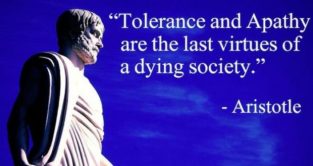 For a society, the question worth asking is “What will happen to society if we tolerate this?” And one possible answer is that it will lose its ability to function. Societies are ongoing propositions. They need to be affirmed and supported and criticized every day and when any of those things fails, the future of that society begins to dim. It is that perspective that Aristotle has in mind in the quote I am showing here. When people withdraw from society as if it will run itself, the society begins to come apart.
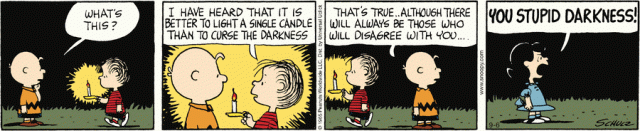 On June 2, Bill led with this cartoon and a sustained argument against “darkness cursing.” I feel a lot of the same things Bill feels, but when I read the column, my mind went off in a different direction. So, with my thanks to Bill for a good column, I would like to pursue that other direction this morning.
 private and public. And when I had gotten that far, I heard George H. W. Bush’s “thousand points of light” speeches (one in accepting the Republican nomination and one in his inaugural address) in which he advocates private activity rather than public (political) activity. Or possibly local rather than national.
 I am loading these examples in favor of cursing the darkness, but if cursing is all you do, it is even less effective that lighting a candle. The question the private response/public solution formula gives us is this: what do you do if the only meaningful resolution of the issue is systemic. No changes, in other words, that are less that systemic will help. Unless something like this assembly of candles means something.
 peace between Protestants and Catholics. [1] Orange is a color that has been associated with Protestantism every since William of Orange defeated James II at the Battle of Boyne in 1690. [2] Green has represented Irish republicanism since March 7, 1848, when it was flown over the Wolf Tone Confederate Club in the city of Waterford by Thomas Meagher. [3]
 We could try to finesse our way out of it. Here is the flag of France. The blue band is on what they call “the hoist side.” According to my quick review of the flags of the world, there is no flag with these colors in this alignment where red is on the hoist side. That would make the new U. S flag unique in the very narrow sense of the word, but you would have to look really hard to see which nation is being represented, and that’s not a good thing for a country’s flag. [4]
 If the flag were to represent liberals and conservatives, it would be representing words that have been with us for a long time, even though the meanings of the words have varied with the times. If the flag were to represent left leaning and right leaning parties, it would, again, be using words that have been with us for a long time—since the French Revolution, in that case.
 If none of those is familiar, I urge you to stop reading right now and go to the New York Times opinion column by Sarah Vowell, which has one of the best opening lines I have seen in a long time: “Greg Gianforte doesn’t represent this state. O.K., he does now, but you get what I mean.” This is not a picture taken at Holladay Park Plaza. We use tablecloths.
 true in the narrow sense. We have paid for those meals and that money is gone. You don’t get any back by not eating all thirty meals here. Getting a refund really would be “saving money” but that’s now how it works. On the other hand, when you set aside what you would really rather do, you are also wasting a valuable resource and you don’t get those opportunities back at the end of the month either.
 If the choices I made are to be embedded in my personality, so that I am expected by those who know me, to make choices based on a well-known standard—“Isn’t it just like him to…”—I would rather not use a standard that I market as being a cheapskate; I would rather be known as a hedonist. For one thing, the outcome of the cheapskate rationale is always the same. Use 30 meal credits a month. But the outcome of the hedonism rationale could vary a good deal from one circumstance to another.
 s/Venus books. She thinks you have committed an offense of some kind. You would like to explain that you have not, but she is miffed and won’t hear anything you say until you apologize. So apologize. Then you get to say the thing that needs to be said.
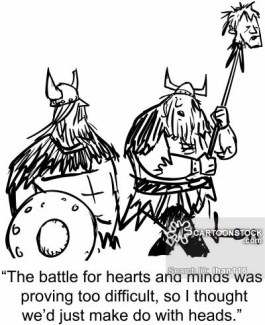 So if the Democrats’ problem is a hearts and minds problem, how do we reach the hearts and minds of the abused and ignored low income voters? They are, as I see it, the only part of the Trump constituency to which the Democrats have access. Besides that, they were part of the the original Democratic coalition.
 That’s not a hearts and minds view. The actual politics of providing or refusing abortions is complicated by the federal system, which requires the Supreme Court to tell the states what they may do and what they may not do. The Court cannot say that abortion is acceptable if there is a good reason and otherwise it is not. But Democrats could say that. That’s the position President Clinton was widely understood to support when he said that abortions should be “safe, legal, and rare.” That is not a criterion the law can live up to, but it could be the rhetorical home of the Democratic party.
 President Bartlet has been on edge since his daughter Zooey was kidnapped and held for ransom. She was found and rescued, but the event left Bartlet shaken and his marriage in tatters. Going to Oklahoma to “serve people” was what he wanted to do more than anything and he found it so rewarding that he wanted to keep on doing it.
 duties of a servant rather than to compete with each other to be the top dog. As always, you get real clarity when you specify the opposite of what you are trying to say. When you say, “Not this, but rather that,” you have made the meaning of “this” much clearer. So it is with “serve others” and “rule over others.” Look at the alternatives in this passage from Matthew 20:
 When he agreed to go back to being President of the United States, he agreed to take on the authority that being of service required of him. Flying back to Washington in Air Force 1 doesn’t look humble, but on this occasion, that is exactly what it was.
 Of these roles, which is best characterized as “serving others?” Neither, if you follow my argument this far. The person who is a natural leader, but who lays those preferences aside to take up the role of healer, is serving others. And so is the person who is a natural healer and takes on the role of healing the casualties that are the natural part of the small group process. It costs the leader more to serve as a healer. If you count his willingness to pay that cost as meritorious, then he has more merit. But he has not served more or better than the person to whom it comes naturally. The confusion I am trying to oppose is graphically represented in this cartoon.
 The Dilettante's Dilemma