
This might be the time to take another look at Mayor Murphy. We have all the True Believers and hyperpatriots we really need right now. We have a Congress full of people who have signed pledges of ideological purity and have promised not to compromise with the enemy—ordinarily, that’s the other party but sometimes another faction in your own party—no matter how bad the outcome looks to be. So maybe it’s time to reconsider Mayor Murphy.
I have three goals in mind for this essay. First, obviously, I am going to have to tell you about Mayor Murphy. Second, I am going to pose the question of democratic accountability as Edward C. Banfield has illustrated it. [1] Third, I am going to argue for the crucial necessity, in our time, of the kind of leadership Murphy illustrates.

The character himself is taken from Banfield’s pamphlet. In that little story, he is called “the Mayor,” but, in the words of the fictional journalist who interviewed him, the Mayor was “a little roly-poly fellow, very jolly and red-faced, and a real pro.” That, and the legendary success of Irish politicians in city politics, was enough for me to decide that I might as well name him Murphy. I think this is actually Jack Germond, but his face fits the type perfectly.
The newspaper reporter in this case study is Banfield’s tool for collecting information about all the relevant players in an urban development drama. There are four principal positions [2] and the reporter’s job, as Banfield deploys him, is to show that each of them is inadequate. As a practical matter, however, we, in the Trump era, have only two choices as they bear on these positions. We could choose to adopt one of these four perspectives and go to war with the others. Or we could admit that we need them all and try to find some way of balancing their strengths and weaknesses.
The Problem the Mayor Faces.
Here is the nub of it.
“Well, we might as well talk frankly,” the Mayor said. “The reason I didn’t do it the way it ought to be done was that I just couldn’t. The people wouldn’t stand for it. I would have been out on my ear if I had tried to tear down that slum. I would have been right square in the middle of the worst row you ever saw.
The Mayor had the chance to tear down a slum, bring back the suburbanites who had left, increase the urban tax base, and redevelop the core of the city. Instead, he put the federally funded redevelopment project in an old warehouse district, and tastefully “refurbished” a small fraction of the old slum.
And he did that because “the people” wouldn’t stand for it. When I hear a phrase like that, I wonder the same thing you do. “What people are we talking about?” [3] Murphy has two kinds of people in mind:
- those who are making profits from slum properties—“[that includes] some churches too” the Mayor adds,
- the working class whites who just moved to the suburbs and don’t want public housing built next door to them—the classic NIMBY position.
- Besides that, the Mayor is concerned about the racial unrest these public housing projects might cause and is not eager to put his town through that.
That’s what he means by “the people wouldn’t stand for it.”
The Reporter Pushes Back
 This is the “Profiles in Courage” rebuttal. The Mayor has said that he couldn’t “do the right thing” because it would cost him his office. The reporter comes back hard, “Maybe you should have made your fight and taken your licking,”
The Mayor comes back at the reporter just as hard and this rationale is the main reason I wanted to spend some time with him.
“Personally, I don’t look at it that way,” he said. “I don’t have any respect for a politician with such high principles that he can’t get re-elected. In this game you got to do what it takes to win. Either that or let somebody else play in your place. If you’ve got such a sensitive conscience that you can never make any compromises, you’re too good for politics. You owe it to your party to step aside for someone else. After all, the party wants to win, not just make your conscience feel good”.
I don’t know anyone who talks like that, even off the record, and I’m not sure I know anyone who would accept the Mayor’s case as he makes it. The people who populate my circle are more apt to say what the reporter said, viz. do the right thing and whatever happens happens.
I think there are four separate kinds of justification in the Mayor’s response, counting the snarky phrasing as one of the points. The first point, the most general one, is that getting re-elected is his job. Things that get in the way of his doing his job—“high principles” is the example he gives—need to be put aside in the present instance.
The second is that from the standpoint of the party, he is taking up space. The party wants whoever is in the Mayor’s office to do what is necessary to keep the party in control of the office. [3] If he can’t do it, he needs to get out of the way so someone else can. The Mayor owes the party something as well as owing the people something.
The third is that what he has done is “make compromises.” That’s what politics is about. It is not a place for True Believers (remember Eric Hoffer’s book?)—but a place for politicians who can get the best deal available for their supporters. And “the best deal” includes keeping potential disasters at an arm’s length.
The fourth “point”—the snarky one—comprises the language the Mayor chooses to demean the alternatives. “Such high principles” does that; so does “such a sensitive conscience;” and so does “too good for politics.” These are all disqualifications from the Mayor’s perspective. They might be virtues in private life, but they are vices in public life.
I think the Mayor makes a very strong case, but it is all phrased as a response to the reporter. Let me take a shot at phrasing it more generally.
 The Mayor is the exemplar of “democratic accountability” as Banfield sees it. There is no way for voters to choose a party (and the party’s nominee) unless the party makes good on its promises. There is no way for the party to make good on its promises unless its officeholders “do the right thing.” Being so committed to the revitalization of downtown that you cause a race riot is not the right thing. Alienating the working class voters in the inner suburbs and turning the Mayor’s office over to the other party is also “not the right thing.”
So the point is that if you believe in “the sovereignty of the people” in any practical way, you need to believe that there is a way for the people to choose a government that will do what needs to be done. Not a party strangled by its own “high principles,” but a party willing to cut the deals that serve its own base. The old notion was that “half a loaf is better than no bread at all,” but, of course, those alternatives require a particular kind of context. That is how voters can affect policy, which is the heart of democratic accountability, which is the mechanism by which the sovereignty of the people means anything at all. It all links together and none of it allows a free-lancing Mayor.
Conclusion
My pitch, above, was that we might need to take all four of the positions and try to balance them. Today’s job was just to present the Mayor’s case as one that ought not be thrown out. Somebody needs to exercise the discipline that keeps the worst from happening and maintains the stability that will allow further steps to be taken later on. I am sure that is what Mayor Murphy thinks he is doing and he may be right.
[1]This was taken from pamphlet called “The Case of the Blighted City.” Banfield, later in  his career, became famous for such books as The Unheavenly City, The Unheavenly City Revisited, The Moral Basis of a Backward Society, Here the People Rule, Political Influence, Civility and Citizenship, and City Politics .Here,very early in his career, I think he was just trying to make a buck. This was written in 1959, which accounts for some of the ethnic stereotypes and some old words (“Negro”), but the political principles work just the same way now that they did then. Here is Banfield as a very young academic.
[2] There is an economist, who represents the “free market” perspective, the city engineer, who represents the efficiency standard, and the citizen activist who represents the goals of a well-informed and highly motivated citizen. The mayor is the foil to all three of these.
[3] At some point, I need to say that the relationship between the party and the incumbent presupposed throughout this little study is that the party is dominant and the Mayor is their current representative. The party guarantees the Mayor a majority of the votes in “the organization precincts” of the city by exchanging job for votes. Given this relationship, it is not implausible that the Mayor would defer to the party’s interests.
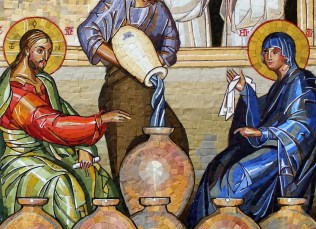 represented as performing a series of actions that pointed beyond their plain meaning. For that reason, they are not called miracles; they are called “signs.” [1] That means that they point to some meaning beyond themselves. What they have in common is that they look at some major element of Jewish practice—we are going to be looking at the wedding at Cana for our example—and then declare it to be surpassed by the present ministry of Jesus. So each of the signs “means something” in the same way; they point beyond. The meanings themselves differ as the occasions differ.
 I am calling those tangential. I am not arguing that they are mistaken; only that they don’t help John establish the point he is making. John has a use for this story and for this use, the central symbol is the six jars of water. All this water is necessary because “the Jews” [2] needed to ritually purify themselves. John’s point is that because of Jesus, all that water is superfluous. You can do something else with it, since you don’t need it for ritual ablutions. So why not turn it into some really superior wine?
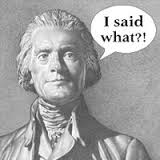 It is not only the right of these peoples to throw off the yoke of tyranny, but it is their duty to do so. [4] This is true of all peoples—all collections of politically self-conscious people—so it is the general case. Someone arguing against Jefferson would have to argue that although it is true of mankind generally, it is not true of the British colonies in North America; or he would have to argue that Locke’s notions of contract were not valid even in their general sense.
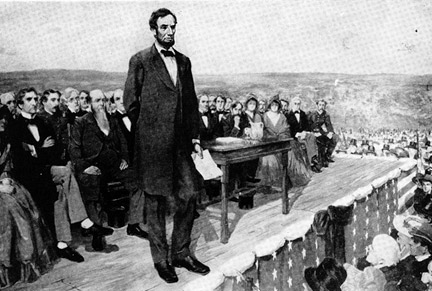 Lincoln has no use at all for the hypothetical equality of peoples, equally freed from their allegiance to a tyrant. What he needs is an understanding that puts white people and black people in the same scale—Lincoln had signed the Emancipation Proclamation in January of that year—and finds them to be equal in worth. It would be a violation of “Nature and Nature’s God,” to use Jefferson’s phrase, for one man to own another.
 issue of The Christian Century. That’s where I am going next, but I want to make one final point about arriving at 2 (after having experienced 5). When you know you can’t keep it, there are several things you could do as a response. You could devalue it. “Because it won’t last, it isn’t really that important.” You could strain to hold onto it. “I want to feel this way for as long as I can.” Or you could just enjoy every second of it, knowing that won’t last.
 The second point is that I don’t have any experience at all of putting my wife in God’s hands. I don’t have that experience with Bette; I did not have it with Marilyn. I want to go back now to the advice to Mike, which I liked so much, and to pick up the part I left out. Here is the whole quotation with the deletion in bold.
 Susan Carpenter (Naomi Watts) is trying to raise two small boys: Henry (Jaeden Lieberher) and Peter (Jacob Tremblay). Peter is a perfectly normal little kid, which means he has to come somehow with the fact that Henry is a genius and a competent manager of events and a superb caregiver and an action-oriented empath. Something is fundamentally wrong with Susan. We never find out what it is, but it keeps her in the dead end job she has as a waitress, it keeps her from writing and illustrating the children’s books, for which she has a real gift. It does not keep her from playing war-themed video games.
 s worked. So when he dies suddenly—sorry to just drop it in like that—he leaves behind the red notebook you see him with in the picture. This is the Book of Henry. In it, he argues very powerfully that his mother’s job now is to murder the stepfather, having already fraudulently produced a document that says in the event of his death, he would like Susan Carpenter to have custody of the stepdaughter.
 In fact, the best Susan Line is not “No, you are only a child.” Her best line is just afterward, when she leaves the shelter from which Henry’s ambush should have happened and tells the stepfather that she knows everything about what he has been doing and that she will see to it that he pays the price. The evil stepfather is also the local chief of police, so the likely consequences of saying this are ugly. He waves her off and starts to leave. She orders him to stop and turn around and face her and when he does she gives her best line—the best Susan Line: “I just wanted you to see who you’re up against.” Amazing!
 I think that to appreciate the power of Susan’s renunciation of Henry’s thinking—not just of the conclusion Henry reached but the simplicity of the route he took in getting to that conclusion—you have to appreciate how attractive intervention is made to seem. The stepfather next door is a brute and the girl who lives with him is completely helpless. The husband at the grocery is a jerk and “deserves what he gets.” That’s the way the narrative is set up. There is no anxious wrestling with the consequences of other possible choices.
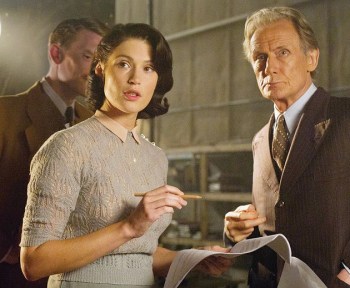 Both plots are there, but the movie can’t be “about” both of them. What to do? There are two early scenes that offer beginnings to this story. In the first, a [2] loutish husband sends his wife off to make enough money to pay the rent. In the second, a group of British moviegoers watches a truly terrible propaganda movie in a theater. If the last scene matches one or the other of those in the way a second parenthesis “matches” the first, then I would say that inclusio is in play and decide in favor of that theme.
 So let me tell you what the last scene means. Michael and Mary are lovers, which is just a little odd, since they just recently divorced and married other people. The people they married Robert (Aiden Gillen) for Mary and Lucy (Melora Walters) for Michael, were their lovers when they were married to each other.
 Historically, Reason was contrasted with Authority, particularly the authority of the Catholic Church, as an alternative basis for society. I don’t think that is the best set of alternatives for today, but even that set is suggestive. Consider, for instance, that “God says everyone shall be paid enough to live on.” We might even throw in “Thou shalt not muzzle the ox that treads the grain. Deuteronomy 25:4 and several New Testament citations). We would say that this is ordering society on the basis of “revelation,” as the Church understands what God is commanding. That is not rational in any narrow sense of the term. [3] On the other hand, the market system isn’t rational either. “People will be paid whatever employers are forced to pay them to insure for themselves a skilled and stable supply of labor” is not rational. Even in an un-distorted market it would not be rational and no one thinks that the current market for labor is “un-distorted.”
 This meets the broader standard of “rationality” you will notice—the one that was met by saying that doing what the Church said God wanted you to do is “rational”—although it does not meet the narrower standard.
 am thinking of it as analogous to the death of the canary in the coal mine, which is a major event for the canary, but for the miners, it is only an indication that things are not safe. But we have decided, apparently, to vote with our hearts, not our heads. And we have decided not to elect someone who will do what the office requires, but instead to take actions that make us feel good. And we have decided that words and acts—anything, really—that shows how angry we are is all we will require of the person we choose to organize the domestic economy and to deploy the military. That is how the majority that chose Donald Trump was assembled.
 “Jews.” [2] The interviewer’s first question had to do with Franken’s home town, a suburb of Minneapolis called St. Louis Park. He observed that a lot of other famous and accomplished people came from that same little suburb and asked Franken what was special about it. “Jews,” said Franken. Great line; great timing; great delivery. The whole place went nuts. [3]
 I know what it costs me, for example, to walk by the expression “your analysis” pretending that I did not also hear it as “urinalysis.” Or to bypass “gray day eggs,”you know, the really large ones, which were apparently laid on overcast days. Or to ignore the liabilities of the Taipei personality, very common in Taiwan, I understand, but associated with vulnerability to heart attacks. I went to see a new doctor last week, an ENT and he hadn’t read Lord of the Rings and I had to just stuff all the Ent jokes for nearly an hour.
 And most of the time it doesn’t matter at all. It makes a better story that way and all the “facts” that really matter are still what they were. No harm, no foul, we say. And that may be true. In that telling.
 mind during this shower. Things like this have happened before, so I wasn’t startled by it and I didn’t rush out of the shower to write it down because I knew I would remember it, like Poincaré’s Conjecture, which came to him as he was getting on a bus and which he didn’t bother to write down until the end of the trip. [3]
 Raymond E. Brown, the Catholic scholar whose lectures and books are very likely the ultimate source for whatever it is that happened in my shower this morning, has a different image of this unity and multiplicity. He imagines that the life of Jesus is like a jewel, whose multifaceted beauty cannot really be fully appreciated until it is seen from all sides. One facet is featured as you look at it from this side; another facet when you look at it from another side. (An-other side, not as we often say today, “the” other side.)
 the significance of Jesus—is a little more aggressive than Brown’s notion of the multifaceted jewel. When, in Brown’s metaphor, you don’t appreciate all the facets, you miss part of the beauty. When, in Hess’s metaphor, you don’t use all the chair’s legs, you get dumped unceremoniously on the floor. So, this notion that came to me this morning is a notion with, as they say today, “an attitude.” It is a response to something.
 You would think that a rewarded action would be more likely to be repeated than an unrewarded action, and that is certainly true, but how on earth would we know whether an action was rewarded? In the neighborhood where I lived for a long time, there was an old man who walk around with rubber gloves and a plastic bag and picked up trash. It wasn’t his job. He wasn’t paid for it. So far as I know, he wasn’t thanked for it very often. Was his action rewarded?


 one thing from another. It’s a harvest metaphor, so if your mind runs to separating wheat from tares, you are thinking along some very old lines. Also you were raised reading the King James Bible.
 “My kind” is an answer that rejects the notion that there are a few recognizable kinds. And that brings us to the question of how important “kinds” of feminism are. For that, let me take you to Emily Bazelon’s
  But there is another kind of feminism, which Bazelon says commentators have labeled “commodity feminism.” [2] I have more commonly heard it called “lipstick feminism.” It is another “kind” and it is the kind Pamela Frable likes. She seems to have put Hillary Clinton up against Ivanka Trump as alternative visions of where this nation might go and to have chosen Ivanka.
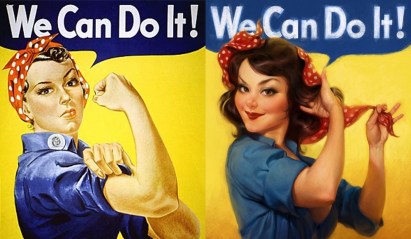 recognize some women as feminist and others not and also to claim women who are pursuing that understanding of feminism as sisters, then it will continue to be powerful as a movement. “We” will refer to “other women who are feminist in the same way I am.” There is no reason to refer to the approach of other women as “wrong,” only as misguided. “We,” my sisters and I, can show them a better way. I think feminism as a movement will require distinctions that function in that way. If the women in this picture call each other “sister,” the movement model will continue to be powerful.
