In a Larger Sense, We Cannot …Hallow This Ground

The battle of Gettysburg began on July 1, 1863: 150 years ago today.  Three days of unparalleled carnage followed.  Recent studies conclude that the Union army and the Confederate army each lost somewhere in the neighborhood of 23,000 soldiers in those three days.

It was Abraham Lincoln who said that the men who died there had consecrated this ground “far above our poor power to add or detract.”  That line is from the Gettysburg Address, of course, given on November 19, 1863.

But it was also Lincoln who said:

Fondly do we hope, fervently do we pray, that this mighty scourge of war may speedily pass away. Yet, if God wills that it continue until all the wealth piled by the bondsman’s two hundred and fifty years of unrequited toil shall be sunk, and until every drop of blood drawn with the lash shall be paid by another drawn with the sword, as was said three thousand years ago, so still it must be said “the judgments of the Lord are true and righteous altogether.”

That familiar judgment is from Lincoln’s second inaugural address, given in March of 1865—a year and eight months after Gettysburg and one month before Lee’s surrender at Appomattox Court House, Virginia. 

It’s hard to know, 150 years later, how to feel about Gettysburg.  Lee didn’t invade Pennsylvania because he wanted to capture it; he invaded to show that he could go anywhere he wanted and that Lincoln couldn’t stop him.  The idea was to show that Lincoln’s war aims were a travesty and that Lincoln should sign a treaty then and there to end hostilities and recognize the realty that the north and south were sovereign nations, each controlling its own territory.

A Confederate victory at Gettysburg could very well have accomplished that.  Anti-war sentiment was strong in the north.  A war president is always popular when the war is going well.  Otherwise not. Lincoln was not.

Gettysburg, Day 1

You can see on the map what happened on the first day.  The Confederate armies, attacking from the north, pushed the Union armies right through the city of Gettysburg and onto the hills south of town.  On the second day, Lee faced an army larger than his, entrenched in positions on the high ground. He attacked the Union left wing on the second day, trying to get around Little Round Top.  He failed.  He attacked the Union center on the third day.  He failed again.  Then he took what was left of his army home to Virginia.

The most engaging accounts I know of Gettysburg are Michael Shaara’s Killer Angels and the movie, Gettysburg, which was based on that book.  Both the book and the movie emphasize the role of junior officers, improvising to shape the battle (like Brigadier General John Buford) or devising new tactics on the spot (Like Colonel Joshua Lawrence Chamberlain).  It was not a battle won by strategy, according to these accounts; it was a battle won by the imagination and daring of soldiers on the ground.

I understand a good deal about the battle because I have read books about it all my life, but my feelings are being played with these days—by Aaron Sorkin, of all people.  In the movie, Gettysburg, Robert E. Lee is played by Martin Sheen, who is dear to my heart as President Josiah Bartlet, of The West Wing.  Sorkin gave President Bartlet some of the best political speeches ever given on television.[1]  But Colonel Chamberlain is played by Jeff Daniels, who is dear to my heart as Will McAvoy of The Newsroom.  Sorkin has not yet given McAvoy the speeches he gave Bartlet, but the second season begins this month and we will see.[2]

There is no legitimate connection between Gettysburg and these two Sorkinesque characters, but I can’t see Col. Chamberlain without hearing Will McAvoy and I can’t see General Lee without hearing President Bartlet.

So I still know what I know about Gettysburg, but my feelings have gone all screwy.


[1] President Bartlet’s first spoken line in Season 1, Episode 1 is, “I am the Lord, thy God.  Thou shalt have no other gods before me.”  It’s a snappy opening for a Democratic president, but the context  helps us understand how appropriate the line was.

[2] Will McAvoy delivered the line for which he is best known when a student asked him in public to say why America was the greatest country in the world.  He said, “It’s not the greatest country in the world.  That’s my answer.”  A three minute rant follows.  And after that, “…but we used to be.”  And after that “…and we could be again.”

Posted in Books, Movies, Politics | Tagged , , | Leave a comment

If It’s Not About the Nail, What IS it About?

With any luck at all, I will embed a wonderful short clip called “It’s Not About the Nail” in this post.  If it doesn’t work, I recommend that you Google “It’s not about the nail” and enjoy the following 78 seconds.  It’s serious and it’s funny.  It’s wonderful.

http://www.youtube.com/watch?v=-4EDhdAHrOg

OK.  That was the last wonderful thing I have to offer.  Now I want to think about what “it” means in the expression “It’s not about the nail.” 

There is an object somewhere (an artifact, a fable, a relationship) that is consonant with some meanings and not with others.  I know that sounds stiff, but I am trying for the most general formulation I can think of.  It will get better from here on.

“Consonant with some meanings and not with others” is my way of saying “about.”  When you say a movie is “about” something, you are trying to identify a theme, often a theme that means a lot to you.  You will expect other people to say, “No it isn’t.  It’s really about [something else].”  Many happy and collegial hours have been consumed, along with unnumbered beers, in such discussions.

Contentious issues are a different matter.  When I say that closing a tax loophole is “about” forcing the corporations to pay their fair share and you say it is “about” taking away the incentive for corporations to create jobs, then “about” means something very important.  The tax loophole has many effects.  I pick the one I want to talk about and say that the loophole is “about” that; it’s about tax equity.  You pick the one you want to talk about and say that the loophole is “about” that; it’s about a thriving and growing labor market.

It makes no sense at all to ask what it is “really” about.  On the other hand, we both agree that it is not “about” global warming or aesthetic standards.  Another way to say this is that tax equity is very important to me and it is the effect of the loophole on that that I want to talk about.  That is how “about” functions.  The tax loopholes are consonant with some meanings—the ones that I think most urgent—and not about others.

Let’s talk about what I think is important!  No, let’s talk instead about what I think is important.  That’s what “about” is about when there is a conflict to be resolved.

This formulation casts a new, but not really unexpected light, on “about the nail.”  The nail is an external problem.[1]  It is an issue she is facing, but he is not.  The issue he is facing is that she wants from him—desires urgently from him—a response that he finds difficult to summon up and which, in his judgment, will do no good at all.  He is highlighting this issue; she is highlighting that issue.  One will be in the foreground; the other in the background.

This little clip is a parody.  It’s intended to be funny and it is.  But it is funny because it plays off of a very common situation that is not funny at all.  Wives very often want a response of emotional intimacy from their husbands.[2]  When their husbands treat them as people with problems and then put all their attention on the problems, the wives feel that the problem has been featured and that they, themselves, have been forgotten.  Husbands very often take pride in their ability to solve problems and their attention gravitates to the external part of the issue rather than to their wives’ emotional response to it.

If the wife’s difficulty has to do with being bullied at the office, for instance, it may be that she has done everything about the situation she is willing to do.  She has examined the possible responses.  She is sure that the one she has chosen is the best one available.  Now she wants help is carrying the burden that her choice has imposed on her.  There is no “nail” here.  A husband who insists on perceiving a “nail” (because there is something he can do about it if there is a nail) is choosing to deal with the problem he would prefer to the problem he actually has—which is that is wife is suffering and needs the patient non-judgmental caring that someone who knows her and loves her can offer.

No nail.  So it isn’t “about” the nail.

This little skit is funny—I know this analysis is not, I’m sorry about that—because here there really is a nail.  The husband wants to do what husbands mostly want to do—solve the problem—but in this particular case, he is exactly right.  And the wife knows it.  All the understanding in the world will not keep her from snagging her sweaters—all of them, she says—on the nail.

She focuses on the easy issue for her.  Her husband wants to “solve the problem” rather than to “care about me.” She’s had that grievance many times before and charging her husband with “not listening to me” is so easy she doesn’t even notice that she has chosen one line of response to him rather than any of several other more promising ones.  The husband doesn’t help himself much when he uses genuinely inflammatory language.  When she says, “What I really need is for you to just LISTEN, he actually says, “See, I don’t think that IS what you need…”

 The man is fearless!  She has said what she needs.  We all tend to think that there is a reality to which we have private access.  We know and others do not.  He has said that she has read this “reality”–her own reality–wrong.  This “fact” to which she has direct access and he does not has been misinterpreted by her.  He knows what she really needs and she does not.

OK, so he’s correct in this particular instance.  It still is something he should know he cannot say.  Maybe he could say it in some other way—some way that does not use those particular words.  Those are truly awful words.  Trust me on that.

 Because once you say those words, that’s what the conversation is “about.”  And nothing good is going to happen.


[1] OK, part of it is internal to her, but we’ll leave that aside for now.

[2] I’m assuming “wives and husbands” here, mostly for convenience.  This particular issue operates the same way with nearly any set of two people who care for each other, on the one hand, and who have a project they are pursuing jointly on the other.  I have seen this dynamic exactly between doctoral students and advisers.

Posted in Love and Marriage, Paying Attention, ways of knowing, Words | Tagged , , | Leave a comment

Hearing God’s Voice

How do you go about “hearing God’s voice?”  I’m not sure, to tell you the truth.  It isn’t anything I’ve ever been good at.  It may be that I just don’t have the basic capacity.  Or it may be that I have just not been willing to do the necessary work.  In any case, it is what I want to think about today and you are invited.

I’ve been thinking about Samuel, the last judge and first king-maker of ancient Israel.  He anointed David to be king, which was a rather dicey thing to do, since Saul was king of Israel at the time and did not have a reputation for playing nicely with others. God told Samuel to go to the house of Jesse and to anoint one of his sons as king.[1]  You can see all this yourself in I Samuel, chapter 16.  It sounds a little improbable and you might think I am making it up.

God Talking 2First up was Jesse’s son Eliab.  Samuel thought Eliab looked like the kind of man God would choose to be king, but God said No.  Next up to bat was Abinidab.  “Him?” said Samuel.  “Nope,” said God.  Then Shammah.  Nope.  Then four more sons whose names are not given.  Then they fetched David, the youngest, from the fields and God said, “Him.  He’s the one I want.  Anoint him to be king.”

This all sounds fairy-tale-ish to me and I have written it to emphasize that sense.  But here is a fact: Samuel did not choose the son that looked right to him.  He waited until he heard God’s voice and did what that voice told him to do.

Parenthesis 1  If you want a very emotionally compelling experience of what it can be like to hear God’s voice and do what it tells you to do, I recommend a scene from the movie, “Ghost.”  Sam Wheat (Patrick Swayze) is killed early in the movie.  He is now “the ghost” of the title.  He devises a way to communicate with his fiancée, Molly Jensen (Demi Moore), and tells her to go to the police and tell them who killed him and why.  The communication comes to Molly through a medium, Oda Mae Brown (Whoopi Goldberg), who has a substantial police record.  Molly goes to the police as Sam has asked her.  She says what Sam has told her to say.   She accepts the ridicule she gets from the police for asking them to act on information she got from a ghost by means of a medium and leaves humiliated and distraught.  As viewers, we know that everything she told them is true, but that doesn’t help her and if wouldn’t have helped Samuel.  If you watch this clip, you will see that it wouldn’t have helped you, either.

So what did Samuel have to do to “hear God’s voice?”  First, he had to know that the voice he was hearing was not his own voice.  Everything in Samuel said, when he saw Eliab, “Yes.  That’s the one.  I have a sense about things like this.”  He heard that voice, but, remarkably, he recognized it as his own; not God’s.  Samuel’s my hero.

Parenthesis 2  Another experience you might want to try on is the experience of the baseball scouts in “Moneyball.”  They keep proposing players who either won’t work out for their team or that the team can’t afford.  And they keep doing it because their nominees meet their own criteria.  They are hearing their own voices and are being completely seduced those voices.  They know what the team needs, but they can’t bring themselves to want that.  These scouts would have chosen Eliab, only to watch him drift down through the minor leagues.

How did Samuel get so good at “hearing the voice of God?”  We don’t really know, of course, and that isn’t the kind of question the historical accounts of the Old Testament show any interest in.  I’m interested, though, and here’s my account.

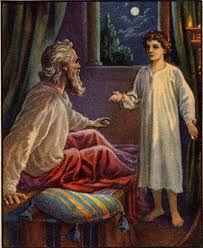
Go back now to I Samuel, chapter 3.  Samuel is a little boy, serving Eli, the God Talking 3judge of Israel.  It had been a long time since anyone had heard from God.  So it’s 1:00 a.m. and Samuel is sound asleep and hears a voice calling his name.  “Rats!” says Samuel, “And I was sleeping so well. Now I’ve got to get up and go see what Eli wants.”  So he gets up and runs to Eli, who says he did not call Samuel and sends him back to bed.

Now it’s 2:00 a.m. and Samuel hears the voice again.  Very likely he doesn’t want to hear the voice, but he does hear it.  He also doesn’t want to get up and see what Eli wants, but he does go.  And Eli again says he did not call Samuel and sends him back to bed.

The same thing happens at 3:00 a.m. and Samuel’s patience is wearing thin.  Maybe I didn’t hear him this time.  Maybe he will forget again that he has called me already—twice.  He didn’t do any of those things.  He got up and ran to Eli again.  This time, Eli understood what was going on.  He understood that God was speaking to Samuel.  He was not, you will notice, speaking to Eli and Eli needed to find some way to be OK with that.  “It is God speaking to you, Samuel,” said Eli.  “The next time, just say ‘Is there something you want to tell me’?”

Parenthesis 3  In our time, people have come to understand God as a cuddly sort of being.  We wonder why the first thing the angels always say is, “Don’t be afraid.”  The God who is the central character of these stories is not at all cuddly, which is why I chose, as Samuel’s question a line from “The Sixth Sense.”  Cole Sear (Haley Joel Osment) is being terrorized by a ghost who has come into his bedroom.  It has gotten cold in the room as it always gets when a dead person is there.  Fighting for control of himself, he approaches the ghost, step by difficult step, and says what his counselor has told him to say.  Nearly overcome with terror, he manages to say to this dead person, “Is there something you want to tell me?”

It may have been something like that for Samuel.  We don’t really know.  It was not anything like a coronation.  It was dark and severe.  But still, he asked the question he had been told to ask and he got the answer that served as the foundation of the rest of his life.  This answer, and what he had to go through to hear it, still mattered to him when God sent him out of find a replacement for Saul.  That’s how Samuel knew that Eliab wasn’t God’s choice and that David was.

Samuel had learned to hear what he heard.  He did not deny it.  He did not pretend he had not heard it.  He did not disobey it.  He got up, over and over, and went to the bedside of the old man who kept on saying that he had not called.  In a word, Samuel practiced hearing the voice of God.  He got good at it.  He heard it even when it said things he didn’t want to hear.  He learned that God’s voice did not sound like his own voice.

God Talking 1This has been swirling around in my mind since I started reading T. M. Luhrmann in the New York TimesHere’s the whole article and here’s the clip that caught my attention:

I eventually discovered that these experiences [unusual auditory experiences] were associated with intense prayer practice. They felt spontaneous, but people who liked to get absorbed in their imaginations were more likely to experience them. Those were the people who were more likely to love to pray, and the “prayer warriors” who prayed for long periods were likely to report even more of them.

The prayer warriors said that as they became immersed in prayer, their senses became more acute. Smells seemed richer, colors more vibrant. Their inner sensory worlds grew more vivid and more detailed, and their thoughts and images sometimes seemed as if they were external to the mind. Later, I was able to demonstrate experimentally that prayer practice did lead to more vivid inner images and more hallucination-like events.

It seems that you have to have a leaning in this direction, Luhrmann says, but beyond the residual “gift,” you have to do the work.  I suspect that I might not have the resident capacity, but I am quite sure that I have not done the work.

That means that when I report that “I have not heard God speaking to me,” I have several ways of accounting for that, several “attributional options,” as we say in my line of work.  God isn’t speaking.[2]  I don’t have the talent to hear God speaking.  I do have the talent, but I haven’t done the work necessary to distinguish “the voice of God” from my own preferences.  All those explanations work.  God had not spoken in Israel for a long time before He spoke to Samuel.  Samuel had the talent, the residual capacity, to hear God speaking.  But even for Samuel, he had to do the work that will always be necessary to distinguish “what God said to me” from “I’m not sure God says things” and “I can’t hear God’s whispering over the shouting of my own ego.”

We see Samuel first in the role of king-maker.  He is the one who understands what choices God is making.  But before that, we saw him as a dutiful little boy, getting up over and over to tend to an old man.  In this story, it was patience of the little boy that produced the anointing of a new king.


[1] The whole operation was covert.  God said to go to Jesse’s house.  Samuel objected that if Saul caught him at it, he would kill him.  God said not to worry and gave Samuel the precise lie to tell that would keep him from getting caught.  God instructed Samuel, in other words, to “bear false witness,” which is interesting, all things considered.

[2] I am leaving aside for the moment the question of whether there is a God to do the speaking.  Some say there is such a being; some say there is not.  No one, on either side, has produced anything that a serious scientist would call “evidence.”

Posted in Biblical Studies, Paying Attention, ways of knowing | Tagged , , , , , | Leave a comment

Skeptification

We don’t always have at hand the words we need most.  A lot of people, facing this difficulty, chose a word with meanings close to what they need and call it good enough.  People who are more confident in their acquaintance with their language are more likely to feel vaguely affronted.  There should be a word for that.  There really should.  Why isn’t there?

At that point, some of us just make up whatever words we need and launch them on their careers.  These careers are inevitably short and the deaths of these new words mostly unlamented, but they do meet the short-term interest of the person who fabricated them and ordinarily, that’s value enough.

You know one of these new words is coming, right?

Everyone knows that for every public policy adopted, there are winners and skeptification 3losers.  The winners are called “beneficiaries;” sometimes thoughtfully, but more often not.  In common unthoughtful use, someone who is affected by a policy is called a “beneficiary.”  But what if the effect on that person is disastrously bad.  Negative beneficiary?  Too clunky.  So I made up, for use in my public policy classes, “maleficiary.”  Because bene- is “good” and mal- is “bad,” I figured that the meaning would be easily understood and it was—for the purposes of the class.

This brings us to skeptificate.  As you see, this is a noun.  I have a skeptificate in the proper use of words.  You’ll have to admit it makes perfect sense.  A lot of people have certificates these days.  The effect of a certificate is certus = “certain” plus facere = “to make.”  I might or might not have the relevant skills—how is one to know?—but if I have a certificate, it makes you more certain that I have those skills.  Why, otherwise, would anyone have issued me a certificate under their own name?

A skeptic is, according to the etymology of the word, supposed to be a “thoughtful person.”  We get it from the Greek skeptesthai, = “to reflect, look, or view.”  It is related to a number of more familiar –scope words that come to us from Latin.  Skeptics, however, tended to be thoughtful about matters other people took for granted, so the word began a slow evolutionary drift in the direction of “doubt” or “challenge” and it has had this meaning since early in the 17th Century. 

How do I know all this?  Well, I read a little article about this word in the online etymology dictionary, which I heartily recommend.  The article on skeptical was written by Doug Harper, whose learning I have every reason to trust.  Do you know why?[1]  Yes.  Because Doug Harper has certificates from places I have heard of and these certificates make me more certain that his work is trustworthy.

But what if Doug Harper came to me with a document from the Academy of Peace, Justice, and Love (APJL)?  This academy vouches for Doug Harper, but no one vouches for APJL.  The document Mr. Harper brings to me does not, in fact, make me more certain.  It makes me more doubtful.  I am less likely to trust him on this matter than I was before he showed me his little piece of paper.[2]  His piece of paper says CREDENTIAL at the top, but it does not make me more certain.  Papers like these should be called something else and I think they should be called SKEPTENTIALS because their effect is to make one less certain; more likely to doubt and challenge.

That brings me to this morning’s article in the New York Times, which describesskeptification 1 the new wave of interest in “Death Cafes.”  A bunch of people get together to talk about death in a philosophical way.  That sounded pretty good to me. I’m interested in death in a philosophical way, so I looked to see whether there was such a gathering in Portland, Oregon.  We really are that kind of town, so I thought the chances were pretty good.

Sure enough, there is such a gathering.  At least there is a convener.  Nothing at the site actually says where they meet or whether they have met—although technically, there is no convener if a convention has not actually occurred—or whether anyone is actually interested in the topic.  The convener’s name is Holly Pruett, about whom I know next to nothing.  I do know that she is a “certified” (that means she has a certificate) Life-Cycle Celebrant.  Her certificate has been granted by the Celebrant Foundation and Institute (CFI) of Montclair, New Jersey.  “Live the art of life through personalized ceremonies.”

I don’t know anything about CFI either and what follows is really only a meditation on my own prejudices.  I, personally, am extremely wary of a “Celebrant Institute.”  It is the support of such programs that produces documents affirming that Holly Pruett is a competent celebrant and I have no reason to think she is not.  But the paper issued to her by CFI does not function to “make me more certain.”  It functions to make me less certain.  It makes me more likely to doubt and challenge.  It is, in other words, not a “certificate” but a “skeptificate.”  For me.

Frankly, I was leaning in that direction anyway, but I have not been helped at all by reading John McKnight’s The Careless Society: Community and Its Counterfeits.  Here’s a clip from Chapter 1: 

Modernized professions also piece us out in time. Service professionals now assure us that we live through a set of needs defined by age. Professionals have “found” seven life crises (formerly known as the seven ages of man) from infancy to death, each requiring its helping professional. Elizabeth Kǜbler-Ross has advanced the process by giving us five phases of death. Her work ensures a new set of helpers for stage one of dying, stage two of dying, and so on. Following these dying therapists will be research professionals attempting to decide why some people skip, say, stage two or three of dying.

This paragraph moves from Shakespeare’s “seven ages of man” to the “seven life crises.”  Crises are occasions for judgment, with “ages” are not.[3]  The work of Elizabeth Kübler-Ross “ensures” (that’s McKnight’s word) a new set of helpers for each stage of dying.  But it turns out that not everyone seems to go through all the stages (apologies to Elizabeth Kübler-Ross, who did not argue that everyone should go through all the stages or even that the stages had an invariant order).  That means that we will need research professionals who will study why some people “skip” one or more stages.  These “skippers” are, apparently, not doing it right and will need professional assistance.  I found this picture by googling the Professional Dog Walkers Association.skeptification 2

I had read that passage from McKnight just before reading about the Death Cafes, which was just before I wondered whether we had one in Portland, which is what brought me to Holly Pruett, who brought me to the Celebrant Foundation and Institute.  Had that line of thought gone in a different direction, it would not have produced this post.

The best encapsulation of this dilemma I know of comes from Crocodile Dundee.  Mick Dundee is from Australia’s Outback and his new girlfriend is a New York City journalist.  She tells Mick that a friend of hers is seeing a psychiatrist.  There’s nothing wrong with the friend; it’s just, you know, to have someone to talk to.  Dundee is incredulous.  “Doesn’t she have any mates,” he asks?

Apparently not.  We have chosen, as McKnight’s subtitle puts it: “counterfeits for community” rather than “community itself.”  I am sure we feel safer in a community we have hired for the purpose, but I am not sure that such a “community” sustains us.


[1] Harper is a graduate of Dickinson College, Carlisle, Pa., with a degree in history and English. He has been featured in a BBC production on the Welsh settlements in America, and has been interviewed as a source for historical articles by the Philadelphia Inquirer, Washington Post and many magazines.

[2] Credentials, by the way, are scarcely any better.  Credentials—credo, “I believe”—are supposed to give you a reason to believe in the competence of the person.  On this foundation, a certificate is just further confirmation.

[3] The Greek krisis includes, among its principal meanings, “to decide,” and this remains true even though krisis has also given us critic, which has flowed, over time, in the same direction as skeptic.

Posted in Paying Attention, Words | Leave a comment

What Will We Do After Work?

after work 1And I don’t mean “after work” like 5:00 and I get to go home.  I mean “after work” like there isn’t enough work to do to sustain us as a country.  That kind of “after work.”

I am not an economist, like Paul Krugman.  I know enough economics to be a fan of his columns in the New York TimesThis column was about how we are going to cope with the relentless loss of jobs.  And on this issue, I am ahead of him.  I am still behind Karl Marx—aren’t we all?—who scrambled to find a kind of society that would continue to function when “jobs” had become superfluous, but I am ahead of Krugman. 

Today’s column ended like this

So what is the answer? If the picture I’ve drawn is at all right, the only way we could have anything resembling a middle-class society — a society in which ordinary citizens have a reasonable assurance of maintaining a decent life as long as they work hard and play by the rules — would be by having a strong social safety net, one that guarantees not just health care but a minimum income, too…

I can already hear conservatives shouting about the evils of “redistribution.” But what, exactly, would they propose instead?”

Yup.  That’s where I’ve been for several months now.  We use employment as the way we distribute income.  We have to distribute a lot of income because our economy is based on consumer demand.  Consumer demand requires the levels of income that good jobs used to provide.

On the other hand, we are also committed to reducing labor costs.  Keeping costs low keeps prices low (lower than they would otherwise be) and profits high.  We have reduced labor costs for many decades now, by using machines that do away with human workers.  We also export jobs to places in the world where we can pay workers less money, of course, but even these workers can’t match the productivity of the new machines—which, among other things, don’t take coffee breaks.

The old solution was to keep the brainy jobs here and leave the manual jobs for after work 2foreigners abroad and the lower classes here at home.  This two-part solution has two challenges to face.  The first is that as the machines get brainier (have you seen any GE  or IBM ads on television lately?) more and more of the brainy jobs can be done by workers powered by battery packs.  There have been, for instance, some truly amazing experiments recently using robot counselers.[1]  And, of course, the other challenge is that you can’t pay low income workers enough to enable them to sustain a consumer economy.

Those two projected paths are so clear that I am willing to call them, for the purposes of this post, “facts.”

Is there a liberal response to these facts?  Yes, there is.  In the short run.  It is that we follow the socialist democracies of Europe with substantially higher taxes and substantially higher services.  That will work for a while.  But unless we find some way to keep ourselves from turning most productive labor—including “creative labor”—over to smart machines, it won’t work for very long.  I don’t see us passing laws requiring that some given percentage of all “labor” must be performed by human beings.

Conservatives don’t have a response even in the short run.  The percent of national income now controlled by the top 1% is now about where it was on the eve of the Great Depression.[2]  We can argue for upward mobility until we are blue in the face, but upward mobility doesn’t create enough good jobs to sustain an economy based on consumer spending.  It changes who gets to do the spending, but now how many people are able to spend.

after work 3So the liberals win this one.  Let’s move on to the next one.  What will people need to be like in a society where most people’s time is not structured by “doing jobs,” and where people are free to “be” whoever they want to be?  I’ll tell you.  They will need to be like the people the conservatives have been arguing for—not, I hasten to point out, supporting—lo these many years.  They will need to be—WE will need to be—people of character.  Neighbors, friends, communities.  Dilettantes.

If you thought the U. S. government was up against a huge challenge in redefining “work” so that we can afford it, how do you like this challenge?  Here, the U. S. government is going to have to make citizens who can be trusted with these levels of resources and freedom.

I said that the worst way I could think of.  “The U. S. is going to have to make citizens…”  Except in the very most technical sense, no government “makes” citizens.  And no government makes citizens virtuous.  The very best would could do as a government is to make family settings rich enough in resources that parents—who may not have had a fighting chance themselves—could give their children a fighting chance to become virtuous citizens. And ordinarily, that doesn’t work.  We would need to find a way to enrich the communities that actually could, if they chose to and if they had the resources, provide nourishing contexts for the families that make up those communities.

We will need, in short, the kinds of communities conservatives have beenafter work 4 kvetching about for decades now and liberals have been telling them to shut up.  That brings us back to Krugman’s very good question, “What…would they propose, instead?” 

Except that now it is a short term question only, given that “they” refers to conservatives.  The long term question is the same, but it is asked by conservatives about liberals.  Looking at our great need for the traditional virtues—given the “fact” of a machine-dominated economy and a human dominated world of leisure—conservatives will ask “What…would they propose, instead?”

I’m a liberal and I feel the bite of that second question.  I know what kind of society I would like, but when conservatives ask about “proposing something,” they are not asking about preferred outcomes.  They are asking about how to get there.

I have no idea.  No way of getting there seems very likely to me.


[1] It’s a lot worse than it sounds.  See Sherry Turkle’s Alone Together for a much larger dinner of bad news.  And here is the entre to that dinner.  We are redefining our needs so that they can be met better by computers than by humans.  We are redefining our needs.  Redefining.  We are doing that.

[2] Robert Reich has a very readable account of this in his book, Aftershock, but no one disputes that it is true.

Posted in Politics, Sustainability | Tagged , , , , | Leave a comment

The Exception Proves the Rule

This is a really cheap post.  I labor over some of my posts.  I use punctuation and everything.  For this one, I am going to point you to the website  (The Phrase Finder) that deserves the credit for this and then just say a few things that I feel like saying. 

“The exception proves the rule.”  I have never understood this saying.  Why does an exception prove anything? To the best of my recollection, I have never used it.  Ordinarily, I am the guy who is pointing to the regularities; to the rule.  It is the other guy who is saying that the rule doesn’t apply at the moment.  And since it didn’t really mean anything, it couldn’t be refuted.  It was just an annoyance.

The Phrase Finder cites this situation—my situation—first.  “To the untutored ear it might appear to mean “if there’s a rule and I can find a counter-example to it, then the rule must be true.”  This is clearly nonsense; for example, if our rule were ‘all birdException 1s can fly’, the existence of a flightless bird like the penguin hardly proves that rule to be correct.  In fact, it proves just the opposite.”  So here, my opponent would be arguing that that the existence of a flightless bird proves that all birds can fly.  It is, as the Phrase Finder notes, “clearly nonsense.”

I came to this topic yesterday because Dr. Andrew Novella, whose lectures I have been listening to, (see: Can You Be Too Skeptical?) pointed out that “the exception that proves the rule” has been widely misunderstood.  The reason it has, he says, is that we don’t understand that “prove,” in that formulation, means “test.”  The exception tests the rule.

Of course it does.  I have had a particular affection for the word anomaly ever since I learned that it is formed of an-, a negative prefix, and homalos, “even.”  An anomaly is an unevenness: a bump in an otherwise flat plane.  It is an anomaly.  It is an exception.  Does this exception “test” the rule?  Do we want to call this plane “flat,” even though there is this exception?

I liked that a lot better.  But if you go to the Phrase Finder hyperlink, you will find this response to that explanation.  “Unfortunately, when we go back to the legal origin of the phrase, we see that it doesn’t mean that at all.” 

Exception 2The origin is the maxim, “Exceptio probat regulam in sasibus non exceptis” and is interpreted to mean “exception confirms the rule in the cases not excepted.”  The exception points out, in other words, what the rule is: it does this in the process of removing one instance from the rule.  Phrase Finder’s example is: “If we have a statement like ‘entry is free of charge on Sundays,’ we can reasonably assume that as a general rule, entry is charged for.  So, from that statement, here’s our rule—you usually have to pay to get in.”

Think about the realities—the rules—pointed to by such phrases as: except when accompanied by children; or, without proof of membership; or, unless you are a Democrat.  Every one of those points to a situation that is to be taken for granted—it is a rule—and makes a small exception to that rule.  It is the exception that testifies to the existence of the rule.

Isn’t that satisfying?  Unless, of course, you are a casuist and therefore an exception.


Posted in Words | Tagged , | Leave a comment

Can You Be Too Skeptical?

Yes.  You can.

I want to refer, down the page a little, to a controversy between medical doctors.  Dr. Andrew Newberg, whom I know only from his recorded lectures, called “The Spiritual Brain” is one; the other is Dr. Steven Novella, whom I know only from his recorded lectures called “Your Deceptive Mind.”  So far as I know, they don’t know each other and if they did, they might not know that they are arguing with each other.  But I know.

Phyrro, the father of the school of thought called Skepticism, is with us still.  At least, he is with the inventor of “truthiness.”

skeptic 1To illustrate this point—not to prove it, only to illustrate it—allow me to contrast a word that managed to survive in English with one that did not.  The word that did survive is sepsis, “a poisoned state caused by the absorption of pathogenic microorganisms and their products into the bloodstream.”  No one would ask if I had “too much sepsis.”  Any sepsis is too much.  The word that did not survive is skepsis.[1]  The OED defines it as “inquiry, hesitation, doubt.”  Their one quotation comes from 1876: “Among their products were the system of Locke, the scepsis of Hume, the critical philosophy of Kant.”

This glimpse of the two words is enough to show that they represent different ways of pointing to gains and losses and that is what I want to think about today.  An appropriate treatment of skepticism requires a balance.  There is too much, too little, and just right.  An appropriate treatment of sepsis requires only simple condemnation.  There is no just right; the absence of septicism (sepsis) is really the only good.[2]  The further you can get away from sepsis, the better.

Here is Dr. Newberg’s contribution to this dilemma.  He cites a study in which “believers” and “non-believers were asked to find objects embedded in a complex picture.  For the purposes of this study, “believers” are religious, spiritually engaged people and “non-believers” are athiests, agnostics, and people disengaged generally from religion.  I know those ways of assigning people to categories are crude, but they are good enough for this study.

He gave these volunteers a very complicated picture to study.  Embedded in the picture are some real images and some lines that “suggest” an image, but are really not images.  Here’s what he found.  Believers found a lot more of the embedded objects than nonbelievers.  They also found more “pseudo-objects,” partial patterns that were supposed to “suggest” an image, but not really to “be” an image.  So believers got more right answers and more wrong answers.  It will not surprise you that non-believers found fewer objects in the picture and very seldom mistook a pseudo-object for a real one.

This is a particular kind of finding.  It shows that believers are readier to say yes.  They give more right answers because they are sensitive to the “is this really an object” cues.  They give more wrong answers for the same reason.  A reasonable person could argue that this is a pretty good deal.  You gain this and you lose that—not bad over all.  Or one person could say that she was really more the “make fewer errors” sort of person and preferred the style used by non-believers.  Another could say he was really the “make more good identifications” sort of person and preferred the style that was more common among the believers in the study.  Most of us would call those stylistic choices.

Sepsis isn’t like that.  And, for Dr. Novella, skepsis isn’t either.  I haven’t finished all of Dr. Novella’s lectures yet, although I plan to because I am really enjoying them.  Still, I have listened to three or four hours so far and I have yet to find a study, illustration, or personal anecdote in which skepticism is not the good that is to be sought.  The good guys Novella has in mind are crouching down at the far end of the scale, as far from “over-willingness to believe” as they can get.  Novella doesn’t have anything bad to say about religion but, oddly enough, religious people are the bad guys in all of the examples.  Sometimes they are the butt of the joke; sometimes real villains.

For Newberg, skepticism is something to be engaged in in moderation.  Too much is bad; too little is bad.  For Novella, the more skepticism you can manage, the better, provided that it doesn’t drive you to be skeptical of everything as a matter of principle.  To tell you the truth, I believe that if you sat Drs. Newberg and Novella down in a room and asked them to devise a criterion for skepticism, they could do it with no trouble.  They would produce a joint statement with both signatures and call it an easy morning’s work.

Then they would go back to their studios to continue recording their lectures.  Dr. Newberg would talk about belief and believers.  The statistics show that their lives are better in every way we know how to measure.[3]  Sure you make more mistakes, but look how much better your lives are.  Dr. Novella would talk about the credulous and simpleminded (both victims and villains) who don’t recognize the power of coincidence and of probability and who, therefore, attribute agency to the oddest situations.  He regularly cites people who believe in Bigfoot, people who beliskeptic 3eve they have been abducted by aliens (as we see here), and people who assign religious answers to problems for which there are perfectly good scientific answers.

Their work, that is to say, would be entirely unaffected by the paper they had just devised and signed.  Why is that?  It is because Newberg is working in a world of too much, too little, and just right.  All the studies he reports fit that model.  And Novella is working in a world where credulity is a kind of sepsis and the better you can defend yourself against it, the better off you are.

My guess is that neither of them knows the truth of what I just wrote about them.  But if you look at the title of this post and at the first line, you know where I stand.


[1] Don’t worry too much about the spelling.  Our linguistic cousins, the British, spell this family of words sceptic, scepticism, sceptical.  We spell them skeptic, skepticism, skeptical.  I had to go back and change all the sc- words to sk- words.  My spellchecker didn’t just disapprove of the British spelling; it attacked it and Americanized it on the spot.

[2] I’m going to keep fussing with these forms.  English has borrowed an adjective from one word and a noun from the other.  The complete pattern, which English does not have—did not have until today—would offer skepsis, skepticism and sepsis, septicism.  We don’t do that.

[3] In fact, he comes perilously close to proposing that people ought to be religious because it has X, Y, and Z benefits for their health.  That pisses me off more than anything Novella says.  “Religion” that you adopt so that you will get the benefits isn’t religious enough to consider God as anything other than a tool.  Just routine idolatry in the Judeo- Christian-Muslim way of looking at things.

Posted in Living My Life, ways of knowing, Words | Tagged , , , | 2 Comments

Surveillance and Its Discontents

The federal government has recently been prodded and leaked into admitting that they have been snooping on an unprecedented number of American citizens. I don’t really think this is an issue that is going to matter much.  It should, probably, but it won’t.  Let me tell you why I think that.

This is an ends and means question but it isn’t a very good one.  Here, by contrast, are two good ones.  I need a widget and I have only an hour to find one I like.  The first place I stop offers to sell me a widget at roughly twice what it is worth.   I think about this unfair price and then about where I will have to go to get a fair one in the time I have and decide to pay it.  The end I have in mind is keeping to my schedule; the means is paying too much for my widget.

In Robert Harmon’s movie, “Ike,” Gen. Eisenhower must describe to the King and Queen of England what Operation Overlord will be like.  The King is nearly overwhelmed by the estimate of casualties.  “…the expected losses—sheer carnage,” he says.  Eisenhower responds that he, too, is grieved by the casualties, but “…if they do not offer the sacrifice of blood now, we will all pay dearly with added gallons later.  So if some must die, it is in a worthy cause.”[1] 

This question, like my widget question, is a matter of what end is to be achieved and what means will be nesurveillance 1cessary to achieve it.  As different as these to settings are, they share some important features.  The first is that the end is a current value.  If I don’t have to shop elsewhere, I get to keep the time it would have cost me.  If we sacrifice the lives of many of our soldiers, we defeat the German army and end the war.

What value do we achieve by the currently confessed levels of surveillance?  No terrorist acts are committed against American locales or American citizens.  In this formulation, what we “win” is that nothing happens.  How would you like to run for re-election on that platform?

That is the current stance of the Obama administration and of majorities in both houses of Congress.  Not too much pop, is there?  Leaving aside the Obama administration (which, in the very unlikely event of a successful candidacy by Vice President Joe Biden, cannot be re-elected), we have all these Representatives and Senators claiming, as one reason why they should be re-elected, that something did not happen during their term of office.

So the goal statement is weak, politically.

The means statements are worse.  President Obama can say that the Congress and the federal judiciary are “empowered” to oversee the intelligence agencies—to exercise surveillance over our surveillance programs.  So to speak.  In fact, the President said it yesterday.

But that’s also why we set up congressional oversight. These are the folks you all vote for as your representatives in Congress, and they’re being fully briefed on these programs. And if, in fact, there was — there were abuses taking place, presumably those members of Congress could raise those issues very aggressively. They’re empowered to do so.

We also have federal judges that we put in place who are not subject to political pressure. They’ve got lifetime tenure as federal judges, and they’re empowered to look over our shoulder at the executive branch to make sure that these programs aren’t being abused.

All this makes sense to a rational person if Congress is briefed regularly and specifically on what the covert programs are doing.  They wouldn’t be covert very long under those circumstances.  And Senators Wyden (D-OR) and Udall (D-CO) were not impressed.  Here’s the New York Times for June 6.

“I do not take a back seat to any member of this body in terms of protecting the sources and methods of those in the intelligence community,” Mr. Wyden said. But he warned that those efforts “should never be a secret from the American people.”

Late Wednesday, the secret was exposed, bringing to light the scale of government collection of communication information in the name of national security that Mr. Wyden and another serious-minded Western Democrat — Mark Udall of Colorado — have been hinting at for years.

“The intelligence community can target individuals who have no connection to terrorist organizations,” Mr. Udall warned back in May 2011. “They can collect business records on law-abiding Americans.”

The case for serious resistance coming from the federal courts is more Surveillance 3complicated, but I will say here that the courts have no independent basis for deciding whether the case the intelligence community made is asking for “data mining” was a good case.

So as an ends and means problem, it doesn’t look very good.  The ends will have to be embraced by politician who want to be re-elected and “all kinds of bad things did not happen during my term” is weak.  The means and supposed to be protected by vigorous debate among the policy branches of government but no one seems to know what means are necessary to deal with threats no one knows about.

But here’s the worst problem.  In order to protect our privacy, we have to be willing to allow for the likelihood that some terrorist acts will succeed.  Let me put that another way.  The government will have to intentionally choose NOT to take actions and everyone will know that the result of this restraint will be that acts of terrorism will be more likely.

A lot of Americans are not very happy about unimaginably broad surveillance by their government, but they feel very strongly that he government should do whatever is necessary to protect us from getting blown up.

This is why I started with widgets and invasions.  The debate on the value of the end and the cost of the means is right there in front of us.  We can have a debate about it.  In the case of the invasion, we did have a debate about it and it wasn’t as simple as that line attributed to General Eisenhower.

But we cannot have a debate about being willing to be less secure against terrorist attacks so that we can prevent unreasonable searches and seizures, the Fourth Amendment to the Constitution notwithstanding.  We will not allow our elected representatives to engage in that debate.  If they do, reprisal will be swift even if there is not a terrorist attack.  If there is, and the odds favor it no matter what our spy agencies do, the reprisals will be vicious.

Here’s President Obama again:

But I think it’s important to recognize that you can’t have 100 percent security and also then have 100 percent privacy and zero inconvenience. We’re going to have to make some choices as a society.

Honestly, I honor the man just for saying things like that in public.  But “making choices as a society” is not how it gets done.  It gets done by making choices as a polity and the way we do that is by means of elections which raise and examine policy questions. 

We have never had that kind of elections and we do not now.


[1] Eisenhower tosses the word crusade into his account casually.  In our world, a lot of people understand that what looks like a crusade from one side looks like jihad from the other.  It isn’t a casual word anymore.

Posted in Politics | Tagged , , , | 2 Comments

Saving Normal

Being “normal” is a little bit of a challenge.  There are several reasons why this is so.  One is that knowing what is “normal” is not always easy.  Then too, being “normal” is not always what one aspires to.  Also, there is the moral part of “normal”—what I would call, any other time, the “normative” part of “normal.”  You see why I didn’t do it here.  If you are ready to object that normal simply means “most common,” please see abnormal and draw your own conclusions.

In the New York Times for May 27, David Brooks wrote a column called “Heroes of Uncertainty.”  It was a very adroit column, in which Brooks shared his doubts about the new Diagnostic and Statistical Manual of Mental Disorders  (DSM-5) on the one hand and lauded the psychiatrists who refuse to be bound by it and who, instead, jury-rig treatments for the patients they actually have.  He also snarked, wittily, that if the creators of DSM-5 are so hot for “new diseases,” they should have included “physics envy,” because the crucial failing of the psychological sciences is their aspiration to me more like the physical sciences.
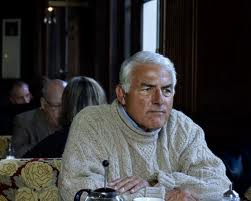
allen francis, normal 1But for me, the most important part of the column is his reference to Dr. Allen Frances and to his book, Saving Normal, which I have taken as the title for this post.  Here is a clip from the book review at Amazon.com.

Anyone living a full, rich life experiences ups and downs, stresses, disappointments, sorrows, and setbacks. These challenges are a normal part of being human, and they should not be treated as psychiatric disease. However, today millions of people who are really no more than “worried well” are being diagnosed as having a mental disorder and are receiving unnecessary treatment.

This practice is bad in a number of ways.  Here are four.  It “leads to unnecessary, harmful medications, [to the] narrowing of horizons, [to the] misallocation of medical resources, and [to the] draining of the budgets of families and the nations.”

You’ll agree that those are serious.  This one is worse.  By doing this, we “shift responsibility for our mental well-being away from our own naturally resilient and self-healing brains…and into the hands of ‘Big Pharma,’ who are reaping multi-billion dollar profits.”

There are two points here that are worth our attention.  The first is that we shift responsibility away from ourselves.  We explain “what is going on” in our lives in ways that cause us not to look to our own resources, but to pseudo-scientific, cookie cutter, psychopharmacology.  That one is going to have to wait for another post.

The second is that we shift responsibility to the pharmaceuticals industry (Big Pharma), apparently hoping that the right pill will save us.  How does that work, exactly?  Well,…“normal griefnormal 2 will become ‘Major Depressive Disorder;’ the forgetting seen in old age is ‘Mild Neurocognitive Disorder’, temper tantrums are ‘Disruptive Mood Dysregulation Disorder’, gluttony is ‘Binge Eating Disorder’…” and so on.

I think Dr. Frances is right.  I think these name changes will become common among therapists and, more alarmingly, among patients.  In all these pairs, we see the option of defining them as moral or normal on the one side and as medical on the other side.  Grief and forgetting are “normal.”  They are not pathological.  Temper tantrums and gluttony are moral failures.  They are not pathological either.

Society is pretty much a moral enterprise.  There are rules we are supposed to live by and failure to live by those rules ought to bring moral condemnation.  Ideally, the person who violated the rules would condemn himself, apologize, affirm the general value of the rule, and promise not to do it again.  Failing that, the society should condemn him for the violation and provide the array of incentives and disincentives that will not only change his behavior, but that will also bring him back to the moral standards.

Calling these behaviors medical rather than moral doesn’t do any of those things.  The approach that treats these issues as moral issues and that counts on the wisdom of the violator or the community where the violator lives is better in every way.  If it works.  If it doesn’t work, it isn’t better.

What we have actually done for a long time now—most of my lifetime—is to define issues like this as normal (she forgets things sometimes) or moral (I’m sorry, I shouldn’t have done that) as long as we are able to define them that way.  When the behaviors get really bad, we ask for professional assistance.  I think that’s the way it ought to work.

Frances’s concern is that that order of events is going to get turned around.  We are not going to give “our own naturally resilient and self-healing brains” a chance.  We are not going to accept some kinds of failures as “normal” or some kinds of violations of social norms as “immoral.”  We are going to go straight for the major leagues of therapy where normal grief becomes Major Depressive Disorder.

In this way of looking at it, the difficulty is that we choose professional interventions first.  We don’t try, first to incorporate these events into the normal rhythm of our lives or try, first, to show that important norms have been violated and apologies are in order.  We skip over both of those and go for the pill—whatever new solution the pharmaceutical companies have come up with.

There’s another way of looking at it, however, that is a little darker.  Nobody makes any money when we decide that grandma will require a little more vigilance from all of us because she forgets things.  Nobody makes any money when a school day is broken up by enough exercise and project work that children don’t have Attention Deficit and Hyperactivity Disorder “symptoms” any more.  Nobody makes any money when normal grief is treated as something that should not be borne by anyone who has insurance.  But if those conditions are called “disorders” and treated with drugs, quite a few people make money.

This is the place for vilifying doctors and hospitals and insurance companies and pharmaceutical companies.  I’ll leave that to people who are better at it than I am.  What I want to point to is that under these conditions, everyone involved is rewarded for seeing a condition as a “Disorder.”  No one is rewarded when it is not called a “Disorder.”  Under those conditions, everyone slides slowly, not intending to, into the frame of mind where calling “Disorders” is the professional and the responsible thing to do.  It is the compassionate thing as well, because it takes the “suffering” of the “patient” seriously.

I’m going to close with two stories.  These don’t prove anything.  They do give illustrations of just what we are up against as we try to understand these matters.

Story #1          Something happened to me in the summer of 2006.  I didn’t know what it was then and I still don’t know what it was.  I lay around at home for a while trying to get better, but I kept passing out. I couldn’t sleep at night and couldn’t stay awake during the day.  I went to my doctor, who said, “I don’t know what’s wrong with you, but you are going to have to have some sleep.”  He said that when he found me asleep on the hallway floor outside his office.  He gave me pills that knocked me completely out at night and he put me on six months of antidepressants.  Because of those pills, I was able to start teaching at the beginning of the Fall term at Portland State.  The first week, I taught as much of a class period as I could and then went home and went back to bed.  By the third week, I was teaching whole two-hour periods and holding office hours.  They never did find out what was wrong with me, but the pills either fixed it or gave my body enough time to fix it on its own.  We don’t know.

Story #2          My wife, Marilyn, died in 2003.  We had been married nearly 25 years.  She was my best friend and losing her was really awful.  I grieved the loss of this special friend for a normal 3long time.  In the middle of this time, an old friend of mine pointed out that I was depressed and asked whether I had considered taking an antidepressant.  I thought about it for awhile and told her, eventually, that I wasn’t any more depressed than I ought to be, having lost a wife like that.  The way it ought to work, I said, was that I would be depressed for a while and then slowly start to get better.  And, with a lot of help from friends who knew me and were willing to put themselves out on my behalf, that is just what happened.  I did get better and ever since then, I have benefitted from what I learned as the process worked itself out through me.
You see the dilemma.  Story #1 and Story #2 define the options.  These are both good stories because I did what I needed to do in each one, but it wouldn’t be hard to imagine them reversed.  In the first instance, I would refuse medication when in fact, my active life had been brought to a stop.  In the second, I would refuse the experiences and the learning that working through my grief would give me and go straight for a pharmaceutical solution.

The authors I am considering today are worried that the #2 stories are going to fade away.  People who are taught to define their grief as a “disorder” will not accept the lessons it has to teach.  These authors also worry that #1 stories will be all that is left.  These stories are built on the premise that we don’t know what is wrong with you, but if you’ll take two of these every day, they will fix you. 

We will all be poorer if that happens, no matter who is making money on it.


Posted in Living My Life, Political Psychology | Tagged , , , , | Leave a comment

A Retirement that Sparkles

I want to admit, right away before someone reminds me of it, that it is my own retirement I am thinking of.  I know that yours—the one you are currently experiencing or the one you are hoping to experience—will likely be very different.  To me, that doesn’t mean you don’t want your retirement to sparkle; it means only that different things will make it sparkle.

Thsparkle 2is post is about what I think will make my own retirement sparkle.  We’ll begin by recognizing that sparkle is what they call “a frequentative.”  My dictionary says that it “expresses frequent and repeated action” and by sweet happenstance, it gives sparkle as the frequentative form of spark.

Now let’s reset the scene a little.  I was sitting in the northwest corner of my favorite Starbucks—it’s where the Northwest Corner Caucus meets—and George Battistel, a member of the caucus asked me how the retirement was going.  I had put in a solid month of it at that time and wasn’t really sure.  I told George that I was pretty clear about some of the elements it needed to have.  I wanted to be active and I needed a good deal of structure, but I wanted to be more relaxed than my work at Portland State had allowed, but I still wanted to be “productive,” whatever that meant.  George said he thought that was pretty complicated and that I might want to give some thought to making it an acronym.

spar 1So I did that.  I made SPAR—structured, productive, active, and relaxed.  I was pretty happy about that.  “I’m retired, but I want to keep SPARRING.”  That sort of thing.  It did sound a little nautical for me, however. Then I thought I might be better off to have something that sounded like a unit of measure; something like reps or volts or decibels or something.  It wasn’t too hard to get to ARPS.  That sounded like a unit of measure to me.  “It’s a good retirement.  I’m averaging over five ARPS a day.”

I have no idea what that means.

The next time I saw George at Starbucks, I was ready to tell him about my ARPS but he had been thinking about it too.  His idea was that it would be a better acronym if it had a K in it.   He liked the idea of SPARK.  I liked it too and as I looked over my ARPS, I realized there wasn’t anything there that represented the persistent attraction to knowledge, which I was pretty sure would be part of any retirement I had.  So I make the K into KNOWLEDGE and put it at the end of my old SPAR.

That gives me SPARK for my retirement goals and, with the frequentative form, SPARKLE.  So what does all that mean?  It’s hard to say in advance.  Here is what I hope it will mean.

The S is there to remind me of structure.  When you have a job, you have an imposed structure.  When you don’t—and you still need some—you need to build it yourself.  It helps me to have to be somewhere in particular at some time in particular.  I fit the rest of my life in there somewhere and everything is good.

The P is there to remind me of productivity.  For me, that’s just doing something I think is worthwhile.  I enjoy some things just because they are enjoyable and I am very proud of that.  The other things I do need to have an effect of some kind.  That doesn’t mean that I am driven to achievement.  It mostly means that I like to keep track of whether I am actually doing what I am trying to do.  I still keep track of my mile times when I run on Wildwood Trail.  I don’t strive to achieve them; I just note what they are.  I like that.

The A is there to remindspark 3 me that everything works better when I am physically active.  Many hundreds of times, I have begun a run I did not want to do and have discovered somewhere in the first quarter of a mile that this whole running thing is pretty nice.  Being active keeps my body feeling good, increases the number of calories I can safely consume in a day, and keeps me from being moody.

The R is there to remind me that I need to relax.  It’s like running; I discover how much I enjoy it when I make myself start doing it.  My niece, Kendy, calls it “unclenching.”  Perfect metaphor!  I could use a little Jamaican influence.  Maybe I should go to Jamaica and study them.  (Just kidding.)

The K is there to remind me that the production and consumption of knowledge has always been a major part of my life and, especially now when I have no classes to teach, I need to find ways to continue to emphasize it.  My friend Dave Campbell and I are presenting a paper at the Public Administration Theory Network convention in a few weeks.  Maybe I can count that as something like teaching a course.

So I hope to sparkle in my retirement.  We’ll see how it goes.

Posted in Living My Life | Tagged , , | Leave a comment