Jesus and Rich People

So how did Jesus feel about rich people?  That doesn’t sound too hard to answer.  I’ve got some proof texts right here.  I hope they are the same as your proof texts.

We don’t have Jesus’s words to consider, of course.  We have his teachings as they have been preserved in several traditions.  We have, in other words, four different notions of how Jesus answered that question.  Jesus has the most bitingly negative view of wealth in Luke’s gospel, so let’s look at that one as an example.

I’ve been listening to Raymond E. Brown’s lectures on the Gospel According to Luke.  I’d have to say that I’m a fan.[1]  Some day, I may come to disagree with how Brown goes about understanding the gospels, but for the moment, he is my standard for both accuracy and relevance.  When I hear another view, the first thing I do is to check to see whether it is compatible with what Brown says.

I know that’s cheap.  It’s a little like an intellectual infatuation—I am aware that the Latin fatuus, on which the word is based, means “foolish.”—but I have high hopes for it anyway.  My hope is that as I continue to read other scholars, I will come to see that Brown is really good on this question, but not so good on that one.  I have followed this same process in each new field of academic study and it has worked the same way each time.  The person I choose first winds up as scaffolding and he finds a place for everyone, even his worst critics.

Here is what Brown says about Jesus and rich people.  He points out that the Jesus of Luke’s gospelrich fool 1 is really hard on rich people; much harder than the other gospel writers are.   In this post, I would like to just pick one instance and play around with it a little.

Here is a parable Luke records (Chapter 12), but which does not appear in the other gospels. 

16 And he told them this parable: “The ground of a certain rich man yielded an abundant harvest. 17 He thought to himself, ‘What shall I do? I have no place to store my crops.’

18 “Then he said, ‘This is what I’ll do. I will tear down my barns and build bigger ones, and there I will store my surplus grain. 19 And I’ll say to myself, “You have plenty of grain laid up for many years. Take life easy; eat, drink and be merry.”’

20 “But God said to him, ‘You fool! This very night your life will be demanded from you. Then who will get what you have prepared for yourself?’

21 “This is how it will be with whoever stores up things for themselves but is not rich toward God.”

So here are two really good questions.  What did this parable mean to Jesus?  What does it mean to us? 

To answer these questions, some notion of what an economy is must be filled in.  Jesus and all of his contemporaries understood that there was a fixed amount of wealth.  The world of economic transactions is, in other words, a zero sum proposition.  What I have, I have because I took it from you; what I get, you lose.

Rather than picturing this narrative as a harvest, which can be stored and used over long periods of time, it might help us to picture it as a the body of a freshly killed animal.  Because there is no refrigeration, whatever is not consumed immediately is going to rot.  The rich man can have as large an appetite as he wants; he is not going to be able to eat the whole animal.  His options are sharing it or wasting it.  In this parable, he chooses to waste it.

That new setting provides a way for us to better appreciate Jesus’s scorn.  Using the hunter imagery, it is easier to see that the man should have shared the kill with his neighbors.  It also suggests that being “rich toward God” (v. 21) is one outcome and “sharing with your neighbors” is the other.  God is a God of sharing with your neighbors.  When you keep it all for yourself, therefore, you are not only denying your neighbors, but God as well.[2]

So what does this mean to us?  We don’t share Jesus’s presuppositions about the economy.  Capitalism has a way of making the market larger, under some circurich fool 3mstances, so it is possible for my wealth and your wealth to increase at the same time.  As a result of the actions I take, I get richer and so do you.  The metaphor of the economic “pie” is often used.  If you can make the pie bigger—or “higher,” as George W. Bush used to say—then both of us can have more pie.

Imagine, for instance, that the point of the story about building a new barn was that this farmer employed a lot of workers in construction of the barn, that the delayed sale of the wheat brought increased revenues, and that the taxes on those revenues supported three new centers for transitional youth.  This is a ferocious adulteration of a simple metaphor.  Let me be the second to admit that (second only because you probably made that observation while I was finishing the sentence).  On the other hand, my story, like Jesus’s story, has a point.  It is that “sharing with the neighbors” can look very different in a society in which economic activity can benefit everyone (although not equally) and in which there is a government which has at least some redistributive functions.

So.  Would the Jesus who condemned the greedy farmer condemn the keen-sighted entrepreneur?  He might.  I’m really not sure.  But if he did, it would be on grounds other than those presumed in his story.  And what about the farmer’s reception in the next world, where God relies on the judgments made by the poor to make up His mind about the rich?  Certainly we can say it is more complex. 

This is not the case of the hunter who, having killed more than he can eat, would rather see the excess rot than share it with his hungry neighbors.  This farmer did what he did because of greed—it is the only motive capitalist theory recognizes—but by that greed, he benefitted many of his neighbors, who otherwise would have received very little benefit. Rather than giving out a dole of grain, he employed workers, made profits, and paid taxes.  Presumably, those who benefitted would, when the farmer died that night, recommend to God that he be shown mercy.

On the other hand, one thing you can be sure about, if we are talking about capitalism, is that some rich fool 2will benefit and some will lose.  Capitalism is a truly awful distribution mechanism and it would not be too much to say that it eats (some of) its children.  Capitalism guarantees that many will be worse off.  That is how the price of labor is set.  What will those, the marginalized, say to God when the farmer dies and faces the judgment?  And what will God do, faced with benevolence from some of the poor (the winners) and malevolence from others (the losers).[3]

Let’s go back to Luke.  The set of questions with which I finished the paragraph above are really bad questions.  They are bad because they impose some modern ways of understanding economic activity that are foreign to the world Jesus was talking about.  They also impose the categories of economic actors—like proletariat and bourgeoisie— that would have been entirely foreign to the First Century.  That means that “building a new barn” is not necessarily a good thing or a bad thing.  It is not like eating all the kill you can hold and allowing the rest to rot, which is always a bad thing.

Anyone who wants to be a learner from Jesus—and that is what “disciple” means—is going to have to figure out what Jesus would say to you on Facebook when he heard about the new barn.  That’s actually what a learner would want to know.


[1] I got my introduction to Brown’s way of approaching scripture maybe twenty years ago.  I got his book The Birth of the Messiah.  There are two accounts of Jesus’ birth: Matthew and Luke.  I opened up Brown’s book and saw that the whole book was divided into two parts.  The first half was about Matthew; the second half about Luke.   It was love at first sight.

[2] Luke tells some other stories which, according to Brown’s understanding, have the same point.  The poor are going to be in heaven.  When you get there, they will testify in your favor or against you and God will listen to what they have to say.  The parable of the rich man and the beggar at his door makes this point.  So, in its own odd way, does the parable of the sleazy steward.  Both are in Luke 16.

[3] If you are following Mitt Romney’s dichotomy of “makers” and “takers,” the farmer represents the 53% who actually make the economy work and both kinds of workers are the 47% who are “takers.”  Just so you know.

Posted in Biblical Studies | Tagged , , , , | Leave a comment

Too Pretty to Work Here

It is hard to write seriously about the Iowa dental assistant who was fired.  I am sure it is a serious matter for Melissa Nelson, the dental assistant.  It is probably about to become serious for James and Jeanne Knight because they have set themselves up to be objects of ridicule.[1]   Nevertheless, I will try.  I will be serious.  I will.

According to the news reports, Nelson was fired because the dentist found her too attractive.  According to the opinion of the Supreme Court of Iowa, Nelson was fired because the dentist’s wife, Jeanne Knight, was concerned about the relationship between her husband and Nelson.  Here is the case.  See what you think.

http://www.iowacourts.gov/supreme_court/recent_opinions/20130712/

The question as the court construes it is this: “Can a male employer terminate a female employee because the employer’s wife…is concerned about the nature of the relationship between the employer and the employee?”  Answer: Yes, he may.

The question as I have seen it treated—ordinarily, I would say “discussed,” but this case does not seem to lend itself to “discussion”—is whether the law offers Melissa Nelson any recourse, after having been fired by her employer.  The answer is: No, it does not.  Not, at least, in Iowa.

Melissa Nelson, IowaSo here is Melissa Nelson.  If  I were going to take a picture of her as an innocent victim, I would put her in a loose-fitting gray sweater with a scarf around her neck and use a shelf or so of law books as the background.  That’s what they have done here and I applaud their judgment.  If you would like to see extravagantly worse judgment, you may google “Melissa Nelson, dental assistant” and see what has been done with the issue.

I would like to use this very small public forum of mine to look at this issue in three other  ways.  I want to consider the realistic options available to Mrs. Knight; then what a healing intervention by their pastor might have done; and finally, the very difficult legal argument the court was required to use in its decision.  There will be a huge celebration of “the issue” in the online news sites, in the press, and on TV.  It will be ridiculed by everyone.  I think my approach is better.

  My first reaction, when I read in the court’s decision, that James Knight acted at his wife’s urging, was to regard her as a bit player in a drama that was not about her.  But if she values her marriage, maybe it is about her; there is, at least, a way of looking at the issue that takes her interests into account.

Jeanne Knight sees her marriage going away because she has failed to act to save it.  The first question you run into, if you are willing to start there, is: Is my marriage in danger of dissolution?  If you think it is, the next question would likely be: Is there anything I can do to help save it?  I you think there is, you look at the elements of the problem.  My husband, James Knight is more erotically attracted to his dental assistant than he wants to be.  His employee, Melissa Nelson, is much more attractive to him than is compatible with my continuing to have a happy marriage.

Now picture these options.

Scenario 1:      Jeanne has a sit-down talk with her husband and asks him to be less erotically attracted to Melissa than he is.

Scenario 2:      Jeanne admits that there is no way for James to be less attracted to Melissa than he is, but urges him to be very careful about seeming, in any way, to act on his feelings.

Scenario 3:      Jeanne tells her husband that there is room for one erotic attraction in his life, but not for two.  It is time for him to make a choice.

I have to admit that Scenario 3 is the only one in which Jeanne, herself, can act on her behalf or on behalf of the marriage.  By contrast, picture her asking James to feel differently than he does feel or to be continually aware that he needs to refrain from acting on his feelings.  If you are reluctant to dismiss Scenario 2, I ask you to imagine yourself in the position of a patient undergoing root canal at the hands of a dentist whose mind is largely elsewhere.

So much for Jeanne Knight.  Another way to look at this is from the standpoint of the church.  Frank Hearn, a communitarian author and a favorite of mine, has a vocabulary that can help us here.  Most important transactions, Hearn writes, really should be taking place in a community where people know and care for each other.  Some issues that can be handled well only by a community are highjacked and sent off to be dealt with by the courts.  He calls this process juridification.  This question of sexual attraction in the workplace can best be handled by the people who actually know what is going on.  It is a good deal too subtle for the courts to handle competently.

So let’s start with the religious community.  Let’s imagine—I have nothing but the neighborhood church to go on and I am choosing it instead of inventing a church—that all four people are members of the same church.  It would be the Faith Baptist Church of Fort Dodge, Iowa, which looks to be a block or so east of the Knight home.  So Steve and Melissa Nelson would be members of this church and so would James and Jeanne Knight.

It would not be hard for the pastor of the church to recall St. Paul’s words about “taking a brother to court.”  Paul’s advice is, “Don’t do it.”  Here’s the text from 1 Corinthians 6.

Is one of you with a complaint against another so brazen as to seek judgment from sinners and not from God’s holy people?  …when you have matters of this life to be judged, you bring them before those who are of no account in the Church![2]  I say this to make you ashamed of yourselves.  Can it really be that it is impossible to find in the community one sensible person capable of deciding questions between brothers, and that this is why brother goes to law against brother, and that before unbelievers?

Of course, Fort Dodge, Iowa and ancient Corinth are not similar places and we don’t categorize “the church” and “the world” that way anymore.  Still, it is not hard to imagine a pastor who cares about saving relationships as well as people to think of the situation more broadly.  Here is something he might have said.

“I’m glad the four of you were willing to sit down with me to talk about this.  The media will have a field day with us all if this gets into the court system.  All of you are going to be damaged if that happens and we don’t need to do that.  Here’s what needs to happen.  Melissa needs an apology.  James and Jeanne, that’s your job.  She is going to lose a job she likes and is going to become a figure to be ridiculed.  If she is going to have to take another job, she needs a sincere apology, a letter of recommendation that sounds like it came from God, a guarantee of a new job without any loss of income.

Melissa, you and Steve and going to have to find some charity in your hearts for James and Jeanne.  Jeanne is not crazy to be concerned about whether her marriage is going to be destroyed.  Marriages get destroyed by workplace flirtations all the time.  James has crossed the line that is supposed to separate employer conduct from sexual flirtation.  That was wrong.  On the other hand, he tried not to cross that line for a long time and under the circumstances, I think you can find it in your hearts to forgive him when he was not successful.”

Let me stop and remind you that most of that is made up.  It isn’t implausible, however, and it does defeat the threat of juridification.  Actual persons apologize and forgive.  Actual persons have their financial well-being taken into account.  I think it is a pretty good outcome.  It does require that the pastor take a very broad look at the issue and a pretty aggressive approach to the two couples, but I have seen pastors do that.

And finally, what happens if the matter is not handled within the community.  It goes to court.  And Nelson’s attorney employs the “but-for” strategy.  Nelson would not have been fired “but for” being a woman.  Not so, says Dr. Knight’s attorney.  It was the nature of the relationship and the threat to the marriage that are the issue.  Absolutely, says Nelson’s attorney, and you are telling us that there would have been this threat to the marriage if Nelson were not a woman?  That’s what you are telling us.

The Iowa Supreme Court wound up contrasting a “condition”—unjust treatment of an employee—with a “motive:” this was done to save the Knight’s marriage.  That just seems like bad law to me.  It doesn’t seem stable.  And the only court in the land to which this case could be appealed is the U. S. Supreme Court and I would have no hope at all that the legal issues would be sorted out there.


[1] Ordinarily, I would have said “objects of ridicule by the liberal press,” but I saw a broadcast about the issue on ABC in which both Mr. and Mrs. Knight and the Iowa State Supreme Court were trashed.  ABC is not any part of “the liberal media.”

[2] “Those who are of no account in the church”—which is not a pejorative expression in the context of the letter—would include the Supreme Court of Iowa and the 8th and 11th (federal) Circuit Courts of Appeals.

Posted in Uncategorized | Leave a comment

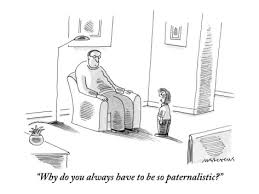
A Modest Proposal about Paternalism

Today is a rescue operation.  I am going to try to rescue the term “paternalism.”  Very likely, I won’t succeed, but I have learned a phrase from my wife that I now use a good deal: “How bad could it be?”

Once you know that paternalism is bad, you really don’t need to know what it means.  In this, it parallels “racism” and “sexism.”  To the best of my recollection, racism was once a wPaternalism 2ay of ordering the several races in a hierarchy.  It meant that “my race”—all of the members of my race, without regard to personal traits—is better than “your race,” with the same wall to wall erasing of personal distinctions.  In that form, it is false.  You can have any kind of grading system you like, provided that it grades individuals, and “racism” in that form can be shown to be empirically false.

Over time, the term came to mean the recognition of any racial differences at all.  I think the operating theory must have been that if a fact is established, people of ill will can use it to the disadvantage of the targeted race.  And since there is no way to prevent people of ill will from using facts in this manner, it is up to you to deny the existence of those facts.  Or, if you are not willing to deny them, just ignore them.  That will work just as well unless you are put on the spot.[1]

Sexism works the same way.  One sex is better than another.  That has meant that men are better than women.  But it doesn’t work the way race does.  You simply can’t say that every man is better at everything than any woman.  You can get most of the heavy lifting done, however, if you denigrate the value of the things women are better at.  I trust you will notice the pun.[2]  So men are better “at the things that really matter” than women are.  This runs into the factual problem, of course, just as racism did, and the options for people who know what the facts are are the same: deny the facts or shut up about them.

This brings us to paternalism.  That ought to mean that fathers—not “men,” but “fathers”—are better at everything than mothers—not “women,” but “mothers”—are.  No one thinks that.  The fallback position would be that fathers are better at all the most important parts of parenting than the mothers are.  Hardly anyone thinks that either, although there remains the question of just what “the most important” parts are.

This brings us to the text for today.

But paternalism, modestly construed as an expectation of achievement cushioned by a responsible willingness to provide guidance and support, has both a firm basis in male tradition and a present utility.[3]  As with many of the important criteria of manhood, it expresses tension between judgment of performance and a loving association with the performer: one measures one’s son and tries to help him through the measurements.[4] (p. 194)

Paternalism 1This from Peter N. Stearns, a social historian and long-time observer of the pattern of gender roles.  In that whole description, I see only one weasel word, which I think is truly admirable.  The word I see is the “modestly,” after “paternalism.”  He gets to say what a “modestly construed paternalism” is and the men’s liberationists and feminists who have attacked him for this view (the book was first published in 1979) “just don’t understand” the kind of paternalism he has in mind.

I do, though.  I had a mentor.  My brother, Karl, was a pediatrician for most of his adult life.  He saw a lot of family settings and a lot of whole and balanced kids and a lot of seriously messed up kids.  He looked for two elements in the family setting.  He said that if these two elements were there, nearly every kid, however varied the personalities, had a good foundation for all the later choices.  The two elements were: love and firm rules.

That’s the way I remember it from all those years of conversation, but I called him last week to be sure I remembered it correctly and I discovered that he has clarified “love” a little.  He said he counted that a little boy was “loved” if there was someone in the home who was willing to listen to him.  Karl is a pediatrician, remember, not a child psychologist.  What he needs is a rough and ready criterion for “home setting,” something that will help him judge whether a child’s health is supported or abraded by the conditions at home.

I’ve remembered those two criteria over the decades since I first heard him say it, and they were in my mind when I read Stearns’ account.  In “loving association with the performer,” I see Karl’s insistence that the child is cared about and listened to.  In “judgment of performance,” I see the firm and clear rules that Karl thought were so important.

I see two kinds of dilemmas that will need to be addressed if this “modestly construed paternalism” is to be developed.  One has to do with the children; the other with the wife.

Stearns says that the decline of “traditional fathering” since the beginning of the industrial era has left men with a confusing situation. 

“Now that men cannot train their sons for work, and work with them during an overlap of careers, it has been difficult to find an alternate style with will produce guidance and authority…  Leisure activities, to which men now resort for so many of the satisfactions of manhood, have been the best surrogate, for they combine friendly association with training in skills and, where the father keeps up his own abilities, with the possibility of ongoing contact.” (pp. 192—193).

Being “buddies” with your children is often not what the child wants.  Furthermore, if one chooses to be a buddy rather than a father, it is not likely to be what the child needs, either.  The “judgment of performance” part of the father’s role is not really compatible with “being a buddy.”  If you have been to highly organized sports for children, you have seen fathers trying some way to play both roles at the same time.[5]

Before the industrial revolution changed family life so drastically, the father was the master of a setPaternalism 3 of skills he could teach to his sons.  This loaded the scale in favor of the judgment of performance criterion and against the “loving association with the performer” criterion.  Or, in Karl’s terms, the scale was loaded in favor of the rules part and against the “loving and listening to” part.  The Little League father is looking at a scale loaded the other way, even for the relatively minor part of essential family life that is played out in sports.  There are difficulties both ways.

Then there are the difficulties the wife presents.  Women have long borne the brunt of caring for the family.  The idea that the husband is going to be at home more now and therefore available to help bear the burden of family life has been an idea long welcomed.  On the other hand, when the women did all the work, they defined the job the way they wanted it and had no notion at all that it involved an exercise of power.  When the men enter the family to a new extent, being freed from the workplace to an increasing extent, they see “caring for the family” in their own way.  They don’t see themselves as apprentice mothers; they see themselves as fathers.

The family is, or should be, a field of male action in which men insist on defining a clear role for themselves, including a style of parenting.  Women complain that despite important strides to mutuality, men actually remain dominant in more cases than not.  This is doubtless true in many aspects of husband-wife relations.  But it is less likely true in areas of family activity, including child rearing, over which women have long maintained a virtual monopoly.

Men who want to be fathers, in this sense, are going to have to find a way to make it OK with their wives.  If the wives can’t find a way to assimilate a new adult at home, the children will be denied the “modest paternalism” that Stearns argues is the gift men have to give at home, or engage in protracted conflict about how to raise the children, particularly the boys.

I have no idea how these stresses are going to work themselves out.  I am quite sure it will not happen in my lifetime.  Stearn’s view is that the industrial revolution distorted gender patterns for several hundred years.  It would be odd to imagine that men and women—fathers and mothers—would devise some new balance on the fly and apply it collegially to the new challenges.  That is asking too much and I am not asking it.

What I am asking is that “paternalism” be removed from the listing of social pathologies it shares with sexism and racism.  Some way needs to be found for men to be men and fathers and husbands at the same time under confusing post-industrial circumstances.  I think this word can help us.


[1] In Ursula LeGuin’s marvelous novel, The Lathe of Heaven, her protagonist, George Orr, “solves” the race problem in a dream that changes the reality of the world.  In this new world, everyone is gray.

[2] I don’t, of course.  If I trusted that you would notice the pun based in denigrate, I wouldn’t have written this footnote.

[3] If you are like me and read a quotation beginning with “but…” you will want to know why it is there.  The previous sentence is, “Not a patriarchal style: quite apart from the effective disappearance of the propertied weapons of the patriarch, there is no way to justify a return to this formal dominion.”

[4] Peter N. Stearns, Be a Man! Males in Modern Society.  New York: Holmes and Meier Publishers, Inc. 1979.  I will give the page references along with the specific quotations.

[5] Not to go all nostalgic or anything, but the vast majority of my athletic experience took place in a vacant lot in our neighborhood, which was just fine with my parents who knew where we were and that we were safe, and cared nothing at all about whether we were learning to be wide receivers, shortstops, or power forwards.

Posted in Uncategorized | Leave a comment

Fully and Visibly Engaged

It has to be one of the hardest jobs in the world.  You are on camera frequently and you have to be visibly responding to what someone else is doing.  Yawning is out; napping is out; checking your watch is out.  It’s just hard to do well.

I have thought for some time now that Vice President Joe Biden’s performances in appearing to respond to President Obama’s State of the Union speeches were Oscar-worthy.  He’s not just happy and approving.  He is amused, wry, anxious, hopeful.  The emotional palette he uses is extraordinary.Andy Murray 9

“I have,” as Tom Lehrer says in introducing his satire, ‘The Vatican Rag,’ “a modest example here.”

This one looks like: “Whenever you start talking about presidential succession, I focus intensely.  I think I am beginning to get that headache again.”

Andy Murray 8

Here’s the Vice President again.  I propose: Ve-e-e-r-y E-e-e-nerestink.  This imagines that the  Vice President knows Artie Johnson as well as other members of our generation do.

And finally, how about this one?  I’m thinking: “It isn’t just anyone who can tAndy Murray 7ell that joke, but you nailed it.”  I am encouraged in that interpretation by the droll expression of the face of Speaker of the House, John Boehner.  He would not have gotten the joke, I suppose, or would not have thought it was funny.   Also, you will notice that Boehner and Biden are leaning away from each other.  It’s just a visual artifact, really.  Biden, on the left, is leaning to his right and Boehner, on the right, is leaning to his left.  Both are trying to find a way to meet in the center.  Or not.

One the other hand, Andy Murray’s girlfriend, Kim Sears, is a gifted responder as well.    The best I have seen since Joe Biden.  Andy Murray did some amazing work in putting Novak Djokovic away in straight sets in the Wimbledon finals, but every time Murray did something amazing, the camera panned over to Kim to see how she was reacting.  She, too, needs to be fully and visibly engaged in the event.  No yawning, napping, or watch-checking.

Here are some guesses about what she was thinking.  I’ll make the pictures bigger because she is a good deal cuter than Joe is.  Here are the three pictures I liked best along with my proposals for what might have been going on in her head.

Andy Murray 5“A drop shot?  From behind the baseline?  We’ve talked about that several times, you will recall.”

Andy Murray 6

And for the second picture, how about: “Oh.  I can wear the blue gown to the victory dinner.  That will work.  When I wear white, people mistake me for Kate Middleton.   Or they did before she got pregnant.”

And for the third one, how about this?  “This must be so hard for Novak’s Djokovic’s girlfriend.”

Andy Murray 3

This is the kind of game anyone can play, as you see, so if you have any ideas about what captions to supply to these pictures, don’t let timidity or good taste hold you back.


Posted in Living My Life | Tagged , , , , | Leave a comment

Borrowing Bette

Every metaphor you can think of is deficient in some respect and, regrettably,  that includes the metaphor I am going to use today.  I am going to treat the opportunity I have of living my life with Bette by the analogy that she is a book I have checked out of the library.  This is what she looked like when I met her.  Why would I not have wantedBette Pensive to check her out?

There.  That’s the worst of it.  Now you are in for a little exculpatory throat-clearing, after which I will work with the metaphor a little.  One: there really isn’t any Library in this metaphor, out of which I could have checked Bette.[1]  Also no Librarian, no cosmic Yenta who makes matches and therefore also makes mistakes.  Bette is a person, not an object.  She is not like a “book,” that can be owned, borrowed, and returned; and if she were, she would be the kind of book the librarian consulted with before loaning her to anyone.[2]

Here’s why I’m using this metaphor anyway.  It distinguishes sharply between “reading a book” and “having a book.”  That’s worth doing.[3]  Besides, Bette was a librarian when I met her, so I am benefitting from both ends of whatever humor there is in this metaphor.[4]

Bette had a headache earlier this week.  Bette doesn’t get headaches.  So this was a potentially disturbing event.  What did this headache mean?  The question had a little more pop for me than it would have had for a guy who has not already lost a wife to a disease that first presented itself as a series of inconsequential medical anomalies.  Being that guy, I press a little harder on just what “inconsequential” might mean, even if it is just an unexpected headache.

So I had a bad night that night and the next day the headache went away and Bette is back to normal.  But during that bad night, it occurred to me that living intimately with someone is like reading a really good book from the library.  Even if you have to let go of it—you can get it renewed sometimes, but eventually you have to give it back—you still got to read the story.  Bette’s story–in this metaphor, the story that is Bette–is a rich and complicated story; it has subplots and sub-subplots; it has heroes and villains; it has engaging sidekicks and comic relief.  It means something wonderful.

And you always get to keep the story, even if you have to return the book.  That’s how far I got during that bad night.  It’s a metaphor with some problems, as noted above, but it brings a wonderful clarity to the central meaning of the metaphor, which is that no matter what happens, you always get to keep the story.

I have books, and I’ll bet you do too, that I have not really given myself to.  I’ve enjoyed them.  I know there is more in them than I have yet found, but I also know that I have them, there on my shelf, and that I can always go back and read them again.  If I knew that I could not go back and read them again, I imagine that I would invest myself more intensively, getting everything the book had to give me.  What this metaphor does is to remind me that the partner you married really is not like the book you have.  She is more like the story you need to give yourself to so that you will always have it when you have to give the book back.

So to conclude, I have offered a metaphor that has recently meant a lot to me.  It is truly terrible theology and I don’t mean it as theology.  They say sometimes that youth is “wasted” on the young because they don’t know how wonderful it is.  They might also say that marriage is wasted on the married, because they don’t know how wonderful it is.  But I really do know how wonderful it is and I don’t want it to be wasted on me and so far it has not been.


[1] This is not to say that I did not check her out when we first met, back in January of 2005.

[2] That was, in fact, the experience of the mutual friend who undertook the task of persuading Bette to loan herself to me for a brief coffee date.  He pleaded; she resisted.  “It’s a fourteen day loan,” he said, “and he is really good about returning the people he borrows.”  Bette said, “That’s not good enough, I’m afraid.  I have things I want to do in the next fourteen days and none of them involves getting back into the Slough of Dating.”  The above story is true, more or less, in principle.  The dialogue is entirely invented.

[3] People who know my life will understand that I have also lost a book.  You have to pay a fee for that.  It is a quite substantial fee.  I did return my next book when it was due, and I understand that I may be called on to return Bette as well.  I hope not.  It is about my turn to be returned.

[4] I went so far as to say, at our wedding, that I was proud to have taken her out of circulation, a joke only her librarian friends really appreciated.

Posted in Getting Old, Living My Life, Love and Marriage | Tagged , , , , | Leave a comment

Hannah Arendt

Please go see this movie.  It will be good for you.  You will want to talk about it with your friends.

Critics have not been very kind to the movie, Hannah Arendt, because it is a talky movie.  I don’t see what else it could be.  Hannah Arendt, played in Hannah Arendt 1the movie by Barbara Sukowa, was a prominent political philosopher before the New Yorker asked her to cover the trial of Adolf Eichmann in Jerusalem.  On the left, here, is Arendt as herself.  On the right, Sukowa as Arendt.

I know Arendt from her Origins of Totalitarianism and The Human Condition.  This movie is about Eichmann in Jerusalem: A Report on the Banality of Evil.  Most particularly, it is about Arendt’s insistence that the most horrible thing about Eichmann was his mediocrity.  Eichmann was not a monHannah Arendt 2ster, according to Arendt.  He was only a paper shuffler.  He was not even an anti-Semite.  He was a nothing.  That is what made the Holocaust so horrible.

Have you ever had the experience of trying to point out the “real cause” on an event and being defeated because your explanation didn’t have any villains in it?  Or not villains who were quite evil enough?  I have had that experience many times.

Here’s what happens.  Imagine that villainy can be calibrated on a scale of ten.  The prevailing sentiment among your audience is that the Villain at Issue—it is Eichmann in this case—should be an 8.  Your own view is that, given the circumstances, he is no more villainous than 5.  What will you be charged with, do you suppose?  Defending the villain!  The case you make that he is a 5 is an affront to decent people everywhere and especially to the victims of villainy.  You are “defending” the villain by arguing that 5 is a better measure of his villainy than 8!

This response is what the movie, Hannah Arendt, is about.[1]  We see Arendt in Jerusalem listening to the testimony.  Eichmann is in a class case.  They say it is to protect him, and maybe it really was, but he looks in that case, like an exception to the human race.  There is everyone else and then there is EichmHannah Arendt 4ann.  Arendt is struck by how horrible the death machine is.  Nothing can be said about the Nazi intentions and actions that is too awful to say.  On the other hand, once the machine is built, it doesn’t take any particular malice to run it.  It just takes bureaucrats who have their orders and who comply with them to the very best of their ability.

It is evil, surely.  But it is also banal.  The OED gives these meanings to banal: commonplace, common, trite, trivial, petty.[2]  The operation Eichmann ran was so thoroughly evil it was hard to comprehend.  Eichmann’s part in it, Arendt argued, was trivial.  It was petty.  It was trite.

It has always seemed to me that it is more valuable for all of us to understand that social systems can be built that do not require evil men to operate them.  Trivial bureaucrats will be enough.  This is scarcely saying more than Edmund Burke said: “All that is necessary for the triumph of evil is that good men do nothing.” Arendt, however, pointed to the system.  That is what we need to understand.  Her opponents wanted to revile Eichmann, himself.  In doing this, said Arendt, we cheat ourselves and deny to ourselves a knowledge of what is now possible that we will urgently need in the future.

Arendt’s major professor, Martin Heidegger, joined the Nazi party in the hopes of reforming the university system.  He was tried, in the denazification hearings following World War II.  The French military finally classified him in 1949 as a “Mitläufer or Nazi follower (Mitläufer : person who gives into peer pressure without participation nor resistance nor inner conviction, unlike a fellow traveler, literally “with-runner” similar to “lemming-like”).”[3]  I think Arendt’s position was that Eichmann was a Mitläuffer.

I’m in no position to say whether Arendt or her critics is nearer to the truth.  The better question, it seems to me, is whether we need to understand Arendt’s view of Evil—that’s a capital E—or her critic’s view.  Which is more crucially important for us?  I’m with Arendt on this one.


[1] Mostly.  It is also, to a certain extent, about her judgment that the local German rabbis made the Nazi’s work easier by organizing the local Jews for them.  Arendt is charged, in this instance, with “blaming the victim” rather than “defending the villain,” but the dynamics work out along the same lines.


[2] There is an earlier meaning of banal which has no real historical association with the modern use of the word, but the meaning seems almost an eerie forerunner in Eichmann’s case: “of belonging to compulsory feudal service.”.

Here is a use of that meaning from 1753: “ a kind of feudal service, whereby the tenants of a certain district are obliged to carry their corn to be ground at a certain mill, and to be baked at a certain oven for the benefit of the lord.”

[3] Thanks to the Wikipedia article “Heidegger and Nazism” for that quote.

Posted in Movies, Politics, Uncategorized | Tagged , , , , | 4 Comments

In a Larger Sense, We Cannot …Hallow This Ground

The battle of Gettysburg began on July 1, 1863: 150 years ago today.  Three days of unparalleled carnage followed.  Recent studies conclude that the Union army and the Confederate army each lost somewhere in the neighborhood of 23,000 soldiers in those three days.

It was Abraham Lincoln who said that the men who died there had consecrated this ground “far above our poor power to add or detract.”  That line is from the Gettysburg Address, of course, given on November 19, 1863.

But it was also Lincoln who said:

Fondly do we hope, fervently do we pray, that this mighty scourge of war may speedily pass away. Yet, if God wills that it continue until all the wealth piled by the bondsman’s two hundred and fifty years of unrequited toil shall be sunk, and until every drop of blood drawn with the lash shall be paid by another drawn with the sword, as was said three thousand years ago, so still it must be said “the judgments of the Lord are true and righteous altogether.”

That familiar judgment is from Lincoln’s second inaugural address, given in March of 1865—a year and eight months after Gettysburg and one month before Lee’s surrender at Appomattox Court House, Virginia. 

It’s hard to know, 150 years later, how to feel about Gettysburg.  Lee didn’t invade Pennsylvania because he wanted to capture it; he invaded to show that he could go anywhere he wanted and that Lincoln couldn’t stop him.  The idea was to show that Lincoln’s war aims were a travesty and that Lincoln should sign a treaty then and there to end hostilities and recognize the realty that the north and south were sovereign nations, each controlling its own territory.

A Confederate victory at Gettysburg could very well have accomplished that.  Anti-war sentiment was strong in the north.  A war president is always popular when the war is going well.  Otherwise not. Lincoln was not.

Gettysburg, Day 1

You can see on the map what happened on the first day.  The Confederate armies, attacking from the north, pushed the Union armies right through the city of Gettysburg and onto the hills south of town.  On the second day, Lee faced an army larger than his, entrenched in positions on the high ground. He attacked the Union left wing on the second day, trying to get around Little Round Top.  He failed.  He attacked the Union center on the third day.  He failed again.  Then he took what was left of his army home to Virginia.

The most engaging accounts I know of Gettysburg are Michael Shaara’s Killer Angels and the movie, Gettysburg, which was based on that book.  Both the book and the movie emphasize the role of junior officers, improvising to shape the battle (like Brigadier General John Buford) or devising new tactics on the spot (Like Colonel Joshua Lawrence Chamberlain).  It was not a battle won by strategy, according to these accounts; it was a battle won by the imagination and daring of soldiers on the ground.

I understand a good deal about the battle because I have read books about it all my life, but my feelings are being played with these days—by Aaron Sorkin, of all people.  In the movie, Gettysburg, Robert E. Lee is played by Martin Sheen, who is dear to my heart as President Josiah Bartlet, of The West Wing.  Sorkin gave President Bartlet some of the best political speeches ever given on television.[1]  But Colonel Chamberlain is played by Jeff Daniels, who is dear to my heart as Will McAvoy of The Newsroom.  Sorkin has not yet given McAvoy the speeches he gave Bartlet, but the second season begins this month and we will see.[2]

There is no legitimate connection between Gettysburg and these two Sorkinesque characters, but I can’t see Col. Chamberlain without hearing Will McAvoy and I can’t see General Lee without hearing President Bartlet.

So I still know what I know about Gettysburg, but my feelings have gone all screwy.


[1] President Bartlet’s first spoken line in Season 1, Episode 1 is, “I am the Lord, thy God.  Thou shalt have no other gods before me.”  It’s a snappy opening for a Democratic president, but the context  helps us understand how appropriate the line was.

[2] Will McAvoy delivered the line for which he is best known when a student asked him in public to say why America was the greatest country in the world.  He said, “It’s not the greatest country in the world.  That’s my answer.”  A three minute rant follows.  And after that, “…but we used to be.”  And after that “…and we could be again.”

Posted in Books, Movies, Politics | Tagged , , | Leave a comment

If It’s Not About the Nail, What IS it About?

With any luck at all, I will embed a wonderful short clip called “It’s Not About the Nail” in this post.  If it doesn’t work, I recommend that you Google “It’s not about the nail” and enjoy the following 78 seconds.  It’s serious and it’s funny.  It’s wonderful.

http://www.youtube.com/watch?v=-4EDhdAHrOg

OK.  That was the last wonderful thing I have to offer.  Now I want to think about what “it” means in the expression “It’s not about the nail.” 

There is an object somewhere (an artifact, a fable, a relationship) that is consonant with some meanings and not with others.  I know that sounds stiff, but I am trying for the most general formulation I can think of.  It will get better from here on.

“Consonant with some meanings and not with others” is my way of saying “about.”  When you say a movie is “about” something, you are trying to identify a theme, often a theme that means a lot to you.  You will expect other people to say, “No it isn’t.  It’s really about [something else].”  Many happy and collegial hours have been consumed, along with unnumbered beers, in such discussions.

Contentious issues are a different matter.  When I say that closing a tax loophole is “about” forcing the corporations to pay their fair share and you say it is “about” taking away the incentive for corporations to create jobs, then “about” means something very important.  The tax loophole has many effects.  I pick the one I want to talk about and say that the loophole is “about” that; it’s about tax equity.  You pick the one you want to talk about and say that the loophole is “about” that; it’s about a thriving and growing labor market.

It makes no sense at all to ask what it is “really” about.  On the other hand, we both agree that it is not “about” global warming or aesthetic standards.  Another way to say this is that tax equity is very important to me and it is the effect of the loophole on that that I want to talk about.  That is how “about” functions.  The tax loopholes are consonant with some meanings—the ones that I think most urgent—and not about others.

Let’s talk about what I think is important!  No, let’s talk instead about what I think is important.  That’s what “about” is about when there is a conflict to be resolved.

This formulation casts a new, but not really unexpected light, on “about the nail.”  The nail is an external problem.[1]  It is an issue she is facing, but he is not.  The issue he is facing is that she wants from him—desires urgently from him—a response that he finds difficult to summon up and which, in his judgment, will do no good at all.  He is highlighting this issue; she is highlighting that issue.  One will be in the foreground; the other in the background.

This little clip is a parody.  It’s intended to be funny and it is.  But it is funny because it plays off of a very common situation that is not funny at all.  Wives very often want a response of emotional intimacy from their husbands.[2]  When their husbands treat them as people with problems and then put all their attention on the problems, the wives feel that the problem has been featured and that they, themselves, have been forgotten.  Husbands very often take pride in their ability to solve problems and their attention gravitates to the external part of the issue rather than to their wives’ emotional response to it.

If the wife’s difficulty has to do with being bullied at the office, for instance, it may be that she has done everything about the situation she is willing to do.  She has examined the possible responses.  She is sure that the one she has chosen is the best one available.  Now she wants help is carrying the burden that her choice has imposed on her.  There is no “nail” here.  A husband who insists on perceiving a “nail” (because there is something he can do about it if there is a nail) is choosing to deal with the problem he would prefer to the problem he actually has—which is that is wife is suffering and needs the patient non-judgmental caring that someone who knows her and loves her can offer.

No nail.  So it isn’t “about” the nail.

This little skit is funny—I know this analysis is not, I’m sorry about that—because here there really is a nail.  The husband wants to do what husbands mostly want to do—solve the problem—but in this particular case, he is exactly right.  And the wife knows it.  All the understanding in the world will not keep her from snagging her sweaters—all of them, she says—on the nail.

She focuses on the easy issue for her.  Her husband wants to “solve the problem” rather than to “care about me.” She’s had that grievance many times before and charging her husband with “not listening to me” is so easy she doesn’t even notice that she has chosen one line of response to him rather than any of several other more promising ones.  The husband doesn’t help himself much when he uses genuinely inflammatory language.  When she says, “What I really need is for you to just LISTEN, he actually says, “See, I don’t think that IS what you need…”

 The man is fearless!  She has said what she needs.  We all tend to think that there is a reality to which we have private access.  We know and others do not.  He has said that she has read this “reality”–her own reality–wrong.  This “fact” to which she has direct access and he does not has been misinterpreted by her.  He knows what she really needs and she does not.

OK, so he’s correct in this particular instance.  It still is something he should know he cannot say.  Maybe he could say it in some other way—some way that does not use those particular words.  Those are truly awful words.  Trust me on that.

 Because once you say those words, that’s what the conversation is “about.”  And nothing good is going to happen.


[1] OK, part of it is internal to her, but we’ll leave that aside for now.

[2] I’m assuming “wives and husbands” here, mostly for convenience.  This particular issue operates the same way with nearly any set of two people who care for each other, on the one hand, and who have a project they are pursuing jointly on the other.  I have seen this dynamic exactly between doctoral students and advisers.

Posted in Love and Marriage, Paying Attention, ways of knowing, Words | Tagged , , | Leave a comment

Hearing God’s Voice

How do you go about “hearing God’s voice?”  I’m not sure, to tell you the truth.  It isn’t anything I’ve ever been good at.  It may be that I just don’t have the basic capacity.  Or it may be that I have just not been willing to do the necessary work.  In any case, it is what I want to think about today and you are invited.

I’ve been thinking about Samuel, the last judge and first king-maker of ancient Israel.  He anointed David to be king, which was a rather dicey thing to do, since Saul was king of Israel at the time and did not have a reputation for playing nicely with others. God told Samuel to go to the house of Jesse and to anoint one of his sons as king.[1]  You can see all this yourself in I Samuel, chapter 16.  It sounds a little improbable and you might think I am making it up.

God Talking 2First up was Jesse’s son Eliab.  Samuel thought Eliab looked like the kind of man God would choose to be king, but God said No.  Next up to bat was Abinidab.  “Him?” said Samuel.  “Nope,” said God.  Then Shammah.  Nope.  Then four more sons whose names are not given.  Then they fetched David, the youngest, from the fields and God said, “Him.  He’s the one I want.  Anoint him to be king.”

This all sounds fairy-tale-ish to me and I have written it to emphasize that sense.  But here is a fact: Samuel did not choose the son that looked right to him.  He waited until he heard God’s voice and did what that voice told him to do.

Parenthesis 1  If you want a very emotionally compelling experience of what it can be like to hear God’s voice and do what it tells you to do, I recommend a scene from the movie, “Ghost.”  Sam Wheat (Patrick Swayze) is killed early in the movie.  He is now “the ghost” of the title.  He devises a way to communicate with his fiancée, Molly Jensen (Demi Moore), and tells her to go to the police and tell them who killed him and why.  The communication comes to Molly through a medium, Oda Mae Brown (Whoopi Goldberg), who has a substantial police record.  Molly goes to the police as Sam has asked her.  She says what Sam has told her to say.   She accepts the ridicule she gets from the police for asking them to act on information she got from a ghost by means of a medium and leaves humiliated and distraught.  As viewers, we know that everything she told them is true, but that doesn’t help her and if wouldn’t have helped Samuel.  If you watch this clip, you will see that it wouldn’t have helped you, either.

So what did Samuel have to do to “hear God’s voice?”  First, he had to know that the voice he was hearing was not his own voice.  Everything in Samuel said, when he saw Eliab, “Yes.  That’s the one.  I have a sense about things like this.”  He heard that voice, but, remarkably, he recognized it as his own; not God’s.  Samuel’s my hero.

Parenthesis 2  Another experience you might want to try on is the experience of the baseball scouts in “Moneyball.”  They keep proposing players who either won’t work out for their team or that the team can’t afford.  And they keep doing it because their nominees meet their own criteria.  They are hearing their own voices and are being completely seduced those voices.  They know what the team needs, but they can’t bring themselves to want that.  These scouts would have chosen Eliab, only to watch him drift down through the minor leagues.

How did Samuel get so good at “hearing the voice of God?”  We don’t really know, of course, and that isn’t the kind of question the historical accounts of the Old Testament show any interest in.  I’m interested, though, and here’s my account.

Go back now to I Samuel, chapter 3.  Samuel is a little boy, serving Eli, the God Talking 3judge of Israel.  It had been a long time since anyone had heard from God.  So it’s 1:00 a.m. and Samuel is sound asleep and hears a voice calling his name.  “Rats!” says Samuel, “And I was sleeping so well. Now I’ve got to get up and go see what Eli wants.”  So he gets up and runs to Eli, who says he did not call Samuel and sends him back to bed.

Now it’s 2:00 a.m. and Samuel hears the voice again.  Very likely he doesn’t want to hear the voice, but he does hear it.  He also doesn’t want to get up and see what Eli wants, but he does go.  And Eli again says he did not call Samuel and sends him back to bed.

The same thing happens at 3:00 a.m. and Samuel’s patience is wearing thin.  Maybe I didn’t hear him this time.  Maybe he will forget again that he has called me already—twice.  He didn’t do any of those things.  He got up and ran to Eli again.  This time, Eli understood what was going on.  He understood that God was speaking to Samuel.  He was not, you will notice, speaking to Eli and Eli needed to find some way to be OK with that.  “It is God speaking to you, Samuel,” said Eli.  “The next time, just say ‘Is there something you want to tell me’?”

Parenthesis 3  In our time, people have come to understand God as a cuddly sort of being.  We wonder why the first thing the angels always say is, “Don’t be afraid.”  The God who is the central character of these stories is not at all cuddly, which is why I chose, as Samuel’s question a line from “The Sixth Sense.”  Cole Sear (Haley Joel Osment) is being terrorized by a ghost who has come into his bedroom.  It has gotten cold in the room as it always gets when a dead person is there.  Fighting for control of himself, he approaches the ghost, step by difficult step, and says what his counselor has told him to say.  Nearly overcome with terror, he manages to say to this dead person, “Is there something you want to tell me?”

It may have been something like that for Samuel.  We don’t really know.  It was not anything like a coronation.  It was dark and severe.  But still, he asked the question he had been told to ask and he got the answer that served as the foundation of the rest of his life.  This answer, and what he had to go through to hear it, still mattered to him when God sent him out of find a replacement for Saul.  That’s how Samuel knew that Eliab wasn’t God’s choice and that David was.

Samuel had learned to hear what he heard.  He did not deny it.  He did not pretend he had not heard it.  He did not disobey it.  He got up, over and over, and went to the bedside of the old man who kept on saying that he had not called.  In a word, Samuel practiced hearing the voice of God.  He got good at it.  He heard it even when it said things he didn’t want to hear.  He learned that God’s voice did not sound like his own voice.

God Talking 1This has been swirling around in my mind since I started reading T. M. Luhrmann in the New York Times.  Here’s the whole article and here’s the clip that caught my attention:

I eventually discovered that these experiences [unusual auditory experiences] were associated with intense prayer practice. They felt spontaneous, but people who liked to get absorbed in their imaginations were more likely to experience them. Those were the people who were more likely to love to pray, and the “prayer warriors” who prayed for long periods were likely to report even more of them.

The prayer warriors said that as they became immersed in prayer, their senses became more acute. Smells seemed richer, colors more vibrant. Their inner sensory worlds grew more vivid and more detailed, and their thoughts and images sometimes seemed as if they were external to the mind. Later, I was able to demonstrate experimentally that prayer practice did lead to more vivid inner images and more hallucination-like events.

It seems that you have to have a leaning in this direction, Luhrmann says, but beyond the residual “gift,” you have to do the work.  I suspect that I might not have the resident capacity, but I am quite sure that I have not done the work.

That means that when I report that “I have not heard God speaking to me,” I have several ways of accounting for that, several “attributional options,” as we say in my line of work.  God isn’t speaking.[2]  I don’t have the talent to hear God speaking.  I do have the talent, but I haven’t done the work necessary to distinguish “the voice of God” from my own preferences.  All those explanations work.  God had not spoken in Israel for a long time before He spoke to Samuel.  Samuel had the talent, the residual capacity, to hear God speaking.  But even for Samuel, he had to do the work that will always be necessary to distinguish “what God said to me” from “I’m not sure God says things” and “I can’t hear God’s whispering over the shouting of my own ego.”

We see Samuel first in the role of king-maker.  He is the one who understands what choices God is making.  But before that, we saw him as a dutiful little boy, getting up over and over to tend to an old man.  In this story, it was patience of the little boy that produced the anointing of a new king.


[1] The whole operation was covert.  God said to go to Jesse’s house.  Samuel objected that if Saul caught him at it, he would kill him.  God said not to worry and gave Samuel the precise lie to tell that would keep him from getting caught.  God instructed Samuel, in other words, to “bear false witness,” which is interesting, all things considered.

[2] I am leaving aside for the moment the question of whether there is a God to do the speaking.  Some say there is such a being; some say there is not.  No one, on either side, has produced anything that a serious scientist would call “evidence.”

Posted in Biblical Studies, Paying Attention, ways of knowing | Tagged , , , , , | Leave a comment

Skeptification

We don’t always have at hand the words we need most.  A lot of people, facing this difficulty, chose a word with meanings close to what they need and call it good enough.  People who are more confident in their acquaintance with their language are more likely to feel vaguely affronted.  There should be a word for that.  There really should.  Why isn’t there?

At that point, some of us just make up whatever words we need and launch them on their careers.  These careers are inevitably short and the deaths of these new words mostly unlamented, but they do meet the short-term interest of the person who fabricated them and ordinarily, that’s value enough.

You know one of these new words is coming, right?

Everyone knows that for every public policy adopted, there are winners and skeptification 3losers.  The winners are called “beneficiaries;” sometimes thoughtfully, but more often not.  In common unthoughtful use, someone who is affected by a policy is called a “beneficiary.”  But what if the effect on that person is disastrously bad.  Negative beneficiary?  Too clunky.  So I made up, for use in my public policy classes, “maleficiary.”  Because bene- is “good” and mal- is “bad,” I figured that the meaning would be easily understood and it was—for the purposes of the class.

This brings us to skeptificate.  As you see, this is a noun.  I have a skeptificate in the proper use of words.  You’ll have to admit it makes perfect sense.  A lot of people have certificates these days.  The effect of a certificate is certus = “certain” plus facere = “to make.”  I might or might not have the relevant skills—how is one to know?—but if I have a certificate, it makes you more certain that I have those skills.  Why, otherwise, would anyone have issued me a certificate under their own name?

A skeptic is, according to the etymology of the word, supposed to be a “thoughtful person.”  We get it from the Greek skeptesthai, = “to reflect, look, or view.”  It is related to a number of more familiar –scope words that come to us from Latin.  Skeptics, however, tended to be thoughtful about matters other people took for granted, so the word began a slow evolutionary drift in the direction of “doubt” or “challenge” and it has had this meaning since early in the 17th Century. 

How do I know all this?  Well, I read a little article about this word in the online etymology dictionary, which I heartily recommend.  The article on skeptical was written by Doug Harper, whose learning I have every reason to trust.  Do you know why?[1]  Yes.  Because Doug Harper has certificates from places I have heard of and these certificates make me more certain that his work is trustworthy.

But what if Doug Harper came to me with a document from the Academy of Peace, Justice, and Love (APJL)?  This academy vouches for Doug Harper, but no one vouches for APJL.  The document Mr. Harper brings to me does not, in fact, make me more certain.  It makes me more doubtful.  I am less likely to trust him on this matter than I was before he showed me his little piece of paper.[2]  His piece of paper says CREDENTIAL at the top, but it does not make me more certain.  Papers like these should be called something else and I think they should be called SKEPTENTIALS because their effect is to make one less certain; more likely to doubt and challenge.

That brings me to this morning’s article in the New York Times, which describesskeptification 1 the new wave of interest in “Death Cafes.”  A bunch of people get together to talk about death in a philosophical way.  That sounded pretty good to me. I’m interested in death in a philosophical way, so I looked to see whether there was such a gathering in Portland, Oregon.  We really are that kind of town, so I thought the chances were pretty good.

Sure enough, there is such a gathering.  At least there is a convener.  Nothing at the site actually says where they meet or whether they have met—although technically, there is no convener if a convention has not actually occurred—or whether anyone is actually interested in the topic.  The convener’s name is Holly Pruett, about whom I know next to nothing.  I do know that she is a “certified” (that means she has a certificate) Life-Cycle Celebrant.  Her certificate has been granted by the Celebrant Foundation and Institute (CFI) of Montclair, New Jersey.  “Live the art of life through personalized ceremonies.”

I don’t know anything about CFI either and what follows is really only a meditation on my own prejudices.  I, personally, am extremely wary of a “Celebrant Institute.”  It is the support of such programs that produces documents affirming that Holly Pruett is a competent celebrant and I have no reason to think she is not.  But the paper issued to her by CFI does not function to “make me more certain.”  It functions to make me less certain.  It makes me more likely to doubt and challenge.  It is, in other words, not a “certificate” but a “skeptificate.”  For me.

Frankly, I was leaning in that direction anyway, but I have not been helped at all by reading John McKnight’s The Careless Society: Community and Its Counterfeits.  Here’s a clip from Chapter 1: 

Modernized professions also piece us out in time. Service professionals now assure us that we live through a set of needs defined by age. Professionals have “found” seven life crises (formerly known as the seven ages of man) from infancy to death, each requiring its helping professional. Elizabeth Kǜbler-Ross has advanced the process by giving us five phases of death. Her work ensures a new set of helpers for stage one of dying, stage two of dying, and so on. Following these dying therapists will be research professionals attempting to decide why some people skip, say, stage two or three of dying.

This paragraph moves from Shakespeare’s “seven ages of man” to the “seven life crises.”  Crises are occasions for judgment, with “ages” are not.[3]  The work of Elizabeth Kübler-Ross “ensures” (that’s McKnight’s word) a new set of helpers for each stage of dying.  But it turns out that not everyone seems to go through all the stages (apologies to Elizabeth Kübler-Ross, who did not argue that everyone should go through all the stages or even that the stages had an invariant order).  That means that we will need research professionals who will study why some people “skip” one or more stages.  These “skippers” are, apparently, not doing it right and will need professional assistance.  I found this picture by googling the Professional Dog Walkers Association.skeptification 2

I had read that passage from McKnight just before reading about the Death Cafes, which was just before I wondered whether we had one in Portland, which is what brought me to Holly Pruett, who brought me to the Celebrant Foundation and Institute.  Had that line of thought gone in a different direction, it would not have produced this post.

The best encapsulation of this dilemma I know of comes from Crocodile Dundee.  Mick Dundee is from Australia’s Outback and his new girlfriend is a New York City journalist.  She tells Mick that a friend of hers is seeing a psychiatrist.  There’s nothing wrong with the friend; it’s just, you know, to have someone to talk to.  Dundee is incredulous.  “Doesn’t she have any mates,” he asks?

Apparently not.  We have chosen, as McKnight’s subtitle puts it: “counterfeits for community” rather than “community itself.”  I am sure we feel safer in a community we have hired for the purpose, but I am not sure that such a “community” sustains us.


[1] Harper is a graduate of Dickinson College, Carlisle, Pa., with a degree in history and English. He has been featured in a BBC production on the Welsh settlements in America, and has been interviewed as a source for historical articles by the Philadelphia Inquirer, Washington Post and many magazines.

[2] Credentials, by the way, are scarcely any better.  Credentials—credo, “I believe”—are supposed to give you a reason to believe in the competence of the person.  On this foundation, a certificate is just further confirmation.

[3] The Greek krisis includes, among its principal meanings, “to decide,” and this remains true even though krisis has also given us critic, which has flowed, over time, in the same direction as skeptic.

Posted in Paying Attention, Words | Leave a comment