Was Jesus Short?

This post is about Jesus.  Or, more exactly, our attitude toward Jesus.  Or, still more exactly, our attitude toward images of Jesus.

It won’t take long to get to where I want to go, but let’s start with this question.  Was Jesus tall and handsome?  Christians seem to want Jesus to be represented as an exemplar of whatever passes for masculine beauty in any particular culture.  There’s nothing really remarkable about that.

“British men are the bravest and British women the most beautiful in the world, “an old British gentleman told a very young C. S. Lewis.  “But” replied an amused but tolerant Lewis, “all nations think their men the bravest and their women the most beautiful.”  The old man was undaunted.  “I know” he said confidentially, “but in Britain, it is true.”

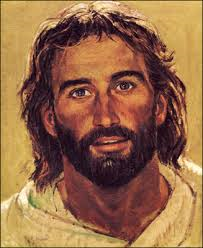
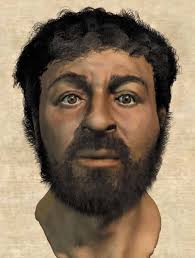
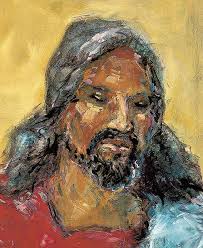
So there’s nothing remarkable about the attitude.  Once upon a time, I had a mother-in-law who sincerely disliked my favorite picture of Jesus.  That’s the one to the right, by Richard Francis Hook.  She grewr hook 2 up with the one on the leftr hook 1, by Warner Sallman.[1]  Neither one tells us much about what the actual historical Jesus looked like.  I have seen pictures that represented Jesus as meek and mild and as a raging Zealot; I have seen him with light skin and with dark skin; with a straight Greek-statue nose and with a large hooked nose.  I have never seen a picture of him as a short man.

Why?  Because we are a lot more like the old British gentlemen than we usually like to think.

So is there really any reason to think that Jesus was short?  Of course there is.  Do you remember this story, from Luke 19?

He entered Jericho and was passing through.  And there was a man called by the name of Zaccheus; he was a chief tax collector and he was rich.  Zaccheus was trying to see who Jesus was, and was unable because of the crowd, for he was small in stature.

r hook 4Who was small in stature?  The story doesn’t actually say.  It works either way, of course.  If Jesus were short, Zaccheus would have to gain some elevation to see him from the back of a crowd.  If Zaccheus were short, he would have to gain some elevation to see Jesus from the back of a crowd.  The question I asked earlier was whether there was any reason to think that Jesus was short.  I did not ask whether the story establishes that Jesus was short; certainly it does not.  We are still hesitating over our two choices: Jesus, Zaccheus; Jesus, Zaccheus.

r hook 5And it doesn’t actually matter.  Except that Christians made a good deal of use of the “Suffering Servant” passages in Isaiah.  Opponents of the early Christians maintained that Jesus couldn’t have been the Messiah because there are passages where the Messiah wreaks God’s vengeance, establishes justice, puts the enemies of Israel under his feet.  You might want to take a peek at the Magnificat of Mary in Luke 1 for a tidy little summary.  Christians retorted by citing passages like this one from the prophet Isaiah, Chapter 52.

Like a sapling he grew up before him, like a root in arid ground. He had no form or charm to attract us, no beauty to win our hearts;  he was despised, the lowest of men, a man of sorrows, familiar with suffering, one from whom, as it were, we averted our gaze, despised, for whom we had no regard.

r hook 6As modern Christians, we have no trouble accepting the essential unattractiveness of Jesus, especially as Lent crawls slowly toward Good Friday.  Except he was not short.  Not.  Not.  Not.  He might have been ugly, but at least he was tall.

Sometimes I wonder why we don’t just guffaw in the middle of a church service when dilemmas like this occur.  It might be good for us.


[1] About my picture, she always said that at least Jesus would have combed his hair.  What I always liked about my picture is that it represents Jesus as being interested in whatever is going on at the time.

Posted in Living My Life | Tagged , , , , , , | Leave a comment

Where you are going, you will need friends.

The title is today’s text.  With no context at all, it seems at least plausible.  When we get down to it, the context I will supply for “where you are going” will be the fact that we are all mortal.  The context Luke provides for this reflection will require something better than “plausible.”

I have been interested lately in some of Jesus’s teachings that are emphasized quite strongly in Luke.  I have two things in mind.  The first is this: how does Luke’s portrayal of Jesus represent the relationship of this life with the next life?  The second is, if that’s the way life is (and death and the continuing “life” after that), how would the prudent man or woman prepare for it?[1] 

Let’s start with an example so clear that it is right at the edge of silly.  A group of middle school children is going on a field trip to see an old growth forest.  Everyone was issued a big bag of potato chips and told the chips could be eaten whenever the children chose.  Group A ate theirs on the way to the forest; Group B saved theirs until the trip home.  I think that is Luke’s notion of the relationship between this life and the next.  You can eat ‘em now or you can eat ‘em later.

Still staying with the potato chips, let’s look at Luke, Chapter 6 and consider two fragments from “the Sermon on the Plain,” Luke’ version of Matthew’s “Sermon on the Mount.”  Somewhere in the middle of verse 20, there is this line: “Blessed are you who are hungry now for you shall have your fill.”  And down in verse 25, “Alas for you who have plenty to eat now: you shall go hungry.”

Those two sentiments—a benediction and a malediction—pivot on the expression “you have already had yours” in verse 24.  Clearly, this is in response to the unhappiness of the children who ate their chips on the way to the forest and now have none to eat.[2]  “You already ate yours,” is the response.  Now is the time for those who saved theirs to enjoy them.[3]

compensation 1Some will surely say that simplifies things unconscionably.  Yes, it does.  In the economic world of Luke’s time, it was thought that there was a fixed amount of wealth to be had.  If I had a lot, the effect would be that you would have very little.  There is none of the ever expanding pie of capitalism here; nothing of “a rising tide floats all boats.”  If you have wealth, you took it from me and my fellow proletarians.

You will note that this translates the snack example into a matter of moral worth.  The poor are morally good in this way of looking at it and the rich morally bad.  Let’s look at the parable of the successful farmer in Chapter 12.

“Then he told them a parable, ‘There was once a rich man who, having had a good harvest from his land, thought to himself, “What am I to do? I have not enough room to store my crops.”  Then he said, “This is what I will do: I will pull down my barns and build bigger ones, and store all my grain and my goods in them,  and I will say to my soul: My soul, you have plenty of good things laid by for many years to come; take things easy, eat, drink, have a good time.”  But God said to him, “Fool! This very night the demand will be made for your soul; and this hoard of yours, whose will it be then?”  So it is when someone stores up treasure for himself instead of becoming rich in the sight of God.’ “

He had a really good harvest that year.  We don’t know why.  Normally, in his culture, you would compensation 2expect him to take the poverty of the other farmers—or, more likely, farm hands—into account.  We are all brothers in the Covenant after all.  Three for me and one for you; five for me, and one for you.  That’s what a rich man should do.  The fact that he did not do it does not mean that he goes to everlasting punishment.  It does mean that he has put all his emphasis on getting and keeping as much wealth as he could and the hell with everybody else.  Jesus said, “So you emphasized accumulation to the exclusion of everything else and now you are going to die and everything you accumulated will go to other people.”  That’s what Jesus did say.  He could have said, “If you had shared it, you would have done a lot of good for a lot of people and wouldn’t be one whit worse off yourself.”  Being, you know, dead in either case.
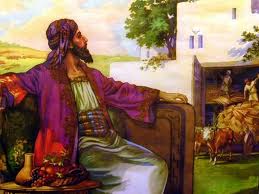
Now we move into the question of having friends.  In Luke’s vision, the rich are going to the uncomfortably warm and solitary end of Sheol and the poor to the blissfully cool and social end.  Looking at the story that is often called Lazarus and the rich man we find the compensatory character of the next life affirmed and we begin to see how nice it would be to have a friend.

“There was a rich man who used to dress in purple and fine linen and feast magnificently every day.  And at his gate there used to lie a poor man called Lazarus, covered with sores, who longed to fill himself with what fell from the rich man’s table.  Even dogs came and licked his sores.  Now it happened that the poor man died and was carried away by the angels into Abraham’s embrace.  The rich man also died and was buried.

“In his torment in Hades, he looked up and saw Abraham a long way off with Lazarus in his embrace.  So he cried out, “Father Abraham, pity me and send Lazarus to dip the tip of his finger in water and cool my tongue, for I am in agony in these flames.”  Abraham said, “My son, remember that during your life you had your fill of good things, just as Lazarus had his fill of bad.  Now he is being comforted here while you are in agony.”

Let’s consider, then, what the rich man—who is accused of no fault at all in this life—could have done.  He could have made Lazarus a beneficiary.  He could have made a friend.  Had he done that, he would have had someone in the next life who would put in a good word for him.  Nothing in this story says the rich man had any bad feelings about Lazarus.  I am sure he didn’t notice him at all.

I will go now into unrelieved fantasy.  You don’t have to follow if you don’t want to.  Notice that Lazarus has no speaking part at all.  He does not ask for table scraps, although we are told that he wanted them.  He does not intervene with Father Abraham either.  Abraham says, “My son, remember that during your life you had your fill of god things, just as Lazarus his fill of bad.  Now he is being comforted here while you are in agony.” Lazarus who, in this fantasy, could have interceded on the rich man’s behalf, says not a word.  The rich man has not won Lazarus’s favor and what will happen to the rich man otherwise, does happen.

Imagine that the rich man likes eating Chinese and one day, in his fortune cookie, he found this bit of wisdom, “Where you are going, you are going to need friends.”  He puzzles over it a little.  It is long for a “fortune.”  Then he returns to the Kung Pao Chicken with no thought to “where he is going.”

This is a choice the rich man made.  It was very likely so much a part of his daily life that it didn’t seem to be a choice at all.  It is, in that way, like many of the opportunities for choice that we all encounter.  But it is not the choice he would have had to make; he could have chosen otherwise.  And, in fact, in Luke’s next parable, a real scoundrel makes a much better choice.  Biblical scholars have found this parable challenging, but in the context I have provided for it, it is not problem at all.

“He also said to his disciples, ‘There was a rich man and he had a steward who was denounced to him for being wasteful with his property.  He called for the man and said, “What is this I hear about you? Draw me up an account of your stewardship because you are not to be my steward any longer.”  Then the steward said to himself, “Now that my master is taking the stewardship from me, what am I to do? Dig? I am not strong enough. Go begging? I should be too ashamed.  Ah, I know what I will do to make sure that when I am dismissed from office there will be some to welcome me into their homes.”  ‘Then he called his master’s debtors one by one. To the first he said, “How much do you owe my master?”  “One hundred measures of oil,” he said. The steward said, “Here, take your bond; sit down and quickly write fifty.”  To another he said, “And you, sir, how much do you owe?” “One hundred measures of wheat,” he said. The steward said, “Here, take your bond and write eighty.”  ‘The master praised the dishonest steward for his astuteness. “
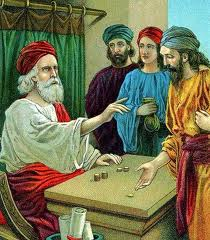
 compensation 5A steward is responsible for the use of his master’s financial holdings.  That is his job.  This particular steward has not been doing the job.  He has been skimming off profits for himself.  He has been discovered and now he is going to be fired.  But before that happens, the steward calls the major debtors into the office and cheats his master yet again.[4] 

No one says this is a good thing to do, but what it has in its favor is what the rich man in the first parable failed at.  The steward looks at the life he is now living and sees that it is coming to an end.  He knows that where he is going, he is going to need the active welcome of the poor—those who were in debt to his master—so he goes out and gets it.  He uses the resources he has in his present life to invest in “the life to come,” in his case, a life on the streets.

Pretty smart, says Luke.  He was not blinded by his current wealth and power to the fact that he is going to lose it all.  Not being blinded, he takes the initiative to prepare a welcome for himself.  He knows, in short, that where he is going, he will need friends.

A proverb cited in 1Timothy has it that “the love of money is the root of all evils.”  In these three Lucan parables, the question is whether the presence of money blinds you to the friends you could make in the next life. 

First Parable:  Jesus doesn’t raise that question about the man who built bigger barns, but the case could be made that if he shared his bountiful harvest with his neighbors, they would vouch for him in the next life.  In the next life, according to Luke’s picture, the poor neighbors will be in the good end of Sheol and the agribusiness tycoon in the bad end. 

Second Parable: The rich man did not attend, the way he might have, to the need to cultivate Lazarus’s friendship.  When the crucial moment comes, Lazarus says not a word on the rich man’s behalf. 

Third Parable: The fraudulent steward uses money—not his own money, but this is no time to be picky—to attend to what really matters.  He invests it in “the next life,” and when he gets there, all those poor debtors will vouch for him.  He will have a friend.

It doesn’t strike me as a consistent teaching of the gospels that there will be an economically compensatory afterlife.  On the other hand, I do think that all the gospels teach that the permanent things—“the life of the ages,” John calls it in Chapter 3—is more important than the ephemeral things of this life, to which we pay so much attention.

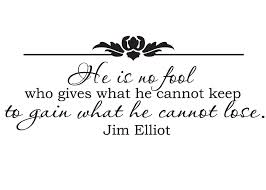
Here is the best summary of the point I have seen. compensation 4


[1] I am not counseling prudence, by the way.  I am only trying to see how clear I can make the implications of putting prudence first.

[2] According to Luke, “the trip home” takes a great deal longer than the trip out, but I want to keep my potato chip analogy and unequal trips are just too complicated.

[3] Actually, God provides the chips for the poor children on the way back, but you can’t make a story tell everything at once.

[4] That’s what Raymond Brown thinks.  His good friend, Joseph Fitzmyer, thinks otherwise.  Fitzmyer thinks that what the steward does is to reduce the debts by the amount of his commission.  That’s what the footnotes in the New Jerusalem Bible say as well. It doesn’t really matter from a theological standpoint, but it is good for me to see noted biblical scholars and good friends come down on opposite sides of the fence.


Posted in Biblical Studies, Theology | Tagged , , , , , , | Leave a comment

Does Democracy Actually Work?

There are a lot of reasons why it might not.  I have lectured for many years about why democracy might not work anymore or why it never really did, although it seemed to at the time.  When you approach the case from the backside, as in these instances, just what “democracy” ought to mean is a very complicated question.  I don’t have a very complicated question in mind today.

For today, I mean only this: Can the U. S. operate an adequately functioning government by the mechanism of electing legislators to Congress?[1]  Here’s a quick tour of what has happened recently.  President Obama (D) and Senate Majority Leader Harry Reid (D) and House Speaker John Boehner (R) came up with a “grand plan.”  It was supposed to turn the U. S. government ontopolitical solution 4 a new road, where entitlement costs do not keep increasing and where revenues are increased to cover the costs of “adequate functioning.”[2]  Speaker Boehner couldn’t sell it to his caucus in the House—at least he couldn’t sell it well enough to pass it with a majority of Republican votes, which is the standard he uses (the Hastert rule, it is called).

So we got the Sequester instead—a percent reduction in federal spending so stupid that the people on both sides who agreed to it thought that its monumental stupidity would surely cause people to compromise rather than endure it.  They didn’t.

Then there was the question of paying our debts.  You wouldn’t think that would be a question, really, since that is the effect of raising the debt ceiling.  President Obama wanted to raise the ceiling; Majority Leader Reid wanted to; Speaker Boehner wanted to—but the Speaker could not raise the necessary votes from the Republican caucus and we simply shut down the federal government.  Boehner had quite a few members of his caucus who would rather shut the government down—some had promised their constituents they would—than accept his leadership and make the compromise.

These two illustrations show that the Republican party in the House of Representatives has a sizeable minority of intransigent conservatives, who make it impossible for the leader of their party to actually lead them.  Republicans in the House and the Senate pleaded with them; told them they were going to be hated for what they were doing; told them they were ruining the Republican party.  Nothing worked.

A lot of solutions to this continuing dilemma have been proposed.  Some rely on new powers by federal agencies; some on new powers of the President; some on constitutional amendment. None of those meet the definition—democracy that works— I posed at the beginning, so we are brought back to the question of whether the legislature can be saved.  This is not easy.  It is a little like trying to save a kamikaze plane and pilot after it has taken off.  You will have to defuse the bomb, extend the range, provide additional maneuverability, and add some wheels—while it is in flight—if you want plane and pilot back safely.

Here is what is being done.

Steve LaTourette, (shown below) former Republican House member is leading a group called Main Street Republicans.

“Hopefully we’ll go into eight to 10 races and beat the snot out of them,” said former Rep. Steve LaTourette of Ohio, whose new political group, Defending Main Street, aims to raise $8 million to fend off tea-party challenges against more mainstream Republican incumbents. “We’re going to be very aggressive and we’re going to get in their faces.”

This is Strategy #1.  Moderate and conservative Republicans who care about the continued viability of their party and of the government of the U. S. simply go into the districts where the troublemakers are and beat them.  These are districts where the Republican candidate is certainly going to win the general election in the fall of 2014.  The question is whether the Republican candidate is gopolitical solution 1ing to be committed to his or her “principles,” so that the destruction of the party is an unfortunate side effect, or is going to be a Republican who will make the compromises necessary to restore the party and enable the government to govern.  Those races will all be held in the spring primaries of 2014.  That is how long LaTourette and his group have to show that their strategy works.

Here is Strategy #2.  The Democratic party is taking advantage of the very low approval ratings for the Republican House members by launching a very aggressive campaign to win back House seats.  Ordinarily, in off-year elections (between the presidential elections), whichever party controls the White House loses seats in Congress.  That might not happen this year.

Historic modeling doesn’t seem to apply any more to US congressional elections. The American electorate is impatient and anxious. They want results now, and by focusing on culture war issues instead of jobs and the economy, House Republicans are putting themselves back on the fast track to minority status.[3]

If I were the director of this play, I would instruct the Democrats to put their money into races against Tea Party candidates.  That would have the best effect on the Congress, on the Republican party, and for the robustness of legislative solutions to legislative problems—a solution I am calling “democracy.”  Of course, that is not what the Democrats are doing.  The Democrats are putting their money into the districts they are most likely to win.  The Republicans they are most likely to beat are moderate, business-oriented, mainstream Republicans.  Those are the very Republicans the Democrats have been calling for in the recent negotiations, but it turns out that the party thinks moderate (we would call the “conservative” if they were Democrats), business-oriented, mainstream Democrats are even better.  The result of the Democratic campaign, therefore, will be to eliminate the Republicans most willing to compromise with them.

political solution 2That brings us to Strategy #3.  Business-oriented groups who are accustomed to playing a part in primary and general elections and in actively lobbying the winners, who, after all, do become Congressmen, are beginning to actively seek the defeat of Tea Party Republicans.  And this is true even where the U. S. Chamber of Commerce supported those candidates two years ago.  The National Federation of Independent Businesses, which normally represents smaller businesses, is on exactly the same page as the Chamber of Commerce this time.

Taking on the ideological conservatives could be a bruising task for the business groups, but it’s something they say they now realize they have to do.

“Politics has always been a full-contact sport. The most active groups often command the most attention, and that’s why the tea party has risen in its influence within the GOP,” Mr. French said. “The shutdown has made it clear that the business community cannot afford to stay on the sidelines any longer. If you don’t like what’s going on in Washington, get in the game and make a difference.”[4]

So what could happen?

Democracy, as I have defined it, could be restored.  That’s one of the possibilities.  By the actions voters take, the unassimilable Tea Party members can be reduced in number, their seats being taken by conservative Democrats or moderate Republicans.  Some of the Tea Party Republicans who survive could be persuaded to care about the long term health of the Republican party and could, as a step in that direction, be persuaded to support the Speaker of the House, if it is still a Republican in 2015 when Congress reconvenes.

This is not a constitutional or executive or federal agency end run.  This is not “kicking the can down the street.”  This is candidates adapting themselves to the current concerns of their voters or losing their seats to candidates who did adapt. 

That is actually how democracy is supposed to work.  It is the legislative slice of what “popular sovereignty” means.  It would be so wonderful to see that happen.  I can picture James Madison and Thomas Jefferson and John Adams saying, “See.  I told you it would work.”


[1] I know that “adequately functioning” is a phrase that opens the door to all the backside questions I am trying to avoid.  Is the government “adequately functioning” if it loses the predominance in world affairs that Americans have gotten used to?  Is the government “adequately functioning” if it can continue to function only with a huge percentage of its citizens in prison—the highest percentage in the world?  I’m skipping all those, although they are perfectly good questions.

[2] There’s that weasel term again.  There are differences about what is needed and what levels are adequate, but all those views include the U. S. government maintaining a credit rating good enough to keep the costs of borrowing down.  The next step would be something like payday loan offices.  In Beijing.

[3] I took that quote from an analysis of the 2012 election.  I could have rephrased it, but I kept it just as it was to show that the Republican dilemma contains all the old choices as well as the new failures I have described.

[4] Says Patrice Hill in the Washington Times, a paper I have never before quoted.

Posted in Politics | Tagged , , , , , , , , | Leave a comment

What Good Health Is For

So I’ve been thinking about getting old and what I ought to do about it.

The model that has suggested itself comes from all the 10K races I have run over the years.  I should say that for me, even the 10 K is not run to beat anyone, so I don’t really run with a strategy in mind.  For me, I regret to say, the 10K is an endurance race.  I know there are some who treat it as a long sprint.

The way I run, there is a “middle of the race” caste of mind.  I think “am I going to be able to keep this pace up?”  I think, “Am I going to crash at the end and walk ignominiously across the finish line?”  I think, “Is there any chance I could attach myself to that group of runners, up ahead there, and get some extra pull from them?”  All these questions are based on extending my resources to meet the challenges of the race.  That is their common focus.

Then, at some point near the end, a change comes over me.  It isn’t something I do.  It is somethingRace 1 that I notice has occurred.  This change is based on two ideas.  The first is that I have often thought, very soon after crossing the finish line, that I did not run as daring a race as I now know I could have.  I think back on how discouraging that hill was and how, with just a little grit, I could have powered past it.  The second is that I am determined to cross the finish line with not very much left in the tank.  What, after all, is the point of saving resources until you have no use for them?  These questions have a different focus from the first set.  These questions are based on satisfying my criteria for running a race I am proud of, from the standpoint of having finished the race.

That shift which I have so often experienced in running is now taking place in my life generally.  It is not, please remember, something I do.  It is something I notice.  I think I am catching myself thinking back on “the race” now that the finish line is in sight and wondering whether I have really used all the resources I had.  I don’t want to be looking back on my life and thinking that I could have done a lot more if I hadn’t been so careful about husbanding my resources

This line of thought got a boost today as my brother, Mark, sent me a quote from George Bernard Shaw: “Use your health even to the point of wearing it out.  That is what it is for.”

You can probably see that “that’s what it’s for” captures my interest in using the remaining resources to meet the remaining tasks.  On the other hand, this isn’t a “bucket list.”  Nothing against bucket lists—those things you want to be sure to do before you kick the bucket.[1]  The direction pointed by “what my health is for” is, as you can probably see, the same direction as “how am I going to feel about the way I ran the race.”  On the other hand, running a 10K race has only to do with time and distance.  “Using myself appropriately” is more complicated.

How do I do that?  I have three things in mind.

The first is authenticity.  By this age, I really have become who I am.  I want to look back on my life from some mythological standpoint and approve of who I was during that last stretch to the finish line.  I want to judge that I did continue to be true to who I was—or at least as nearly as my declining capabilities allowed me to be. 

running 2The second is service.  There are actually some things I am really good at.  Some have grown naturally out of the way I have spent my life.  I know a lot more about politics than most people do, for instance, having taught it and studied it and even practiced it.  I know how to hold a political frame of reference in place so that people can locate their own positions with reference to it and think more clearly about their own values and commitments.  Holding that frame steady is a service to them and I will be proud if I have done it well.  That same thing is true, it turns out, for a theological frame of reference.  My lifetime of study and my good fortune in finding mentors have given me a strong theological frame of reference that I really don’t feel I need to justify.  I can just hold it steady and let people—former fundamentalists, in many cases—make whatever use of it they need to make.

Other notable resources have grown out of experiences I have had, especially hard experiences.  I am a veteran of a failed marriage, for instance, and I am a widower as well.  Those two experiences have enabled me to look people in the eye and say, “I know what you are talking about.”  They believe me when I say that and that enables me to provide a service to them.  They can say to me things they would never say to someone they think would not understand.

The third is a willingness to keep growing.  I do want to keep my life in continuity with the person I have been—authenticity is what I call that—but I also want to transcend my thought patterns and behavior patterns when they no longer serve me.  I want to keep paying attention to the vital question “Is it working?”  I want to be willing to change, when necessary, when “what used to work” doesn’t work anymore.

I do want to continue the behaviors that I called “service” above, but those same behaviors will not always really be “service.”[2]  It has often been a service to hold a frame of reference in place, but there may come a time when all out full-throated advocacy is what is called for. I hope it doesn’t come to that.  I’m not really any good at it.  But if it does come to that, I hope I will move my habitual caution out of the way and let ‘er rip.

I want to look back from that mythological standpoint after I have ended “the race” of my life and approve the race I ran.  That means being willing to do new things, even at my age, when the old things aren’t worth doing anymore or have become impediments to the work of others.  The constant element, I hope you see, is that I want to look back and approve of the work I did and the choices I made.  Authenticity is a good thing, but it is not ultimately good.  “Service” is a good thing, but it is not ultimately good.  “Changing tactics” is a wonderful ability, but it might be just the wrong thing to do in the situation.  All those change.  Being proud of the judgments I made—even the misjudgments, if they were honest and courageous—is what does not change.

Finally, I want to confess that I do believe in providence.  I believe that God has something in mind for how human life is going to turn out.  I believe there are implications, in that plan, for what I, personally, ought to be doing.[3]  I believe I am not at all likely to know what these providential twists and turns are at the time I am making the necessary judgments.  That means I must act in circumstances where I don’t actually know what I am doing.  I must act, but I don’t know what action is required.  I am balanced on the existential razor’s edge.

On the other hand:

If [I could believe] that the context in which [I am] living and acting were the outworking of the loving purposes of a God who wills that [I act] in freedom and who will therefore [sustain me] in freedom, not permitting [me] to destroy [myself] or [my] loved ones, [I] could act freely.[4]

That’s how I reconcile the bewilderment of a belief in the unknowable providence of God and the need to make day to day decisions so I can look back on them and be satisfied.  It’s tricky to hold both of those, I grant you, but it has worked so far.


[1] A metaphor made current by Jack Nicholson and Morgan Freeman (2007) in their movie of that name. 

[2] Not everything the band does in “proving entertainment” is actually entertaining.  Not everything the “security officers” do makes us more secure.  Calling an act a “service” doesn’t really mean that it serves anyone’s interests.

[3] In my notion of the providence of God, “the right thing” is not necessarily the difficult thing or the costly thing to do.  Sometimes, it is just the joyous performance of the tasks your life has prepared you to fulfill.  People who think you are not doing what you should be doing on the grounds that you are having fun doing it don’t know how much God loves dilettantes.

[4] That is theologian Gordon D. Kaufman’s summary of just how “salvation” works within the Christian tradition.  I love each and every word of it.  Kaufman is one of the people I called “mentors” earlier although I never met him and although he changed his mind about a lot of his theology after he wrote this.  I have altered the quotation only by changing all the third person plurals to first person singulars.

Posted in Getting Old, Living My Life | Tagged , , , | Leave a comment

Tanya Luhrmann, Halloween, and Ghost Pets

I want to begin this consideration of paranormal experiences with the first line of the Wikipedia entry under T. M. Luhrman.[1]

“Tanya Marie Luhrmann (born 1959) is an American psychological anthropologist best known for her studies of modern-day witches, charismatic Christians, and psychiatrists.” 

Luhrmann 1How could anyone not be drawn to a scholar who studies witches, charismatic Christians, and psychiatrists?  And besides that, she studies charismatic Christians as an anthropologist studies an interesting local population.  She is with them, she learns their language, she is trusted by them, but she is not one of them.  Yet.

She is beginning to raise some concerns, however, and this post will be about those concerns.  Here is her Halloween column, including some really good stuff about the origins of the seasonal celebration.  Let’s start with the first two paragraphs.

When my dog Dorothea died — she was the first dog I’d chosen for myself, and she had looked at me in a certain way when I visited the shelter, making me feel that I could not leave without her — she left a nearly unbearable ache in my heart. Dogs do this: They hold joy and love and solace in a way humans can’t, and then they die. But after she died, I heard her. I was sitting at my desk and the sounds of her nails tap-tapping down the wood floor of the hall came to my ears, and only when I turned to look for her did I remember that she was gone. Sometimes I felt her presence, like a heaviness on my lap or at my side. Sometimes I still do.

It turns out that this is not uncommon. As many as 80 percent of those who lose loved ones report that they sense that person after death. These are real sensory events. People hear a voice; they feel a touch; they recognize a presence. A friend told me that a year after her husband’s death, she would still find him sitting on that bench in the park, waiting for her. She liked that. In fact, one of the central research findings in this area is that post-bereavement experiences are helpful. They’re also more likely to occur after long and happy marriages. (There appears to be no research yet on pet loss.)

The word I want you to see is “recognize,” in the fourth sentence of that second paragraph.  “They recognize a presence,” Luhrmann says.  Do they?

Luhrmann says she “heard” the sound of Dorothea’s nail tapping on the wood floor.  Did she? Luhrmann 2 What does it mean to “hear” something?  Luhrmann says that she sometimes felt a heaviness on her lap.  OK.  Or she felt it “at her side.”  That one makes me uncomfortable.  How about you?   Is the dog this man is petting “really there?”  Does he know the dog is there?

These are, Luhrmann says, “real sensory events.”  She means by that, I think, that her ears did actually record the sound of the tapping on the wood floor.  I think Luhrmann would say that a properly placed sensor would show her ears hearing something.  Actual neurons are used in this process.  I think that’s what she means by a “real sensory event.”

So people “hear a voice.”  I’m OK with that.  I myself would say I thought I heard a voice, but perhaps that is just a matter of rhetorical style.  “They feel a touch.”  OK.  They “recognize a presence.”  Uh oh.  This might just be a casual use on her part, but I don’t think so.  I think her choice of “recognize” means that the person who was sensed was “there,” in some way, and was the person he or she was “sensed” to be. That’s what I would mean if I wrote that line.

Not to get all lexy or anything[2] but here’s the Oxford English Dictionary on “recognize.”  This is meaning 5a: “To know again.  To perceive to be identical with something previously known.”  The word comes apart easily.  To cognize = “to know” and re- has its common (but not invariant) meaning of “again.”  The difficulty is with “identical with something previously known.”  In context, this means “identical with my late husband,” and that means “is” my late husband.

Luhrmann is not, herself, a charismatic; she is an anthropologist.  She is a scientist.  It is her job to say that her informants say that they “heard a voice.”  It is her job to say that the informants believed that the voice belonged to a well-known relative who had died some time ago.  When she says they are right in believing what they do—and that is what “recognize” means to me—I think she has stepped over a line.  She has, at the very least, taken me out of my comfort zone.

Still, lines like the one Luhrmann stepped over, don’t always stay where we draw them.  What causes the pain from a “phantom limb.”  We have long known that people can feel pain from limbs that are no longer there.  This pain is “a real sensory event.”  It means that the neurons what once had the job of passing along to the brain the events in the arm have continued to send messages about that arm when there is no longer an arm.  This isn’t paranormal activity.  Ways have been found to successfully treat phantom pain, at least some of the time.

I don’t think that’s what Luhrmann is writing about.

I could be helped a good deal if Luhrmann would separate the sensory event and the interpretation of the event.  Luhrmann feels a heaviness on her lap.  It is like the heaviness she used to feel when her dog, Dorothy, lay there.  Her interpretation of that sensory event is what is at stake in her column.  Is she remembering Dorothy?  Is she recalling the times she sat there with Dorothy on her lap?  Does she think that Dorothy is there right now, producing the same sense of weight she always did, although Dorothy no longer has a body?  Or no longer has a visible body.  Or something.

I am not, as you can tell, attracted to paranormal interpretations.  “Feeling the weight in her lap” is fine with me.  Her neurons are doing what neurons do.  The part of the brain that responds first identifies that weight as consistent with or evocative of those times with Dorothy.  But then another part of the brain says, “Wait.  Could this be?”[3]

I say No.  Luhrmann says No sometimes and Yes other times.  That’s the way I read her.  Her expression “recognize a presence” in the second quoted paragraph is a Yes response as I see it.  Do you see it that way?


[1] Also to distinguish my use of Wikipedia from Sen. Rand Paul’s use of it.  According to the clips I saw on the Rachel Maddow show yesterday, he looks right at the teleprompter and reads whole paragraphs of Wikipedia material as if it were his own.  I don’t want anyone to think I am doing that. 

[2] Proposed new word, belonging to the family of “truthiness.”  I could have said “lexicographical,” sure, but my son, Doug, and I are working our way through Anne Curzan’s lectures on linguistics and I am feeling daring.

[3] In other writings, Luhrmann emphasizes that some people have more natural capacity for attributions like this and that you can get better at it if you work at certain skills.  Those distinctions are not what this column is about.

Posted in Living My Life, Paying Attention, ways of knowing | Tagged , , , | 1 Comment

The Five Big Issues in Supreme Court’s Current Term: Presidential Power

This is the fifth and last of a series of posts on the issues that Adam Liptak has identified as prominent on the agenda of the Supreme Court in its current session.  Liptak listed campaign finance, abortion, affirmative action, prayer and presidential power. I have dealt with them in that order.  The remaining issue is presidential power.

This series of posts has been about political ideology—liberalism and conservatism—but it has approached ideology through a series of court cases.  That means that a caution is in order.  It is this: principles are not cases. Ideologies are notoriously general; cases notoriously particular.  That’s important. 

I can say I am a liberal (I am) and look at the likely implications of my liberalism, but when a particular case comes up, some difficulties can come up with it.  It may not be clear just what a liberal ought to want from the Court in this case.  Do the proper resolution of this case and the confirmation of my political ideology always point in the same direction?  No, actually, they don’t always.  They don’t today, in fact.

The questions I have been asking in this series are: a) being a liberal, what outcome do I expect to want; b) as I read the case, what decision seems fair and reasonable to me; and c) do my preferences for this case and my political position fit nicely together?  Might I, for instance, have to question my liberalism on the basis of this case? 

This is a family sort of game.  You are all invited to play along.  Pick the ideological name you apply to yourself, read the case on http://www.oyez.com and choose what action you want the Court to take, and then reflect on your ideology in the light of your decision.

The case that brings the presidential power question to us is National Labor Relations Board v. Noel Canning.  The Oyez summary for this case is long and complicated and beside the point. You can see it here if you are curious.  What follows is the Hess Summary.

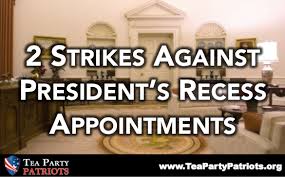
 Senate recess 1Noel Canning, a distributor of Pepsi products committed an action that the Teamsters Union called “an unfair labor practice.”  The National Labor Relations Board (NLRB)—consisting at the time of the one (1) member who had been duly confirmed by the U. S. Senate—agreed that it was unfair.  Canning pointed out that there must be a quorum for the Board to make any rulings at all and that one member, on a five member panel, does not constitute a quorum.  There were two other members on the Board at the time—a total of three, an official quorum—but President Obama had appointed these other two as “recess appointments.”

The power of the President to make “recess appointments” is what this case is about.  Or, to look at it from the other side, the power of the Republicans in the Senate to keep the President from making any recess appointments at all is what this case is about.  Let’s look at that side first.

The Republicans would really rather there would not be a National Labor Relations Board.  If there has to be one, they would rather it be composed of pro-business, anti-union members.  President Obama is deeply beholden to the unions for their support of his candidacy and for that reason, among others, he has been nominating pro-union members to the NLRB.

Is there anything the Senate Republicans can do to prevent the President from doing this?  Of course.  There are lots of ways and they have been used over the years by whichever party is in the minority in the Senate.  But on this round, the Republicans came up with a new one.  Here’s how it goes.  The President is constitutionally permitted to make an appointment while the Senate is in recess.  The way to block this power is for the Senate never to go to recess.

But wouldn’t that be a huge inconvenience for the Senators from, say, Oregon, who really want to and need to “go home” during the Senate recess?  No, not at all.  You see, the Senate doesn’t really need to be “in session.”  The Republicans can prevent the Senate from recessing by lodSenate recess 3ging an objection to it.  Then they can ask a Republican Senator from a nearby state to briefly open and close a faux “session of the Senate.”  No business is conducted.  Only the presiding Senator is present in the chamber.  Imagine that this is the guy. The Senate members (99 of the 100 of them) are gone, but still the Senate is not “in recess.”  If the Senate is never in recess, President Obama cannot make recess appointments.

That’s how it is done.  The Supreme Court is being asked, in NLRB v. Noel Canning, to decide whether this one Senator’s performance means that the Senate is “in session.”  If the Senate is in session, then the President cannot make recess appointments.  If the President cannot make recess appointments, then he did not really appoint those other two members of the NLRB.  If he did not really appoint those members, then there is only one member of the NLRB and there is not a quorum.  If there is not a quorum, then the NLRB did not really agree that Noel Canning violated the rights of the Teamsters, as they alleged in their suit.

As I come to my liberal moment in this post, I have to admit that when the system is this broken, it is hard even to know what to want.  Denying the constitutional powers of the President to make recess appointments is a serious constraint on his powers.  I don’t want any President, especially one I like, to be deprived of those powers.  On the other hand, I don’t want a President to be able to declare, on his own authority, that the Senate is in recess, when according to the rules of the Senate, they are not in recess.

Senate recess 4There is, in other words, no good solution to the issue as it stands.  There is no liberal solution and no conservative solution.  Mitch McConnell, the minority leader of the Senate and the architect of the faux sessions strategy, can win if the Court agrees that the Senate really was in session.  That would be a win for any Senate minority leader from here on, Democrat or Republican.  Barack Obama could win if the Court agrees that a faux session is not really a session and that if faux sessions are all that is going on, the Senate is actually in recess, no matter what they call it.  That would be a win for any succeeding President and would increase any President’s power over the Senate.

I don’t like either of those.  We lose—the American people lose—either way.  It’s hard not to hope that President Obama wins but there is no way for President Obama to win without “all succeeding Presidents”  winning and I am pretty sure I am not going to like all the Presidents that succeed President Obama and I don’t want they all to be empowered.

I want the Presidents I like to have more power and the Presidents I don’t like to have less power.  That is not what the Court is going to decide.  I’m pretty sure of that.


Posted in Politics | Tagged , , , , | Leave a comment

The Five Big Issues in Supreme Court’s Current Term: Prayer

This is the fourth of five posts.  I have taken the issues in the order that Adam Liptak listed them in his New York Times article, so I have considered campaign finance, abortion, affirmative action.  Today we look at prayer.

The most substantial caution for this series is that this post considers ideology, mostly, but it does so by looking at Supreme Court cases.  As everyone knows, however, principles are not cases. That’s important. 

religion 2I can say I am a liberal (I am) and look at the likely implications of my liberalism, but when a particular case comes up, some difficulties can come up with it.  It may not be clear just what a liberal ought to want from the Court in this case.  Do the proper resolution of this case and the confirmation of my political ideology always point in the same direction?  No, actually, they don’t always.

My standard set of questions would be: a) being a liberal, what outcome do I expect to want; b) as I read the case, what decision seems fair and reasonable to me; and c) do my preferences for this case and my political position fit nicely together?  Might I, for instance, have to question my liberalism on the basis of this case? 

This is a family sort of game.  You are all invited to play along.  Pick the ideological name you apply to yourself, read the case on www.oyez.com and choose what action you want the Court to take, and then reflect on your ideology in the light of your decision.

A short way to summarize the guarantees of religious guarantees of the First Amendment is that itreligion 1 provides freedom of religion—freedom for believers to engage in their own religion’s practices—and freedom from religion; no practice of government, in other words, favors one religion over another or “religion” over “irreligion.”  Note that irreligion is not pictured on the graphic.  For that, you have to go to the last one in this post.

Liberals, when they are thinking of freedom of speech, favor everyone’s right—religious people as much as secular people— to say nearly anything.  When we are thinking of freedom of religion, instead of freedom of speech, we are very wary of religious speech practiced by the government.  That’s what this case is about.  Since this case is about religion, I would anticipate being opposed to religious exercises by governments.

Conservatives come at this differently.  They start with the society, not the polity.  They note that there are many communities in the U. S., and even some states, where there are more Christians than there are members of any other religious faith, including, they point out, “secularism.”[1]  Why, they wonder, in a Christian town—a town where a majority of residents is Christian—can we not have a Christian practice at the meetings of our town council.

Here are the facts, as Oyez describes them, ending, as always, with the question.

Facts of the Case 

The town of Greece, New York, is governed by a five-member town board that conducts official business at monthly public meetings. Starting in 1999, the town meetings began with a prayer given by an invited member of the local clergy. The town did not adopt any policy regarding who may lead the prayer or its content, but in practice, Christian clergy members delivered the vast majority of the prayers at the town’s invitation. In 2007, Susan Galloway and Linda Stephens complained about the town’s prayer practices, after which there was some increase in the denominations represented.

In February 2008, Galloway and Stephens sued the town and John Auberger, in his official capacity as Town Supervisor, and argued that the town’s practices violated the Establishment Clause of the First Amendment by preferring Christianity over other faiths. The district court found in favor of the town and held that the plaintiffs failed to present credible evidence that there was intentional seclusion of non-Christian faiths. The U.S. Court of Appeals for the Second Circuit reversed and held that the practices violated the Establishment Clause by showing a clear preference for Christian prayers.

Question 

Does the invocation of prayer at a legislative session violate the Establishment Clause of the First Amendment even in the absence of discrimination in the selection of prayer-givers and content?

religion 3The two perspectives are clearly presented in the Oyez account.  The district court wondered whether there was an intentional seclusion of non-Christian faiths.[2]  They found that there was not.  I imagine that they counted the percentage of Christians in town and then the percentage of prayers that reflected Christian presuppositions and found they entirely appropriate.  That’s the decision conservatives would like. The court of appeals found that the pattern of prayers showed a marked preference for Christian prayers and that preference is just what the Framers were trying to prevent when they said there should be no “establishment of religion.”  That’s the decision liberals would like.

So what do I learn about my liberalism by thinking about my reflexive vote for the U. S. Supreme Court to agree with the court of appeals?  Not a lot.  Being a Christian myself, I have no worries that “religious perspectives” are going to take over society.  I think that might be really good for society, depending on what the alternatives are, but it would be really bad for the government, which is supposed to be the government for us all.  But being a Christian, I am not as wary of Christian presuppositions as members of other religions or no religion would be.

I think this is a lot like knowing what foods contain gluten. I am quite sure I would be more awarereligion 4 of foods that contain gluten or that have touched anything containing gluten if my aversion to gluten were extreme and disabling.

For liberals, religious practices by governmental bodies are “gluten.”


[1] Whether “secularism” is a “faith” or not is an interesting and complicated question.  The Court has answered yes in some contexts and no in others.

[2] I would have said an “exclusion,” but maybe “seclusion” has some formal meaning I don’t know about.  Since this is Oyez, it probably isn’t a typo.

Posted in Politics | Tagged , , , , , | Leave a comment

The Five Big Issues in Supreme Court’s Current Term: Affirmative Action

This is the third of five posts.  I covered the Court’s opportunity to deal with campaign reform the day before yesterday; yesterday it was abortion; today it is affirmative action.  All five issues and the associated cases are drawn from this article by AdamCourt term 5 Liptak in the New York Times.

If we are going to talk about political ideology and court decisions, we need to remember that principles are not cases.  I can say I am a liberal (I am) and look at the likely implications of that position, but when a particular case comes up, some difficulties can come up with it.  It may not be clear just what a liberal ought to want from the Court in an affirmative action case.  Do the proper resolution of the case and the reaffirmation of my political ideology always point in the same direction?  Alas, they don’t always; then I have to choose between them.

The questions that are applicable to all these cases are these: a) being a liberal, what social and political outcome do I expect to want; b) as I read the case, what decision seems fair and reasonable to me; and c) do my preferences for this case and my political position fit nicely together?  Might I, for instance, have to question my liberalism on the basis of this case?

This is a family sort of game.  You are all invited to play along.  Pick the ideological nameCourt term 6 you apply to yourself, read the case on www.oyez.com and choose what action you want the Court to take, and then reflect on your ideology in the light of your decision.

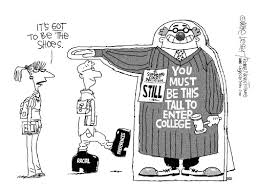
For me, the answer to the first question has to be ambiguous.  So what is “affirmative action?”  First, it is a euphemism.  Nothing wrong with that.  Second, it means “don’t just stop discriminating against racial and ethnic minorities,” but rather take positive steps to favor those minorities.  President Kennedy’s language in Executive Order 10925 (1961) says both that government employers “not discriminate against any employee…because of race, creed, color, or national origin,” but also that government employers should “take affirmative action to ensure” that they employed and treated without such regard.

If you have only the welfare of racial and ethnic minorities (and, currently, of women) in mind, then the negative phrasing (stop discriminating against) and the positive phrasing (take actions to ensure) are equivalent.  But then, who really has only the welfare of those minorities in mind?

And then there is this: if the government takes positive action to ensure the employment of those people, what happens when there is not enough room for (in college admissions) or not enough contracts for (in government contracting) my people?  Is “not being discriminated for” really the same as “being discriminated against?”

And then there is this: how will you know when you are done?  Is “affirmative action” forever?  Is it until some balance in employment and admissions questions is reached?  If we are waiting for “balance,” have we specified a quota system of some sort?

Court term 7And then there is this: is admission to a university by affirmative action going to tar you for the rest of your life.  Is it like being hired because you are related to the boss?  Even if you show yourself to be worthy by your own good work, will you ever be judged just on your own work or will the conditions of your admission or your employment always be held against you?[1]

So with all my initial ambivalence as a liberal, what about the case itself?  This is Schuette v. Coalition to Defend Affirmative Action.  Here is what Oyez.com has to say about it.

Facts of the Case

In November 2006 election, a majority of Michigan voters supported a proposition to amend the state constitution to prohibit “all sex- and race-based preferences in public education, public employment, and public contracting.” The day after the proposition passed, a collection of interest groups and individuals formed the Coalition to Defend Affirmative Action, Integration and Immigration Rights and Fight for Equality by Any Means Necessary (Coalition). The Coalition sued the governor and the regents and boards of trustees of three state universities in district court by arguing that the proposition as it related to public education violated the Equal Protection Clause.

Question

Does an amendment to a state’s constitution to prohibit race- and sex-based discrimination and preferential treatment in public university admission decisions violate the Equal Protection Clause of the Fourteenth Amendment?

Answer: well, kind of.  If the equal protection clause requires affirmative action or if it Court term 8allows affirmative action, then the voters of Michigan should not be allowed to annul it because of their local preferences.  That’s just nullification, a very popular pre-Civil War response in the South.  But the Court has been squeezing down harder and harder on just how a goal should be defined (quotas are bad) and what purposes justify involvement by the federal government (“racial balance” is bad, but “diversity” is good).

So what does this do to my liberalism?  It puts a dent in it.  I’m not sure I know any white liberals who have deep misgivings about affirmative action.  This is one of those questions where the society really ought to solve it by not being racist (or sexist or any of the other –ists).  That’s the only really good solution.  But if society doesn’t solve it and people call on government to solve it, it is going to be clunky and expensive and confusing.  That’s what it is now.


[1] You might, in that regard, want to consult Stephen Carter’s Reflections of an Affirmative Action Baby.  Carter describes himself as both a “beneficiary” and a “victim” of affirmative action.

Posted in Politics | Tagged , , , , , | Leave a comment

The Five Big Issues of the Supreme Court’s Current Term: Abortion

This is the second of five posts.  I covered the Court’s opportunity to deal with campaign reform yesterday; today, it is abortion’s turn.  All five issues and the associated cases are drawn from this article by Alan Liptak in the New York Times.

Principles are not cases.  I can say I am a liberal (I am) and look at the likely implications of that Terry Clineposition, but when a particular case comes up, some difficulties can come up with it.  It may not be clear just what a liberal ought to want from the Court in this case.  Do the proper resolution of the case and the reaffirmation of my political ideology always point in the same direction?

My questions would be: a) being a liberal, what outcome do I expect to want; b) as I read the case, what decision seems fair and reasonable to me; and c) do my preferences for this case and my political position fit nicely together?  Might I, for instance, have to question my liberalism on the basis of this case? 

This is a family sort of game.  You are all invited to play along.  Pick the ideological name you apply to yourself, read the case on www.oyez.com and choose what action you want the Court to take, and then reflect on your ideology in the light of your decision.

My best characterization of the availability of abortion is borrowed from Bill Clinton’s 1992 said abortions should be “safe, legal, and rare.”  The legality criterion means that a woman and her doctor should be free to choose the procedure they think best until the third trimester, when the state acquires an interest in a new citizen who will one day register and vote.  Since abortions will be performed, whether they are legal or not, the safety criterion requires that abortions not needlessly endanger the lives of the women who are undergoing them.  The rarity criterion meant, in 1992, that abortion ought not to be chosen very often.  It isn’t a method of birth control; it is a cataclysmic event that should be chosen only seldom.[1]

So knowing that it is an abortion question and that liberals (including me) want to see the right to choose an abortion to be protected, I would anticipate that I would want the Court to rule negatively.  I want them to tell Oklahoma to get on with the process of protecting the constitutional rights of the women of Oklahoma.

Of the two abortion cases that will come before the Supreme Court this term, Cline is more interesting.  Here is what Oyez has to say about it.

Facts of the Case 

In 2011, the Oklahoma state legislature passed a bill that restricts the use of abortion-inducing drugs to the uses described on their Federal Drug Administration (FDA) labels. The law criminalizes the use of these drugs in alternative combinations, known as “off-label uses,” that have been found to produce safer, less costly abortions. Before the law took effect, the Oklahoma Coalition for Reproductive Justice and Nova Health Systems sued the state in state district court and sought an injunction to prohibit enforcement of the law. They argued that the law effectively banned abortions in violation of both the state and federal constitutions. The state district court held the law unconstitutional and the state officials appealed to the Oklahoma Supreme Court. The Oklahoma Supreme Court held that the state law conflicted with Supreme Court rulings that protected a woman’s right to seek an abortion and was therefore unconstitutional.

Question 

Did the Oklahoma Supreme Court err in holding that the state law restricting the administration of abortion-inducing drugs to the uses described on their FDA labels conflicts with Supreme Court rulings that protect a woman’s constitutional right to seek an abortion?

Court term 4The “Cline” in the name of the case is Terry L. Cline, Ph.D., Oklahoma Commissioner of Health. [2]  Presumably, he is the person who would carry out the Oklahoma legislature’s ban on “off-label” uses and I’d guess that is why he is named in the suit.  This battle in one of the innumerable detours built by conservative states to get around the roadblock Roe v. Wade erected.  The Oklahoma Supreme Court noted that implementing this law would conflict with prior rulings of the U. S. Supreme Court and that, therefore, Dr. Cline should not implement them.

Now that I have read about the case, I look at the formulation of the question.  “Did the Oklahoma Supreme Court err…?”  My answer is Yes, they did err and they should be forced to end that particular error.  The legislature in Oklahoma, in other words, may not take away rights guaranteed to the women of Oklahoma by the U. S. Constitution (as interpreted by the U. S. Supreme Court).

I didn’t really learn a lot about my liberalism from this case.  I am not an abortion rights activist—or, really, any other kind of activist[3]–but I think the current position of the law is clear and women ought to be protected in their right to choose legal remedies.

The next issue is affirmative action.  You might start consulting your liberalism/conservatism to see where you might wind up.


[1] The rarity criterion was not met, in Bill Clinton’s formulation, but the current Republican practice of shutting down any clinic where an abortion could be performed and de-funding Planned Parenthood.  Those practices do make abortions rarer, in those states that have pursued those measures, but they don’t make them rarer in other states and they don’t make them safer at all.

[2] By the way, I chose this picture from “images” after I had googled “abortion.”  You can scarcely imagine the graphic choices I had on that page.  You may thank me now for choosing this one.

[3] With the possible exception of apostrophe abuse and expressions like “very unique.”

Posted in Politics | Tagged , , , , | Leave a comment

The Five Big Issues in the Supreme Court’s Current Term: Campaign Finance

This is the first of five posts.  Each of the five issues gives you an opportunity to ask yourself, “Just what do I mean when I say I am a liberal or a conservative (or whatever designation you use for yourself)?”  It’s a question worth asking.  You might not be sure what label to use.  If you do use one label consistently, you might not be sure just how that applies to concrete situations.

I can ask the question more simply of myself, since I am a garden variety liberal.  My questions would be: a) being a liberal, how do you imagine you will respond to today’s issue (campaign finance); b) having read about McCutcheon v. FED, what do you think ought to be done; and c) does this position confirm or challenge your idea of yourself as a liberal?

I’m going to be using Adam Liptak’s article in the New York Times as my information source (here it is) about the current term of the court and www.oyez.com as my information source about each of the cases.  Today’s issue is campaign finance.

Being a liberal, I am bothered by how much influence wealthy people have in our elections.  I don’tCourt term 2 like the way they dominate the lobbying of Congress either, but that isn’t today’s topic.  The Supreme Court’s standard—one man, one vote—in Reynolds v. Simms (1964) seems like a good one to me.  “One dollar, one vote,” which is what happens to the political system when unlimited amounts of money may be dumped into it and candidacies bought and sold in from of God and everyone, seems like a bad standard.

For that reason, the Congress passed the Bipartisan Campaign Reform Act in 2002, putting two kinds of limits on how much money could be given in a campaign and to whom.  In the 2010—2011 election cycle, Shaun McCutcheon wanted to give more money—in the aggregate—than  the law allowed.  Here are the basic facts of McCutcheon v. FEC as presented by www.oyez.com, the easiest to use of the Supreme Court sites.

http://www.oyez.org/cases/2010-2019/2013/2013_12_536

Since the Federal Election Commission is responsible for enforcing the provisions of the Bipartisan Campaign Reform Act, McCutcheon sued them.  His case is set to be heard by the Supreme Court this term.

Court term 1McCutcheon wants to go the wrong direction, according to my values.  He wants to increase the amount of money wealthy people can invest in politics and I would like to decrease it.  That’s where my liberalism brings me.  So I hope the Court will decide against him and that the aggregate limits for political donations will stay where they are.  As I reflect on my political ideology, as it show up in this case, I think I got it right.  I’m liberal.


Posted in Politics | Tagged , , , , , | Leave a comment