Using the Right Words

I wish a happy 2014 to you all and as a step toward that happiness, let’s look at one of my favorite scenes from II robot 1, Robot.[1]  The guiding genius behind U.S. Robotics’ (USB) success was Alfred Landingham, who appears to have thrown himself out of the window very near the top of a tall office building.  Detective Del Spooner (Will Smith) has been called to investigate and Dr. Susan Calvin (Bridget Moynihan) is escorting him around the building, as you see.

Spooner:  So, Dr…Calvin.  What exactly do you do around here?

Calvin:      My general fields are advanced robotics and psychiatry[2] although I specialize in hardware to wetware interfaces in an effort to advance USR’s robotic anthropomorphization program.

Spooner:  So…what do you do?

Calvin:    I…make the robots seem more human.

Spooner: Wasn’t that easier to say?

Calvin:    (reflects briefly on the question)  Not really.  No.

It’s not hard to make fun of Dr. Calvin’s answer and that is really why this exchange is in the movie at all.  I think it is a really good answer in many ways, but it is not a good response to Detective Spooner.  Dr. Calvin’s answer is formal.  This is the answer she would give to a new colleague she would meet at an academic convention or a trade show.  It gives the fields of her training first—advanced robotics and psychiatry.  It gives the field of application second—hardware to wetware interfaces.  It gives the goal third—robotic anthropomorphization.  Every one of those terms leads in an appropriate and helpful academic direction.  They are very nearly citations of the relevant academic work.

Detective Spooner is not someone Dr. Calvin would meet at the conferences.  He is a very good cop, he hates robots, and his method is highly intuitive.  This is a very bad answer for him.  The good answer comes next.  You can see Dr. Calvin stumble in the ellipse between “I” and “make.”  She’s working on how to phrase her work in a very general way.  It has been a long time since she has had to do that.  When she comes up with it, however, it is a really good answer: “I make the robots seem more human.”

Spooner now knows what she does and that really ought to end the conversation, but Spooner wants to reprove Calvin for giving herself a needlessly difficult task.  He has no idea that it is easier for her to give the first answer than the second.  She does stop, though, and give his question some consideration.  The answer she gives is not a response in any way to his discomfort with “the long answer.”  It is a simple and honest answer: No, the long answer I gave was easier than the short answer you wanted.

I have enjoyed that little patch of dialogue for years.  Also, robotization in general and the interactive performance of affect will be a major topic in 2014 and I wanted to get an early start.[3]


[1] For those of you who are fans of the book, I, Robot, the movie has very nearly no relationship to the book.  On the other hand, the book does not have this exchange between Will Smith and Bridget Moynihan.

[2] It really isn’t that funny.  Dr. Calvin’s work has produced a very difficult reality in the current movie, Her, in which, according to the blurb: “A lonely writer develops an unlikely relationship with his newly purchased operating system that’s designed to meet his every need.”  It is Dr. Calvin and her colleagues who have done the designing.

[3] “Interactive performance of affect?”  Are you kidding me?  Well…yes.  On the other hand, it is exactly what I want to talk about.

Posted in Words | Tagged , , , | Leave a comment

The Neurological Infrastructure of Christmas

I’ve been thinking for the last few days about believing in Santa Claus.  You might think that “neurological infrastructure” is a little too much for a piece about Christmas, but hold that thought until you are done.  If you still feel that way, read Kelly Lambert’s piece by clicking on the hypertext link.  And if you STILL feel that way, I say “Bah.  Humbug!”

The reference to “infrastructure” in the title, on the other hand, points to something a little less superficial.  I got to thinking about this when I read Kelly Lambert’s piece (here) in the New York Times.  Lambert is a mother whose young children still believe in Santa Claus.  She is also “a behavioral neuroscientist, a professor and a generally serious-minded, reality-based person.”

In the column she tells the story of an enormous and inventive lie she told her children the year they discovered their presents in the attic and then reflects, as a neurologist, on how glad she was that she told that lie. 

I’ll start with something we all know, beginning with “eventually, they learn that reindeer can’t fly…” The issue Lambert raises is the value of the experiences you have before you learn that.

Although children are born with a full set of 86 billion brain cells, or neurons, the connections between these neurons are relatively sparse during these early years. As their brains develop — as more and more micro-thread extensions form between neurons, and neurochemicals zap across the tiny gaps — children slowly learn about the rules of the physical world, and the distinctions between fiction and nonfiction.

 Eventually, they learn that reindeer can’t fly, that Santa can’t visit every child’s home in one single night and, even if he could make such a trip, there’s no way he could eat all those cookies. Magical beliefs are pruned away as mature neural circuits reflecting real-world contingencies become solidified.

Christmas 3So what’s the advantage?  By preserving a “Santa Claus era,” she assured “that my girls have an emotional holiday portal for their future adult brains.”  So what’s an emotional portal?  It’s the same mechanism that provides the infrastructure for post-traumatic stress disorder.  Neuroimaging evidence shows that going through that portal—experiencing the past in its full cognitive and emotional power—is different from simply remembering an event.  Everyone knows that about battlefield stress.  Lambert is arguing that it’s true about Christmas memories, too.

Her children, as adults—knowing about the material world and its laws—will still retain access to those earlier times.  They will still have access to that portal.  It might be worth calling it a “post-tradition experiential benefit” just to keep the order of ideas in the same pattern as PTSD and thus to remind us that the same infrastructure underlies both.

I liked Lambert’s piece on its own merits, but I probably wouldn’t have written about it myself if several other dialogues had not been available.  Here is one.  It is from one of the many remakes of the movie Miracle on 42th Street.[1]  Susan Walker is a little girl who has had Santa Claus stripped away from her too early.  We know it is too early when she asks her mother, Dorey Walker, “Do I have to not believe in Santa Claus all at once?”  Here’s the way the discussion goes.

Dorey:             “…believing in myths and fantasies just makes you unhappy.”Christmas 1

Susan:             Did you believe in Santa Claus when you were my age?

Dorey:             Yes.

Susan:             Were you unhappy?

Dorey:             Well, when all the things I believed in turned out not to be true…yes, I was unhappy.

This is not the world neurologist Kelly Lambert gives us.  In her world, we learn what the world is really like but we retain access to a portal that leads us back to those magical pre-scientific times.  Dorey Walker ran into a wall at full speed.  A “portal” back to those times would be more like PTSD for her and she wants to spare her daughter that awful experience.  Lambert wants to keep her daughters’ access to those wonderful experiences.  “For every year I layered another set of Christmas memories into their brains,” Lambert says, “the easier it would be for them to relive those feelings.”

Christmas 2The neurology works the same way in either case.  That’s why I have been leaning on the notion of infrastructure.  And it isn’t really about Santa Claus.  I didn’t believe in Santa Claus as a young child, but I got “the magic of Christmas” completely.  I got the sights and the smells and the events of excitement and anticipation.  And that is the same kind of experience I wanted for my own kids, who also, if memory serves, didn’t believe in Santa Claus.

They got something, though.  Here is a Facebook note from my younger son Doug, put up on his page on Christmas day this year.

Remember that sense of wonder, that whole-body excitement you felt for Christmas as a child? Everything about today was special and felt like a once-in-a-lifetime experience. It wasn’t just the presents, and it wasn’t just being together, there was something more, something . . . different, as though the air itself contained something extra, and light had properties it only had that day. The effect was intoxicating.  I wish that for you today. May you and all those you care about experience that on this most wondrous day.

“Intoxicating” is the word that reminded me of the portal back to the magic of Christmas, so on this third day of Christmas—the “three French hens day”—I wish you at least nine more wonderful days of vividly remembered pleasure.


[1] Not the 1947 version or the 1959 version or the 1973 version or the 2013 version, but the 1994 version.

Posted in Living My Life | Tagged , , , , | Leave a comment

He Said/She Said: the Two Narratives of the Birth of Jesus

I have known for several decades that we have two accounts of the birth of Jesus.  It had not occurred to me until yesterday that one of them (Matthew) has Joseph in the foreground and Mary in the background, while the other (Luke) has Mary in the foreground and Joseph in the background.  If the principal characters narrated these stories (they don’t), we could call those versions “he said” and “she said.”

The next two paragraphs record what the two traditions actually say about Joseph and Mary.  You can skip them if you like and then, if the conclusions that follow seem puzzling, you can come back and look at them.  Or, if worst comes to worst, you can read the first two chapters of Matthew and Luke.

The four parts of Matthew that bear directly on Joseph and Mary are these: a) Joseph is told to accept Mary although she is pregnant with a child that is not his and he does what he is asked to do, b) he names the baby Jesus, as he is instructed, c)  Joseph is warned to flee immediately to Egypt, taking his wife and son, and he does that, as we see here joseph and mary 2d) he took the family back to Israel, when he was told to do so, but not back to their home in Bethlehem, because he was warned about the Herodian ruler, and decided that Nazareth was far enough away that his family would be safe.

The nine parts of Luke that bear directly on Joseph and Mary are these: a) Mary is visited by the angel Gabriel and told that even though she is a virgin, she will conceive and bear Israel’s Messiah, b) Mary responds with a question—How can this be?—and then with willing acceptance,  c) Gabriel also told Mary that her cousin Elizabeth, aged and barren, would have a son and Mary went to visit her as quickly as she could, d) Elizabeth greets her as “the mother of my Lord” and Mary responds with an extended canticle, the Magnificat,  e) she leaves their home in Nazareth with her husband, Joseph, and goes to Bethlehem to register in Augustus’s census and while there, delivers her baby in a stable, f) she keeps carefully in her heart (Joseph did not) the words of the shepherds who came to see her baby and who told of a choir of angels that had appeared to them, g) on the eighth day, Joseph and Mary had their babymary and joseph circumcised and Mary named him Jesus, h) while they were in Jerusalem to offer their son to God (because he was a first-born), they heard a canticle (the Nunc Dimittis) from the aged Simeon, who said to Mary (not to Joseph) that her son would be great and also a cause of division, from which she herself would not be spared, i) she reproved the preadolescent Jesus (Joseph did not) for not staying with the family as he should have when they left Jerusalem for home.

Matthew’s story (the “he said” version):  Joseph’s receptivity to God’s voice and his prompt obedience are featured in Matthew.  He names the child Jesus. He takes Mary, he flees to Egypt, he returns to Israel.  He also makes a prudent calculation about how far the Herodian ruler’s power would extend and settles his family well outside his kingdom.  He doesn’t say a word to God or to Mary or to anyone else.  He just does what he is told.

Luke’s story (the “she said” version):  Mary has an actual conversation with the angel Gabriel and decides on her own to visit Elizabeth.  While there, she delivers a substantial speech.  She goes with Joseph to Bethlehem and delivers her child there.  She names the child Jesus. Several participants have special messages for her and she hears them and thinks about them. She and Joseph act as parents in circumcising him, in redeeming him at the Temple.[1]  Later she rebukes her pre-adolescent son for his carelessness and is rebuked by the son in turn.

Note that there is almost nothing about Mary in Matthew’s account.  She is the object of Joseph’s benevolence and accompanies her husband to all the places he is told to go.  Similarly, there is almost nothing about Joseph in Luke’s account.  He is named as Mary’s fiancée[2] and as the one who is required to go to Bethlehem to register and as the person who was with Mary in the stable, and later, at the temple.  Nothing else.  Other references are “they” and “the child’s father and mother” and finally, “his parents.”  In Luke, Joseph decides nothing, not even the child’s name, has no dreams, and  receives no guidance.  He is a bystander.

Matthew’s birth narrative is about Joseph, in short, and Luke’s is about Mary.  There is no need to be confused by the fact that the side stories are different.  Matthew, for instance, adds gentile academics (Wise Men) to his account because he wants an early gentile recognition of the status of the new “King of the Jews.”  Luke adds the shepherds because he cares deeply about the poor and wants them, lowly sheep herders, in this case, to get a special invitation to come to Bethlehem to see an apparently insignificant child who was born in a barn.[3]  These additions make each birth narrative a little more complicated, but they don’t change the focal characters. 

Matthew gives us the compassionate, visionary, and action-oriented husband.  Luke gives us the divinely chosen virgin mother and her male caregiver.  Each story has a focus and a strong narrative integrity.  The story I heard for the first fifty or so years of my life, “the Christmas story,” has neither one focus nor two; and no narrative integrity at all. 

Does that seem harsh?  OK, you tell me where the tension is in a story where an angel tells Mary about her pregnancy and then tells Joseph the same thing.  It is “their secret” now, since both know the same thing?  No, Matthew has it better, where Joseph is told and Mary is not.  And Luke has it better as well, where Mary is told and Joseph is not. 

W. H. Auden gets that in the way he represents Joseph’s confrontation with Gabriel in his poem, “For the Time Being.”

JOSEPH:         How then am I to know, Father, that you are just? Give me one reason.

GABRIEL:      No

JOSEPH:         All I ask is one/Important and elegant proof/That what my Love had done/Was                                really at your will/And that your will is Love.


GABRIEL:      No, you must believe; Be silent, and sit still.


[1] As a first-born male, Jesus “belongs to God” and must be redeemed so he can live at home with his parents.

[2] I think fiancée is the best I can do.  According to the customs of that time, Joseph and Mary were “man and wife” for a period of time before they began living together.  It’s hard to find a way to say that in English.

[3] Whenever I get to this reference, I am reminded that the literal meaning of the English word bastard is “born in a barn.”  The Latin bastum means “pack saddle.”  The –ard suffix is a standard pejorative suffix, seen also in sluggard and drunkard.  So a “pack-saddle child” is born, not in the marriage bed, but in the barn where the saddles are kept.

Posted in Biblical Studies, Living My Life | Tagged , , , , | Leave a comment

Nelson Mandela: An Educated Man

Most of what matters to me most about Nelson Rolihlahla Mandela, I learned from watching—over and over—Morgan Freeman’s portrayal of Mandela in the movie Invictus.[1]  But in today’s New York Times coverage (here), I learned a little more about those few themes that captured me at first.  Everyone who knows anything about President Mandela will be writing about him.  I don’t really know anything, but I’d like to write today about some things that have impressed me.

Mandela 3The big stories today are about how patient he was, how disinclined to retribution.  He gave South Africa a gift that no other South African of his time could have given.  Here he is, for instance, addressing the U. N. in New York. I don’t find it hard to admire such a man, but—I might as well say it—I do have difficulty identifying with him.  In Bill Keller’s piece today, I did find some people I could identify with.  They are little people.  Functionaries.  And they are white.  And they are there for the purpose of preventing Mandela from escaping.

But look at this:

Still, Mr. Mandela said he regarded his prison experience as a major factor in his nonracial outlook. He said prison tempered any desire for vengeance by exposing him to sympathetic white guards who smuggled in newspapers and extra rations, and to moderates within the National Party government who approached him in hopes of opening a dialogue. Above all, prison taught him to be a master negotiator.

This is the first I have heard that there were “sympathetic white guards” who supported him.  Very likely, they supported Mandela the man, rather than Mandela’s association with the African National Congress or the demand by the majority of black South Africans for the right to vote.

I think I might have been able to do that.  I might have seen to it that a man like Mandela—a man who refused to play the victim, who carried himself in prison like exiled royalty—got extra news and extra rations.  I might particularly have done so because I knew there were other guards who treated him differently.

Perhaps because Mr. Mandela was so revered, he was singled out for gratuitous cruelties by the authorities. The wardens left newspaper clippings in his cell about how his wife had been cited as the other woman in a divorce case, and about the persecution she and her children endured after being exiled to a bleak town 250 miles from Johannesburg.

I might not have been able to support fairness in South Africa, but I am quite sure I would want to find a way to say that I was not one of “them”—meaning my fellow guards who took pleasure in causing Mandela pain.  Very likely, I would have been a guard who wished to take no action at all—neither pro nor con—toward this particular prisoner.  But when I consented by my silence to the treatment meted out by the other guards, I don’t know whether I could really have stood by and done nothing.

The part in this grand political biography that I feel some identification with is very small indeed and not all that virtuous, but of the things I read about today, it is one I could see myself doing.  Also, I am quite sure I would have wanted to treat this man honorably.  Why?  Well, consider this.

The first time his lawyer, George Bizos, visited him, Mr. Mandela greeted him and then introduced his eight guards by name — to their amazement — as “my guard of honor.” The prison authorities began treating him as a prison elder statesman.

I would have been a part of that group, the group the prisoner called “my guard of honor.”  I would have been one of the group whose name the prisoner knew; a guard who was introduced to the visiting lawyer by my name.  I am quite sure I would have wanted to honor him if I could find a way to do so.  The extra news and the extra rations would have seemed to me only a small return for the honor he had showed me.

And I think I might not have been able to resist wondering why he did all that.  He is in this prison on a life sentence, after all.  And he learned my language and he learned my name and he gave me—a man whose only official function is to see that he didn’t escape—a status of honor.

In the movie, it is William Ernest Henley’s poem “Invictus,” that Mandela claims as a source of support.  I’ve never liked the poem, but Mandela says, “It helped me stand when all I wanted to do was lie down.”  However I might feel about the poem, it is hard not to appreciate the effect.  Think about whatever it was that helped you stand when all you wanted to do was lie down; think about how you feel about whatever or whoever that was.

But when I think about the choices Mandela made in prison, it is Rudyard Kipling’s “If” that comes to my mind.  When Mandela was on trial, he chose to be a high profile defendant and to appeal to the conscience of the world.  Being convicted and sent to prison for life could be treated as a triumph in that career.  On the other hand, living on a remote island under the absolute control of racist guards might be treated as a disaster.

He did neither.  “If you can meet with Triumph and Disaster/And treat those two impostors just the same…you will be a man, my son,” says Kipling.  Mandela met with the prison experience and called it neither a triumph nor a disaster.  He called it an education.


[1] Rolihlahla is his birth name, according to Bill Keller’s article.  Nelson is the name he picked up at the age of seven when a teacher assigned that name to him.  In the movie, Mandela gives his name, at the inauguration, as “Nelson Rolihlahla Mandela.”  I don’t know if he actually did that, but if he did it would be welding together the two sides he had and that his nation had.  That weld was a personal and also a political project for Mandela.

Posted in Living My Life, Movies, Politics | Tagged , , , , , | 2 Comments

Christmas, not so much any more


More and more, as December begins, I find I am living in a time of Advent and less and less in a time of Christmas.  As I ponder why that is, I don’t begin with the idea that this change in what matters to me is a good thing or a bad thing.  It is what it is.

In thinking about it, though, I have stumbled over a few things I seem to have glided past before.  Some celebrations, for instance, are seasonal.  For many thousands of years, we and our ancestors have celebrated the longest day of the year and the shortest day of the year.  These are not based on how long the day seems, by the way.  If that were the case, I would nominate Black Friday, still the day after Thanksgiving but now preceded by an overlapping array of run-ups and countdowns.

Merry Xmas 2You celebrate seasonal events every season they occur.  You celebrate the return of life in the spring and the colorful beginnings of an eventually bleak dormancy in the fall.  “Spring” itself recurs and we celebrate it each time.

Other celebrations are historical.  They happened at some particular time.  You were born, for instance, at a particular time and although we say we will celebrate your “birthday,” we, in fact, celebrate the anniversary of your birth.  Anniversaries do not recur.  When you have celebrated the 70th anniversary of the day of your birth, you are done with that.  Next year, you will celebrate a different anniversary of that day.

Christmas is, properly speaking, seasonal.  Christian missionaries came across societies celebrating the shortest day of the year and dumped a celebration of their own on top of it.  Let’s call the people celebrating the solstice (literally “sun stand”) “pagans,” meaning no disrespect.  Pagans were villagers, people from the country, and the term was used to distinguish them from Christians, who were more prominent in the cities.[1]  Since the Christians had cultural hegemony (and military and economic and political dominance) they simply placed Christmas on top of an already existing celebration.[2]

I’m sure the missionaries thought that was the smart thing to do, but in doing it, they changed the celebration from historical to seasonal.  Jesus is not, in fact, born every winter.  The church celebrates his birth every winter.  How we do that and why we should do it will have to wait for another time.

“Pagan” and “Christian”—again without prejudice to either term—have undergone an astonishing reversal.  If we persisted in looking at the distinction in demographic terms, we would say that the Christians are more prominent in the rural areas and the Pagans in the cities.  The more important distinction, however, has to do with cultural hegemony.  The missionaries were able to dump Christmas right on top of…oh…the “Feast of Sun-return,” because they had the power to do it.  That’s what cultural hegemony means.  Now the Pagans have cultural hegemony and they are acting in their own interest just as the missionaries did.  They are dumping Xmas right on top of Advent.

The power exercised by the Pagans, especially the control of advertising dollars,  defines what the Merry Xmascelebration is about.  It is about spending and getting together and eating too much and drinking w-a-a-y too much.  It is about getting presents for yourself, too, because “it’s the season.”  For many years, a resisting part of me would mumble, “What season is it?”  That battle is over—long over, probably—and the Pagans have won that one.  For that reason, I am now content to give up the name Christmas, to which I have clung as much for cultural reasons as for religious ones, and accept Xmas as a legitimate designation.[3]

I don’t want to be all grinchy about losing this one.  There are lots of parts of Xmas I enjoy.  I enjoy the excuse for giving presents, for instance.  Getting presents was the big thing for me when I was a boy, but it has been a very long time since getting them gave me the same pleasure of giving them.  There is a lot of music that would otherwise be “sacred,” which is brought out during Xmas.  You can hear “O Little Town of Bethlehem” over PA systems almost anywhere.  There is a lot of Xmas music, like “I Saw Mommy Kissing Santa Claus,” or “Frosty the Snowman” or “Rudolf the Red-Nosed Reindeer,” which could be a lot of fun if they didn’t start playing it before Thanksgiving.

Christmas 6But most of Xmas, I don’t enjoy.  It’s like a very well done, but dark and discouraging, movie.  Everyone says it is an artistic triumph and I agree.  But I don’t want to have to go see it for myself.  I don’t want to participate in it.  At the shopping mall nearest us, the shopping already looks frantic and you know it is going to get worse.  The lists of things to buy—not things you want to buy, but people you NEED to check off your list—drive your days, and deeper into the Xmas season, your nights as well.

Advent isn’t like that for me.  Christians have two really good Advent stories.  Most Christians like to puree them and feast on a version of the two that obliterates their differences and their strengths.  I don’t.  I like to keep them separate and enjoy each one.  To help me do that, I have assigned the Matthew story to the odd-numbered years (we are doing Matthew this year) and the Luke story to the even-numbered years.  My own church is a pureeing church, so I rely on family members and tolerant friends to help me celebrate the integrity of each of the stories.

I like Advent for a lot of different reasons.  I’m really proud of some of those reasons.  Here’s one I’m not so proud of.  It gives me a quiet place to sit to watch Xmas.  Once you realize that the Xmas-celebrants are celebrating a different holiday, you can just sit and watch them.  You can enjoy their pleasure, when you find it, and mourn their exhaustion and self-sacrifice when you see it.  It feels more like watching a parade and much less like being in the Bataan death march.

I heard, once, of a little child who had been run over by the family’s Christmas frenzy for several weeks before Christmas day.  His father heard the child murmur, as he said his prayers at bedtime on Christmas eve: “…and forgive us our Christmases as we forgive those who Christmas against us.”  Way to go, kid.


[1]Heathen probably derived from “people who dwell in the heath,” i.e. out in the country.  From a demographic standpoint, then “Christian” translates to “urban” and both “heathen” and “pagan” to “rural.”

[2] Culturally as well as physically, rolling friction is less than starting friction.  It is easier, in other words, to adapt the meaning of an already existing celebration than to start a new one.

[3] I freely confess that I began thinking of the distinction when I was a teenager and first read C. S. Lewis’s snarky little parody, “Xmas and Christmas: a Lost Chapter from Heroditus.”  Lewis was still protesting the expropriation of Christmas so he placed its strange customs in an imaginary country.  It wasn’t all the imaginary: Niaturb is Britain, spelled backward.

Posted in Living My Life, Words | Tagged , , , | Leave a comment

The Land of the Free

Here’s a thought experiment.  It’s an imagined scenario that is going to offend some people, but I think it’s worth the risk, particularly because: a) I’m not sure anyone who reads this blog is going to be offended and b) I’m not likely to find out about it.

incarceration 1Imagine the beginning of a high profile sports event.  Football is now the iconic American sport, so let’s make it a college football game.  At the beginning someone sings “our national anthem.”  Or maybe everyone sings it.  It’s been so long since I’ve been to a football game that I honestly don’t know how it is done any more.  Let’s have a vocalist and a band of some kind.

The song goes like this:

Oh, say can you see by the dawn’s early light What so proudly we hailed at the twilight’s last gleaming? Whose broad stripes and bright stars thru the perilous fight, O’er the ramparts we watched were so gallantly streaming? And the rocket’s red glare, the bombs bursting in air, Gave proof through the night that our flag was still there. Oh, say does that star-spangled banner yet wave Hm, hm, hm, hm, hm, hmmmmmmm, and the home of the brave?

Obviously, the first question we would want to ask is why a part of the song was replaced by hummed syllables.  We note that the omitted words are, “O’er the land of the free,” and we begin to suspect social protest. Why did the singer leave that part out?  The band played them without any difficulty?  Did she forget those particular words?  It’s certainly possible.

It becomes less likely when the pamphlets get passed down the row the way the hot dogs and the beers will get passed down later.  On the front of the pamphlet, it says, “We are NOT the land of the free.”  Inside, it  has this chart.  It is calibrated in prisoners per 100,000 of population.[1]

1  United States 716
2  Seychelles 709
3  Saint Kitts and Nevis 701
4  U.S. Virgin Islands 539
5  Cuba 510
6  Rwanda 492
7  Anguilla 487
8  Russia 484
9  British Virgin Islands 460 c.
10  El Salvador 425
11  Bermuda 417
12  Azerbaijan 413
13  Belize 407
14  Grenada 402
15  Panama 401
16  Antigua and Barbuda 395
17  Cayman Islands 382
18  Thailand 381
19  Barbados 377
20  Saint Vincent and the Grenadines 376
21  Bahamas 371
22  Sint Maarten 369
23  Dominica 356
24  Palau 348
25  Greenland 340


On the final page of the tri-fold, it says, “We pay such attention to the top 25 in this sport.  This is a top 25 we really don’t want to be a part of, let alone to lead.  Please join us is refusing to sing this blatantly false phrase of our official song until we have given up our #1 ranking.”

It wouldn’t be all that unusual if the singer, without the knowledge of the band, had given no notice incarceration 2of what she intended to do.  She could, after all, pretend that she stumbled on the words at the time.  That might give her time to get out of the stadium before people put the song together with the pamphlets.

You can imagine a lot of intermediate forms—the teams did/didn’t know, the university presidents did/didn’t know, the league executives did/didn’t know—and so on.   But let’s go to the far end of the possibilities and say that everyone knew except the fans who showed up to see the game.  The NCAA said they thought it was a good idea, the PAC 12 said it was a good idea, as did the coaches and a majority of the players of both teams, and so on.  Imagine further that they launch an appeal to all other teams in the top 25 of the national rankings to follow their example.  No more singing of that phrase at our games.  We will sing all the other phrases with gusto, and we will add that phrase back when the U. S. drops out of the top 25 most incarcerating countries in the world.

Now that I have imagined this scenario, I have to say that I can’t really see it.   I can close my eyes and try to picture the events I have described.  Nothing comes.  Even why I try really hard, I can’t see it in my mind.  You try it.  I’m sure some of you can summon the inner vision I cannot.

Wouldn’t it just be amazing?  Unprecedented, I think.  This isn’t like burning your draft card or your bra.  This isn’t like sitting on the steps of the U. S. Capitol until the police come and haul you away.  This is more like a coup by the leaders of the most popular sport in America.  It’s a cultural coup, rather than a political one, but it would get political really fast.


[1] I, for one, don’t like being that far ahead of Cuba.

Posted in Politics | Tagged , , , , , | Leave a comment

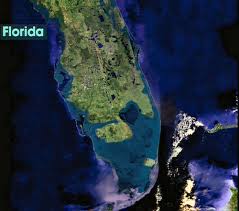
In Florida, Oceans and Premiums Rise Together

When I was in grad school at Oregon, I read a footnote that changed my thinking forever.  It was in Robert Heilbroner’s An Inquiry into the Human Prospect.  The text, as I recall it, was talking about how we were going to run out of copper.  The footnote said that actually, we would never run out of copper, but that the cost of copper per ounce would rise to levels that would prohibit our using copper in all the ways we are not using it.

Formally, these two positions are contradictory.  We will run out of copper; we won’t run out of copper.  Practically, the second is just a specification, a more careful explanation, of the first.  There will always be copper, but we won’t be about to use it any more.[1] This brings me to coastal properties in Florida and, eventually, just to Florida itself.  All of it.

Will coastal Florida continue to be available for newly constructed housing?  Yes, it will.  Will the dramatically rising costs of insuring homes on the Florida cost make new housing there virtuallflorida 1y impossible?  Yes, it will.  And the cost of insuring modest homes that have been there for a long time.[2]

Here we see precisely the play on “available” for coastal housing that Heilbroner used for “available” copper.  Yes, there will still be dry land at the Florida coasts that is zoned for individual residences.  No, insurance on those houses will not be available to the people who are now living there.  They are going to have to move.  And they will have to move not as the ocean rises (which it is doing in increasing rates) but at the insurance premiums rise.  You were looking for examples of art imitating life?  There you go.  People who thought the greenhouse gases would not cause in increase in insurance premiums just weren’t thinking the way insurance people think.  Here’s a piece from the New York Times that lays out some of the fundamentals.

Insurance people think that the risks they incur in insuring coastal homes should be echoed in the premiums the homeowners pay.  That doesn’t sound all that unreasonable as a business model.  Residents who are looking at a quadrupling—from last year to this year—of their insurance premiums are not thinking about business models.  They are thinking that the Sheriff has come to the family home, based on a speculative article in a journal of meteorology, and thrown them out of their house.  They may have heard of climate change, but it hasn’t been any part of the discussions the governor and the legislature have been having.

So the insurance nerds are being prudent and the homeowners feel like they are getting mugged.  But even in Florida, “stand your ground” is not a strategy that will deal effectively with rising oceans and the insurance companies are going to do what they are going to do.

florida 2The federal government is also going to what it is going to do because Congress has assigned itself the job of maintaining a national flood insurance program.  After the costs imposed by Hurricane Katrina, Congress passed the Biggert-Waters Flood Insurance Reform Act, the goal of which was to keep down that part of flooding costs that the feds were liable for.  The program does have to remain solvent, after all.[3]  The Congress is truly sorry that people are being priced out of their homes, but Congress cannot bear the cost of keeping them in place.  We are, after, all trying to reduce the size of the federal government.

The government is working on this issue in Florida as well.  House Insurance and Banking Chairman Bryan Nelson, R-Apopka is trying to get Congress to postpone implementation of the Biggert-Waters Act.  If you want to call that “working.”

Americans are accustomed to finding technological solutions for problems that would otherwise be intractable.  Part of that effort involved talking to Dutch engineers because The Netherlands is famous for its flood control technology, but (see the New York Times account)  “the very different topography of Miami Beach and its sister coastal cities does not lend itself to the fixes engineered by the Dutch.”  In addition to which, points out Miami Beach city manager, Jimmy L. Morales, “Ultimately, you can’t beat nature, but you can learn to live with it.”  Learning to live with it currently costs The Netherlands $1 billion a year for flood mitigation and they are working with about 280 miles of coastline.  Florida is working with 1197 miles of coastline; more than four times as much.

This is not a problem that “government” at any level, or at all levels together, can solve.  We made the choices that have producing the rapidly rising seas a long time ago.  Even mitigation is going to be horribly expensive and mitigation is a short term response.

A governmental response is going to require that government be trusted and funded at levels we have never contemplated before, except in wartime.  Is this wartime?  If I lived anywhere in Florida, I think pushing for increasing levels of trust in the only government that can summon the will and the resources to help me, would be a prudent thing to do.  Florida, of course, is not known for its prudence, so we will see.


[1] Actually, “we” means industry.  There will always be individuals who can afford huge expenditures on copper for the most frivolous of reasons.  Heilbroner doesn’t include these individuals in “we.”

[2] JFK speechwriter Ted Sorenson found the slogan in the writings of the New England Council during Kennedy’s career in the Senate and began to insert it into Kennedy’s speeches. Everyone was expected to be enthusiastic about that.  In Florida, it is going to lift all houses and no one is expected to be enthusiastic.

[3] The “waters” in the Biggert-Waters act is Maxine Waters, Democrat of California.  She is apparently well-known so nothing I have read commented that a Waters sponsoring flood control legislation was at all funny.

Posted in Paying Attention, Politics | Tagged , , , , | 3 Comments

Was Jesus Short?

This post is about Jesus.  Or, more exactly, our attitude toward Jesus.  Or, still more exactly, our attitude toward images of Jesus.

It won’t take long to get to where I want to go, but let’s start with this question.  Was Jesus tall and handsome?  Christians seem to want Jesus to be represented as an exemplar of whatever passes for masculine beauty in any particular culture.  There’s nothing really remarkable about that.

“British men are the bravest and British women the most beautiful in the world, “an old British gentleman told a very young C. S. Lewis.  “But” replied an amused but tolerant Lewis, “all nations think their men the bravest and their women the most beautiful.”  The old man was undaunted.  “I know” he said confidentially, “but in Britain, it is true.”

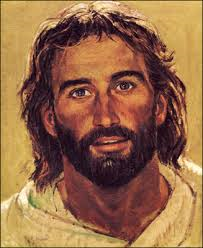
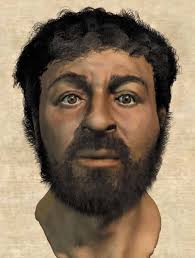
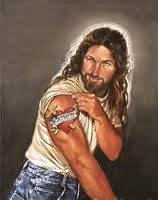
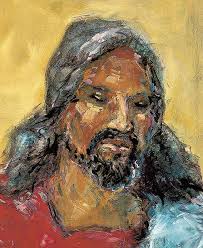
So there’s nothing remarkable about the attitude.  Once upon a time, I had a mother-in-law who sincerely disliked my favorite picture of Jesus.  That’s the one to the right, by Richard Francis Hook.  She grewr hook 2 up with the one on the leftr hook 1, by Warner Sallman.[1]  Neither one tells us much about what the actual historical Jesus looked like.  I have seen pictures that represented Jesus as meek and mild and as a raging Zealot; I have seen him with light skin and with dark skin; with a straight Greek-statue nose and with a large hooked nose.  I have never seen a picture of him as a short man.

Why?  Because we are a lot more like the old British gentlemen than we usually like to think.

So is there really any reason to think that Jesus was short?  Of course there is.  Do you remember this story, from Luke 19?

He entered Jericho and was passing through.  And there was a man called by the name of Zaccheus; he was a chief tax collector and he was rich.  Zaccheus was trying to see who Jesus was, and was unable because of the crowd, for he was small in stature.

r hook 4Who was small in stature?  The story doesn’t actually say.  It works either way, of course.  If Jesus were short, Zaccheus would have to gain some elevation to see him from the back of a crowd.  If Zaccheus were short, he would have to gain some elevation to see Jesus from the back of a crowd.  The question I asked earlier was whether there was any reason to think that Jesus was short.  I did not ask whether the story establishes that Jesus was short; certainly it does not.  We are still hesitating over our two choices: Jesus, Zaccheus; Jesus, Zaccheus.

r hook 5And it doesn’t actually matter.  Except that Christians made a good deal of use of the “Suffering Servant” passages in Isaiah.  Opponents of the early Christians maintained that Jesus couldn’t have been the Messiah because there are passages where the Messiah wreaks God’s vengeance, establishes justice, puts the enemies of Israel under his feet.  You might want to take a peek at the Magnificat of Mary in Luke 1 for a tidy little summary.  Christians retorted by citing passages like this one from the prophet Isaiah, Chapter 52.

Like a sapling he grew up before him, like a root in arid ground. He had no form or charm to attract us, no beauty to win our hearts;  he was despised, the lowest of men, a man of sorrows, familiar with suffering, one from whom, as it were, we averted our gaze, despised, for whom we had no regard.

r hook 6As modern Christians, we have no trouble accepting the essential unattractiveness of Jesus, especially as Lent crawls slowly toward Good Friday.  Except he was not short.  Not.  Not.  Not.  He might have been ugly, but at least he was tall.

Sometimes I wonder why we don’t just guffaw in the middle of a church service when dilemmas like this occur.  It might be good for us.


[1] About my picture, she always said that at least Jesus would have combed his hair.  What I always liked about my picture is that it represents Jesus as being interested in whatever is going on at the time.

Posted in Living My Life | Tagged , , , , , , | Leave a comment

Where you are going, you will need friends.

The title is today’s text.  With no context at all, it seems at least plausible.  When we get down to it, the context I will supply for “where you are going” will be the fact that we are all mortal.  The context Luke provides for this reflection will require something better than “plausible.”

I have been interested lately in some of Jesus’s teachings that are emphasized quite strongly in Luke.  I have two things in mind.  The first is this: how does Luke’s portrayal of Jesus represent the relationship of this life with the next life?  The second is, if that’s the way life is (and death and the continuing “life” after that), how would the prudent man or woman prepare for it?[1] 

Let’s start with an example so clear that it is right at the edge of silly.  A group of middle school children is going on a field trip to see an old growth forest.  Everyone was issued a big bag of potato chips and told the chips could be eaten whenever the children chose.  Group A ate theirs on the way to the forest; Group B saved theirs until the trip home.  I think that is Luke’s notion of the relationship between this life and the next.  You can eat ‘em now or you can eat ‘em later.

Still staying with the potato chips, let’s look at Luke, Chapter 6 and consider two fragments from “the Sermon on the Plain,” Luke’ version of Matthew’s “Sermon on the Mount.”  Somewhere in the middle of verse 20, there is this line: “Blessed are you who are hungry now for you shall have your fill.”  And down in verse 25, “Alas for you who have plenty to eat now: you shall go hungry.”

Those two sentiments—a benediction and a malediction—pivot on the expression “you have already had yours” in verse 24.  Clearly, this is in response to the unhappiness of the children who ate their chips on the way to the forest and now have none to eat.[2]  “You already ate yours,” is the response.  Now is the time for those who saved theirs to enjoy them.[3]

compensation 1Some will surely say that simplifies things unconscionably.  Yes, it does.  In the economic world of Luke’s time, it was thought that there was a fixed amount of wealth to be had.  If I had a lot, the effect would be that you would have very little.  There is none of the ever expanding pie of capitalism here; nothing of “a rising tide floats all boats.”  If you have wealth, you took it from me and my fellow proletarians.

You will note that this translates the snack example into a matter of moral worth.  The poor are morally good in this way of looking at it and the rich morally bad.  Let’s look at the parable of the successful farmer in Chapter 12.

“Then he told them a parable, ‘There was once a rich man who, having had a good harvest from his land, thought to himself, “What am I to do? I have not enough room to store my crops.”  Then he said, “This is what I will do: I will pull down my barns and build bigger ones, and store all my grain and my goods in them,  and I will say to my soul: My soul, you have plenty of good things laid by for many years to come; take things easy, eat, drink, have a good time.”  But God said to him, “Fool! This very night the demand will be made for your soul; and this hoard of yours, whose will it be then?”  So it is when someone stores up treasure for himself instead of becoming rich in the sight of God.’ “

He had a really good harvest that year.  We don’t know why.  Normally, in his culture, you would compensation 2expect him to take the poverty of the other farmers—or, more likely, farm hands—into account.  We are all brothers in the Covenant after all.  Three for me and one for you; five for me, and one for you.  That’s what a rich man should do.  The fact that he did not do it does not mean that he goes to everlasting punishment.  It does mean that he has put all his emphasis on getting and keeping as much wealth as he could and the hell with everybody else.  Jesus said, “So you emphasized accumulation to the exclusion of everything else and now you are going to die and everything you accumulated will go to other people.”  That’s what Jesus did say.  He could have said, “If you had shared it, you would have done a lot of good for a lot of people and wouldn’t be one whit worse off yourself.”  Being, you know, dead in either case.
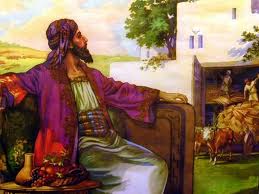
Now we move into the question of having friends.  In Luke’s vision, the rich are going to the uncomfortably warm and solitary end of Sheol and the poor to the blissfully cool and social end.  Looking at the story that is often called Lazarus and the rich man we find the compensatory character of the next life affirmed and we begin to see how nice it would be to have a friend.

“There was a rich man who used to dress in purple and fine linen and feast magnificently every day.  And at his gate there used to lie a poor man called Lazarus, covered with sores, who longed to fill himself with what fell from the rich man’s table.  Even dogs came and licked his sores.  Now it happened that the poor man died and was carried away by the angels into Abraham’s embrace.  The rich man also died and was buried.

“In his torment in Hades, he looked up and saw Abraham a long way off with Lazarus in his embrace.  So he cried out, “Father Abraham, pity me and send Lazarus to dip the tip of his finger in water and cool my tongue, for I am in agony in these flames.”  Abraham said, “My son, remember that during your life you had your fill of good things, just as Lazarus had his fill of bad.  Now he is being comforted here while you are in agony.”

Let’s consider, then, what the rich man—who is accused of no fault at all in this life—could have done.  He could have made Lazarus a beneficiary.  He could have made a friend.  Had he done that, he would have had someone in the next life who would put in a good word for him.  Nothing in this story says the rich man had any bad feelings about Lazarus.  I am sure he didn’t notice him at all.

I will go now into unrelieved fantasy.  You don’t have to follow if you don’t want to.  Notice that Lazarus has no speaking part at all.  He does not ask for table scraps, although we are told that he wanted them.  He does not intervene with Father Abraham either.  Abraham says, “My son, remember that during your life you had your fill of god things, just as Lazarus his fill of bad.  Now he is being comforted here while you are in agony.” Lazarus who, in this fantasy, could have interceded on the rich man’s behalf, says not a word.  The rich man has not won Lazarus’s favor and what will happen to the rich man otherwise, does happen.

Imagine that the rich man likes eating Chinese and one day, in his fortune cookie, he found this bit of wisdom, “Where you are going, you are going to need friends.”  He puzzles over it a little.  It is long for a “fortune.”  Then he returns to the Kung Pao Chicken with no thought to “where he is going.”

This is a choice the rich man made.  It was very likely so much a part of his daily life that it didn’t seem to be a choice at all.  It is, in that way, like many of the opportunities for choice that we all encounter.  But it is not the choice he would have had to make; he could have chosen otherwise.  And, in fact, in Luke’s next parable, a real scoundrel makes a much better choice.  Biblical scholars have found this parable challenging, but in the context I have provided for it, it is not problem at all.

“He also said to his disciples, ‘There was a rich man and he had a steward who was denounced to him for being wasteful with his property.  He called for the man and said, “What is this I hear about you? Draw me up an account of your stewardship because you are not to be my steward any longer.”  Then the steward said to himself, “Now that my master is taking the stewardship from me, what am I to do? Dig? I am not strong enough. Go begging? I should be too ashamed.  Ah, I know what I will do to make sure that when I am dismissed from office there will be some to welcome me into their homes.”  ‘Then he called his master’s debtors one by one. To the first he said, “How much do you owe my master?”  “One hundred measures of oil,” he said. The steward said, “Here, take your bond; sit down and quickly write fifty.”  To another he said, “And you, sir, how much do you owe?” “One hundred measures of wheat,” he said. The steward said, “Here, take your bond and write eighty.”  ‘The master praised the dishonest steward for his astuteness. “
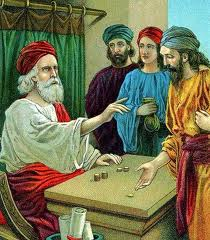
 compensation 5A steward is responsible for the use of his master’s financial holdings.  That is his job.  This particular steward has not been doing the job.  He has been skimming off profits for himself.  He has been discovered and now he is going to be fired.  But before that happens, the steward calls the major debtors into the office and cheats his master yet again.[4] 

No one says this is a good thing to do, but what it has in its favor is what the rich man in the first parable failed at.  The steward looks at the life he is now living and sees that it is coming to an end.  He knows that where he is going, he is going to need the active welcome of the poor—those who were in debt to his master—so he goes out and gets it.  He uses the resources he has in his present life to invest in “the life to come,” in his case, a life on the streets.

Pretty smart, says Luke.  He was not blinded by his current wealth and power to the fact that he is going to lose it all.  Not being blinded, he takes the initiative to prepare a welcome for himself.  He knows, in short, that where he is going, he will need friends.

A proverb cited in 1Timothy has it that “the love of money is the root of all evils.”  In these three Lucan parables, the question is whether the presence of money blinds you to the friends you could make in the next life. 

First Parable:  Jesus doesn’t raise that question about the man who built bigger barns, but the case could be made that if he shared his bountiful harvest with his neighbors, they would vouch for him in the next life.  In the next life, according to Luke’s picture, the poor neighbors will be in the good end of Sheol and the agribusiness tycoon in the bad end. 

Second Parable: The rich man did not attend, the way he might have, to the need to cultivate Lazarus’s friendship.  When the crucial moment comes, Lazarus says not a word on the rich man’s behalf. 

Third Parable: The fraudulent steward uses money—not his own money, but this is no time to be picky—to attend to what really matters.  He invests it in “the next life,” and when he gets there, all those poor debtors will vouch for him.  He will have a friend.

It doesn’t strike me as a consistent teaching of the gospels that there will be an economically compensatory afterlife.  On the other hand, I do think that all the gospels teach that the permanent things—“the life of the ages,” John calls it in Chapter 3—is more important than the ephemeral things of this life, to which we pay so much attention.

Here is the best summary of the point I have seen. compensation 4



[1] I am not counseling prudence, by the way.  I am only trying to see how clear I can make the implications of putting prudence first.

[2] According to Luke, “the trip home” takes a great deal longer than the trip out, but I want to keep my potato chip analogy and unequal trips are just too complicated.

[3] Actually, God provides the chips for the poor children on the way back, but you can’t make a story tell everything at once.

[4] That’s what Raymond Brown thinks.  His good friend, Joseph Fitzmyer, thinks otherwise.  Fitzmyer thinks that what the steward does is to reduce the debts by the amount of his commission.  That’s what the footnotes in the New Jerusalem Bible say as well. It doesn’t really matter from a theological standpoint, but it is good for me to see noted biblical scholars and good friends come down on opposite sides of the fence.


Posted in Biblical Studies, Theology | Tagged , , , , , , | Leave a comment

Does Democracy Actually Work?

There are a lot of reasons why it might not.  I have lectured for many years about why democracy might not work anymore or why it never really did, although it seemed to at the time.  When you approach the case from the backside, as in these instances, just what “democracy” ought to mean is a very complicated question.  I don’t have a very complicated question in mind today.

For today, I mean only this: Can the U. S. operate an adequately functioning government by the mechanism of electing legislators to Congress?[1]  Here’s a quick tour of what has happened recently.  President Obama (D) and Senate Majority Leader Harry Reid (D) and House Speaker John Boehner (R) came up with a “grand plan.”  It was supposed to turn the U. S. government ontopolitical solution 4 a new road, where entitlement costs do not keep increasing and where revenues are increased to cover the costs of “adequate functioning.”[2]  Speaker Boehner couldn’t sell it to his caucus in the House—at least he couldn’t sell it well enough to pass it with a majority of Republican votes, which is the standard he uses (the Hastert rule, it is called).

So we got the Sequester instead—a percent reduction in federal spending so stupid that the people on both sides who agreed to it thought that its monumental stupidity would surely cause people to compromise rather than endure it.  They didn’t.

Then there was the question of paying our debts.  You wouldn’t think that would be a question, really, since that is the effect of raising the debt ceiling.  President Obama wanted to raise the ceiling; Majority Leader Reid wanted to; Speaker Boehner wanted to—but the Speaker could not raise the necessary votes from the Republican caucus and we simply shut down the federal government.  Boehner had quite a few members of his caucus who would rather shut the government down—some had promised their constituents they would—than accept his leadership and make the compromise.

These two illustrations show that the Republican party in the House of Representatives has a sizeable minority of intransigent conservatives, who make it impossible for the leader of their party to actually lead them.  Republicans in the House and the Senate pleaded with them; told them they were going to be hated for what they were doing; told them they were ruining the Republican party.  Nothing worked.

A lot of solutions to this continuing dilemma have been proposed.  Some rely on new powers by federal agencies; some on new powers of the President; some on constitutional amendment. None of those meet the definition—democracy that works— I posed at the beginning, so we are brought back to the question of whether the legislature can be saved.  This is not easy.  It is a little like trying to save a kamikaze plane and pilot after it has taken off.  You will have to defuse the bomb, extend the range, provide additional maneuverability, and add some wheels—while it is in flight—if you want plane and pilot back safely.

Here is what is being done.

Steve LaTourette, (shown below) former Republican House member is leading a group called Main Street Republicans.

“Hopefully we’ll go into eight to 10 races and beat the snot out of them,” said former Rep. Steve LaTourette of Ohio, whose new political group, Defending Main Street, aims to raise $8 million to fend off tea-party challenges against more mainstream Republican incumbents. “We’re going to be very aggressive and we’re going to get in their faces.”

This is Strategy #1.  Moderate and conservative Republicans who care about the continued viability of their party and of the government of the U. S. simply go into the districts where the troublemakers are and beat them.  These are districts where the Republican candidate is certainly going to win the general election in the fall of 2014.  The question is whether the Republican candidate is gopolitical solution 1ing to be committed to his or her “principles,” so that the destruction of the party is an unfortunate side effect, or is going to be a Republican who will make the compromises necessary to restore the party and enable the government to govern.  Those races will all be held in the spring primaries of 2014.  That is how long LaTourette and his group have to show that their strategy works.

Here is Strategy #2.  The Democratic party is taking advantage of the very low approval ratings for the Republican House members by launching a very aggressive campaign to win back House seats.  Ordinarily, in off-year elections (between the presidential elections), whichever party controls the White House loses seats in Congress.  That might not happen this year.

Historic modeling doesn’t seem to apply any more to US congressional elections. The American electorate is impatient and anxious. They want results now, and by focusing on culture war issues instead of jobs and the economy, House Republicans are putting themselves back on the fast track to minority status.[3]

If I were the director of this play, I would instruct the Democrats to put their money into races against Tea Party candidates.  That would have the best effect on the Congress, on the Republican party, and for the robustness of legislative solutions to legislative problems—a solution I am calling “democracy.”  Of course, that is not what the Democrats are doing.  The Democrats are putting their money into the districts they are most likely to win.  The Republicans they are most likely to beat are moderate, business-oriented, mainstream Republicans.  Those are the very Republicans the Democrats have been calling for in the recent negotiations, but it turns out that the party thinks moderate (we would call the “conservative” if they were Democrats), business-oriented, mainstream Democrats are even better.  The result of the Democratic campaign, therefore, will be to eliminate the Republicans most willing to compromise with them.

political solution 2That brings us to Strategy #3.  Business-oriented groups who are accustomed to playing a part in primary and general elections and in actively lobbying the winners, who, after all, do become Congressmen, are beginning to actively seek the defeat of Tea Party Republicans.  And this is true even where the U. S. Chamber of Commerce supported those candidates two years ago.  The National Federation of Independent Businesses, which normally represents smaller businesses, is on exactly the same page as the Chamber of Commerce this time.

Taking on the ideological conservatives could be a bruising task for the business groups, but it’s something they say they now realize they have to do.

“Politics has always been a full-contact sport. The most active groups often command the most attention, and that’s why the tea party has risen in its influence within the GOP,” Mr. French said. “The shutdown has made it clear that the business community cannot afford to stay on the sidelines any longer. If you don’t like what’s going on in Washington, get in the game and make a difference.”[4]

So what could happen?

Democracy, as I have defined it, could be restored.  That’s one of the possibilities.  By the actions voters take, the unassimilable Tea Party members can be reduced in number, their seats being taken by conservative Democrats or moderate Republicans.  Some of the Tea Party Republicans who survive could be persuaded to care about the long term health of the Republican party and could, as a step in that direction, be persuaded to support the Speaker of the House, if it is still a Republican in 2015 when Congress reconvenes.

This is not a constitutional or executive or federal agency end run.  This is not “kicking the can down the street.”  This is candidates adapting themselves to the current concerns of their voters or losing their seats to candidates who did adapt. 

That is actually how democracy is supposed to work.  It is the legislative slice of what “popular sovereignty” means.  It would be so wonderful to see that happen.  I can picture James Madison and Thomas Jefferson and John Adams saying, “See.  I told you it would work.”


[1] I know that “adequately functioning” is a phrase that opens the door to all the backside questions I am trying to avoid.  Is the government “adequately functioning” if it loses the predominance in world affairs that Americans have gotten used to?  Is the government “adequately functioning” if it can continue to function only with a huge percentage of its citizens in prison—the highest percentage in the world?  I’m skipping all those, although they are perfectly good questions.

[2] There’s that weasel term again.  There are differences about what is needed and what levels are adequate, but all those views include the U. S. government maintaining a credit rating good enough to keep the costs of borrowing down.  The next step would be something like payday loan offices.  In Beijing.

[3] I took that quote from an analysis of the 2012 election.  I could have rephrased it, but I kept it just as it was to show that the Republican dilemma contains all the old choices as well as the new failures I have described.

[4] Says Patrice Hill in the Washington Times, a paper I have never before quoted.

Posted in Politics | Tagged , , , , , , , , | Leave a comment