Is the free speech of rich people guaranteed?

McCutcheon 4Yes.  It is.  And it will continue to be guaranteed until one of the five justices who gave that answer drops dead or retires and is replaced by a liberal.  That would be the first and last in the top row and the first three in the second row.

In political science classes—and probably not anywhere else—students ask what kind of sense it makes for modern 21st Century America to be governed by a constitution that took an 18th Century society for granted.  We are going to be dealing with the unhappy part of that answer today, so let’s start with the happy part.  The happy part of the answer is that our Constitution is flexible.  It can be adapted to changing circumstances by being amended by the people or by decisions of the Supreme Court.

At that point, a student who knows more than the rest and is not happy with recent rulingsMcCutcheon 5 says, but what if the justices of the Supreme Court get it wrong?  What if they say that the Constitution says something it really doesn’t say?  That answer to that question, a good enough answer in an introductory political science class, is: That is impossible.  The Constitution actually says whatever the Supreme Court says it says.”
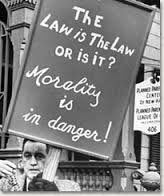
And, of course, that’s the bad part.  Now let’s take a detour.  I think this will help us put matters in perspective.  Here is “the question” as posed in the justly famous Griswold v. Connecticut.  These are all cut and pasted from www.oyez.org, the easiest of the court sites to use.

Does the Constitution protect the right of marital privacy against state restrictions on a couple’s ability to be counseled in the use of contraceptives?

And here is “the answer,” just an inch or so down the page. “Together, the First, Third, Fourth, and Ninth Amendments, create a new constitutional right, the right to privacy in marital relations.”  Or, more briefly, “Yes.  The Constitution does protect that right.”

We didn’t have the hyperpartisan sources in 1965 that we have now, but it is not hard to imagine conservatives screaming about the misuse of any very general “right to privacy.”  Does the Constitution protect privacy for bad uses as well as for good uses,” they would ask?  Yes.  It does.

It didn’t take us very long after that to get to Roe v. Wade.  Here is the question: “Does the Constitution embrace a woman’s right to terminate her pregnancy by abortion?”  And here is the answer: “The Court held that a woman’s right to an abortion fell within the right to privacy (recognized in Griswold v. Connecticut) protected by the Fourteenth Amendment.”  Or, more briefly, Yes the Constitution does do that.

Conservatives argued against both Griswold and Roe on the grounds that the decision the court made would have bad effects.  The court majority responded, in effect: “Our job is to say what the Constitution requires.  After that, whatever happens, happens.”

What this means is that you will have two perspectives on any seriously contested Supreme Court case.  One will have to do with the logic of the decision or, in some cases, the effects of the decision for the Court.[1]  The other will have to do with the effects on society of one decision or another.

That brings us to McCutcheon v. FCC, which is making headlines these days.  Here is the question: “Is the two-year aggregate campaign contribution limit constitutional under the First Amendment?”  The answer is, No, it is not.

This is an answer that makes conservatives very happy, at least in the short run.  It means that the attempt of the Bipartisan Campaign Reform Act, which tried to find a way to limit the amount of money being spent on politics, was a failure.  Liberals, of course, are unhappy and four of the unhappiest liberals are the four losing justices on the Court’s 5-4 decision.  Justice Breyer was so unhappy he read his entire dissent from the bench and made everyone listen to it.
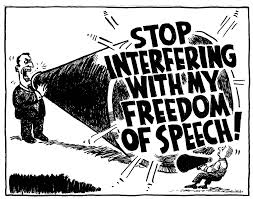
McCutcheonBut the liberals are unhappy because of the effects they see.  It would be a very rare liberal—I have not yet heard anyone take this view—that the Court got the First Amendment wrong.  If money is speech (Buckley v. Valeo), then the Bipartisan Campaign Reform Act infringes on Shaun McCutcheon’s right to speak freely.  What is it about the guarantees of the First Amendment, much beloved by liberals everywhere, that makes they want to think that in this case, it doesn’t mean what it says.   It says, “Congress shall make no law…abridging the freedom of speech.”[2]

Liberals wail, “How could you do that?”  The court majority responded, in effect: “Our job is to say what the Constitution requires.  After that, whatever happens, happens.”  I hope that looks familiar.  It is just cut and paste from the Griswold decision.

This is what I thought was going to happen.  Here’s what I wrote last October 10 about this case.

Being a liberal, I am bothered by how much influence wealthy people have in our elections.  I don’t like the way they dominate the lobbying of Congress either, but that isn’t today’s topic.  The Supreme Court’s standard—one man, one vote—in Reynolds v. Simms (1964) seems like a good one to me.  “One dollar, one vote,” which is what happens to the political system when unlimited amounts of money may be dumped into it and candidacies bought and sold in front of God and everyone, seems like a bad standard.

And I still feel that way, but you will notice that my objection to it last October had to do McCutcheon 2with the effects it would have and why I, as a liberal, would deplore those effects.  I think the effects of money are so pernicious that I would be happy to see Buckley v. Valeo overturned so that the court said, “Look. There is speech.  That’s protected by the Constitution.  Then there’s money, which is legitimately regulated by the Congress.”

I’m pretty sure the Hobby Lobby case will be coming up next.  Conservatives will say it is about freedom of religion.  Can the government really force individuals to take actions they believe to be wrong?  What does that do the conscientious objection to active service in the armed forces?  I don’t know how the Court will decide that one, but I know this.  Some will argue that the decision ought to take into account the effects the decision will have and the others will argue that only the questions that bear strictly on the logic of the Constitution should be allowed.

And if I’m wrong, you can use my blog to say, “I told you so.”

[1] The Court has argued against reversing the conviction and subsequent sentence of death for a man conclusively proved to be innocent.  The argument is that if the Court started taking cases like that, they would be inundated by this one kind of case and would not be able to do their real work.  This is an “effect argument,” but it is only the effect on the Court’s docket that is being considered.
[2] It has, of course, made a lot of laws restricting speech which the courts have found fully constitutional, but the language is there to be confronted.  You do have to find a reason and the Roberts Court did not find one.

Posted in Politics | Tagged , , , , , | Leave a comment

What to wear to the commons


“Nobody washes a rental car,” runs an oft-repeated conservative lament.

“Farmers don’t prevent their cattle from overgrazing and killing the commons” runs an oft-repeated liberal lament.

You can’t exactly say either of these is false, but I think we can say that neither is true all the time.  The rental car companies do, in fact, wash rental cars and they do that so they can rent them out again.  Farmers do, in fact, prevent their cattle from overgrazing if they will be caught and punished for not doing it.  We might wish for loftier motives, but most of us say “good enough” and let it go.

I am going to wind up talking about public school dress codes, but I want to go back and dress code 5lay in a little background on the commons first.  Garret Hardin proposed the dilemma by picturing a common grazing area and a bunch of dairy farmers.  The commons will support only so much grazing, but each farmer thinks it might support just a little more—just enough for him to add a few of his own cows, provided that no one else follows the same logic.  The others do follow the same logic—how could they not?—and the commons is overgrazed and crashes and all the farmers go through a very hard time until it recovers.

The “commons” I want to think about today is common value commitments.  There are some outcomes that everyone wants in the same way that every farmer wants to graze his herd on the common pasture land.  Even the students in the schools we are going to look at want to “decrease violence and theft” (E, below) and to “aid in the recognition of [potentially lethal] intruders (J, below).  Many of these students also want to “enhance the schools’ ability to achieve their basic academic purposes” (A, below) and even to “diminish differences among socioeconomic levels” (B, below).

But even if they wanted all those values to be achieved, they would desire them impersonally and abstractly.  They would desire those goods the way the farmers desire “sustainable use of the common grazing lands.”  But, it turns out, there are things that each member wants in a more immediate and more individual way.  For the farmers, it’s “extra grazing land for my (not your) cattle.  For the students, it is “pushing the uniform code just enough to call attention to myself (not you).

dress code 3So lets think about public school dress codes.  Nearly half the states explicitly allow schools to formulate and enforce dress codes and in all the other states, except Massachusetts, where it is forbidden, it is presumed that schools have good reasons for having them.  Here is more information about states and dress codes than you ever wanted, courtesy of the Education Commission of the States.  There are lots of good reasons why schools might want a uniform style of dress.  Here, for instance, is a collection

 While no long-term empirical studies have been conducted to assess the effectiveness of school uniforms or dress codes in improving student or school performance, proponents argue that the use of such policies (A)can enhance schools’ ability to achieve their basic academic purposes. Uniforms, they say: (B)diminish differences among socioeconomic levels,  (C) promote school spirit and (D) improve student self-confidence and behavior. Similar positive effects from implementing a school uniform policy were cited in the U.S. Department of Education Manual of School Uniforms, disseminated in 1996 to all of the nation’s 16,000 school districts. Among the potential benefits cited were: (1) (E) decreasing violence and theft, (2) (F) preventing students from wearing gang-related colors to school, (3) (G) instilling student discipline, (4) (H) helping to resist peer pressure, (5) (I) helping students to concentrate on academics, and (6) (J) aiding in the recognition of intruders.

My lettering goes, as you see, from A to J, so there are 10 good reasons, allowing for a little overlap here and there, for making and enforcing dress codes in public schools.[1]   These public goals and rationales are “the commons” to which I referred in the title.  How could anyone be against such things?  Is there a pro-gang clothing faction among educators?  Does anyone want to sponsor a form of dress that has the goal of diminishing the self-esteem of some students?  Doesn’t everyone understand that some kinds of clothing are going to make the effective conduct of class very difficult?

The answers are all obvious.  It is hardly worth the trouble to formulate the answers.  Schools have great difficulty with their dress codes, however, so something is going on.  Here are some possibilities and here is the full New York Times article.

Let’s consider Andie Alexander, pictured below.

 Lincoln Middle School in Indianapolis has started to allow leggings beneath skirts— and Andie Alexander, in eighth grade, has already gotten into trouble over it. “When I realized we were going to be able to wear leggings, I went and bought a bunch in wild colors — neon purple, violet, bright green, turquoise, red and yellow,” said Andie, 13.

Let’s pause for one moment and consider Common Values A—J.  Now take another dress code 2moment and try to think which of these Andie was trying to overthrow.  If nothing comes to mind, you might take one additional moment…or you might just say that there is no relationship between Andie’s choices and the school’s goals.  None at all.

These kids don’t oppose the Common Values.  They don’t connect with them at all.  The school administration is trying to explain why they are important and—with one exception, which we will get to in a moment—the kids don’t care.  The students aren’t connected to the values; they are connected to the enforcers of the values.  They want to wear clothes that distinguish them; clothes that are maybe a little daring; clothes that push the edge just a little.  They said leggings—it does get cold in northern cities in the winter—and Andie said, “Woohoo!  Neon purple!  Violet!  Mrs. Thompson will hate these!”

dress code 4There is a little bit of the jailhouse lawyer in 13-year-old kids.[2]  And then there are the peer subversion networks.  And then there is the heroic status achieved by finding something “they” are going to hate, but that they didn’t clearly forbid.

None of those very common traits considers the commons at all.  The substantial educational and social values that are supposed to be attained by this program are just ignored.

And where do the kids get these just-barely-permitted clothes?  Oddly enough, they are manufactured precisely for this market.

Retailers have been happily catering to the changes. For the first time this year, the Lands’ End uniform catalog is offering girls’ khakis in pencil and boot-cut silhouettes. There are also shawl-collar cardigans, fleece peacoats, leggings and yoga pants. French Toast, another large uniform company, has made its girls’ polos and blouses tighter-fitting, and has added items like a boyfriend cardigan.

“Schools really do adjust to fashion,” said Matt Buesing, school marketing coordinator at French Toast. If a girl wears a polo that’s a little form-fitting, for instance, “it may not fit their code exactly, but the administrators in the school say, ‘That’s an acceptable shirt — we should allow it.’ ”

Part of the natural resistance kids have to school uniforms is that the uniforms are forced on them by adults.  The easy way to solve that particular dilemma is to give the students a role in deciding what is to be permitted.

At Martin Luther King Jr. middle school in Charlotte, N.C., administrators asked students to help create the uniforms when they were first introduced in 2006 to minimize resistance. “If the people who are going to have to follow the rules are involved in establishing the rules, you have a lot more buy-in and a lot more cooperation than if it’s forced upon them,” said Janet Moss, an assistant principal at the school. “Of course, it was a much more popular thing for the students who created it than it was for the students who are there now.”

And that’s the problem Thomas Jefferson had in mind when he said there should be a revolution every twenty years.  A revolution is a democratic achievement for the generation that pulls it off successfully.  But keeping the regime the revolution devised is just more rules passed down for the next generation.  It’s fine to say the “the students” should participate, but then you have to say that the next generation of students is free to throw out a dress code that is working very well, thank you very much.  We just solved the “cargo shorts” definitions and the “winter leggings” definitions, and now you guys want to change the rules again!

There is a formal solution.  Don’t get your hopes up.  There are two, actually.  The first is that the students trust the adults to have instituted the dress code for good reasons and their compliance with it displays that trust.  In this solution, the students don’t have to understand the relationship between how they dress and social values A—J.  I’m not putting a lot of faith in that one.

The second one if for the students to be instructed in how their behavior relates to the values.  This will require that the students be willing to sacrifice a little fashion one-up-manship so that other values, like banning gang colors, can be achieved.  I’m not putting a lot of faith in that one either.

I think that means that the dress code public schools “movement” will always be small and we are going to have to figure out another approach to protecting the commons.


[1] In private schools, of course, it is even easier because you can just throw students out if they don’t conform.

[2] Jailhouse lawyer is a colloquial term in North American English to refer to an inmate in a jail or other prison who, though usually never having practiced law nor having any formal legal training, informally assists other inmates in legal matters relating to their sentence (e.g. appeal of their sentence, pardons, stays of execution, etc.) or to their conditions in prison. Sometimes, he or she also assists other inmates in civil matters of a legal nature.

Posted in Education, Political Psychology, sociability, Sustainability | Tagged , , , | Leave a comment

Racism and Sin

Am I a racist?  No.  I’m not.

There.  That takes care of the substance of the matter.  I have blasphemed in public and I will be chastened by a lot of people whose social and political views are very like mine.  We part company on some other issues.  It might be the question of what language is for.  It might be the question of what sin is like and what to do about it.  I’m really not sure, but in the process of writing this post, I am hoping that I will find out.

Let’s take the language question first.  What should a word like “racist” mean?  It certainly racist 1ought to mean that race is a highly salient category.  So a racist would look at a woman who is a Democrat, an entrepreneur, a Baptist, a mother, a Ph. D, a gifted poet and the product of Yoruba parents and say that she is “black.”[1]  That category is more important, more immediate, than all the others.  That doesn’t make this person a racist.

The second would be that it is race itself, rather than attributes that might be associated with race, that is the focus.  Someone is going to point out that nothing I have said so far screens out black nationalists and that is true, but the next one will.  If a population is black and poor and malnourished and used to living on a very short timeline of rewards and punishments, a racist would want to talk about inheritable traits rather than cultural ones.  He would begin with a logic like “you can’t make a silk purse out of a sow’s ear” and make race, itself, the sow’s ear.  That means that the population in question could become orderly, middle class, well-fed, and characterized by long-term incentives, and the racist would still predict disaster because the population is still black.  You do inherit the Negritude after all.[2]  The new successful orderly middle class black population would be very confusing to the racist.

Race, already salient and genetic, must also be negative.  It must be bad for people to be black.  That screens out the black nationalists who work to form positive and effective “black identities” and to read and write histories centered on the achievements of black people.

racist 3

Finally, a “racist” must hold these views much more than his or her contemporaries.  “Racism” is the name of the left end of the scale of racial views, as below.  It is not the name of the whole scale, as above.  Whatever social value you might hope for by labeling everyone a racist, it has no linguistic value at all.  I don’t think it has much social value either, but that is a matter for another time.

racist 4

So there is the language question.  Now let’s take “sin.”  Am I sinful?  Sure.  Of course.  People are sinful, according to the theology I hold, so I am sinful.  Not much of a linguist triumph is it?  But if you are going to posit two entities—as Christian theology routinely does—God, on the one hand, and humankind, on the other, then there is still a language value in saying that God is not sinful but we humans, are.  And God, who is sinless and omniscient as well, knows that I am sinful, and, where necessary, just how sinful.  It goes with being God, I guess.

racist 6You, on the other hand, know that I am sinful only by the linguistic and logical route and you don’t know just how sinful I am at all.  But what would you do if you really needed to know?  If I were in your place, I would look for acts of impiety.  Failing that, I would look for words of impiety.  Failing that, I would look for acts or deeds that I thought might betray an inner attitude of impiety.  Failing that, I would look for any associates you might have who are impious.  Failing that, I would look at statuses you occupy—lord, serf, capitalist, rabble-rouser—to see if any impiety might be transferred from the category to you personally.  And if even that failed, I might go so far as to say that you have not protested the impiety of others with the vigor you should have shown.  I’d get you, one way or the other, I am pretty sure.

Seems like a lot of effort to expend, doesn’t it?  But I think it is exactly what you would have to do to find me to be a racist.  No effort is necessary, of course, to find me to be a racist on the scale labelled “racism.”  For all the positions on that scale, there are only matters of degree.  Just how racist I am, is the language game that can be played in that arena.  But if you use the other scale, the one where “racist” applies only to the pejorative end of the scale, you will have to exercise due diligence to see whether my deeds and words and attitudes, etc. merit your placing me that far down.

Not that it can’t be done. You could look for acts or racism, then words of racism, then attitudes of racism, then racism by social category, then “tolerance of racism” on the part of others.  Since I have reproduced the impiety series exactly, I am hoping that will sound familiar.  It is, as I said, a lot of work to have to go to.

And who benefits so much from that finding that I am “racist” in the meaningful, not inracist 2 the presupposed, sense?  The immediate maleficiaries[3] of racism, certainly.  People who, because of the racism of others, are denied graduate assistantships or promotions or lodging or dining[4] to which they would otherwise be entitled.  It doesn’t help them very much, though.  If I am the person who has refused to serve them in the way I would serve any other customers and they have established that I am a racist, they have made a significant causal attribution.  It is my racism, according to this attribution, that is the reason for what I have done.  But then, if I am chastened for my racism and move over to refusing to serve them because they are poor, they are only marginally better off.

There is no reason to deny that Asians are the victims of racial attitudes held by black people.  The videos of Korean-owned convenience stores in Los Angeles that were a good deal too convenient to crowds of black people bent on revenge, make that point clear.  There is a demonstrable prejudice in New York City against black people who were raised here and in favor of black people who were born in Africa.  Continental prejudice?  And the competition that Hispanics and blacks are forced into for some kinds of work has produced a lot of anti-black rhetoric by the Hispanics and a lot of anti-Hispanic rhetoric by the blacks.

These are serious issues.  I would like to see progress made on solving them.  Controlling the official attributions, so that the people who are doing things I don’t like are “racists” does not seem like much progress to me.

So I admit to being a sinner, as I define the term.  Just how bad my sin is, God knows—and that’s good because He really needs to know.  I don’t admit to being a racist as I define the term, although I admit that anyone who wanted to go through the steps I outlined above would find reason to call me that.

And that would be worth doing because…?


[1] One of the many useful things I learned in the course of completing an undistinguished history major at Wheaton College is that PERSIA—the political, economic, religious, social, intellectual, and aesthetic elements of society—is an amazingly useful acronym.  I used it in the example of “the black woman” as you can now see.
[2] The word is such an oddity.  You have to keep the capital N- because Negro is capitalized (as is Caucasian), while black is not (nor is white).  Negritude refers to the physical racial inheritance, whereas black is much more often a word that takes in cultural phenomena as well.
[3] I invented that for a public policy class.  I got tired of talking about the beneficiaries of a given policy and the…people who were disadvantaged by it.  It’s not an acceptable word, so far as I know, but it does feel good.
[4] Unless, of course, it offends the religious scruples of the corporation who has hired the manager who refused to serve you.


Posted in Living My Life, Political Psychology, Politics, Theology, Uncategorized, Words | Tagged , , , , | 4 Comments

Mother Nature holds all the cards

I want to think out loud for a little while today about the Oso landslide in Washington.  When I heard the news on Monday morning, my first thought was that they are now naming the landslides the way they name tropical storms.  The second thought was, “Wow!  They have gotten as far as  the O- in Oso!”  Not so.  The call it the Oso landslide because it occurred in Oso, Washington, in Snohomish County.

The TV account I saw, on my way to find out what happened in the NCAA games the night Oso 1before, was all about two things: the rainfall and the survivors.  The news anchors handled the survivor questions by going to field reporters who were interviewing people.  The rainfall news came from the meteorologist.  There had already been a lot of rain, he said, and the soil can only hold so much before gravity starts to push the tops of the hills toward the bottom.

Well, I thought to myself, we need to find a way to get it to rain less or to find a way to help the soil absorb more.  Either one would work.

That reflection put me in mind of the class’s reaction to a word game I used to use in my political psychology classes.  I would show them a picture of a bridge under water and ask if the difficulties the motorists were experiencing came from the bridge being too low or from the water being too high.  It didn’t take very long in most classes for everyone to agree that it was not a good question.  It was bad because it is the relationship of the bridge to the water that is the difficulty.  It is not one or the other.

On the other hand, when you take the next step and turn it into a problem[1] it matters a great deal whether you say the bridge is too low or the water is too high.  It matters because as soon as you call it one problem or the other, a set of things you should do about it comes into view and, it turns out, some things are harder to do than others.  That always divided the class again.  It was one thing to agree that it was the ratio of the bridge to the water that made it impassible.  It was quite another to say that the best solution was to lower the water level or to raise the bridge level.  The class divided into “bridge people” and “water people” and in some years, they stayed divided throughout the term.

Oso 3This came to my mind as I was watching the meteorologist talk about how much rain there had been and how the soil could hold only so much water.  I noticed that the TV station didn’t have an environmentalist to say how even steep hills ordinarily hold their shape because they are held in place by the roots of the trees and bushes growing on it.  Having someone to say that there was too much rain and no one to say that clear-cutting the forest is going to make the soil unstable didn’t sound sensible to me.

Everyone knows that if you raise the bridge, you can allow the water to get higher without submerging the bridge.  I you had a TV station with a bridge person, who would explain that the bridge was too low, you might almost expect the station to have a water person to explain why the water is so much higher than it used to be.  If the TV station had someone on staff to give one perspective and no one on staff to give the other perspective, it would feel almost like an editorial endorsement for raising the bridge.

Or, if it was a station with a reputation for responsibility, it might have a panel of experts available.  One would talk learnedly about the bridge; the other learnedly about the water.  Viewers would be left with the impression that even the experts didn’t agree and so with  no clear sense of what might be done about it.

I did wonder about the Oso landslide.  Here is one of the things I found with a few minutes of poking around.

One factor that is linked to landslide occurrences is areas that have been cleared of vegetation – more specifically areas that have been stripped of trees by clear-cut logging practices. Trees and their root structures strengthen slopes and help keep soil in place. After an area that has been clear cut of trees, roots deteriorate and lose the ability to hold soil in place on mountain or hilly slopes. The trigger for landslides is typically from rainfall that saturates the deforested slope or in some circumstances earthquakes can bring down masses of earth.

Jonathan H. Friend posted that on May 2, 2011.  You can see the whole page here. I am quite sure that is what he would have said about the Oso landslide had he been in the studio, as the meteorologist was, and had been asked why this terrible tragedy had occurred.  He would have said that “trees and their root structures strengthen the slopes” and that hills with that kind of protection could withstand a great deal more precipitation than could hills from which the “trees and their root structures” had been removed.

You have to admit that sounds sensible.

But the TV reporters faced the same problem my students faced.  Once you say that “too much rain” causes landslides, you have said all you have to say.  You aren’t going to make it rain less.  The other thing that might be said is that leaving adequate protection on the steep banks by cutting trees selectively, rather than by clear-cutting, is something we actually could do.  It could be a “best practice.”  It could be state policy.  It could be the law.  It could be the kind of thing you could get sued for neglecting to do.

Not to sound all conspiratorial or anything, but it seems likely to me that the TV station does not regularly receive money from people who want to protect the steep forested slopes, even in rainy weather.  I think it is more likely that they receive money from people who want to talk about “balanced use of forest products” and it is these people who order their lands to be clear-cut.

The logic is clear-cut as well.

Oso 4I don’t have a criticism to place at the door of Governor Jay Inslee—I just don’t know enough—but I was caught by the logic of what he said about the tragedy.  “Mother Nature holds the cards,” he said at a briefing on Sunday in the Osa area.  I think he meant by that that “Mother Nature” is going to make it rain as much as she wants and that no one can talk her out of it.  I don’t think he meant that the systematic denuding of steep slopes was one of the nasty tricks nature plays on us.


[1] I used “problem” as a technical term in that class.  This kind of problem began with a statement that had a normative standard in it, e.g. the bridge is “too low,” and that followed this standard with the implied resolution, i.e., the bridge should be higher.

Posted in Political Psychology, Politics, Sustainability | Tagged , , , | Leave a comment

Giving up haggis for Lent

Lent 3I’d like to think about “giving up X for Lent” today.  I am honestly respectful of the notion that additional resources ought to be devoted to experiencing Lent—the dark season of the church—fully.  I am pretty open-minded about just how to go about that.  When it comes to “giving up”—one strategy among several—things “for Lent,” I am more inclined toward public skepticism and private amusement.[1]

“Giving up something for Lent” is a tool looking for a project.  Ordinarily, that’s not a good way to go about it.  If you start at the other end—beginning not with the more fundamental question of why you should have anything to do with Lent at all, but the more challenging question of how to observe it more fully—you get a question like, “How can I receive all that Lent has to give me?”

Lent 2So, what is Lent and what is it for?  For many churches, Lent is the period from Ash Wednesday, which was March 5 this year, to Easter Sunday, which will be on April 20 this year.  That’s 40 days exactly if you don’t count Sundays.  Why 40?  Forty is a “set aside” sort of number.  Forty years in the wilderness; forty days of testing in the desert; forty days in the preparation of the church.[2]  So if 40 is a “specially set aside” sort of number, what are the forty days of Lent set aside for?

There are two ways to go at that question: institutional and personal.  I like them both.  Churches celebrate Lent in ways that make sense for “the church” as a body and for the members of that church collectively.  It would make sense for a member of such a congregation to say “We are commemorating Lent this year in a series of evening vigils.”

I’ve always been more interested in the individual observation of Lent and it is in that sense that the question of “what is Lent for?” can be posed.  Lent is ordinarily observed as a time of dark and quiet so the way I ask questions would have to lead me to ask what is so good about dark and quiet?  In the context of Lent, if Lent is a preparation for Easter, the answer is that it gives Easter a much more powerful effect than it would have had if you had not prepared yourself for it.   If you are looking for a celebration of Easter than will shake you right down to your shoes, a dark and quiet Lenten season would be the way to do it.

There is nothing puzzling about the effect.  It is the difference between being in a dark room for aLent 6 long time and then coming into a bright room.  It’s a trumpet fanfare after a long silence.  The relation of Lent to Easter is just like that, so it leads to the question of whether you want to experience Easter in a way that has a powerful effect on you.

But Lent isn’t just a dark and quiet room and Easter isn’t just the full light of day.  There is more to it in each case—at least there can be.  In the dark room, your pupils contract so as to make the best use of whatever light there is.  Our selves don’t react to the dark season the way our pupils react to the dark room.  If you are going to use your time in the dark, you are going to have to know what you are doing and some discipline might be required.

That brings some unusual Lenten questions, for instance: a) what does Easter mean to the church and b) what does it mean to me particularly?

I’m not going to try to answer either question, except to suggest what Lent might be used for, but Lent is the time to prepare yourself for fully experiencing what Easter means.  It might mean “victory over death.”  Certainly, there are some scriptural supports for that notion.  It refer to the disciples’ realization that the life of Jesus, which appeared to end in defeat, was all it ever appeared to be and more.  Easter is the time when we realize that, again, ourselves.  It might mean that God actually did pay the ultimate price—the price He spared Abraham—to redeem humanity and there is no denying the depth of His care for us.

All those ideas are completely orthodox ideas about what Easter has meant to the church, but if I want to experience Easter myself and experience it as victory over death, then I should use the time of preparation Lent offers me to be ready to have that experience.  What I would do to live fully into the meaning of “victory over death” (Meaning 1) would be entirely different from what I would do to live fully into Easter as the demonstration that God will stoop to whatever depth is necessary to offer His love to us (Meaning 3).  If you and I knew each other as fellow Christians, we might look at each other’s use of Lent with utter incomprehension.  “You’re doing what!?”

But really, this is not different from my advising you to take a #33 bus because it will take you Lent 7where you are trying to go, although I myself take a #22  bus because I need to go somewhere else.  It is not different from that in the slightest degree—except, of course, by being trivial.

If we could do that—with and for each other—you can see how far we have come from “giving up marshmallows for Lent.  There is a lot of popular ridicule associated with “giving up X for Lent.”  I didn’t know that before I reviewed the images associated with.  I have put some of them here, but if you’d like the full experience, google “giving it up for Lent” and hit “images.”  You will be amazed.

So I would like to advocate a thoughtful alignment of what we do in Lent with how we want to celebrate Easter.  I think if we do that, we won’t be quite so easy to parody.


[1] Haggis is a savoury pudding containing sheep’s pluck (heart, liver and lungs); minced with onion, oatmeal, suet, spices, and salt, mixed with stock, and traditionally encased in the animal’s stomach and simmered for approximately three hours—or so says Wikipedia.

[2] Raymond Brown says that our Bibles tell three stories;  The Old Testament tells about the law and the prophets.  The New Testament tells about the ministry of Jesus and the foundation of the church.  That’s too simple, as Brown admits, but it is interesting that there is a 40 at the front end of each of them.  It is not an accidental sort of number.

Posted in Living My Life, Paying Attention, Theology | Tagged , , , , , | Leave a comment

Being nice to Siri

Siri, would you set an alarm for 3:30 please?

Siri, set an alarm for 3:30.

Damn it, Siri, I told you to set an alarm for 3:30

As you know, “Siri” is a “personal voice search assistant.”  She (Siri has a female voice) is a feature of the iPhones and she doesn’t care how you address her.  She has no preference among the three “requests” above.  Unfortunately, I do.  Let’s look at that.  I believe this is the woman who voices Siri.  She looks like a pleasant person.Siri 1

One of the hundreds of gender-related experiments cited in Nancy Etcoff’s, The Survival of the Prettiest is one where the men who are the subject of this experiment are given a picture of the woman they are talking to on the phone.  It’s the same woman in every case, reading the same script in every case, in the same manner in every case.  The difference—the “variable” we social scientists like to say, hoping that someone will mistake us for physicists—is the picture of the woman.  A picture of a very attractive woman is given to some of the men; a picture of a very plain woman to the others.  You can tell by listening to a recording of the men which woman they think they are talking to.

Why?  Well, like everyone else, these men have learned to tailor their manner to the audience.  If you do that long enough with enough audiences, you learn quite a few styles of presenting yourself.  And if you accept the notion of “authentic character,” (rather than situational role playing) you come to an expectation of what “the real you” sounds like.  And also, what you ought to sound like.

This is all pretty complicated for human-to-human interactions, but today, we are considering human-to-operating system “interactions.”[1]  Since Siri doesn’t actually care how I address her, I need only care about hSiri 2ow I feel, talking to her one way or the other.  I can treat her like an invaluable personal assistant.  I can treat her like a colleague.  I can treat her as the drone at the office that I have to work with no matter how much I wish she would call in sick more.  None of those affect her.  All of them affect me. This, by the way, is a picture of Siri Hustvedt, author of “The Blazing World.”  She comes up when you Google “Siri,” and I had no idea why.

So far, I have chosen collegiality.  I’ve tried being more polite, hoping that I would feel better about myself that way.  It doesn’t work.  I feel stupid.  I imagine that someone is going to tap me on the shoulder and say, “She’s not really in there.”  So I compromise: I say, “Set an alarm for 3:30.”

I’m one of these guys who speaks differently to women than I do to men.  It was the height of the “women’s lib” season when I was in grad school in the early 1970s and I got a lot of grief for doing that.  The “liberation norm” of that season was that treating males differently from females in any form of social interaction was a form of social control.  I didn’t like the idea of treating men and women alike, and I had been practicing the two styles for several decades before I ran into this reaction and I didn’t like getting scolded. So, all in all, I didn’t change then and I haven’t changed in that way since.

This brings me to an issue with Siri, who sends all the “woman” signals I learned to respond to in a gendered way.  There is no reason, of course, that I couldn’t have a male voice on my phone.  Here’s a little fantasy I found somewhere this morning.

I like Mark. He wakes me up at six on Mondays, Wednesdays and Fridays, knows not to disturb me on Thursdays. Often, he is the reason I remember birthdays, anniversaries and appointments with doctors. He even calls people for me when I’m ill or just plain lazy. So, a few months after getting to know him, I asked, “Mark do you like me?” “I would not wish any companion in the world but you,” he said.[2]

Mark is the “interactive personal search assistant”—the Siri—on her phone.  It seems to me that Siri 3she isn’t having the kinds of difficulties I am having.  So one of the options is to embrace the possibilities that the interaction opens up.  Men and women could have “significant other” voices put on their phones.  We may not be far away from having the actual voice of the actual “significant other” recorded, “Sirified,” and used on our phones.  “Bette,” I would say to my iPhone, “would you wake me up at 3:30?”  My actual Bette could be in Heidelberg but she’s still kind of here “in the person of” my operating system.

Or you could go the other way.  You could have the voice of Rajib, the house boy.  You could have the voice of Rastus, the house…um…person, from a pre-Civil War movie epic.  Then you could order these people to do whatever today’s Siri does and do it in the “I am your colonial master” voice or in your “I am your owner and don’t you forget it” voice.  Picture that interaction on a crowded public transit system.

The point here is that the operating system doesn’t care and you are going to have to consult “who you are willing to seem to be” in order to choose a style.  Sherry Turkle’s research with human/robot interactions shows that mostly, we want them to like us.[3]   We want them to succeed.  We wish them well.  He hope they feel as positively toward us as we do toward them.

And that’s just the beginning.  It is, technologically, a piece of cake to set the desired “style” of interaction of the operating system.  Who “desires” this style?  Not an easy question to answer.  It is easy to say that the programmers “desire” the style of whatever they devise and put in the operating system and that is true in a very limited sense.  They did write the code.  But they did not choose the style.  The marketing department—someone with an advanced degree in cognitive neuroscience—chose the style.

Having “a preferred style” means that if you speak more brusquely to the operating system than she is set for—imagine a thermostat-like “setting”—she takes offense.  Or she wonders if you are having a bad day.  She introduces a trace of reluctance or of hurt feelings into her statement that the task you ordered is done.  She says, “I have set an alarm for 3:30” in a way that suggest she would rather not have done it.

I don’t suppose I will have to solve this problem myself and I am sure that my grandchildren will find a way.  Probably, I should just leave them to it.  I would like to come up with a solution in principle, though.

“Siri, is there any good way to handle this dilemma?”

“I’m sorry.  I don’t understand the question.”

“Never mind.  Probably I don’t either.”


[1] As you see, you want to start dropping quotation marks everywhere so you don’t fall into an anthromorphic maze with no hope of escape.  We are already in the maze.  There IS no hope of escape.  I’m going to stop with the quotation marks, right after this.  Siri is a “she,” who “lives” in my phone and who “interacts” with me.

[2] To be fair, this little scenario is presented as “what the future of interaction with operating systems is going.”  There actually is, however, a male voice called Mark and he is now available.

[3] Alone Together.  The best book about human/robot interactions I have read.

Posted in Getting Old, Sustainability, ways of knowing | Tagged , , , , , , | Leave a comment

Permanent Love

I grew up hearing my mother tell a causal attribution joke.  That isn’t what she called it, but that’s what it is and that’s why I telling you about it.  As she was growing up, both “bums” and “limburger cheese” were more common than they are now.[1]  According to this joke, some boys found a bum asleep in a boxcar and rubbed some limburger cheese in his beard as a prank.  The bum woke up and changed locations immediately because the boxcar where he had been sleeping, smelled so bad.  Kind of a rotten sour smell.  So hPermanent Love 1e went to the nearest bar for a drink and no sooner had he sat down, but he noticed that the bar smelled really bad.  Kind of rotten sour smell.  This goes on in setting after setting—it can be a really long joke—until he finally gets on the road into the teeth of a stiff breeze and walks away from town.

Pretty simple idea.  So a young married couple is out buying a few things for the house.  The clerk at the hardware store apologizes profusely because, apparently, something is wrong with the computer; it doesn’t want to approve the credit card.  The same thing happens at the convenience store, except that the clerk isn’t so accommodating.  “Is there something wrong with your card?” he says.  They shift over to the debit card and hit the local ATM.  The message says: “Sorry.  Insufficient funds.” “I hate this part of town,” says the young man.  “Let’s move across the river and up the hill.”

Permanent Love 2Same joke, right?  So I have a suggestion for this couple.  Put some money in your account!  If you are going to be drawing on it, you will need to keep putting money in the account.  That’s a really easy idea to grasp because dollars are fungible—one dollar isn’t any different from another.  You could substitute dollar #12 for dollar #8 and no one would care. 

So Joe and Sue come in to see lead author Steven Ford for a little counseling.[2]  What seems to be the problem?

Waiting for “something to go wrong” in a marriage is an understanding bereft entirely of the fact that there are things you say and do that put resources into your common account and things you say and do that draw resources out of the account.  There is nothing wrong with drawing funds out of the account.  That is why funds are there.  It isn’t too bright to keep running the balance down to zero, but it is amazingly naïve to believe you can keep taking funds out without putting funds in.

So a couple that counselor Edward Ford has designated “Frances and Charles” comes to see him.  Ford asks why they are there.  Well, says Frances, “Lately we’ve started bickering with each other when we’re alone. I don’t know. . . things aren’t what they were, that’s all.”

When I hear that, a lot of questions come to my mind right away; all of them bad questions.  I would want to know just what it is they are bickering about; whether this is a result of a lot of stress at work or maybe at home; is it a morning kind of problem or an evening problem; who starts it?  I hear “bickering a lot” and those are the questions that come to my mind.  But Ford has heard this question a lot over the years, so the question he asks what they do together.  Here are the two answers.

Now: “Well, Charles watches television a lot. We go to the movies fairly often. We turn on [to pot] quite frequently and listen to music. We have a great new stereo system. My mother hasn’t been feeling good lately, so I’ve started  spending a lot of time with her. Charles sees his friends on the weekends, and we seem to go to a lot of parties with them.”

Then (when they first met): “They enjoyed their shared activities—horseback riding, swimming, taking the same adult education classes, and doing the same household tasks. The first year of their relationship saw them frequently engaged in these relatively strenuous and demanding pursuits.

That is the set of answers that matters to Edward Ford was looking for.  It isn’t the bickering.  ThePermanent Love 3 bickering is the “insufficient funds” notice; it is the frown on the face of the cashier who is trying to run your credit card.  They aren’t the source of the difficulty and treating it won’t help.  The source of the difficulty is that Frances and Charles stopped doing all the things that put resources into their relationship.  If they want to get past the current manifestation—the bickering—what they need to do is start putting funds into their joint account again.

This is all pretty simple, right?  Yes, it is simple if we are talking about the balance in the checking account or whether there is gas in the tank.  If you are engaged in the bickering, you aren’t thinking about the balance in the account.  You are wondering why he is so crabby today.  You are wondering why she takes offense at every little thing.  It seems that the most obvious thing to do is to ask the partner to stop doing those irritating things–as in the illustration above.

And, actually, sometimes it is a good thing.  Sometimes, you get, “Oh, I’m sorry.  I know I’m being crabby.  I had a really hard day at school and now I’m taking it out on you.”  But that’s not what’s going on when “we seem to be bickering a lot.”

And that’s why I came to like my mother’s causal attribution joke.  Everyone understands how sensible it seems for the bum to complain about how bad it smells.  Everyone understands, at the same time, how pointless the complaint is.  But that leaves us with two very sensible questions.  The first is, “Is there any way you can fit your relationship with a gas gauge or a thermostat or something that calls your attention to the deficit? There is a certain amount of gas in the car, just as there is a certain number of dollars in the bank.  The trick is to know that the slowing the sputtering of the car is not really the issue  that has to be addressed and you have to know that at the time you are really upset that the car is sputtering.  Or that your wife or husband is irritable.  Whichever.

Permanent Love 4The second question is what to do about it.  You know now that your relationship—your joint account—has insufficient funds.  Now what?  Ford and Englund’s answer is that you need to do, together, whatever will have the effect of putting resources back in your joint account.  That’s a good answer.  But you need to know what will do that.  Frances and Charles, it was “horseback riding, swimming, taking the same adult education classes, and doing the same household tasks.”  That wouldn’t do it for Bette and me and it is our job to know just what would work and to get busy at doing it.  I’ve always liked the idea of running together.  I think it would work well, for one thing, and it gives me a chance to use one of my favorite lines: “The couple that sweats together, sticks together.”

That’s my pitch for today, but let me touch on one personal matter before I hit the blue “publish” button on my WordPress home page.  For many years, I have divided friendship, including married friendships, into two parts.  I call them intimacy and collegiality, meaning by the first term to refer to the face to face parts of the friendship and by the second to refer to the side by side parts.  Nearly everything I have said about collegiality, over the last thirty years, came straight out of Permanent Love, only I just recently discovered that.  I read it and took it into my heart, from which it went to my brain, then to my tongue and I have been preaching it as my very own gospel for a long time.  My first response, on rediscovering this book, was embarrassment.  “Wow!  So this is where I got all that!”

I have been preaching for many years that that “being in love” is something you do and when people like Charles say “I guess we just fell out of love with each other (see p. 33),” my ears prick up and questions about how to restore the positive balance in their account come to mind. 

You don’t “fall out of love” any more than you “fall out of shape.”


[1] And if “bums” are not exactly less common, they are now called more kinds of names, so it is harder to tell whether they are common.

[2] Edward Ford and Steven Englund, Permanent Love: Practical Steps to a Lasting Relationship: Minneapolis: Winston Press, Inc. 1979.

Posted in Living My Life, Love and Marriage, ways of knowing | Tagged | Leave a comment

The King’s Speech

The King’s Speech won the Oscar for best picture in 2013.  I’m not surprised anymore.  Several weeks ago, I got a DVD with a full commentary track and I have been living inside this story ever since then.  The intricate internal structure of the film makes it seem to more like a poem than like a simple narrative. I’d like to write about that some day, but not today.  For today, I want to start with the line that brought everything together for me.  It was, “That ought to ring a few bells with you, Bertie.”

Speech therapist Lionel Logue (Geoffrey Rush) started learning about speech defects under very trying circumstances.  Here’s the way Logue, an Australian, describes it to his patient, King George VI (Colin Firth).

When the Great War came, a lot of our soldiers were returning from the front, a lot of them shell-shocked, unable to speak…I did muscle therapy, exercises, relaxation, but I knew I had to go deeper.  Those poor young bastards had cried out in fear and no one was listening to them.  My job was to give them faith in their own voice and let them know that a friend was listening.

And then he says, “That ought to ring a few bells with you, Bertie.”

When this man first came to see Logue, he was not King George; he was the Duke of York.[1]  He was a member of the royal family and he wanted to be “a royal” more than he wanted anything.  He wanted it more than he wanted to be able to speak without a stammer.

But then things happened.

King's Speech 3His father, King George V died.  His older brother became King Edward VIII, then abdicated so he could marry Wallis Simpson.  Mrs. Simpson had been divorced twice and Edward, being the king was head of the Church of England, so he could not marry her and continue as king.  The crown then passed to his brother Albert, whom the family called “Bertie.”  Now he was a king and he absolutely had to speak.  At that point, the tug of war between being a member of the royal family, on the one hand, and allowing Logue real access to the person he was, began.  And that is what the movie is about.

The transition to what might be called “radical therapy” was simple enough for the shell-shocked troops.[2]  Getting the future king to agree to it was another matter.  “As far as I see it, the Duchess (Helena Bonham Carter) informs Logue, “my husband has mechanical difficulties with his speech.  Maybe just deal with that.”

Logue knows from his postwar experience that isn’t going to work. “I did muscle therapy, exercises, relaxation,…”  That didn’t help the soldiers.  Logue concluded, “…I knew I had to go deeper.”   But, of course, you can’t go deeper if your patient is not willing to go deeper and as the Duke of York, he was not willing.  “Strictly business,” says the Duke.  “None of that personal nonsense.”

But “that personal nonsense” is just where the problem lay.  Logue’s patients from the Great War “had cried out in fear and no one was listening to them.”  The Duke, “Bertie” eventually, had never cried out.  He did, however, begin to stammer.  Slowly, over the course of the relationship, we learn some important things about Bertie.  He was naturally left handed.  He was punished for it and now he is right handed—and, of course, a stammerer.  He was also knock-kneed and wore corrective braces night and day.  “Must have been painful,” says Logue.  “Bloody agony,” replies Bertie.  And his nanny abused him, both by making him cry at what Bertie refers to as “the daily viewing,” (the time of day he and his brother were presented to parents) and then withholding food from him.  Stomach problems ensued over the next three years.  His brother, David, ridiculed him for his stammering.  Their father approved of the ridicule and told Bertie to get over it.  And he did get over the ridicule, to a certain extent, but he stammered.

Logue does for Bertie what he did for the returning soldiers: muscle therapy, exercises, relaxation.  It doesn’t work.  Bertie is discouraged that it didn’t work, but it’s still tolerable because his brother David is now king and it looks to Bertie like he has dodged the bullet.  Then his brother forfeits the crown and all the dodging Bertie can do will no longer avoid that bullet.  He is now the king.

He returns to Logue.  He is desperate now.  “Being a member of the royal family” isn’t that much of a consolation if you actually are the king and you have to give a speech.  Logue has been very strict with Bertie. “My castle, my rules.”

To the Duchess, he said, “I can cure your husband, but for my method to work, I need trKing's Speech 1ust and total equality, here in the safety of my consultation room.  No exceptions.”  And he stayed with that.  The hauteur of the royal family didn’t daunt him in the least.

And later, he and Bertie have this exchange.

Lionel:              What will I call you? 

Bertie:             “Your Royal Highness”…then, it’s “Sir” after that.

Lionel:              A little stuffy for in here.  I prefer names.  How about “Bertie?”

Bertie:             (deeply offended) Only my family calls me that.[3]

Lionel:             Perfect.  In here, it’s better if we were equals.

Now, at last,  all that drawing of clear boundaries pays off.  When the king comes back, finally ready to work with Lionel, the relationship is there for him to return to.  They seal the deal with a glass or so of whiskey.  The first glass goes down pretty fast and Lionel offers to top off Bertie’s drink.  Bertie thanks him without thinking about what he is saying.  Lionel responds, also without thinking what he is saying, but the words he chooses so casually hang in the air.  Instead of “You’re welcome,” which is what he meant, he said, “What are friends for?”  Bertie’s response is heartbreaking.  He says, “I wouldn’t know.”

Of course he wouldn’t know.  He’s never had a friend; how could he know?  But it turns out that if he doesn’t have a friend, he can’t give a speech and Hitler has invaded Poland and Great Britain has declared that a state of war exists between Germany and Great Britain and the king now has to give a speech.   And it has to be a speech that clarifies the stakes for his nation and that rallies them to support the Parliament’s action.  It has to be the best speech he has ever given in his life.

King's Speech 2Finally, it is just the three of them: just the king, the therapist, and, between them, the microphone.  Logue looks through the microphone grill and says, “Forget everything else and just say it to me…as a friend.”  And he does.  It is, in fact, the best speech he has ever given in his life.

It’s an amazing story.  We think, when we first hear Logue say it, that he is asking for too much: Logue says, “I can cure your husband, but for my method to work, I need trust and total equality, here in the safety of my consultation room.  No exceptions.”  By the end, we see that nothing less than that would have worked.  You don’t say, “Say it to me as a friend,” if you are not a friend.  And you would not have become a friend if you had not demanded “trust and total equality” and if you had not violated the Duke’s demand that there be, “None of that personal nonsense.”

That personal nonsense saved George’s kingship and he and Logue were friends as long as they lived.


[1]The personal designations for members of the royal family are just a little intricate.  “The King’s” name is “Albert Frederick Arthur George” of the house of Windsor.  The “Albert” is the reason the family called him Bertie.  He is also the Duke of York.  His older brother’s personal name was Edward Albert Christian George Andrew Patrick David, of the house of Windsor.  David was Duke of Kent before his accession to the throne.  As king, he was Edward VIII.

[2] The etymological relationship between superficial and radical has delighted me for years.  You can see the Latin form of “face” there, so superficial could be read “on its face.”  Radical comes from the Latin word for “root,” (both radical and radish derive from the Latin radix, “root.”  So when Logue says he is being asked to deal only with the surface of the problem and that he knows he will “have to go deeper”  (to the root of the problem),he is laying the meaning of superficial and the meaning of radical on the table together.

[3] They come back to that line as they are setting up for the coronation.  Bertie asks that Logue be seated in the royal box.  The Archbishop protests that the royal box is for family only and Bertie responds, “That’s why it’s appropriate.”

Posted in Movies | Tagged , , , , , , | 2 Comments

Sex, Coffee, and the Law

I’m not kidding about the Law, but it isn’t the law you were thinking of.

 “In a short, sheer, baby-doll negligee and coordinated pink panties, Candice Law is dressed tocoffee 3 work at a drive-through espresso stand in Tukwila, and she is working it.”  That’s the first line of a 2007 article in the Seattle Times, which you can see here, if you like.  And here is Candace Law.

When I reach into my grab bag of tricks to help me understand what Americans are doing, collectively, I often divide us into a polity, an economy, and a society, as the chart below shows.  The polity is where the legal authority rests, the economy is about who sells what to whom for how much, and the society is the home of the small groups, with their habits and values, that make communities what they are. 

This story is about the eroticization of drive-through coffee shops in the Seattle, Washington area.  From the standpoint of this story, the job of the government is to define the playing field and make sure that whatever competition there is stays on the field.  It turns out that state law requires “that employees cover their breasts and buttocks.”  I try and fail to imagine the legislative debate over that bill.  Was there a minority report?Three Ring Circus

I did use an excerpt of a longer sentence about state law, however, and the whole sentence leads to the next topic.  “Bowden [Laurie Bowden, owner of a string of the Cowgirls Espresso Stands, seven of them in 2007)  said law requires that employees cover their breasts and buttocks, so there will be no ‘Thong Thursday,’ as some customers have requested.”

So here is a business (the economy) which is prevented from meeting the demands of its customers (the society) by rules laid down by the legislature (the polity).

If you are going to run a business on the basis of consumer demand,  you need to ask just what the consumers are going to demand—it raises, that is, the question of the values that the members of the community hold and express.  If you were thinking of cutting back on this enthusiastic lasciviousness, you need to know that the best you could hope to do is cut back on the values the community expresses.  How the values are expressed. Modifying the values the community actually holds is another matter entirely.

There are, apparently, enough customers who like to get steamed at the same time their lattes arecoffee getting steamed to make these “sexpresso stands,” as they are called, profitable.  Here are some things to consider.

“One recent morning, she [Candace Law] served 400 customers between about 6 a.m. and noon.  So, 400 customers in 360 minutes is about 1.11 minutes per customer and if they are selling drinks at $4.00 a piece, that’s a lot of money.

Also: “If I’m going to pay $4 for a cup of coffee” said one male customer, “I’m not going to get served by a guy.”

And further: When Ryan Reed pulled up to Best Friend Espresso for his usual, a 24-ounce iced vanilla latte, on a recent weekday afternoon, he knew what to expect. “The owner [Wayne Hembree] always hires super-hot girls,” Reed said. “That’s basically his philosophy.”

In other words, if the advent of “sexpresso stands” is undesirable, there are three ways you can go.  You can tighten up the law.  Make it read “fully covered at all times” or something like that.  You can change the values of the customers, who at the moment, like to see women as sex and service objects and are willing to pay for the privilege.  Or you can prevent the owners of these stands from requiring their employees to market their bodies as a way of attracting customers.

You can, to say it another way, intervene in the polity, the economy, or the society.

coffee 5So let’s take a look at Wayne Hembree, who, according to satisfied customer Ryan Reed, “always hires super-hot girls.”[1]  Well, Wayne Hembree does not, in fact, “hire super-hot girls.”  What he does is this.  First, he “requires his girls to “dress classy;” dresses, skirts and a nice top.  Like this barista, for instance. That sounds like most of the sales people I saw on my last trip through Nordstroms.  Second, he also “requires staff members to wear makeup and do their hair.”  That still sounds like Nordstroms to me.

You know what doesn’t sound like Nordstroms?  Hembree adds “What I think most of them have found is that their tips are better if they wear short skirts.”  Now short skirts is a long way from “bikini-clad baristas,” not to mention “Thong Thursday,” but it is the mechanism Hembree uses that caught my attention here.

The customers will train the girls.  Sex as advertising is written about and talked about, so it requires a little bit of effort to imagine the step I am about to describe.  Try.  This would work perfectly even if the baristas didn’t know what they were being rewarded for by the customers.  You really don’t need to know what you are doing that “works” in order to find yourself doing it more often.  As has been shown over and over in social science labs, students can master nearly any game you can devise for them so long as the payoff matrix is stable.  They can learn to win huge amounts of “laboratory money,” whereas the new people fail miserably.  So why don’t the veterans tell the rookies how to master the games?  Because they don’t know.  They know how to do it, but they don’t know just what they are doing that works.  It would work exactly the same way if the baristas worked with a stable payoff matrix—which, apparently, they do.

On the other hand, they probably do know what they are doing that causes the tips to go up and choosing to do it because they like the response (“Your customers freakin’ adore you,” says Candace Law) or because they like the money (Law said she makes more in tips than she ever did as a waitress) or, of course, both.

This very close, mutually defining, relationship between the customers and the baristas indicates how hard it would be to change the values that are expressed in this exchange.  Feminists say, correctly in my view, that “women as a category” are the losers when some women define the gender by exchanging sex for money.  But the women who are directly involved in this trade don’t look at it that way and asking them to forego the income so as to change “the image of women” generally, is asking a lot.  Similarly, asking the customers to refrain from choosing an activity that they like and that the baristas apparently like and that is entirely legal, is also asking a lot.

So probably, it isn’t going to happen.  Coffee anyone?


[1] “It’s his philosophy,” says Reed.  Philosophy is a term that has really taken a beating lately, but this use stretches even that.


[1] “It’s his philosophy,” says Reed.  Philosophy is a term that has really taken a beating lately, but this use stretches even that.

Posted in Economy, Political Psychology, Politics, Society, ways of knowing | Tagged , , | Leave a comment

Playing Cards: The Death of Dialogue

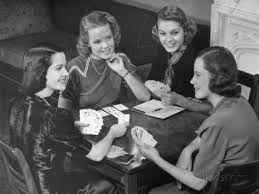
“Playing cards” was not an activity in the little town where I grew up.  It was an object.  “Playing cards” referred to what you used when you played poker and other devious games.  “Playing cards” is an activity for people who know how to play poker or even suspension.[1]

I’m not thinking about either of those today.  I’m thinking about “playing the ___ card.”  It means to activate a status you hold so as to gain an advantage in the discussion.  And that’s how it can become the death of dialogue.  Here’s an instructive exchange from the movie, Glory.

10th Connecticut Corporal: [Scoffing as he notices Rawlins’ rank] Stripes on a nigger. That’s like tits on a bull!

Sgt. Maj. John Rawlins: You’re lookin’ at a higher rank, Corporal. You’ll obey and like it.

cards 4The first speaker is white, of course.  The second speaker is black and the holder of a higher rank.  The white man is “playing the race card.”  The black man is “playing the rank card.”  That’s what I mean by “playing cards.”

Playing a card is a dicey move.  It is a way of establishing your right to be part of the conversation or your right to right to dominate the conversation or to end the conversation. Because it is an action that calls attention to the speaker rather than to the issue, it is not something the speaker does casually.

“I’ve lived on the streets so I know what real life is like.  You haven’t, so shut up.”  A claim to dominate.

“Has anybody thought about this from the standpoint of the child care worker?”  A claim to participate.

“But I am, in fact, the employer and I say that your services are no longer required.”  A claim to end the conversation.

You can see from these examples that playing the ___ card is a claim to rhetorical advantage.  That doesn’t mean claiming an unfair advantage.  Most often, when a speaker is accused of “playing the ___ card,” on the other hand, the implication is always that he shouldn’t have.

I think there was a time in our history where “playing the race card” meant that a white person was attempting to gain an advantage over a non-white person.  Today, it is nearly always the other way around.  There was certainly a time in our history when “playing the gender card” meant that a man was attempting to gain an advantage over a woman.  Today, it is nearly always the other way around.  Looking at this situation formally, we would expect to see a rise in racism among blacks and a rise in sexism among women.  I think that’s just what we find in the media and also among some groups of blacks and women.

I referred in an earlier post to my friend Bob, who has a truly amazing collection of “cards” at his disposal and simply refuses to play them.  That makes Bob a hero in my eyes, but it is heroic partly because it is so rare.  My experience of nearly everyone except myself[2] is that we play the cards we have.

Let’s take the case of women, for instance.[3]  Women live in a society that presupposes values cards 3that are more common among men or more natural to men than to women.  For all the years that they accepted those social practices and values, it was a disadvantage to them.  Now that the legitimacy of those practices and values has been turned into a question, it is a great advantage for them.   Men are not nearly as conscious of their gender status and attributes as women are.  So long as the social practices favored men, there was no reason to be all that aware.  Now that the social practices are a source of contention, men don’t know what to do about it.

When “you think like a woman” was a charge that could lower your pay or deny you a job or a promotion, women decided to do something about it.  Good for them.  Now that “you think like a man” is a charge that puts a man on the wrong side of nearly any issue you want to name, men have no idea what to do.  What kind of a man are you anyway?  You are not very sensitive.  Your mind goes right away to defending your turf, when it really should go to building your network.  Your thinking is so…linear.  Ugh.  You need to let your thinking get in touch with your feelings.  You need to be a little more…you know…human.  Sex?  You know, you’d be a much better person if your interest in sex was more like the kind of interest women have.  You think you could maybe work on that a little?[4]

cards 2Staying at the formal historical level, it seems to me that there are two things men can do[5] and by “men,” I mean men in the aggregate.  Actual men who are comfortable with themselves and comfortable with their wives or significant others who, in turn, like them the way they are—I’m not talking to you.  I’m talking about “men in general” in the same way I was talking about “women in general.” 

The first is to decide just what it is about being a man that is worthwhile and push it.[6]  This would require that men recognize that we are in the minority, not just demographically, but culturally as well.  We could develop the kind of self-awareness that religious or ethnic minorities routinely develop instead of relying on the historically exhausted masculine assumptions that were once presupposed.  That would make “being male” a card to be played, not a character defect to be apologized for.

Very likely, that wouldn’t work.  Or at least, it wouldn’t work in the sense of benefitting men, for a long time.  What it would do, almost immediately, is to create a rhetorical game in which there are two players, each of whom has cards and knows how to play them.  This means that women are no longer the background against which we can see the real show, which is what men do with power and authority.  It means that men are no longer the background against which we can see how women organize themselves to get things done and, at the same time, affirm the personal contribution of each member.  It means that the background is rhetorical; that everyone has cards to play; and that who plays which cards when is what we get to watch.

This is, I say again, a game that is to be played on the aggregate level.  This is not something individual men and women need to do.  It is something that sports shows and game shows and talk shows and sitcoms and crime dramas and articles on “the gender crisis” need to do.

Playing cards is something people do when they are in the foreground.  It is not a game when one player is on the stage and the other “player” is holding up the scenery.  It doesn’t work that way.

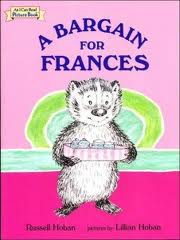
And finally, here’s a story that illustrates the kind of transformation I am hoping for.  One of mycards 1 favorite stories in the world is A Bargain for Frances.  As you can see, Frances is a badger.  Frances has a “friend” named Thelma.  Every time Frances plays with Thelma, something bad happens to Frances.  Thelma always seems to come through unscathed.  One day, Thelma goes too far; she cheats Frances out of a tea set.  This allows Frances to see the whole relationship in a new light and, as a response, she cheats Thelma out of the tea set, restoring the status quo ante.

Thelma is disturbed.  “I can see that when I play with you, I am going to have to be careful,” says Thelma.  Frances’s response is inspired: “Do you want to be careful…or do you want to be friends?”

Friendship is a possibility now.  It never was before.  Thelma was the predator and Frances the prey.  This was never anything Thelma saw fit to criticize.  It had a lot of advantages.  On the other hand, Thelma didn’t have Frances as a friend and nothing she could do would supply that to her.  It needed to be something Frances could do.  Now both Thelma and Frances have cards to play and they can play them or not as they choose.


[1] You might not have heard of that.  Suspension is a kind of bridge.

[2] I am not saying, of course, that I don’t do it myself.  What I said was that if I do it—probably, I do—I don’t catch myself at it.

[3] Not all women, of course.  I know women who are so unassertive they discard trump cards rather than play them.  I know women who are heroic in the mode of my friend Bob who have cards and know what to do with them and then don’t do it.  But “the women” of TV, movies, books, magazines, blogs and quite a few women I see in conversations that include men, routinely reach for the gender card and play it to their advantage.  And why wouldn’t they?

[4] I started to think about this some years ago when I spent some time looking over the “men’s studies” sections of some very good bookstores.  What to do about “the man problem” was divided about 75% into Position A—it’s a disease, but here are some possible cures—and Position B: it’s not a glitch, it’s a feature.  Position B gets men out in the woods, painted blue and howling at the moon.

[5] The second way is to organize in social and political ways to push for gender advantages.  I can see I’m not to get there in this piece.  It would involve developing schools, for instance, that are as supportive of boys as they are of girls.

[6] It is an etymological curiosity and no more than that, but the truth is that the vir- in virtue means “man” as in a male human beings.  There are, of course, many virtues that women have more prominently than men do, but etymologically, these virtues are all kinds of “manliness.”

Posted in Political Psychology, Politics, ways of knowing | Tagged , , , | Leave a comment