Such a Boy Scout

I was a Boy Scout in my younger years.  Scouting didn’t make much sense to me, but it was at a Boy Scout 1time in my life when nothing much made any sense, so I don’t really blame them.  But you remember the oddest things.  I remember, for instance, learning that a scout is trustworthy, loyal, helpful, friendly, courteous, kind, obedient, cheerful, thrifty, brave, clean, and reverent.  A lot of the scouts in my troop didn’t check off all 12 every day—I didn’t, certainly—but I was sitting in memorial service last week and all 12 of them came back to me, in order, as if I had been saying them every day for the intervening 60 years.

Those were unquestionably good traits, as I saw them then.  But then I grew up.  Worse yet, I went to grad school.  And then I developed an appetite for seeing the meanings of words in the context of their language of origin.[1]  So now, when I look at the list of Boy Scout aspirations, I think thoughts that would not have been possible for me then and that would make me a poor choice for scoutmaster now.[2]

I wonder, for instance, about the “traits.”  What is a trait?  This list of characteristics of a Boy Scout was adopted in 1911.  The whole collection is called “the Boy Scout Law,” which seems quite daring to me.  These are a law?  Wow!  In 1937, Gordon Allport published the study of traits, for which he was best known.  I think it would be fair to say that this way of thinking about people was presupposed in 1911, but was under serious study by 1937.  A substantial criticism of “traits” as a good way to think about what people are likely to do was offered by Walter Mischell in 1968, so I think we can no longer say that traits are presumed by the people who study them although they come in very handy in coffee shop conversations.

So, what is a trait?  Well, trustworthiness, (the first of the two desirata to come to us from Old Norse—thrifty is the other) is a trait.  It means that I can be trusted.  I am trustworthy.  But what if I am, like most people, absolutely trustworthy in this circumstance, probably trustworthy in that circumstance, and a poor bet in some other setting.  Am I trustworthy?

Or, to ask the same question another way, are “traits” a good way to think about what people will do?  Would it be better to look at the settings first?  Say I am a former smoker.  What are the odds that I will continue to refrain from smoking when I go to the old hangouts and spend time with the guys I used to smoke with?  Not good, I would think.  The chances are better if I make new (nonsmoking) friends and go to new settings to spend time with them. 

Let’s look at helpful.  Would you expect me to “help” someone who needed help?  Yes?  So I’m “helpful.”  Would you expect that I would provide: a) the help I think this person needs or, b) the help he wants,  presuming that he might want something different?  Am I helpful in both cases?  And in our time, “enablers” are thought to be bad people so I can say I am helping this person and you can say I am only enabling her to do something she will regret.  Am I helping?  Or let’s say that supporting a person in his efforts to chart his own course is “helpful,” apart from whether he makes good or bad decisions.  Do you want to say it is “unhelpful” if his decisions don’t work out?  I don’t think you do want to say that.

Helpful turns out to be complicated.  Let me tell you that friendly and reverent aren’t any better.

Further, some trait names just beg the question.  Loyal is good, I suppose.  Loyal to whom?  Are some loyalties good and others bad?  Is “loyal” good and “disloyal” bad?  If the law wants you to take one course and your family needs for you to take another course, where does “loyalty” push you?  Just asking.

Now I don’t expect any of these nasty questions to be resolved by looking at the language of origin, but I do think that we can look at these words more carefully and more usefully be seeing where they were before they came to us.  We don’t need, in other words, to accept the cultural contexts in which their meanings were clarified, but it is probably a good idea to know what they are.

I’m going to start with the Old Norse trait names first –trustworthy and thrifty.  Then I’ll move to the Old English names—helpful, friendly, kind, cheerful, and clean.  And I’ll finish up with Latin, mostly arriving here through forms adopted by the French—loyal, courteous, obedient, brave (through Italian), and reverent.  I plan to take a year doing this, so you can afford to get comfy.


[1] All English words are immigrants.  There appears to have been a sort of linguistic Ellis Island where words wanting to become part of the English language, stopped and declared the land of their origin and possibly the land from which they came just before arriving here.

[2] In the intervening years, most of my contact with the Boy Scouts as come from Boy Scouts of America v. Dale, in which the Supreme Court slapped the Boy Scouts on the wrist for claiming that the first amendment rights of free speech could be stretched to their denial of troop leadership to gay scoutmasters.

Posted in Living My Life, Words | Tagged , , , , | 2 Comments

The Growing Middle Class

I remember when the Democratic Party was the champion of “the poor.”  I always thought it was pretty gutsy to champion a set of people based on their economic status—especially the class of people that votes at lower levels than any other category of voter. After that came “the marginalized.”  I knew they meant the same people, but this word had that magic –ized ending on it which means that something has been done to these people.  They were victims.  If, after all, these people have been marginalized, then there are marginalizers—the bad guys—who can be vilified and  perhaps even defeated.

For several election cycles now, the Democrats have been the champions of “the middle class.”  I never really believed that.  I always thought that it was just a new and more respectable name for the downtrodden, the traditional Democratic icon.  I’m sure the idea of choosing “the middle class” as the favored class has something to do with the fact that the vast majority of Americans think they are part of that class.  Take a look at this chart.

middle class 1

If you combine middle class and upper middle class, you come up with 55%.  If you include the working class, and they largely do include themselves when they are asked what class they belong to, you get 86%.  That’s a lot of people who think of themselves as middle class and that’s one major reason the Democrats have made themselves the official guardians of the well-being of the middle class.

A part of the larger political message is that American economic well-being rests on having access to a middle class that can afford to make purchases.  Take a look at that sentence.  Read it twice. Remember where you saw it.  We are going to come back to it shortly.

Robert Reich, in his recent book Aftershock: The Next Economy and America’s Future, begins with the insight of Henry Ford.  Ford paid his workers outrageously well.  The Wall Street Journal called Ford’s pay scale “an economic crime.”  Ford’s idea was that if he paid his workers enough to buy Ford cars, he would sell a lot of Ford cars, and so he did.

Reich characterizes the thirty years from 1947—1975 as “The Great Prosperity.”  Everything worked.  Productivity grew, wages and salaries grew, safety net protections grew, unions were strong, increasing numbers were attending college.  Then we started doing things wrong and for the next thirty years—which included Reich’s turn as Secretary of Labor—all those advances began to retreat.  Here is his summary:

To summarize: The fundamental problem is that Americans no longer have the purchasing power to buy what the U. S. economy is capable of producing. ..What’s broken is the basic bargain linking pay to production.  The solution is to remake the bargain.

And, on the next page:

The question, then, is to move from a vicious cycle to a virtuous one—how to restore the widespread prosperity needed for growth and how to get the growth necessary for widespread prosperity.

It is true beyond question that American companies cannot thrive unless they can sell their products at a profit.  But nothing in that scheme requires that these products be sold to American consumers.  Here’s that sentence I asked you to remember.

A part of the larger political message is that American economic well-being rests on having access to a middle class that can afford to make purchases. 

Did you notice that nothing in that sentence has anything to do with access to an AMERICAN middle class? I didn’t notice it myself until I wrote it and then read it several times.  In other words, all Reich’s solution requires is that there be a middle class somewhere that is big enough—has the aggregate purchasing capacity—to keep American businesses strong.  Henry Ford’s solution—paying his workers enough to buy a car—worked just fine for Ford, but now we can sell Fords anywhere in the world that people have enough money to buy them.  Ford doesn’t really need to pay its workers “enough” anymore.

What Ford really needs is “a global middle class.”  And is there such a thing?  Sure.  Here are a couple of things I ran across.  We have the 27th largest middle class in the world if you measure median wealth per adult.  I got that from Les Leopold in the Business Section of HuffPost.  Median wealth is just  “the amount of wealth accumulated by the person precisely in the middle of the wealth distribution — fifty percent of the adult population has more wealth, while fifty percent has less.”  And, as Leopold observes, you can’t get much more middle than that.

Here’s a chart based on the findings of an International Labor Organization’s study

global middle class 2


It’s hard to see the number values in this chart, but you should be able to see that the United States is the last one on the list.  Questions can be asked about the size of each of these middle classes and about whether “median wealth per adult” is the best measure of potential aggregate demand.

Here’s what can’t be asked any more.  Where will American businesses find buyers for their products after the American middle class has wrung itself dry?  The answer is, “Everywhere else.”  There is no advantage to an American manufacturer or service provider to sell to American customers.  People who have money to spend are “customers.”

The American middle class really doesn’t have money to spend.  Wages have gone down, measured by purchasing power, since 1972.  Continuously down.  Converting families with one bread-winner into families with two bread-winners helped for a while, but falling wages wiped that out as an economic solution.  Vastly increasing credit card debt helped for a while, but eventually those have to be paid off.  Borrowing on the value of the house helped until the housing market tanked and millions of people were left with nothing.  The American middle class really doesn’t have enough money to sustain the consumer spending part of the economy and that’s a crucially necessary part of that economy.

So the Ford solution, which Reich is counting on, doesn’t really help us anymore.  American business can be prosperous so long as they have prosperous customers and there is no reason why those customers need to be Americans.  The American middle class can continue to shrivel—the protectorship of the Democratic Party notwithstanding—and American businesses can continue to prosper.

It’s hard to imagine a stable democratic country where the two large classes are the wage-poor and the profit-rich.  We’ve always thought of ourselves as essentially a middle class country.  Thomas Jefferson said that is all that would save democracy in the United States over the long run.

We’ve always thought that was good news, but maybe it isn’t.

Posted in Politics | Tagged , , , , | 1 Comment

Let Even the Old Rejoice


Every year, as close to Epiphany as we can get it and still have it fall on a weekend, Bette and I invite friends over to read W. H. Auden’s poem, “For the Time Being” together.[1]  It takes about three hours, start to finish, if you count the time we take for the comments between sections, the frequent trips back to the table and the bar, and all the side conversations that happen when you collect a bunch of interesting people in one room.  It was a superb group again this year—some church people, some book group people, some Starbucks people.  “All three of our churches,” as Bette might put it.

“For The Time Being” is a huge sprawling poem with intricate rhymes in some parts and flat-out bawdy commentary in other parts. Every stanza of “The Voices of the Desert,” when the Holy Family is fleeing to Egypt, ends with a limerick.  That tells you something.

It’s not a hard poem to read.  We have good readers and not so good readers every year and the old 4everyone does just fine.  It is hard, however, to understand.  The whole poem is a single argument.  It begins with the world in sad shape and proceeds through the Incarnation, with Joseph and Mary and the Wise Men and the Shepherds and all those capitalized roles that everyone knows so well.  It ends with a vision of a redeemed world—two visions really; one theologically grand and the other about how to straighten the house up after all the holiday parties.  That much tells you that the argument moves from a condition through and event to an altered condition.  It is a narrative.  It is an argument.

On the other hand, the language is so rich that it is hard to pay attention to the argument.  Here is a particularly rich excerpt.  The stone is content/With a formal anger and falls and falls; the plants are indignant /With one dimension only and can only doubt/Whether light or darkness lies in the worse direction.

I love language like that.  The continual falling of a stone as “a formal anger,” for instance, moves my mind toward wordplay and serious thought at the same time and there are lots of small passages like that.

Then, when you pull back just a little and see the argument—which was always there—it is a little bit like catching a glimpse of the muscle beneath the skin.  “Why do I keep forgetting it is there?” you ask yourself.

Today, in celebration of this year’s reading of the Auden poem, I am going to look at that sequence of skin, then muscle; at language, then narrative.

I will start with a stanza about old people.  This one catches my eye every year partly because I am old, myself, and partly because the prospect of the death they describe is half exuberance and half hilarity.  The old people’s stanza comes in a series like this: a) let number and weight rejoice, b) let even the great rejoice, c) let even the small rejoice, d) let even the young rejoice, and finally, e) let even the old rejoice.  That’s a lot of rejoicing and you would think that anyone with half a mind would ask, “Hey.  What’s all the rejoicing about?”  But until this year, I didn’t ask that.

Here’s what I did instead.

Let even the old rejoice

The Bleak and the Dim, abandoned

By impulse and regret,

Are startled out of their lives;

For to footsteps long expected

(There’s a Way. There’s a Voice.)

Their ruins echo, yet

The Demolisher arrives

Singing and dancing

the old 1I noticed that the old are described as “The Bleak and the Dim.”  I liked that.  It captures different dimensions of what “being old” is like for a lot of people.[2]  For the same reason, I liked “abandoned by impulse and regret.”  When I think of impulses, I think of those sudden, powerful decisions to do something or the experience of being overcome by desire for something.   They are, in either case, something that happens to you.  Regrets are sometimes produced by acting on the impulses, but other times, the regret is a part of not acting on the impulses.  Reflecting back on a life from the position of great age makes both of those real.  But they are not current.  They are not what your life is like then.  These great impulses and regrets have abandoned these old people and now they must do without them.

Then death approaches—The Demolisher—as they knew it would.  These are “footsteps long expected” and their ruined bodies echo the footsteps they hear.  That is what they have always expected, but that is not what happens.  The Demolisher arrives, in fact, singing and dancing and inviting them all to sing and dance with him.  Now that’s the way to die.[3]

I was so taken by this characterization of the old and The Demolisher that I forgot that the singing and dancing of the old is just a part of the singing and dancing.  The young are singing and dancing too, and the great and the small.  So, having noticed that this year for the first time, I find I am back to the question I said anyone with half a mind would be asking, which is: What’s all the singing and dancing about?

These stanzas are part of a section called  “The Annunciation,” but which I, given my own choice, would call by a broader name.  I would call it “The Incarnation.”  I would call it Emmanuel, “God With us.” That is what has happened.  That’s why all the singing and dancing.

And this brings us to what we grew up calling “the Christmas story.”  Mary and Joseph and the Wise Men and the Shepherds and all that—all of whom, as well as the Star of the Nativity, are characters in the poem.  But Auden takes us to the heart of that whole process.  He goes to the visit of the angel Gabriel to the young woman, Mary.  Joseph’s fiancée, you remember.  Gabriel appears to Mary and says, “Will you do this very difficult thing because God needs it done?”  And Mary says, “Yes.  I will.”  As a transaction, it is as simple as that.[4]

To Auden, it isn’t just a transaction.  Auden provides a setting for this event.  To use the same metaphor he gives to Mary, her saying yes would be like a diamond lying on a table.  But her saying yes in the context of what God wants for us all is like a diamond mounted in an exquisite setting.

Here’s what Mary says.

My flesh in terror and fire

Rejoices that the Word

Who utters the world out of nothing,

As a pledge of His word to love her

Against her will, and to turn

Her desperate longing to love,

Should ask to wear me,

From now to their wedding day,

For an engagement ring.

 Remember that this speech, beautiful as it is on its own, is part of a narrative.  The terror and fire that Mary experiences are part of the same story that the Bleak and the Dim old people experience, but it is because of what Mary says that “the Demolisher arrives, Singing and Dancing.”  That, to refer one more time to my question, is “what all the singing and dancing is about.”

What does Mary say?  If you crushed it and forces it into prose, what would it mean?  Here’s what I think it means.  The Word  (God)who uttered the world out of nothing has pledged to love her (the world, or, more briefly, us) no matter what.  This love will have its final and necessary and appropriate conclusion in “the Great Wedding;” the final reconciliation of God and humankind which He has been arranging for a very long time.  The Great Wedding, in other words, has been preceded by “the Great Courtship,” which is what is going on now.

Why has it taken so long?  It turns out that we were not sure God could be trusted as a suitor.  He has had to love us against our will.  He has had to turn our desperate longing into love.  And for it to happen at all, we would need to continue to believe that it could happen.  That is why there must be “an engagement ring” for us to see and it is why Mary consented to be that engagement ring.

That is what she says.  “My flesh in terror and fire rejoices that the Word should ask to wear me as a sign of His trustworthiness until the very day of the Great Wedding.”  You have to throw away a lot of very beautiful words to find that sentence.  You have to know who “the Word” is and who “the world” is and what “their wedding day” is, but when you know those things, you can make this sentence.  You can read “My flesh in terror and fire rejoices…” and know, at last, that that is what all the Singing and Dancing is about.

Amen.


[1] Epiphany as a special day offers difficulties for us.  We celebrate Advent according to Matthew’s story on one year and according to Luke’s story the next year.  Since Epiphany is connected to the visit of the Magi, which occurs only in Matthew’s account, we have nothing to celebrate in Luke’s year.  This was Matthew’s year, so there was no tension to feel.

[2] In fact, it a very good representation of the final stage of life which, according to Erik Erikson, is characterized by “integrity”  by those who embrace it, and by “despair” by those who do not.

[3] It reminds me of the last scene of The Milagro Beanfield War where Amarante Cordova, the sick old man who has saved the town and the Coyote Angel (Death, personified as in the Auden poem) set off for the party they can hear from just over the hill.  “It seems like such a long way,” says the Coyote Angel.  “I know a short cut.”  And they move off together, laughing and telling stories and are not seen again.

[4] It is as simple as Jesus’s response to God on the night before his crucifixion.  Jesus prays, “Is this really the only way?”  God responds, “I’m afraid so.  No one else can do this and now is the time.”  Jesus says, “Then bring it on.”  In all honesty, this paraphrase leans on Luke’s version more than on Matthew’s and Mark’s.

Posted in Getting Old, Living My Life | Tagged , , , , , , , | Leave a comment

Microaggression! Really?

I was watching an episode of The Mentalist this week and particularly enjoyed this one line.  I’ll let you know when the line shows up.  This next part is just background

So there are these two guys in a bar.  What is with these guys?  They are clumsy.  They don’t present themselves very well.  On the other hand, they are in the bar because women they might be interested in are there and it is their job, apparently, not the women’s job, to take the initiative.  They do it badly.

The women are there to check up on Patrick Jane, the main character of the show, who is having a date somewhere in the restaurant.  The men give their names.  After a brief pause, the women give their names.  The first woman’s name is Kim. The second woman’s name is Theresa.  “Theresa,” says the Second Oaf, “that’s a pretty name.”

OK, here’s the line.  She looks up at him and says, “Thank you.”  When, in the next  conversational pass, the women reveal that they are FBI agents and the men back cautiously away, the whole scene is over, but I thought that Theresa’s thanking the Second Oaf for doing as well as he could, was a nice touch.  I’ve had that job myself, recently, and I didn’t always do it very well. I understood that to be treated with generosity by a woman who was simultaneously signaling that she didn’t want to have anything further to do with me was a gift from her to me and I accepted it thankfully.

If you go to this site on Buzzfeed, you will see a lot of what someone  thinks ought to be called microaggression.  I look at it as training in victimhood for the featured young people.  I’ll show some pictures from this site later.

http://www.buzzfeed.com/hnigatu/racial-microagressions-you-hear-on-a-daily-basis

Now let’s talk about microaggression.  It doesn’t have to be racial or ethnic as the examples on this site are.  It could have to do with gender, with age, with social presentability e.g. fat or ugly, with being a member of the wrong class, with being—as with the two guys at the bar—confronted with a task that was beyond their ability.

“Micro” aggressions are, of course, just “little aggressions,” but it makes me wonder why it is a good idea to invent a scale that groups a lot of different behaviors together and calls them all “aggressions,” distinguishing them only by whether they are large or small.  Why is that a good idea?  So lynching a black civil rights worker in Mississippi is a macroaggression, right, and not being able to tell the nationality of an Asian schoolgirl is a microaggression.  Is a scale that does that really a good idea?

It seems to me it would be a good deal more satisfying, and not so…you know…microaggressive, to build two scales.  In my teaching days, I called them axes and called the ends of the axis, poles.  On the one axis, you put people who intend to do harm to others.  You could calibrate it from large harmful acts at one pole to small harmful acts at the other, but there would be nothing inadvertent on the axis at all.  The other axis would measure social competence—a kind of a klutz or doofus scale—micro 1and goes from high (reliably incompetent or insensitive) to low (socially skillful).

If you don’t do it that way, you are going to be calling “aggressive,” a lot of people who are trying to do social tasks that are beyond their ability.

So here’s one.  I’m guessing that the point is that she is thought not to be “American” because she is not Caucasian.  If she looked Russian, in other words, she would not be thought to be an immigrant.  If she were Russian, her family  actually could have come from the region of the Caucasus Mountains and she would be Caucasian in a way Germans and Swedes and Italians could only envy.  I wonder if she knows that rolling her eyes like that can only be an act of microaggression.

micro 5Or try this one. In my classes at Portland State, I had a lot students from Japan, Korea, China, and Vietnam and a few each term from other Asian countries.  If there is a way to distinguish students from each of these countries flawlessly just by looking at them, it was not covered in the faculty manual.[1]   If you are teaching political science, questions of relations between the government of the U. S. and these four countries will arise.  I’m trying to think why I shouldn’t ask this question of an Asian student who looks like this.

Or how about this one?  Would you really look at a person who is as far away from you as this camera shot suggests and screw up your mouth like that?  Would you really?  So the question of the monumental preference of black voters for Democratic candidates comes up and the likelihood that the one black student in the class will have no views on the question that are worth hearing is accepted as common knowledge?  What would he know about it?  What experience does he have of black voters that would not be shared equally by the other students in the class?

Of the many grievances I harbor about this piece—What!  You couldn’t tell?—let me select two. micro 3 People who perform a delicate or even a routine piece of social interaction badly are not necessarily “aggressive.”  They might be daunted, shy, anxious, or just incompetent.  That’s my first grievance.

Second, the microaggression is a notion that can have some useful applications in an experimental setting.  Used generally to disparage people who said things you didn’t like is not a good idea.  It exacerbates any tensions there may be.  It leads the doofus who asked the stupid question to move in the direction of further alienation from “different looking people.”  There are no pictures in this piece of the people who asked these questions, of course, because this is a session dedicated to training people how to feel like victims, but it is worth asking what the effect on these people will be. 

Does the routine labeling of social ineptitude as “racism” really help bring the several races into productive dialogue?  It does?  Really”


[1] The names help a good deal more.  One term, I had four Vietnamese students named Nguyen.

Posted in Political Psychology | Tagged , , , , | Leave a comment

Do You Understand What You Are Reading?

I take the title from the question Philip asks the government official in Acts 8:30.  The official is reading Isaiah and Philip runs up to the chariot to ask if the official is reading with understanding.  The two passages I have in mind for today come from Matthew and Luke, but the question I am asking is the same question Philip asked.

In the family and the community and the culture in which I was raised, knowing what the Bible Zechariahsaid was thought to be a good thing.  You could learn a lot just by reading it by yourself, of course.  Who was Tamar’s father-in-law?  Um…Judah.  But there were also groups who “studied” the Bible together and if you are going to pursue an activity in a group, there must be a common notion of what we are doing.  You can’t do it together if you don’t have some common notion of what you are doing.  Here is Gabriel, by the way.  Look at the pointing finger.

What were we doing in these groups was looking at the passage under consideration and trying to decide what it meant.  That seemed so unremarkable at the time.  We might take a passage like Matthew 25, here in the King James Version of my youth.

34 Then shall the King say unto them on his right hand, Come, ye blessed of my Father, inherit the kingdom prepared for you from the foundation of the world: 35 For I was an hungred, and ye gave me meat: I was thirsty, and ye gave me drink: I was a stranger, and ye took me in: 36 Naked, and ye clothed me: I was sick, and ye visited me: I was in prison, and ye came unto me.37 Then shall the righteous answer him, saying, Lord, when saw we thee an hungred, and fed thee? or thirsty, and gave thee drink? 38 When saw we thee a stranger, and took thee in? or naked, and clothed thee? 39 Or when saw we thee sick, or in prison, and came unto thee? 40 And the King shall answer and say unto them, Verily I say unto you, Inasmuch as ye have done it unto one of the least of these my brethren, ye have done it unto me.

ZechariahWe could have talked about the justice of God.  We could have let our imaginations run about just who “the least of these” were.  We certainly wouldn’t have paused to add “or my sisters” after “these my brethren,” although that is a perfectly respectable way to translate it if the question had come up.  We might even have raised the question of whether it is really “the least of these” who is highlighted or is it “even the least of my brothers.”  It is the brothers (and sisters) we are talking about and the least among these are being given particular focus.  Is the passage about the disciples of Jesus, in other words?

I have nothing against conversations of that kind.  There are passages in the Bible where that kind of discussion is as good as any other kind.  Furthermore, it is a very democratic and forgiving group process.  If “the meaning of the text” is right there on the page, in English, presupposing our own cultural values rather than those of the time when it occurred, and I understand it one way and you another, the discussion goes on.  I value your contribution and you value my contribution and we have punch and cookies afterward.

Then there are passages where that kind of understanding is simply not adequate.  Let’s consider one so we can explore just what would be required to understand such a passage.   Here’s one from Luke 1, shifting now to the New Jerusalem Bible, my current favorite.

18 Zechariah said to the angel, ‘How can I know this? * I am an old man and my wife is getting on in years.’ 19 The angel replied, ‘I am Gabriel, who stand in God’s presence, and I have been sent to speak to you and bring you this good news. 20 Look! Since you did not believe my words, which will come true at their appointed time, you will be silenced and have no power of speech until this has happened.’

 How will the group I have been describing and which I have often been a part of, understand this text?  I have always understood that Gabriel is chastising Zechariah for his unbelief.  That never seemed quite fair to me.  An angel appears to me in the middle of a work day and says my wife, who has never been able to get pregnant—we tried everything!—is going to have a baby.  Now, when even menopause is a distant memory.  I say, “How in the world is that going to happen?”  And he punishes me.  I thought it was a pretty good question.

It gets worse if anyone in the group happens to know that Abraham asked the same question exactly—word for word—without getting hammered for it and Mary asked the same question as well, of this same angel, and got a very informative answer to her question.  Puzzling, of course, but an answer.  There are a lot of ways the discussion in my group can go after that; all of them bad, so far as understanding the passage is concerned.

Here’s another approach to that passage.  It has a lot of drawbacks.  For one thing, it is scholarly.  We are never going to have a church full of biblical scholars or a church open to consulting biblical scholars.  Why?  Remember what I said about how bracing this kind of discussion was—democratic and forgiving, I called it?  The scholarly approach isn’t like that.  It features the authority of scholarship.  If there is more than one scholar, I probably includes academic competition as well.

But it has advantages, too.  For one thing, if provides an answer to the question of why Gabriel was so snotty to that dazzled old man.  Here’s what Raymond Brown says, “He is struck dumb.  That seems harsh, but this is not told for sentiment.”

Matthew is trying, Brown says, to remind his hearers[1] of Gabriel’s appearance to the prophet Daniel, which was Gabriel’s only previous appearance in the Bible.  Here’s how that encounter went, as Daniel himself describes it in Daniel, Chapter 9:

 14 “Now I have come to explain the vision to you. I will tell you what will happen to your people. The vision shows what will take place in days to come.” 15 While he was telling me those things, I bowed with my face toward the ground. I wasn’t able to speak.

Gabriel gave to Daniel a vision of the last times and Daniel was struck dumb by the vision.  He wasn’t being punished.  He was being overwhelmed.  And Brown says that Luke introduces this little plot twist into the annunciation story to remind the readers of the power, the gravity, the significance of the pronouncement.  The alternative way of approaching it, the way I described as my group’s approach, is dismissed by the line, “…this is not told for sentiment.”  This one line, in fact, dismisses all the kinds of understandings available to the group.  We presupposed that this story was being told for “sentiment,” although that is not what we would have called it.

Let’s just say that Brown is right about Luke’s editorial intent.  Where does that leave us?  As you would expect, there are some good effects and some bad effects.  The most immediate good effect, the one I experienced most directly when I heard Brown’s line—“…this is not told for sentiment”—is the relief of letting go of Gabriel’s snappishness.  Why Gabriel said what he said now makes sense and it has nothing to do with Zechariah.

The second implication is that a group consideration of passages like this are doomed to failure if “understanding the passage” is what the group is about.  No one in the group is going to know about Gabriel’s previous appearance.  No one will think of Luke’s artistry in evoking Daniel’s vision of the last times as he prepares us for understanding the decisive invasion of human history that begins (again) with the annunciation of the birth of John the Baptist.  No one will be thinking about Luke at all because it will not occur to anyone that the best understanding of this passage comes from the use the writer is making of it.

very old 5That means that the easy collegiality that was made possible in the Bible study group (by the presupposition that the meaning of the text was right there in the text) goes away.  That’s a big loss for me.  I really liked being part of a group working together on that tast.  People who look back at their participation in such groups with anger think of pictures like this one.  I don’t. Those old meetings are replaced by having a textual expert handy and by relying on the authority of the expert rather than our own back-of-the-envelope calculations.

Those are the gains and the losses that come to my mind first.  For myself, I don’t think I have any choice any more.  When I read about Luke’s intention to evoke Daniel, something snaps in place and all of a sudden I feel that I am seeing the passage clearly—very often, clearly for the first time.  And there is an emotional excitement about it.  I don’t want to give that up either.  I don’t think there is any going back for me.

That means that no Bible study group I have ever been part of is going to work for me anymore.  Maybe there’s a group somewhere.  I could teach a group like that myself, if the group would allow “teaching” to be relaying to them the understandings I found in my studies among Brown and his fellow scholars.  That doesn’t sound very likely to me, especially when there are so many scholars who might be chosen.

So I choose to read my books and to listen to my CDs and to have the conversations I can have based on what I have learned.  I have some friends who will be glad to be a part of this enterprise, although none of them lives in Portland, Oregon.  I have a blog, which serves to begin conversations with this far-flung set of friends.  That’s pretty good.

But however good or bad it is, I’m sure I can’t go back to the group approach I once knew.  Always, there are two questions.  The second one, “What does this passage mean for the way I understand my own life and the challenges of my own discipleship?” is going to be the same in either setting.  The first one, “What does this passage mean to me?” has been decisively replaced by “What is Luke trying to say by crafting this text as he does?”


[1] Father Raymond E. Brown tries, especially in his lectures, to remind us that most of the people who came in contact with Matthew’s text in the first several centuries were hearing it read, rather than reading it themselves.  There weren’t many copies of these texts and most people couldn’t read anyway.  This consideration of Luke’s use of the vision appears in his book, The Birth of the Messiah and in a set of lectures with the same title.

Posted in Biblical Studies | Tagged , , , , , , | Leave a comment

The Best Practice for Dying Well is Living Well

“Death” is the end of life.  “Dying,” on the other hand, is life’s last task.  I have heard it is a difficult task; difficult, at least, to do well.  On the supposition that we are likely to die as we lived, the best preparation for dying well would seem to be living well.

Here is the quote that started me thinking along this line: “The most critical task among the very old is to retain a sense of identity when confronting physical decline and the loss of loved ones…”[1] Today, I’d like to unpack that quote a little.  What is meant by “the very old?”  What is a “sense of identity?” Why are “physical decline” and “the loss of loved ones” chosen as the important categories?

very old 1I’m somewhere between “the days of a man are three score and ten” (70) and “by reason of strength, four score” (80), so I don’t think I am what Professor McCarthy meant by “very old.”[2] On the other hand, if dying is a task you can practice and, over time, get good at, I want to get started.  I’ve never been a quick learner and being “very old” would not make me any quicker.

So, what is “a sense of identity;” the sense I have of who I am which it is important to retain.  There are two important things to say about identities.  The first is that they are largely fictions.  The second is that they are extremely important. 

I might have gone a little too far in saying that they are fictions.  The fact is that they are constructs.  An identity, in other words, is not something you find; it is something you make.  On the other hand, you don’t always have the material to make the self you would really like to make.  We all have to build with the materials we can find, earn, or scavenge. A child who wants to think of himself as lovable would do well to surround himself with people who love him, for example.

So, clearly, “a self,” an “identity” is not something that is true or false.  It is true and false.  The best two questions about a self are: a) is it useful and b) is it plausible?  Those two questions are my version of the criteria employed by Snell and Gail Putney: an accurate and acceptable self image.[3]  I have turned “accurate” to “plausible,” as you see.  I think that is really the best we can do.  And I have turned “acceptable” to “useful.”  My sense of who I am, in this formulation, needs to help me do what I am trying to do.  In this post, “dying well” is what I am trying to do—or “living well,” if you want to contrast the rehearsal with the performance.

We try to “retain,” says the quote, a sense of identity.  We had it once, in other words, and we want to keep it.  We want, at the very least, not to squander it.  On the other hand, a substantial part of the materials we used to build this identity consisted of things we were good at and those materials tend to slip away from the very old.  You can’t retain the identity you have built without the materials you need.  Even identities get soiled and frayed and eroded and substantial pieces of an very old 4identity will need to be replaced, like so many shingles. So you can keep on being the person you have the materials to repair and expressions like “physical decline” suggest that the repairs you once made without thinking much about it, may no longer be possible.

What to do?

You can be the self who does remarkable and innovative work with the materials available.  That’s my goal.  Every morning, usually in the shower, I consider what I need to do or would like to do that day.  Above is the team meeting I would like to have; below, the team meeting is more often have.  I huddle with my team’s members and call a play.  Some of my team’s members are not happy.  The feet say they are fine if they can do it in stages; the legs say they could manage if I wear my compression socks; the eyes say somebody else is going to have to read the fine print on the warranty, and so on.  Most often, I have to modify the play I first called so that it calls on the present abilities of my teammates. 

Over the years, I’ve gotten really good at that.  I have a better and better grasp of what they are very old 5capable of.  I invent new offenses and new defenses to take advantage of their abilities.  In this way of thinking of it, “I” have “retained a sense of identity” while confronting “physical decline”—an expression that now refers to the team members.  I can’t run faster than anyone else any more or throw harder than anyone else.  I can’t even outwork everyone else, which was my default strategy as a younger man.  But I know my team better than ever.  I trust them to do what they can and I am smart enough not to ask them to do things they really can’t do.

The second element—the loss of loved ones—is harder in some ways.  The loved ones I have had have served—this is Putney and Putney again—as “mirrors, models, and receivers of my action.”  As mirrors, they have reflected back to me who I am.  As models, they show me what I could be or, sometimes, what I am going to be if I don’t shape up.  As receivers of my initiatives, they accept, reject, modify, accept with conditions, and any number of other kinds of responses.  To pick the simplest example, I love my wife dearly.  That means she has to be willing to be loved dearly.  She also has to teach me what loving her dearly, her in particular, means to her, but that is a topic for another post.

very old 6You lose the people who knew who you were.  The loss of those loved ones is an irreparable loss.  The saying that best captures this reality for me is “You can’t make new old friends.”

On the other hand, you will always be surrounded by people who know—or could know—who you are.  To take advantage of that resource, you will have to be willing to be who you are, not who you used to be.  If you fall into the trap of thinking that “the person I once was” is the person I “really am,” the resource of the people you have will not be adequate.  They, who know you as you are and who are looking for a chance to like you as you are, never knew you as you were.  Telling them who you used to be won’t get the job done for very long.

But if you think back, you will remember that the best friends you ever had were not discovered by telling them who you used to be.  You got those friends by telling them who you were at that time and by living the life that made that identity make sense to them.  That is what you did and I hope you got good at it because that is what you need to do now as a “very old person,” whatever Professor McCarthy means by that.  You need to look, as a good teacher does, at just who is actually there, rather than who you wish were there.

In any case, focusing on the task at hand is going to be a good idea.  This dialogue if from the movie Lion in Winter, but it isn’t the way the script has it.  It is the way Toby Zeigler and President Bartlet of The West Wing remember it.

TOBY:  Hey, your favorite movie was on TV last night.

BARTLET: “By God, I’m 50, alive, and the King all at the same time.”

TOBY:  I turned it on just as they got to the scene when Richard, Geoffrey and John were locked in the dungeon and Henry was coming down to execute them. Richard tells his brothers not to cower but to take it like men. And Geoffrey says, “You fool! “As if it matters how a man falls down.” And Richard says…

BOTH: “When the fall is all that’s left…

BARTLET: …it matters a great deal.”

And so it does.  But if you understand that dying well is only the last part of living well, you can practice.


[1] It is cited by David Matzko McCarthy in his article, “Generational Conflict: Continuity and Change.”  He found it elsewhere, but I suspect that in the elsewhere he found it, it was a quote attributed to yet another where.

[2] The age markers come from Psalm 90.  I’ve fiddled with the wording to improve the meter in English and I have completely ignored the point of this passage, which is that as long as it lasts, it is going to be hard.

[3] The Adjusted American: Normal Neuroses in the Individual and Society.

Posted in Getting Old | Tagged , , , | Leave a comment

Using the Right Words

I wish a happy 2014 to you all and as a step toward that happiness, let’s look at one of my favorite scenes from II robot 1, Robot.[1]  The guiding genius behind U.S. Robotics’ (USB) success was Alfred Landingham, who appears to have thrown himself out of the window very near the top of a tall office building.  Detective Del Spooner (Will Smith) has been called to investigate and Dr. Susan Calvin (Bridget Moynihan) is escorting him around the building, as you see.

Spooner:  So, Dr…Calvin.  What exactly do you do around here?

Calvin:      My general fields are advanced robotics and psychiatry[2] although I specialize in hardware to wetware interfaces in an effort to advance USR’s robotic anthropomorphization program.

Spooner:  So…what do you do?

Calvin:    I…make the robots seem more human.

Spooner: Wasn’t that easier to say?

Calvin:    (reflects briefly on the question)  Not really.  No.

It’s not hard to make fun of Dr. Calvin’s answer and that is really why this exchange is in the movie at all.  I think it is a really good answer in many ways, but it is not a good response to Detective Spooner.  Dr. Calvin’s answer is formal.  This is the answer she would give to a new colleague she would meet at an academic convention or a trade show.  It gives the fields of her training first—advanced robotics and psychiatry.  It gives the field of application second—hardware to wetware interfaces.  It gives the goal third—robotic anthropomorphization.  Every one of those terms leads in an appropriate and helpful academic direction.  They are very nearly citations of the relevant academic work.

Detective Spooner is not someone Dr. Calvin would meet at the conferences.  He is a very good cop, he hates robots, and his method is highly intuitive.  This is a very bad answer for him.  The good answer comes next.  You can see Dr. Calvin stumble in the ellipse between “I” and “make.”  She’s working on how to phrase her work in a very general way.  It has been a long time since she has had to do that.  When she comes up with it, however, it is a really good answer: “I make the robots seem more human.”

Spooner now knows what she does and that really ought to end the conversation, but Spooner wants to reprove Calvin for giving herself a needlessly difficult task.  He has no idea that it is easier for her to give the first answer than the second.  She does stop, though, and give his question some consideration.  The answer she gives is not a response in any way to his discomfort with “the long answer.”  It is a simple and honest answer: No, the long answer I gave was easier than the short answer you wanted.

I have enjoyed that little patch of dialogue for years.  Also, robotization in general and the interactive performance of affect will be a major topic in 2014 and I wanted to get an early start.[3]


[1] For those of you who are fans of the book, I, Robot, the movie has very nearly no relationship to the book.  On the other hand, the book does not have this exchange between Will Smith and Bridget Moynihan.

[2] It really isn’t that funny.  Dr. Calvin’s work has produced a very difficult reality in the current movie, Her, in which, according to the blurb: “A lonely writer develops an unlikely relationship with his newly purchased operating system that’s designed to meet his every need.”  It is Dr. Calvin and her colleagues who have done the designing.

[3] “Interactive performance of affect?”  Are you kidding me?  Well…yes.  On the other hand, it is exactly what I want to talk about.

Posted in Words | Tagged , , , | Leave a comment

The Neurological Infrastructure of Christmas

I’ve been thinking for the last few days about believing in Santa Claus.  You might think that “neurological infrastructure” is a little too much for a piece about Christmas, but hold that thought until you are done.  If you still feel that way, read Kelly Lambert’s piece by clicking on the hypertext link.  And if you STILL feel that way, I say “Bah.  Humbug!”

The reference to “infrastructure” in the title, on the other hand, points to something a little less superficial.  I got to thinking about this when I read Kelly Lambert’s piece (here) in the New York Times.  Lambert is a mother whose young children still believe in Santa Claus.  She is also “a behavioral neuroscientist, a professor and a generally serious-minded, reality-based person.”

In the column she tells the story of an enormous and inventive lie she told her children the year they discovered their presents in the attic and then reflects, as a neurologist, on how glad she was that she told that lie. 

I’ll start with something we all know, beginning with “eventually, they learn that reindeer can’t fly…” The issue Lambert raises is the value of the experiences you have before you learn that.

Although children are born with a full set of 86 billion brain cells, or neurons, the connections between these neurons are relatively sparse during these early years. As their brains develop — as more and more micro-thread extensions form between neurons, and neurochemicals zap across the tiny gaps — children slowly learn about the rules of the physical world, and the distinctions between fiction and nonfiction.

 Eventually, they learn that reindeer can’t fly, that Santa can’t visit every child’s home in one single night and, even if he could make such a trip, there’s no way he could eat all those cookies. Magical beliefs are pruned away as mature neural circuits reflecting real-world contingencies become solidified.

Christmas 3So what’s the advantage?  By preserving a “Santa Claus era,” she assured “that my girls have an emotional holiday portal for their future adult brains.”  So what’s an emotional portal?  It’s the same mechanism that provides the infrastructure for post-traumatic stress disorder.  Neuroimaging evidence shows that going through that portal—experiencing the past in its full cognitive and emotional power—is different from simply remembering an event.  Everyone knows that about battlefield stress.  Lambert is arguing that it’s true about Christmas memories, too.

Her children, as adults—knowing about the material world and its laws—will still retain access to those earlier times.  They will still have access to that portal.  It might be worth calling it a “post-tradition experiential benefit” just to keep the order of ideas in the same pattern as PTSD and thus to remind us that the same infrastructure underlies both.

I liked Lambert’s piece on its own merits, but I probably wouldn’t have written about it myself if several other dialogues had not been available.  Here is one.  It is from one of the many remakes of the movie Miracle on 42th Street.[1]  Susan Walker is a little girl who has had Santa Claus stripped away from her too early.  We know it is too early when she asks her mother, Dorey Walker, “Do I have to not believe in Santa Claus all at once?”  Here’s the way the discussion goes.

Dorey:             “…believing in myths and fantasies just makes you unhappy.”Christmas 1

Susan:             Did you believe in Santa Claus when you were my age?

Dorey:             Yes.

Susan:             Were you unhappy?

Dorey:             Well, when all the things I believed in turned out not to be true…yes, I was unhappy.

This is not the world neurologist Kelly Lambert gives us.  In her world, we learn what the world is really like but we retain access to a portal that leads us back to those magical pre-scientific times.  Dorey Walker ran into a wall at full speed.  A “portal” back to those times would be more like PTSD for her and she wants to spare her daughter that awful experience.  Lambert wants to keep her daughters’ access to those wonderful experiences.  “For every year I layered another set of Christmas memories into their brains,” Lambert says, “the easier it would be for them to relive those feelings.”

Christmas 2The neurology works the same way in either case.  That’s why I have been leaning on the notion of infrastructure.  And it isn’t really about Santa Claus.  I didn’t believe in Santa Claus as a young child, but I got “the magic of Christmas” completely.  I got the sights and the smells and the events of excitement and anticipation.  And that is the same kind of experience I wanted for my own kids, who also, if memory serves, didn’t believe in Santa Claus.

They got something, though.  Here is a Facebook note from my younger son Doug, put up on his page on Christmas day this year.

Remember that sense of wonder, that whole-body excitement you felt for Christmas as a child? Everything about today was special and felt like a once-in-a-lifetime experience. It wasn’t just the presents, and it wasn’t just being together, there was something more, something . . . different, as though the air itself contained something extra, and light had properties it only had that day. The effect was intoxicating.  I wish that for you today. May you and all those you care about experience that on this most wondrous day.

“Intoxicating” is the word that reminded me of the portal back to the magic of Christmas, so on this third day of Christmas—the “three French hens day”—I wish you at least nine more wonderful days of vividly remembered pleasure.


[1] Not the 1947 version or the 1959 version or the 1973 version or the 2013 version, but the 1994 version.

Posted in Living My Life | Tagged , , , , | Leave a comment

He Said/She Said: the Two Narratives of the Birth of Jesus

I have known for several decades that we have two accounts of the birth of Jesus.  It had not occurred to me until yesterday that one of them (Matthew) has Joseph in the foreground and Mary in the background, while the other (Luke) has Mary in the foreground and Joseph in the background.  If the principal characters narrated these stories (they don’t), we could call those versions “he said” and “she said.”

The next two paragraphs record what the two traditions actually say about Joseph and Mary.  You can skip them if you like and then, if the conclusions that follow seem puzzling, you can come back and look at them.  Or, if worst comes to worst, you can read the first two chapters of Matthew and Luke.

The four parts of Matthew that bear directly on Joseph and Mary are these: a) Joseph is told to accept Mary although she is pregnant with a child that is not his and he does what he is asked to do, b) he names the baby Jesus, as he is instructed, c)  Joseph is warned to flee immediately to Egypt, taking his wife and son, and he does that, as we see here joseph and mary 2d) he took the family back to Israel, when he was told to do so, but not back to their home in Bethlehem, because he was warned about the Herodian ruler, and decided that Nazareth was far enough away that his family would be safe.

The nine parts of Luke that bear directly on Joseph and Mary are these: a) Mary is visited by the angel Gabriel and told that even though she is a virgin, she will conceive and bear Israel’s Messiah, b) Mary responds with a question—How can this be?—and then with willing acceptance,  c) Gabriel also told Mary that her cousin Elizabeth, aged and barren, would have a son and Mary went to visit her as quickly as she could, d) Elizabeth greets her as “the mother of my Lord” and Mary responds with an extended canticle, the Magnificat,  e) she leaves their home in Nazareth with her husband, Joseph, and goes to Bethlehem to register in Augustus’s census and while there, delivers her baby in a stable, f) she keeps carefully in her heart (Joseph did not) the words of the shepherds who came to see her baby and who told of a choir of angels that had appeared to them, g) on the eighth day, Joseph and Mary had their babymary and joseph circumcised and Mary named him Jesus, h) while they were in Jerusalem to offer their son to God (because he was a first-born), they heard a canticle (the Nunc Dimittis) from the aged Simeon, who said to Mary (not to Joseph) that her son would be great and also a cause of division, from which she herself would not be spared, i) she reproved the preadolescent Jesus (Joseph did not) for not staying with the family as he should have when they left Jerusalem for home.

Matthew’s story (the “he said” version):  Joseph’s receptivity to God’s voice and his prompt obedience are featured in Matthew.  He names the child Jesus. He takes Mary, he flees to Egypt, he returns to Israel.  He also makes a prudent calculation about how far the Herodian ruler’s power would extend and settles his family well outside his kingdom.  He doesn’t say a word to God or to Mary or to anyone else.  He just does what he is told.

Luke’s story (the “she said” version):  Mary has an actual conversation with the angel Gabriel and decides on her own to visit Elizabeth.  While there, she delivers a substantial speech.  She goes with Joseph to Bethlehem and delivers her child there.  She names the child Jesus. Several participants have special messages for her and she hears them and thinks about them. She and Joseph act as parents in circumcising him, in redeeming him at the Temple.[1]  Later she rebukes her pre-adolescent son for his carelessness and is rebuked by the son in turn.

Note that there is almost nothing about Mary in Matthew’s account.  She is the object of Joseph’s benevolence and accompanies her husband to all the places he is told to go.  Similarly, there is almost nothing about Joseph in Luke’s account.  He is named as Mary’s fiancée[2] and as the one who is required to go to Bethlehem to register and as the person who was with Mary in the stable, and later, at the temple.  Nothing else.  Other references are “they” and “the child’s father and mother” and finally, “his parents.”  In Luke, Joseph decides nothing, not even the child’s name, has no dreams, and  receives no guidance.  He is a bystander.

Matthew’s birth narrative is about Joseph, in short, and Luke’s is about Mary.  There is no need to be confused by the fact that the side stories are different.  Matthew, for instance, adds gentile academics (Wise Men) to his account because he wants an early gentile recognition of the status of the new “King of the Jews.”  Luke adds the shepherds because he cares deeply about the poor and wants them, lowly sheep herders, in this case, to get a special invitation to come to Bethlehem to see an apparently insignificant child who was born in a barn.[3]  These additions make each birth narrative a little more complicated, but they don’t change the focal characters. 

Matthew gives us the compassionate, visionary, and action-oriented husband.  Luke gives us the divinely chosen virgin mother and her male caregiver.  Each story has a focus and a strong narrative integrity.  The story I heard for the first fifty or so years of my life, “the Christmas story,” has neither one focus nor two; and no narrative integrity at all. 

Does that seem harsh?  OK, you tell me where the tension is in a story where an angel tells Mary about her pregnancy and then tells Joseph the same thing.  It is “their secret” now, since both know the same thing?  No, Matthew has it better, where Joseph is told and Mary is not.  And Luke has it better as well, where Mary is told and Joseph is not. 

W. H. Auden gets that in the way he represents Joseph’s confrontation with Gabriel in his poem, “For the Time Being.”

JOSEPH:         How then am I to know, Father, that you are just? Give me one reason.

GABRIEL:      No

JOSEPH:         All I ask is one/Important and elegant proof/That what my Love had done/Was                                really at your will/And that your will is Love.


GABRIEL:      No, you must believe; Be silent, and sit still.


[1] As a first-born male, Jesus “belongs to God” and must be redeemed so he can live at home with his parents.

[2] I think fiancée is the best I can do.  According to the customs of that time, Joseph and Mary were “man and wife” for a period of time before they began living together.  It’s hard to find a way to say that in English.

[3] Whenever I get to this reference, I am reminded that the literal meaning of the English word bastard is “born in a barn.”  The Latin bastum means “pack saddle.”  The –ard suffix is a standard pejorative suffix, seen also in sluggard and drunkard.  So a “pack-saddle child” is born, not in the marriage bed, but in the barn where the saddles are kept.

Posted in Biblical Studies, Living My Life | Tagged , , , , | Leave a comment

Nelson Mandela: An Educated Man

Most of what matters to me most about Nelson Rolihlahla Mandela, I learned from watching—over and over—Morgan Freeman’s portrayal of Mandela in the movie Invictus.[1]  But in today’s New York Times coverage (here), I learned a little more about those few themes that captured me at first.  Everyone who knows anything about President Mandela will be writing about him.  I don’t really know anything, but I’d like to write today about some things that have impressed me.

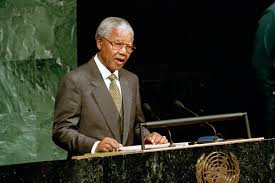
Mandela 3The big stories today are about how patient he was, how disinclined to retribution.  He gave South Africa a gift that no other South African of his time could have given.  Here he is, for instance, addressing the U. N. in New York. I don’t find it hard to admire such a man, but—I might as well say it—I do have difficulty identifying with him.  In Bill Keller’s piece today, I did find some people I could identify with.  They are little people.  Functionaries.  And they are white.  And they are there for the purpose of preventing Mandela from escaping.

But look at this:

Still, Mr. Mandela said he regarded his prison experience as a major factor in his nonracial outlook. He said prison tempered any desire for vengeance by exposing him to sympathetic white guards who smuggled in newspapers and extra rations, and to moderates within the National Party government who approached him in hopes of opening a dialogue. Above all, prison taught him to be a master negotiator.

This is the first I have heard that there were “sympathetic white guards” who supported him.  Very likely, they supported Mandela the man, rather than Mandela’s association with the African National Congress or the demand by the majority of black South Africans for the right to vote.

I think I might have been able to do that.  I might have seen to it that a man like Mandela—a man who refused to play the victim, who carried himself in prison like exiled royalty—got extra news and extra rations.  I might particularly have done so because I knew there were other guards who treated him differently.

Perhaps because Mr. Mandela was so revered, he was singled out for gratuitous cruelties by the authorities. The wardens left newspaper clippings in his cell about how his wife had been cited as the other woman in a divorce case, and about the persecution she and her children endured after being exiled to a bleak town 250 miles from Johannesburg.

I might not have been able to support fairness in South Africa, but I am quite sure I would want to find a way to say that I was not one of “them”—meaning my fellow guards who took pleasure in causing Mandela pain.  Very likely, I would have been a guard who wished to take no action at all—neither pro nor con—toward this particular prisoner.  But when I consented by my silence to the treatment meted out by the other guards, I don’t know whether I could really have stood by and done nothing.

The part in this grand political biography that I feel some identification with is very small indeed and not all that virtuous, but of the things I read about today, it is one I could see myself doing.  Also, I am quite sure I would have wanted to treat this man honorably.  Why?  Well, consider this.

The first time his lawyer, George Bizos, visited him, Mr. Mandela greeted him and then introduced his eight guards by name — to their amazement — as “my guard of honor.” The prison authorities began treating him as a prison elder statesman.

I would have been a part of that group, the group the prisoner called “my guard of honor.”  I would have been one of the group whose name the prisoner knew; a guard who was introduced to the visiting lawyer by my name.  I am quite sure I would have wanted to honor him if I could find a way to do so.  The extra news and the extra rations would have seemed to me only a small return for the honor he had showed me.

And I think I might not have been able to resist wondering why he did all that.  He is in this prison on a life sentence, after all.  And he learned my language and he learned my name and he gave me—a man whose only official function is to see that he didn’t escape—a status of honor.

In the movie, it is William Ernest Henley’s poem “Invictus,” that Mandela claims as a source of support.  I’ve never liked the poem, but Mandela says, “It helped me stand when all I wanted to do was lie down.”  However I might feel about the poem, it is hard not to appreciate the effect.  Think about whatever it was that helped you stand when all you wanted to do was lie down; think about how you feel about whatever or whoever that was.

But when I think about the choices Mandela made in prison, it is Rudyard Kipling’s “If” that comes to my mind.  When Mandela was on trial, he chose to be a high profile defendant and to appeal to the conscience of the world.  Being convicted and sent to prison for life could be treated as a triumph in that career.  On the other hand, living on a remote island under the absolute control of racist guards might be treated as a disaster.

He did neither.  “If you can meet with Triumph and Disaster/And treat those two impostors just the same…you will be a man, my son,” says Kipling.  Mandela met with the prison experience and called it neither a triumph nor a disaster.  He called it an education.


[1] Rolihlahla is his birth name, according to Bill Keller’s article.  Nelson is the name he picked up at the age of seven when a teacher assigned that name to him.  In the movie, Mandela gives his name, at the inauguration, as “Nelson Rolihlahla Mandela.”  I don’t know if he actually did that, but if he did it would be welding together the two sides he had and that his nation had.  That weld was a personal and also a political project for Mandela.

Posted in Living My Life, Movies, Politics | Tagged , , , , , | 2 Comments