Biases, folded in and folded out

Where on earth did we get the idea that we ought to be unbiased? Or that we could possibly be unbiased? I have never understood that. [1]

There was a time, not all that long ago, when everyone in the village was expected to hold the same views, particularly about “us” and “them.” Now we are beginning to formulate a standard that holds the each of us should have perceptions and lines of reasoning and conclusions of fact and value that are based on extensive study. That is, in fact, what being “unbiased” would require.

How on earth did we come to such a place?

bias-2Emily Badger has a really interesting column in the New York Times for October 6 in which she refers to the term “implicit bias” as “one of the newest chew toys in the presidential campaign.” At the level of actual discourse—Ms. Badger was referring specifically to the Vice Presidential debate between Mike Pense and Tim Kaine—here is what all the chewing comes down to. Kaine represents black voters who have everything to gain by pointing out the extent of the bias against them. Pense represents white voters who are sick and tired of being accused of having biases they don’t even know about.

I find both of those views entirely understandable, but then, I can afford to. I am not seeking the allegiance of any voters at all. I would really like to see a long-running and profitable public discourse on the status of ethnic and racial minorities or of sexual minorities (of the two most common gender statuses, that would be men) or of old people or fat people.

Shall we start the conversation by determining just who is biased? Here’s a comment from Emily Badger’s column.

The science of how this submerged bias affects your actions is still a work in progress; studies have found a link between the biases and specific actions in some situations but not others. But because this bias is a function of universal human psychology, researchers say, we all experience it — and you can’t exactly get “rid” of it.

So I’m biased and you’re biased. How shall we begin the conversation? Could we, possibly, begin with the biases that have effects on the kind of conversation we could have? Let’s see. I think you are African-American and therefore stupid and lazy. You think I am a white person and therefore a racist and a bigot. Does either of those sound to you like a good place to begin a conversation. I would say a conversation that starts there is doomed before it even begins.

We could, I suppose, compare how harmful our biases/prejudices are. “Your biases are more harmful than mine! No, how can you say that? You know that yours are more harmful than mine!”

I wrote that exchange to sound silly and I think you will have to agree with me—it bias-1does sound silly. On the other hand, it is a step forward—a step toward an enduring public conversation—better, that is, than debating whether we have any biases or not. This silly exchange focuses on what the effects of the biases are, which is a conversation worth having, rather than whether there are biases.

Interpersonal Conversation

So here’s an idea that would work really well in interpersonal conversation. I am going to attempt to ignore all the biases you hold, including some that you treasure, if they do not impede the path of the conversation. You will do the same. There is now a subset of all our biases that will need to be recognized and dealt with—likely a very small subset.

Maybe an example would help. You and I want to have a conversation on how to counteract every influence on academic performance at our local grade school except interest and ability, Kids who like learning (in any of the modes it is offered at our local school) will do better than those who do not. Fine. Kids who are really smart will do better than those who are not. Fine.

But gender, race, class, and family status should not be allowed to constrain the natural expression of any child’s ability and interest. So we work together on how those can be accomplished. And in our conversation, my food preferences (and your attitude toward my food preferences) and your taste in clothes (and my attitude toward your taste in clothes) and my authoritarian attitude toward raising my own children (and your attitude toward my parental style) will all be set aside.

Needless to say, the fact that you are a right-leaning Trump supporter and I am a left-leaning Sanders supporter, now sagging back onto the Clinton team, will also be set aside.

That’s my program for interpersonal conversations where there is a common goal. In the setting I just described, there are two common goals: one of ends and one of means. The substantive goal is that we change the educational climate of the local grade school which your children and my children attend. The procedural goal is to have the kind of conversation that enables us to settle on a program of action and purbias-4sue it over time.

Conversation in Groups

Conversations in groups can follow this same sensible protocol PROVIDED that there is agreement on the ends and the means AND there is someone in the group who will call attention to the inevitable violations of the norms the group agreed to honor.

That would be an astounding achievement in the current political and social climate, but you may think I have lobbed a softball up toward the place just so I could hit it out of the park. So let me rephrase. You are asking the participants in this group to collaborate with evil people—under ordinary circumstances, “the enemy”— and to be complicit in conversations full of lies and slurs and half-truths and massive ignorance of the facts.

Yes, that is what I am asking. And further, I am asking that this be done over and over, at conversation after conversation, until the job we share is done. That means that just “enduring” these conversations is not going to be enough. If participating in one such conversation uses up 10% of your reserve, how many of those do you think you can take before you bail out. [Hint: the correct answer is considerably less that 10: you don’t bail out when you have used up your resources but when you see that you are going to.]

Debates between Parties

Only one step to go. Let’s go back to Mike Pense and Tim Kaine. Let’s imagine that neither of them is a bigot or a nanny—neither one who believes in vile racial stereotypes or one who takes it on himself to punish lapses in political correctness. They could still say exactly what they said in the debate because they are trying to mobilize indentifiable sets of voters. It’s their job.?

But what if it were not their job? What if they refused? What if they made a show of their amiable collegiality before and after the show? What is the principals—Trump and Clinton—did not require their vice presidential candidates to serve as rabble rousers? What if the Democratic National Committee and the Republican National Committee refused to condone that kind of behavior by their candidates?

I’m not proposing any of those. I’m just trying to illustrate how far we would have to go to affect the partisan morality plays that fill up our campaigns.

Or what if the rabble-rousing we left to marginal parties. Let me offer a homely example. Car dealerships in Oregon are now advertising that their sales force are salaried. What does that mean? It means that they are not required to strong-arm customers in order to make a living. They can afford to be courteous and knowledgeable because they are going to receive their salaries whether they sell you any cars or not. [2] This is an opportunity to demean the dealerships when a customer walking onto the sales floor is treated like a piece of raw meat.

Following that same logic—you can call it snobishness if you like—the major parties, currently the Democrats and the Republicans, will identify themselves as the “salaries sales force” kind of organization. We argue for the superiority of our candidates and our platforms, but we don’t treat our opponents like enemies and we don’t appeal to the base instincts of the rabble. They do—those “fringe parties”—but we don’t.

bias-6Or imagine that the standard of behavior of major league baseball players was very high and those of minor leaguers notably lower. When the minor league player is called up to the majors, he does not want to flaunt his ignorance and naiveté. He wants to behave “the way we do it at this level.” He wants to look like the guys he knows belong in the big leagues.

So the fringe parties—whether Marxist or environmental or nutritional or xenophobic—are free to bash and slash, thereby identifying themselves and their programs as bush league. [3] But if they were to aspire to serious social standing, if they wanted a place at the table, they would have to act like the grownups.

Please note that is proposing these changes, I am not asking for anyone to be better than they are. I am not asking for a raising of moral standards or a return to the public probity we associate with a bygone era. I am asking only that people continue to do what works. I am proposing a social setting in which “what works” is less noxious to the participants and less toxic to the republic.

So…I’ll tell you what. Indulge in all the implicit biases you have and all the finger-pointing you like so much—provided that it does not impede the job you and your colleagues are trying to do. If there isn’t anything you are trying to do, you might want to ask why that is.

[1]  The Latin verb plicare is the source of all this.  It means “to fold,” so implicit biases are “folded in” and explicit biases are “folded out” where everyone can see them.

[2]  I am not describing here how sales people who don’t sell cars are treated by their employers.  I am describing the appeal of that way of pitching the company.

[3]  No offense is intended toward either of the Presidents Bush or to the recent Republican candidate for his party’s nomination.

Posted in Politics, Sustainability, Words | Tagged , , , , , , | Leave a comment

Yesterday when it is past

Today I would like to tell you about some surprises I have encountered in moving from one kind of life to another. That sounds more momentous that it would really need to but I am going to start with a passage from the Psalms and I thought that sentence could afford a little extra gravity. Here’s the passage (in the King James, which I nearly always like best for psalms).

Psalm 90:4 For a thousand years in thy sight are but as yesterday when it is past,and as a watch in the night.

That verse kept coming back to me as I was writing the first draft of this essay and now I think I know why. Look at the expression “yesterday when it is past.” As I am considering it in the light of today’s reflection, I note that “yesterday while it is still happening” is going to look and feel very different.

So from my standpoint, “today,” I look back and reflect on yesterday and I know that the reflection is distorted. “Yesterday when it is past” seems like a blip. While it was happening, it felt like a parade. There is no value at all in asking which it “really was.” This is a distinction that bears entirely on how it seemed. “Yesterday when it is past” is a beautiful and engaging way of saying “brief.”
I turn now to the new life/old life distinction. Briefly, after living in the same house on the west side of Portland for a very long time, Bette and I moved to a retirement center on the east side of Portland. [1] Part of the newness is living in a very attractive and welcoming retirement center rather than in an attractive and welcoming neighborhood. But another part is that all the things that are really familiar to us are now “over there” and we have to go to them.

We had a really good life on the west side and have begun a really good life here on the east side, so the natural question is how to go about keeping the best of the old and adding to it the best of the new. I’ve been turning this over in my mind for the last several years—what Bette calls “hyperprocessing” and I call “being intentional”—and I had the general outlines of a strategy in mind.

If it is true, however, that there is a distortion of “how things seem” depending on where in time you are standing—“yesterday when it is past”—then all that planning is going to produce more surprises that accurate predictions. And it has.

Let me use my beloved Multnomah Village Starbucks as the example that representsneighborhood-1the whole “old life” construct. My practice used to be to hit Starbucks twice each morning. I would drive over around 5:30 or 6:00. I’d get coffee for Bette and me and come home to write things like this. Then I would walk over (about a mile) intending to get there about 7:30 for the meeting of “the Northwest Corner Caucus.” [2] And then the other caucus participants and I would do whatever happened that morning.

It was a really good experience and I had no intention of giving it up just because I had moved across the river and Bette and I were down to one car. There are perfectly good public transit alternatives and I practiced them just to be sure. So I announced that my plan was to be there at the regular time on Tuesdays, Thursdays, and Saturdays. I was counting on being there predictably as an adequate substitute for being there all the time.

It isn’t.

The caucus still meets and I still get there at 7:30 on the appointed days and I still like everyone just as I did before and they still like me just as they did before. But I am a guest now. My many years at that Starbucks—and the Hillsdale Starbucks, a mile to the east, before that—are like “yesterday when it is past.” The distortion that distinguishes “today while I am experiencing it” from “tomorrow as I am imagining it” fooled me. When you get to tomorrow, you discover that yesterday looks different than it did when you were living it.

Then I started thinking about the mechanism by which that shift occurs. That second thought—how does that happen?—follows almost immediately after “what just happened?” for me. [3] And then, following a feeling more than a memory, I went back to the breakup with my very first girlfriend.  This is not that girlfriend, but that girlfriend was, in fact, a redhead as is my current…um…girlfriend.

neighborhood-3I was a senior in high school. She was kind of a “practice girl friend” for me and I was a practice boy friend for her. It was a new and exciting kind of relationship but as the school year was winding down, we both looked at the relationship and realized it wasn’t going anywhere. It was a generous and thoughtful and collegial decision and we were both satisfied with it.

There was one small problem. This was a very small school—an academy in rural Pennsylvania— and “who was going with whom” and particularly “who was breaking up with whom” were really big topics. My girl friend and I agreed that we would save ourselves a lot of grief if we would just pretend to continue being boyfriend and girlfriend for the remaining two weeks of school. What would be so hard about that?

In that experience, I learned something I would never have suspected. The excitement in a romance comes from where you think it is going. You “borrow” a lot of the emotion from things you think are going to happen or that might happen in your common future. Events are not merely pleasant, but also significant. They “foretell the future” in a hamhanded sort of way. And when you know there is not going to be a common future, the air just leaks out of the balloon.

neighborhood-10Now, I do not have any girlfriends west of the river. I brought the only girlfriend I have with me to the east side. But I have a lot of friends over there and being with them has reminded me of my first girlfriend and the fading of a relationship with no future. If it is really true, as I learned in high school, that what we call “the experience of a relationship” is in fact part experience and part expectation, then I should have imagined that when you remove the expectation part, the experience part would start to lose its color and snap. [4]

Is it something like an aura of engagement that stays bright when you know you are going to keep on seeing someone and keep on valuing them; and then that starts to dim when you don’t see them as often? Is it something like investing in a fund and drawing from it what you need and then, later, just drawing from it. The opportunities for investment are only occasional and continuing to draw from the fund now shrinks it? Is it like that?

On the other hand, some such mechanism works in the other direction here. Every new part of the life here I try out—I went swimming at 4:00 a.m. a week or so ago—could be the beginning of “a practice.” Every new acquaintance could be the beginning of a friendship. Each new setting that seems to invite one sort of behavior but that also undercuts it, it a delicious new dilemma to consider.

Over here is not “yesterday when it has passed;” it is “tomorrow as I prepare for it.” Is that a distortion? Yup. No one anticipates or remembers without distortion. No one. But I think this distortion is going to be working in my favor. That’s how I feel about it today and, more important, that what I think really ought to happen.

It’s the way the machinery works.

[1] Long before I ever lived in Portland, I learned about the east side/west side neighborhood-7distinction from a Portland guide book. It opened with a completely straight-faced joke about a man who came to Portland and got a job and worked hard and saved his money and eventually was able to move to the west side. He married and started a family and then began again to save money so he “could bring his mother across.” First I said, they didn’t really mean that and I read it again. I decided that was exactly what they meant. Then I said, “Ooooh. I want to live in a city that thinks that is as funny as I do.”


[2] Imagine “the caucus” as a pool of people, some of whom will show up on a given morning with the expectation that we will talk about whatever is on our minds—some collection of personal tidbits and public issues—and practice “civil discourse.” Just how we arrived at the practices of what we call “civil discourse” is another story.
[3] Some say it is a character flaw; I say it is my graduate training.
[4] Of course, over here the machinery works just the other way around. A conversation I just had here on my front porch was pleasant enough, but it also laid down markers for other things that might be important in the future. This conversation carried significance. Significance of what, exactly, I don’t know yet, but I am hot on the trail.


Posted in Getting Old, Living My Life, ways of knowing, Words | Tagged , , , , | Leave a comment

Both Sides Now

There are 127 apartment units at Holladay Park Plaza. [1] I Three of them have both an east view and a west view. Bette and I live in one of those. We can see “both sides now.”

IMG_0389.jpg

The sunset picture is completely genuine. I took it from my front porch—the public area just outside our apartment door where I am, in fact, writing this. I took it because when our friends Frank and Joan McNamara were visiting us, Frank looked out the window at the collection of buildings that is prominent in this picture and said, “There’s your new notch.”

I saw it as soon as he said it, although I don’t know how long it would have taken me to come to it myself. The “old notch” was Grindstone Ridge, a prominent dip in the Coast Range that was visible from our Dakota Street house. All the Bookies—members of the book group we started in 1983— including Frank and Joan, had, for many years, sat on our deck in September to celebrate the sun’s setting in that notch. We invented a gruesome Spanglish name for the event: we called in Buenos Notches Dias. [2] And to celebrate it, we invited friends in for…nachos.

When we moved over here, we were prepared to say goodbye to the notch and to Buenos Notches Dias. Even, perhaps, to the nachos. Sad, I thought, but not one of the great catastrophes of our time. And when Frank said what he said, I began to be alert for just when the sun would set in our new “notch,” which is formed by the Lloyd Center Tower on the right and the Lloyd 700 Building and Kaiser Permanente tower on the left. One of the days it sets nicely into the new notch is September 28.

IMG_0384.jpg

The sunrise picture is completely genuine. It was taken facing east from Holladay Park Plaza and features Mount Hood, as it should. On the other hand, the east view from our apartment, which in on the fourth floor, [3] is entirely innocent of Mount Hood. This picture was taken from the penthouse level (16th floor) and this is what it looked like yesterday. The sunrise picture and the sunset picture were taken on the same day.

It is not accidental, it turns out, that people like me can go up to the highest floor and walk out onto the roof patio and take pictures like this. At Holladay Park Plaza, as everywhere else, the higher floors are justly prized for the view they offer. It’s hard to get an apartment on one of the upper floors because they are very much in demand.

But the Penthouse belongs to everyone on the same grounds that Oregon’s magnificent beaches belong to everyone. The highest and best floor is “reserved” for everyone. It is a common area although, as you see, the view of what Portlanders call “the mountain” is anything but ordinary. You have to wait a long time to get this prospect from the 15th floor, but it is there for anyone anytime on the 16th floor.

There is no law that protects access for all the residents to the Penthouse level. There is, of course, a law that protects access for all Oregonians to Oregon’s beaches. So the two are different in that way. But I think the instinct that leads us to “save the best for all of us” is what shows up in both cases. And I like that.

[1] What number you want to use depends a little on what you have in mind. For today’s use, I am including all the independent living apartments and excluding both of the floors of the South Tower that are there for residents needing special treatment of some kind. So this number counts the Holladay North (a separate building) the north tower (north of us) and the south tower (south of us) and the bridge between them, which is where we live.
[2] The choice of names was not entirely innocent. We had a Spaniard living with us at the time we named it, and the “Spanish” in the name was so truly bad that, although he tried to be playful about it as the rest of us were, caused him real distress.
[3] The top floor of the bridge (between the north and south towers) is only four floors high. We live on the top floor of the bridge.

Posted in Living My Life | Tagged , , , , | 1 Comment

Official Sexism

As you can tell from the title, I have a grievance in mind for today. After such a long struggle for gender equality, it grieves me that we have given it up so easily.[1] Ah well.

sexism-4This morning, I had a truly wonderful experience at the Multnomah County Courthouse. I was summoned to be part of the pool of potential jurors and I gave them from 8:00 a.m until 11:30 a.m. so I was available to be chosen. I was not chosen, so I will be back at the courthouse at 8:00 tomorrow morning to give them a second chance.

Today’s reflection is almost entirely positive. You wouldn’t know it from the title of this essay, but then, there wouldn’t be an essay about this experience had it been all positive. The juror’s orientation included a remarkably good speech by Judge Kenneth Walker. I liked it that they asked a judge to give the orientation; I thought it showed that they were serious about it. The speech itself was very good. It was funny without being frivolous; it allayed the fears of potential jurors without making the choices we might be asked to make seem inconsequential. The continuing management of the roomful of jurors by Mayami and Julie was done competently and in good humor.

Judge Walker did say something I objected to, but we’ll get to that later.

They also showed us a video made by the Oregon Department of Justice and I thought it was every bit as good as Judge Walker’s speech. It took us through the whole process in a realistic way. The actors represented nearly the whole spectrum of Oregon residents, including not only various ethnic affiliations and gender statuses, but even some strikingly large people. What they often call “size-ism,” to make it seem like “sexism,” was nowhere to be found there.

Judge Walker told us that Multnomah County has 38 judges, 20 of whom are women and 18 of whom are men. He called that “parity,” although it is not, but I didn’t care because I think of parity in a general way. Equality, plus or minus 5% is fine by me, or equality across the span of time. The word means 50/50, but I think that’s asking a lot and I don’t ask it.

Then, in summing up he said that we could go home and tell our daughters that they had a better chance of being judges in Multnomah County than our sons do. There were appreciative chuckles. I think Judge Walker imagined that he was simply specifying the consequences of what he had earlier called “gender parity.”

sexism-2But this is different. “Women have a better chance…” and this is a good thing. Really? Let’s see: “Men have less of a chance…” and that is a good thing?  Really?  The first statement is a commonplace. [1] I have never heard the second said out loud although the meaning is exactly the same. This rooting for the comparative success of women is a new thing, it seems to me. Maybe the sports metaphor comes easily to mind because of the Olympic games, but I hear people rooting for the success of women in the same spirit that they root for the success of American athletes generally.
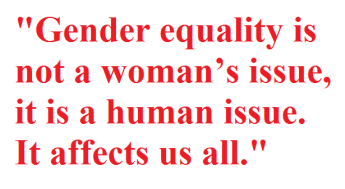
Someone could say that a win for America is good for us all because we are all Americans. I know that is stretching the sentiment a little, but it is not an incomprehensible sentiment. No one could say that a win for “women” (remember that this is a comparative question now: a winners and losers question) is good for us all because we are all women.

Picture one of my fellow jurors from this morning going home to his children, a boy and a girl, and saying, “Good news for us all, kids. Sally here has a better chance of becoming a judge in Multnomah county that you do, Robert.” Just sit with that a little. It’s ugly and uncomfortable and it’s sexist, but let’s just sit with it a little.

You cannot be a partisan of women and a partisan of equality both. You have to choose. You could say, of a a prestigious vocation, that even though men and women are equally attracted to it, there are twice as many men as women members. You could express the hope and you could take actions leading to increasing the percent of women in that vocation and you could do all that in the name of gender equality. But as you watch the percentage of women in that profession move up from 35% to 45% and then to 55% and express the hope that the trend continues, you have left equality concerns behind. You are now a partisan, not of equality, but of women. Your partisanship necessarily includes, since these are comparative measures, hoping for and working for a loss of the number of men in this vocation. We have, apparently, “too many men.” Why is that?

Some will say that the mistake Judge Walker made today is an easy mistake to make.sexism-3 Granted. Some will say it is easy to mistake hoping for advances for women for hoping for the disproportionate success of women—and, of course, the failure of men. I know it is an easy mistake to make and I don’t hold bad feelings against Judge Walker for making it. At the same time, the standard itself is sexist and reprehensible and I think it deserves to be vilified. Judge Walker does not, but the position that he, perhaps inadvertently, advanced, does deserve it.

OK, let’s all take a breath and remember that it’s easy to make a mistake. My concern is for the standard we are being asked to value and support. If I thought we all agreed about that (I don’t think that), I wouldn’t even have written this piece.

[1] “Equity,” meaning “fairness” is another matter entirely. It is not at all difficult to be in favor of fairness, unless and until you need to be specific about how it is to be measured. If it is not 50%, you will need to explain why. If it is 50% it is the same as equality, so it doesn’t really add anything.
[2] Meredith Viera celebrated how many women were on the U. S. Olympic team this last summer by saying how high the percent of women athletes was. I think she said 54%. And expressed the hop that it would get even higher. I didn’t get a chance to ask her why that would be good.

Posted in Living My Life, Society, Words | Tagged , , , , , | Leave a comment

New Life, New Categories

The time it takes me to go from “having an experience” to “having “a kind of experience” has gotten perilously short. I don’t think I have put anyone in danger yet, but the transition from the one to the other is getting quick and I want to tell you about it.

“Kind” in “kind of experience,” is a word that presupposes categories, each of whichservice-5 contains [1] objects or events. When your seventh son brings home a girl he is interested in, you do not say, “Wow! What’s going on?” You say “I think these are getting easier,” which places this event into the category “all such events,” meaning what it was like when the six older brothers brought their girl friends home. I don’t have seven sons, myself, but I can speak for these parents. It is extremely difficult to take this seventh iteration on its own terms! Your mind goes to the category and to this event, the seventh girl friend,  as an instance of the category. It isn’t fair to the son or to the girlfriend, but first sons have special difficulties too and I think it all evens out.

I want you to imagine “the first time you have an experience.” Hard, isn’t it. It’s like “the First Annual Something,” where “annual” expresses  nothing more than the organizer’s hopes. At about the third time, if it is a highly scripted social event, like getting fired from your job, or dissed by your teenage daughter, you see the similarities and you start talking about “events like this one.” If it isn’t so scripted, it might take a few more, but eventually even the dullest will notice that these experiences are a lot like those and begin to invent a name for the category.

So here’s the stinger. “Social norms”–what ought to happen– don’t belong to experiences; they belong to kinds or categories of experiences. So the notion that you are doing something right or that someone else is doing something right depends on the category to which you assign the experience.  So there is this constant and largely unconscious interplay between the actual experience and the whole context to which that experience belongs.

OK, enough from the nosebleed level of social theory. Let me tell you a story my father used to tell. There was a man in a little town who was so ugly that kids with nothing better to do would taunt him when he passed and call him names. It’s hard to see this clearly at this part of the story, but the kids are doing “what kids do” in a situation of this kind. Or that, at least, is what they would tell themselves if they bothered to think about it.

Well he really was ugly, but he wasn’t stupid. He stopped to talk to the kids and he said that it was really inconvenient to be called names out in public like that, but if they would come over to his house to call him names, he would give them a dollar each every time they did it. Free money just for being a jerk! WhooHoo!

service-6So they did it for a few days and then the man said that times were a little tough economically and although they were doing everything they promised, he would be able to pay them only 75 cents each from now on. It’s still free money. Later, he reduced it further. When he got down to a dime for each kid, there was a rebellion. “What! You expect us to come clear over here to insult you for a measly dime? We’re done with this deal. Goodbye!” The old ugly man waved goodbye as cheerfully as he had done everything else and smiled quietly to himself.

How did that work? The ugly man took one category of events, the kids harassing him because they could, and turned it into another category of events—wage labor. With the notion of wage labor goes the idea that you are doing what you are doing because you are getting paid for it. A whole new motivation: entirely implicit; completely effective.  Here is that interaction between the experience itself and the background expectations that make the experience understandable.

service-7At the crucial moment in such transitions—I am just about to tell you one of mine—the question, “What is happening here?” or sometimes “Why am I doing this?” gets asked. When it gets a different answer than the one you were expecting, you get the feeling Wiley Coyote gets when he runs off a cliff and doesn’t start falling until he notices that he isn’t standing on anything anymore. Here was my Wiley Coyote moment last week and here’s the way I described it when it happened.

I’ve been using the same torn towel for days now. It isn’t torn very much; there is a little notch on one of the long edges. I am quite sure that if I toweled off with that edge taking most of the tension, the towel would rip further. After that, it wouldn’t take very long for it to become a pile of rags.

“Not much of an event,” you say? Probably not worth writing about?

You might be right, but let’s consider first what categories this event might fall into. Is this a defective towel? Have I been too hard on it in some way—brought it into contact with a sharp edge, perhaps? Maybe after a long and useful life in the service of desiccation, it has reached the age of retirement.

All those are possible. None all that interesting.

As I was mulling my towel with the notch, it occurred to me that this is not my towel. This is a towel provided by Holladay Park Plaza, the retirement center I where I have lived for nine days now.  [2]At the moment that thought came to me, I felt my perceptual field shifting.

  • “They gave me a bad towel!” was one of the voices I heard.
  • “What kind of place is this?” came from another.
  • And one, much further away, may have said, “Do you even know what the process is for filing a grievance?”

All that in the twinkling of an eye; all that about something as inconsequential as a damaged towel—a towel, by the way, that I have been using successfully for several days now. I have moved from an environment wholly of my devising and largely my responsibility [3] to an environment of someone else’s devising—and for which they are responsible!

And I had no notion of that change—not a change of experiences, please note, but a change of the categories that give meaning to the experiences—until I realized that the torn towel was not my problem. I didn’t cause it. Probably. I don’t need to fix it. THEY need to fix it and they will be happy to if I just mention it to them.

I am convinced that “life,” i.e. the aggregate of meanings we assemble, is controlled by moments like this.  People who solve a problem by changing the environment (alloplasts) and people who solve it by changing their own behavior (autoplasts) are distinguished entirely by what category the experience gets placed in.

It intrigues me that changes that are so crucially important to the kind of life each of us lives happen so fast that we can’t even say just when they happened–that intrigues me and I hope that you will catch sight of it, maybe out of the corner of your eye, from time to time, too.

[1] Or “is made up of.” It’s a linguistic argument I am competent to recognize, but not to participate in.

[2]  Actually a month and a day on the day I am posting this.

[3] Just to make things easier, I am going to skip over Bette’s part in making the environment what it is.

Posted in Getting Old, Living My Life, Paying Attention | Tagged , , | 2 Comments

“One plucky leper”

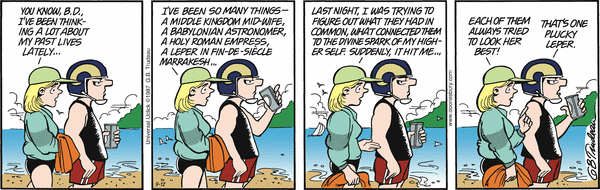
I have been a fan of Gary Trudeau’s work for a long time.  He does a lot of current political things.  I’m pretty sure, for instance, that there will be a caricature of Donald Trump in today’s cartoon.  But a lot of the stuff he does is just classic.  This column is one of those.

plucky-1

I laughed out loud when I first saw it.  And then, over the next few days, it would come to mind and make me smile.  It delighted me. [1]  So first, what’s funny about it?  I don’t know many jokes that have the word “leper” in the punch line.  I think the best answer is the Trudeau is the master of discrepancy and discrepancy (the sense that this and that really don’t belong together) taken playfully, is at the heart of humor.

B.D. [2] has one line.  Boopsie (Barbara Ann Boopstein) says everything else.  And this is pure Boopsie: the relentless focus on herself, her infatuation with her “past lives,” and her focus on beauty.  In a strip that contains 76 words, Boopsie has the first 72 and they all go in the same direction.  And there’s nothing funny about them.

B.D is coming from a different place entirely.  Of the four “identities” Boopsie is remembering, he picks the most grotesque one.  He picks the one most at odds with the theme Boopsie has discovered: “always tried to look her best.”  But he doesn’t ridicule that identity.  That wouldn’t be funny.  He accepts it–kind of–and tags it with the perfect word.  “Plucky.”  Perfect.

And speaking of discrepancy, nothing in the first 72 words hints at B. D.’s  angle of attack.  In that way, it is classic Trudeau.  You don’t get what the first three frames were really about until you get slapped in the face with the last one.

There are two reasons, I think, why I kept smiling at this strip and why I wanted to share it.  I live in a retirement center. [3]  It’s a very good retirement center and I am delighted to be here.  On the other hand, it is, as you would expect of a retirement center, full of old people.  Myself included, of course.  And a lot of these people have disabilities of one kind or another.  Again, no surprise.

I’ll tell you what rIMG_0272.jpgeally has surprised me.  There is no relationship I can see between how constraining a disability is and how the person responds to it.  I write on our “front porch,” just outside the door of our apartment.  The front edge of this picture is a hallway and I sit at one of the tables.  And most of the time I am writing, people are walking by–some with the aid of walkers or canes.

Some people are consumed by their walkers.  They look like they have given up on the common task of living here together.  They look as if the rubber handles and the aluminum tubes and the wheels have somehow drained them of their vitality.

Others, who are every bit as disabled, treat their walkers as if they were some sort of launching pad.  They are going from one place to another.  They are grateful for the assistance of the walker.  They greet with enthusiasm anyone they happen to meet.  They are fully alive and are delighted that they can still get around and see their friends.  The walker might just as well be a pogo stick.

“Well, yeah,” you might say, “but they aren’t lepers.”  No, they are not.  But from what I can see, if they were lepers, they would be “plucky lepers.”  And I don’t mean, by reusing that expression, what Boopsie means.  Boopsie is there because she has a straight line to deliver.  I mean what B. D. means.  I am full of admiration for these people who refuse to be defined by the amount of help they require to get from one place to another.

I want to be like them.  “Rising above decline” is what I call it.  It is the work of the day here–every day–and I am grateful to be among so many accomplished old people who can serve as my mentors.

[1]  And I call this blog “the dilettantes’s dilemma” because “dilettante,” is a word based on “delight.”  In my blog, I said when I started it in 2010, I will write about the things that give me delight.  Today’s post is a good example.

[2]  Brian Dowling (B. D.) was quarterback of the Yale football team when Trudeau was at Yale.  He and Dowling have long since made their peace about what a dork B. D. is, but if you don’t follow the strip, you might not know why he is always wearing a football helmet.

[3]  I start the fourth week tomorrow.

Posted in Uncategorized | Tagged , , , | 2 Comments

“Estate” is a noun. Sigh.

No one “estates” anything to anyone. The language won’t allow it even if the tax codes would. The defining feature of an estate, in the modern sense of the word, is that it belongs to you. On the other hand, blood glucose belongs to you, too, and the two notions are treated very differently.

estate-4Everyone who knows what blood glucose is would wonder what you were planning on using it for. That is not the question that comes first to mind to people who know what an estate is. But today, I find myself wondering why that is. I think that is a really good question to ask about estates: “What are you going to use it for?”

Bette and I have found ourselves a part of quite a few conversations recently in which the basic logic of our choice of a Continuing Care Retirement Community (CCRC) has been called into question. The logic isn’t different than it was when we had those conversations over the last ten years, but we have actually done it now–we begin our third week at Holladay Park Plaza today– and the conversations seem to have taken on a little more edge.

There seems to have been a shift from “why would you…” to “why did you…” You can see where that extra edge came from.

The objection is that when you buy in to a CCRC the money is gone. If that money represented your estate—money you were thinking of giving to the kids or the grandkids—it is easy to think that in spending it on yourselves, you are depriving the children of something they had every right to expect. “We are spending this money on ourselves,” this couple might say, “and we hoped we would be able to give it to the kids.”  And in some scenarios, we can imagine the kids saying the same thing.

I don’t have any trouble understanding the sentiment, but I see it from a differentestate-2 stream of stories. I see “children” in their fifties and sixties (and older) seriously encumbered by the process of caring for an aged parent. [1] This parent could have invested in his or her (“”her,” usually) own care by moving to a CCRC, but she did not. She relies, instead, on the daily services of her children to enable her to keep living the kind of life she is used to.

“I want to keep my independence,” she says. “I understand,” says the caregiver, “I would love to have some independence.

If we consider this as an economic transaction—which it is, although it is more than that as well—then the “child,” the caregiver, is trading many years of exhausting toil against the hope of eventually receiving some money. No one would say it that way, of course. Both the giver and the receiver of these services think of them, on a good day, in terms of love and duty and affiliation. [2] These are personal transactions, as they see them, not financial transactions.

But what if the caregiver would gladly give away the hope of receiving “an estate” in order to see that the parent’s needs were thoughtfully and competently taken care of. If she felt that way, and it is a very common way for caregivers to feel, she would yearn for the parent to choose to live in a CCRC and to forego entirely the dream of “passing the estate” to the child. She is not taking care of her mother in the hope of financial gain. Besides, it would be nice to have some of her own life back.  And in cases where the burden of caregiving has imperiled the marriage, it would be nice to have the marriage back as well.

This is not a wish for less contact with the parent. It is a wish that more of the the contact be with the person herself. It is crucially important that the parent be supplied with the services her or she requires: being driven to appointments, being reminder of medications, help with meals, and so on. It is not crucially important that the principal caregiver herself do all those things. It is entirely possible to go to visit the parent and just sit and chat or go out to lunch. To do together, in short, the things the two of you like to do, rather than always the things that have to get done.

estate-3Buying time like that is what you would get, in this scenario, for using the estate rather than saving it for the kids. But there needs to be a way to say that in less than a page and a half. If it were possible to say, “I would like to estate to you the freedom to use our time together as we choose,” that would do the job. No one will say that.

The notion of usufruct is not a matter of common speech. [3] If it were, the notion of the “use” of one’s retirement and the “enjoyment” of one’s retirement could guide us toward the distinction I am making. The estate is the income itself so “using it” would use it up. Still, I think the distinction is worth making since the parent’s use of the estate would make possible the enjoyment of the relationship.

We could say, “I am using the estate as a way to free you from being perpetually my caregiver and not mostly my friend.” But even there, “estate” is a solid and impenetrable noun and you have to establish a novel verb of some sort to mean anything but “give over after my death.” I like novel verbs, but it takes a lot of work to make them practical in use.

I could look my own children, all now in their 50s, in the eye and say, “I am not leaving you an inheritance; I am spending it on our relationship in these days we are now living.” And they would understand what I meant and appreciate it because of the relationship we have achieved as adults.. But a formula that requires that much background is not fit for use as a general formula.

And I end this essay by saying that I cannot think of an easy way to say this simple thing.

[1[ I know it is common to say “aging” parent, as if it were the process of getting older (I have an aging nine-year-old grandson) that needs to be highlighted, rather than just where on the aging spectrum you are. “Aged” is a place on the spectrum.
[2] On a bad day, maybe just the obligation.
[3]The gains granted by usufruct can be clearly seen in the Latin phrase from which the word developed, usus et fructus, which means “use and enjoyment.” Thank you Merrian-Webster.

Posted in Getting Old | Tagged , , , , | 2 Comments

Jesus supports my political program

Today, I feel like Yaskov, the Russian spy in Howard Neame’s 1980 movie, Hopscotch. service-4He says of his opposite number, the American spy, “I do like him, you know. One can’t help it.” The opposite number in Hopscotch is Miles Kendrick, played by Walter Matthau.  Like Yaskov, I just don’t seem to be able to help liking Nicholas Kristof. He writes a lot of things I find fault with (like his September 4 column) but it never occurs to me not to like him. And I liked his father a great deal. [1]

In Sunday’s column, “What religion would Jesus belong to?,” he has a point to make and he makes it well. In the process, he leaves a trail of dearth and destruction. Let’s look at the point and then follow the trail.

The Point

The general point is made in the first line: “One puzzle of the world is that religions often don’t resemble their founders.” He goes on to refer to Mohammed and the Buddha and even adds a rabbi (Rick Jacobs, the president of the Union for Reform Judaism) to cover what Moses might have done. But mostly, Kristof wants to talk about how far short Christianity has fallen from what he thinks Jesus’s original intentions were.

Jesus never mentioned gays or abortion but focused on the sick and the poor, yet some Christian leaders have prospered by demonizing gays.

To describe Jesus’s intentions more fully, Kristof turns to Brian McLaren’s book, The Great Spiritual Migration. So I’m going to let McLaren be the voice of Kristof for a few paragraphs.

“Our religions often stand for the very opposite of what their founders stood for,”

“…Jesus was a radical who challenged the establishment…’

Founders are typically bold and charismatic visionaries who inspire with their moral imagination, while their teachings sometimes evolve into ingrown, risk-averse bureaucracies obsessed with money and power.

“In the way Jesus is presented by some of his followers] he often comes across as anti-poor, anti-environment, anti-gay, anti-intellectual, anti-immigrant and anti-science. That’s not the Jesus we met in the Gospels!”

I have some reservations

The point, when it is eventually made, is going to be that Jesus was a certain kind of person and that his ministry had certain characteristics. Then Kristof and McLaren go on to say that we should be the kind of person Jesus was and that our lives (our ministry)—both personal and institutional—should be characterized by the same emphases as his.

Really?

McLaren/Kristof are offering a very strange Jesus. You would never know from this account, for example, that Jesus prayed. Or that he challenged the religious institutions of his day to be more accommodating and less censorious. Or that he anticipated that the world would end very soon and that his own ministry was a part of that gathering of events. Or that he had no social program in mind to help the poor—none at all. [2] Or that he felt himself to be in a uniquely intimate relationship with the God of his fathers.

Where did all that go?

service-2There really isn’t any way to categorize Jesus simply unless the purpose of the categorization is to turn him into a tool of some sort. The bad guys in this column “weaponize” Jesus as part of their social program: opposed to women, opposed to the poor, wholly without compassion. The good guys in this column “instrumentalize” (I know “weaponize” would keep the parallel, but I just can’t manage it.) Jesus as part of their social program: attentive to the needs of the poor, responsive to the feminism of our time, global in its compassion for those who are suffering. I like the second set of programs much better than the first, but from a Christian standpoint, they are both idolatry
Let me ask the horrifying question at this point: what should Jesus be used for? For which of our contemporary social goals should he be used as a hammer or a saw or a screwdriver? I am hoping, in asking the question that way, to get Christians to wonder whether Jesus should be “used” for anything. [3]

Complicity

One of the great rhetorical devices might be called “control of the alternatives.” It is used prominently in this column. Here’s an example: do you want to send a check to my organization today, or do you want to be complicit in the genocide of millions? The goal of such a formulation is two-fold. First it says that there are two and only two options (that’s what the “or” is for). Second, it glorifies the one option and demonizes the other. That’s how you present what look like “alternatives” and deny any choice on the question.

McLaren, for instance, offers us this set, which is much more generous than the horrific example I used to introduce this line of thought.

“What would it mean for Christians to rediscover their faith not as a problematic system of beliefs but as a just and generous way of life, rooted in contemplation and expressed in compassion?”

And then, just in case we missed it, he repeats it in a briefer and more memorable form.

“Could Christians migrate from defining their faith as a system of beliefs to expressing it as a loving way of life?”

Let’s begin by looking at the alternative McLaren offers. You can a) hold to a faith as a problematic system of beliefs or b) hold to a faith as a just and generous way of life…[and other good things]. So the reader gets to choose between “a system of beliefs” and “a way of life.”

Now wait. Don’t rush me. I want to take some time with this. Do I want to believe things or to adopt a way of life? Shoot! Why does he have to start with the hard questions?

Again, the “or” functions to instruct us that we must have one or the other. The notion, quite common in both the Old Testament and the New, that beliefs have their natural outcome in actions is entirely missing here. James (2:18) is not “anti-belief” when he says “you show me your faith apart from your deeds and I will show you my faith by my deeds.

service-3McLaren continues with a series of examples of beliefs as distractions—actually, he considers only that they will be distractions. He touches on whether biblical miracles are true as a distraction and, of course they can be. They can also be an invitation to modern Christians to place themselves in the 1st Century as receivers of the good news about Jesus. He contrasts questioning whether Jesus actually healed a leper (that’s the miracle) with focusing on Jesus’s “outreach to the most stigmatized of outcasts.”
There is no question in my mind that this social category—the most stigmatized of outcasts—is the category of most interest to Kristof and McLaren. I have serious doubts, scholarly doubts, about whether that is the way the gospel writers understood it and they did not present Jesus as understanding it that way. Again, the options are a) being distracted by doctrinal matters or b) doing something to help poor people. Think about it. Are those the options?

In all honesty, I have to admit that they can be. People can take hold of a faith that is intended to root the believer in God’s purposes and to produce the behaviors of neighborliness (see Luke 10 of the “Good” Samaritan.) and hold to one or the other. Kristof is protesting those who hang onto faith in a way that precludes action and he is praising those kinds of action that have nothing at all to do with faith.

You could argue—Kristof does argue—that if you have to have one, right actions (orthopraxy) is the one to have, not right beliefs (orthodoxy). What Kristof, both speaking for himself and in his citations of McLaren, seems unwilling to consider is that you don’t have to have one or the other. It is the business of all churches and the actual practice of many churches to teach that belief overflows into action.

I think that might be as close as we can get to the religion founded on the life and ministry of Jesus. It isn’t really the religion he would belong to; it is the religion that belongs to him.

[1] I think I started liking Nicholas when his father, Ladis, and I shared an office for adjunct professors at Portland State. Nicholas would send his father a pre-publication copy of a column. Ladis would hand it over to me, pretending to be casual about it and say, “Nicholas—Ladis was an east European, he would say Knee-ko-lahs, three very distinct syllables—wants to know what I think of his column.” That’s when I started liking Nicholas Kristof.
[2] That doesn’t mean he was opposed to social legislation. It means that he approved, as a general matter, of the social legislation in the Torah. One should, for instance, leave the corners of the fields unmowed so the poor could glean there or that one is absolutely forbidden to charge a fellow Israelite interest on a loan.
[3] General Semanticist (and U. S. Senator) Samuel I. Hayakawa used to say that there was a Chinese proverb that went like this: “The mind is a clumsy forceps and when it grasps the truth, it crushes it a little.” I don’t know whether there is such a proverb, but I know that Hayakawa used to say that there was. You can’t be too careful about Chinese proverbs.


Posted in Biblical Studies, Political Psychology | Tagged , , , , , | Leave a comment

The Return of the Austin-Boston Axis

It’s time to start thinking about the Hillary Clinton administration. The Republicans are. Here is an amazing paragraph from Thomas Friedman’s New York Times column this morning, August 31.

Politico last week reported that while some G.O.P. officials may vote for Hillary, they are already sketching plans “to stymie a President Hillary Clinton agenda.”

It sounds to me as if Friedman thinks that’s a truly awful thing. That’s not the way it looks to me. “G.O.P officials”—I assume those are the people who are being called “the party elders” these days—have lost control of “their” party. It has become the party of a wealthy enfant terrible, Donald Trump. They are embarrassed that Republican voters have chosen him and they are prepared to see him lose in a big way.

Then what?

That’s where I think Friedman loses his bearings. Let’s talk about “the Republican Agenda,” meaning Speaker Paul Ryan’s agenda, which is the only Republican agenda I know anything about. To what extent is pursuing this agenda planning “to stymie a President Hillary Clinton agenda.” Are they the same thing? “Pursuing the Republican (Ryan) agenda” is the same thing as “obstructing the Democratic agenda?” It didn’t used to be that way.  Obstructing the Democratic agenda is more like Senate Minority Leader Mitch McConnell’s pledge that his “top legislative priority was to make Barack Obama a one-term President.”  Does that sound like a legislative priority to you?

There is some sense in thinking of “agendas” as opposed, but it makes a great deal more sense to me to say that policy makers are opposed. And why should they not be opposed? Isn’t that the value of two-party competition?

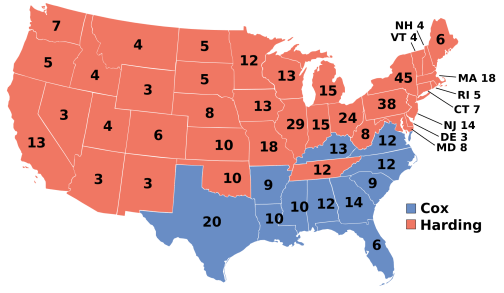
S dem 2So let’s think back a little. Historically, the Democratic party integrated these two agendas within the party. There was a liberal northern wing, which ran the executive branch, and a conservative southern wing which ran (controlled) the legislative branch. Then there was a Republican legislative party that aligned itself with the liberals sometimes, mostly on supporting business and with the conservatives sometimes, especially on social issues.  That blue band across the south, normally including Tennessee, was the natural home of the “Austin” branch of the Democratic party.  Notice that everything else has changed a great deal.

You want clashing agendas? Here are three. And because of the seniority rules in the House of Representatives, all the crucial committees had conservative Democrats as chairmen. So the northern plus southern wings worked just fine for electing presidents—the famed Austin-Boston Axis—but not so well for progressive social legislation. It was slow, but it was not frozen—except for civil rights.

Now let’s imagine that Donald Trump loses as badly as the pundits are saying he will. How is that different? A lot of conservatives can go back to the Democratic party which, until the ideological realignment of the 1960s was their natural home. The Republicans can just give up on the presidency, except for the odd election here and there, and go back to policy participation in the Congress and in the Executive Branch. And, for the purposes of passing legislation, we’ll be back to the old three party system: Northern D’s (liberals), Southern D’s (conservatives) and R’s (aggressive on business issues, conservative on social issues).

How is that different?

S dem 3Well, it is different in one way. Sen. Dirksen was famous for “delivering” the Republican vote in the Senate on the 1964 Civil Rights Act. That wasn’t what he wanted to do at the beginning of the process, but he stayed with it and kept talking to his R colleagues and at the end, delivered the votes.
Friedman characterizes the current stance of policy makers as very similar to the “politics of the Middle East” which just alternates between the two “modes of zero-sum, rule-or-die thinking.” That’s not quite what we have in Washington. We have “I will keep you from ruling, at whatever cost to the vital concerns of the country.”

Friedman’s proposed solution, which I like very much, is that the Republican elders give up on their project of a breakaway, ideologically consistent conservative party and become, again, a part of the government with a different set of policy priorities. It requires that Hillary move to the right, just as Bill Clinton did, and recognize some Republican demands.

Jim Hightower, a Texas progressive, used to say that “the middle of the road” was not a fit destination for a political party. “There ain’t nothin’ in the middle of the road, but yellow stripes and dead armadillos.” [1] I don’t like the middle of the road any better than Hightower does, but I do like having several lanes to accommodate policies moving at different speeds.

In 1960, John F. Kennedy campaigned on the slogan, “Let’s get this country moving again.” He meant to contrast his promise of vigorous action (except on civil rights) with the oddly quiet Eisenhower years. But the Eisenhower years were a blur of action compared to the present deadlock and Hillary could do worse than to promise to “get the country moving again.”

We know now that “there are no red states, there are no blue states” is a strategy that was too ambitious for us. It would have been nice, but it required a new way of thinking. That’s too much. But “getting the country moving again” would be nice and if there are any Republican party elders left, leaders who have not been Trumped, let them speak now or forever hold their peace. Hillary, the ball is in your court and if you do this right, you may get to nominate as many as three associate justices.

[1] That’s the way he used to say it, as I remember. It was part of his “good ol’ boy” schtick. For his book title, he cleaned it up just a little. There’s Nothing in the Middle of the Road but Yellow Stripes and Dead Armadillos, and then he gave it a subtitle: A Work of Political Subversion.


Posted in Politics | Tagged , , , , | Leave a comment

Civil Discourse is our “Commons”

Did you ever have that terrific feeling when you pick up an article that makes brilliantly, the case you have been making poorly for years? I just had that feeling. How I missed “The Coddling of the American Mind” by Greg Lukianoff and Jonathan Haidt (in The Atlantic, September 2015) I have no idea.

But I did. And as a result I have been struggling, mostly unsuccessfully, to make the case that our “sensitivity jihad”—I’m trying not to overuse “crusade”—is costing us more than we know.

I see now that I have been picking the issue up by the wrong handle. I have been focusing on intentional abuses of the process. We start having a conversation and it isn’t going well for you for some reason, so you choose a word I have used as “offensive.” It’s an easy claim to make. I have no way of knowing whether you are offended. It seems a simple calculation that if you are offended, then the word I used must have been “offensive.” But now the subject has been changed and I am now engaged in protecting my own character instead of talking about the issue.

Then I ran across the article by Lukianoff and Haidt. Besides offering a real buffet of horrific examples (microaggressions, trigger warnings) they pay some attention to what this new fetish is costing us. Of course, the cost is general; that means it is costing the abusers of the system just as it is costing the rest of us.

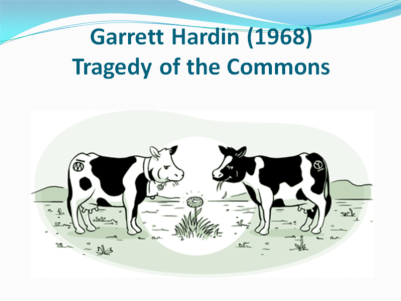
commons 1And once I got that far, I saw that it was the old familiar Tragedy of the Commons and the rest of this essay is an attempt to play our the metaphor. As first formulated, it is about cows. There is a common grazing area which is big enough to sustain grazing by so many cows; not more. But the arithmetic underlying this arrangement is seductive. If Farmer A adds just one more cow to the commons, he uses only a small fraction of the grazing area and he keeps all the profit that extra cow brings for himself. Pretty good deal.

It presupposes, however, that Farmer A is the only cheater, which is not a likely prospect for the long term, especially since Farmer A has set such an enticing example. So other farmers begin to slip an extra cow onto the commons. They overgraze the commons until the grass is gone—it is gone for the cows of the cheaters and also for the cows of the righteous farmers who are grazing only their allotted number of cows—and everyone goes through a period of very hard times.

Once I saw that “civil discourse” was our commons and the encouragement of “microaggressions” was the extra grazing, I experienced a moment of clarity. I might have said, “Woohoo!” in the manner of Walter Matthau playing Albert Einstein in Fred Schepisi’s movie, I. Q.

So what does that analogy help us to see more clearly? If the free and frank exchange of views is what is valuable in the commons, then the more constraints there are on that exchange, the less free and the less frank it will be. “Sensitivity challenges” are a tax on every exchange. They not only make exchanges more onerous, but also keep people away from topics that really need to be addressed. This is, without question, the case for the “conversation about race” that President Obama keeps saying we ought to have.

It is easy, I think, for anyone with a sensitivity or a favorite grievance to claim to be offended. [1] “It’s just this one issue,” she thinks, “They can handle it.”  It’s just racism or sexism or ageism or size-ism. Just that one thing. But that is what every farmer thinks who grazes an extra cow on the commons and says, “Hey, it’s only one cow.”

And the amount of additional grazing really is just one cow. But that one cow is a challenge to the agreement among all the farmers not to add just one cow. It might be worth extending the metaphor so that it is the common trust that is being grazed on and when it is overgrazed too badly, it is destroyed. When the trust is destroyed, it is only a matter of time until the grass is destroyed as well. Maybe “grazing on (abusing) the trust” and “grazing on the grass” is one too many kinds of grazing.

commons 5This point tends to be lost on an oversensitive member of the discussion because he thinks that racism is a really important issue. Crossing the line in talking about race is a serious offense. And this guy probably thinks that when someone else shows the sensitivity about sexism that he himself shows about racism, that he is being “oversensitive” or maybe even pretending to be offended to regain the initiative. I know that makes this “oversensitive to race issues” guy look stupid, but he isn’t using all his intelligence if he thinks that only one issue makes people angry.

What is lost on this guy is that as explosive as racist words are to him, they are not so explosive to everyone else. To someone else, sexist words may be the source of personal outrage. That is certainly the way you will feel if you think that “racism” is a real issue and “sexism” is a secondary and artificial issue. Let alone “ageism.” But the truth is, hard as it is to remember when you are in a discussion, that the words that I find offensive are different from the words that you find offensive. If we could get far enough away from it, we could all see the truth, which is that a cow is a cow. If it eats grass, it’s “a cow.”

So the argument that my extra cow is justified, but yours is not, meets a swift and justified end.

commons 2Furthermore, what I find very hard to remember when I am the one being insulted or demeaned is that we are all beneficiaries of the commons. If the commons represent a style of discussion, not a topic to be discussed, then every kind of discussion is taxed by oversensitivity. We don’t talk about supporting and sustaining families the way we might if the commons had not been so shrunk from overuse. We don’t talk about poverty and homelessness the way we might. We don’t talk about American imperialism the way we might, or the frightening over-expansion of executive power under President Obama.

And when we lose that commons, everyone loses. The people who would like only their particular sensitivities honored lose. The people who think that everyone’s sensitivities should be honored, lose. And, of course, we lose as well.

The War of the Roses

Here’s an example. Suppose we are having a discussion about movies and someone refers to The War of the Roses as “a black comedy.” The two black members of the discussion look at each other and try to decide whether to treat that term as racial taunt and the user of the term as a racist. I’d like to ask them not to. Here are several reasons.

1. The War of the Roses, Danny DeVito’s movie from 1989, is a daring and difficult movie. It needs to be discussed for any number of reasons. [2] But when the topic is changed to whether I am colluding in racism by referring to the movie as “a black comedy,” none of those things is going to be debated. It’s just me and my racism.

2. The discussion of this movie could very well lead to the discussion of other movies or of domestic discord or of the fragility of marriage. When the topic is changed to me and my racism, none of those things is going to happen.

3. I’m pretty sure that, as the conversation continues, I am going to find “insensitivities” in some area that means a lot to me. I look across the group to see whether another friend and I are going to choose to be frightfully offended about the dominance of straight actors in parts where gay actors would be every bit as good.

In short, I see the extra cow (the racism charge) you tried to graze on the commons and I can’t think why I shouldn’t add my cow (sexual preference). And do you have any idea how many extra cows there are available, should the other farmers see us grazing our extra cows on the commons?

Redemption

How do we get the commons back? Well, remembering that trust is what sustains our common dialogue, we need a chance for the trust to be reestablished. On the original commons, all you have to do is stop grazing it for awhile and the grass grows back; that doesn’t work for trust. Regaining enough trust to sustain public discussion is more like climbing a ladder, rung by laborious rung, than it is like just letting the discussion lie fallow for a season.

commons 4My solution is taking one for the team. [3] We’re having our discussion about The War of the Roses and someone makes a remark that bears on the race, religion, national origin, or sexual preference of someone else. The potential victim notes it (no problem there) decides it is not the opening gun of a bombardment, and lets it pass without comment.

At the second reference, the potential victim says something like, “but laying aside the question of race, this scene is really about anger” In saying only that much, he has said that he noticed the possibility of race as a new topic and is choosing not to pursue it; he is offering a new, nonracial, interpretation.

This is a very good thing to do because it does not accuse anyone of anything. We need to stay away from that because “who are you calling a racist?!” is just as much a diversion as the original racist (possibly racist) remark. Both preclude continuing the discussion. It is also good because it serves notice to the other members who are waiting for an opportunity to pursue their own favorite grievances—an opportunity to graze their cows on the commons as well—that you did not take the opportunity when it was offered to you. So maybe they ought to hold back as well.

At the third reference—or the fifth or whatever [4]—the potential victim says something like, “We keep drifting into a racial (not racist) interpretation of this scene and all the assessments seem to be negative. I’m sure no one intends to turn the discussion in a racist direction, so let’s go back to the question of what this scene is for.” [5] Now it is true that the language “I’m sure no one intends….” is more honorary than descriptive. It usually means, “I am going to pretend that no one intends…” Still, it gives everyone the chance to back away slowly with their hands in plain sight and no charges have been made and the topic is still on track.

How does this re-grow the grass? People with other grievances either a) experience no break in the discussion and benefit from that or b) notice that the potential victim has handled his own grievance with restraint. He has taken one for the team and it may make them feel that they can afford to take one for the team as well when their turn comes.

Here’s what Lukianoff and Haidt say.

“Teaching students to avoid giving unintentional offense is a worthy goal, especially when the students come from many different cultural backgrounds. But students should also be taught how to live in a world full of potential offenses.”

What I’ve called “redemption” is about “how to live in a world full of potential offenses.”

Before I end this, however, I think I should say that sometimes there are statements made that are so destructive that they are worth challenging, no matter what the cost to the commons. What I have been calling “the reestablishment of trust” is crucially important, but that doesn’t mean that the most vicious racism (or sexism, etc.) needs to be tolerated. That doesn’t regrow trust. It just segregates the group as people leave rather than submit to the assault.

Sometimes, you just have to say NO. It’s a kind of perimeter defense. It doesn’t regrow the grass. It doesn’t move you up the ladder by so much as a single rung. But it does stop new damage and that is worth doing.

[1] I’m not implying that they are not really offended, nor even that they should not be offended. I am saying only that when the bar of “offending others” or for being “insensitive” is set so low that many statements meet it, the space for free and frank discussions will have shrunk nearly to disappearing.
[2] One of them is Kathleen Turner’s destruction of Michael Douglas’s car with her monster truck. Is it reasonable to call that act “rape?”
[3] That’s my solution for a lot of things, actually, but being part of a team has to matter a lot to you for that to work and teams that good are in short supply.
[4] Some groups have a specific procedure for noting a possible impediment to the discussion and setting it aside for the moment, with the promise that they will return to it later should the participants still wish to. For a group like that, the explicit naming of the racial issue could be done in almost any round.
[5] red, orange, yellow, blue, and green according to Secretary of Homeland Security Janet Napolitano. And what’s more important to the security of our homeland than maintaining a commons for public discourse?

Posted in Communication, Politics, Sustainability, Words | Tagged , , , , | 4 Comments