
Is there a right way to read a story? The first—the very first—discussion of a topic of general interest between the Hesses and the Jaenisches concerned that question. The Hesses are Bette and me. The Jaenisches are Bette’s daughter Melisa, her son-in-law Thomas, and all three of their children: Konrad, age 9, and the twins Liliana and Lara, age 8.
Every one of us agreed that the answer was Yes. From there we took different paths. This essay is about the different paths taken at the time and also about a few later reconsiderations.
We were all surprised that the teams, if it is fair to use the word “team” to refer to several continually changing coalitions, divided along gender lines. Who would have thought it?
“They”—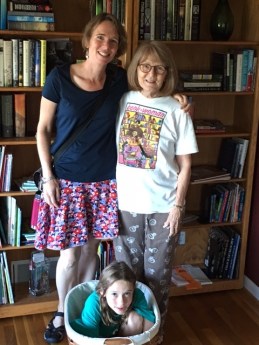 Bette, her daughter Melisa, and her granddaughters Liliana and Lara [it’s Lara in the picture]—took the view, initially, that the best way to go about reading a novel was to start at the beginning and move through to the end. They granted that sometimes a book starts slowly and you have to exercise some discipline to keep reading until it starts getting interesting, but you will be rewarded for your efforts. Besides, it’s the right thing to do.
I know I’m speaking as a member of the other team, but I think that position is essentially a moral view. It honors the intentions and the craftsmanship of the author. Books, especailly novels, are written to be read in a certain way and it is therefore quite likely that the reader will have the best experience by reading it that way.
The idea that reading it “the right way” is more satisfying does an interesting thing as I see it. It turns a momentous corner and begins to move away from a formula “right way” and toward an “experienced outcome.” The experience of the reader, the individual reader, is the whole point of my team’s view, so I will turn to that next.
“We”—Melisa’s husband Thomas, their son Konrad and I—took the view that there were many “right ways” to read a book. Finding the right way called for some knowledge of yourself as a reader. A reader might read in a way that maximized the suspense, for instance, or that minimized it, depending on the book 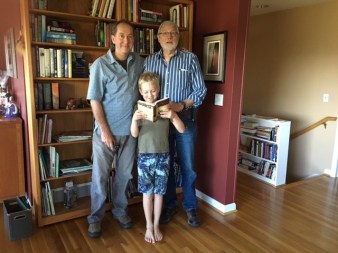 and the time of day.
I grant that the author has a plan. It may involve selling the highest number of books or getting the most favorable reviews. It may even be a work of art that emanates from his or her own inner sanctum and that is “art” in the purest way.
I don’t care.
I have a plan too. I want to live in an artfully constructed fictional world, for instance. Or, in another book, I might want to bathe myself in the beauty and urgency of the author’s prose. [1] I want to follow in fictional terms an argument that actually matters a lot to me in the real world. I want to laugh out loud and tell my Starbucks caucus the next morning what was so funny.
These are the purposes I care the most about and the “plan” of the author really doesn’t weigh very heavily against them. More so for the other team, I think, but not so much for our team. I want to read a novel in a way that gives me the best chance to experience one or more of these rewards of reading. I call it “reading strategically,” because there is plan attached to a goal.
Both Konrad and I have had the experience of reading a novel in which the plot gets tighter and tighter as if some emotional rubber band is being wound up. It makes us anxious or afraid or uncomfortable. Reading the end of the book or the end of that episode—whatever is appropriate—has the effect of relaxing that rubber band and letting us calm down so we can go back and really enjoy reading about the developments that no longer bother us.
Let me give a concrete example. A lot of people love to read mysteries for the final revelation of culpability. That’s why they call them whodunits. That’s not what I like. I like knowing what kind of story it is. Very often that amounts to who gets murdered and under what circumstances.
Then I like seeing the various plot element slide into place. These are the clues that point one way and then another. When I know what a character is going to do, I can see and appreciation the way he is first introduced into the plot. Obviously, if I didn’t know what he is going to do, I wouldn’t know how to appreciate the way he was introduced.
Of course, in order to  see these characters and developments slide “into place,” I have to know where they are going. That means I have to know what happens and to do that, I have to read the ending. People who like the mystery suddenly resolved should read a murder mystery A and then B and then C, just as it is written. People, like me, who want to enjoy seeing the plot assembled should read it A and then C and then B. And that is the way I most often—not always—read a murder mystery. Jodi Picoult’s hopes to the contrary notwithstanding.
The very heart of our approach—Thomas and Konrad and I—as I understand it, is that every reader is free to read a novel in the way that produces the most enjoyable experience. [2] Also, I think it is a gift to teach young readers the value of “strategic reading,” in which the interests and experiences of the reader are put in first place; if we do that, we will have made a substantial contribution to the younger generation. I would wish nothing for them but that they have a full lifetime of great reading, just as I have.
On the other hand, every kind of reading takes a certain amount of discipline and that virtue is appropriately emphasized by the other side—by Bette, Melisa, Liliana, and Lara.
Afterwards
There was some shifting around of positions in the two days following the discussion. Initially, I wondered why that would be. I settled on two explanations. The first is that it is not at all uncommon for people to reconsider their views after a thoughtful exchange. I don’t want quite to say that is the point of the exchange, but it is certainly not an uncommon effect.
The second is that Bette et. al, had held their views in a general way and were surprised to be in a discussion where labels were put on those views. If there is truly One Best Way, then a proponent of that way has to be willing to look a friend in the eye and say something like, “I don’t care if you would enjoy the book more the other way, you still should read it in the One Best Way.” That is not an easy thing to say, although it follows directly from the views as they were first expressed. And it isn’t the kind of thing that either Bette or Melisa would permit themselves to say. They aren’t that kind of person.
So I think that having the views set out formally so that the implications as well as the principles could be seen, may have aided in the shifting around.
Whatever.
This topic produced the first All Hands on Deck discussion by the families Jaenisch and Hess and I am very grateful for it.
[1] I remember vividly the summer I was trying to read The English Patient. I discovered that over and over, my mind drifted away from the plot (which I found myself unable to engage) toward the writing itself, which was luminous. So I did the obvious thing: I read the last page, then the next to last page, then the one before that, and so on until I had come to page 1. It was very satisfying.
[2] I am currently reading The Summer Before the War, a novel in four parts. The first part, which I read from beginning to end, is a pre-war (World War I) novel of social manners. I didn’t like it at all, but I didn’t give up. The last part is a very gritty look at war in the trenches and I got some idea of where this plot must have been in order to get all the way from A to D. Encouraged, I turned back to begin B, the second of the four sections.
 Eastman says that two things are necessary for something to be funny. There must be a discrepancy of some kind and there must be a setting which encourages or allows you to take it lightly. Jokes that turn on ethnic or gender or professional stereotypes are a good example. You can describe a situation that could be understood either of two ways, the classic discrepancy. But in an audience that disapproves of…oh…Polish jokes, let’s say…the permission to regard it as funny is missing. So it isn’t funny. Or at least you try not to laugh at the time.
 It’s sad, really. The old agreement was that I tell jokes that make fun of your ethnicity and you respond by telling jokes that make fun of mine. The rule was that “equally offensive” was about the same as “inoffensive.” Under current conditions, the fact that someone was offended by it is the defining trait and we can see nearly anything as offensive.
 Why did it take me so long? It wasn’t the Latin quotation. I didn’t know it, but it was easy to look up. The whole quotation is “Vita brevis est, ars longa.” My previous contact with ars with on the Metro-Goldyn-Mayer logo, which says “Ars gratia artis.” That’s how I knew it meant “art”—the motto means “Art for art’s sake.” And, in the same way, I knew that it was pronounced “arz.”
 I think I was floating in that current when I hit au revoir because something divided the expression into “Goodbye to what?” and having gotten that far, I noticed that Au is the symbol for the element, gold. That means that one way of sensing the discrepancy is that Au revoir (notice the capital A) is a way of saying “goodbye to gold,” which is a pretty good way of categorizing the meeting where we write the check for our apartment.

 Ferdinand Magellan sailed out of the very nasty seas around Cape Horn and found a relatively quiet body of water. He was thankful for how peaceful it was for the same reason that the Pilgrims were thankful for food after having lost half their number the previous winter. We could say that the seas Magellan found were “relatively” calm. So in the general sense, “pacific” means “peaceful.” Everyone who has ever given a baby a pacifier ought to understand that. [1]
 But I don’t have any direct interest in Pacific Retirement Services where “Pacific” refers to the ocean. Bette and I are going to be living at Holladay Park Plaza—in a few weeks—and HPP is one of the retirement centers belonging to (affiliated with) Pacific Retirement Services. [3] So right away, as I begin to wonder whether PRS is good for HPP, my mind drifts over to a pacific retirement, the kind I want very much. And that raises the questions of what “services” will help me achieve that. [4]
 But before we get to Rover Joe, let’s go back and pick up Kermit. Leroy’s bumbling master, Mordecai Sledge, managed to throw a Sousaphone up in a tree and it came down around Leroy’s neck. Leroy takes off, hauling a whole wagon of musical instruments behind him. He doesn’t know what this thing around his neck is and, having escaped “from”—with no thought yet given to the “to” part—he doesn’t really know who he is either. Kermit solves both of those problems.
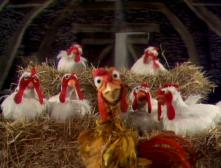
 throwed out.” That can be usefully abbreviated as OBUWATO. It is why, in response to the first question, he is sad. It is why, in response to the second question, the reason that his master, Mean Floyd, threw him out the window. They invite him to join them as a travelling musician. Rover Joe declines. What to know what the reason was? OBUWATO. He says it so often that T.R. begins beak-synching with him.
 private if you know what I mean.” That seems clear enough. T. R. hears her with respect. “Come on Rover Joe, the lady’s got her rights.” But again, that is not what she wants and the second verse of the song begins “Well now no one care about this story…”
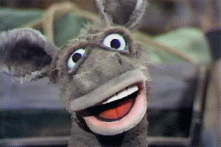
 In the first scene after Leroy escapes, he is just a donkey running away. But he runs into Kermit, who says, in effect, “You are not a runaway donkey, you are a traveling musician!” I have never seen, in real life, the instantaneous transformation Leroy goes through because Kermit gave him an identity, but I have very often seen a new name given and I have seen a person grow into that name. I have been that person.
 moments ago, you were lying here in solitary misery. Catgut was waiting to die and Rover Joe had been OBUWATO. But someone said, “Why don’t you join us?” The choice is really clear. Yes awful things have happened to you. Yes you are lying here because you had no alternative. But now you do. We are asking you to join us.
 I’ve been there a lot in the last few weeks on one errand or another and I have used the restroom on the first floor just north of the lobby. There is good hot water there and a soap dispenser and a tray of rolled up cloth towels. Very classy. Because people wash their hands at the sink, there accumulates on the counter little pools of water and soap suds. So after I have wiped my hands on the towel, I mop up all the water and soap and throw the towel into the basket under the sink.
 That way of understanding the story has not helped me. It has brought a consistent and principled demand down on my behavior. It has not caused me to intervene when otherwise I would not have. I don’t think I have ever seen anyone intervene because of the “do likewise” instruction. That formulation is really good for blaming yourself, of course, and it is even better for blaming other people, but without compassion, it doesn’t actually work and I think we know that.
 I think that’s a really good idea. The bully’s aggression works by isolating some vulnerable person. If the bystanders refuse to fall away, to expose this boy or girl to abuse, then he or she is not isolated and the bully will have to reconsider. He may very well reconsider by going after you, but that is one of the things you might have to risk. You might be willing to risk it because you feel compassion for the bully-bait, especially if you have seen it before. You feel compassion and you are impelled to follow those feeling with actions.
 Cute.
Cute.
 I know there will be other sortings as well; I’m just not sure what they will be. Will there be a group—a real group, not just a category—of “people who used to be teachers?” Will there be “people who used to run businesses?” Will there be a group who used to be important and miss it dreadfully? Will there be a group of movers and shakers who serve on retirement center or on neighborhood committees and who want to tell you what is going on? I have no idea.
 I know this happens all the time in new settings. I know I am going to walk into the dining room and look around. I am going to see some people dressed as “we used to be teachers” or “we used to run businesses” or “we were stay-at-home moms.” And they are going to look at us, at “the new guys,” and make the same kinds of early decisions. Where is the Sorting Hat when you really need it?
 As I tried to find a way to say what it was about the two conventions that bothered me, I made my way back to 1895 again. That’s when H. G. Wells’ well-known science fiction work, The Time Machine was published. As nearly everyone knows—I’m sure there is a Classic Comic version of this famous story—the Time Traveler goes far into our future, to a time when there are only two species: the Eloi and the Morlocks. Here’s a piece about their relationship from the Wikipedia article on Morlocks, but you can see it all in the picture.
 The production and distribution of goods and services are being globalized. American manufacturers want to find customers for their products and as a global middle class continues to develop and grow, they are finding them. Not the American middle class, but still, a customer is a customer. A global labor market is also taking shape. This pool of “laborers” includes blue color and white collar; it includes jobs in production, sales, and services—including some very demanding services, like architecture and engineering. The need for workers—reduced as it is by robotics—is still quite large, but there is no need for these to be American workers.
 What would help? OK, I’m not going to call it socialism. I’m not going to call it anything at all. But here’s what needs to happen. If American businesses are going to go to the least expensive labor markets and if they are going to sell their products to a rapidly emerging global middle class, then we might as well admit that the cost to our own middle class—the late great American middle class—is going to be catastrophic. [5] The pain these policies cause makes they angry. The pain needs to be mitigated. That is something governments actually can do and they should. They can’t fix the problem, but they can make it hurt less.
 Since Bette and I decided to leave our Hayhurst Neighborhood and move to a good retirement center somewhere, we have been thinking about the going part. How can it be done thoughtfully and gently, honoring all the neighborhood has been for us? And now that we have bought an apartment at Holladay Park Plaza, our choice of retirement centers, it is time to think about the coming part—coming to a new home. [1] HPP is actually in the Sullivan’s Gulch Neighborhood, as Portland counts neighborhoods [2], but I think it would be better for Bette and me to think of HPP itself as our neighborhood.
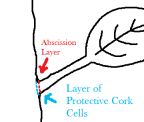 standard are very likely to be rejected at the outset, even though there are other values that also need to be considered. If it isn’t thoughtful and gentle, I don’t want to consider it. I was shopping for a metaphor that would help me think through the process and in the middle of my search, I stumbled on the metaphor I used last January for leaving the neighborhood: it is “the abscission layer.” As soon as I saw that, I knew that I wanted to go around to the other end of the process, which is grafting. Bette and I want to be grafted in to our new neighborhood.
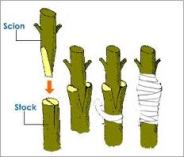 ced by sunlight and magic and sent to wherever in the tree it is needed. I don’t understand photosynthesis, really, but I know it involves an interaction at a part of the tree whose principal responsibility is to make nutrients and put them into a transportation system that will bring them to the right place.
 Not everyone would call the action of hormones like auxins, cytokinins, and gibberellins “politics,” but I would. The production and inhibition of growth and the distribution of resources to one place rather than another sound like the ordinary work of the legislature to me. We’ll see.
