Only two, though. I am saving the last one for a better resolution of the dilemma.
I want to think this morning about Nicholas Kristof’s column in the New York Times, which you can see here. (For reasons I don’t pretend to understand, the hyperlink is below on the word “of.”)
 And I want to start with three comments. First, I am grateful to Nicholas Kristof for asking the question, Timothy Keller for providing some answers, and to the New York Times for publishing it on the front page—of the electronic version, at least— two days before Christmas. Thanks to all.
Second, I am probably not an evangelical myself. My friend, Bill Teague, of Langhorne Presbyterian Church in Pennsylvania, says that I am. I think he’s just being gracious. He is an evangelical himself and we have had delightful talks over the last thirty years or so and I think he wants to offer that status to me as a gift. But even Bill says that I am a “minimalist evangelical.”
Finally, when my father taught me how to drive a car (an old stick shift pickup truck), he said, “OK. Now you are not going to be completely satisfied with the way anyone else drives.” And as in many other things, he was right. Once you know how you would do it, the way anyone else does it doesn’t seem quite right.
Like Tim Keller, I have had this conversation a lot of times. Nearly always, I walked away from the conversation still friends, as I am sure Keller and Kristof are. I count that a good thing, although it is not the only good thing. And because I have “learned to drive” in this conversation, I am not entirely happy with the way Keller drives. I’m not really critical of him. I just know that I do it differently.
For instance, Keller winds up making two points about orthodox Christian beliefs. One is that you have to have them. The other is that some doctrines that seem fully dispensable to me, seem crucially important to him.
As to the first, I would be really wary of identifying the holding of a particular set of beliefs as “being a Christian.” Especially in a country whose history has been predominantly Christian. Are we really saved by what we believe? Really? Not through relationship with the God whose character and intentions we understand through the life and ministry of Jesus? Really?
It is to take care of difficulties like this that I have come to identify the whole corpus of Christian beliefs as “Christianity.” Christianity is, in that sense, like Pythagorean geometry. It starts from the premises and proceeds through logic and evidence to answers to a whole bunch of questions of application. But if I misunderstand one of the premises or if I lose my way in reasoning myself from one conclusion to another, what happens? If Christianity is a “discipline” like geometry, I have failed. If it is a relationship with God, understood in the light of Jesus, the relationship doesn’t go away. What parent among us can imagine that only the child who is perfectly in line with our expectations is going to be welcomed home? And faith is, as in the picture, a kind of trust.
So I see the business of “being a Christian” not as Keller sees it—believing in the crucial doctrines—but as a relationship that will survive substantial degrees of heresy. The church could not, but a Christian could.
 Then there is the question of what doctrines are really crucial. The virgin birth? Really? Keller bases his argument on the idea that if there really is a God, we have no idea at all what He is capable of. [1] Keller is right about that. We cannot know. On the other hand, we don’t need to know.
It is true that many New Testament works present Jesus as “without spot or blemish,” but it is also true that these presuppose the Jewish sacrificial system in which the purity of the sacrifice is crucial. The church has taught at times that Jesus saves because of the good example he was. Some have said that whatever his life and death were about, they did nonetheless produce a historical community bound by love and committed to obedient sacrificial living within God’s (renewed) Covenant. I think of “sacrificial atonement” as a metaphor. There are lots of metaphors. And many of them have no need at all of the virginal conception of Jesus. [2]
So my argument with Keller is that the virginal conception is not a crucial part of the body of Christian doctrine as I imagine it. I wouldn’t say that about the resurrection of Jesus, however, and that puts me right back in the “miracles in modern times” soup along with Keller.
What I can say confidently is what Keller says: something happened. After Jesus’s death, something happened to his followers—and not to anyone else—that turned them from from losers hiding in spare rooms to dynamic evangelists moving the crowds and daring the authorities to stop them. What did that?
I don’t know. The several New Testament witnesses don’t have the same notion of what  happened or, indeed, of what “resurrection” means. You can say that Jesus acquired “a spiritual body,” but no one knows what that means. You can say he went to “heaven,” if you want to hang onto the geocentric picture of the universe which was common coinage in the time the gospels were written. You can wear yourself out on what the resurrection “was.” I wish you well. My interest is in what the resurrection “means.” It means—the witness of all New Testament writers supports this—that the life of Jesus, which was understood at the time to have ended in defeat, actually ended in triumph. God raised up this Jesus whom you crucified. (See Acts 2:36 for a concise formulation). That is what it “means.” (Skepticism is still, as you see in this picture, an aspect of a relationship, just as faith is.)
But, to tie these two ideas together and get off the stage before the audience starts throwing fruit, let’s say I can’t find my way to believing that Jesus was resurrected and let’s say that his resurrection is logically crucial to the integrity of the whole argument. Is God going to reject me because I continued to believe in Him and His son and His work although by rationale was faulty? Really?
I don’t think so. If I thought there was a heaven and if I thought I would meet God there, I could imagine Him taking me by the hand and showing me where I screwed up—how, once I put this piece back into my doctrinal armory, the resurrection would be necessary and would make perfect sense. But, in this little fantasy, God did not damn me because of the mistake I made.
I would have been prodigal in my thinking, but still, I would be His son.
[1] Sorry about the pronoun. I don’t believe God can be meaningfully thought of as having a gender. I just like to stay as far away as I can from any sentence that will require me to say “Godself.”
[2] Joseph Fitzmyer and Raymond Brown, both Roman Catholic priests, argue with each other as scholars and friends about whether Luke really has a doctrine of the virgin birth. Fitzmyer says no on textual grounds; Brown says yes on the grounds of literary format.
 the best response will have to be based on what it is responding to.
 clearly identified and that it is “them.” The power of this leader does not come from any solution to the problem, but only with a way to fix the blame for it. This is very satisfying in several ways. First, if it is “their fault,” it is not my fault. Second, making them “pay” in some way for what they are doing to us is a perfectly satisfactory substitute for actually dealing with the issues. I may still be dying from the diseases my work reliably causes and still desperately poor and alcoholic, the the new problem—the gift of the leader to people like me—is that “they” don’t respect us.
 Let me describe how that would work and then you can tell me that it doesn’t solve the problem as I framed it and then I will tell you why it will work anyway. [5] I propose that we sit down with conservatives who are willing to have a civil conversation based on the different values each of us seems to have. Our job, the job he and I are working on, is having this conversation in a way that is honest and sustainable. If we succeed, it will be because of our teamwork. If we fail, “we,” not one of us, will have failed.
 But, you say, that doesn’t end the tantrum. No. It doesn’t. You are quite right. But it may well do two things that are worth doing. The first is that it may change the relationship between the policy-oriented leaders of the “Less Government” school of thought and their angry and self-destructive supporters. The second is that it may change the relationship between the “More Government” people (myself included) and the “Less Government” people.
 I wasn’t the father. She said she that had had a vision and that this was all God’s work somehow and that there was no shame in it. She also said that God said we had to name him Jesus. There haven’t been any Jesuses in my family as far back as I know. Even in this picture, all you see is my back. Luke must have taken the picture.
 I had to get everybody back home to Nazareth. When Jesus was right on the edge of the teen years, we wanted to go to Jerusalem to celebrate Passover. So I loaded everybody up again and made the trek down south and then up the hills to Jerusalem—which is a thousand feet higher than Nazareth. It’s a climb, let me tell you. And then he got himself lost and Mary and I had to go back for him. That kid! He looked me in the eye and said that we should have known he would be in “my father’s house,” he said. Pretty mouthy, I think, but the scribes at the temple seemed to think he was something special. I should have just left him with them, but that’s not my part. I am a transportation service. So I took them all back home again.”
 A Christmas Visitor. I have seen several of the main actors in other, more demanding parts, and I know they can act. It is not their fault that this movie doesn’t require them to do any. There is “the dad” (William Devaney); and “the mom” (Meredith Baxter); and a son and a daughter—and a “visitor.” That’s pretty much it.
 more visible healing. Jean has been rejecting, or at least has not been enjoying, memories of old times with her brother, John. The two kids are shown in a flashback, decorating the tree and and a direct result of their playing round, breaking one of the five points of the star. John, still in his character as “Matthew,” heals the star and in that way restores the memory to Jean. [3]
 “It is time for healing” is what George said back at the beginning. And John knows that. We don’t know how he knows. And because he knows that, John comes to them as Matthew. John is credible as Matthew, but just barely. He knows too much and even after he explains everything away, the Boyajian family is not quite convinced.
 Holies in the temple and burn incense. The angel Gabriel appears to him and calls him by name and gives him the wonderful news about the forthcoming pregnancy of his aged wife.
 Yes, you have. That’s the best answer. Remember back to Daniel 10:15?, the only previous appearance of Gabriel? [5] Gabriel was telling Daniel about the events that will mark the end of this era and Daniel was struck dumb. Well, here is Gabriel again and Zechariah is struck dumb. So…what does the fulfillment of God’s promise to Zechariah have to do with the end of the era?
 I can do that. I think the appearance is supposed to mean to Luke’s hearers what the sound of the gun at the beginning of the last lap [6] means to fans of track and field. It means that the race is almost over and if you had a move to make, this would be the right time to make it. [7] Jesus said that over and over in his ministry, but I think it is a mark of Luke’s art that he introduces it into the story of John’s birth.
 Hochschild is a wonderful choice to begin the new year. She is a sociologist at Berkeley and has written on some very sensitive topics. She came to my attention when I read The Managed Heart: the Commercialization or Human Feeling. [3] in 1979. It was an adptation of what “labor” means from the Marxist notion to a much richer sense that is broadened to include “emotional labor.” To study that, she studied flight attendants, who are paid to maintain a certain emotional demeanor and who suffer, as a result, from what Hochschild calls “charm depression.”
 retirement center. This picture shows a little of the living room and a little of Bette. She is having a wonderful and warm conversation with her first mother-in-law, who lives in North Dakota. I am in the kitchen kneading dinner rolls for our upcoming Thanksgiving feast at the home of a much-prized stepdaughter who lives here in town.
 was about the likelihood that fewer people in Plymouth Colony would die in the coming winter than had died in the previous one. Roughly half the population, as I recall the story, died during the first winter. Imagine that for just a moment. We are now into the second winter and the leaders of the colony are saying to each other, “How wonderful. Thank God there are fewer deaths this winter than last. The colony may survive after all.”
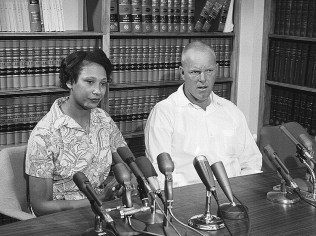 I think that is what I liked best about it. It would have been easy to turn the story of this quiet and courageous couple into a “storming of the barricades” kind of story. And doing that may have been truer to the cause, but it would not have been true at all to the Lovings. [This is the actual couple, by the way. The actors, Ruth Nega and Joel Egerton, look remarkably like them.]
 federal system, such matters are properly addressed by the states, rather than by the federal government, but states are not free to take away rights guaranteed to citizens of the United States. Just what those guaranteed “rights” are has been a matter of controversy for a long time now.
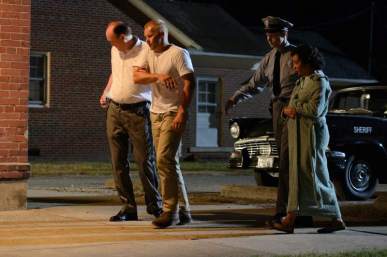 Set that against the quiet certainty and the authoritarian control of Virginia. There was no question that the sheriff would throw Richard Loving in prison and might even set the bail too high for anyone to reach. The threat of imminent punishment loomed over the conversation and I knew immediately, as I sat in the theater, what a struggle it would be for me to pass by that analogy.