I think so. Let me review three instances where I see that happening and then I’ll come back so we can revisit the question together. The three concern: a) Jesus’s healing of a paralyzed man, b) his partying with sinners, and c) his justification of his disciples’ violation of the Sabbath. These are all stories that Luke passes along to us.
Healing a Paralyzed Man
Jesus heals a paralyzed man and declares that his sins have been forgiven. [1] The scribes  and Pharisees accuse Jesus of blasphemy, interpreting his statement as something he, himself, was doing. It would have been easy for Jesus to have said that God had obviously forgiven this man, so it was not something Jesus was doing, but only something Jesus recognized. Then they could argue about whether God had done that or not, citing various interpretations against each other.
That’s not what Jesus did. Here is the account in Luke 5.
21 The scribes and the Pharisees began to think this over. ‘Who is this man, talking blasphemy? Who but God alone can forgive sins?’ 22 But Jesus, aware of their thoughts, made them this reply, ‘What are these thoughts you have in your hearts? 23Which of these is easier: to say, “Your sins are forgiven you,” or to say, “Get up and walk”? 24 But to prove to you that the Son of man has authority on earth to forgive sins,’—he said to the paralyzed man—‘I order you: get up, and pick up your stretcher and go home.
In this episode, Jesus accepts his opponents’ understanding of what he had done and offered a “proof” that he had not exceeded his authority. He said, “I will continue to debate this matter with you if you have the power, as I do, to heal this man. Oh, you don’t have the power? I guess the discussion is over then.”
Partying with sinners
In Luke’s account (5:29—32), Jesus attends a party in the home of his newest disciple, a tax collector named Levi. The Pharisees noted the Jesus was associating with people whom the Law told him to avoid. Jesus took the whole basket of undesirables and recategorized them.
The Pharisees saw these people as an affront to God. God demands purity and purity requires that you forego association with violators of the law. Jesus did not dispute that the other people at the party were sinners and he did not dispute that he would become ceremonially impure by association with them. He said, as I hear it, “They may be impure, but they are also spiritually sick. It is my mission to heal as many as I can. Why would God send me to people—like you—who are not sick and who, therefore, have no need of my special gift?”
Overseeing God’s Sabbath
Let’s take one more. At the beginning of chapter 6, Luke gives an account of a controversy about the Sabbath.
It happened that one Sabbath he was walking through the cornfields, and his disciples were picking ears of corn, rubbing them in their hands and eating them. 2 Some of the Pharisees said, ‘Why are you doing something that is forbidden on the Sabbath day?’ 3 Jesus answered them, ‘So you have not read what David did * when he and his followers were hungry— 4 how he went into the house of God and took the loaves of the offering and ate them and gave them to his followers, loaves which the priests alone are allowed to eat?’ 5 And he said to them, ‘The Son of man is master of the Sabbath.’
Jesus was challenged about the Sabbath-breaking of his disciples. [2] He gave an answer entirely within the narrative of Judaism using a kind of debate that was common among the rabbis. And then he claimed an unheard of status for himself—he attacked the entire structure of “holiness as separation” by declaring that he, himself, was master over God’s sabbath.
OK, there are three instances where, it seems to me, Jesus picked a fight he need not have picked. So this Jesus, the Jesus Luke gives us, [3] apparently wanted to make a point of some kind by picking these fights. Nothing Luke ever says about Jesus suggests that Jesus was not in control of his words and his actions. These events that Luke describes are not slip-ups; they are tactics. And tactics are intended to accomplish something. That brings us to the question of just why Jesus was picking these particular fights with these particular people.
Why Jesus Picked Fights
In this section, we move from material that is clearly part of Luke’s tradition. In recounting them, I am not speculating about anything; I’m just telling you what Jesus did and said. And we are moving to raw speculation. Luke has no interest at all in telling us why Jesus was doing these things, so we are really on our own here. [4]
 Let’s begin with Jesus as a chooser of what issues are going to be salient. Etymologically, and issue is “salient” when it jumps out at you. [5] Each of the events I have chosen as examples brings some new aspect of Judaism front and center. In the case of the paralytic, the question of God’s forgiveness is raised. At the party, the question of holiness as separation from the needy is raised. In the “cornfield,” the question of the applicability of the Law to Jesus and his mission is raised.
There was, in each of these areas, the normal way of looking at a question and then there were other elements at the margins. In each of these, Jesus took one of these “marginal” issues and made it central. Something about the message Jesus wanted to bring required new ways of looking at old things, so I think the general answer to the question I raised (Why did Jesus pick fights?) is just that–it offers a chance to look at things in a new way.
How does that idea work out in these three episodes?
In the case of the paralytic, Jesus does two things that, together, have powerful implications. He accepts the Pharisees understanding that he had forgiven the sins of the paralyzed man and links it to his power to heal. Either one of those would set him against the Pharisees, but together they make a very strong claim—they attach this claim to a title Jesus uses of himself—“Son of Man.” Jesus comes very close to saying to the Pharisees that whoever has the power has the authority.
The Pharisees claimed the authority of Moses, which is perfectly fair, but the authority they had did not enable them to cure this man. If power and authority are linked, then the Pharisees have neither. If they are not linked, Jesus has power, but the Pharisees have authority.
My argument here is that Jesus did not correct the misunderstanding of the Pharisees because accepting their accusation enabled him to clarify something about his ministry—that God had endowed him particularly with the power to heal and the authority to forgive sins—and that this relationship with God he was claiming put him outside the reach of the Pharisees.
In the case of Levi and his friends, the argument Jesus is looking for is unexpectedly fundamental. The whole Jewish notion of “holiness” is related to “separation from.” When Yahweh says He is holy, the meaning is that He is “other” and “separate” and “not mixed in” and when God asks His people to be holy, the meaning is the same. See Isaiah 52:11b for the original context). The way to stay holy is to avoid sources of contamination and the Pharisees were very serious about avoiding contamination.
When Jesus changes “contaminated” to “sick,” he changes the other role from “separated Israelite” to “engaged physician.” What kind of a physician would avoid people who were sick? Now, in the most literal and most narrow view, Jesus identified “tending to the sick” as his own role, not one that “sons of Israel” should play. He could be understood as saying, “I know this is not your role, but I want you to know that it is the role I was sent here to play.” But in context, there is a very good chance that Jesus’s rejoinder will be taken to mean: “And why are you Pharisees refusing to attend to the sick?” It would be a strong accusation at that level of meaning and that seems to be the way the Pharisees took it.
So the answer to the question “Why did Jesus pick fights?” as it appears in this story is, “So he could upend the Pharisees concern with purity and replace it with a concern for healing.”
In the final episode, the “Lord of the Sabbath” episode, the contrast is clearest and the attachment of the argument to Jesus himself is most prominent. Here’s the way Joseph Fitzmyer (see footnote 1) puts it.
Without formally abolishing the Sabbath regulations, Jesus subordinates them to his person and mission.
 Jesus picked this fight, it seems to me, in order to establish that he dare not subordinate his mission to the ordinary constraints of Judaism. That’s why he didn’t stop with the rabbinic justification of his disciples’ actions, but went on to make a claim about himself.
The point could be phrased this way. “I am a loyal law-observing Jew, but I have also been set apart by God for a particular mission and I must be loyal to that mission above everything. So when the two are in conflict, as they are here [6] I must be loyal to God’s call and not to the Law.” This is not different from the conflict just before this one and which I had to skip over. (Luke 5:36—39) in which Jesus identifies his movement as being like “new wine” and the Jewish institutional commitments as “old wineskins.”
Summary
I am amazed that I read these stories during the whole of my youth without noticing how Jesus sought these conflicts. It seems so plain to me now. I suppose that I was taught that “Jesus was a nice person” and therefore that he would not seek out and provoke conflicts unnecessarily. And if one begins with that interpretative filter, these stories can be understood—not very well—in another way. Clearly, Jesus is baiting his opponents in these stories. It isn’t that they were stupid, in Luke’s account, but that they were led into an ambush.
But if Jesus did seek out and exacerbate these conflicts, as I am arguing here, then we get to ask the next question, which is “Why did he do that?” My answer in this essay is that he did it in order to change the question from the ones that were being asked to the ones that needed to be asked if he was to clarify who he was and what his mission was. [6] Everyone is forced into speculation when the question “why did Jesus do that?” is asked. For “what Jesus did” we rely on the several gospel accounts. For “why did he do that,” we are, I regret to say, on our own.
My view is that Jesus had an answer he needed to give and that he did what he needed to do to provoke the question that required that answer.
[1] There is some debate about what Jesus actually said here and what it meant. Joseph Fitzmyer, my authority on Luke (see the Yale Anchor Bible Commentary), translates Jesus’s remark as “Your sins have been forgiven you” and suggests that the theological passive used here is meant to suggest that it is God who has done the forgiving.
[2] This was one of the most puzzling stories for me when I was young. What the disciples were doing with “corn” made no sense to me at all. I had had a lot of experience with “ears of corn” and I know you can’t do with them what the disciples did. It took me a long time to realize that the text has grain in mind, not maize. And then there was the matter of the disciples stealing from the farmer through whose fields they were walking. So that looked like trespassing to me and then theft on top of it. I was bewildered.
[3] Perhaps it is worth saying here that we and dependent on Luke’s view of what Jesus did and what he was trying to do. My argument that Jesus’s intentions can be reasonably read right off the page could more carefully be phrased as “the Jesus tradition Luke draws on presents him in this way.” So it may be that the contrasts that I find so compelling are the ones Luke wants us to see rather than the ones Jesus would have wanted us to see. There is no resolution to that problem. Luke (and the other synoptic accounts) is the source of our information and there isn’t any way to peek around the account to the events that lay behind it.
[4] I am not entirely on my own. I have benefitted a good deal from the work of Sidney Tarrow’s Power in Movement:Social Movements and Contentious Politics., particularly his idea of the “repertoire of contention” and Charles Tilly’s idea of “claims as performances” in his Contentious Performances.
[5] Salire, “to leap” is the root of quite a few English words, including, oddly enough, “salacious.”
[6] Of course they were not fundamentally in conflict here. That is established by Jesus’s defense of his disciples’ action through an interpretation of the scriptures. Jesus went on—unnecessarily, in the view of this essay—to redefine the conflict as fundamental. “I am the Lord of the Sabbath” is a fundamental conflict.
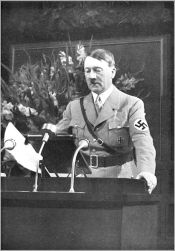 I have taught in public schools and universities nearly all my life, so I can tell you that comparing anyone to Adolf Hitler is taken as a serious insult. If you say to a politician who is five feet and nine inches tall that he is as tall as Hitler, he will take it as a mortal insult. He will say, incredulously, “Are you comparing me to Hitler?” If I say that Hitler was a marvelously gifted tactician, deploying a largely unwilling bureaucracy with great skill, I will be accused of “justifying Hitler.”
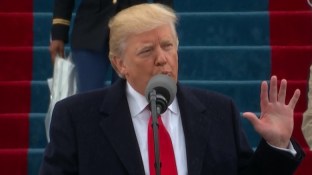 Noting these similarities is not a charge against Trump. You can go down the two speeches and just substitute a German expression for an English one and just doing that is scary.[2] It is true, however, that Trump sees many more similarities than I do between the time of his assuming power and the time of Hitler’s assuming power. And because Trump sees these similarities, he chooses words that highlight them. Any good speaker would do that. Abraham Lincoln did the same thing; he was a superb speaker as a result.
 achievement to the appropriate agencies, funding them adequately, and then holding them accountable for their work. That’s not how you build a movement. A movement needs a leader. The leader needs to focus the movement on himself and to give indications that he, personally, is bound to the success of the movement.
 United States of our time (by contrast with the Germany of Hitler’s time) there are many social and political institutions, including a robust federal system, in place. They can’t simply be set aside. They will have to be bargained with.
 OK, how are we going to have such ceremonies if people say that the ceremony is about the person who is being honored? We will not have them. If the ceremony is about the person rather than the office, then the ceremonies that are supposed to celebrate our unity as Americans and the peaceful transfer of power from one party to another, will have no power at all. Everything is politics—the pursuit of power. Nothing is government—things like providing for a common defense and protecting domestic tranquility.
 Trump will be the 45th President of the United States. But winning an election does not mean a man can show contempt for millions of Americans and then expect those very people to celebrate him.
 It takes her a little longer to get to the “but;” still, when she gets there, she wiggles the same way Rep. Castro did. I respect the office. Good. I respect the peaceful transfer of power. Good. But the man who will take the office is a jerk and the man to whom power is transferred is offensive…and therefore we cannot participate in this celebration of peaceful democracy in America.
 I think that President Trump’s actions, proposed and executed, should be opposed by everything we have. He is going to want to cozy up to Russia with predictable consequences for Germany and France. Make him pay. He is going to want to gut the health protections President Obama put in place and that the Supreme Court declared to be constitutional. Make him pay. He is going to continue to engage in business practices that are wholly out of line with the office of the President. Make him pay. He is responsible for his actions and when he does wrong, he should pay the consequences.
 Let’s look at what the word itself—as opposed to our use of it—would like to be or what it would like to do. It’s a little like agreeing to recognize gravity or inertia. I wouldn’t want to go so far as to say that the word’s intentions have been frustrating our intentions. There are quite a few things wrong with that formulation. [1] But I do want to start with the word.
 These are not things I am going to decide to do, as if they were foreign countries I had not yet invaded or competitors I had not yet eliminated. These are not decisions that I have been struggling with—a di-lemma is a common kind of struggle [4]—what with the two lemmas to deal with.
 intend anything and then act on that intention. On the other hand, sometimes it is the easiest way to say something and if you stay vigilant, it doesn’t do any harm. Take Dawkins’ The Selfish Gene, for instance. Dawkins does not think that genes “intend;” his contention is that imagining that they do helps us make sense of the pattern of their actions.
 ampion. So far as it is possible, they are going to deny that he really did what all the papers say he did. Failing that, they are going to say that it was an understandable mistake by a new president or that it was well-intentioned by the president but mishandled by his supporters. They are going to say that huge errors are mere foibles.


 Ominous, isn’t it? But it is the reason I changed Kevin Quinn’s sign-off line from “my story” to “our story.” If there is an “our story” and if joining with others in the community to support it is the way people can tell whether you are “one of us,” then joining in is crucially important. Being right about the changes in butterfly migration and the reasons for it, is not crucially important.
 and professionally to the same conclusion. But I found that same conclusion, much more graphically expressed in Kingsolver’s Flight Behavior. Had Hochschild and Cramer studied Dellarobia Turnbow, they would have come to exactly the same conclusion each reached about the groups they studied.
 Two further things. There is a resentment of Al Gore the person in this remark. Gore is invited to “toast his buns” on the frost. Not a very dignified reference, surely, to a man who lost the presidency by one vote. Even “toast his toes” is not so demeaning. And all such expressions are beside the point anyway, unless the point is to derogate Gore.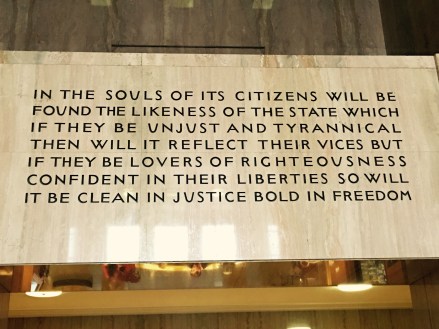
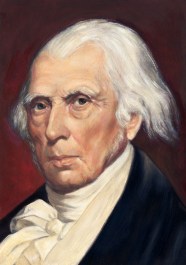 So the Framers put their hopes elsewhere. They put their hopes in the architecture of the system. I have said it this way sometimes [3]. “The Framers no more believed in the goodness of citizens than Newton believed in the goodness of planets. Newton’s idea was that if the planets were of a certain size and density and velocity and a certain distance from each other, they would just keep doing what they are doing and no “intervention” would be necessary. That’s what the Framers thought about federalism, the separation of powers, and checks and balances.”
 could produce a good state. They despaired also of forcing people to act as if they were good citizens, as if their own interests did not matter more to them than the welfare of the state. They settled on a system that would allow them to be as bad as they actually were, hoping that the long and torturous maze that confronted them would tire them out before they took over the government.