
…they comfort me.
That’s the way the psalm goes. It is Psalm 23, very likely the most famous psalm in the world. [1] I got to thinking about it the other day and, like so many other things I think about, when I get far enough away from it, I see new things. [2] The powerful truth in this exegetical advice has been captured by Yosemite Sam, as you see.
So today I would like to think through some of the most obvious, and therefore the  most likely to be overlooked, aspects of Psalm 23. First, it was written by a sheep. We will need an adjective or two here, so let me offer ovine (sheep-like) and pastoral (shepherd-like) as the most useful.
This sheep is a disaster as an author because he has the authorial viewpoint of the shepherd. He speaks, in other words, in his own voice, but he knows things that only the shepherd would know. Or, to use the adjectives I provided above, the voice is ovine, [3] but the words are pastoral. That’s not how they told us to do it in Writing 101.
An Apology
So I would like to explore this discrepancy, but before I do that, I would like to apologize to lovers of Psalm 23 (although I am one) and to explain why the approach I will be taking, helps me. There is a way of understanding this psalm that takes its real world images into account. What, for instance, are rods and staffs used for? And, from the other side of the road, what images are supposed to be called to mind by the use of these words.
There is a danger, when you ask these questions, that you will come to care more about the answers than about the certainty of God’s care that the psalmist wanted to convey. That would be a wrong reading, it seems to me. But where there is danger, there is opportunity as well and the opportunity is learning to take account of the real world and the biblical allusions that his hearers would have understood instantly. With great effort, we can learn to hear these psalms in the way that even the dumbest Israelite would have been able to hear them and then we can appreciate them much more fully.
In short, although I am aware of the danger of substituting the study of the 23rd Psalm for the beauty of it or for the meaning of it, I think it is a danger worth taking. I hope very much that I will not take away form anyone what he or she most liked about the psalm, but this blog is a place where I think out loud and today I want to tell you what happened to me when I started thinking about it.
Ovine Knowledge
I am going to move past the lines “The Lord is my shepherd,” which sets the master metaphor for the psalm, and “he restoreth my soul,” which summarizes the sheeply benefits in a most un-sheeply way. So let’s go to the benefits this sheep celebrates. I have put the King James first and the New Jerusalem Bible in parentheses after it.
He maketh me to lie down in green pastures ( In grassy meadows he lets me lie)
He leadeth me beside the still waters (By tranquil streams he leads me)
These are perfectly ovine preferences. Good grass is better than desiccated scrub and slow moving water is easier to drink from than fast moving and tastes better than stagnant water. Any sheep knows that and any sheep who associates these benefits with the leadership of the shepherd has every reason to be grateful to him.
The Failure of Pastoral Knowledge
We come now to the part where something in my mind said, “Hey. Wait just a minute.”
Thy rod and thy staff, they comfort me. (Your staff and your crook [4] are there to soothe me).
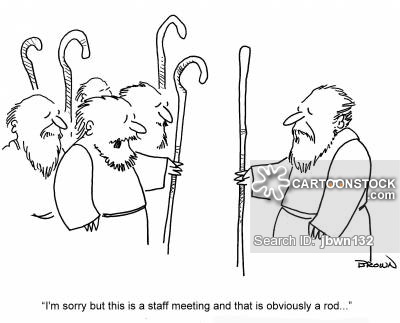 Any shepherd knows what any pastor knows: those under his care are often willful. They want what they want. Very often, they pursue what they want without reference to the dangers to themselves or to the rest of the flock. The shepherd, seeing that, would do what needs to be done. Apart from more spiritual considerations, these sheep are the source of the milk and meat and wool he relies on for his living. So what might he do?
Here I begin to rely on material from an African shepherd, W. Phillip Keller, who wrote a book called A Shepherd Looks at the 23rd Psalm. He knows more about rods and staffs than anyone I have come across and if I am to approach my goal of learning, through careful study, what the stupidest shepherd in Palestine took for granted, I can profit from Keller’s recollections.
We will begin with the staff because that is the picture that came first to my mind. Here is Keller.
The shepherd’s staff is normally a long, slender stick, often with a crook or hook on one end…The staff is also used for guiding sheep. Again and again I have seen a shepherd use his staff to guide his sheep gently into a new path or through some gate or along dangerous, difficult routes. He does not use it actually to beat the beast. Rather, the tip of the long slender stick is laid gently against the animal’s side and the pressure applied guides the sheep in the way the owner wants it to go…Being stubborn creatures sheep often get into the most ridiculous and preposterous dilemmas. I have seen my own sheep, greedy for one more mouthful of green grass, climb down steep cliffs where they slipped and fell into the sea.
Note: I did remove a sentence from that account. See the second ellipsis. It will return to us shortly.
The staff, you will notice is used “to guide the sheep in the way the owner wants it to go.” True as this may be, it is not, let me assure you, the experience of the sheep. Consider this line from that paragraph:
Being stubborn creatures sheep often get into the most ridiculous and preposterous dilemmas. I have seen my own sheep, greedy for one more mouthful of green grass, climb down steep cliffs where they slipped and fell into the sea.
I ask you now to consider the perspective of the sheep. There is a mouthful of green grass to be had and the sheep is greedy. Why not just stretch out a little bit—just a little bit—and get one more mouthful? That is what the sheep wants. The staff is what is preventing me from getting to that luscious bunch of grass. It is an impediment. If I am a sophisticated sheep, I might say it is an unreasonable or an unnecessary or an overly prudent impediment.
I don’t see any comfort there. The operation of the staff to keep the sheep from going 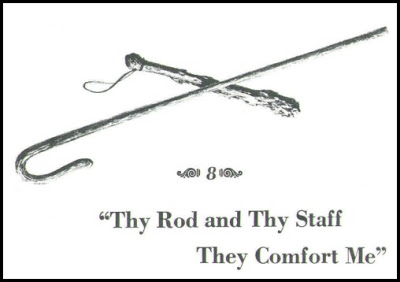 where its owner wants to prevent it from going—that makes perfect sense. I might go so far as to say that it comforts the shepherd. It does not comfort the sheep.
The rod is a little better, but it is a little like having a father who is capable of dealing out serious physical punishment. You might feel really good about that if you are in danger of getting beat up by others, but you have to know he is capable of that kind of punishment against you. You do know that.
Keller says:
The skilled shepherd uses his rod to drive off predators like coyotes, wolves, cougars or stray dogs. Often it is used to beat the brush discouraging snakes and other creatures from disturbing the flock.
He also says:
And it was, furthermore, the instrument he used to discipline and correct any wayward sheep that insisted on wandering away.
So the comfort you take in the rod, as a sheep, depends on whether you think of its being used on you or on predators. I think that maybe ambivalence is the best I could manage if I were approached by someone with a clipboard and asked, “So…how do you feel about the rod? On a scale of 10.”
That’s how I think I would feel as a sheep. This particular sheep, the one who wrote Psalm 23, is a sheep who thinks like a shepherd. He’s an amazing sheep. I am not at all surprised that goodness and mercy follow him.
[1] I suspect that it is, in part, because it is only 122 words long (in the New Jerusalem Bible), while Psalm 119 is 2448 words long.
[2] I once had a brief enthusiasm for establishing this truth in a website to be called “Find ASIA.” The gimmick is that those four letters are so spread out on the map that you have to get some distance away to see the name of the largest continent in the world
[3] Baaaa.
[4] I’m not going there and I hope you will bypass it as well.
 know the experience. So here we have Moses anticipating the 613 mitzvot by starting off with a very general 10. Good luck, Moses.
 So I had the two indicators of the intention of the composer that I have had before, but this time I had a third. As we practiced it yesterday, for instance, I noticed that he—as a singer, but knowing what he knows about the piece—treated rests of identical length differently. We are considering a measure with four beats, the last of which is half a beat—an eighth rest.
 how to treat the printed score are better if they are available. Best is standing next to someone who is singing it the way it ought to be sung. It amounts to an inversion of authorities. Ordinarily, I sing next to my friend Jim, and we have an active and friendly relationship as colleagues. If I hold the note over into the rest or don’t quite get up to the G# or get confused at where I go after the first ending, Jim feels free to help me get it right and I do the same for him. But in those cases, each of us is relying on the music—on how it is written [5]—and judging our performance by our fidelity to it.
 (see pod with inhabitants) what he means by “food” is “something with ingredients your grandmother could pronounce.” He is opposing every instance of synthetically “enhanced” foods, foods that are stuffed with flavor enhancers and preservatives. It’s a readily identifiable meaning of “natural,” of course, the the prominence of the notion, the jihad-like dimensions [1] of the “natural food” movement are a reaction to the overwhelming artificiality of the American diet.
 Tantrums are natural. Tit for tat is natural. Holding grievances is natural. Lashing out in anger is natural. Doing loving things at the time you feel loving is natural. None of those things builds the kind of marriage Johansson might have wanted and that Bette and I most certainly want. We don’t want a marriage that is “natural.” We want a marriage that goes way beyond natural and heads in the direction of wonderful and satisfying and nourishing to the soul. “Natural” pales by comparison to what you can have if you are willing to put in the work.
 I’m not really sure we can say, as a matter of careful secular [3] observation that humans “have” a nature at all. This whole matter of Hobbes v. Rousseau is replayed on a much smaller stage by psychologists. On the one side, we have psychologists who describe people as having stable “traits;” and on the other hand, psychologists who think that other things, things outside us, determine what we think and how we feel and what we do.
 And, finally, “the carnal [of the flesh] mind is an enemy of God and cannot please God; the spiritual mind, on the other hand, is “life and peace.”
 Let me just give one example of demonization. The first paragraph of the declaration gives us this gem: “the god [small g-] of Donald Trump’s [ not President Trump’s] “America first” nationalism is not the God [capital G-] revealed in our scriptures.”
 The first is just exegetical. There are no biblical texts anywhere that deal with how a wealthy national economy should handle the hordes of people who can improve their lives by moving there. None. “The stranger” presupposes an agricultural context in small villages in the highlands of Palestine. It isn’t Ellis Island; it isn’t the Rio Grande. Those scriptures need to be reconsidered in a modern context if they are to be used as first principles. Does “immigrant” really equal “stranger” in the biblical sense? Does even “illegal workers” (as in the angry poster above) equal “the stranger?” Of course not.
 earlier, but I will have to admit to an exception here. The “empowerment of women” has often meant the demand for the professionalization of women—whether any particular woman is attracted to that style of life or not—and the blanket condemnation of women who choose other kinds of life. If these women don’t want what we (liberal Democrats) think they ought to want, then clearly, they have been brainwashed and we are here to set them straight. I reject that view.
 It can be a personal disease; I do know that. People can strip their lives of virtually everything worthwhile just to get more things. But I don’t think I want to say that it is a fault in an economic system based on consumer spending. No recent Democratic president has taken a stand against “extreme materialism.” Some—President Obama is a good example—have preached and modeled the value of other kinds of goals, but the Federal Reserve System has not been given any guidance about how to reduce the materialism of the American consumer; nor has the Department of the Treasury, nor Commerce, nor Labor.
 I want to argue that the second interpretation is better. Improving something about the game of one player is a good thing, of course, but improving something about the team is a great deal better. And it sometimes happens, in the world created and sustained by sports analysts, that that loss in the conference finals was a blessing in disguise. “There is no way,” the analyst might say, “that this team wins the NCAA tournament without having suffered that crucial loss and learning how to put it behind them.”
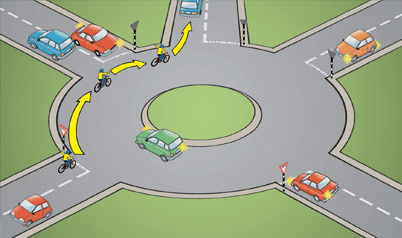 Marilyn was not at her all-forgiving best. She had been in an automobile accident just a few days before we left; she was still badly bruised and was sitting “on the wrong side of the car,” as one does in the UK, and watching cars driving in unfamiliar patterns and heading straight at her door. It was a tough first day. She proposed that we turn the car in and find another way of getting around. I agreed that I would, should it come to that, but I asked if we could try something else first.
 When, some years later, when she was diagnosed with cancer, we had the roundabout process to fall back on. We called our negotiation of the diagnostic marathon, “doing the roundabouts,” and we knew exactly what that meant. It meant an intimate and joint understanding of what we were doing and the full engagement of each of us in some necessary part of the task. And, best of all, we did it on purpose and we knew we were doing it on purpose.
 that lost in the conference finals and met in the locker room to look each other in the eye and vow to trust each other more, the couple that treats a defeat like that has laid the foundation for a successful season. Or a successful program. Or a tradition of winning. Years down the road, some new player will start blaming another for “having lost us the game.” And an older player—ANY older player in that program—will take him aside and say, “That’s not how we do it here.”
 , it functions to protect the staff and it protects the residents and that is why it is good.
 That is, the residents are treated alike because they all share they same status. They are “residents,” the status I stumbled into when I moved here. They are not treated differently because they are so different as persons. And this formal equality is played out as the staff [1] refers to each resident formally as Mr. or Mrs. or Ms. and we refer to them by their first names. There is a status asymmetry, in other words, that is presupposed by the culture and practiced by the staff.
 It’s really just the no tipping rule played out in most forms of face-to-face interaction. Tipping is a great idea in a restaurant because rewarding the staff for extraordinary service is built into the model and works to reward be best servers. There is a very good restaurant within a few blocks of Holladay Park Plaza where there is a superb waitress; I conspire to be seated at one of her tables. She is good at her job and has a great deal of fun in the process and I tip substantially to reflect how well pleased I am. That works just fine in the restaurant setting. It would be just awful at the retirement center.
 within the system, just as the occasional filching of towels from motels is not likely to cause the motel owners to hide all the towels. The behavior of these older residents is, in a sense, the cost of doing business. It is allowable so long as it doesn’t become common.
 The first question we might ask is, “Do you know how you feel?” You wouldn’t know it from reading introductory psychology texts, but emotions don’t come with discrete labels. You feel what you feel, of course, but when you get around to calling it something, you are in the same mess anyone else is. It isn’t quite like the Snickers ad that assures us the we aren’t quite ourselves when we are hungry, but I think the truth is off somewhere in that direction.
 furiously deny that it is true, we are left to our own incomprehensible, unsharable grief. I was told by someone I asked about it yesterday that it was “an arrogant thing to say to another.” [2]
 Here’s the argument. Trump has his heart set on authoritarian control of all the major institutions in the country, not just the political and economic ones. If we just sit back and let him do it, as some self-styled “voices of reason” counsel, we will lose our democratic system and may never get it back. [1]
 reading I have done, memories are not “accessed” in the way a filed document is; it is “recreated” each time. One thing that means is that although pulling a document out of a folder—either the paper kind or the electronic kind—doesn’t alter the document at all, recreating a “document” out of the elements of memory most certainly alters it.
 I describe it as a vision so that I can say what the vision was like. All of this is pure invention (except for the obvious debt it owes to Peter’s vision in Acts 10) but it enables me to say that something happened first and something after that, and so on. I say that I saw a great grey filing cabinet [1] coming down from the sky and a voice speaking to me. It might have begun, “Listen up, dummy.” Or not.
 And so on. 2a might be further divided into 2a-1 and 2a-2 by horizontal lines, but that is seldom needed and never very useful. There are, as you can easily see, four major parts to this “chapter;” the introduction and four substantive sections. The first section has seven subsections. The second section has 12, and so on. A, B, C, D provides the “outline” of the “chapter.” Subsections 1—7 provide the “outline” of Section A.
 The Dilettante's Dilemma