
I grew up at a very favored time in the U. S. We had fought and won a war against “the Axis powers.” We had a nuclear monopoly in the world. We were the last undamaged economy in the world and we rampaged through the world’s other economies, bringing order (based on U. S. interests) and predictability (based on commitments we could enforce) everywhere we went.
It was a very good time. [1]
 It is gone and it is not coming back. Politicians can promise that they will “fight for us,” and as long as we are feeling powerless to control our own economic destiny, that promise will be powerful. They are empty promises. We can no longer control our economic destiny and that is probably a good thing, however uncomfortable it makes us feel.
I want to reflect today on a New York Times article that is, in the narrow sense, “about” China’s domination of the solar panel market. Just a little more broadly, I would say it is really about economic nationalism, a “perversion of the market,” in which the state intervenes to shape the market in support of national goals. And finally, just a little more broadly than that, I would like to look at realistic American goals in a world economy in which China is the dominant power. [2]
Here are some reflections by Keith Bradsher’s Times article.
President Trump, who pressed President Xi Jinping of China on trade and other issues this week when they met at Mar-a-Lago in Palm Beach, Fla., has vowed to end what he calls China’s unfair business practices.
When I referred to politicians “promising to fight for us,” it is actions like this I had in mind, although Hillary’s rhetoric used the same emotional promises. What are we going to do, exactly, about “China’s unfair business practices?” There are no global economic institutions that can constrain China. Arguments made from classic market theories will not cause them to choose a lesser role than their resources could earn them. We are the coach yelling for a charging foul because we have found no way to keep the driver from free access to the basket.
 Consider what China has already done with solar panels. “China is now home,” Bradsher says, “to two thirds of the world’s solar production capacity.” That gets them a place at the table, wouldn’t you think? And, Bradsher continues, “because China also buys half of the world’s new solar panels, it now effectively controls the market.” I would think that would give them most of the other places at the table as well.
What does that mean for us? The Times piece chooses Russell Abney, of Perrysburg, Ohio as the poster boy for these effects. The Chinese government cut its subsidies to domestic buyers of solar panels; the manufactures cut their prices to compensate, and Mr. Abney is out of a job.
… Mr. Abney and about 450 other employees suddenly found themselves out of work. “Within just a few months, it all came crashing down,” Mr. Abney said. “It’s like a death in the family. People feel awkward talking about it.”
In Perrysburg, Mr. Abney lost his job at First Solar, the largest solar-panel manufacturer based in the United States, and looked in vain for a job in the auto industry in the Toledo area. He ended up taking a job three weeks ago at a building materials company in Lancaster, Pa.
That is a huge effect for a small market adjustment in China to have and it wasn’t just in the U. S. There were jobs lost in Germany as well. I think we have lost our sensitivity to this kind of effect because we have been more often the actor than the patient. [3] We are accustomed, in other words, to looking at a specific business decision we made—like China’s decision to cut subsidies to customers—and justifying it by the outcomes for us. We are looking now at that same decision being made by someone else, with unpredictable consequences for us, and no way to square it with our traditional notions of national autonomy.
The case for Chinese capacity in the new global market gets a great deal more extensive and I want to at least bow in that direction, but in dealing just with solar panels, I have laid the foundation for some questions about domestic politics in America.
The nationalists—whether progressive or conservative—are going to make their pitch to  voters on the basis of what we will have to do to “govern ourselves once more” or to “take control of our own destiny” or even “to return America to the leadership we once had.” I haven’t even begun to cover the slogans, and in my list, I restricted myself to only positive images. If you include avoiding negative outcomes—like “Better Red than Dead”—you can make a much bigger list.
The globalists—whether progressive or conservative—are going to say that the world is a certain way and that pretending it is not is only prolonging a fantasy. We can be very successful niche players, these globalists will say, and make a lot of money and continue our tradition as an independent nation. Or we can waste a lot of money trying to pretend that we dominate the economic and political systems the way we did after World War II—and fail anyway.
 The nationalists will call the globalists, “defeatist.” The globalists will call the nationalists “delusional.” What I want to know is what the voters will call these two “parties.”
In Robert Reich’s excellent book Aftershock, he imagines that Margaret Jones wins the presidency in the 2020 election. [4] Here are a few elements of her platform:
- increased tariffs on all imports
- a ban on American companies moving their operations to another country or outsourcing abroad
- a prohibition on foreign “sovereign wealth funds” investing in the United States.
America will:
- withdraw from the United Nations, the World Trade Organization, the World Bank, and the International Monetary Fund.
- end all “involvements” on foreign countries
- refuse to pay any more interest on our debt to China, essentially defaulting on it, and,
- stop trading with China unless China freely floats its currency.
Or, as President-elect Jones says as she hits the climax of her acceptance speech, “A nation of good jobs and good wages for anyone willing to work hard! Our nation! America for Americans!” (Thunderous applause).
President-elect Jones’s speech came to mind as I reviewed the coming conflict between the nationalists—like Margaret Jones and Donald Trump—and the globalists, like George H. W. Bush, Bill Clinton, George W. Bush, and Barack Obama. If the average per capita income in the United States continues to decline for middle class families, it is hard to see a globalist getting elected. In the chart below, look at the trend lines below $50,000,
One more point about China.
But economists and business groups warn that China’s industrial ambitions have entered a new, far-reaching phase. With its deep government pockets, growing technical sophistication and a comprehensive plan to free itself from dependence on foreign companies, China aims to become dominant in industries of the future like renewable energy, big data and self-driving cars.
Solar panels are, in other words, China’s off-Broadway production. They have a model—I called it “economic nationalism” earlier—and the resources to put that model into operation in ways that far outstrip Japan’s efforts in the 1990s. With that much money and that much power and that many customers and that many producers, what global industry could they not dominate if they chose to?
 If this is the wave of the future, economically, how can the American voters prepare to vote their own economic self-interest in national elections? How can they learn to respond to the globalist message when there is no hope in it for them and no way back to American global dominance?
Can these Americans learn to prefer actual prosperity based on being a part of a well-functioning global system, to promises of a return to former glory? We didn’t in 2016. Maybe we will have another chance in 2020.
[1] And I’m not even considering the post-war social conservatism which was very favorable to men. I didn’t know at the time that I was living in a little androcentric bubble; I thought that’s just how things had always been.
[2] In choosing that focus, I am not saying that China now is that dominant power, but China is following the 1990s path used so successfully by Japan, except they are bringing a huge population and huge resource base to the project. If they can continue to buy off their internal dissenters, I don’t see what stands in their way. Certainly, it is not us.
[3[ I know that “patient” looks odd there, but I wanted to imply passivity and also to imply suffering and both of those words derive from a Latin verb meaning “to suffer.” So I am granting myself a little poetic license.
[4] The subtitle of Reich’s book is “The next economy and America’s future.” See page 79 for the platform of the “Independence Party.” Reich’s vision is so compelling that I forgive him for predicting it four years too late. In this fantasy, Jones defeats the Republican candidate, George P. Bush and the Democratic candidate Chelsea Clinton.
 one thing evokes which attached it to another. Of course, associations—plausible but mistaken associations—are the root of a great deal of humor. Advertising for mattresses, for instance, is full of references that could be taken to refer to the mattress or to what one might enjoy doing on the mattress. They count on you to associate the one meaning with the other and nearly everyone does.
 I have seen that story set in Revolutionary War times and in Civil War times, but either setting presupposes the line of soldiers with muskets or rifles standing in the way of an attacking army and refusing to retreat. “They stood there,” ran one account I saw, “like they had tar on their heels.” The Tar Heels had the courage to “stand their ground,” a term that makes perfect sense on the battlefield. [2]
 down the street yesterday when I passed a car with a North Carolina plate. It said, like this one, “First in Flight.” At that point, my mind handed me a meaning of Tar Heel I had never had before. Thank you, mind. It pointed out to me that “Tar Heel” means “Last in Flight.” That’s a very good thing if you are talking about the behavior of soldiers in battle. So I started smiling and have hardly stopped. When I was still chuckling about it this morning, I thought I would share it.
 No one questions the speaker’s qualifications to speak on the assigned topic, but he is a member of an organization (the Presbyterian Church of America) which is more conservative than the Presbyterian Church USA, the home denomination of Princeton Seminary and the PCA is a great deal more conservative than the faculty and students at the Seminary itself.
 l beyond our initial expectations, many gentiles have responded positively. We could treat their interest as an occasion for “harassing them” [2]. We could see how sincere they are by putting obstacles in their way. We could cast aspersions on some other aspect of their way of life or their associations. But wait, James says, let’s not do that. They are turning to God. Let’s refuse to throw obstacles in their way.
 The expression “identity theology” is new to me, but it is an idea I have seen in practice for a long time. Sometimes, when I get sloppy, I see it in my own practice so I am not pointing fingers as a mere spectator might. I ran across this idea first in C. S. Lewis’s The Screwtape Letters, the premise of which is that Screwtape, a very senior devil, is giving advice to his pupil, Wormwood, about how to damn human souls. [4] This passage is from Letter 25.
 Some years ago, I read a fascinating review of Chariots of Fire by Ted Mahar, who reviewed movies for The Oregonian at the time. “You’re really going to like this movie,” he said, as I recall it. “You’re going to to talk to your friends and they are going to ask you what the movie was about. And at that moment, you are going to begin to struggle. What was it about, really? You know you liked it, but what was it about?”
 Last Word. Embedded in the story of Harriet Lawler, a wealthy and talented bully, who lacks only a compassionately written obituary to support her declaration that her life a success, is the inspiring story of Anne Sherman, the girl she picks on to write the obituary.
 Fourth, I survey the characters who are now “minor characters” in this movie, Life for the Taking. That would include MacLaine, who is the major character in The Last Word. In this new movie, MacLaine is important only as she bears on the odyssey of Anne Sherman. In what way did each of these characters contribute to the main theme? What depth did they add? What tension? How did each help define this plot? Here are two of the main characters of one of the movies you can see in Lone Star.
 John maintains, is beautifully illustrated in The Matrix. When Neo, who is thought to be “the One,” is reunited with his body, which has spent all his previous years immersed in a tub of goo, he wonders, “Why do my eyes hurt?” Morpheus has to tell him, “Because you’ve never used them before.”
 So think about that a minute while I tell you about birdwatching. Most of the time when you are looking at a bird through binoculars, you have some idea of what it is and a broader notion of what it might be. And rather than just “seeing what is there,” you find that your mind offers you one plausible rendition after another after another. If it ought to have a yellow throat, for instance your eye will choose the yellow of a flower from the background and “place it” onto the throat so that you have a momentary glimpse of the bird with the yellow throat. And you have to be patient and disciplined to see whether the yellow you saw on the throat—you really did see that—actually IS on the throat.
 I’m guessing about the neurological strategies involved here, but I think I saw the woman’s hand being held up at what, you will agree, is an odd angle unless you see that she is holding onto a strap. Which I did not see. I could have, but I didn’t.
 MacLaine’s character, Harriet Lawler, is a thoroughly unpleasant person. She has no respect at all for personal boundaries and respects no one at all—including her former husband and a woman who could probably be best characterized as her former daughter. She is very bright, very aggressive, and very rich so there isn’t a lot she can’t do just by wanting to.
 Now I would like to say what is right with Harriet’s approach and to do that, I want to step back a little and talk about the Bible. There are people who think of the Bible as a kind of rule book, every piece of which means whatever the King James Version says it means and every piece of which is applicable to me. There is so much wrong with that approach that it is hard to confine myself to just one criticism. But I will.
 Anne is severely risk averse. She want’s to be a writer, but the very limited range of life experiences she has chosen confine her writing to that of an idealistic little girl. She has chosen a safe little occupation to support her while she “becomes a writer.” She withholds her heart from life-changing romantic involvements for the same reason. She has never gone to Andalusia, here dream vacation, for the same reason.
 Here’s an example that caught my attention recently. This was is a local neighborhood paper in Portland, in the neighborhood where Bette and I lived before we moved across the river to a different Congressional district.
 My kids used to like it when we read Mrs. Piggle Wiggle stories. I never understood why. The children were always wrong in these stories. One they particularly liked was the “Thought You Saiders Cure,” in which the children keep “creatively mishearing” what is said. [1]

 most likely to be overlooked, aspects of Psalm 23. First, it was written by a sheep. We will need an adjective or two here, so let me offer ovine (sheep-like) and pastoral (shepherd-like) as the most useful.
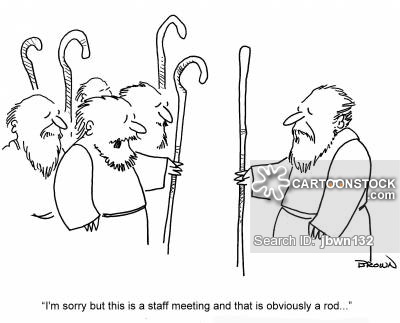 Any shepherd knows what any pastor knows: those under his care are often willful. They want what they want. Very often, they pursue what they want without reference to the dangers to themselves or to the rest of the flock. The shepherd, seeing that, would do what needs to be done. Apart from more spiritual considerations, these sheep are the source of the milk and meat and wool he relies on for his living. So what might he do?
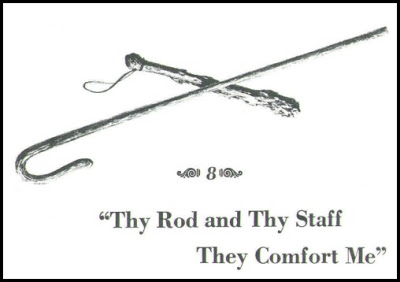 where its owner wants to prevent it from going—that makes perfect sense. I might go so far as to say that it comforts the shepherd. It does not comfort the sheep.
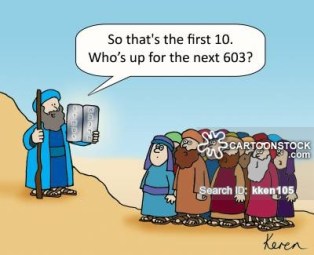 know the experience. So here we have Moses anticipating the 613 mitzvot by starting off with a very general 10. Good luck, Moses.
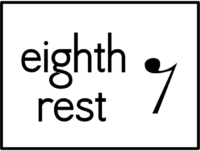 So I had the two indicators of the intention of the composer that I have had before, but this time I had a third. As we practiced it yesterday, for instance, I noticed that he—as a singer, but knowing what he knows about the piece—treated rests of identical length differently. We are considering a measure with four beats, the last of which is half a beat—an eighth rest.
 how to treat the printed score are better if they are available. Best is standing next to someone who is singing it the way it ought to be sung. It amounts to an inversion of authorities. Ordinarily, I sing next to my friend Jim, and we have an active and friendly relationship as colleagues. If I hold the note over into the rest or don’t quite get up to the G# or get confused at where I go after the first ending, Jim feels free to help me get it right and I do the same for him. But in those cases, each of us is relying on the music—on how it is written [5]—and judging our performance by our fidelity to it.
 (see pod with inhabitants) what he means by “food” is “something with ingredients your grandmother could pronounce.” He is opposing every instance of synthetically “enhanced” foods, foods that are stuffed with flavor enhancers and preservatives. It’s a readily identifiable meaning of “natural,” of course, the the prominence of the notion, the jihad-like dimensions [1] of the “natural food” movement are a reaction to the overwhelming artificiality of the American diet.
 Tantrums are natural. Tit for tat is natural. Holding grievances is natural. Lashing out in anger is natural. Doing loving things at the time you feel loving is natural. None of those things builds the kind of marriage Johansson might have wanted and that Bette and I most certainly want. We don’t want a marriage that is “natural.” We want a marriage that goes way beyond natural and heads in the direction of wonderful and satisfying and nourishing to the soul. “Natural” pales by comparison to what you can have if you are willing to put in the work.
 I’m not really sure we can say, as a matter of careful secular [3] observation that humans “have” a nature at all. This whole matter of Hobbes v. Rousseau is replayed on a much smaller stage by psychologists. On the one side, we have psychologists who describe people as having stable “traits;” and on the other hand, psychologists who think that other things, things outside us, determine what we think and how we feel and what we do.
 And, finally, “the carnal [of the flesh] mind is an enemy of God and cannot please God; the spiritual mind, on the other hand, is “life and peace.”
 The Dilettante's Dilemma