
When I first began to formulate the metaphor of victory laps in 1977 (much more later), my wife, Donnie, and our children—then 16, 14, and 12—were living in New Wilmington, Pennsylvania on a little circle of houses kept for new faculty at Westminster College.
The Original Victory Laps
The first approach to the notion of a “victory lap” was no more than self-talk. Part of my life at this period was running 34 (and change) miles a week every week for a year. [1] That wouldn’t really have been so bad, but things happen. I took a couple weeks off for a backpacking trip in the Rockies—and none of those miles counted—and then I got sick a time or two. By the spring of 1977, I was several hundred miles behind and looking for any way at all to pad my total.
It turned out that New Faculty Circle was half a mile around, if you start and end at 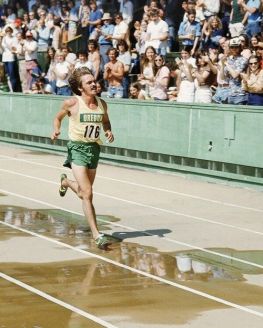 our house, so after every run, I would add that extra half mile. I called them “victory laps” after all the victory laps I had seen superb runners like Steve Prefontaine take at Hayward Field in Eugene. [2] And that’s all there was to it at first.
But running distances is an intensively mental activity and after a while I noticed that my body didn’t feel the same when I was running that “extra” half mile as it felt during the “real” miles. There was a 19 mile run I used to do, for instance and I remember coming down the hill to my house in real distress; cramps or blisters or a side stitch or a headache or something. But when I started the extra half mile, those feelings went away. That helped substantiate the notion of “victory lap.” It was a celebration lap. A “victory” not over any competitor, but over my pain barrier and my tiredness.
That was a very carefully phrased sentence, I hope you noticed. I didn’t say that in that half mile the blisters healed themselves. I said the feelings went away. Did I just stop paying attention to them? Was there something about the gentle grades of that last half that didn’t aggravate them? Running pains of various kinds seems to have a wave character and the come and go, even as the condition that produces them stays the same. I have no idea what the truth was. What I cared about was that the extra half mile was ordinarily pain-free and took on a celebratory cast.
The Victory Lap Metaphor
I was about 20 when I met Donnie and we were together for 20 years, roughly, and I began to move toward imagining that if I lived to be 80, I would have “run” four 20 year “laps.” Life as mile race, where every lap was 20 years long. The proverb that runs, “The days of a man are fourscore and ten/or by reason of strength, fourscore” has been familiar to me nearly all my life. I think that accounts, in part, for my early attraction to 80.
The timing has gotten a little ragged since age 40, but Marilyn and I were together for] nearly 24 years and by the time I reach 80, Bette and I will have been together for 12 years. [3] It’s not a perfect division, but it’s good enough for me and it raises the question, “What is a “victory lap” after you have run all four of the two-decade laps and have turned 80.
Getting Serious About Application
I honestly don’t know. I have memories that that was the time the pain went away or at least that it stopped bothering me. I have the notion of a little extra running to celebrate that the “real” running is done for the day. I have the sense that during many of those victory laps, I let my mind range back over the run, celebrating the best parts, reconsidering the pace I had chosen for the hills, building a new strategy for the next run.
And then, just a few days ago, something really heart-warming happened. I got a letter from Donnie, who really understands the “victory lap” metaphor because she was there at the time. [4] She ended her note to me with this:
“However, in my heart and my mind, I will always…want you to know I care enormously about your “victory laps.”
 This is Britain Lake, by the way. The faculty circle loop is just to the right.
I loved that warm thought and it made me think that maybe it’s time I get to work deciding what the victory laps will mean to me in their new metaphorical clothes. The original “victory lap” was a time of physical relief. It’s hard to be against that. It was a time of critical assessment of “the run.” [5] That seems worth doing in both the immediate sense of the run just concluded and also in the more general sense of strategy for that course. It was a time of celebration. However that particular day went, I had completed the run that day and I picked up a certain number of miles against my accumulated deficit. I think I like that one too.
Those three, at least, ought to make up my present day about-to-turn-80 victory laps. If I called them Celebration, Physical relief, and Assessment, I could say I am working on my CPA. Probably I wouldn’t want to say it very often.
Celebration of completing the eighth decade certainly ought not to be a problem. At the very least, I could celebrate not having died yet and on beyond that, I have, in fact, had moments that I can recall with real pleasure and I could celebrate those. I could celebrate them as many old people do by telling stories about them.
Physical relief is going to be the hardest one to apply metaphorically. There are two reasons for that. The first is that over a long life, I have associated strenuous exercise with virtue and avoiding it with vice. If I have no more to guide me than “If it doesn’t feel good, don’t do it,” that is going to require an adjustment. What happens to all that virtue foregone; all that vice avoided?
The second is that if things like a good soak in a hot tub feel good, I have the time  and right downstairs by the pool is the hot tub. I do have one new trick about physical relief. My body has felt bad in a lot of different ways over the years and I am familiar with those ways. I am capable, now, of getting up in the morning and actually experience the “not hurting” of a joint or a muscle. That is something I never experienced at all at the time I was running the 1776 project.
Assessment will be the easiest one. I do that anyway. What has worked on this course? Where have I too often failed to pick up a challenge that would have benefitted me later? When have I overestimated my energy and spent too much too early? Those are all very physical question in the original scenario but they are provocative prompts in the new one. Good answers to those questions could shape my life going forward.
But what is a lap?
That leaves the question of what a “lap” is—not what it is for (we’ve just established that) but how long it is.I’m inclined, at the moment, to make the lap a season. That would give me four of them a year, rather than four of them in eighty years. It would orient me outward toward the natural world, rather than inward as “quarterly” would. And the notion of “season” as a metaphor for part of a life is already well established. [6] New Wilmington is surrounded by Amish farms, so sights like this one (this stretch looks very familiar, so I think it was part of this run) were common.
 And I think I will start with winter. Winter will begin five days after my birthday. That doesn’t seem too long to wait. And my brother John, who has greatly enriched my appreciation of seasons, begins his survey [7] with winter on the grounds that it is the simplest. Productivity has shut down and “life” is resting—unless it is trying to find a way to live through the winter—and the whole cycle is getting ready to begin again.
Also, the church year begins in the winter with Advent. There is no historical reason for placing the birth of Jesus in winter, but the church has done it for a very long time now and I began accepting it long before I had any idea how arbitrary it was. Besides, now that I think about it, Advent is the time when Christians reflect on the many scriptures that, in retrospect, point definitively to Jesus’s birth. These scriptures are very much like my reflection, at the end of the run where, looking back, everything seems clearer.
Now if you will excuse me, I need to finish this lap so I can get the celebration started.
[1] I know it sounds odd, but I had signed up for a National Joggers Association project which called on members to run 1776 miles between the 4th of July 1976 and the 4th of July 1977. It was to be a celebration of the bicentennial.
[2] Of course, Prefontaine’s victory laps marked the races where he came in first. Mine marked training runs where I managed to come it at all
[3] I will be 80 on December 16 this year and Bette and I will have been married for 12 years on the 28th, less than two weeks later.
[4] Although I have to say that my kids were there at the time too, and they just hate the victory lap metaphor. Nothing I have ever said to them has moved them off the notion that “finishing the race” is just a metaphor for death. It is heartwarming that they don’t want me to die, of course, but it would be nice if they would take the metaphor in the way I mean it. I am a teacher, after all, as well as a father.
[5] The quotation marks there indicate a small complexity. “The run” includes the most recent run over a particular course, but it also includes “my strategy on that particular course” generally. I might conclude that I take that long uphill toward the cheese plant too fast and pay for it for the next several miles. In that way it is a more general reflection of “the best way to manage that course,” not just how I did on that course today.
[6] I am thinking, certainly, of Daniel Levinson’s The Seasons of a Man’s Life and probably also Archibald McLeish’s summary, in which he refers to autumn as “the human season.”
[7] See John Hess, A Perfectly Ordinary Paradise (the working title), forthcoming.

 good at it or who had gotten good at it. But good people or no, the ceremony itself is aimed at making people feel welcome because it is a library. They conveyed the attitude that a library is a special place. That’s where the illusion of the curtsying came from. Welcome to this special place. We do knowledge here. We are so glad you have come to spend some time sharing this pursuit with us.
 We’ll look first at the situation as Levitin describes it; then at the alternatives as they seemed to him at first. Then, finally, how he escaped that trap and how those familiar and bad options turned themselves inside out and gave him some new choices.
 indicated above, the decision situation derives directly from things you aren’t aware of at the time. “The situation” is concocted of stories you have heard, movies you have seen, arguments you have had, your own attitude toward yourself, your self-confidence or the lack of it. So the set of options—should I shoot or not if it comes down to that—seems very present. It seems clear. And it should seem clear. These are all things you are experiencing.
 I like this story because Levitin escaped from the trap that his gun laid for him. Suddenly another question became available to him Am I prepared to kill another human being just to protect all this stuff? Of course not. In that form, he rejected it instantly.
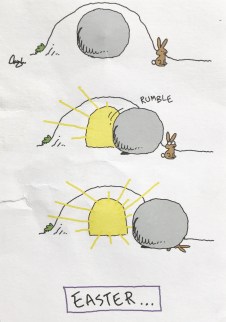 ry to understand why an Easter card has meant so much to me over the years. It first meant something to me because it was sent to me by my niece, Lisa Hess, in the confident expectation that she and I found the same kinds of things to be funny. Boy was she right about that!
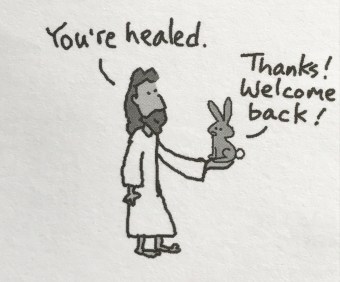 . Welcome back.” For me, this is where the funny starts.
 artist didn’t have a candidate in mind. For myself, I think maybe “the natural order.” The relationship of God’s followers to the natural order has been contentious to say the least. Those drawing from Genesis get to choose between God’s command that we “dominate” and “subdue” nature or that we “care for it” as a steward cares for his master’s property. Quite a difference.
 wrestling with it. I haven’t either. Dad was in a great deal more contact with “resurrection” than any casually orthodox Christian would have been. I think Dad knew the Resurrection about as well as Jacob knew the angel he wrestled with and for most of the same reasons.
 have any trouble with that particular clause, but there were clauses that troubled him a good deal and he didn’t say those clauses. The effect was like a radio with a loose connection and some clauses would be easily audible, then some silence, then another audible phrase.
 is probably about right—I tried to understand the essential “truths” of the Christian faith in a way that made sense. I was free, as Dad was not, to mess around with the questions and that is how I was able to come up with “answers” that fit the questions better. Like Captain Kirk, subverting the Kobayashi Maru exercise, I have felt free to reprogram the computer and manage not to die.
 ear. Of the socks I show you here, one of the tapes is still clear, as Dad had been. And one is blank, the identity has come off, as Dad became. And I think about that when I put on the one sock; then the other.
 Let’s get the invidious comparisons out of the way right here at the beginning. McKenna Grace is much cuter than Matt Damon has ever been. OK, having said that, Good Will Hunting is a much richer movie than Gifted. Both explore the dilemma faced by a brilliant kid who wants to life a normal life. Matt Damon plays a punk from South Boston; McKenna Grace plays Mary, a little girl with no social skills whatsoever (no friends either) being raised by her uncle in Florida.
 had read the synopsis and seen a preview. But I also knew that sitting there in my chair in the theater, I could see any number of other movies. It occurred to me when we went in that I might be about to see a movie about a “gifted” uncle, who is raising a little mathematically precocious girl in pretty casual circumstances in Florida. I was ready to see that movie and it would have been a really good movie. I might see that movie when I go back to see Gifted again. I could call it The Gifted Uncle.
 g. But if the climax of the movie is Frank’s slamming the document down on the desk in front of his unbelieving mother, then his doing nothing about that document all through the movie is enormously meaningful. You just don’t realize it at the time.
 I have no way of knowing, of course, what movie you will see when you go to see Gifted. You may want to go back and see Good Will Hunting again. I did. You may attach the principal meaning to the mother and the relationships she has had with her husband, her son (Frank) and her daughter, Mary’s mother. This particular movie is about her relationship with her granddaughter, but Evelyn is a “one interest at at time” sort of person. “Very English,” says her continent son Frank, and there is no reason you can’t just give yourself permission to see the story that stars her and her aspirations, if that is the one you want to see.
 It is gone and it is not coming back. Politicians can promise that they will “fight for us,” and as long as we are feeling powerless to control our own economic destiny, that promise will be powerful. They are empty promises. We can no longer control our economic destiny and that is probably a good thing, however uncomfortable it makes us feel.
 Consider what China has already done with solar panels. “China is now home,” Bradsher says, “to two thirds of the world’s solar production capacity.” That gets them a place at the table, wouldn’t you think? And, Bradsher continues, “because China also buys half of the world’s new solar panels, it now effectively controls the market.” I would think that would give them most of the other places at the table as well.
 voters on the basis of what we will have to do to “govern ourselves once more” or to “take control of our own destiny” or even “to return America to the leadership we once had.” I haven’t even begun to cover the slogans, and in my list, I restricted myself to only positive images. If you include avoiding negative outcomes—like “Better Red than Dead”—you can make a much bigger list.
 The nationalists will call the globalists, “defeatist.” The globalists will call the nationalists “delusional.” What I want to know is what the voters will call these two “parties.”
 If this is the wave of the future, economically, how can the American voters prepare to vote their own economic self-interest in national elections? How can they learn to respond to the globalist message when there is no hope in it for them and no way back to American global dominance?
 one thing evokes which attached it to another. Of course, associations—plausible but mistaken associations—are the root of a great deal of humor. Advertising for mattresses, for instance, is full of references that could be taken to refer to the mattress or to what one might enjoy doing on the mattress. They count on you to associate the one meaning with the other and nearly everyone does.
 I have seen that story set in Revolutionary War times and in Civil War times, but either setting presupposes the line of soldiers with muskets or rifles standing in the way of an attacking army and refusing to retreat. “They stood there,” ran one account I saw, “like they had tar on their heels.” The Tar Heels had the courage to “stand their ground,” a term that makes perfect sense on the battlefield. [2]
 down the street yesterday when I passed a car with a North Carolina plate. It said, like this one, “First in Flight.” At that point, my mind handed me a meaning of Tar Heel I had never had before. Thank you, mind. It pointed out to me that “Tar Heel” means “Last in Flight.” That’s a very good thing if you are talking about the behavior of soldiers in battle. So I started smiling and have hardly stopped. When I was still chuckling about it this morning, I thought I would share it.
 No one questions the speaker’s qualifications to speak on the assigned topic, but he is a member of an organization (the Presbyterian Church of America) which is more conservative than the Presbyterian Church USA, the home denomination of Princeton Seminary and the PCA is a great deal more conservative than the faculty and students at the Seminary itself.
 l beyond our initial expectations, many gentiles have responded positively. We could treat their interest as an occasion for “harassing them” [2]. We could see how sincere they are by putting obstacles in their way. We could cast aspersions on some other aspect of their way of life or their associations. But wait, James says, let’s not do that. They are turning to God. Let’s refuse to throw obstacles in their way.
 The expression “identity theology” is new to me, but it is an idea I have seen in practice for a long time. Sometimes, when I get sloppy, I see it in my own practice so I am not pointing fingers as a mere spectator might. I ran across this idea first in C. S. Lewis’s The Screwtape Letters, the premise of which is that Screwtape, a very senior devil, is giving advice to his pupil, Wormwood, about how to damn human souls. [4] This passage is from Letter 25.
 Some years ago, I read a fascinating review of Chariots of Fire by Ted Mahar, who reviewed movies for The Oregonian at the time. “You’re really going to like this movie,” he said, as I recall it. “You’re going to to talk to your friends and they are going to ask you what the movie was about. And at that moment, you are going to begin to struggle. What was it about, really? You know you liked it, but what was it about?”
 Last Word. Embedded in the story of Harriet Lawler, a wealthy and talented bully, who lacks only a compassionately written obituary to support her declaration that her life a success, is the inspiring story of Anne Sherman, the girl she picks on to write the obituary.
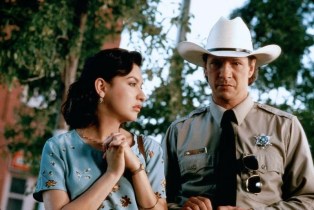 Fourth, I survey the characters who are now “minor characters” in this movie, Life for the Taking. That would include MacLaine, who is the major character in The Last Word. In this new movie, MacLaine is important only as she bears on the odyssey of Anne Sherman. In what way did each of these characters contribute to the main theme? What depth did they add? What tension? How did each help define this plot? Here are two of the main characters of one of the movies you can see in Lone Star.
 John maintains, is beautifully illustrated in The Matrix. When Neo, who is thought to be “the One,” is reunited with his body, which has spent all his previous years immersed in a tub of goo, he wonders, “Why do my eyes hurt?” Morpheus has to tell him, “Because you’ve never used them before.”
