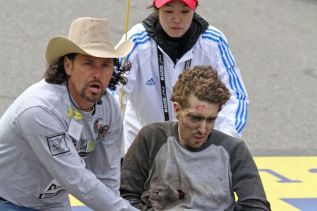
I was “only joking”

The serious work to be done in this essay is a consideration of what the word “only” contributes to the expression, “I was only joking.” This is something that might be said by someone who has just been reproved for passing along the scandalous “Pizza-gate” allegations about Hillary Rodham Clinton. In such a context, what function is performed by the modifier “only?”

But let’s begin with a lovely and completely fictional meadow.

There is a well-worm path in a meadow I am calling up in my mind. In the future, I suppose it will become a road and then maybe a turnpike, but for now it is just a footpath. But before it was a footpath, it was just an unusually flat section in the meadow—a sort of crease leading to the nearby woods.

Did I mention that I am making all this up?

And then, over the years, ninety-nine people walked along this soon-to-be-a path part of joking 1the meadow. The first 33 were headed to the woods to cut firewood and bring it back home by the armload. The second 33 were all a man named Per [1] who was sneaking off to meet Par [2], a beautiful Persian girl whom Per’s parents would like him to avoid. The third set of 33 trips were taken by a physicist deep in thought. She found the predictable walk to the woods and back…oh…restful. It cleared her mind to work on the space-time continuum.

OK, that’s just a little story I made up. Now, let’s get serious and talk about neurons. This picture represents a bunch of neurons that have never recorded any experience at all. They are as unspoiled as the never-before-walked-upon meadow.

OK, that’s just a little story I made up. Now, let’s get serious and talk about neurons. This picture represents a bunch of neurons that have never recorded any experience at all. They are as unspoiled as the never-before-walked-upon meadow.

Then it—your neural system— sees a letter H. And these 64 neurons ready themselves to fire. Sixteen are actually activated and the neurological infrastructure of your experience of the letter H is encoded there—but only for an instant.

And it leaves only this. The very faintest path, which encodes the memory of once having seen an H. Look again. Make sure you can see the faint trace.

The next time you see an H only a few of the neurons notice—let’s say the first one to notice was the one in column 3 and row 3, below—and that one triggers the activity in the rest of the trail. So the pattern of activation goes from the diagram in A to the diagram in B.
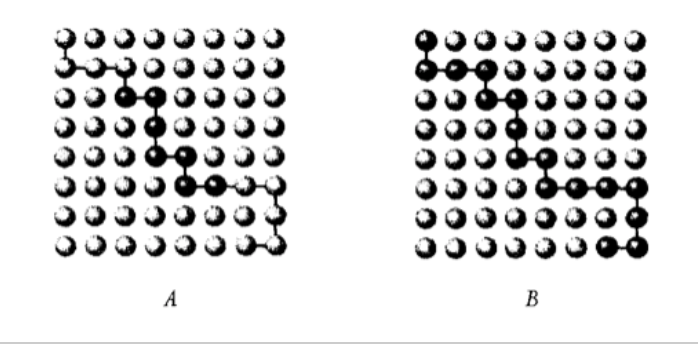
This storage scheme, the brainchild of psychologist Donald Hebb, is a powerhouse. Hebb proposed the mechanism a few years after World War II. Only within the past fifteen years, however, did researchers explore its mathematical premises and build large-scale computer models of Hebbian learning. Both endeavors—the mathematical insights and their implementation in computer simulations—have illuminated quite a few of the mysteries about why people think and feel the way they do. [4]

Every presentation of an H works the same way so far as these neurons are concerned and since they are the source of what you see, what they think is what matters for what you think. A prankster holding up a sign with an H on it, along with the text, “THIS IS NOT AN H” works. A legal citation to Section H, in HR 2243, works. A sign created to tell a school child what the eighth letter of the alphabet is, works.

The point? Everything that activates that path of neurons makes it stronger and more stable and more likely to override other patterns of neurons which might, in any given instance, be more nearly correct. The twentieth time you receive a stimulus, for instance, it might actually be an A. By that time, it doesn’t matter. You are primed to see H’s and that’s what you will see.

Does anything sound political yet? The neurological trace—now nearly a rut—winds up looking like this.
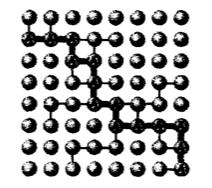
Solid looking, isn’t it? It is as solid-looking as an established footpath through a meadow. These neurons are like those blades of grass. The grass doesn’t care whether the shoes were being worn by the firewood carriers or the assignation keepers or the peripatetic theorizers. Every step that abrades the grass, thereby creating the path, makes makes every other user more likely to use the same path. And that is why it might be a turnpike one day.

During the 2016 election, I heard references to bizarre allegations that Hillary Clinton was running a child sex ring from a Washington area pizza parlor. I did not know until I read Benedict Carey’s piece]that those allegations were called “Pizza-gate.”

Here’s how that works. Some Hillary-hater devises the Pizza-gate scandal and posts it on Facebook. A thousand other Hillary-haters drink it down and believe every word. Eventually, one of that thousand, who has a Democratic friend or maybe just an academic friend, passes the Pizza-gate piece to someone who is outraged by it. This Hillary-lover passes the fake news story on to her friends along with a scathing commentary. Half of the people who get it from the Hillary lover think it is a spoof and one of the best “social media outrages” of the day and pass it along in a lighthearted way to other people who also don’t take social media seriously.

So here’s the thing. Every one of those people is walking along the same path. The dots go Hillary—Pizzagate—Sex scandal. And those neurons wake up the rest of the neurons in the chain. Connecting those neurons out of malice strengthens the connection. Connecting them as a fun media outrage strengthens them. Fulminating against them and demonstrating that they are false and malicious—STRENGTHENS THEM.

What to do? I really don’t know. I am distraught.

Refuting Falsehood

I’ve always been a fan of refutation. Refutation seems the best choice for falsehood. This has been said to be true, but it has been decisively refuted. We now know that it is not true.

My friend David Rawson and I once taught an interdisciplinary introduction to the social sciences. We arranged a model experiment for them. For our purposes, it was about where “men in general” carried their pocket handkerchiefs. To help engage the students, we agreed on a sampling rule for “men in general,” on on how the sample would be drawn and how big it had to be, and what level the findings had to be before either of us would be declared the winner.

So we ran the experiment exactly as we had planned it and one of us was declared the winner (I was) and the other hypothesis, which sounded entirely reasonable in the abstract, was declared to have been refuted. That’s what I like and what I am used to.

But Pizza-gate can’t be “refuted” if every attempt to spread it and every attempt to refute it work to strengthen the neurological connection. In fact, “refute” doesn’t really mean anything under those circumstances.

Shaming the Local Gossips

Back in the old days, the spread of information was slow enough and personal enough that lies could be nailed. “Oh, you got that from Harold? Then just ignore it. Harold makes up the truths he thinks will sell best.” Only the word “that” in that formulation refers at all to what Harold said. That story is now cast away and future stories made more doubtful because they came from Harold. Harold pays a price in this story for being the origin of or the purveyor of inaccuracies. If the price is high enough and he has to pay it often enough, he will stop if he is able.

Not any more

So back then, being the source of stories that turned out not to be true could really cost you something. Even passing along stories from notoriously unreliable sources could cost you something—but not as much. Now, by contrast, it costs the source of a defamatory and completely untrue story nothing at all. Whoever invented Pizza-gate, the story that Hillary was running a child sex ring from a Washington area pizza parlor, probably had a wonderful timing inventing it and posting it. It cost him nothing to do it.

If we were able to track down the person who did it, it would still cost nothing and if here were prosecuted, he would achieve hero status in the political tribe he belongs to. Needless to say, it cost the people who passed it along nothing. They could have stopped and checked to see if it were true—and in the small town of my example, someone might have—but stopping to check if something is true really does cost something. And no one expects a user of social media to stop and check whether a story is true before forwarding it to friends. Especially if you really hope it is true.

Wouldn’t it be just wonderful, this person might say, if Hillary were running a sex scam out of a pizza joint in Washington? I’m going to pass the story along to you so you can share with me the sheer joy of baseless malevolence. It costs me something to check on the factuality—and I don’t really care—and it costs me nothing to be found to be passing long false and malicious rumors.

The accusation of “only”

And that is what the “only” means in “I was only kidding.” I thought this was funny and I am passing it along to you because you will think it is funny too—and no consequences we care about will happen as a result of this “joke.”

And that might be true. Trust in the social institutions and political leaders that make a republic possible will be reduced. A reputation will be freighted with charges that do not pertain to her at all and that no one actually believes to be true. The insularity of the social network that passes these horrific stories around for the fun of it will be increased.

And yet, the accusation of the “only” in “only joking” might really be apt. Those really might be consequences you don’t care about.

[1] Short for Peregrine, it turns out. The traveler. So, technically speaking, these trips were peregrinations.
[2] Short for Parveneh. A Persian name, I was told by a friend who has that same name.
[3] This kind of activation and storage has been called Hebbian Learning, after Donald Hebb, in the 1940s. The instruments needed to verify it did not come along for decades but when the studies were done, they confirmed Hebbs’ theories.
[4] The diagrams and nearly all the analysis have been taken from a marvelous book called A General Theory of Love, by Thomas Lewis, Fari Amini, and Richard Lannon.
 

Posted in Uncategorized | Leave a comment

We are running out of umpires

I first ran into what Rush Limbaugh calls “trans-partisan authorities” in the form of “trans-racial authorities.” In was in the late 1960s and a very angry black man was telling me how things really were. He said that segregation was perfectly legal. I said it was not and cited a decision by the U. S. Supreme Court. Who says?” he asked. “The Supreme Court,” I answered. “Your Supreme Court,” he replied.

Hm.. MY Supreme Court. I had never heard that before and had no idea at all how to respond to it.

Recently, David Roberts wrote a piece in Vox called “Donald Trump and the Rise of Tribal Epistemology.” [1] He says this:

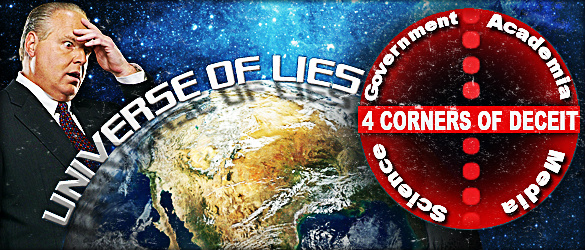
In Limbaugh’s view, the core institutions and norms of American democracy have been irredeemably corrupted by an alien enemy. Their claims to transpartisan authority — authority that applies equally to all political factions and parties — are fraudulent. There are no transpartisan authorities; there is only zero-sum competition between tribes, the left and right. Two universes.

It doesn’t take much imagination to transpose the conversation I had with the alienated black man in the 1960s into charges that go like this. “How do you know.” he says. “I read it in the New York Times or the Houston Chronicle or the St. Louis Post Dispatch,” I say. “Hah!” he says, “YOUR press.”

umpire 2

It doesn’t take much imagination, either, to see what a delightful state of affairs this is for Rush Limbaugh. Limbaugh is the one of the major instigators of one of the cheering sections. He knows when an infraction has occurred on the field of play because he knows then something has happened that is an unfortunate for his team. When the good guys have the ball and the wide receiver and the safety are running stride for stride downfield and there is contact, it is obviously defensive pass interference. When the bad guys have the ball and the exact same event occurs, it is offensive pass interference.

And there are no umpires to establish what actually happened. Perfect!

That is where Limbaugh’s vision—there are no “trans-partisan” authorities—leaves us. Limbaugh will argue, certainly, that on “the other side,” there is someone doing exactly the same things he is doing, but on behalf of “the bad guys.” So it’s him, Limbaugh, against the other guy and all the decisions are zero-sum decisions; there is a winner and a loser every time. There are no “good calls,” calls that penalize a player for a foul that was actually committed; just favorable or unfavorable calls.

And what is an umpire? [2] Here, as if often the case, etymology paints a picture for us. In the middle of the 15th Century, the Old French “an oumpere”—not an equal—was divided as “a noumpere.” [3] This third person is not a peer of the other two; he is the peer of the other referees and judges. And because he is not a peer—not “on par;” not an equal—of the players, he can make unbiased and accurate judgments.

Limbaugh says that there is no such unbiased entity. Everybody is shilling for his teamumpire and there are only two teams the left and the right. The people who have been calling themselves umpires, are actually members of the left—they have been “irredeemably corrupted by an alien enemy.”
This view is, as I say, a great boon for people like Limbaugh. If nothing is really true, then my version is as good as yours and there is only the battle between one agitator and another.

Steve Bannon’s Version

Steve Bannon, whom David Roberts calls Trump’s consigliere [3] says that the mainstream press is “the opposition party.” This uses the same notion that Limbaugh uses, but in a considerably more virulent form.

If the mainstream press is “a party,” it is by definition, “partisan.” [4] That means that whatever the mainstream press says is not only partisan—watch the logic here—but “merely partisan.” That means that it has no other claim to our attention. The bulletins issued by the Democratic National Committee (or, in the Trump Era, also by the Republican National Committee) and news articles in the New York Times have the same persuasive value in Bannon’s scheme. What the mainstream parties say (Republican and Democratic) and what the mainstream press says (Seattle Times, Cincinnati Inquirer, Wall Street Journal) are equivalent. They are propaganda efforts by—remember Limbaugh’s phrase—“an alien enemy.”

What that means in practical terms is that no one can be trusted to tell you what the Trump administration is really doing. Time one: Trump embezzles money. Time two: The Times reports that Trump has embezzled money. Time three: Trump lashes out against a political attack by “the other party,” meaning, in this instance, the press.  Now we have a new story and, guess what, it isn’t about embezzlement.

This is much worse that the old default accusation that a charge was politically motivated. As I write this, lots of very ugly things are being said about Judge Roy Moore of Alabama. Moore says, in the November 12 New York Times, that the charges are politically motivated. He doesn’t say they aren’t true; he just shifts the public’s attention to the motives of the people who are reporting the stories. My own reaction to politicians who do that is that they have not only admitted the truth of the accusation, but have also revealed that they think we are stupid.

Bannon’s scenario is much worse. In Bannon’s world, we know that the reports—whatever their ultimate source—are false because they are reported by the press. So a umpire 3woman could have been raped and her account of what happened to her could be true—UNTIL IT WAS REPORTED IN THE PRESS. Then it isn’t true anymore. When it is reported, it is an act of political aggression and the truth claim is buried in politics.
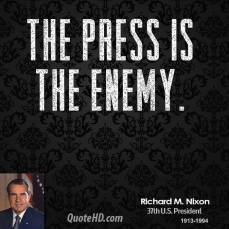
We now have a principal actor (the Trump administration) which is completely unaccountable. How completely delightful!  By the way, if all this sounds familiar, you may be remembering Watergate, but the present situation is what Nixon could only have dreamed of; he never got anywhere near it himself.

I think everything I have said about this situation is correct as far as it goes. It’s truly objectionable. It is self-serving in the extreme. On the other hand, I don’t think it’s as dire as I have made it sound. Despite Bannon’s formulations, a solid majority of the electorate—the whole electorate minus the 30% or so who are inalienable Trump fans—still believes in the truth of well-substantiated accounts published in the mainstream press. [6]

The logic of public action that supports the existence and reliability of “an umpire” is, of course, under attack and those of us who value it will need to defend it. I don’t think that is a bad thing. It is just the work we will need to do if we want candidates to compete for our votes, i.e., if we want to live in a republic.

[1] It’s a little hard to get to, but here is the step-by-step version. Go to https://www.vox.com/authors/david-roberts. That will give you a list of his recent articles. On the second page of that list, you will find an article classed “America is facing an epistemological crisis.” If you click on that article, you will find a hyper text link to “tribal epistemology.” If you click on that, you will be at the site of the article I am responding to.
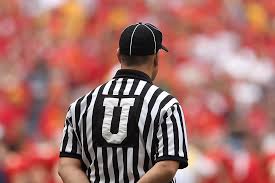
[2]The umpire (U) stands behind the defensive line and linebackers… observing the blocks by the offensive line and defenders trying to ward off those blocks, looking for holding or illegal blocks. Prior to the snap, he counts all offensive players.  During passing plays, he moves forward towards the line of scrimmage as the play develops to  penalize any offensive linemen who move illegally downfield before the pass is thrown or [to] penalize the quarterback for throwing the ball when beyond the original line of scrimmage. He also assists in ruling incomplete passes when the ball is thrown short.
[3] This is a common way to get new words. I once had “a napple” but it became “an apple.” My napron became “an apron.”
[4] A consigliere is an advisor, by dictionary says, “especially to a crime boss.”
[5] In contemporary usage, the word “partisan” has taken on a host of negative connotations. That is unfortunate, in my view, because it eliminates an otherwise very usable adjective form of the noun, “party.”
[6] It is true that these allegations may have reached them through social media, but even so, there is a public account that can be referred to.

Posted in Politics | Tagged , , , , , | Leave a comment

A Better World

Jean Paul Sartre published Being and Nothingness in 1943. I was five years old, so I alone 1missed most of the early discussions, but as I came to understand it, Sartre argues that life has no intrinsic meaning at all and that the task of existentialists, those who are courageous enough, is to live a life of authenticity. Authenticity as a value has the great virtue of being centered in the self and if there really is nothing else, that is a great virtue indeed.
But if, in fact, there is something else, it would be good to know what it is and how to align oneself with “it”—or him or her or them, if you think ultimate reality has the characteristics we ascribe to persons. [1]

A lot of the broader questions I have heard discussed lately have divided on the question of whether human life as we know it is an I—It kind of arrangement or an I—Thou kind. As a Christian, and most often the only one present for these discussions, I am a champion of the I—Thou model. It is the presupposition of my own faith and of many many others. It is antithetical to non-personal religions of all kinds and to cynicism, which argues that it really doesn’t matter.

I began with Sartre, who, as I pointed out, is way out of my period, so I could make the point that the world in which I grew up—everywhere but home and church—took the non-personalist model for granted and celebrated it. I celebrated it right along with them until I realized that I was committing myself simultaneously to contradictory views. If I am going to hold contradictory views, I much prefer to hold them serially, rather than simultaneously.  It’s less embarrassing.

Invictus

I’d like to begin with the poem” Invictus,” particularly as it is presented by President Mandela of South Africa in the movie, Invictus, in which Morgan Freeman plays Mandela. “It’s just a Victorian poem,” he tells the captain of the national rugby team, “but it helped me stand up when all I wanted to do was lie down.”

alone 3I have great respect for the effect that poem had on President Mandela. I have been affected in that way from time to time. It is a marvelous experience—not always one that feels good—and I am always grateful to have it. So I am a fan of standing up when all you really want to do is lie down.”

I am not a fan of the point of view represented by the poem. I am, as I said, a Christian. I am not the master of my fate or the captain of my soul. The person I associate most with that stance is Adam, the legendary father of us all, who caused us all a lot of grief by taking that position.

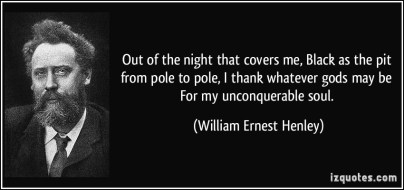
I know I am being unfair in making that comparison. “Invictus” was built for an I-It world. William Ernest Henley, who wrote “Invictus” finds himself unafraid. How much better that is than being fearful, and that is the comparison available to him. He finds himself unbowed (although bloody). He finds himself in possession of an unconquerable soul. How much better than is than having a conquered one.

But Henley is forced to chose between those polarities because there is nothing in life or in death to trust. If he isn’t “unconquerable,” then he must be “conquered;” if not unbowed, then bowing down; if not unafraid, then afraid. Those are Henley’s options.

But they are not the only options. What if there were someone—Someone, I admit the theistic premise right away—who could say, “I am your Father and I love you with a perfect love.” That gives new meanings entirely to “bowed,” to conquered; and to unafraid. This Father who loves can be said to conquer resistance (if not persons), and the bowing is completely appropriate as an acknowledgment, and the fear is replaced by trust. Those are, from Henley’s standpoint, new options. He doesn’t reject these options. He just doesn’t see them as available. [2]

When you walk through a storm

I didn’t really start this mental trip with” Invictus.” I started with an anthem text by Gerard Marklin. The anthem is called “Do Not Be Afraid” and it has this line in it: “When you walk through the waters, I’ll be with you.” I guess that was close enough for one nerve ending to make a post-synaptic recommendation to another and I remembered “When you walk through a storm,” from Rogers and Hammerstein’s Carousel (1945)

alone 2It is not clear to me just why Julie will never walk alone. Will her husband Billy Bigelow, who killed himself, be walking with her? Will Julie’s cousin, Nettie Fowler, who sings this song to her, be with her? It says to have hope in your heart, which seems like a good thing, but what is one to hope for? Is an unspecified hope, a hope with no home, enough to keep you from being alone? It doesn’t seem like it, but this was the mid 1940s and maybe “hope itself”—hope with no clear referent at all—was thought to be enough.

Do Not Be Afraid

Marklin’s text, in “Do Not Be Afraid” provides a context for the hope and that is where the tears started running down my face. (See the full text at the end of this post or, if you prefer, hear it here.) It is a richly considered hope, fully as Jewish as it is Christian, and it has these elements. [3]

I am your Father and I love you.

I will be with you.

You will walk through the waters, but they will not cover you.

You will walk through the fire, but you will not be consumed.

You will encounter the fear on loneliness, but you will not forget that I am with you.

You will dwell in exile, as a stranger dwells, but you will remember that you are precious in my sight.

Belonging

Marklin uses half of a family metaphor, a half that matters a great deal to me. But here, I am going to add the other half because I think they make sense together. [3] I will call you by your name, says God in the passage (Isaiah 43) Marklin has in mind. But God also says, “I will call you by my name.”

I can’t help thinking of these as phases of development, although I know it isn’t really alone 4fair. Abraham Maslow, whose stages of development are widely cited, says that we need to be a part of a group. But after that, we need to go on to become who we are ourselves, without reference to the group. My grad school mentor, Jim Davies, used to identify these stages by saying that we need to be a part—then we need to be apart.
Yes. We need to be called by His name. We need to belong to God’s family. And we also need to be called by our name. This God whose family we belong to, knows us, knows who we are, and knows our name. [4]-

It is that identity that marks off the I-It world celebrated by “Invictus” and by “When you walk through a Storm” from the I-Thou world of “Do Not Be Afraid.” I think the virtues claimed in “Invictus” are indeed admirable, by contrast to the alternatives that are considered. But there are, in this other world, alternatives that cannot be found in that world. Who, really, would choose simple indominability, if one could be truly known and truly loved?

I wouldn’t. But to choose to be known and loved, you must choose a world where one could be known and loved, a world where there are better choices than being simply the master of our fate, the captain of our soul.  I choose that world.

[1] Ultimate reality “is personal,” I would normally have said, but this is a mixed audience and there is no harm is trying to communicate clearly, even if it does, on occasion, require a few extra syllables.
[2] Or maybe he sees them as available and contemptible. I don’t know that much about Henley.
[3] Conceptually, they belong together—belonging and being known are part of the family metaphor. But I think there is also a historical upgrade here. The context of the early passages ( 2 Chronicles 7 and many other citations) is that we are known by His name. We took His name in becoming part of the family. It is very collectivist. But this is an individualistic time and to say that He calls us by OUR names is the other part. He knows our names. He knows who we are. And in Revelation 2:17, the metaphor is extended even further: “I will give you,” says God, “a new name—a name only you and I know—the truest name you can have.”
[4] There is no way to make too much of this. In the ancient world, the name was the whole being. “Know your name” and “Know who you really are” can be considered equivalent expressions within that understanding of “name.”

Text

Do not be afraid, for I have redeemed you.
I have called you by your name;
you are mine.
When you walk through the waters ,
I’ll be with you;
you will never sink beneath the waves.
Do not be afraid, for I have redeemed you.
I have called you by your name;
you are mine.
When the fire is burning all around you,
you will never be consumed by the flames.
Do not be afraid, for I have redeemed you.
I have called you by your name;
you are mine.
When the fear of loneliness is looming,
then remember I am at your side.
Do not be afraid, for I have redeemed you.
I have called you by your name;
you are mine.
When you dwell in the exile of a stranger,
remember you are precious in my eyes.
Do not be afraid, for I have redeemed you.
I have called you by your name;
you are mine.
You are mine,O my child,
I am your Father,
and I love you with a perfect love.
Do not be afraid, for I have redeemed you.
I have called you by your name;
you are mine.

Posted in A life of faith, Uncategorized | Tagged , , , , , | Leave a comment

A Marriage Covenant

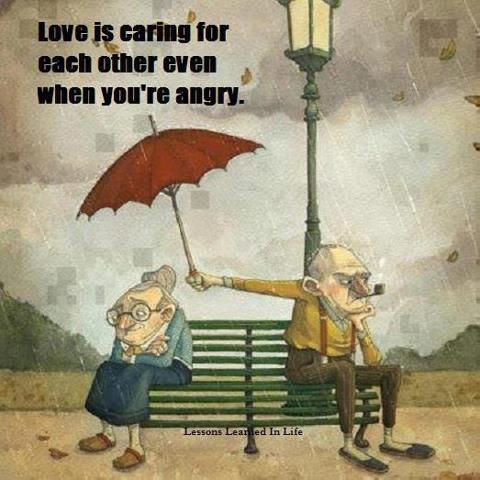
We call it a “marriage covenant” without thinking much about it. A covenant is a “coming together,” certainly; every way of parsing the word must note com = “together” and venire = “to come.” But we “come together” in so many different ways, don’t we? This picture is about several of those ways, all happening at the same time.

For a number of years now, I have liked this particular way of understanding it.
I’d say these people, Al and Vickie [1], have been married a long time, so, presumably, they have had their ups and downs.

We can see in this picture that Al is generous and disciplined. We can’t tell just by looking whether he is also smart. If Vickie understands the “acts of service” Al performs for her as the truest and most authentic expression of love, then what Al is doing in this picture is not only generous and disciplined, but smart as well. If she understands displays of  emotional attachment—not acts of generosity—as the building block, then what Al is doing is not going to cut it. And he is getting wet needlessly. [2]

politics 1.jpg

He is grumpy. She is morose. Very likely, that is how they express discord between them. Al is being actively grumpy. I think that is why the artist wanted us to see the puffs of smoke coming out of the pipe. Al is working at it. And I think that means that he is going to have to be the one to take the next step.

He seems to understand his choice to shelter her, rather than himself, as part of the trip back toward each other And that is one way to understand it. If, on the other hand, his holding the umbrella is more of a gambit; more an attempt to entice her to take the next step, then what we are seeing is not the precursor to an initiative of his. It is a request for an initiative of hers. And if that is the way she understands it, then we, as onlookers, can be sure it will fail.

It is harder, I think to become less morose [3] than it is to become less grumpy. Grumpy is stamping through the halls and slamming the doors. Morose is hiding in the bedroom, holding yourself, and rocking quietly back and forth. Morose is static [4]; grumpy is dynamic. That means that if she sees the umbrella as an attempt by Al to draw her into action, it will be only another affront. If she sees it as a wisely chosen initiative on Al’s part—“wisely” because it takes into account the kind of person he knows she is—then she can safely respond is whatever way is appropriate.

And what way is appropriate? It will depend on the kind of person she knows Al to be. Does he respond best to praise? Some men do. To touch? Some men do. To actions that clearly have the restoration of the relationship as their premise? Some men do. If she has been paying attention over the last…oh…50 years, she will know how to respond to him—to Al in particular—in a way that is appropriate to him and that will say what she wants to say.

What Al knows, and I think this is the thing I like best about the picture, is that Vickie is still the woman he loves. And he loves her now, in this moment, when they have just had a disagreement that shredded the peace in which they normally live. He is angry at her at the moment, but his love for her is not a fact of their lives that exists at the same level that the anger does. The love is the foundation of the relationship; the anger is a badly chosen color for the garage.

So it isn’t that he doesn’t love her at the moment, but knows that he will again. His love for her is settled and decisive. It is an offer made and honored over and over again for many years. The anger is an emotion that has come and it will go and when it goes, Vickie will still be dry and Al will still be wet.

Finally, the caption that comes with the picture says that this shows “caring for each other.” Al cares for Vickie; Vickie cares for Al. The funny part of the picture is grumpy old Al holding the umbrella over Vickie’s head. But Vickie is caring for Al too.

I note, for instance, that she is still there. If you will think back to your own past, you will remember times when caring was not enough to keep you or your spouse from leaving the scene. When the relationship is bad, there are so many other places you could be.

And although she seems sad and withdrawn, we have to wonder whether that is really the best she can do at that moment. I think it might have been. And if it was, if holding herself at that emotional level and refusing to allow herself to go lower, was an achievement for her, then Al probably knows that and may very well be proud of her. In doing the hard work of emotional control, she may have been caring for him, just as he is caring for her by where he hold the umbrella.

I really like these people. I have no idea whether the internal stories I have made for them are true—or even what “true” means in this context—but they seem realistic to me because I have been at some of those places and have loved wives who were at others of those places and I think that is why I like this cartoon so much.

[1] I think I may once have had Queen Victoria and her husband Prince Albert in mind, but looking at the picture, Al and Vickie is as close as I could come.
[2] An important part of the early relationship Bette and I experienced was based on The 5 Love Languages, by Gary Chapman. The notion that loving your partner in the language she cares most about is the smartest thing to do comes from that book and from some years of living with Bette.
[3] I always hear “less-ose” when I write “morose,” but with vigilance and good will, I can confine it to the footnotes.
[4] It is a static that will interfere with whatever signals she is trying to send Albert.

Posted in Getting Old, Love and Marriage, Uncategorized | Tagged , , , , | Leave a comment

And don’t forget to put the milk in the icebox

One of my favorite slogans is “Rising Above Decline” I first ran into it in a study of what to do with excess school space in Boston and they meant simply that the school age population was decreasing, so the need for school space was decreasing (decline) but that all that extra space could be put to good use (rising above decline). But I have declined a good deal myself since then and the slogan has come to mean quite a bit to me.

I want to reflect today on the stages of life. I’m sure no one will ever do it as well as Shakespeare did [1] but I have something else in mind. I want to look at the presuppositions of the normal periods of health, decline, and disability, But I want to start with the day my mother died.

I don’t want to play this for comedy exactly [2] but the account I am going to provide has someice box 2 iconically funny moments. Mother had seen a doctor for her regular checkup that day. On her way home, she stopped to get some groceries, including some milk. When she got home, she put the shopping bag on the table, put the milk in the refrigerator [3], went into the living room, turned on the TV, lay down on the sofa, crossed her ankles, and died. Just like that. But first, she put the milk in the…um…icebox.

That’s really where I want to get to. That’s the last stage in my list, where strength and intention are directed to goals that have immediate value. But when you get to that stage and you pause and look back over the route you have taken to get there, you realize right away that things have been different in the past. Of course, you say, they have been physically different because young bodies are different than old bodies. True, but that’s not what I mean. I mean that the presuppositions—the things you don’t look at because you take them for granted—change from one age to another. [4] Let’s look at that a little.

The categories I am thinking of are: a) youth and health, b) first illness/disability, c) later disabilities, more frequent or more serious, and d) extensive compromises with illness/disability. So the question as it shows up for me is, just what are the presuppositions of each stage? When older people sigh, “Youth is wasted on young people,” all they really mean is that the young people are taking for granted states that older people are working hard to retain or  just trying to remember clearly. These states are presupposed by the young. They look right past them and plan on how best to use their resources, given, of course, that they are healthy, which goes without saying.

ice box 5That presupposition is put even further out of conscious reach in the second stage in which you get injured or sick and then recover. You look at the picture of disability as an episode in an otherwise whole and healthy life. You might feel grateful, for a little while, to regain the full use of an injured leg, but you life goes back to normal and you count on the leg to function “normally.”

“Normal” is brought into question in the third stage for two reasons. One is that there are more such episodes and the other is that you don’t ever get all the way back to where you started. You are in the era of “substantially recovered,” but no longer in the era of “back to normal.” This is the state at which the presuppositions are called seriously into question. Now you need new goals or possibly just different ways of pursuing the old goals. This is the time you really need to give something up. It isn’t, as it was in the previous stage, that “recovery” is going to take longer. Recovery is never going to happen if you define it as returning to your old times or your old heights or your old Yards After Contact.

The presuppositions here are still about intention and effort and achievement, but you don’t take the old standards for granted anymore. You give serious thought to the new standards: what should they be, can they fully engage me, are they the best balance I can strike between what I aspire to and what I have to leave behind?

But what you get, if you are serious and wholehearted about the new goals, is a new ice box 4round of satisfactions and successes. I can go back to teaching if I teach two courses instead of three. I can get back on the trail because I can still run on soft surfaces, but running on the hard surfaces of my neighborhood are a thing of the past. I can rejoin the book group with the understanding that the “discussions” are now going to include detours of personal reminiscence and repeated stories. It’s “back” you see; it just isn’t all the way back.

If the previous stages were about full functioning, this third one is about mostly full functioning.

There is another substantial shift as we move into the next phase. In this stage, it is the condition that is primary. You are what you are and you can do what you can do. “Manning up” to meet the old standards is a thing of the past because so many of those old standards are no longer relevant. You can keep them relevant if you want. That will mean continuing to aspire to standards of performance you are no longer capable of. It will mean consistent and debilitating failure. It will mean continuing the presuppositions of stage three well into stage four when, really, you could do better for yourself. What would the condition first—goal second constellation look like?

Let me illustrate the difference by telling you about my team meeting. The “team meeting” happens in the shower in the morning. Back in the old days, I would “call the play. OK, guys, this is how we are going to score today.” But then I would be interrupted by the members of my team. They wanted to be sure that in calling that play, I had taken their special…um…abilities, into account. I call Red Right 30 Pull Trap. [5] The halfback who is going to receive the pitch reminds me that his hands have gotten arthritic and he may not be able to catch it. The center and the right guard look at what I am asking them to do—maintain the 0 hole—and remind me that the defensive players across from them are a lot better than they are. (They often say they are “younger” than we are, but I know what they mean.) The backside guard has been having trouble with his knees and getting up out of his stance is taking longer than it used to. And when all that is over, the wide receiver, who has been having what he calls “hearing issues,” says, “So…what’s that play again?” ice box 3

I don’t do it that way any more.  Now I start the team meeting by calling the roll. First, we find out who is there and ready to play a part—any part. Then we consider the plays available, ranked from those requiring the most coordinated action to those requiring the least. Then we eliminate the plays that will spook the players and keep them from showing up for tomorrow’s team meeting.

You get the idea. In this stage, what have you got to work with is the first thing in the process. When you know that, you have an idea what kind play might conceivably work. Who the team is and what abilities you can confidently ascribe to them is question one. We used to take that for granted. Now we take for granted that some match must be made between the resources we have and the task we might decide to attempt. That is why on one day, we walk to downtown Portland and take the light rail home after the movie and on another day, we hoard our energy because we are going to need to walk to the grocery in the afternoon.

Every age has some reality that is so pervasive and so important that we can’t see it at all. That is what every age has in common. Just what that reality is varies, as I have indicated, from age to age. I think it’s all good. What’s bad, I think, is failing to come to grips with how the reality of each new stage can be formulated and made a part of the planning. When you do that, you start losing games you could have won.

And although I treated it as a mild comedy when I told you about my mother and the milk, there is a sense in which her last decision was the very best one available. Put the milk in the icebox before you lie down on the sofa.

Good choice, mother.  I approve.

[1]As You Like It, Act II, Scene 7 begins:  

“All the world’s a stage,
And all the men and women merely players;
They have their exits and their entrances,
And one man in his time plays many parts,
His acts being seven ages…”

[2] Certainly not as tragedy. Mother lived a long and productive life and she deserved the celebration she received as people looked back over the course of that life.
[3] It was an icebox when she was growing up and I thought in a whole life survey like this, I could afford to do her that honor
[4] As they say, it would be a really bright fish who realized that he was always wet.
[5]”Red Right” specifies the pro set formation, with three receivers and two backs. The receivers include a split end to the left, a tight end, and a flanker to the right. The backs consist of a halfback and a fullback split two yards apart and two yards behind the quarterback. The fullback is lined up on the strong side (the side of the formation with the tight end) behind the right tackle, while the halfback is lined up behind the left tackle. In “30”, the “3” specifies a toss play: The quarterback delivers the ball to the halfback with an underhanded toss. The “0” specifies the hole the halfback will run toward. (The “0-hole” is the gap between the center and right guard). “Pull trap” describes a blocking scheme: The backside guard (the one away from the flow of the play) will “pull” out from his normal position to “trap block”, which means he leads the running back through the hole and blocks the linebacker back towards the backside of the play.

Posted in Getting Old | Tagged , , , , | Leave a comment

“We don’t get no respect!”

Martin E. P. Seligman surprised a lot of people when he predicted the standings in the next year’s baseball season from a content analysis of comments made by the management and the players about the season just finished. Like me, Seligman studies attributions, and he thought that the way a team explained whatever success they had had in the current season would be a useful indicator about how well they would be respect 3likely to do in the next season.

When you put it that way, it doesn’t sound so outlandish.  And Seligman’s predictions were better than those of a lot of sportscasters who know more about baseball than he does.

Ever since grad school, my ears have pricked up when I hear someone say why something happened.

  • Was it chance? OK, did this “by chance” event happen to all of the relevant people or just some of them?
  • Was it a failure of cooperation with someone else? That’s interesting. Why was the cooperation not forthcoming?
  • Was it a lack of clarity? Hmmm. In whose interest was it that the matter was clearly understood by both (all) parties?
  • Was it a failure of motivation? A failure of persistence? Was it sabotaged by someone out of ill intent? Did it fail because of someone’s incompetence?

And best of all:

  • is it, by any chance, a PLOT by THEM? Those are the most fun of all.

They don’t have any respect for us

Really? And how would that be displayed? I once had a friend who was dating an Austrian professor. On a visit to the professor’s homes near Vienna, my friend was perpetually irked that her boyfriend’s mother kept addressing her in “baby German.” [1] This was understood as a protest against her son’s marrying a non-German speaking woman. The “lack of respect” is flagrant and intentional and is intended to carry some more substantive message—which in this case, it did.

External Attributions

I was part of a discussion recently in which it was alleged that “they” had no respect for “us.” This is, as you might guess, a very satisfying point to make because the “us” are all here and all part of the conversation and “they” are elsewhere and might never find out what we think. Or care.

Now nothing in this essay is going to raise the question of whether” they” do or don’t respect 1respect us. I am concerned entirely with the effects of one kind of assignment of responsibility or another and the first thing I notice about this one is that it is external. It would be entirely possible for this group to say that they are not worthy of respect and that is why they aren’t getting any. It isn’t very likely, of course, but that would be an internal attribution (it’s “us”) rather than an external one (it’s them).


Trait Attributions

The second thing that came to mind when I heard this about “respect” is that the responsibility is placed at the level of a consistent trait. “They do not…” would be at the level of character if “they” were a person instead of an organization. The attribution, if it were folded out more fully, would say, “It is quite characteristic of them to have—and to display—this lack of respect for us.”  No one would say such a clunky sentence out loud but seeing it all makes the meaning entirely clear.

Again, if we were talking about an uncharacteristic behavior, we could say something like, “I’m really puzzled. Ordinarily they show great respect for us but in this last instance, they did not. What do you suppose was different about this last time that could account for that?” [2] This is not that. We are saying here that they characteristically do not show us respect and that was evident in this last instance as well.

Elastic Attributions

The third question that came to my mind right away is: “How elastic is this category?” The notion of categories that change size and shape is not at all unfamiliar, but they are not often called “elastic,” and I think that is the perfect word for it.  Let’s start with inelastic—rigid—categories and work our way up. If I take a minimum wage job and get paid the minimum wage, there is no puzzle about the cause (I’m a cheap hire) or the category. I get $11.25 an hour.

If I ask whether I am getting paid what I am worth, I ask a different kind of question. There are very specific measurements of how much I produce and if the question of “what I am worth” means whether I am to be paid in line with my merits as an employee, everything is still clear.  I could even compare my wages with those of others who have my kind of job.

But what if I am paid differently than other people who produce at the level I do, but who differ from me in race or age or religion or relationship to the boss?  We are dealing now with “respect” in a much more elastic way. How many different kinds of things could fit into that pay disparity? Could a category like that expand and expand until almost anything would fit into it? Yes it could and it does.

Where I live

So here are a few residents in a senior center who are unhappy. There is a current respect 5occasion for the expression of their unhappiness, but the current occasion is not the reason for their unhappiness, just a chance to express it. What kind of formulation of their unhappiness will loosen the borders of the category so that nearly everything “fits” into it? Conversely, what kind of formulation will keep each reason for unhappiness separate and therefore easier to act on?

I have argued already that the “don’t get no respect” explanation has some predictable effects. It is socially affirmative, because is separates those present from those absent and places the problem over there (with them, not over here with us). It is set at the level of characteristic action—the level that we would call “character” in a person. Because these actions occur from time to time, this formulation rounds them up and treats them as a disposition—this is something that might happen at any time. And, in dealing with “respect” where there is no context for earning respect, it provides a formulation that is remarkably elastic. It can be stretched so wide that any kind of grievance—any kind at all—will be seen to fit it. Parking is expensive or hard to find? See, that shows their lack of respect. A building project used professional contractors rather than relying on the expertise of residents? See, that too shows lack of respect? A failure in communication with the head of the organization? What reason could there be for that, apart from lack of respect?

When the concept is put at the right place and when the boundaries are so elastic that they can expand to accommodate nearly any kind of grievance, then you have an issue that won’t go away. At that size, it can’t be adequately addressed either, of course, so, like Bill Cosby’s barbecued sparrow in his skit, “Fernet Branca,” it “just lays there and makes gas.”

Needless to say, it is not an obviously good idea to formulate a problem that is so large that it attracts anyone with a grievance and that, on the other hand, is so large that it can’t be dealt with even when everyone wants to. The step that is most often missing in making problems like this one is the sense that it is you who are “making” the problem.

Other Kinds of Problems Beckon

If there is a condition that needs to be formulated as a problem, you have a lot of options about how to go about doing that. Alternative formulations are no more true or false than wearing the brown suit or the blue suit to a meeting is true or false. Formulating a situation as a problem needs to be useful. [3] “True” is much to broad a standard for it.

respect 6Internal:  There is no reason, for instance, that the problem described above could not have been formulated as an internal problem. [4] “They” don’t respect us (although they should) is an external problem.  There is no reason, absent some context, that the difficulty represented in this picture should be formulated as the bridge being too low or the water being too high.  Which way to define it depends entirely on what tools you have at your disposal.

Characteristic:  There is no reason, either, that some recent faux pas could not have been represented as a stand alone event, rather than linked to all the others so that it is only an “instance” of the same trait and not a separate events.

Elastic:  There is also no reason why the grievance could not have been defined in a less elastic (more stable) way, so that it does not expand to accommodate any and all grievances from any and all contributors. You can expand the concept by giving the same name—in this instance “lack of respect”—to every event you object to or have ever objected to.

So there is nothing at all inevitable about the “we don’t get no respect” coding of these events. The question is really whether such a coding is useful. I suspect it is not.

[1] This is nothing like “simple German,” that you would use on someone just learning German. This is something more like “Oooh. Does Greta wike the wittle red ball?” This was especially irksome because my friend’s name was not Greta and the potential mother-in-law knew it.
[2] NFL broadcasters note the extraordinary reliability of a receiver along with a recent lapse, with the phrase, “the normally sure-handed…..” “Normally” means that he wasn’t this time.
[3] Of course, a formulation is not going to be useful if it ignores or misnames crucially important parts of the situation. Even so, for every perspective on the situation, just what facts are crucially important changes. That is why perspectives are so important.
[4] It could be internal to the group, or internal to some persons within the group.


Posted in Books, Political Psychology, Sustainability, ways of knowing, Words | Tagged , , , , | Leave a comment

Halloween

I just don’t get Halloween. Not as a big deal celebration. I get a few things.

I get the language underpinning of it. I know, for instance, that the -een of Halloween is properly “e’en.” In the Scottish version of the word it is a contraction of “even,” still meaning “evening” rather than “eve.”

I get the notion of a liminal time—a time of the year when the borders between the living and the dead are thin and permeable. [2] Such a border means that “they” are closer to us and we are closer to “them.” Whether that is a good thing or a bad thing depends on your views of the relationship between the dead and the living, so it varies quite a bit among cultures and faiths.

If, for instance, “they,” the people on the other side of the border that separates the living and the dead,” are active and inclined to be mischievous, I can see why placating them would be a prudent thing to do and a big part of Halloween is about that.

I get the attachment to the annual cycles of death and rebirth. The autumn is, after all, the time of year when the sun is going away—and who knows whether it will ever come back north—and the plants are all dying.

On the other hand, all these understandings have declined quite a distance from their earlier meanings. Often, when we say things like, “declined from their earlier meanings,” the implication is that we have substituted later meanings. That is not true in this case. In the case of Halloween, the customs have declined from the spooky earlier meanings to no meanings at all. Of course, “no meanings” doesn’t mean “no reason.” The commercialization of Halloween insures that there are lots of reasons to push the celebration of it. I’m thinking of the costumes, the cards, the candy, the paraphernalia. [1] And Bette says that a lot of people have a lot of fun at Halloween, dressing up and going out for candy and so on. I never did, so I really wouldn’t know.

And while I don’t begrudge anyone a bit of special holiday fun—provided I don’t have to do it myself—I belong to a related but different tradition. And for reasons that have nothing at all to do with the secular celebration of the holiday, it is a tradition that has come to mean a lot to me.

In my tradition, the “hallow” of Halloween is a big thing. It means “holy.” Most Americans probably know it as a verb because that is the way Abraham Lincoln used it in the Gettysburg Address: “we cannot hallow this ground.”

Some Christians celebrate All Saints’ Day. In fact, I celebrate All Saints’ Day, having known and honored quite a few saints in my time. All Saints’ Day is the remnant of a much older and longer celebration called Allhallowtide, which had—as did Christmas, Easter, and Pentecost—a vigil that began the night before. It is that inaugural vigil, “all hallow’s eve,” which placed the word “Halloween” in Western Christianity.

And the limen?

If we are to think that the boundary between the world of the living and the world of the dead is stretched thin at this particular time, I can’t think of a better way to honor that thinness that than to honor those who have left us but whom we still hold in our hearts. The “dying” or “dozing off” of nature in winter suggests it. Pope Gregory III suggested it in the middle of the 8th Century. [2] The practice of many cultures outside the culture of the church, suggest it.

If there is “another side”—something on the other side of the threshold, it matters a great deal how a culture imagines what is there. Is it the spirits of the ancestors, watching kindly over their progeny? Is it the spirits of the ancestors, angry at being dead and waiting only for the thinning of the barrier to come back and wreak havoc? Are there beings that were never human—fairies, ogres, dryads—who have intentions of their own if they can just get back among the living?

There is a lot of such speculation—all of it implicit—in the modern celebration of Halloween. That is, in fact, what the fire theme is for. It accounts for the “lantern” part of the Jack-of-the-Lantern. [4] The fire is supposed to scare the spirits away. On the other hand, it also accounts for the food themes because the food is supposed to appease the spirits, on the off-chance that they are inclined toward malice. And, to add the last little bit of historical setting to it, if you were approached in the “trick or treat” mode by a Druid priest, you might want to think seriously about what a Druid might think a “trick” was.

All Saints’ Day

At my church, the tradition is to hold a reading of the names of the saints who have died since the previous All Saint’s Day. A name is read and a bell is tolled. Then another name; another tone. From the time my wife, Marilyn, was diagnosed with cancer, we expected that we would have only a few All Saints’ Days left to us and we sat in church as the names were read and the bells tolled and held hands and cried. On the All Saints Day after she died, I sat there and listened to her name being called and the bell being tolled and cried by myself.  It was bitter, but the context of meaning made it tolerable.

That year, the “boundary” between my world and whatever is on the other side [5] was thinned almost to transparency. So when I think of Halloween, I think of All Saints Day. And when I think of All Saints’ Day, I think of the day Marilyn’s name was read. And then I think of the day when my name will be read. [6]

So I don’t really object to Halloween. It’s just, as I said at the beginning, that I don’t get it. I do object to conceiving of that time as a time for appeasing malevolent spirits and warding off angry minor deities. I don’t want to be any part of that. [7] All Hallow’s Eve, on the other hand, makes perfect sense to me and offers a great deal of comfort.

[1] How many innocent pumpkins, for instance, have given their lives to become jack-o-lanterns so they can simulate the ignis fatuus, “the foolish fire?”
[2] We don’t use liminal (from the Latin limen) straight up, but it is common in compounds like “subliminal.” A limn is a threshold.
[2] The reference of the author of 2 Timothy may have had something like this in mind (1:16—18) but given the lack of context, it is hard to say for sure.
[3] These people didn’t become saints just by dying. Here’s a good summary of the broader meaning of the terms from http://www.gotquestions.org, a site I like a good deal. “Christians are saints by virtue of their connection with Jesus Christ. Christians are called to be saints, to increasingly allow their daily life to more closely match their position in Christ. This is the biblical description and calling of the saints.”
[4] I almost hate to tell you this, but they didn’t always use pumpkins. Sometimes they used rutabagas and I really like rutabagas.
[5] I don’t mean by that phrasing to say that there is something “on the other side.” I have no idea. But at the beginning, my sense of “no longer here” was so strong that it virtually stipulated some “…and now there.”
[6] I’m not forgetting Bette. I’m just skipping over her because according to our deal, she has to live longer than I will. It just isn’t right to expect a man to marry and lose two such women in just one lifetime.
[7] On the other hand, I fully believe that people can be killed by witchcraft in cultures that believe in witchcraft. People are psychosomatic unities. We don’t come in two packages, one universal and the other local.


Posted in A life of faith, Living My Life, ways of knowing | Tagged , , , , | Leave a comment

Stronger. Also wiser.

In Stronger, Jeff Bauman, played superbly by Jake Gyllenhaal, learns a really hard lesson. It isn’t all that easy to say what it is, but at the very core, it involves being willing to be who people need for you to be.

This is not, in other words, a movie about authenticity. At least, it is not about what we ordinarily call authenticity. [1] Quite the contrary, it is a movie about transcending that core of self and opening yourself as a means by which others’ needs can be met.

Jeff was near the finish line of the Boston Marathon when the bombs went off. His legs stronger 6were so badly damaged that they had to be amputated above the knee. He may very well have died from loss of blood had Carlos not intervened. But he didn’t die and a very frightened city declared him to be a hero—just for not dying.

That put Jeff in a really difficult place. First, he knew he wasn’t a hero. So accepting the status of hero [2] is hard for him. Second, he is a long way from understanding that the city needs him to be a hero—that his hero status is a sacrifice for him and a gift to the city. It takes him a long time to get there. And third, his family and his buddies all try to cash in on Jeff’s status as a hero, which adds an immediately repulsive patina to the whole thing and makes it seem to be one giant con job.  He is repelled by the con job; it takes him longer to see into the core of the matter.

That’s a huge challenge for Jeff and he doesn’t have much to go on in meeting it; he is not much of a person. The whole first part—the pre-marathon part— of the movie is given over to showing us that. Jeff is fiercely tribal and his tribe is not equipped to help him either. In fact, they are the first ones to exploit his new notoriety. [3]

stronger 4The help he gets, he gets from his sometime (but not current) girlfriend, Erin (Tatiana Maslany) who sees what he needs and is unwilling to withhold it from him. She is immediately heroic, as I see it, although that is not the way the movie understands her. And when all the crisis is over and Jeff has had a chance to discover in a whole new way just who he is, he gives himself to Erin.  That is very satisfying. He says something to her in this scene about “leaning on her.”  Yes he does.

The dimensions of Jeff’s difficulty are that a) he is called on to play a part for the benefit of someone else, b) it is a high profile and honorable part, and c) he is trapped by the conventions and expectations of his tribe. Three really big problems and he doesn’t deal with them very well. [4]

It will simplify this transition if we just look at two instances: one is very bad and gives us a sense of just how strained Jeff’s resources are. The other marks the occasion for a substantial step toward health (the Red Sox game) and also an occasion where the work Jeff has already done can be displayed.

The Bruins Game

They want Jeff to come onto the ice wearing a Blackhawk shirt. Erin, also wearing a Bruins shirt, pushes him onto the ice in his wheelchair. Everyone cheers, Jeff’s name is on the readerboard, along with his picture. He is required to wave a flag that reads “Boston Strong” back and forth while everyone cheers.

In the elevator on the way out, he attacks the only person who has dealt with his tragedy in his terms, rather than is her own (the mother) or his own (the father) or their own (his buddies) terms. Erin has put Jeff’s life in the center of her concern and she is the only one who has. That is why she is close to him and available for his anger and rejection.

stronger 8Everything is wrong with the Blackhawks event and it is portrayed so that we see that. Here, for instance, is a picture I didn’t see at the movie and now that I am looking at it, I can hardly believe I missed it.  Look at the cage the shadows of the hockey goal make on his face!  Then Jeff goes through a lot of development. He learns, for instance, that giving Boston the hero they need so badly is a form of self-transcendence.

The Red Sox Game

The setting is not all that different than the Bruins game, but Jeff if different by now. He is not yet ready to go beyond his own limits and offer himself to another person (Carlos is the exception so far), but it is something he can do for his city and the Red Sox are his team—he would really do anything he could for them.

stronger 7So he does. He plays the hero for them. He throws out the first pitch. [5] Carlos pushes his wheelchair out to the mound and that makes sense because Carlos is a hero in the same sense that Jeff is a hero. (As viewers, we understand Erin’s heroism at the Bruins game, but no one in the film understands it that way.) And then he tries to escape from the setting of the game, having done everything he thinks he can do. But here, his heroism catches up with him—not the phony imputed heroism that Boston lavished on him, but the real personal heroism that is based on his courage in responding to his personal disaster. A man named Larry needs to talk with him about the courage he has shown, and Jeff is willing to talk. We are surprised when Jeff asks the man his name; we are dumbfounded when Jeff reaches up and hugs him.

And after Larry, there is another; then another. The scene ends with Jeff still surrounded by people who want something he actually has and is willing to give. I was willing to call Jeff a hero when he understood that the hero business wasn’t really about him—it was a gift he gave to his city. But now Jeff understands that in his determination to work through his disabilities, to have a life again, he has become a hero of another kind entirely. And this heroism, based on his own understanding and his own work and his own pain, is his to give to anyone who needs it.

And he does.

[1] That may be a comment on how inadequate our notion of authenticity is. You could say that by the end of the movie, Jeff authentically embraces his status as a hero—a public property—and uses it to serve the needs of his fellow citizens.
[2] We see the other side of the mirror in the movie Hero, in which Bernie LaPlante (Dustin Hoffman) rescues a woman from a plane only to see John Bubber (Andy Garcia) take the credit for it. Taking credit for being the hero he knows he is not doesn’t bother Bubber at all, but in Stronger, it bothers Jeff a lot.
[3] It’s hard to blame them, under the circumstances. They are no more prepared to deal with Jeff’s situation than Jeff is.
[4] I know I am skipping over the fact that he had his legs blown off and that he suffers, after the blast, from PTSD. Those are large challenges, but they are not the ones that caught my attention this time.
[5] Following Pedro Martinez’s advice, which I am sure we are to take in both the literal and the metaphorical senses of the term: “aim high.”

Posted in Movies | Tagged , , , , , | Leave a comment

Is “the good doctor” candid?

You can ask questions so that they are easy or so that they are hard. This one seems hard to me. [1]

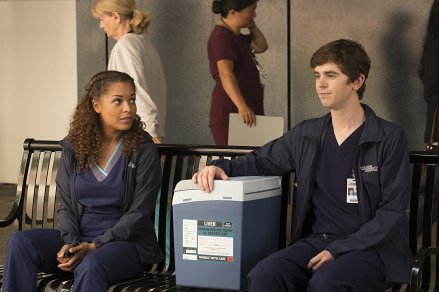
The doctor—the titular doctor in the new ABC series, The Good Doctor—is a very youngdoctor 4 man. Also autistic. Also extremely bright. When you hear him diagnosing a medical condition, you think of Sherlock Holmes.

I have seen one episode so far (twice) and I can tell you with complete confidence that the show is going to be about Dr. Sean Murphy saying inappropriate things and everybody else coping with the destruction he causes. If you picture a tornado (Dr. Murphy) and a horde of relief agencies (the hospital staff) moving in where he has passed, you will have the essential dynamic of the show. [2]

In the first episode, we see Dr. Murphy joining the surgical staff of St. Bonaventure hospital in San Jose. There is a lot of resistance to hiring an autistic surgeon, but Dr. Murphy has a champion, the president of the hospital, Dr. Aaron Glassman. [3] And because Dr. Murphy is always right about the medical things and always wrong about the social things, this is a pot that is just going to keep boiling.

Is Dr. Murphy candid? Here’s an example to work with.

“Why were you rude to me when we first met, then nicer to me the second time we met and now you want to be my friend? Which time was it that you were pretending?”

To begin with, we, as viewers, see all three of the occasions Dr. Murphy is referring to. In the first, he was an odd-talking person who had administered first aid to the patient at the airport. He is urging the medical staff at the hospital to take an action, an echocardiogram (echo), for which no clear diagnostic need exists. And he tries to force his way into the hospital. It is a that point that Dr. Clare Brown (Antonia Thomas) gets firm with him. That is “You were mean to me.”

doctor 5The second occasion was set up when she comes back outside—where Dr. Murphy is still waiting in the rain—to ask him why he kept recommending an echocardiogram. He gives a plausible reason, but while they are talking, the call comes that the echo revealed nothing at all. Dr. Murphy rejects that reading of the echo and when, through Dr. Brown’s auspices, he is shown the screen, he sees something no one else had seen—why the patient is still in danger. That’s the second occasion, and Dr. Murphy characterizes it as “nicer to me.”

The trauma is over; Dr. Murphy has been proven right on all counts. Dr. Brown comes to the cafeteria to congratulate him. That is “Now you want to be my friend.”

So now you know what the circumstances were that Dr. Murphy characterized so badly. The first thing to notice is that he has understood all these events to be personal. They were “about” the relationship of this beautiful woman, Dr. Brown, to him. We know they were not. Dr. Brown was protecting the hospital in the first case, defying her colleagues to consult Dr. Murphy in the second, and generously congratulating him in the third. None of those was personal in the sense Murphy thinks, and it makes me wary of the character of Dr. Murphy that he thinks they were. Then again, he is autistic.

The second thing to note is that Dr. Murphy thinks that some of those actions by Dr. Brown were insincere. When you look at it through the “it’s personal” presuppositions of the autistic doctor, there is one true interpersonal orientation between people. Or between these two people, at least. But the three interactions were different—we are leaving aside the fact that all three situations were different—so Dr. Brown “really meant” what she said in one of those interactions as “was pretending” the others.

Society is not possible under those circumstances.

doctor 2That brings us to the final two questions. The first is, what can Dr. Murphy do to keep from destroying a very good hospital staff? We pretend with each other. We represent ourselves as more interested than we actually are or as less offended than we actually are. We are expected to do that. We are very nearly required to do that, given the penalties that are meted out for failing. [4]
Dr. Murphy simply doesn’t know how to pretend. Some autistic adults learn how to do it after a manner. By some accounts I have read, they don’t learn empathy, but they learn what kind of responses are required from them. These responses are “a performance” of empathy.  To a required expression of sorrow, they learn to return a required expression of thanks. They do not observe, as they might once have, that the person expressing the sorrow is not, in fact, truly sorry but is “only pretending.”

There is reason to think that Dr. Murphy could learn to do that. I’m quite sure he won’t, however, because the show is set on the contrast between his extraordinary medical skills and his abysmal people skills. If he were to get better at his people skills—even in the paint by numbers way I described—the tension of the two threads of the narrative would suffer. Besides, the surrounding cast is responsible to cope with his behavior as it is and it needs to be incumbent upon them to change rather than it being incumbent upon Dr. Murphy to change.

So there are some things a real autistic doctor could do, but I think Dr. Murphy will not be allowed to do those.

The second question is, “What is candor?” If we are going to think about whether the doctor 3doctor is candid, we are going to have to think about what candor is. The Merriam-Webster podcast which featured this word in 2012 gave an illustration like this: “when the job applicant admitted to some indiscretions in his past, the interviewer thanked him for his candor.” Since the root, the Latin adjective candidus, means “white” or “pure,” I think we can see in this interview, the idea that putting your best foot forward is a violation of candor. The “shaping” of your presentation of yourself is a “blot,” let’s say on what would otherwise be a pure unshaped presentation of yourself.

So I think the direct answer is that “the good doctor,” Dr Shaun Murphy is always candid. He cannot choose to be candid because he cannot choose to represent himself in whatever way the situation demands. Nor can he understand—as was illustrated in his conversation with Dr. Brown—that other people routinely “violate” candor for the sake of their colleagues and the welfare of their organizations.

So I think the best short answer is, “Yes. He is candid. But he can’t help it.”

I’m actually OK with Dr. Murphy’s candor. But as I was watching Episode 1, I kept having the feeling that there were people who were celebrating this disability as a goal we should all strive for. “If only,” this line of thinking goes, “we were only candid with each other.” I want to reject that in the strongest terms, even as an ideal.

It may well be that we should approach candor more closely than we sometimes do. I think it is crucially important that we refuse to mislead others unless it is truly necessary. But I really value being brave, as bravery is imagined in the expression “Discretion is the better part of valor.” [5]

I always like valor. Candor, I like sometimes.

[1] When I started running, in the 1960s, it was common to run without socks and that is what I did. I liked the feel of the leather on my foot. Ah, the Nike Cortez. But when I began to use an orthotic, I had to wear a sock on that foot at least, so it wouldn’t blister the sole of my foot.. It was a small town, and people would stop me and ask why I had one sock on and one sock off. I would say that “one sock on” is a matter of simple observation. But the question of how many socks I was not wearing is a deep and vexing philosophical problem. It was a college town so I got away with it for quite a while.
[2] That is not the view of David Shore, who has been called “the creative force behind the show.” Shore says that there is “an honest, unabashed emotionality to this show that is…refreshing.”
[3] Played by Richard Schiff in a style that is nearly identical with his Toby Zeigler of The West Wing. I’ve seen him play other kinds of characters, but I’d have to say he is really really good at this particular one.
[4] Jim Carey approaches this same question in his movie Liar, Liar, in which he falls under a curse of some sort as is doomed to “tell the truth” for 24 hours. To the makers of this film, “telling the truth” means refusing to play the normal parts we play and which make society possible. A woman who has just had sex with Jim Carey’s character asks him, “Wasn’t that just great?!” His response—which is called “honesty” in the movie, is “I’ve had better.” Really? That’s being honest?
[5] Professor Paul Brians on his Washington State University website gives this helpful caution: “In Shakespeare’s Henry IV, Part I when Prince Hal finds the cowardly Falstaff pretending to be dead on the battlefield, the prince assumes he has been killed. After the prince leaves the stage, Falstaff rationalizes “The better part of Valour, is Discretion; in the which better part, I haue saued my life” (spelling and punctuation from the First Folio, Act 5, Scene 3, lines 3085–3086). Falstaff is saying that the best part of courage is caution, which we are to take as a joke. Truly courageous people may be cautious, but caution is not the most important characteristic of courage.”


Posted in Movies, Society, Sustainability, Uncategorized | Tagged , , , , | Leave a comment

Ebb Tide

“I wish it need not have happened in my time,” said Frodo.
“So do I,” said Gandalf, “and so do all who live to see such times. But that is not for them to decide. All we have to decide is what to do with the time that is given us.”

I think that must be one of the most famous exchanges in the English language. The “it” that Frodo wishes had not happened is the discovery of the One Ring, the ring of power, but Gandalf’s rejoinder is much more general. “So do all who live to see such times…” he says. You are a member of a category and the way you are feeling about it is the way all the members of that category feel. But you must find a way to deal with it anyway.

Now…wizards, like Gandalf, live a very long time. Gandalf has seen “such times” overebb 2 and over and he knows what he is talking about. Frodo, like most of the rest of us, is living in the only time he knows. [1] And like the rest of us, Frodo is forced to take the presuppositions of his age for granted.

Peter Stearns, the social historian [2] has a way of approaching matters that is a great deal more like Gandalf’s than like Frodo’s. Stearns will study some small aspect of the whole social whirl and pay attention to how that one small aspect has developed over time. I’m going to reflect on his treatment of the notion of “obedience” today, but I’ll be back from time to time with another notion from his work.

Imagine that you are standing at the shore of the ocean in the middle of the afternoon on a beautiful sunny day and watching the “tide” go “out.” (How odd, you think, to put those words in quotation marks.  I thought so too.) And let’s say you know nothing at all about the influence the moon exerts over the tides on earth. You don’t know that the water goes out for awhile and then comes back in and then goes out. You don’t know the system.

ebb 1What you do know is that the water used to reach much further up the beach and now it is clear down to where you are standing and it is still going down, going “away.” You are horrified, let’s say, because you liked this part of the coast where the ocean “used to come” and you long for “the good old days” when the water—you don’t know to call it a “tide”—used to come all the way up to here.

It seem odd, I suppose, to imagine anyone who doesn’t know about “tides,” but really, who knows about grieving; who knows about “jealousy;” who knows about what a “real man” or a “real woman” ought to be like; who knows whether children should be obedient to their parents? All these are like the tides and we, who take for granted the sentiments of our own time, are like the guy who doesn’t know that “the water going out” is called an ebb tide and that it will all come back.

Let me illustrate by recalling what I can from my recent reading of Stearns’ treatment of obedience. The point of all this is that these ideas about obedience—is it a good thing or a bad thing, does it come at the expense of other important virtues, how is it to be inculcated— are broadly shared by your contemporaries. Whenever you were a child or whenever you were raising children or, more ominously, grandchildren, there was a set of ideas that was considered to be “common sense.”

Stearns says that agricultural families neeebb 3ded to have large families of obedient children.
That’s how the family was made an economically viable unit. So there is an economic infrastructure to the ethical demands of “obey your parents.” Notice how powerful it is when the two are joined. Obeying your parents is the right thing to do and besides that, you will all starve without it. Powerful.

The Industrial Revolution removed the economic infrastructure for many families. For these families, the admonition to obedience was still strong, but now it had to stand alone. After a period when urban and suburban children “helped out at the shop” or even “tended the vegetable garden,” the chores of children shrank to things like keeping their own rooms neat and taking out the garbage and washing the dishes. Household chores, in other words, instead of contributions to the family’s economic viability.

In the latter part of the obedience phase, there grew up an ideal that children should obey gladly. In my own mind, I suspect that there were some good reasons for this new emphasis and some bad reasons. The good reason is that when the cows had to be milked, all that mattered was that the kids got up at the right time and milked them. They could be a snarly about it as them wanted. But for the new work, the “chores,” it actually matters whether the kids “obey” sweetly and kindly or with grousing and foot dragging. The bad reason I am thinking of is that the parents and the people who wrote books about how to be parents sensed that the old “obedience” norm was slipping away and tried to prop it up with a new emotional resonance. “I’m obeying my parents (as I should) and I’m happy about it.”

As urban (and later, suburban) notions of what a good child is like, this happiness in compliance was joined to a happiness in independence. It’s not as hard as you might think. Once you start caring about whether the kids are happy or not—as opposed to just obedient or not—it is easy to join this virtue of any other virtue and “the child who can choose for himself” was the next virtue in line. So now we want children who make good choices and are happy about it. Obedience of the “look both ways before you cross the street” is still appropriate, but that kind of obedience is justified by the immediate context, not by the nature of the parent/child relationship.

ebb 4In the next phase, the helicopter parent phase, parents are responsible for the good choices and the consequent happiness of the children. Let’s just stop and think how far we have come from the farm family where the kids are plowing the back forty and gathering and selling the eggs. Now that the parents are responsible for the choosing that the child does—not, please note, for the choices themselves [3]—a child who is not choosing well or who does not play nicely with others or who can’t make the soccer team or who is not happy, is a problem that the parents need to do something about.

Does that seem weird? Not if everyone you know is doing the same thing. When everyone is doing the same thing, we are back to the guy who doesn’t know what tides are and who therefore mourns the “passing away” of what was once “a mighty ocean.”

Stearns historical approach gives us a chance to look at the matter more broadly. There is a very nice fit in the situation where the farm family has to make a living and so needs a lot of children who will do what they are told. There are good things and bad things about this scheme—as there are about any scheme—but the parts all fit together.

What we need in our time is an economic infrastructure and  an understanding of moral obligations that will do for us what the old agriculture/obedience construct did for them. What should we aspire to for our children? What does it cost them for us to aspire to so much? What does it cost us to aspire to that on their behalf? What do children actually need from their parents [4] as opposed to the things they want or things they think they have a right to?

I think it is an advantage to us all that the problem can be posed generally–that is Stearns’s gift– even granting that any particular family will have to come up with some response to that commonality that works and that is within their means. [5]

So it might be worth considering that the tide is now in, it is high tide, on such questions ebb 5as autonomy for children and choosing as the principal mode of self-expression and the complete responsibility parents have shouldered for the quality and the success of their children. If it is really high tide on all those things, then the demands they make need to be met in some way. Or perhaps they can be modified. Or even rejected.

Whatever is done, it will have to be done again as the tide begins to go back out and new structures will have to be devised. And I would think that even as we must work in the present we are given—just as Frodo must—still we may be able to get some relief from knowing that out children will face different demands and different collections of virtues.

And maybe letting them see us struggling with ours, will help them struggle more successfully with theirs.

[1] Sociologist Peter Berger makes the very good point that “society” is a show that is meant to be seen only once, and when you live a long time and start to see the same things a second or third time, you start to notice things you missed at first.
[2] “my guy,” as I said last month, on gender roles
[3] The law still has the old fashioned view about legal and financial liability.
[4] I will grant you the truth of the observation you are about to make that different children require different things from their parents. That is true. But it is also true that every child needs certain things, common things, although they might need to have them delivered in different ways. The unity and the diversity are both true and both trite.
[5] When my wife and I were raising children, we agreed about most things, but differed on the obedience question. I wanted prompt and effective obedience and I didn’t care all that much what emotional flavor accompanied it. One of my kids could say almost anything by way of complaint while he was doing what he was told to do. My wife felt that the emotional part of the act of obedience was important too. She really wanted happy obedience, although she would settle for silent obedience, if “happy” was too much to ask for at the time. I had no idea when she and I were having these discussions about childrearing, how well we represented the recent emphases of our culture.

Posted in Living My Life, Society | Tagged , , , , | Leave a comment