
The question of what kind of life is worth living is addressed in compatible and complementary ways by the Gospel of John and by the Wachowski brothers movie, The Matrix.[1] John’s account of the conversation between Jesus and Nicodemus is powerful, but it is confusing and if you are trying to visualize what they are talking about, you are going to have trouble. The Matrix is a dystopian fantasy, but it tells much the same story John tells and it is remarkably visual.
If they really tell the same story, they belong together. Do they really tell the same story? I think so. Both ask what “real life” is and if we are going to think about it, we are going to ask what “unreal life” is.
I can think of two ways to approach to notion of “unreal life.” In one, the life you are experiencing isn’t really happening at all although it feels like it is. In the other, the goals toward which a life is oriented are so nearly insignificant that a life in pursuit of them might be said not to be a “real” life at all.
The Matrix
What does the contrast between real and unreal life look like in The Matrix? I’m going to have to count on your familiarity with The Matrix because there is not a good way to summarize it. I do want to point out some of the most important parts.
In The Matrix, we hear about, but do not see, a city of humans located down in the earth where it is warm. [2] It is called Zion. All human beings who are living “the life of the ages” [3]—real life, rather than imaginary life— are in Zion or in one of the ships sent out from Zion. These ships are the only settings in which we see truly self-aware humans in the first movie. It is into one such ship that Neo’s body is taken when it (he) is rescued from his tub of goo.
What about all the other humans? Every other human in the world is locked up in a pod of goo and the sole function of these humans is to provide, through the natural operation of their bodies, the electricity that the Matrix requires to rule them and keep them (us) in their place. In this picture you can still see the goo on Neo and several of the pods near him, each containing a “human battery.”
It turns out that it is necessary, in order to keep the human bodies alive, to stimulate the brain with an electronic probe. This probe provides all the neurological input that is needed to simulate a life in society and even the illusion of free moral choice.
Our hero, Neo, is rescued from one of those pods by a crew from Zion and is given access to “the life of the ages”—a life in which things will actually matter. All the other people we see—people who are apparently living lives of consequence (except that there are no consequences)—are people we see as they appear to themselves in the Matrix. They are actually, physically, encased in their own tubs of goo.
Given that a big part of the New Testament is given over to contrasting “real life” and “lingering death,” The Matrix is a good theological movie because it is so graphic. The dialogue between Jesus and Nicodemus is not at all graphic. It is all verbal, and the words are deliberately filled with ambiguity and misunderstanding. [4] If the point being made by John in chapter 3 is the same as the point being made by the Wachowski brothers in The Matrix, it will be a marvelous convenience. John is obscure and difficult; The Matrix is explicit and graphic. My case today is that each is making the same point about life.
Jesus and Nicodemus in John 3
Here I show how the argument is organized in John, with particular attention being paid to some of the deliberately ambiguous words Jesus uses. Here is the passage from the New Jerusalem Bible.
3 Jesus answered: In all truth I tell you, no one can see the kingdom of God without being born from above. 4 Nicodemus said, ‘How can anyone who is already old be born? Is it possible to go back into the womb again and be born?’ 5 Jesus replied: In all truth I tell you, no one can enter the kingdom of God without being born through water and the Spirit; 6 what is born of human nature is human; what is born of the Spirit is spirit. 7 Do not be surprised when I say: You must be born from above.
12 If you do not believe me when I speak to you about earthly things, how will you believe me when I speak to you about heavenly things? 13 No one has gone up to heaven except the one who came down from heaven, the Son of man; 14 as Moses lifted up the snake in the desert, so must the Son of man be lifted up 15 so that everyone who believes may have eternal life in him. 16 For this is how God loved the world: he gave his only Son, so that everyone who believes in him may not perish but may have eternal life.
Jesus talks (verse 3) about being born (genēthē) from above (anōthen). Both of the Greek words I put in parentheses have alternative meanings and Nicodemus takes the wrong one both times. That is the way John has organized this tutorial. Jesus offers the opportunity to misunderstand. Nicodemus makes use of that opportunity. Then Jesus “explains further,” making, in that explanation, the points John thinks are most important.
For instance, the Greek genēthē can mean either “begotten” or “born.” Jesus likely intended “begotten,” since it was more common in his time, as it is in ours, to refer to God’s action as male rather than female and “begetting” is the male contribution as “bearing” is the female contribution. It doesn’t actually matter very much.
On the other hand, it does set us up for his misunderstanding of anōthen, which can mean either “from above,” which is clearly what Jesus intended, or “again,” which is the way Nicodemus construed it.
The third ambiguous expression, one that Nicodemus doesn’t seem to have trouble with, although exegetes do, is zoēn aiōnion. It means “the life of the ages.” It can be construed as a life as long as the age {5] or as long as all the ages. Or it can be construed as a life characteristic of the ages, a life of enduring significance and value.
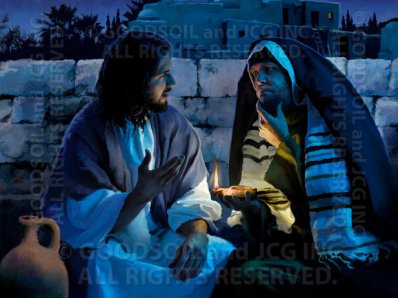 By all three of these expressions, Jesus is talking about the new life in the spirit—the life of the ages—and Nicodemus is talking about the old life, the life of the flesh. So when Nicodemus understands anōthen as “again,” he immediately thinks about being born a second time in the same manner that he was born the first time. So he asks disbelievingly how it is possible for a grown man to enter his mother’s womb so he can be born again. My argument is that in his conversation with Nicodemus, Jesus is better understood as contrasting the insignificant (merely earthly) with the enduringly significant (the heavenly).
Jesus continually stresses the higher life—the life of the ages—and contrasts it with the lower earthly life. He does it in verse 7 where he says “You must be born (begotten) from above.” In verse 12, he chides Nicodemus about not being ready to hear about heavenly things since he is not even ready to hear about earthly things. Notice the “higher and lower” imagery. In verse 13, he refers to himself as “the one who came down from Heaven.” In the famous verse 16, he says that the higher life—the zoēn aiōnion—may be granted to anyone who believes in him
Throughout this failed and frustrating conversation, Nicodemus presupposes the quotidian life while Jesus presupposes the significant life. In none of these uses is the extent of “the ages” the point of the argument; rather it is the quality of “the ages” that matters.
This is an easy argument to make, but it is abstract and as pointed as the contrasts might have been for the Johannine community, they seem vague to us. And there, I think, The Matrix can help us.
Jesus and Neo
In The Matrix, the meaningful life is the result of the grasp of reality you have and the choices you make and the actions that flow from those choices. [6] If you are not part of this “higher life,” you are stuck in a tub of goo with a brain probe helping you to imagine that you are living a real life—the life you are not actually living. The contrast on the screen is overwhelmingly clear.
And it is made clearer by the one person who has chosen to live the zoēn aiōnion and  found it too challenging. Cypher is rescued from the life he imagined he was living and was made part of a real life. The real life was dreary and difficult and he made the choice for which John ridicules Nicodemus. Here we see Cypher in the matrix “experiencing” a juicy steak. At the moment of this picture, his body is back in the hovercraft, but he is making arrangements to be put back into a tub of goo and to have an imaginary life restored—a life of complete insignificance. He says he wants to be somebody famous.
Just how good is this analogy? Well…it’s not perfect. (Perfect is a lot to ask of analogies.) But it is very good in some ways and it is graphically clear, which the account in John is not. First of all, in The Matrix we clearly see “the living and the dead.” The living dodge around in the dark places of the city or hide in the last human city, deep underground. The “dead”–people whose choices matter not at all– are secure in their tubs of goo, imagining that they are actresses or police or notorious hackers, but actually, just producing the electric power that enables their enemies to dominate them. The dead live wonderful lives, but only by the courtesy of the brain probes that allow them such a satisfying hallucination.
 Second, you can be rescued from such a life. We see Neo choosing it. This is the justly famous “red pill or blue pill” scene where Neo may choose to go back into his life of illusion (blue pill) or he may choose to be rescued (red pill)—literally “lifted up” from the tub of goo—and live a real, though hazardous, life. Note: to insert the picture here, I have to click on a button that says CHOOSE. Not a bad name for this picture.
The question I am asking by bringing this difficult passage from the Gospel of John together with an imaginative movie like The Matrix is this: do the “higher” and “lower” lives in the Nicodemus dialogue match up with the “in the matrix” or “free from the matrix” pictures in the movie? I think they do.
Neo is offered the red pill or the blue bill by Morpheus. Nicodemus is offered the red pill—“believe…and enter the life of the ages” or the blue pill by Jesus. Nicodemus chooses the blue pill He is not begotten by the Spirit; he does not enter into the life that believing the claims of the Son of God would have enabled him to enter. He continues living in his tub of goo. [7]
From here on, Neo, having accepted the red pill—which is the only thing he can do as a slave of the matrix—has experiences that Nicodemus cannot have. Neo is redeemed from his tub of goo; his body is restored and his mind aligned to reality; he is trained to do the work that his new colleagues are doing, including rescuing others. But Neo discovers that he is not just one of the colleagues; he is, as Morpheus always believed, “the One.” [8] He is killed by the forces of evil and restored to life, but a life of an entirely different kind. There is a “risen Neo” that is comparable to the risen Christ, but there is nothing in Nicodemus’s life to compare it to.
So far as Nicodemus’s life of “new reality” is concerned, it ended when he took the blue pill rather than the red.
The analogy assessed.
Pretty good. My goal here is to bring John 3 and The Matrix into alignment so that the obscure and hard to visualize meanings in John are given graphic form in The Matrix. If that works for you, you have to see Nicodemus’s puzzlement at Jesus teaching as equivalent to Neo’s continued imprisonment in his tub of goo.
You have to see Nicodemus’s failure to grasp and to choose the message of Jesus as equivalent to his choosing the blue pill; continuing, that is, to live on the meaningless level of mere existence, rather than accepting the life of the ages, which Jesus is offering him.
From there on, Neo has experiences—described above—which Nicodemus does not have and cannot have because all of them require that he take the red pill so that he can be rescued from his slavery and redeemed to be part of a free people.
In closing, I need to say that this is not the view of the contrast between the gospel and the alternatives that is described elsewhere in the New Testament. The Synoptic gospels don’t see things as drastically as this. Quite a number of the New Testament epistles, notably James, but also the Pastoral Epistles, do not see life and death tin these stark images either.
But I think John does see it that way and I find myself wondering if you do.
[1] As a stylistic matter, I use the initial capitals—The and Matrix—to refer to the movie. When the movie is already the context, I use a lower case m-, to refer to the system of control the machines permit.
[2] We do see it in the second two films of the trilogy.
[3] That way of characterizing it comes from John 3. I’ll spend some time with it when we get there.
[4] In fact, considered only from a teaching standpoint, the dialogue between Jesus and Nicodemus is wrong in nearly every way and is an utter failure. As an instance of teaching methodology, it is really awful.
[5] Jesus promises his disciples (Matthew 28:20) that he will be with them “unto the end of the age.” The same word—aiōnion—is used there.
[6] This sentence shows why the style convention I use matters. That sentence with the capitals—The Matrix—is true; without the capitals, it is false. There is no life of significance in the matrix.
[7] I know that is harsh, but I think it is exactly what John means.
[8] Here, as in many places in the movie, the dependence on the language of the Bible is clear. “The One” is a clipped reference to the longer expression “the one who was to redeem Israel.” See Luke 24:21 for an applicable instance.
 My goal for today is to define the difficulty Mr. Peterson is in and to extend my sympathies. If he and I were having a discussion about the U. S. and the future and about what is needed for the long-term health of our homeland, I think I would get angry at him and say things I shouldn’t. But sitting here at my desk on a beautiful fall day, I have nothing for him but sympathy. [2]
 character. Well…”good character,” really. He believes that people ought to make the right decisions because they are the right decisions. And they do sometimes. But when the economic supports for what used to be “the right decisions” go away, you get a situation where “character” points this way and “economic viability” points that way.
 “degrades the marriage market value of the men.” As a social conservative, he deplores the destruction of intact families and the production of children that no one seems to be able to care for. But now, as a political conservative, he also opposes the government programs which could soften the impact of the economic difficulties and ease some of the social costs of postponed marriages. There really isn’t anywhere else to go.
 free to graze their cattle on the common pasture provided they don’t have too many cattle. Only so many and no more. But each farmer has an incentive to add just a few “extra” cattle—how much harm can a few extra cattle possibly do?—to the common area and when too many farmers do that, the commons crashes and there is no food for anyone’s cattle and disaster ensues.
 asked “to join in”—even though the word “free” with that awful tight ee- vowel comes at a high G that hardly anyone can reach. That adds a common ritual to the “sacrosanct leisure hours.” As long as you don’t pay much attention to what it says, you can just wait until the performance is over and the game starts. [4] And as long as it is common, no one objects.
 Now the commons is gone. Players are staying in the locker room until after our “ritual of solidarity is over.” Players are inventing combinations of ways to affirm the unity of the team amidst the different views of the players. Look at this picture of the Detroit Lions. Some are kneeling, some are standing. All are holding onto each other. I wish the churches could figure out a way to do that.
 If you begin by understanding that President Trump was making a campaign speech aimed at people “back home” it all makes more sense. There is a great deal of anti-U. N. sentiment among Trump supporters. I used to see signs “U.S. out of U. N.” I haven’t seen any of those signs for awhile, but the sentiment lives on. This speech pandered to that sentiment in quite a few ways.
 embarrassing. They are dumb, but they aren’t really dangerous. But there is another matter that troubles me and this one I think it is far more dangerous. Trump has in mind changing the understanding of what the U. N. is for.
 explain what that means before I write anything about his work. When a subject area is both important to me and too confusing for me to sort out, I like to choose “a guy” as my default guru. [2] “Default guru” means that I provisionally accept that person’s perspective as my own and I pay particular attention to writers who diverge a little from that perspective. [3] Sometimes these divergences pile up and I have to look for another guru—if I still feel, by that time, that I need a guru. More often, I keep the guru’s perspective, but modify it to meet my own needs. In that case, I think of myself as a “neo-something.”
 I like that a great deal. If you look at the current fluidity in the performance of gender and the norms by which those performances are judged, it is easy to be overwhelmed by the complexity. If you get a firm notion of how those roles used to be and what happened to them, you can see today’s struggles as an attempt to return to clarity. Starting that far back gives you a perspective on today that you can’t get by starting today.
 And what are those “waves of events.” As specific tools, they vary, of course, from one parent to another, but as kinds of tools, they are pretty common among parents who are trying really hard to be “modern” [3] and “positive.” These tools involve amazing levels of “polite request” and “expressions of appreciation” for the children’s compliance with those requests that sometimes occurs. The tools involve praising a child for doing something he has no sense of doing at all. This has the effect of weaponizing the child, who now knows what behavior he is currently foregoing and therefore what behavior will bring him the attention he craves. The kid who was perfectly happy looking out the window, learns, for instance, that he has been passing up jumping up and down on his seat.
 little girl standing on her seat, the mother say “Would you sit down please?” and, when the little girl sat down, “Thank you.” Why is that a good thing to say, I wondered.
 What would work a good deal better, I think, is for the parent—we have been considering the mother here, but there is no reason it couldn’t be the father—to take the role of the parent, to be in loco parentis. That means that she has special authority to organize the behavior of the group, to dole out rewards and punishments as needed. She can be as sweet-tempered as the situation allows her to be, subject to getting the work done successfully. And let me remind you that “successfully” has independent metrics for the safety of the children, the health and welfare of the mother, and the safety of non-belligerent parties, such as neighbors and passers-by.
 restaurant with one of the most beautiful women in the world and the wife interrupted her affair long enough to notice. She hopes desperately that the husband has had an affair. She thinks that would somehow make it easier for the marriage to survive her affair. Here are the grandmother and the wife in urgent conversation. I’m not even going to bother to identify the parts. It begins when the husband comes home. We, as viewers, have already seen what it cost him to continue to be faithful to his wife.
 And if we did that, the moment would go by when the argument can be put aside just for now and simple humanitarian assistance given—without a ruler across the knuckles for once. And the resentment of elite know-it-alls in exacerbated and Trumpism gets stronger. You can see why Pruitt would like that. You can see why I wouldn’t.
 accumulated—“a lifetime of reasons”—that present events cannot be made the reason for deciding what to do. In that way too, I think Keaton illustrates the resentments of the right wing.
 thing I want to say is that if there are indeed two (or more) and if they operate independently, it is crucially important that we know that. Not knowing it makes us all look foolish.
 similarly formal system. You confess your sins to the priest, [4] he prescribes some act of penance (and possibly of restitution—the movies aren’t as clear about that) and then pronounces, on God’s behalf, that you are forgiven and restored to full fellowship in the church. I hope that account isn’t too far wrong; I am trying only to illustrate a non-state version of the judicial system.
 If there is only one system, then the behaviors of the other person will be evaluated using the norms of that system. This is the step where I lose people, so let’s imagine that a well-known rugby player, Jonah Lomu, for instance, is referred to as the dirtiest basketball player in the league. I know that makes it seem silly, but if you really believe that the only game there is is basketball and if, with that in mind, you watch Lomu doing this, you will be driven to that kind of criticism.
 that it is really hard to do. Picture this. A man finds that his wife has been sleeping around in the neighborhood with his friends. What he wants from her is some sign of remorse and a good faith promise that she won’t do it again. What he gets after each episode is…oh, “enhanced affection” from his wife. Whatever it is that he likes best about the relationship, there if more of it for him for awhile. This is perfectly in keeping with his wife’s understanding that what she did was emotionally hurtful to her husband and now she is making up for it by being emotionally receptive to him. There are no “offenses” here; I was mean so now I am being nice.
 “the reconciliation room.” I liked that It had never occurred to me before that you could name the room after the outcome, rather that after the process.
 nobleman turned shepherd, had seen a lot of bushes on fire, but never one like this. It struck him as odd and he went to see it on the grounds that it was a natural oddity. I was an anomaly. It was The Anomaly.
 But as I said, the name God gave to Moses can be understood as “I will do what I will do” and the doing accomplished things that the name could not. Moses was scarcely willing to believe in the project himself, so God gave him three tricks to do. One has to do with a walking stick that turns into a snake and then back; one with a hand that is terribly diseased and then healthy; and one about water that turns into blood when you pour it out. Moses can, apparently, picture being persuasive in Egypt if he has these tricks in his repertoire. They certainly work for the elders of Israel the same way they worked for Moses. They didn’t believe in the name, but they did believe in the deeds.
 Real issues are at stake. One team is going to win and another will lose. I want to be on the winning team so I subordinate any other interest I might have to the team’s needs. Ordinarily, for instance, I’d rather score than rebound, but winning tonight is going to require more rebounding, so I pass up my shot and get in position for the rebound. This is so clearly what the team needs that I might not even be conscious that I am doing it. But if you see me doing it, you will know how to understand it.
 cost of parking. A resident is recognized and goes on for awhile about how rich our area is in public transit and how, as a result, there is very little need for a resident to have a car at all. That’s the real way to deal with increases in parking fees!. Let’s imagine that this resident is well-known for his pro-mass transit views and nearly always expresses those views in private or small group conversations. It seems odd to us that this familiar pitch would be made again in a public meeting and that the time of the meeting would be taken up by what is, essentially, a public service announcement. But if it is true that this resident would not have allowed himself to make this pitch in a public meeting during “game time,” then his willingness to allow it now is yet another indicator that we have arrived at garbage time.
 Of course, I don’t want to argue that there are, in fact, people who think of the meetings that way. I don’t know whether there are or not. I don’t think I know anyone about whom I would say that—that they attend meetings just waiting for garbage time. On the other hand, this is a way of looking at the meeting that starts at a different place entirely. It understands the meeting as a way for individuals to meet their individual needs in public and that way of understanding the value of the meeting had never occurred to me and likely never would have.
 The Dilettante's Dilemma