
Jean Paul Sartre published Being and Nothingness in 1943. I was five years old, so I 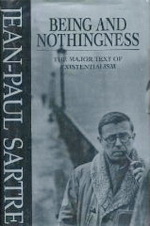 missed most of the early discussions, but as I came to understand it, Sartre argues that life has no intrinsic meaning at all and that the task of existentialists, those who are courageous enough, is to live a life of authenticity. Authenticity as a value has the great virtue of being centered in the self and if there really is nothing else, that is a great virtue indeed.
But if, in fact, there is something else, it would be good to know what it is and how to align oneself with “it”—or him or her or them, if you think ultimate reality has the characteristics we ascribe to persons. [1]
A lot of the broader questions I have heard discussed lately have divided on the question of whether human life as we know it is an I—It kind of arrangement or an I—Thou kind. As a Christian, and most often the only one present for these discussions, I am a champion of the I—Thou model. It is the presupposition of my own faith and of many many others. It is antithetical to non-personal religions of all kinds and to cynicism, which argues that it really doesn’t matter.
I began with Sartre, who, as I pointed out, is way out of my period, so I could make the point that the world in which I grew up—everywhere but home and church—took the non-personalist model for granted and celebrated it. I celebrated it right along with them until I realized that I was committing myself simultaneously to contradictory views. If I am going to hold contradictory views, I much prefer to hold them serially, rather than simultaneously. It’s less embarrassing.
Invictus
I’d like to begin with the poem” Invictus,” particularly as it is presented by President Mandela of South Africa in the movie, Invictus, in which Morgan Freeman plays Mandela. “It’s just a Victorian poem,” he tells the captain of the national rugby team, “but it helped me stand up when all I wanted to do was lie down.”
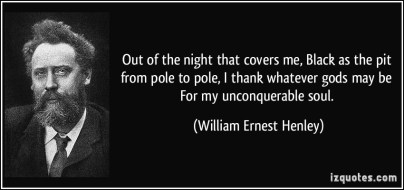 I have great respect for the effect that poem had on President Mandela. I have been affected in that way from time to time. It is a marvelous experience—not always one that feels good—and I am always grateful to have it. So I am a fan of standing up when all you really want to do is lie down.”
I am not a fan of the point of view represented by the poem. I am, as I said, a Christian. I am not the master of my fate or the captain of my soul. The person I associate most with that stance is Adam, the legendary father of us all, who caused us all a lot of grief by taking that position.
I know I am being unfair in making that comparison. “Invictus” was built for an I-It world. William Ernest Henley, who wrote “Invictus” finds himself unafraid. How much better that is than being fearful, and that is the comparison available to him. He finds himself unbowed (although bloody). He finds himself in possession of an unconquerable soul. How much better than is than having a conquered one.
But Henley is forced to chose between those polarities because there is nothing in life or in death to trust. If he isn’t “unconquerable,” then he must be “conquered;” if not unbowed, then bowing down; if not unafraid, then afraid. Those are Henley’s options.
But they are not the only options. What if there were someone—Someone, I admit the theistic premise right away—who could say, “I am your Father and I love you with a perfect love.” That gives new meanings entirely to “bowed,” to conquered; and to unafraid. This Father who loves can be said to conquer resistance (if not persons), and the bowing is completely appropriate as an acknowledgment, and the fear is replaced by trust. Those are, from Henley’s standpoint, new options. He doesn’t reject these options. He just doesn’t see them as available. [2]
When you walk through a storm
I didn’t really start this mental trip with” Invictus.” I started with an anthem text by Gerard Marklin. The anthem is called “Do Not Be Afraid” and it has this line in it: “When you walk through the waters, I’ll be with you.” I guess that was close enough for one nerve ending to make a post-synaptic recommendation to another and I remembered “When you walk through a storm,” from Rogers and Hammerstein’s Carousel (1945)
 It is not clear to me just why Julie will never walk alone. Will her husband Billy Bigelow, who killed himself, be walking with her? Will Julie’s cousin, Nettie Fowler, who sings this song to her, be with her? It says to have hope in your heart, which seems like a good thing, but what is one to hope for? Is an unspecified hope, a hope with no home, enough to keep you from being alone? It doesn’t seem like it, but this was the mid 1940s and maybe “hope itself”—hope with no clear referent at all—was thought to be enough.
Do Not Be Afraid
Marklin’s text, in “Do Not Be Afraid” provides a context for the hope and that is where the tears started running down my face. (See the full text at the end of this post or, if you prefer, hear it here.) It is a richly considered hope, fully as Jewish as it is Christian, and it has these elements. [3]
I am your Father and I love you.
I will be with you.
You will walk through the waters, but they will not cover you.
You will walk through the fire, but you will not be consumed.
You will encounter the fear on loneliness, but you will not forget that I am with you.
You will dwell in exile, as a stranger dwells, but you will remember that you are precious in my sight.
Belonging
Marklin uses half of a family metaphor, a half that matters a great deal to me. But here, I am going to add the other half because I think they make sense together. [3] I will call you by your name, says God in the passage (Isaiah 43) Marklin has in mind. But God also says, “I will call you by my name.”
I can’t help thinking of these as phases of development, although I know it isn’t really  fair. Abraham Maslow, whose stages of development are widely cited, says that we need to be a part of a group. But after that, we need to go on to become who we are ourselves, without reference to the group. My grad school mentor, Jim Davies, used to identify these stages by saying that we need to be a part—then we need to be apart.
Yes. We need to be called by His name. We need to belong to God’s family. And we also need to be called by our name. This God whose family we belong to, knows us, knows who we are, and knows our name. [4]-
It is that identity that marks off the I-It world celebrated by “Invictus” and by “When you walk through a Storm” from the I-Thou world of “Do Not Be Afraid.” I think the virtues claimed in “Invictus” are indeed admirable, by contrast to the alternatives that are considered. But there are, in this other world, alternatives that cannot be found in that world. Who, really, would choose simple indominability, if one could be truly known and truly loved?
I wouldn’t. But to choose to be known and loved, you must choose a world where one could be known and loved, a world where there are better choices than being simply the master of our fate, the captain of our soul. I choose that world.
[1] Ultimate reality “is personal,” I would normally have said, but this is a mixed audience and there is no harm is trying to communicate clearly, even if it does, on occasion, require a few extra syllables.
[2] Or maybe he sees them as available and contemptible. I don’t know that much about Henley.
[3] Conceptually, they belong together—belonging and being known are part of the family metaphor. But I think there is also a historical upgrade here. The context of the early passages ( 2 Chronicles 7 and many other citations) is that we are known by His name. We took His name in becoming part of the family. It is very collectivist. But this is an individualistic time and to say that He calls us by OUR names is the other part. He knows our names. He knows who we are. And in Revelation 2:17, the metaphor is extended even further: “I will give you,” says God, “a new name—a name only you and I know—the truest name you can have.”
[4] There is no way to make too much of this. In the ancient world, the name was the whole being. “Know your name” and “Know who you really are” can be considered equivalent expressions within that understanding of “name.”
Text
Do not be afraid, for I have redeemed you.
I have called you by your name;
you are mine.
When you walk through the waters ,
I’ll be with you;
you will never sink beneath the waves.
Do not be afraid, for I have redeemed you.
I have called you by your name;
you are mine.
When the fire is burning all around you,
you will never be consumed by the flames.
Do not be afraid, for I have redeemed you.
I have called you by your name;
you are mine.
When the fear of loneliness is looming,
then remember I am at your side.
Do not be afraid, for I have redeemed you.
I have called you by your name;
you are mine.
When you dwell in the exile of a stranger,
remember you are precious in my eyes.
Do not be afraid, for I have redeemed you.
I have called you by your name;
you are mine.
You are mine,O my child,
I am your Father,
and I love you with a perfect love.
Do not be afraid, for I have redeemed you.
I have called you by your name;
you are mine.
 iconically funny moments. Mother had seen a doctor for her regular checkup that day. On her way home, she stopped to get some groceries, including some milk. When she got home, she put the shopping bag on the table, put the milk in the refrigerator [3], went into the living room, turned on the TV, lay down on the sofa, crossed her ankles, and died. Just like that. But first, she put the milk in the…um…icebox.
 That presupposition is put even further out of conscious reach in the second stage in which you get injured or sick and then recover. You look at the picture of disability as an episode in an otherwise whole and healthy life. You might feel grateful, for a little while, to regain the full use of an injured leg, but you life goes back to normal and you count on the leg to function “normally.”
 round of satisfactions and successes. I can go back to teaching if I teach two courses instead of three. I can get back on the trail because I can still run on soft surfaces, but running on the hard surfaces of my neighborhood are a thing of the past. I can rejoin the book group with the understanding that the “discussions” are now going to include detours of personal reminiscence and repeated stories. It’s “back” you see; it just isn’t all the way back.
 likely to do in the next season.
 respect us. I am concerned entirely with the effects of one kind of assignment of responsibility or another and the first thing I notice about this one is that it is external. It would be entirely possible for this group to say that they are not worthy of respect and that is why they aren’t getting any. It isn’t very likely, of course, but that would be an internal attribution (it’s “us”) rather than an external one (it’s them).
 occasion for the expression of their unhappiness, but the current occasion is not the reason for their unhappiness, just a chance to express it. What kind of formulation of their unhappiness will loosen the borders of the category so that nearly everything “fits” into it? Conversely, what kind of formulation will keep each reason for unhappiness separate and therefore easier to act on?
 Internal: There is no reason, for instance, that the problem described above could not have been formulated as an internal problem. [4] “They” don’t respect us (although they should) is an external problem. There is no reason, absent some context, that the difficulty represented in this picture should be formulated as the bridge being too low or the water being too high. Which way to define it depends entirely on what tools you have at your disposal.

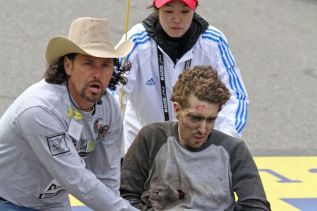 were so badly damaged that they had to be amputated above the knee. He may very well have died from loss of blood had Carlos not intervened. But he didn’t die and a very frightened city declared him to be a hero—just for not dying.
 The help he gets, he gets from his sometime (but not current) girlfriend, Erin (Tatiana Maslany) who sees what he needs and is unwilling to withhold it from him. She is immediately heroic, as I see it, although that is not the way the movie understands her. And when all the crisis is over and Jeff has had a chance to discover in a whole new way just who he is, he gives himself to Erin. That is very satisfying. He says something to her in this scene about “leaning on her.” Yes he does.
 Everything is wrong with the Blackhawks event and it is portrayed so that we see that. Here, for instance, is a picture I didn’t see at the movie and now that I am looking at it, I can hardly believe I missed it. Look at the cage the shadows of the hockey goal make on his face! Then Jeff goes through a lot of development. He learns, for instance, that giving Boston the hero they need so badly is a form of self-transcendence.
 So he does. He plays the hero for them. He throws out the first pitch. [5] Carlos pushes his wheelchair out to the mound and that makes sense because Carlos is a hero in the same sense that Jeff is a hero. (As viewers, we understand Erin’s heroism at the Bruins game, but no one in the film understands it that way.) And then he tries to escape from the setting of the game, having done everything he thinks he can do. But here, his heroism catches up with him—not the phony imputed heroism that Boston lavished on him, but the real personal heroism that is based on his courage in responding to his personal disaster. A man named Larry needs to talk with him about the courage he has shown, and Jeff is willing to talk. We are surprised when Jeff asks the man his name; we are dumbfounded when Jeff reaches up and hugs him.
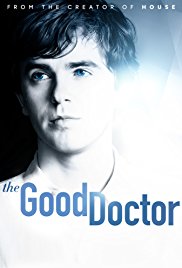 man. Also autistic. Also extremely bright. When you hear him diagnosing a medical condition, you think of Sherlock Holmes.
 The second occasion was set up when she comes back outside—where Dr. Murphy is still waiting in the rain—to ask him why he kept recommending an echocardiogram. He gives a plausible reason, but while they are talking, the call comes that the echo revealed nothing at all. Dr. Murphy rejects that reading of the echo and when, through Dr. Brown’s auspices, he is shown the screen, he sees something no one else had seen—why the patient is still in danger. That’s the second occasion, and Dr. Murphy characterizes it as “nicer to me.”
 That brings us to the final two questions. The first is, what can Dr. Murphy do to keep from destroying a very good hospital staff? We pretend with each other. We represent ourselves as more interested than we actually are or as less offended than we actually are. We are expected to do that. We are very nearly required to do that, given the penalties that are meted out for failing. [4]
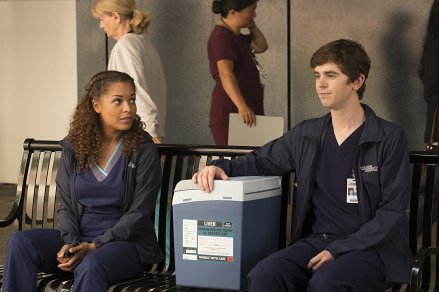 doctor is candid, we are going to have to think about what candor is. The Merriam-Webster podcast which featured this word in 2012 gave an illustration like this: “when the job applicant admitted to some indiscretions in his past, the interviewer thanked him for his candor.” Since the root, the Latin adjective candidus, means “white” or “pure,” I think we can see in this interview, the idea that putting your best foot forward is a violation of candor. The “shaping” of your presentation of yourself is a “blot,” let’s say on what would otherwise be a pure unshaped presentation of yourself.
 and over and he knows what he is talking about. Frodo, like most of the rest of us, is living in the only time he knows. [1] And like the rest of us, Frodo is forced to take the presuppositions of his age for granted.
 What you do know is that the water used to reach much further up the beach and now it is clear down to where you are standing and it is still going down, going “away.” You are horrified, let’s say, because you liked this part of the coast where the ocean “used to come” and you long for “the good old days” when the water—you don’t know to call it a “tide”—used to come all the way up to here.
 ded to have large families of obedient children.
 In the next phase, the helicopter parent phase, parents are responsible for the good choices and the consequent happiness of the children. Let’s just stop and think how far we have come from the farm family where the kids are plowing the back forty and gathering and selling the eggs. Now that the parents are responsible for the choosing that the child does—not, please note, for the choices themselves [3]—a child who is not choosing well or who does not play nicely with others or who can’t make the soccer team or who is not happy, is a problem that the parents need to do something about.
 as autonomy for children and choosing as the principal mode of self-expression and the complete responsibility parents have shouldered for the quality and the success of their children. If it is really high tide on all those things, then the demands they make need to be met in some way. Or perhaps they can be modified. Or even rejected.
 of goo and the sole function of these humans is to provide, through the natural operation of their bodies, the electricity that the Matrix requires to rule them and keep them (us) in their place. In this picture you can still see the goo on Neo and several of the pods near him, each containing a “human battery.”
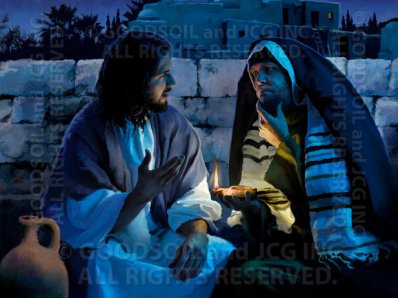 By all three of these expressions, Jesus is talking about the new life in the spirit—the life of the ages—and Nicodemus is talking about the old life, the life of the flesh. So when Nicodemus understands anōthen as “again,” he immediately thinks about being born a second time in the same manner that he was born the first time. So he asks disbelievingly how it is possible for a grown man to enter his mother’s womb so he can be born again. My argument is that in his conversation with Nicodemus, Jesus is better understood as contrasting the insignificant (merely earthly) with the enduringly significant (the heavenly).
 found it too challenging. Cypher is rescued from the life he imagined he was living and was made part of a real life. The real life was dreary and difficult and he made the choice for which John ridicules Nicodemus. Here we see Cypher in the matrix “experiencing” a juicy steak. At the moment of this picture, his body is back in the hovercraft, but he is making arrangements to be put back into a tub of goo and to have an imaginary life restored—a life of complete insignificance. He says he wants to be somebody famous.
 Second, you can be rescued from such a life. We see Neo choosing it. This is the justly famous “red pill or blue pill” scene where Neo may choose to go back into his life of illusion (blue pill) or he may choose to be rescued (red pill)—literally “lifted up” from the tub of goo—and live a real, though hazardous, life. Note: to insert the picture here, I have to click on a button that says CHOOSE. Not a bad name for this picture.
 My goal for today is to define the difficulty Mr. Peterson is in and to extend my sympathies. If he and I were having a discussion about the U. S. and the future and about what is needed for the long-term health of our homeland, I think I would get angry at him and say things I shouldn’t. But sitting here at my desk on a beautiful fall day, I have nothing for him but sympathy. [2]
 character. Well…”good character,” really. He believes that people ought to make the right decisions because they are the right decisions. And they do sometimes. But when the economic supports for what used to be “the right decisions” go away, you get a situation where “character” points this way and “economic viability” points that way.
 “degrades the marriage market value of the men.” As a social conservative, he deplores the destruction of intact families and the production of children that no one seems to be able to care for. But now, as a political conservative, he also opposes the government programs which could soften the impact of the economic difficulties and ease some of the social costs of postponed marriages. There really isn’t anywhere else to go.
 The Dilettante's Dilemma