
When Robert Dahl died some years ago, I wrote an essay I called “Robert Dahl, R.I.P” That seemed about right, but today, as I am saying goodbye to Billy Graham, it occurs to me that a big part of Robert Dahl was Yale and a big part of Billy Graham was rural North Carolina. I think I might have managed “Requiescat in pace, William Franklin Graham.” but nobody called him William Franklin Graham. [1] so I have settled for “Goodbye, Billy.”
According to the New York Times, Billy died early in the morning of February 21. Now the wars will begin. Billy’s own goals were narrowly focused. He was an evangelist. He held mass rallies all over the world. [2] It is what he was good at.
 Unfortunately, he was a very popular man and everyone wanted a piece of him, including every president of the U. S. since Truman. Psalm 18 refers to God as our “shield and buckler” and that is a good thing, but President Nixon used Billy Graham as his shield and buckler and that was a bad thing. Billy hoped to be spiritually helpful to the presidents he counseled, and he may have been. He was, without question, politically helpful.
Billy was the cleanest of the clean in the sometimes sordid field of American evangelists. He didn’t get rich. He didn’t have affairs. The books of the Billy Graham Evangelistic Association were open to scrutiny. He doesn’t ever seem to have really desired fame except as a tool to use in his work.
He was a social conservative. It’s hard to see how he could have been anything else, given his background. That made him an easy target for feminists and gay rights activists. He was likely to apologize to the people whom he had offended—real apologies, not the current “non-apology apologies we hear today [3]. He considered himself bound by the same standard of conduct he preached, and I think that’s admirable.
I don’t have any trouble admiring Billy Graham, but his view of what Christianity was all about has been has been one of the major entrapments of my life. I have spent all of the fifty years since my late 20s trying to get out of the box that Billy lived in preached from and believed in. That’s really what I want to talk about today.
I have been thinking about Billy anyway because last week, Bette and I watched an episode of The Crown in which he played a role. [4] Here is the beginning of his sermon.
As I considered what to preach about today, I considered various topics which speak to me personally. but I thought that i would start with a simple question. What is a Christian?
The Bible tells us. Colossians 1:27 says that a Christian is a person in whom Christ dwells. It’s Christ in you. The hope of glory. It means that you have a personal relationship with the Lord Jesus Christ. That encounter has taken place. You have received Christ as savior. And that is what a Christian is.
That seems quite straightforward, but, of course, it isn’t. It is hard to say just what “a person in whom Christ dwells” means. It is hard to say clearly what “personal relationship with Christ” means. It is hard to say what “encounter” must mean, even though it is easy to say what Billy means by it. Similarly with “received” Christ, rather than “recognized” or “admitted” or even “acknowledged.” All that language is familiar and meaningful in the rural south and in evangelical circles everywhere. When I say that it isn’t straightforward, I mean it is hard to explain to people from other Christian traditions and that (now) includes me. It is completely straightforward in Billy’s home culture.
 The matter gets further complicated in The Crown in the next scene where Queen Elizabeth has a private audience with Billy, after the chapel service. She compliments Billy on his clear exposition of the demands of Christian faith.
Elizabeth: In an increasingly complex world we all need certainty and you provide it.
Billy; Oh that’s not me. The scriptures provide it.
“Certainty” Billy says, is what the scriptures provide, but I don’t think so. One of the things I did at Wheaton that has served me well over the years is study Greek. Without any Greek, you are pretty much stuck with “the English translation,” which in my youth was the King James Bible.
The King James Bible does indeed say what Billy says it says. “ to whom God would make known what is the riches of the glory of this mystery among the Gentiles; which is Christ in you, the hope of glory.” But the Greek makes it clear that “you” is a plural preposition, so Billy could have said “Christ in y’all” and been truer to the text.

The ‘umín in line three (fifth word from the left) is “you plural,” not, as Billy uses it, “you singular.” So a better way to translate it would be “Christ among you,” or “Christ in your presence.” which is certainly what Paul or a disciple of his (however you judge the authorship of Colossians) meant. The New Jerusalem Bible catches that nicely as “ It was God’s purpose to reveal to them how rich is the glory of this mystery among the gentiles; it is Christ among you, your hope of glory.”
So the relentless individualism which is so characteristic of Billy’s slice of conservative Protestantism is not at all well served by the text he chose for Queen Elizabeth in this episode.
According to all the Bible study I have been doing for the last few decades, the first job of studying scripture is to find out what the author meant in addressing the text to some particular body of Christians. And when I have a chance to teach at our church in Portland, I rail against the common practice of taking the text as it appears and applying it immediately to our own situation and language context. What I would say to my class is that when we understand what Paul (or whoever) meant is saying that to the church at Colossae, then we have a better chance of understanding what that same text—in its context, of course—can mean to us.
And if one of my students said that scripture provides certainty, meaning that we make safely snatch those words out of context and apply them to ourselves, I would say, “Actually, we can’t. They don’t apply directly to us. They apply indirectly to us. They matter enormously, but you have to deal with the thought, not just the words.”
So I have been battling “Graham-ism” all my adult life. It has been costly. When so much of your work is showing that the passage does’t really mean that, it is hard to turn the corner and commit yourself to an openminded and open-hearted consideration of what the passage does mean and what effect it would have on your own life if you took it seriously. Turning that corner has been the work of decades now and I still lapse back into criticism when I am off my game.
But I don’t think I would have battled Billy. People who knew him said he didn’t spend all of his time being “the big deal evangelist.” He was just a thoughtful and kindhearted Christian man and I think I would have liked him.
[1] When I was at Wheaton. Billy’s alma mater and mine, the President, V. Raymond Edman, had that same difficulty. He was bestowing an honorary doctorate on Dr. Graham in 1956. As he was putting the hood over Billy’s neck, he said, “William Franklin Graham…” and then he stopped as if that was inappropriate, and revised it to “…Billy.” I think if President Edman had had his way, Wheaton’s most famous alum would have been known as Dr. Billy.
[2] Including racially integrated rallies in Mississippi. He wouldn’t do it any other way. This North Carolina son said, “I will not preach Jim Crow.”
[3] He once ran afoul of the Nixon secret taping machine in the Oval Office where he was recorded saying some scurrilous things about Jews and their effect on American society. He didn’t remember saying it, but when the tape showed he had, he went to his Jewish friends and apologized.
[4] This is Season 2, Episode 6, “Vergangenheit.” Queen Elizabeth asks Billy to preach in the chapel in Buckingham Palace and the section of the script I will be using here is from that episode. It is a fact, however, that Billy and Queen Elizabeth were friends and she knighted him in 2001.
 The same thing happens on the social side. A resident I have gotten to know in my brief time here shows up in the little coffee nook where world problems are hashed out every afternoon [4] and today, he has a cane. Tomorrow—or some tomorrow or other—it is a walker. Then a wheelchair; then a wheelchair with oxygen. Then he doesn’t come all the time; then he doesn’t come at all. These are perfectly ordinary signs that “it” is failing.
 The other side of that dichotomy is harder. The other side is when “you” begin to suffer losses so that you are “no longer yourself.” That’s the way they say it, but, of course, you are “yourself;” you are precisely the self you now are. You are not the self you used to be, of course, which is what everyone who uses that phrase is understood to mean. [5]
 prominent response. When a person has lived a long and successful life, it is perfectly appropriate to celebrate that life as a whole and at the same time to mourn the loss the the person.
 him look bad. I’ve been grateful to him ever since for being willing to do that. His notion of living the Christian life was that around him in the world were people he was called to serve. He didn’t have a narrow or a specifically religious notion of what “service” was. He did have a sense of how those people were to be identified to him, however. He counted on the Holy Spirit to move him toward those particular people he was being called to serve. Not only is that resolutely orthodox; it was not even unusual at Wheaton when I was there.
 Now let’s go back and look at the sequence. “Eliminating drudgery” creates the possibility of leisure, which in turn creates the possibility of self-cultivation in a way that was once possible only for aristocrats. With these new household “conveniences,” everyone can be “like an aristocrat.” [3]
 If it were formulated as a rule, and there is no reason to think anyone would really do that, the rule would be this: if it takes either work or waiting, I will choose something else. Political reform? Takes too long. Providing infrastructure? Way too long. Slowing the rate of climate change? [4] Not every worth thinking about. Easier just to deny the reality of it.
 of St. Bonaventure Hospital in San Jose. Here are Dr. Coyle
  and Dr. Browne. She reproves him as she should and reports him as she should. But Dr. Kalu, her boyfriend, (that’s a gross characterization, but it’s good enough for this small turn of the plot) is angry and physically assaults Dr. Coyle. And then he gets fired for having done that.
 This requires a confrontation between Allegra Aoki (Tamlyn Tomita), who is Chair of the
 St. Bonaventure Foundation—that means she presides over the sources of the money that fund the hospital—and Jessica Preston, (Beau Garrett) who is Vice Chair of Risk Management. You see them here.
 Dr. Andrews, the black Chief of Surgery, (on the right) reproves Dr. Kalu, the dark
 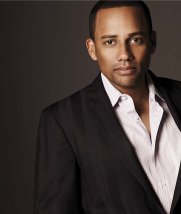 surgical intern, (on the left) for playing the race card inappropriately. Kalu defends himself by arguing that the case he made—white doctors in that situation have been treated differently than he was—is true. Andrews says that isn’t a good enough excuse. “You stepped over a line,” he says. He doesn’t say what “the line” was, but he is about to.
 is like. [1] In The Great Divorce, Lewis gives a very interesting account of the Spirits who are in Heaven and who belong there. In Lewis’s version, the Ghosts come up from Hell as visitors—there is a bus every day for that purpose— and are met at the bus stop by the Spirits who are there to help them.
 It is also true, in this fantasy, that the Ghosts are completely insubstantial. Picture a column of smoke in the shape of a person. The Spirits are substantial—“real” Lewis says—because Heaven is “real” (substantial) and that difference in the two places mimics the spiritual condition of the two kinds of beings.
 physical tasks. The Rights-monger cannot simply wander around Heaven on his insubstantial feet, much less begin a journey to the mountains. He will need quite a bit of help and Len is offering it to him. It means spiritual tasks as well, as in asking for forgiveness for the evils Len had done on earth.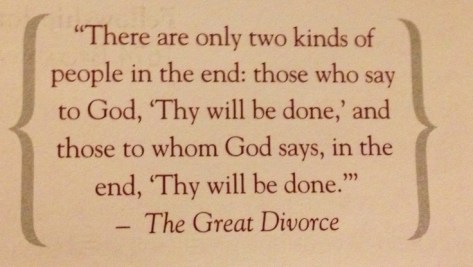

 There are people here, for instance, who manage to stay in touch with their biological family—that ordinarily means siblings and children and grandchildren—and also to build stable friendships with the other residents. I wasn’t all that impressed at the beginning of my time here, but now that I have given it a try, I know how hard it is and I want to learn how they do that. I don’t want to copy them—the differences also need to be taken into account—but I want to learn how they see the field of play and how the decide what to do.
 chipper; the husband was quiet, but he could say things that made sense on their own and that contributed to the conversation. Sometimes. And sometimes not. When “sometimes not” happens, the wife has a decision to make.
 incontestable outline of things. And after that, and without losing any awareness of it, you can attend to a good deal of complexity without losing your sense of the vision as a whole.
 And it isn’t just history. In preparing for a Bible study course that begins in September, I have been studying the Old Testament prophets. And all of a sudden, it occurred to me that there were three major categories of those prophets. Only three. There were the pre-Exilic, whose message was that God is going to punish (“discipline” in some of the prophets) you for your godless ways. And then there were the Exilic prophets, who said to Israel, “Your sentence is almost up. God is going to restore you to your homeland.” And there were the post-Exilic prophets who, with the exception of Jonah, said, “The holiness of the temple and the city and the worship of Yahweh have all been compromised while you were gone. Put things back to the way they should be.” [3] This is someone’s notion of what the prophet Amos looked like. He was one of the pre-Exilic prophets.
 When I hit my first communitarian sociologist, Frank Hearn, I was fascinated by his allocation of all kinds of “social problems” to one of three places. His own preference as a sociologist is that most problems be considered as “social problems,” by which he means problems rightly referred to communities using their own local institutions. But that means that he has to have a nasty name for the practice of referring those social problems to other places, where they really shouldn’t be. [4] Problems that are rightfully social, but that are referred to the polity instead, have been “politicized.” Problems that are rightfully social, but have been referred to the economy instead, have been “commodified.” Three places to put problems: no more. Horizon.
 complexities of today’s policy proposals. DACA or not? Amnesty or not? Enhanced legal immigration or not? But all of these questions take the present political system—the old classic post-medieval Liberal system—for granted. And Deneen says that system is running out of fuel and can’t be saved. I’m sure this picture is an ad for a business of some kind, but note the similarity to Deneen’s communalist picture of liberty.
 movies. [1] The picture I am relying on here is the patient lying on the couch free-associating in the presence of a fully present therapist. The “free” of free associating means, in part, that the little boxes in which we keep the thoughts and feelings that contradict each other are all opened at the same time in free association. And they associate with each other, not in the dark safety of the mind but in the public space between the therapist and the patient. Both hear the patient say things neither has ever heard before. [2]
 year, red states want to do red state things and blue states want to do blue state things. And every year, each color has to put up with federal regulations that requires them to be much more similar than they would really like to be. This tension between the national administration of national systems and the state preferences which express the political culture of their own states, is the heart of the federal bargain.
 know that because they aren’t working. Further, they are not working because they choose not to work and in that choice, they forfeit their claim to society’s help.
 states are finally being allowed to do what they have wanted to do for so long. It is this “permission,” that called to mind the image of Dr. Trump as the therapist and “the red states” as the patient. Dr. Obama kept telling them how they should feel—compassion, for instance, toward those not able to find work—and made them feel ashamed of how they did, in fact, feel. Dr. Trump is allowing those states to say out loud what they have felt for so long and is giving them permission to build systems tying work to medical service.
 has not yet abated. Some of that animosity appears to be no more than personal grudges projected onto public issues. What could have been a perfectly normal division within the Democratic party between the ideological left and the pragmatic center, got blown out of proportion by the personal attachments of the campaign supporters. Hillary’s people need to get over blaming Bernie’s people for “denying her the election.” Bernie’s people need to get over their resentment of Hillary’s persistent tacking to take advantage of the winds of the campaign season
 This argument agrees that the Republicans may be very weak in 2020 as a result of the expected Trump implosion but they make the case that winning seats is more important than the success of the programs so dear to the left wing of the party. And you don’t have to say out loud that you don’t share those goals if you can just make the case that it would be risky to pursue them.
 are not the same kind of thing at all. The dominant voice of the Republican party is now a movement-oriented voice, something like jihad. The Democratic style is collecting groups of voters who are willing to sign on for the campaign, like a state militia. The Democratic party works like the United Nations, not like Al Qaeda. [4]
 Of course, the fact that I am not “working” anymore doesn’t mean that there aren’t things I want to do. In fact, there are things I commit myself to accomplish and they highlight that task-focused center and they push my focus on myself to the blurry periphery. It’s a very familiar feeling and most of the time, I like it.
 to be done—sometimes there is a deadline—and you need to do to yourself whatever you need to do to get it done. Solitude, alcohol, stimulants, brainstorming…whatever. So starting from the other end, “What job best fits what I have to give right now?” is a whole new thing. Sometimes I am frazzled and can’t focus on anything. That is the basic fact. But there is a collection of errands or chores to do that require virtually no focused thought. I can do them just as well when I am scattered as I can when I am cogent. So I choose those.
 tranquility by showing you this picture. The case for: wouldn’t it be great to be able to be like this some part of every day? The case against: wouldn’t it be awful to be like this all day every day?
