
Two quick things. Yes, this is Easter Sunday. [1] No, this isn’t about the resurrection appearances of Jesus, except, perhaps, analogically. This is about the movie, Michael, and John Travolta plays the reappearing angel, Michael.
I’ve written about this movie before because there is a wonderful scene in which Frank  Quinlan (William Hurt) flatly denies all of the events that have made up the movie up to this point, including a very real romance between him and Dorothy Winters (Andie McDowell). Here he is denying it all to his buddy Huey Driscoll (Robert Pastorelli) who experienced it along with him.
Quinlan.: As far as I’m concerned, it never happened.[2]
Driscoll: But we were there. We saw it.
Quinlan: No. Never happened.
Driscoll: So…where’s your raincoat? (he gave it to Michael)
Quinlan: [this is my summary of his position] It never happened and you know why? Because if it happened, I’d have to believe that wonderful and unaccountable things could happen to me for no reason at all. And I don’t want to believe that. I refuse to believe that such things are possible. So I resolutely deny what you and I both saw and lived for all those days.
Maundy Thursday
But on Thursday, after our Maundy Thursday service at church, I was feeling…oh…quiet, I guess. So I got out that last section of Michael to watch it again and this time I saw much more than ever before. I saw Quinlan “seeing” Michael after Michael’s death and I saw his emotional response to that seeing and I saw the changed behavior that resulted from it and I followed it all the way to the denouement, which is “true love,” the closest Hollywood ever gets to Life Eternal.
And that’s what I want to tell you about. This is not about who is seen; this is about what happens to the see-ers.
Quinlan becomes a (temporarily) changed man under Michael’s care. He allows himself  to really care about Dorothy, for instance, and “opening Quinlan’s heart” is why Michael came to earth this one last time. But, it turns out, that all that was contingent on Michael’s actual presence. We learn that because when Michael dies, Quinlan snaps back to his old cold self almost instantly.
So if Michael is here on a bet—that’s what he tells Quinlan—then either he has lost the bet or he hasn’t won—yet. Quinlan says to Driscoll that what they both saw happen couldn’t possibly have happened because if it had, he would have to believe that “things” would unaccountably and without any initiative from him, simply fall into place. The example he uses is that a car carrying the woman of his dreams would pull up to where he is walking and get a flat tire. Ridiculous, right?
This is Quinlan’s sober careful thought; his way of distancing his mind from all the conflict. And that has been “working” for him. He has continued to live the thin flat life he has gotten used to. If you call that “working.” Except that as he leaves the bar, he thinks he sees Michael walking down the street in front of him. This is an instant dilemma for Quinlan and I feel very much in debt to William Hurt for making that dilemma show up fully in Quinlan’s face. “It never happened,” is a great position in a bar with a friend who knows why you are doing what you are doing, but out in the street alone at night, you see someone who looks very much like Michael wearing something that looks very much like your raincoat.
“It never happened” has no more chance of success than Thomas’s “Unless I can see…I refuse to believe” as he stands there confronting the risen Jesus. So Quinlan calls out to Michael and starts walking quickly down the sidewalk toward him. Michael picks up the pace. Quinlan begins running; Michael stays ahead of them.
Not to break the suspense or anything, but what Quinlan wants more than anything is to see Michael again. What he needs more than anything is to have his heart opened to Dorothy. [4] Quinlan doesn’t know that is a possibility; the viewers don’t know it is a possibility. But Michael does and whether he is dead or alive—or whether, with angels, it matters at all—he is still trying to win his bet. He is not willing to go home until Quinlan can go home and “home” for Quinlan requires Dorothy.
 The next scene requires just a little context. My all time favorite of Jesus’ resurrection appearances is his walk to Emmaus with two of his followers. They spend a long day on the road with him and have no idea who he is until at the evening meal, he broke the bread and handed it to them. Suddenly, they knew what must have been true all day.
Back to the movie. Quinlan is now is full pursuit and he round the corner and runs into Dorothy. They are both startled. Dorothy starts, “I thought I saw…” Quinlan says, pointing back the way he had come, “He came that way.” Dorothy responds, pointing back the way she had come, “No, he came that way.”
Quinlan has been fuddled. We saw that clearly in his conversation with Huey Driscoll at the bar. And now he has been unsuccessfully chasing a ghost who is wearing his raincoat through the streets of Chicago. But even in that condition, Quinlan understands that no one could have been simultaneously leading one person east and another person west.
So we might say that Michael is “present” again. He is present to Frank, at least, for he looks longingly at Dorothy and says, “I love you, Dorothy.” On the third time he asks her, she consents to marry him. [4] He puts out his hand and she takes it and he says, “Let’s go home.” And now that he has Dorothy, he actually has a home.
So Michael wins the bet. And as Quinlan and Dorothy walk like lovers crossing the street and going home, Michael peeks out of the alley where he has been hiding. And Pansy Milbank (Jeane Stapleton) who has been Michael’s ally through all of this and who died much earlier in the film (see footnote 4), steps out with him. And Michael holds out his hand and Patsy takes it, and he says, “Let’s go home.”
It is exactly what I wanted to watch late at night after the Maundy Thursday service. Maybe I’ll watch it next year, too.
[1] And this year, it is also April Fool’s Day. I think that is the perfect pairing. It gives everyone a choice.
[2] All the time he is saying this, he is eating sugar cubes and they show us Huey noticing that he is doing it, but he doesn’t say anything. The joke is that Michael had the world’s absolutely worst sweet tooth. He poured sugar on his Frosted Flakes at breakfast. The joke for us viewers is that we get to celebrate Quinlan’s saying it never happened as he is doing something he would absolutely never have done otherwise.
[2] So again, the distinction between what we want and what we need is illustrated. We can only think what a disaster it would have been had Quinlan been able to catch up to Michael, which means he would not have collided with Dorothy.
[3] And this is Andie McDowell’s star turn. She knows that Quinlan needs to really open himself to her and his first attempt—“Marry me.”—doesn’t do that. So she says no, while everything else about her body and her face conveys yes. And she does that twice. Two of the most enticing no’s I have ever seen.
[4] Director Nora Ephron plays on the idea of being “really here” or not from the beginning of the movie. Here, for instance, is the scene where Quinlan, Driscoll, and Dorothy meet Pansy’s friend, Michael, the angel.
Pansy: Do you see an angel?
Dorothy: I don’t think I do.
Pansy: Then how could I be with him?
Quinlan: Well, we don’t know exactly how it works with angels.
Pansy: How it works? If he’s in the room then you’re with him. If he’s somewhere else, then you’re not.
Dorothy: [very hesitantly] And that’s why we can’t see him now? He’s not here.
Pansy: Are you impaired in some way that I haven’t noticed, Miss?
 Please note that she makes her case twice in this brief paragraph. The first is quite general: “The danger of any education…” It defines “a broader liberalism” as the promotion of economic equity. It contrasts the values implicit in “big money” [2] and “progressive values.”
 political critique they don’t have the guts to make. Ms. Belafonte’s charge is that they have progressive values, but they can’t risk offending wealthy donors, so instead they go over the actions of the faculty with a fine tooth comb to see if anything has been done or said that could be prosecuted on grounds of moral rectitude.
 is that it directs my attention to the wrong place. Let’s take Matthew’s interest in Jesus as a player in the cosmic drama, for example.
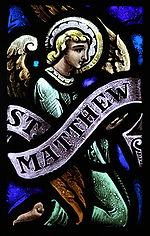 Or we could say about Matthew, “There he goes again.” There is no way, we might say, that Matthew is going to preach about the death of Jesus without a host of cosmic phenomena. [4] There is no value at all in asking why Matthew is interested in the cosmic dimension of the Christ. We might ask where he gets the accounts he passes along. He wasn’t there. This isn’t an eyewitness account. Where does he get it?
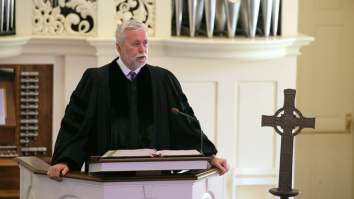 each thinks most needs to be said. The second problem is more difficult. If I am preaching and the tools I have in my tool kit are my collection of Jesus stories and the needs of the congregation are not clearly addressed by any Jesus stories I have…then what I really need is a new Jesus story. The picture is President M. Craig Barnes of Princeton Theological Seminary, who is probably the best preacher it has ever been my pleasure to hear.
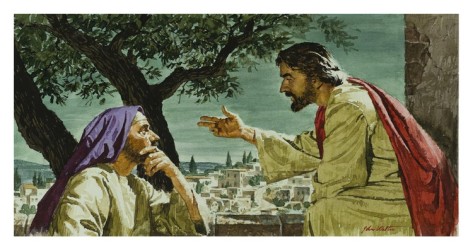 Reading the gospels as narratives, I focus on the art of the narrator. I pay a lot of attention to the dialogical style of Jesus in John. When I read about Jesus’s interaction with Nicodemus in Chapter 3 as if it were taken down by a court reporter, it sounds like an inquisition. Nicodemus is a hapless tool and Jesus embarrasses him whichever way he turns. [6] When I read that same text as an example of a format John uses—and into which he puts Jesus—in order to raise and highlight questions that would not be available for consideration otherwise, I can read it differently. John is writing both parts (the Jesus in John’s writing and the Nicodemus in John’s writing are two halves of a set dialogue) and he is writing them so that his goal as a narrator will be successfully reached.
 Or, in the case I am just about to describe for you, not even teaching; just convening. This year, at the senior center where I live, we used the Foreign Policy Association’s annual program, Great Decisions. It teaches itself, in a way. There is a video of eight 30 minute programs and a briefing book to go with it. My own job was simply to convene the group, show the video, and moderate the discussion afterward.
 intended to be parallel to the Pax Romana and the Pax Britannica and when the Pax Sinica (the peace guaranteed by Chinese ascendancy) is fully in place, they will say it is a parallel expression to the Pax Americana. So I, along with everyone else was familiar with the Pax Americana. It means that the U. S. is the principal guarantor of the dominant international order. But what kind of system is it that we guarantee?
 Equality could be about politics— “one man, one vote” said the Supreme Court in 1963—but it cannot be disconnected from questions of economic equality. South Africa is a good illustration of that, of course, and I already knew that. Allowing the black citizens to vote changed everything politically and almost nothing economically. So what are we doing over there is the next bar to South Africa? That brought Jeremy Adelman’s distinction between liberty and equality right back to me and this time, with some force.
 So the first thing to know is that the Sermon on the Mount is a device that Matthew uses to contrast Jesus to Moses. Moses goes up on the mount and brings down the Law; Jesus goes up on the mount (different mountain, of course) and refines the Law’s demands. That is why v. 39 (above) is preceded by v. 38, which cites “an eye for an eye and a tooth for a tooth” as if it were clearly the Mosaic standard. And that is the point Matthew is trying to make: the “old law,” what Moses brought to Israel, is no longer enough and we must now open ourselves to “the new law,” that is, to Jesus.
 Frances understands eventually what her mother understood right from page 1: Thelma is a predator and Frances is her prey. That is the nature of the relationship—mother gives several examples—and will continue to be the nature of the relationship unless some kind of fundamental change is made. You could argue, I suppose, that Frances might suggest that they both become prey; that no one take advantage of anyone else. But the only action that is entirely within Frances’s power is to become a predator just like Thelma and that is what she does when she cheats Thelma out of the tea set. And Thelma recognizes it right away. “I see that you, too, are now capable of predation.” That’s what “I am going to have to be careful “means.
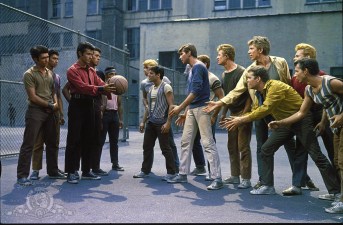 There isn’t a war, but the gang leaders—these gangs may be ethnic enclaves or nation-states with elected leaders—say that there is going to be a war and furthermore that there should be a war. It is a moral necessity. “Yo, Sam,” calls one of the aspiring leaders, “You have no business hanging around with people like George there. He’s one of THEM. Come over here and we’ll take the war to him.” There’s nothing remarkable about that sentiment—the awful tone deaf language I used to convey it is bad, sure, but you get the idea—and it is, in fact, the basis of shock jock radio.
 The Fascist Party of Italy, about which I have headline knowledge only, is presumably anti-immigrant. They promise to take Italy back to some largely mythical “golden era” when things were as they should be. The party proposes programs about how to accomplish that. Let’s imagine, just to have something to refer to, that everyone who can’t prove he or she was born to an Italian father and mother, has to leave the country. What that means, for our example, is that Signor Salvini has to look at the proposals of the Fascist Party and say, “I don’t care about those.” You can hear that in “I guess he’s a fascist, too,” as if he were saying, “And I hear he also collects stamps.”
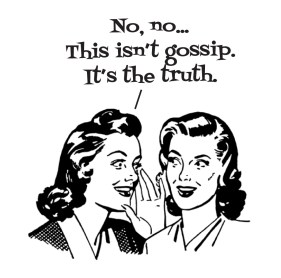 But if, in the present context, the alternative to truth is gossip, then I vote for truth—even for “truthiness.” [8] When you live in a small village, you know you can pass along “information” you got from one person, because it is likely to be true, but not “information” from another person because he or she–not just “she” as in the picture– is a notorious gossip and just passes along what he or she has heard, without assessing the likelihood of it. Life is the same is small organizations. You get a sense of who screens his remarks for the likelihood that some piece of information is true and who just pass anything on.
 what is being said, simply bristle with aggression or twist with implication and you never really noticed. That’s why it was flat to you. And when you notice what is being said, you wonder how you ever managed to pass it by as if it were not remarkable.
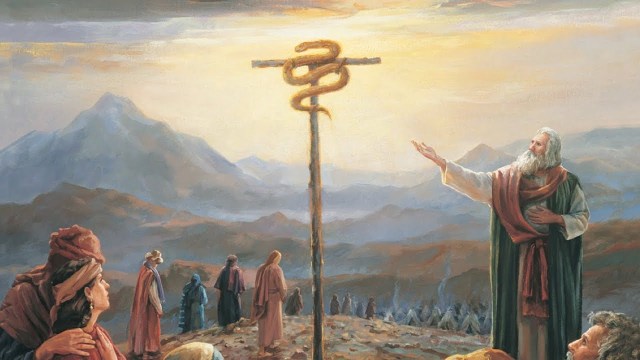 But what is John saying about everyone else? That takes us back to the wilderness. The snakes were a punishment from God and they afflicted Israelites generally. They did not seek out the ones who had been complaining and bite them and leave the rest alone. Furthermore, God did not withdraw the snakes when the people repented; God just provided a remedy for some of the Israelites. And to be saved from death, the Israelites had to “look at” the bronze snake on the pole.
 as nonsensical as “looking at a snake on a pole.” [5] Believing Moses wasn’t always the obvious thing to do. He had had his good moments and his bad moments. And they had just had their hands collectively slapped about the golden calf and here is this “brazen image” thing again. But there is something very persuasive about feeling that you are dying from a poisonous bite and looking at the snake on the pole as you were told to do and recovering from the poison. People who had seen that done might very plausibly exhort others to “take the treatment” and be saved.
 are people who tell the good news. In the desert, the good news is that you really don’t have to die because you were bitten by this snake. You can go to the pole and look at the snake and you will live. Not “eternally,” but you will not die today. People who carried that message to their friends and neighbors who would otherwise by dead by tomorrow, were carrying “good news” indeed.
 How a movement like that could be “overcome,” I have no idea and, in fact, it makes me think that someone in the marketing department at Harvard University Press added that last little bit to sell more books.
 Does that mean giving up “denouncing past and present injustices?” It might. A steady diet of such denunciations is like a steady diet of salt. Salt has its uses as a condiment, but treating it as an aliment—as the entrée—is not going to work. We still get to do all the denunciation that doesn’t get in the road of the job. So we won’t have to give it up completely. The job, as Mounk gives it to us, is redefining “patriotism” as a new more inclusive, more inspiring form of our common quest.
 nations’ highest ideals, many activists seem content with denouncing past and present injustices.” That is what he said is going to have to be overcome if we are to see clearly how to re-orient nationalism toward the most crucial of the progressive’s goals.
 other. We were glad to have found each other and we have enjoyed the marriage fully, but both of us know that marrying each other was not going to be “the answer.” Neither of us, in Shel Silverstein’s well-known parody, was “missing a piece.”
 it is vital that you get some clarity about how you want to live. For one thing, he will want to know that because he will want to take it into account in his own choices. I would think that being clear about how you want to live is fundamental to living in love and harmony with your mate.
 If I know that about my own needs—not what I need to keep trudging on, but what I need to truly thrive—and if I take responsibility for acquiring those, then the distinction between “alone” and “with a partner” simply melts away. “Doing what I need to live the life I am trying to live” is, to say it this way, a more general formulation. It is more fundamental.
