Politics is the least of our worries

I argued two years ago this month, that as scary as the Trump candidacy was, the conditions that made it possible for such a candidate to be successful were much scarier.  I still think that’s true and since then, Trump, now President Trump, has done some really scary things.

The Brooks Triad

So what “conditions” are we talking about? David Brooks, in a recent column, named three.

First, says Brooks, is the erasure of the informal norms of behavior. He cites a recent book that argues that democracy relies not only on formal constitutions but also on informal codes.

Second, is the loss of faith in the democratic system. Brooks gives the example of an Italian voter who said “Salvini is a good man. I like him because he puts Italians first. And I guess he’s a fascist, too. What can you do?”

The third, element is the deterioration of debate caused by social media.

Triad Infrastructure

I don’t disagree with any of those,[1] but my interest goes a little deeper. What are the causes of these three phenomena that David Brooks rightly laments?

Let’s begin with the “informal codes.” Imagine a group of friends hanging out together. Rival gang leaders show up and begin to call one and then another of the members of this group to join them to prepare for war against the others.

democracy 5There isn’t a war, but the gang leaders—these gangs may be ethnic enclaves or nation-states with elected leaders—say that there is going to be a war and furthermore that there should be a war. It is a moral necessity. “Yo, Sam,” calls one of the aspiring leaders, “You have no business hanging around with people like George there. He’s one of THEM. Come over here and we’ll take the war to him.” There’s nothing remarkable about that sentiment—the awful tone deaf language I used to convey it is bad, sure, but you get the idea—and it is, in fact, the basis of shock jock radio.

But what does Sam say? This brings us to the “informal codes” David Brooks is talking about. Does he say he’s perfectly happy and there’s no reason for war? Does he say there are grievances, sure, but warfare isn’t the way to right them? Does he say that he is not under any circumstances going to turn against George, who is a member of his bowling team [2] and a fellow Eagles fan and a fellow member of the City Club and the parent of one of his son’s best friends?

He could say that. And if he were one of the first ones the gang leader called to man the barricades, he probably would say that. But if he is the fifth or sixth one to leave the group of friends, he is going to have to make a choice of communities. The gang community is a community of tight bonds and obvious purpose and is given a very satisfying cohesiveness by being “against” something. The group of friends, by contrast, is a community of weak bonds—the Bowling Alone kind of bonds—and an array of private purposes, and no obvious enemy. We are asking Sam to make a very difficult choice. David Brooks is asking Sam to make a very difficult choice.

What conditions will help Sam make that choice? Well, having some hope for his own or for his children’s economic future would help him. That doesn’t look like it is going to happen, at least not for hourly workers. Things are not getting better and they are not going to. That is not going to make Sam abandon George UNLESS some case can be made that George’s fortunes are better than Sam’s and/or that George can be, in any way at all, blamed for Sam’s dismal prospects.

The best solution to this problem—the problem we are dealing with is maintaining  the crucially important weak social bonds among diverse populations—is for incomes to increase. Failing that, some reason to hope that they will increase would help. And failing that, placing the blame where it will do the most good would help a great deal. [4]

Needless to say, none of these is a solution to the taste of the gang members. What would best serve them is despair about the current group of friends, anger about the prospects of continuing to hang out with them, and hope that something radical like joining a gang and going to war against your former “friends.” will do some good.

Loss of faith in democracy as a system

This is the second of Brooks’ three points and while I agree with it, I would put is somewhat differently. The Framers had very little trust of “the people” and counted on the elites—people like themselves—to steer the ship of state. Early in the history of the republic, we turned to mass-based political parties of which Thomas Jefferson’s Democratic-Republican party was the first. The theory was that, while ordinary citizens could not run the government, they should be able to choose between two proposed directions and that is what the parties would give them.

This presupposes party voting. So…you might ask…what else is there? Well, there is “issue voting” but that requires a great deal of information about your issue and a focused effort to advance it. But mostly, there is “candidate voting.” Notice the Italian voter Brooks quotes.

“Salvini is a good man. I like him because he puts Italians first. And I guess he’s a fascist, too. What can you do?”

democracy 7The Fascist Party of Italy, about which I have headline knowledge only, is presumably anti-immigrant. They promise to take Italy back to some largely mythical “golden era” when things were as they should be. The party proposes programs about how to accomplish that. Let’s imagine, just to have something to refer to, that everyone who can’t prove he or she was born to an Italian father and mother, has to leave the country. What that means, for our example, is that Signor Salvini has to look at the proposals of the Fascist Party and say, “I don’t care about those.” You can hear that in “I guess he’s a fascist, too,” as if he were saying, “And I hear he also collects stamps.”

That focus on “the candidate,” or more precisely, the image of the candidate that has been marketed to you, simply precludes party platforms. And if you don’t think that we choose among market images of “presidents,” let me pass on to you this comment about President Bartlet and some other candidates.. [5]

A Detroit voter said, in 2003 that she would vote for Bartlet for president because, “I really know him better than Bush or Gore.”   And this is one small clip from the substantial research mixing factual and fictional “leaders.”  See Melissa Crawley’s superb Mr. Sorkin Goes to Washington for the whole argument.

Social media as a killer of reasoned debate

I see this as less serious and more serious than Brooks offers it in this column. Reasoned debate has never been our strong suite. It has never been anyone’s strong suite. When the Enlightenment first offered reason and evidence as the solution to our problems, it proposed a program that most people simply cannot or will not follow. We don’t make up our minds rationally about things we care deeply about and trying to arrive at a decision that way is probably folly anyway. Furthermore, when the urban machines of the late 1800s were overturned by the Progressive movement, the idea was that paying voters (jobs, favors, amenities) to vote for the party machine was clunky and corrupt. People freed from the daily bribery of machine politics would be free to make up their own minds and to vote their own interests. That was the point at which rates of voting plummeted to levels that are now among the lowest in the industrial world.

Those two watershed moments—the Enlightenment embrace of rationalism and the Progressive affirmation of individually determined self-interest—are the perfect setup for party politics. You don’t have to reason; there are talking points available if you really have to talk to anyone. You don’t have to know your own interest; the party will find and press your hot button issues so that you “feel represented,” whether you are or not. None of those requires “rational debate,” and both, in fact, are alternatives to it. So the structural problem was with us long before social media.

On the other hand, social media did exacerbate the problem. The problem of social media is often said to be that it locks us into monolithic ghettoes of value and fact. Everyone in “my group,” —and that term can now be extended to refer to people who watch the same news stations, who read the same blogs, and who share their opinions online with remarkably similar groups,—feels the same way. [6]. That is a severe difficulty, I grant. It is hard to “debate” anyone when everyone’s views are the same.

But I think there is a worse problem and the social media are not adjunct to this one. They are at the very heart of it. And that is the erosion of the distinction between gossip and truth. Big words, I know. But not too big.

I am not a big fan of “the truth.” My notion of what “a truth” is is just a proposition which can be richly supported by evidence. Needless to say, conflicting propositions can be supported by evidence—really good evidence, not just academic experts for hire by Big Pharma—and we turn then to which propositions really matter. This is the battle among “truths” that Thomas Kuhn popularized in the 1960s and ‘70s and that has left a lasting mark on scientific debate. [7]
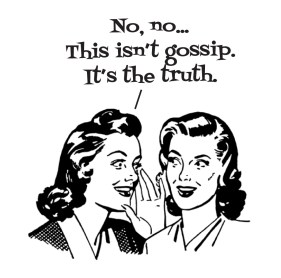
democracy 6But if, in the present context, the alternative to truth is gossip, then I vote for truth—even for “truthiness.” [8] When you live in a small village, you know you can pass along “information” you got from one person, because it is likely to be true, but not “information” from another person because he or she–not just “she” as in the picture– is a notorious gossip and just passes along what he or she has heard, without assessing the likelihood of it. Life is the same is small organizations. You get a sense of who screens his remarks for the likelihood that some piece of information is true and who just pass anything on.

But life among the social media is not like that. That’s what makes the Russian meddling in what were once “American debates” so perilous. Anyone can set up a platform called Americans for Truth and Justice and disseminate the most frightful tales. This is the real “fake news” because it is valued  only for the effect it has, not for any data being shared or any real opinions expressed. It is the likely effect alone that matters and no one knows who you are.

What the social media have done is to make is possible to “pass along to friends” allegations about which you know nothing. You become, by consenting to that process, a “platform,” rather than a person. No one says of a platform, “it provides information you can count on.” A platform is just an electronic bulletin board; it cannot conceivably have any integrity. And when millions of Americans, accepting the presuppositions of the social media, disseminate to their friends allegations about which they know nothing, they are just gossiping. [9]

Conclusion

So I agree with David Brooks that it is not so much Trump himself, but the conditions that promote “Trump-ism” that are our real concern. Of the three such concerns Brooks named, I think the most dangerous is probably the effect of social media. If our reliance on social media has finally eradicated the difference between truth (what can be shown to be true) and mere allegation, then we have finally crossed a bridge we will not be able to re-cross.

Ignorance can be combatted by information. Prejudice can be combatted by experience. Even mistrust can be combatted, under some circumstances, by repeated trustworthy words and actions. But is nothing can be established as true—nothing at all—unless we like it, then we have gone too far and will not be able to come back.

That’s the threat. It isn’t just Trump.

[1]This may be the place to say that since the rise of President Trump to power, I have come to value Brooks’s good sense and conservative decency more than I ever did during the Obama administration.
[2] This kind of relationship is the source of Robert Putnam’s article, and later book, “Bowling Alone.” We used to have lots of casual acquaintances who re not like us. It turns out that those mattered more than anyone but Putnam thought.
[3] One of my favorite lines from South Pacific is De Becque’s retort to Capt. Brackett. Capt. Brackett: “We’re asking you to help us lick the Japanese. It’s as simple as that. We’re against the Japanese.”
De Becque: “I know what you are against. What are you for?”
[4] Which brings me to my own favorite field of study. Placing the credit or the blame for some event is one of the most politically fraught decisions citizens can make.
[5] The TV show, The West Wing, hasn’t been broadcast for more than a decade now, but a lot of people know that President Jed Bartlet, played by Martin Sheen, was a very appealing president. His only real liability was being entirely fictional.
[6] The word “feel” has been transformed into a much more general word, now meaning “what I think.” Tom Lehrer once introduced his satirical song, Vatican Rag, by saying that the Catholic church’s new use of secular music has “inspired me with the thought that…” The copy I have renders that transition as “…but I feel…” That’s the transformation I’m talking about.
[7] Briefly, Kuhn argued that one set of presuppositions for research (a paradigm) cannot be shown to be better than another apart from the comparative utility of one paradigm or the other. Ultimately, it is not the truth, but the utility, of research designs that causes some to live and others to die.
[8]Truthiness, according to Stephen Colbert, is “the quality of seeming or being felt to be true, even if not necessarily true.”
[9] Some have complained that this standard would require them to “fact check” everything, but, of course, that is not true. You would only have to check what you were going to disseminate. You are perfectly free to put it in your trash and/or send a snarky note to the person who sent it to you.

Posted in Political Psychology, Politics | Tagged , , , , , | Leave a comment

Being “snakebit”

I gave a small lecture recently to a Lenten class at our church. It was more a rant, really, but they seemed to be a tolerant mood. I called some scripture texts “flat” in the way a Pepsi might get “flat” if you opened it and left it out for a few hours.

But that’s not the only way to discover flat texts. There are some texts that, if you see snakebit 6what is being said, simply bristle with aggression or twist with implication and you never really noticed. That’s why it was flat to you. And when you notice what is being said, you wonder how you ever managed to pass it by as if it were not remarkable.
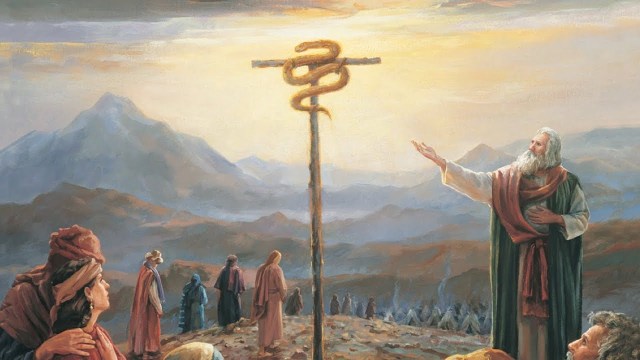
The class I taught fell between a church service—just before my class—and a Vespers’s service late in the afternoon. John 3:16 and a few surrounding verses were read at both services, [1] but the Numbers passage (Chapter 21) was read only at Vespers and Numbers shines a very bright light on John 3. And I read John 3 as if I had just been awakened—which is unkind, but just about accurate.

Having been raised in the church, I am familiar with John 3:14. It is a kind of taxiing passage to prepare you to take off at John 3:16. And I think that rhetorically, that is just the way John uses it. But today I want to look at what it actually says and play a little with the implications.

Jesus says [2]

14 as Moses lifted up the snake in the desert, so must the Son of man be lifted up 15so that everyone who believes may have eternal life in him.[3]

The Fiery Snakes

Presumably, the reference to the snake directed the attention of all his hearers back to the incident in the desert, when God sent poisonous snakes among the Israelites to call them to repentance. I know that sounds odd, but that is the perspective of the authors of that story in Numbers. Here is that passage from Numbers 21.

4They left Mount Hor by the road to the Sea of Suph, to skirt round Edom. On the way the people lost patience. 5They spoke against God and against Moses, ‘Why did you bring us out of Egypt to die in the desert? For there is neither food nor water here; we are sick of this meagre diet.’ 6 At this, God sent fiery serpents among the people; their bite brought death to many in Israel. 7The people came and said to Moses, ‘We have sinned by speaking against Yahweh and against you. Intercede for us with Yahweh to save us from these serpents.’ Moses interceded for the people, 8 and Yahweh replied, ‘Make a fiery serpent and raise it as a standard. Anyone who is bitten and looks at it will survive.’ 9Moses then made a serpent out of bronze and raised it as a standard, and anyone who was bitten by a serpent and looked at the bronze serpent survived.

Let’s look at the pattern first. My reason for doing that is that I believe John is reminding his readers of the whole sequence of events, not just the climax. So the people lost patience (v. 4) and spoke against God (v.5). So God sent fiery serpents (v.6) and a lot of people died. Then they repented (v. 7) and God provided a solution of sorts (v. 8,9 more on that later) and those who accepted the solution God offered, survived. Presumably, the others did not. It is that sequence I am referring to as “the pattern.”

Clearly, Jesus says he is like the snake who was lifted up. [4] And he says that salvation is available to those who “believe on” him. “Believing on” is the analog to “looking at” in Numbers.

snakebit 1But what is John saying about everyone else? That takes us back to the wilderness. The snakes were a punishment from God and they afflicted Israelites generally. They did not seek out the ones who had been complaining and bite them and leave the rest alone. Furthermore, God did not withdraw the snakes when the people repented; God just provided a remedy for some of the Israelites. And to be saved from death, the Israelites had to “look at” the bronze snake on the pole.

There are some oddities in this account when you look at it carefully, but the essential transaction is very clear. If you believe what Moses says—and he did, after all, do that thing at the Red Sea—and you are bitten by a snake, all you have to do is go to the pole and look at the bronze snake and you will be healed. In cause and effect terms, this is like taking an aspirin when you have a headache.

There were some people, surely, who didn’t believe Moses and refused to do somethingsnakebit 2 as nonsensical as “looking at a snake on a pole.” [5] Believing Moses wasn’t always the obvious thing to do. He had had his good moments and his bad moments. And they had just had their hands collectively slapped about the golden calf and here is this “brazen image” thing again. But there is something very persuasive about feeling that you are dying from a poisonous bite and looking at the snake on the pole as you were told to do and recovering from the poison. People who had seen that done might very plausibly exhort others to “take the treatment” and be saved.

The Cursed Condition

John draws on all of that, but the analogy is stark. Jesus says that he, himself is the snake, and that he is going to be “lifted up,” which is the term John uses for crucifixion. So where does that leave the people he is speaking to? If Jesus is the remedy, in the same sense that the snake was the remedy, then the people he is talking to are snakebit. [6]

Several substantial problems flow from this. First, John’s use of this analogy comes at a time of substantial conflict. Quite a few of John’s slurs against “the Jews” have the rhetorical flavor of “Yeah, and your mother wears army boots!” Second, this relates to a condition, not to an event. A guy who has been bitten by a snake knows when and where. There is no “event” of “not believing in Jesus.” That is a condition. Furthermore, it is a condition fully sanctioned by the traditions of your people.

Third, while “looking at a snake” is an action clearly understood and immediately taken, “believing in” Jesus is neither. It is not “an action”—thousands of Billy Graham appeals to the contrary notwithstanding—and it is not clearly understood. What on earth does “believing” mean in this context? And what does “eternal life” mean? [7] The hearers didn’t seem to know.

And finally, there is a much different role for evangelists in John’s setting. “Evangelists” snakebit 3are people who tell the good news. In the desert, the good news is that you really don’t have to die because you were bitten by this snake. You can go to the pole and look at the snake and you will live. Not “eternally,” but you will not die today. People who carried that message to their friends and neighbors who would otherwise by dead by tomorrow, were carrying “good news” indeed.

The role of the evangelist—the bringer of good news—in John’s account is that however you might feel about your life, you are, in fact, cursed. You are “snakebit.” And for this implausible diagnosis, we offer an equally implausible treatment. “Believe in” Jesus. That is like “looking at the snake” and it will have the same effects. It will keep you from dying. That is the role of the evangelist in John.

So the premise of the “if I be lifted up” passage is that you are all snakebit and I am the way God has provided for you not to die. That’s the premise. That’s what makes everything else in John 3 understandable. This isn’t at all like Matthew’s scribe (Chapter 13) who brings treasures, both old and new, out of the treasury. It isn’t like Luke’s (Chapter 5) wonderful old wine in comfortable old wineskins. This is a blanket diagnosis of the condition of life the hearers are experiencing but not understanding.

And I thought that text was flat? What on earth was I thinking? [8]

[1] The lectionary readings for the fourth week in Lent in Year B include readings from Numbers 21, John 3, Psalm 107, and Ephesians 2
[2] This is the Johannine Jesus speaking and as I read it, he is directly addressing the issues contemporary with the writing of John’s gospel. The church and the synagogue were, by the end of the First Century, in full contact battle with each other.
[3] All scripture quotations are from the New Jerusalem Bible.
[4] If you like doubling back on the metaphor and you are drawn to the role of the “serpent” in the Garden of Eden, please don’t let me stand in your way.
[5] Naaman couldn’t understand why he had to bathe in the waters of the Jordan when there were so many better rivers back home in Aram. It took world class staff work to get him to do it.
[6] It’s a recent word, first recorded in 1957, but it was so apt that I decided to use it anyway. Merriam-Webster says it means “having or experiencing a period of bad luck” but the Urban Dictionary comes closer to the uses I have heard when it identifies it as “cursed.”
[7] The Greek is zoē aiōnion, which can legitimately be translated “eternal life,” but which can just as legitimately be translated “life of the ages” or “life for the ages.” That expression refers much more clearly to a kind of life, not to an extent of time, which is why I prefer it.
[8] Heartfelt thanks to Caroline Litzenberger, who spoke briefly at Vespers and laid these two texts down side by side for us and who, in doing that, knew full well what she was doing.


Posted in A life of faith, Biblical Studies, Uncategorized | Tagged , , , , , | Leave a comment

Nationalism for Progressives

The title points to a connection I am not comfortable with. I am going to try to get over that today. This essay rests on two pieces from the New York Times. On March 4 by Yasha Mounk; the other by David Brooks just a few days earlier.

Everyone who has not been living in a cave for the last 20 years knows David Brooks. [1] Yasha Mounk is new to me and if he is new to you, too, it might help you see his argument in a more meaningful context if I share a little of what I have learned about him. He is German, born in Munich in 1982. A big part of his political identity is his Jewish background.  He is currently a lecturer at Harvard and he appears to have an instinct for looking at the other side of the picture. I like that.

In The Age of Responsibility: Luck, Choice, and the Welfare State (2017) he shows, according to a reviewer, “why the Age of Responsibility is pernicious—and how it might be overcome.” He argues, according to other reviewers, that it is also pervasive and powerful. “Pernicious, Pervasive, and Powerful.  That doesn’t sound like a promising start to me.

nationalism 1How a movement like that could be “overcome,” I have no idea and, in fact, it makes me think that someone in the marketing department at Harvard University Press added that last little bit to sell more books.

The current hot book of Mounk’s is The People v. Democracy: Why our Freedom is in Danger and How to Save It (2018). If my guess about his 2017 book title was correct, then I am guessing that the same guy in marketing added the last five words of this title. And, in fact, my introduction to Mounk’s work—which was yesterday—supports my guess about the marketing department. Let me tell you why.

Nationalism is like a half-wild beast. As long as it remains under our control, it can be of tremendous use. But if we abandon it, others are sure to step in, prodding and baiting the beast to bring out its most ferocious side. For all the well-founded misgivings about it, we have little choice but to domesticate it as best we can.

That is the last paragraph, the conclusion, of his piece, “How Liberals Can Reclaim Nationalism.” When you look at the conclusion (above) and then at the title, you know something odd is going on. The hypothetical guy in the marketing department at Harvard University Press may have a brother who writes headlines for the New York Times. You can’t get from the headline to the conclusion. So which is the real Yasha Mounk?

Here is what he says in the New York Times piece.

“…nationalism began to enjoy an astonishing resurgence. President Trump casts himself as a nationalist doing battle with globalists. He’s not alone. From Poland to Venezuela, authoritarian populists have exploited nationalism to disable democracy. In China, Turkey and Russia, dictators have played on nationalist sentiments to concentrate power in their own hands. Institutions like the European Union are on the back foot.”

And he concludes:

For the foreseeable future, nationalism is likely to remain a defining political force.

You would think that if things are as dismal as that, he might just stop writing at that point. But he doesn’t. He proposes that, while “nationalism” has always been one kind of thing, we—the good guys—can take it and make it another kind of thing.

On the other hand:

Its [nationalism’s] modern form took shape as a result of deliberate political choices and the construction of elaborate myths.

Now Mounk intends that observation to be encouraging. Nationalism was “constructed,” he says, meaning that it is not “natural” in the sense that gravity is natural. And as part of this construction, it was supported and protected by “elaborate myths.” I think that by “myths,” he means something like “spin,” as if shining the light of truth on it is going to destroy it. But Mounk is Jewish and he ought to have more respect for ‘myths.” Myths aren’t spin; they go down into your soul; they become the cement that holds societies together. Shining the light of truth on it mobilizes people with rifles who want to shoot the light out while there is still time.

In short, he is trying to build toward the project he has in mind, which is, please recall, “domesticating nationalism.” But the more he does that, the more he puts me in mind of his forebears, who scouted out the promised land (Numbers 13) and reported that it was full of giants and could not be conquered.

So if “nationalism” is the promised land, what will we (progressives) have to do to conquer (domesticate) it. Well…different things than we have been doing, for sure. Consider this.

One common reaction to the dangerous excesses of nationalism has been to forgo the need for any form of collective identity, exhorting people to transcend tribal allegiances completely. But for better or probably worse, it’s easier to be moved by the suffering of people with whom we have some form of kinship. That is why nationalism remains one of the most powerful vehicles for expanding our circle of sympathy.

So first we urged people to forego—we probably said “transcend”—nationalism entirely and in the process, we said some nasty things about the people who wouldn’t do that. Some of those things are going to have to be retracted. That isn’t going to be easy. We can only hope that Mounk is wrong in thinking that we will have to do it.

Then we have to move away from the victim orientation to the extent that it is something we do rather than forging a new, more inclusive national identity. It is relatively easy, psychologically speaking, to anguish over the sufferings of people like ourselves or the groups who need the protections of groups like ourselves. Those are good things to do, but they won’t rebuild a better nationalism.

Another thing progressives have done is to “celebrate more narrow forms of collective identity, such as race or religion.” (We will get a good example of that from David Brooks in a few paragraphs.)  If we expand on the two examples he gave, it takes us right to the powerful tribalization the U. S. is experiencing now. Being “educated” or “enlightened” or “tolerant” or “wealthy” can name tribes just as well as “race or religion can.” And sinking back into those identities, rather than pushing on to a more expansive and engaging nationalism, is not going to get the job done.

And finally:

Convinced that they would be unable to redirect nationalism toward their own ends, many of the most open-minded segments of society long ago gave up on the fight to determine its meaning….Instead of exhorting their fellow citizens to live up to their nations’ highest ideals, many activists seem content with denouncing past and present injustices.

Progressives, according to this charge, have given up on nationalism as such. If “nationalism” is something to be abandoned in the progressive march toward “true humanity,” then there is no point in rescuing it by redefining it. And that is particularly true if you want to say that true nationalism—we are going to have to say “true patriotism” eventually—means living up to our nation’s highest ideals.

nationalism 6Does that mean giving up “denouncing past and present injustices?” It might. A steady diet of such denunciations is like a steady diet of salt. Salt has its uses as a condiment, but treating it as an aliment—as the entrée—is not going to work. We still get to do all the denunciation that doesn’t get in the road of the job. So we won’t have to give it up completely. The job, as Mounk gives it to us, is redefining “patriotism” as a new more inclusive, more inspiring form of our common quest.

I hope Mounk understands—I don’t think he does, but it’s too early to make a final judgment—that this new quest is going to have to be supported and protected by a robust infrastructure of myth. The tasks we undertake that are held together by the stories and symbols of mythology will succeed. Those who are not similarly protected and inspired will fail.

So just as he has undervalued, as I see it, the power of the old nationalist mythology, so he under-appreciates the need for a new nationalist mythology; for a mythology of “patriotism.” And when we move to take that seriously, we lose not only the people who like narrow exclusive nationalism better, but also people who think we can do without mythology at all.  I’m not sure we can do without both groups at the same time.

At this point I would like to turn briefly to David Brooks’s piece. Brooks’ goals are fully compatible, I think, with Mounk’s, but Brooks has been out on the street [2]talking to people and he has some idea where they are at the moment.

Brooks asked them a probing question about “the American Story” and gave a little prompt of his own to guide the answers.

We were the lucky inheritors of Jefferson and Madison, Whitman and Lincoln, the Roosevelts, Kennedy and King. Our ancestors left oppression, crossed a wilderness and are trying to build a promised land.

It didn’t work very well

They looked at me like I was from Mars. “That’s the way powerful white males talk about America,” one student said.

I have a lot of trouble with an answer like that. It identifies the social location of the speaker and accepts or dismisses the message on that basis. If there is to be “a story,” –a common story, not all our stories together–who is going to tell it?

As to what they, themselves have been taught about the history of our country.

Others made it clear that the American story is mostly a story of oppression and guilt. “You come to realize the U.S. is this incredibly imperfect place.” “I don’t have a sense of being proud to be an American.” Others didn’t recognize an American identity at all: “The U.S. doesn’t have a unified culture the way other places do,” one said.

I think the information Brooks brings us about “the word on the street”—especially that street—is profoundly disturbing. It dismisses makers of the story on the basis of race, gender, and social position. The instruction they have had about the history of their country is “mostly a story of oppression and guilt.” That doesn’t sound like the kind of story anyone is going to rally around.

So I would be discouraged just by the information Brooks brings us; just the information. But when you look at the information in the light of the project Mounk is talking about, it is worse. It is much worse.

Mounk said, remember: “.…Instead of exhorting their fellow citizens to live up to theirnationalism 2 nations’ highest ideals, many activists seem content with denouncing past and present injustices.” That is what he said is going to have to be overcome if we are to see clearly how to re-orient nationalism toward the most crucial of the progressive’s goals.

So I admit the project—the goal defined by Mounk, the starting point by Brooks—is discouraging, but I don’t see that we have an alternative. If “nationalism” is the wave of the future, then we need to make it a wave worth riding.

[1] I have had my troubles with David Brooks, but his early, consistent, and principled opposition to the Trump phenomenon and everything associated with it has made me feel as he and I are fellow soldiers, at least for the moment.
[2] It’s a very well appointed street— Harvard, Yale, the University of Chicago and Davidson .

Posted in Politics, Sustainability | Tagged , , , , , | Leave a comment

How to thrive while living

In May of last year, Carol Marat wrote a piece called “How to Thrive While Living Alone.” Nearly everything in my response to this lovely piece could be construed as criticism of it, so I want to take the time necessary at the beginning to say that I have no criticisms to make of it. At all.

On the other hand, Ms. Marat pushed my thinking in some directions it would not otherwise have gone and I appreciate the help. Two of those directions are these.

  • How is “living alone” different from living with a mate? Answer” not as much as you might think.
  • And, is there a general model for meeting your own needs—not those of “elderly people living alone” but your needs in particular. Answer: Yes there is. Surprisingly, I have one in mind.

Living “with”

Bette and I had been married for a long time before we began to be married to each alone 6other. We were glad to have found each other and we have enjoyed the marriage fully, but both of us know that marrying each other was not going to be “the answer.” Neither of us, in Shel Silverstein’s well-known parody, was “missing a piece.”

Neither of us, in other words, was going to be “the answer,” the crucial resource to whatever problems each of us had been carrying for years. I think that only very young people imagine that marriage will do that for them. Another way to say that is that each of us is “alone” a good deal of the time and whether we feel lonely or not is really up to each of us. It is, in that respect, just like not having a mate.

That is what brought me to my first reflection about Carol Marat’s piece. If these are the things one ought to do to “thrive while living alone,” how does she imagine “living with a mate?” Let’s deal with the “what to do” part first.

How to live alone and thrive

  • The first is to be clear about how you want to live.
  • The second is that understanding what your needs are enables you to live authentically.
  • The third is that it is crucially important to forgive yourself.
  • The fourth is that honoring the special traits that make you who you are in crucially important.

Well…I like the idea of doing all the things she says are important if you are going to live alone. Those four ideas—some of them go too far for my own personal taste—are good guidance.

But when I try to think how she must construct the situation of living with a mate, it all begins to seem odd to me. So, let’s just negate each of those—not implying that this represents Ms. Marat’s views—and see where that takes us.

  • The first is that if you live with a mate, it is not necessary to be clear about how you want to live.

I can see why that would be true if you planned to be completely subordinate to your mate. “I don’t need to be clear; she will be clear and I will comply.” Or maybe she imagines the opposite to be the union of the two persons in something like a Vulcan mind meld. [2]

If, on the other hand, you think of yourself as an active presence in the life of your mate, alone 4.jpgit is vital that you get some clarity about how you want to live. For one thing, he will want to know that because he will want to take it into account in his own choices. I would think that being clear about how you want to live is fundamental to living in love and harmony with your mate.

  • The second is that if you live with a mate, it is not necessary to live authentically, therefore it is not necessary to have the understanding of yourself that would allow it. I think that saying that out loud is close enough to refutation that I can just let it go.
  • The third is that is that if you live with a mate it is not necessary to forgive yourself. I guess the idea is that the mate will do the forgiving. If you have ever had the experience of having your mate forgive you for some transgression for which you have been unable to forgive yourself, you know that doesn’t work at all. Forgiving yourself is the foundation of your forgiveness or your mate on anyone else; it is foundation of your accepting and benefiting from forgiveness that is offered to you. [3]
  • The fourth is that if you live with a mate, you don’t need to honor the special traits that make you who you are. This is the most difficult one, I think, because it is problematic even in Ms. Marat’s formulation of it. Just to finish off the exercise, I will say that she may be thinking that the mate will understand and honor those traits—I would call them constitutive traits—so that you don’t have to.

First, not all the traits that make up who I am—my constitutive traits—are good. I am defined by my sloth and my greed and my cowardice as much as I am by my energy and my satiety [4]and my courage. So that relates to me as a person. If I go further that think of myself as one member of a partnership,  some of my traits that are constitutive also for the partnership. They are important for me and important also for my contribution to the relationship.

Is there another way to approach this question?

Of course. Not that there is anything wrong with this one. It’s just not the one I use. Because I have a notion of what kind of life I am capable of living, I have a notion also of what kind of fuel I will require and how much of it, in order to live that life. I call those “psycho-social resources,” but that’s because I went to grad school late in life (I was in my mid-30s) and mined the literature for the language I needed. You can call it something else if you like.

alone 5

This turns out to be a very complicated arrangement, so I am going to cut it back to the basics for today. [5] That little formulation requires that I know what I need and that I take responsibility for acquiring it. It would be easy to argue that I could be a better person if everyone were nicer to me, but that way of putting it doesn’t begin where I need to begin, which is: what choices do I have before me? [6]

It also requires that I exercise some discretion about the quality of the resources I am using—“empty calories” is a convenient analogy—and the quantity. I need “enough” of the right kind of resources if I am to be who I want to be and do what I want to do (or am called to do, as in Footnote 5).

alone 3If I know that about my own needs—not what I need to keep trudging on, but what I need to truly thrive—and if I take responsibility for acquiring those, then the distinction between “alone” and “with a partner” simply melts away. “Doing what I need to live the life I am trying to live” is, to say it this way, a more general formulation. It is more fundamental.

It doesn’t point to some different set of requirements of the single and the bound. It points to the common requirements of the two conditions, allowing that precisely how one goes about it will vary as one’s circumstances vary.

That seems like something worth knowing.

[1] I might be missing a few now, but that’s the matter of another post entirely.
[2] Just a note for non-Trekkies. “The Vulcan mind meld or mind probe was a telepathic link between two individuals. It allowed for an intimate exchange of thoughts, thus in essence enabling the participants to become one mind, sharing consciousness in a kind of gestalt.”
[3] If anyone imagines that “forgiveness” is the quick and easy way to restore equilibrium, he is in for a shock. That are many transgressions that require truly understanding what you have done and truly seeking the pardon of those you have harmed and even, in some circumstances, doing what is necessary to heal the harm you have done. All those re compatible with “forgiving yourself” and may sometimes be prerequisite to it.
[4] Just a plea for tolerance from the reader. If English has another word for “enough-ness,” I don’t know what it is. I know “satiety” is unfamiliar, but I’m going with it as the best word I know for that condition.
[5] And these basics will need to skip over the resources I need to live a life of Christian discipleship. That commitment changes both the resource base and the kinds of things for which I will need resources. No chance to deal with either here.
[6] It is also true that “making do with less” is a choice I might make. It isn’t only being responsible to acquire “enough” resources, it is also recognizing that there are not always going to be enough resources and that I need to deal with that situation, too.


Posted in Uncategorized | Leave a comment

Goodbye, Billy

When Robert Dahl died some years ago, I wrote an essay I called “Robert Dahl, R.I.P” That seemed about right, but today, as I am saying goodbye to Billy Graham, it occurs to me that a big part of Robert Dahl was Yale and a big part of Billy Graham was rural North Carolina. I think I might have managed “Requiescat in pace, William Franklin Graham.” but nobody called him William Franklin Graham. [1] so I have settled for “Goodbye, Billy.”

According to the New York Times, Billy died early in the morning of February 21. Now the wars will begin. Billy’s own goals were narrowly focused. He was an evangelist. He held mass rallies all over the world. [2] It is what he was good at.

billy 3Unfortunately, he was a very popular man and everyone wanted a piece of him, including every president of the U. S. since Truman. Psalm 18 refers to God as our “shield and buckler” and that is a good thing, but President Nixon used Billy Graham as his shield and buckler and that was a bad thing. Billy hoped to be spiritually helpful to the presidents he counseled, and he may have been. He was, without question, politically helpful.

Billy was the cleanest of the clean in the sometimes sordid field of American evangelists. He didn’t get rich. He didn’t have affairs. The books of the Billy Graham Evangelistic Association were open to scrutiny. He doesn’t ever seem to have really desired fame except as a tool to use in his work.

He was a social conservative. It’s hard to see how he could have been anything else, given his background. That made him an easy target for feminists and gay rights activists. He was likely to apologize to the people whom he had offended—real apologies, not the current “non-apology apologies we hear today [3]. He considered himself bound by the same standard of conduct he preached, and I think that’s admirable.

I don’t have any trouble admiring Billy Graham, but his view of what Christianity was all about has been has been one of the major entrapments of my life. I have spent all of the fifty years since my late 20s trying to get out of the box that Billy lived  in preached from and believed in. That’s really what I want to talk about today.
I have been thinking about Billy anyway because last week, Bette and I watched an episode of The Crown in which he played a role. [4] Here is the beginning of his sermon.

As I considered what to preach about today, I considered various topics which speak to me personally. but I thought that i would start with a simple question. What is a Christian?

The Bible tells us. Colossians 1:27 says that a Christian is a person in whom Christ dwells. It’s Christ in you. The hope of glory. It means that you have a personal relationship with the Lord Jesus Christ. That encounter has taken place. You have received Christ as savior. And that is what a Christian is.

That seems quite straightforward, but, of course, it isn’t. It is hard to say just what “a person in whom Christ dwells” means. It is hard to say clearly what “personal relationship with Christ” means. It is hard to say what “encounter” must mean, even though it is easy to say what Billy means by it. Similarly with “received” Christ, rather than “recognized” or “admitted” or even “acknowledged.” All that language is familiar and meaningful in the rural south and in evangelical circles everywhere. When I say that it isn’t straightforward, I mean it is hard to explain to people from other Christian traditions and that (now) includes me.  It is completely straightforward in Billy’s home culture.

billy 1The matter gets further complicated in The Crown in the next scene where Queen Elizabeth has a private audience with Billy, after the chapel service. She compliments Billy on his clear exposition of the demands of Christian faith.

Elizabeth: In an increasingly complex world we all need certainty and you provide it.

Billy; Oh that’s not me. The scriptures provide it.

“Certainty” Billy says, is what the scriptures provide, but I don’t think so. One of the things I did at Wheaton that has served me well over the years is study Greek. Without any Greek, you are pretty much stuck with “the English translation,” which in my youth was the King James Bible.

The King James Bible does indeed say what Billy says it says. “ to whom God would make known what is the riches of the glory of this mystery among the Gentiles; which is Christ in you, the hope of glory.” But the Greek makes it clear that “you” is a plural preposition, so Billy could have said “Christ in y’all” and been truer to the text.

Screen Shot 2018-02-22 at 6.04.10 AM.png
The ‘umín in line three (fifth word from the left) is “you plural,” not, as Billy uses it, “you singular.” So a better way to translate it would be “Christ among you,” or “Christ in your presence.” which is certainly what Paul or a disciple of his (however you judge the authorship of Colossians) meant. The New Jerusalem Bible catches that nicely as “ It was God’s purpose to reveal to them how rich is the glory of this mystery among the gentiles; it is Christ among you, your hope of glory.”

So the relentless individualism which is so characteristic of Billy’s slice of conservative Protestantism is not at all well served by the text he chose for Queen Elizabeth in this episode.

According to all the Bible study I have been doing for the last few decades, the first job of studying scripture is to find out what the author meant in addressing the text to some particular body of Christians. And when I have a chance to teach at our church in Portland, I rail against the common practice of taking the text as it appears and applying it immediately to our own situation and language context. What I would say to my class is that when we understand what Paul (or whoever) meant is saying that to the church at Colossae, then we have a better chance of understanding what that same text—in its context, of course—can mean to us.

And if one of my students said that scripture provides certainty, meaning thatbilly 2 we make safely snatch those words out of context and apply them to ourselves, I would say, “Actually, we can’t. They don’t apply directly to us. They apply indirectly to us. They matter enormously, but you have to deal with the thought, not just the words.”

So I have been battling “Graham-ism” all my adult life. It has been costly. When so much of your work is showing that the passage does’t really mean that, it is hard to turn the corner and commit yourself to an openminded and open-hearted consideration of what the passage does mean and what effect it would have on your own life if you took it seriously. Turning that corner has been the work of decades now and I still lapse back into criticism when I am off my game.

But I don’t think I would have battled Billy. People who knew him said he didn’t spend all of his time being “the big deal evangelist.” He was just a thoughtful and kindhearted Christian man and I think I would have liked him.

[1] When I was at Wheaton. Billy’s alma mater and mine, the President, V. Raymond Edman, had that same difficulty. He was bestowing an honorary doctorate on Dr. Graham in 1956. As he was putting the hood over Billy’s neck, he said, “William Franklin Graham…” and then he stopped as if that was inappropriate, and revised it to “…Billy.” I think if President Edman had had his way, Wheaton’s most famous alum would have been known as Dr. Billy.
[2] Including racially integrated rallies in Mississippi. He wouldn’t do it any other way. This North Carolina son said, “I will not preach Jim Crow.”
[3] He once ran afoul of the Nixon secret taping machine in the Oval Office where he was recorded saying some scurrilous things about Jews and their effect on American society. He didn’t remember saying it, but when the tape showed he had, he went to his Jewish friends and apologized.
[4] This is Season 2, Episode 6, “Vergangenheit.” Queen Elizabeth asks Billy to preach in the chapel in Buckingham Palace and the section of the script I will be using here is from that episode. It is a fact, however, that Billy and Queen Elizabeth were friends and she knighted him in 2001.


Posted in Biblical Studies, Living My Life, Movies | Tagged , , , , | Leave a comment

What to do while you are dying

It’s a little more complicated than that title suggests. Not a great deal, but a little. [1]

It will simplify things a great deal to make the distinction between “it,” the body that serves us well or ill by turns, and “I,” meaning the sense of myself I have. This is a crude distinction, of course, but I am relying on your own knowledge of your life in which on some days “you” are just fine, while “it” is acting up; then there are other days when “it” is entirely free of any symptoms at all and “you” are miserable.

I live in a Continuing Care Retirement Center (CCRC) and when I moved here a year and a half ago, I told friends I trusted that I was coming here to die. It was only the phrasing, not the idea, that was open to misunderstanding. That phrasing could be understood “coming here for the purpose of dying” as if it were a hospice. The friends to whom I trusted that phrasing knew I didn’t mean that. What I meant is that I wouldn’t have to move—or be moved—to any other place when either “it” or “I” neared the end. [2] It was a very comforting thought to me and still is.

Death as a commonplace

So…where I live, a lot of people die. That means that I get to see all the paraphernalia that goes with all those deaths. A lot of ambulances pull up to this address. There are lots of notices on the front desk that someone died yesterday. There are lots of memorial services, some of them here in the Penthouse. [3] The families of the recently deceased residents show up, the grandchildren and great-grandchildren having no clear idea what is going on.

death 1The same thing happens on the social side. A resident I have gotten to know in my brief time here shows up in the little coffee nook where world problems are hashed out every afternoon [4] and today, he has a cane. Tomorrow—or some tomorrow or other—it is a walker. Then a wheelchair; then a wheelchair with oxygen. Then he doesn’t come all the time; then he doesn’t come at all. These are perfectly ordinary signs that “it” is failing.

And that brings us to the meaning of “you” in the title. Nothing I have said bears at all on the “you” of that resident and friend who kept coming to Drasko’s Seminar. He may very well continue to be as cantankerous or irenic or liberal or conservative or as disciplined or dilatory as ever. It’s harder to be cantankerous when you’re on oxygen, but aside from that, everything is the same.

This person is the best answer I know to the question of what to do while you are dying. Living. That is the best thing to do while you are dying. You keep going to the places you can go; you keep hanging out with the people you used to hang out with. You keep on pointing out to them that they missed the whole point of movie by failing to appreciate the fundamental contradiction in the character of the eldest son. You keep hoping the Steelers can figure out a way to beat Jacksonville.

It should be pretty easy to nod your head affirmatively as you read through that paragraph. Maybe not the part about the Steelers. But because of where I live, I see it every day. There is nothing subjunctive about it for me, as if I were trying to imagine what it would feel like to be running with the bulls in Pamplona. It is subjective for me; it is experiential. I get to see these amazing people living fully—to the full extent of their capacity—even as “it” declines. It is a powerful experience for anyone with the eyes to see it and I count myself as one of the fortunate ones in that I have learned to see it for myself.

I had no idea when I moved here that you could continue to express all of who you are, subject only to the limitations of what “it” will allow. It sets a standard I can aspire to.

death 3The other side of that dichotomy is harder. The other side is when “you” begin to suffer losses so that you are “no longer yourself.” That’s the way they say it, but, of course, you are “yourself;” you are precisely the self you now are. You are not the self you used to be, of course, which is what everyone who uses that phrase is understood to mean. [5]

I have declined a good deal, myself, in what I would call “peripheral” functions. I don’t remember names and faces as well as I once did; I forget authors I have cited effortlessly for decades, and so on. These are “peripheral” not only because they allow more important functions to continue unimpeded, but also because quite a few of the people I live with are experiencing the same decrements of functioning. These deficits are something we share and that makes it easier to treat them as a standing joke at no one’s expense.

There are more fundamental losses, however. I don’t know what those are like. You can’t tell by looking and you can’t find out by asking. I am hoping that I could feel that I was doing my best under difficult circumstances, but I don’t know if dementia really allows you to feel that way. When the “you,” not the “it” declines, your standards for understanding what is going on decline as well.

Maybe it’s like this. When my father was well into his Alzheimer’s phase, he was visited by my brother Mark, a physician, and his wife, Carol. When they came into the room, Carol went over to him and kissed him on the cheek and said, “Hi, Dad.” Mark and Dad made conversation of some sort. I am sure it was generous and situationally appropriate because that is the way Mark would do it. When the visit was over, Mother asked Dad if he knew who that was who had visited. The question presumed the answer, “My son, Mark.”  The answer was, “His wife kissed me.”

I think the gift Mark gave was every bit as good as the gift Carol gave. For many years, Dad had been appreciative of the gifts Mark had to give, in part because they were so much like Dad’s gifts. But he wasn’t able to appreciate that kind of gift any more; he was still able to “understand” the kiss of an attractive and warm-hearted woman. Maybe that’s what it’s like.

Death as a brief interruption in the community’s life

The other thing I have noticed here, being a participant in a community that sees so many deaths, is how brief the period of public reflection is. I take great comfort in that.

There is always grieving when there is death, but grieving isn’t always the most death 4prominent response. When a person has lived a long and successful life, it is perfectly appropriate to celebrate that life as a whole and at the same time to mourn the loss the the person.

Then there is the question of the setting in which those emotions are noted. I, myself, have lost a wife I adored and I now believe that you never really get done grieving. It just comes and goes and you call it for what it is when it comes and you say a gentle goodbye when it goes. That personal level is one where grief doesn’t “go away;” it just comes and goes.

But there are smaller communities of friends—people you always went to the movies with or played bridge with or served on committees with—some of which should really have come with combat pay. The occasional return of the conversation to the member of our group who is no longer with us may continue for quite a while. But if the other members of the group keep on living—actively investing themselves in their lives—the death of that one member begins to recede. Other complicated events take up part of the space it once took. Also, the group that was once the “community that knew him” is itself reduced in number over time.

The public grieving is remarkably short. There is an equanimity that characterizes community life here. The death of one of us causes a ripple on the surface of the pond which we all notice. Some are able to comment more than others, but I have never seen the topic linger at this level—at the most general level—for more than a day or so.

We appear, as a community, to have made our peace with the loss of a friend. The death is most often not a surprise. It is on some occasions a relief for everyone—the person, his family, and all of us who knew them. If the effect of the death of a member were given in points of a Richter scale, I would say most deaths here are well below 3.0. That is what I hope for my own death. I would want to say, after the formal notice has been paid, “Go on with what you were doing;” meaning, “I know you were all busy living and I know that is what you should be doing. Please continue.”

There are people who have known me well and loved me dearly. I think I would hope for them the kind of grieving I have had for Marilyn. It comes and brings with it most often some really sweet memory, and then it goes and you smile with the memory. And then you go on living.

[1] Throughout, I will be distinguishing between things that are complicated, i.e. hard to understand, and things that are grievous. I am going to be thinking in this essay about how to understand things, not about what it might cost to endure them..
[2] “Nearing the end” gets more complicated when some parts of you are mechanical. I could hardly stop laughing when they told me last year that the battery in my pacemaker was guaranteed for ten years. It was hard to avoid the sense that I had just been given a warranty.
[3] I would like mine to be at our church because I understand my own life in fundamentally Christian terms, but if the setting were all that mattered to me, the Penthouse is a lovely place for a memorial service.
[4] For the sake of convenience, I will all it Drasko’s Seminar. That is what everyone else calls it, in honor of Drasko Jovanovic who, just by his presence, convenes the daily mix of attendees, of whom I am sometimes one.
[5] Just when “once” was is a little more complicated. It might mean “what I was like at the height of my powers.” More often, it seems to mean, “what I have been like in recent years.” But you still see once-beautiful women yearning for the effect on men they used to have and the same thing goes for once-authoritative men. That seems unnecessary and sad to me.

Posted in Getting Old, Living My Life, Love and Marriage | Tagged , , , , , | 7 Comments

Lent and inconvenience

If only we had more time, right? If only. If we had more time, we would…um…we would… OK, what would we do with more time?

A professor of mine at Wheaton College [1] once told a story about himself that madeTime 2 him look bad. I’ve been grateful to him ever since for being willing to do that. His notion of living the Christian life was that around him in the world were people he was called to serve. He didn’t have a narrow or a specifically religious notion of what “service” was. He did have a sense of how those people were to be identified to him, however. He counted on the Holy Spirit to move him toward those particular people he was being called to serve. Not only is that resolutely orthodox; it was not even unusual at Wheaton when I was there.

Quite a few times, he said, he had to defer acting on that inner urging because he didn’t have the time to comply with it. So he tried an experiment. He would set aside fifteen minutes each day specifically to do the things God was asking him to do that he would otherwise have said he didn’t have the time to do. God, I’m giving you fifteen minutes for free! WooHoo!

Then he told us that in several months of trying this experiment, he never—ever—used up the fifteen minutes. He stopped using the excuse of not having enough time to do the things God was pointing out for him to do and discovered to his amazement that doing those things took almost no time at all. [2]

I want to get to Lent in a little while. Christians are urged to “give up something” for Lent. Sometimes that is treated as if giving up something for awhile was good all by itself, but at other times, the idea is that you will have more time for a special spiritual emphasis or practice if you give something up. I don’t think the odds are good on either of them and I’ll tell you why.

Let’s start from another place and see if we can get back to that question. Tim Wu has a column in the New York Times in which he argues that “convenience” is a double-edged sword. Let’s begin with “housework.”

However mundane it seems now, convenience, the great liberator of humankind from labor, was a utopian ideal. By saving time and eliminating drudgery, it would create the possibility of leisure. And with leisure would come the possibility of devoting time to learning, hobbies or whatever else might really matter to us. Convenience would make available to the general population the kind of freedom for self-cultivation once available only to the aristocracy.

Let’s take the time, now, to imagine a family of a husband and a wife and two kids where the “work at home”—that includes all kinds of housework and all the various forms of childcare—engages husband and wife equally. This would become another kind of essay in another kind of family.

time 3Now let’s go back and look at the sequence. “Eliminating drudgery” creates the possibility of leisure, which in turn creates the possibility of self-cultivation in a way that was once possible only for aristocrats. With these new household “conveniences,” everyone can be “like an aristocrat.” [3]

And how did that work out?

Betty Friedan looked at what household technologies had done for women and concluded that they had just created more demands. “Even with all the new labor-saving appliances,” she wrote, “the modern American housewife probably spends more time on housework than her grandmother.”

And this isn’t only historically true—as if it applied only to dishwashers and vacuum cleaners—but it is persuasive as a principle. It might be nice to think it is only the drudgery of doing the dishes that keeps me from mastering the Greek epics, but when the drudgery goes away, what takes it’s place? Some new drudgery, like protecting all your internet passwords from being compromised or a new higher set of standards—your glassware is clean, but does it really “sparkle?”— that requires all the old work but at a higher level?

The only thing that is going to really work toward your mastery of the
Greek epics is a really strong desire to learn Greek and master the best stories written in that language. That’s what’s stopping you. It isn’t the housework and the childcare—at least not in the family I created for this example. What is missing is the strong desire for the project and the willingness to do whatever it is that needs to be done to achieve it.

Tim Wu points out, correctly in my view, that when “convenience” gives us more time, we tend to spend that time on more conveniences.

Convenience has the ability to make other options unthinkable. …After you have experienced streaming television, waiting to see a show at a prescribed hour seems silly, even a little undignified.

I know a lot of people who “binge watch” TV because they can. It isn’t that the show isn’t good enough to wait for. It isn’t that you don’t feel any need to discuss it. It is that you subordinate other desires—desires that would make much more sense if they took more time—to “the most convenient option.”

Of course, that gets political too.

When you can skip the line and buy concert tickets on your phone, waiting in line to vote in an election is irritating. This is especially true for those who have never had to wait in lines (which may help explain the low rate at which young people vote).

Time 4If it were formulated as a rule, and there is no reason to think anyone would really do that, the rule would be this: if it takes either work or waiting, I will choose something else. Political reform? Takes too long. Providing infrastructure? Way too long. Slowing the rate of climate change? [4] Not every worth thinking about. Easier just to deny the reality of it.

It takes too long. End of story. Let’s do something “more convenient.” Playing Wu’s argument out in the political arena—that’s not what he does with it—would mean that choosing systemic projects, no matter how important they are, would fail to occur and we would choose instead projects that require an election cycle or less. Voting for someone who is angry on the grounds that you too are angry, for example, is immediately gratifying.

So the time I clear for myself by “labor-saving conveniences” is not at all likely to be used for hard work. It will not be used, following the logic of Wu’s argument, for time consuming or onerous tasks or for the pursuit of goals that will not mature quickly. Conveniences don’t lead us in that direction.

Here’s a possibility. How about a driving desire to prioritize our lives so that the most important things receive our commitments first? That sounds pretty good. And now we have arrived back at Lent.

For Lent, that would mean some new study or reflection or emotional openness or behavior that evokes this special period—the last painful phase of Jesus’s ministry. [5] I am going to be reading Raymond Brown’s study, The Death of the Messiah, again. That has been my practice for the last ten years or so. Every year, as I read, I remind myself of things I already know and learn some new things. And then I learn to wonder about things I never wondered about before.

This year I am going to be working on understanding the use of genre (my word for it) by the evangelists. It’s hard to say exactly what that means, but it isn’t hard to illustrate. Several years ago, I proposed this “quotation” for the readers of this blog.

All men are created equal, that they are endowed by their Creator with certain unalienable rights. Therefore, Workers of the World, unite! You have nothing to lose but your chains.

The first question is simple: Is it reasonable to get from first part of this quote to the second part? My answer is, Yes, it is. The second question is more difficult: Is it even conceivable that any document could use a quote like this without taking a substantial part of its “meaning” from the fact that the first part comes from our Declaration of Independence and the second from the Communist Manifesto? My answer is, No, that is not possible.
The “meaning” of this misshapen quote is that part A comes from here and part B comes from there. That is the “meaning” over and above what the words mean. That’s what I mean by “genre.” So what on earth does Matthew mean when he says (27:51—53, New Jerusalem Bible) this?

51And suddenly, the veil of the Sanctuary was torn in two from top to bottom, the earth quaked, the rocks were split, 52the tombs opened and the bodies of many holy people rose from the dead, 53 and these, after his resurrection, came out of the tombs, entered the holy city and appeared to a number of people.

I don’t think that’s reporting things that happened. I think it is citing a scripture or some scriptures (a genre) and that “where those accounts come from” will be a big part of their meaning, just as Thomas Jefferson and Karl Marx provided the largest part of the “meaning” in that fake quote by being the authors.

And if the source is the meaning, what meaning does it have? I don’t know because I don’t know the source. I think I will know that when I find out what the source is; I think I will know then what they meant to Matthew and/or to his church. And when I know that, I hope I will be able to reflect constructively on who this Jesus is that Matthew is trying to make present for us.

And that seems worth doing for Lent.

[1] Not the Wheaton Crusaders, as they were when I was there in the 1950s, but the Wheaton Thunder now.
[2] There are lots of ways to criticize this instructor’s experiment. You could question the mechanism by which he was to be directed; you could question the tasks to which he was called, and so on, but I have benefited so much from the conclusion he drew that I am not inclined to.
[3] Just to remind us all, the English aristocracy comes from the Greek aristos, meaning “the best.” You see immediately, I am sure, that commoners with household conveniences can be “aristocrat-like” without being “the best people in the society.”
[4] In Kim Stanley Robinson’s dystopian novel 2312, the period of life on earth where we are now is dated from 2005—2060 and is called “The Dithering.” New York City is entirely flooded and people get from building to building on skybridges.
[5] That is not a random or casual list of approaches. If you think it is, try grouping the middle two and contrasting them with the first and last.

Posted in Biblical Studies, Politics, Sustainability, Theology | Tagged , , , | Leave a comment

Racism and Sexism, treated by The Good Doctor.

If you were here, I would dearly love to turn to you, as I did to Bette, and say, “What just happened?” Here is what I think happened. In the first season of The Good Doctor, they have developed a racism subplot and a sexism subplot to supplement the handicapped theme—the “good doctor” is autistic—which is the main driver of the show.

In Season I,  Episodes 10, 11, and 12, one of these two plot developments absolutely floored me and the other followed a very familiar pattern.  It is the racism subplot that has turned strange; the sexism subplot is thoroughly predictable.

The Sexism Subplot

We are going to have to do some plot now. I’m going to be using a lot of pictures because most of the characters are non-white and that matters in this account.

Step 1 Dr. Coyle (Eric Winter) inappropriately propositions Dr. Browne (Antonia Thomas) in one of the operating rooms racism 6of St. Bonaventure Hospital in San Jose. Here are Dr. Coyle ANTONIA THOMASand Dr. Browne. She reproves him as she should and reports him as she should. But Dr. Kalu, her boyfriend, (that’s a gross characterization, but it’s good enough for this small turn of the plot) is angry and physically assaults Dr. Coyle. And then he gets fired for having done that.


Step 2 Dr. Kalu wants his job back, so he hires a lawyer to make the case that his punishment is much greater than the punishment of several white doctors who were reproved for having done the same thing Dr. Coyle did. [1] The severity of Dr. Kalu’s punishment is said either to be racism or to be something that will look like racism when Dr. Kalu’s lawyer takes the case to court when he sues the hospital.

race 2This requires a confrontation between Allegra Aoki (Tamlyn Tomita),  who is Chair of therace 3 St. Bonaventure Foundation—that means she presides over the sources of the money that fund the hospital—and Jessica Preston, (Beau Garrett) who is Vice Chair of Risk Management. You see them here.


Step 3 Ms. Aoki agrees the settle the case rather than to allow it to go to court, the result of which is the Dr. Kalu gets his job back. That means he returns to his position as surgical resident under Dr. Andrews, who is furious with him for doing what he had to do to get his job back. Here are Dr. Andrews and Dr. Kalu. Keep this picture in your mind when you see the line, “It sets us (us!) back two steps.”

Step 4 Dr. Coyle has been “punished” by being transferred to a different hospital at a higher salary, but that is not enough for Dr. Browne. She complains to Ms. Aoki that the punishment is not severe enough. Ms. Aoki agrees, but says that all Dr. Browne has, from a legal standpoint, is a case of he said/she said, which is not a strong case. So Dr. Browne heads out to round up other women who may have been abused by Dr. Coyle (#me too!) and in the last scene of these three episodes, finds one.

A familiar problem with a familiar solution

Let’s take the harassment problem first. Dr. Coyle is a creep. He is not a racist, but he is a creep. Dr. Browne complained about his behavior and he was punished, but not severely enough to satisfy Dr. Browne, who is pretty sure that Dr. Coyle is going to continue to operate [2] in the way he did at St. Bonaventure. So Dr. Browne goes out looking for other women who may have experiences inappropriate advances from Dr. Coyle.

This is the #me too moment. We are led to believe that if this subplot is continued, Dr. Browne will find a bunch of women—fellow victims—and that Dr. Coyle will finally get what is coming to him.

This is the most common of the current plots. The man is evil and the women are victims, but when they join together, the evil man can be punished appropriately. I’m not making a judgment either about the real world events or the TV drama events that follow this path. I am saying it is the most common current path of the shows I watch or hear discussed. In fact, I might go so far as to say that as a plot device—not as a real life event, but as a dramatic convention—it is trite.

A familiar problem with a twist

The race question goes a different way, although it doesn’t appear, at first, that it is going to. Up in Step 2, I said that there was a clash of sorts between Ms. Aoki and Ms. Preston. Here’s what that looked like.

Preston: The chief oncologist—this is before I came here in December of ’14—Dr. Marshall shoved a scrub nurse during a post-op discussion of some sort. So you remember that?

Aoki: I do.

Preston: Your response was to settle with the nurse while Dr. Marshall was let off with a warning. There’s another almost identical instance later that year. In both cased, the doctors in question were white. They were censured. Dr. Kalu was fired.

Aoki: Do you think this was a racial matter. Do you think I’m racist? That I favor white people?

Preston: Then why the leniency then and not now?

Aoki: They’re stars that happened to be white. Doctors like Dr. Marshall allow St. Bonaventure to compete with other West Coast institutions.

Preston: So that’s our defense. We’re not racist. We just allow our doctors to assault people as long as they bring in enough donors.

Aoki: They were reprimanded and there were no further incidents.

Preston: And how do you think all of this is going to play out in court?

Aoki [pushes the file across the desk to Preston] Settle.

Preston: OK

Neither Ms. Aoki or Ms. Preston thinks that the way Dr. Kalu was disciplined had anything to do with his race. [3] Both look at the damage that can be done to the hospital if Kalu’s case goes to court and Ms. Aoki makes the prudent choice. Settle this out of court.

I think that is not quite standard. The charge is standard. You treat white offenders different than “dark” (Caribbean, maybe?) offenders. But neither of the women in this discussion thinks that issue really is race. They agree that it will look like racism if it goes to court.

The Racism Subplot

But then something blatantly non-standard happens. Not only was I unprepared for it; I found myself nearly speechless when I saw it. I went back and watched that part again to be sure it really happened the way I thought it happened. It did. Here it is.

Dr. Andrews, Chief of Surgery, (Hill Harper) is just leaving for the day when Dr. Kalu (Chuku Mood) catches up to him and tries to engage him in a conversation about what happened in surgery that day at the hospital. Dr. Andrews isn’t having any.

Dr. Kalu Dt. Andrews. Good evening. I…uh…checked out the twins’ file…it’s an amazing case.

Dr. Andrews: To be clear, Jared, I don’t want you here.

Kalu: What we presented to Miss Preston was the truth.

Andrews: I understand that. And those problem doctors and the ways we police ourselves will be dealt with, should have been dealt with a long time ago. But you stepped over a line.

Kalu: I fought for my job.

Andrews: You compromised your integrity. The incident with that jerk Coyle had nothing to do with black or white, but that’s what you and your lawyer sold for leverage. And when you misrepresent racism for something it’s not…it sets us two steps back.

So how is the racism question being dealt with here? Very differently that the sexual harassment question certainly! I said that development of the harassment theme was trite as a dramatic narrative. This one is pathbreaking.

race 1Dr. Andrews, the black Chief of Surgery, (on the right) reproves Dr. Kalu, the dark race 4surgical intern, (on the left) for playing the race card inappropriately. Kalu defends himself by arguing that the case he made—white doctors in that situation have been treated differently than he was—is true. Andrews says that isn’t a good enough excuse. “You stepped over a line,” he says. He doesn’t say what “the line” was, but he is about to.


Kalu defends himself again. He was just doing what was necessary to get his job back. He is right about that. Nothing less that threatening an embarrassing and unsuccessful appearance in court would have caused the hospital to settle. But that isn’t the line Dr. Andrews is talking about. He says that Kalu compromised his integrity. That is not something you ordinarily hear a victim of racism accused of, and very probably no one who is not black and not his superior at the hospital could have said it.

What did Kalu do wrong, according to Andrews? Kalu knew that the discipline he received had nothing at all to do with race, but he and his lawyer used race anyway, just as leverage. Then come two really important final steps. The first is this: “When you misrepresent racism for something it’s not….” Your punishment had nothing to do with racism and you knew that, but you said it did and you said that for your own advantage.

The second is this: “…it sets us back two steps.” Us. The differences between Dr. Andrews and Dr. Kalu, so far, have been that Andrews is Kalu’s immediate superior. Andrews is Chief Surgeon. Kalu is a resident in surgery. Kalu is a hothead and romantically involved with another resident. Andrews is not a hothead, and in his position, he couldn’t afford to be. And he knows the risks he runs by having a hot-tempered resident on his staff. We know about those differences. They have been clearly shown to us in previous episodes.

“Us” has not been clearly shown. “You and I,” Andrews is saying, “are people who have been and who will continue to be, subjected to racism. We have been making progress; slow and painful, step by step progress. And you have just set ‘us’ back two steps.”

Andrews here addresses Kalu as a fellow black man. That’s what “us” means. It is hard enough to make any progress in undoing the knot of racism without some of the victims playing fast and loose with the truth. “The truth” here is given a very high place. “Making a dent in racism” is given a lesser place. If one is to be sacrificed to the other, is the the crusade against racism that is the give way and the truth of the matter to be preserved and it is especially the work of the black victims of racism to demand it.

Sexism and Racism

So…I don’t know. I’ve never seen these two liberal subplots running along side by side and then watch one change direction drastically while the other keeps on going. I suspect the marketing department at ABC knows something I don’t know. Do they have a liberal fan base and a conservative fan base and decided to give one subplot to each? Do they have one tribal fan base—racism, anti-racism, sexism, and anti-sexism are all tribal affiliations—and one judicious, let the facts speak for themselves fan base?

Surely not. If I were in marketing for ABC, I would certainly argue that the network is going to make more money pandering to the tribal affiliations–either one, let alone one for each– than to the judicious, above-it-all group.

Any ideas?

[1] This is a plot problem of sorts. No one is accused of having done what Dr. Kalu did, which was to physically assault another member of the hospital staff.
[2] The notion of “a smooth operator” in a hospital-based show is really asking for trouble, but there it is. The language will stand only so much twisting and bending.
[3] There is a nice moment, though, when Aoki, who is Japanese, asks Preston, who is white, if she really thinks Aoki is racist. Really?


Posted in Communication, Movies, Paying Attention, Society | Tagged , , , , | Leave a comment

My next job

This is a fantasy. If you don’t know me, you might wonder why I would write about what my next job will be. I have retired several times already and my final retirement was five years ago. If you do know me, you know very well that I am not going to take on a new job and would certainly not be writing about it.

And it gets worse.

My “next job” is doing whatever I would be doing in C. S. Lewis’s notion of what Heaven new job 5is like. [1] In The Great Divorce, Lewis gives a very interesting account of the Spirits who are in Heaven and who belong there. In Lewis’s version, the Ghosts come up from Hell as visitors—there is a bus every day for that purpose— and are met at the bus stop by the Spirits who are there to help them.

I have spent a lot of time on the Ghosts in The Great Divorce. In 2011 and again in 2014 I taught an Adult Ed class based on it at our church, here in Portland. To give you a little of the flavor, the course was called Seven Characters in Search of Damnation. [2] The Ghosts are quite different from each other superficially. One is an artist, one an Episcopal priest, one a mother (ONLY a mother), one a tough guy employer, one a world-weary cynic, and so on But radically—at their very root [3]—they are the same. They have come to Heaven to try to use God for some purpose of their own.

But I have begun to think recently about the Spirits who meet the several Ghosts at the bus stop.  The work each does is different because each Ghost has a different reason for preferring Hell to Heaven, but deep down—“radically”—they are broadly similar. They offer the same kinds of service.

  • They offer a personal apology, if that is one of the reasons they were chosen. That is true in the case of the Spirit who was sent to meet the Rights-monger, as we will see below.
  • They clarify any misunderstandings about what is real and what is not.
  • And they offer their services if the Ghost decides to stay in heaven (only one does).

So if I wound up in C. S. Lewis’s Heaven, those three things would be my job. I would be traveling  up into the mountains, because that is that is the hope and desire of every Spirit. I would interrupt my trip—all those miles would have to be traveled again when I returned—and come back to the bus stop to meet someone to whom I had to make personal amends or whom I was particularly well equipped to help. And I would offer my services to that Ghost for as long as he needed me or, as in the case of the Spirit who was sent to meet the Rights-monger, longer. [5]

Those three things. They would be my “next job” in the world Lewis has built. And if I started in Hell, my first job would be to get on the bus and get off in Heaven and to choose to stay. I guess that’s really three jobs. So it is easier to start in Heaven.

The Rights-monger

The clearest example of this relationship is the interaction between a Spirit who, on earth, was called Len, and a Ghost who is not given name, but whom I call “the Rights-monger.”[6]  He knows his rights, or thinks he does, and demands that they be honored. [7] In Heaven, where only the grace that God offers matters at all, this is a very costly demand.

new job 1It is also true, in this fantasy, that the Ghosts are completely insubstantial. Picture a column of smoke in the shape of a person. The Spirits are substantial—“real” Lewis says—because Heaven is “real” (substantial) and that difference in the two places mimics the spiritual condition of the two kinds of beings.

One of the characters, whom I have called “the Cynic,” describes the difficulties of Heaven this way.

“That’s all propaganda [that you can stay if you want to]. Of course, there was never any question of our staying. You can’t eat the fruit and you can’t drink the water and it takes all your time to walk on the grass. A human being couldn’t live here.” [8]

In fact, Heaven is the kind of place that you can adapt to if you stay long enough. You solidify as you stay and the result is that you actually can eat the fruit and you can drink the water and the blades of grass no longer pierce your feet—as they did when you arrived because those blades of grass are real (substantial) and you are not. Every Spirit tells every Ghost how that works. It doesn’t work for the Cynic, of course, because he doesn’t stay. “It’s all an advertising stunt,” he says in dismissing the possibility.

Len, the Spirit who was sent to the Rights-monger, has some explaining to do. Once, back on earth, he had killed a man named Jack and Len’s crime looms very large in the Rights-monger’s mind. Here is Len’s account of why he was chosen to come to the bus to meet his former employer.

That’s why I have been sent to you now: to ask your forgiveness and to be your servant as long as you need one and longer if it pleases you.

That is the “job” of this particular Spirit. “Servant” in this context means a lot of very new job 8physical tasks. The Rights-monger cannot simply wander around Heaven on his insubstantial feet, much less begin a journey to the mountains. He will need quite a bit of help and Len is offering it to him. It means spiritual tasks as well, as in asking for forgiveness for the evils Len had done on earth.


On the other hand, one of the conditions in Heaven is that you know a very great deal that the Ghosts do not know and about the previous life on earth, they seem to know everything. Here are some examples.

Rights-monger: What about poor Jack?

Spirit: Here is here. You will meet him soon if you stay.

And there is sure knowledge about Heaven.

Rights-monger: That may be very well for you, I daresay. If they choose to let in a bloody murderer all because he makes a poor mouth at the last moment, that’s their lookout. But I don’t see myself going in the same boat with you, see? Why should I? I don’t want charity. I’m a decent man and if I had my rights, I’d have been here a long time ago and you can tell them I said so.

Spirit: You can never do it like that. Your feet will never grow hard enough to walk on our grass that way. You’d be tired out before we got to the mountains.

And it isn’t exactly true, you know.

Ghost: What isn’t true (sulkily, Lewis adds).

Spirit: You weren’t a decent man and you didn’t do your best. None of us were and none of us did. Lord bless you, it doesn’t matter. There is no need to go into it all now.

The Spirit who used to be Len the Murderer knows quite a bit. He knows about Heaven—your feet will get accustomed to our grass if you stay—and he knows about life on earth. He knows the Rights-monger was not decent (even in the way the Rights-monger himself defines it) and he did not do his best. And he knows that in Heaven, it doesn’t matter at all. And finally:

Spirit: You made it hard for us [employees] you know and you made it hard for your wife and for your children.

Ghost: You mind your own business, young man….I’m not taking any impudence from you about my private affairs.

Spirit: There are no private affairs.

This is another aspect of what the Spirit knows. Heaven is a huge and joyous commons, but nothing is private. In Heaven, there is no walling off of the “business decisions” and the “political decisions” and the “family affairs.” Everything is known and grace is available for the acceptance of every act the Ghost is willing to own. When the Spirit says that none of them had done their best, he is referring to a state of knowledge he now has. He is not repeating some especially dour philosophy he held on earth.

The Rights-monger isn’t having any of it. He knows his rights, he says, and he demands what he deserves. Unfortunately, he deserves damnation, which is why he gets back on the bus and goes “home” to Hell.

Lewis has a “guide” in Heaven for the purpose of explaining things he cannot show us by the actions of the characters. In fact, Lewis himself is one of the characters. He is the one to whom the spiritual infrastructure of Heaven and Hell is explained and George MacDonald is the guide. [9] MacDonald puts it this way.

new job 6

[1] You might be wondering whether I have not skipped a step or two in assigning myself to Heaven, even C. S. Lewis’s heaven, but in fact there are no jobs to do in C. S. Lewis’s Hell, so I had no choice.
[2] Apologies to Luigi Pirandello, author of Six Characters in Search of an Author.
[3] “Radical” comes into English from the Latin radix = root. I often think of “radical” and “superficial” as the alternatives if you have only two alternatives. For reasons that are easier to understand, our word “radish” also comes from radix.
[4] I have half a suspicion that this extra service, service that depends only on the whim of the Ghost, has something of restitution in it. Lewis never says that, but I have my suspicions.
[5] “Monger” is not a combining form used much in American English, although we still say “rumormonger.” A monger is a trader in something. In England, we would know what a fishmonger does. But you can’t trade in “rights” in exactly the same way you trade in fish.
[6] He is, in that respect, very much like the “prisoner of war” in The Mouse That Roared who demands that his food be brought to him on a tin plate at least 10 inches in diameter. He does not know that they have prepared a banquet in his honor and his tin plate functions as a refusal to go to the banquet at all.
[7] Notice the function of “you” in this complaint. It means “one” as the Cynic uses it. “No one,” in other words, can eat anything or drink anything. But obviously, it is the Ghosts who can’t and the Spirits who can. So the use of “you” as the Cynic deploys it is entirely rhetorical.
[8] C. S. Lewis, the author, not the character, credits the writings of George MacDonald as being an important part of his own conversion to Christianity, especially Phantastes, and Lilith.

Posted in A life of faith, Books, Theology | Tagged , , , , | Leave a comment

Living with Seniors

That’s what I do. I live in a Senior Center, being old myself. [1] But when I was an undergraduate in college, I lived with Seniors, too. And Juniors and Sophomores and Freshmen. I just thought of that today. It changes the sense of “living with Seniors” entirely and not only that, it also offers a very useful new idea about them.

Now imagine that I was about to take a three course sequence. At Portland State, these courses would be called AGE 199, 299, and 399. And let’s say that I was worried about my GPA. [2] I might very well locate a Senior who had taken that sequence and had done very well with it. And since he had already had the experiences I was about to have, I might ask him to share what he could about how to do that particular piece of work well. Furthermore, to the extent that “doing well” involved any way of mastering academic material generally, I might ask if I could hang around and see what I could learn from watching him.

OK, the Senior Center where I live is…actually…rich in Seniors. And quite a few of them—there is no way of knowing in advance which ones—have already taken AGE 199, 299, and 399 and some of them did very well in them, metaphorically speaking. Is there any reason I couldn’t choose the ones I think have done best and listen carefully as they say just how they managed? I think that would be the smart thing to do and I live at the perfect place to try it.

Here at Holladay Park Plaza, the real life equivalent of AGE 199, 299, and 399 are challenges of two sorts. For reasons I will explore below, I am calling them KM and non-KM challenges. The KM challenges are those that you can’t beat—there is no way to beat them—but you can keep them from beating you. The second, non-KM challenges, are ones that you actually can beat if you are willing to develop the skills that are required.

Kobayashi Maru (KM)

Star Trek is famous for the Kobayashi Maru test. The purpose of this simulation is KM 1
“to cause the cadets to ‘experience fear in the face of certain death and learn to remain in control of themselves… despite that fear.” [3] Of course, everybody faces certain death. That is, as Ursula LeGuin’s Archmage, Ged, says, “a consequence of living.” But here, I see people for whom that death is not all that far off. A diagnosis has been made and a probable time line established. If that isn’t “in the face of certain death,” I don’t know what is. And yet many of the Seniors I live with, live absolutely radiant, other-centered lives. [4] They are passing Kobayashi Maru and everyone around them is benefiting by it.

It is said, in Star Trek, that you can’t beat the Kobayashi Maru test. But you can, keep it from beating you. You can remain in control of yourself despite your fear. I see people doing that all the time. It is said, in Star Trek circles, that Captain Kirk “passed” the Kobayashi Maru test. We find out, by the end of The Wrath of Kahn, what that expression means (he cheated), but the fact is that Kirk did not pass the Kobayashi Maru test. He didn’t take it.

Where I live, everybody takes the Kobayashi Maru and nobody cheats. Some pass and some don’t. I get to live with many who have passed it. And I don’t want so much to learn their tricks as to be strengthened by their resolve.

It is easy to say, sometimes, that you just cannot bring yourself to do something that is difficult or unpleasant. But it is harder to say that when you live among people who do, in fact, bring themselves to do extraordinarily difficult  or unpleasant things and manage them with a certain flair.

Non KM Tests

The Kobayashi Maru is about self control in the midst of fear. The collection of challenges I am going to consider now are not about self control. They are about achievement.  I have several kinds of achievement I want to tell you about and then I would like to tell you a story.

KM 2There are people here, for instance, who manage to stay in touch with their biological family—that ordinarily means siblings and children and grandchildren—and also to build stable friendships with the other residents. I wasn’t all that impressed at the beginning of my time here, but now that I have given it a try, I know how hard it is and I want to learn how they do that. I don’t want to copy them—the differences also need to be taken into account—but I want to learn how they see the field of play and how the decide what to do.

There are also people here who have descended from one level of physical ability to another. And sometimes to yet another. And these people—not all of them, but the ones who have done it best—have managed to rise to the top of each level of physical capacity. They find a way, in other words, to get the most out of whatever level of ability they currently possess. One of the skills that requires is not getting lost in lamenting the earlier levels. Another thing that requires is not giving up the abilities you now have on the grounds that further decline in in your future.

Let’s just put those two skills into the scale of a single week to help you see what an achievement they are. It is Wednesday and you are capable of all the actions in Set B. You give yourself fully to those actions. You master them, you implement them; when necessary you work around them. And all this without dwelling unduly on Set A, which you were capable of last Monday or on Set C, which is all you will be capable of by Friday. You put Set A aside, remembering it but not lamenting it. You put Set C aside, predicting it but refusing to be prematurely constrained by it. That leaves you Set B and you do Set B for all you’re worth.

Telling Stories

These are Seniors who passed AGE 199, 299, and 399 with flying colors and I can only profit by getting to know them. Let’s deal with something more concrete.  I said I had a story to tell you.

There are people here whose spouses are no longer good company. Most, but not all, of these spouses are men, so I am going to shift over to “husband” as a convenience. The story I am going to tell you—“lightly edited,” as they say now—takes place in the Holladay Park Plaza dining room.

Bette and I had dinner with one of these couples recently. The wife was bright and KM 5chipper; the husband was quiet, but he could say things that made sense on their own and that contributed to the conversation. Sometimes. And sometimes not. When “sometimes not” happens, the wife has a decision to make.

He said, “So…I used to play basketball at a little high school in Texas…” And she said, “You just told that story.” And he said, “Well, I want to tell it again.” And she said, “You go ahead and tell it. That’s a really good story.” And she looked at Bette and me and winked. That’s the story.  And I’ve been thinking about what it means.

This story could be told a hundred different ways. I know that. Even being at the table, I realize that I could interpret it an several ways, myself. Here is how I interpreted it at the time and, having reflected on it for a week or so, how I still interpret it.

The husband could be really incompetent. He could deny that he has a responsibility not to tell the same story over and over, knowing also that he can get away with it. I don’t think that was what was going on. I think he didn’t remember that he had told it and the “rule” that you don’t tell the same story over and over again [5] seemed remote to him.

The wife could act as if she were the only real person at the table. I see that sometimes. She could, for instance, say, “He just keeps telling the old stories over and over” as if her husband were not at the table at all. This woman didn’t do that. She kept in touch with her husband on one side and Bette and me on the other. She helped us understand that this was something he did from time to time, even when he was reminded, and that it didn’t have anything to do with us in particular.

The wife could take the husband’s side, explaining to us how good the story was or how significant it was and implying that we ought to be happy hearing it over and over again. She didn’t do that either. She affirmed him, seeing that she couldn’t dissuade him, and she affirmed us as well. By saying to him, “You go ahead and tell it…” she touched him warmly and by winking at us, she touched us warmly. She made us part of the audience along with herself and promised us her help in moving on to a genuinely common topic after the story was over.

This is the only time I have had this experience with this particular husband and wife, but I have had a lot of experience with that particular dilemma and I don’t think I have ever seen it done better. She facilitated the conversation and affirmed every person in it. I don’t know what it cost her to do that, but I admire it and it helps me to aspire to do it myself.

Conclusion

So the really good thing about Senior Centers is that there are people here who have already done very well on “courses” you haven’t taken yet, but which you will take as you proceed through this particular curriculum. Seeing what the best of them do and, when it is appropriate, asking them how they do it, is a great advantage. We are, in fact, going to be taking these courses and watching people who are passing them with flying colors is almost like Cliff’s Notes.

[1] It turns out that when you say “senior center” to yourself in just the wrong way, you come up with something like this. Jake Hanson is, in fact, the center on the Duck’s football team, and if he keeps his grades up and stays out of trouble and doesn’t go pro, he will be a senior center in just two short years.Screen Shot 2018-01-18 at 6.28.14 AM.png

[2] True confessions. MY undergraduate GPA was so low that there was no point at all in worrying about it. I was admitted to graduate school on probation.

[3] It is true, of course, that Captain Kirk “defeated” the Kobayashi Maru challenge. He cheated. And he did so on the grounds that there shouldn’t be tests like that. “I don’t believe in the No Win scenario,” he said. That means that we never find out whether Kirk could have passed the test; that he could have remained in control of himself in the face of certain death.

[4] To help lessen the risk that you will conclude that this essay was written by the Holladay Park Plaza marketing folks, I need to find some place to say that there are fair to middling seniors here and some I would call failures. Just like college. The fact that this essay selects the best of them as my mentors is not meant to imply that all the residents are like the ones I am focusing on here.

[5] This suggests another kind of spouse problem. Bette and I have been meeting a lot of new people over the last year or so and I have had occasion to tell the same story in Bette’s hearing over and over again. And I hear her stories over and over again. There isn’t any other way for us to be together for a long time and to keep meeting new couples and not run into this problem. A good solution, I think, is for the spouse to assess the performance itself. The setting demands that the story be told and the spouse could say, “Well done. You tell that story better every time I hear you tell it.” Or if it is not well told, he or she could say nothing. Given the setting, it isn’t really fair for the spouse to say, “Oh no, not that story again.”


Posted in Getting Old | Tagged , , , | Leave a comment