Does God Love Unconditionally?

The theological argument I have heard that Christians ought to be unconditionally loving is that God is unconditionally loving.  I’m not sure that’s true.  And if it is true, I think we wouldn’t be able to tell.

Today, I am concluding a thought experiment about unconditional love.  I have reflected over the last few essays my view that “unconditional love” is not a very useful notion.  It is theologically opaque.  It is spiritually misleading.  It is strategically unsustainable.  And, perhaps worst of all, it precludes a lot of other questions that would help us more.

 I’ve put the theological rationale off till last.  Let’s start with these two well-known passages.

The first is Leviticus 26: 3, 4; the second in just down the page at 14—17.

“If you follow my decrees and are careful to obey my commands, 4 I will send you rain in its season, and the ground will yield its crops and the trees their fruit. 5 Your threshing will continue until grape harvest and the grape harvest will continue until planting, and you will eat all the food you want and live in safety in your land.

“‘But if you will not listen to me and carry out all these commands, 15 and if you reject my decrees and abhor my laws and fail to carry out all my commands and so violate my covenant, 16 then I will do this to you: I will bring on you sudden terror, wasting diseases and fever that will destroy your sight and sap your strength. You will plant seed in vain, because your enemies will eat it. 17 I will set my face against you so that you will be defeated by your enemies; those who hate you will rule over you, and you will flee even when no one is pursuing you.

Those sound like conditions to me.

A Servant, committed as he is to doing loving things, would have to say that God is represented as loving in the first passage and not as loving in the second.  A Steward, committed as he is to “doing what love requires” would have to say that God, in these passages is doing what love requires, and so is “loving” in both passages.

Neither of those responses is very sensible, although sometimes it is just a good idea to give up being sensible when you are trying to explain God’s behavior.  The Servant’s response is, “That second one doesn’t look loving to me.”  The Steward’s response is, “I know they are both loving—this is God we are talking about, right?—but I couldn’t say just how they are loving.”

It isn’t hard to see what the dilemma is.  When I was a child, I thought my parents were loving sometimes and not sometimes.  When I was a parent, I did a lot of things that I thought love required that my kids did not think were loving at all.  So I see the dilemma.  If God is like a parent, we can grant that He might have to do things that the kids (that’s the human race) won’t understand fully.  But reasoning like that can’t establish that God is loving, much less that He is unconditionally loving.

And these if…then sequences don’t stop in the Old Testament like they ran into the Apocryphal Books and couldn’t get around them and into the New Testament.  There are too many to cite as evidence, so I will pick one from Matthew and one from Revelation.  How about Matthew 18:35?  “And that is how my heavenly Father will deal with you unless you each forgive your brother from your heart.”  The “that” in the sentence refers back to “the master handed him over to the torturers…”

Revelation 3:20 is a wonderful picture; Jesus knocking at the door and asking to come in, but this passage contains that conditional “if” as well.  “Look, I am standing at the door, knocking.  If one of you hears me calling and opens the door, I will come in to share a meal at that person’s side.”  Otherwise, not.

If we can judge God’s acts at all, we will have to say that some are loving are some are not; some are conditional and some are not. 

So maybe the better course is to say that we are not able to judge God’s actions, so mimicking them might not be a good idea either. 

We have still left the idea that God, whose judgments we cannot judge, has instructed us to be unconditionally loving.  And that idea can actually be sustained in some forms, but it can’t be sustained in the forms I have been working with here.

 In Matthew 18, Jesus gives a sequence of the right actions for a brother who has erred.  This sequence ends with “report it to the community” and “treat him like a gentile or a tax collector.”  I don’t think there is any way to say that is a loving act toward the brother, but you can say that your love for the community and all its members compelled you to do what you did with the erring brother.  We are often caught between what our love for this person requires and what our love for that person

I hear sometimes that God wants us to be channels of his love.  I don’t have any objection to that.  Like everyone else, I have trouble with the practice, but I don’t have trouble with the doctrine.  But I like much better the idea that God wants us to be stewards of his love.  We are to treasure it; not to hoard it.  We are to invest it; not to hide it.  We are to take risks with it.  But we are not to squander it.  That’s not what it’s for.  And it is not what we are for.  We are not to be squandered either. 

When you allow yourself to become so severely depleted as a steward of God’s resources, you invest those resources badly and you ignore what you once knew: you are a resource as well.


Posted in Biblical Studies, Theology | Tagged , | 4 Comments

How Man Looketh

My text today is 1 Samuel 16:7a, which, for the purposes of today’s blog, I will render as, “A man looketh on the outward appearance.”  My sense is that men who look only on the outward appearance are probably jerks, but men who don’t look at all on the outward appearance are missing this picture of Liv Tyler.

I thought she did a really good job of Arwen Evenstar, in The Lord of the Rings, but I’d have to say she didn’t look this good as an elf princess.


Posted in Biblical Studies, Movies | Leave a comment

Do We Know Enough to Love?

So…is unconditional love a good thing?  Is it possible?  It seems to me that the answers to both questions are going to have to be No, but the exploration of the context of this answer, these answers, will be meandering.  The next and last of these reflections will take Christian theology as its frame of reference.  This one does not.

I said when I began this set of thought experiments that the real cost of a question is the value of all the questions it precludes.  For unconditional love, the best of those questions is, “What conditions are you talking about?”  That seems to me an eminently reasonable question, but if there really ought not to be conditions under which love is not extended (or, having been extended, is withdrawn), then “what conditions” is not a question that can be asked.  If no conditions preclude “unconditional love,” then it is both foolish and wasteful to ask the question.

I think it is a question that will be asked and will be answered, no matter what.  If we forbid these words, the question will be asked in other words.  If we forbid all such words, the question will be asked without words.  But it will be asked and it will be answered.  In the meantime, we dodge and weave, trying not to get hit that hard.

I think there are two kinds of this dodging and weaving.  One is practiced by the people I called Servants; the other by people I called Stewards.[1]  Servants know what kinds of attitudes and actions are “loving.”  Generosity is good.  Forgiveness is good.  Empathy is good.  It is thought that these ought to be available on demand, like water in a well.  People who want some come to the well and help themselves.  No one restricts their drawing privileges and the well never runs out of water.  I wonder sometimes how they know things I don’t know.  Maybe it’s the earpiece.

I have described this as an inherently unsustainable situation, but people who favor it say it looks unsustainable to me only because I have misunderstood how the process works. I have heard three kinds of justifications from Servants.  Here is the first.  When I love someone, a Servant says, it increases the amount of love I have to give to others.  Love is not, as you are picturing it, like a well, where you can draw water until you overdraw and none is left; it is like a muscle that gets stronger the more it is used. 

Second, they say that when you love people in any of these ways, offering empathy, for instance, it changes them.  They now return resources to the relationship, so it is stronger than it was before.  And not only do they return this gift to you, but they also have more resources to give to others.  Empathy was the gift she needed, let’s say, and you provided it; now she is stronger and is able to give the next person the gift he needs, which, let’s say, is forgiveness.  So the supply of resources doesn’t run out and they take whatever shape is needed.  The original relationship is replenished and other relationships are enriched.  And it goes on and on.

The third element of the perspective is the response to what are called “failures.”  People like me are apt to look at an action that was lovingly intended and point out that both the giver and the receiver are now worse off than before.  Crucial resources—think, again, of how much water is in the well— have been drawn down and everyone is worse off than before.  That’s the criticism.  But that criticism requires that a judgment be made at a particular time about a particular cast of characters and this judgment requires, in addition, that an outside observer can tell which outcomes are good and which are bad.  None of these is actually true, say the Servants. 

If I say the outcomes are bad, they will say they have not yet become good and that time will tell.  If I say that these people are worse off, they will say that others—people I am not looking at—are better off and that I should take everyone into account.  If I say that I can tell which are good and which are bad, they will say that I really can’t.  Some that appear bad turn out to have been blessings in disguise and some that I would have called good, turn out to have been steps in the wrong direction.

And, if these people are of a secular cast of mind, they might tell me the story of the Zen master.[2]   The little boy breaks his leg and the villages say, “How awful.”  The Zen master says, “We’ll see.”  Then the army comes to recruit boys from the village away for a military campaign, but they can’t take the boy with the broken leg.  “How wonderful,” say the villagers.  “We’ll see,” says the Zen master.  You get the idea.  If people are of a Christian cast of mind, they might say that God has some good in mind that cannot be seen by us and that the right way to assess what is good and what is bad is from God’s perspective and on God’s timeline, not ours.

All those defenses are entirely reasonable, it seems to me.  I wouldn’t argue with a one of them on principle.  You will recall, however, that the Steward sees his business as reconciling the means that are available with the end he thinks is the best that can be achieved.  All the Servant’s points render the Steward’s way of coming at the world as fundamentally flawed.   Stewards tend not to like that.  These principles also work to justify the Servants in producing outcomes that Stewards think are regrettable and unnecessary.
The Stewards come at it a different way, of course.  If you really can tell what results are better, only timidity or cowardice—not transcendent faith— would prevent you from doing what needed to be done.  Or, of course, lack of love.  That one probably stings, if you are a Servant and have to listen to it.  There are certainly better ways to explain the Steward’s way of coming at the question of  unconditional love, but the Servant’s perspective sounded really good to me as I wrote it and I think I’ll feel better if I try just to dent it a little.

On the well analogy, a Steward—this particular Steward, in any case—will raise no objection at all.  If loving unconditionally (meaning by that what a Servant would mean) fills you with the resources needed to accomplish the job, go at it.  The Steward’s point is that very often, the Unconditional Love Project leaves the practitioners exhausted, frustrated, and alienated from their own support networks.  It is not a good time to use the unfailing well metaphor when the well is already dry.  And if the unconditional love image requires you to say that the well is never dry, then acknowledging that it is dry will be hard, hard, hard.  The Steward, but not the Servant, can say, “This is not sustainable.  We’re going to have to come at this a different way.” That is because the Servant is fixed on the means, while the Steward is fixed on the ends.  And, of course, the costs.

The second justification, which is that love given unconditionally returns to the giver and spreads through an unknown legion of others, is also something Stewards approve of.[3]  There are two ways this can go wrong.  In the first, you point out that what the Servant calls “loving” might be called irresponsible complicity by other people.[4]  It does “return to the source,” in a sense, and it is catastrophic.  And it does ripple through the bystanders, where it models and rewards bad behavior.

The second objecting is more fundamental.  You chose this behavior, the Steward reproves the Servant, because it was “the right thing to do.”  But look at the results.  They are consistently bad.  They exhaust you.  Everyone is worse off as a result.  At some point, you are going to have to look at whether the results are “loving” or not.  Does a person who loves the way you do really want to produce effects like that?

This brings us to the final and the most serious element of the Servant’s beliefs.  Let me put this disagreement into as sharp a focus as I can.  The Servant says you can’t really know ultimate outcomes and to pretend you can is simply arrogant.  The Steward says that it’s hard to argue about what outcomes are truly “ultimate,” but the results as far down the road as they can be seen are really bad and it is irresponsible to keep on doing whatever produces these outcomes.  So there you are; arrogance on the one side and irresponsibility on the other.  It’s not pretty at all, is it?

The Servant says that God has certain outcomes in mind—or that fate has intended certain outcomes—and we are not competent to judge them.  That means we are not free to adjust our behavior so that we are producing outcomes we judge to be good.  The Steward says we can know outcomes—not ultimate outcomes, of course—and “loving” requires that we do whatever needs to be done to produce them.  If that means withdrawing from exhausting and unsustainable relationships, withdraw from them.  All the others who want and need your love will benefit.  If it means doing things that are really going to piss off the beloved, do them anyway.  Sometimes saying “I will not help you do that” is the only loving thing to say.

That’s really the whole argument as I understand it.  As a Steward myself, I say the well will run dry if you abuse it and that will not be good.  I say that some loving acts do return to bless everyone, even yourself, but other loving acts impoverish the original relationship and deprive many others from the benefits you could otherwise provide them.  I say that we can know many of the immediate effects of our acts and even some of the long term effects.  Not “ultimate effect,” of course.  But if we are truly called to love, we are called to bring the benefits of our love to those who need them.

It almost seems, sometimes, that Servants judge whether an act is loving by how much it costs them to do it.  The measurement they are sensitive to is this: “Am I willing to pay the price or is my love so pallid I shrink from inconveniencing myself in the way I love?”  For the life of me, I cannot see that as a useful measure.  Being willing to love, even at substantial cost to myself?  I get that.  I have even, on occasion, done it.  But the cost is not a measure of the love.  It is truly lamentable to judge the “quality” of the love by how much it costs.  I say if you can produce the same benefit at negligible cost, do it. 

Sometimes costly love is all that will work.  But when it isn’t all that will work, it isn’t “costly;” it’s exhorbitant.


[1] The line is drawn between people who feel they are not and cannot be responsible for the outcome of events and who, therefore, fix on actions that are thought to be virtuous in themselves.  These are the Servants.  The other people think they can know what the outcome will be and are morally bound to adopt the means what will lead to the achievement of that outcome.  These are the Stewards.  Obviously, either approach can be abused.

[2] I heard this story in Charlie Wilson’s War, tellingly delivered by Philip Seymour Hoffman, but I think we were supposed to understand that it is a well-known story.

[3] Actually, it is hard to disapprove of it while you are watching Pay It Forward, the best “unknown beneficiaries” movie I know.

[4] I realize that the contemporary word for this behavior is “enabling,” but “making people more able” should more good than bad to me.  Besides, able is the Anglo-Saxon version of the Latin habilis, from which we get —making able again—and I don’t want to give up rehab, having needed it so often myself.  It all depends, of course, or just what behavior is being “enabled,” but neither word specifies that so I am going to keep both words.


Posted in Love and Marriage, Political Psychology, Theology | Tagged | Leave a comment

Why Bother Voting?

I’ve been looking at the results of the most recent New York Times/CBS Poll.  It’s about a week old now; recent, as polls go.  It seems like a real shame that we have to go through all the fuss and bother of having an election because, clearly, no one can be trusted with a public office.  Any public office.

Let’s see what we have here.  The national economy is bad.  If you add the “fairly bad” and “very bad” scores, you get 80%  Looking back, we see that the percent of people who thought things were pretty good came down under 50% in 2007 and have been headed mostly down ever since.  And it’s getting worse.  If you add together the “about the same” and “getting worse” scores, you get 85%.   Have things gotten “pretty seriously off on the wrong track?”  Yes they have, say 74% of those polled.

Trust in government to help?  The question asks whether you can trust the government in Washington to do what is right: the options are “always/most of the time” and “some of the time/never.”  That second measure is chosen by 89% of the people in this poll.

How about Barack Obama’s handling of things?  Not so good.  Only 50% approve of his handling of foreign policy; only 38% his handling of the economy; only 35% his efforts at job creation.

Congress?  In single digits for the first time since polling was begun.  Who are the 9% who approve of “the way Congress is handling its job?”

So let’s see if I’ve got this.  Things are bad and they are getting worse.  The government can be trusted to do the right thing seldom or never.  The President is handling his job poorly.  The Congress is disastrously bad.

A little over 80% of those polled said they were registered to vote.  About 40% of that 80% are going to vote in a Democratic primary.  That’s a little less than a third of the eligible voters by my calculation.  Another 32% of the 80% plan to vote in a Republican primary.  That’s another 26% of the eligible voters. 

That’s a lot of people.  You have to wonder why they bother.

Posted in Politics | Leave a comment

Servants and Stewards and Unconditional Love

We just don’t have the stuff for unconditional love.    The “we” I had in mind in that sentence is us humans and that’s the conclusion I came to at the end of Adam and Eve and Unconditional Love.  I’d like to pursue that dilemma a little further this time.  Let’s see what happens.

The point Genesis wants to make in telling the Adam and Eve story is that we are their children, in a sense, and share  with them the dilemma of their choices.  Here’s the way I see that dilemma.[1]  Our decision to be morally autonomous made us responsible for choices we are really not competent to make.  We are “thrown into history” (Heidegger’s phrase) and responsible to decide.  Deciding—linking immediate choices to ultimate outcomes—is fundamental to our nature and we aren’t smart enough to do it.  We aren’t loving enough either, but that’s a difficulty I will postpone briefly.

The names Kaufman gives to our condition are “alienation” and “anxiety.”  By “alienation,” he means that we are cut off from a relationship of trust and obedience, which is the context within which we were built to operate.  He means by “anxiety” what any of us would mean, but he thinks of it as operating at a fundamental level of our being.  The need to decide, hampered as we are by our alienation from God and our consequent anxiety, drives us absolutely nuts.  It drives us into the two kinds of sins we commit: idolatry (the ultimate worship of lesser values) and sloth (the withdrawal from the world of responsible choice).

This is a difficulty we all face.  It is a human difficulty and it hamstrings us without regard to race, color, creed, sexual preference, or any of the other variables on the ever-growing list of conditions protected by the 5th and 14th Amendments.  The two common approaches to this dilemma, as I see them, are commitments to live at the strategic or the tactical level.  The tacticians—I have been calling them Servants for some years now—think they can escape the trap by choosing their behavior from a list of approved actions.  The strategists—I have been calling them Stewards for some years now—think they know what actions will produce what outcomes and they are free to choose their actions accordingly.

A lot of times, the Servants look stupid.  That’s their liability.  They choose their actions from the approved list—“turning the other cheek” was a big one in my youth—without regard to what the effects of that choice are.  Indeed, Servants will tell you there is no way of knowing what the effects.  “Effects” are God’s job, they say, and people who think they do know are guilty of the sin of pride.  They got that right, at least.

A lot of times, the Stewards look arrogant.[2]   That’s their liability.  They commit themselves—and, if they are in positions of authority, they commit us as well—to praiseworthy ends and choose as means to achieve those ends, actions that fail.  And fail.  And fail.  Why do they fail?  Because the Stewards don’t know enough to choose the right means.  Remember the silent little codicil to the serpent’s pitch to Eve?  The serpent promised that she would be like a god in the sense of knowing good from evil; he didn’t say that not being smart enough to choose effective means to the chosen outcomes was going to turn out to be an ugly reality.  So the Stewards flail away, choosing now this means and now that one.[3]  They know how dumb it is to choose means apart from ends.  They don’t know they aren’t smart enough to choose the ends that will achieve the means they intend.  It isn’t pretty.

So instead of the few, the proud, the Marines, we get the many, the stupid and the arrogant.  It makes the Marines sound pretty good by comparison although I realize it isn’t quite fair to compare a marketing slogan with an existential reality.

We return now to the question of unconditional love.  It doesn’t look so promising any more, does it?  The Servants will identify certain acts as “loving,” regardless of the outcomes they produce.  The Stewards will claim unimpeachable goals and sort vainly through the grab-bag of available actions for means that will achieve those goals.  Let’s imagine a Servant who thinks that his ability to attend to others is unlimited and that all others have a legitimate claim on his attention.  He will be a very nice person as long as he lasts, but anyone outside that box can see the end approaching.  He will run out of attention even in the short term.[4]  He will begin to prioritize the claimants although the core commitment of “unconditional love”  requires unconditional love for all claimants.  This denial of “valid claims” will be painful, so he will begin to ignore (case by case) or withdraw from (a life choice) all those hard and painful choices.

When we love at all, we love conditionally.  We love these but not those; now but not then.  Really, it’s the best we can do.  And it’s better than not loving at all and it’s a lot better than not loving at all if you can find a way to get the “conditions” right.  Although…let’s face it…it’s hard to get the conditions right so long as you are laboring under the belief that there really shouldn’t be conditions at all.  I’ll come back to that in a post or two.

You would think that being a Steward is better and it is better in the limited sense that you don’t make the same mistakes that Servants make.  But Stewards don’t solve the problem either.  They are willing to adjust their workloads, so that the burden of “unconditional love” doesn’t exhaust them.  They might even affirm the duty of unconditional love, provided that they can define just what is “loving” in every circumstance.  Having trouble with a rebellious kid?  It’s time for “tough love.”  The means chosen might be undistinguishable from failure or indifference, but the Steward knows it is just another form of love.    Having trouble with a friend who is terrified of success and so sabotages his career at the crucial moment and calls you to lament his fate?  No problem.  You have only so much sympathy to offer—less at each successive iteration—but you can always help him come to grips with the reality of his self-sabotage.  Telling him a couple of times ought to do the trick.  Maybe this unconditional love thing isn’t as hard as people say.  Having trouble with a philandering husband—I notice I have made the Steward (ess?) a woman—and wonder what unconditional love means here?  Well, not loving him is out and so its establishing the conditions under which you will offer him anything he would recognize as love.  But withdrawing from him, physically and/or emotionally, is only husbanding (no pun intended) your resources in this difficult time so you will be able to be fully participatory in his recovery later on.

I hate to make Stewards sound that bad, partly because I am a Steward myself, but being a Steward and hanging onto the norm of unconditional love requires self-deception on a truly massive scale.  Nearly anything you want to do or feel you must do can be redefined as “the loving thing to do” even if the effect of each choice is to reduce the cost of the “loving act.”

Servants have to lie to themselves about the effects of their actions.  They don’t see the effects clearly, so choosing actions is all they have.  Stewards have to lie to themselves about the meaning of their actions.  They define whatever actions they decide on as “appropriate” to the goal, because the goal itself is all they have.

This seems to me a fundamental dilemma.  Just as we aspire to be “like the gods” but don’t have the equipment, so we aspire to love unconditionally, but don’t have the equipment.  Servants bury their talents and call the result “prudence.”  Stewards invest their talents haphazardly in the market and call whatever the outcome is “progress.”

I’m thinking that giving up the norm of unconditional love might be a step in the right direction.  For Christians, that’s a little dicey from a theological standpoint because the God we worship loves unconditionally.  Doesn’t He?  Or is he just so smart that the only conditions are the conditions necessary to His character and to our welfare.  And how would we know?

All this makes me wish that the serpent has been a little more candid.


[1] I will be borrowing, in this section, from Gordon Kaufman again.  Possibly I should remember to say that this is the 1968 Gordon Kaufman, the Kaufman of Systematic Theology: A Historicist Perspective.  The actual Gordon Kaufman went on thinking and came, later, to somewhat different conclusions.  I, myself, am still attracted to the old conclusions.

[2] Catchy word.  Stewards “arrogate” to themselves abilities they do not have and make a lot of trouble for us all.  The Latin is ad- plus rogare, “to ask.”  Arrogate is a verb; the related adjective is arrogant.

[3] This is the reality of our lives, not only at the individual level, but at every collective level as well.  It characterizes our politics, our economic relations, our social relations, our religious relations, our intellectual relations, and our aesthetic appreciations.

[4] We get attention from the Latin ad- + tendere = “to stretch,” so “to stretch toward.”  I move that over, just slightly, to “to strain toward” to catch more of the flavor of what “attention” costs.  The strain cannot be borne indefinitely.

Posted in Biblical Studies, Love and Marriage, Political Psychology | Tagged , | Leave a comment

Adam, Eve, and Unconditional Love

I am beginning today a set of thought experiments bearing on the notion of “unconditional” or “non-contingent” love.  I am beginning with the position that it is a bad idea.  It asks more discernment of us than we can reliably muster.  It misdirects our attention from effects to motives.  It renders unavailable questions that are really useful, most of the time.  It sometimes draws on a theological tradition (Christian, in this case) that I think gives uncertain support to it.

I’m not writing this post because I am looking for new friends, you will note.  I just hope I can keep most of the friends I already have.

Let’s start with the fall of “man.”[1]  God put Adam and Eve in a beautiful garden where they could be happy ever after if they chose.  There were two conditions.  The first is that they were mortal.  I infer that from the existence of a “tree of life” the effect of which would be that Adam and Eve would live forever.  The second is that the range of their responses to God would be a) obeying and b) disobeying.  I infer this from the existence of the much better known “tree of the knowledge of good and evil,” or as I sometimes call it, “the tree of moral autonomy.”  Adam and Eve violated the second condition—they ate “the apple”—and were escorted hastily from the garden lest they violate the first condition.[2]

The serpent’s pitch to Eve was that God was worried about His creation becoming equal with the Creator and that is why He forbade the fruit of the tree of the knowledge of good and evil.  If you eat from the tree, said the serpent, you will be as gods, knowing good from evil.  That must have sounded pretty attractive to Eve.  She was going to sit at the big table with the grown-ups.

There were a few things the serpent didn’t mention, however.  Isn’t that how it goes?  God can get away with “knowing good from evil” because He is…well…God.  God is omniscient, which is nice if you are going to create a world and run it competently, and God is completely and reliably benign, according to the mainstream beliefs of both Jewish and Christian theologians.  God, in other words, loves completely and competently.  It is safe to have Him at the big table with the grown-ups.  It is, after all, His table.

Is it safe to have Adam and Eve there?  Not really.  They overestimated their abilities when they took on the burden of moral autonomy.  They could manage obedience.  Mostly.  And, as I read the story, they could manage occasional disobedience as well, because there was a way to be reconciled.  But moral autonomy is a whole new basis for deciding what is good and what is evil.  It is an intramural basis.  It doesn’t reach outside the walls, where God is.  It says, “We can make that decision perfectly well on our own, thank you very much for your concern.”

Unfortunately, you have to be completely loving and really really smart to be trusted with moral autonomy.  God meets those criteria quite well, but Adam and Eve do not.  They really don’t have the stuff to manage that level of understanding and caring and acting.  Nor do they, do “we,” have the stuff for unconditional love.  To be trusted with a mandate like that, we would have to be “like gods.”  Does that requirement sound at all familiar?  We would have to more perceptive and more caring and more strategic than we are really capable of being.

If the hubris that lead us into the Fall and the hubris that leads us to accept “unconditional love” as a standard for our behavior sound similar to you and if that similarity makes you a little uneasy, then this post has reached the place where in marathons, you stop for a drink.


[1] I learned recently from an old lecture by Raymond E. Brown, the Catholic biblical scholar, that in the early tradition “Adam” was not the name of the man and “Eve” the name of the woman.  “Adam” represented “mankind.”  The idea that mankind came in separate gendered flavors was a later idea.

[2]Genesis 1—3 covers all the narrative.  The notion of “moral autonomy” I ran across first in the writings of the late Gordon Kaufman, a Mennonite theologian at Harvard.  What are the chances of that?

Posted in Biblical Studies, Political Psychology | Tagged , | 4 Comments

Being a Patient and a Citizen

I’ve been thinking for a couple of days now about the recommendations by the U. S. Preventive Services Task Force that we stop testing for the prostate-specific antigen (PSA).  The difficulty they point to is not that the PSA doesn’t identify prostate cancers—the fact is that it does sometimes and doesn’t sometimes—but that identifying prostate cancers doesn’t save lives.

This finding, and its twin two years ago, on mammograms, points to many difficulties.  Some are medical; some technical; some political.  I want to attend in this post to the social difficulties, but let’s start with the political ones.  If PSA screening doesn’t save lives, there really isn’t any reason why Medicare should pay for it.  Apart, that is, from the demand by Congress that they pay for it.

Here’s the difficulty.  Let’s say I am a healthy old man with an enlarged prostate.  I need to determine whether I should have tests to determine whether I have prostate cancer.  If it didn’t cost anyone anything to perform these tests and to read, evaluate, and disseminate the results[1] and if the tests themselves didn’t pose threats to my health, I would probably say, “Why not?”  If I knew I had to pay for the tests, I might say, “Why (should I get the test)?”  That is the dilemma faced by the U. S. Preventive Services Task Force, the Obama administration, and anyone else who understands that we cannot continue to spend money on healthcare at the rate we have been spending it.

The Task Force has a really useful view of these matters.  The evidence is very compelling at the aggregate level. Here is an account of it from the New York Times.  The short way of putting it is that PSA tests, given routinely to men without any symptoms, don’t save lives.  And they cost a lot of money.  An elevated PSA can lead to a lot of other tests, some painful and some lethal.

The question this article poses is just what we actually get from the routine testing of healthy men.  The case is pretty clear at the aggregate level: we don’t get anything—no savings of life—at all.  At the individual level, it looks different.  Individual patients are a lot more likely to be guided by stories that are passed around at the coffee shop than they are by large-scale longitudinal studies.  At the coffee shop, you will hear about the guy whose routine PSA—or digital rectal exam or ultrasound—turned up the existence of a previously unsuspected cancer and that early treatment was successful.  You will probably not hear about the 182,000 men in the European test or the 76,000 men in the U. S. test who showed that receiving a PSA test had no beneficial effect at all in saving lives.  After that experience, you go to see your internist or your urologist and the question comes up of whether we ought to just “take a peek” at your prostate just to “make sure everything is OK.”

The answer I am exploring today is, “No, let’s don’t just take a peek.  If there is a reason to suspect an aggressive cancer, let’s check it out.  If there is no reason or if the cancer is the ordinary slow-growing kind, let’s not.”  That is the right answer; it is the answer indicated by the recommendations of the task force on the basis of the studies.  On what grounds would it be my answer?

How about “citizenship?”  Let’s say I love my life and I want to do everything within reason to protect it.  Getting routine prostate tests don’t do that.  They do something, though.[2]  They reassure me that I don’t have prostate cancer.  Or they reassure me that the cancer I have—most old men have prostate cancer—is the ordinary slow-growing kind and that “watchful waiting” is the best course of “treatment.”  But since I can get all of that—again, absent any symptoms—without any kind of testing at all, another way to say it would be to say that they give me nothing at all.  And they cost a lot.  I’ve noted some cost statistics below.

Now we get the citizenship part.  Is it possible to think of “choosing not to get tested  as a way of holding down medical costs” as an act of citizenship?  I think so.  It isn’t easy, though.  Let’s take the analogous case of water usage during a drought.  I do all kinds of things at my house to be a “responsible” citizen and to help my city get through this difficult time.  That makes a lot of water available in other parts of town where driveway car washings and lawn waterings go up because there is now water available.  That just makes you feel stupid and it doesn’t save any water, region-wide, or any money at all.

What you really want to do is to define in this new area—routine prostate testing—what the implications of citizenship are.   If the implications are only that expensive and unreasonable medical practices shift from prostate testing to something else, it won’t help.  You get the virtuous glow of “doing the right thing” and the aggregate spending on procedures we shouldn’t spend money on continue unabated.  It’s virtuous, but it doesn’t do anyone any good.

I’ve been thinking about the analogy of military patrols in Afghanistan.  If we knew that routine patrols of an area didn’t increase the security of the area, would we send troops out just to “take a peek,” just “to be sure” that there were no terrorists there?  Would it be an act of citizenship for the local commander of U. S. forces there to refuse to send troops out on patrol for no reason?  What do we do about the possibility that the area would be secure if we did not patrol it, but patrols would attract insurgents and the security situation would get worse?

This is not an idle comparison, according to the Times article.

From 1986 through 2005, one million men received surgery, radiation therapy or both who would not have been treated without a P.S.A. test, according to the task force. Among them, at least 5,000 died soon after surgery and 10,000 to 70,000 suffered serious complications. Half had persistent blood in their semen, and 200,000 to 300,000 suffered impotence, incontinence or both.

So here’s the final form of the question.  Is it reasonable to put the citizen-patient who foregoes routine prostate testing to help make our healthcare spending sustainable in the same category as the citizen-commander who refuses routine patrols to make our military presence sustainable?  The citizen-patient will have to live with “not knowing for sure” or with “watchful waiting.”  The citizen-commander will have to live with the suspicions of his superiors that he isn’t “sticking it to the _______________ [insert the hate-name of current enemy].”

I admit that the military example is risky because there is a chain of command and decisions about how aggressively to patrol are sometimes—sometimes—made higher up the chain.  But I like the similarities.  Is it really an act of citizenship to forego what seems like a personal benefit (peace of mind, promotion) in order to follow the larger logic, the benefit being more manageable costs in the healthcare instance and fewer needless casualties in the military instance?

Today, I think it is but I’m just starting to think about what “medical citizenship” might be and I could use some help.


[1] I thought really hard about whether I wanted to use the word “disseminate” there and decided I could get away with it.  Did I?

[2] I’m not considering here what they do for surgeons who perform prostatectomies or companies who build ultrasound machines.  I am not considering the groups of prostate cancer survivors who will go ballistic about these recommendations because it directly attacks the salience of their mission and the basis of their contact with their members.  Nor am I considering the boon this will be to Republican candidates who will want to call this approach “rationing healthcare.”

Posted in Politics | Tagged , | Leave a comment

moneyball

It is hard to give up the old ways.  I am not going to do it casually.  You will have to give me a really good reason to change my ways and then I probably still won’t do it.  I might think about it.  But if the way in question is the principal scaffolding of my sense of who I am, I’d have to say your chances aren’t really very good.

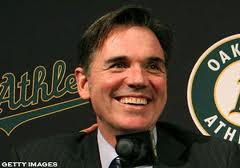
I’m going to give you a scene from Moneyball momentarily—the book, not the movie—but I want to stop and reflect on the Greek word metanoia.  I know it from its religious context, where it is usually translated “repent,” but it is a surprisingly cognitive word.  It means “change your mind” or even, “change the way you are thinking.”  That is precisely what  Oakland A’s General Manager Billy Beane is asking the baseball scouts to do in this scene.

Michael Lewis, the author of Moneyball, plays this scene for laughs.  It is funny, but I think it is funny because we see it the way Billy sees it.  I want to go around to the other side of the table to see it the way the scouts see it.  Billy and Paul Dipodesta, his computer ace, are trying to line up the players to draft in the coming year.  The opposition is a bunch scouts who have been doing this for a long time and know how it should be done. 

A player, in the scout’s view, should be drafted on the basis of his potential.  Billy and Paul think he should be drafted on the basis of his performance.  Where a player’s performance confirms his potential, Billy and the Scouts will be on the same page.  But so will everyone else in the major leagues, and that unanimity will make that player very expensive to sign if he is available at all.  If he has “potential,” but not performance, he will be affordable and the scouts will love him.  If he has “performance,” but not “potential,” he will be affordable and Billy and Paul will love him.  That’s where this conflict will be fought out, but it isn’t really what the conflict is about.  So what is it about?

For the scouts, it’s about the value of their lives; the value of themselves.  Here’s what scouts bring to the table, the table that has Billy’s computer on it.

In the scouts’ view, you found a big league ballplayer by driving sixty thousand miles, staying in a hundred crappy motels, and eating god knows how many meals at Denny’s all so you could watch 200 high school and college baseball games inside of four months, 199 of which were completely meaningless to you. Most of your worth derived from your membership in the fraternity of old scouts who did this for a living. The other little part came from the one time out of two hundred when you would walk into the ballpark, find a seat on the aluminum plank in the fourth row directly behind the catcher, and see something no one else had seen—at least no one who knew the meaning of it.

A scout like this is someone who can see what no one else has seen; can bring undiscovered talent to the team who has put its confidence in him; can use the discernment that he developed as a player and that he honed to a fine edge in all those hours in the bleachers.  The scout says, “The way I learned the game matters.”  The scout says, “My judgment matters.”  He says, “My life matters; I matter.”  That’s what is at stake.

We’re going to look at Billy Beane next, but let’s go back and remember what metanoia means.  It means “Change the way you think.”  The scouts bring to the table not just a way of thinking, but a way of being.  They stand  for “the old values;” for “the way the game ought to be played.”  This way of contributing to their sport is what they  have to bring to the table.  If it is valuable.  Billy is saying it isn’t valuable.  He’s not just asking them to change their minds; he is asking them to change who they are.

Billy Beane cares about what a new player can do for the team.  Assessing the players’ strengths by ransacking the computer databases is not how Billy grew up.  He grew up the same way the scouts did.  He has repented.  Now he is calling on them to repent.  Let’s look at the decision to draft Jeremy Brown

“Jeremy Brown is a bad body catcher,” says the most vocal of the old scouts.

“A bad body who owns the Alabama record books,” says Pitter [Oakland A’s scout Chris Pettaro, who is working Billy’s side of the table. “He’s the only player in the history of the SEC with three hundred hits and two hundred walks,” says Paul, looking up from his computer.

It’s soft body,” says the most vocal old scout. “A fleshy kind of a body.  A body like that can be low energy.”

The old scout is talking about what he has seen.  Brown has “a bad body.”  But for that to really mean anything, it has to mean what the scout thinks it means.  If it doesn’t mean that, the scout wasted all those hours playing ball and then sitting in the stands.  Pitter says Brown’s performance is very good.

 “Yeah,” says the scout. “Well, in this case low energy is because when he walks, his thighs stick together.

“I repeat: we’re not selling jeans here,” says Billy.

“That’s good,” says the scout. “Because if you put him in corduroys, he’d start a fire.”

 “He’s leading the country in walks,” says Paul.

“He better walk because he can’t run,” says one of the scouts.

“That body, Billy,” says the most vocal old scout. “It’s not natural.” He’s pleading now.

“He’s got big thighs,” says the fat scout, thoughtfully munching another jumbo-sized chocolate chip cookie. “A big butt. He’s huge in the ass.”

“Every year that body has just gotten worse and worse and worse,” says a third.

“Can he hit, though?” asks Billy Beane.

Here are the three scouts, eagerly seconding one another’s “insights.”  His thighs stick together.  He can’t wear corduroys.  He can’t run.  He has a big butt.  Michael Lewis characterizes the scouts this way.

The old scouts aren’t built to argue; they are built to agree. They are part of a tightly woven class of former baseball players.

 Nobody can answer Billy’s question, “Can he hit?”  Yes.  He can hit.  And in 390 at bats, he walked 98 times.  For Billy, singles and walks are just alternative ways of getting to first base.  For the scouts, singles are “the right way to get to first” and walks are “the wrong way.”  For all practical purposes, singles show good character; walks show bad character.  Billy says a player who “earns” that many walks is a player who knows how to “control the plate.”

 Billy is right, of course.  Judging players on their performance is better than judging them on the scout’s instincts, which are really just another form of nostalgia.  And judging them on what they can do for your team—your team particularly—allows Billy to draft players he can actually afford instead of the ones everyone else wants too.  If everyone else wants them, Billy won’t be able to afford them.  There is no way, in fact, to argue that the Oakland A’s should use the judgment of the scouts rather than the judgment of Paul Dipodesta’s computer.  Billy is right and the scouts are wrong.

 But just think what Billy is asking of the scouts.  Think what metanoia means in a case like this.  It cuts deep.   It hurts a lot.  And if the scouts pay this price, their “reward” is that the Oakland A’s win a lot of games.  The outcome of my sacrifice, of my “changing my way of thinking” is that somebody else gets to look really good.

 I know the scouts are wrong.  But, probably more often than not, I have done what they are doing so I don’t take much pleasure in condemning them.


Posted in Books, Movies, Theology, ways of knowing | 5 Comments

Kimiko Says Thank You

People who formulate, legitimate, or enforce public policy for a living have a good idea what makes a policy work.  It has to be effective, i.e., meet the goals the policy establishes.  It has to be affordable, i.e., not cost more than succeeding legislatures are willing to pay for it.  And it has to be acceptable, i.e., those affected by it need to comply without too much opposition.  You can tell when there is “too much” opposition because people grumble; they invent shortcuts that are probably illegal but which make enforcement uncertain; and sometimes they violate the policy flagrantly because they have no emotional attachment to it and want to make their opposition plain to the authorities.

There are other reasons policies fail, but those three take care of most cases.  When there are difficulties with a policy, the first wave of responses considers ways to alter the goals, increase the revenues, and rev up enforcement.  I’d like to consider another approach.

I was coming home from a run on the Wildwood Trail this week when I had to stop for a school bus.  I have taught at a lot of schools so I have a kind of respect for school buses.  For me, the STOP sign attached to the arm that swings out when the bus stops and the flashing lights and the little gate that extends from the front bumper are just reminders.  On the other hand, when you are on a road with school buses, you are going to be stopping a lot.  It was an ordinary compliance situation.  I was ready to comply, but I wasn’t happy.

One little girl got off the bus.  She looked like she might be Japanese, so I called her Kimiko, just to myself.  She was wearing a pink jacket and carrying a backpack.  And she looked at me as she crossed the road and waved her thanks.  It looked like it meant something to her that I had stopped.   She wanted me to know that she appreciated it.

I played with that appreciation the rest of the way home.  It occurred to me that maybe the best way to sell a policy is to have the beneficiaries say thank you.  Kimiko wasn’t thanking me as a way to drum up support for the schools’ traffic laws.  She really didn’t gain anything by it.  But she was small and cute and looked happy and the idea of stopping for her seemed a lot more appealing than stopping for the bus ever seemed.

This isn’t a “technique,” really.  It isn’t going to make palatable policies that cost too much or that are fundamentally contested.  On the other hand, people who oppose policies spend a lot of money dramatizing how their rights are being violated or their estates compromised.  It probably would not hurt a lot if some of the beneficiaries of the policy took a minute to say thank you.  I think maybe Kimiko is onto something.

Posted in Saturday Evening Post | Tagged , , | Leave a comment

Obama’s Policy on Israel and Palestine

How shall we approach the decades-long standoff between Israel and Palestine?  In our rush to establish one position or another, we blow right by the general questions which the positions purportedly address.  Any set of comparable positions lines up on an axis of some kind.  Is I see it, there are three axes available.  The first is conquest.  Everyone has a claim on the Promised Land.  It has been notoriously over-promised.  Some combination of Middle Eastern states may very overwhelm Israel and put the land back in pre-1947 conditions, minus, of course, the British.  Israel may decisively preempt attack and decisively defeat their enemies.  They have done it before.  Yet the war goes on.

The second is international settlement.  There will have to be a deciding party and an enforcing party. The deciding party will be the United Nations.  It’s hard to envision who will take part in the enforcing.  A “New World Order” style of temporary coalition wouldn’t be stable enough.  The U. S. would have to form the core of it and we wouldn’t unless the alternative were decisively worse for Israel and that view was taken by a substantial majority of the important pro-Israel groups in the United States.  The basis would be the 1967 lines with land swaps and some arrangement for sharing Jerusalem.

The third is bilateral agreement.  Israel and the Palestinian Authority work it out.  That seems the least likely.  No conceivable Israeli government could engineer such an agreement and no conceivable government of all the Palestinians—the West Bank and Gaza—could enforce the peace such an agreement would require.  The fatal flaw in the “land for peace” deal is that Israel does not have the political will to give up the land and Palestine does not have the security forces to legitimately offer peace.

That is the set President Obama is working with.  I don’t see any winners there.  My gripe about the president’s speech to the U. N. is that he is denying any attention to what I think is the only hope.  I call it, below, a “hybrid option” and will spend the rest of this post considering it.

The only hope I see is that the United Nations grants that the current set of options is unworkable and come with a hybrid.  Palestine becomes a member of the United Nations.  The plundering of the West Bank is recognized as the invasion of the territory of a UN member.  Economic and military sanctions are threatened, as they would be if there were a similar invasion of Italy or any other member state.  The same set of sanctions turns against the Palestinians if they are unable to control their militants and end military retaliation.

It is possible, under those circumstances, that the Israeli parties could decisively renounce their aspirations to Greater Israel and make the only deal there is to make.  And it is possible that Palestine (UN member nation Palestine) could decisively deal with the array of their allies—most notably Iran– who consent annually to the deaths of thousands of Palestinians, provided that their own war against Israel continues.  It is possible.  The look on the face of Mahmoud Abbas is not encouraging.

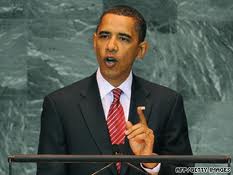
To do that—to devise this hybrid—it is necessary to abandon the line President Obama drew in his September 21 speech to the United Nations.  There is “judgment from the top” he said, and then there is “agreement by the two parties.”  There is no hybrid there, please note.  There is, instead, a resolute ignoring of the possibility of a hybrid and where necessary, the denial that it is possible.  That is awkward, presuming that nothing else will work.

The bulk of the President’s speech was devoted to clarifying that line, so that the top down—the international mandate—solution could be decisively rejected.  “This is how it is supposed to work,” said the President, “nations standing together for the sake of peace and security and individuals claiming their rights.  He cited South Sudan and Côte D’Ivoire and Tunisia and Egypt and Libya.  All those—successes or successes-in-progress all—show “the way it is supposed to be.”  We can argue about whether any of those is an example comparable to the Palestine/Israel conflict, which is the use the president wants to make of it. 

My interest here is the way each example reinforces the line of division the President wants to maintain.  “We must choose,” he says over and over, “between ineffective top-down decisions” and “letting the two parties work it out.”  Given only those two, the President is hoping that the U. N. members will deny Palestine’s bid for recognition.  But to do that, you have to say that those two are really the only options.

Since I am pushing a hybrid—enhanced negotiations resulting from U. N. membership for Palestine—I am not happy to see my option obscured.  When the President claims that there are only two options (and of the two, the one he likes looks preferable), it is important to argue that there are not just two and that we need not choose between them.

Controlling which options are seen as available is one of the first rules of power.  Whatever choice is finally made, that will have been the first step.  But to do that for the benefit of all, you have to get the options right and I don’t think President Obama did that at the U. N.

Posted in Political Psychology, Politics | Tagged , , , | Leave a comment