
I really wanted the title “If Authoritarianism is Trump, We Need a New Deal.” Alas. It was too long to use.
It is a presidential election year in the United States. A Summer Olympics year everywhere else. This year, more than ever, I hope that the Olympics will be beautiful and that everyone will want to watch because the presidential election in the U. S. is going to be ugly and the fewer people around the world who see it, the better.
Because of Donald Trump’s candidacy—as I write this, he is a candidate for the Republican nomination—there has been a lot of talk about “authoritarianism.” On behalf of the political scientists of the world, let me invite you to the discussion. We talk about authoritarianism pretty much all the time. It’s just that this year, some of our stuff is landing on editorial pages and is being read by a broader audience.
I like the attention to “our topic,” but frankly, I am not too happy about the way the word authoritarian—that’s spelled with a scarlet A in quite a few papers—is being used. And making good use of it, especially in this election, seems important to me, so I’m going to spend a little time on it. As you see, I am calling this piece Authoritarianism I. I have no idea how far this will go.
I have three questions in mind for today. I will treat all three as serious questions, although you might think that the first two are too easy to be serious about and the third one “merely” definitional.
Question 1: Is Donald Trump authoritarian?
Question 2: Are Trump voters authoritarian?
Question 3: What do you mean, exactly, by “authoritarian?”
You see the problem.
Answer 1: No. That will depend, of course, on our coming to a useful shared notion of what that word means; it will depend also on whether it is the inner, personal, intimate Donald Trump or the outer, public Donald Trump. The outer one is the only one I care about.
 In her book, Eichmann in Jerusalem: A Report on the Banality of Evil [1], Hannah Arendt raises the question of whether Adolf Eichmann was, himself, anti-Semitic. As I read her, the answer is either “No, he was not,” or “He might have been but it didn’t matter to his work.” [2] Arendt came very close to saying that Eichmann really wasn’t bright enough to be a thoroughgoing anti-Semite. She does say, clearly and repeatedly, that Eichmann’s operation of the Nazi death camps would not have been altered by so much as a single Jew if he actually had been an anti-Semite.
Would Donald Trump’s campaign—his posturing, his pronouncements, his race-baiting—be altered by so much as a single epithet by his actually being authoritarian? I don’t think so. That’s why I said No in answer to my question.
If Trump cares about anything at all in an urgent and persistent way, it is his image [3] or as people say these days, his “brand.” That means that we can count on Trump for a certain kind of speech. He doesn’t just want “a wall” between the U. S. and Mexico, for instance, but he wants the Mexicans to pay for it. It’s the language of outrage. It should not be expected to make sense. It is not a policy proposal. It is a scream in the dark. It is emotionally identical to Howard Beal’s famous, “I’m mad as hell and I’m not going to take this any more!”[4]
But if Trump is just “brand tending,” then what will he say when the situation changes? If he were a proponent of authoritarian policies—another possible meaning of the word—he would hang onto those policies no matter what. He doesn’t do that. He shifts the topics and the proposals so that they express the outrage his followers feel. Following Arendt’s line of thought, I would say that Trump is no more an authoritarian than Eichmann was an anti-Semite.
Answer 2: Some are, some aren’t. The question, remember, was: Are Trump voters authoritarian? This is a question we will have to come back to when we have spent more time on actual measures of authoritarianism, but for now, let’s just say that there are “external” or situational Trump voters and “internal” or character-based Trump voters.
My argument at this point is that some people think that this is a crucial time in American history in which a bold “take no prisoners” kind of leader is required. Imagine for a moment that you are the superintendent of a school district and that one of your school is a chaotic mess filled with incorrigible students. You may have the most fanciful liberal arts dreams in mind for this school, but first you are going to have to establish law and order. So you choose a law and order principal. He is flamboyant. He drives a fire engine red sports car which has a driver’s side door fitted with a scabbard for his Winchester. He encourages his teachers to carry guns in class. The parents who are desperate for order are enthusiastic and reduce his offenses to mere peccadilloes. The others are horrified that some blowhard clown is in charge of their kids’ high school.
In due course, law and order are established and the way is clear for a softer and gentler vision of educational opportunities, at which point you take the next step and choose a mild-mannered liberal arts type as the new principal of the high school. When you chose that first principal, you looked like an educational authoritarian. What is it about you, the horrified parents wanted to know, that makes you value bluster over diplomacy, power over reason, punishment over tolerance. An unhappy childhood perhaps?
What we know about you is that you care deeply about the educational success of your high school and its students. In order to take the next step toward that goal, you needed a tyrant who knew how to play the egotistical maniac. That’s what the sports car and the rifle and the armed teachers are for. But that is not your goal. When you are free to pursue your goal directly, you choose an educational leader for her gentleness and tolerance.
Are you an “authoritarian” superintendent? Of course not. You don’t even like the first principal you chose; it was just what the circumstances demanded. So, the analogy goes, people who support Trump because he is the right man for the job are only “external” or situational or instrumental supporters. They are not really authoritarian, themselves. They are just pooling their votes and their donations with the crazies who are genuinely, internally, psychologically authoritarian.
I see now that I am not going to get to Question 3 today. I thought about going back and changing the “three” to “two,” but I decided to leave it. “Authoritarian 2” will begin with the work of Marc Heatherington and Jonathan Weiler on measuring authoritarianism. When we have got that down, we’re going to go around to the other side—to the voter’s side—and see what their choices are.
In the meantime, take a look at Howard Beal’s rant on the YouTube clip from the movie, Network. It will do you good.
[1] I see that on amazon.com, they are advertising it as The Banality of Evil: Hannah Arendt and the “Final Solution.” The blurb indicates that it is the same book so don’t worry about the change in title.
[2] The movie version of this part of Arendt’s life, called Hannah Arendt, is well worth seeing. In the scene in which she finally defends her views against her critics, she makes the same case I am making here.
[3] The word idolatry was devised to refer to the worship of “an image,” not of “one’s own image.” Still, if you could extend the meaning to Trump’s worship of his own image, I would have no trouble calling him an idolater. NOTE TO THE TRUMP CAMPAIGN: All of the -olater words are based on the Greek verb latreuo, “to worship.” I didn’t invent it just for you guys.
[4] If you’d like to invest a minute and forty seconds into Beal’s pitch, just google “I’m mad as hell…” and watch it on YouTube. You will be surprised, I think, at how little the language of alienation has changed.
 Wendy Lustbader has written more sensibly about aging than anyone I have read for a long time and in a recent issue of Generations (2014) she wrote a piece called “It All Depends on What You Mean by Home.” Isn’t it the truth!
 But among people who have known you for a long time, there is a broader kind of acceptance and it is based on a broader kind of knowledge. People who have known you for a long time know “who you really are,” not just how you seem in the afternoon after your nap. “How he is after his nap” is part of what friends know about you. “He’ll be fine,” they will say, “Just give him a little time.”
 There are two things worth noting here. The first is the way Johnson sets the hook in the reader. “Did you ever have an experience like this?” he says. Nearly every Christian I know has had experiences like that. If you mix with the general public, it is pretty likely that you are going to be in a conversation where the idiocy, the arrogance, and the utter hypocrisy of religious belief are going to be taken for granted. Your own consequent idiocy, arrogance and hypocrisy are obvious applications of this view. That isn’t fun at all.
 has nothing to do with religion and b) I am part of the group of friends.
 So the lesson embedded in this setting of the story is: Let it pass and see what happens.
 group. But a person who feels unable to do either of those might still feel that something should be done and that person might think of saying, “Remember when you were talking and laughing about how stupid religious people are? That really hurt my feelings and I wish you would be more careful and not do that any more.”
 on that is going to choose Donald Trump as the nominee of “the Republican party.” Notice the quotation marks. Ryan is the highest ranking Republican. He is behind only Joe Biden as “our next President.” [1] He is as close to Mr. Republican as anyone can be. He looks pensive, don’t you think?
 I think of “agenda” and “Trump” in the way I think of the agenda of the Earp brothers at the OK Corral. If there is an agenda there, it is “get them before they have a chance to get you.” Grand Old Party? Really?
 [1] And if you can’t imagine what it would be like for a conservative Republican Speaker of the House to move seamlessly into the Oval Office and start “presidenting,” then you owe it to yourself to see John Goodman do it as Glen Alan Walken in Season 4 of The West Wing. I found it disconcerting.
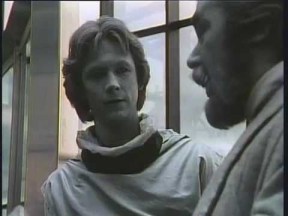 In this picture, we see the result of Haber’s suggestion that the world not be divided into warring groups by the color of their skin. George dreamed that everyone was gray and when he woke up, they all were—including Dr. Haber. I’m sure that seemed a good solution to a dreaming mind, however far from Haber’s mind it was. When George was instructed to bring “peace on earth,” he invented aliens and had them invade Earth. Problem solved.
 You don’t have to walk very far to see these two signs. There is going to be a vote, apparently, on whether to “put” (Boo!) or to “restore” (Yea!) fluoride in the water. “Put” emphasizes the novelty. This is new. It could be dangerous. “Restore” emphasizes the familiarity. We used to have this. Remember how nice it was? We could have it again if we wanted.
 Here’s the other sign. It just comes from the other side of the conflict, but it might almost have come from another planet. Notice first how the policy process flows. Back in the good old days, we had “healthy water.” [2] Presumably, we made the water “healthful” by adding fluoride to it. And the fluoride produced healthy water and the healthy water produced healthy teeth. They don’t say that, but you can see the healthy teeth.
 I like to work in the area between those. I believe that it is reasonable and also useful to say that there are “kinds” or “categories” of marriages and that each kind has the norms of growth and health that are appropriate to it and therefor the kind of consummation that is appropriate to it.
 Let’s start on the easy end of the scale and work up. Let’s say a young couple discover each other at a party by a beautiful lake and fall instantly in love. This is a really terrific feeling and their idea is that if they get married, they will continue to feel that way about each other. Marriage “locks in” the feelings of infatuation, in other words.
 The balance is important because collegiality can decay into routine or even into drudgery. There’s nothing routine about a jolt of intimacy. Intimacy can decay into volatile emotions and loss of trust because when you go that far inside [5], neither of you knows what is there. The steady friendly pace of shared work is a wonderful balance to all that volatility.
 When I think about the consummation of the kind of marriage we have, two things are immediately clear and were clear even from the beginning. The first is that it would take both of us working at it consistently to achieve it. I am thinking, for instance, of the kind of work it takes to make sure that our emotional bank account always has enough funds for us to draw on day by day. And, should it come to that, for emergencies as well.
 ine that things would continue pretty much along the lines described in the earlier chapters. This one didn’t do that. That is what makes it so good for 2016.
 Second, young people with a new vision of the kind of country we could be are the source of new values, values which are both more humanistic (not just anti-corporate) and more egalitarian.
 Point 1: We have done very well with “continuing economic disorganization.” That’s why there are so many angry voters and why authoritarian candidates are so popular. And despite the rhetorical reliance on “the 1%,” we have not done at all well in seeing our dilemma in class-based terms. Class is important in this scenario because the group, gender, and racial/ethic conflicts can all be manipulated as distractions. Class, by this analysis, can not be a distraction and I can’t think of a substitute.
 It is easy to remember the Democratic party as “the party of American liberalism,” and that is true as far as it goes. It is not so easy to remember that “the party of American liberalism” was held in power by the solid South. That Democratic party was the party of “I have a dream,” as Martin Luther King Jr. put it and also of “Segregation now, segregation tomorrow, segregation forever,” as Gov. George Wallace of Alabama put it. Both in 1963, by the way.
 to make them” in mind and search until they find a restaurant that offers that dish. They choose a “kind of restaurant:” vegetarian or Thai or, in Portland, Ethiopian and they go in and sit down and whatever happens is what happens.
 The voters have organized themselves into two cohesive voting blocks. Now they are requiring that the parties become ideologically cohesive parties. And, partly in response to that, the parties are repelling each other [5] and becoming more and more different. The politicians who succeed within these highly polarized parties are the ones who best represent the polarized electorate. What Lind means by his headline is that Donald Trump and Hillary Clinton best represent their respective parties. (I especially like this picture because of the alternation of foreground and background.)
 moderate. The Democrats were “in favor of” civil rights in the south, for instance, and they “urged the southern states” to be more fair and moderate. They did not pass binding civil rights legislation and put money into implementing it. Not in those days. It would have…you know…split the party.
 everything I want to say about the movie. This picture gives you a feeling for what Doris’s house looks like. The audience sees it. Her brother Todd, who wants to sell the house, sees it. The therapist whom the brother engages to help Doris through the process of de-cluttering, sees it. But Doris doesn’t see it.
 I will need to say just a little about how she goes about pursuing him, but it’s really the house I care about. Doris establishes a Facebook account so that Fremont will “friend her.” Facebook is a whole new thing to Doris. She has no idea how it can be honestly used, let along how it can be dishonestly used, which is what her 13 year old friend Vivian has in mind. Vivian invents a new persona for her and chooses a picture that looks nothing like Doris to dress the page up. It’s a really dumb thing to do and it turns out badly, but—and you hardly notice this on the way by—it is doing something.
 It turns out the Fremont has a girlfriend, and, as silly as it seems, Doris is shocked by it all. Fremont is two-timing her! He is being unfaithful to a romance he doesn’t even know he is having. So Doris sneaks around the city, following them. When they catch her at it—she really isn’t very good—they invite her to join them and they go to a club where the girlfriend is the singer. This is a place Doris would never have thought of going.
 The Dilettante's Dilemma