Autonomous Christians

Can Christian persons be autonomous? I have three settings where I would like to place that question. In those three settings, the answers are: absolutely not, of course, and “you’re going to have to be more specific.”

Setting 1: Living in the Garden of Eden

According to the Judeo-Christian myth of our origins, humankind came into being in a autonomy 1.jpgspecial relationship with God. There isn’t really any way to say precisely what that relationship was. C. S. Lewis in his Perelandra takes a very creditable shot at imagining what it must have been like. What we need to know is that it was a relationship of intimacy and trust.

Here’s a way of picturing the event that Christian theology calls “The Fall.” God starts up a business of His own. Fabrication, let’s say. And he makes the first man and the first woman junior partners in the business. The sign on the truck says Jehovah and Son and Daughter. [1] Then it is suggested by some nefarious force that it is demeaning to be always an employee and that there is no reason why they can’t just set up on their own: Adam and Eve, Fabrication! So they do that and go into business in competition with their father.

Not to play out this farce unnecessarily, the point is that what was once a relationship so close it couldn’t even be quite familial was wrecked by the demand that the son and daughter made for autonomy. In Christian theology, “autonomy” is just another word for rebellion and since, in this story, we were made for relationship, rebellion leads very naturally to alienation and then to anxiety and then to sin.

So “autonomy” in the essential sense of our relationship with God is just a euphemism for rebellion and that is why my answer to the question in this setting is “Absolutely not.”

Setting 2: Living in Oregon

Or anywhere else, of course, but Portland is the heart of “the none zone.” In Portland, we are “spiritual, but not religious.” So I am considering “society” in the secular sense in which sociologists and political scientists consider it. When we talk about “the sovereignty of the people,” for example, we don’t mean that God is not sovereign. We mean that the king is not sovereign. Autonomy is a perfectly appropriate relationship between neighbors. When my neighbor says he doesn’t like the way I have designed my garden, I say, “So…? Is there any reason your ideas about what my garden should look like should be taken in preference to mine?” The rough equality of personhood makes it possible for us to stand in line and (with small exceptions like a husband who was parking the car joining his wife who was standing in line) we take it for granted that the line goes in order of arrival—and not in order of title or rank.autonomy 2

Autonomy is a wonderful presupposition for a society. It means that if you want me to change my mind, you need to persuade me. It means that no one in a marriage is more important that anyone else. It means that if you are going to violate the expectation that it is my life and so I get to choose what I will do, you will need a really good reason for doing that.

So in the context of everyday life, not just in Oregon, I say the answer to my question is, “Of course.”

Setting 3: Living in Collegiality

People who are “colleagues” are people “chosen to work together.” [2] I am going to have churches in mind here. I didn’t choose churches because they are hotbeds of collegiality, but because they are intermediate between the loyalty and obedience we owe God and the individuality and autonomy we demand in society. [3] Churches are, in this location, “working groups,” and they are, in that way, very much like athletic teams, when the chemistry is good, or small groups of soldiers in battle.

My answer here is “you’ll have to be more specific” because in the intimacy of a well-functioning group, each protects the other. I risk my life to save yours because just yesterday you risked yours to save me. We are bonded into a single unit by the trust and the danger. I am not “obedient” to you as in Setting 1 and I am not separate from you as in Setting 2. I am functioning in such harmony with you—it is the kind of relationship that just might allow us to live until tomorrow—that only colleagueship is close enough.  This picture came from a search for, “He ain’t heavy; he’s my brother.”

autonomy 4Sports teams at their best are like that. If they cover me, they won’t be able to cover you, so you get the ball. It doesn’t mean you’re a better shot; it doesn’t mean you’re more important; it means you are open. The best quarterbacks working with the best receivers, look at the coverage and know how it will seem to the receiver and throw the ball to the place where the receiver will decide to go. That’s not obedience. It’s certainly not autonomy. It’s this third thing. It is a unity of purpose and an abundance of trust and experience: it is a relationship that words like “colleagueship” only hint at.

Now, I’ve never been in a church like that, but if I found one, I would want to go there tomorrow. I wouldn’t actually go, probably, because I have relationships of honor and trust with people at my present church and I wouldn’t want to violate those relationships. But I would want to.

In the schema I have devised here, you can see that the church is intermediate between the individualistic society, where individual autonomy may not be breached, and the relationship of Eden, where trust and intimacy were built into the relationship from the beginning. Structurally speaking, the church could be the place where the autonomy is superseded by the obligations of covenantal love and where the oneness of the community is a way of returning to the relationship of love and trust with God.

In a bad church, you would still have to insist on autonomy. Without collegiality, it’s all predators and prey. [4] And both of those are bad. In a good church, you would think that autonomy would only get in the way.

[1] I did once see a moving truck that said Smith & Son (and Daughter).
[2] The immediate Latin predecessor is collega, “partner in office,” and it is derived from com-, “with” and legare, “to choose.”
[3] I know that there are societies where that is not true: “collectivist societies,” they are called. In the U. S. we presume the values of an “individualist society” or, as critics often put it, a “hyperindividualistic” society.
[4] A very small church joke.

Posted in A life of faith, Living My Life, Society, Theology | Tagged , , , , | Leave a comment

Angry voters are stupid voters

That’s the thesis for today. I have a story to tell you—one of my very few polished performances as a teacher. [1] And there is some throat clearing to be done, 2016 being a presidential year and one of the angriest in my long political memory. And then, if everything works out, a rousing conclusion. We’ll see.

Throat Clearing

I don’t mean by the title to imply that anger is not perfectly appropriate in politics. Of course it is. It is a terrific motivator. Anger can get you up up our of your chair and off to a political meeting when all the rest of you would like to stay home and watch TV. Anger can get you to put your body on the line to protect some valued public right, aware that you are very likely going to get hurt today.

angry 1On the other hand, anger is like the first stage of a space shot. The booster rocket has no idea what the mission is; has no ability to guide the space craft; can not even orient the craft in the proper direction. That is not what it is for and it is no criticism of a booster rocket to say that it is dumb. It is strong; that is its job.

So anger, even in politics, is not a bad thing. On the other hand, anger is undiscriminating. If you have a policy outcome in mind, say reducing the rate of growth of the national debt or ensuring that every citizen is automatically registered to vote, you need to know which parties and which candidates and which policies will help you. Anger won’t do any of that for you so if angry is all you are as a voter, then stupid is all you are as a voter. [2]

Story

Angry voters are looking for appropriate targets for their anger. That’s the good scenario. The guy who hears a political speech that makes him angry and then goes home to kick the dog is not after an “appropriate” target. Anger motivates punishment. I understand that. The question is always who is to be punished and how. From a policy standpoint, kicking the dog fails both of those tests notably.

angry 2I

I was teaching American government at Portland State University during and after the political era of the September 11 attacks. Quite a few of the students in my classes were angry and they favored “angry responses” to this assault on America. When we got to the chapter on foreign policy, these students were looking for policies that would express their anger.

That isn’t what I wanted them to want. I wanted them to survey the policy tools available to us and to choose the ones that would take our country in the direction they thought it should go. I think that is the job of citizenship and to the extent that political science is involved in citizenship training, asking those questions was my job.

I am not above helping students who think that military action is all that works choose what wars to use, when, and against whom. My idea as a teacher is that once you get students on the if/then train, [3] you can get them to pay attention to the outcomes of the policies they have chosen and the methods they have chosen and then they can really learn something. I do the same for students who think that military approaches are usually counterproductive and who prefer diplomatic approaches instead. If you can get them looking at “if I do this, then that will happen,” you have set them up to learn a great deal on their own.

So this particular year, probably 2002, I tried an experiment. I set up a target. Who, exactly, are the bad guys? I chose terrorist recruiters as my bad guys. They prey on young and poor people and get them to sacrifice their lives in order to kill others. They distort the truth; they deceive these impressionable young people about the true meaning of their sacrifice.  They prey on ignorance and poverty and despair.

Then I said that we should come up with a response that “will make their lives a living Hell.” They liked that. It promised a vehicle for their anger. Then I proposed a series of pretty standard liberal interventions around the world.

I proposed a series of agreements with heads of state where terrorist recruiters were known to be active. That one could have come straight out of George Kennan’s theories about “containing” Soviet aggression in the 1950s.

I proposed active anti-poverty measures in areas where there were many poor Muslim young people. If it was the poverty that made the promises of the terrorist recruiters attractive, we could get there first and when the recruiters showed up, the doors would be slammed in their faces. And it would serve them right!

I proposed the direct and indirect support for education for these young people. The more they can learn on their own, the less dependent they will be on what they are told. That included the education of women because recruitment could be shown to be less successful where women were included in the educational system.

I proposed active support for the regional economies where joblessness, not the same as poverty, made young people easy victims of the recruiters. The recruiters would, in effect, have to offer these young people “a better job than the one they had,” which they could not do. The standard counsel of despair and heroism, which comes so easily to the recruiters, would fall on deaf ears.

angry 4Conclusion: If the terrorist recruiters ever found out who hatched this plan, this series of programs that made their lives so awful, they would hate us (“us” would be me and the American government class, I guess) but we are willing to be judged by the punishment we inflicted on them and which they so richly deserved.

They loved it. For each program, I made a plausible argument that it would have a certain effect. Ordinarily, those programs come with liberal rationales, which would cause them to reject those programs. Here, they are seen as fit vehicles for their anger against terrorism—the recruiters, in this case—so they are all good ideas.

Conclusion

OK, that’s the story. That actually happened in several of my classes. I was absolutely dumbfounded. Is it really possible that these students will accept pretty much anything that they see as a way to express their anger? That’s what it looks like to me.

And it is on the basis of experiences like that that I say that voting angry is voting stupid. Anger is a terrific motivator. That’s what it is best at. But when you go to vote, the right questions to ask are consequential questions. What will happen if this person gets to be President? How are the policies that are being proposed being accepted by the crucial audiences? Congress, say? Or our most important allies? Are the policies that best express my anger clearly unconstitutional? Maybe that’s not a good idea.

So my idea is that it is fine for citizens to be as angry as they want to be, but I think we would all be better off if we thought before we voted and the thought I recommend most highly is this: What do I want to see happen to my country?

[1] I don’t like “polished performances” as a rule. It’s not that I can’t manage them; it’s more that the kind of teaching I like best doesn’t have much use for them. I like working with students to define the nature of the problem we have before us and assimilating the experiences that are right there in class within a coherent framework of thought. That’s what I like best.
[2] A lot of people confuse “stupid” with “uninformed.” That’s not what I mean at all. The ability of uninformed voters to vote “correctly,” i.e. for the people they would have voted for had they known a lot more than they do, is really amazing. See Samuel Popkin’s The Reasoning Voter for details.

[3]  If you have a goal, a positive goal, and not just an emotion, then at some point, you will have to say “if we choose this direction, then that will happen.”  When you get on that train, you learn a lot about what your preferences are, about who your allies are, and about how to proceed.

Posted in Education, Politics | Tagged , , , , | 2 Comments

We have met the enemy and he is us[1]

In 1888, Edward Bellamy wrote a very influential book called Looking Backward. That’s Bellamy in the next paragraph.  He placed the action well into the future—the beginning of the 21st Century—so that his readers could get some distance on the society they were living in at the time. Some things in his imagined future look odd to us, the technical things particularly, but every future is an imaginative projection of our present and very often, we are so immersed in that present that we cannot see it clearly.

2312-1In 2011, roughly the time when Looking Backward is set, Kim Stanley Robinson wrote 2312: A Novel. His goal is different from Bellamy’s in many ways. Robinson, who also wrote the breathtakingly technical Red Mars, Blue Mars, Green Mars series, is a practitioner of “hard SF.” [2] He’s not a reformer, really. On the other hand, the protagonist, Swan Er Hong, lives on Mercury and when she is forced to visit Earth, she is scandalized by what has become of it.  It is what we all know but projected to a catastrophic future.
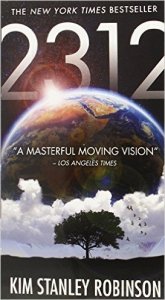
In this essay, I would like to point to two very small excerpts from Robinson’s latest work. The first is a new “periodizing system” by the fictional historian Charlotte Shortback. We use historical periods as common currency in the West and give them very little thought: the Middle Ages, the Renaissance, the Romantic Period, the Early Industrial Period. They use historical periods in the East too, of course, but they use different ones.  Those all collect sets of years in agreed upon chunks.

2312-3Shortback’s periodization takes off from our present and moves to the present in which the novel is set. I’ll name them all and then I will pay closer attention to three of them. First, The Dithering: 2005 to 2060; then The Crisis: 2060 to 2130.; then The Turnaround: 2130 to 2160; then The Accelerando: 2160 to 2220; then The Ritard: 2220 to 2270; then The Balkanization: 2270 to 2320.

All those are, of course, unfamiliar, because only the first part of the first period has yet occurred. Still for a story set in 2312 that will feature a ruined and barely habitable earth, it is hard to think of a better title for our own era that the one Shortback provides. We live in “the Dithering.” Here is Shortback’s description.

The Dithering: 2005 to 2060. From the end of the postmodern (Charlotte’s date derived from the UN announcement of climate change) to the fall into crisis. These were wasted years.

That is followed immediately by:

The Crisis: 2060 to 2130. Disappearance of Arctic summer ice, irreversible permafrost melt and methane release, and unavoidable commitment to major sea rise, In these years all the bad trends converged in “perfect storm” fashion, leading to a rise in average global temperature of five K, and sea level rise of five meters — and as a result, in the 2120s, food shortages, mass riots, catastrophic death on all continents, and an immense spike in the extinction rate of other species. Early lunar bases, scientific stations on Mars.

Shortback points out that “all the bad trends” converged during this time. The convergence belongs to her time period, 2060—2130, but the trends are all perfectly understandable in our own time. Note the “disappearance of Arctic summer ice (happening now), the irreversible permafrost melt (happening now) and the methane release which results from the permafrost melt (happening now) and the unavoidable…sea rise (happening now).

Then a bunch of things happen. A good deal of the plot of 2312: A Novel comes from these intervening periods. But I thought it might be worth your while to look at the final period of Shortback’s set.

The Balkanization: 2270 to 2320. On earth the major events of The Balkanization are these: “volatile shortages pinching harder, causing hoarding, then tribalism; tragedy of the commons redux; splintering into widespread “self-sufficient” enclave city-states.”

We have met the enemy, it seems.

So Shortback’s historical periods serve as the first clip from the novel. The second excerpt has to do with restoring the Earth and its people with space-based technologies. It doesn’t work very well and in this second excerpt, I would like to explore why.

The “splintering into widespread enclave city states” is known, even in our time (the first few years of The Dithering), but they become prominent in parts of the world that live under life and death tensions for decades at a time. People living under those conditions become less and less able to help themselves and also less and less able to accept help from outside. The local rulers demonize “Outside” as a way of keeping control.

Here’s a recent example. Do you remember the Clinton Administration’s brief foray into2312-5 humanitarian politics in Somalia? There were starving people in Somalia and there were TV cameras. It was the combination that made it hard for U.S., specifically the Clinton Administration, to bear. The Somalis needed food and we had food.

Here’s an account of what happened by General John S. Brown, Army Chief of Military History.  The picture shows “the cheering Somali mobs” Brown describes.

The United States Army has a long tradition of humanitarian relief. No such operation has proven as costly or shocking , however, as that undertaken in Somalia from August 1992 to March 1994. Greeted initially by Somalis happy to be saved from starvation, U.S. troops were slowly drawn into inter-clan power struggles and ill-defined “nation-building” missions.

That sense of “mission accomplished” made the events of 3-4 October 1993 more startling, as Americans reacted to the spectacle of dead U. S. soldiers being dragged through the streets by cheering Somali mobs, the very people Americans thought they had rescued from starvation.

For our purposes, it is the “starving Somalis” and the “inter-clan power struggles” that matter most. The worse things get for the people, the more powerful the clans are. The more powerful they are, the more there will be conflict between them. The more conflict there is, the more their attention will be focused on their power relative to other clans and the less it will be focused on the needs of the people.

Robinson deals with this same process on a much larger canvas. The need on Earth is so great that Swan and some other spacers [3] decide to “terraform” Earth. [4]

They planned to start by reconstructing the part of Harare called Domboshawa, transforming its northernmost ring of shantytowns into garden city versions of themselves. This “refurbishing of the built infrastructure” was not a complete solution but the selfreps [not really sure what those are] did build wells, health centers, schools, clothing factories, and housing in several styles already used in Domboshawa, including aspects of the traditional local rondavels.

That sounds spectacularly good to me. It sounds like American marines storming the beach in order to provide food for starving Somalis.

But on Earth, it wasn’t working out. The transformations involved were too great; there grew furious objections, often from elsewhere that the areas being renovated.

It was happening all over Earth…; their restoration projects were getting tangled in dense networks of law and practice and landscape, and the occasional sabotage or accident didn’t help. One couldn’t change anything on Earth without several different kinds of mess resulting, some of them paralyzing. Every square meter of the Earth’s land was owned in several different ways.

Are we surprised? I was surprised only by the scale.

There were of course very powerful forces on Earth adamantly opposed to tinkering from above in general and to creating full employment in particular. Full employment, if enacted, would remove “wage pressure”—which phrase had always meant fear struck into the hearts of the poor [bold font in the original] also into the hearts of anyone who feared becoming poor, which meant almost everyone on earth.

I’m nearly finished with the book. I don’t expect the “terraforming of Earth” to be any part of a successful conclusion of the plot, although they did bring Florida back above sea level. The technology, even now, is enough to relieve a great deal of the present misery, but our efforts founder on what General Brown calls “inter-clan power struggles.”

In setting after setting, we meet the enemy and, as Pogo has it, “he is us.”

[1] One of my favorite quotes of all time, but variously attributed. The original dates from 1813, when Oliver Hazard Perry reported on his success against the British fleet on Lake Erie, “We have met the enemy and they are ours.” Walt Kelly, in the Pogo comic strips I read when I was growing up, revised it to, “We have met the enemy and he is us.” Pretty existential for a swamp possum. Lately, I have heart it attributed to Charlie Brown of the Peanuts comic strip.
[2] I learned that phrase a few weeks ago, just before I started reading Robinson. It means science fiction (SF) that focuses on the scientific and technical aspects (Hard) of the story, rather than the social or psychological aspects.
[3] “Spacers” are people who were born “elsewhere,” i.e. not on Earth and/or who identify with their place of birth. Swan was born on Mercury. Neal Stephenson has the same naming problem in SevenEves where a “people” who have lived in space for generations come back to Earth to confront two separate populations, one of which survived below the land and the other below the sea.
[4] Our planet is often referred to as Terra so “terraforming” would mean making life “there,” like life here. Constructing an atmosphere containing oxygen and adequate heat and adequate gravity and so on. By 2270 they have terraformed quite a few planets and asteroids. The question now is, would those same techniques work on what is left of Earth. The technical answer is that they would. The political answer might be entirely different, as it was in Somalia in the 1990s.

Posted in Books, Economy, Politics | Tagged , , , , , | 2 Comments

First, meet your own standards

I was on a long drive, once, with a woman I did not know well. I knew the family. I knew her husband much better than I knew her. But it was early morning and it was dark and it was a long drive and she began thinking back over her part in the history of what, so far as I knew, was a very good marriage.  Telling it easily, as if it had happened to someone else.

I’m going to tell you the story she told me. This single account is all I have to go on, but I believed every piece of it—I believed, that is, that she was telling it to me exactly as she understood it herself.  Beyond that, I can’t go and have no interest in going.

She said that at the time this event took place, she and her husband had been married a few years. I don’t believe they had children at that time. Her husband came to her one night and said that he thought the marriage really wasn’t working and that he thought it should end. So far, that’s a story that is so familiar that it seems trite even on soap operas. What happened next was not trite. I had never heard anything like it before, nor have I since.

wife 2She told him that she knew she had not been a good wife. She was disappointed in herself. Would he give her six more months, she wondered, and in that time she would be the wife she could be. If she did her best to be the kind of wife she approved of—her standards for her performance—and at the end of six months, he still wanted a divorce, she would raise no obstacles to his dissolving the marriage.
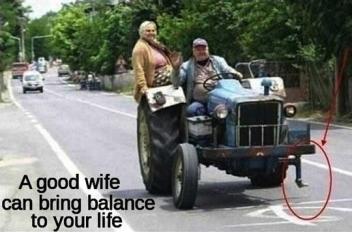
There were no pictures, by the way, that I could count on to illustrate my friend’s story.  I chose this one because it is precisely true to her account, although I’d guess that 90 out of 100 people will misunderstand it.  I’m after the other 10 of you.

I had no idea what to say and we rode along in comfortable silence for a while. That’s all I remember clearly, so from here on, it’s going to be remembered fragments of the conversation, stitched together by the ways I have told this story over the years.

Before we get there, a note or two to the reader. This is not a story about “women;” it is a story about this woman. It is not a story about the inadequacy of the husband. I’m sure a case could be made for that but it was no part at all of this woman’s story. It is not a story about his expectations of her as his wife—however appropriate or inappropriate they may have been. [1] So as you read, you need to give up those common narratives, just as I did, and listen to this amazing woman.

First of all, when some fundamental part of my life or of my self is attacked, the first thing I want to do is to counterattack. She could have said angry things to her husband that were true enough to hurt and I’m not saying that she should not have done that. I am saying that had she done that, she and I would not have been in the car driving along in the dark and she would not have been telling me one of the foundational stories of her life.

She didn’t do that.

Second, a very common exculpation is to deny the appropriateness of the standards. [2] If I haven’t been up to YOUR standards as a wife, that only shows that there is something wrong with your standards. The standards have been wrong or you have not been clear or you have not provided the resources necessary or the incentives necessary, etc. In a way, that is just a form of counterattack, as in the first point, but it implies that if the appropriate standards were used, your complaint against me would have no basis in fact.

She didn’t do that either.  Here’s what she did do.

wife 1She said that she was ashamed that she had not met her own standards as a wife. Perhaps you can see, by now, how breathtakingly simple this is; how many self-justifications she walked past in order to get to this statement: I have not met my standards. I know you are disappointed with me. I want you to know that I am disappointed with me as well.

She said that her meeting her own standards as a wife was the most important first step to take. That is the first step; note that there is a second step. She didn’t tell me what it was about her performance of that role that disappointed her. Maybe she didn’t care about it enough. Maybe she wanted so little emotional intimacy with her husband that he never felt a chance to be engaged in her life or she wanted so much that he was overwhelmed. Maybe it was the sex. Maybe it was the finances. Maybe there was a religious dispute or some sort or a disagreement about whether to have children. She didn’t say.  I didn’t ask.

What she did say is that the second step would necessarily be her husband’s to take. She asked for six months. During that time, she was going to be the kind of wife she could be proud of. [3] She had a good notion of “what she should be as a wife.” That doesn’t mean that she had a standard for “what a wife should be” as if she accepted the stereotypical definition. Her standard was for her own behavior (not “a wife’s) in this relationship (not in “a marriage”).

In doing that, she preserved for herself her right to assess the marriage to see if it met her own needs.  At that time, she would not say that the decision to remain married or not properly belonged to her husband.  She would say–she is now the person in step two–that it is her decision to make.  It a mark of her respect for herself, as well as for him, that either partner can raise the question of whether the relationship is to be kept or not.

I wanted to include the picture just below because it is a commonly expressed sentiment. It is NOT what she said.  She said that she had not been doing the best she could.  She said she would be content for him to make his decision based on her doing the best she could.  She asked only for some time to do that.

wife 3This woman and the husband who asked her for a divorce had been happily married for many years before the morning she told me this story. They are married still, and happy still, and their children have grown up and there are grandchildren. So, to use a formula more common among hobbits than among humans, “They lived happily until the end of their days.”

I wanted to tell this story because I have been looking back, recently, over the course of my life, and remembering with pleasure stories of ordinary people doing absolutely extraordinary things. This woman has set a standard that I use, myself, when I have the guts to do it. When I have done my best—which isn’t all the time, much as I wish it were—I want to let it go, as this woman did. When I am asked to leave—even listing the KINDS of groups, not the groups themselves, I have been asked to leave would make this a much longer essay than it needs to be—I remember the story of this heroic woman and try to live up to what she chose to do. [4]

[1] And just a note to readers. If you google nearly any phrase that is central to this story and choose [images] you will call up pictures that will make you want to throw up. The people who collect images for searches like this do not have this woman’s story in mind.
[2] And for the last decade or so, given the evaporation of common standards, it is enough to establish that the standards in question are YOUR standards. You don’t need to show that they are inappropriate standards. You don’t need to compare them to your own standards, in fact, your standards might be substantially the same. It is proposing those standards as the basis for taking an action that is so offensive.
[3] That may be the part of the story I like best. Had she attempted to “save the marriage” by trying harder “to please him,” it’s had to see that marriage as worth saving. She is doing new things and looking, always looking, to see if he approves. He is always the evaluator; she is always the one being evaluated. That’s not what she did. She determined to satisfy her own standards and when she had done that, she was ready for him to make any choice that seemed appropriate to him.
[4] Maybe just one quick example. I have been a member of First Presbyterian Church of Portland since the mid-1980s. Marilyn and I joined together. We were looking for a church because I had been asked to leave the church we had been attending. Asked by the pastor! He was new to the church and did a quick scan of people who looked like they might be able to cause trouble. So he asked me to come in to see him and gave me a just barely “spiritualized” version of “This church ain’t big enuf for the both of us.” So we left. And I left, feeling very much like the friend who told me the story of her marriage, that I had done my best work and I was proud of what I had done, but this new guy had a church to run and if I could make it easier by leaving, I should.

Posted in Living My Life | Tagged , , , | Leave a comment

Faith Healing

For reasons I don’t entirely understand, I am thinking about faith healing today. In the expression “faith healing,” there is no question about what “healing” means. Understanding what “faith” means is more difficult.

To introduce this speculation, I want to start with the TV show, NCIS. Special Agent Leroy Jethro Gibbs is “God” for all practical purposes. He knows things he can’t possibly know; he appears with impossible suddenness at unpredictable times; he loves the little children like a father. And so on. Oh…and he demands absolute loyalty. He is a larger than life person and that is the way all his staff feel about him, especially Anthony DiNozzo, and that’s a good thing for him because DiNozzo is the one who needs to be healed.

healing 1Early in the second season, an angry mother releases a genetically modified plague bacterium and Tony is the only one who comes down with it. The scientist who designed this bacterium says that Tony has about one chance in fifteen of surviving it. So if you set aside your certain knowledge that Tony appears in the next episode, it seems that he doesn’t have much of a chance.

Enter Gibbs.

He does three things, all of which require the relationship they have developed over the years. He says to Tony, his mouth so close to Tony’s ear that only he can hear, “You…will…not…die.” Then, “Can you hear me?” Tony nods, barely; it is the best he can do. And again, “You…will…not…die”

The second thing he does will be understood immediately by anyone who knows the show. He gives Tony a slap on the back of his head. Ordinarily, that means, “DiNozzo! Focus!” This time it means, I am not treating you the way I would treat anyone with only a few breaths left. I am treating you the way I will treat you when you come back to the team, having recovered from all this.”

The third thing he does is to give him a new cellphone. [1] He presses it into DiNozzo’s hand, which is lying limp on the bed, and says, as he leaves, “And change the number. Women keep calling and asking for Spanky.” DiNozzo knows what that means and smiles—just barely and at considerable effort, but he can’t help himself.

And he does get better. Of course, maybe he would have recovered anyway. He did have a 15% chance after all. But I think it is reasonable to think that the director wants us to believe that what Gibbs did affected Tony’s chances.

Is that faith healing?

I read a study a few years ago that opened another notion of faith healing to me. Here is the question it brought me to. What if there is a reserve of “illness-fighting” resources somewhere in your body? Whoever can release those healing resources in your body can be said to have “healed” you. Just to be clear, the resources are there but you can’t get access to them. They are like a computer document that you have “deleted.” It is still there, but it is not there “to you.” What if it were there “to someone else?”

healing 2The experimenters I read about were studying how to treat athletes at the point of exhaustion. That sounds brutal to me, but there are athletes who really want to know how much they can take. These particular athletes were cycling—on stationary bikes, I suppose. They ride until they are exhausted and then are treated by one or another intervention. In this case the two interventions were: a) drinking sugar water or b) rinsing their mouths with sugar water and then spitting it out.

Group A, the ones who drank the sugar water, got extra resources of energy as the sugar was digested and processed and made available to the muscles. Group B, who only rinsed with the sugar water, got extra resources of energy immediately. There’s more to it, of course, but here’s the part I care about. The scientists concluded that the taste buds signaled the brain that new resources of nutrition were on their way. The brain said, “Oh good, then I won’t have to hold this energy in reserve any longer. I can release it because it will be replaced right away.”

Now…the taste buds were wrong, so the message they sent to the brain was wrong, but the brain responded as if the message were true. It released the energy it had been holding in reserve. In reserve. That means the brain is holding it somewhere where you can’t get at it.

healing 4So then I got to thinking, “What if there were a “reserve of healing” that functioned by precise analogy with the “reserve of energy?” I don’t know that there is such a thing, but I would guess that there is. What would you call someone who has access to that reserve, someone who can cause the healing response to be produced? I don’t want to be stuffy, but I don’t think it would be out of line to call such a person a healer. If he “causes a healing response,” I’d be willing to call him or her a healer. If this response CAN NOT be called forth—the reserve cannot be released—unless you believe that this particular person can do it, then I would say that person is a “faith healer,” This person is someone who is able to “heal you” (call out the healing reserve) if you believe he or she can do it (if you have faith). Faith healer?

Was Jesus a faith healer? [2]

I think so. Jesus is so variously presented in the different gospel traditions that it is hard to be too confident about it. In Mark 5:34, we get this ’My daughter,’ he [Jesus] said, ‘your faith has restored you to health; go in peace and be free of your complaint.’ Everyone calls that episode “a healing performed by Jesus” and I have no quibble with that way of characterizing it, but Jesus says, “The active agent in your healing is your faith that I could heal you.”

healing 3.pngThe counter-instance is made, too. Jesus, having established a reputation as a healer, returns to his home town, Nazareth, and runs into a wall of disbelief. Maybe “dismissal” would be a better word. The villagers said, “Where did this guy get all the religious stuff. He grew up here. We know his family and so he can’t be who he says he is.” And Matthew (13:58) tells us that Jesus “did not work many miracles there because of their lack of faith. Mark says (6:5) that he could not work miracles there because of their lack of faith.

So let’s see if the “healing reserve” analogy helps us here. A woman was restored to health because of her faith. Her faith that Jesus could help her gave Jesus access to the “healing reserve” and her body released all that “healing” and she was cured. In Nazareth, where, according to Mark, he was unable to heal, they did not believe in him and so protected their healing reserve and so Jesus was not able to open it so that they would be healed.

That is a way of understanding the healing ministry of Jesus. I don’t know if it is better than the others, but it is new to me. It is also a way of understanding what “faith healer” could mean. Again, there are lots of other ways of understanding the notion of “faith healer.” [3]

You could ask, I suppose, whether I have offered a “naturalistic explanation” of “faith healing” rather than a religious or supernatural one. To tell you the truth, when we get to the place where believing something is true has an undeniable real world effect on health, I’m not sure just what the “super” part of “supernatural” is any more.

[1] The old one was infected by the virus and had to be destroyed.
[2] English is such a vulnerable language. It associates adjectives with nouns by proximity alone, without the help of gender or case designations. So, just because faith stands next to healer, the expression could mean “the healer of our faith” or it could mean a person who heals because of or by means of our faith. It could even mean someone who is able to heal because of his or her own faith. Jesus as the “healer of our faith” is perfectly orthodox. In Mark 9:24, a father calls out to Jesus, “Lord I believe; help my unbelief.” Both meanings of “faith healer” are there.
[3] You could argue—I don’t want to—that it is the belief a person has in the “healing power” (efficacy) of a placebo that gives it such power to heal. If you gave a placebo saying, “Oh, and by the way, this is a completely inactive sugar pill,” it probably wouldn’t have any effect at all. I don’t want to stretch the word faith so far that it covers “faith in a pill,” but otherwise, I think the parallel is interesting.

Posted in Uncategorized | Leave a comment

The Polls Don’t Lie

Of course, they don’t tell the truth either.

The New York Times/CBS poll came out last week. I discarded the rest of my electronic New York Times and called up the poll. What do these 1,252 potential voters have to tell us about how things are? [1] Particularly, what do they have to tell us about Democratic and Republican candidates and the current look of the general election in November?

Reading Polls

Maybe just a note about these polls would be in order. Polling is a science. The mathematics alone is way past my understanding and the people who study polls seem to agree about the math. Interpreting polls is not a science. At the most favorable, you can say it is an art but there are less inspiring things it can be called.

poll 1I’ll make two brief points here. The first is that these questions [Do you approve of the way Barack Obama is handling his job as President?] may seem simple-minded, but a good deal can be learned from the fact that they ask the same question in the same form year after year. [2] So in these polls, I can look at the responses to this question from from February 2—4, 2009 to this most recent one. Sometimes the fluctuation is the most interesting thing.


The second point is that I don’t read polls to see what they have to say. I have questions in mind and I read polls to find the answers to the questions I am asking. When I saw how low the “trust in Hillary” numbers were, I went back to see when they were higher. “Why are they so low RIGHT NOW?” is the question I was asking. The poll was not conducted to deal with that question, although it provies all the information.

OK. Now to the poll itself.

Bernie Sanders

First, this isn’t really a good time to be president. Most people (61%) feel that things in this country [3] are not going in the right direction, but rather that things have pretty seriously gotten off on the wrong track. It would be nice, if you were thinking of being the head of the executive branch of the federal government to think that your people had hope; to find that half or more thought that things were generally going in the right direction. To do that, you would have to go back to March and April 2003. It has been less that 50% percent ever since then.

Or, if things are not going in the right direction and you still wanted to be the president, it would be nice if there were things you could do to put things back on the right track. But probably there is nothing an executive can do.

In April 2015, I wrote an essay called “Hillary’s Last Chance to Prepare for 2020.” In it, I

imagined that Hillary might be elected in 2016, in part because she was not seen to be poll 6responsible for the poor showing of the economy. The economy is still going to be bad in 2020, according to my argument, and President Hillary is going to be swept away by the popular anger UNLESS she provides, by 2020, when she would be up for re-election, someone else for people to be angry at.

People are not going to say that things are going in the right direction when their own financial circumstances get worse and worse and particularly as inequality gets worse and worse. The president, no matter who it is, will not be able to change that trend so, I argued in April of last year, the only thing a president can affect is who gets blamed for it. So I argued that Hillary needed to start immediately because once she’s President in 2017, it’s going to be too late.

So I learned from the answers to Question 2 that things are headed in the wrong direction according to 61% of the people. I supplemented that by my own theories about why things are so tight economically and why they are going to continue to get worse and it left me wondering why anyone would want to be elected president this year.

That is especially true if you are a Republican candidate. The people in this survey think of the Republican party as “divided” (88% to 10%); they think the campaign is “negative” (58% to 10%); and they are “embarrassed” about the campaign (60% rather than “proud” (27%). I don’t think that looks good for whoever gets the Republican nomination, particularly if there is a fight at the convention in Cleveland and particularly if it gets ugly in public at the convention.

poll 4There is not that same circus atmosphere on the Democratic side, but the difficulties of a Democratic candidate are already plain—people don’t know Bernie and they don’t trust Hillary. The favorable opinion about Hillary—Is your opinion of Hillary Clinton favorable—peaked in 2008 and 2009 during and just after her run for the Democratic nomination. She was above 50% approval for five polls in a row: that’s from September of 2008 until February of 2013. Something happened—the Benghazi controversy, probably—which resulted in here approval rating plummeting from 57% to 26% in just a little over a month. She has been, with a single exception, in the 20s and 30’s ever since. She was at 31% in this most recent poll. “Not favorable” is now over 50%. [4]

I don’t trust Bernie Sanders’ numbers because the time has been so short and the numbers so volatile, but for what it is worth, 84% of the sample say he is “honest and trustworthy” and only 11% say he is not.

For Sanders, the Achilles heel is “realism.” Only 56% think Sanders is “realistic.” The question is: From what you’ve heard or read, generally, would you describe Bernie Sanders’s policy proposals as realistic or not realistic? And 38% say his proposals are not realistic. That compares to the 78% who say Hillary’s proposals are “realistic.”

So on the Democratic side, people don’t trust Hillary and they think Bernie is a dreamer. Now you might ask whether this “don’t trust Hillary” feeling is one of the great achievements of 30 or so years of Republican pot-banging. Of course it is. But the electoral question is not whether Hillary is trustworthy; it is whether people FEEL (I didn’t say THINK) she is trustworthy. She needs to show that she is—I have no idea what would do that—and Bernie needs to show that his policies could actually be enacted. I have no idea how he would do that either, but I think I would start by urging every potential voter to go see Michael Moore’s new movie, Where to Invade Next. (I posted a review of sorts on March 21.)

I began by saying that things were “volatile.”This morning, The Donald “revoked” his pledge to support whoever the Republican Convention chooses. Amazing!

[1] This number included 362 Republican primary voters and 388 Democratic primary voters.
[2] If you run across a question that says, “How is PRESIDENT OBAMA handling foreign policy?” you are reading a poll put out by the Democratic party. The Times/CBS polls are exactly the same, word for word, decade after decade.  And they don’t say “President Obama.”  Ever.
[3] I will put the actual language of the question in italics, as here.
[4] The “trustworthy” numbers—do you think Hillary Clinton is honest and trustworthy—are a little better: 56% say she is and 40% say she is not. All the Republican candidates are at (Cruz) or below 40%. Kasich is at 16%!

Posted in Politics, Uncategorized | Tagged , , , , , , , | Leave a comment

Almost Easter, 2016

Today, the Saturday before Easter, doesn’t have a name so far as I know. In the church Bette and I attend, there are special services for Maundy Thursday [1] and Good Friday [2] and of course, on Easter [3]. At my church, and at English-speaking churches around the world, we will perform this little antiphon. The presiding minister will say, “He is risen” and the congregation will respond, “He is risen indeed”

Every year, I wonder why we say it that way. This year, I have been thinking that we use that language because it is not very specific. Also, because it is archaic and archaic expressions lend themselves very nicely to occasions that have the gravity to bear them. I’d like to explore the lack of specificity just a little, then this essay will take me wherever it wants to go. [4]

Passing On

When we began saying “passed on” to refer to someone who had died, I understood it as a reference to another place. That’s what “on” properly means. [5] You were here on earth and now that you have died, you have gone to “the next place.” Since this was being said out loud about someone we all knew, that was presumed to be heaven, but it is “on” that assured us that it was somewhere.

An alternative form—I think of it as later because I began to hear it later—is “passed away.” Notice that “away” does not require another place. She was here and now she is not here. She is “away.” We could say that of dust on the porch furniture after a windstorm, although we probably wouldn’t because of the associations. The dust was here and now it is not; we would not imagine a “dust heaven” to which it had gone.

But now, the expression I hear most is “passed.” Why is that, I wonder. Why do we not specify the implications of either “on” or “away?” I think we use it because it is imprecise. We don’t have anything precise to say so we choose a form that accommodate all the current meanings.

Being Raised

Easter 1I think that is why we say “He is risen.” But that’s not the way I say it when I have a chance to say it by myself. I say “He is risen” along with everyone else, but I mean, “He was raised.”

My choice of that formulation ought not be taken to mean that I know what happened at the event my church celebrates as “the Resurrection” with a capital R. It means that the form in which the church first began to preach about it is still the form that means the most to me. Here is Luke’s re-creation of the sermon Peter gave to the multitudes. Peter is speaking to the crowd at Pentecost and says this:  “This man [Jesus]…you took and had crucified…but God raised him to life.” [6]
Notice what that says. The event that we celebrate at Easter is something God did. It is not something God did “through Jesus,” which is a way we often characterize his ministry, but something he did “to Jesus.”

Jesus was dead. That’s a very orthodox thing to say. And then he wasn’t. And it is God who accomplished that transition. That’s what Peter says. Later formulations [7] say that Jesus “rose” from the dead as if it is something that he did, rather than something that was done to him. You see now, I hope, why I began with “passing on” and “passing away.” Whatever the resurrectional appearances were like, as the disciples experienced them, they caused the disciples to focus on the implications, rather than on the mechanics of the process. The overwhelming hit for the disciples was, “So it was all true after all.”

In our period of history, so much more in love with knowledge than with trust, we would like to know what actually happened. We would like to have that account in our pockets and we think if we only had that, we could keep track of the expanding role of Christ that the church crafted on his behalf and we could do it with understanding and tolerance. We don’t have that account. We have the early stages of the traditions and the later stages.

What I am saying is the I find the early stages of that process—Peter, as Luke imagines him—more meaningful. On the other hand, I am part of a community here is Portland that really doesn’t care one way or the other whether the verb is active (rose) or passive (was raised) and I’m not saying they should. I am saying that I want to be a part of that community so when I am greeted by a dear old friend or by a relative stranger with “His is risen,” I will say, “He is risen indeed.” It is what I should say and it is what I will say. But some small and inaudible part of myself will say, “Jesus was raised. Thanks be to God.”

Easter 2I think C. S. Lewis comes at this question best when he comes at it indirectly. In The Lion, the Witch, and the Wardrobe, he includes a scenesin which Aslan, the lion, who is the Christ-figure, is humiliated, tortured, and killed on a stone Table. And then one in which he is alive again. The witch figured she had Aslan dead to rights because he gave up his life to save the life of a traitor. But, Aslan says, the next morning, “There was a deeper magic that the witch did not know. She did not know that when a willing victim was killed in a traitor’s stead, the Table would crack and Death itself would start working backwards.”

Lewis, in the children’s stories, contents himself with the notion that there is  “a deeper magic.” I really don’t think that we, as Christians, can do better than that. Something happened. That is solidly historical. The first tellers of the tale were driven by the rHealed 2 (Dale).jpegeturn to life of the story they had thought, up until the death of Jesus, they were part of. When he died, they thought they must have been mistaken. Then when they experienced him again, they said first, “So it was all true!.” Then they said, “Look, these scriptures—as we now understand them—show that this was the plan all along.” Then they said, “OK then. Let’s get to work.”

For me, most of this is captured in a whimsical little cartoon that my dear niece, Lisa Hess, sent to me years ago. She and I have a sense of humor that strikes people as odd on occasion. She thought this card was funny and that I would think it was funny in the same way she did. I did think it was funny that way, but for some reason it also strikes me as true in a powerful and not funny way.

On the front of the card, as you see above, the stone rolls away from the opening to Jesus’s tomb. It rolls over what must be the slowest bunny in the world and kills him. “Easter,” it says on the front of the card. On the inside, it says, “It’s not about a bunny.” Even about the world’s slowest bunny. But then there is this wonderful transaction in the bottom right hand corner of the card.

Jesus, restored now to life (but life of a different sort) heals the bunny. It’s You are healed (Dale).jpegpretty simple, as you can see. “You’re healed,” Jesus says. “Thanks!” replies the bunny, “Welcome back!” This bunny knows from the beginning what the church struggled even to begin to grasp. It’s so easy for the bunny. It isn’t easy because he was healed although I think we could say that not being dead is an advantage. It is easy because it is easy. It is easy in the way it was easy for the girls in The Lion, the Witch, and the Wardrobe.

There is, apparently, a place you can be where Easter is easy. I don’t know where that is. But I celebrate in anyway. A part of my celebration is that every Easter, I wear to church a pair of socks that once belonged to my dad. His name is written on a tape on the socks because in that part of his life, he didn’t know what his name was.

For all the years I knew him, Dad struggled with the Resurrection, as I do. He believed it as he was able, as I do.  He believed with great courage and I would fill his shoes if I could. I can’t. But every Easter, I wear his socks.

[1] From the Latin noun mandatum, “commandment.” Jesus said to his disciples, “A new commandment I give to you. Love one another.” (John 13:34) It is easy to see the English mandate in that.
[2] There is more debate about this than I thought among language people. I always thought it was an extension of God—as it is is “good-bye,” i.e. God be with ye. Apparently not. It appears that a consensus was achieved while I wasn’t looking that it reflects an earlier meaning of good, i.e. “sacred.”
[3] Easter is the only non-Christian word of the bunch. It’s almost ironic. We get the word in English from Eastre, the dawn goddess. It was, my dictionary says, “almost coincident in date with [the] paschal festival of the church.” I’m fine with that. There was already a festival at our Christmas, too. It isn’t as if we are going to run out of significant dates.
[4] My brother, John, and I have a very healthy respect for personalization. John is a biologist and there are moments when is just seems to him the right thing to say about a Roseate Spoonbill (for instance) that it is just beginning to think about heading home. There is something about the expression on the face that evokes that impression from John and he has no qualms about saying it because everyone understands that he is not claiming to know what the Spoonbill is thinking. It is a way of saying what John’s experience of the Spoonbill is. I do the same thing. I know that this essay does not have somewhere is wants to go. “It” does not exist, because I have not created it yet. But it does feel like that. It is like feeling a current in the water and imagining that the stream “wants you to go that way.”
[5] The series of alternative terms for “died” in Monty Python’s skit about the Norwegian Blue Parrot, one of which is Hamlet’s “shuffled off this mortal coil,” comes inevitably to mind.
[6] Those are fragments of Acts 2: 23,24. This is an amazing passage for any number of reasons, one of which is that Luke is giving to Peter a Christology that he himself does not hold, but that he thinks Peter held.
[7] Or Pauline formulations, which are based on a mystical “life and death” of Jesus, not a “following him around Galilee” life.

Posted in Biblical Studies, ways of knowing | Tagged , , | Leave a comment

Dementia and Orthodoxy

I get into trouble more, in my opinion, than I really deserve to. It is true that I do like to have words mean something. I know that is troublesome. I like it even better when the words mean what they are supposed to mean. [1]

But there are, apparently, some questions you are just not supposed to ask.

Just don’t ask

I horrified quite a few people I did not want to horrify by asking whether Marilyn’s children were still my stepchildren after she had died.  The question my friends heard, apparently, was “Do you think I should continue to have friendships with Marilyn’s children?” They embraced me in a truly wonderful way when their mother died.  Each one of them did.  Why I should want to simply drop them was hardly a thinkable thought for me.

So I changed the question so that it sounded more technical. “I was their stepfather,” I would say, “because I was married to their mother. Now that I am no longer married to their mother, how is it that I am still their stepfather?” It didn’t help a bit. The same people who translated my “what is the mechanism by which” question in the first form of the question, did just the same in the second form. There were two prominent results: a) I never did get my question answered and b) I got scolded by at least two sets of friends. I suspect that their estimate of my character was adjusted downward permanently, but you can’t find that kind of thing out by asking.

Dementia and Orthodoxy

I think I may have begun to run into that same trouble again. It’s a religious question this time, but the kind of trouble feels really familiar. Here’s the question. Can a Christian with Alzheimer’s disease be “orthodox?” [2] I think I want to say No.

orthodox 1Here’s how I get there. If you treat “orthodoxy” as “believing the right things,” then you have to be able to believe something in order to be orthodox. Not to get rigorously etymological or anything, but the -doxy part of orthodox comes from the Greek verb (dokein) meaning “to think” and the ortho- part from the Greek adjective (orthos) meaning “straight.” So “thinking the right things” is a pretty good indicator of orthodoxy, especially if we allow “straight” to be defined by the local community.

But what if you can’t think? What if you can’t remember whether some statement that you hear is your head is your own or something you heard at lunch? What if the alternatives you pose don’t fit on the same axis? [3] What if you assert the truth of proposition X at 3:00 and the contradictory proposition Y at 4:00? This is where I start to lose people because they think I am being nasty, but really, if you can’t think, you can’t think the right things.

OK, let’s say that topic is concluded. (I know better, I just need to move on.) Is this person, who is no longer orthodox, still Christian?  Of course he is. Did we think that being accepted as a part of God’s family was a matter of believing the right things? Really?

For many years I have treasured the scorn that James (2:19) lays on people who take pride in their orthodoxy. “You believe in One God? Terrific! That makes you as orthodox as the demons, who know it for a fact what you struggle to believe and they shudder.”  It’s my own paraphrase: I just like to work in a little more of the scorn I think the verse carries.

orthodox 6I think a much better measure of being Christian, of being, as Christians understand it, a part of God’s family, is saying Yes to God with every available resource. Here’s a handy checklist. (See Deuteronomy 6 and Mark 12) To know what the authors of Deuteronomy meant, you would have to have a better grasp than I do of the crucial terms. What did they mean by “heart” or by “soul,” for instance?  When I run a checklist of that kind for myself, I use these four categories: what I think, what I intend, how I feel, and what I do.  That is a series that is meaningful to me. [4]

We have already taken thinking off the list, so far as “believing the right things” is concerned, but there may be other ways you can use your mind to say Yes to whatever God is asking from you. Your ability to intend some outcome and to pursue it successfully may have shriveled along with your ability to remember what you intended, but I’d be open to the idea that intending to be truthful or generous or grateful in whatever lucid moments you have meets the “with all your strength” criterion in Deuteronomy.

I don’t know how rich the emotional life of an Alzheimer’s patient is, but my guess is that if you can feel  both the tug of resentment and the invitation to joy, you can still lean in the one direction or the other.

I remember vividly a story my mother used to tell about what happened one day when my brother Mark and his wife Carol visited my father. There wasn’t much left of Dad’s mind by that time. Mark did what I would have done. He treated what was left of Dad as a person deserving of respect. Carol greeted him warmly and went over to the bedside and kissed him on the cheek. Those are both really good things to do.

When they had left, Mother reviewed the event with Dad. She wanted to be sure he understood that his son had come to visit. The way I heard the story, Mom said, “You know who that was, don’t you?” And Dad said, “His wife kissed me.” I have no idea what Dad was thinking or feeling about himself by then, but I’d guess that he understood that he had the choice of opening himself to this gift or of closing himself off from it and that he said Yes.

When the last fragment of you says Yes, you are doing the right thing.

Open the Door

Finally, I think sometimes about the invitation Jesus gives in Revelation 3:20. Here it is in the New Jerusalem Bible:

Look, I am standing at the door, knocking. If one of you hears me calling and opens the door, I will come in to share a meal at that person’s side.

orthodox 5The only question that verse asks of the person living in that house is, “Are you going to open the door?” It doesn’t ask if you know who is knocking. It doesn’t ask if you had intended to have a visitor. It doesn’t ask if you are anxious about who is knocking. It asks whether you are going to open the door.

I’ve always liked that particular scripture because it is so clearly an invitation. It isn’t an invitation matched with a threat. It doesn’t say that Jesus is going to go on banging on the door until your neighbors are up in arms. I like it because it is gentle and because it puts the ball in my court. “What are you going to do?” it asks.

Imagine now that I have had a stroke and can no longer get to the door. Or that I have been gagged and tied to a chair. Or that I have gone next door to help care for a neighbor. Is there any circumstance you can imagine in which the Jesus of this invitation would say, “Well…if you can’t get to the door, the whole deal is off.” Any circumstance at all?

And that is why I imagine that people who have said Yes with all their heart and mind and soul and strength will be welcomed home when only the merest fragments of their “selves” are still at their command.

[1] I’m not talking about dictionary meanings here, but only that among these people, this word is ordinarily accepted as meaning this. That’s what I mean by “supposed to:” I mean that the word is commonly supposed to mean that one thing.
[2] I am not, obviously, using a common abbreviation for the Greek Orthodox church. I just mean “believing what you are supposed to believe in your religious setting or group.” A very very loose definition, you will agree.
[3] A joke I remember from grade school is: “Would you rather walk to work…or carry your lunch.” It was supposed to be funny because things are presented as alternatives that really don’t belong on the same axis.
[4] If you ever have to run that series yourself, you can call them what I called them in grad school: cognition, conation, affect, and behavior.  Or “behavior tendency” if there is a behaviorist in the crowd.

Posted in A life of faith, Getting Old | Tagged , , , | Leave a comment

Michael Moore on “Where to Invade Next”

The United States (hereafter “we”) look really bad in the recent Michael Moore movie, moore 2“Where to Invade Next.” That’s not a headline. We don’t look good in any of the Michael Moore movies. It’s just a statement about what I want to think about today.

According to my own highly personal system of counting, I have seen “Where to Invade Next” three times. I went to see it while Bette was off visiting one of the countries Moore includes in the movie (Germany) and then, last night, saw it again with her. I count seeing a movie with Bette as seeing it twice. She sees it differently than I do and then we talk about it afterwards. It’s like seeing it again, only for free.

Jonathan Kim makes a really interesting point about Michael Moore movies in his Huffington Post article.

But when looking at his filmography, no one can dispute his track record for shining a light on issues several years before they’re noticed by the corporate media or adopted by politicians.

With his first film, 1989’s Roger & Me, Moore showed the devastating effects of offshoring and corporate callousness on his hometown of Flint, Michigan. Bowling For Columbine in 2002 drew attention to America’s uniquely insane gun obsession and its consequences years before mass shootings became commonplace. Moore slammed the door on the Bush administration’s response to 9/11, the catastrophic Iraq war, and the media’s complicity in both with Fahrenheit 9/11 in 2004, and three years before Obamacare was signed into law, Moore skewered the cartoonish cruelty of the health insurance industry in 2007’s Sicko while making a demand for universal healthcare.  And two years before Occupy Wall Street, Moore called out an economy rigged for the rich in 2009’s Capitalism: A Love Story, with the housing meltdown and subsequent bailout as the ultimate crime scene.

The first time I saw it, I paid attention to the material he presented. The Italians have more generous vacation policies than we do; the French serve better (and cheaper) school lunches, the Germans have dealt more courageously with their shameful past [1]; the Portuguese have a better drug policy; the Finns have better schools; the Norwegians have a more enlightened (and more effective) prison system, and so on.

What I noticed in seeing twice more [2] is that the argument he makes is the same for every topic. I’m going to add a bunch of caveats in the next paragraph, so just lay yours aside for now.

Moore compares the outcomes they are getting with the outcomes we are getting here. Theirs are better. Very often, they are also cheaper.

Now the yes buts. Yes, but Moore cherrypicks the issue he wants for every country he visits. Yes. He does. Imagining for the moment that Slovenia, for instance, is not as good at everything as they are at the feature Moore is examining [3], he spends no time at all on what they are not good at. That is not the point he wants to make.

Yes, but Moore does not account for the inevitable decay in the character of the work force when they are no longer driven by poverty or the threat of poverty. No. He does not. He looks at how things are now, not at how things might come to be if the same policies are continued.

Yes, but Moore considers only domestic policies. The only reference to foreign policy in the whole film is his claim that the U. S. spends 60% of its budget on the military. Could these other countries—Norway and Iceland and France, for instance—afford such generous domestic policies if they spend as much as we do on the military. No, probably they couldn’t. But since we are spending it, they don’t have to.

Yes, but Moore does not present a balanced picture. No. He doesn’t. He claims that the coverage of these issues in the U. S. is completely dominated by status quo conservatives and his films are a corrective. He films rebuttals. No one would expect a rebuttal to be fair to all the arguments.

OK, enough of that. I can’t hit all the yes, buts, so I have chosen these as a representative collection.

Moore’s movie is a visual feast. For instance, the sun is always shining in the countries he visits. Even Norway and Finland. The people are happy and productive. Things are good. The best part of the movie for me was seeing and hearing the people who get a chance to tell about their lives—on camera.

moore 3The Italian couple pictured here who are accustomed to eight weeks of vacation every year are astounded to learn that American workers get none at all—by law. Moore does admit that vacation hours are negotiated in contracts. She is in a mid-level business; he’s a cop. They both look very good in the vacation pictures that someone takes of them nearly everywhere in the world it is sunny and warm.

But this guy (below), who runs a Bugati motorcycle factory says that treating the workers well not only insures that they will work productively, but it means he gets to live in a country where people have free time and know how to use it. He agrees that he would make more money if he tightened the screws a little, but he thinks he makes enough money and he likes living in Italy.

I think France is my favorite. He chooses school lunches and sex education in France. Themoore 6 meal we see at the elementary school is charming. It is served by kitchen staff. On china. A four-course meal. For less per child than we spend. And they get an hour to eat it.

I suppose I could find something to criticize if I worked at it, but the whole scene charmed me and I didn’t feel like working at it. Lunch was treated as one of the school learning periods. What to eat. How to eat. How to share food with others at the table. Moore’s best line comes as a very attractive small plate of food is shown. Just that plate of food takes up the whole screen. It looks wonderful. Moore’s line is, “This is just the appetizer.” It turns out that there are three more courses to follow.  In the picture below, Moore, playing the American buffoon, is the only inappropriately dressed person at the table.

The class in sex education was based on the idea that young people are going to engage in sexual activity. The question of whether they should or not was not raised. The teacher wanted to talk about how important it was for each party to attend to the sexual experience of the other; how the sexual part was just a part of a larger relationship, and so on.

moore 5

It is entirely possible, of course, to approach premarital [4] sex from a principally moral point of view. That view can be succinctly summarized: don’t. But, of course, it doesn’t work. Moore brings Texas governor Rick Perry on in a film clip to say that “abstinence only” works as a public policy. He says he has personal experience that it works. The question the interviewer is asking Perry is why, if abstinence only education works so well in Texas, does Texas have the third highest teen pregnancy rates in the country. And lest we miss the point, Moore puts a graph of teen pregnancy rates in France and in the U. S. up on the screen. We have…maybe three times (or so) the number of teen pregnancies.

And this is really Moore’s strategy throughout. He shows what works in the host country. He shows that what they are doing there is working a lot better than what we are doing here. The question, mostly unasked in the movie, is, “Why wouldn’t we want to have those results here?” [5]

And that’s really the feeling I have after my multiple viewings. Watching those French and Finnish and Portuguese and Tunisian and Icelandic and German and Norwegian citizens describing the outcomes of their policies with such pride, I find myself yearning for those kinds of outcome and that kind of pride here in my country.

Bette said, as we sat down to discuss the movie, “What do you think about it?” That’s nearly always a good question for me because what I think about a movie is usually what is available to me first. Not this time. This time, I had to say, “This isn’t a thinking movie for me yet. It’s just a feeling movie so far and it makes me feel sad.”

[1] I’m sure Moore thinks every nation-state has a shameful past. He characterizes ours as “based on genocide and built by slave labor.” That’s not entirely accurate, of course; on the other hand, you can’t say it is wrong.
[2] I’m appreciating this numbering system more as I go on. I bought three tickets and “saw the movie” three times. It doesn’t sound bad at all that way.
[3] It is the free provision of university education to everyone who lives in Slovenia—even the American students who moved there because they could not afford to go to school here.
[4] As marriage continues to decline as a normal state of adult relations, we are going to need a prefix other than pre-. Extramarital could have meant, but it has not, “sex without reference to marriage.” Possibly “non-marital” is still available because, so far as I know, it does not have a meaning.
[5] The official in charge of Portugal’s drug policy tries to warn Moore away from his obvious interest in transplanting Portugal’s drug policy to the U. S. It isn’t just a piece of policy, the official says. You can’t just pick this one up and plunk it down in your country. Our policy requires health care for all our citizens and I know you don’t have that in your country.


Posted in Politics, Society, Sustainability | Tagged , , , , , | Leave a comment

Being “useful”

“We do not take well to uselessness.”

So says Wendy Lustbader in her superb Counting on Kindness: the Dilemmas of Dependency. She has older people in mind, but I would like to explore the idea today in a somewhat broader context. There is no question in my mind that she is right in what she says, but I wonder if the fact that we take so poorly to it retire 1is as good a thing as she thinks it is.

Let’s take retirement first. [1] A common complaint among American men who have “retired” from their jobs is that they feel useless. [2] That kind of “usefulness” relies on the contribution you make to the company and fuses with it the regard for your work that comes from your colleagues. But it could mean that your retirement from that battlefield frees you to choose another battlefield, one that better serves the forces you still have to commit.

If retirement means only that, that you are now free to choose another engagement with other foes with increased odds of “winning,” then there is no reason whatever that a man retiring from his job would need to run the risk of feeling useless.

Unless, of course: a) doing that particular job is the only reason he values himself, b) there are no other commitments that truly engage him, and c) there are no other colleagues who assess his work and value it when it is good. If he doesn’t have any of those, then “not being at work” is not the problem he thinks it is.  His problems are much deeper than he has suspected.

There is a broader context, however. “Usefulness” is a kind of doing. It is not a kind of being. Is doing really all that matters? Really?  The being/doing distinction can be seen as fundamental, but that’s not the way I am thinking of it here. Anyone who engages himself or herself completely in a world (of experience) or in a task, does not rely on the activity, and may scarcely be aware of it.

Mihaly Czickszentmihaly describes the experience as “flow.” [3] When you are in a state of flow, the world goes away. The conversation you are having becomes vivid and all the rest of the world, pallid; the picture you are painting and its possibilities, both chosen and rejected, is the whole world of your experience; the concept you have almost but not quite grasped makes up all of “what you are doing” and peripherals like…oh…eating, sleeping, and being somewhere on time, simply recede into the distance.

No one, in a state of flow, wonders whether he or she is being “useful.”

There is a distinction, as well, between “who I am” and “what I do.” It’s not a simple distinction, obviously, but I would like to drop a pin in the map right there so we can find our way back.

retire 3Another difficulty that the notion of “uselessness” hands us is, “What do we mean when we say ‘useful’?” Society is a rough and ready kind of enterprise so far as meanings go. Society is possible because “close enough” is the standard for giving and receiving meaning. But every now that then, “good enough” really isn’t good enough and I think this is one. What if, for instance, our common definitions of “useful” are merely conventional? What is these common definitions are not “useful?” What if another notion of “useful,” on being presented, would be welcomed and would benefit us all?

Here’s an example. There was quite a bit of time that elapsed between my wife, Marilyn’s cancer diagnosis and her death. During most of that time, she was disabled by cancer treatments of one kind or another and she understood that her obvious frailties made her a problem for her friends. Marilyn didn’t give up on being “useful” and she didn’t demand that her friends give up on it either.  She did something better than either of those.

She actively pursued a sense of easy exchange with her friends. Her friends wanted to be with her and to console her. Marilyn did all the work that made it possible for them to do that. She actively defined the relationship between herself and her friends so that they would know they were “doing it right;” so they would be at ease from the first and would grow more confident and more effective as they went on.

Everyone looking at that scene would agree that her friends were there to “be useful to her.” And they were. And they would have done the things that she needed had she been self-conscious and spiteful or had she grown weary from the persistent demands for gratitude. But Marilyn’s notion of “usefulness” to her friends enabled her to invite them to do things for her and to receive their efforts with generosity.

So she was at least as “useful” to them as they were to her. More useful, as I saw it. I was dumbfounded. I had never considered the possibility that avoiding “uselessness” could look like that. Obviously, I had never seen it either. I filed it away so that should I ever be in that situation, I will have her strength and generosity as a guide.

When I think of “useful” in the conventional ways, what Marilyn did simply does not come into view. That is one of the reasons that conventional meanings need to be expanded from time to time. So here is an example of a different sort entirely.

I am part of a weekly discussion group where the discussion ebbs and flows. There is oneretire 2.png member of the group who is willing to ask the “Why is grass green?” kind of question. No one knows the answer, but we all think we should so all of us pass the opportunity by and none of us asks it. But this one guy does. He would be very much surprised, I think, to learn that his contribution is “useful” to the group; it is, in fact, much more than useful. It is vital.
If he were to learn the value of what he does so that he could do it on purpose when it is needed, I think he should be designated A National Resource and loaned out, when needed, to groups whose discussions are doing more ebbing and less flowing.

Lustbader is right, I think, to point to the phenomenon of “uselessness,” especially in older adults. And the feeling of “being useless” is a very real feeling for many seniors. But we ought to ask, I think, why we have allowed our notion of what is “useful” to shrink so drastically. Why is “working for a wage” a useful thing to do, but making your home an inviting place for the grandkids or a place of refuge for their parents “not useful?” Why is making shrewd and productive investments in bonds “useful,” but making shrewd and productive investments in friendships, not? [4]

I want to leave you with an image of “retirement” to consider. I have a DVD of the movie The Twilight Zone, which, taken as a whole, is wa-a-a-y too scary for my taste. But there is one episode that features Scatman Crothers as Mr. Bloom. He’s new to this senior center. He apparently doesn’t know how the game is played, because he keeps asking questions that lead the residents to remember who they were and to take pleasure in the memories.

retire 6One night, all the residents (except the one holdout) are magically transformed into themselves as children. They run and play and laugh. But before the night is over, they have begun to remember also the wonderful relationships and events of which they were a part and which they will not have any access to unless they go back to their old selves. And Mr. Bloom gives them that. You can go back, he says, to “your old comfortable bodies,” but with “fresh young minds.” The next morning these old people nearly erupt from the senior center, bursting with things to do and places to go that were there all along, but which they had not been willing to contemplate.
Mr. Bloom watches all this activity with satisfaction, then ambles down the walk and along the street where he turns in at the entrance to another senior center—one that looks remarkably like the one he has just left. The residents are sitting or standing in the front yard staring into a meaningless middle distance. Bloom waves his cane in front of the eyes of one old man, provoking not so much as a blink.

“Oh boy,” says Bloom, facing the camera, “this [new assignment] is going to be a tough one.

I tell that story for two reasons. The first is that we see Mr. Bloom “retire,” leave the field, from the first nursing home. This is the only field of action in the movie until the last few seconds.  Why has he done that? Because he is about to begin his campaign at another nursing home. I think “retirement” can mean that.

And then there is the question of Mr. Bloom and “uselessness.” Mr. Bloom is the antithesis of uselessness. And also the antidote.

[1] I have been waiting for some time now for a chance to return that word to its natural home. When an army “retires” from the field, it may be for any number of reasons, most prominent among them is that they want to take up a stronger defensive position elsewhere. Robert E. Lee’s refusal to “retire” from Gettysburg after the first day brought about the disaster of the third day.  For us, it just means that today’s retirement helps to set the table for tomorrow’s victory.
[2] This has not been so common among American women because they much more frequently have additional commitments and they don’t retire from those. That sounds pretty sensible to me.
[3] In his book by that name.
[4] The friendships you invest in don’t need to include you at all. It is perfectly possible to invest in people so that they are drawn to their friendship with each other. Seeing their friendship flourish, you have every reason to “retire” from it and to be pleased with your work.

Posted in Getting Old | Tagged , , , , | Leave a comment