“Bad Faith” and Politics

I don’t know J. D. Vance at all, but I think I’d like him if I had the chance. The New York Times for June 26 offered his article, “The Bad Faith of the White Working Class,” which you can (and should) see here.

This particular column could use some editing—either that or it has been over-edited so as to cram several themes into just a few column inches. I’m going to object to a few things I read here, none of which reflect badly on Mr. Vance. I just want to use his argument for some other purposes.  Let’s begin here.

The evangelical Christian faith I’d grown up with sustained me. It demanded that I refuse the drugs and alcohol on offer in our southwestern Ohio town, that I treat my friends and family kindly and that I work hard in school. Most of all, when times were toughest, it gave me reason to hope.

I like all of those effects. Who wouldn’t? As a Christian myself, I don’t take any particular satisfaction in the religious context in which Mr. Vance grew up because the good outcomes he describes are not an intrinsic part of any particular religious faith. A warm and loving coven of witches would do just fine. We’ll get to that.

His religious upbringing demanded that he refuse drugs and alcohol. [1] It demanded that he treat friends and family kindly. (No word there on how to treat enemies.)  It demanded that he work hard in school. It gave him a reason to hope—for what, Vance does not say, but I’d guess it had something to do with a stable and prosperous life.

These effects are produced by institutions that are vehicles of his Christian faith, as Vance understands it, not by Christian faith itself. When you look at the statistics, you find that kids who attend “church” [2] “perform better in school, divorce less as adults and commit fewer crimes. Regular church attendees even exhibit less racial prejudice than their nonreligious peers.”

At this point, Vance begins to move in a direction that concerns me. He points out that working class whites have largely abandoned their churches; not their faith, just their churches. And if it is true, as Vance and I both believe, that it is the institutional effect that produces the good outcomes he remembers, then this is a substantial loss to society.

Though many working-class whites have lost any ties to church, they haven’t necessarily abandoned their faith. More than one in three identify as evangelical, and well over 75 percent claim some Christian affiliation. But that faith has become deinstitutionalized. They carry it alone.

Those losses show up as increases in incarcerations rates for white women, increased deaths from drugs for white youth, and increased rates of divorce and domestic chaos. It is the loss of the institutional home, according to Vance, that has produces these effects among working class whites.

But I want to think now about what Christian churches are for. Presumably, the purpose of a church—as it sees itself—has something to do with God. I would hope that it had something to do with the invitation to reconciliation God offered through Jesus Christ. If churches aren’t for that, I’m not sure what they are for. [3]

Vance’s consideration of the value of institutional churches is entirely instrumental. Being a part of a religious community does all the good things he is talking about—the drugs, the divorce, the dropouts—but that is not “what they are for.”
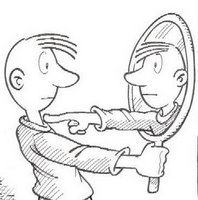
jdvance 6Vance’s second point is that as “faith” as been de-institutionalized, it has been re-politicized. But politicization, even among white working class voters, means more than Vance considers in this column. Further, the black Protestant churches are almost surely the most politicized churches in the U. S. The “values voters” that Vance laments are only a pale reflection of the “black Christian voters” that the black churches turn out year after year. [4]

What Vance really wants to get at, though, is that Christian commitment can lead to “a certain amount of self-reflection and, occasionally, self-criticism.” The pale residue of a community of faith he sees among the “values voters” has enough power to collect and confirm class prejudices, but not enough to compel self-reflection. Or, as Vance says:

“…this fusion of religion and politics necessarily forces people to look externally [and]…a Christianity constantly looking for political answers to moral and spiritual problems gives believers an excuse to blame other people when they should be looking in the mirror.”

I didn’t know, for instance, until I read this article, that Donald Trump succeeded best among people who identified as evangelicals but who rarely—“a few times per year”—attended church. Among evangelicals who go to church frequently, Ted Cruz got nearly twice as many votes as Trump did.

jdvance 3Vance sees that as the difference between a religious stance with and one without an actual community. Evangelicals who worship in community have, as Vance puts it, “camaraderie, community, and a sense of purpose.” Evangelicals who are alienated from actual communities have only a vacuum there and “into that vacuum has stepped Donald J. Trump.”

I was first attracted to Vance’s article by the title the headline writers gave him: “The Bad Faith of the White Working Class.” Now that I have spent some time with Vance’s take on it, I think I can rule out some possible meanings and make a good guess about what the notion means here.

Jean-Paul Sartre used the expression “bad faith” (mauvaise foi) as a centerpiece of his existential critique. But he meant that we deceive ourselves about the real possibilities open to us and imagine ourselves to be the prisoners of our circumstances, when in fact we have consented to them. That is not what Vance means.

I think that for Vance, “bad faith” is more like junk food. You choose it, you eat it, you pay the consequences for eating it. It is advertised extensively and packaged attractively and you gobble it down, knowing you shouldn’t. And then you find out that it does not sustain you. It will fuel a considerable array of short term actions, but it will not sustain you through anything that takes time and consistent effort.

I think that Vance believes that a religious faith as part of a supportive community does actually provide that kind of support. A faith that moves you to remove the splinter in your own eye before you attempt delicate surgery on the speck of dust in your brother’s eye [5] is “a good faith.” If it just provides more juice for the hating machine, then it is bad faith.

I think Vance is right about that.

[1] That one means something to me because he grew up, as I did, in a southwestern Ohio town. He grew up in Middletown, Ohio. I grew up in Englewood, which is roughly 75% smaller.
[2] I have seen the same effect in statistics about attendance at mosques and synagogues and I would guess that participation in any regular religious community would have this kind of effect. If rehydration is your concern, you don’t really care what flavor it comes in.
[3] By saying what they are for, I don’t mean to imply that they might not have other effects—such as the ones Vance is talking about—or that society might not benefit from them.
[4] The best film version of that role I know is The Long Walk Home starring Whoopi Goldberg and Sissy Spacek. The best academic consideration I know is Amazing Grace: How Religion Units and Divides Us by Robert D. Putnam and David E. Campbell
[5] Matthew 7:3, freely paraphrased.

Posted in A life of faith, Politics | Tagged , , , , | Leave a comment

How not to feel like a frail old man

It’s not as easy as you might think. Here are some things we need to consider just to get started.

First, it would help a good deal of you are actually not frail[1], not old, or not male. That would take care of “frail old man” on all three counts. [2] Second, it would help if the way your body is did not cause you to represent it to yourself as “frail.” Notice, please, that it is the representation to yourself that does the damage in the problem I am constructing, not the fragility itself.  That will become clearer in the stair-climbing example.

What the process is like

That is the point in the argument where I lose nearly everyone. People have no idea the extent to which they construct a reality for themselves and then later—not very much later, sometimes—“discover” this reality and treat it as a part of the common objective world in which we all live. This essay is aimed at paying attention to that hidden part of the process—and then, later, at messing with it just a little.

frail 1How does that work, exactly? “Frail” is an evaluative term that requires an outside perspective. If you were to see an old man shuffling along warily, concentrating full force on not falling over, you might easily call that old man “frail.” But you would apply that term to yourself only if you imagine others would see you in that light. You imagine the way you may be viewed and apply that label to yourself.

But…here’s the thing. There really doesn’t need to be anyone else around to make that judgment. If “frail” is a term in common use, then you have a notion of “what it means.” [3] And when you have that notion, you will apply it to yourself whether anyone is around or not.

So far, we have an old man trying to decide if he is “frail.” He doesn’t know he is doing that, but we know that he is. We know that he is going to internalize and apply to himself the word “frail” when that is the judgment he thinks “others” would make. We have to say that clearly because the point here is that the label is an external entity. The feelings he has are internal; the word he chooses as an appropriate description of his feelings is held in place by social processes that are external.

So this old man uses the word the way “others” use it. Now we can ask, “Which others?”
The short answer is, “his reference group”—those people whom he counts on to make the judgments he approves of and who use that word “as it should be used.” That should make it clear that when you “choose” the people who who will make up your reference group, you are choosing the meaning of the word “frail.” Is it a sympathetic word? A dismissive word? A condemnatory word? Is the criterion for its use set low, so that nearly everyone past the peak of physical fitness is “frail” or is it set high, so that only old people who must move slowly and warily are “frail?”

Whatever is the case, you will apply the word “frail” to yourself the way your reference group does. If you are an old man and your reference group has placed the criterion low and if they use it in a condemnatory rather than a sympathetic way, then the chances that you are “a frail old man” are extremely good.

Let me stop one more time to say that we are not talking about the cfrail 3ondition of your bones and muscles and joints, we are talking about the conditions that will cause you to apply a word to yourself. The word is “frail.” And if you have decided that “being a frail old man” doesn’t serve you well, what can you do about it?

Messing with the process

There really are some things you can do. You can, as I promised, “mess with it just a little.” To do that, you have to know how the process works. This is how it works. There is a loop which comprises three links. [4] First, a)you act and then, b) you interpret and then, c)  you apply. You do this many times a minute for some traits. It is a loop by which your action (walking up a flight of stairs, pulling the bath mat off the bar on the shower door, getting out of a car) asks whether the word “frail” applies to it and receives the answer. Many times a minute. If you are an old man and the answer to your question—the one you are not aware of asking—is always Yes, then you are a frail old man.

However.

Because it is a process and because it is a repetitive process, you can intervene in it. You can “mess with it a little.” I say that on impeccable theoretical grounds and support it on the grounds of daily personal experience.

Let’s start with the stairs. When I walk up a flight of steps, I try to plant the first foot firmly and push pretty hard of the second foot and swing it up to the next step. It takes more energy to do it that way.  The lead knee comes up higher than it would really need to.  But by doing it that way, I feel strong and confident on the steps.

This is not an argument from efficiency. I am trying to meddle with b) and c),  the “interpret” and the “apply” steps of the process. My internalized reference group watches me climbing the stairs and says, “Wow. He’s still got it.” I know that sounds odd, but when you try to imagine how you might appear to others, that’s what you are doing and it doesn’t matter in the slightest if any of those “others” is actually present. It also doesn’t matter whether you know you are doing it.   I interpret that way of climbing the stairs as “vigorous” or some such word and apply it to myself, which pushes the “frail old man” interpretations way out to the margin.

Now if I were not able to climb stairs that way, I would have to rig the criteria a little more. If, for instance, I had to plant the lead foot (carefully) and then push to bring the second foot up to that step, I would be climbing more slowly, but everything else would work the same for me. The internalized other says something like, “Wow. And him with that bad knee, too. Look at how he attacks those stairs!” You see, it really doesn’t matter–beyond a very low minimum– what strength and flexibility I actually have left. What matters is using my understanding of the process to rig the “interpret” and “apply” phases so that they tell me what I need to hear.

I feel the need to pause to remind you that it is “feeling like” a frail old man that I am attacking and that feeding information to myself about how I look, doing what I am doing, is the way I am working it.  This goes on faster than you can catch it so rigging the process is the only efficient way to manage it.

Example two is even more lowly. One of the things I do every morning is to take the bath mat off the rail and put it on the floor where I can step onto it when I get out of the shower. I pull it off pretty hard. It reminds me of that scene in the magician movies where the maestro whips the table cloth off of the table, leaving the crystal, the china, and the silverware undisturbed. [5] Now, I can’t grip it with my fingers and thumbs (bad thumbs), so I roll it a little and grip it with my fingers and whip it off the towel rack and put it on the floor.

Stop for just a moment and imagine a hesitant and unsteady way to do the same job. The mat gets on the floor either way. The difference is in the message that gets sent to me about who I am and how I’m feeling this morning.  “Frail old man?”  Nope.

Example three involves getting out of my car, as you can see in the picture. There is hardly anything I can do when my knees are in that position. The car seat is low and my legs are long and my knees are achIMG_0177.jpgey. So I change how I act, which categorizes that kind of action as my internalized “other” will do it, which changes the meaning of what I have just done as it is applied to me. There is not an internal or “self-talk” piece in this routine anywhere. The action is external. The “meaning” is external. The application is automatic.

So, as you see, I hook my arms onto the two sides of the door and just explode up and out. It feels terrific. It gets the job done (“standing up” is the job) and it hacks into the communication system that would otherwise be reminding me how pathetic I look trying to get out of the car.

My approach to this whole problem–over and above doing what I can to keep from being frail–is to keep demonstrating to myself that I am not.  And if you think that this is way too much attention to pay to “frailty,” be assured that everything else that uses evaluative criteria of any kind, works exactly the same way.

If it is an unconscious process and if it is repetitive and if it uses external criteria (all those are true), then you are going to have to intend an outcome.  You are going to have to act in accordance with it and interpret it and apply it so that you wind up as near to where you want to be as possible.

And then, you call it “good enough” and move on to the next item on the agenda.

[1] If you were uncertain about whether it was really a bad thing to be “frail,” allow me to present a pile of dictionary-provided synonyms: “easily broken, shattered, damaged, or destroyed, fragile, delicate…not robust, weak” and, by analogy, “easily tempted to do wrong, morally weak.” The whole array comes to us with the blessings of the Latin adjective fragilis.
[2] This is largely an autobiographical reflection, so I’m going to draw the examples narrowly. More broadly than just me, but not much more broadly.
[3] And when we say “it,” we mean the word itself. We do know better. We know that words are sounds that we use by common agreement to refer to things. But then “the common agreement” fades away and “it” seems to mean something all by itself. It’s a very efficient way to treat language and that’s why we all do it, but every now and then it is worth our while to remember that “words don’t really mean—we mean things and use words to convey them.”
[4] Or 8 or 13. How many “slices “ are there in a stick of salami? That’s the way it is with “the crucial elements of a process.” You can slice them thin and get a high number or thick and get a low number. I’m slicing it thick today.
[5] More often, I guess, that scene shows up in comedies where someone tries to do it and trashes the entire scene by his incompetence.

Posted in Getting Old | Tagged , , , | Leave a comment

How to be seen and heard

Much to my surprise, I discover that I am not quite finished with the movie, The Intern. In my earlier post [“The Intern as a Theological Prop,” on March 11] I considered the whole plot and let my theological sensitivities guide me. I thought that would be enough, but it turns out that some other things mattered to me too.  Much smaller things.

I debated for a little while over whether to use “heard” or “seen” as the master metaphor. I reflected on my own experiences, of which two kinds are relevant, and decided that my legislative experience favors “heard,” whereas my recent dating experience favors “seen.”  So I used them both.

The two modes are alike in the sense that the person or the group to whom you are directing a communication is entirely unlikely to pay attention at all. You will be a part of the white noise in the legislative setting and part of the parade of possibilities in the dating setting. Neither of those was what I wanted, so I devised techniques to get around them.

Difficulties 1 and 2

There are two difficulties in these settings. The first is that there are things you are expected to say. When I was giving testimony before legislative committees, I represented a state agency and I had a position to describe and they already knew what it was. [1] They had no reason at all to pay attention to what I actually said.

Furthermore, you have a chance to say something that will help you make your case, something not in the written testimony, IF you can get their attention. Something needs to bring them out of routine listening and into active listening. That means you have to say something they didn’t expect you to say.

Then, while they were coming slowly back to focus, as a result of the discrepancy they had heard, I would say the one thing I wanted them to hear. Ordinarily, you can’t make them vote the way you want, but if you are careful, you can get them to hear what you want them to hear. [2]

intern 5The online dating setting is the same problem in a way. There are things you are expected to say. If you say only those things, they (potential dates) don’t hear you at all. But the issue in dating is not really that you want them to “hear” you. It is that you want them to “see” you; you want them to see who you are. So I learned that if you want them to see you—or, indeed, to see anything—you need to surprise them a little. Everyone on an online dating site wants to have “adventures,” for instance. So if you say you don’t like to “have adventures,” you have created an opportunity for yourself. And even if you follow that up with “…instead, I like to CHOOSE adventures,” you are likely to have revealed something about yourself. [3]

The second difficulty is that you need to establish that you and they (in the committee testimony setting) and you and she (in the online dating setting) are really trying to do the same thing. You are not opponents; we are colleagues, at least for the moment. People like that. “My interest v. your interests” is inherently divisive. “Let’s see if we can get this done together” is inherently collaborative.

OK, so that’s what I know about being seen and heard.

Now let’s look at the way these issues show up in The Intern. Jules Ostin,(Anne Hathaway) the founder and CEO of a very young startup company in Brooklyn has been assigned a “senior intern.” She doesn’t want the program, but apparently she agreed to it, so she is stuck with it. She doesn’t want to have one of these interns assigned to her in particular because “she doesn’t get along with old people.” Ben Whittaker (Robert DeNiro) is 70, so she is expecting to interview him and dismiss him.

intern 3That doesn’t happen because Ben makes common cause with her immediately and he also causes Jules to see him. In the movie, we see her do that. She says what she wants to say and then looks back down at her laptop. Then she hears what he actually said and looks back up again.   Can you see that her face and her eyes are not oriented in the same way?  That’s why.

That doesn’t happen because Whittaker is really good at being seen and being heard. There are four moments in this very brief interview. Two of them deal with what I called Difficulty 2: you have to establish a useful commonality. In the other two, (Difficulty 1), he says something that pierces her routine disregard of him and causes her to look up and actually see him.

I wish I could sit down with you and play this scene half a dozen times. That’s what did it for me. But…hey…this is a blog. We’ll have to make do.

Colleagueship

Ben knocks at Jules’ office door to begin an interview he knows cannot take more than four minutes. “I’m Ben,” he says, “your new intern” and he says it with an ironic smile. Jules reads the smile. “I’m glad that you also see the humor in the situation,” says Jules. “It would be hard not to,” says Ben.

Since it is just barely possible that you will see this exchange differently, let me say what I see. Ben matches Jules’ irony. “Both of us,” Ben is saying, “see this situation from the outside; we both see the unusual character it has; we both see the potential for humor.”

The second one comes at the end of the interview. Jules says the last thing she has to say and then looks down at her laptop and continues typing. Ben says, “Well, I think we managed that in less than two minutes.” There is no notice—and I mean not even so much as a lingering glance— that an “interview” with a new intern that could not possibly last more than four minutes, is a little odd. Then there is the “we” in “we managed.” Not so much as a nod to “Thanks for giving me two minutes of your valuable time;” nothing like apologizing for intruding. We succeeded. Good for us.

Anomaly

As I said in reviewing my legislative and dating experiences, you have to give them something they aren’t expecting if you hope to be seen at all.

“Could I just be honest?” Jules says, “I’m not going to have a lot for you to do. If you ask me, it would make more sense for you to be in creative or marketing. It’s a little slower and it’s not so technical and if you want a transfer, we can make that happen. And if you want to know the truth, I’m not so easy to work for.”

Jules has offered Ben an easy out. “I’m old and this is technical and I’m afraid I won’t be able to keep up.” He doesn’t take the easy out. And Jules offers Ben a handhold by giving him an additional reason to transfer: “I’m not so easy to work for.

intern 4Ben jumps right on that one. “So I gather,” he says, “but I can get along with anyone.” As viewers, we remember the response of the other interns to the news. That’s how Ben knows Jules is hard to work for. He recognizes that directly and she reacts like someone just ripped a bandage off her arm. It isn’t pleasant, but when it is done, it is done and it’s all better. Besides, Ben says, “I’m here to learn about your world.”

When Ben leaves, he asks, “Do you want the door open or closed?” She doesn’t know until Ben starts to close the door and then she says, “Open…actually.” And then, dismissing him, “You’ll get used to me.” And then she looks back down at her computer. But she doesn’t yet know who she is dealing with.

Ben answers, “I’m looking forward to it.” That’s a lot more than Jules had in mind in her remark. She has already returned her gaze to the laptop, but when she hears that, she looks up again. The very beginnings of “Who IS this guy?” are beginning to form in her mind.

I don’t know what this very small, very tightly choreographed scene will mean to you but I can hardly get enough of it. Ben Whittaker is very nearly perfect in this scene. He makes something out of less than nothing. And since I have had to try that myself, I know a master when I see one.

Way to go, Ben.

[1] Plus, in the legislative setting, they also have your written testimony before them and they don’t want you to read it. They want you to summarize it. Concisely.
[2] Please note that “saying it in their presence” is not at all the same as their hearing it.
[3] It is true that you might only have revealed that you like to play with words and manage expectations, but a woman who was intrigued by that might be just the woman you were wanting to meet.
[4] It is supposed to take less than two minutes in the movie. It actually takes about three and a half.

Posted in Living My Life, Movies, Uncategorized | Tagged , , , , , | Leave a comment

Generosity and the Discipline of the Market

This is another celebration of a remarkable Starbucks discussion. That is why I chose such an academic-sounding title for it; all that formality sounds like a celebration to me.  It was the kind of discussion from which the participants leave saying, “This is the only conversation like this I am going to be able to find all day.” Often that is what I say, myself, and I am nearly always right about that.

In my mind, the real topic of this essay is that conversations like this one do actually go on in our little corner of the Multnomah Village Starbucks (the Northwest Corner). Counting on those conversation is one of the major structures of my life. [1] But what I am going to think about today is one particular discussion.  Here are the usual suspects. Bob Nightingale, my good friend and my protagonist for this morning is the guy in the white beard.

IMG_0164.jpgIt can be looked at in several ways. We will examine two of them. From my side of the table, it is about “subverting the discipline of the market.” I mean that ironically, as you might infer from the quotation marks, but I do mean it. Markets actually work and they don’t work by presupposing that all the participants will have good character. They work by presupposing that everyone is trying to make money.

On the other side of the table is Bob Nightingale. I can tell you what Bob’s perspective on this issue was, but in order for it to mean anything to you, you need to know a little about him. From Bob’s side of the table, the whole issue has to do with “small acts of kindness.”

Bob’s life contains the oddest collections of pasts of anyone I know. We met by comparing post-apocalytic science fiction stories, about which I quickly discovered he knew more than I did. Bob spent some very hard time on the streets as a young man, which I never did. He has a passion for theater, having built and lighted sets, acted, and directed, none of which I have done. He has skills for bringing warring parties together and he used them as Oregon’s state conciliator. Based on how much I have enjoyed the stories, I would have loved to see him in action. [2]

Bob has done enough different things that he could trump—you will pardon the marketplace 4expression just this once—about any conversation that comes up. “You think that’s something,” he might be expected to say, “but I did this or that or the other thing, which is a lot better or more painful or more mind altering or something.” He could. But one of the things I like best about Bob is that he doesn’t do that. Ever.

As a result of that kind of restraint, conversations of the kind I am celebrating today happen with amazing frequency. Bob approached the dry cleaning problem I am about to describe with “small acts of kindness” in the front of his mind. And despite my best efforts, he left with it still in the front of his mind.

There is a dry cleaner in Multnomah Village, just a block or so from the Starbucks and Bob has taken clothes there for years.  Bob recently took three shirts in to be cleaned. They were sent off to whoever does the cleaning [I’m going to call it “the factory,” just to have something to call it]…and never came back. Repeated inquiries have failed to locate Bob’s shirts. What to do?

Bob’s idea is that the value of the three shirts is about $100, so someone owes someone $100. Looking at the whole process as an economic system, it is not very complicated. The factory lost the shirts (or did something else with them), so they owe Bob $100. But Bob is not a party to that transaction at all. His contact is with the proprietor.  (Note to Seinfeld fans: It doesn’t have to be like this.)

marketplace 2So the proprietor seems to owe Bob $100, for which he would be reimbursed by the factory. Except that the proprietor doesn’t seem eager to do that and Bob believes that pushing too hard on the factory—on which you rely for day to day business—is probably not a good idea for the proprietor.
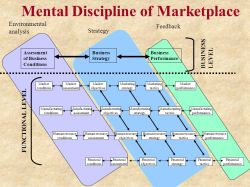
Also, it is likely that the proprietor has insurance to cover events like this. Otherwise it would come out of his pocket. But it is also likely—Bob is speculating about all this, but it sounded sensible to me—that the deductible on the insurance was a good deal higher than the $100 that is at stake here, so it would still come out of someone’s pocket.

That brings Bob—not me—to the question of “who’s pocket?” And it is at that point that Bob’s “small acts of kindness” template kicks in. Bob said, “I can afford it a lot better than he can.”

That story establishes that Bob is a good guy. It does not establish that he is offering a good criterion. For what percent of commercial transactions could Bob say, “I can afford the loss better than he or she can?” Eighty percent? Ninety percent? Would anyone urge Bob to apply that criterion so broadly? No, of course not. Each person would find a way to limit the application of the criterion. To family but not friends; to retail but not wholesale; to local merchants but not online merchants; to people you like who are economically vulnerable rather than to people you don’t like, who are every bit as vulnerable.

So why would Bob’s vastly over-broad criterion apply in this particular case? That’s the first thing that puzzles me. The second is: are we really sure that the market will not, in this case,  work the way it is supposed to work? Let’s say that the factory cannot account to the proprietor for what happened to Bob’s shirts. That means they make good on the loss. If it happens several times, they find out why and fix it. There is no self-interested reason for them to investigate if the proprietor, the man Bob deals with, bears the loss each time, so it is in everyone’s long term interest for Bob not to take the proprietor off the hook.

Or let’s say the proprietor is unable to get satisfaction for the loss from the factory andmarketplace 1 that becomes one of several kinds of difficulty which causes him to switch cleaners. That’s the way it ought to happen. If you don’t do good work, the people who run businesses will find someone who does.

Or let’s say that the proprietor is the one who is being careless with the shirts or with the records he keeps on the shirts. Bearing the cost of his bad behavior might be just the thing to help him pay attention to what he is doing. Bob could always take his shirts to another cleaner. Again, that is the way it is supposed to work. You provide a good product or you lose customers. The market is not supposed to run on friendship or compassion.

So that was my argument. I probably lost. Bob’s willingness to imagine the best for the proprietor and to bear, himself, the cost of someone else’s sloppiness is so appealing that my much more reasonable case didn’t really have much of a chance. And I’m fine with that. It’s the discussion I get hungry for.

The other participants at Starbucks that morning contributed not so much by taking sides—there were only two sides to take—as by arguing about emphasis. Should Bob’s long experience as a customer (this is not a personal friendship) have as much weight as Bob is giving it? Isn’t it a mistake to trade the sere beauty of the market for the chaos that results when you try to introduce the sympathies that are more appropriate to friendships?

marketplace 3The truth is, about an issue like this, that the actual decision depends on which values you put in first place, which in second place, and which in third. No one in the Starbucks salon [3] argued that any of the values under discussion was wrong. All the discussion had to do with whether the personal relationship (long time customer) was so important that the proprietor shouldn’t pay for his own mistakes. Or would we all be better off just if we just waived such considerations as we are able and treat service providers mostly just as people?


 

As usual. I can see all the sides. I can argue all the sides myself. But no abilities I might have would make a discussion of that kind possible—much less “likely,” and at our Starbucks, in our corner, such discussions really are likely. And the two rules we really do attend to consistently—no proselytizing, no flame throwing—help to preserve the space in which such discussions can happen when they are ready to happen. [4]

[1]  Just how it is that “regular events” get to be treated as “structures” was the happiest thought I had in all of 1973. It cleared the way for me to write my dissertation at the University of Oregon.
[2] I did see him in action once. Several years ago, I was named to a church committee which was made up, without anyone actually admitting it, of the prominent opponents in a recent conflict. Bob didn’t know anything about the conflict and didn’t need to. I brought him in to talk to us about what kinds of things move “reconciliation” forward. His guidance was one of the best things that ever happened in that committee.
[3] I’ve been waiting for a chance to use that word. Here is the historical basis of my reference, courtesy of Wikipedia.

“Their base was the Parisian salons, where networks of social and intellectual exchange were developed to connect Paris, the capital of the Enlightenment and the City of Light, with the rest of France.”

That’s us—bringing light and life to all of Southwest Portland.

[4]  I wanted to end with this picture of Ian MacKellen playing Gandalf the Wizard from The Lord of the Rings.  First, it is a marvelous phrasing of the idea.  Second, Bob has a son named Gandalf and I wanted you to be sure that the quote came from the book, not from the family dinner table.

Posted in Communication, Living My Life, Society, Uncategorized | Tagged , , , , | Leave a comment

When fathers are teachers

I’ve decided this year to celebrate my experiences of being a father. Not all of them deserve to be celebrated, of course. I still regret the time I punished one of my kids for an offense another kid later confessed to. But two things have happened recently that have put me in a celebratory mood and I’d like to tell you about them.

The first happened in 2005. I remember the date so well because I met and married Bette in 2005 (January and December, respectively) and a good deal of calendar year 2005 involved introducing her to people whose reaction would be important to me. One of those was my son, Dan. Dan and Julie were living in the Seattle area at the time and on one of their visits to Portland, the four of us went to see a movie called Thank you for Smoking.

One of the principal characters (Nick Naylor, played by Aaron Eckhart) was a lobbyist for the tobacco companies. [1] They didn’t play him as a bad guy. He was just someone who worked for the bad guys. He was also a father and by the account given in this movie, a pretty good father. It is just how Naylor went about being a good father and how Dan responded to him that I want to tell you.

MCDTHYO FE022

THANK YOU FOR SMOKING, Cameron Bright, Aaron Eckhart, 2006, ©Fox Searchlight

Nick’s son Joey is struggling with an essay he has to write for school. Nick is across the room, reading the paper. Joey is in such distress that Nick asks what is wrong. “Oh…I have to write a paper about why America is the greatest country in the world.” Nick slowly puts the paper down and looks across the room. “IS America the greatest country in the world?” he asks.

At that point, Dan leaned across me in the theater and said to Bette, my brand new girlfriend, “You are looking at my childhood.” And he said it in a voice that insured that I would hear it. It was one of the proudest moments of my life. THAT is what my son wanted to tell a woman I was seriously interested in marrying.

The second story is going to take a little longer to tell because it will require that we review some material. It happened last Thursday, June 2, when my younger son, Doug, and I were chatting on the phone. He had just read the essay I called Authoritarianism III, which reflected on my years teaching at Portland State. The point I was making in that essay was that I did not see that my job as a teacher involved pushing the students to become more or less authoritarian. [2] I built a little model that helped me say that I wanted to help them clarify their values and to see clearly what actions those values would support; then I wanted to examine the relationship between the actions they chose and the whole array of effects such actions might cause–not just the effect they were thinking of at the time.

As an illustration of that model, I wrote about an imaginary classroom in which 81 father 2students routinely registered for the class and only 27 desks. It’s an interesting example because some students are interested only in getting one of those 27 seats for themselves; others are much more interested in making sure that there is a seat for everyone. [3]


Doug took the side of the students who wanted to desks for themselves. He didn’t announce that we were going to do a little role playing; he just dropped into the individualist/conservative position. Teaching politics is half role playing anyway, so I picked up my part.

  • I tried to clarify just what value(s) he was pursuing by trying to solve his own problem rather than the class’s problem.
  • I tried to specify what kinds of action he might take that would be consonant with those values.
  • I tried to project what kinds of outcomes those actions would have.

Doug raised objections every step of the way.

  • Why did I say these actions and not those were in line with his values?
  • Wasn’t that too narrow?
  • Why did I say that these side effects would be a part of choosing those actions and implementing them?
  • Was I making the side effects more negative than was really realistic?

On and on. It was a great pleasure. We were playing a game we both knew how to play and enjoying each other’s performance. When we were done, he said, “Well, that’s what I thought you’d say.”

“Why did you think that?” I asked, sensing that the subject was about to be changed and not knowing just what the new one would be.

“Because,” Doug said, “That’s how you raised us.”

And he wasn’t talking about politics in our home. It could be anything. A school project, a playground hassle, a clunky assignment, whose job it was to clean up the kitchen tonight. How are the values I know you have being expressed in the actions you are choosing? What kinds of effects to you expect to produce by choosing those particular actions.

Those weren’t his words, exactly. They are my own words of today. But he recited them as if they were so familiar he didn’t have to work at remembering what they were. I think that’s what I liked best.

And I heard what Dan said to Bette as meaning about the same thing that Doug played out in our phone conversation. I can hardly tell you what warmth I take from those memories.

Thanks, guys.

[1] The names are part of the dark fun in this movie. Eckhart is Vice President of the Academy of Tobacco Studies. His colleague Polly Bailey (Maria Bello) works in the Moderation Council (alcohol). The third of the trio is Bobby Jay Bailey (David Koetchner) who runs an organization called SAFETY and promotes the gun business. They call their meetings, meetings of the MOD Squad—Merchants of Death.
[2] “Not an evangelist for anti-authoritarianism” is the way I put it in the essay, thinking of my friends who would say that is exactly what I should be doing.
[3] Both honest orientations toward policy, but with very different outcomes. It was my job to point out the differences in the outcomes.

Posted in Education, Living My Life, Political Psychology | Tagged , , , , | 2 Comments

Memorial Day Reflections

What does it cost to use a U. S. citizen in the U. S armed forces?

That’s the question I want to ask. I know it cannot be answered in the form I have first asked it, but I have never heard it asked at all and that doesn’t seem good. To begin to ask it, I want to divide the costs into three periods of time: the cost of preparing him [1] for service; the cost of equipping and sustaining him during his service; and the cost of supporting him in civilian life after his period of service is ended. So: before, during, and after. I am aware that “after” might be a very long time.

vets 4

The U. S. government has the legal right to pass “draft legislation” and thereafter, to commandeer anyone who is physically able to fight or to support in some organizational way [2] those who are fighting. So for those eligible to be drafted, “serving your country” is something that can be done to you. It is also, of course, something you may choose.

I don’t know more about basic training than what they show in the movies and what people say who reflect on their experience of it, but I do know that the goal of the process is to get people to do without reflection things they might decide not to do at all if they were left to their own devices. That involves stripping off a lot of the individual traits that have enabled these men to know who they are. I think that is the official view. But it may also, depending on the person, involve stripping OUT of the person, some crucial part—something that needs to be there for the person to be functional.

If you picture this as “taking off civilian clothes” and “putting on a uniform” is seems like no more than a change of clothing. But there is more to being a soldier that wearing a soldier’s [3] uniform. If it were no more than that, it would be easy to think that you put a soldier’s gear on him and use him as a fighter and then bring him home and take off the soldier’s gear and put on civilian clothes and it’s all back the way it was.

Then there is the cost of sustaining these soldiers in theaters of combat. The costs of supply and of advanced weaponry and of medical care are very high. The costs to the families are high as well.

Since we are thinking only about costs—and deliberately ignoring the other parts of the dilemma—let’s ask how much it would cost to put a former soldier “back”—to restore him to the life he had before his active duty. And let’s just consider the commonly accepted notion that 10% of the men in the military see actual combat. [4] Restoring that 10% to who they were before may be simply impossible. But even just restoring each man to “adequate functioning” after he comes home could cost quite a bit.

vets 2Let’s consider some of the costs. If marriages that were perfectly adequate before the term of service are no longer viable after a soldier’s wartime experiences, then the costs borne by all parties, particularly the children, need to be considered. I have no idea how to calculate those, but remember that it is only the monetary costs we are considering.

If there are disabling wounds, they will need to be treated. But here we run into the same “change of clothing” phenomenon we saw before. Some of these wounds aren’t like a scraped knee that is “all healed” when the bandage comes off. Some require artificial limbs; some wheel chairs; some dialysis; some tracheotomies. What might it cost to “restore” soldiers on whom we dropped Agent Orange?

When I say “restore,” it is really a rhetorical question, but if we back the question away as far as “compensate for” or “provide a generous safety net for,” the questions get non-rhetorical quickly and the costs are mind-boggling even if we consider only physical damages.

But not all the damages are physical. There are the psychological costs. Everyone has read about PTSD, but you can’t see PTSD. PTSD is an explanation for a lot of asocial and anti-social behaviors that everyone can see. It is an explanation for some criminal behaviors that would ordinarily be handled by civilian courts. If they are PTSD-related, should they be handled by military courts? Should the military provide legal counsel for whatever civil court has to handle the case? Does “military service” become a “get out of jail free” card for all veterans? For some veterans? Which ones?

If a veteran comes back to a civilian life unable to cope with its complexity, should the military—just a shorthand expression for “taxpayers”—help them cope and, if “coping” is beyond their capacity, should the military provide some safe place for them to live. And by “safe,” I think we should mean that they are safe from us and we are safe from them.

vets 1I began to think of the costs of military service when I noticed the proliferation of charitable projects to support “homeless vets.” And I began to wonder how it is that soldiers can be put against their will into situations that will damage them for life and then, when they come home, be treated as the objects of charity drives? I had a brief and angry vision of myself wheeling a friend, now a vet in a wheelchair, up to an army recruiting office and saying, “Here. You broke him. Now fix him.”

It’s a really bad vision in a lot of ways. I admit that. But the alternative, if I really want to find a place to use that line, would be to take him to a Veterans Administration (V.A.) hospital and they are desperately underfunded. We have not given them the money even to do the things we require them to do, much less the money to cover the expanded notion of services I am considering here. Besides, they are not the ones who broke him.

It seems so “private sector.” The recruiting office is the marketing department. No underfunding there. But the company doesn’t maintain a department to fix the customers that their product damages They have a legal office to manage their legal liability for damaged customers, but no Rehabilitation Division. That’s the V.A. hospital. The armed forces do have a “rehabilitation division” but we fund it as if it were a government charity and then we call on private citizens to supplement that budget with private charities.

Domestic violence

How would we calculate “the costs of military action” if we said that every soldier we send into combat (not the other 90%) is guaranteed compensatory services for the rest of his life. Those have to do with education, employment, financial support, medical services, including psychological and legal services—for the rest of his life. And if any of these 10% suffer a loss of family support for whatever reason (that includes “reasons” which cannot be traced directly to the term of military service) the family receives the needed support as well.

I started off with an intentionally provocative question. I asked about the cost of “using” a citizen. “Using” is not a word we normally allow, but for some servicemen, the difference between being “used” and being “abused” [5] is really too thin for everyday conversations.

Not abusing these men would be everyone’s first choice, I am sure, but the business of killing people in a setting where the enemies and the civilians look just alike is daunting. So some of our soldiers are going to be ab-used. The next best choice is for the costs of rehabilitation—physical, psychological, social, vocational—be borne by the authority that sent them into battle. [6]

vets 3It is not right, according to this argument, to recruit men to serve a public purpose and then dump the responsibility for them onto society as if they were to be a subject of private charity. I am not opposed to private charities, but they should not be run for the purpose of compensating for the deliberate underfunding of public programs. Let us take care, as citizens and taxpayers, of the men we have sent into combat. Let us take care, as private persons whose compassion reaches out to others, of anyone whose need reaches us.

Someone will surely say that defining “public purpose” as broadly as I have will substantially increase the cost of waging war—or, as we say these days, “defending the national interest”—and that is true in a sense. It might be that no more dollars would be spent, but it is very likely that the proportion of those dollars provided by the public through their taxes would increase. What might feel to many taxpayers like an increase would only, in that case, be an honest accounting for what it actually costs.

Someone else will say, I am sure, that the picture I am painting is not patriotic. I believe in being patriotic [7] but all the banner waving seems to be a part of the recruitment phase at the front end and of the public announcements of gratitude at the back end of the process. I would like it to be seriously considered as part of the funding decisions by which these men are cared for.

It is a well-known Marine maxim that you don’t leave a Marine behind on the field of battle. What I am proposing here extends the “field of battle” to the long post-service civilian life.  These are our warriors and they may not be left behind.

[1] According to the latest figures I saw, 85% of the armed forces were men, so I will use the generic “he” in good conscience. I will imagine that the costs would not differ for women.
[2] I know that is clunky, but I am trying simultaneously to recognize what the serviceman’s family does to sustain a soldier but still to exclude them from the financial calculations.
[3] Even I know that “soldier” is not an acceptable substitute for all the services. Marines like to be called “Marines,” although they are a corps of the Navy. You can call members of the Navy “sailors,” and members of the Air Force, “airmen.” There is apparently no agreement on what to call a member of the U. S. Coast Guard.
[4] I don’t know if that calculation holds in a time when anywhere you walk or drive might bring you into contact with an IED. I would call that vulnerability “combat” myself, because I am considering the cost to the serviceman.
[5] We don’t often notice it, but the prefix ab-, as in, say, ab-normal, means “in the wrong way.” So there is, in the infrastructure of this word, a “proper use” and an improper (or ab-) use. This does not quite ease our discomfort at the notion of “using people,” but it might be the best we can do.
[6] We ordinarily say “into harm’s way,” as if our soldiers could be harmed by what happens to them rather than also by what they are forced to do.
[7] I don’t always define the love of my “father-land” (the patris in patriot comes from the Greek word meaning father) the way everyone else does, but I would be happy to justify that love to anyone who asks.

Posted in Paying Attention, Politics, Sustainability | Tagged , , , , , | 2 Comments

My blog is 6 years old today

Today is May 30, 2016. It is the sixth anniversary of my birth as a blogger. Or six years aftersixty 5 I gave birth to the blog.  It’s a question of perspective, I guess.  And after six years of this, I’d have to say that I am surprised at how much it has changed me. As is often the case, I have three things in mind.

The first is how hard it is to do what set out to do. I had in mind a record of those things that delighted me. I knew when I chose it, of course, that dilettante was mostly a negatively connoted word. Certainly, it does not suggest that the person is actually good at anything. Quite the contrary. A dilettante “dabbles;” he jumps from one idea or project to another without seeing anything through.

I chose it for a different reason. I knew that it was based on the Latin delectare, “to delight in.” And I wanted to write about the things that delighted me. What could go wrong?

Quite a bit, it turns out. To know what is tickling my fancy, I have to be paying attention to my fancy. There is a certain amount of quiet attending involved. And if I am going to hear what is quiet, I am going to have to unhook myself, at least a little, from what is loud and boisterous.

In a loud and contentious political time, people want me to write about politics. I can do that. I have paid attention to politics, in one form or another, for most of my adult life. But if I write about what is going on out there, I run the risk of missing what is going on in here. I miss the early signs of a new idea—a heightened wariness, an unexplained recurrence of a particular image, the filing of one event after another into the same mental file, when that file had scarcely been used before. Those are very quiet things and if I am not quiet, I will miss them.

I chose dilettante as a way to remind myself not to miss those things.

The second thing that surprised me—I see now that it should not have—is that when I pay attention to things because I think I might write about them, I attend to them differently than I would have otherwise. I noticed it because of all my years in the classroom. When I learn something only because it is of interest to me, I learn it one way. When I learn something because I am going to use it for something—I am going to integrate it, for instance, into some larger structure—I learn it differently. It feels different. I have that feeling about the blog and it is a very familiar feeling.

sixty 1In writing a blog, I find that many of the ideas I run across in the course of a day’s conversations are neurologically linked, like a microphone planted somewhere in my mental landscape. They catch and transmit the remarks of passersby; they remind me of stories I haven’t thought of for fifty years; they make connections between phenomena I have never seen as related before. Briefly, it changes how my mind works.

Third, trying to write out ideas as I am thinking them through makes me much more “vulnerable” [1] to the process of writing. Like every other writer I have ever heard of, I have little connections I don’t know anything about. I use a figure of speech and it sends my narrative off in a direction I had not imagined. I use a metaphor that I have always associated with offense to describe a situation I have always associated with defense. It is like coming around a familiar corner and seeing a completely unfamiliar landscape.

I had thought of developing the essay like a ski jump. There are lots of elements to a successful jump and I know they include speed and balance and wind resistance. But sometimes it is more like being the ball in a pinball machine. All you want to do is go safely down the hole, but everything you touch whacks you or bumps you or flips you in an unanticipated direction. And when they are done with you—THEN you get to go down the hole and rest.

So very often, I start off in one direction, looking for the word that will complete the thought, and I choose, instead, one that subverts it. Or, sometimes a word that amplifies it so that it no longer fits in the neighborhood where I was when I started looking. Mostly, I just go with those things. I don’t experience them as “things I am doing.” I experience them as “things that are happening to me” and sometimes I am just charmed by how fresh they are. [2]

sixty 4My first blog was called “Blog 1” and it was 257 words long. Then I sat down and wrote 502 more essays. This one is #503. That works out to somewhere in the mid-70s per year. [3]

In that first essay, I worked out what “log” meant as a nautical device and how the b- of web got assimilated to it to make the word blog. It was heady stuff, for sure. If I had known that six years later, I would think it was a good use of anyone’s time to remember that, I would have been truly amazed.

[1] I am very cautious about using a word like vulnerable. I know that the Latin vulna means “wound,” and know that by using that word, I am setting up a picture of my writing as something that can be “wounded” by new thoughts or images. I don’t want to say that, but I want to almost say that.
[2] By “fresh,” of course, I mean that they seem fresh to me. I will never forget the criticism a teacher wrote on a school essay. I had included a figure of speech I had never heard before and that I really liked. She said it was “trite.” Later, I learned that if I mean “often used to convey that idea, tired from overuse, threadbare,” it was indeed trite. But I had never heard it before, and I was still being charmed by its novelty. Trite! Humph!
[3] Although “year” has been defined in several ways during this time. I counted May—December 2010 as a “year,” because I started in May. Then in 2013, I began a “blogging year,” which begins December 1 and lasts until November 30. So all the yearly collections since 2012 have been named BY (Blogging Year) + the year in which that series ends. So I am working in BY 2016 at the moment.

Posted in Living My Life | Tagged , , , | Leave a comment

Authoritarianism III

I set the table for myself this time. Here is how I ended the previous post—number two in this set of three.

But by far my most vivid contact with these dilemmas has not come as a person, but as a professor. In my teaching years, I looked out over a classroom full of kids who weren’t sure what their own values were. They knew what they felt, but they weren’t sure they should honor those feelings. And they weren’t sure of the effects would be if the policies they liked best were put into effect.

Those are the right concerns to have, I think. At least, they are the ones that have meant the most to me as a teacher. In this third and final essay (Authoritarianism III) I will try to deal with them

The heart of this political dilemma, as it bears on my experience as a professor, at any rate, has to do with two principle values. These values are called a lot of things: I call them authenticity and effectiveness.  They look like this.

A and O Final JPEG

These transactions are really simple in principle. You have certain political preferences that you  may have not yet put into words. We call them “gut feelings” sometimes. And you can see that a particular action would express what you are feeling. You are angry about the immigrants who enter the U. S. illegally and you can see that a wall would keep them from doing that. [1] And the promise that the Mexican government would have to pay for it adds a little something to the proposal. Taco sauce, possibly.

You know what you feel and you can see the actions as a direct consequence—but you also know that you have feelings that you really don’t want to honor. Let’s say that you have these anti-immigrant feelings and you learn that they are properly called “ethnocentrism” and that ethnocentrism is bad. [2] Now the student knows he has a feeling and the “knows” that the feeling is wrong so he absolutely does not want that bad feeling translated into “bad” actions.  Where would he learn that?

I am defining “authentic” very narrowly in this setting. I am going to mean only that the ideas and/or the politically relevant emotions this student has get translated into action. If what he does is the direct product of how he feels and what he thinks, then the action is “authentic.”

bsr005

The  leap from the action taken to the outcome sought is given the name “effective.” The kind of information I am likely to have—the kind referred to in footnote 1—comes in here. “But,” I might say in my professorly role, “That wouldn’t really change anything.” Or I might say, “Yes, it would make that change, but it would cause all these other changes as well and you need to look at ALL the consequences when you are making your choice.”

Mostly by giving the student a chance to think out loud—to voice the ideas and the feelings he has in a relatively safe [3] setting—I help the student clarify his own views and his own feelings. I can help him honor some of the feelings he has and withdraw his support from others. I can help him see that the action he is contemplating—ordinarily it is voting or campaigning for someone—is a very plausible way to express what he is feeling. That is an argument based on reason.

Let’s put a woman student on the hot seat next. She feels the same way her male colleague does and contemplates the same action, but where he is an idealist, she is a pragmatist. He might want to know only whether taking Action A truly expresses “the ideals of the movement,” whatever movement it is. She wants to know whether it will change anything. She wants to know whether her action is going to be “effective.” You notice that I have labeled the bridge between action and outcome “effectiveness.” Will Action A actually produce Outcome A? That’s what she wants to know.

I can help with that. Very seldom did a proposed political action come up in my classes that had not been tried many times before. There is a buffet table full of considerations. Here are some.

  • Yes, it would work, but no one has the authority to do that.
  • Yes, it might work, but it would cause the Senate to be turned over to the control of the other party for the foreseeable future.
  • It might work if adequate funding were available, but all such attempts have been gradually de-funded over the ten years after they were put in place.
  • Yes, it would work. However, these other things would also happen and they would exact a high price.

And of course, there is always:

  • No. That wouldn’t work at all.

I have been talking here about my own work as a professor. I have one more kind of task to describe, but before I do that, let’s look at authoritarianism as it relates to my own teaching. I have said that there are character-based authoritarians and situation-based authoritarians. If I were authoritarian myself and saw my teaching role as being an evangelist for authoritarianism, what I would do is to praise the character traits most commonly held by authoritarians. Four of them are, as you doubtless recall from the last essay: preference for ingroups, ethnocentrism, the priority of social to individual norms and a tendency to rely on agreeable information under threatening conditions.

I would say that all those traits are good and I would give them good names. I would callA and O 6 the ingroup bias, “sticking with your friends.” I would call the ethnocentrism, “American exceptionalism.” I would call the emphasis on social norms “being a team player.” I would call a reliance on friendly sources of information, trusting people “whose hearts are in the right place.” And of course, I would provide pejorative names that they could use to describe the nonauthoritarians. Traitor and coward come readily to mind.

For the situation-based authoritarians, I would argue that authoritarianism isn’t always the right approach. I would talk about my friend the school superintendent, who was not at all authoritarian himself, but who chose authoritarian principles when he needed them. [4] I would ask my students to make the case that this is one of those time. What is it about our time—don’t describe your fears to me—that justifies authoritarianism right now.

And, of course, if I were anti-authoritarian, which is pretty common among political scientists, I could just turn the values around and give good names to the nonauthoritarians and bad names to the authoritarians. But I wouldn’t want to do that. I described that role as “evangelist for (non)authoritarianism.” I don’t want to be that. I want to be someone who knows a lot—that helps with the “effectiveness” transition [5], and someone who can make the world of public discourse hold still long enough for different kinds of students to hear themselves and their fellow students air their “values.” In many cases, this was the first setting in which such statements were “allowed” or in which they were taken seriously.

I did that for many years and I was proud of it. I helped the authoritarians (and nonauthoritarians) learn what their values were and to see what political actions flowed plausibly from those values. I helped them sort through their action choices with an eye toward consistency (for the idealists) or toward effectiveness (for the pragmatists).

Getting the good seats

But there is another kind of question that often gets raised. It is frequent enough and powerful enough that I would like to clear the stage and offer it a solo performance. It is the question of scale. Heatherington and Weiler raised the question of “affirmative action” particularly and pointed out that either action that might be taken could be justified as “fair”—just fair to different settings. That is what I am calling the problem of scale.

Let me illustrate. I would draw on the board—or, in later years, hand out a graphic I had designed—that showed a classroom with only a few chairs (27) for a class that had many more students (81) than the seating would accommodate. The students responded to this situation in two ways. This happened year after year. Some students were interested in the question, “What do I have to do to get one of those desks?” That is the question that meant the most to them and nothing I did succeeded in substitution a policy question for it. Other students said, “Wait a minute. Why are there only 27 desks when there are 81 students registered?” What will we have to do to get enough desks for everybody?”

A and O 5I presented these contradictory responses as a “policy conflict,” but actually only the second response engages policy at all. The students who wanted to get the best of what there was to get did not have a policy orientation in mind at all. They took the system for granted and wanted to know how to work it. “What if we came to class an hour early?” they wondered. “Or maybe if we were among the first 27 students to register for the class. Or maybe we could get the professor to give upperclassmen first shot at those seats and seat underclassmen only if there were still room. Or maybe we could send one of “us” early and have him reserve the 27 seats for the rest of us.”

It is hard to take the dilemma seriously because it appears to be about seats in a classroom. That is its great strength, I think. Those two approaches wouldn’t have to be altered in the slightest if the good to be won were shelter or food or access to medical care. In every case the one approach—the only policy approach—is “How can we provide enough shelter or food or medical care for everyone?”

I did feel a moral obligation as a professor to present the “how can I get mine” approach as deficient and the “how can adequate supplies be found for everyone” as superior. There are people who think that my doing that constitutes imposing my moral stance on students who are there to learn from me, but I don’t think so.

I think I can make a case that a policy approach, an approach that raises the question of what action by the authority (the university in this case) will produce a distribution of goods that is better for everyone is A BETTER QUESTION. [6] I have an obligation as a teacher to prefer better questions to worse ones and to show why they are better and why they should be used.

To recap. For all my students, authoritarian and non-, I have the obligation to help them clarify their values, to learn what the action implications of those values are, and the likely effects of the actions they would choose. It is not my business to say that they should have good character or that they should love their neighbor or that they must mute their fear and their anger and always choose diplomacy over war.

I have never been at all hesitant to talk about my own policy preferences in class when asked. I think it is a good idea, for one thing, but I also cannot think why I should be the only person in the room who is immune from these questions. I start with my own political values—what I think is important and how I feel about those things. I go on to the actions I take that are based on those values. Then I describe the effects I think those policies would have if they were put in place.

I don’t characterize these as “the right answers,” even though I know some students will construe them that way no matter what I say. I don’t defend just why I have the values I have, although I would do so in the office with a student who wanted to know. I defend the authenticity of my choices. They actions I take do truly reflect the values I hold dear. I defend the effectiveness of the actions I advocate. If these policies were put in place, those would be the effects.

In other words, I run the whole system using myself as the guest of honor. I am not above it. It works in my life the same way it works in their lives. If I had a classroom full of ardent authoritarians, that is how I would treat them. And if I had a classrom full of ardent nonauthoritarians—or even ardent anti-authoritarians—that is how I would treat them. And if the values I see implicit in Mr. Trumps pronouncements and the actions he advocates seem to me to lead to disastrous results for us all, I am perfectly free to say that. “Authenticity and Effectiveness;” Authenticity and Effectiveness.

Say it with me.

[1] It wouldn’t, actually, but we are talking here about the translation of feeling to policy preference.
[2] I’m not arguing that any of that is true. I am following carefully along the path the student is trying out because that is the path I am going to be called on to clarify.
[3] I know I cannot protect the student against the eye-rolling and the negative postural feedback of his peers, but I can prevent more overt criticism of the speaker. I cannot and wouldn’t want to, prevent criticism of the ideas we are discussing.
[4] I’m sorry. I have held this off as long as I can. My superintendent friend does not have authoritarian principles, but he does hire authoritarian principals when he needs them.
[5] Being really old and remembering what happened the last four times they tried that also helps. I used to dazzle classes with my memories of playground fights between kids who said they were for Dewey and kids who said they were for Truman. That was 1948. We didn’t know who those people were, but playground fights were always fun.
[6] I admit that a student who calculates his own merit by having more than others will not be pleased by this principle. To that student, I say, “I’ll tell you what. Why don’t you distinguish yourself by the quality of your work? I award A’s to everyone who does A quality work.”

Posted in Education, Politics, Uncategorized | Tagged , , , | Leave a comment

Authoritarianism II

Since this is the second of a proposed three-essay set, I am bound to a certain extent by the promises I made in the first essay. I suggested some divisions in using the word “authoritarian,” so that I could say that Donald Trump may not be “authoritarian” and that only some of his followers are. I promised that I would return to look at those followers and here I am.

I would like to begin, however, with a consideration of the uses of language, especially political language. When a word is used exclusively for its effect in tarring other people, we lose the meaning of the word. That seems like a high price to pay.

No one remembers that “a villain” lives in “a villa” or that “a heathen” lives out in the “heath” and those are not the primary meanings anymore. We have shrunk the perfectly usable expression “invidious discrimination” down to just “discrimination” and made it a word that is always bad. (Oddly, “discriminating” still has some positive uses.) We have taken all the life out of “hero” by insisting that everyone is a hero, each in his or own way, of course. “Language” is now a reason for being wary of a movie. It has an R because of “language.” [1]

When we deny that authoritarian has an actual meaning, we are doing the same to that word and we really need that word.  I mean we need for it to mean something, especially this year. And if it is only a snarl, it does not, really, mean anything.  Trump voters are said, for instance, to be “authoritarian.” In the previous post in this series, I distinguished between “external” or situational or instrumental authoritarians and what I call “real ones.” You can think that some time is just the right time for a strong, strict, even bellicose leader and not “be” authoritarian. It is not who you are; it is what the times require.

But you can also “be” an authoritarian. This use refers to an internal orientation that is characteristic of you. There will be four particular dimensions discussed later. When I call such a person “authoritarian” it is descriptive in the same way that “tall” or “smart” is descriptive. My own test for this is for a group of social psychologists—some are authoritarians themselves, some are non-authoritarians—to sit down and look at the profiles they have collected and sort them exactly the same way. The authoritarian social psychologists will celebrate how many authoritarian subjects there are; the non-authoritarian social psychologists will mourn how many there are, but they will agree entirely on who is who. That’s my test.

a traits 1At this point, I would like to introduce Marc Heatherington and Jonathan Weiler as they are represented in their book Authoritarianism and Polarization in American Politics (2009). I’m going to be relying on their recent work for most of the rest of this essay. They use several tests which look very good to academics. The tests are “valid,” i.e., they test what they are supposed to test and they are “reliable,” i.e. they come up with the same findings when a population is retested. So, in general terms,  these are really good measures.
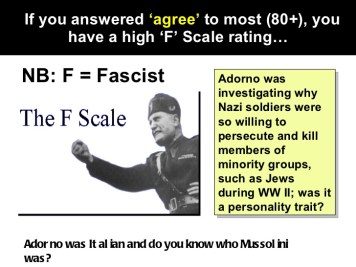
Here’s how they work. They offer a number of questions, usually yes or no questions, and add up the 0’s and 1’s. [2]. That gives us a profile of complete authoritarians and complete nonauthoritarians. These extreme positions are called “ideal types.” It is taken for granted that most of us are somewhere in the middle but by describing the extremes, we can say “in the middle of what?”

One of the reasons I like Heatheringon and Weiler’s approach is that they are committed to describing, rather than condemning. Let me illustrate:

[There is an] extraordinary difference between authoritarians and nonauthoritarians on the question of whether there is a right way and a wrong way to do things. Again, nonauthoritarians’ resistance to making snap judgments is evident here. One could certainly imagine circumstances in which this attribute could be viewed as admirable and others in which it could be deemed an irresponsible failure to hold individuals accountable when circumstances warrant such accountability.

The authors here describe a trait on which extreme authoritarians differ from extreme nonauthoritarians. In this case it is whether there is “a right way and a wrong way to do things.” If I stand here as a nonauthoritarian, I can wail about the rigidity of the other guys. If I stand as an authoritarian, I can wail about the lack of conviction of the other guys. That’s a lot of wailing and what does it get us?  What Heatherington and Weiler do is to say that there are circumstances in which the one value is best and others in which the other value is best.

a traits 2That’s what I like. “Authoritarian” is a description; it is not a condemnation. On the other hand, there are times when the policies that authoritarians disproportionately support cost all of us dearly. I can be against those policies without raising—without even considering—the question of just why they chose those policies. And that is what the authoritarianism scholarship, beginning with Theodor Adorno, has mostly done up to now. It is not what Heatherington and Weiler do, which is why I am passing their work along to you.

Do you have any friends who are authoritarians?

Of course you do. I do. And I love some of them dearly. In this section, I would like to follow the authors’ descriptions of four traits on which the authoritarians—those out on one end of the distribution—differ from nonauthoritarians (who are, of course, way out on the other end).

Ingroup v. Outgroup preference

Authoritarians are likely to favor the groups that they are part of or that they affiliate with. Nonauthoritarians are more likely to favor “outgroups,” particularly marginal groups made up of race, poverty, or sexual orientation.

Affirmative Action programs are probably the best example here. These choices are likely to pit authoritarians against nonauthoritarians both on: a) what groups are to be given preference and b) on just what is “fair” in the circumstances. Nonauthoritarians favor the outgroups and define “fair” in historical, not in interpersonal, terms.

2. Accuracy Motivation

Authoritarians and Nonauthoritarians differ scarcely at all on the desire for accurate information—until they feel the presence of a threat.

However, once they [the experimenters] introduced a threat condition, authoritarians subsequently became much less interested than nonauthoritarians in seeking information that was balanced in its approach, and much more interested in pursuing one-sided information that reinforced existing beliefs.

3. Ethnocentrism

I would be really surprised if these findings were different from the ingroup/outgroup findings and I am relieved to see that they are not. I think we call the preference for “people like ourselves” an “ingroup bias” when we are thinking of domestic affairs and “ethnocentrism” when we are thinking of people of other nations and cultures. In any case, nonauthoritarians show significantly less ethnocentrism than authoritarians do.  This puffin sounds pretty familiar to me.

4. Personal Autonomy

Authoritarians tend to feel that autonomy is a good thing provided that it does not a traits 4seriously challenge social norms; nonauthoritarians are more likely to think that it is a good thing even when it does. Nonauthoritarians, to say it another way, are willing to put up with a good deal of disorder to protect the autonomy of persons. They don’t feel the same consideration for the “autonomy” of powerful social systems.
So what does all this mean?

It means that there are circumstances in which doing what the authoritarians want is exactly the right thing to do. In the previous post, I argued that when a school superintendent chooses an authoritarian principal for the high school, that does not mean that he is authoritarian: it means that he know what that school needs at the moment.

On the other hand, when: a) preference needs to be given to ingroups and where b) one-sided information sources are adequate and when c) groups representing other nationalities or cultures need to be opposed and when d) claims of personal autonomy need to be set aside so that the social norms are honored—in those times, we just cannot have too many authoritarians.  Lining them all up like this makes me think of Gary Trudeau’s old cartoons of B.D. in the huddle–a setting where authoritarianism is crucially necessary–and finding way too little of it.

a traits 4My own personal views really don’t fall at either extreme. Like most people I have some of these traits and some of those. Or I honor these values in one situation and those values in another. In other words, I do not fit the “ideal type” that the tests identify. I fit somewhere further toward the middle of the scale.

But by far my most vivid contact with these dilemmas has not come as a person, but as a professor. In my teaching years, I looked out over a classroom full of kids who weren’t sure what their own values were. They knew what they felt, but they weren’t sure they should honor those feelings. And they weren’t sure of the effects would be if the policies they liked best were put into effect.

Those are the right concerns to have, I think. At least, they are the ones that have meant the most to me as a teacher. In the third and final essay (Authoritarianism III) I will try to deal with them.

[1] And I haven’t even touched words like Nazi, which once meant “a member of the National Socialist Party” and can now mean someone who is, from the standpoint of the accuser, “too strict” about something. Anything. I have head of “grammar Nazis.”
[2] 30 questions in the Right-wing Authoritarianism Scale, 4 in the National Election Study authoritarianism index, 17 in the Social Conformity-Autonomy Scale.

Posted in Politics, Uncategorized | Tagged , , , , | Leave a comment

“It’s in the Book”

Give not that which is holy unto the dogs, neither cast ye your pearls before swine, lest they trample them under their feet, and turn again and rend you. Matthew 7:6, KJV.

IMG_0135 (3).jpgAs you can almost tell, even with the way I cropped the picture, this is a front yard display. It is in my neighborhood in the sense that I drive by it on 35th Avenue every morning on my way to Starbucks. And one morning at Starbucks, my friend Paul McKay said, “Hey, you know that house on 35th that has that pig in the front yard? You know what that is? It’s ‘pearls before swine,’ like in Matthew.”

I hadn’t ever seen that because you don’t see the “pearls” from the road. They are too small.  I took this picture standing in their front yard. From the road, you see only the large white spheres and I just assumed they were mushrooms. This is a truffle hunting pig, I guess. Once Paul said they were pearls, I went there and saw for myself. They are pearls.

Ordinarily, that would be the end of the story. It really should be the end of the story, but as I got to thinking about this very short and ambiguous text, I remembered a record (45 rpm) from my own youth. It is by Johnny Standley and it’s called “It’s in the Book.” [1] Standley plays the part of a southern revival evangelist, with the overdone gestures and the quavery voice. The part I am interested in today—the part, that is, that comes before his leading his imaginary congregation in a hymn called “Grandma’s Lye Soap”—is his exegesis of “Little Bo Peep.” He gives it all:

Little Bo Peep/Has lost her sheep/And doesn’t know where to find them/Leave them alone and they’ll come home/ Wagging their tails behind them.

pearls 1

Then he works each phrase in that tremulous mock-sincere voice. He notes how sad it is that Little Bo Peep has lost her sheep. He is offended that the text says both that she has lost them AND that she does not know where to find them. That seems obvious to Preacher Standley. If she has lost them then obviously, she doesn’t know where to find them. But after all, “It’s in the Book.”

Then he comes to the advice “the Book” offers her. “Leave them alone.” He muses over that a little. If she doesn’t know where to find them, what else could she possibly do than leave them alone?

And finally, he gets to “they’ll come home (“Ah yes,” he assures us, “there’ll be a brighter day tomorrow; they WILL come home.”) wagging their tails behind them. “Behind them,” he repeats with emphasis. “Did we think they’d wag them in front?”

OK, you get the idea. That is the attitude that came back to me when my friend Paul deciphered the front yard display of the “pearls before swine.” When I began thinking about “pearls before swine” with Preacher Johnny Standley whispering in my ear about Little Bo Peep,  I began to think of quibbles that might be made. Five came immediately to mind. [2]

So the question is this: in the prohibition recorded in Matthew 7:6, what exactly is prohibited and does this display violate those prohibitions?

Quibble 1: I learned when I started playing with this that in English, the word swine may be either singular or plural. In English, we can say “that swine” or “those swine.” That’s not true in Greek: tōn choirōn, which is the Greek expression translated “swine,” is plural. Of course, “they” indicates that we are talking about a number of pigs, as in “they will turn again and rend you” and I could have figured it out that way. But I didn’t.

So does this display illustrate a casting of pearls before swine (pl.)? No. Obviously, there is only one pig here.

Quibble 2: What is the rationale given? It is implied that there is something inappropriate about casting something valuable before animals, especially ritually impure animals. But beyond what is implied, only one part of the rationale is certain and that is that it is dangerous. “They might,” Jesus implies, “do you harm.” Now if that is something that herds of pigs do but that individual pigs do not do, then casting pearls before this particular pig might be completely safe and since safety is the only explicit criterion, I would say that this display does not show anything Jesus forbade.

Quibble 3: It says not to cast your own pearls before the swine, but it doesn’t say anything about casting anyone else’s pearls. I can see that there are pearls there in the front yard, but I have no way of knowing whose they are. It is entirely possible that Matthew meant to represent Jesus as saying, “Remember now. Don’t throw your sister’s pearls before swine.” That would be a very prudent piece of advice—almost as prudential as the previous one.

Quibble 4: Does this display show pearls that were cast before “the pigs,” or even this one pig? Certainly not. They may have been cast there. They may have been dropped accidentally. They may have been placed there with great care. There is no way to know that they were “thrown.” Of course, they might have been.

Quibble 5: Does this show pearls that were cast before the swine? Unfortunately, no. It shows that they are now before the swine. It is entirely possible that the pearls were cast behind the swine and that the swine turned around. They do that. I have seen it myself.

And in closing, a final word on silliness. It turns out that Matthew 7:6 has some really interesting meanings—serious meanings—that I was entirely unaware of. You can be as committed to silly as you like, apparently, and it doesn’t keep really interesting ideas at bay.

[1] I remembered (incorrectly) that Andy Griffith had done that recording. I think I was confusing it with his “What it Was Was Football,” which was released about the same time. I remembered correctly that Griffith was known at the time as Deacon Andy Griffith.
[2] I do, from time to time write on scriptural topics in unconventional ways. I remember the time I invented Dewey Decimal classifications for the “books” of the Bible. Today’s musing isn’t one of those. This is just silly.

Posted in Living My Life, Uncategorized | Tagged , , , , | Leave a comment