
I have, in mind for today a tactic to help me watch movies. I ran into it in biblical studies, where it is called “inclusio.” [1] I’m going to spend a little time on what this technique is, but let’s look at a movie first. The movie I have in mind is Their Finest, which either a dispiriting tragedy about a woman who leaves her husband, finds a true love, only to see him killed right before her eyes or a bracing tale of a talented woman who persists at her job until her real worth is recognized.
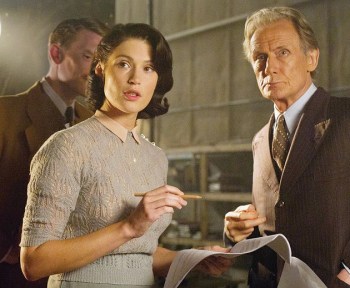 Both plots are there, but the movie can’t be “about” both of them. What to do? There are two early scenes that offer beginnings to this story. In the first, a [2] loutish husband sends his wife off to make enough money to pay the rent. In the second, a group of British moviegoers watches a truly terrible propaganda movie in a theater. If the last scene matches one or the other of those in the way a second parenthesis “matches” the first, then I would say that inclusio is in play and decide in favor of that theme.
Well it turns out that in the last scene, the writer attends a showing of her movie—the movie the making of which this story has been about—and finds people genuinely moved by it. Ending the movie there tells me something about where the director wanted the movie to begin. That last scene demands that the early propaganda movie, not the husband shipping his wife out to make the rent money, be understood as the first scene.
And that is the use I have in mind for inclusio. So what is inclusio? Most of what I know about it, I know from having biblical scholars use it. They identify instances of it and a plausible reason for it, but they don’t talk about what it is exactly and I will need to do that to use it for my movie watching.
In Matthew 5, there are the famous beatitudes. Two of them—the first one and the last one—end with “for theirs is the kingdom of heaven.” The goal of this device, according to the commentators is to identify the material between those references as a single body of material. It is identified as “a unit” by being bracketed with those identical clauses.
Matthew also use the device to bracket the whole Sermon on the Mount and the collection of actions that are grouped into a narrative following the Sermon. That is why, some scholars argue, Matthew 4:23 and 9:35 are nearly identical. Matthew 4:23 reads (in the New Jerusalem Bible):
He went round the whole of Galilee teaching in their synagogues, proclaiming the good news of the kingdom and curing all kinds of disease and illness among the people
And Matthew 9:35:
Jesus made a tour through all the towns and villages, teaching in their synagogues, proclaiming the good news of the kingdom and curing all kinds of disease and all kinds of illness.
Nearly identical. They function like the first and second parentheses or the first and second quotation marks. I have been sensitized to that because I spend some time every week scanning documents and very often one of the parentheses makes it into the text, while the other does not. So when I find a left-facing parenthesis, I go back looking for the right-facing one, knowing that all the material between them is one kind of thing. When I identify that material by locating the boundary markers, then I go back and see if I can say what “it” is about.
Here’s a little pitch I found in Wikipedia and which I think is adequate for todays needs (the bold font is in the original).
In biblical studies, inclusio is a literary device based on a concentric principle, also known as bracketing or an envelope structure, which consists of creating a frame by placing similar material at the beginning and end of a section, although whether this material should consist of a word or a phrase, or whether greater amounts of text also qualify, and of what length the frames section should be, are matters of some debate.
I have described how I made some sense out of Their Finest Hour by treating the last scene as if it were the second parenthesis and therefore a clue to the “real” theme of the movie. I was very happy with that experience. On the other hand, it isn’t always a clear as that.
Let’s look at The Lovers with this same technique in mind. [3] Again, all the warnings about spoilers apply. I need to start with the whole film to try to explore how the first relates to the last. In the last scene, Michael (Tracy Letts) and Mary (Debra Winger) are arranging a sexual rendezvous by phone. They manage to seem excited and furtive at the same time, which seems odd to me and will seem odd to you, too, when I give you the background of the relationship. The first scene—which by the inclusio technique ought to me the mirror image— shows Michael trying to comfort a disconsolate woman: “Don’t cry, Lucy” he says. We don’t know who the woman is when we see this scene.
 So let me tell you what the last scene means. Michael and Mary are lovers, which is just a little odd, since they just recently divorced and married other people. The people they married Robert (Aiden Gillen) for Mary and Lucy (Melora Walters) for Michael, were their lovers when they were married to each other.
This is not a movie about loving. This is a movie about cheating. In the middle of their boring and loveless marriage—and two boring and loveless affairs—Michael and Mary suddenly get turned on by each other. This urgent powerful sexual attraction is the only one the movie gives us. Neither of the affairs has anything like the power of this unexpected episode in the lives of Michael and Mary. Michael and Lucy are not like that; Mary and Robert are not like that.
So Michael and Mary divorce, their hot sexual attraction to each other notwithstanding, and marry their “lovers” as they had promised them they would. At which point, they carry on with their own torrid sexual relationship which is now an adultery. To do this, Michael needs to cheat on Lucy in exactly the same way he has been cheating on Mary; Mary needs to cheat on Robert in exactly the same way
So I think I would pick for the “first scene”—the one that serves as the key to understanding the narrative as a whole—the first scene where Michael and Mary are together. They are “together” in the sense that they are both in the screen at the same time, but they are not together in any other way. They are not as close as you would be to someone who lives in your neighborhood and whom you met unexpectedly at a shopping mall. The chance encounter would be warmer, more personal. The Michael and Mary scene shows only the most grudging of recognitions that there is another person in the room.
So that’s my choice for “first scene.” It is the left-facing parenthesis. I like what it says about the last scene, which, however illicit it might be, is also engaged and personal. And if those are the first and last scenes, then I get to say–using or misusing the technique of inclusio– that the movie is “about” the interpersonal relationship of these two people (Michael and Mary) who once had a nerve-dead relationship (though married) and who now have a rich and sexually engaging relationship (though adulterous).
The good news is that this technique offers a way of questioning a thematically complex movie to see what it was “about.” The bad news is that if the movie really won’t tolerate that treatment, people like me might use it anyway, just tucking in the corners as necessary.
[1] I have recently seen it called “inclusion,” but if it is a specific technique—and it is—I would rather give it a distinctive name.
[2] Their Finest is “comedy, drama, romance” according to IMDB. I guess you get to take your pick. The book was called Their Finest Hour and a Half—which I really like as a title—and was directed by Lone Sherfig.
[3] A “comedy” according to IMDB. It was written and directed by Azazel Jacobs.
 Historically, Reason was contrasted with Authority, particularly the authority of the Catholic Church, as an alternative basis for society. I don’t think that is the best set of alternatives for today, but even that set is suggestive. Consider, for instance, that “God says everyone shall be paid enough to live on.” We might even throw in “Thou shalt not muzzle the ox that treads the grain. Deuteronomy 25:4 and several New Testament citations). We would say that this is ordering society on the basis of “revelation,” as the Church understands what God is commanding. That is not rational in any narrow sense of the term. [3] On the other hand, the market system isn’t rational either. “People will be paid whatever employers are forced to pay them to insure for themselves a skilled and stable supply of labor” is not rational. Even in an un-distorted market it would not be rational and no one thinks that the current market for labor is “un-distorted.”
 This meets the broader standard of “rationality” you will notice—the one that was met by saying that doing what the Church said God wanted you to do is “rational”—although it does not meet the narrower standard.
 am thinking of it as analogous to the death of the canary in the coal mine, which is a major event for the canary, but for the miners, it is only an indication that things are not safe. But we have decided, apparently, to vote with our hearts, not our heads. And we have decided not to elect someone who will do what the office requires, but instead to take actions that make us feel good. And we have decided that words and acts—anything, really—that shows how angry we are is all we will require of the person we choose to organize the domestic economy and to deploy the military. That is how the majority that chose Donald Trump was assembled.
 “Jews.” [2] The interviewer’s first question had to do with Franken’s home town, a suburb of Minneapolis called St. Louis Park. He observed that a lot of other famous and accomplished people came from that same little suburb and asked Franken what was special about it. “Jews,” said Franken. Great line; great timing; great delivery. The whole place went nuts. [3]
 I know what it costs me, for example, to walk by the expression “your analysis” pretending that I did not also hear it as “urinalysis.” Or to bypass “gray day eggs,”you know, the really large ones, which were apparently laid on overcast days. Or to ignore the liabilities of the Taipei personality, very common in Taiwan, I understand, but associated with vulnerability to heart attacks. I went to see a new doctor last week, an ENT and he hadn’t read Lord of the Rings and I had to just stuff all the Ent jokes for nearly an hour.
 And most of the time it doesn’t matter at all. It makes a better story that way and all the “facts” that really matter are still what they were. No harm, no foul, we say. And that may be true. In that telling.
 mind during this shower. Things like this have happened before, so I wasn’t startled by it and I didn’t rush out of the shower to write it down because I knew I would remember it, like Poincaré’s Conjecture, which came to him as he was getting on a bus and which he didn’t bother to write down until the end of the trip. [3]
 Raymond E. Brown, the Catholic scholar whose lectures and books are very likely the ultimate source for whatever it is that happened in my shower this morning, has a different image of this unity and multiplicity. He imagines that the life of Jesus is like a jewel, whose multifaceted beauty cannot really be fully appreciated until it is seen from all sides. One facet is featured as you look at it from this side; another facet when you look at it from another side. (An-other side, not as we often say today, “the” other side.)
 the significance of Jesus—is a little more aggressive than Brown’s notion of the multifaceted jewel. When, in Brown’s metaphor, you don’t appreciate all the facets, you miss part of the beauty. When, in Hess’s metaphor, you don’t use all the chair’s legs, you get dumped unceremoniously on the floor. So, this notion that came to me this morning is a notion with, as they say today, “an attitude.” It is a response to something.
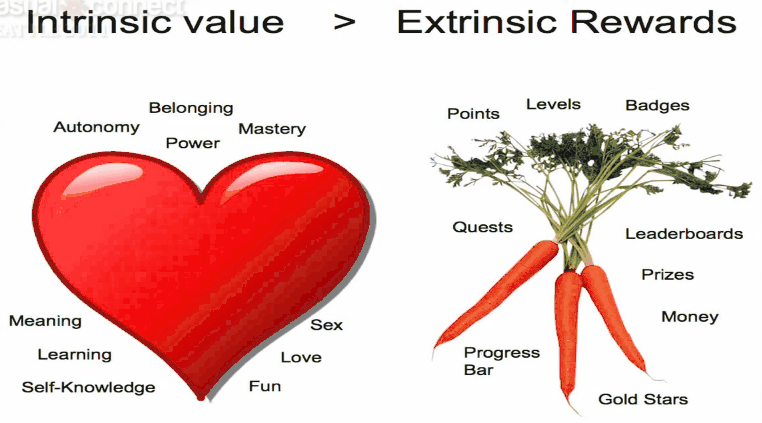
 You would think that a rewarded action would be more likely to be repeated than an unrewarded action, and that is certainly true, but how on earth would we know whether an action was rewarded? In the neighborhood where I lived for a long time, there was an old man who walk around with rubber gloves and a plastic bag and picked up trash. It wasn’t his job. He wasn’t paid for it. So far as I know, he wasn’t thanked for it very often. Was his action rewarded?

 one thing from another. It’s a harvest metaphor, so if your mind runs to separating wheat from tares, you are thinking along some very old lines. Also you were raised reading the King James Bible.
 “My kind” is an answer that rejects the notion that there are a few recognizable kinds. And that brings us to the question of how important “kinds” of feminism are. For that, let me take you to Emily Bazelon’s
  But there is another kind of feminism, which Bazelon says commentators have labeled “commodity feminism.” [2] I have more commonly heard it called “lipstick feminism.” It is another “kind” and it is the kind Pamela Frable likes. She seems to have put Hillary Clinton up against Ivanka Trump as alternative visions of where this nation might go and to have chosen Ivanka.
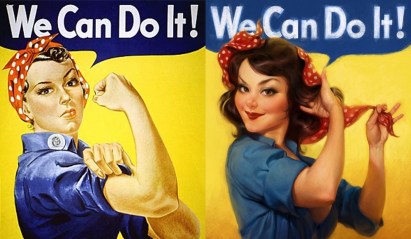 recognize some women as feminist and others not and also to claim women who are pursuing that understanding of feminism as sisters, then it will continue to be powerful as a movement. “We” will refer to “other women who are feminist in the same way I am.” There is no reason to refer to the approach of other women as “wrong,” only as misguided. “We,” my sisters and I, can show them a better way. I think feminism as a movement will require distinctions that function in that way. If the women in this picture call each other “sister,” the movement model will continue to be powerful.
 d just take one step back. No…one more.” At that point the dumb guy takes that last step back and falls backward off the cliff and dies (saying something funny or something pathetic, depending on the kinds of movies you are used to seeing).
 rection, not a location. We are admonished to “be more tolerant” as if tolerance were a good thing all by itself. Obviously, it is not. There is such a thing as too much tolerance, just as there is such a thing as too little.
 ask, “How much more tolerant should I be?” Or, to revert to the “carry” meaning of the Latin source of “tolerate,” how much longer must I carry this burden. (Or, alternatively, how much heavier a burden should I carry.)
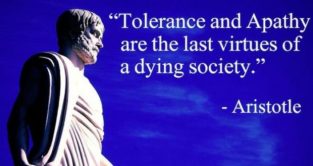 For a society, the question worth asking is “What will happen to society if we tolerate this?” And one possible answer is that it will lose its ability to function. Societies are ongoing propositions. They need to be affirmed and supported and criticized every day and when any of those things fails, the future of that society begins to dim. It is that perspective that Aristotle has in mind in the quote I am showing here. When people withdraw from society as if it will run itself, the society begins to come apart.
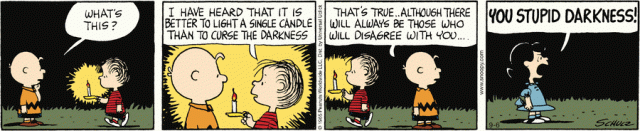 On June 2, Bill led with this cartoon and a sustained argument against “darkness cursing.” I feel a lot of the same things Bill feels, but when I read the column, my mind went off in a different direction. So, with my thanks to Bill for a good column, I would like to pursue that other direction this morning.
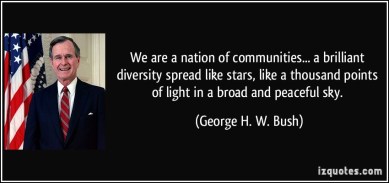 private and public. And when I had gotten that far, I heard George H. W. Bush’s “thousand points of light” speeches (one in accepting the Republican nomination and one in his inaugural address) in which he advocates private activity rather than public (political) activity. Or possibly local rather than national.
 I am loading these examples in favor of cursing the darkness, but if cursing is all you do, it is even less effective that lighting a candle. The question the private response/public solution formula gives us is this: what do you do if the only meaningful resolution of the issue is systemic. No changes, in other words, that are less that systemic will help. Unless something like this assembly of candles means something.
 peace between Protestants and Catholics. [1] Orange is a color that has been associated with Protestantism every since William of Orange defeated James II at the Battle of Boyne in 1690. [2] Green has represented Irish republicanism since March 7, 1848, when it was flown over the Wolf Tone Confederate Club in the city of Waterford by Thomas Meagher. [3]
 We could try to finesse our way out of it. Here is the flag of France. The blue band is on what they call “the hoist side.” According to my quick review of the flags of the world, there is no flag with these colors in this alignment where red is on the hoist side. That would make the new U. S flag unique in the very narrow sense of the word, but you would have to look really hard to see which nation is being represented, and that’s not a good thing for a country’s flag. [4]
 If the flag were to represent liberals and conservatives, it would be representing words that have been with us for a long time, even though the meanings of the words have varied with the times. If the flag were to represent left leaning and right leaning parties, it would, again, be using words that have been with us for a long time—since the French Revolution, in that case.
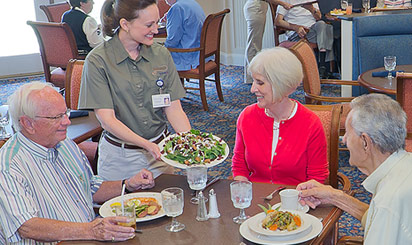 If none of those is familiar, I urge you to stop reading right now and go to the New York Times opinion column by Sarah Vowell, which has one of the best opening lines I have seen in a long time: “Greg Gianforte doesn’t represent this state. O.K., he does now, but you get what I mean.” This is not a picture taken at Holladay Park Plaza. We use tablecloths.
 true in the narrow sense. We have paid for those meals and that money is gone. You don’t get any back by not eating all thirty meals here. Getting a refund really would be “saving money” but that’s now how it works. On the other hand, when you set aside what you would really rather do, you are also wasting a valuable resource and you don’t get those opportunities back at the end of the month either.
 If the choices I made are to be embedded in my personality, so that I am expected by those who know me, to make choices based on a well-known standard—“Isn’t it just like him to…”—I would rather not use a standard that I market as being a cheapskate; I would rather be known as a hedonist. For one thing, the outcome of the cheapskate rationale is always the same. Use 30 meal credits a month. But the outcome of the hedonism rationale could vary a good deal from one circumstance to another.
 The Dilettante's Dilemma