Martin E. P. Seligman surprised a lot of people when he predicted the standings in the next year’s baseball season from a content analysis of comments made by the management and the players about the season just finished. Like me, Seligman studies attributions, and he thought that the way a team explained whatever success they had had in the current season would be a useful indicator about how well they would be  likely to do in the next season.
When you put it that way, it doesn’t sound so outlandish. And Seligman’s predictions were better than those of a lot of sportscasters who know more about baseball than he does.
Ever since grad school, my ears have pricked up when I hear someone say why something happened.
- Was it chance? OK, did this “by chance” event happen to all of the relevant people or just some of them?
- Was it a failure of cooperation with someone else? That’s interesting. Why was the cooperation not forthcoming?
- Was it a lack of clarity? Hmmm. In whose interest was it that the matter was clearly understood by both (all) parties?
- Was it a failure of motivation? A failure of persistence? Was it sabotaged by someone out of ill intent? Did it fail because of someone’s incompetence?
And best of all:
- is it, by any chance, a PLOT by THEM? Those are the most fun of all.
They don’t have any respect for us
Really? And how would that be displayed? I once had a friend who was dating an Austrian professor. On a visit to the professor’s homes near Vienna, my friend was perpetually irked that her boyfriend’s mother kept addressing her in “baby German.” [1] This was understood as a protest against her son’s marrying a non-German speaking woman. The “lack of respect” is flagrant and intentional and is intended to carry some more substantive message—which in this case, it did.
External Attributions
I was part of a discussion recently in which it was alleged that “they” had no respect for “us.” This is, as you might guess, a very satisfying point to make because the “us” are all here and all part of the conversation and “they” are elsewhere and might never find out what we think. Or care.
Now nothing in this essay is going to raise the question of whether” they” do or don’t  respect us. I am concerned entirely with the effects of one kind of assignment of responsibility or another and the first thing I notice about this one is that it is external. It would be entirely possible for this group to say that they are not worthy of respect and that is why they aren’t getting any. It isn’t very likely, of course, but that would be an internal attribution (it’s “us”) rather than an external one (it’s them).
Trait Attributions
The second thing that came to mind when I heard this about “respect” is that the responsibility is placed at the level of a consistent trait. “They do not…” would be at the level of character if “they” were a person instead of an organization. The attribution, if it were folded out more fully, would say, “It is quite characteristic of them to have—and to display—this lack of respect for us.” No one would say such a clunky sentence out loud but seeing it all makes the meaning entirely clear.
Again, if we were talking about an uncharacteristic behavior, we could say something like, “I’m really puzzled. Ordinarily they show great respect for us but in this last instance, they did not. What do you suppose was different about this last time that could account for that?” [2] This is not that. We are saying here that they characteristically do not show us respect and that was evident in this last instance as well.
Elastic Attributions
The third question that came to my mind right away is: “How elastic is this category?” The notion of categories that change size and shape is not at all unfamiliar, but they are not often called “elastic,” and I think that is the perfect word for it. Let’s start with inelastic—rigid—categories and work our way up. If I take a minimum wage job and get paid the minimum wage, there is no puzzle about the cause (I’m a cheap hire) or the category. I get $11.25 an hour.
If I ask whether I am getting paid what I am worth, I ask a different kind of question. There are very specific measurements of how much I produce and if the question of “what I am worth” means whether I am to be paid in line with my merits as an employee, everything is still clear. I could even compare my wages with those of others who have my kind of job.
But what if I am paid differently than other people who produce at the level I do, but who differ from me in race or age or religion or relationship to the boss? We are dealing now with “respect” in a much more elastic way. How many different kinds of things could fit into that pay disparity? Could a category like that expand and expand until almost anything would fit into it? Yes it could and it does.
Where I live
So here are a few residents in a senior center who are unhappy. There is a current  occasion for the expression of their unhappiness, but the current occasion is not the reason for their unhappiness, just a chance to express it. What kind of formulation of their unhappiness will loosen the borders of the category so that nearly everything “fits” into it? Conversely, what kind of formulation will keep each reason for unhappiness separate and therefore easier to act on?
I have argued already that the “don’t get no respect” explanation has some predictable effects. It is socially affirmative, because is separates those present from those absent and places the problem over there (with them, not over here with us). It is set at the level of characteristic action—the level that we would call “character” in a person. Because these actions occur from time to time, this formulation rounds them up and treats them as a disposition—this is something that might happen at any time. And, in dealing with “respect” where there is no context for earning respect, it provides a formulation that is remarkably elastic. It can be stretched so wide that any kind of grievance—any kind at all—will be seen to fit it. Parking is expensive or hard to find? See, that shows their lack of respect. A building project used professional contractors rather than relying on the expertise of residents? See, that too shows lack of respect? A failure in communication with the head of the organization? What reason could there be for that, apart from lack of respect?
When the concept is put at the right place and when the boundaries are so elastic that they can expand to accommodate nearly any kind of grievance, then you have an issue that won’t go away. At that size, it can’t be adequately addressed either, of course, so, like Bill Cosby’s barbecued sparrow in his skit, “Fernet Branca,” it “just lays there and makes gas.”
Needless to say, it is not an obviously good idea to formulate a problem that is so large that it attracts anyone with a grievance and that, on the other hand, is so large that it can’t be dealt with even when everyone wants to. The step that is most often missing in making problems like this one is the sense that it is you who are “making” the problem.
Other Kinds of Problems Beckon
If there is a condition that needs to be formulated as a problem, you have a lot of options about how to go about doing that. Alternative formulations are no more true or false than wearing the brown suit or the blue suit to a meeting is true or false. Formulating a situation as a problem needs to be useful. [3] “True” is much to broad a standard for it.
 Internal: There is no reason, for instance, that the problem described above could not have been formulated as an internal problem. [4] “They” don’t respect us (although they should) is an external problem. There is no reason, absent some context, that the difficulty represented in this picture should be formulated as the bridge being too low or the water being too high. Which way to define it depends entirely on what tools you have at your disposal.
Characteristic: There is no reason, either, that some recent faux pas could not have been represented as a stand alone event, rather than linked to all the others so that it is only an “instance” of the same trait and not a separate events.
Elastic: There is also no reason why the grievance could not have been defined in a less elastic (more stable) way, so that it does not expand to accommodate any and all grievances from any and all contributors. You can expand the concept by giving the same name—in this instance “lack of respect”—to every event you object to or have ever objected to.
So there is nothing at all inevitable about the “we don’t get no respect” coding of these events. The question is really whether such a coding is useful. I suspect it is not.
[1] This is nothing like “simple German,” that you would use on someone just learning German. This is something more like “Oooh. Does Greta wike the wittle red ball?” This was especially irksome because my friend’s name was not Greta and the potential mother-in-law knew it.
[2] NFL broadcasters note the extraordinary reliability of a receiver along with a recent lapse, with the phrase, “the normally sure-handed…..” “Normally” means that he wasn’t this time.
[3] Of course, a formulation is not going to be useful if it ignores or misnames crucially important parts of the situation. Even so, for every perspective on the situation, just what facts are crucially important changes. That is why perspectives are so important.
[4] It could be internal to the group, or internal to some persons within the group.




 were so badly damaged that they had to be amputated above the knee. He may very well have died from loss of blood had Carlos not intervened. But he didn’t die and a very frightened city declared him to be a hero—just for not dying.
 The help he gets, he gets from his sometime (but not current) girlfriend, Erin (Tatiana Maslany) who sees what he needs and is unwilling to withhold it from him. She is immediately heroic, as I see it, although that is not the way the movie understands her. And when all the crisis is over and Jeff has had a chance to discover in a whole new way just who he is, he gives himself to Erin. That is very satisfying. He says something to her in this scene about “leaning on her.” Yes he does.
 Everything is wrong with the Blackhawks event and it is portrayed so that we see that. Here, for instance, is a picture I didn’t see at the movie and now that I am looking at it, I can hardly believe I missed it. Look at the cage the shadows of the hockey goal make on his face! Then Jeff goes through a lot of development. He learns, for instance, that giving Boston the hero they need so badly is a form of self-transcendence.
 So he does. He plays the hero for them. He throws out the first pitch. [5] Carlos pushes his wheelchair out to the mound and that makes sense because Carlos is a hero in the same sense that Jeff is a hero. (As viewers, we understand Erin’s heroism at the Bruins game, but no one in the film understands it that way.) And then he tries to escape from the setting of the game, having done everything he thinks he can do. But here, his heroism catches up with him—not the phony imputed heroism that Boston lavished on him, but the real personal heroism that is based on his courage in responding to his personal disaster. A man named Larry needs to talk with him about the courage he has shown, and Jeff is willing to talk. We are surprised when Jeff asks the man his name; we are dumbfounded when Jeff reaches up and hugs him.
 man. Also autistic. Also extremely bright. When you hear him diagnosing a medical condition, you think of Sherlock Holmes.
 The second occasion was set up when she comes back outside—where Dr. Murphy is still waiting in the rain—to ask him why he kept recommending an echocardiogram. He gives a plausible reason, but while they are talking, the call comes that the echo revealed nothing at all. Dr. Murphy rejects that reading of the echo and when, through Dr. Brown’s auspices, he is shown the screen, he sees something no one else had seen—why the patient is still in danger. That’s the second occasion, and Dr. Murphy characterizes it as “nicer to me.”
 That brings us to the final two questions. The first is, what can Dr. Murphy do to keep from destroying a very good hospital staff? We pretend with each other. We represent ourselves as more interested than we actually are or as less offended than we actually are. We are expected to do that. We are very nearly required to do that, given the penalties that are meted out for failing. [4]
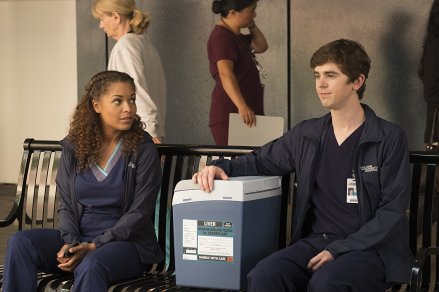 doctor is candid, we are going to have to think about what candor is. The Merriam-Webster podcast which featured this word in 2012 gave an illustration like this: “when the job applicant admitted to some indiscretions in his past, the interviewer thanked him for his candor.” Since the root, the Latin adjective candidus, means “white” or “pure,” I think we can see in this interview, the idea that putting your best foot forward is a violation of candor. The “shaping” of your presentation of yourself is a “blot,” let’s say on what would otherwise be a pure unshaped presentation of yourself.
 and over and he knows what he is talking about. Frodo, like most of the rest of us, is living in the only time he knows. [1] And like the rest of us, Frodo is forced to take the presuppositions of his age for granted.
 What you do know is that the water used to reach much further up the beach and now it is clear down to where you are standing and it is still going down, going “away.” You are horrified, let’s say, because you liked this part of the coast where the ocean “used to come” and you long for “the good old days” when the water—you don’t know to call it a “tide”—used to come all the way up to here.
 ded to have large families of obedient children.
 In the next phase, the helicopter parent phase, parents are responsible for the good choices and the consequent happiness of the children. Let’s just stop and think how far we have come from the farm family where the kids are plowing the back forty and gathering and selling the eggs. Now that the parents are responsible for the choosing that the child does—not, please note, for the choices themselves [3]—a child who is not choosing well or who does not play nicely with others or who can’t make the soccer team or who is not happy, is a problem that the parents need to do something about.
 as autonomy for children and choosing as the principal mode of self-expression and the complete responsibility parents have shouldered for the quality and the success of their children. If it is really high tide on all those things, then the demands they make need to be met in some way. Or perhaps they can be modified. Or even rejected.
 of goo and the sole function of these humans is to provide, through the natural operation of their bodies, the electricity that the Matrix requires to rule them and keep them (us) in their place. In this picture you can still see the goo on Neo and several of the pods near him, each containing a “human battery.”
 By all three of these expressions, Jesus is talking about the new life in the spirit—the life of the ages—and Nicodemus is talking about the old life, the life of the flesh. So when Nicodemus understands anōthen as “again,” he immediately thinks about being born a second time in the same manner that he was born the first time. So he asks disbelievingly how it is possible for a grown man to enter his mother’s womb so he can be born again. My argument is that in his conversation with Nicodemus, Jesus is better understood as contrasting the insignificant (merely earthly) with the enduringly significant (the heavenly).
 found it too challenging. Cypher is rescued from the life he imagined he was living and was made part of a real life. The real life was dreary and difficult and he made the choice for which John ridicules Nicodemus. Here we see Cypher in the matrix “experiencing” a juicy steak. At the moment of this picture, his body is back in the hovercraft, but he is making arrangements to be put back into a tub of goo and to have an imaginary life restored—a life of complete insignificance. He says he wants to be somebody famous.
 Second, you can be rescued from such a life. We see Neo choosing it. This is the justly famous “red pill or blue pill” scene where Neo may choose to go back into his life of illusion (blue pill) or he may choose to be rescued (red pill)—literally “lifted up” from the tub of goo—and live a real, though hazardous, life. Note: to insert the picture here, I have to click on a button that says CHOOSE. Not a bad name for this picture.
 My goal for today is to define the difficulty Mr. Peterson is in and to extend my sympathies. If he and I were having a discussion about the U. S. and the future and about what is needed for the long-term health of our homeland, I think I would get angry at him and say things I shouldn’t. But sitting here at my desk on a beautiful fall day, I have nothing for him but sympathy. [2]
 character. Well…”good character,” really. He believes that people ought to make the right decisions because they are the right decisions. And they do sometimes. But when the economic supports for what used to be “the right decisions” go away, you get a situation where “character” points this way and “economic viability” points that way.
 “degrades the marriage market value of the men.” As a social conservative, he deplores the destruction of intact families and the production of children that no one seems to be able to care for. But now, as a political conservative, he also opposes the government programs which could soften the impact of the economic difficulties and ease some of the social costs of postponed marriages. There really isn’t anywhere else to go.
 free to graze their cattle on the common pasture provided they don’t have too many cattle. Only so many and no more. But each farmer has an incentive to add just a few “extra” cattle—how much harm can a few extra cattle possibly do?—to the common area and when too many farmers do that, the commons crashes and there is no food for anyone’s cattle and disaster ensues.
 asked “to join in”—even though the word “free” with that awful tight ee- vowel comes at a high G that hardly anyone can reach. That adds a common ritual to the “sacrosanct leisure hours.” As long as you don’t pay much attention to what it says, you can just wait until the performance is over and the game starts. [4] And as long as it is common, no one objects.
 Now the commons is gone. Players are staying in the locker room until after our “ritual of solidarity is over.” Players are inventing combinations of ways to affirm the unity of the team amidst the different views of the players. Look at this picture of the Detroit Lions. Some are kneeling, some are standing. All are holding onto each other. I wish the churches could figure out a way to do that.
 If you begin by understanding that President Trump was making a campaign speech aimed at people “back home” it all makes more sense. There is a great deal of anti-U. N. sentiment among Trump supporters. I used to see signs “U.S. out of U. N.” I haven’t seen any of those signs for awhile, but the sentiment lives on. This speech pandered to that sentiment in quite a few ways.
 embarrassing. They are dumb, but they aren’t really dangerous. But there is another matter that troubles me and this one I think it is far more dangerous. Trump has in mind changing the understanding of what the U. N. is for.
 explain what that means before I write anything about his work. When a subject area is both important to me and too confusing for me to sort out, I like to choose “a guy” as my default guru. [2] “Default guru” means that I provisionally accept that person’s perspective as my own and I pay particular attention to writers who diverge a little from that perspective. [3] Sometimes these divergences pile up and I have to look for another guru—if I still feel, by that time, that I need a guru. More often, I keep the guru’s perspective, but modify it to meet my own needs. In that case, I think of myself as a “neo-something.”
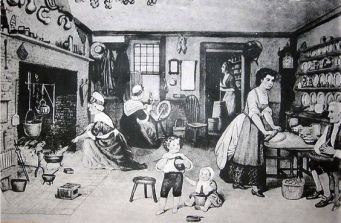 I like that a great deal. If you look at the current fluidity in the performance of gender and the norms by which those performances are judged, it is easy to be overwhelmed by the complexity. If you get a firm notion of how those roles used to be and what happened to them, you can see today’s struggles as an attempt to return to clarity. Starting that far back gives you a perspective on today that you can’t get by starting today.