
“I wish it need not have happened in my time,” said Frodo.
“So do I,” said Gandalf, “and so do all who live to see such times. But that is not for them to decide. All we have to decide is what to do with the time that is given us.”
I think that must be one of the most famous exchanges in the English language. The “it” that Frodo wishes had not happened is the discovery of the One Ring, the ring of power, but Gandalf’s rejoinder is much more general. “So do all who live to see such times…” he says. You are a member of a category and the way you are feeling about it is the way all the members of that category feel. But you must find a way to deal with it anyway.
Now…wizards, like Gandalf, live a very long time. Gandalf has seen “such times” over and over and he knows what he is talking about. Frodo, like most of the rest of us, is living in the only time he knows. [1] And like the rest of us, Frodo is forced to take the presuppositions of his age for granted.
Peter Stearns, the social historian [2] has a way of approaching matters that is a great deal more like Gandalf’s than like Frodo’s. Stearns will study some small aspect of the whole social whirl and pay attention to how that one small aspect has developed over time. I’m going to reflect on his treatment of the notion of “obedience” today, but I’ll be back from time to time with another notion from his work.
Imagine that you are standing at the shore of the ocean in the middle of the afternoon on a beautiful sunny day and watching the “tide” go “out.” (How odd, you think, to put those words in quotation marks. I thought so too.) And let’s say you know nothing at all about the influence the moon exerts over the tides on earth. You don’t know that the water goes out for awhile and then comes back in and then goes out. You don’t know the system.
 What you do know is that the water used to reach much further up the beach and now it is clear down to where you are standing and it is still going down, going “away.” You are horrified, let’s say, because you liked this part of the coast where the ocean “used to come” and you long for “the good old days” when the water—you don’t know to call it a “tide”—used to come all the way up to here.
It seem odd, I suppose, to imagine anyone who doesn’t know about “tides,” but really, who knows about grieving; who knows about “jealousy;” who knows about what a “real man” or a “real woman” ought to be like; who knows whether children should be obedient to their parents? All these are like the tides and we, who take for granted the sentiments of our own time, are like the guy who doesn’t know that “the water going out” is called an ebb tide and that it will all come back.
Let me illustrate by recalling what I can from my recent reading of Stearns’ treatment of obedience. The point of all this is that these ideas about obedience—is it a good thing or a bad thing, does it come at the expense of other important virtues, how is it to be inculcated— are broadly shared by your contemporaries. Whenever you were a child or whenever you were raising children or, more ominously, grandchildren, there was a set of ideas that was considered to be “common sense.”
Stearns says that agricultural families nee ded to have large families of obedient children.
That’s how the family was made an economically viable unit. So there is an economic infrastructure to the ethical demands of “obey your parents.” Notice how powerful it is when the two are joined. Obeying your parents is the right thing to do and besides that, you will all starve without it. Powerful.
The Industrial Revolution removed the economic infrastructure for many families. For these families, the admonition to obedience was still strong, but now it had to stand alone. After a period when urban and suburban children “helped out at the shop” or even “tended the vegetable garden,” the chores of children shrank to things like keeping their own rooms neat and taking out the garbage and washing the dishes. Household chores, in other words, instead of contributions to the family’s economic viability.
In the latter part of the obedience phase, there grew up an ideal that children should obey gladly. In my own mind, I suspect that there were some good reasons for this new emphasis and some bad reasons. The good reason is that when the cows had to be milked, all that mattered was that the kids got up at the right time and milked them. They could be a snarly about it as them wanted. But for the new work, the “chores,” it actually matters whether the kids “obey” sweetly and kindly or with grousing and foot dragging. The bad reason I am thinking of is that the parents and the people who wrote books about how to be parents sensed that the old “obedience” norm was slipping away and tried to prop it up with a new emotional resonance. “I’m obeying my parents (as I should) and I’m happy about it.”
As urban (and later, suburban) notions of what a good child is like, this happiness in compliance was joined to a happiness in independence. It’s not as hard as you might think. Once you start caring about whether the kids are happy or not—as opposed to just obedient or not—it is easy to join this virtue of any other virtue and “the child who can choose for himself” was the next virtue in line. So now we want children who make good choices and are happy about it. Obedience of the “look both ways before you cross the street” is still appropriate, but that kind of obedience is justified by the immediate context, not by the nature of the parent/child relationship.
 In the next phase, the helicopter parent phase, parents are responsible for the good choices and the consequent happiness of the children. Let’s just stop and think how far we have come from the farm family where the kids are plowing the back forty and gathering and selling the eggs. Now that the parents are responsible for the choosing that the child does—not, please note, for the choices themselves [3]—a child who is not choosing well or who does not play nicely with others or who can’t make the soccer team or who is not happy, is a problem that the parents need to do something about.
Does that seem weird? Not if everyone you know is doing the same thing. When everyone is doing the same thing, we are back to the guy who doesn’t know what tides are and who therefore mourns the “passing away” of what was once “a mighty ocean.”
Stearns historical approach gives us a chance to look at the matter more broadly. There is a very nice fit in the situation where the farm family has to make a living and so needs a lot of children who will do what they are told. There are good things and bad things about this scheme—as there are about any scheme—but the parts all fit together.
What we need in our time is an economic infrastructure and an understanding of moral obligations that will do for us what the old agriculture/obedience construct did for them. What should we aspire to for our children? What does it cost them for us to aspire to so much? What does it cost us to aspire to that on their behalf? What do children actually need from their parents [4] as opposed to the things they want or things they think they have a right to?
I think it is an advantage to us all that the problem can be posed generally–that is Stearns’s gift– even granting that any particular family will have to come up with some response to that commonality that works and that is within their means. [5]
So it might be worth considering that the tide is now in, it is high tide, on such questions  as autonomy for children and choosing as the principal mode of self-expression and the complete responsibility parents have shouldered for the quality and the success of their children. If it is really high tide on all those things, then the demands they make need to be met in some way. Or perhaps they can be modified. Or even rejected.
Whatever is done, it will have to be done again as the tide begins to go back out and new structures will have to be devised. And I would think that even as we must work in the present we are given—just as Frodo must—still we may be able to get some relief from knowing that out children will face different demands and different collections of virtues.
And maybe letting them see us struggling with ours, will help them struggle more successfully with theirs.
[1] Sociologist Peter Berger makes the very good point that “society” is a show that is meant to be seen only once, and when you live a long time and start to see the same things a second or third time, you start to notice things you missed at first.
[2] “my guy,” as I said last month, on gender roles
[3] The law still has the old fashioned view about legal and financial liability.
[4] I will grant you the truth of the observation you are about to make that different children require different things from their parents. That is true. But it is also true that every child needs certain things, common things, although they might need to have them delivered in different ways. The unity and the diversity are both true and both trite.
[5] When my wife and I were raising children, we agreed about most things, but differed on the obedience question. I wanted prompt and effective obedience and I didn’t care all that much what emotional flavor accompanied it. One of my kids could say almost anything by way of complaint while he was doing what he was told to do. My wife felt that the emotional part of the act of obedience was important too. She really wanted happy obedience, although she would settle for silent obedience, if “happy” was too much to ask for at the time. I had no idea when she and I were having these discussions about childrearing, how well we represented the recent emphases of our culture.
 of goo and the sole function of these humans is to provide, through the natural operation of their bodies, the electricity that the Matrix requires to rule them and keep them (us) in their place. In this picture you can still see the goo on Neo and several of the pods near him, each containing a “human battery.”
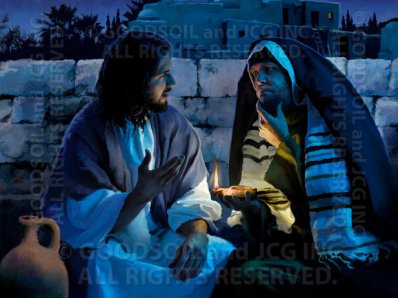 By all three of these expressions, Jesus is talking about the new life in the spirit—the life of the ages—and Nicodemus is talking about the old life, the life of the flesh. So when Nicodemus understands anōthen as “again,” he immediately thinks about being born a second time in the same manner that he was born the first time. So he asks disbelievingly how it is possible for a grown man to enter his mother’s womb so he can be born again. My argument is that in his conversation with Nicodemus, Jesus is better understood as contrasting the insignificant (merely earthly) with the enduringly significant (the heavenly).
 found it too challenging. Cypher is rescued from the life he imagined he was living and was made part of a real life. The real life was dreary and difficult and he made the choice for which John ridicules Nicodemus. Here we see Cypher in the matrix “experiencing” a juicy steak. At the moment of this picture, his body is back in the hovercraft, but he is making arrangements to be put back into a tub of goo and to have an imaginary life restored—a life of complete insignificance. He says he wants to be somebody famous.
 Second, you can be rescued from such a life. We see Neo choosing it. This is the justly famous “red pill or blue pill” scene where Neo may choose to go back into his life of illusion (blue pill) or he may choose to be rescued (red pill)—literally “lifted up” from the tub of goo—and live a real, though hazardous, life. Note: to insert the picture here, I have to click on a button that says CHOOSE. Not a bad name for this picture.
 My goal for today is to define the difficulty Mr. Peterson is in and to extend my sympathies. If he and I were having a discussion about the U. S. and the future and about what is needed for the long-term health of our homeland, I think I would get angry at him and say things I shouldn’t. But sitting here at my desk on a beautiful fall day, I have nothing for him but sympathy. [2]
 character. Well…”good character,” really. He believes that people ought to make the right decisions because they are the right decisions. And they do sometimes. But when the economic supports for what used to be “the right decisions” go away, you get a situation where “character” points this way and “economic viability” points that way.
 “degrades the marriage market value of the men.” As a social conservative, he deplores the destruction of intact families and the production of children that no one seems to be able to care for. But now, as a political conservative, he also opposes the government programs which could soften the impact of the economic difficulties and ease some of the social costs of postponed marriages. There really isn’t anywhere else to go.
 free to graze their cattle on the common pasture provided they don’t have too many cattle. Only so many and no more. But each farmer has an incentive to add just a few “extra” cattle—how much harm can a few extra cattle possibly do?—to the common area and when too many farmers do that, the commons crashes and there is no food for anyone’s cattle and disaster ensues.
 asked “to join in”—even though the word “free” with that awful tight ee- vowel comes at a high G that hardly anyone can reach. That adds a common ritual to the “sacrosanct leisure hours.” As long as you don’t pay much attention to what it says, you can just wait until the performance is over and the game starts. [4] And as long as it is common, no one objects.
 Now the commons is gone. Players are staying in the locker room until after our “ritual of solidarity is over.” Players are inventing combinations of ways to affirm the unity of the team amidst the different views of the players. Look at this picture of the Detroit Lions. Some are kneeling, some are standing. All are holding onto each other. I wish the churches could figure out a way to do that.
 If you begin by understanding that President Trump was making a campaign speech aimed at people “back home” it all makes more sense. There is a great deal of anti-U. N. sentiment among Trump supporters. I used to see signs “U.S. out of U. N.” I haven’t seen any of those signs for awhile, but the sentiment lives on. This speech pandered to that sentiment in quite a few ways.
 embarrassing. They are dumb, but they aren’t really dangerous. But there is another matter that troubles me and this one I think it is far more dangerous. Trump has in mind changing the understanding of what the U. N. is for.
 explain what that means before I write anything about his work. When a subject area is both important to me and too confusing for me to sort out, I like to choose “a guy” as my default guru. [2] “Default guru” means that I provisionally accept that person’s perspective as my own and I pay particular attention to writers who diverge a little from that perspective. [3] Sometimes these divergences pile up and I have to look for another guru—if I still feel, by that time, that I need a guru. More often, I keep the guru’s perspective, but modify it to meet my own needs. In that case, I think of myself as a “neo-something.”
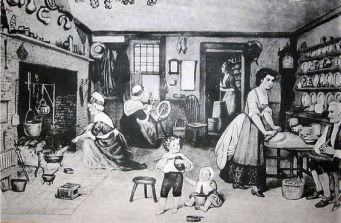 I like that a great deal. If you look at the current fluidity in the performance of gender and the norms by which those performances are judged, it is easy to be overwhelmed by the complexity. If you get a firm notion of how those roles used to be and what happened to them, you can see today’s struggles as an attempt to return to clarity. Starting that far back gives you a perspective on today that you can’t get by starting today.
 And what are those “waves of events.” As specific tools, they vary, of course, from one parent to another, but as kinds of tools, they are pretty common among parents who are trying really hard to be “modern” [3] and “positive.” These tools involve amazing levels of “polite request” and “expressions of appreciation” for the children’s compliance with those requests that sometimes occurs. The tools involve praising a child for doing something he has no sense of doing at all. This has the effect of weaponizing the child, who now knows what behavior he is currently foregoing and therefore what behavior will bring him the attention he craves. The kid who was perfectly happy looking out the window, learns, for instance, that he has been passing up jumping up and down on his seat.
 little girl standing on her seat, the mother say “Would you sit down please?” and, when the little girl sat down, “Thank you.” Why is that a good thing to say, I wondered.
 What would work a good deal better, I think, is for the parent—we have been considering the mother here, but there is no reason it couldn’t be the father—to take the role of the parent, to be in loco parentis. That means that she has special authority to organize the behavior of the group, to dole out rewards and punishments as needed. She can be as sweet-tempered as the situation allows her to be, subject to getting the work done successfully. And let me remind you that “successfully” has independent metrics for the safety of the children, the health and welfare of the mother, and the safety of non-belligerent parties, such as neighbors and passers-by.
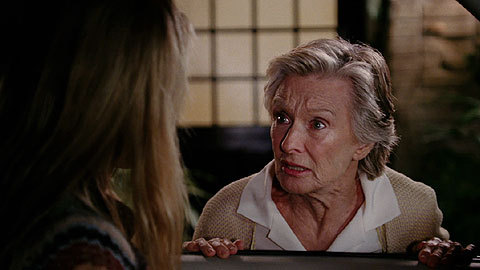 restaurant with one of the most beautiful women in the world and the wife interrupted her affair long enough to notice. She hopes desperately that the husband has had an affair. She thinks that would somehow make it easier for the marriage to survive her affair. Here are the grandmother and the wife in urgent conversation. I’m not even going to bother to identify the parts. It begins when the husband comes home. We, as viewers, have already seen what it cost him to continue to be faithful to his wife.
 And if we did that, the moment would go by when the argument can be put aside just for now and simple humanitarian assistance given—without a ruler across the knuckles for once. And the resentment of elite know-it-alls in exacerbated and Trumpism gets stronger. You can see why Pruitt would like that. You can see why I wouldn’t.
 accumulated—“a lifetime of reasons”—that present events cannot be made the reason for deciding what to do. In that way too, I think Keaton illustrates the resentments of the right wing.
 thing I want to say is that if there are indeed two (or more) and if they operate independently, it is crucially important that we know that. Not knowing it makes us all look foolish.
 similarly formal system. You confess your sins to the priest, [4] he prescribes some act of penance (and possibly of restitution—the movies aren’t as clear about that) and then pronounces, on God’s behalf, that you are forgiven and restored to full fellowship in the church. I hope that account isn’t too far wrong; I am trying only to illustrate a non-state version of the judicial system.
 If there is only one system, then the behaviors of the other person will be evaluated using the norms of that system. This is the step where I lose people, so let’s imagine that a well-known rugby player, Jonah Lomu, for instance, is referred to as the dirtiest basketball player in the league. I know that makes it seem silly, but if you really believe that the only game there is is basketball and if, with that in mind, you watch Lomu doing this, you will be driven to that kind of criticism.
 that it is really hard to do. Picture this. A man finds that his wife has been sleeping around in the neighborhood with his friends. What he wants from her is some sign of remorse and a good faith promise that she won’t do it again. What he gets after each episode is…oh, “enhanced affection” from his wife. Whatever it is that he likes best about the relationship, there if more of it for him for awhile. This is perfectly in keeping with his wife’s understanding that what she did was emotionally hurtful to her husband and now she is making up for it by being emotionally receptive to him. There are no “offenses” here; I was mean so now I am being nice.
 “the reconciliation room.” I liked that It had never occurred to me before that you could name the room after the outcome, rather that after the process.
 nobleman turned shepherd, had seen a lot of bushes on fire, but never one like this. It struck him as odd and he went to see it on the grounds that it was a natural oddity. I was an anomaly. It was The Anomaly.
 But as I said, the name God gave to Moses can be understood as “I will do what I will do” and the doing accomplished things that the name could not. Moses was scarcely willing to believe in the project himself, so God gave him three tricks to do. One has to do with a walking stick that turns into a snake and then back; one with a hand that is terribly diseased and then healthy; and one about water that turns into blood when you pour it out. Moses can, apparently, picture being persuasive in Egypt if he has these tricks in his repertoire. They certainly work for the elders of Israel the same way they worked for Moses. They didn’t believe in the name, but they did believe in the deeds.
 The Dilettante's Dilemma