
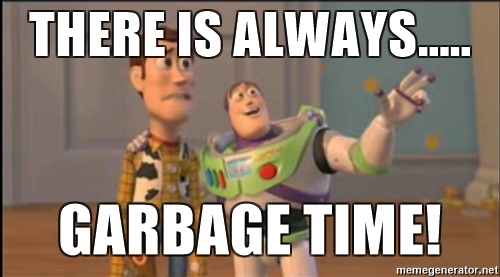
Yesterday I attended a meeting at which a lot of appropriate things were said. After that, the meeting deteriorated into a free for all of bad questions and posturing. It is that latter part of the meeting that I am calling garbage time.
I’d like to speculate a little about how to understand meetings like these, and especially the contribution that the notion of garbage time brings to that understanding. Then I’d like to offer an abrupt change of perspective that was given to me for free by Barbara Tyler. [1]
How the idea of “Garbage Time” helps
It gives you a way to think about the good part of the meeting. There is a purpose to be achieved, let’s say. You are here to describe a program and I am here to understand the program. We have a common interest. That’s the part of the meeting that is like the game.
 Real issues are at stake. One team is going to win and another will lose. I want to be on the winning team so I subordinate any other interest I might have to the team’s needs. Ordinarily, for instance, I’d rather score than rebound, but winning tonight is going to require more rebounding, so I pass up my shot and get in position for the rebound. This is so clearly what the team needs that I might not even be conscious that I am doing it. But if you see me doing it, you will know how to understand it.
But when that part of the game is over—we are so far ahead that we couldn’t really lose or so far behind that we couldn’t really win—the reason for all that discipline is over as well. Now I can take the shots I had wanted to take and maybe some shots I shouldn’t ever take. I take them now. It’s garbage time.
I think that participants at a public meeting make judgments just like that one. There is a time when the success of the meeting is up for grabs. We may succeed if we focus carefully and we will surely lose if we allow our discipline to lapse and our individual interests to take precedence. So we keep ourselves from doing the things that will cause us to fail. Instead, we do the things that the meeting requires. That’s how we all win at a public meeting. We keep the benefits high and the costs low.
The notion of garbage time helps to clarify, by contrast, the real game part of the meeting is and when it is no longer “a real meeting;” it is only garbage time. So these function as indicators. When we see these things starting to happen, we conclude that the real meeting is over. In a game, inappropriate shots and lax defense and missed assignments are all indicators we can rely on. What can we rely on to help us identify garbage time in a public meeting. [2]
I think examples might be more useful than categories here. I have two in mind.
Let’s say that I am a resident attending the meeting and that I was, in my career, the master of some skill that bears on this meeting. Accounting or programming or systems analysis. Because it is garbage time, I spend a good deal of time informing the other residents of my skills and I imply that if there is anything wrong with the information being presented, I will find it.
Is that an indicator that it is garbage time? Probably. Going on and on about my skills seems needlessly self-aggrandizing to me but what we really need to know is whether this account would have been withheld earlier in the meeting—when the game was still in doubt. But if it is true—I am postulating that it is true for the purposes of this example—that she would ordinarily have disciplined herself to the purposes of the meeting and would not have made all those personal claims, then the fact that she did make the claims could be taken as an indicator that the “real contest” part of the meeting had ended and that garbage time had begun. And that is what we are looking for; we are looking for indicators of the transition.
Or, for our second example, let’s say that some explanation is made about changes in the  cost of parking. A resident is recognized and goes on for awhile about how rich our area is in public transit and how, as a result, there is very little need for a resident to have a car at all. That’s the real way to deal with increases in parking fees!. Let’s imagine that this resident is well-known for his pro-mass transit views and nearly always expresses those views in private or small group conversations. It seems odd to us that this familiar pitch would be made again in a public meeting and that the time of the meeting would be taken up by what is, essentially, a public service announcement. But if it is true that this resident would not have allowed himself to make this pitch in a public meeting during “game time,” then his willingness to allow it now is yet another indicator that we have arrived at garbage time.
When things like that start happening, it represents the judgment of the attendees that the useful part of the meeting is over and the willingness to exercise discipline on behalf of the common goals begins to decline markedly. And of course, since the value of the meeting as a public meeting declines rapidly when people begin to use the common time as a time of personal grievances or private aggrandizement. So the more garbage there is, the more garbage there will be.
Another Perspective from the Tyler Coffee Klatch
All of the ideas so far begin with the public meeting. I have always begun with the meeting itself. We are having a meeting because there is a goal to be achieved by meeting together. The meeting is the primary thing and although it is true that the proceedings tend to get frayed toward the end, we can chalk those off to fatigue or frustration.
But Barbara Tyler said that she thinks some people go to the meeting specifically for the garbage time. That struck me immediately as quite likely. But I am raising it here because it is an analytical game changer. It starts at the other end of the process. It begins with the reasons to go to the meeting, not with the purpose of the meeting. I was really struck by that. I’m still excited by it. It’s like discovering a new species.
In this view, people go to the meeting with no interest in the announced topic at all, but with the confident expectation that at the end of whatever focused consideration there is, there will be a time for the public airing of private grievances and the public posturing about past accomplishments and the public chastisement of anyone who has run afoul of that resident in the past. And the time of the meeting—garbage time—when those kinds of contributions are common is the reason for attending the meeting at all.
 Of course, I don’t want to argue that there are, in fact, people who think of the meetings that way. I don’t know whether there are or not. I don’t think I know anyone about whom I would say that—that they attend meetings just waiting for garbage time. On the other hand, this is a way of looking at the meeting that starts at a different place entirely. It understands the meeting as a way for individuals to meet their individual needs in public and that way of understanding the value of the meeting had never occurred to me and likely never would have.
[1] Ordinarily, I take good ideas wherever I find them and just tuck them into the narrative, but this one came as part of what I called Barbara’s Coffee Klatch, when I wrote about that gathering on our first anniversary here, so I’ll just go ahead and own up to where I got it.
[2] It isn’t anger, by the way. Sometimes, it seems that the presenters are not playing their roles well. They are withholding information the meeting needs, or demeaning the askers of inconvenient questions or pretending to “answer” a question by repeating the same non-answer that has been given several times before. I have seen groups get really angry at being treated that way. The temperature goes up and the volume goes up, but this is a natural part of the deliberations and no one leaves because of it. In fact, the agitation might have some entertainment value.
 Sheriff Arpaio was convicted of “flagrant defiance of another judge’s orders in a long-running case over the former Maricopa County sheriff’s targeting of Latinos in Arizona,” according to Joan Biskupic, a CNN court reporter. The court said that Arpaio was violating the constitutional rights of Arizona citizens and he said he didn’t care and wasn’t going to quit. Hence the arrest and conviction.
 Hatfields and the McCoys. [1] On the one side of this divide would be the laws of the land and the men and women charged with seeing to it that it is obeyed. On the other would be the people who are immune from legal prosecution for anything they do on behalf of their tribe. It would mean looking at Eliot Ness and Al Capone as the heads of two tribes fighting for supremacy in Chicago. The fact that one represented the law and the other a criminal organization is not brought to light in this conflict of tribes perspective.
 I know that is where tribalism goes. I don’t know if we are taking large steps in that direction. It looks like it. People who stand up for the integrity of the law will be accused as being members of “the other tribe.” The Tribe of Anti-Trump. That is, after wall, what Capone said to the members of his organization who were not Anti-Ness enough. It is what members of the McCoy Clan said to family members who were not Anti-Hatfield enough. It is what President Nixon meant when he urged the people of his administration to “take one for the team” and go to jail. But he didn’t pardon them.
 can’t believe what he says. He is not credible. That’s the old basic meaning, but it isn’t the meaning that is reflected most in current usage.
 Let’s look at what that boundary condition means because as much fun as it is to have an enormous monster with great pecs and a bad disposition, it is less fun to have a Chief Executive who frequently leaves the common human condition and does “incredible things.”
 President Trump has not had a major legislative victory yet and probably won’t ever have one because his inability to win the early battles causes him to declare war on his teammates. Trump needs to be seen as a winner. That means that high profile programs need to be passed by the Congress. But when the early votes fail, he experiences “signs of stress” and begins to attack his team members. Trump has major conflicts going on now with Paul Ryan, the Speaker of the House and with Mitch McConnell, the majority leader of the Senate.
 describe than I thought.
 There are travelogues as well, because quite a few of these men have lived a lot of places, but we keep coming back to the question on the floor.
 Even if you went up to the 16th floor for the purpose of watching the solar eclipse, you found a lot of competing claims on your attention. Here are Holladay Park Plaza (a really good senior center on the east side of Portland, Oregon) we make a lot out of events. So there was a whole table full of edible puns for us to enjoy. There were the dark Oreo cookies set on top of the light Oreo cookies. There were Starburst candies. There was a large container of ice and water sitting next to a large container of ice and a dark tea of some sort. [1] There were Sun chips, cut-out cheese moons, that you could mount on dark crackers. You could eat away the whole eclipse time if you wanted. This shows the roof from the west. We were up there just on the other side of the brown sign.
 if only a few people felt that nothing was going on that needed their attention. We watched the construction of the building just east of us slow down and then stop entirely. It was still light enough to see how to cover the rafters with big sheets of plywood, but maybe a little break in the action would be appreciated.
 I found myself interested in whether people would think of the closest approach to totality as the end of the show or the intermission. I thought it would be fun to watch when the general exodus began. It began almost as soon as the bright crescent of the sun started to increase again, but by that time, I had thought how many other variables ought to be considered. A lot of people had been sitting out in the sun for a long time by then. Quite a few had been standing for awhile by then. The restoration of the sun may not have seemed all that different from the occlusion of the sun; not that much to hang around for.
 So even Lincoln’s program under Lincoln’s leadership would have failed in the short run, but Lincoln wasn’t really in it for the short run. He calls, in the final clauses, not only to achieve a just and lasting peace among ourselves, but also to cherish that just and lasting peace. I don’t think Lincoln would have achieved it, but I do think he would have cherished it and I think that is where we have fallen down in our time.
 I saw the result of that during my visit. Every way of embracing and cherishing Irish culture was at the same time a rejection of the Anglicization project. If it didn’t take all ten fingers to play the harp, I think one of those fingers, a finger with its own significance, would have been raised meaningfully against the English. That is the present day expression of all those years of denial and derogation.
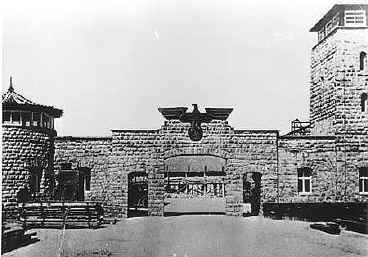 (you see the problem) death camp. It was in Mauthausen, Austria [2] But I saw it twice because I took the Elderhostel bicycle tour twice and it was the historical site featured on that day. Before we went out to see the camp, we saw a film about the era and the camp itself. It wasn’t a preachy film, but the condemnation was consistent and powerful. The first time I sat through the film, these processes were attributed to “the Germans.” The second time, some years later, they were attributed to “the Nazis.”
 against their country, except, of course, being unfaithful to their state. They would be the Southern Statesmen in a Losing Cause. They would be “the Germans.” Their statues could be revered because of their place in the Common Southern Narrative. These statues would be protected in every relevant way, both verbal and physical, by the whole coalition who put the Narrative together.
 Bruni also agrees that the “check your privilege” exhortation rightly asks us to recognize that. I know that when I make an argument, the argument is affected by who I am and the experiences I have had and the same is true for you. That is as far, I think, as that truth should go.
 and color don’t sound right to me. Didn’t we write some things in the Civil Rights Act of 1965 about disparaging people because of their sex or color? Is that why it sounds familiar? Clearly the dueling tee shirts point the direction of our future.
 I think these instances are ugly and that is why I have cited them. But even more ugly to me, and I say this as a former professor [2], are the “classroom conversations” Lilla points to that take the form of “Speaking as an X, I am offended that you claim B.” Lilla says that the form of assertion precludes much more useful forms, such as “I think A and here is my argument.”
 whatever you say both on the grounds of “how you know things” and also “what you know.” Those are just aspects of “who you are.” And I could. Now the two of us, completely heedless of the worth of anything the other might say, stand there and waste each other’s time. [3]
 belligerency about North Korea, including both “fire and fury like the world has never seen” and “not tough enough.” And now, since I wrote those, to “locked and loaded.” But let’s start with President Bartlet and work back.
 to support the kind of response the President is talking about. Bartlet just wants to hit back. There has been no engagement with Congress, not even the famous “Gang of Eight.” [1]. Nothing with Great Britain or Japan. There has been no foreign policy preparation at all and only a rookie President would act militarily in such circumstances and this rookie President if very fortunate t have someone who will tell him that. The caption is from a Fitzwallace fan. He didn’t have a nameplate that said that.
 For example, it is not a difference of public and private person. Bartlet was as angry in this narrative as Trump is today about the threat of North Korea. It is not that Bartlet successfully muffles his anger, determined to act like a president, rather than like an avenger. Taking this scene as a fair instance of his early presidency, he “muffles his anger” no better than President Trump is reported to.
 purpose of dealing with other heads of state, some friendly, some hostile, then he needs a strong staff in the very worst way. And he shows very little inclination—General Kelly is a possible exception—to appoint any. The recent televised cabinet meeting at which each secretary was given a chance to say what an honor it was to serve in the Trump administration, does not bode well for anyone giving the President good advice.
 I ask you to imagine that sitting down at a table with friends to eat a meal is really just a palette; it is an occasion that you will use to paint a picture of yourself. In this scenario, the meal itself is just a color, just a tool. In such a setting, it makes no more sense to say “Enjoy your meal” than it would to say to an artist, “Enjoy your yellow.”
 the meal at all, so very probably he is not enjoying it. Each kind of food is an occasion for recounting where else he has eaten this kind of food and how much better it was then than now. It is a self-aggrandizing performance and while it doesn’t, strictly speaking, preclude his enjoying the food, it is hard to think that he does.
 Let’s take it for granted that people like President Trump do whatever they feel is in their best interest. [2] And I take it for granted that people listen to what they think is in their best interest and believe what they think it is in their best interest to believe. And I think it has always been like that. I think that characterizes the presidencies of George Washington and Abraham Lincoln and Bill Clinton. [3]
 remind me of the “pep rallies” of my high school days. Speaker after speaker praises the home team and vilifies the next team on the schedule. Coaches will say things like, “And we are going to win because we are winners” with complete impunity. It doesn’t imply anything about the actual prospects of the home team in the coming game. We may have lost every game so far and be confidently expected to lose this one as well. No one takes what appears to be a prediction as a statement with any factual content at all. It is just a way of praising ourselves and fortifying ourselves against whatever reality will bring.
 There is no down side, in the current environment, to being shown to be a liar. In fact, now that I think of it, I don’t see that word used. We see stories that some percent of a politician’s statements (I saw a 70% ranking for Trump during the campaign) are lies, but not that the candidate was “a liar.” In the current environment, lies are honored equally with truths as “courageous,” or as “standing up for the downtrodden” (or the downtreaders) or “saying how he really feels.”
 public officials by treating some things as acceptable and others as not acceptable. Politicians who thought their campaigns would be seriously damaged if they could be shown to be lying about public matters would stop lying about public matters. Mrs. Motter trained my friend Bruce to understand that he was not really being called for dinner when she called his name. Bruce responded exactly as you would expect, and as any politician would, who was doing something rewarding and illicit and was not punished for it.
 The Dilettante's Dilemma