
I once had a Latin teacher who said that teaching Latin was the ONLY way to learn Latin. I don’t think that’s really true. Being a Latin teacher, he often used the device of a minori ad maius [1] so it is hard to know just how far to go in extending his remarks. I do know of my own knowledge, however, that in preparing to teach a class I learn more than I do in preparing to take a class. It is one of the many reasons I like teaching.
 Or, in the case I am just about to describe for you, not even teaching; just convening. This year, at the senior center where I live, we used the Foreign Policy Association’s annual program, Great Decisions. It teaches itself, in a way. There is a video of eight 30 minute programs and a briefing book to go with it. My own job was simply to convene the group, show the video, and moderate the discussion afterward.
I did, however, want as good a discussion as I could get–I really like good discussions– so I cast about for some way to prepare the other residents to engage the material for themselves. I hit on the idea of pulling some quotations out of the material they were going to see and passing them out the week before. It didn’t work that well all the time for the group, but it was absolutely terrific for me.
That’s how I discovered the “themes.” That’s what I call them. They are emphases that didn’t play a starring role in any of the eight topics, but that showed up in a supporting role in at least half of them. In watching the DVDs over and over to get the quotes right and to attribute them correctly, I began to notice some of the material that I passed over on the first several viewings.
Here are the three I chose to share with my fellow residents after the program ended last week. These are obvious points. They are dumbfoundingly obvious. Don’t let that discourage you. And they are big points, by which I mean the scale is large. You don’t get to these points by mastering the details. But after the details are so familiar that you don’t have to pay attention to them any more, these more general and often, more important points begin to emerge.
1. What kind of international order does American hegemony guarantee?
A hegemon [2] is a kind of first among equals and the U. S. emerged from World War II as the leader of an alliance of western nations. The period of mostly peaceful competition among nations since then has been referred to as the Pax Americana, the peace that American dominance guarantees.
You don’t have to know very much Latin to know what Pax Americana means. It is  intended to be parallel to the Pax Romana and the Pax Britannica and when the Pax Sinica (the peace guaranteed by Chinese ascendancy) is fully in place, they will say it is a parallel expression to the Pax Americana. So I, along with everyone else was familiar with the Pax Americana. It means that the U. S. is the principal guarantor of the dominant international order. But what kind of system is it that we guarantee?
It seems an obvious question, right? I never asked it and never heard it asked. But it showed up in several of the presentations, almost always as a bit player, and after awhile I began to ask it myself. The answer is that America guarantees a “liberal international order” a LIO. That means, according to one of the commentators:
…a new order—an American-led order that involved the creation of the United Nations, the World Bank, the International Monetary Fund. Separate but equally important NATO, the World Trade Organization. These were really the key pieces of architecture of the U. S.-led global order.
This is the architecture of the international order. It is hard to explain to Americans what “liberal” means in this context because both conservatives and liberals in the American political spectrum are Liberals in this historical sense of the term, so I moved on to WIO, a Western-oriented International Order. That has several advantages. For one thing, it clearly means architecture favorable to the West and, really, what other kind of order would the Pax Americana guarantee? Furthermore, if it is true that there will be a Pax Sinica under China, we will have a name ready for the new architecture. It will be EIO. [3]
It will provide something like the World Trade Organization (they have already begun an Asian Infrastructure Investment Bank) but it will operate with different rules and different priorities. There will be different tariff rules and different rules for military engagement and for financial management. I have no idea what they would be, but they would be guaranteed under the Pax Sinica, (which is an EIO) just as the international rules and institutions oriented toward the West are guaranteed by the WIO.
The new idea to me is that something is guaranteed under the leadership of the leading nation. When we take the trouble to say just what that would be or what it now is, we will know better how to talk about the era and might even catch a glimpse of ourselves in the mirror.
2. Liberty and Equality are not only not the same thing, they are probably not even compatible on the global scale.
First you have to go through detoxification. This particular kind of syntactical poison operates by making any “good” (positively connoted) word the rough equivalent of any other such word. So, brought up on this particular toxin (as you probably were), I was entirely likely to equate liberty and equality on the grounds that they are both good words and we like both of them.
But Jeremy Adelman, commenting on the Cold War confrontation, put it this way.
What the Soviets held out was a model of global integration that was connected to social and economic progress for those at the bottom. Let’s say the American model, liberal internationalism, made a different case. argued that it was not so much the language “the equality of all peoples,” but rather “the liberty of all people.”
Adelman contrasts the rhetorical pitches being made by the U. S. and the Soviet Union as “the liberty of all people” as opposed to “the equality of all peoples.” That’s what detox looked like to me. “Liberty” is the pitch we were making; “equality” is the pitch they were making. We are pitching a process by which everyone is free to pursue whatever it is they want. They are pitching an outcome, where groups that were radically unequal at the beginning have achieved a rough parity by the end.
I’m not arguing that either pitch was sincere or that one would work better than the other. I am remarking that this year, thanks to the Foreign Policy Association, I noticed that liberty is one kind of thing and equality another.
Then, in the program on South Africa, the writer of the script, Mary Patricia Nunan, gives this line to the narrator.
While the racial composition of South Africa’s elite has shifted to some degree, the staggering level of inequality has not. A tiny majority still control most of the industry, land, and economic power.
That took me to the site of the Organisation for Economic Cooperation and Development to look at nations with prominently unequal distributions of income and there I found this, the last two (worst) bars on the right representing South Africa and the United States.Then I remembered, in this new context, that our pitch is all about liberty and we think of liberty as freedom from government control. It is a political issue for us. Equality could be about politics— “one man, one vote” said the Supreme Court in 1963—but it cannot be disconnected from questions of economic equality. South Africa is a good illustration of that, of course, and I already knew that. Allowing the black citizens to vote changed everything politically and almost nothing economically. So what are we doing over there is the next bar to South Africa? That brought Jeremy Adelman’s distinction between liberty and equality right back to me and this time, with some force.
3. America cannot be the hegemon and court valued customers at the same time.
This is another one of those “yeah, of course” realizations. But stop and think for a minute. Where, in the contrast between Western-oriented and Eastern-oriented International Orders, do we see the United States curtailing its role as hegemon so that it can compete in the trade wars along with Europe and China? I’ve read about our hegemony and I’ve read about our trade initiatives, but I have not reconciled our much-heralded “leadership of the Western World”with our courtship of new customers.
While I was preparing for the discussion of our economic relationship with South Africa, I ran across an article by Parag Khanna in the New York Times. Khanna invents the term ‘Second World” to refer to the nations that are just becoming rich enough to be valuable customers. [4]

When I started thinking of it that way, I found this picture, (above) which represents the latter part of that dilemma. Khanna says that China, Europe, and the U. S. are engaged in all-out courtship of these nations for their trade and their resources. In this picture, I saw the Second World as the attractive woman in the center and China, Europe, and the U. S. (clockwise around the circle) as suitors. And when I began to see commercial “courtship” in this way, the contrast with “American hegemony” became a very sharp contrast.
Conclusion
Sometimes, I guess, the most obvious lessons are the hardest to learn. That is particularly true if you have spent an apprenticeship of…oh…70 years or so in learning not to see the obvious things. But now that I have seen them, I guess they are going to have to compete for mindspace with all the other things I have learned.
[1] From the lesser to the greater. For example, in Luke (23:31) Jesus says, “For if people do these things when the tree is green, what will happen when it is dry? Green is the lesser (a minori) and dry the greater (ad maius)
[2] There doesn’t seem to be any way around this unfamiliar word. It is a Greek word ”hegemōn”which means “leader,” just as the German “Fuhrer” does. In common use, it refers to the leading nation among a set of powerful nations. The abstract noun “hegemony” is more familiar to most readers.
[3] The only major downside to this abbreviation is that for most Americans, EIO already means something and McDonald’s farm is not where I want people’s imaginations to be headed.
[4] Rather than the old division where “second world” referred to the communist countries, and “third world” to the poor and underdeveloped ones.
 So the first thing to know is that the Sermon on the Mount is a device that Matthew uses to contrast Jesus to Moses. Moses goes up on the mount and brings down the Law; Jesus goes up on the mount (different mountain, of course) and refines the Law’s demands. That is why v. 39 (above) is preceded by v. 38, which cites “an eye for an eye and a tooth for a tooth” as if it were clearly the Mosaic standard. And that is the point Matthew is trying to make: the “old law,” what Moses brought to Israel, is no longer enough and we must now open ourselves to “the new law,” that is, to Jesus.
 Frances understands eventually what her mother understood right from page 1: Thelma is a predator and Frances is her prey. That is the nature of the relationship—mother gives several examples—and will continue to be the nature of the relationship unless some kind of fundamental change is made. You could argue, I suppose, that Frances might suggest that they both become prey; that no one take advantage of anyone else. But the only action that is entirely within Frances’s power is to become a predator just like Thelma and that is what she does when she cheats Thelma out of the tea set. And Thelma recognizes it right away. “I see that you, too, are now capable of predation.” That’s what “I am going to have to be careful “means.
 There isn’t a war, but the gang leaders—these gangs may be ethnic enclaves or nation-states with elected leaders—say that there is going to be a war and furthermore that there should be a war. It is a moral necessity. “Yo, Sam,” calls one of the aspiring leaders, “You have no business hanging around with people like George there. He’s one of THEM. Come over here and we’ll take the war to him.” There’s nothing remarkable about that sentiment—the awful tone deaf language I used to convey it is bad, sure, but you get the idea—and it is, in fact, the basis of shock jock radio.
 The Fascist Party of Italy, about which I have headline knowledge only, is presumably anti-immigrant. They promise to take Italy back to some largely mythical “golden era” when things were as they should be. The party proposes programs about how to accomplish that. Let’s imagine, just to have something to refer to, that everyone who can’t prove he or she was born to an Italian father and mother, has to leave the country. What that means, for our example, is that Signor Salvini has to look at the proposals of the Fascist Party and say, “I don’t care about those.” You can hear that in “I guess he’s a fascist, too,” as if he were saying, “And I hear he also collects stamps.”
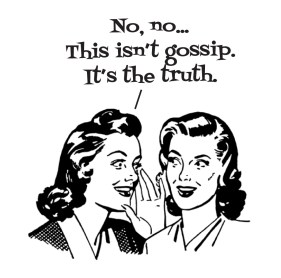 But if, in the present context, the alternative to truth is gossip, then I vote for truth—even for “truthiness.” [8] When you live in a small village, you know you can pass along “information” you got from one person, because it is likely to be true, but not “information” from another person because he or she–not just “she” as in the picture– is a notorious gossip and just passes along what he or she has heard, without assessing the likelihood of it. Life is the same is small organizations. You get a sense of who screens his remarks for the likelihood that some piece of information is true and who just pass anything on.
 what is being said, simply bristle with aggression or twist with implication and you never really noticed. That’s why it was flat to you. And when you notice what is being said, you wonder how you ever managed to pass it by as if it were not remarkable.
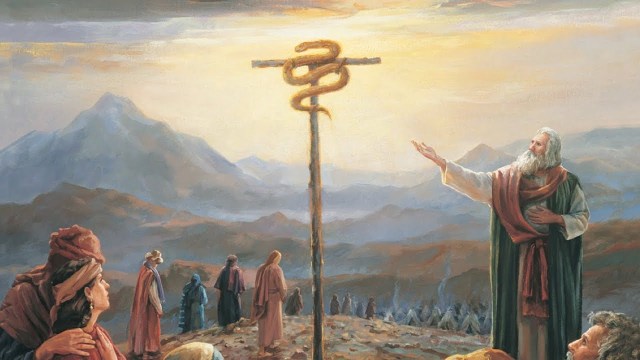 But what is John saying about everyone else? That takes us back to the wilderness. The snakes were a punishment from God and they afflicted Israelites generally. They did not seek out the ones who had been complaining and bite them and leave the rest alone. Furthermore, God did not withdraw the snakes when the people repented; God just provided a remedy for some of the Israelites. And to be saved from death, the Israelites had to “look at” the bronze snake on the pole.
 as nonsensical as “looking at a snake on a pole.” [5] Believing Moses wasn’t always the obvious thing to do. He had had his good moments and his bad moments. And they had just had their hands collectively slapped about the golden calf and here is this “brazen image” thing again. But there is something very persuasive about feeling that you are dying from a poisonous bite and looking at the snake on the pole as you were told to do and recovering from the poison. People who had seen that done might very plausibly exhort others to “take the treatment” and be saved.
 are people who tell the good news. In the desert, the good news is that you really don’t have to die because you were bitten by this snake. You can go to the pole and look at the snake and you will live. Not “eternally,” but you will not die today. People who carried that message to their friends and neighbors who would otherwise by dead by tomorrow, were carrying “good news” indeed.
 How a movement like that could be “overcome,” I have no idea and, in fact, it makes me think that someone in the marketing department at Harvard University Press added that last little bit to sell more books.
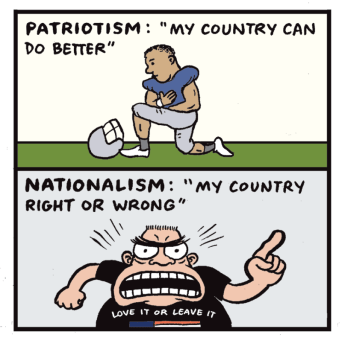 Does that mean giving up “denouncing past and present injustices?” It might. A steady diet of such denunciations is like a steady diet of salt. Salt has its uses as a condiment, but treating it as an aliment—as the entrée—is not going to work. We still get to do all the denunciation that doesn’t get in the road of the job. So we won’t have to give it up completely. The job, as Mounk gives it to us, is redefining “patriotism” as a new more inclusive, more inspiring form of our common quest.
 nations’ highest ideals, many activists seem content with denouncing past and present injustices.” That is what he said is going to have to be overcome if we are to see clearly how to re-orient nationalism toward the most crucial of the progressive’s goals.
 other. We were glad to have found each other and we have enjoyed the marriage fully, but both of us know that marrying each other was not going to be “the answer.” Neither of us, in Shel Silverstein’s well-known parody, was “missing a piece.”
 it is vital that you get some clarity about how you want to live. For one thing, he will want to know that because he will want to take it into account in his own choices. I would think that being clear about how you want to live is fundamental to living in love and harmony with your mate.
 If I know that about my own needs—not what I need to keep trudging on, but what I need to truly thrive—and if I take responsibility for acquiring those, then the distinction between “alone” and “with a partner” simply melts away. “Doing what I need to live the life I am trying to live” is, to say it this way, a more general formulation. It is more fundamental.
 Unfortunately, he was a very popular man and everyone wanted a piece of him, including every president of the U. S. since Truman. Psalm 18 refers to God as our “shield and buckler” and that is a good thing, but President Nixon used Billy Graham as his shield and buckler and that was a bad thing. Billy hoped to be spiritually helpful to the presidents he counseled, and he may have been. He was, without question, politically helpful.
 The matter gets further complicated in The Crown in the next scene where Queen Elizabeth has a private audience with Billy, after the chapel service. She compliments Billy on his clear exposition of the demands of Christian faith.
 we make safely snatch those words out of context and apply them to ourselves, I would say, “Actually, we can’t. They don’t apply directly to us. They apply indirectly to us. They matter enormously, but you have to deal with the thought, not just the words.”
 The same thing happens on the social side. A resident I have gotten to know in my brief time here shows up in the little coffee nook where world problems are hashed out every afternoon [4] and today, he has a cane. Tomorrow—or some tomorrow or other—it is a walker. Then a wheelchair; then a wheelchair with oxygen. Then he doesn’t come all the time; then he doesn’t come at all. These are perfectly ordinary signs that “it” is failing.
 The other side of that dichotomy is harder. The other side is when “you” begin to suffer losses so that you are “no longer yourself.” That’s the way they say it, but, of course, you are “yourself;” you are precisely the self you now are. You are not the self you used to be, of course, which is what everyone who uses that phrase is understood to mean. [5]
 prominent response. When a person has lived a long and successful life, it is perfectly appropriate to celebrate that life as a whole and at the same time to mourn the loss the the person.
 him look bad. I’ve been grateful to him ever since for being willing to do that. His notion of living the Christian life was that around him in the world were people he was called to serve. He didn’t have a narrow or a specifically religious notion of what “service” was. He did have a sense of how those people were to be identified to him, however. He counted on the Holy Spirit to move him toward those particular people he was being called to serve. Not only is that resolutely orthodox; it was not even unusual at Wheaton when I was there.
 Now let’s go back and look at the sequence. “Eliminating drudgery” creates the possibility of leisure, which in turn creates the possibility of self-cultivation in a way that was once possible only for aristocrats. With these new household “conveniences,” everyone can be “like an aristocrat.” [3]
 If it were formulated as a rule, and there is no reason to think anyone would really do that, the rule would be this: if it takes either work or waiting, I will choose something else. Political reform? Takes too long. Providing infrastructure? Way too long. Slowing the rate of climate change? [4] Not every worth thinking about. Easier just to deny the reality of it.
 of St. Bonaventure Hospital in San Jose. Here are Dr. Coyle
  and Dr. Browne. She reproves him as she should and reports him as she should. But Dr. Kalu, her boyfriend, (that’s a gross characterization, but it’s good enough for this small turn of the plot) is angry and physically assaults Dr. Coyle. And then he gets fired for having done that.
 This requires a confrontation between Allegra Aoki (Tamlyn Tomita), who is Chair of the
 St. Bonaventure Foundation—that means she presides over the sources of the money that fund the hospital—and Jessica Preston, (Beau Garrett) who is Vice Chair of Risk Management. You see them here.
 Dr. Andrews, the black Chief of Surgery, (on the right) reproves Dr. Kalu, the dark
 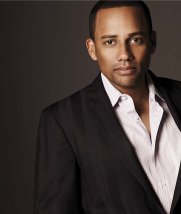 surgical intern, (on the left) for playing the race card inappropriately. Kalu defends himself by arguing that the case he made—white doctors in that situation have been treated differently than he was—is true. Andrews says that isn’t a good enough excuse. “You stepped over a line,” he says. He doesn’t say what “the line” was, but he is about to.
 The Dilettante's Dilemma