“Optimal” aging

On a recent visit to one of the legion of doctors I have been seeing recently (don’t ask) I picked up a pamphlet called “Optimal Aging.” The tag line featured on the front of the trifold is:“There’s no place like home. Let us help you stay there.”

It is a straightforward pitch by the Providence Healthcare System that staying home is optimal 2“better.” Just what it is better than is not mentioned . Why it is better varies some, too, in the reasons offered, which is enough to raise my suspicions.  The pamphlet doesn’t raise security issues at all, but if they wanted to, they could borrow this picture: Safe at Home!

When I begin complaining about this pamphlet, which is what I am about to do, you might feel that I am getting all exercised about a very small issue. I’d like to give you two reasons to pause and consider.

The first is that I am, myself a person who has chosen Option B, the one never mentioned in the pamphlet. I live at Holladay Park Plaza, a very good continuing care retirement community (CCRC) in Portland, Oregon. None of the reasons I chose it—the range of activities, the resilient and accepting community, the easy access by public transportation to the events of the city—are so much as hinted at in the brochure.

In fact, if my goal were the goal they presuppose in the brochure, we would still be living in our house in southwest Portland because we would still be able to. The goal they have in mind is to find a way to help older people stay in their homes.  That’s a good goal for them, but it might not be a good choice for you.

The second reason is that I have heard variants of one single conversation over and over optimal 5since I moved here. It goes like this. “If I had known things could be like THIS, I would have come here years ago” What they mean by THIS varies a little as you would expect, but very often it has to do with the services we offer—those are the same services the pamphlet pitches as part of the “stay in your own home” message—and also with the new options that are available here, but not “there.” Coffee group? Right downstairs in the Bistro lobby. Exercise? The room with the machines is always open and the swimming pool is usually available. Library? Right at the end of the hall.

The point here is that there are quite a few things that can be a good deal better than you could have them living in your own home and all of those are screened out by asking only how you can manage to continue staying where you are.

“There’s no place like home.”

That’s true, but for a lot of aging seniors, that are places that are a good deal better than home. “There’s no place like home” is the sentimental appeal and I don’t begrudge them that at all.On   the other hand, the claim they actually make for this—that it is “optimal” is fraught with difficulties. [1] “Optimal aging” means that it is the best kind of aging. That means that it is better than the other kinds of aging—that is, after all what a superlative form is for. And to make that judgment, you really ought to know about the alternatives.

And that is the place in the argument where I start to get snarky. There is nothing in this pamphlet about other kinds of aging situations. That makes it hard to justify a claim like “best.”

And that may be why, as you fold the top of the trifold back, you come right away to the second standard, which is that these services are for “older adults who’d rather stay home.”

That is a great deal more justifiable. People should be able to do what they prefer. But then I remember all the conversations with new residents that begin, “If only we had known…” In staying in their own homes, they were doing what they preferred. But they are not doing what they WOULD HAVE PREFERRED had they known that a place like Holladay Park Plaza [2] was available. And when I read this particular defense in the brochure, those are the conversations that come to mind.

And why is that?

Three separate reasons follow. The first is not really a reason; it is just a restatement of the tag line. It says, “Who wouldn’t want to stay at home as long as possible?” I won’t deny that the phrasing gives it an appeal, but the answer is, “Anyone who would live a richer life somewhere else and knows that is possible.” Notice that in “as long as possible…” the question becomes “are you able to” rather than “do you choose to.”

The second is a reference to “the obvious comfort” of living at home. This is a little on the optimal 4dicey side because again, the words go one way and the meaning goes another way. I think “comfort” probably stands for “familiarity” here. I am not less comfortable here at Holladay Park Plaza than I was at our house in southwest Portland. For all practical purposes, we simply moved our familiar way of living across the river to northeast Portland and plunked it down. Nothing is going to be more familiar than continuing to remain where you are, but when you shift to “comfortable,” you are requiring a comparison of here with there and they would not win that argument.

The third reason (set of reasons) deserves to be quoted in full.

When you stay at home, you can keep working on your hobbies, easily see your friends and neighbors, and be with pets that need you as much as you need them.

Whether you can “keep working on your hobbies” at a fully equipped CCRC depends, of course, on what your hobbies are. The comparison is stacked, as it should be in a pamphlet intended to persuade, toward the services Providence Healthcare is providing and that slant is clear in “keep working on.” It is the continuity that is highlighted. If the CCRC is a much better place to work on your hobbies, and the chances are pretty good if you are a woodworker or a weaver or if you work out in a gym or swim in a pool, that it is easier to do here.

“Easily see your friends and neighbors [3]” is a better reason because they mean the optimal 1friends you already have—not the new ones you will make—and the “neighbors” you will have at the CCRC will be just as much your neighbors as the people living next door. [4]  I think that this picture captures “the alternative” the brochure wants you to imagine.  It’s not a pretty picture, I grant, but pictures like this are not a good reason to refuse to consider a change.

The point about pets is probably the best one in the brochure. Many CCRC’s are pet-free [5] and if you want to take your pet with you, you will have to be sure that the center you are considering will allow it. Many will, of course, and as the next generation of oldsters—more pet-oriented than their parents’ generation—begins to look at CCRC’s, there is likely to be a wholesale change. And the turn in which the pets need you as much as you need them is a stroke of genius.

Choosing the kind of life you want to live

If you have any notion at all of the kind of life you want, you are in a position to ask where and with whom [6] you want to live it. “We choose this kind of setting/community rather than that one” is the format of a really good choice. “What do we have to do to be able to stay where we are as long as possible” is the format of a really bad choice. That doesn’t mean the choice itself is a bad choice for everyone. For any particular elder or older couple, staying where you are might be just the perfect thing to do. I’m considering in this essay the way the question gets raised, not what the best answer is.

I’ve been accused, every now and then, of being more intentional than I should be. Most of the time, this language is just a “stop and smell the roses” sort of plea and I probably should stop more often to smell the roses. But at other time—most of the time, I think—it is a confidence that just continuing to do what you are doing will produce the results you are looking for or it is an expression of hope that “things will work out.” In writing this essay, I have given those critics everything they need to make their case and I wish them well.

On the other hand, Bette and I got here, where we are, by asking what kind of life we wanted to live and it seems to have turned out pretty well.

[1]Optimum is the neuter singular form ofoptimus, which means “best.” It is the superlative form of bonus, which means “good.”
[2] Or any of several other CCRCs in Portland. I don’t mean to exclude them, but I live in only one, myself. As Secretary of State Dean Rusk said, “I hate to keep referring to personal experience, but that is the only kind I have ever had.”
[3] I always see the “nigh” in “neighbor.” All you have to be to be a neighbor is to be close. And if you have what we call here, “mobility issues,” close actually matters more than it did in the old (suburban) neighborhood.
[4] It is true, as they say, that “you can’t make new old friends.” It is also true that you don’t have to give away the old friends when you make new ones.
[5] I get a kick out of the alternative metaphors now in use. In place of the old -less, as in helpless, we are using two strongly inflected forms. The first is -free, as if some negative value is being referred to and anyone would want to be free of it. “Tax free” is a good example. The other strongly inflected form is –friendly, as if refusing to permit some action was an unfriendly thing to do. A hotel with a reputation for discretion might advertise itself as “affair-friendly,” for instance.No one seems to have any trouble reading the meaning, the the flavors of these several alternatives are distinctly different.
[6] I don’t mean just a spouse. If there is a kind of people you would really like to age with, going to where they are wouldn’t be a bad thing to do.

Posted in Getting Old | Tagged , , , , | Leave a comment

I believe in the integrity of the atom

On the morning of the 4th of July, a friend of mine [1] was greeted with a cheery, “Happy Birthday.”  I’m sure he responded to the sentiment in a gentle way, but inside, he felt himself strongly rejected the idea.  The birthday of a country like ours, mired in division and tiptoeing in the direction of fascism.  “Birthday of our country.  Hah!”  Or some such sentiment.

He was still in that mood later in the morning when he told me about it.  He and I have roughly similar political views, but it turns out that we differ a great deal on what I am calling, maybe just for this morning, “atomic integrity.”

I didn’t have that label handy while we were talking, but I must have had something similar in mind because I accused him, at one point, of being “anti-proton.” [2]  Before we get deep into atomic theory, which I make no pretense of understanding, let’s look at the kind of examples everyone will understand.

The Inauguration of the President of the United States

That is the title Donald Trump currently holds.  In my view, he demeans and tarnishes it every day, but he is the only person in the world who currently holds it and it was bestowed on him on inauguration day.  And our Congressman, Earl Blumenauer, made a point of refusing to attend it.  He didn’t slink off into some dark corner.  He didn’t say he needed to spend more time with the wife and kids.  He said he did not want to be “complicit” in the presidency of Donald Trump.

Earl [3] seriously misunderstands the role of inaugurations.  Inaugurations are the time4th of July 1 that Americans get together and celebrate the peaceful transfer of the executive power.  All the little routines that are staged surrounding the ceremony point to it.  The President and the First Lady meet with the President-elect and First-Lady-to be at the White House, but only the latter two return.


What is that for?  It is a dramatic statement that the White House and the Presidency belong to us all and that, while it is true that elsewhere in the world the losing candidate is put up against a wall and shot, that is not true here.  The Inauguration is our chance, as Americans, to support the legitimacy of the office.  There is always the chance, after all, that we will come some day to want the office to be held in high regard, don’t you think?  And how will we do that?  Well… not by turning the ceremony into a partisan celebration as Earl has done. There will be a lot of that in the White House later and people will cheer each other’s efforts and say, in one language or another, “We won!” or “We really showed the bastards, didn’t we” or whatever.  Earl and I will not be invited to such parties and would not go if we were.  Those are partisan celebrations and we belong to the other party.

But the inauguration is for everyone.

An American Culture is for everyone, too.

This is the kind of point that gets me into trouble, but stay with me.  We are just about to go nuclear.

4th of july 3

A society has a common core of values.  If it doesn’t, it is not a society.  It also has a range of values which differ from each other. It has both commonality and diversity.   My argument is that the more strongly the center is affirmed—not tolerated, but actively affirmed—the greater is the range of differences that can be tolerated [4]

Back in the old days, it was common to refer to America as a “melting pot.”  Disparate materials got put into the pot and melted and became all one substance.  People from various cultures became American and affirmed the common values and the common language of the new land.  It was an act of belonging.

In 1971, Michael Novak wrote a book with a truly memorable title: The Rise of the Unmeltable Ethnics.  His point was that the new immigrants, unlike the old, have no intention of “melting” into some generality Americanism.  They want to live here and remain “Old Country.” [5]  They want to keep the boundaries that define “us” by contrast with “them” and they want to add their own private identity to their identity as Americans or they want to completely substitute the private one for the public one.  The first would say, “Yes, I am an American.  I am also an Old Country Resident.”  See!  I told you it was going to get awkward.  Or he could say, “No, I am not an American (except technically), I am an Old Country Resident instead.  I just live in America.”

That’s what unmeltable means.

Nuclear Politics

Finally.   So here’s my idea.  The bigger the nucleus of an atom, the more electrons will remain in its orbit.  There is nothing really fancy about this idea.  It looks like this.

atom 1All you really need is the understanding that the nucleus is like the common values and practices and the electrons are like the diverse—unassimilable—parts that also define a healthy society.  Using this analogy commits us to all kinds of absurdities.  It allows us to imagine, for instance, that an atom might want to have more electrons than it can currently “afford”—at its current level of electromagnetic attraction—and decides to “add more protons and neutrons,” as if it were a squirrel adding nuts to the larder for the winter.

But at the level of society, it isn’t silly at all.  The Supreme Court is capable of saying that saluting the flag is absolutely mandatory in schools as World War II is approaching and fascism looks unstoppable (Minersville School District v. Gobitis, 1940)  and deciding that it is not mandatory after all, later in the war (West Virginia State Board of Education v. Barnette, 1943) when it looks like things are going to come out all right after all.

Societies are perfectly capable of withstanding centrifugal elements—the orbit of theatom 5 electrons, for instance—if the intensity to the common core is strong and stable.  Societies feel, as the loyalty and trust begin to wane that they can no longer afford to have the norms challenged and they begin tightening up and get all anti-electron.

So what is only an exercise in absurdity as it relates to atoms is everyday common sense as it relates to societies, and where I live, many of us can remember such swings from challenge to trust and back.

Obvious implications

So if you are a liberal like my friend—and I don’t mean anything extreme by that—you are prone to partiality toward those parts of society that have the hardest time.  They have been “marginalized,” liberals say. [6]  They aren’t trying hard enough, conservatives say.  And if you have religious language available to you, you might find yourself referring to the people whom you would most like to see benefitted by public policy as “the least, the lost, and the last,” which, you have to admit, is nicely alliterative.

My friend would definitely be pro-electron.  He likes protest and dissent.  He likes diversity.  He likes “unmeltable ethnics.”  He likes, as a matter of moral principle, all the things which, if they are not counterbalanced by a strong and resolute commitment to the values we hold in common, are unsustainable.

But I think a case can be made for being “pro-atom.”  The atom is not going to hold together if the attractive force—technically, the “electronegativity,” I learned on an internet search—is not enough to keep the electrons in their orbits.  So if I want more electrons—those diverse and discrepant elements of society without which we would be Pleasantville—I also want a bigger stronger nucleus.  “You can’t have,” in a memorable phrase from my past, “one without the other.”

So every opportunity we have to augment the nucleus (and thereby the nuclear attractive force) should be seized upon.  National anthem, inaugurations, reverence for the flag, respect for our political forebears, even, at the extreme, a kind remark for straight white males.  The atomic model holds that the more strength the center has—the more we invest in common values and practices—the more diversity we can afford without destroying the integrity (literally, the wholeness) of the atom itself.

The fundamental perversity of the atomic model is that many fans of the nucleus imagine themselves as valuing the nucleus rather than the electrons.  Many supporters of the electrons imagine themselves to have “transcended” the mere nucleus.  But those of us who value atomic integrity understand that the more we contribute to the gravity of the nucleus, the more we can celebrate the diversity of the electrons.

I don’t think “perverse” is too strong an accolade  for that understanding of where we are.

[1]  And a fellow resident of Holladay Park Plaza (HPP) a continuing care retirement center (CCRC) in Portland, Oregon.

[2]  Very likely “anti-nucleus” would have been better but there are so many ways a name like that can go wrong.

[3]  Earl was my first political contact in Portland when I moved here in 1980.  I’m not pretending to an unrealistic familiarity with the representative of House District #3 in Oregon.  He also gave me one of the most consequential pieces of advice I have ever received.  We were out running on Terwilliger hill one morning and he said, “You have got to stop saying Yes to dead-end academic jobs.  If you want to get into public policy, just stop saying Yes when they call.”  So I did.

[4]  They can be “celebrated” too, of course, but let’s not get ahead of ourselves.  You don’t want to celebrate differences that will blow the whole social cohesion sky high.  We already did that once and had almost done it several other times.  It isn’t pretty.

[5]  I tried several specific names—a specific name would pack a little more punch than “Old Country”—but in the context of this point, every one of them sounded derogatory to my ear, so I just left it out.  You may feel free to supply your own.

[6]  Often there is not much awareness that the -ized suffix means that someone has done this.  Saying that a group is marginal is not at all the same as saying that they have been marginalized any more than saying that someone has died is the same as saying that he was murdered.


Posted in Getting Old, Politics, Sustainability | Tagged , , , , , | Leave a comment

There is no Starbucks in Mr. Rogers’ Neighborhood. Sigh.

Bette and I went to see Won’t You Be My Neighbor yesterday, as good a way to begin a July as I could think of.  I knew I needed to see it, but I was hesitant, too, because Mr. Rogers’ neighborhood isn’t anywhere I would like to live.

There is, for one thing, no Starbucks there and while I hope you appreciate the humor in that, I also mean it is a serious way.  I have serious reservations about the way Fred Rogers imagines what children need and there is nowhere in the Neighborhood to raise such questions.  That is what the Starbucks would be for.

About Mr. Rogers himself, I have no such reservations.  I am quite sure I would like him.rogers 1  I’m pretty sure I wouldn’t venerate him and I think he would be fine with that.  The film is rich with veneration of Mr. Rogers, but none of it seems to stick to him and quite a few of the richest appreciations of him shown in the movie were posthumous.

I’m going to pass along, below, a few of the things I liked best about the movie, but what really saved it for me was the clear sense that if I had known him and had proposed that we head off to Starbucks to talk about Baumrind’s work on what children need to thrive, he would have thought it was a good idea and we would have had that conversation.  It is that sense that saved the movie for me and allowed me to enjoy all the other things that are there to savor.

The ear fell off

I think a very early exchange in the movie will serve as a good example.  A little kid—his name was Daniel, as I recall— tells Mr. Rogers that his pet had lost an ear in the washing machine.  Mr. Rogers says, “That happens sometimes.”  Then he goes to the heart of the matter—how he knew it was the heart of the matter I have no idea—which is Daniel’s concern that his own ear, or his hand or his leg might fall off, too.  Mr. Rogers says they won’t and leads the kid through a list of appendages that won’t fall off.  Problem solved for the moment.

Fred Rogers is famous for saying that emotions are mentionable and controllable, but in this instance, there was no mentioning at all.  There was just the damaged pet.  But Rogers knew what the emotion was anyway.  I saw the film of the conversation.  I had no idea what the kid was upset about.  I might very well have offered to buy him a new toy because I so misunderstood the real issue.  Rogers didn’t.  He went to it without so much as a skipped beat.

Goose bumps

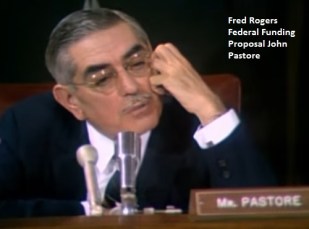
Rogers was given a chance to testify before Sen. John Pastore’s committee.  The Nixon rogers 9administration budget had in mind cutting funding for the Public Broadcasting System, which would have included Mr. Rogers’ Neighborhood,  and that what the issue was when Mr. Rogers sat down at the witness table to give testimony to Sen. Pastore, a notably irritable and plain-spoken chairman.
Take a minute and remember what the political climate of 1969 was like.  Remember the riots of 1968 and the controversial election of Richard Nixon.  Mr. Rogers asked if the committee would like to hear the lyrics to a song he often used on the show.  Neither Pastore nor I had ever heard it.  It goes like this.

What do you do with the mad that you feel? When you feel so mad you could bite. When the whole wide world seems oh so wrong, and nothing you do seems very right. What do you do? Do you punch a bag? Do you pound some clay or some dough? Do you round up friends for a game of tag or see how fast you go? It’s great to be able to stop when you’ve planned the thing that’s wrong. And be able to do something else instead ― and think this song ―

“I can stop when I want to. Can stop when I wish. Can stop, stop, stop anytime … And what a good feeling to feel like this! And know that the feeling is really mine. Know that there’s something deep inside that helps us become what we can. For a girl can be someday a lady, and a boy can be someday a man.”

And he recited the whole thing. You can see how long it is.  It didn’t feel long as I watched him recite it.  Given the OK Corral context of the scene, I think I understand how the suspense carried me along.

Pastore’s response went like this.

“I’m supposed to be a pretty tough guy, and this is the first time I’ve had goose bumps for the last two days,” he said. “Looks like you just earned the $20 million.”

“The twenty million” is a reference to the entire budget allocation for NPR, which was the issue before the committee.  Rogers seems a simple, even a naive man, in the committee setting, but he was right on the money with Sen. Pastore, just as he was with Daniel.

Then he poured water into a basin and began to wash the disciples’ feel with the towel

There is a longer version of the story in John 13, but The Reverend Mr. Fred Rogers, ordained minister in the Presbyterian Church, very likely knew what his adult viewers would be reminded of, consciously or not. [1]

This was a time when swimming pools were “being integrated,” that is, black kids were allowed to swim in the public pools along with white kids.  The movie shows film of a pool manager dumping chemicals into the pool in an attempt to clear the black kids out.  I had never seen that footage and the context to what was going on in the Neighborhood was stark.

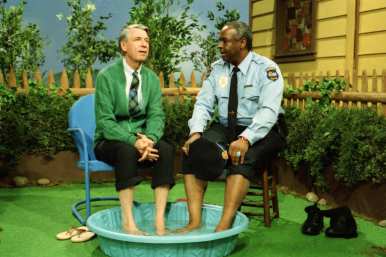
rogers 8Rogers invited the local cop, a black man, to take off his shoes and socks and cool his feet in the little wading pool you see here.  Feet.  Hot.  Cool water.  Sharing towel.  Easy camaraderie.  Nothing in what you see on the screen feels like public policy.  It doesn’t feel like protest.  It seems like something neighbors might do on a hot day.
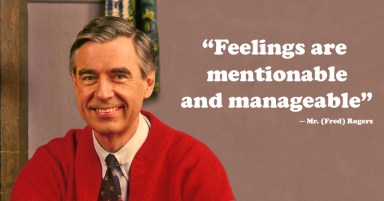
Those three episodes are enough, I think, to suggest what the movie has to offer.  Alissa Wilkinson, in a vox.com review of the film said that “it feels radically subversive.”  I didn’t like that observation before I saw the movie and I am still not sure I agree with it, but now I know what she meant.  You do come out of the movie feeling that you have been living in a different place, a place dominated by different values.  It gives you a chance to wonder, again, whether we are really doing the right thing.

It’s Starbucks Time

As winning as Fred Rogers is in the variety of settings in which we see him, I never quite shook the “yes, but” feeling I got when he tried to explain his more general approach to children.  There were no standards in his approach, no limits, no achievements. [2]

My brother, Karl, was a pediatrician for many years and in that capacity, he saw a lot of different parenting styles.  I have often heard him say that amid all the superficial variety of these styles, every one that had firm clear standards and warm nurturing support, worked just fine.  Present parents, clear standards, warm support.  I took for granted that he knew what he was talking about and that is the standard I aimed at in raising my own kids.  I didn’t see any of that in the Neighborhood.

Probably the best-known typology of parenting styles comes from the work of Dianarogers 7 Baumrind.  Using her original typology [3] I would say that Fred Rogers believes in a low control/high warmth combination, which Baumrind calls “Permissive.”  What my brother and I were aiming for was high control/high warmth, which Baumrind calls “Authoritative.” [Not, please, “authoritarian.”  That’s a different style in Baumrind’s mix.]

The role of “control” in those styles of parenting is to make it possible for children to respect themselves.  Every study I have ever seen of the topic shows that the U. S. leads the world in “self-esteem.”  We think we are wonderful. [4]  But we don’t think we are good at things because to be good at things, you have to master the requisite skills and to master them, you have to fail so you can correct whatever you did wrong.  The trying and failing and mastery and consequent “self-respect” require the clear standards that seem to be missing in the neighborhood.

“Self-respect” was not the issue Mr. Rogers was trying to address.  That’s why I have no quarrel at all with his wonderfully therapeutic touch with children and adults, and even, when necessary, with Senators.  But when that project is blown up into a way of understanding “what children need,” I start to squirm because what I needed was a way to respect my own efforts and, eventually, myself.  And I think that’s what a lot of kids need.

And if there were only a Starbucks in the neighborhood, Fred and I could go there and work it out.  And I am sure we would.  I like him a great deal. [5]

[1]  In a similar manner, FDR used to refer to his wealthy opponents as “malefactors of great wealth,” trusting that the only other context in which his listeners would have heard the word “malefactors” was in the King James Version of the crucifixion of Jesus and that it referred to the criminals who were being crucified at the same time.  Sometimes just placing a word in a context is all that is needed.

[2]  Bette says they were really there.  It is just that they were not shown in the movie.  I don’t know how she knows things like that but I know not to bet against her.

[3]  Baumrind has since expanded the typology by allowing mid-range values for the scales, not just high and low.  Using the expanded typology, it is possible that Mr. Rogers would be “mild control/high warmth” or “Democratic” parent.  That would be only mildly ironic for Mr. Rogers, the lifelong Republican.

[4]  This is the element of Rogers’ teaching that produced protests from the Wall Street Journal and Fox News, both of which were shown, but not explored, in the movie.  No Starbucks, remember”

[5]  And I can hardly wait to see Tom Hanks playing Fred Rogers in You Are My Friend, which is currently being produced.

Posted in A life of faith, Living My Life, Movies | Tagged , , , , , | Leave a comment

It isn’t HIM, it’s THEM

The New York Times did us all a service in its June 23 article, “As Critics Assail Trump, His Supporters Dig in Deeper.”  I confess that I liked it partly because it wasn’t news to me, but I also liked it because my own angle on political psychology looks most closely at the reasons people give for the things they do and the things they say.  That is really what this article is about.

Jeremy W. Peters, who wrote the article, has spent a good deal of time talking to Trump voters.  I think what he really wanted to ask them was how they can still support Trump after all he has done.  But that’s not really what happened in these interviews.

I counted seven of them all together and what I am going to do in this essay is reflect on just what some of the seven Trump voters wanted to talk about.  In most cases, it isn’t Trump, but the connection between Trump and and the polarized environment is best illustrated by Ms. Anders, who has the first and also the last word in this piece.

Ms. Anders

Even if Mr. Trump wasn’t at the center of the national conversation, Ms. Anders, the Loudoun County business executive, said she thinks that the country would still be polarized. But as long as he is, she said, people on the right and the left will probably continue to dig in based on what Mr. Trump does and how his opponents respond.

“It all coalesces around Trump,” she said. “It’s either, ‘Trump wants to put people in cages, in concentration camps.’ Or, on the other side, ‘Oh the left just wants everybody to come into the country illegally so they can get voters.’”

She concluded: “We can’t have a conversation.”

Trump 4She notes that the country was polarized before Trump arrived—she didn’t say that Trump didn’t make it worse.  The difference is that it is very difficult, now, to talk about the polarization.  The topic defaults to Trump instead.  “He wants to put children in cages” say the people who “just want to leg everybody come into the country illegally so they can get voters.”  [It is not my fault that the apostrophe is where it is.]

Neither of those is Ms. Anders’ view.  She would like to have a conversation rich enough to sustain the nuance and complexity—her words—that the issue deserves.

But then she comes down at the commonest of all Trump landing places: she is angry at Trump’s critics and “it makes me angry at them” and it makes me “want to defend him to them more.”

The words I would like to highlight are “to them.”  She wants to defend Trump “to them.”  There is the fraught relationship.  That is what is drawing Ms. Anders’ attention.  The reaction of Trump’s critics are “overblown” and it makes her angry.  Trump disappears from the battlefield at this point and the war between Ms. Anders as the Trump critics continues unabated.  If Trump were to disappear tomorrow, the critics would still have done what they have done, would still have committed their crime and Ms. Anders would still be justifiably angry at them and would still want to blame them for what they had done.  They destroyed nuance and complexity and they have to be made to pay for what they have done.

I agree with nearly everything Ms. Anders says.  She doesn’t apply her criticism to herself, which something a compassionate liberal might be able to help her with, but what she ways about the President’s critics is exactly right.  My disagreement with Ms. Anders is about salience.  There are two issues to deal with here.  Trump is doing terrible things (that’s one) and his critics are immoderate in their criticism (that’s the other one).

Ms. Anders is so deeply offended by the critics that she is willing to downgrade the Trump policies to second place.  What the policies are and why they are being pursued and what the effects are and what alternatives are being foregone—all those are secondary.  The most highly salient issue to her is the quality of the critics.

It is at that point that I have to leave her.

Schrantz and Arnold

They are interviewees #2 and #4 in my list.  They, too, are not addressing President Trump and if, as I suspect, the question Peters really wants to ask them is, “How can you keep on supporting this guy!?” he is going to continue to be frustrated.  That is not what the Trump supporters talk about (with the single exception to be dealt with at the end).

Here is Schrantz

“He’s not a perfect guy; he does some stupid stuff,” said Tony Schrantz, 50, of Lino Lakes, Minn., the owner of a water systems leak detection business. “But when they’re hounding him all the time it just gets old. Give the guy a little.”

“They”—could refer to the media, could refer to Trump critics—are hounding him all theTrump 1 time.  That is a fact.  Mr. Schrantz is correct.  There are two things wrong with what they are doing.  The first is that they are not being “fair-minded” (my word) in that they are not giving him any leeway.  I think that is what the reference to “a little” is.  Trump is a public figure and they—the media or the critics—ought not to be so quick to judge him.

The second thing that is wrong is that this persistent criticism has lost its entertainment value for Mr. Schrantz.  “It just gets old” is not a comment on the truth or even the importance of a criticism of the President.  It’s just that having heard it so much has worn off the novelty.

Arnold agrees.

“It’s kind of like when you experience a sensation over and over and over again,” said Daniel Arnold, 32, a warehouse manager from Leesburg, Va., about an hour outside Washington. “A sensation is no longer a sensation. It’s just, ‘Oh, here we are again.’”

Arnold is looking for anomalies.  The criticism of the President by the media is not anomalous, so it is not worth paying attention to.

Julie Knight

“It bothers me that he doesn’t tell the truth, but I guess I kind of expect that, and I expect that from the media, too — not to always tell the truth or to slant it one way,” said Julie Knight, 63, a retired personal injury case manager from Algona, Wash.

Ms. Knight comes at it from a different side.  She has been following the news and she knows that the President doesn’t always tell the truth (A common New York Times headline is “Trump lies about ______”)  But she doesn’t think the media always tells the truth either.  So we have a source we don’t trust saying that an officeholder we like is lying.

A more serious criticism, although it doesn’t seem as major in her comments, is that what she means by “telling the truth” is not slanting the news one way or the other.  This is completely useless way to assess “slant.” 

When the media choose one story rather than another, they are slanting “the news.” When they shape the narrative one way or the other, they are slanting the news.  There is no way to tell the news without “slanting “ it.  And if that is Ms. Knight’s criterion, there are no news reports at all that she can trust.

This is the reason for the success of Trump’s argument that “the media” are the other Trump 2party.  There is his administration and then there is “the media.”  This means that the President is running in a one-horse race, which means we know who is going to win it.  The notion that the opponents are the Democrats and that the media’s job is to call the fouls and enforce the penalties, is a notion long abandoned.  Ms. Knight is a prime example.

On the other hand, some Trump supporters really do address the policy context and the way they do it speaks volumes about how Trump has regained their loyalty. 

Here is John Westling.

“Let’s see,” said John Westling, 70, of Princeton, Minn., reciting a list of the president’s accomplishments that he said no one in the media wants to talk about. “Economy booming, check. Unemployment down, check. Border security being addressed, check. Possible end to the Korean War that started when I was 3 years old, 68 years ago, check.”

This list has the advantage of actually being about policy outcomes, at least superficially.  But this kind of support is very thin.  Westling says that the booming economy and the low unemployment numbers” are “achievements” by the President.  But that’s not really the way the economy works.  Presidents who are in office when the economy is bad are blamed and those who are in office when it is good are praised.  The causal links are completely obscure.  And does anyone think that when the economy tanks and unemployment goes back up, that Westlake is going to blame the President for it?  Of course not

Border security is “being addressed” says Westlake.  Emotionally, that is the kind of claim any President’s supporters make.  “At least he is trying,” they will say.  But Mr. Westlake seems to think it is an achievement.  He certainly thinks the recent meeting with Kim Jong Un is an achievement although nothing has yet come from it and most experts seem to think nothing will.  “Possible end,” says Mr. Westlake.

And there are others.  Lynn Dittbenner admits that it is terrible about kids getting separated from their parents at the border, but “the parents shouldn’t have been there.” Gary Winthorpe is wary of the President, but feels that he is doing his best and that people ought to recognize him for that.  The list of devices goes on and on.

Balls and Strikes

Of the people featured in the article, only John Westlake looks at the policy outcomes—or in some cases, the intentions—and says they are praiseworthy.  I have given the reasons why I think those “outcomes” are spurious, but Westlake is using the right metric.

The other Trump supporters have turned instead to attacking the media. THEY are not being fair to HIM.  I think it is surprising that the Democrats don’t show up in this set of justifications.  For these people, I think there are no other proposals for governing the nation.  There is only President Trump and whether he is being treated fairly or not by his critics.

This is the kind of perspective you hear from fans of the home team who believe that the umpire is not calling the balls and strikes fairly.  They see the pitch from where they are seated.  They hear the call from the umpire immediately behind the plate.  They say that he is mistaken or corrupt because that’s not what the pitches looked like from where they are sitting.

These Trump supporters are, in other words, fans.  This is not a citizenship perspective.  These are not voters who would choose between two policy directions the one that is best for the country or even the one that is best for them.  They love the pitcher and the umpire is cheating.

End of story.  It’s not a pretty story, it seems to me, but this way of understanding how they justify their political preferences helps me grasp, finally, why for this part of the electorate, nothing will work.

Posted in Political Psychology | Tagged , , , , | Leave a comment

The Times, They Are A’Changin’

Count on it.

Let’s take as an example the Roaring Twenties and the Stodgy Fifties. [1]  The 20s were a time for experimentation and throwing away traditional norms.  The 50s were a time of recovering from that and reacquiring those traditional norms.  Then, beginning in the middle of the decade with what we now call “the 60s,” another time of experimenting, leading to another hungering for “the old days.”

That way of looking at society and change has the rhythm of the tides to it.  In and out; in and out.  But when you are at the end of a prolonged period of what I called above “recovery,” it doesn’t feel like that.  It feels like the whole society is static and dull and has been like that forever and that change—something!—would be better.

I heard that in Bob Dylan’s song, “The times, they are a changin’,” which “we” sang in atime changin 7 concert last week.  “We” is the Plaza Singers, a choral group in Holladay Park Plaza, where Bette and I live.  It was part of a program called “When we were 15,” which tells you a little about how the songs were chosen. [2]  And one of the songs “we” sang when we were 15 was “The times, they are a’changin’”, which was released in 1964, by my calculation the very last year of the 1950s or possibly the first year of the 60s.  I was 15 in 1952, so there must be some younger people in the choir. [3]

The result of all these developments is that I heard the song in a way I had never heard it before.  I can hear the frustration in it, especially in the assessment of the culture that is just about to be “outgrown.”  The deluge is coming and it is going to sweep all these unimaginative and stodgy social structures away.

Here are some samples, then I would like to come back and reflect a little on the Tea Party and Trump revolutions.

It calls on politicians who are not up for drastic change to get out of the way.

Come senators, congressmen/Please heed the call

Don’t stand in the doorway/Don’t block up the hall

For he that gets hurt/Will be he who has stalled

There is going to be a crowd of people blowing through the halls of Congress, this says, and you can go with them or get out of the way or get crushed.  Those are your options.  Note that the political establishment and the energized populace are the two actors here.  Was that ever the case?

Or this one.

Come mothers and fathers/Throughout the land

And don’t criticize/What you can’t understand

Your sons and your daughters/Are beyond your command…

This one is a little different.  It is intimate, for one thing.  This is not about Congress, it is about families.  What will, later, be lamented as “the breakdown of the American family” is here celebrated as the beginning of the revolution.  “Command” is the old way, and the kids have outgrown that.  Just what they have grown into is not specified, but control by the parents for any reason, even deep respect, is over.

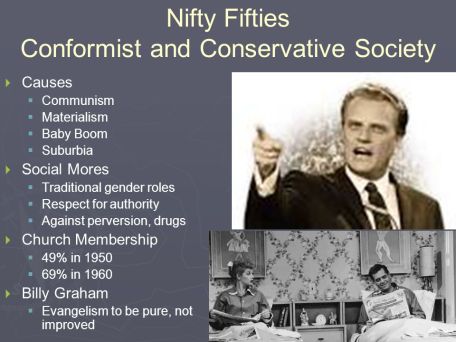
Note that it is the parents who do not understand and the kids who do.  This is not antimes changin 5 intergenerational kumbaya moment.  This is a massive supercession of an old and failed generation by a new and resourceful generation.  Imagine that David and Ricky Nelson rise up and put their sad old worn out parents Ozzie and Harriet, in their place.  That’s what we are talking about here.

So, in any case, we did all that.  We “offed the pigs” and we “brought the Mother down” and we made free love and we had a wave of radical violence, some based on race and some based more on class.  And then the tide came back in again and Congressmen were expected to actually govern, rather than just be run over by angry young people, and parents were expected to provide that best conditions they could for the development of their children.

It became clear in that era that some of the major players in Congress—and everywhere else throughout the legislative and executive branches—were the major economic players.  It isn’t just “the people” on one side and “the government” on the other.  It is the military-industrial complex and the Wall Street firms and the extractive industries and the labor unions.  And what once looked like “the people” demanding change from “the government” comes to look like a much more complicated transaction in which the government was bought off and the people distracted by actual prosperity for some and the promise of prosperity for all.  That kind of complexity does not sustain revolutions.  It also does not make good folk songs.

Now we have major parts of our society trying to get “back” to where they thought theytimes changin 3 were in the 50s before all these self-appointed radicals took over.  We had a lot of flag burning [4] and so we now demand that people treat the national anthem as a sacred moment. [5] And we don’t have families the way we remembered them but we do have By God Family Values.

Think of it this way.  All the wonderful stable things we lost in the decadent 1920s we got back in the return to “normal” after the depression of of the 1930s and the war of the 1940s.  Then we lost them again—this is the period Dylan is anticipating—and now substantial sections of society are trying to get them back again.  Note especially, in this poster, Lucille Ball and Desi Arnaz in their separate little single beds.

It isn’t quite that simple, but when you look at society as ebb and flow, the once and for all drama of songs like “The times, they are a changin’” don’t have the power they seemed to have at the time.  We don’t actually go back, but the yearning for “going back” is now a powerful political force and we see it driving agendas in sexual orientation and immigration and publicly mandated religious expression, and sexual norms and a whole host of other questions that have become, as a result of the social ebb and flow, political hot spots.

It looks like the times, they are a’changin’.  Back.

[1]  Not to be judgmental.  I don’t remember ever hearing a characterization of the 50s.  I friend suggested “Fabulous Fifties,” but I don’t think I have ever heard that.

[2]  We also sang, for example, “Peggy Sue,” and “Smoke Gets In Your Eyes” and “The Sounds of Silence.”

[3]  But in 1952, when I actually was 15, we listened to Jo Stafford’s, “You Belong to Me,” and Very Lynn’s Auf Wiederseh’n Sweetheart,” and Patti Page’s “I Went to Your Wedding,” none of which were sung by the Plaza Singers this year. 

[4]  Which turned out to be a constitutionally protected form of “free expression.”

[5]  We started singing “The Star-Spangled Banner” at the ball games in 1918 when World War I was looking very grim and people were wondering why all these superb athletes weren’t off at war with everybody else.  Solution: sing patriotic songs.

Posted in Political Psychology, Society | Tagged , , , , | Leave a comment

The Church and Reconciliation

I have just read a report by Ian Lovett, written for the Wall Street Journal in May 2018.  The subtitle of the report runs like this: “A push toward activism among liberal Christian denominations is reshaping traditional worship and splitting congregations.”  My apologies for not providing a hyperlink to the article.  I don’t have that kind of access to The Wall Street Journal. 

I want to begin this thought experiment with two questions.  Ordinarily, two questions multiply like two rabbits, but not always.  We will see. The two questions that first occurred to me are:

  •  “Who are we getting from this reshaping and who are we losing?” and:
  •  “Are the options as stark as Lovett says they are? 

There is nothing religious—nothing notably Christian—about the activism Lovett describes.  And there is nothing necessarily apolitical about the traditionalism.  So why are they presented as alternatives and why, particularly, are the people who are attracted and repelled by the activism, presented in that dichotomous way?

New Members and Old Members

Who are we getting?  Millennials, apparently.  Social activists.

For some congregations, that shift has prompted a surge in attendance–especially among young people–something mainline Protestant churches haven’t seen in decades 

Regular Sunday attendance, meanwhile, has jumped to about 100–including an influx of young people who hadn’t attended church in years, or sometimes ever.

And what are we losing? Older people.  Long-time members of the church community.  People who are used to hearing about Jesus on Sundays.

Should the church be doing “this” or “that?”

The downside of that phrasing—“the church”— is that it implies that all the churches should be doing the same thing.  I want to reject that as a realistic option, but I don’t want to throw it away as a way of asking the question because it seems to be presumed by a number of the people quoted in this article.

politicization 2David Hoover, for instance, says, “We just have to keep standing up.”  Hoover is “encouraged by the church’s sharper political tone,” says Lovett.

On the other hand, Riki Ellison says, “There is no sanctuary at Christ Church,  just a battleground.”  That’s why he and his family are leaving.  This is the same church Hoover was talking about when he said the liked the “sharper political tone.”

When Lovett looks for a way of characterizing the change, he says the two sides are “parishioners who believe the church should be a force for political change” and “those who believe it should be a haven for spiritual renewal.”  Note that in this formulation, there are only the two goals and they are diametrically opposed to each other. [1]

The new activism of the clergy, says Lovett,  “[has] alienated conservatives, or politicization 3worshipers who think politics has little place in church.”  That depends crucially on what Lovett means by “conservative.”  Does Lovett mean by “conservatives,” people who think the church should not be politically active?  These might be called “ecclesial conservatives.”  

Or are they political conservatives, who might very well see their activism as “not politics,” but as part of a great crusade for restoring morality to America.  Picketing an abortion clinic, for instance, isn’t really “politics,” they might say; it’s just “doing the right thing.”

Lovett’s next paragraph introduces the Rev. Kaji Douša, who has goals of “stopping the wall” and also of “stopping the deportations.”  She says “the point of following Jesus is that you move and you do.”  It wouldn’t be hard to call that “activism,” but as soon as you call it “activism,” you remember right away that there are all kinds of activism.  The alternative, as the Rev. Douša sees it is “just getting people in church.”  It is almost as if nothing worthwhile can happen in church and that is why there is such a gap between “getting people in church” on the one hand and “moving and doing” on the other.

“If we’re not going to stop the wall and the deportations, then I don’t think we’re following Jesus,” said the Rev. Kaji Douša, pastor of Park Avenue Christian Church in Manhattan. “We’re just getting people in church, and that’s not interesting to me. The point of following Jesus is that you move and you do.” [2]

New York and Oklahoma

Another perspective on this divide comes from the Rev. John Bain and his daughter, Danielle Bain.  Danielle joined the Park Avenue Christin Church last year after ten years away from what Lovett calls “organized religion.” [3]

“Churches have upped their activism this year, because there’s been a call for it,” said Ms. Bain, who took part in a recent protest against deportations that the church helped organize in Washington Square Park. “Those churches are really drawing the millennial crowd.” 

Who has been “calling for it?” I wonder.  Is it something that they want no matter what the cost?  If the radical politicization of the church causes it to break up into little pieces and sink to the bottom, would these people say that they had to destroy the church to save it, as if it were a Vietnamese village?

politicization 1And then there is the question of who is leading and who is following.  If there is a public demand for a certain kind of activity and the church does what is necessary to meet that demand, isn’t that the same as if there were a demand for a new kind of housing unit and contractors fell all over themselves building that kind to meet the new demand?  That is the way commerce works and the way it is supposed to work, but what does it cost the church to work that way?  Pictured here is the Rev. Kaji Douša.

Then again, Ms. Bain is in New York City.  Her father, the Rev. John Bain, is in Stillwater, Oklahoma and in his church, “Democratic and Republican party leaders sat side-by-side in the pews.  Keeping the peace was never difficult, he said, until last year.”

Bain implies that he had been mentioning President Trump in his sermons, but we learn about that only by his saying that he had stopped doing it.  We don’t know what he said about the President.  What we know is that his church created a special ministry for immigrants, which outraged some members.  They saw it as taking a political stand. Several longtime members left the church.

It wouldn’t be hard to make a case that the church has a special responsibility to the sojourner apart from any politics entirely.  Deuteronomy 10:19 [4] could serve as a beginning text for such a church, provided that the responsibility was not set into a modern political context.  But if Rev. Bain had been talking about President Trump and also beginning a ministry to immigrants, he may very well have put it into a setting of partisan politics.  And if he did, it is not hard to see how the Republican and Democratic leaders started to have trouble sitting together.

Are those really the only options?

It probably did not escape your notice that David Hoover’s vision is about the church acting in the world outside.  That’s what “We just have to keep standing up” points to.  On the other hand, when Riki Ellison mourns the loss of the church as a sanctuary, he is not pointing outside at all.  He sees the church as a place of fellowship and maybe even of healing.  It makes no sense at all to ask which of those two the church should be doing.

I think we lose a great deal by organizing our options as political activism, on the one hand, and “just getting people in church” on the other.  I feel a real clarity about what we lose by building that picture.  Maybe a little anger, too.

I don’t have that same clarity about what we should be doing instead, but I do have an idea.  What if we made it a part of our ministry to de-tribalize our communities?  That’s not all that different from casting out demons.  [5] I see this in two settings.

First, this is something the church as a body, an institution, could do.  Imagine that along with the committees on Fellowship and Worship, etc., there was one on Reconciliation. [6]  The work of this committee would be to survey the issues that have turned their neighbors into partisan predators.  Back in the days Robert Putnam surveyed in Bowling Alone, people who didn’t agree with each other about very much competed against each other year after year in bowling leagues.  They could do that because the crime of “Bowling with the Enemy” had not yet been invented.  Now, of course, it has.  Along with Shopping with the Enemy and Going to Parties with the Enemy, and so on. [7]

politicization 5Here is a small example.  The church might, with a little training, nail down a table at a Starbucks where partisan bloodletting is simply not allowed.  The consensus of the group is that we are here for other things.  We have established a very local culture of civility and reconciliation.  It’s how we do it here.  If you want to do proselytizing or flamethrowing, go do it online somewhere.politicization 4

That’s the institutional face; it is something the Committee on Reconciliation might take on and systematically monitor.  But there could also be an individual face.  Individual members of that church could serve that same function wherever they go—provided they are willing to give up “winning” to serve as a group’s de facto conciliator. [8]

So if the split between remorseless partisan activity on the one hand and meaningless religious quietude on the other seems to you an unnecessarily broad split, let’s remember that this is something we are doing to ourselves.  There are vitally important things we can do that are not either of those and if the partisan Prodigals are ever to want to come home, it would be nice if there were a home for them to come back to.

Maybe we could do that.

[1]  When I see goals set out like that, in fundamental opposition to each other, I wonder whether there are not other goals that could be endorsed instead of or in addition to these two.  What about “community reconciliation,” for instance?

[2]  I suspect that the Rev. Douša is  a young person.  If that is true, the expression “not interesting to me” might mean only “not worth doing.”  Many young people have begun to use “interesting” as a marker for “worthwhile.”  But if this is not just the thoughtless language of a young person; if, by contrast, it is a serious argument, then it is a flagrantly bad argument.  The notion that God will call you only to things that “interest you” has been rejected by the church in all its ages and for good reason.

[3]  I always wonder what that term means.  Plausible antonyms could be “unorganized religion”—but then how would you know it was religious?—and “disorganized religion.”  Certainly we have seen a lot of that.  I suspect the term intends to point to the institutional structure within which the activities are carried on.  So “institutionalized religious practices” is probably what the terms intends.

[4] “And you are to love those who are foreigners, for you yourselves were foreigners in Egypt.”

[5]  I intended that remark mostly as a quip, but it started me down the road to thinking about it.  When you look at the effect the demons had on the…um…hosts in the New Testament, “casting out demons” might not be a bad metaphor at all.

[6]  You couldn’t call it the Committee on Exorcism, I suppose, but it is so tempting.

[7]  And watching others commit those crimes and not saying anything about it makes you “complicit,” so there is no “sanctuary” anywhere.  This goes to Riki Ellison’s point about the church as a sanctuary.  How about the church as “providing Sanctuary?”

[8]  It is the groups that must do the reconciling, of course.  The role of the “conciliator” might never be recognized and if it recognized, it still might not be understood.  “How did he do that?” would come to replace “Who was that masked man?”


Posted in A life of faith, Political Psychology | Tagged , , , , | Leave a comment

All the “Yes” you will ever need

I have been thinking this year about the Resurrection.  There is no way to avoid it, really, because at the First Presbyterian Church of Portland, Oregon (hereafter, “my church”) Easter is not a “day,” it is a “season.”  So on Easter day, when everyone else is wrapping up the celebration [1], we are just beginning “the Easter season.”  So the choir sings Easter-themed anthems and the congregation sings Easter-themed hymns and there are Easter-themed sermons and all that while normal people are drifting on to Pentecost.

So there is no way I can not think about the Resurrection.  But this year, I have shifted consciously over to the experience of the disciples, who gave the whole show up for lost and then were persuaded that it wasn’t.  And that it never had been.  The end of the show, which they so mourned, was just the intermission and if they had read the program carefully, they would have known that (see Luke 24:32).

Looking back, I am amazed that it took me so long to get here.  What chance, after all, do I have to grasp the experience that the risen Jesus has had?  The attention gets focused on Jesus very naturally because what God did for him (see Acts 2:36) bears very strongly on beliefs that are central to the church. [2]  But once you start thinking about what it must have felt like to discover that it was all true after all, you gravitate quite naturally to the experiences of the disciples, who were the  people who had that experience.

So today, I want to put two accounts on the table for our common inspection.  One is scientific and draws on some recent discoveries in neuroimaging. The other is Stephen King’s  Hearts in Atlantis, which actually is a good book, although that’s not why I’m offering it to you.  But let’s start with the science.

An emotional portal

There is no way we can study the Resurrection, but we have spent quite a bit of time and invested the lives of innumerable grad students in studying what it means to “experience” something.  I was one of those grad students, after all.

I admit that the neurology I read was oriented to non-neurologists. In other words, I know enough to appreciate the argument, but not enough to make it.  

Which brings me to Kelly Lambert’s 2013 article in the New York Times.  I am going to come, in a moment, to her account of  how she preserved the experience of Christmas for her kids, but I want to begin with the work of Pascal Boyer.

Pascal Boyer, a professor of memory at Washington University in St. Louis, differentiates between what he refers to as episodic memories — the first time we sat on Santa’s knee or the year a blizzard knocked out the electricity — and mental time travel memories, or M.T.T. 

lambert 1These come closer to re-experiencing a remembered event. Professor Boyer describes how neuroimaging evidence indicates that, when certain events are recalled — presumably after being triggered by familiar sights, smells or sounds — emotional brain areas are activated as well as visceral responses. You relive the feelings you experienced in the past. These recollections can be thought of as full body and brain memories.

I don’t respond very well to expressions like “mental time travel,” especially when we are talking about the results of neuroimaging, but the idea that sometimes you can recall an event in a way that causes you to “relive” the feelings you had at the time of the event.  That’s what it means to say that the areas of the brain that cause us to experience emotions (not just visceral reactions) bring the feeling of the experience back, not just the meaning of it.

And what does that have to do with Kelly Lambert, neurologist and mother?

So, although I was in mom-mode and not neuroscience-mode when I came up with that cockamamie story about Santa’s bad back, [3] neuroscience research confirms the benefits of trying to assure that my girls have an emotional holiday portal  [bold font not in the original] for their future adult brains. I believe this is just as important as their childhood vaccinations — as it is for all children, whether their memories are of Christmas or of other celebrations and traditions.

An emotional portal.  These early experiences preserve access to the part of the brain that will reconnect with the experiences.  This is different from remembering what you used to do at Christmas when you were kids.  This is reclaiming some of the buzz you had when you did it as kids.  These are the feelings that “belong with” the meanings of the experience. [4]

Note that nothing about the operation of this “emotional portal” bears on whether the event is true or false.  It has to do with whether you have access to the emotions that belong with the event.  This can have to do with what events the smell of a baseball glove bring back to you or the shaft of sunlight that picks out the one grove of scarlet oaks in a cluster of fir trees or the feel of silk under your fingers.  Those events may be artifacts of your distant recollection or they may be brought back as a powerful emotional experience depending on whether you have an “emotional portal” that lets you experience them again.

So it isn’t about true or false; it’s about distantly remote or vividly present.

There are several accounts in the gospels in which Jesus’ disciples “experienced” the “alive again after his death” Jesus. [5]  It was a really powerful experience for them.  Twenty centuries later, is it going to be a distantly remote “experience” for Christians who for whatever reason have allowed that emotional portal to close.

If the portal has closed, I think it is just shut off to you.  You can read about an event and feel a great affinity for it and approve of it and “believe in” it, but you can’t go back and use the neurons that long ago shut down from lack of use.  What I understand about Lambert and the “emotional portal” is that you can keep those neurons from shutting down from lack of use and that is what she was doing for her kids.

“He remembered me.”

How to tell you about Stephen King’s book?  Bobby Garfield develops a very strong relationship with an old man, Ted Brautigan.  At the end of the story about the two of them, Ted is captured by “the Low Men,” and taken away to serve “the Red King” as a Breaker. [6]  Bobby goes into a protracted tailspin, which gets him several terms in the Juvenile Correction facility.  Ted is gone and Bobby has turned bad.

Bobby’s time in juvenile corrections isn’t the only indicator of how deeply broken he is.  He has so fully rejected his mother, that when she threatens him (in a parental sort of way) he rejects her completely.  Here’s what that looks like.

Liz (Bobby’s mother) stood weeping in the doorway as Officer Grandelle led Bobby to the police car parked at the curb. “I’m going to wash my hands of you if you don’t stop!” she cried after him. “I mean it! I do!”

“Wash em,” he said, getting in the back. “Go ahead, Ma, wash em now and save time.”

But when he gets home from the corrections facility, there is a package waiting for him and it is from Ted.  In the package are rose petals.  Here they are.

There was no letter, no note, no writing of any kind. When Bobby tilted the envelope, what showered down on the surface of his desk were rose petals of the deepest, darkest red he had ever seen.

Heart’s blood, he thought, exalted without knowing why. All at once, and for the first time in years, he remembered how you could take your mind away, how you could just put it on parole. And even as he thought of it he felt his thoughts lifting. The rose petals gleamed on the scarred surface of his desk like rubies, like secret light spilled from the world’s secret heart. 

Not just one world, Bobby thought. Not just one. There are other worlds than this, millions of worlds, all turning on the spindle of the Tower. And then he thought: He got away from them again. He’s free again. 

The petals left no room for doubt. They were all the yes anyone could ever need; all the you-may, all the you-can, all the it’s-true.

That’s the experience.  It is not the explanation.  But Bobby has an explanation of sorts.  It is this.

Ted was free. Not in this world and time, this time he had run in another direction .. . but in some world. 

Bobby scooped up the petals, each one like a tiny silk coin. He cupped them like palmfuls of blood, then raised them to his face. He could have drowned in their sweet reek. Ted was in them, Ted clear as day with his funny stooped way of walking, his baby-fine white hair, and the yellow nicotine spots tattooed on the first two fingers of his right hand. Ted with his carryhandle shopping bags.

And finally, this.

He sat at his desk for a long time with the rose petals pressed to his face. At last, careful not to lose a single one, he put them back into the little envelope and folded down the torn top.

He’s free. He’s . . . somewhere. And he remembered.

“He remembered me,” Bobby said. “He remembered me. 

That experience and the explanation Bobby provided for it changed his life completely.  We learn about that in one of the later short stories that make up the remainder of the book. [7]  But there is also an immediate effect.  After he  gets the great gift that the rose petals have for him, he reaches out to his mother.

He got up, went into the kitchen, and put on the tea kettle. Then he went into his mother’s room. She was on her bed, lying there in her slip with her feet up, and he could see she had started to look old. She turned her face away from him when he sat down next to her, a boy now almost as big as a man, but she let him take her hand. He held it and stroked it and waited for the kettle to whistle. After awhile she turned to look at him. “Oh Bobby,” she said. “We’ve made such a mess of things, you and me. What are we going to do?”

“The best we can,” he said, still stroking her hand. He raised it to his lips and kissed the palm where her lifeline and heartline tangled briefly before wandering away from each other again. “The best we can.”

Bobby’s Portal and Mine

In this last section, I am going to describe the neurology I got from Kelly Lambert as it applies to Bobby Garfield and me.  It’s easier with Bobby, partly because he has a world class author to bring him to life and I have a few autobiographical speculations.

Bobby experienced the truly uncanny in Ted.  Sometimes it was wonderful; sometimes it was awful.  But it was all extremely powerful and when it all crashed into meaningless disaster—the Low Men captured him and took him away— Bobby crashed as well.  “All that” was over.  Everything he invested in was gone and the person Ted had enabled him to be was gone as well.

lambert 4But it wasn’t losing Ted that did all that to Bobby.  It was knowing that what seemed to be true while he was learning from Ted, had all been fraudulent.  The strong did as they chose after all.  The world was only predators and prey.  Even revenge, which Bobby indulged in, didn’t bring meaning back.  That being the case, there was no reason not to beat the kid up and steal his guitar and no reason not to break into the convenience store for cigarets and beer and no reason not to decisively cut off his relationship with his mother.  Here, from the movie version are Anthony Hopkins as Ted Brautigan and Anton Yelchin as Bobby.

What the rose petals did for Bobby was to take that old time, the time when Bobby thought life was meaningful and he was a good person, and say that it was true.  It was true then and it is still true now, despite the current difficulties.

The rose petals are all the “it’s-true” anyone could ever need.  That deals with the facts.  The rest deal with the implications: the petals are all the yes and all the you-may and all the you-can.

And all those meanings are rooted in Bobby’s understanding that somehow, Ted was lambert 2again free and in his freedom, Ted had sent this to Bobby.  And the relationship Bobby thought he had with Ted and then despaired of; that relationship is back.  He is free and he remembered me.

I’ve never had an experience like Bobby’s, but I think that, had I been one of Jesus’ disciples, I would have felt the way they did.  They said, meeting a stranger on the road (see Luke 24), “ But we trusted that it had been he which should have redeemed Israel…”  That period of trusting is over.  We “had trusted,” but obviously, we don’t anymore.  The two pictures in this section are the Emmaus road scene as I picture it with the emotional portal and then without it.

This Jesus was a prophet mighty in word and deed and we thought at the time that it meant something.  Now we know and everyone knows, that it did not.  Like Bobby Garfield, it isn’t that their present day hopes are dashed.  The crucifixion showed everyone that it never meant anything at all.  Jesus’ enemies are celebrating and the initially interested have gone back to “real life” and Jesus’ disciples are reduced to saying things like, “we had been hoping.”

And the sudden appearance of the risen Jesus with them at dinner didn’t mean that the situation was about to get better.  It meant that Jesus’ life had always meant what they had thought; what they wanted to be true had always been true. 

lambert 3And that is my portal.  I can read the post-resurrection stories as well as anyone.  I can try and fail to understand what the experience of resurrection could possibly mean.  I can lock the formal meaning of the Resurrection into the doctrinal orthodoxy which is so important to the Christian church.  But when I read this passage from Stephen King, I simply sat down and cried.

I felt what it meant to them to have given up on it and then to discover, to know that they were right all along.  And they can continue to be the people they once thought they could be, back when they thought it was all trur.

That is the experience I can have.  The neurons I need to experience that again were not, apparently, destroyed.

And now I get to cash in on a distinction that might have seemed a little too fine to you, back when I introduced it.  Here’s what I said.

So it isn’t about true or false; it’s about distantly remote or vividly present.

The distinction, remember, is not between true and false.  That’s not what the portal does.  It is between what is distantly remote, only a memory,  and what is vividly present.  The fact that this experience seems present and vivid to me is no guarantee that is what historically true. “Truth” travels a different road entirely.  But to experience vividly the return of the disciples’ hope and my hope as well, is a crucial resource for living the kind of life I want to live.

[1]  No reason to consider this necessarily a religious celebration.  I am thinking of Easter eggs and new clothes, and, why not, a new pickup truck to celebrate Jesus’ transcendence of death.

[2]  The Incarnation, which “my church” celebrates at Advent and the Resurrection which we celebrate at Easter are the two historical events that the church cannot give up and still be the church.  Giving up the “water into wine” trick is a small thing by comparison.

[3]  One year, her children discovered their Christmas presents hidden in the attic.  No problem.  She told the kids that Santa was having back problems this year and had contacted all the parents whose kids were expecting bulky gifts so that he could send the presents ahead of time by UPS.

[4]  Which is also the reason that I have labored manfully in recent years to bring back the word “orthopathy,” to mean “having the feelings that belong to  your understanding of the event.” Not much luck so far, but I’m still at it.

[5]  “Resurrection” is an explanation for what the disciples experienced.  The clunky phrase I used here is what they actually experienced.

[6]  A whole cosmology would have to be developed to say just what “a Breaker” is and why “…there are other worlds than this, millions of worlds, all turning on the spindle of the Tower.”  For our purposes today, being “taken away” by the Low men is like being crucified and “turning on the spindle of the tower” represents other modes of being and consciousness.  Stephen King never has any need of the full cosmology and doesn’t really care that we might like to know more.

[7]  Especially the last one, which is called “Heavenly shades of night are falling.”  The first one, where the story of Bobby and Ted is told, is called “Low Men in Yellow Coats,” which is set almost forty years before “Heavenly shades…”  

Posted in A life of faith, Books, Movies, ways of knowing | Tagged , , , , | Leave a comment

My place or yours?

It’s not what you think. [1]  The “places” I am thinking of have to do with memorial services.  Bette and I have just come from a service at our church, celebrating the life of a dear woman.  We had just the kind of service she would have wanted, but it brought into sharper relief a question I have been turning over in my mind for a few years now.

The question is about how to imagine a memorial service and it takes the form of “my place or yours?”

My Place

I began planning my memorial service with nothing more in mind than that I wanted to be thoughtful about it; I wanted the service to fairly represent the kind of person I was.

memorial 3You can go a long way with no more of a head start than that, trust me.  You can start by rejecting the saccharine anecdotes that so often show up at memorial services.  These very often misrepresent the guest of honor and they also imply a closeness to the person or a degree of insight that are palpably false.  I didn’t want that.  I was attracted particularly to the prospect of these pigeons crapping all over my life clock.
I wanted something that was more nearly “true.” [2]  So, moving away from simply rejecting the saccharine anecdotes, I imagined something like a tapestry, which would be much more vivid a representation of a person’s life because it would have the dark parts as well as the bright parts and the bright parts would be vivid and beautiful the way the one grove of maple trees is beautiful in September when it is set in a whole hillside of dark green Douglas Firs.

I still like the idea of the mixed dark and light—I have had plenty of both in my life—but then I got to thinking about who I would ask to relate those dark parts.  And I imagined how I would feel if a friend, having just that sort of notion about his own memorial service, asked me to describe one of those dark parts in his own life.  I would probably do it out of friendship, but I would dread it for months ahead of time and having to do that would dampen my experience of what would otherwise have been a rich sharing among friends.  I wouldn’t like that at all.

I also liked the idea that this mix of dark and light might provide a sense of invitation of people who knew me in ways other than the “official ones,” the ways being featured at the memorial service.  That was one of the things that came forcefully to me at my friend’s memorial service.  I knew her in ways that seemed, maybe only superficially, to contradict the “official biography,” on which the speakers all seemed to agree.  I didn’t want that to happen at my service.  I wanted at the very least a safe hiding place for people who knew me differently than the way I was being presented.

I am in the process of jettisoning that view, but in doing so, I am seeing better how I got memorial 5there in the first place.  In Orson Scott Card’s series, there is a book in which Andrew Wiggin (Ender) serves as a Truthteller.  It is true that he has extraordinary resources for finding out what the truth actually is, but it is also true that in the instance we get to see in Speaker for the Dead, people realize as they hear him speaking that these are truths they knew already.  They had been exercising a great deal of restraint to keep these truths out of their own consciousness and out of the shared public awareness—but they did know these truths already.

That was enormously appealing to me.  What a tagline for my last event!  “Let the truth be told.”  Except, of course, the form “Let the truth…” is passive and if someone is actually going to tell the truth, it will have to be active and I don’t know anyone with the resources Andrew Wiggin has.  And the alternative, assembling a group of friends, and passing out the several areas where “the truth” would have to be told, really isn’t an adequate alternative.

It doesn’t really provide “the truth;” only as much truth as the several speakers can scrape up.  And it doesn’t meet the needs of the people who would have assembled to celebrate my life and to affirm the part each of the others had played.

Your Place

It was at that point that I realized that I wasn’t the customer.  Hello.  Was that so hard?  What I have is a bunch of friends [3] Who are grieving for themselves and for each other and who are celebrating the parts of my life that they want to celebrate.  And there may even be a few who are thinking about their own memorial services with mine in mind and I wouldn’t object to providing an example that brought a little clarity to that project.

So…all is well.  I have arrived at the place where I can ask a much better question than before.  I call that progress.  The fact that I have no good idea how to begin answering that new question is a small matter, compared with spending a lot of time on the wrong question.

memorial 2I foresee difficulties, of course, but they are not mine to solve.  The people who attend my memorial service will have the same constraints that the people who assembled to hear Andrew Wiggin had.  As they simplify their image of my life and my character [4] they are going to realize that there are some truths they have always known and have not admitted that they knew.  I know that sounds ominous, but some of these truths are going to be really positive.  Others, not so much.  And as they prepare to share what they know with others, they will have to distinguish between the truths that are important only for them to hold and those that are also important to share.  I liked this picture because it is about everyone who is bereaved, not just the people who are being reaved of me. [5]

But, as I say, that is their job, not mine.  I wish them well. I hope my memorial service meets their needs and I hope, if Bette is still living, especially that it meets her needs.  But nothing I plan is going to do that and I need to let it go.

As the master, in one of Jesus’ best stories, told the field hands who wanted to go through the field and take out all the weeds, “That’s really above your pay grade.”

[1]  Although I did have the pleasure of running on Portland’s famed Wildwood Trail “with” a woman who was a Nike employee and who was wearing a tee shirt that said “My pace of yours?”  I couldn’t come anywhere near running at her pace—hence the quotes around “with”—but every time I saw her coming, I would start to laugh and eventually, we stopped and exchanged names and for years afterward, greeted each other as we passed.

[2]  Which, now that I think about it, is a strange position for me to take.  The question of what is “true,” has, as I have said for a long time, no bottom to it at all, and we must learn to settle for what is useful.

[3]  I was going to say “former friends” on the grounds that since I am not here anymore, “we” are not currently friends, but the visceral meaning of “former friends” was just too strong and I had to give it up.  Except here, of course.

[4]  These are not “untruths,” they are simplifications.  You clean out the inconsistencies unless those are what you want to spend your slice of the public time on, and you refine a clearer image, so you can share it.

[5]  Sorry.  Just a little word joke is passing.

Posted in Getting Old, Living My Life | Tagged , , , , | Leave a comment

New fashions in exculpation


When fashion writers comment on the new styles of the new season, then don’t stop to call their readers’ attention to the fact that all these people have chosen to wear clothes.  They take that for granted and so do we.  In this essay, I am going to survey the current styles of exculpation. [1]  I am not going to stop to call anyone’s attention to the fact that people who are caught in a scandal try to shift the attention and the blame to others.  I take that for granted and so do you.

But in exculpation, as in haute couture, there are fashions; new ways of catching andExculpation 1 deflecting attention and I would like to look at the recent troubles of the former (but only recently) governor of Missouri, Eric Greitens.

He was caught in a nasty sex scandal.  Got it.  A lot of powerful people come, after a while, to think that everyone should accede to their preferences.  In addition, there are apparently a lot of women who get drunk on the power and the presence of that kind of man and agree to do things they would not do when they were sober.  Got it.

But if you were such a man—the New York Times article called him “chiseled and charismatic”—and you got caught, what would you do to place the attention and the blame somewhere else?  And how would you deal with the unavoidable residual blame?  My idea here is that ways of doing this vary from one time and place to another just as clothing styles do and I would like to take a look at this season’s fashions in exculpation.

Here’s the first one.

Defiant but somber, Mr. Greitens, who was voted into office in 2016, insisted that he had committed no crimes or “any offense worthy of this treatment.”

Crimes, yes.  But the punishment is more severe than this particular crime deserves.  Right away we wonder just how severe a punishment he thinks his “crime” deserves and whether the really thinks that is a crime.

And then.

He described “legal harassment of colleagues, friends and campaign workers” and said “it’s clear that for the forces that oppose us that there is no end in sight.”

This a significant and very helpful shift of focus.  It is not about “us,” is about “them.”  And those people—“them”—a given no identity at all except by their opposition to Gov. Greitens.

All this harassment is the result of something the governor did, apparently.  We don’t businessman hiding face not my faultlearn what it was from any of the statements he is making.  Which is interesting because Greitens and his wife described “the situation” as “a deeply personal mistake.”


“Personal” rather than what?  Rather than public, I think.  “Eric” might have exercised poor judgment, but “the Governor” is not involved in this in any way.  This is a crisis in our marriage, but it is none of the public’s business.

Besides which, if we are going to talk about personal characteristics, let’s talk about how “Eric” responded to this “situation.”  He “took responsibility”—for what, the statement does not say—and we (Mrs. and Mrs Greitens, not the Governor and the First Lady) dealt with this.

How did they deal with it?  “Together, honestly, and privately.”  All three.  Notice how nicely they group together.  This response is everything that the Governor’s offense was not.  The Governor had an affair with “his former hairdresser.”  This is flagrantly “not together” so far as his marriage with his wife is concerned.  And however “honest” the pair might be about dealing with what the governor had done, there is nothing at all honest about the affair.  And the couple dealt with this event “privately,” as well but, of course, the extraordinary measures the governor took to keep this affair private, show what “privately” means about the actions themselves.

And finally, from his resignation speech.

“I know, and people of good faith know, that I am not perfect.

This functions as an admission of some flaw in today’s political culture, but it is hard to see just how it could.  The “not perfect” defense imagines a scale like this  

 Screen Shot 2018-05-30 at 8.40.42 AM.png

This is obviously a very convenient scale.  No one fits the specifically named right end of the scale and everyone fits on the rest of the scale.  The effect of the “not perfect” ploy is to deny any real difference between what the governor did and what everyone else does.

A Primer

So if I were writing a primer for Exculpation 101, I would be delighted to have this come along as a case.  You get caught in the most sordid kind of sex controversy and you don’t want to get blamed at all.  You certainly don’t want to get impeached.  So what do you do?

First, you deny it for as long as you can.  That includes preventing others with certain knowledge and/or evidence from saying what occurred.  Gov. Greitens’ ploy was to threaten to release an embarrassing photograph.  Pres. Trump’s was to offer hush money.  Two kinds of strategies with the same goal.  So far, neither seems to be working all that well.

Failing to deny it, you try to contain it.  This is a private matter, just between my wife and me.  We have resolved our differences so the issue, being only private, is done.  People who continue to beat the drums are making public what ought to be only private.  This is the “Eric” v. “the Governor” dimension.

At the same time, you attack the people who are attacking you.  These brutes are causing untold grief to your professional associates and to your family.  The grief they are causing is unrelated, of course, to any misdeeds of Gov. Greitens; they relate only to the viciousness of the opponents.

exculpation 5And at the same time, you trumpet the governor’s virtues.  These virtues, it goes without saying, do not have to do with the affair itself or the threats that accompanied it.  They have to do with how well the governor is taking it.  That is where “together” (he’s just another husband) [2] and “private” (it’s none of the public’s business) and “honestly” (after all those months of lies, we are talking candidly about what to do) come in.  These are all virtues.  At least the names all sound virtuous.

Who would want to bring a vice charge against the private choices of such a nice guy?  And to hurt the feeling of his wife?  Really!

And finally, you do the “I’m not perfect” ploy as if that were the standard to which we wanted to hold public officials.  But, of course, “perfect” is not the standard.  On the other hand egregiously tawdry adultery isn’t any useful part of the campaign either, not for a rising star in the Republican party.

So if you are thinking of teaching a course or even just a module on Exculpation, let me offer you this case.  It’s a classic of most of the best moves.

[1]  An obvious word, given that culpa = guilt or blame (as in mea culpa) and that the prefix ex- means what it always means.  Obvious, but not used as much as it deserves to be used.

[2]  Very near the end of A Guide for the Married Man, Walter Matthau is trying to talk his way out of the affair he halfheartedly set up.  “Don’t you want a husband,” he asks the attractive woman who looks ready to start taking her clothes off.  “I have a husband,” she replies.  “No, no,” Matthau responds, “I mean one of your own.”  I loved that.  It was good comedy.  On he other hand, who “has” a husband who is a public figure conducting what is supposed to be a very private affair, is a relevant question.  And the husband had definitely been had.

Posted in Political Psychology, Politics | Tagged , , , , , , | Leave a comment

Peers and Um-peers

“Peer” is the English language version of the Latin par, which means “equal.” [1]“Umpire” just means “not a peer.” English borrowed nompere from the French but over time “a noumpere” became “an oumpere”—a process I learned just today is called metanalysis. And that is why in English, especially at baseball games, an umpire, who is “not a peer” gets to say which are balls and which are strikes. Pitchers, catchers, and batters may disagree, of course, but they are all peers (equals) and so must defer.

Mariners vs Pirates - June 29, 2016But in the U. S., we live in a time of tribes and there is a squeezing together of people who were once “peers” into a virtually featureless mob of adherents to a common cause. “We” now all hate the same people and love the same people. This is a real problem for someone whose instincts run in the direction of making up his own mind and the role of umpire beckons.

This squeezing of pre-established hierarchies into groups of peers has been an artifact of war for a long time now. Of course, it sound better in iambic pentameter.

We few, we happy few, we band of brothers;
For he to-day that sheds his blood with me
Shall be my brother…

So it goes in the famous Crispian’s Day speech in Henry V. These few brave Englishmen did not melt into “a featureless mob of adherents,” at least not in Shakespeare’s treatment of them, but the silos of like-minded political activists do, in fact, run that risk. They read the same sources, subscribe to the same blogs, listen to the same broadcasts and podcasts, and attend the same rallies. The idea that other people might raise questions that begin from another ideological base place is a genuinely foreign idea.

There are two common responses to the well-known fact that some people do, in fact, formulate problems beginning at a different place than yours. The first is that they are wrong. Something—morality or efficiency or sustainability or something—requires the starting point that my tribe and I have chosen.

ump 4The other, the one that comes down on my house, is that admitting that there is more than one starting place is a bad idea because it weakens the tribal bond. And they are right. It does weaken the tribal bond. A person who often says that you can plausibly start at either place really has the burden of justifying this practice to his colleagues. [2] This person is an umpire—a non-peer.

The count is 3-2, last of the ninth, two outs, the bases loaded, and the pitch comes in in the vicinity of the outer edge of the plate. The batter knows it is wide and starts off for first base. The pitcher and the catcher know it caught the corner and head for the dugout pumping their fists. These are two peer groups: the batter belongs to one, the pitcher and catcher to the other. The interest in one call or the other is very strong and their perceptions follow along obediently.

The umpire is in a different place. [3] His job is to say where the ball was, with reference to the strike zone, no matter what the implications are for one team or the other. And now that we have electronic tracking of each pitch, it is worth pausing to admire how good these human calls really are.

That’s not the kind of umpire I am. I am the kind that says that when you start here, the logic of inference will bring you out there. This is the tribe-specific answer to the claim that the event is “really about this.” As I noted recently, I have a special antipathy to “that’s not what it’s really about,” which is, nearly always, a demand that we start the discussion here, where I am, rather than there, where you are. And we should do that, according to this particular device, because “the issue” is “really about” one thing but not the other. Puh-leese!

Here’s an example. A black man jaywalks across a busy street, putting the orderly flow of traffic at risk. The police arrest him. Liberal sources will feature “black man” and “police.” They will not say that this citizen should not have been breaking the law. Conservative sources will feature “lawbreaker” and “police.” They will not say that the man is a member of a small racial minority which is often arrested for doing things that members larger racial minorities are not arrested for. [4] Both of these are true. The pundits at each site will say, with reference to the other source’s emphasis, “but the real issue is.”

In fact, it is true that I, acting as an umpire, am weakening the argument being made ump 7by my friends and neighbors. That is a cost to the issues they hold most dear. If I am going to continue in their company—not to be a member of their tribe because umpires don’t belong to tribes [5]—I need to make at least one other point. Here it is.

Recognizing that other people begin with alternative biases is a good thing for this group. It benefits them is some important way to be continually aware of that. If you are trying to sell an idea, for instance, you don’t start with why the target audience ought to care. We already know they don’t. You need to start with what they already care about and sell your idea as a way to expand the value they already hold.

Here is an extremely local example. I live in a senior center that has just taken a turn away from “homey” toward “professional.” One small part of that change is that the residents receive, at the end of the meal, slips to sign indicating that the charges for the meal are correct and that we consent to have that amount subtracted from our monthly total. These slips are printed on expensive and non-recyclable paper.

Some people don’t like these slips—they are new, after all, and we are old—because they signal the decay of the homey culture. We are moving, they say, toward a more “commercial” and “impersonal” culture. Some don’t like the slips because they are environmentally aware, and hate to waste all that paper. Some don’t like it because the paper is expensive and in one way or another, we are going to have to pay for it.

I don’t have to be a member of any of these groups to know that if I want their support, I am going to have to start where they start. I don’t start with the green group and try to argue that they should resent the creeping commercialism of the new process. Why would I do that? I will start with what they already value—this is non-recyclable paper and there is a lot of it—and point out that getting rid of the post-meal accounting system would save a lot of trees.

I’m not going to make that point at all in my role as umpire. I am going to try to get this group of greens to be willing to keep me around because “beginning with people who have alternative biases” is a really good skill to have. My awareness of the different biases cherished by other people makes me a benefit to this tribe, even though I don’t argue the tribal line. That’s why they should consent to having a non-peer (me) in the group with them.

I feel sometimes like Andrew McPhee in C. S. Lewis’s That Hideous Strength. He is the designated skeptic in a collection of people called to fight to the very end in a war that is, to McPhee, murky and uncertain. You wonder after awhile why he is there. [5] But Edwin Ransom, the Director, says to Jane Studdock, a new member, “I want you to like him if you can. He’s one of my oldest friends. He’ll be about the best man if we’re going to be defeated [by the forces of evil]. …What he’ll do if we win, I can’t imagine.”

I like being an umpire. I don’t like not being a part of the tribe, but I think that is a cost that going with the position. The deal is that they like to have you around because of what you can do that they can’t do or don’t want to do. They forgive you your lack of enthusiasm for the currently hot consensus because they want you to stay even though you are a pain in the butt from time to time.

It’s really not a bad deal at all.

[1] I can scarcely use the word without hearing the Major General in The Pirates of Penzance singing “Peers will be peers and youth will have its fling.”
[2] I am not counting as “colleagues” the other people who have that same practice. I am picturing a logician in a group of friends, pointing out that the other argument is as logical as ours. I am aware that this logician has colleagues—other logicians—who will applaud (in absentia) what he is doing.
[3] It is not quite as different as is sometimes maintained. Umpires are under a good deal of pressure to keep the strike zone constant. They would be criticized harshly fall establishing a narrow strike zone in the early innings and then expanding it when the game is on the line in the ninth. That means that the umpire needs not only to see where the ball is, but also to remember how he has been calling pitches like that in the game so far.
[4]I know that sounds clunky, but I keep hearing that whites are going to lose their status as “the majority” in the U. S. and I thought I should begin practicing other ways to say it.
[5] Someone is going to cite the Major League Umpires Association, superseded in 2000 by the World Umpires Association as the “tribe” to which umpires belong. There is some merit in that point, but umpires do not live with the other members of the Association, so the problem doesn’t really go away.
[5] Some Lewis scholars think that is adding McPhee to the mix, he is redeeming the story of his own teacher, William T. Kirkpatrick. Kirkpatrick whom the Lewis men (father and two sons) called “the Great Knock” had no room at all in his life for the Christian faith which was later to be the foundation of Lewis’s life, but Lewis remembered him with great affection and brought him back into the story as McPhee.


Posted in Living My Life, sociability | Tagged , , , , | Leave a comment