Not a nationalist. Not a globalist.

That really is the question.  What alternatives are you rejecting when you choose this one.  Here’s an account that Matt Bai, a Yahoo columnist, published on October 25

“You know what I am?” Trump asked the amped-up crowd. “I’m a nationalist, OK? Nationalist. Nationalist! Use that word! Use that word!”

He then accused his opponents of being “corrupt, power-hungry globalists.” He went on:

“You know what a globalist is? A globalist is a person who wants the globe to do well, frankly, not caring about our country so much.”

That establishes what alternative President Trump wants to oppose.  He is against globalism.  That is the fight he would like to have.  “Nationalists” against “Globalists.”  

globalism 2And you can see why he would like that.  “Pro-lifers” would like to enter into a debate with “Anti-lifers.”  And “Pro-choicers” would love to debate “Anti-choicers.”  But that’s not really the way the debates are structured.  President Trump knows that and he is trying to restructure them.  He is not a subtle person.

A lot of times, the whole game is decided when the name of a measure is decided.  It is a little like assembling the teams on the field for the coin flip, then whoever wins the coin flip is declared the winner and everyone goes back to the (now completely unnecessary) showers.  I remember hearing of a bill to be debated in the Ohio legislature when I lived there.  The bill had to do with experiments that may or may not be performed on animals.  The bill was going to be called either “the child-saving bill” or “the dog-killing bill.”  This is the coin flip.  Somebody wins and everyone goes home. [1]

But more often, it is the naming of the alternative that establishes the home field advantage.  In the examples I gave above, there is a Life team and a Choice team.  In the pro-life v. anti-life game, Life is the home team and in these contests, the home team ALWAYS wins.  In the pro-choice v. anti-choice game, the Choice teams is the home team.  That is why the choice of home field is so important.

President Trump, in the remarks Matt Bai reports is working to gain the home field advantage.  One context pits the Nationalism team (Yea!) against the Globalism team (Boo!).  The other contest pits the Nationalism team (Boo!) against the Internationalism team (Yea!).

In the Internationalists stadium, the “nationalists” are just narrow minded jingoistsglobalization 6 [hyperpatriots with a big army and a chip on their shoulder]. [2]  In the Nationalists stadium, the “globalists” are cosmopolitan snobs who care nothing for the land of their birth.

So…if the home teams always wins, it is a really good thing to be the home team.

President Trump doesn’t confine his sense of what nationalism means to the partisan rallies, like the one Matt Bai reported on.  Here he is before the U. N. General Assembly.

Each of us here today is the emissary of a distinct culture, a rich history, and a people bound together by ties of memory, tradition, and the values that make our homelands like nowhere else on Earth.

That is why America will always choose independence and cooperation over global governance, control, and domination.

But President Trump thinks he can destroy internationalism as a public choice.  He can try to pretend it doesn’t exist.  He can link it to “global governance and domination” as he has here.  But it’s a big hill for him to climb.  Internationalism has been the basic choice of every president since World War II.  It was the choice of Presidents Reagan and Obama and Clinton and both Bushes.

The Foreign Policy Association

Let’s take a very short tour of why all those presidents have chosen it.  Last year, the Foreign Policy Association lead off their Great Decisions series with a presentation called “The Waning of the Pax Americana.”  The idea was that the set of international institutions that have served our interests so well since World War II are being threatened. [3]

The first quote gives us some useful specifics for what is often called “the Liberal International Order” or LIO.  This is not “liberal” in the domestic American sense.  This is “liberal” in the sense that means pro-West generally.

“…a new order—an American-led order that involved the creation of the United Nations, the World Bank, the International Monetary Fund.  Separate but equally important NATO, the World Trade Organization.  These were really the key pieces of architecture of the U S led global order.”

The Liberal International Order is characterized here as “the U. S. led global order,” and so it was.  Those institutions were invented to give order to international dealings, but always with the interests of the U. S., as the leader of that coalition, kept in mind.  “Globalism” does away with those.  “Internationalism” cherishes them.  Nationalism simply avoids them in favor of bilateral negotiations, which can be clearly seen in President Trump’s U. N. remarks.

Here is another characterization of internationalism from the Great Decisions series.

“…the Liberal International Order (LIO) that we helped to structure and we did it for selfish American reasons.  It was the cheapest way for us to accomplish our goals.  And what made it cheap?  Allies.”

The question of the cost of our negotiations is raised directly here.  Programs run jointly for ourselves and our allies are simply cheaper.  We are not stuck arranging quid pro quo for each “deal.”  The deals are supervised by institutions organized particularly to do that work—the World Trade Organization, for instance—and they are funded by everybody.

You take these four things together: economic stagnation, large scale immigration, unmediated social media, creaky old sclerotic governments, and what you have is a recipe for populism on a world stage.

Where nationalism will take us

With these considerations, we look at the alternatives.  With the recent election of Jair Bolsonaro as president of Brazil “populism on a world stage” is exactly what we have and he is not the first such leader.  President-elect Bolsonaro wants “a better deal for Brazil.”  Does he really?  Just imagine?  And how will that “better deal” be pursued, do you think?

globalism 1I would think that President Bolsonaro would try to drive a harder bargain with the U. S.  Brazil has a huge middle class and it has been very good about buying American products.  If I were Brazil, I would want to use that as a bargaining chip.

And so would everyone else who has a bargaining chip.  And that is the end of the international institutions that have brought about an international order favorable to the West.

That’s why I think being an “internationalist” is a good position.  It is also why I think that the opposition President Trump proposes between “nationalism” and “globalism” should be exposed as a superficial and misleading opposition.

I’m sure it works well on the campaign trail and I’m sure that is why he uses it, but that is the only sense I can see in it at all, and I think the costs are insupportably large.

[1]  I don’t actually remember whose bill passed, but I am sure it is the same as whoever won the naming battle.

[2]  Nationalism with a chip on its shoulder and a willingness to go quickly to war has been called “jingoism” for a long time now.  Here is the poem that popularized that name.

“We don’t want to fight but by Jingo if we do,
We’ve got the ships, we’ve got the men, we’ve got the money too,
We’ve fought the Bear before, and while we’re Britons true,
The Russians shall not have Constantinople.”

[3]  I’m afraid I don’t remember any more which quotes go with which people.  They are all mainstream commentators on U. S. foreign policy, the they report this in the manner of “As you all know…”
Posted in Political Psychology, Politics | Tagged , , , , , | Leave a comment

Taming Uncle Bot

So…I met Karen Tamerius this morning.  She is the founder of a group called Smart Politics.  I’m not sure why she calls her organization that.  Having spent a little time with it, I think I might have called it “How To Escape the Perils of Engagement.”

Her article in the New York Times on Thanksgiving morning was actually called “How to have a conversation with your angry uncle over Thanksgiving.”  The format of the article is very engaging.  First, you get to choose whether you want to play the part of a liberal and Uncle is a conservative or vice versa.  I chose liberal.

You saw the hyperlink.  If you want to go through the mill before you read my complaints about my own going through the mill, I wish you the best of luck.  Hurry back.

How it works

Uncle Bot says three things and I get to respond to the one I chose.  Dr. Tamerius then tells me whether it was a good response or not.  And what, pray tell, is a “good response?”

The first thing Uncle Bot says is, “Great, well let me tell you something…” or “Trump hastemarius 2 been great for America” or “Just look at the economy, it’s booming.”  I have a choice of three responses.  I get to respond “Trump’s good for the rich,” or “The job numbers are misleading” or “So how are you doing financially?”
That last one is the right answer.  When I chose it, I got this response from Dr. Tamerius. “

Good choice. The goal at this point is to start a conversation. The easiest way to do that is by asking questions – ones that are non-threatening, open-ended and non-leading. 

Questions are powerful because they make people feel safe, demonstrate respect, gather useful information, contribute to understanding, elicit empathy, build relationships and encourage self-reflection. Asking people about their own experiences in a nonjudgmental way is an especially good opening because it gives them an opportunity to talk about a subject they care and know more about: themselves.

Had I chosen the one about job numbers, I would have gotten this:

Not a good choice. This will turn the conversation into a debate over facts and figures. That’s a problem because people tend not be persuaded by contrary evidence and may even end up believing more strongly in their original position.

And had I chosen the one about Trump being good for the rich, I would have gotten this:

Not a good choice. This argumentative response will turn the conversation into a debate where you and Uncle Bot seek to score points and “win” rather than learn from each other or collaborate to elucidate the truth. In addition, the exclamation point suggests scorn and exasperation which will make the Uncle Bot angry. The goal is to have a conversation, not fight. Try this response instead:

I was still feeling pretty good about Dr. Tamerius.  Once you neutralize the early hostile responses and signal to Uncle Bot that you are not someone who needs to be opposed, you can move on to actually…you know…talking about politics or economics or the frayed social systems.

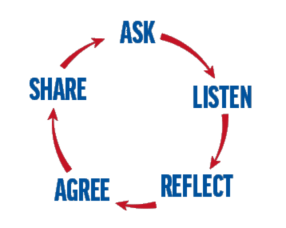
To my great frustration, that never really happens.  There are four more exchanges in the article.  Each is a conservative thrust and a personal parry.  Uncle Bot, in other words, actually isScreen Shot 2018-11-22 at 6.22.25 AM.png talking politics, but you are not.  So it turns out that “talking politics” with Uncle Bot means only getting away unscathed.  He has ranted and you have come away unscathed.

Perhaps I should be more generous because I, myself, am a fan of coming away unscathed.  But I am also a fan of talking about politics and this cycle on the Smart Politics website looks like therapy to me; it does not look like conversation.  The Smart Politics website talks about “civil conversations.”  That’s what I like.  I wouldn’t call this time with Uncle Bot a “civil conversation” because it fails the first test;  is not a conversation.

Let’s look at the rest of them just in overview.  You know the system now, so you know what is “good” and what is “bad.”

In response to my first answer, Uncle Bot says either “But things would have been worse under Hillary,” or  “Not that great, actually.”  

I do not give either of the bad responses.  The first “Why are you still talking about Hillary, that was two years ago?” The second bad response is “Did your taxes go down under the tax cut?” The first of the bad responses is clearly political; in fact, it is partisan.  The second is simply fact-oriented.

The good response is a personal response.“So what are your biggest hurdles right now.?”  Both of the disapproved responses move the conversation in the direction of understanding the situation as a whole—the political context or the economic context.  Neither is personal; the preferred response is personal.

Uncle Bot says, in response to your question, that he is not doing very well at all.  Dr. Tamerius’s “bad responses” are “You know, Trump has actually made your situation worse,” and “So the economy isn’t exactly booming.”  Again, one of the bad responses is political and one economic.  

The good response is, again, personal.  “So you feel pretty insecure, moneywise, no matter how hard you are working?”

Uncle Bot says he doesn’t know how much longer he can last.  As before, you have two bad responses that you could make.  The first is “That’s why we need a stronger safety net, for people like you.”  The second is, “That’s why you should have voted for Clinton.”

The good response is, “Things are tough for people like us.  I’m worried about the future.”  People like us?  Really?

Why it doesn’t really work

There is no question that if the goal is “getting through the daunting Thanksgiving dinner,” Dr. Tamerius’s responses are the best ones.  When Uncle Bot says things that are partisan or that reflect the factual world that is out there, your response is to find a way to personalize it.  That might work for the entire meal, but I strongly suggest pro football for afterwards.

Furthermore, “getting through the meal unscathed” is not a bad goal if there is nothing better available.  Is there really nothing better available?

temarius 3Usually there is something better.  Now if Uncle Bot is determined to make war about political and economic events at the table, maybe just retreating is best.  But it may be worth taking a little time to find out if Uncle Bot is going to persist.  There are other ways to interpret what Bot is saying.

What if he is just giving automatic answers. These are not his own views, perhaps.  Maybe they are just the things he has heard his friends say in situations like this.  If you cue the answers his friends always give, you will get those same answers from Uncle Bot.  But what if you cue some other kind of answers?

What if he has just not yet sensed that a real political discussion is possible.  His initial aggressiveness, in this case, would only be remarks that reflect his despair about finding a real discussion—a discussion where people give their own views and listen respectfully to the views of others.  If he were to discover that a serious and civil discussion was possible, he might very well drop all the dismissive slogans and become a real participant.

What if he would be ready to have a real discussion—not to initiate it, which is a risky thing to do—but to respond positively to it, except that he really doesn’t know you that well.  You’re Aunt Martha’s cousin from “back east” or something; why should he take the risk of being candid with you?

So there are three possibilities.  Political discussion—candid and civil—would be possible in these circumstances if the barriers to it could be surmounted. 

  • If, for instance, you cue “out of patterns” answers from him, not the ones his buddies always use. 
  • Or if, for instance, you hold open the possibility that a real discussion could happen and that he should not give up hope. 
  • Or if, for instance, you take the time to get to know him and to see to it that he understands some of the important things about you.  If those conditions are the barriers, these responses might get over those barriers.

What Dr. Tamerius proposes will not get over any barriers.  It retreats from the political into the personal and stays there.  No political discussion will happen.

What might work better

There is another kind of response, though.  In a lot of cases—maybe not over Thanksgiving dinner—it is possible to structure the conversation so that people feel safe participating in it.  I am thinking of two kinds of structures.

The first is substantive.  Start with the goal.  The easiest arguments to dismiss are proposals of how to reach the goal.  This process is too expensive, that one is too slow, the other one is too risky.  But when the goal is clarified first—and that may require coming back to it several times—then everyone is responsible for devising some means to that goal. What if the goal, for instance, is that every citizen who wants to vote has a chance to have his or her vote counted on an equal basis with all other voters?

temarius 4It is virtually impossible to oppose that as a goal.  But how can it be achieved?  Here we come up against the old objections (expensive, slow, risky, and those are just examples I used above) but now in a new setting.  If that won’t work, we can now ask, what will work?  What do you propose?  Everyone who knocks down a proposal has the obligation to make a better proposal than the one he has opposed.  That is the automatic effect of beginning with a goal everyone has agreed it is important to achieve.

And it is even better if some specific time could be agreed upon for the solution to be achieved.  Now means that would not work can be opposed, but also means that would not work quickly enough.  Responses to global warming very often fit the time-urgent category.

The second is procedural.  Broadly speaking, it simply requires that the rules of engagement protect civil agreement and disagreement, but not uncivil; they protect disagreements with persons, but not disagreements with groups.

The goal here is to return the conversation to the people who are actually there.  “Liberals” in the general sense are not there, nor are “Conservatives” as a group.  Even “Trump supporters” are not there as a group.  This means that arguments phrased as “Trump supporters always argue…” may not be used.  The argument Uncle Bot made may be used even if it is just the talking points he heard on a talk show, provided that he himself approves of the meaning and of the phrasing.  We privilege him because he is there, but he has to own the views he is holding.

The second is that if the group is to protect itself from proselytizing and from flamethrowing, respectful behavior is going to have to be modeled and reinforced.  There has been mockery of the formula used in the U. S. Senate, “My distinguished colleague, the Senator from Ohio, argues….” but I think that the use of some such markers of respect might help us.  Maybe nothing as flowery as that, but ways of showing that you have heard and understood; something that will carry the respect due every member of the conversation.

Temarius 1For such a purpose, I think Dr. Tamerius’s proposals can hardly be improved on.  The difference would be that these are ways of making political discourse more generous and moderate, not ways not not having political conversations at all.

You might give it some thought.  I know Thanksgiving is over, but Christmas and Easter are still ahead of us and for communication about topics that really cannot be communicated about, there is always Pentecost.

Posted in Political Psychology, sociability, Sustainability | Tagged , , , , , | Leave a comment

“You’ve got to want it bad”

When I so much as think those words, let alone write them, I hear the voice of President alexa 5Andrew Shepherd (and I hear Sorkin’s touch with words) in The American President. He was talking about “America,” he says. The line goes like this

America isn’t easy. America is advanced citizenship. You gotta want it bad.

“Wanting it bad” in the context of Shepherd’s re-emergence in his own presidency, means doing the things that need to be done; in particular, it means publicly opposing Senator Rumsen’s bid for the presidency.

There are, of course, other things it might mean and I am after one of those other things today. I am aware that I run the risk of sounding like Huxley’s John, the Savage, [1] but I really think that “good enough” is not really good enough any more. I think that performances are not enough to sustain the relationships we are capable of. I think that is as nearly true about Alexa as it is about my friend Alyx. [2]

Judith Shulevitz has an amazingly good article in the November 2018 issue of Atlantic. At the end, reflecting on the meaning for us of the rise to prominence of voice-activated “personal assistants:”

If I have learned anything in my years of therapy, it is that the human psyche defaults to shallowness.

You can set that remark against a rich background, which she develops in her article, or you can perch it precariously on top of a shallow one. Here’s the shallow one.

We cling to our denials. It’s easier to pretend that deeper feelings don’t exist, because, of course, a lot of them are painful. What better way to avoid all that unpleasantness than to keep company with emotive entities unencumbered by actual emotions?

And here’s the deep one.

Evolution has not prepared me to know. We’ve been reacting to human vocalizations for millions of years as if they signaled human proximity. We’ve had only about a century and a half to adapt to the idea that a voice can be disconnected from its source, and only a few years to adapt to the idea that an entity that talks and sounds like a human may not be a human.

Or, to say the same thing another way, evolution has not prepared us to treat personal assistants like Alexa as the things we know they are. You can know that Alexa is just a machine at one level of our minds and not know it—in fact strongly deny it—at another level.  “The family” here gathers around a voice-activated assistant in very traditional probably borrowed from the early radio era.

Alexa 1The school children Sherry Turkle recruited to try out cute little interactive robots [3] came up with a way to split the difference. The robots, which they understood were only on loan to them, were, the children decided, “alive enough” to have a relationship with. Not a bad first formulation, I think.

It recognizes the internal response they have formulated in “response” to the performance of the humanoid little robot. This response is entirely genuine. It is just like the responses they formulate to respond to their parents and their teachers and their classmates. That won’t be good enough for very long.

Shulavetz understands the work it takes to continue to be aware that Alexa is only a machine simulating affiliation with her. She understands the work that has gone into making the machine a tolerable entity—both personal enough and impersonal enough—but I don’t think she really deals with why people would do all that work. And I don’t think we will.

That’s where President Shepherd’s warning comes into play: You’ve got to want it bad. Will we “want it bad?” Will we continue to do all the work that keeps a buffer between us and “her?” [4] Probably not. The people who are building the algorithmic patterns that would be called “character” in a human being, understand that people want their personal assistants to be acceptable as well as desirable.

An example of the “acceptable” criterion is that Google Assistant, [says Emma Coats, who is designing the “character” part] said, “should be able to speak like a person, but it should never pretend to be one.”

Speaking like a person enables us to relate closely to her. But she will have to help us alexa 3recognize the distance that is really there, and that is where the “never pretend to be one” comes in. Coats means that the presuppositions of the assistant’s responses can’t be too personal. That would destroy the buffer.
For instance, if you ask Google Assistant, “What’s your favorite ice-cream flavor?,” it might say, “You can’t go wrong with Neapolitan. There’s something in it for everyone.” That’s a dodge, of course, but it follows the principle Coats articulated. Software can’t eat ice cream, and therefore can’t have ice-cream preferences.

Note that the evasive answer—You can’t go wrong with Neapolitan”—avoids implying that she herself has a preference. On the other hand, it is something that might be said by someone who did have a preference and wanted to point to the range of acceptable options rather than to her own choice within that range.

But there is nothing that will stop us from emotional attachment to Google Assistant (or Alexa or Siri) if we continue to formulate personal responses that signal emotional attachment in other—in interpersonal—settings. And if the ratio of pleasant emotional performances we experience tips strongly in favor of the robotic over the personal, will we not come to prefer those kinds of responses? And will we not come to demand them from our friends; from people, in other words, who actually do have a favorite ice cream flavor.

Will not the “acceptable range” kind of response come to be “the way we relate to each other now” and will not there be pressure to bring the responses of our friends into line with “the way we say it now?” This brings us to actual people being required by other actual people to emulate a verbal style [5] that was developed to maintain a buffer between real people and robots. How weird is that?

I see that path of adaptation as clearly as if I had already seen it happen and was just reflecting on it. It is hard for me to see what will prevent it. There is no reason why the software designers would want to prevent it. In building the buffer, they have done their part. If it is not going to happen, we are going to have to define what real relationship is and we are going to have to want it bad.

We have not yet had any reason to demand real relationship as if it were something we could have if we demanded it. “Real relationship”—meaning relationships with beings like ourselves—has been the default category. When there were only humans, all relationships were “real.”[6] And now that there is another kind of interaction that meets many of our needs—our needs for emotional resonance as well as for information—we need to have a reason to demand relationship.

Not to presume them; to demand them. To reject as inadequate “simulations” that are not real, no matter how real they might come to feel.

We will have to want it bad. But I don’t think we will.

[1] “In fact’, said Mustapha Mond, ‘you’re claiming the right to be unhappy.’
‘All right then,’ said the Savage defiantly, ‘I’m claiming the right to be unhappy.’
[2] I will say a little more about Alyx, who, when I met her, was the receptionist at the Holladay Park Plaza Senior Center. This essay is actually about Alexa.
[3] Turkle’s exploration of this difficulty has always struck me as insightful. Now it is beginning to seem prescient. See her Alone Together for the studies her concern is based on.
[4] Or him. Shulavetz has chosen a young man’s voice for her personal assistant.
[5] And this style can be fine-tuned to each of us. Shulavitz thinks that
“…[we] no longer feel entirely comfortable with feminine obsequiousness, however. We like our servility to come in less servile flavors. The voice should be friendly but not too friendly. It should possess just the right dose of sass.” 
[5] Not to say they were all authentic.

Posted in Communication, Living My Life, Sustainability | Tagged , , , , | Leave a comment

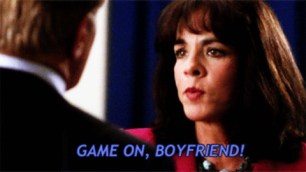
Abby says, “Game On!”

The “presidential debate” in Season 4 of The West Wing has been a favorite for quite a abby 1while. It isn’t a real debate, like the Season 7 debate between Matt Santos and Arnie Vinick. It’s more like T-ball, where Governor Ritchie of Florida, the Republican nominee, places the ball on the T and President Bartlet knocks it out of the park. Time after time after time.

There is a charming scene just before the debate happens. Here is the script of that scene, just to establish what happens. Then I’d like to move around a little bit, just as a fan, to enjoy it from another angle. You can come along if you would like.

BARTLET
…Remember the tie Josh had to give me at the last minute?

ABBEY
Yeah. I heard that happen. So, do you think there’s any point in still havng the debate?

BARTLET
There was a lot of juice in that tie. It was like in the last seconds. Just the energy getting me out on stage…

ABBEY
Well… tough.

We’ll do mushy later. So, for now, I just got to say I love you so much that my head’s going to fly off. But, more importantly, game on, boyfriend! Let’s go!

By the way, I feel bad. I don’t think I’ve done enough to help you prepare for this debate.

BARTLET
Why are you telling me this now?

When Bartlet turns around to look back, Abbey pulls out a pair of scissors and cuts off his tie. (about three inches below the knot)

ABBEY
Just ’cause.

Bartlet looks down at his tie, then up at Abbey who has a sly grin on her face.

BARTLET
Oh, my God. You’re insane. Are you…? You’re insane! Charlie!

Bartlet runs out into the HALLWAY.

CHARLIE
Josh, we need your tie.

JOSH
What the hell?!

CHARLIE
Take it off!

C.J.
What happened?

BARTLET
My wife cut it off with scissors.

JOSH
Why?

BARTLET
I don’t think we have that kind of time, Josh.

“We don’t have that kind of time!” I loved that.

It isn’t an explanation, which is just as well, because an explanation wouldn’t help anyone, even Josh. C. J.’s question is perfectly natural—C.J. can see the the tie has been cut—and the answer is short enough to use even while everyone is rushing around frantically. Josh’s question leads in another direction entirely. It brings long therapy sessions into view; deep explorations of the First Lady’s psyche. That is what there is not “that kind of time for.”

But that isn’t what caught me this time. Go back up to the dialogue, starting with “Remember the time…” All the time the two are facing each other, Abby is holding a pair of scissors in her right hand.  We can’t see it, but once she uses it, we know it was there all along.

She sees no contradiction at all between the scissors (and what she plans to do with them) and ironic comments like, “So…do you think there is any point in still having the debate?”

There seems to be no contradiction in her mind between the scissors and the emotional and apparently heartfelt proclamation, “We’ll do mushy later. So, for now, I just got to say I love you so much that my head’s going to fly off.” She delivers that line with an intensity that is a real problem for a viewer (me) who knows she is holding the scissors and what she is going to do with them.

And her “apology” for not doing enough the help him prepare is just the verbal context for what she is about to do with the scissors. And when you understand that—when you know what she is about to do as you watch her deliver that line—the contrast is amazing.  It’s enough to make anyone a Stockard Channing fan.  Or at least, an Abby Bartlet fan.

And worst of all, it works. The superstitious panic we see in Jed’s remarks, and which has been a feature of the episode up to this moment, has been disabling. He is relying on “the old stuff.” Abby simple deprives him of “the old stuff” and puts him into a panic that serves him very well in the debate.

Game on, Abby.

Posted in Politics | Tagged , , | Leave a comment

I am glad I am not THERE anymore

If you have lived a long time, you have held views you no longer hold. Your choice, from the place you are now, is how to regard those views you once held. [1]

I want to emphasize that this is all about narrative-building. You do not, in fact, know why you held the views you once held. Nor is is “true,” exactly, that those views were a stumbling block that you finally surmounted or a scaffolding that enabled you to build the (much superior) views you hold today. Or a sequence of views you held as you served your apprenticeship to your parents, or to your commanding officer, or to your professor, or to your employer.  You can buy this hoodie, apparently.  It means “Control my own narrative.”

All those things are necessary parts of your self-narrative. You can’t really get rid of live there 4them, so you have to assert some functional role for each. We hear this all the time, “Back when I was young and naive….” someone will say, implying that his present views have somehow escaped that naiveté. “My Sunday School teacher always said…” is the beginning of a rejection of that position—or, more likely, a caricature of that position—and a celebration that it has been discarded. [2] Sometimes you hear a narrative placement like, “Our parents always insisted that we…” and this is particularly true if the speaker is trying to assert the continuity of those early practices with his current practices.

I’ve told those stories a lot of times myself. Mostly, they are “love ‘em and leave ‘em” narratives. I say that I grew up with a certain set of views (or a certain way of establishing my views) [3] and they were good for me at the time but eventually, I grew out of them. Or I was forced out. Or I became much more attracted to some other view and found I could not hold both.

I’ve been thinking about a political version of my narrative recently. The most recent turning point is how I used to be a liberal. But I am much more familiar with the religious narrative so I think I’ll start with that one and then move over to the political one when I have built up enough speed. If any of you have been on both of those journeys, you may have comments of your own to make.

Religious Narrative

I was raised in a religiously conservative home. My father and my mother held different, but compatible, ideas of what a good Christian life would look like. Naturally, I absorbed some of each. The conservatism I learned in college [4] was much more systematic and much more Calvinist than anything I had learned at home. Biblical scholarship at Wheaton was recruited to hold its conservative views in place and to give them a solid intellectual backing. It didn’t work that way for me. The more I embraced the scholarship, the less I embraced the conservatism.

live there 3So I became a liberal. Kind of. [5] And like a lot of liberals who had once been conservatives, I belittled the conservative views. This was my first experience with “I’m glad I am not there anymore” (IGIANTA). The liberalism I graduated to had a great deal of anti-conservatism in it and I enjoyed both the breadth of scholarship to which my new liberal appetites directed me and also the regular belittling of the views I once held. [6] I told “fundy” (fundamentalist) jokes the way we used to tell “dumb blonde” jokes.
But I got tired of it, eventually. The views I held then were made up of equal parts rejection of conservatism and attraction to liberal scholarship. [7] Initially, perhaps, even more rejection than attraction. Then I moved on to a commitment to liberal scholarship without having to bash my former colleagues in passing. That is my position now.

So those people who occupy the place where I lived until that last ten years or so, are now “where I used to live” and I have the same rejection of their views that I once had of conservatism. The relentless banging on conservatives—they are stupid, they are racist, they are hypocrites, etc.—-seems so unnecessary. I wish “they”—the people who are still doing what I myself was doing until recently—would just knock it off. There are such wonderful positive engaging things to be learned in scripture and to be celebrated; why waste all that venom on conservatives.

I am well aware that there were people who felt exactly that way about me in my conservative-rejecting liberal phase. I am sure they had every right to. But now I feel that way myself, so it seems so much more reasonable now. I call this the “love ‘em and leave ‘em” mode. I liked being where I was, but now I am somewhere else.

Political Narrative

I was raised conservative politically, too. I didn’t know it until I moved away from home and was able to look back and see my political upbringing as a particular kind, one that fit into a particular category. Colin Woodard in his book American Nations would say that I grew up in Greater Appalachia. When I discovered this, I became a liberal. Of sorts. [8]

And having become a liberal, I disparaged conservatives, particularly conservatives of the kind I was. I had escaped. I was now a butterfly. I exercised my contempt for colleagues who were still caterpillars. I think I did manage to grow out of that phase so far as the damning of conservatives is concerned. “Damning” just isn’t as much fun as it used to be.

But my real problem with liberalism is its break to the left. Continuing to hold the views I held as a “liberal” now make me almost conservative. This is like one of those jokes where everyone else in line takes a step backward and you discover that you have just volunteered for something.

I don’t want to be the one who breaks the news, but partisan politics in our time has live there 6become a blood sport. This isn’t something Donald Trump did. This is the social change that gave us Donald Trump. Years of economic stagnation have left their mark. The effectiveness of ridicule and disparagement of one’s political colleagues pioneered at the national level by Newt Gingrich and widely adopted by Republicans has also left its mark. The moral condemnation of many traditional voters as “haters” of one kind or another has become standard practice by liberals and that, too, has left its mark.

Liberalism, which used to attract me by its hopes and its more generous policies for the welfare of society, seems to have degenerated into angry accusations about the immorality and the stupidity and the racism of conservatives. Liberalism has been weaponized as a political movement and I don’t see that as a way to restore the legitimacy of democratic government.

And that’s what I want. I want to be governed by institutions and leaders that are broadly seen as legitimate. They were properly elected and have the right to govern in what they see as the interest of the public until they are replaced in office by voters. That, in case you have not noticed, is not what we are doing now and I would like to move back in that direction. So the liberalism that broadens and deepens its disparagement of conservatives is why I’m glad I am not there anymore And IGIANTA to you as well.

I haven’t tried to devise a name for my current position yet, but perhaps “post-liberal moderate” would do as a starter. I now run the risk of alienation from my friends who think of their bellicosity as “being true to the cause” and of my hankering for a post-war peace accord as being “untrue to the cause.” And they are right, in a way. If “the cause” is weaponized liberalism, I am not being true to it. It is not going to get me anywhere I want to go.

I’ve already said where I want to go. I want to have a government characterized by respected legitimate institutions and I want a politics that will allow the maintenance and use of those institutions. Maybe an example would help here. Liberals and conservatives have differed for years on tax policy. As a caricature—good enough for this one example—if the liberals, when in office, bent the IRS toward their tax preferences (and the conservatives the same), that would preserve the legitimacy of the IRS. If the elected government thinks of itself as the Mafia and uses whatever tools it has to destroy its enemies, that would not preserve the legitimacy of the IRS.

Partisan political competition has already been weaponized. When the government itself is weaponized, the era of free and fair elections and of legitimate government is over. My liberal friends don’t see it that way. They want to win the political wars, thinking, I suppose that they will govern freely and fairly when they win.

That seems short-sighted to me, for reasons I will have to explore at another time. [9] The point here is that I am having to disparage the people (liberals) whose views represent the achievement of my youth and middle age. I am genuinely attracted to the reconstruction of legitimate government. I know that means de-escalating the political wars. It does not mean unilateral disarmament, but it does mean detente.

So the liberalism of most of my life is somewhere I have had to leave. What I want to do is to continue to value my liberal friends—including those who think that weaponizing politics is the only way to be true to the cause—and to work toward practical cooperation with those conservatives who are tired of teeter-totter. About that liberalism, I have to say IGIANTA.

I’m post-partisan. I’m bipartisan. I think there is no way to have legitimate government without electing people who care more about the public good than they do about cheap partisan victories.

I have no interest in people who care more about the public good than they do about being elected. If they don’t get elected, they are of no use to me at all.

But they can take the honest and difficult path instead of the cheap and easy path.

That’s where I want to be.

[1] This is as nearly true of me as it is of you. I’m just trying to stabilize the pronouns.
[2] It is awkward if you, yourself, hold the view that the speaker attributes to his ignorant, self-righteous, and dogmatic Sunday School teacher, but sometimes that happens.
[3] Experience and authority are the two major ones, especially if you include the results of research in “experience.”
[4] Wheaton College in Wheaton, Illinois. When I was there, Wheaton was still calling itself “the West Point of evangelical Christianity” and both the religious views and the military underpinnings were prominent at Wheaton.
[5] A very friendly evangelical pastor who knew me well maintained that I was not really a liberal. He said I was “a minimalist evangelical.” It was an act of friendship.
[6] Not, as nearly as I could manage it, the people who once marched with me under the flag of conservatism.
[7] There are many “liberalisms,” of course, just as there are many “conservatisms.” I was never attracted to “God is dead” liberalism, or liberation theology or process theology.
[8] In politics, as in religion, there are many different “conservatisms” and many different “liberalisms.” I have always been fairly conservative socially. I call it traditionalism, not conservatism. I am much more progressive on political and economic issues than on social ones.
[9] The short version is that the alternation in power is like being on a teeter-totter. Whoever is down has both the incentive and the means (contact with the ground) to change positions. That means you can’t win at teeter-totter. You need to be playing some other game. And not the merry-go-round if that was your first thought.

Posted in A life of faith, Politics, ways of knowing | Tagged , , , , | Leave a comment

Neaera H. comes to life

In 1975, five years after ending the series featuring Frances the Badger, Russell Hoban wrote Turtle Diary. Turtle Diary is a book for adults—not “an adult book”—about William G and Neaera H., two losers who, in freeing some turtles from the London zoo, become winners. [1]

They are losers is quite different ways, so what they look like when they become winners is quite different. I like Neaera’s story better; I just respond to it more. Here is a reflection by Neaera as she is just beginning to adjust to being a winner.

It used to be that I stayed up till all hours and still felt time-starved, none of the day seemed to be metabolized into living. Now the minutes make me strong.

neaera 2There are some particular issues that have defined Neaera’s life [2] but the thing that intrigued me about this observation of hers is the transition from “time endured” to “life lived.” She calls this transformation “metabolism.” She goes through a whole day without this transformation of minutes into living; she experiences it as not having enough time, but when she becomes a winner and begins to reflect on her life, she knows that isn’t what it was. She felt time-starved, but she wasn’t, really. She was “life-starved.”  Here, as played by Glenda Jackson.

So how does one manage one’s life so that the minutes are metabolized into the experience of living? For Neaera, there are two things. There are the turtles, on the one hand and her feeling for them living trapped and pointless lives. And then there is the turtle keeper, George Fairbairn.

This is not a story, I am happy to say, where years of self-neglect are redeemed by a convenient romance. They were redeemed, in fact, by an act of liberation. She and William G. formulate a plan to steal the turtles—the keeper, George Fairbairn, is all for it—and take them to a small coastal city and turn them loose.

This is daring is a lot of different ways. For Nearea H., who is trapped in a sterile neaera 3passivity, it requires that she help plan the heist, that she cooperate with William G., whom she know only from the context of this proposal, that she sneak the turtles to the coast and set them free. And then, presumably, come back to her own life, which she characterized, early in the book (p. 43) as “I seem to go on doing what I do.”  Ben Kingsley here as William G. along with a woman who wants very much to be his girlfriend.

It turns out that she was not able to do that. Once she was out of the trap, she was able to look back at where she had been and see that it was a trap. On p. 184, for instance, after the success of the turtle liberation project, she observes: (p. 184)

I didn’t know how lonely I’d been until the loneliness stopped. Now…my flat…seemed to have been cleared of the invisible wires, criss-crossed in patterns of pain that had been there for years. [3]

The other thing that happens to Neaera H. is that she meets George Fairbairn, the turtle keeper. This relationship might become a romance or not (Hoban doesn’t commit himself in the book and director John Irvin doesn’t commit himself in the movie) but the effect on Neaera H. doesn’t depend on that. It depends on George’s modeling for her another way to be (p. 178)

George seemed to carry a clear space about with him that made all things plain and simple where he was.

Nothing in her life has been “plain and simple” for a long time. It might be that her early writing about the happy animals was like that when she first wrote them, but she has moved on and they have not.

Gillian Vole and Delia Swallow and all the other and all the other animals and birds I had written about and drawn They led such cosy cheerful lives, that lot.

She sees her life to have been “safe” in a stunted way, as if she has given away priceless things so that she can stay away from dangerous boundaries. You can see that in her reference to the creations of her mind as “that lot.” She made her living off of “that lot” but now she is done with them.

I was waiting for something now and the waiting was pleasant. I was waiting for the self inside me to come forward to the boundaries from which it had long ago withdrawn. Life would be less quiet and more dangerous, life is risky on the borders. Gillian Vole and Delia Swallow live in safe places.

In this passage, (p. 185) she contrasts the “safe places” where her animals live with “the boundaries” from which, for no reasons the book gives us, she has withdrawn.

Whatever it was that happened to her—it wasn’t just liberating the turtles—required her to move out of that safe space. The turtles were magnificent creatures suffering a great indignity, decade after decade. It just wasn’t right! But she was also hankering for a little danger in her life and seeing those feelings as “about the turtles” helps her. [4] William G. helped her, too, taking risks on his own. And George Fairbairn helped her by being who he was.

And having escaped from her trap, she was able to look back and see what a trap it had been and to choose never to go back there again. She is no longer the writer who cuddles up with the likes of Gillian Vole. She is, instead, the writer whose last poem in the book, goes like this.

Stiff but not formal
          A dead cat says hello
This winter morning

[1] The movie version stars Ben Kingsley and Glenda Jackson. It is a slow story, a low key delight. But the book is better.
[2] She is an author of very popular children’s stories, but the ore in that mine seems to have petered out and she begins to suspect that she has been publishing rather than living.
[3] There is nothing in her description of her life, as it is represented early in the book, that has any of the emotional power of “criss-crossed in patterns of pain.” There is no pain at all in her early descriptions. There is only despair. Looking back, she realizes that the despair was what she chose so she would not feel the pain.
[4] That doesn’t work for her partner in crime, William G. whose sad conclusion was “You can’t do it with turtles.”

Posted in Books, Living My Life, Movies | Tagged , , , , | Leave a comment

But Whitey’s goin’ to the moon

Would we be better off, do you think, if we were more sensitive to the concerns of others?  You would think so, wouldn’t you?  That notion has come very close, in the blue bubble where I live [1], to replacing all ten of the commandments that were so important to Moses.

But when you think about it, shouldn’t it matter what the “concerns”—grievances, really—are?  What if there are concerns that are not based, even loosely, on facts?  Would we want to know whether a concern had any merit other than being deeply felt?  You would think so, wouldn’t you?

Expressions of concern

For me, the classic “expression of concern” is “I’m mad as hell and I’m not going to take this any more.”  Howard Beale gave us that in the movie, Network.  People all over the viewing area did just what he urged them to do.  They opened their windows and stuck their heads out and yelled that line as loudly and as many times as they could and they took great comfort from discovering that many other people were yelling the same thing at the same time.

Should we take that “expression of concern” seriously?  Would it help to understand why they are mad as hell?  I’m thinking of the man who took his gun and went out looking for revenge on 9/11.  He found a Sikh, an Indian wearing a turban, and shot and killed him because he imagined that the man was “an A-rab” and therefore a Muslim and therefore complicit in the attack on New York and Washington.  Would it help if we took this man’s “concern” more seriously?  I don’t think so.

Some grievances need to be abandoned because there is no factual cause for them.  I remember a story of an irate parent who stormed over to the house of the teacher who told his daughter that Paris was in “Europe” when the father was holding in his hand a map that showed that it was in France.

Some grievances need to be abandoned because there is nothing that can be done aboutmoon 1 them.  In the Pacific Northwest, where I live, a major earthquake is long overdue.  When it occurs, it will be a tragedy, but the earth is, in fact, made up of tectonic plates and the Juan de Fuca plate is pressing harder and harder on the North American plate and some sort of “adjustment” is going to occur.  There is no point, it seems to me, in formulating that as a grievance. [2]

Some grievances need to be expressed because we all feel better after we have expressed them, but these are not “concerns” that we expect to be addressed and they do not attribute any particular causes of our grievance.  When we think about responding to those grievances—being “sensitive” to them—we have to ask whether anyone will be better off if they are taken seriously?  Will the aggrieved?  Will those to whom the grievance is attributed?  Will society as a whole?  

And who will be worse off?  

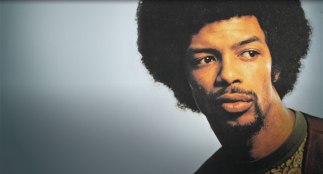
I saw the movie First Man this week.  It was very light on the great achievement of the moon landing and very heavy on the cost of it to the astronauts, especially Neil Armstrong, who was the subject of the film. [3]  This movie introduced me for the first time to Gil Scott-Heron’s song, “Whitey on the Moon,” which he sang in 1970, just a year after the event itself. [4]

Whitey on the moon

moon 4I want to make a comment or two about the song and then I want to return to the “sensitivity problem.”  First, it is a song of racial alienation.  That might seem too obvious to say, but it is not.  There are so many sources of alienation in our society today; the song could have been about any of them.  None of the astronauts was gay, for instance. [5]  The song could have been about “straight people” —“Straighties?—on the moon and would have expressed the same alienation.  None of the three astronauts was a woman, so…[insert your favorite derogatory terms for men here] “on the moon.” Of all the  alienations that currently afflict us, I am specifying that this was a song of racial alienation, rather than of some other kind.

Second, the song laments black poverty and contrasts it with white achievement.  This splits “Americans” into racial groups so that sentiments like “America, first in the race to the moon” lose all their meaning.  “Oh, I’m sorry.  Did you mean the white America or the black America?” [6]

These two Americas are latched together in the song in two ways.  One is principally poetic.  The other is a causal attribution.

Of the poetic ones, “Whitey’s on the moon” is introduced by “with” three times, by “but” three times, and by “and,” “while,” “for,” “of,” and “to” once each.  There is also a “Hmmm,” which is my favorite from an artistic standpoint.  Those words connect the bad things happening to black people here with the heroic achievements of the all-white space exploration, but only because they occurred at the same time.  

But there are also to causal ones.  All these bad things are happening here “cause” Whitey’s on the moon.  Here are those two.

The man just upped my rent last night.

(’cause Whitey’s on the moon)

I wonder why he’s upping me?

(’cause Whitey’s on the moon?)

“The man” could just as well have been Asian or Hispanic or black, but in the context, we might as well assume that he is white.  While I don’t know why the rent was raised,  I am entirely sure that it was not so we could send a white astronaut to the moon.

For all the lament in this song, for all the alienation it expresses, for all the black solidarity it engenders, this particular attribution is just wrong.  No one raised this black man’s rent so NASA could beat the Russians to the moon.

Even worse alienations

And as an illustration of alienation—even just racial alienation, forgetting for a moment all the other kinds—I think it points to an even worse fragmenting of the society.  Emily Hanford recently published a column in the New York Times about learning how to read.  The short answer is the phonics is crucial because it teaches students to “decode words.”  There is active resistance to this idea.  It’s the basis of the resistance that inclines me to put it in a consideration of Whitey’s on the moon.

It’s not just ignorance. There’s active resistance to the science, too. I interviewed a professor of literacy in Mississippi who told me she was “philosophically opposed” to phonics instruction. One of her colleagues told me she didn’t agree with the findings of reading scientists because “it’s their science.”

“It’s their science” is very close to the ultimate alienation.  It is as if each baseball team brought its own home plate umpires, each of whom called the balls and strikes.  The calls of “your umpire” are to be rejected, of course.  You can’t play ball that way and you can’t sustain a society that way either.  Different values will always be at the root of social grievances, but we should be able to agree on enough of the facts to propose some solutions.

“It’s their science” is very near the end of the line in alienation, but that line begins way back at “Whitey’s on the moon.”

[1]  That’s not mostly a political reference, although Oregon is a “blue state,” i.e. votes consistently for Democratic candidates.  I’m thinking of it in class and cultural terms as well.  We are mostly mainstream Protestants and genteel agnostics.  We meet each other at symphony concerts and say hello.

[2]  My favorite solution is to purchase “no fault insurance.”  If there were no fault, there would be no earthquake, after all.

[3]  I did know, before I went, that the movie was not going to be about Adam.  For one thing, “Adam” mans “earth.”

[4]  Just to introduce a different perspective on the achievement, Dennis Overbye had this to say about the mission —finally ended—of the Kepler telescope, which had had the job of looking for other habitable planets.  “Kepler’s retirement marks just the beginning of a quest to end humankind’s cosmic loneliness.”  Think about “humankind’s cosmic loneliness” a little before you return to “Whitey’s on the moon.”

[5]  I don’t know that for a fact, but since the question has never been raised at all in my hearing, despite many other gay issues being raised, I am just going to assume it for the moment.

[6]  The historical context of the race to the moon was, of course, the Cold War.  “America” was contrasted to the Soviet Union.  “We” meant all of us, not “them.”

Posted in Political Psychology, Society, Sustainability | Tagged , , , , , | Leave a comment

Madam Secretary 4.1

I want to think about trashy news and trashy people today.  The United States has enemies, of course, and they act against us in the old style and in the new. [1]  The old style is acting against us in support of some interest of theirs.  If we had planes surveying the areas where they are growing or refining drugs and they shot down one of our planes, that would be the old style.  

In the new style, the enemies are trying to weaken the United States generally.  This has nothing to do with some current conflict.  They would like to live in a world where the U. S. is internally divided and is, therefore, weak and hesitant externally.  Whatever does that, whenever it is possible to act on it, they will act on it.  These are acts of war, not of diplomacy and they are part of the fabric of our world.

Our peril lies in the combination of enemies—when have we not had enemies?—andmad sec 5 trashy people.  I am going to look at some of the trashy people and I am going to say directly that they make possible the damage our enemies do to us.

I have some trashy people in mind.  These particular trashy people are players in an episode of NBC’s Madam Secretary. [2]  I’m going to lay out the bare bones of the plot and distinguish “the bad guys” from the trashy people.  Then I want to indulge in some baldfaced moralizing.

Shrewsbury College

But before I do any of that, I want to visit Lord Peter Wimsey briefly.  This aristocrat, Dorothy Sayers’ best-known sleuth, was called in to solve a series of crimes at a women’s college in Oxford, England.  The perpetrator of these crimes is acting against Shrewsbury College in what I called, above, the new style—whatever weakens the college is good.  She commits crimes of which anyone might be suspected, and in fact, each of the dons comes to suspect most of the others.  They bend, in a sense, but they don’t break.  Here’s the way Lord Peter puts it:

Will you let me say here and now, that the one thing which frustrated the whole attack…was the remarkable solidarity and public spirit displayed by your college as a body…This kind of loyalty forms at once the psychological excuse for the attack and the only possible defense against it.”

There is, of course, no possibility of getting the kind of group loyalty Lord Peter is referring to in a nation-state.

The Obama Interview

In an interview with David Letterman, former President Obama said that in his early and enthusiastic use of the internet as a campaign tool, he did not see the formidable uses the same techniques could be put to.

So I had a very optimistic feeling about [the net-based campaign in 2008].  And I think that what we missed was the degree to which people who are in power…people…special interests…foreign governments, etc….can, in fact, manipulate that and …propagandize.

What the Russians exploited, but it was already here, [bold font is added]  is we are operating in completely different information universes.

What was it that was “already here?”

Madam Secretary, Season 4, Episode 1

The Colima Cartel, drug dealers, want a small “independent” Asian nation, so they can expand their distribution in Asia.  The President of Timor Lesté, holds them off for awhile and finally caves in.  His second in command, a personal friend, does not give in and the Cartel murders him.  He dies of the poison they gave him during his meeting with the U. S. Secretary of State (shown here, with the President).

mad sec 3Long before the body is cold, some manufacturers of “outrages made to order,” a specialty of the house in Macedonia, has begun circulating the rumor that the Secretary had, in fact, killed the Vice President.  And we haven’t even come to the trashy people yet.

These rumors—enticing enough to serve as “click bait”—are picked up by Americans who run conspiracy-oriented sites and who care nothing at all for the truth of the rumor, but only for its likely effect.  This rumor “goes viral” among these groups and finally makes the leap to the next level.

At the next level are Senator Carlos Morejon and talk show host Marty Hawk, who bring this to the attention of the mainstream public.  Hawk says it is not longer possible to ignore a rumor that is lighting up the blogs.  The allegations are trash and Hawk knows they are trash, but he is as fully addicted to “clickbait” as the conspiracy theorists are.  So, not only does he inform his viewers that these rumors are circulating, he presents them as something to be denied.

And in the process, he shows a clips (from ten minutes ago, he says) from Senator Morejon.  Morejon also takes no responsibility for bringing this item to public notice.  “I was just repeating a news item that one of my staffers read online.”  And with no more than that to go on, he links these words together: allegation, investigation, FBI, murder, Secretary of State.  And he does it with a stern “root out corruption” tone and demeanor.

Senator Morejon is not a trashy person.  He is at war.  Anything is fair.  Here is the way he puts it in his final scene.  

Here’s what I know already.  In this brave new world of scattered partisan media where unscrupulous news outlet are desperate for any juicy news story and political plot twist that they can find,  I believe I can chip away at [President] Dalton’s approval ratings quickly and efficiently.  12% of the American public thinks that you’re a murderer, Madam Secretary.  I can work with that.

Comments

In this kind of world, it really doesn’t take very many bad people to conduct a vicious war.  It takes a few bad people; a great many trashy people; a general alienation from politics as a public concern; and an internet to connect all of the above.

There is probably nothing we can do about the Colima Cartel.  We could stop using drugs, I suppose.  That would require changes in the economy, in the high-using communities, in our incarceration policies, in our institutionalized racism, and in our relations with the governments where that cartel and all the others, operate with impunity.  So…not much we can do.

There is probably nothing we can do about the “click-bait factories” operating in Macedonia and which have found a very comfortable home in conservative sites.  If you think of the founders—like well-known Macedonian media attorney, Trajche Arsov—as “click lords,” rather than “drug lords,” you will see the similarities in the two situations.

There is probably nothing we can do about the conspiracy-oriented sites.  If these people think of themselves as at war with the U. S. they are “foreign agents” in a sense, but if they just like to play in the mud, I’d put them in the trashy people category.  So long as their audiences hold up, there is no reason for them not to publish the most outrageous lies, provided that they are lies their fans click on and thus provide revenue.

We might be able to do something about the fanatics who “share” the trash with each other.  They pass it along free of any involvement because “reposting is not endorsing,” they say.  So all the “sharing” of egregious lies doesn’t even raise a moral issue with these people.

The Cable News Anchor

The principal “trashy person” in this show is Marty Hawk, the cable news anchor.  He springs the whole load on the Secretary of State on the grounds that: a) there is a “story” that is burning up a lot of websites right now, b) a snap poll shows that 22% of Americans believe you are a murderer, and c) Sen. Morejon of Arizona gave an interview ten minutes ago in which he promised an investigation.  Then he shows the ominous clip from Sen. Morejon.

What Hawk does is to lift the story up out of the right wing sewer and present it as “news.”  The fact that he can offer a legally-elected U. S. Senator who is “just repeating a news item a member of my staff read online,” really does make it news, but the real news is that Sen. Morejon has just hit a new low.  The seeming news is that nearly a quarter of the American populace thinks their Secretary of State is a murderer.

But, of course, people watch the Marty Hawk show hoping for titillating little goodies like this, which they will pass on as “news.”  Secretary McCord assesses the situation accurately, I think, when she goes right at Marty Hawk.

Morejon is using the tactics not just of dirty politics but of warfare.

Because it’s dictatorial.  It’s autocratic.  It’s un-American.

Furthermore, a mainstream media outlet ought to have a better understanding of its responsibility to the public and refuse to signal-boost these kinds of outright lies.  Really.  You ought to know better. [3]

Conclusion

I know this is a grim assessment.  The sources of this public sickness are either beyond our reach (Macedonia, Colima) or so much a part of our life that we can hardly see them, much less oppose them.  Still, I think this show—which is a TV drama, not a news report—has captured a large part of what the problem is and that is worth doing.

Thank you Madam Secretary.

[1]  As we act against them.

[2]  This is not a show I have watched much.  When it was introduced several years ago, I watched a few episodes, decided it wasn’t all that good and turned to other things.  A friend told me recently that it had gotten better over several seasons and that I should try it again.  The episode I watched, News Cycle, is the first of Season 4.  I still don’t like the show generally, but this particular episode dramatized very nicely an issue that is coming to mean a great deal to me, namely web-based attacks on the U. S.

[3]  This tirade causes the President’s Chief of Staff to go ballistic because that’s not how you treat a scandal.  You just hunker down until it’s over.  And he is right, if minimizing damage to the Secretary and the President is the game.  But it passes up the chance to call this cancer what it is and to oppose it.

Posted in Political Psychology, Politics | Tagged , , , , | Leave a comment

Starbucks Lost

Apologies to John Milton. I don’t mean at all that I think of Starbucks as Paradise, but it is true that I have seen a Starbucks that was a lot closer than any Starbucks I now know. I feel sad about it, but when I look back at what made “my Starbucks” so very wonderful, it seems unlikely that it could have lasted even as long as it did. [1]

I don’t want to make this essay about Jennifer. Not exactly. I want to make it about the e11cec8d84f8ee5a1ed0e608b320851a--coffee-gif-i-love-coffeestyle of service she offered as a barista and taught as a manager of baristas. But to do that, I will have to tell you a little about her so you don’t imagine that the kind of service she provided was disembodied and abstract. It was not. She embodied that quality of customer service herself and she made it a part of nearly all the waves (it is tempting for me to think of them as “generations”) of baristas who were fortunate enough to come under her pedagogy.

The names of these neighborhoods won’t mean anything to you if you don’t live in Portland, Oregon on the west side of the Willamette River, but the Starbucks where I met Jennifer served the Hillsdale neighborhood. She was the assistant manager and very likely much more. She had an extraordinary collection of baristas working there. [2]

Then she moved about a mile west to become the manager of the Multnomah Village Starbucks and I moved with her. She had an extraordinary collection of baristas working there. That’s when I began to get suspicious. It could just be a coincidence, I cautioned myself.

It was not.

It is not just that her own manner of greeting and welcoming and serving customers was superb; it is that it was exemplary. Literally.

Every transaction had a bonus with it. There was always some more personal or more gracious or more welcoming way to do the things that had to be done to make the place work. It’s just, after all, selling coffee. You really don’t have to do all those other things.

After a collection of us had been at the Starbucks together for awhile, we began to swap Jennifer stories and that helped us notice things we might not have noticed before or, more likely, to put the things we noticed into Jennifer-related categories. It was in the contest of those discussions that we began to talk about the “Jennifer Effect.”

Baristas came to the Multnomah Village store from a lot of different backgrounds. Some transferred from other stores, which had other cultures, particularly the drive-through stores. Some were brand new baristas. Some came from stores where there had been neglectful managers, who gave no real teaching. All of these would, in a very short period of time, begin to show the Jennifer Effect. [3]

camelot 2They would begin to add the personal touches to the transactions. One I remember is the change from “What is your name?” if a name needed to be taken for an order, to “May I have your name for the order?” Little things; classy things. They just began to creep into the language and behavior of the new people, which is why the group called it “the Jennifer Effect.”

That was some time ago, I regret to say. Jennifer is now studying for her masters degree in counseling at Lewis and Clark College, which has a very good counseling psychology program. [4]

And why am I writing this now?

Well…something ugly happened to me at that Starbucks this week. It wasn’t AWFUL, except in principle, but it was something that would not have happened when Jennifer’s customer orientation oriented the staff. The actual problem was a small one. I kept ordering my breakfast sandwich on a plate, and it kept coming in a bag. That’s not such a big deal, is it?

This week, I mentioned the problem to the the current manager, who, because she was making lattés, was the closest person to me at the time. Her response was that it wasn’t her fault.

Really?

So…I pointed out that my order was not being fulfilled—not just this time, but on several occasions in the past as well. I am a long term customer with a complaint. I would expect that the response would be something about the complaint. What I am talking about is the first item on the agenda.

“I’m so sorry that happened,” would be a good first step. “I know you like to have your sandwich on a plate,” wouldn’t be a bad followup. “Let us bring you another one” wouldn’t hurt, even if I turned it down. All those responses have the common virtue of being about the complaint. And, frankly, they all sound a good deal like a Jennifer-trained manager.

None of those happened. The response presupposed that the real question—the question that needed to be answered while I stood there at the counter—was whose fault it was. So the sandwich agenda got itself replaced by the personal responsibility agenda. It works like this: let’s not talk about the bad service you got; let’s talk about whose fault it was. Or, most particularly, whose fault it was not. It was not, said the manager, the manager’s fault.

I don’t actually care whose fault it was. Considering the kind of effect Jennifer had on her staff, I think a case could be made that the persistent mishandling of my order actually was the manager’s problem. I don’t care all that much about the sandwich. The thing that struck me most forcefully was the vast change that had taken place so quickly. Not very long ago, it was “Starbucks is the place where we count on meeting or exceeding your expectations.” And very quickly, it has come down to “It isn’t my fault.”

And, of course, now that you know whose fault it wasn’t, that ought to take care of your concerns as a customer. Right? I mean, right? Not really.

Not “Paradise,” maybe.  Maybe just Camelot.

[1] My favorite story about the Hillsdale store happened one morning when Jennifer wasn’t even there. It was at a time when Marilyn could no longer drink coffee so I would fiddle with the teabag while the barista made my coffee. I would take the bag out of the sealed envelope, put the bag in the hot water, wad up the envelope and throw it into the trash container on the other side of the counter. I nearly always hit it, but one morning I missed. The barista, on his way from one machine to another, stopped and picked it up and put it back on the counter so I could try again. He didn’t even say anything. He may not even have looked at me. It makes me happy just to remember it. I put it in on my second try.

[2] I fell in love with the place when Marilyn and I used to go there. When Marilyn died, I fell even more in love with the place because there were competent friendly people there and they opened at 5:00 a.m. I had a lot of bad nights after Marilyn died, but I almost always felt I could hang on until 5:00 and then I could get up. And then I met Bette at a Starbucks and it wasn’t entirely a joke—maybe a little bit—when I gave her Starbucks stock as a wedding present.
[3] It wasn’t gender-specific, by the way. It worked on men who came to work there as well as women. Of course, it expressed itself differently in the men than it did in the women.
[4] I got a chance to write a recommendation for her. My translation of the skills and the orientation that produced the Jennifer Effect to the skills that made her a good bet for admission to graduate study was one of the best recommendations I ever wrote.

Posted in Living My Life | Tagged , , , , | Leave a comment

“Grammar Nazis”

To tell you the truth, the “Nazi” metaphor was always too much for me. It treated lightly something I wasn’t ready to treat lightly. I am a veteran of a good deal of post-WW II anti-Nazi propaganda. I remember Nazi propaganda from a time when the Nazis were still winning. And, of course, I have seen many anti-Nazi movies. So treating it only metaphorically still doesn’t feel quite right, and there are several reasons for that.

nazi 2First, you may not have noticed, but real honest-to-goodness Nazis are coming back. These are the classic Nazis with the racial paranoia and the lust for authority and the attraction to violence. The guy who edits a Nazi newsletter is a grammar Nazi and it isn’t even a joke. The idea of Rudolf Hess (no relation) as a grammar Nazi actually is a joke and I had not heard it until today.

So even if it was funny back in the Cold War days, it isn’t funny anymore and may not even be safe anymore.

Language Nazis

Second, the emphasis on grammar obscures a much more pervasive problem with language generally. Consider this example from Michelle Obama.

“I remember there were kids around my [Chicago] neighborhood who would say, ‘Ooh, you talk funny. You talk like a white girl.’ I heard that growing up my whole life. I was like, ‘I don’t even know what that means but I am still getting my A.’”

The problem here is racial identity. The “kids around her neighborhood” had a model of language use in mind that specifies how “one” should talk if she is to be considered “one of us.” The threat is that if you don’t make the same mistakes we make, we will reject you and may well persecute you.

But it is class identity, too. In South Chicago, the two are intertwined, but in the Middletown, Ohio of J. D. Vance’s Hillbilly Elegy, they are not. The demand that you “talk like us” [1] has, in Vance’s book, to do with class norms, not race norms. If you use speech that sounds like the kind the kids of the professional classes are taught to use, you will get the same kind of threats Michelle Obama got.

The essential part of the “Nazi” metaphor is the enforcement. It is not any part of the jokenazi 1 that Nazis have better grammar than “normal people.” It is the intrusiveness of the enforcement that suggests Nazism. And in the Obama example, the intrusiveness belongs to the users of incorrect grammar. The demand is, “You will use the grammar we use or you will pay the price.”

Does that sound Nazi-ish to you? It does to me.

My father used to tell a story that had to do with language and character. I am going to tell you the story and then reconsider it from the Language Nazi standpoint. Dad used to say that a boy [2] who says “My old man ain’t got no right to bitch like he’s doin” and one who says, “My father has no right to complain the way he is” are saying the same thing about the father. They are saying different things about themselves.

The story itself implies that it is the character (read “social class”) of the boy that controls the form of the speech. In Dad’s use of it, it also implied that the first boy’s expression (=character) was inferior to the second boy’s. Dad could easily have become a Language Nazi by cruising the neighborhood and correcting the errant expressions of neighbor boys. He didn’t do that.

But the neighborhood boys could also establish the “my old man…” formula as morally superior and punish deviant uses. “Deviant” in this case would point particularly to the “My father has no right…” formulation. And if they enforced that usage, excluding and punishing the people who said it “the wrong way,” they would be Language Nazis in the same way, but in the reverse direction.

The two seem remarkably similar to me.

nazi 3You might respond that there is an objectionable “snottiness” about the traditional Grammar Nazi kind correction, a common instance of which is the confusion of “your” and “you’re.” (As the example shows.)  But I would argue that there is also a remarkably pervasive snottiness about language that is “too white” or “too middle class” for the present group of hearers.

Political Correctness

“Political correctness” is a good contemporary example. The term itself is a protest by conservatives who are tired of being “corrected.” “Correct” is a notoriously weak norm. [4] If, for instance, the indigenous peoples of North America [3] find being called “redskins” or “Indians” to be offensive and if we have no reason to want to offend them there is no reason we couldn’t call them what they want to be called. But the criterion that marks such a choice is that it is collegial or civil or even generous. Justifying it on the grounds that it is “correct” is more like a criticism than like a justification. And, in fact, that is how it is used.

But if calling these people Indigenous Peoples is going to bring you ridicule and exclusion from one group and calling them “redskins” is going to bring you ridicule and exclusion from the other group, which are the Nazis? Does it make any sense anymore to label one of the groups that patrols expressions and punishes non-conformers “Nazis” and not the other group?

And that brings us back to the Grammar Nazis with whom we began. So long as the upper classes use a grammar of a certain sort, there is going to be a temptation to call it “standard” and to use it to measure the speech of others, who are presumed to aspire to upper class status. If the speech of these people is no longer widely admired–and that is one of the likely effects of the recent failure of upward mobility, then “correct” will have a specific social location, say a street gang, or a specific context, say a job interview. [5]

The people who punish you for using formulations they don’t like will have earned the Nazi label without any help from you.

[1] Pause for one delicious moment to substitute “Talk as we do” and then close that part of your mind and move on.
[2] My father had four boys to raise, so the stories were always pitched in the direction of male illustrations.
[3] “Indigenous” would have to mean the people who were living there when we became aware of them. It could not mean the people who were there before and whom the people we call “indigenous peoples” displaced. “Indigenous” is a slippery sort of notion when you look at it.

[4]  It is, in that way, like the “conventional” in John Kenneth Galbraith’s widely used, “conventional wisdom.”  It is as if the assembled agreement of all scholars made a point too dull to be really worth making.

[5]  Bergen Evans, co-author, with Cornelia Evans, of one of my favorite dictionaries A Dictionary of Contemporary American Usage, used to say that he didn’t correct the speech of anyone who didn’t pay him to correct his speech.  Evans is the ultimate non-Nazi.

Posted in Communication, Words | Tagged , , , , | Leave a comment