The Apostles Cred

In just a little while, I am honestly going to think about the Apostles Creed.  But I just want to savor first, the juxtaposition of “cred” as in “street cred” and “creed,” a word that could hardly be more different in our use of it.

Both are, obviously, derived from the Latin verb, whose principal forms are Credo, Credere, Credidi, Creditus.  “Cred” as in “street cred” is only a shortening of credibility.  It’s a good thing, too.  Ask yourself how the expression “street credibility” sounds to you.  Just what the apostles cred was, using that same sense of the word, is a really interesting question on which very little scripture bears.  The “creed” in the Apostles Creed is simply derivative from the first word, “Credo,” which means “I believe.” [1]

The other push in the direction of this essay came from my stepdaughter, Kathy Humphries, who have me a heat-sensitive coffee mug.  When it is cool, the entire text of the Bill of Rights appears on it.  When you put a hot liquid into the mug, whole sections disappear.  The question, of course, for anyone interested in the Bill of Rights would be, “Which sections disappear and which are left visible?” [2]

cred 4And then yesterday, a little poking around on the internet produced a company that says it will construct a mug to your specifications. [3]  I took that to mean that you give them the text you want on the mug and tell them which ones you want to disappear when the hot liquid is poured in.  I hope that’s what they mean, because I am very likely to use their services if it is.

Before we go on to engage the Apostles Creed seriously, let’s look at two instances of the apostles’s cred.  Only one of them is from a movie.  That’s pretty good for me.  I have separated them by significantly different titles.

How did you do that?

 After the disciples were empowered at Pentecost, they picked up the career of Jesus, healing and teaching.  Here is a sample from Acts 3, after Peter and John had cured a lame beggar at the gate of the temple.

Men of Israel, why are you surprised at this? Why are you staring at us as though we had made this man walk by our own power or holiness? 13 It is the God of Abraham, Isaac and Jacob, the God of our ancestors, who has glorified his servant * Jesus…16 and it is the name of Jesus which…has brought back the strength of this man whom you see here and who is well known to you.

There is no problem with cred there.  There were some more realistic looking pictures, but I picked this one because I love the looks on all three faces. (See further down the page.)

How do you know that?

Frank Quinlan and Hughie Driscoll just finished up an extraordinary journey in the company of the Archangel, Michael  They saw the mighty works.  They heard the all but incredible story.  Then Michael “died” and they went back to their own tawdry lives.  Here, they meet in a bar afterwards.

Quinlan: As far as I’m concerned, it never happened.

Driscoll: But we saw it.  We were there.

Quinlan: It never happened.

Driscoll: If it never happened, where’s your raincoat. [They both know Quinlan gave it to Michael, who was wearing it when he disappeared from their view.]

Quinlan: What is this?  If it happened, then you know what?  Then I’ve got to believe that some day [some wonderful and unexpected thing is going to happen to me]….No.  It never happened.

Quinlan’s skepticism is his own particular brand, but Hughie’s claim on their joint experience is exactly what I am talking about.  It is the apostles cred, part two.

The Apostles Creed

So here it is.

1. I believe in God the Father, Almighty, Maker of heaven and earth:

2. And in Jesus Christ, his only begotten Son, our Lord:

3. Who was conceived by the Holy Ghost, born of the Virgin Mary:

4. Suffered under Pontius Pilate; was crucified, dead and buried: He descended into hell:

5. The third day he rose again from the dead:

6. He ascended into heaven, and sits at the right hand of God the Father Almighty:

7. From thence he shall come to judge the quick and the dead:

8. I believe in the Holy Ghost:

9. I believe in the holy catholic church: the communion of saints:

10. The forgiveness of sins:

1l. The resurrection of the body:

12. And the life everlasting. Amen.

The jump from cred to creed is a substantial jump.  The Apostles Creed is a very early formulation of the belief of the early church.  You can divide it up is different ways. [4]  It is trinitarian, for instance.  Beginning at clause 1, at clause 2, and at clause 8 (in red) gives you the three persons of the trinity.  Clauses 9—12 are a an addendum.

It can also be divided into phrases that are easier to understand and/or believe and thosecred 3 where you really have to choose.  You can understand them or you can believe them, but not both.  I can say I believe that “he descended into hell” but I have no idea what it means.  It doesn’t meant “Hell” the way Dante pictured it.  And because it is a formulation meant to be said, it has to skip over some things, such as, for instance, why he would have done that.  The only similar citation is from Ephesians (4.9) which seems to be based on Ps. 68.  Maybe.[5]

Not to belabor this point, but several teachings of the Apostles Creed can be made credible by defining them in ways that are more in line with our times and much less in line with that of the disciples.  For instance, with reference to the Virgin Mary, we might say that we believe that Mary was a virgin in the sense that Isaiah meant it, without believing that she was a virgin in the sense that Matthew meant it.

The beliefs that require the ancient cosmological referents are another example.  “Heaven” is up as if it were painted on the dome of the sky like the Sistine Chapel.  “Hell” is down as if it were somewhere above or below the tectonic plates.  If those expressions could be given theologically meaningful meanings, rather than cosmologically explicit ones, they could be understood as well as believed. 

Or you could divide the clauses into the ones that seem supernatural to you and the ones that you think a good stringent historian would accommodate.  You could argue, for instance, that nearly all of lines 2—7 could be accommodated to a modern, theology-oriented form, except for the verbs “descended, come, ascended,” and “rose.”  Of those, the first three require cosmological structures we no longer have.  The fourth requires a completely new form of life that is not resuscitation and not “virtual” life.

And now for the mug

So, although, the ways of dividing the 12 clauses could be developed further, I think wecred 1 are ready to design a mug.  Start with a mug that has the whole Apostles Creed on it.  You can give this as a gift or as an invitation or as an accusation.  It depends largely on how it is taken.  So the hot liquid goes in and some parts of the Creed disappear.  Which parts?  Just the statement of the trinity?  Just the historically supportable parts?  Just the parts that don’t require a 1st Century cosmology?

All those would work.  But if you were designing one for yourself—which, I have to admit, I have begun to consider—there wouldn’t have to be a single rationale to what was omitted.  You could eliminate Clause 5 or parts of it because you associate them with an obnoxious professor and Clause 7 because you just can’t bring yourself to take “the quick and the dead” seriously.  You have always thought of those as categories of pedestrians in Chicago and nothing will make it sound theological to you.

You can, of course, affirm it all without understanding it all.  And there are ways of understanding the verb “believe” that allow you believe something that you don’t understand.

And if you will allow me to close with a completely irreverent recollection. I have to say I have always loved the recurring joke in the TV show Get Smart.  The agent, Max, was pretty flamboyant so far as truth was concerned and at a certain point, his boss would say, “Max, I just can’t believe that.”  Max would respond, “Well…what would you believe, Chief?  Let’s start there and work back.”

[1]  It is worth speculating what we would be saying if the first word of the Creed in Latin were credimus, “we believe.”  This could be said by any member of the church, whether he, himself, held those beliefs himself.  The verb credunt, “they believe” could have been said by a visiting anthropologist.

[2]  I was so taken with the idea that I bought a mug to give to the chair of the political science division at Portland State.  The idea I pitched, not very seriously, was that he have several ideologically significant versions made and hand them out to students as a final exam in their course on the Constitution.  The instructions would go like this. “ Pour a hot liquid into the mug on your desk.  Notice what parts of the Bill of Rights survive that treatment.  Write an essay on the philosophy represented by the mug on your desk, understanding that the mugs on the desks of your neighbors have different deletions than yours.”

[3]  It looks to me as if contrado.com does that kind of thing I am going to want.

[4]  I learned today, for instance, that it was once thought to be a collective composition, such that each of the twelve phrases was contributed by one of the twelve disciples.  The only documents I have ever seen that were produced like that came from brainstorming sessions in committees and this is not the kind of document such sessions produce.

[5]  Ps. 68, 17:18 seems to be about the conquest of the holy mountain by David so that he could build a city (Jerusalem) and a temple there. “17 The chariots of God are thousand upon thousand; God has come from Sinai to the sanctuary. 18You have climbed the heights, taken captives, you have taken men as tribute, even rebels that Yahweh God might have a dwelling-place.”

Posted in Biblical Studies, Theology | Tagged , , , , | Leave a comment

Moral outrage and moral rigor

Lee Siegel begins his examination of “moral rigor” by choosing an exemplar; it is James Baldwin. Siegel knows that “moral rigor” is going to be a tough sell and he is working for as much specific and acceptable material as he can get. So…an exemplar.

Baldwin was as committed as any writer has ever been. But the stuff of his commitment was a moral clarity steeped in intellectual difficulties and ethical complications — a labyrinthine clarity that he refused to sacrifice to prescribed attitudes.

Baldwin’s moral clarity was steeped, notice, in intellectual difficulties and ethical complications. Those sound hard. The clarity Baldwin has to offer is “labyrinthine,” which is also hard. Right away, I begin to wonder why anyone would aspire to such a standard.And…we don’t, according to Siegel. We choose, instead, “ringing moral indictments;”the hallmarks of which are:

  • absolute certainty,
  • predetermined ideas and
  • conformity to collective sentiments.

Those are what we do, in fact, choose, according to Siegel. Why would we do that? Well,218425_v9_ba to tell the truth, they don’t sound so hard when you start with the third one. “Collective sentiments” and fundamental to being human in times of conflict. We circle the wagons, we amp up our message, we jam other messages. I don’t really have any objection to Siegel’s choice of the word “conformity,” but that’s not what it feels like to belong to a team in times of conflict. The supposed one-ness of all our feelings and expressions gives us great comfort. I think I would have said, with less pejoration, “participation in the collective sentiments.”

And given that there were sentiments before you got there, the sting is also taken out of Siegel’s “predetermined.” The words of the songs we sing as Americans are predetermined. I sing “the land of the free and the home of the brave” even knowing that my country leads the world in incarcerations per thousand of population. If I were to join a group that used a secret handshake, I would ask what it is. The fact that it is “predetermined” from the standpoint of the new person, is part of why it is so attractive. You don’t catch that side of the meaning in Siegel’s “predetermined ideas.”

I think Siegel has gone too far in “absolute certainty,” but not very much too far. The lack of variation or nuance in a group’s expression is not an indicator that the certainty is absolute: it means only that adherence to “what we all know” is rewarded and deviation from it is punished.

Ringing Moral Indictments

These three indicators, Siegel’s “hallmarks,” identify the “ringing moral indictments” so common in our time and while I quibble—you might have noticed—about how those work and how they are enforced, I certainly agree with him that these traits characterize much of public discourse in our time.

And it gets worse quickly. The great strength of Siegel’s essay, it seems to me is his analysis of just how it gets worse so quickly.

In the process of abandoning the type of complex moral clarity that Baldwin practiced, we have made behavior that is unacceptable the equivalent of behavior that is criminal. An equal amount of fury is directed toward actions as morally — and legally — distinct from each other as rape, harassment, rudeness, boorishness and incivility. The outrage over a police shooting of an unarmed black teen unfolds at the same level of intensity as the outrage over what might or might not be a case of racial profiling by a salesperson in a small Brooklyn boutique.

Follow the line he traces in this paragraph from “unacceptable” to “criminal.” I think he is right about that, but consider for a minute where else that might go. We might say that we have the obligation to protest expressions or actions that we find unacceptable. We might declare them evil, rather than illegal. We might put our efforts toward protecting or compensating the victims of such actions. But Siegel is right: we go to legal.

When we go so quickly to legal remedies, I am always reminded of some very useful language that Frank Hearn provides in his book, Moral Order and Social Disorder. Hearn is a communitarian, so many of the social problems we experience really should be dealt with, as he sees it, in the community. Wholehearted commitment to institutional norms will give us both structure and freedom and they are, after all, our norms.

The word Hearn uses to describe the transfer of these issues from their natural and appropriate home in the community and into the the legal system is “juridification.” It is not a familiar word, the the meaning is clear anyway. It is the taking of an issue and placing it into the legal system, ultimately into the courts. These issues have been “juridified.” There is no way to treat these issues adequately in the courts.

And when I say “these issues,” I mean to refer to the sequence of offenses which Siegel says have become morally equivalent. It is this line that lit up the whole essay for me. It made me want to stand up and applaud. “Rape, harassment rudeness, boorishness, and incivility,” he says, have been made “morally equivalent.”

Stop for a moment and think what that means. It means that the essential character of an act as vile as rape is morally equivalent to being “uncivil.” Rape is sometimes a miscommunication, but more often it is just the brutality of a man enacted on a woman. Harassment is a good deal more subtle sometimes. Sometimes not. Rudeness depends entirely on local norms. What violates the standards of courtesy here is only the informal affirmation of belonging there. Boorishness sinks deeper in the the character. There are people who just don’t get it or, having got it, decide to offend anyway. Incivility is wholly a matter of intention and setting.

These are “morally equivalent?” Really?

And Siegel is right again, in my view, when he says that this equivalency “flattens and obfuscates,” rather than clarifying the issues we must deal with. It flattens these offenses by squeezing them into the same box and by demanding that each and every kind be protested in full voice as a moral outrage.  Consider the two pictures below.  Do they differ, do you think, in the variety of “collective sentiment?”  It doesn’t look like it to me.

Men's Basketball vs. UNLV, John Kelly PhotoThat doesn’t work. We can’t manage that much outrage and, of course, we don’t. We begin simply to disattend and deny. We excuse actions, too, if they were committed by members of our tribe. So it is only the officially sanctioned outrages, the ones that “conform to the collective sentiments” that we really have to gear up for.

There is another way of dealing with this surplus outrage and that is the way Siegel has chosen. Siegel speaks on behalf of the system as a whole when he says it just doesn’t work. Not only does squeezing all these kinds of offenses together fail to approach “moral rigor,” as illustrated by James Baldwin, but it also just doesn’t work. So he argues that we should begin to do the hard work of saying that boorish behavior is bad but it isn’t the moral equivalent of harassment.

Anyone who says that boorishness is bad, but not “that bad” is going to be attacked. Trustbaldwin 4 me on that. He is going to be said to be morally insensitive. He is going to be said to be complicit. He is going to have Edmund Burke’s most famous saying [1] hung around his neck and he will be made to wear it in public to show his status as an outcast.


Treating boorishness and incivility as “bad, but not that bad” denies the real feelings, they say,  of the butt of that behavior. And how would you know, anyway, because you have never been a black trans-sexual refugee from the sex trade and if you don’t know how such a person might feel then who are you to say that it is not “that bad? Huh?!!” And that is how people are set aside who want to make the claim that we simply cannot run for long on the levels of outrage that are being generated today.

I don’t hold out much hope, to tell you the truth, for a standard as remote as “a moral clarity steeped in intellectual difficulties and ethical complication.” That sounds like something a few people might aspire to and even fewer achieve. And I am not at all sure I am one of those people.  But I also know that the juridification of minor misdeeds and the uniform levels of outrage simply cannot be sustained for long.

We will find shortcuts. And they will be ugly.

[1] “All that is necessary for evil to triumph is for good men to do nothing.”

Posted in Communication, Political Psychology | Tagged , , , , | Leave a comment

Attraction and Engagement

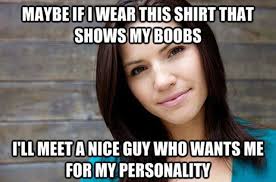
There is a criticism implicit in this picture that I think is largely unfair.  It could be a lot worse.  She could be dressed like a showgirl and her hope could be placed as stupid rather than, as here, as wistful.

On the other hand the person who put this together and posted it—I am going to refer to him as the Snark [1]—sees physical attractiveness (my boobs) and attractiveness of character (my personality) as mutually exclusive and that makes me think that he doesn’t really understand the situation. 

The Snark

First, I think that the Snark has a grievance.  He thinks of the upper and lower parts of the statement as in conflict with each other and he is blaming the woman in the picture for embodying that contradiction.  There is no way of knowing for sure which side of this contradiction he himself would prefer to encounter.  I’d guess, based on word choice and syntax, that it would be the physical part.  Here is why.

The word choice is “boobs.”  Synechdoche, we call it, using the part to stand for the whole.  I’m pretty sure he has physical attractiveness in general in mind, although we are a strikingly breast-conscious culture.  There are other anatomical terms that are even cruder and which are used to stand for the woman as a whole and he didn’t choose those.

The syntax part is the if/then construction.  “If I do this, maybe I’ll achieve that.”  The goal is clear; she wants to meet a man who will value her for her personality.  The means chosen is clear; she wants to dress in a way that attracts men to her physical appearance.

But “If/then” is pretty severe.  It links one condition (only) to one outcome (only).  But the circumstance where anyone chooses clothes for one and only one purpose is quite rare.  It is much more common for people to match the clothing to the occasion.  We say, “This is the kind of outfit people ordinarily wear to….” and when we are going there, we wear that kind of outfit.

It would be fair to ask the creator of this poster how he thinks a woman should dress for the purpose of attracting a man who will value her personality.  It needs to be something you can see from across the bar.

A few specifications

I’m going to get a little critical myself in just a little bit, so let’s just specify a few things to help me stay on track.  Let’s imagine that he is thinking about  “meeting a nice guy” in a bar.  There’s no reason it couldn’t be a church or a PTA meeting or a bookstore coffee shop.

And let imagine further that the women are in this bar to meet men and that they dress “appropriately.”  They want, in this scenario, to “attract” men.  What happens after that is entirely up to them because they get to say yes or no to whoever is attracted, but if no one is attracted, there is nothing to say.

And finally, let’s imagine that whatever it is that “attracts” from across the room, is not some nuance of personality.  God may indeed look upon the heart, as God told Samuel, but a man looketh upon the outward appearance pretty reliably.

The Contradiction

So…what kind of outfit is going to attract a man who will find your personality fascinating?  If the physical attractiveness isn’t enough to attract a man, nothing works.  If it is clearly an invitation to an erotic relationship, that won’t work either. (Usually.  I will close with a story in which it works anyway).  So what will work—from across the room?

I’d vote for confidence and competence.  How does this look to you?  It looks to me as if she knows what she’s doing and has every confidence that she is doing it right.  In the whole middle range between too little and too much, I think looking like you know what you are doing, what you want to happen, is going to work.

Engagement

I called this essay attraction and engagement, because I see those as step one and step two.  The Snark sees them as simultaneous and also as contradictory, but I don’t.  To me, it seems perfectly natural that a woman would dress in a way that would attract a man who would want to sit down and talk.  And if he wants to buy her a drink—presuming he hasn’t drugged it—that’s fine, too.  And if, as they talk, he gets more and more engaged by her personality, more attracted to the cognitive and emotional parts of who she is (and not just the physical part), then I would say that the “contradiction” the Snark has given us has been dealt with.

Jeff and Laurie

So here’s the story I said I was going to close with. I told this story in a post on July 17, 2014.  I have hyperlinked the essay in case you want to see the context, but here is the story I wanted to tell.

I want to finish with a story about two students of mine at the University of Oregon.  Jeff is one of my heroes.  The story goes that his friends and her friends decided that Jeff and Laurie would be a really good couple, so they started pushing them together.  One night, Jeff went over to the house to pick up Laurie.  In the meantime, Laurie’s friends were upstairs helping her “get ready” for her date with Jeff.  Her friends pushed her repeatedly in the direction of clothes that were—borrowing Kristine Cranley’s categories—too loose, too tight, too low, or too high.  Laurie was feeling really uncomfortable when she went down to meet Jeff for the first time.

They sat down and talked for a little while.  Finally, Jeff said, “My friends thought it would be really good for us to get to know each other.  I’d like that, but I don’t think I can get to know you while you’re wearing that.  Would you mind changing?”  By that time, Laurie had begun to resent her friends for pushing her so far toward immodesty and to regret her own timidity in refusing to tell them no.  For these reasons and several others, she was delighted that Jeff had named her problem as his problem too.  He wanted to know her so much that he gladly passed up an evening spent with a dazzling woman wearing way too little.  It was her he wanted; not “that.”

I don’t think we can count on responses like Jeff’s, which are oriented clearly toward the personality side and refuse to be diverted by the boobs.  No reason not to be attracted by them, of course, but if finding out what this woman is like is your goal, then you need to keep moving on toward the goal.

So, let’s un-Snark the situation and just celebrate the people who are attracted, and then engaged.


Posted in Living My Life | Tagged , , , | Leave a comment

Left-leaning media

Where is the plumb line when you really need one?  A plumb line defines straight up and down, deviating neither to the left nor to the right.[1]  Everybody agrees on the absolute verticality of the plumb line because it a useful assumption to make and nobody really cares.

For media, nearly everybody cares.  And there isn’t a plumb line.

I have seen quite a few quantitative studies of “bias in the media.”  Nearly always, theyleft 2 find that the “left-leaning media” charge is inaccurate.  The goal of these scholars is to dummy up a plumb line.  They want to show, on the basis of unchallengeable scientific methodology, that the line is straight up and down.  Or that it “leans” a little to the left or to the right.  They really don’t care. [2]  What they care about is that some standard is established that everyone can agree on.  The charge needs to be shown to be true or false. [3]

If that could be done, then everyone could agree that “left” means left of the line and “right” means to the right of the line in the same way that west Portland is west of the river and east Portland is east of the river.  That’s what they want.  That’s not going to happen and in this essay, I am going to feel around a little for why that is so.

I am the plumb line

It is very hard to get over the idea that your own views and your own values are the way things really are.  All little kids are like that until the age of 5 (by some measures) or 10 (by other measures).  Eventually, they learn to understand that the person standing outside the door can see the knocker that is not visible from the inside of the house.  I think that must be a very difficult day.  Or maybe it is exciting.

Before you learn this, what you see and what is true are the same thing.  Afterwards, you have to admit that whatever the truth is, these people will see it one way and those people another.  It is still possible to say that those people are wrong, of course, or willful or hardhearted or whatever.  But all of those charges begin with the idea that different people see things differently.

And that is true even if we treat “things” just as physical objects, like inside the house or outside the house.  What if we expand “things” to mean beliefs?  When we get to beliefs, it gets difficult very quickly.  There are three reasons for that.

Why it isn’t going to happen

The first is that beliefs are a team sport.  “We,” we say, “believe this that THEY believe that.”  The great power of this formulation is that is asks whether you are really one of us or one of THEM.  If you are one of us, then a lot of good things follow.  “We” help each other, we include each other, we take pride in each other, and should a dispute come we “have each other’s back.”  For treasures like that, most people would swear that black is white and up is down.  It would be hard not to.

So a liberal who holds in his hand a well-researched report showing that there is no left 3genetic element at all in homosexuality and that, consequently, it is completely the choice of the individual—has a problem.  A conservative holding in her hands a report showing that explicit instruction in sexuality dramatically reduces the rate of pregnancies among unmarried youth—has a problem.   You would really like to follow the evidence, but you would also like to have friends and neighbors and the tribal nature of beliefs suggests that you may have to choose.

The second is that a belief system is indicated and supported by what topics are chosen for consideration.  This is the issue of “salience.” [4]  In politics, we talk about these things and THEY talk about those things.  And that is true also of news sources.  Entirely apart from any bias in evaluation—which is the next point—there is a bias in salience.  

Liberal news sources blame President Trump for everything imaginable and credit him with no achievements at all.  Conservative news sources exonerate President Trump from any blame whatever and call the slightest hint of hope, an “achievement.”  Liberal news sources talk about civil rights and the equal protections clause.  Conservative new sources talk about religious liberty and the inviolability of conscience.

Third, a belief system says that these things are good and those things are bad.  Or, less combatively, that these things are better than those things.  Or that these things are better than those things…right now.  It is too late, for instance, to restore the integrity of the American family, now that it has been torn asunder by generations of liberal permissiveness.  It is too late to stop the pollution which is rapidly heating the atmosphere, but it is too early to start planning expensive protective efforts for those communities about to be inundated by rising oceans.

Left-leaning media

If, as noted earlier, I am the plumb line, then all I have to do to form an opinion about the fairness of the media, is to see where they fall with reference to my own—that means to “our” own—views.  To be “left-leaning,” a news source would have to do two things.  They would have to focus on issues that we don’t like to talk about and they would have to say things that contradict our values and our loyalties.

left 5A common conservative belief, for instance, is that the nations of the world are persistently taking advantage of America.  We are the global policemen and the global lending agency and the global social workers and the global food bank and so on.  And in return, we get hostility, refusal to cooperate, and binding agreements with our enemies.  Now take a minute and think of what stories—we are considering only the salience question here—would violate that belief.  Countries that actively refuse our “police services” are a story that would not be covered.  Stories showing that what Americans call “gratitude” would require that a country do things directly opposed to their self-interest, would not be covered. Instances of opposition, which would be called “ingratitude” would be covered in detail.

A left-leaning news source would feature topics that we don’t really talk about in my (conservative) news “neighborhood.”  And they would take positions on those topics that we conservatives find weak or relativistic or unpatriotic unrealistic on questions of the global environment.

“Left-leaning” has nothing at all to do with whether these sources are “fair and unbiased;” it has nothing to do with equal numbers of liberal and conservative commentators; it has nothing to do with a careful grounding of the conclusions in the facts of the matter.  And how could anyone—political scientists among them—have thought it could?

It means leaning away from me.  And the further to the right I am, the more powerfully true it is that “many sources” or “most sources” of news are “left-leaning.”

I’m saying it’s a conspiracy.

[1]  The terms left and right could be said to be arbitrary.  They derive from the 18th Century French politics that put the aristocrats on the right side of the assembly and the commoners on the left, but there was no rationale for the seating and it is just a taken for granted term now.

[2]  It is easier, of course, to sell your results to your left-leaning student body or your left-leaning community of scholars, but lots of scholars would be really happy to defy their students and/or their colleagues if their data would hold up to unfriendly scrutiny.

[3]  Or…you know…adequately or inadequately supported by the data so far.

[4]  Literally, the issue of what “jumps out” for you.

Posted in Political Psychology, Politics, Society | Tagged , , , | Leave a comment

It’s not about time travel

I just saw Richard Curtis’s 2013 movie, About Time. [1]  I know, it’s about time I saw it, but I had never heard of it and of all the stars, Bill Nighy is the only one I had ever heard of.

In this essay, I am going to reflect on what it was about—specifically, what it was about for me—and I am going to make free with references to the story so if you haven’t seen it or if you don’t like reading about the plots of movies you have not seen, this is your time to bail out.

This is centrally the story of Tim Lake (Domhnall Gleeson) who, at age 21, discovers thattime 4
he can go back in time.  Here is his father (Bill Nighy) performing the magic ritual with him.  You go into some dark place and close your eyes and clench your fists and picture the time and place where you want to be.  Tim learns that he  can’t go forward and he can’t go to any time or place that he did not experience himself. It’s a “do over” sort of superpower.

There are two limits on this power.  One I understand in principle.  It is that you can’t just change one thing.  Everything is connected, so when you change one thing you change a lot of other things.  I get that.  The other is that the birth of a child—it has to be Tim’s child, I think—sets a limit on the time to which he can return. [1]

How it works

Tim uses this power very clumsily at first and for really trivial things.  But he gets more skillful as he goes on and also extends the range of applications.  Needless to say, extending the range of applications does not work out well. He changes all kinds of things he didn’t want to change.  

From that low point, he begins to do by slow, painful, and natural means, the things that anyone would have to do.  His sister Kit Kat, for instance, is a snarl of bad choices and bad habits, and as a result, has a nearly fatal car accident.  Tim’s first response is to go back in time and get her away from the party before that danger develops.  He does that.  It doesn’t work.  Then he and his wife, Mary (Rachel McAdams) sit in Kit Kat’s hospital room and say they are not leaving until she decides to knock off the self-destructive behavior.  That’s a little clumsy, but it is completely natural.

In everything that happens after that, Tim chooses more modest goals and more natural—“time travel” is not natural—means.  He is headed in the direction of using his superpower as part of the way he looks at life.  The “do over” is, at this later stage, not a special power, but a special perspective on how life is to be lived.

Time 3Let me offer a few examples.  One of the difficulties of this kind of time travel is that you get to meet the same girl for the first time, several times.  You know it is several; she experiences each one as the first.  He uses that ability to learn about Mary’s tastes—she is a big Kate Moss fan—and on the next occasion, he uses the lines she used last time as his own views.  She loves it.  He is so insightful.

The next time he sees Mary, she has just acquired a new boyfriend whom she met recently at a party.  No problem.  He goes to that party just a few minutes before that guy shows up so Tim gets to spend time with her and she never really meets “the boyfriend.”

Those are cute, but they are not what the movie is about.

When he gets the hang of it, he goes back to the beginning of a day where he has made a lot of mistakes.  On his first try, his buddy is excoriated by their boss and Tim sits there and does nothing.  The two of them run through a crowded courthouse scarcely noticing where they are.  Time grabs a quick lunch without noticing the person behind the counter. [2]  They win their case showing only relief from the stress; their client does the same.

When he goes back to that day, Tim actively supports his buddy when the boss scolds him.  He stops on his way to court to marvel at just where they are and to feel the truth that they, themselves, are part of it.  The interaction at the counter where Tim grabs a quick lunch to go is personal and satisfying.  They celebrate their win in court with pleasure and good spirits as does their client.

Now THAT, the movie is telling us, is what the do over power is really for.  And then Tim takes the next step, a step his father did not take.  He anticipates events—events like the first court date—with the full knowledge that he could do it this way or that way.  At this point, his super power has provided him with a base of experiences—a point to which I will return—and the clear sense that he can follow path A or path B.  In all the remaining scenes, he chooses path B, the path of full awareness and generosity, taking pleasure in his surroundings and the people in them.

My super power, and yours

What the movie doesn’t deal with directly is that there are events and then there are time 6kinds of events.  The movie gives us a sample day with four events: the boss’s tantrum, the trip to court, the quick lunch, and the victory in court.  But anyone with some life experience will tell you that although those are unique events in a way, they are also very common kinds of events.  The boss will lose his temper and snark at a colleague (or at you) for instance.  You know that.  And having faced it before, you know where path A leads and where path B leads and you can choose one or the other so far as your own behavior is concerned.  That’s your super power.

But it’s only Super Power 101.

It is true that there are kinds of events and you can choose them on the base of anticipation, rather than, as Tim does on the basis of having experienced them before.  On the other hand, within the category, that kind of event, there are important differences.  Tim supports his colleague, but he doesn’t confront the boss.  Maybe the next time, that will be the best thing to do.  Or maybe trying to charm the boss will be the right thing.  Or maybe quitting your job will be the right thing.  It varies and it varies in part because of the choices you made last time.

In Super Power 501, the first of the graduate level courses, you are asked to take account of the uniqueness of the event as well as the commonality of all events of that kind.  In every society, events come in categories that are defined by the characteristics they have in common.  That’s why we call them categories.  But the events themselves differ remarkably.  And you yourself change over time—we call it “development” if we like the changes—so your sense of what should be done about an event and particularly what you, yourself, should do about an event also changes over time.

Sometimes you know you gave in to a childish impulse and vow to show more discipline next time.  Sometimes you look back and note that everyone seemed to be OK with what you did, but you know you could have done more.  You held something back that should have been committed to the battle.  Sometimes you made a mistake and you know you should have just ignored it, rather than making it the center of everyone’s agenda.  And you learn these things by having a sense of who you are and of how that is clarified and expanded by what you do.

I’m not complaining that the movie didn’t give us that.  I loved the movie.  But…really…there is more.  Grad courses await.

[1]  Many thanks to my son, Doug, who counts this movie as one of his favorites, and showed it to me yesterday.  And then, at the end of the day, when he would have rather gone to bed, he showed me the last fifteen minutes again.

[2]They have to accomplish very much the same outcome in To Gillian on her 39th Birthday, but I understand that one. If the woman who has died is no longer remembered and cherished in the hearts of those she left, then she can’t really “be there” for them. I get that one.

[3]  The cinematographer really nails that one.  The young woman at the counter is shown only from behind that time.  In the next round, the do over round, they show her face and Tim’s as they manage the small commercial exchange with everyday courtesy and generosity.

[4]  Note to fathers.  If you think that learning how to deal with your first child has taught you how to deal with either of the next two, you have a surprise coming.  A good share of the lessons you learn with the first are going to have to be jettisoned in order to deal with the second and the third might require a different playbook entirely.

Posted in Living My Life, Movies, Political Psychology | Tagged , , , , | Leave a comment

Mother Theresa is a Servant

And a hero.  And a saint.  You never hear anything bad about Mother Theresa. [1]

And if you were waiting for me to say that I am going to stand up and start criticizing, you will wait for a long time.  So I’m not criticizing.  On the other hand, I think a great deal of what she has to say in her well-known “…do it anyway” sayings,  (see below) has limits that the sayings themselves do not recognize.  Maybe she did, they they don’t.’

anyway 1I want to say three things in general and then I plan to cherry-pick among the sayings.  The first is to unpack “servant” a little.  Mother Theresa served many people for many years so there is no question of her being a servant in that sense of the term, but I want to contrast it to “steward.”

Servants and Stewards

You can be a faithful servant and you can be a faithful steward, but sometimes you have to choose which is more important.  A servant does “the right things.”  A steward tries to do whatever will produce the best outcome.  

Mother Theresa advocates the right things.  She is in favor of forgiveness, kindness, honesty, happiness, doing good, and doing your best.  If you look at the names of those actions only—that is what a servant would do—you can find no room at all for criticism.

If you look at is like a steward, you see different things.  One of the nasty things that is said about wives who forgive their husbands more than they should, is that they are “enablers.” [2]  What they are doing is generous, maybe even heroic, in each and every instance, and the result is a disaster.  There is a lot of disagreement, of course, about what such a woman should do rather than forgive, but all the things that are proposed are proposed on the grounds that the outcome will be better if they do that.  It is proposed, in other words, on the grounds of stewardship.

Stewards look for ways to achieve good outcomes.  When the master returns from his travels, he is not going to ask whether the person he left in charge hired too many laborers or two few or whether he paid them on time or not.  He is going to ask whether the harvest was what it should have been and whether it is now safe in the barn. [3]

My all time favorite “stewardship” story is Russell Hoban’s A Bargain for Frances.Mother T 6  Frances’s “friend” Thelma is a consistent abuser of the relationship and we can see, in retrospect, that Frances invites her to do that to her.  The center point of this story is that Thelma cheats Frances and then Frances cheats Thelma in return.  Not the servantly style at all.  And Thelma’s response is “Oh.  I had no idea you were capable of playing this game.  Will we be competitors now?”  And Frances’s response is a triumph of stewardship, “No,” she says, “let’s just be friends.”

Thelma had no idea how to be a friend to someone who was begging to be cheated.  Frances had no idea how to stop inviting abuse without violating her own personal norms.  What Frances did, in the terms I am using, is to upgrade the norms from those of a servant to those of a steward.  She gave Thelma a problem Thelma knew how to solve and when she solved it, Frances offered her friendship, a status that years of victimhood had not produced.

You can see why I like that story so much.

Reading the cues

The second thing I want to say before I get to the cherrypicking is that Mother Theresa does not believe that the world is giving cues.  The world is falling short.  It is failing.  Sometimes.

Sometimes people are unreasonable and self-centered.  Yes they are.  People who don’t understand that your motives are pure, will accuse you of having impure motives.  Yes they will. [4]  People will cheat you if they have the chance.  Thelma, pay attention.  They will be jealous of your happiness.  They will quickly forget the good you do.  It doesn’t matter.

But now we come to the crucial one.  Do your best.  Always.  I suspect that Mother Theresa means that you should forgive even when it is hard to forgive, because that is “your best.”  In the world she has constructed, “best” means “most completely forgiving.”  Mother Theresa is a servant.

But “do your best” might also mean “bring about the best outcome.”  Do the thing that will benefit everyone, including your enemy.  If it is easy to do, do it anyway.  If it is hard to do, do it anyway.  If the rewards are immediate, don’t let that dissuade you.  If they are remote, buckle down to work.  Those are steward perspectives.

What the world is like sometimes

Mother T 5One can imagine that “the world” in behaving the way it is behaving, is giving you cues you would do well to pay attention to.  What do you do with someone who will not get the cues?  The dating context is often played for laughs.  The overconfident guy just keeps coming on and the girl finally has to say brutally, what she had been hinting at for awhile.  It would be the parody of a parody to imagine that the clueless pursuer is “forgiving her” for her unresponsiveness over and over until she finally gives in.  She shouldn’t give in.  He shouldn’t be “forgiving her.”  He should, instead, be paying attention to what she is trying to tell him.

That example is there only for clarity.  I don’t mean to imply that the traits Mother Theresa is talking about are all like that.  And yet, I think it would be unwise to ignore the information that comes as signals, rather than as clear communication.  If we ourselves were perfect and if the actions of others had only one meaning, we could afford to ignore all the cues.  The parody on the other side of the spectrum is provided by C. S. Lewis, “She is the kind of woman who lives for others—you can tell the others by their hunted expression.”  All you have to do to get what Lewis is talking about is to imagine the series of actions from the standpoint of the woman and then from the standpoint of “the others.”

The last of Mother Theresa’s proposals is the only one I think we can afford to take at full strength.  Doing your best is always the right thing to do.  Loving others is always the right thing to do.  But loving others, seen from the perspective of the steward, means doing whatever is necessary to achieve the good.

Cherrypicking

Forgiveness in a situation where forgiveness is only encouragement for continued misbehavior is not loving.  Love will require sterner stuff in that situation, as any parent of teenagers already knows.

Kindness is always good as an intention, but sometimes it is hard to know what kindness requires.  It isn’t always being nice.  If we knew everything and knew that our motives were always pure, we might take a chance on the action that seems kind to us at the moment.  But that is setting the bar very high.

If the kind of “honest” you are practicing works as an invitation to others to cheat you, maybe what you are currently regarding as “honest” requires reconsideration.  And I’m not just talking about lying to the Nazis about the Jews in your basement.  I’m talking about organizing the information situation so that a person who is always hesitating between cheating and not cheating, will be helped to understand just what “cheating” is in this situation and to refuse to do it.  Whatever behavior on your part does that is a kindness you have offered.

Paul had an inkling of this kind of difficulty when he advised, “Do not let your good be evil spoken of.” (Rom. 14:16)  I think that to bring that text into line with today’s essay, I would paraphrase it, “Do not let what seems good to you, be rejected by everybody else.”  Of course it seems good to you, he says, but you need to understand that it isn’t going to seem good to everybody else and in deciding what to do, you need to take that into account.

That sounds like a good idea to me.  It is, maybe, a little more complicated but it is more likely, too, to take you where you feel called to go.

[1]  My own mother, whom we all called “Mother,” rather than any of the more modern terms, was a wonderful person, but she was not wonderful in the Mother Theresa mode.  My mother was strong-willed and opinionated, as well as being loving, generous, and kind.  Quite a few people in the little town where we all lived had had occasion to run across both sides of Mother’s personality, so when I had the honor of giving the eulogy at her memorial service, I thought of a line that I treasured for months before I had a chance to give it.  The line was, “To tell you the truth, when I think about her and Mother Theresa of Calcutta, the similarity that really strikes me is that they have the same first name.’

[2]  What has happened to the wonderful word, “enable” is one of the real disasters of the 20th Century.  I regret it deeply.  On the other hand, it is a very servantly thing to say that “enabling” is good without saying just what it is that is being enabled, so the long downhill slide of “enabled” is understandable.  I still regret it.

[3]  Inevitably, stewards say nasty things about servants and vice versa.  If I gave you “robotic” and “devious” as two of the terms, you would know which one to put where.  It is an argument not worth having.

[4] And the number of times they will be right is truly distressing.

Posted in A life of faith, Communication, Paying Attention, Uncategorized | Tagged , , , , | Leave a comment

“Optimal” aging

On a recent visit to one of the legion of doctors I have been seeing recently (don’t ask) I picked up a pamphlet called “Optimal Aging.” The tag line featured on the front of the trifold is:“There’s no place like home. Let us help you stay there.”

It is a straightforward pitch by the Providence Healthcare System that staying home is optimal 2“better.” Just what it is better than is not mentioned . Why it is better varies some, too, in the reasons offered, which is enough to raise my suspicions.  The pamphlet doesn’t raise security issues at all, but if they wanted to, they could borrow this picture: Safe at Home!

When I begin complaining about this pamphlet, which is what I am about to do, you might feel that I am getting all exercised about a very small issue. I’d like to give you two reasons to pause and consider.

The first is that I am, myself a person who has chosen Option B, the one never mentioned in the pamphlet. I live at Holladay Park Plaza, a very good continuing care retirement community (CCRC) in Portland, Oregon. None of the reasons I chose it—the range of activities, the resilient and accepting community, the easy access by public transportation to the events of the city—are so much as hinted at in the brochure.

In fact, if my goal were the goal they presuppose in the brochure, we would still be living in our house in southwest Portland because we would still be able to. The goal they have in mind is to find a way to help older people stay in their homes.  That’s a good goal for them, but it might not be a good choice for you.

The second reason is that I have heard variants of one single conversation over and over optimal 5since I moved here. It goes like this. “If I had known things could be like THIS, I would have come here years ago” What they mean by THIS varies a little as you would expect, but very often it has to do with the services we offer—those are the same services the pamphlet pitches as part of the “stay in your own home” message—and also with the new options that are available here, but not “there.” Coffee group? Right downstairs in the Bistro lobby. Exercise? The room with the machines is always open and the swimming pool is usually available. Library? Right at the end of the hall.
The point here is that there are quite a few things that can be a good deal better than you could have them living in your own home and all of those are screened out by asking only how you can manage to continue staying where you are.

“There’s no place like home.”

That’s true, but for a lot of aging seniors, that are places that are a good deal better than home. “There’s no place like home” is the sentimental appeal and I don’t begrudge them that at all.On   the other hand, the claim they actually make for this—that it is “optimal” is fraught with difficulties. [1] “Optimal aging” means that it is the best kind of aging. That means that it is better than the other kinds of aging—that is, after all what a superlative form is for. And to make that judgment, you really ought to know about the alternatives.

And that is the place in the argument where I start to get snarky. There is nothing in this pamphlet about other kinds of aging situations. That makes it hard to justify a claim like “best.”

And that may be why, as you fold the top of the trifold back, you come right away to the second standard, which is that these services are for “older adults who’d rather stay home.”

That is a great deal more justifiable. People should be able to do what they prefer. But then I remember all the conversations with new residents that begin, “If only we had known…” In staying in their own homes, they were doing what they preferred. But they are not doing what they WOULD HAVE PREFERRED had they known that a place like Holladay Park Plaza [2] was available. And when I read this particular defense in the brochure, those are the conversations that come to mind.

And why is that?

Three separate reasons follow. The first is not really a reason; it is just a restatement of the tag line. It says, “Who wouldn’t want to stay at home as long as possible?” I won’t deny that the phrasing gives it an appeal, but the answer is, “Anyone who would live a richer life somewhere else and knows that is possible.” Notice that in “as long as possible…” the question becomes “are you able to” rather than “do you choose to.”

The second is a reference to “the obvious comfort” of living at home. This is a little on the optimal 4dicey side because again, the words go one way and the meaning goes another way. I think “comfort” probably stands for “familiarity” here. I am not less comfortable here at Holladay Park Plaza than I was at our house in southwest Portland. For all practical purposes, we simply moved our familiar way of living across the river to northeast Portland and plunked it down. Nothing is going to be more familiar than continuing to remain where you are, but when you shift to “comfortable,” you are requiring a comparison of here with there and they would not win that argument.

The third reason (set of reasons) deserves to be quoted in full.

When you stay at home, you can keep working on your hobbies, easily see your friends and neighbors, and be with pets that need you as much as you need them.

Whether you can “keep working on your hobbies” at a fully equipped CCRC depends, of course, on what your hobbies are. The comparison is stacked, as it should be in a pamphlet intended to persuade, toward the services Providence Healthcare is providing and that slant is clear in “keep working on.” It is the continuity that is highlighted. If the CCRC is a much better place to work on your hobbies, and the chances are pretty good if you are a woodworker or a weaver or if you work out in a gym or swim in a pool, that it is easier to do here.

“Easily see your friends and neighbors [3]” is a better reason because they mean the optimal 1friends you already have—not the new ones you will make—and the “neighbors” you will have at the CCRC will be just as much your neighbors as the people living next door. [4]  I think that this picture captures “the alternative” the brochure wants you to imagine.  It’s not a pretty picture, I grant, but pictures like this are not a good reason to refuse to consider a change.

The point about pets is probably the best one in the brochure. Many CCRC’s are pet-free [5] and if you want to take your pet with you, you will have to be sure that the center you are considering will allow it. Many will, of course, and as the next generation of oldsters—more pet-oriented than their parents’ generation—begins to look at CCRC’s, there is likely to be a wholesale change. And the turn in which the pets need you as much as you need them is a stroke of genius.

Choosing the kind of life you want to live

If you have any notion at all of the kind of life you want, you are in a position to ask where and with whom [6] you want to live it. “We choose this kind of setting/community rather than that one” is the format of a really good choice. “What do we have to do to be able to stay where we are as long as possible” is the format of a really bad choice. That doesn’t mean the choice itself is a bad choice for everyone. For any particular elder or older couple, staying where you are might be just the perfect thing to do. I’m considering in this essay the way the question gets raised, not what the best answer is.

I’ve been accused, every now and then, of being more intentional than I should be. Most of the time, this language is just a “stop and smell the roses” sort of plea and I probably should stop more often to smell the roses. But at other time—most of the time, I think—it is a confidence that just continuing to do what you are doing will produce the results you are looking for or it is an expression of hope that “things will work out.” In writing this essay, I have given those critics everything they need to make their case and I wish them well.

On the other hand, Bette and I got here, where we are, by asking what kind of life we wanted to live and it seems to have turned out pretty well.

[1]Optimum is the neuter singular form ofoptimus, which means “best.” It is the superlative form of bonus, which means “good.”
[2] Or any of several other CCRCs in Portland. I don’t mean to exclude them, but I live in only one, myself. As Secretary of State Dean Rusk said, “I hate to keep referring to personal experience, but that is the only kind I have ever had.”
[3] I always see the “nigh” in “neighbor.” All you have to be to be a neighbor is to be close. And if you have what we call here, “mobility issues,” close actually matters more than it did in the old (suburban) neighborhood.
[4] It is true, as they say, that “you can’t make new old friends.” It is also true that you don’t have to give away the old friends when you make new ones.
[5] I get a kick out of the alternative metaphors now in use. In place of the old -less, as in helpless, we are using two strongly inflected forms. The first is -free, as if some negative value is being referred to and anyone would want to be free of it. “Tax free” is a good example. The other strongly inflected form is –friendly, as if refusing to permit some action was an unfriendly thing to do. A hotel with a reputation for discretion might advertise itself as “affair-friendly,” for instance.No one seems to have any trouble reading the meaning, the the flavors of these several alternatives are distinctly different.
[6] I don’t mean just a spouse. If there is a kind of people you would really like to age with, going to where they are wouldn’t be a bad thing to do.

Posted in Getting Old | Tagged , , , , | Leave a comment

I believe in the integrity of the atom

On the morning of the 4th of July, a friend of mine [1] was greeted with a cheery, “Happy Birthday.”  I’m sure he responded to the sentiment in a gentle way, but inside, he felt himself strongly rejected the idea.  The birthday of a country like ours, mired in division and tiptoeing in the direction of fascism.  “Birthday of our country.  Hah!”  Or some such sentiment.

He was still in that mood later in the morning when he told me about it.  He and I have roughly similar political views, but it turns out that we differ a great deal on what I am calling, maybe just for this morning, “atomic integrity.”

I didn’t have that label handy while we were talking, but I must have had something similar in mind because I accused him, at one point, of being “anti-proton.” [2]  Before we get deep into atomic theory, which I make no pretense of understanding, let’s look at the kind of examples everyone will understand.

The Inauguration of the President of the United States

That is the title Donald Trump currently holds.  In my view, he demeans and tarnishes it every day, but he is the only person in the world who currently holds it and it was bestowed on him on inauguration day.  And our Congressman, Earl Blumenauer, made a point of refusing to attend it.  He didn’t slink off into some dark corner.  He didn’t say he needed to spend more time with the wife and kids.  He said he did not want to be “complicit” in the presidency of Donald Trump.

Earl [3] seriously misunderstands the role of inaugurations.  Inaugurations are the time4th of July 1 that Americans get together and celebrate the peaceful transfer of the executive power.  All the little routines that are staged surrounding the ceremony point to it.  The President and the First Lady meet with the President-elect and First-Lady-to be at the White House, but only the latter two return.


What is that for?  It is a dramatic statement that the White House and the Presidency belong to us all and that, while it is true that elsewhere in the world the losing candidate is put up against a wall and shot, that is not true here.  The Inauguration is our chance, as Americans, to support the legitimacy of the office.  There is always the chance, after all, that we will come some day to want the office to be held in high regard, don’t you think?  And how will we do that?  Well… not by turning the ceremony into a partisan celebration as Earl has done. There will be a lot of that in the White House later and people will cheer each other’s efforts and say, in one language or another, “We won!” or “We really showed the bastards, didn’t we” or whatever.  Earl and I will not be invited to such parties and would not go if we were.  Those are partisan celebrations and we belong to the other party.

But the inauguration is for everyone.

An American Culture is for everyone, too.

This is the kind of point that gets me into trouble, but stay with me.  We are just about to go nuclear.

4th of july 3

A society has a common core of values.  If it doesn’t, it is not a society.  It also has a range of values which differ from each other. It has both commonality and diversity.   My argument is that the more strongly the center is affirmed—not tolerated, but actively affirmed—the greater is the range of differences that can be tolerated [4]

Back in the old days, it was common to refer to America as a “melting pot.”  Disparate materials got put into the pot and melted and became all one substance.  People from various cultures became American and affirmed the common values and the common language of the new land.  It was an act of belonging.

In 1971, Michael Novak wrote a book with a truly memorable title: The Rise of the Unmeltable Ethnics.  His point was that the new immigrants, unlike the old, have no intention of “melting” into some generality Americanism.  They want to live here and remain “Old Country.” [5]  They want to keep the boundaries that define “us” by contrast with “them” and they want to add their own private identity to their identity as Americans or they want to completely substitute the private one for the public one.  The first would say, “Yes, I am an American.  I am also an Old Country Resident.”  See!  I told you it was going to get awkward.  Or he could say, “No, I am not an American (except technically), I am an Old Country Resident instead.  I just live in America.”

That’s what unmeltable means.

Nuclear Politics

Finally.   So here’s my idea.  The bigger the nucleus of an atom, the more electrons will remain in its orbit.  There is nothing really fancy about this idea.  It looks like this.

atom 1All you really need is the understanding that the nucleus is like the common values and practices and the electrons are like the diverse—unassimilable—parts that also define a healthy society.  Using this analogy commits us to all kinds of absurdities.  It allows us to imagine, for instance, that an atom might want to have more electrons than it can currently “afford”—at its current level of electromagnetic attraction—and decides to “add more protons and neutrons,” as if it were a squirrel adding nuts to the larder for the winter.

But at the level of society, it isn’t silly at all.  The Supreme Court is capable of saying that saluting the flag is absolutely mandatory in schools as World War II is approaching and fascism looks unstoppable (Minersville School District v. Gobitis, 1940)  and deciding that it is not mandatory after all, later in the war (West Virginia State Board of Education v. Barnette, 1943) when it looks like things are going to come out all right after all.

Societies are perfectly capable of withstanding centrifugal elements—the orbit of theatom 5 electrons, for instance—if the intensity to the common core is strong and stable.  Societies feel, as the loyalty and trust begin to wane that they can no longer afford to have the norms challenged and they begin tightening up and get all anti-electron.

So what is only an exercise in absurdity as it relates to atoms is everyday common sense as it relates to societies, and where I live, many of us can remember such swings from challenge to trust and back.

Obvious implications

So if you are a liberal like my friend—and I don’t mean anything extreme by that—you are prone to partiality toward those parts of society that have the hardest time.  They have been “marginalized,” liberals say. [6]  They aren’t trying hard enough, conservatives say.  And if you have religious language available to you, you might find yourself referring to the people whom you would most like to see benefitted by public policy as “the least, the lost, and the last,” which, you have to admit, is nicely alliterative.

My friend would definitely be pro-electron.  He likes protest and dissent.  He likes diversity.  He likes “unmeltable ethnics.”  He likes, as a matter of moral principle, all the things which, if they are not counterbalanced by a strong and resolute commitment to the values we hold in common, are unsustainable.

But I think a case can be made for being “pro-atom.”  The atom is not going to hold together if the attractive force—technically, the “electronegativity,” I learned on an internet search—is not enough to keep the electrons in their orbits.  So if I want more electrons—those diverse and discrepant elements of society without which we would be Pleasantville—I also want a bigger stronger nucleus.  “You can’t have,” in a memorable phrase from my past, “one without the other.”

So every opportunity we have to augment the nucleus (and thereby the nuclear attractive force) should be seized upon.  National anthem, inaugurations, reverence for the flag, respect for our political forebears, even, at the extreme, a kind remark for straight white males.  The atomic model holds that the more strength the center has—the more we invest in common values and practices—the more diversity we can afford without destroying the integrity (literally, the wholeness) of the atom itself.

The fundamental perversity of the atomic model is that many fans of the nucleus imagine themselves as valuing the nucleus rather than the electrons.  Many supporters of the electrons imagine themselves to have “transcended” the mere nucleus.  But those of us who value atomic integrity understand that the more we contribute to the gravity of the nucleus, the more we can celebrate the diversity of the electrons.

I don’t think “perverse” is too strong an accolade  for that understanding of where we are.

[1]  And a fellow resident of Holladay Park Plaza (HPP) a continuing care retirement center (CCRC) in Portland, Oregon.

[2]  Very likely “anti-nucleus” would have been better but there are so many ways a name like that can go wrong.

[3]  Earl was my first political contact in Portland when I moved here in 1980.  I’m not pretending to an unrealistic familiarity with the representative of House District #3 in Oregon.  He also gave me one of the most consequential pieces of advice I have ever received.  We were out running on Terwilliger hill one morning and he said, “You have got to stop saying Yes to dead-end academic jobs.  If you want to get into public policy, just stop saying Yes when they call.”  So I did.

[4]  They can be “celebrated” too, of course, but let’s not get ahead of ourselves.  You don’t want to celebrate differences that will blow the whole social cohesion sky high.  We already did that once and had almost done it several other times.  It isn’t pretty.

[5]  I tried several specific names—a specific name would pack a little more punch than “Old Country”—but in the context of this point, every one of them sounded derogatory to my ear, so I just left it out.  You may feel free to supply your own.

[6]  Often there is not much awareness that the -ized suffix means that someone has done this.  Saying that a group is marginal is not at all the same as saying that they have been marginalized any more than saying that someone has died is the same as saying that he was murdered.


Posted in Getting Old, Politics, Sustainability | Tagged , , , , , | Leave a comment

There is no Starbucks in Mr. Rogers’ Neighborhood. Sigh.

Bette and I went to see Won’t You Be My Neighbor yesterday, as good a way to begin a July as I could think of.  I knew I needed to see it, but I was hesitant, too, because Mr. Rogers’ neighborhood isn’t anywhere I would like to live.

There is, for one thing, no Starbucks there and while I hope you appreciate the humor in that, I also mean it is a serious way.  I have serious reservations about the way Fred Rogers imagines what children need and there is nowhere in the Neighborhood to raise such questions.  That is what the Starbucks would be for.

About Mr. Rogers himself, I have no such reservations.  I am quite sure I would like him.rogers 1  I’m pretty sure I wouldn’t venerate him and I think he would be fine with that.  The film is rich with veneration of Mr. Rogers, but none of it seems to stick to him and quite a few of the richest appreciations of him shown in the movie were posthumous.

I’m going to pass along, below, a few of the things I liked best about the movie, but what really saved it for me was the clear sense that if I had known him and had proposed that we head off to Starbucks to talk about Baumrind’s work on what children need to thrive, he would have thought it was a good idea and we would have had that conversation.  It is that sense that saved the movie for me and allowed me to enjoy all the other things that are there to savor.

The ear fell off

I think a very early exchange in the movie will serve as a good example.  A little kid—his name was Daniel, as I recall— tells Mr. Rogers that his pet had lost an ear in the washing machine.  Mr. Rogers says, “That happens sometimes.”  Then he goes to the heart of the matter—how he knew it was the heart of the matter I have no idea—which is Daniel’s concern that his own ear, or his hand or his leg might fall off, too.  Mr. Rogers says they won’t and leads the kid through a list of appendages that won’t fall off.  Problem solved for the moment.

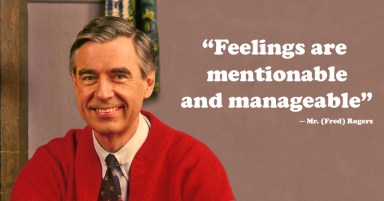
Fred Rogers is famous for saying that emotions are mentionable and controllable, but in this instance, there was no mentioning at all.  There was just the damaged pet.  But Rogers knew what the emotion was anyway.  I saw the film of the conversation.  I had no idea what the kid was upset about.  I might very well have offered to buy him a new toy because I so misunderstood the real issue.  Rogers didn’t.  He went to it without so much as a skipped beat.

Goose bumps

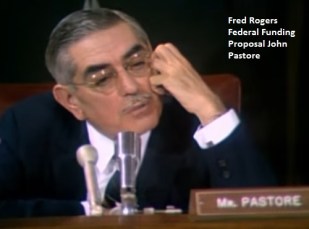
Rogers was given a chance to testify before Sen. John Pastore’s committee.  The Nixon rogers 9administration budget had in mind cutting funding for the Public Broadcasting System, which would have included Mr. Rogers’ Neighborhood,  and that what the issue was when Mr. Rogers sat down at the witness table to give testimony to Sen. Pastore, a notably irritable and plain-spoken chairman.
Take a minute and remember what the political climate of 1969 was like.  Remember the riots of 1968 and the controversial election of Richard Nixon.  Mr. Rogers asked if the committee would like to hear the lyrics to a song he often used on the show.  Neither Pastore nor I had ever heard it.  It goes like this.

What do you do with the mad that you feel? When you feel so mad you could bite. When the whole wide world seems oh so wrong, and nothing you do seems very right. What do you do? Do you punch a bag? Do you pound some clay or some dough? Do you round up friends for a game of tag or see how fast you go? It’s great to be able to stop when you’ve planned the thing that’s wrong. And be able to do something else instead ― and think this song ―

“I can stop when I want to. Can stop when I wish. Can stop, stop, stop anytime … And what a good feeling to feel like this! And know that the feeling is really mine. Know that there’s something deep inside that helps us become what we can. For a girl can be someday a lady, and a boy can be someday a man.”

And he recited the whole thing. You can see how long it is.  It didn’t feel long as I watched him recite it.  Given the OK Corral context of the scene, I think I understand how the suspense carried me along.

Pastore’s response went like this.

“I’m supposed to be a pretty tough guy, and this is the first time I’ve had goose bumps for the last two days,” he said. “Looks like you just earned the $20 million.”

“The twenty million” is a reference to the entire budget allocation for NPR, which was the issue before the committee.  Rogers seems a simple, even a naive man, in the committee setting, but he was right on the money with Sen. Pastore, just as he was with Daniel.

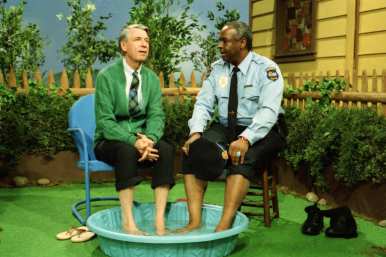
Then he poured water into a basin and began to wash the disciples’ feel with the towel

There is a longer version of the story in John 13, but The Reverend Mr. Fred Rogers, ordained minister in the Presbyterian Church, very likely knew what his adult viewers would be reminded of, consciously or not. [1]

This was a time when swimming pools were “being integrated,” that is, black kids were allowed to swim in the public pools along with white kids.  The movie shows film of a pool manager dumping chemicals into the pool in an attempt to clear the black kids out.  I had never seen that footage and the context to what was going on in the Neighborhood was stark.

rogers 8Rogers invited the local cop, a black man, to take off his shoes and socks and cool his feet in the little wading pool you see here.  Feet.  Hot.  Cool water.  Sharing towel.  Easy camaraderie.  Nothing in what you see on the screen feels like public policy.  It doesn’t feel like protest.  It seems like something neighbors might do on a hot day.
Those three episodes are enough, I think, to suggest what the movie has to offer.  Alissa Wilkinson, in a vox.com review of the film said that “it feels radically subversive.”  I didn’t like that observation before I saw the movie and I am still not sure I agree with it, but now I know what she meant.  You do come out of the movie feeling that you have been living in a different place, a place dominated by different values.  It gives you a chance to wonder, again, whether we are really doing the right thing.

It’s Starbucks Time

As winning as Fred Rogers is in the variety of settings in which we see him, I never quite shook the “yes, but” feeling I got when he tried to explain his more general approach to children.  There were no standards in his approach, no limits, no achievements. [2]

My brother, Karl, was a pediatrician for many years and in that capacity, he saw a lot of different parenting styles.  I have often heard him say that amid all the superficial variety of these styles, every one that had firm clear standards and warm nurturing support, worked just fine.  Present parents, clear standards, warm support.  I took for granted that he knew what he was talking about and that is the standard I aimed at in raising my own kids.  I didn’t see any of that in the Neighborhood.

Probably the best-known typology of parenting styles comes from the work of Dianarogers 7 Baumrind.  Using her original typology [3] I would say that Fred Rogers believes in a low control/high warmth combination, which Baumrind calls “Permissive.”  What my brother and I were aiming for was high control/high warmth, which Baumrind calls “Authoritative.” [Not, please, “authoritarian.”  That’s a different style in Baumrind’s mix.]

The role of “control” in those styles of parenting is to make it possible for children to respect themselves.  Every study I have ever seen of the topic shows that the U. S. leads the world in “self-esteem.”  We think we are wonderful. [4]  But we don’t think we are good at things because to be good at things, you have to master the requisite skills and to master them, you have to fail so you can correct whatever you did wrong.  The trying and failing and mastery and consequent “self-respect” require the clear standards that seem to be missing in the neighborhood.

“Self-respect” was not the issue Mr. Rogers was trying to address.  That’s why I have no quarrel at all with his wonderfully therapeutic touch with children and adults, and even, when necessary, with Senators.  But when that project is blown up into a way of understanding “what children need,” I start to squirm because what I needed was a way to respect my own efforts and, eventually, myself.  And I think that’s what a lot of kids need.

And if there were only a Starbucks in the neighborhood, Fred and I could go there and work it out.  And I am sure we would.  I like him a great deal. [5]

[1]  In a similar manner, FDR used to refer to his wealthy opponents as “malefactors of great wealth,” trusting that the only other context in which his listeners would have heard the word “malefactors” was in the King James Version of the crucifixion of Jesus and that it referred to the criminals who were being crucified at the same time.  Sometimes just placing a word in a context is all that is needed.

[2]  Bette says they were really there.  It is just that they were not shown in the movie.  I don’t know how she knows things like that but I know not to bet against her.

[3]  Baumrind has since expanded the typology by allowing mid-range values for the scales, not just high and low.  Using the expanded typology, it is possible that Mr. Rogers would be “mild control/high warmth” or “Democratic” parent.  That would be only mildly ironic for Mr. Rogers, the lifelong Republican.

[4]  This is the element of Rogers’ teaching that produced protests from the Wall Street Journal and Fox News, both of which were shown, but not explored, in the movie.  No Starbucks, remember”

[5]  And I can hardly wait to see Tom Hanks playing Fred Rogers in You Are My Friend, which is currently being produced.

Posted in A life of faith, Living My Life, Movies | Tagged , , , , , | Leave a comment

It isn’t HIM, it’s THEM

The New York Times did us all a service in its June 23 article, “As Critics Assail Trump, His Supporters Dig in Deeper.”  I confess that I liked it partly because it wasn’t news to me, but I also liked it because my own angle on political psychology looks most closely at the reasons people give for the things they do and the things they say.  That is really what this article is about.

Jeremy W. Peters, who wrote the article, has spent a good deal of time talking to Trump voters.  I think what he really wanted to ask them was how they can still support Trump after all he has done.  But that’s not really what happened in these interviews.

I counted seven of them all together and what I am going to do in this essay is reflect on just what some of the seven Trump voters wanted to talk about.  In most cases, it isn’t Trump, but the connection between Trump and and the polarized environment is best illustrated by Ms. Anders, who has the first and also the last word in this piece.

Ms. Anders

Even if Mr. Trump wasn’t at the center of the national conversation, Ms. Anders, the Loudoun County business executive, said she thinks that the country would still be polarized. But as long as he is, she said, people on the right and the left will probably continue to dig in based on what Mr. Trump does and how his opponents respond.

“It all coalesces around Trump,” she said. “It’s either, ‘Trump wants to put people in cages, in concentration camps.’ Or, on the other side, ‘Oh the left just wants everybody to come into the country illegally so they can get voters.’”

She concluded: “We can’t have a conversation.”

Trump 4She notes that the country was polarized before Trump arrived—she didn’t say that Trump didn’t make it worse.  The difference is that it is very difficult, now, to talk about the polarization.  The topic defaults to Trump instead.  “He wants to put children in cages” say the people who “just want to leg everybody come into the country illegally so they can get voters.”  [It is not my fault that the apostrophe is where it is.]

Neither of those is Ms. Anders’ view.  She would like to have a conversation rich enough to sustain the nuance and complexity—her words—that the issue deserves.

But then she comes down at the commonest of all Trump landing places: she is angry at Trump’s critics and “it makes me angry at them” and it makes me “want to defend him to them more.”

The words I would like to highlight are “to them.”  She wants to defend Trump “to them.”  There is the fraught relationship.  That is what is drawing Ms. Anders’ attention.  The reaction of Trump’s critics are “overblown” and it makes her angry.  Trump disappears from the battlefield at this point and the war between Ms. Anders as the Trump critics continues unabated.  If Trump were to disappear tomorrow, the critics would still have done what they have done, would still have committed their crime and Ms. Anders would still be justifiably angry at them and would still want to blame them for what they had done.  They destroyed nuance and complexity and they have to be made to pay for what they have done.

I agree with nearly everything Ms. Anders says.  She doesn’t apply her criticism to herself, which something a compassionate liberal might be able to help her with, but what she ways about the President’s critics is exactly right.  My disagreement with Ms. Anders is about salience.  There are two issues to deal with here.  Trump is doing terrible things (that’s one) and his critics are immoderate in their criticism (that’s the other one).

Ms. Anders is so deeply offended by the critics that she is willing to downgrade the Trump policies to second place.  What the policies are and why they are being pursued and what the effects are and what alternatives are being foregone—all those are secondary.  The most highly salient issue to her is the quality of the critics.

It is at that point that I have to leave her.

Schrantz and Arnold

They are interviewees #2 and #4 in my list.  They, too, are not addressing President Trump and if, as I suspect, the question Peters really wants to ask them is, “How can you keep on supporting this guy!?” he is going to continue to be frustrated.  That is not what the Trump supporters talk about (with the single exception to be dealt with at the end).

Here is Schrantz

“He’s not a perfect guy; he does some stupid stuff,” said Tony Schrantz, 50, of Lino Lakes, Minn., the owner of a water systems leak detection business. “But when they’re hounding him all the time it just gets old. Give the guy a little.”

“They”—could refer to the media, could refer to Trump critics—are hounding him all theTrump 1 time.  That is a fact.  Mr. Schrantz is correct.  There are two things wrong with what they are doing.  The first is that they are not being “fair-minded” (my word) in that they are not giving him any leeway.  I think that is what the reference to “a little” is.  Trump is a public figure and they—the media or the critics—ought not to be so quick to judge him.

The second thing that is wrong is that this persistent criticism has lost its entertainment value for Mr. Schrantz.  “It just gets old” is not a comment on the truth or even the importance of a criticism of the President.  It’s just that having heard it so much has worn off the novelty.

Arnold agrees.

“It’s kind of like when you experience a sensation over and over and over again,” said Daniel Arnold, 32, a warehouse manager from Leesburg, Va., about an hour outside Washington. “A sensation is no longer a sensation. It’s just, ‘Oh, here we are again.’”

Arnold is looking for anomalies.  The criticism of the President by the media is not anomalous, so it is not worth paying attention to.

Julie Knight

“It bothers me that he doesn’t tell the truth, but I guess I kind of expect that, and I expect that from the media, too — not to always tell the truth or to slant it one way,” said Julie Knight, 63, a retired personal injury case manager from Algona, Wash.

Ms. Knight comes at it from a different side.  She has been following the news and she knows that the President doesn’t always tell the truth (A common New York Times headline is “Trump lies about ______”)  But she doesn’t think the media always tells the truth either.  So we have a source we don’t trust saying that an officeholder we like is lying.

A more serious criticism, although it doesn’t seem as major in her comments, is that what she means by “telling the truth” is not slanting the news one way or the other.  This is completely useless way to assess “slant.” 

When the media choose one story rather than another, they are slanting “the news.” When they shape the narrative one way or the other, they are slanting the news.  There is no way to tell the news without “slanting “ it.  And if that is Ms. Knight’s criterion, there are no news reports at all that she can trust.

This is the reason for the success of Trump’s argument that “the media” are the other Trump 2party.  There is his administration and then there is “the media.”  This means that the President is running in a one-horse race, which means we know who is going to win it.  The notion that the opponents are the Democrats and that the media’s job is to call the fouls and enforce the penalties, is a notion long abandoned.  Ms. Knight is a prime example.

On the other hand, some Trump supporters really do address the policy context and the way they do it speaks volumes about how Trump has regained their loyalty. 

Here is John Westling.

“Let’s see,” said John Westling, 70, of Princeton, Minn., reciting a list of the president’s accomplishments that he said no one in the media wants to talk about. “Economy booming, check. Unemployment down, check. Border security being addressed, check. Possible end to the Korean War that started when I was 3 years old, 68 years ago, check.”

This list has the advantage of actually being about policy outcomes, at least superficially.  But this kind of support is very thin.  Westling says that the booming economy and the low unemployment numbers” are “achievements” by the President.  But that’s not really the way the economy works.  Presidents who are in office when the economy is bad are blamed and those who are in office when it is good are praised.  The causal links are completely obscure.  And does anyone think that when the economy tanks and unemployment goes back up, that Westlake is going to blame the President for it?  Of course not

Border security is “being addressed” says Westlake.  Emotionally, that is the kind of claim any President’s supporters make.  “At least he is trying,” they will say.  But Mr. Westlake seems to think it is an achievement.  He certainly thinks the recent meeting with Kim Jong Un is an achievement although nothing has yet come from it and most experts seem to think nothing will.  “Possible end,” says Mr. Westlake.

And there are others.  Lynn Dittbenner admits that it is terrible about kids getting separated from their parents at the border, but “the parents shouldn’t have been there.” Gary Winthorpe is wary of the President, but feels that he is doing his best and that people ought to recognize him for that.  The list of devices goes on and on.

Balls and Strikes

Of the people featured in the article, only John Westlake looks at the policy outcomes—or in some cases, the intentions—and says they are praiseworthy.  I have given the reasons why I think those “outcomes” are spurious, but Westlake is using the right metric.

The other Trump supporters have turned instead to attacking the media. THEY are not being fair to HIM.  I think it is surprising that the Democrats don’t show up in this set of justifications.  For these people, I think there are no other proposals for governing the nation.  There is only President Trump and whether he is being treated fairly or not by his critics.

This is the kind of perspective you hear from fans of the home team who believe that the umpire is not calling the balls and strikes fairly.  They see the pitch from where they are seated.  They hear the call from the umpire immediately behind the plate.  They say that he is mistaken or corrupt because that’s not what the pitches looked like from where they are sitting.

These Trump supporters are, in other words, fans.  This is not a citizenship perspective.  These are not voters who would choose between two policy directions the one that is best for the country or even the one that is best for them.  They love the pitcher and the umpire is cheating.

End of story.  It’s not a pretty story, it seems to me, but this way of understanding how they justify their political preferences helps me grasp, finally, why for this part of the electorate, nothing will work.

Posted in Political Psychology | Tagged , , , , | Leave a comment