Is Forgiveness a Good Idea?

I want to begin with as simple a phrasing as I can.  Things are going to get so messy that I want to have something to look back at, as I would look back at my own innocent youth if I had had one like that.  The simple phrasing is: Is forgiveness a good idea?”

forgive 1There are some old notions of forgiveness that refer to social processes.  These were not that complicated because they meant one thing rather than many things simultaneously and because they were transacted in public.  When a debt was “forgiven,” you were no longer expected to pay it and you also did not go to debtor’s prison or into slavery.  All of those are really clear.  No one asked whether you were “really forgiven” of the debt.  (Notice that “of;” we will need it again and I want you to know where I parked it.)

But no one was expected to loan money to that person either.  He was not declared to be a good risk on the grounds that he no longer owed money.  Giving money to people who don’t have any and need some might be a really good idea, but good or not, it would be called charity.  Loaning money to people who are not at all likely to have the resources to repay you is just stupid.  We are talking about loans here, not gifts.

All these transactions are, in principle, public transactions.  The rich person—we are not considering branch managers here—who makes the loan and the poor person who gets the loan are characters in a public drama.  Let me illustrate by citing the word “bankrupt.”  Its literal meaning is “broken bench.”  You were lending money in the marketplace.  You had a bench that served as your place of business.  When you were no longer had the resources to be a moneylender, they came and broke your bench.  You were “bench-broken;” bankrupt.

Mostly, though, when we talk about “forgiveness,” we are talking about being releasedforgive 4 from an offense and the altered relationships the offense has caused.  This is not a public process.  It is not publically understood and supported by social sanctions.  It is private—although often it is not as private as we think it is—and personal.  And that is why we need that “of,” which I parked back at the end of the second paragraph.

To be forgiven “of” an offense means something different that “being forgiven.” (I’m going to introduce “forgiven for” in a little while to make that clear.)  What does it mean to forgive “a person” as opposed to forgiving a person of an offense?  It doesn’t mean anything at all to me.  I think it is just an unfortunate contraction of the words we use.  I think it would be clumsy always to say, “I forgive him his offense (having an offense in particular in mind)” and it is much easier to say, “I forgive him.”  But now we have committed ourselves to a phrasing that is hard to understand.  It is personal and private;  it is no longer specific; it is emotionally volatile.  And we have given up a phrasing that is interpersonal and public; it is more specific; and  it is not quite so emotionally volatile because it has to do more with doing and not just with feeling.  Maybe that’s why I like it so much better.

In this setting, as in so many others, we have individualized and interiorized a meaning that was once social and public.  There is value, I think, in keeping the old meanings in mind.  I don’t think we are able to mean them anymore, but knowing what they once meant might help us.  It’s a little like Ariadne’s thread, which helps us find our way back out of the mazes we have built for ourselves and in which we often get lost.

Please allow me a brief detour.  I have a lot of theologically astute friends who might just forgive 3put this down in disgust if I do not make it plain from the outset that this piece is not theological.   At all.  Maybe I should have written about God’s forgiveness of us and our consequent obligation to forgive each other.  And maybe I will.  But not today.  This is mostly a psychological and linguistic consideration, leaning heavily on the social processes that underlie the psychology and the language we use.

So, what do we mean by “forgiveness?”  I don’t think we mean that “it” is forgotten.  I put “it” in quotes because there is no abstract way to say just what is to be forgotten.  In my classes, I have often made use of a series that goes like this: a) an action, b) a trait, c) a person’s character, and d) human nature.[1]  I don’t know all that much about human nature and I look with wariness on anyone who says he does.  I put “human nature” there to mark the end of the series.  The rest of the series is pretty unremarkable.  There’s  a) an act, like forgetting an appointment; then there’s b) a trait (a series of acts) like “forgetfulness.”  I would probably call it “irresponsibility” because it would irk me so.  A cluster of traits could be assembled.  He is genuine or simpleminded or single-minded or cruel or pathetically eager to please; I would call that  c) “character.”  Does it make any sense to think of “forgiving” a character?  I don’t think so.

I think it is foolishness to go to naively a meeting with a guy who misses half his appointments and not to make other plans.  Take your computer with you; you can blog while you are waiting.  You may have forgiven him—in a sense I am getting to in just a moment—but you have not forgotten that he is not good about appointments.  The factforgive 2 that you remember is a good thing.  It means you might leave an email reminding him of the appointment or call an hour before or keep a side line of communication with his wife.  You could do any of those things with a good spirit, even if you wished you didn’t have to do them.[2]

It is when you go to meet your friend carrying your resentment with you, that you know you have not forgiven him.  When you tell the story to others, making light of his difficulties, you have not forgiven him.  It’s fine to remember “what he is like.”  How, otherwise, could you mitigate the effects.  But when you remember for the purpose of keeping the grievance fresh and “sharing it” with others, you are refusing to forgive.

Let’s come back now to that “of.”  We started by looking at a usage like “forgiven OF a debt.” The way I am looking at this, you can always forgive a friend (or an enemy) OF an act.  You might forgive him OF a trait: something he often does and therefore is likely to do again.  When we get to the next larger collection, character, it gets harder to keep the phrasing “forgive OF.”  When you get to what a person’s character is like, we might begin the think of forgiving FOR.  “He’s a heartless bastard and he made my adolescent years a living hell, but I forgive him FOR that.”[3]  Note 1: I’m not saying that’s a good idea.  I’m just distinguishing between “forgiving of” and “forgiving for.”  Note 2: I’m not saying it’s a bad idea either.

Here’s an episode I thought was surprisingly apt.  This is from the first two pages of Robert Parker’s Stranger in Paradise.  Jesse Stone is chief of police; Molly Crane is the office dispatcher; Wilson Cromartie is a professional criminal.

Molly Crane stuck her head in the doorway to Jesse’s office.

“Man here to see you,” she said. “Says his name’s Wilson Cromartie.”

Jesse looked up. His eyes met Molly’s. Neither of them said anything. Then Jesse stood. His gun was in its holster on the file cabinet behind him. He took the gun from the holster and sat back down and put the gun in the top right-hand drawer of his desk and left the drawer open.

“Show him in,” Jesse said.

Molly went and in a moment returned with the man.

Jesse nodded his head.

“Crow,” he said. “Jesse Stone,” Crow said.

Jesse pointed at a chair. Crow sat. He looked at the file cabinet.

“Empty holster,” he said. “Gun’s in my desk drawer,” Jesse said. “And the drawer’s open,” Crow said. “Uh-huh.”

“No need,” Crow said.

“Good to know,” Jesse said.

“But you’re not shutting the drawer,” Crow said.

“No,” Jesse said.

“Nothing wrong with cautious,” Crow said.

The two lines I like best are Crow’s “No need” [You don’t need to be that careful about me] and Jesse Stone’s “Good to know” [Nice of you to say that.  I’m leaving the gun right where it is.]

Jesse has not been nursing his resentment of the havoc Crow caused the last time he was in town.  On the other hand, he is not discounting the possibility that he is in town to cause a little more havoc.  Jesse is ready, but he is not resentful.  In the way I’m using the words, I would say Jesse has forgiven Crow of his actions; he has forgiven Crow for being an exceptionally competent killer.  On his own behalf, he is going to keep his gun handy.  On the town’s behalf, he is going to do everything he can to find a way to charge him with the crimes he committed the last time he was in town.

My idea is that you can tell whether you have forgiven someone by watching what you do.  If you feed the smoldering fire of resentment—if you don’t feed it, it goes out eventually—you have not forgiven.  If you tell jokes or recall stories or distort other relationships as a way to freshen up your hostility, you have not forgiven.

forgive 6We talk about “carrying” a grudge.  I think that’s a very evocative metaphor.  I’ve heard it likened to carrying rocks in your backpack.  Every time the guy you are resenting does something else, you put another rock in your pack.  That’ll show him you’re nobody to mess with!  And if he does it again, you’ll put ANOTHER rock in the pack.  You can get really tired “carrying” grudges.

One final tricky turn yet and I’ll wrap this up.  All the ways I have illustrated the lack of forgiveness are active.  They are things you do.  You actively feed resentment and you actively tell stories and so on.  But there are passive ways, too, of reminding yourself not to forgive and of displaying your lack of forgiveness to your friend (or your enemy).  Choosing active punishment or passive punishment is just a matter of what tools are at hand or of your own preference for active or passive means. One isn’t any better than another.  They are both bad.

On the other hand, you might choose not to meet with a guy who blows the meeting off half the time.  You might just keep a prudent distance from someone who delights in tormenting you.  You might just stop denying what his arrogance costs you—everyone else knows it anyway—and admit that it hurts every time he does it and cut down, as you are able, on his opportunities to keep doing it.

Every one of those, as I see it, is compatible with “having forgiven him OF” the actions of the past and with “having forgiven him FOR” who he is.  You aren’t carrying the weight.  You aren’t feeding the fires.  You are at peace with how you have responded and with how you are responding.  And you’ve made the decision not to be stupid.

[1] My academic study has been a study of the reasons people give for why something happens.  “Reason giving” is changed significantly by referring to the action of a person, for instance, or the character of a person.
[2] I had an episode of depression in 2006—still unexplained—during which I was a bad appointment risk.  I went so far as to tell a friend that I had every intention of meeting him, but I would ask him to call an hour before just to get a current assessment of whether I could manage it.  It was an extraordinary act of kindness for a friend to do that, but I never had the sense that it was begrudged.  And I have had friends since then who have found themselves in that kind of bind and I am the one who calls an hour ahead to be sure.  I have never had the least sense that I am doing something I “shouldn’t have to do” or that I begrudged.  Possibly…probably…because it was done for me.
[3] The best  movie depiction of this process I know is in Pay it Forward, where Arlene McKinney meets here mother, Grace, in the railroad yard where Grace lives for the purpose of forgiving her for the abusive and neglectful childhood the mother had laid on her.  The dialogue just stops and we see the face of a woman who is being deeply forgiven for many awful things she has done.  It helps that she is, at the same time, invited to her grandson’s birthday party—but only if she can manage to be sober for it.


Posted in Living My Life, Political Psychology, Uncategorized, ways of knowing | Tagged , , , , | 2 Comments

What I’m Good At

“There are two things I know to be true. There’s no difference between good flan and bad flan, and there is no war,” says CIA agent Charles Young (William H. Macy), in Barry Levinson’s mercilessly funny movie, Wag the Dog.  Two seems like a good number.  I’m going to try to say two true things today.

The older I get, the more I am attracted to spending my time doing things I am good at.[1]  It’s not that I don’t need to get better at a few things I’m not all that good at now.  That would be really nice and I plan to do some of them.  But what gives me enduring satisfaction and enduring pleasure—two very different things—is helping people have conversations they would not be able to have if I were not there.

I know that doesn’t sound like much, but it just might be really important.  Here’s a paragraph’s worth of theology on why it might be important and why no one really knows.  I believe in the Providence of God.[2]  That doesn’t mean I know what it is.  The most practical thing I get from believing in Providence is that I am no longer certain how small a small kindness is or how catastrophically bad a “harmless prank” can be.[3]  So I am not (any longer) daunted by how small and insignificant my gift seems because I no longer believe that how small it seems matters very much in the Grand Scheme of Things.[4]  End of theological excursus.

There are two elements that make up this talent.  The first in hearing hidden premises.  The second is a sense for the integrity of the argument itself.  Everything else I want to say today will be about what those words mean.

Hidden Premises.       It is an odd thing to put an intention into the form of speech.  I’mimplicit 7 going to list a series of booby traps that very often blows the transmission of intention right off the road.  Most of them, I don’t care about.  First, there is the question of just who is speaking.  “Who I really am” is strongly situational.  Who I am when I am with these people is not at all like who I am when I am with those people.  Who I am under stress is not like who I am relaxed and focused.  And so on.  One of the most common hidden premises of ads for shaving products, for instance, is the beautiful women that come with them.

Second, there is the question of intention.  I have a credit card that renders the name Dale E. Hess as Dalee and that is the way the company addresses me.  I don’t really care.  On the other hand, one of the guys used to have coffee with in the morning—at a Starbucks in a galaxy far away—thinks I’m a pansy and if he persisted in calling me Dalee, I’d come right up out of my chair.[5]  The computer at the credit card company is dumb; the guy at Starbucks is malicious.  I can tell that because I can hear the emotional premise of what he says.  That’s a really useful thing to be able to do, particularly if you are always right (which, alas, I am not), but that’s not what I’m talking about.

implicit 1The premise I am talking about is the intellectual premise.  In the midst of a discussion, you hear someone make a proposal.  He means it; at least he means the surface of it.  But he doesn’t know why he chose that particular thing to say or what the necessary presuppositions are that underlie the charge.  Very often, I hear all three of those at the same time.  Sometimes they sound like three voices to me.  I hear what is said and what is presupposed and what, from among the plethora of possible emphases, was chosen for particular emphasis.

I’ve been part of a lot of conversations about public policy.  I know you can feature how bad the problem is that the policy is supposed to address.  You can talk about how this policy will save money in the long run if it is invested now.  You can talk about the sincerity of the proponents or the insidious schemes of the opponents.  You can argue that no one will be worse off and some will be better off.  You can argue that this is just the right thing to do, but not by government; or not by the courts particularly; or not by the appellate courts; or not by that particular appellate court.  You get the idea.

Most often, I can “hear” what grounds for action are not being chosen.  If there are five common reasons for making this proposal, I hear the silent ones as well as the verbalized one.  I see the speaker passing by this one and this one and this one and this one and choosing that one.  I can clearly see the unchosen premises and sometimes I can guess why they were not chosen.

How best to use this kind of sight is a problem I face.  Let’s say the question is about child abuse and what can be done to make it less frequent.  The speaker proposes that every instance of child abuse be considered a felony and that the testimony of the other parent—presuming that there are two parents in the setting—will be sufficient for conviction.  I can see all the concerns he has not brought forward.  I see that he has chosen a particular bad behavior, that he wants it criminalized, that he wants serious punitive consequences, and that he wants conviction to be simple and straightforward.  He might have no sense of having made all those choices and in a sense, if he was unaware of them, he didn’t “make them” in the same sense.  But they are there.

The Integrity of the Argument:          My gift is seeing what has been chosen and what has not.  Now I need to decide what to do.  That moves me on to the next focus.  The second part of this gift is an appreciation for the integrity of the argument.  I am often the only guy at the table who is friends with the structure of the argument; who does not want to see it abused.

That’s not always the case, of course.  When a debate is going on and I am one of the implicit 5parties, I try to rig the structure of the argument so that it “comes out right.”  I am perfectly capable of arguing that this is essentially an individual question (if it might otherwise be decided by the group) or that it is an ethical question (if it might otherwise be decided by statute) or that the market will take care of that by itself (if state regulation is in the offing).  I know how to do things like, just as everyone else does, and for quite a few years, I was paid to drive down to Salem, Oregon’s capital, and do it for a living.

But that’s not what I’m talking about.  I would choose—and very often I am now free to choose—not to be one of the parties to the discussion.  I am an amicus tractiae.[6]  I am a “friend of the argument.”  I want it to succeed.  I want it to be healthy and robust.  I come right up to the edge of saying that I want it to be happy, but then I shy away.

And what is the enemy of a happy argumentative structure?  Is it partiality?  I want the argument rigged so that I will prevail!  No, I want the argument rigged so that I shall prevail?  Nope.  That’s not it.  When everyone is arguing his own argument within a common and robust structure, all is well.  It is when they are making incompatible arguments and no one has noticed that everything gets screwy.  There is a wonderful scene in Gilbert and Sullivan’s The Pirates of Penzance in which the Major General and the Pirate King are on the verge of conflict when someone realizes that the Pirate King is saying “often” and the Major General is hearing “orphan.”  When each realizes what the other is saying, the brewing conflict simply evaporates.

implicit 6When you are making an argument that starts from a different premise than mine or that proceeds by a different logic than mine or that features a different emotional color than mine—and I don’t that—you look like a knave or a fool to me.  Your argument is wrong, it is shabbily put together, and emotionally perverse.  When I understand that you are making a different argument, it looks to me and feels to me like…just a different argument.

John Gray dramatizes this so well in his well-known Mars/Venus books.  This is how they argue on Mars (how men argue), Gray says, and that is how they argue on Venus (how women argue).[7]  If a man doesn’t know that, he thinks the woman is trying to argue the way he does and is making a fearful hash of it.  When he learns that she is not trying to argue that way, that she is arguing in an entirely different but equally valid mode, then he can set about taking her argument on its merits.  Not on his merits.  Not on her merits.  On IT’s merits.

It is misaligned arguments like that that can benefit from an amicus tractiae and that would be me.  At my best, I can recognize that different kinds arguments are being made and are not being recognized.  I can build and hold in place a conceptual structure that has a place for both arguments to appear and within which they can be seen to be different from each other and potentially, deserving of respect.[8]  I get hammered on from both sides sometimes.  If you want to tilt the argument this way because it shows how unrepentantly silly the other person’s argument is, you will not want a structure to be built that shows that your argument, too, is “a kind of argument.”  My holding the structure in place is keeping you from tilting it.  I get hit from the other side for the same reason.  But being a friend of the argument itself, wishing it integrity and robustness, is going to mean that the parties might not like what I am doing.

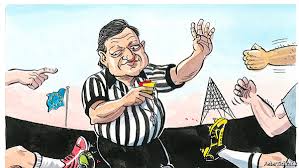
I’m OK with that.  There are times when everybody hates the umpire. [9]  Even worse is a person who is actually one of the parties and who is trying to pretend to be “not one of the pair,” to be “above it all.”  Nobody’s OK with that, including me.  When I find I slipped into it and failed to notice it at the time, I am embarrassed and I have to fight down the feeling that I ought to apologize.

So…I have a gift.  Or a curse.  I guess it depends on how you look at it.  I really do, often, hear hidden premises.  I really do, often, exercise my role as amicus tractiae.  It brings value, sometimes, to discussions that would suffer if someone didn’t do those things and I like at least to try.

[1] “…if you will forgive the grammatical inadequacies of that sentence,” says Dr. Alfred Jones (Ewan McGregor) in Salmon Fishing in the Yemen.
[2] Everyone exercises “providence” in the sense that we “provide” for what we “foresee” (pro + videre = to see).  When God is the subject of the sentence, I use the capital P in Providence to keep my providingness separate from His.
[3] We seem to be doing movies today.  For the former reference, see Pay It Forward; for the latter, Needful Things.
[4] A Grand Schemer is postulated, of course.
[5] After which I would ask him if he’s like to step outside and settle this.  If he were dumb enough to fall for that one, I would lock the door behind him.  If he found his way back in, I suppose I would have to be the one to go outside.
[6] That’s plausible.  It is built on amicus curiae, of course: “friend of the court.”  The Latin word for “discuss” is trahere, which means a lot of other things as well, but which has a past participle, tractus, which, as a noun, would mean “discussion.”
[7] He overdoes it, of course.  The “men” and “women” in his illustrations are just genderized stick figures.  That’s what makes his presentation so clear and its application so useful.
[8] Of course, in any mode of argument—Gray’s male style or his female style, for instance—there are good argument and poor ones.  The standard I am talking about requires only that they be judged by the appropriate criteria.
[9] Etymologically, we get “an umpire” from a numpire.  “Numpire” comes  from the Middle English noumpere, meaning “not a pair.”  The two people who are arguing are a pair and you—the umpire—are not one of them.  You are “not a pair,” which is easy to resent when the pitcher and the batter both know you are wrong.

Posted in Getting Old, Living My Life, Paying Attention | Tagged , , , , , | Leave a comment

“Commemorating” Vietnam, 50 years later

How will we go about commemorating the 50th anniversary of a war from which we have not yet recovered.  I was thinking about the Vietnam War, but it has been 150 years since the American Civil War and there is abundant evidence that we have not entirely recovered from that.

trust in governmentDoes a nation ever recover from a war about which the citizens are deeply divided?  Maybe not.  Maybe a war is a self-inflicted wound.  We can stop the bleeding, but we can’t recover the integrity we enjoyed before the wound.  There will be scars.  The scars will reduce our flexibility.  We’re going to need that flexibility and it is gone, along with the trust Americans used to feel toward their national government.

On Memorial Day 2012,” says today’s New York Times in an article by Sheryl Gay Stolberg,     “President Obama issued a proclamation establishing a 13-year program, lasting until 2025, “in recognition of a chapter in our nation’s history that must never be forgotten.”  We really don’t need to spend $15 million for that—it will not be forgotten.  On the contrary, it will be remembered.  But it will be remembered differently by different people and that is our problem today.

It isn’t just the hatreds.  Jane Fonda will be remembered forever by some part of our population as “Hanoi Jane.”  Allowing pictures like to be taken was foolish and insensitive.  She has apologized for her bad judgment many times.  But she and Tom Vietnam 4Hayden, whom she would marry the next year, had gone to North Vietnam to check on the truth of the Pentagon claim that they had not bombed civilians.  They saw “destroyed villages” and said so by every available medium.  What they wanted to say was that the American people were being lied to about the conduct of the war.  Many Americans felt either that the war was, in fact, justified by the nature of the threat it posed, or that showing that your own country was lying was an unpatriotic thing to do.

And there it is.  What is the patriotic thing to do?  I can think of three approaches.  I don’t want to go so far as to endorse any of them, but whatever we wind up doing ought to be seen against the background of what else we could have done.  Nothing is going to be good.  Is there a way to make it less bad?

Denial:                        The first option is to pretend it didn’t happen.  We can’t deny it, of course; not with such a powerful Vietnam Memorial in Washington D. C; not with organizations of Vietnam Veterans still prominent?  And what would it mean if we did? Would it mean that we really don’t know what happened to the 58,000 or the roughly triple that number wounded?  There is no denying the battlefield heroism of many young Americans.  Why would we want to deny it?

vietnam 6On the other hand, the war itself—apart from the experiences of the people who fought the war—was a dubious policy adventure so say the least.  It looked like a disastrous mistake to me at the time and my sense of it has not improved in the last fifty years.  So let’s say, for the purpose of this contrast, that the war was a disaster; an atrocity.   How do we condemn the war as a whole, while recognizing the heroism of so many individual soldiers and while mourning the loss of so many young men?   What’s the patriotic thing to do?

We could see condemning the war as patriotic. “Living our values doesn’t make us weaker, it makes us safer and it makes us stronger. And that is why I can stand here tonight and say without exception or equivocation that the United States of America does not torture,” Obama said.[1]  He equated patriotism with “living our values” and just as he used that stance to condemn torture, we could use it to condemn our involvement in Vietnam.

We could see denying the war as patriotic.  We did, of course, send American advisors to help the beleaguered South Vietnamese, who were being invaded by their neighbors to the north.  After that we sent troops to support the fledgling democracy in South Vietnam.  In the end, the South Vietnamese were not able to defend themselves, but we tried our best to help them.  (The echoes of our exit from Iraq and Afghanistan are eerie.)  I see that stance as “denying” that we really did what history shows we did in Vietnam and it also identifies “defending democracy” as what our participation was about.  We could call that patriotic.

Justification:   The war in Vietnam was just one more link in America’s successful “containment strategy.”  The theory was that if communism could not expand, it would implode.  We stopped communist expansion in Europe, across the Middle East, andvietnam 7 (Korea and Vietnam) in Asia and today the major communist nations are trading partners and fellow members of the Security Council of the United Nations.  There were domestic protests, of course, which evaluated the war in Vietnam as a conflict without context.  They saw the costs of jungle warfare, but they did not understand the benefits of containment.  Vietnam was not a success for the United States, but the strategy as a whole worked well and we are the beneficiaries of it today.

The Free Market of Ideas:      As we come to the 50th anniversary of significant involvement in Vietnam, we find that there are still deeply held differences among us.  We are a strong enough country to admit that it was a dark time.  There were atrocities committed by U. S. troops; the bombing of the North was barbaric; our allies were venal and corrupt.  At the same time, we protected the South for a long time from the bloodletting perpetrated by the Viet Cong; we fought bravely for years in a war that was not a war of national expansion; there were uncounted acts of bravery and heroic sacrifice by our armed services.

There are two views, we would say. Our democracy is robust enough to allow free play to both of them and to retain the love of our country that has sustained us so far.  There is no need for us to fear the open debate of the meaning of our past.  To allow such debate and to contain it within a free society is one of our highest achievements.

I have presented those three approaches as possible, warning that the best we can hope is to minimize the damage.  Against that background, let’s briefly consider what the Pentagon is going to do.  We have a website up already  that signals the directions we might take.  Major General Claude M. Kicklighter is overseeing the presentation.  He says the mission is “to “help the nation take advantage of a rare opportunity to turn back to a page in history and to right a wrong, by expressing its honor and respect to Vietnam veterans and their families.”

You see where this is going, don’t you?  We are going to “right a wrong.”  We don’t know just what wrong that is, but in order to accomplish it, we are going to express honor and respect to Vietnam veterans.   If we take that means as a guide, we conclude that the lies by the Johnson administration that led to the Gulf of Tonkin resolution will not be among the wrongs to be righted.  Nor will the My Lai massacre, which is being called “an incident.”  Nor will the angry congressional testimony of a young Vietnam vet named John Kerrybe part of the display.

Vietnam 1Tom Hayden’s view displays his skepticism.  “All of us remember that the Pentagon got us into this war in Vietnam with its version of the truth.  If you conduct a war, you shouldn’t be in charge of narrating it.”  I share his skepticism.  I remember vividly an article by Noam Chomsky. In 1975.  The last chopper had just left the last rooftop in Saigon and he said the war to determine what this all meant was just beginning.

The US government was unable to subdue the forces of revolutionary nationalism in Indochina, but the American people are a less resilient enemy. If the apologists for state violence succeed in reversing their ideological defeats of the past years, the stage will be set for a renewal of armed intervention in the case of “local subversion or rebellion” that threatens to extricate some region from the US-dominated global system.[2]

I don’t remember ever hearing anyone call Noam Chomsky a patriot, but that assessment sounds pretty patriotic to me.


[1] His predecessor, George W. Bush, also said that America does not torture, but what he meant was that the practices, such as waterboarding, that everyone else called “torture,” really weren’t torture.  While the President was maintaining this position, the Vice President, Dick Cheney, was trying to exempt the CIA from a ban on torture that was being considered by Congress.
[2] The New York Review of Books, June 12, 1975

Posted in Living My Life, Political Psychology, Politics | Tagged , , , , , | Leave a comment

Reaping to the Very Edge

So…here’s an idea you might not have considered for a while. “When you reap the harvest of your land, do not reap to the very edges of your field or gather the gleanings of your harvest. Leave them for the poor and for the foreigner residing among you. I am the LORD your God.”

That’s Leviticus 23:22 in case it sounded familiar and you weren’t sure why.  I want to play with it a little today.  Frankly, it sounds immensely appealing and completely impractical.  Here’s something a little more practical.  This comes from Lisa Dodson’s survey of strategies for coping with poverty in the U. S. today.[1]

Three years earlier I’d met Andrew, a manager in a large food business in the Midwest, and he told me that low wages are a big dilemma for him too, though together he and his wife made a decent income. But many of the workers in the food company made “poverty wages,” and he was affected by all the troubles people bring with them. Then he told me, “I pad their paychecks because you can’t live on what they make. I punch them out after they have left for a doctor’s appointment or to take care of someone   And I give them food to take home. . . .

Today’s question is this: is the solution in paragraph one the modern equivalent to the solution in paragraph 2?  I don’t think so.  I don’t think there really is any modern equivalent.

gleaning 5In Dodson’s book, I met a produce manager who “managed” the standard for how good produce needed to be.  If it isn’t up to the standard, he can’t sell it, so he gives it to the people who work in produce—and, of course, to their families.  This guy raises the standard toward the end of every month.  The result is that more and more produce “is unacceptable” at the end of the month and may, therefore, be given to the underpaid workers.

The produce manager is leaving the edges of the field unmowed so the poor can come and glean.  He is making sure there is “surplus” by not taking all that is there to take.  It is, however, not his field so his behavior raises some profound questions.

In a society where there are landowners, hired workers, and “the poor,” leaving crops unharvested along the edge of the field looks pretty good.  The grain is all there.  Anyone can see that the owner “owns” the grain and would have a right to harvest it.  He would have, but he does not because he also has covenant obligations.  He owes a duty to the poor of the village, whom, presumably, he knows.  He also owes a duty to the immigrants, whom, presumably, he does not know.  God says, “You need to balance your harvest from the field with your obligations to people who will go hungry if you fail in this obligation.”

Another aspect of this picture is that the owners of the other fields are under the same obligation he is under and everyone can see who is obeying the law of God and who is not.  Without question, there will be farmers who interpret “the very edge” of the field to mean 5—10 feet and others who will estimate it at 1—2 feet.  Still, it is a public norm and compliance with that norm is a matter of common observation.

Finally, the farmer is not called on to determine which of the poor members of his society and which of the immigrants “deserves” access to the unharvested grain.  “Deserving” is no part of the question.  The need is presupposed and the response to the need marks the members of the covenant community.

Our society is just not like that, all things considered.  We are an urban society, which means that we don’t know each other and don’t expect to.[2]  We don’t deal in crops; we deal in cash and, increasingly, in credit.  The mythology of our society is that everyone could be and should be, “self-supporting,” so we have turned “the poor” into “the parasites.”  We have retained a fragment of the older ideology by talking, in some cases, of “the deserving poor,” but you can’t sustain a society like the one I described on the basis on judgments about who deserves poverty and who does not.

There are things we can do.  The produce manager has declared the “field” he manages to gleaning 4be “his field” and has left food for the poor.  We could make up some part of every public sector work crew of people who need the money, not of people who have the highest skill levels or the greatest seniority.  We could emphasize the value of resource-sharing communities so that everyone in the group could draw, when necessary, on the resources of the whole group.

Every one of those thought balloons will run quickly into a needle of some sort.  The produce manager’s behavior is unethical.  The work crew solution will make every job more costly and probably more shabbily done.  The resource-sharing community would have to have real authority over its members in order to work over the long run.  As Americans, we don’t like any of those.  As Americans, we are not part of a theocracy where such social practices can be established by concluding the commands with “I am the LORD your God.”  That’s not us.

gleaning 2So I find solutions like everyone leaving part of the field unharvested very appealing, but I don’t see any systematic ways of applying it to the kind of society I live in.  I see occasions when I can take an action on behalf of someone in need, but actions taken by individuals don’t add up to social practices.  The farmer, in deciding to “obey God’s commandment” and leave the margins of the field for the poor, must also take the reactions of his neighbors into account.  Everyone will know whether he has obeyed the commandment or not and the pressure to “go along” creates what today we would call an “opt out” system.

From God’s standpoint, that would be the very best kind.


.


[1] The Moral Underground: How Ordinary Americans Subvert an Unfair Economy. 
[2] I know a lot of the people I see in a day because I do the same kinds of things every day.  I know a lot of people at “my” Starbucks; in “my” department at the university; at “my” church; and even—oddly—people who run on “my” trail in Forest Park.  I know Debbie because we have run on that same trail for many years.  She’s a lot faster than I am, but we say hello and comment on the running conditions of that day.  One day we exchanged first names and now we greet each other as she blows by me on the trail.


Posted in Biblical Studies, Society, Sustainability | Tagged , , , , | 2 Comments

Amazing High-performance Old Guy

  C’est moi.  I am, in fact, an Amazing, High-performance Old Guy, hereafter AHOG.[1]

You will want evidence, of course, as you should.  Let’s start with this morning, when this first occurred to me.  I made my first Starbucks run of the morning at about 5:40 a.m.  I got my coffee (Verona) and Bette’s (Pike) and headed back to the car.  I put the Verona on the floor so I would have a hand free to pull the drink cup out of the dashboard.  Then I put Bette’s cup, which is smaller than mine, into the holder.  Then I lifted the top of the drink holder in the console and put my cup there.  Then I drove home and took Bette’s coffee to her and brought mine to my desk so I could write this. (The picture below, by the way, is what you get when you search “high performance” and “old guy.”)

old 1Is that amazing?  Of course.  In the ordinary interplay of language, “amazing” means that most people would be amazed.  That’s not what I mean.  All I mean is that I was amazed.  We are all, nearly always, the players and the audience at our little dramas.  When I describe my response to this performance as “amazement,” I am describing the response of the audience.

The interesting question at this point is not whether it was or was not truly amazing.  The interesting question is why I noticed it at all.  Twenty years ago, given the same car and the same Starbucks at the same hour, I would have done all those things and never noticed.  What’s different now?

Well, there have been times in the last twenty years when significant elements of that performance have not gone well.  I have driven away with one of the cups on top of the car.  I have driven away with one cup in the holder and one on the floor of the car.  I have tried to hold one of the cups on the seat and splashed coffee on my pants at a place where a wet patch that size could be misunderstood.  And, of course, I have dropped one or more of the cups or my car keys on occasion.  Once—not on a Starbucks run—I put the trash on the seat and threw my keys into the trash can at a highway rest stop.

It’s doing so many kinds of things wrong that moves you to notice that you didn’t do them wrong this time.  Noticing is the trick.  When I was young, I read a story about a mobster (Dutch Schulz, I believe) whose throat had been cut.  He didn’t die, but the scar remained with him for the rest of his life and he said that in the morning, he would get out of bed and go to the mirror in the bathroom just to see himself.  “O.K.,” he’d say, “I made it again.”  Yet again last night, I did not die.

And he was amazed.  Probably gratified, too.

So the key to being amazing is being amazed.  The key to being amazed is to notice your current performance, with past performances in mind.  That tends to drive down the criteria by which satisfaction is judged and experienced.  Exceeding the current criteria is what defines “high performance.”

This may seem like so much semantic dancing to you, but the words won’t do it by themselves.  You have to feel it.  Whether you can really feel it probably has something to do with temperament, so maybe not every old guy can be an AHOG.  But I think it has also to do with experience.  You have to fail a lot and then notice the failures with some detachment.  “Irony” would work.  After a while, you find yourself saying things like, “Pretty good for a rookie quarterback working with a short week and a new game plan.”  But you say things like that about your own success in not spilling the coffee on the floor or not driving off with a mug on the roof.

When you are the audience, as well as the actor, you have every reason to be tolerant.  And I am.  I am amazing.

[1] The A has a long a- sound, just as it should.  It is a porcine reference, though oblique.

Posted in Getting Old | Tagged , , | 2 Comments

Consenting to sex

Here is the way the State of California is going at the question: Section 67386 is added to the Education Code, to read:

 (a) In order to receive state funds for student financial assistance, the governing board of each community college district, the Trustees of the California State University, the Regents of the University of California, and the governing boards of independent postsecondary institutions shall adopt a policy concerning sexual assault, domestic violence, dating violence, and stalking, as defined in the federal Higher Education Act of 1965 (20 U.S.C. Sec. 1092(f)) involving a student, both on and off campus. The policy shall include all of the following:

(1) An affirmative consent standard in the determination of whether consent was given by both parties to sexual activity. “Affirmative consent” means affirmative, conscious, and voluntary agreement to engage in sexual activity. It is the responsibility of each person involved in the sexual activity to ensure that he or she has the affirmative consent of the other or others to engage in the sexual activity. Lack of protest or resistance does not mean consent, nor does silence mean consent. Affirmative consent must be ongoing throughout a sexual activity and can be revoked at any time. The existence of a dating relationship between the persons involved, or the fact of past sexual relations between them, should never by itself be assumed to be an indicator of consent.

There’s more.  I just started at the top and excerpted what I needed to illustrate the difficulty.  You can see the whole bill here.  And the New York Times op-ed piece about it can be seen here.

So Section 67386 (a) says: “the governing boards shall adopt a policy.”  And Section 67386 (a) (1) adds the standard of “affirmative, conscious, and voluntary agreement to engage in sexual activity.”

This is a bottom-feeding kind of policy concern.  It takes the standpoint of the receiver of a sexual initiative (ordinarily the woman in a heterosexual relationship) as the lens through which actions will be viewed.  Men are not required to propose any activity at all, of course.  Women must “agree” to whatever proposition is made or, alternatively, “consent” to the proposition.

I don’t want to demean Senate Bill 967 by calling it a bottom feeder any more than I would demean a sea cucumber by calling it a bottom feeder.  Senate Bill 967 is all about preventing bad things from happening to women.  I’m all for that.  Just how bad this problem is can be guessed at, even if we didn’t have the horror stories, by the words affirmative, conscious, and voluntary.

“Affirmative” means silence isn’t consent.  “Conscious” probably means something like “intentional” or “deliberate,” but there are a lot of stories of drugs at parties and unconscious women being raped and it may be that the word “conscious” is a backhanded way of recognizing that.  “Voluntary” means that the woman could realistically have said No without fear of retribution.

A range of concerns like that indicates a serious problem.  Legislation aimed at “preventing the worst from happening” is often presented as legislation that will do only one thing.  We know that no public action does “only one thing.”

The way the California Senate has chosen is to require the institutions in the higher education system to adopt a policy or they don’t get any more state funding.  I’m OK with that.  Threatening to withhold funding has worked in the past.  But when you start to define what that policy should be, you run into trouble right away.

In this essay, I want to consider three kinds of trouble.  The first is the trouble that occurs in a large anonymous society when the government tries to intervene in a transaction between willing partners.  Trying to prevent willing buyers from buying alcoholic drinks from willing sellers was a daunting task.  That’s why people raise their eyebrows and say, “Yeah. Prohibition.  Don’t want to go there.”  Preventing intimate sexual activity between two people who are sure they want to engage in it is going to be a lot tougher.

The second is that the presuppositions of the legislation establish the someone, men most likely, want to do something that women, in the instance I am pursuing, might not want them to do.[1]  They are writing rules for a relationship of conflict and opposition.  You see language like this all the time in contract disputes.  People say, “You signed the contract.  You are obligated.”  Other people say, “You misrepresented the terms of the contract” or they say, “You say the contract covers this situation and I say it doesn’t.  See you in court.”

This is common language.  It presupposes economic or jurisdictional conflict.  Language like that is necessary there.  Is it really necessary here?  Do we want to teach that intimate sexual activity is mostly like negotiation a contract?  I don’t.

California 1The third trouble is that people will begin immediately to game the system.  Let’s take this provision for instance: “Affirmative consent must be ongoing throughout a sexual activity and can be revoked at any time.”  Clearly, the statute wants to prevent a single agreement that would “cover” everything that happens afterward.  I get that.  But what does “ongoing” mean.  If I secure your consent to kiss your neck, do I ask again about the shoulder?  Is there a second petition between kissing the left breast and kissing the right breast?

Frank Hearn, a sociologist who values communitarian institutions, talks about the two processes by which matters that ought to be decided by free agents in the context of a supportive community, get shipped somewhere else.  If they become market transactions, as prostitution would be for this topic, sex has been “commodified.”  It has been turned into a commodity and availability is a function of supply and demand.  If they become political transactions, as in the California instance, Hearn says they have been “juridified.”  When I ask questions like those above—does my permission to kiss the left breast carry over to the right breast as well?—the issue has been juridified.

Or consider this sentence. “The existence of a dating relationship between the persons involved, or the fact of past sexual relations between them, should never by itself be assumed to be an indicator of consent.”  I can see the kinds of difficulties they are trying to prevent and so can you.  But are there no married students in California?  Do no married men who are students in California rape their wives?  The statistics about rape in marriage suggest that California has to consider that problem too.  So…does this serial permission-seeking apply to married couples as well?

People will, as I said in the beginning, game this system.  Even if both members of a couple like the idea of the legislation, they will look for ways to “streamline” its application as it bears on themselves.  It’s what people do.  Nothing, for instance, in any of the provisions requires the parties to be sober.

Before I finish, I ought to own up to a few things.  First, I’m an old man.  Second, I am an old-fashioned man.  I have never been in a sexual situation in which either the woman thought anything important would be improved by the multi-part questionnaire this law requires.  I’ve never been with a woman who thought I might rape or abuse her.  My sex life has been pretty much below the radar that California is thinking of operating.

So…I wish them well.  The depth and breadth of this problem is not going to respond very well, I think, to Senate Bill 967.  I, myself, would like to see more emphasis on sex as part of a solid and caring relationship.  They are probably going to take that on in Senate Bill 968.


[1] All this applies to gay and lesbian relationships too.  I’m choosing heterosexual sexual relationships to keep the argument simple.

Posted in Getting Old, Paying Attention, Politics, Society, Words | Tagged , , , , | 1 Comment

Plan B

No one knows what God first had in mind for our species. Genesis gives us one picture of it.  One.  This is it.

“The man and his wife heard the sound of Yahweh God walking in the garden in the cool of the day…and they hid among the trees…”

In the next scene, Eve makes a disastrously bad choice and gets her husband to make that same bad choice.[1]  What we know about God’s plans for us—everything before Plan B—comes from the time before that scene.

disciple 6It appears that God liked to stroll in the garden in the cool of the day. That would be morning or evening around the 30th parallel, which is where Eden was.[2]  Let’s say it was evening.  God expected to find Adam and woman (not yet named) but they were nowhere to be found.  That wasn’t the usual practice, apparently.  It appears that when the day got “walking around cool,” God showed up expecting companionship.  That is what we know about Plan A.

I, myself, am a child of Plan B. [3] Plan B has been celebrated all my life in every church  and every synagogue I have ever attended.  Plan B can be variously characterized, of course, but I am going to choose the covenant with Moses in the wilderness: “You will be my people and I will be your God.”

I’ll just choose my own church as an example. Plan B is celebrated as “God’s Plan.”  Paul, the apostle, says that God had Plan B in mind when He developed Plan A.  There are no Plan A churches so there is no one  who is inclined to say that Plan A was better.  Except me, of course, and even for me, that requires a whimsical attitude.

There is no “covenant” in Eden. There is just the practice of regular fellowship.  Adam and the woman who will eventually be called “Eve,” saw no need for propriety in God’s presence.  “Being proper,” symbolized in this story by the invention of clothing, wasn’t thought to be necessary.  It wasn’t rejected.  It just wasn’t considered.

We might imagine the difference between family and company, or “worn and comfortable old friends,” and “crisp and brittle new acquaintances.” The friend walks in the back door just after dinner and we say, “Thank goodness it’s just you.  I haven’t even had a chance to put the dinner dishes in the sink.”  Or you say, “Thank goodness it’s just you.  I was dreading doing the dinner dishes by myself.”  You get the idea.

In Plan A, we (humankind) have the “old friend” relationship with God. We didn’t need company manners (clothing, in this story, a way to distance ourselves or to claim a status); we just walked together in the garden.

Plan B, the formal covenant between God and Israel, couldn’t have happened in the comfortable unbroken fellowship of Eden. God and His human creation were simply not far apart enough to “make an agreement.”

What would that look like? Among the authors I know of, only C. S. Lewis has tried to picture it.[4]  In this scene from Lewis’s Perelandra, Ransom is from our world and is sent by the divine being—who is, in fact, the God whom we know in Jesus Christ, but who is disciple 7called in this language, Maleldil—to Perelandra to prevent what we call “The Fall.”  He was to prevent to corruption of the two beings who will become the parents of all living humans on that planet.

Here is Ransom’s first look at “the woman”—the woman who will become the Eve of Perelandra if Evil can be defeated.

The alert, inner silence which looked out from those eyes overawed him; yet at any moment she might laugh like a child, or run like Artemis or dance like a Maenad.

So there’s a lot going on in her head. Something requires “an alert inner silence.”  Here is an example of what is going on.

‘That is what I have come to speak to you about,’ [Ransom] said. ‘Maleldil has sent me to your world for some purpose. Do you know what it is?’

She stood for a moment almost like one listening and then answered ‘No.’

She was listening to find out whether she knew about this purpose. She did not have a fund of her own knowledge yet.  She does not ransack her memory to discover what she knows.  She attends, through that always-active connection to Maleldil and that is how she “knows.”

Here is one more.

‘I have been so young till this moment that all my life now seems to have been a kind of sleep. I have thought that I was being carried, and behold, I was walking.’

Ransom asked what she meant.

“What you have made me see,’ answered the Lady, ‘is as plain as the sky, but I never saw it before. Yet it has happened every day. One goes into the forest to pick food and already the thought of one fruit rather than another has grown up in one’s mind. Then, it may be, one finds a different fruit and not the fruit one thought of. One joy was expected and another is given. But this I had never noticed before — that at the very moment of the finding there is in the mind a kind of thrusting back, or a setting aside. The picture of the fruit you have not found is still, for a moment, before you. And if you wished — if it were possible to wish — you could keep it there. You could send your soul after the good you had expected, instead of turning it to the good you had got. You could refuse the real good; you could make the real fruit taste insipid by thinking of the other.’

A whole new idea occurs to the Lady. It is possible, she now sees, to lust after—“to send your soul after”—the good on which you had set your mind, rather than accepting the outcome that actually occurred.  She calls it “the good you had got” (rather than the one you had expected), but we would call it bad, not good, on the grounds that it is not what we had our hearts set upon.

This is Lewis’s notion of what mental and emotional and volitional activity was like in Paradise. To tell you the truth, it sounds pretty good to me.  It isn’t the kind of “good” we know anything about.  The Lady—Perelandra’s equivalent to Eve—uses the language of Maleldil making her “older.”  We would have said “wiser.”  She says that Maleldil has “put these things into my head.”  She also says that Ransom[5] has also made her “older” by helping her realize new things.  On her world, she is a queen; she is “the” queen.  But we are not quite comfortable with her.

In these pictures, we find that our notions of personhood are violated. A mind that open to the teachings of Maleldil is not really “her mind,” we would say.  It contains not the least trace of what we would call “a healthy skepticism.”  Our notions of free will are violated.  In accepting and rejoicing in Maleldil’s plan for her, she is not “choosing” in the way we value choice.

disciple 8But then again, our notions are all Plan B notions and they are taught and supported by Plan B organizations. It would seem odd, given all that, if the kind of intimacy humans had with God before they sinned felt “normal” to us.  It might be attractive.   Later, when the Lord and the Lady, Tor and Tinidril, come into their full powers, it is much more attractive.  But even so, it is not normal (for us) and it doesn’t feel normal (to us.)

Christians and Jews don’t really differ on this. Many Christians—all the ones I knew as I was growing up—viewed the covenant with Moses as Plan B and the “new covenant” with Jesus as Plan C.  Other Christians think of the Mosaic covenant as Plan B.1 and as the Christian covenant as Plan B.2.  The Christian covenant is, in this way of thinking of it, a “renewed” covenant, not a “new kind of covenant,” which excludes the old.

But the Plan B fans and the Plan C fans are alike in skipping over Plan A, which seems to me to deserve a good deal more attention than we have given it.

[1] Although, really, you have to wonder what their life would have been like had he refused.  We talk sometimes about “mixed marriages,” as, for instance, where one of a married couple is a Mac user and the other a PC user, but to have one partner ejected from the Garden of Eden would put a real burden of choice on the other partner.

[2] You can do the map work yourself if you like.  Get a good map of the Middle East and read Genesis 2:10—14.  Write if you have any questions.

[3] Eventually, I am going to have to admit that I know, just as you do, that “Plan B” is also the name of an anti-conception pill.  It is the famous “morning after” pill.  Presumably, Plan A had been to avoid sex the previous night and the plan had not been successfully implemented.  I am not “a child of Plan B” in that sense.

[4] Except for Gary Ross, who wrote and directed the movie, Pleasantville. He sees Pleasantville as “Eden” as a static, emotionally flat, overly scripted sort of existence and he describes it that way in order to demean it.  That’s what he says, at least, on the commentary track.  He does neglect to have God in Eden, however, which seems to me a major oversight.

[5] The man whose name here was Elwin Ransom is called Piebald  by the Lady because on the trip from Thulcandra (Earth) to Perelandra (Venus), he got sunburned on one side only.


Posted in Biblical Studies, Theology, ways of knowing | Tagged , , , , | Leave a comment

Save the Planet! O.K. How Long?

I am not the first person to wince at “Save the Planet!” bumper stickers  I know there is a context that needs to be taken into account, but sometimes you can get a fresh look at an issue by refusing to place the message in that context, so today I am going to begin with just the words and see where it takes me.

save the planet 2First, the planet is not going to be saved.  It is not.  In the two scenarios I have heard, we either crash into the sun and are obliterated or we cool to the point that, although the planet still exits, there is no life on it at all.  To the best of our knowledge, one or the other of those is going to happen and I would not want to refer to either of them as “saving the planet.”  That brings us to a bumper sticker that would read, “Extend the time of human inhabitation on the Planet!”[1]

When we begin with the notion of “saving the planet,” we skip by two questions I would like to put before you today.  The first is, “Save it for what?”  The second is, “How long does it need to be saved?”  You can tell right away that these are not scientific questions.  I am a fan of the scientific accounts of how there came to be matter and suns and elements and planets and life and vertebrates.  But to say, within the context of scientific discourse that the earth is “for something” is to commit the teleological fallacy, and eliminating that particular fallacy was the work of many centuries and I am the beneficiary of that work just as much as you are.[2]

I think the  “What is it for” question is the harder one.  The idea that this planet we live on is “for something” is daunting, just to start with.  But if  it is for something, then we need to ask what it is for.  Science, by the way, doesn’t help us with this.  On the other hand, the “last long enough” question requires an answer to “last long enough for what?” and that gets us where science can’t go.  For me, it’s a theological question.  If anyone is going to have “intentions” for the solar system, it’s going to have to be God.[3]  There is a paucity of candidates.  If we know what God had in mind for this planet—not what is going to happen to it (we already know that), but what is going to happen on it while we are still on it, then we would be in a position to ask the “long enough question.”

save the planet 4So we need an analogy; something to help us work this through.  I offer a Broadway play.  The planet is the set.  There is a drama going on—variously understood, of course—which requires this set.  Say it has something to do with toxic ground water and in the crucial scene, the homeowner turns on the tap and tosses a match into the sink.  The sink bursts into flame and the rest of the play is a response to that demonstration.  To do this play, you need that set.

Now.  Let’s imagine a bumper sticker that says, “Save the set!”  People are going to look at that sticker and scratch their heads in puzzlement.  The play is having a long and successful run.  The set is necessary for the play.  Why would anyone think the set is in danger and if no one thought that, why would this sticker be displayed?[4]

The puzzlement would come from the fact that everyone knows the play is still being performed and that the set is necessary for the performance.  I postulate the same relationship between our planet and God’s intentions.  God is the Playwright in this metaphor.  He is telling a story.  We are the actors—or at least we are some of the actors—and the planet is the set.  Speaking on behalf of the Playwright, I say that the set needs to last as long as it takes to tell the story.

Here is how far we have gotten.  Question 1: What is earth for?  Answer: It is the set that is required for the Grand Narrative, the “play” God is producing and that we are performing.  Question 2: How long does this set need to be saved?  Answer: As long as is needed to finish the play.

Let’s pause briefly to note how unsatisfying this is. If we have responsibility to keep the set in good—good enough—order until it is no longer needed, we will want urgently to know how long that is.  If we knew what the story was going to require of the set—we don’t—we might have an idea how long it is going to take and…we don’t.

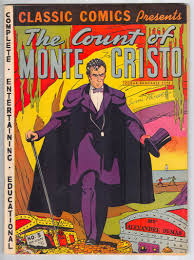
save the planet 5But, frankly, our situation isn’t all that unusual.  Let’s take Bertuccio, the servant of the Count of Monte Cristo.  The Count tells him to buy a bunch of horses and a bunch of stables—just a certain distance apart—so they the Count can go from one place to another faster than anyone could have imagined.  Bertuccio does not say, “How long do you want me to keep this arrangement in place” and here’s why he doesn’t.  He knows he will get one of two answers.  The first is: until I tell you I don’t need them anymore.  The second is: because that’s your job.  I added the comic book cover because that is the way I first learned the story.

Neither of those answers changed Bertuccio’s grasp of his situation in the least.  He has assets to maintain—a set—and he has the resources, both the money and the authority, to maintain them in good condition or, at least, in “good enough” condition.  If the set we built for the play about toxic water is used every day, it is going to begin to show marks of wear.  That’s fine.  On the other hand, the day the flames stop shooting out of the sink, the story begins to die.

As stewards, then we can take on the task of taking care of the set until God’s need of it has ended.

Nevertheless, I am going to postulate that God has some purpose for us, humankind, and that the earth is the place this purpose will either be fulfilled or will fail utterly.  That is what the earth is for.  It is the place where God’s purpose for us it to be fulfilled.  It is, in that sense, like a set for a play on Broadway.  No one asks what the set is for apart from the play that requires it.  The play is important and the set is there so the play can be performed.

Now, having answered nothing yet, we can proceed to the second question, which is, “How long does it need to be saved?”  The answer is obvious in a way; it needs to be saved long enough to serve as the setting for the story to be told completely.

save the planet 3I don’t know how long that is but I would like you to notice that all this fumbling around has moved us to a place from which “how long” could actually mean something.   Neither of the first two images—a fiery nuclear death in the sun or a cold entropic death in space—had any place to put that question.

Here’s an analogy that might help.  A few years ago, I set about exploring the notion of redemption provided for Israelites under the Law.  An Israelite who was a slave was someone who needed to be redeemed.  We may set aside, here, any questions about whether he wanted to be redeemed or whether, after being redeemed, he would return to slavery.  And we may set these aside because the reason for redeeming him doesn’t have anything to do with him at all.  Being an Israelite, he belongs to God.  That means that it is unacceptable for him to be owned by someone else and because of that logic, a kinsman must pay the owner enough to redeem—to buy back his freedom—the slave.  Notice that nothing in this transaction is about the slave.  It is about God’s true ownership of these people; about a social relationship that violates that ownership; and about the consequent duty of the kinsman to restore things to their rightful place.

In a similar way, I want to introduce the notion that the story God is telling—the one that requires a habitable planet as a prop—is really not about us.  In the redemption analogy, the Israelite was to be “restored” to God because he “belonged” to God.  We don’t ask what the Israelite was “for.”  The covenant God made with Israel spells out what that particular Israelite—any Israelite—was for.  The stage set analogy isn’t like that.  The stage isn’t “for” something –having inherent worth—the way the Israelite was.  The stage is there for the play.  It doesn’t have any meaning apart from the play.  It doesn’t have any worth apart from the play.  Contrary to the “Save the Planet!” notion, the set does not have to be saved because of its inherent worth, but because the story requires it.

On the other hand, God has also given us the charge of taking care of the planet.  We are tosave the planet 6 be “stewards” of the earth.  In this new way of looking at the matter, however, our charge is related to the narrative.  We have a complicated relationship with the earth, it is true.  It nourishes us, so it would be only prudent to manage it sustainably.  That gets us as far as my “Extend the time of human habitation on the planet!” bumper sticker, but it does not get us any further.

You can look at population demographics and environmental constraints and say that using currently available techniques, we can support so many billions of people with so many calories per day per person.  This is, in a manner of speaking, a way of “taking care of the planet,” but this is no more than maintaining a set in such a way that the play can continue to be performed.

In the dramatic performance metaphor, taking care of the planet means keeping it fit to serve as a setting for the story God is telling.  This clarifies what “not taking care of the planet” might mean.  If we pollute the planet beyond a certain level or reduce the protection our atmosphere gives us beyond a certain level or unleash nuclear catastrophe, we have not taken care of the planet.  But that’s still about us and the earth is for the story, not for us.  It is for the storyteller’s use, not for us.

The play was not written as a device for employing set builders and stage hands.  It was built so a story could be told.  There is a lot of disagreement about what “the story” is, but I think we have taken a step in the right direction by insisting that the story is more important than the set.


[1] That’s the way it always goes with my bumper stickers: too big for the size currently in fashion among bumper makers.
[2] Darwin, especially, had to fight off the idea that species were being “pulled” to some , some “appropriate end point.”  He argued that evolution was all “push” and that there wasn’t a natural end state.
[3] Or “the gods,” or “the goddesses,” etc.  Some “divine” being who is imagined to be capable of having intentions.  That’s why “fate” or “destiny” don’t work.  I’m working within the Christian tradition, myself, so I am not trying to find an approach that is broadly applicable.  I am only trying to work out the implications for those of us who accept the presuppositions of the Christian position.
[4] After the play closes, it might turn out that some people have a strong attachment to it and want to preserve it as an artifact.  If there are other people who want to tear it down and build another set with the materials—THEN you could imagine a bumper sticker war.

Posted in Sustainability, Theology | Tagged , , , | Leave a comment

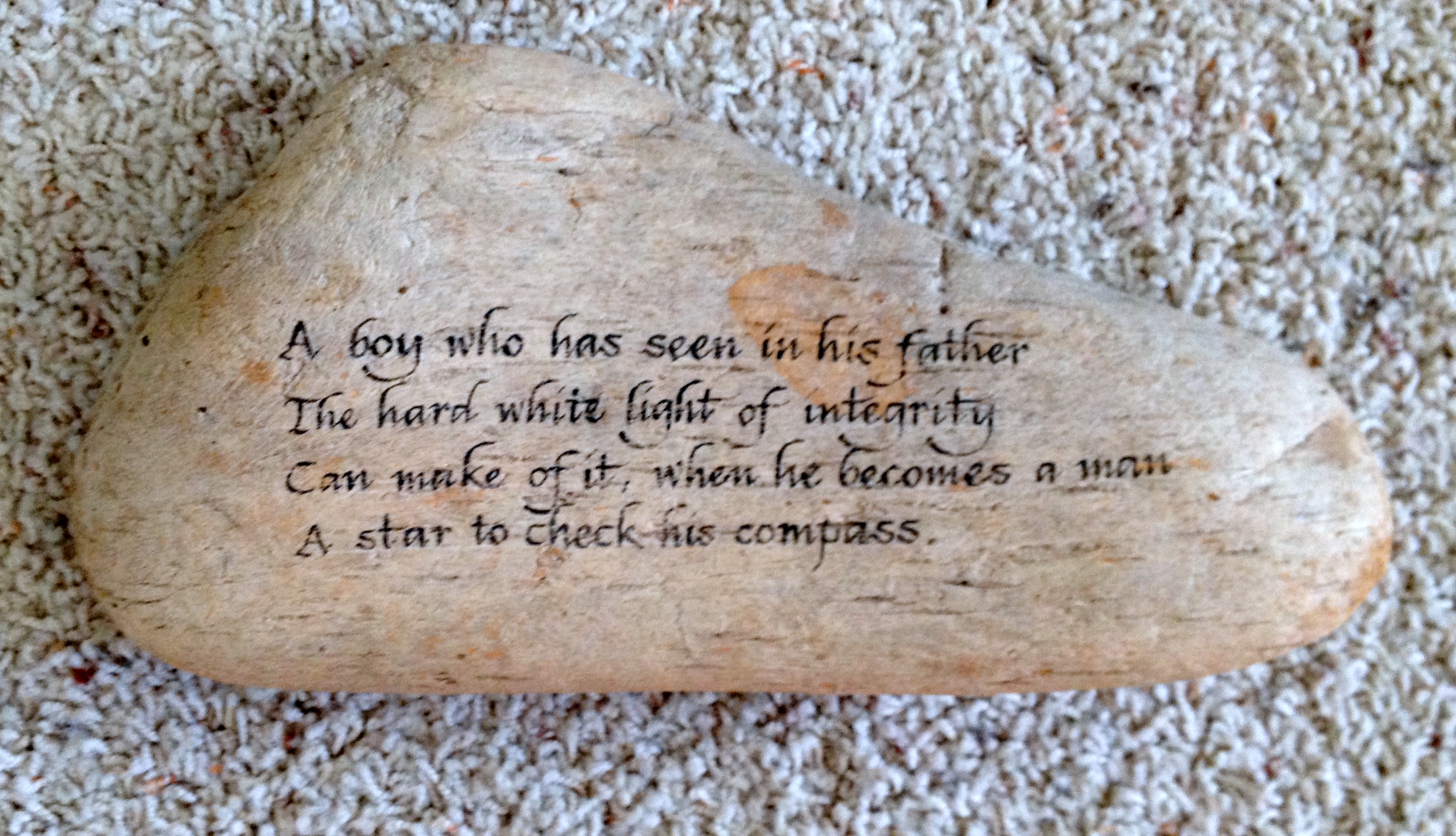
“The Hard White Light of Integrity”

For about a month now, I have been basking in the stories that make up Simon Van Booy’s new book, The Illusion of Separateness.  The book isn’t really a fable with a point.  It is better than that in every way.  But now that I have been thinking about it for a while, a “point” has emerged and here it is: if you are thinking of doing something good for someone, don’t put it off.  Do it now.

I find myself being pulled toward “now” as the right time because we never really know whether “later” is going to happen.  Will there actually be a “later?”  Will “later” actually be better than now?  When you think about it, and even more after you have been too late a few times, you come to the conclusion that “now” might just be the best time.

IntegrityHere’s an example.  I wrote a tribute for my father in 1974.  He was about the age that I am now.  I thought about this tribute for the better part of a year.  I was living in Oregon at the time; he was in Ohio.  So I thought a piece of driftwood might attach the tribute to me.  I imagined that he might show it to a friend and say, “My son, Dale, found this on the beach in Oregon.  He lives there, you know.”  And I found a calligrapher to do the printing for me.  In Eugene, Oregon, that wasn’t hard.

What was hard was getting the words right.  I knew exactly what I wanted to say.  Nearly everything I know about wholeness of intention and of personal integrity I learned from watching him or listening to him.

I don’t think I could have written that earlier in my life.  I could not have understood, earlier, just what the gift was that Dad had given me.  I don’t think I would have had the language, either, to say just what I meant and Dad was someone who knew how to value saying just what you meant.

In this poem, I picture myself as a voyager; someone who would have to rely on things like stars and compasses.  Compasses can go looney for one reason or another, however, and stars don’t do that.[1]  On the other hand, I didn’t want to say that my father was the star by which I supplemented and corrected my own directional readings.  That would have been too much and the man for whom I was writing this would have known it was too much and would have rejected it on those grounds.  He wouldn’t have been nasty about it.  He would just have withheld himself from it emotionally.  As we say today, he wouldn’t really “buy in” to it.

And I didn’t want to say that I was not “a man,” as the voyager was.  What I did want to say that the right time to see that severe brilliance is when you are a boy.  When you become a man, you learn what to do with it and you learn how urgently you need it.  But the time when you most need it is not the time to have the experiences on which it will later be formulated.  That is the time to reach into yourself and use the materials that someone else put there and to make them what you need.

What I did want to say was that out of my experience of him, I had fashioned a “star” and that I relied on it for guidance.  The “hard white light” is a notion that came from seeing stars, something Dad and I used to do together, and it occurred to me that Dad’s integrity could be pictured just that way.  He would have known that about himself.  He wouldn’t have put it that way, but the man I was writing for would have understood what I was talking about.

But “the man I was writing for,” the father of my first 25 years, was not there anymore by the time I gave him this poem in 1974.  By the 1980’s, everyone knew it was Alzheimer’s disease.  What we knew in the 1970’s was that Dad had lost something and the thing he had lost was what he would have needed to take this piece of wood in his hands and to know that he had a son who was grateful for this wonderful gift.

I don’t really regret waiting until 1974 to make this gift and give it to him because I could not have done it earlier.  I do think that the experience of waiting too long has made me more sensitive to how important it is to recognize the gift you have to give and to give it now.

[1] I have heard that there was once a company called Tate’s that made compasses.  The company didn’t last long because the compasses were unreliable.  According to the legend, this is the source of the saying, “He who has a Tate’s, is lost.”  I don’t really believe it myself but something deep in me wishes it were true.

Posted in Getting Old, Living My Life | Tagged , , , | 2 Comments

The President and March Madness

It’s early September today.  Teachers have just celebrated their New Year’s Eve, the last evening before “the year” starts for them.  Students have finished shopping for back to school clothes and backpacks and tablets—I meant the paper ones; with the spiral bindings.  Between now and the beginning of the NCAA post-season basketball tournament, “March Madness,” President Obama is going to have to substantially reconstruct his foreign policy.

Obama policy 6He is going to have to forego the most treasured of liberal dreams, that by cutting back on our spending on “nation-building” in the Middle East, we can afford to so some in the middle west.  You would think that would make Kansans happy, but probably it will not.

He is going to have to rejigger a Pentagon that is in retrenchment mode and get it to take actions it does not want to take.  Imagine that you are just getting into bed, too tired to think clearly, and you remember that you left the milk out on the kitchen counter.  Just admitting that you remembered it is a struggle.  Deciding to do something about it is a struggle.  Actually getting up and putting it back in the fridge is a struggle.  Meet Secretary of Defense Chuck Hagel and show a little respect.

President Obama is going to have to take actions to contain—not to destroy—newly aggressive international actors, ISIS, Russia, and China.  That’s not going to be popular at home.  He is going to have to carefully coordinate alliances, offering different sets of inducements and warnings to each one.  That’s not going to be popular at home.  He is going to have to formulate a strategy that is so complicated that no one at home is going to understand it.  It the days of the cold war, the alternative to understanding was to trust the nation’s leaders to put our best interests first.  We’ve gotten past that.

Sen. Mitch McConnell has captured the heart of the popular response to all this complexity, as he so often does.

“This is not, in my opinion, a manageable situation—they want to kill us.  The president is the guy who needs to lay before Congress and the American people a strategy to deal with it.”

This sounds like bravado to me.  The world is full of people who want to kill us.  If Sen. McConnell means by “deal with it” getting these people to stop wanting to kill us, we can only hope that he leaves office soon.  If, by “deal with it,” he means preventing them from killing any American—that is a possible meaning of “us”—then he has no idea what it means to have soldiers and diplomats and businessmen and journalists and missionaries all over the world.  Some of “us” are going to get killed.  If by “deal with it,” he means that we should try to kill the people who want to kill us, then he is talking about a response the world will not tolerate and that the U.S. cannot afford.

What does all this have to do with March Madness?

“There is a chronic disconnect, not just in this administration, between the policy, the budget guidance, and the classified strategies,” said Shawn Brimley, the director of studies at the Center for a New American Security, who served as the director of strategic planning at the National Security Council during Mr. Obama’s first term. That is what Mr. Obama needs to do for a “lasting legacy” of rethinking America’s defenses, Mr. Brimley said, but “if you don’t do it in the next six months, it’s too late.”

So Brimley, who sounds as if he knows what he is talking about, says that President Obama has between now and next March to bring the policy, the budget, and the strategies into line.  Oh, and there’s an election in November that will very likely make Mitch McConnell, the minority leader, into the majority leader of the Senate, replacing Harry Reid.[1]

David Sanger’s analysis (here) says there are three foreign policy fronts on which this is going to be played out: ISIS, China, and Russia.  Russia should be the easiest one.  In 1947, George Kennan, in an article originally signed X, proposed that the best U. S. policy Obama policy 4toward the communist threat was “containment.”  No one liked it very much and the conservatives hated it, but president after president practiced it and it worked.  It will work against Russia again if President Obama can ward off the conservative reaction against it and can find the money to fund it.

ISIL (Islamic State of Syria and the Levant)[2] is harder because it is not “a state actor,” as the newscasters say.  It is an insurgent movement, rather than a nation-state, and it is signatory to no international agreements at all.  It is sophisticated, well-funded, and well-armed.  All those traits are its advantages in the short run; all are targets of the Obama administration in the long run.  Below, a picture of Abu Bakr al-Baghdadi, leader of ISIL.

Obama policy 2China is the biggest and longest term threat to American dominance.  No one I have talked with or read thinks there is any way to stop it.  There are ways to “manage it,” however and that is the reason for the President’s famous “pivot to Asia.”[3]    China is going to expand industrially, commercially, and militarily.  That is going to happen.  How far that expansion takes China and what the effects will be on American allies in the region is what “manage” means in Asia.

Obama policy 3Part of the old-style “containment” that was derived from George Kennan’s article was a series of regional alliances.  The alliance in China’s part of the world was SEATO, the Southeast Asia Treaty Organization.  It was mostly just an exchange of papers—what James Madison called “a parchment barrier,” to illustrate that it wouldn’t bar anything.  It didn’t work then and it won’t work now.  But the U. S. owes treaty obligations to Japan and South Korea and Vietnam and India, among others and we can, by adroit foreign policy, reduce the cost to those governments of China’s re-emergence on the world stage.  Above, President Xi Jinping of China.

These three tasks—Putin, ISIL, China—will require a wholesale reorientation of the Obama administration.  This reorientation will not be made easier by the fact that the administration supporters really don’t want to do it.  What they really want to do is what they promised in both campaigns: end the Middle Eastern wars and bring that money back home.

That brings us back to March Madness.  The NCAA post-season basketball tournament begins on March 17 in Dayton, Ohio: my home town.  Before then, if Shawn Brimley is right, President Obama must have reoriented his administration toward these three foreign policy targets.  It isn’t something he wants to do, but it is his job.  It will not pay NCAA Basketball: NCAA Tournament-Indiana vs James Madisonpolitical dividends.  He will lose points in the public opinion polls for every good response he makes and all over the country, candidates in close congressional races will distance themselves from him.  He will do it anyway because it is his job.  The money and the attention this will cost him, will detract from domestic issues he cares a lot more about and that could bring political advantages to the Democratic party.  But he will do it anyway, because it is his job.

Has anyone noticed that the President’s hair has turned gray in six short years?


[1] A net gain of six seats in the U. S. Senate would do that.  The current judgment is that somewhere between 4 seats and 8 seats are up for grabs.
[2] The alternative name—Islamic State of Iraq and Syria—is geographically smaller but in practical terms, it means the same thing.
[3] President Obama is a basketball player, so he knows something about pivoting.  One of the things he knows, both as a point guard and as a president, is that you can’t pivot in two directions at the same time.  No sooner had he begun the pivot to Asia, when he was called to pivot back to the Middle East.  That’s not going to work.

Posted in Politics | Tagged , , , , , | Leave a comment