Accountability and Trust

I am going to say a few words in favor of accountability here.  Nearly everyone I know who is a fan of “accountability” will be disappointed by what I have to say and some will feel betrayed.  I don’t think they should.  Stay with me and let’s see.

It will not surprise you that accountability once meant, and sometimes still means, “able to give a [satisfactory] account.”  A lot of social structure goes into that simple statement.  I may ask anyone who is accountable to me to give me an account of her[1] behavior.  I may also ask, if I wish, that people who are not accountable to me give me such an account.  The rejections on the quiet side include, “Why would I do that?”  On the more boisterous side, “Who the hell do you think you are?”

So even from the beginning, accountability means “accountable—owing an account—to someone in particular”.[2]  Imagine that I am a manager’s boss and I stop by her desk and ask why productivity is down.  I’m her boss; she owes me an account.  She is accountable to me.  She says, “There are new people in shipping and it’s taking them some time to get up to speed.  We’ll be back to normal by next week.”

Being able to give a satisfactory account to the people to whom you owe it is a good thing.  On the other hand, I asked a pretty good question.  What sort of question do you think President Truman had in mind when he said, “The buck stops here.”[3]  Haccountability 1ad he been asked why he dropped a second atomic bomb only three days after the first, he could have given an answer.  It was a question he answered often, in fact, and he answered it by giving the reasons he thought it was a good idea.  I raise that particular question in order to wonder who President Truman was accountable to in that instance.  The Congress?  Any reporter with a microphone?  The American people?  General MacArthur?

And it is questions like that that make me wonder.  Would we say that a committee handling sensitive information was “accountable” to anyone who wanted access to that information?  Let’s say it was personnel information, which is often highly protected.  I ask for the information to be given to me and when I am refused, I say that the personnel committee (agency, bureau, office) is “unaccountable.”

That is the way I would say it because it sounds most credible that way.  I would not say “unaccountable to me” because someone might ask if I had the right to demand an account.  I would not say that they were accountable to the government that protected personnel information and which declared that leaking it is a crime.  It is their accountability to me that I want to highlight and not the fact that very often a manager is accountable to different people for different reasons all at the same time.  “Accountability has now become “able to give an account, to whom, about what, by when.”

It gets worse.

Demanding that an account be given is like a tax.  It costs to give an account when it is accountability 2asked for.  I might want my employee to use her resources to do the job rather than to give an account of how well she is doing the job.  If there is reason to question how well she’s doing, then I should ask and she should give me her account.  If there is no reason to ask, I am just taking resources that would be better used elsewhere and diverting them to deal with my own curiosity.
And it gets worse.

The more I supervise, the less able I think my subordinates are.  Here’s a study by Lloyd H. Strickland, which, if I may be candid this far into the essay, is what started me thinking about accountability.[4]  Strickland ran an experiment in which supervisors did or did not have information about one particular aspect of their subordinates.  Since Strickland controlled all the information, he was able to have highly interventionist bosses and clearly laissez faire bosses.  Some bosses, in other words, hovered over their workers and cajoled and corrected and exhorted them.  Other bosses, who were also responsible for the output of their workers, were denied any information about how things were going.

What Strickland was actually studying was the traits the bosses attributed to the workers and to do that, he had to be sure that exactly the same amount of work got done in each setting.  You see immediately that one kind of boss could not argue that his style of management produced “superior results,” because the results were all alike.  All you could do was to account for the work done on the basis of the character of the workers.

Here’s what Strickland found.  The bossy bosses concluded that their workers were lazy louts who needed constant harassment or they would not work.  The laissez faire bosses—bosses who were denied any access at all to their workers—concluded that their workers were honest, hardworking types who did good work on their own.

It is  all artificial, of course.  This is all happening in a social psychology lab at the University of North Carolina.  But notice that each set of bosses chose the explanation that satisfied their own needs as bosses.  If I can’t affect my workers, the least stressful thing for me to do is assume that they will work just fine on their own.  If I can affect my workers, the least stressful  thing for me to do is to assume that what I am doing– all the surveillance and all the exhortation– must be having some effect.  They would not, in other words, have done that work had I not been in their faces all the time.  Would these kids have gotten on the bus safely?  Just asking.

Let’s stop just briefly to remind ourselves that these “differences” are completely illusory. accountability 3There were no differences at all—the experiment required that—between the workers who labored under surveillance and criticism and those who were protected from surveillance and criticism.  But the differences in the supervisors were substantial.

Let us now move to the “complete surveillance society,” which is where we are headed.  Following the implications of Strickland’s work, we would expect the trust that supervisors have in their subordinates will go down.  If police are required to wear cameras that record their every move, we would expect the trust the chief of police has in them would go down.  If a child is under  surveillance by a parent, we would expect the trust the parent has in the child to go down.

We have moved a long way, notice, from “accountability” as the ability to give an account should one be required.  In these examples, “accountability” and “surveillance” are very nearly synonyms.  And the trust which was once thought to lubricate social relations and “make society possible,” as sociologists like to say, has been replaced by knowledge—knowledge in principle, of course.[5]

When I say, “I don’t need to trust you.  I can know for sure what your work is like,” we pass over the changes in me that are produced by my access to your work.  My role in making your work grows ever larger and your role grows ever smaller.  I am trustworthy by definition because I am relying on myself, but you are less trustworthy because I am no longer relying on who you are, but only on what I can verify.  The manager is affected, in other words, by the surveillance.  Your view is distorted.

accountability 4Stop a minute and think.  Does anyone really think that if I strapped a “fidelity cam” on my wife that I would become more and more convinced that she is worthy of my trust?  Really?

So here is where the accountability X total surveillance movement has brought us.  Everyone is under scrutiny.  A record is being kept of every keystroke I make as I type this sentence.  The more “information” there is—information is what all the surveillance produces—the less need there is for trust.  Also, the more surveillance there is, the more you can expand and affirm your role in my productivity by making sure you know what I am doing and by offering “helpful hints.”  The more you do that, the better you feel about yourself and the worse you feel about me.

You see the cyclical nature, right?  What is going to get us off this merry-go-round?

[1] There are so many prominent women CEOs these days.  Let’s just stay with feminine pronouns.

[2] Simpler and more communal societies have an  accountability to broad groups.  I have heard it called “echelon authority.”  In such societies, “an adult,” any adult, might ask a school age child, “Why aren’t you in school?” and expect to receive an answer.  We don’t do it that way.
[3] According to the Truman Library, the saying “the buck stops here” derives from the slang expression “pass the buck” which means passing the responsibility on to someone else. The latter expression is said to have originated with the game of poker, in which a marker or counter, frequently in frontier days a knife with a buckhorn handle, was used to indicate the person whose turn it was to deal. If the player did not wish to deal he could pass the responsibility by passing the “buck,” as the counter came to be called, to the next player.
[4] L. Strickland, “Surveillance and Trust, ,”Journal of Personality, 1958, Vol 26, no. 2, pp. 200—215.
[5] Even if everyone is under unrelenting surveillance, someone is going to have to look at the visual record and establish the meaning of what was recorded.  We tend, carelessly, to call the visual record “data,” but “data” is the end product of a Latin verb meaning “to give.”  Data are, in the old empiricist tradition, “what is given.”  But everyone knows that meaning is not “given.”  Meaning is constructed.  Who is going to do all that?  At what cost?  Will the records be kept forever?  Will they be hacked?  Will they be meaningful?

Posted in Politics, sociability, Society, Sustainability | Tagged , , , , | Leave a comment

My Victory Lap

Long before I began to think of my life as a mile (= four laps) run, I knew the popular version of a saying from Psalm 90: “the days of a man are three score and ten or by reason of strength, four score.”

There was a good deal wrong with my memory, apparently. The King James Version, which I was pretty sure was being quoted, actually says, “”The days of our years are threescore years and ten; and if by reason of strength they be fourscore years, yet is their strength labour and sorrow; for it is soon cut off, and we fly away.” Psalm 90:10

So the point of the verse is that it is soon over and we “fly away.” [1] I never got beyond three score and ten. Also, I never really liked the way the translation scanned in English; too many syllables. “Or by REA-son of STRENGTH four SCORE,” places an emphasis on every other syllable and I like it better that way. And it isn’t “of a man,” as I recalled, but “the days of our years.” Oh well.

I started running seriously in 1968, the year I first visited the University of Oregon. The people I saw running there took my breath away long before I started running myself and discovered that that takes your breath away, too.

Then I noticed that I was twenty years old or so when I first married and forty years or so A very young professor at Westminster Collegewhen that marriage ended and sixty years or so when my second wife died and I got to wondering what was going to happen when I was eighty years or so old. Partly for that reason—it wasn’t just the symmetry of the design—I decided to propose that Bette (third wife) and I move to a senior center in 2017, when I would be eighty years old. This picture is from that same era and I did remember to take a victory lap around the track at the University of Oregon when they granted me a Ph. D. The kids all ran with me.

That’s the timing part. Now comes the part where I have to apologize to my children, all of whom are in their 50s by now so they are more likely to forgive me this flight than when they were in their teens. In 1976, I began a project to “celebrate” the bicentennial of our country. The project was simplicity itself. We were to run one thousand, seven hundred, seventy-six miles between the fourth of July 1976 and the fourth of July 1977. That’s less than six miles a day for each of six days a week for a year. No problem. I was still in my 30s, with relatively fresh knees and something to prove. But…things happen in a year’s time and I showed up in March of 1977 about 280 miles behind the pace. So that’s roughly 36 miles a week built into the schedule PLUS somehow those extra 280 miles.

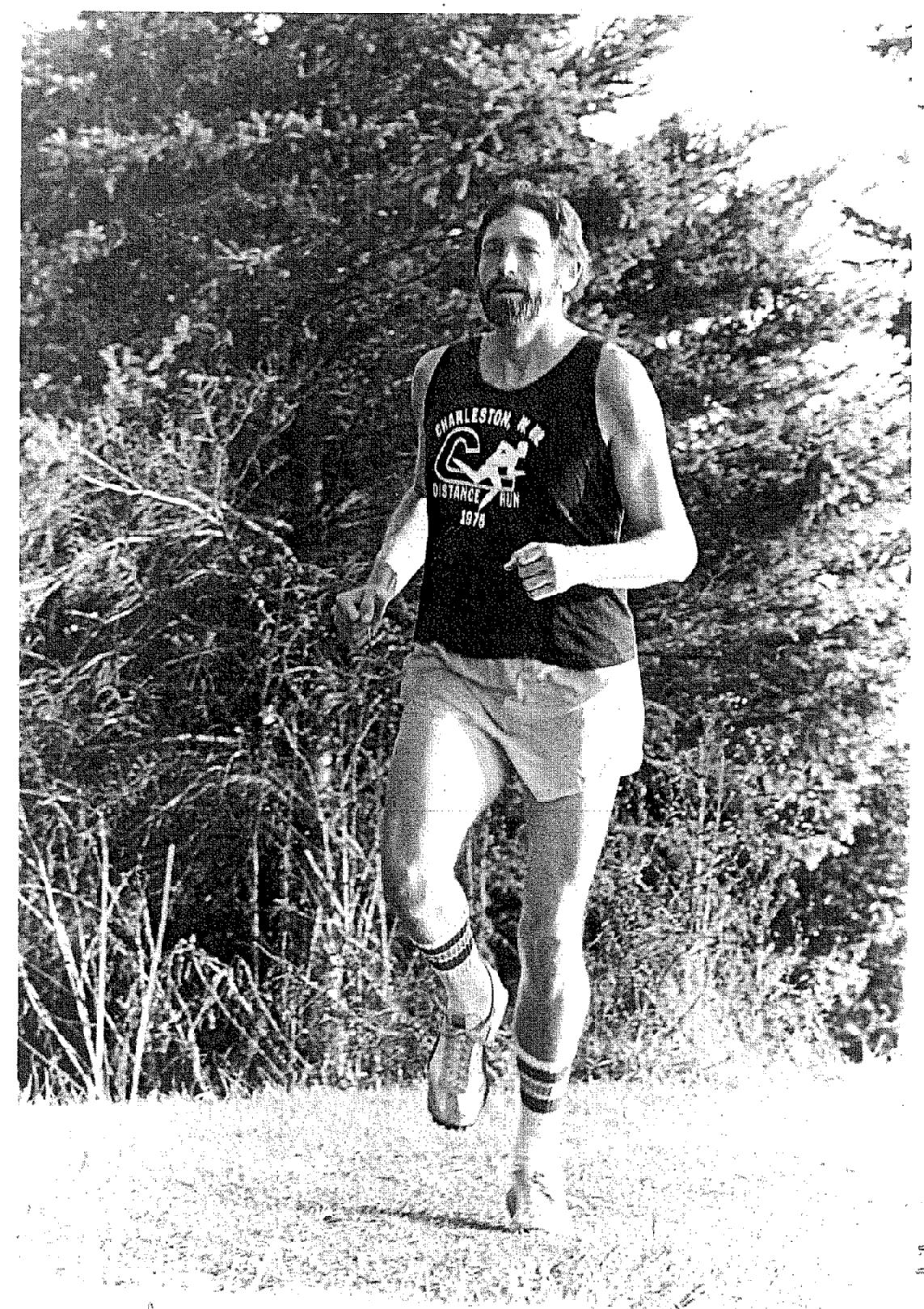
Last Mile.At that point I began to resort to mind games of one kind or another. One of them is the “victory lap,” which is the subject of today’s reflection. We lived on what was called “new faculty circle” in New Wilmington, Pennsylvania, where I taught at Westminster College. The “circle” was half a mile and I made it a practice to run that little extra loop every time I came in from a run. What the heck; it’s another half mile added to the total. I was desperate. I did it, though. Here is 39 year-old Dale running the last of the 1776 miles.

But then something really interesting happened. I noticed that running that extra half mile didn’t feel at all like running the ten or fifteen or twenty before it. If I had been having blister problems, for instance, they stopped bothering me on the “victory lap.” The strong task orientation I felt, especially on longer runs that really tested my body, seemed to go away on the victory lap. I was reflective and peaceful on the victory lap. I looked back on what I had done with a willingness to celebrate.

At that point, I began to think of the victory lap as a metaphor and I thought about those sets of double decades as the laps of a race and I thought how really terrific it would be if, when I finished the race, after my fourth lap, I could run a little longer with that reflective and celebrative cast of mind. It all sounded good to me.

It did not sound good to my kids, who were 16, 14, and 12 at the time. The “end of the race” didn’t mean beginning of a post-run celebration; it meant dying. They didn’t want me to die and they didn’t want me to think about dying. And if I did think about it, they wanted me not to talk about it. And I have mostly not talked about it, at least not to them.

But now it appeals to me more and more strongly. I’m not sure I can do it, to tell the truth. It appears to require skills I have not yet mastered and have only, in fact, caught sight of every now and then. I thought I might treat my retirement from the Oregon Higher Education System like that, but I didn’t. I signed up to teach in a doctoral program at Portland State and I worked at it like a sonofobitch!

As I think about it, there really was no way to do a bad job of the victory lap. All that still confronted me was a hot soak for my feet and a cold beer for the rest of me and then taking on the rest of the day. But there are a thousand ways of teaching badly and I hate each and every one of them.

After leaving Portland State, I took on a year-long Bible study class at First Presbyterian church, here in Portland. For an odd mix of reasons, I worked the course pretty hard. We were supposed to become “a community,” in the process of reading the entire Bible in 34 weeks. That takes some emailing and some phoning and some coffee drinking and some visiting and, in our case, some praying as well. Also, I had been thinking I knew a fair amount about the Bible because I keep reading the parts of it I like best. You don’t do that with a class, so I read a lot of things I hadn’t read in years and that I had never understood at all. I worked it pretty hard, but not like the doctoral studies. I’m prepared to call that an improvement.

Leaving our house in the West Hills of Portland is easier—so far. It’s still a year or two out, but already I am experiencing some of the victory lap feelings. [2] I remember when we planted the Austrian Pine that has gotten so big now. I remember years of “bagel parties,” each different; each a pleasure. [3] I remember the pleasures—sometimes the sorrows, but mostly the pleasures—of living here with my second wife and doing the little things that helped her die more comfortably and brimming with family. I remember with pleasure the mess I made of rototilling the back yard.

All that is victory lap stuff. It isn’t how long the lap is. It is what the lap is for. It is tacking on an extra half mile, all the while remembering the run with pleasure and not feeling the discomfort, discomfort that was undeniably apparent ten minutes ago, but has gone somewhere during the victory lap.

My idea of ending a phase of my life is like closing a long-running and highly successful Broadway play. There are no tears of sadness; there is no lamenting. Everyone celebrates what a glorious run the play had, how many people saw and enjoyed it, how many careers got their start on that cast, and so on.  No one complains that its “run” on Broadway is over.

In December of 2017, I will turn 80 unless something unforeseen intervenes. By then, I hope to have thought through and named and practiced the crucial victory lap skills. I want to be good at them because I really don’t want to have to work very hard at them and I really don’t like doing it wrong.

[1] The actual meaning of the verse was, in other words, entirely opposed to the reason I remembered it. In a long life of biblical scholarship—reading it, not producing it—I have found that to be distressingly common.

[2] “Victory lap skills” would be a great deal better than “victory lap feelings” but be begin where we are able and progress as means, motive, and opportunity enable us.

[3] We really do make and eat bagels at a “bagel party,” but I put the term in quotation marks because of the way we do it. We divide the group into teams of four and each takes a turn shaping the bagels and leaving them to rise. They group one returns to “their bagels”—the ones they claim to remember having made or, failing that, the best-shaped bagels on the table—to boil them and bake them. The boiling is carried out with completely unnecessary precision; there is an official timer; there is a bagel-flipper, etc. Then each remaining group does the same until Group 1’s bagels come out of the oven and the “eating phase” begins. THAT’S a bagel party.

Posted in Getting Old, Living My Life | Tagged , , , , | Leave a comment

Hillary’s last chance to prepare for 2020

2016 could be a really interesting election. Or not.

If the R’s nominate a right-wing flame thrower, Hillary Clinton (hereafter “Hillary,” meaning no disrespect) the Democratic Nominee Presumptive (hereafter DNP) can just coast to the middle of the spectrum and pick up the votes of Republicans who have been nervous since 1964, when Barry Goldwater spooked them. If I were her campaign manager and cared about nothing except her victory margin, that’s what I would do and I would put on my resumé, “guided the candidate to a clear victory.” [1]

hillary 6That would provide no basis at all for her to govern, however. She would do what she could in her first term and then she would settle in to apologize to the American people that they were still working way too hard and were still poor. And the American people would still refuse to listen to anything she says because she has not yet apologized to then for her failure to “fix the economy. [2] Below is a piece I wrote in March 2014 about the forthcoming electoral disaster for Democrats. I am citing it today because that is just where President Hillary Clinton will be in March 2019 if she runs the kind of campaign I have described above.

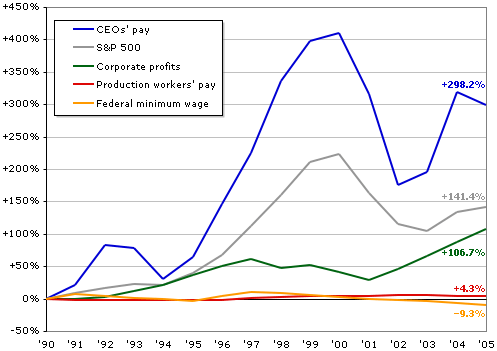
My view is that the economy we have now is the kind of economy we are going to have for the foreseeable future…So think about this. You’re President Obama and you want to talk about some important things. You might want to talk about raising the minimum wage, so people can afford to buy things again. You might want to talk about penalties for companies that outsource their labor force—“shipping American jobs overseas,” is the way President Obama puts it. You might want to talk about the cost to ordinary workers of the obscene levels of executive compensation CEOs are granted. You might want to talk about the strength of labor unions as the only way to guarantee that contractual obligations will be met by employers.
Or you might want to talk about something else. You might want to talk about the deplorable state of our transportation infrastructure or the unenforced environmental regulations that result in polluted air sheds and watersheds. You might want to talk about sustainable levels of energy use and securing those levels from non-polluting sources.
And let’s say the American people agree with your positions on everything that is named in the last two paragraphs. It doesn’t matter! Why? Because the American voters have not yet put in their hearing aids. They will hear no reasons—other than your own culpability, which is assumed—why the economy is what it is and why it will continue to be that way. They will engage in no other conversations, no matter how urgent those conversations might be because they can’t hear what you are saying. They want you to apologize first and that means fixing the economy.

That mess—the mess President Obama was in by March 2014 and will be in until the end of his presidency—is the mess Hillary will be in as the person who presides over this economy which is rich and robust at the top and thin and brittle from the middle on down. The 2016 campaign is Hillary’s only chance to make her presidency about something else. The “something else” is the way the economy works. and whether the America people understand how the economy works.
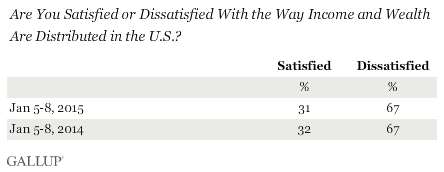
What do the American people understand at the moment? Here are two relevant measures from a January 2015 Gallup Poll.

hillary 7

“…dissatisfaction is relatively high with the way income and wealth are distributed in the country today, indicating that the public’s concern is focused more on the inequality of results as the system plays out, rather than on the chances people have of improving their lot within the system. These attitudes are not new. Gallup polling over the decades has consistently shown that Americans believe money and wealth should be distributed more equally in U.S. society, and have consistently supported higher taxes on the rich to help achieve that aim.”

Hillary could build her campaign on this dissatisfaction if she wanted to. It is consistent “over the decades” as Gallup says and two thirds of the American people is a lot of people. Notice that it is a systemic measure, not an individual measure. The reason to take this as a campaign theme would be that it will mobilize a lot of people and get her elected and bring that issue front and center in her first term.

The reason not to take this as a campaign theme is that the difficulties will still be there in 2019 and any Congressman or Senator running for office in 2020 would have a lot of reason to distance himself/herself from President Clinton.

If the economic difficulties are, as I argued in the Obama post, “the new normal,” then they will still be there in 2020. The difference is that by 2020, they will be President Clinton’s fault because she has “presided” [2] over the continuation of failed U. S. policies.

There is another way to go. It doesn’t make anything better, but it does change the explanation for why things are still bad from a systemic explanation to a personal hillary 3explanation. In this campaign approach, “the richest 1%” are not just the beneficiaries of the way the economy works; they are they reason it works that way. “It” is their fault!

In the expression “it” is their fault, what is “it?” American businesses have adapted to modern methods of production and to global opportunities for consumption. They are using very low cost workers—some robotic, some just underpaid [3]—and, in the absence of an American middle class to sell the products to, they are selling them to the middle classes of the BRIC nations, as they are called: Brazil, Russia, India, and China.

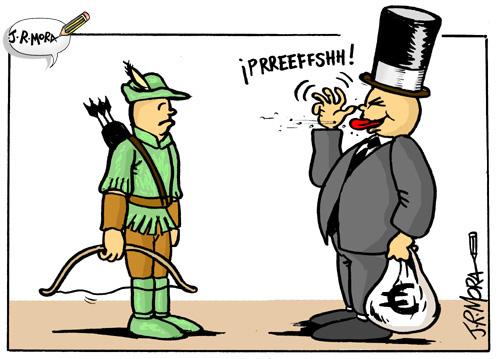
They are satisfied with the way they produce and the way consumers consume because they make a lot of money that way. Nothing is going to change that. Very large amounts, from what they make by running their businesses that way, show up as “executive compensation.” These executives are “fat cats,” a name chosen to show their availability as villains. [4] Hillary could blame these executives for the plight of the middle class. The plight of the middle class is that they are working harder than ever and are continuing to fall behind economically. If that’s a system effect—that’s the way business is these days—it is politically inert. If it results from the greed of the fat cats, who manipulate the process to enrich themselves and to impoverish the rest of us, it is not inert. It is, in fact, a call for a politics of retribution. It is the kind of political action embedded in the Robin Hood stories.

hillary 1Hillary is going to have to go one way or the other. If she campaigns on making things better for “those who follow the rules and work hard”—the Obama mantra—the voters will be after her blood by 2019. She promised systemic improvements and I am still poor. Off with her head! If she campaigns successfully—a major question [5], to be sure—she will not have changed the system, but she will have changed who is to blame for the system.

If that’s all she does, Hillary will have changed the conversation for four years. If she wrings a great deal more money out of the companies—the ones who impoverish American workers so they can sell competitively to the middle classes of the BRIC countries—she can put in place a substantial safety net. That won’t make people less poor, not in the spending money sense—but it will provide at public expense a lot of the services—high quality child care, for instance— that now require out of pocket expenditures by workers who are receiving poverty level wages.

Frankly, I don’t see her chances of making that transition successfully even if she wanted that more than anything else and I don’t think she does want it that much. Elizabeth Warren might, but Hillary doesn’t.

Therefore, I predict that Hillary will confront plummeting popularity in 2019 as more and more people blame her for “how things are,” even if they would have been exactly like that if her R competitor has been elected.

Hillary needs to solve the problem. She can’t do that. The problem is global and endemic. It is, as Gov. Brown (CA) [6] said of California’s desiccation, “the new normal.” She can blame the fat cats for the problem, setting off a wave of retributive voting and possibly even legislation. The fat cats will outlast her; they might accept a little bit of regulation and taxation. Not much. Or she can accept the system in its general terms, tax the rich and establish Sweden-style buffers for the poor.

“Sweden-style”buffers—it’s awkward, but I don’t have to call them “socialist” if I call them “Sweden-style”—will require a fundamental change of heart among Americans. According to that same Gallup poll, 60% of Americans are “satisfied with the opportunity for a person in this nation to get ahead by working hard.” Apparently “getting ahead” is what they want. They don’t want their poverty to hurt less and that is what President Clinton would be offering them—in the best of the three scenarios.

The foundation for Hillary’s popularity in 2019 is being laid right now. Good luck, Hillary.

[1] In the one case when I had the chance, that is what I did do. In 1982, my candidate took out an incumbent county official ih a race that I, as the manager, affected not one whit and I put on my resumé that I had “guided the candidate….”
[2] You have to apologize first. Then they’ll listen. But it only works for a few times.
[3] That is, after all, what Preside-ents do
[4] “Under” in “underpaid really should require a measure of what they should be paid. Marx argued that they should be paid the value they have added to the product. Many labor economists have argued that they “should” be paid whatever they contract to work for, provided that it is within the law and poverty-level wages are eminently legal.
[5] President Franklin Roosevelt called them “malefactors of great wealth.” In the campaign I managed, a campaign very Republican in tone although the office we were seeking was a nonpartisan office, they were called “heavy hitters.”
[6] The top 1% are very adroit in adapting to challenges of this kind. They will defeat the message if they can. The R’s will call it “class warfare.” They will defeat the messenger if they can unless it means electing a Tea Party candidate. Failing those, they will adapt to the new demands in ways that will allow them to keep most of their earnings, but take a well-publicized step in the direction of “reform.”
[7] It’s like “Miami of Ohio.” Oregon has a “Governor Brown” now too, so Jerry Brown is (CA).

Posted in Politics | Tagged , , , , , | Leave a comment

Stanley Victor Freberg, the master of his craft

Stan Freberg died this Tuesday at the age of 88. He was one of the funniest men I had ever heard. He was known for his satire, but it wasn’t nasty satire. Mostly, he was just able to look at things from a different angle.  And he was a master.

In my favorite of all the Freberg productions, Stan Freberg Modestly Presents the United States of America, Volume I, he stages a confrontation on the beach with “an Indian.”

Columbus: Hello there, hello there. We white men–other side of ocean. My name Christopher Columbus.

Native: Oh? You over here on a Fulbright?

Columbus: Huh? Uh, no,no, I’m over here on an Isabella, as a matter of fact. Which reminds me, I want to take a few of you guys back on the boat with me to prove I discovered you.

Native: What you mean, you discover us? We discover you.

Columbus: You discovered us?

Native: Certainly. We discover you on beach here. Is all how you look at it.

It’s always that way. Freberg was able to imagine it from the other side. Freberg’s Freberg 1“Abominable Snowman” complained that he never like that word “abominable” that much but it was the closest they could get to the original abominuyamao, which means “the hairy one with the big feet.”

I started teaching eighth grade students in 1960. The various classes I was to have during the day would shuttle into my classroom for American history or English and on the first day, I would play Freberg’s History of the United States for them. It was the best class evaluation tool I ever found. Some classes snickered when Richard Rodgers, the songwriter, called on the telephone in the middle of the sale of Manhattan Island to a Dutch merchant. A telephone? Other classes listened right by that one, but would laugh at a reference to Leonardo da Vinci as “Lenny.” When we were done with that day, I knew pretty much what I had to work with that year in each class.

On Tuesday, James Ward said, in a comment about Freberg’s death. “I raised my family on Stan Freberg’s United States of America.” I had been thinking of using that as an opening line myself, but Ward got there first. It’s true for my kids, certainly. A reference to anyone who talks too much might be garnished with Benjamin Franklin’s dismissal of George Washington. “Oh yeah. That’s George for ya. Talks up a storm with those wooden teeth. Can’t shut him up. But when it comes time to put the name on the old parchment-o-rooney, try and find him.”

A thanksgiving feast seldom passes without the Puritan lament, “Whaddaya mean you cooked the turkey, Charlie?” Followed by, “And all of us had our mouths set for roast eagle with all the trimmings.”

It gets so bad in my family sometimes that different words entirely, if they have a characteristic intonation from a Freberg skit, will get the next line as a reply. A complaint about anything, if the tonality is just so, will get:

What are you so surly about today?

Surly to bed and surly to rise…

OK, let’s knock off the one line jokes and sign the petition, huh?

That little exchange is from “Tom Jefferson’s” attempt to get “Ben Franklin” to sign, “this little petition I’ve been circulating around the neighborhood.” The “little petition” is the Declaration of Independence, of course, from which Franklin reads, in apparent bafflement, the line…”life, liberty, and the purfuit of happineff?”

freberg 4Because he was a parodist by temperament, Freberg parodied things. And the things he parodied were often things that irked him. He was no fan of what, today, we call “political correctness.” He does a wonderful skit with Daws Butler as Mr. Tweedlie. Tweedlie represents “the Citizen’s Radio Committee” and his job is to stop Freberg’s performance of “Old Man River” whenever he hears something the Committee might object to. By that process, we get lines like, “Elderly man river/That elderly man river/he must know something but the doesn’t say anything/ He just keeps rollin’…uh, rolling…he just keeps rolling along.”

In this picture, Freberg (right), June Foray (center), and Daws Butler (right) are recording “St. George and the Dragonet”  June Foray did a lot of work with Freberg, but my favorite line of hers opens the skit on the sale of Manhattan Island.  It is a loud lament with a “voice crying in the wilderness” tone to it.  “Too many moons we live here, White Cloud.  Time to unload this crummy island.”

Everybody knows what “that’s about the size of it” means. Unless, of course, it doesn’t. In an early Dragnet spoof, “St. George and the Dragonet” (Butler is the dragon) we get:

Dragon   I see you got one of those new .45 caliber swords.

St. George   That’s about the size of it.

One of the things Freberg didn’t like about the popular music of his day was the incessant repetitive piano background; what his fictional piano accompanist called “that clink clink clink jazz.” The pianist takes off on a lovely little jazz riff when Freberg, the singer, says, “Oh yes you will play that clink clink clink jazz or you won’t get paid tonight.” Then, after a pause of exactly the right length, the piano part starts up again. Clink, clink, clink.

freberg 2He parodied the commercialization of Christmas in his wistful little “Green Chri$tma$.” He plays Mr. Scrooge, the head of the Advertising Council. Daws Butler plays Bob Cratchet, who “owns a little spice company in East Orange, New Jersey. The argument between the two is carried on in words and then in music with no possible confusion about what is being said. Scrooge wins. The last sound is a coin rolling around in the drawer of a cash register well after the last sound of a Christmas hymn has faded.

He was surely the kind of kid that always got in trouble in school. There are a lot of those, but not many of them take just that knack for trouble and turn it into decades of innovative comedy.

Posted in Living My Life, Words | Tagged , , , , | Leave a comment

Heroes

Everyone who has served in the Armed Forces of the United States is a hero.

Have you heard that? First I heard it as part of the ads for the armed services. Now it is commonplace in the patter of the sports commentators and very often a feature of the opening ceremonies as well. I am starting to hear casual references to it—to the taken for granted fact of it—on the bus or at a coffee shop. It’s so “true” in these settings that no case needs to be made; it just needs to be referred to.

There are so many things I don’t like about it that it’s hard to know where to start. Let me start with three and I’ll stop then and see if three is really enough.

hero 7I call the first one “bracket creep.” You might have thought “bracket creep” has to do only with tax categories, but I treat it as a much more general phenomenon.  If there were a formal designation for hero, we wouldn’t have this problem. “Winners of Purple Hearts” could be designated as heroes. That would go like this.

“See that guy? He’s having a lot of trouble walking now, but he’s a hero.

Really, when was he awarded the Purple Heart?

In 1972. It was an amazing ceremony. I had never seen one before.”

From a language point of view, this is a very satisfying exchange. Information is exchanged. Understanding is clear. “Hero” means “having been awarded the Purple Heart.”

And it wouldn’t have to be a Purple Heart. It could be any official designation; any commendation for bravery under difficult circumstances. If hero means “has received an official recognition for heroic actions taken” then we are saved from bracket creep so long as the awarding body keeps the same criteria.

That’s not where we are. “Having been employed by the Army [or any other branch of the military] for a period of time” is now the equivalent of the Purple Heart I referred to above. That’s “bracket creep.”

Difficulties run off in every direction. If every soldier is a hero, what designation should be give the soldiers who have received special commendations for courage under fire? Superhero? Won’t work.

You really can’t make everyone think of people who were employed by the U. S. government to be part of our national defense (our national offense too, of course) as a hero. It can’t be done.

What you can do is destroy the word.

Words are kindly things. They accept a lot of abuse without complaint. They are puffed up and then shrunk down and still they hang around in hopes of being useful. But the level of abuse they are able to withstand is still finite. You can destroy them.

I saw “disability” ruined right before my eyes at a state legislative hearing. The proponents of a bill had apparently agreed among themselves that “differently abled” was the right thing to say. They all said it themselves. They interrupted legislators who were asking questions but who did not say the right word. The legislators sensed—all the good ones have a kind of Spidey sense about offending do-gooders in public—that refusing to use “differently abled” would not be well received. So they said “differently abled” and rolled their eyes. They put “air-quotes” around it. They got together in the hallway afterwards and plotted revenge. They were not happy.

This is a difficulty the military will have to find a way to deal with because if everyone is a hero, no one is a hero. This use of a word works because it swoops down on a category and chooses some but not others, for a special distinction. The military really needs heroes. They can’t be happy to watch the category become meaningless. They will have to do something. Good luck, guys.

The second one is subjectivization. As in all these matters, the -zation part refers to something that has been done to hero 1a word or concept. It was A and then the -zation process happened and it is now B. It was objective (A) and now it is subjective (B).  Is the oldest person in this picture a hero?

Subjective language is a wonderful thing. We would all be poorer without it. But we count on some things to be objectively true. The #1 Tri-Met bus picks riders up at the Southwest Fitness Center and takes them downtown. There is no value is saying, “To me, it always takes people shopping at Lloyd Center.” But when you get off the #1 bus, you will be downtown.

We can subjectivize “hero.” We can give up on the word’s having a common public meaning and rely on the meaning each of us gives to it. Here’s an example from the movie While You Were Sleeping.

Lucy You are a hero too. Every day, you give your seat on the train to an old woman.

Peter But that’s not really heroic.

Lucy It is to the woman who gets to sit down.

From a language standpoint, Peter’s case is better. In giving up his seat, he is doing something generous. Lucy is in the booth collecting fares, so she sees whatever happens on the train from some distance ahero 2way. We don’t know how the old woman feels. The designation of hero shows how Lucy feels about Peter, or possibly about generosity.  Is the oldest person in this picture a hero?

Or you could just grant the subjectivity of it. “That seems heroic to me,” someone might say. Or “He’s a hero to me.” Or “She’s a hero to me,” since no one seems to say heroine any more.

So subjectivization “solves” the hero problem by making the word refer to how I feel about an act or about a person. It removes it from the public conflict about its meaning by removing it from the pubic vocabulary.

But—third difficulty— there are cultural problems to deal with as well as language problems. Just as we create problems for ourselves when we choose some acts as meritorious and not others, so we create problems when we choose some kinds of contributions to the national welfare as meritorious and not others.

Language Digression: One feature of language in America is that we like to drop “unnecessary” words. If a given verb is always used in combination with a given noun, we just drop the noun. Baseball announcers who used to say that Terwilliger “reached first base” or “reached base” in the third inning, now say that Terwilliger “reached” in the “third.” After a little while, it stops sounding odd because the range of possible meanings is so small that everyone knows what he means. In basketball, point guards once “created scoring opportunities.” Now they just “create.” They need teammates, so they don’t really create ex nihilo—theologians everywhere breathe a sigh of relief.

So the third difficulty is that when we choose some general category as “heroic,” we distinguish the people from the people in other categories, who are now “non-heroic.” So who are our true heroes? The people who “serve” in the armed forces. Arehero 3 there “un-armed forces?” Is that kind of conflation of “service” and “force” something we want to support? Is military service really the only category we want to value as a category? Are we really no more than Sparta? Didn’t we once aspire to be Athens?

Are firefighters heroes? Medics? Teachers who work miracles no one else could with children everyone else has already given up on? Peace Corps? Women who hold together communities that would othewise lose any sense of belonging?  How about these guys?  Heroes?  Why?

Is “putting yourself in harm’s way” a crucial ingredient? OK. The Peace Corps volunteer comes home with malaria. The public service teacher, exposed to the daily catastrophes of inner city life give up hope and never recovers it. The women who hold communities together burn our after years of trying, during which time they have put their own families and very possibly their husbands is second or third place.

hero 5You want damage done to persons who are serving the public good? There it is. Nothing in any of those jobs is going to get those people a chance to board a flight early or get a free drink on board or to submit to the pro forma thanks of people who have been instructed to thank them for their sacrifice.  How about her?

So “hero” as a shorthand expression for members of any of the armed services, is not a good use of the word. It has at least the three difficulties I referred to above and many many more. And the difficulties it causes are systemic. You can’t ask people to solve them be “being more understanding.” And a really good word has its features scrubbed off and is filed on the shelf in the warehouse along with other words that once meant something.

Posted in Society, Words | Tagged , , , , | Leave a comment

Clean and Sober

I look at it as a goal. It’s the thirteenth step of my 12 Step Program.

In the expression “clean and sober,” clean is supposed to refer to the absence of drugs in your system and soclean and sober 5ber to the absence of alcohol. Drugs and alcohol are not my problem. My problem is continuing to read the gospels the way I learned to as a child—and continued until nearly middle age—even though it is an approach that I have consciously rejected for at least two decades. I just don’t seem to be able to stop.


Here are the steps I go through. These are what NOT being clean and sober look like for me. I’ll read a passage literally that simply cannot be read literally. There is a discrepancy and normally, my mind is attracted to discrepancies. If the hero’s hair is described as brown on page 39 and as blonde on page 132, it is common for me to stop and say, “Wait a minute. Wasn’t his hair brown at the beginning?” If it’s a gospel account, I don’t do that.

Why not? Well, I have already learned to read it the other way. and I simply don’t notice the discrepancies. Matthew says that Jesus came riding into Jerusalem (see Matthew 21:5) on two donkeys. Two. I am long past the place where I care whether there was one or more than one; I am past caring about how the prophet Zechariah (9:9) phrased it and why Matthew kept each half of the parallel rather than combining them. What I care about is why I didn’t notice.

Today, I don’t notice because I have learned not to notice. I read it the way I read it because I have always read it that way. So, in the second stage, right after noticing the problem, I read that passage and say, “Wait. That can’t be right.” Then I move right awayclean and sober 2 to being embarrassed. I have actually stopped reading and looked over my shoulder to see whether anyone noticed the mistake I had been making all my life. When I catch myself looking to see whether anyone noticed the thought I had just had, I laugh and get back to work, so it’s not as bad as you might think.

So then, in stage three, I pick my attention up in both hands and put it back on the trail it is supposed to be following. Why did Matthew use the Zechariah passage? What did he have in mind? What was he trying to say about Jesus? What does it mean for my understanding of Jesus that Matthew represents this episode the way he does?

Now that little sequence—the three little steps—could be read as a success story and in a small way, it is. And if it signaled a broad and lasting transition to this new way of appreciating the text, it would be. But I really really don’t want to have to go through those three steps all the time.

What I really want to do is to take my current view of gospel texts—they are associations of symbols, not of events—and read in that mode naturally. I don’t want to go through long periods where I ignore discrepancies I would have been attracted to in any other field of study. I don’t want to twist my brain into odd shapes trying to account for X on the one hand and Y on the other before finally remembering that I really don’t have to accommodate X or Y or vice versa.

clean and sober 4Maybe it’s time for another example. In John’s account, they put a sponge soaked with sour wine on some hyssop and gave it to Jesus. This is what hyssop looks like. It doesn’t look like the kind of thing you would choose to put a sponge on. Mark and Matthew both say they put the sponge on “a reed,” which at least implies something long and rigid.

Eventually, I get to thinking about how you put put a sponge on a fern. Think for a minute how much better it would be if I would just say, “Hyssop. Hmm. Why hyssop?” A little rummaging around in my memory would produce this text.

And then I would think of the blood of the lamb, which saves all those Israelites who obey God and put the blood on the door posts and I would see what imagery John is drawing from. The account John is giving us is rich with symbolism; it says about Jesus exactly what John wants us to hear. And…it doesn’t require sticking a sponge on a fern and lifting it up in the air.

That’s what I want. I want to say, “Hm. Hyssop. Why hyssop, I wonder.” I don’t want to wander down those alleys that lead to how strong hyssop stalks are or how toxic the digestive juices in a whale are (Jonah) or whether the ark would really have been big enough to add male and female unicorns to the menagerie (Noah).

I want to get clean and sober and stay clean and sober.

Posted in Biblical Studies | Tagged , , , , | 4 Comments

Draft Day

I’d like to tell you about the movie Draft Day.  I liked it a lot.  I don’t think anyone else did.  The critics didn’t, for sure.  Rotten Tomatoes said, “It’s a … dull-witted movie.”  Roger Ebert’s site says, “Both too “inside baseball” for non-NFL fans to care and not nearly character- driven enough at the same time.”

The critics are right.  It’s really not a good movie.  Today, I want to tell you what I liked about it.  It’s a movie that had moments in it.  I’m going to tell you about the moments.  And then, at the end, the one point that actually has some substance to it.

Sonny Weaver Jr. (Kevin Costner)  is general manager of the Cleveland Brown, as was his father before him.  His girlfriend, Ali, (Jennifer Garner) is a Cleveland girl who is passionate about football and whose job with the Browns is keeping track of the team’s salary cap.  They’ve been “going together” for awhile, it seems, and although she doesn’t look it until the last scene, Ali is pregnant.  That’s not a very promising beginning.

Here is the context for the moments I like.  First, Sonny and Ali are having a low-grade lovers’ quarrel.  He keeps trying to patch it up by taking her into a supply closet and saying the right things.  That plays all through the story.  Second, Sonny is ordered by the owner to make a really stupid deal on draft day and Sonny goes along with it for most of the movie.  Then he rejects the whole thing—and very likely his future with the Cleveland Browns—and makes the deal he really wants to make.  Third, on this crucial day, there is a intern manning the desk outside Sonny’s office.  He is treated badly by everyone and responds as if he knows how to be treated badly by everyone—until very near the end.
draft 3

I’m going to take them in reverse order.  Rick (Griffin Newman) has it tough in this movie.  He has been thrown into a job with no preparation and he does a lot of things wrong.  He keeps at it, though, and earns a kind of commendation from Sonny that I am sure he has never had in his life before this.  Sonny puts a hand on Rick’s shoulder and says, “Look, you didn’t deserve this [Sonny just trashed Rick’s computer and this is part of an apology].  You’ve been a soldier today.”  Then, in a “just us soldiers” gesture, he punches Rick gently in the chest and asks, “OK?”  Rick says, “Yeah” and he says it with the beginnings of an “I did the winter at Valley Forge” look on his face.  It is a look that face has never had before. Ever. It is a look that just became possible because of the “soldier” line and the fist to the chest.  That look—that’s one of the moments.

The second moment is the look in Sonny’s eye when it occurs to him that there is still something he can do to save the Browns from the disaster the owner wished on them.  Every move has been determined up to this.  He has had no chance at all to do anything that would a) help the Browns and b) not get him fired.  If he can find a way to get draft 1Jacksonville to trade the #6 pick to Cleveland, there might be a way.  “Who’s the manager at Jacksonville?” asks Sonny.  “Jeff Gordon,” responds scout #1.  “A rookie,” adds scout #2 conspiratorially.

At that point—at that moment right there—a look comes into Sonny’s eyes.  It’s the first time in the entire movie that he has seen himself as the kind of person or as being in the kind of situation where he can take a daring action on his own and possibly, just possibly, pull one off.  That look is the second moment.

All the other moments have to do with Sonny and Ali and they’re all funny.  Max Eastman, in his marvelous book on why things are funny, says that when you expect one thing and get another—in a context where taking it in a humorous way is possible—you think it’s funny.  That’s how these moment are funny.

Here, for instance, is the first of several scenes in the storage closet.  Sonny takes Ali in there just to get a moment’s peace so they can talk.  Sonny is trying to apologize and provide an excuse for himself at the same time.  It’s pretty common.  I once had a friend who, on the rare occasions when he would be late to a meeting, would say, “I’m terribly sorry that I am just a little bit late.”  You see why that doesn’t work, right?

Sonny didn’t “say the right things” when Ali told him he was the father of the baby she was going to have.  And what are the right things?  Oh, “wondering what color to paint the baby’s room.”  Really?  Sonny says he’s never been “one of those Home Depot dads who make the rest of us look like assholes”  Ali give him a really good look at that point.  It’s not warm and tender, but there’s no anger in it, which is what I was expecting.  What I wasn’t expecting is the line, “Those guys are not why you look like an asshole.”

I laughed out loud, thank you Max Eastman.  I’ve seen situations like that in movies a lot of times, just as you have.  The woman tries to reassure the man that it doesn’t really matter or she expresses her anger at him that he really screwed it up this time.  A was already expecting either of those.  I wasn’t expecting what I got and I liked it a lot.
The next of the Sonny and Ali moments comes a little later when Sonny takes Ali by the arm and heads for the storage closet again—the same one.  “Oh no,” she ways, in the perfect self-parody, “Not back in there.”  She’s not saying it to Sonny. She’s saying it to the audience.  It’s almost an aside.  She steps out of her character to deliver that line.

And finally, the Sonny and Ali moment that, to me, actually meant something.  They have been having, as I have said, a low-grade lovers’ quarrel.  And on draft day, too.  “I know,” says Ali, “Shit timing.”  But there is more to the relationship than the lovers’ quarrel.  They are colleagues who work together in Cleveland.  They both love football.  They both love the Cleveland Browns.

So…in addition to their intimacy, (and I’m not talking just about the sexual relationship) they have a collegiality to fall back on.  That’s a very good thing to have.  There are good theoretical grounds for saying that and I have, myself, very good experiential grounds for saying it.
draft 2Sonny comes into her office to talk about draft day difficulties.  This is what that looks like. He thinks he is going to have a hard time getting Ali away from her lover’s grievances.  I would think that too, but that’ not what happens.  Sonny says, “Could we talk football, just football, for fifteen seconds?”  Ali leans back in her chair and says, “We can always talk football.”

A surprise, another one, for me.  Not playing “the tiffed lover,” but the football colleague.  And not just for the moment.  Ali offers collegiality as a permanent part of the relationship, no matter what else is going on.  That’s how she saw the relationship.  Football for sure; other things…we’ll see.

And I liked it.  You’ll notice that I have stayed well short of recommending the movie.  On the other hand, these are things that I have liked a lot and I will keep watching it, now and then, just to enjoy them again.

Posted in Movies, Uncategorized | Tagged , , , , | Leave a comment

Sexism still sells cars

I’d like to spend some of your valuable time today thinking about a topic nearly everyone would call “sexism.” I’m not quite sure what to call it, myself, but when you look at this Buick ad, you will know exactly what I mean. Then we can worry about what to call it.

As you see, the ad is 25 seconds long. You can afford to watch it several times. It features a marvelously tolerant neighbor, Mr. Garcia, who waves cheerfully at his neighbors. His neighbors are peering at him through the kitchen window with the aid of binoculars. Very possibly, he knows they are lusting after his new Buick and that the binoculars aren’t for him, but for the car. Or maybe he just assumes that anyone driving that impressive a car is going to get stared at and he’s fine with that.

I wish fervently that I knew more about what Mrs. Garcia looks like. It would make a difference to what kind of ad it is. I am sure there were earlier versions of the ad that showed Mrs. Garcia climbing out of the car and smiling and waving at her neighbors and if there were earlier versions of them, Mrs. Garcia was probably a blonde in one and a redhead in another, rather than the brunette she is in the final version.

I think what I would really have liked is for Mrs. Garcia to have been a spectacular blonde who gets out of the car and looks adoringly at Mr. Garcia, who is her hero because he bought this car and lets her ride in it. The writers probably discussed that and concluded that it was so ham-handed that it would turn people off.

But the rest of the commercial, the part I want to talk about, is ham-handed too. The neighbors—I’m going to call them the Johnson’s because the ad didn’t feel it was important to name them—are ordinary looking people. Mr. Garcia is strikingly handsome; Mrs. Garcia is probably beautiful, though not glamorous.

Here are the Johnsons. He’s gawky-looking; she could be very attractive, but that’s not what they did to her for this ad. They are “the clunky neighbors.” Ah! But what would she look like if he had bought her a Buick as he should have? Mr. Garcia has been a good provider; Mr. Johnson has not.

You could probably get all that without the dialogue, but for people, like me, who are tuned to the spoken word, they add a sound track.

Mrs. It looks like the Garcias got a new car.

Mr. What’d they get?

Mrs. I don’t know. It’s pretty nice. Maybe he got a raise.

Mr. Good for him.

Mrs. Good for her.

Pretty plain, right? That’s why there is a video track to go with it. Mrs. Johnson’s “Maybe he got a raise” is speculative. Maybe he did, maybe he didn’t. We have something to explain (this nice new car); what would explain it? “Maybe he got a raise” is in the same mode. Nothing edgy; nothing nasty.

buick 2

Here’s the first picture. Even in this one, you can see her yearning for a better life. This is still in the “Looks like the Garcias got a new car” part of the dialogue. All the attention goes to the car and the glamorous Garcias. But when Mr. Johnson says, “Good for him,” the relationship changes. It is not about the Garcias and their Buick any more; now it is about “Why didn’t you get ME a Buick?”

So Mr. Johnson, in this way of dividing the dialogue, didn’t have any way to understand the peril he was it. Beneath his wife’s simple puzzlement, there is a pit and in the pit are snakes; bad snakes. So when he expresses his approval of Mr. Garcia rather than his apology to his wife for being such a bad provider—although as one critic commented, the Johnson’s kitchen probably cost twice what the Garcia’s car cost.

Take a good look at this second picture. See the tight mouth on her? That’s where the resentment is. The eyes are still on the Garcia’s Buick. See the wary sideward glance by him? He has just heard the barb in “her” in the line, “Good for her.” He has just realized that the solid ground he thought he was standing on was illusory and that he will be falling into the pit any time now. He’s been in that pit before. You can tell by how quickly he picked it up this time. He heard it. It was familiar. He just didn’t hear it fast enough.

buick 1

What makes this all work is that “Good for her” is not the reciprocal of “good for him.” Good for him is neighborly affirmation. Good for her is a spousal rebuke. Here’s how that goes. HE is providing good things for his wife; YOU are not. How can you just approve, as if the Garcia’s new car were not a slap in the face to me? Can’t you tell how humiliated I am, living with you next to the Garcias?

The old sexism of the past is over, we learn in the papers and on TV every day. But the old sexism is still alive in the part of our brains that the ad-makers think of as most important. Her job is to mate and bear healthy children. Her beauty is just a signal that she is healthy enough to do that. His job is to provide her the children and to keep the family safe and well-fed. That’s the old Paleolithic Bargain and it’s the deal the ad-makers are counting on.

In the old deal, his part was killing animals and bringing the meat home so the family didn’t starve, but if you call it “providing for the family,” right away you go to “what does the family need,” and, in an economy that runs on consumer demand, “what does the family want?” She—the only “family” he has, so far as the commercial is concerned—wants a Buick. She doesn’t want to have less than Mrs. Garcia has. That means that Mr. Johnson has to come up with whatever Mr. Garcia has or admit that Mr. Garcia is “a better hunter” and “provides for his family” better than Mr. Johnson.

Mr. Johnson is a “success object.” He is not treated, in this ad, as a person, but only as a provider. The more common, and equally sexist presentation, is for Mrs. Johnson to be a “sex object.” The treatment of women as if their sexual appeal were the only important thing about them is the common language of advertising. Beautiful women show up, as if by magic, for the man who drinks the right whiskey or who shaves with the right razor or who drives the right car. These women are there to imply that if the man buys the right commodity, he “deserves” these women and that the women will see that and flock to him. These women are sex objects only and not persons.

The treatment of men not as persons, but as the providers of whatever toys their wives can successfully demand from them, teaches us that men are “success objects” in a way that is perfectly analogous to the “sex object” role for women. That’s why I call it sexism.

Actually, I wouldn’t mind it so much if it were treated as a stage in the relationship rather than the constitution, the fundamental makeup,  of the relationship. We don’t meet each other as persons; we meet each other as objects. That’s what “putting your best foot forward” is all about. That’s why high school kids agonize about “what to wear to school;” they are using the conventions of society to declare themselves to be sex objects or success objects or “I’m not playing your silly game” objects.  Society provides the titles and we turn ourselves into the pictures.

We present ourselves as objects and then we learn to be persons with each other. So I don’t mind the “object” phase provided that it is superseded, when the time is right, by the “person” phase.

buick 3That doesn’t happen in ads, of course. Here’s Payton Manning driving a Buick. I’ve heard that Payton Manning is a good person, but the reason he’s in the ad is that he’s a football icon; he’s a winner. Therefore, presumably, a provider and he has put his champion provider stamp on this Buick so by buying a Buick, you can be or look like or aspire to being a championship provider yourself for only so much down and so much a month. It isn’t Manning’s personhood that is being presented. There were, after all, a lot of Eli Manning ads until his team started losing a lot of games. Did Eli become a bad person? Nope, just not an iconic “provider.”

So “sexism” turns people into gender-based “objects” who play “roles” according to the Paleolithic Bargain. It has been a very successful bargain for roughly the last 2.5 million years. It has brought human beings to a stable and successful productivity in every known habitat.

And it still sells Buicks.

Posted in Economy, Society, Uncategorized, ways of knowing, Words | Tagged , , , , , , | 2 Comments

Spoiler Alert!

Every word we use has an infrastructure of meaning. That’s why it “means” something. It takes the word’s history and its current uses and the present context all for granted and then it just “means something.”When we accept the word, we accept the infrastructure, and we do so without thinking about it. When the Republicans invented the phrase “tax Spoiler 3relief,” for instance, they did it very deliberately. They knew that once “relief” was established as part of the infrastructure, then “taxes” would necessarily be seen as something bad. “Relief” is what you want from pain or disease.

“Taxes are the price we pay for civilization” is the way Oliver Wendell Holmes put it. He wasn’t calling for “relief” because he saw what the taxes bought to be both necessary and desirable. Calling it “a price” takes for granted that we are buying something and the attention goes to the value of what we are buying.

The expression I have in mind for today is “spoiler alert.” When you buy the phrase, you buy the presuppositions and as long as you are using the phrase—no matter what else you say about it—you are enmeshed in those presuppositions. You can say, “I like spoiler alerts” all you want, but if you keep calling them “something that spoils our pleasure,” it won’t matter. Take my word for that.

Last week, I went looking for something else to call “it.” Usually “it” is “how the story ends.” So here’s the infrastructure that supports it.

The best way to appreciate a narrative is to follow its course from beginning to end.

The tension of unresolved conflicts and nebulous but frightening threats may build up, but leaving them to the very end is the right thing to do.

You might want to cheat and “read the ending first,” but you shouldn’t. It shows a lack of respect for the author and it make you look bad as a reader.

Following the development of the plot so as to maximize the tension—and then to enjoy the glories of the resolution—is really the only way to do it right.

Therefore, I will not “spoil” the narrative by telling you what happens. And if you ask me to, I will refuse because if I did, it would “spoil things.”

Does any of that sound familiar? I used to get it all the time. I have beaten it down among my friends and acquaintances. They still roll their eyes when I ask how the story comes out, but they grant me this little oddity. “We know,” they say, “You like spoilers.”

spoilerActually, I don’t like spoilers; I just define them differently. Let’s start back a little. A “spoiler” would be something that spoils your enjoyment of the narrative, right? So you would think that the first thing we need to know is, “What is it about the narrative—we’ll come back to that expression—that gives you pleasure; that you would want to keep from being spoiled?” What I like best, particularly if the narrative is about a crime to be solved or an escape to be made or a relationship to be successfully begun or a character flaw to be overcome, is to know how it starts and how it ends.

That’s what I like. Then I can watch the intermediate events slide into place just exactly where I know they need to be. It’s the kind of pleasure that many people get when they read the book or see the movie the second time. For many kinds of stories, I get it the first time. So…anything that spoiled that sequence—the first, last, middle sequence—would be a “spoiler.”

Now we will consider, as I promised, “the narrative.” There’s more than one, right? Sometimes, the movie or the book begins with the disaster and the story is about what happens next. Andy Weir’s book, The Martian, for instance begins with these two lines: “I’m f***ed. That’s my considered opinion.” And then the story takes off. And since he is, himself, the narrator, we have every reason to think he survives.

You would think that a commonplace among readers would be that “the right way” to read a book is the way that gives you the most enjoyment and the least anxiety. The right way to read a scientific study is to start with the part you care about the most—the methodology, or the literature survey, or the commentary on the conclusions—and then read whatever other parts you need. “The right way,” in other words, would depend on two things: what kind of a book or movie or journal article it is and what your own needs or preferences are. You would think that. I do.

spoiler 2But if we’re going to look at it that way, we need to find something to call “it” other than a “spoiler alert.” I posed this problem to the Caucus at Starbucks last week. We worked on it for a while and didn’t come up with anything. I called Carissa Cunningham over to the table. She is an outstanding barista in a store that has a reputation for outstanding baristas. “Oh, I see the problem,” she said. “I’ll work on it.”

This morning when I came in, she pointed her finger at me and said, “Sneak peek.” I didn’t even need any context. I got it right away and I knew right away that she was right. I’d show you a picture of her working at my Starbucks, but I wouldn’t want to spoil your actually going there.

A “peek” is something you want. No one forces you to take a peek. In fact, my Mac has a “quick look” feature that does’t really open a document, it just shows you what you would see if you did open it. The infrastructure of “peek” is that it is desirable and for me, usually, it is.

I don’t think “sneak” does anything for anyone with my perspective. I think it is called a “sneak peek” to imply that it is something you really shouldn’t be getting. That ought to make it more attractive. Or maybe it is just a tip of the linguistic hat to those other people—the spoiler alert people—saying, “I know you guys think I shouldn’t be doing this, but, look, I am.” I’m not really sure which of those two it is.

So “sneak peek” has the connotation of something desirable, just as “spoiler alert” has the connotation of something undesirable. It’s just right.

And thank you, Carissa.

Posted in Books, Movies | 2 Comments

Cypher’s Sex Life

One of the commonest and most satisfying events of my life is the sudden realization that X is really a lot like Y if you look at it in just the right way.  That happened to me (again) last week as I was thinking of a minor character in The Matrix and a minor character in The Joneses.  Overcome, I realized, by a common enemy–not something you see about characters in different movies.

This is about that.

You don’t have to watch very much of The Matrix to see that Cypher (Joe Pantoliano) has a serious crush on Trinity (Carrie-Anne Moss), nor to see that Trinity is not similarly enchanted. It turns out later that Trinity is in love with Neo–he is the One for her–and that is why Neo is the battleground of the sparring carried out by Trinity and Cypher.

Under the circumstances, there isn’t much hope for Cypher’s sex life aboard the matrix 9Nebuchadnezzar, but that doesn’t entirely account for the Cypher’s choice to betray all his shipmates to the evil Agent Smith. In The Matrix, only Cypher knows what the Matrix is and chooses to give up his real life in favor of the illusion of a life of splendor and satisfaction of every kind. Real life aboard the Nebuchadnezzar is dreary and dull and difficult. Better an imagined (experienced) life of luxury than an actual life , a meaningful life, of resistance and freedom.  Here he is anticipating the taste of a steak he knows does not exist.

Actually, it isn’t Cypher I want to consider. It’s another guy from another movie. It’s Larry Symonds (Gary Cole)from the movie, The Joneses. His sex problem is tougher in a way. His wife has no interest in him at all. What to do?

It turns out that Larry has a “friendly neighbor,” Steve Jones (David Duchovny).  really is a neighbor, but he is not a friend. Steve’s job is pretending to be part of a family—the Joneses—which is there for the purpose of getting people to aspire to keep up with them. The part of Steve’s life that is showcased for Larry’s benefit is their sex life, which, as they represent it, is everything Larry could possibly want.

Two scenes will illustrate this nicely.

Scene 1: Steve intercepts Larry on the sidewalk in front of the house and shows him some earrings he is planning to give to his “wife.” “Summer would really like those,” Larry admits.

“Do you know how I keep it fresh between Kate and me?” Steve asks.
Larry tries for the “good husband” answer. “Good listening?

Steve pours contempt all over the right answer. “Noooo. No, no. It’s about me never believing that I have her. Being full of surprises and a steady stream of gifts.”

There’s a lot to like in that answer. Steve has some “good husband” lines too. The opposite of “never believing that I have her” is “taking her for granted.,” and it’s never good to take your wife for granted. Then there’s “being full of surprises,” as opposed to being dreary and predictamatrix 6ble. That sounds pretty good too. Then there’s the central pitch, the “steady stream of gifts.” Now Larry is caught. He wants the kind of sex life he thinks Steve has and his wife, Summer, has no interest it him at all. She treats him as an inconvenience.

Why does he think Steve and Kate Jones have such a hot sex life? Because they parade it. Kate signs off a phone call from Steve—she is having her hair done at the time so there’s a receptive audience—“Don’t come home too tired.”

Scene 2:  At the party, which features the earrings Steve has given her, Kate wanders off to the den where Steve is displaying some fantastic electronic equipment. Here’s the way Kate displays their sex life for the group of men in the den.

Kate: Are you showing off your new toy?

Steve: Guilty.

Kate leans over Steve, who is seated on the sofa, and gives him a torrid and extended erotic kiss, clearly for the benefit of her audience.

Kate: And who’s your favorite toy?

Steve: (Appearing befuddled) You are?

Kate: Ummm, hmmm.

We are meant to see this from Larry’s point of view. The camera work makes that clear. What he knows about their sex life is that it is fueled by “a steady stream of gifts” and that the effect of these gifts is to have a wife who chooses to come to her husband surrounded by his buddies in the den and pronounce herself “his favorite toy,” a role she apparently finds very satisfying.

Larry wants so badly what he thinks Steve has that he is willing to do anything to get it. matrix 5The movie turns heartless at this point. Larry does in fact provide Summer with “an endless stream of gifts,” although he can’t afford them, and Summer does, in fact respond with the kind of sex life Larry was hoping for—right up until bankruptcy is imminent. That’s when Larry chooses to drown himself in their swimming pool, weighted to the bottom by a huge and fantastic multi-media lawnmower.  This is a picture of Larry before he catches on to the logic of his choices.

There are the two stories. Cypher and Larry judged that reality was not worth living. Both judged that the illusion of living the life they preferred was preferable to actually living the life they had. Both died in the attempt—Cypher by homicide, Larry by suicide.

Why did they do that? This is one of those ratio questions that I am so fond of. I like questions like “Was the water too high or was the bridge too low?” I like “Was the room too cool or did you underdress for the temperature?” I like “Was the power of the commercial enchantment so great or was your resistance to it too weak?” I like those questions because they are really bad questions and they have the additional virtue of seeming to be just as bad as they really are.

Everyone can see that it is the relationship of the two that causes the trouble. If the bridge were higher or if I had dressed more warmly or if I resisted the commercial appeal with a little more moxie, “the problem” in the form I described it would not be there. So we could ask why Cypher and Larry were so weak. It’s a perfectly good question. I am interested today in the other half: why the illusion of the good life was so strong.

Moses made the list of heroes in Hebrews 11 because he “chose to be ill-treated in company with God’s people rather than to enjoy the transitory pleasures of sin.” This passage is thoroughly religious, of course, but it isn’t the religious part I want. For “God’s people,” I need only “the good guys.” For “the transitory pleasures,” I need only “the illusion of pleasure.” For “sin,” I need only “the experience of conspicuous consumption.”

Why are these illusions so strong that Cypher and Larry choose them, knowing them to be illusory?

I see three reasons. These get really nasty when you find them together. First, they were matrix 10strong because they portrayed an illusion as “an alternative reality,” a reality that could be chosen. Agent Smith helped Cypher get through a deal Cypher knew was false. Cypher demands to be, in his illusory life, “rich;” somebody important, like an actor; and he wants to remember nothing of his present perfidy. Smith keeps replying, “Anything you want.” Steve Jones helped his neighbor, Larry, aspire to a level of sexual gratification that he could achieve only by spending himself into bankruptcy. Larry knew, just as Cypher did, that the life he was choosing was a mirage, but the life each was living had so little to recommend it that the choice of an illusory luxury seemed worth it.

Second, they were strong because they made the present reality untenable by comparison. Cypher living conditions were what they were and he had been living with them for nine years. It was only when he began to think there was an alternative—something better—that he was able to look back on his life and find the sacrifices intolerable. Larry Symonds fell for the same ruse. His life with Summer was what it was—not what he wanted, but worth having—until a flagrantly sexual couple showed up next door. When he saw what they had—it was all illusion remember, he reassessed his own marriage and found it to be intolerable.

They were strong because they promised that action could achieve the desired result, leaving everything else the same. That was actually true for Cypher because although the remainder of his real bodily life would be spent in a tub of goo generating heat and electricity for his masters, his experienced life would be rich beyond the dreams of avarice. Larry Symonds wanted everything to be the same—the same house the same golf club, the same job—except that his wife would stop treating him like a litter box. He had it on Steve Jones’s authority (and example) that he could buy his way to acceptability, leaving everything else the same.

When those three get together, they  are extremely effective. When they do, you lose.

Posted in Movies, Political Psychology | Tagged , , , , | Leave a comment