Being “thin-skinned”

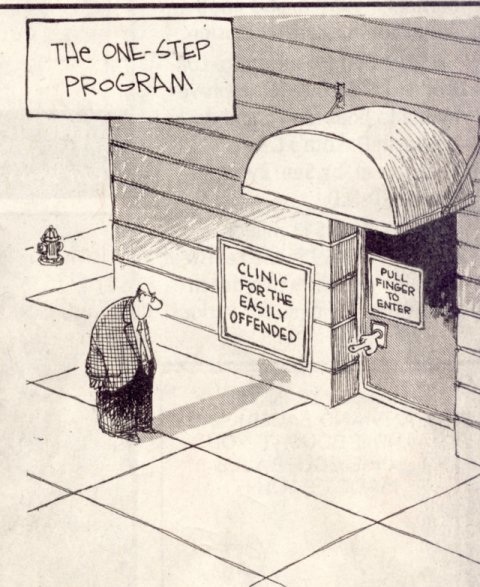
At a meeting of the Northwest Corner Caucus recently, a medical friend of mine observed that an “insult” to the skin was so much easier to acquire when the skin had become thin and therefore vulnerable. I looked at him quickly to see if he had used the medical term “insult” specifically to bring it into line with the social term “insult” and it’s effect on the personal notion of “being thin-skinned.”

He had. Of course he had. But I had not. This is the first time it ever occurred to me that both “insult” and “thin-skinned” could be used in both ways—in both physical and psychological ways.

We might begin by wondering what makes something an “insult” An insult is defined as aninsult 2 attack on the body. [1] It is likely to produce an effect if the skin is particularly vulnerable. It’s only natural. The two logical treatments are a) not going to a place where your body is likely to be insulted and b) thickening up the skin so the insult does not cause damage.

I like both of those. At my age, I have a lot more choice of settings that I did when I was younger. When you are a kid, you are thrown into all kinds of situations, some of them toxic, because there is the inevitable handling of kids in batches. Elementary school recess, for instance. When you move on to your work life, you have job—no matter what it is—that requires you to do some things and be, or to seem to be someone that you are not. Often you aren’t good at those things and you know you are going to have to pay for them later in your life. But when you are old, you pretty much get to choose the settings you like best and make of them what you want.

Considering these stressful settings as analogous to full sun, I just stay out of the sun as much as I can. That’s Plan A. I just avoid insults. Plan B is thickening up my skin so the insult doesn’t do so much damage. Here, the prospects don’t looks so good. Let’s consider actual skin first, then we will move on to metaphorical skin.

My sebaceous glands used to produce a lot of the fats that kept my skin moist, but they insult 5seem to have gotten tired over the years. Furthermore, the increased permeability of the cell walls means that the moisture the cells used to contain, now evaporates more rapidly. And then too, some of the things we call “thin skin” are actually rigid skin; inelastic skin. It is inelastic because I no longer produce the collagen and the elastin I once did. As I said, the prospects don’t look that good. My skin is just going to be insulted more easily. I am going to become more thin-skinned.

There are, however, things I can do to save my actual skin. The epidermal cells are like a leaky boat, except in my cells the fluid leaks out and in the boat, the fluid leaks in. If you had a leaky boat, you would look around for some way to plug the leak. Skin moisturizers do that. They retard the leaking of epidermal fluid, so that the cells that make up the outer layer of skin are fatter. There goes “thin skin.” That’s to retarding the evaporation of the fluids, I now have “fat skin.”

So I am “staying out of the sun.” More exactly, I am limiting my exposure to the sun. I wear hats (sometimes) and put on sun block (sometimes) and don’t go out in the full heat of the day (sometimes). And I certainly don’t smear my skin with Johnson’s Baby Oil and lie out in the sun the way we did when we were young and invulnerable.

So that’s what I do for my actual skin. I thicken it and I stay out of insulting environments. How does that work for my metaphorical skin?

So how do those two strategies, Plan A and Plan B, work for my metaphorical skin? Pretty well, I think, and I speak as one who has always been thin-skinned. There are two ways of “staying out of the sun.” One is to put UV blocker on my skin. I’ve actually done that. I spent a decade and a half of so working in a legislative setting. I represented the interests of my agency before legislative committees and with governor’s advisers and at lobbyist’s parties—all places I would have dreaded going as myself. But I was not there as myself. That’s what functions as the UV blocker. There was no way I could do my job if I responded to the little personal taunts that go with that kind of work, but my job was to respond only the the little organizational taunts that would affect my agency. As I got used to it, I was dumbfounded to see that comment after comment that would have made me either angry or depressed had virtually no effect on me at all.

Why? Because I wasn’t there as myself. So I exposed myself to the “sun” of political conflict wearing the “sunblock” of my organizational identity. I was “the guy representing X organization” not Dale Hess.

insult 1Thin-skinned people are often accused of “not having a sense of humor.” This means, as a rule, that they don’t delight in the array of interpersonal aggression that can so easily be denied by calling it “humor.” “What’s the matter” they say, “Can’t you take a joke?” The joke/insult works because they know where your skin is and they know how thin it is. But if you are not in that environment as yourself, then the joke is at the expense of someone you are not (at the moment). In some cases, that really does make it funny. They are throwing jab after jab at you and none of them are landing because “you” are not there. “That guy,” the agency rep., is there.

And as you watch it safely from your organizational vantage point, you say, “Now that really is funny.

[1] A group of us gather in the northwest corner of the Multnomah Village Starbucks most mornings. There isn’t any “membership” and there aren’t any “rules” as such, but the group does stress civil discourse and on raare occasions, polices uncivil discourse. The policing amounts to “that’s not the way we do it here.” It is also true that each of us violates those rules when we are elsewhere. It is “at the Caucus” that those practices apply.

[2] Medtalk noun Any stressful stimulus which, under normal circumstances, does not affect the host organism, but which may result in morbidity, when it occurs in a background of preexisting compromising conditions

Posted in Getting Old, Living My Life, Words | Tagged , , , | 2 Comments

Premarital Sex and the Rhetoric of the Church

Now there’s a title to be proud of. It has a moral category in it. It looks like it has a moral claim in it. It doesn’t but it looks like it. For men of my generation, the expression suggests “health lectures” in the school building and practicum sessions in the parking lot in the back seats of cars. It is, as I say, a title to be proud of.

Now I’d like to try to describe what the essay is actually about. In the broadest sense, it is about the efforts of the church in the U. S. to maintain their teaching on premarital sex in a culture where the implications of “sex,” and the meaning of “marriage” have both undergone substantial revision. [1] We have failed. Here I want to look at how and why.

I’ve been thinking about this for awhile. Recently, the Presbyterian church went through a spasm of redefinition when the question of ordaining gay clergy was forced on us. A part of that debate involved conservatives feeling around for an issue that could be used against the ordination of gays. They came up with this:

“…all ministers, elders, and deacons [shall] live in “fidelity within the covenant of marriage between a man and a woman or chastity in singleness” (G-6.0106b in the church’s Book of Order). [2]

It was the first concern I had heard in many years about “chastity in singleness.” In the churches I attended and heard about, there was no discussion of the wrongness of sex before marriage because there was no consensus about it. Now, all of a sudden, chastity becomes a big deal. Why?

Well, it turns out that at the time, gays could not marry so whatever sex they had violated the “chastity in singleness” principle. Gay couples living together for twenty years were still “single”—keep your eye on the shell that has the pea under it—because they were not married. [3] The starting line of this conversation is that we don’t expect heterosexual candidates for the ministry to be “chaste”—ugly word, don’t you know, archaic concept—but we do expect it of homosexual candidates.

This was supposed to embarrass the liberals. In the way that Jesus embarrassed some hecklers by asking them to show him a coin that they absolutely should not have had in their pockets, the conservatives dared the liberals to do away with the notion of “chastity” generally. It was embarrassing. No one wanted to notice the fact that the church had long since gone silent on chastity for heterosexuals.

I tell that story—three paragraphs of your life wasted—just to say that I have been thinking about it as a rhetorical problem confronting the church since then. Now…as everyone knows, organizations simply do not change from NO to YES. It isn’t like throwing the switch and sending the train in another direction. Before you throw any switches, you attack the salience of the issue. The step between NO and YES is “does it really matter?” The current position of the churches I know anything about is that it does not.
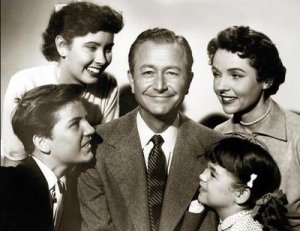
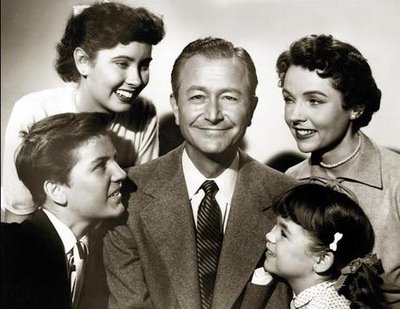
premarital sex 8Why would that be? Here are a few things to think about. The invention of “the teenage years” and the postponement of marriage have, together, made a shambles of our earlier sexual norms. Needless to say, it put a dent in the church’s rhetoric as well If you can imagine a Father Knows Best (FNB) sort of family protecting their daughters Betty (left) and Kathy (right) from “boys” until they had graduated from high school, you can see how the system worked. Father actually did know best. “Chasity” was to be protected for a relatively short period of time and ending it required the father’s permission, by way of permission to marry.

All that is gone. You heard it here first.

“Father” know longer knows best. With the invention of “teenagers,” a wholly artificial grouping in cultures with traditional work settings, your peers know best. Especially those who are “doing it.” With the postponement of marriage until the late 20s, FNB chastity, which was always a little like finding out how long you can hold your breath under water, became an endurance event. It’s not from 14 to 16 anymore; it’s 12 to 28. We have never had a norm that would work over that period of time.

Fear of pregnancy worked for a while, then the Pill became widely available. Shaming worked for awhile, but when the numbers of people participating in teen sex and talking about it got too large, shaming didn’t work any more either. You really can’t shame that many people at a time.

Furthermore, marriage was not only postponed, but brought into question as a necessary or even a desirable state. Very thoughtful men would say to women, “I love you and I am committed to a life with you and to raising any children this union might produce, but this “marriage” thing makes no sense to me at all.”

Funny couple in bed looking and peeking over sheets surprised. Young interracial couple, Asian woman, Caucasian man.

Funny couple in bed looking and peeking over sheets surprised. Young interracial couple, Asian woman, Caucasian man.

I could go on with the cascading social changes but I think that’s really enough to set the stage and I have only one more difficulty to point to anyway. This is it. “Marital” is the adjective form of “marriage.” “Premarital sex” only means “sex before marriage.” If marriage goes away—which it appears to be doing—then the prefix pre- makes no sense at all. The church has a whole bunch of sacred scriptures that presuppose marriage. What do they mean if/when “marriage” as a social institution disappears and we still want to be guided by the scriptures? [4]

Well…rhetorically, you start saying that it doesn’t really matter all that much. I called this, above, the reduction of salience. This is what Pope Francis, without question the most media-savvy pope in history, has been doing with homosexuality and the Roman Catholic church. The official position of the church is being assailed by both left and right, so the Pope says, “Aren’t there things we could be talking about that are closer to the core mission of the church?” That’s a reduction in salience.

But if sex before marriage declines in salience, then something must increase to take its place. “Let’s don’t talk about [that old topic]” we say, “Let’s talk about [this new topic] instead.” Not A, but B. So we need a really good Topic B. It needs to be engaging, so people are willing to talk about it and it needs to be appropriate to the question so it can be practiced and refined.

We chose two. The more political norm is “consensual.” The social norm is “caring.” As usual, the real meaning of the political norm is that it rules out something we feel strongly about. It rules out predatory sex of every kind. It rules out rape, it rules out managers who leverage their position with sexually attractive subordinates, teachers with students, etc. The political norm—informed consent—is met when two people both want to have sex and agree, as equals, to do so.

Nothing in the norm of consensus rules out colossal stupidity. It doesn’t rule out most premarital sex 7kinds of abuse. It doesn’t rule out misunderstandings. That’s why we have fallen so in love with the social norm, “caring.” [5] Sex is good in a serious relationship when it is a long enough relationship to consider the welfare of the persons, not just the bodies. It is good if it is one part of a relationship which has other significant parts as well. It is good if it is one way among several in which each partner cares for the welfare of the other, not excluding kinds of caring that might be personally costly.

I think the church could have tuned its rhetoric about “the new sexuality” for a long time and not come up with a better standard than that. It’s hard to say exactly what it means, but it lays down standards that are good enough to activate a partner’s concerns and possibly those of that partner’s friends. It works like the temperature setting on a heating and cooling system. It doesn’t define “an ideal temperature,” but it defines “too hot” (he AC turns on) and “too cold” (the furnace turns on) and those are worth having.

There is nothing in the Bible that imagines sexuality apart from religious faith. I know of one passage offhand that speaks favorably of sexual relations in that context. Paul says in 1 Corinthians 7 that sex—he means between husbands and wives— is the kind of thing that can ruin a perfectly good life of prayer. So you can do without sex for awhile and make more time for prayer that way. But abstinence can make you crazy over the long haul and God doesn’t want you crazy. Everything else I know about that isn’t poetry is property and purity, with a dash of obedience every now and then.

The Bible is not anti-sex. I don’t mean to say that. What I mean to say is that the sexual part of our lives, like every other part, is to be governed by the network of covenantal obligations in the Old Testament and by the fellowship of the church in the New Testament. The Bible is not friendly to is a “reduction of salience.”
premarital sex 5If the Bible is not happy with that solution and the church in our time is forced to it, then what? It isn’t pretty, it seems to me, but it is what we have. I call it, by way of caricature, “God wants you to play nicely with others.”

You can go a little way in that direction by mining the rich resources of “prefer the needs and wants of others to your own.” That serves as a guard against predatory relations, but it doesn’t do anything for stable authentic partnership. In a stable authentic partnership, you need to put your own needs into the mix with your partner’s needs AND, in my view, you need to pay attention to what IT, the relationship, needs above and beyond what the persons in the relationship need.

In the short term—the dating part of sexual selection—you make the best match you can premarital sex 6make. I was in the dating business recently (2004: I will continue to call it recent until the scars go away) and I was horrified to confront, as a Christian adult, the fact that dating is a meat market. Not “meat” in the exaggerated sense shown here, but in the sense that each is looking for valued traits in the other, and, in not finding them, continues shopping.  So I called around to my fairly impressive collection of pastor friends and I said “What do you teach at your church about Christian dating?” They said—I am summarizing many conversations here—“We don’t teach about it because we don’t know what to say.”

The church can fully support the development of strong and stable long-term relationships in which sexual relations are a major part—again, nothing here raises the question of whether a ceremony of any kind has been performed—but the church doesn’t bring anything to that question that the Lion’s Club doesn’t bring. [6] In the Mosaic Code, there were two reference points. The first was transcendent: I am the Lord your God. The second was immanent and social: therefore you shall deal fairly with your neighbor, with the visitor, with the marginal, with the vulnerable. Oh, and pay your taxes.

The stance of the church that I am describing—the one I caricatured as “God wants you to play nicely with others—has only one referent. It has the social referent. The relationships to which we are committed are not entailed in our relationship to God. There are lots of commandments in both the Old and the New Testaments, of course. They may have to do with caring relationships. They do not, by my understanding, require any particular sexual standard that has meaning in the modern—the post-Father Knows Best— era.

It’s an odd position for the church, it seems to me. We know what to do, but we don’t know what to say. For a church that lives by the Book of Order, that’s not a comfortable place to be.

[1] Just a few quick clarifications. I’ve been a Presbyterian most of my life but I was raised in a much more conservative setting. Until I started in grad school, I went to conservative colleges where “public displays of affection” (people actually knew the acronym PDA) were frowned upon. I am now approaching the age of 80 and am happily married to my third wife. Just so you know.
[2] Non-Presbyterians need to know that the Book of Order is the constitution of the premarital sexPresbyterian Church. When we ratify “constitutional amendments,” this is the document that gets changed. During this debate, I learned not only that some people could quote the regulation at G-6.0106b, but that some would “refer to it” as if it were John 3:16, which everyone knows from Tim Tiebow’s eyepatches.

[3] Adultery, by the way, was always a separate topic. Whatever appetite you might have for your neighbor’s ox or his ass or his maidservant, there are certain formal commitments to a marriage that are violated in adultery.
[4] It doesn’t need to disappear in the sense that there aren’t any more marriages. It needs only to disappear as the common presupposition of the language about sexual relations. When you say, about getting married, “some do and some don’t,” you have destroyed the presupposition of marriage and all the norms that belonged to it.
[5] I really don’t think there is a consensus on this word. It’s harder to agree on the goals than to rule out certain kinds of abuses. I just mean by it, taking the long term welfare of the other into account. I would call it “commitment” if that had more emotional richness in it.
[6] Not to play with the ancient antipathy between Christians and Lions, just choosing the Lion’s Club as a modern era, nonreligious organization.

Posted in Living My Life | Tagged , , , , , | Leave a comment

Seveneves

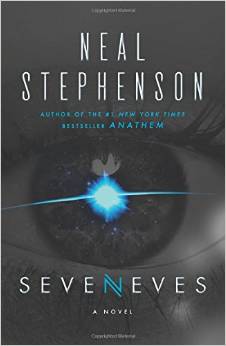
Neal Stephenson has done it again.  The key word in this essay is going to be “it,” apparently.  There is a cluster of notions swirling around and I am counting on “it” to hold still so I can capture a few of them.

seveneves 1Before we get into that, I want to tell you what kind of essay this is.  It is not about the plot of the book.  It is not a spoiler any more than the dust jacket description is a spoiler.  It isn’t about Stephenson’s technical vision, which is daring.  It isn’t about his characters which—especially the seven women who serve as the “Eves” of the human race—really hold the book together when the technovision does not.

No, this essay is about Stephenson and religion.  It’s a little dance.  He keeps denying it all, but he keeps dropping in words that belong to established religions, especially Christianity.  Ultimately, that dance is the “it” we will be spending the most time with.  It will help a great deal if you are a Neal Stephenson fan.  If not, just go read Seveneves and you probably will be.

In the first instance, the “it” in Neal Stephenson has done it again is Stephenson’s new book, Seveneves. [1]  It is HUGE.  Not so much in just the number of pages (only 862) as in the scale of the story.  In the first sentence, some mysterious “it” (they call in “the Agent” because although they don’t know what it is, it “did something,” and that’s what Agent’s do) destroys the moon, which has the effect of destroying the viability of the surface of the earth.  Part III begins, “5000 years later…”  So this is a book on the Stephensonian scale and when I said he had done “it” again, that is part of the “it” I was thinking.

But another part of that “it” is that Stephenson has an itch for someone to play the seveneves 2philosopher king.  He doesn’t take it on himself, but he sees to it that someone takes it.  Here’s a line or two from The Diamond Age, for instance.  The Speaker is Lord Alexander Chung-Sik Finkle-McGraw..  He is “an Equity Lord” of the New Victorians phyle. [2]  “That’s the whole point of being an Equity Lord, you know—to look after the interests of the society as a whole instead of flogging one’s own company, or whatever.”

I mention it because Stephenson keeps putting characters in his books that somehow stand above—I’m going to ignore for the moment that “standing above” is the meaning of superstitious—the plane on which the other actors are working.  Lord Finkle-McGraw plays that role in The Diamond Age.  And someone plays that role in Seveneves as well.  I am arguing that the “Owners” of the bar that employs Ty Lake play the role here.

In this quote below that begins, “Maybe yes…”, the identity of “it” is a little harder to pin down—at least it is hard for the speaker, Tyuratam Lake.  The question is being asked by a young man named Einstein (no relation), who is a descendant of Ivy, one of the seven Eves.

“So it is like believing in God.”

Ty Lake answers,“Maybe yes. But without the theology, the scripture, the pigheaded certainty.”

We’ll come back to “maybe yes,” but it is very Stephensonian to dis what he would probably call “institutionalized religion” in this way.  Stephenson lives in Seattle, one of the two capitals of the “spiritual but not religious” part of the country that  Patricia O’Connell Killen and Mark Silk in their book Religion and Public Life in the Pacific Northwest call “the None Zone.” [3]

seveneves 4This little outburst of Ty Lake’s tells us that Stephenson is no fan of theology or of any sacred texts bearing upon that theology, and particularly not of any “pigheaded certainty.”  Ty Lake, as we will see, has a certainty of another kind and Stephenson is OK with that.

So “believing in” the Purpose is “like” believing in God in some ways.  “Believing in the Purpose” is the “it” we are wrestling with.  So now we need to ask how it is like believing in God.  There are three ways, as I count them.

The first is that “it” has a function.  “It’s a way—the Purpose is a way—of saying there’s something bigger than this crap we’ve spent the last week of our lives dealing with.”“Red versus Blue crap?” Einstein asks.  For nearly all the book after the destruction of the earth, people live is fairly stable coalitions of good guys and bad guys.  It’s a kind of Cold War, particularly since it takes place mostly in space.  Red are the bad guys—about two and a half Eves—and Blue are the good guys, about four and a half Eves.  It is the biggest frame of reference available to us until the final tenth of the book.  So “bigger than Red versus Blue, the organizing political and cultural struggle of our time” is really big.

“Yes,” Ty Lake says, “bigger than Red versus Blue.”  The function of Purpose-with-a-capital-P is to remind us that there is a larger frame of reference that needs to be taken into account.  Here’s another look at what “larger” means.  Esa Arjun, an ally of Lake’s is fending off the curiosity of a soldier serving under him. [4]

“Sergeant Major,” Arjun said quietly, “there are more things in heaven and earth than are dreamt of in your philosophy. [5]

[Roskos]Yur snorted. “Is that a fancy way of saying it’s above my pay grade, sir?”

“Yes,” says Arjun.

“Never mind,” says Yur, “I see it now. It’s some kind of Purpose thing. Above my pay grade. You should have just told me.” He drew himself up and saluted. “What are my orders, sir?”

Yur has no idea what “it” is, but he knows what kind of thing it is, so his response is to ask what orders he has that are based on Arjun’s and Lake’s understanding of what “it” is and as we will see, they don’t know.  We know so far that “it” serves the function of reminding us that as big as Red versus Blue is, there is a context much bigger that has a legitimate call on our allegiance.

That’s the first way that “it” is like believing in God: “it” has a function.  It reminds us of the larger frame of reference.  The second way is a criterion of conduct.  There are people who are worth following because they might know what the Purpose is and their lives are marked by it.

seveneves 3Remember now that this is Stephenson.  He would really hate it if anyone discovered what the Purpose actually was.  It isn’t a destination like Heaven or a rule of conduct like loving your neighbor.  Those are all modern by comparison.  Stephenson says—has Tyuratam Lake say—that certain people are worth following.  I would say that Lake trusts these people in the most fundamental way possible.  He “believes in” these people, meaning by that expression a profound attachment that fits perfectly well within Christian doctrine.  That is how Jesus’s disciples believed in him before they thought of him as Messiah—someone who must know something and who is worth emulating.

Here is Ty Lake:  “No one has ever told me [what the Purpose is]. I have to make guesses, based on what I see from people who act like they know what it is.”

Also: “People who claim they are motivated by the Purpose end up behaving differently—and generally better— than people who serve other masters.”

To me, there is a lot there. These people Tyuratam Lake is talking about “claim they are motivated by the Purpose.”  Some of these people are his employers, but he doesn’t give them this kind of respect because they employ him; it is this other part of them.  They claim “the Purpose.”  They do this out loud. People hear them.  The second thing is that they behave differently—generally better—than…”people who serve other masters?”  Really?  Matthew 6:24?

I think that is very cagey of Stephenson.  I think he chose that phrasing on purpose.  Even people who don’t know exactly where it came from will identify the kind of statement it is.  No modern man serves people he calls “masters.”  Stephenson wants to trigger an association.  Both Theodore and Franklin Roosevelt did the same thing with “malefactors of great wealth.”  It isn’t the meaning.  “Malefactor” just means “someone who does bad things.”  But that word was not a part of the listening vocabulary of their audiences, with one notable exception.  The criminals who were crucified at the same time Jesus was were called “malefactors” in the King James Version, the commonly available version of the Bible during their presidencies.  “Malefactors” is a  “killing Jesus” kind of word.  The direct meaning is common and safe.  The associations—never pointed to—are powerful.  I think that’s what Stephenson is doing with “serving other masters.”

Finally–third and last– there is this characteristic of “those people who serve the Purpose.”  I’m going to re-use a few lines, but they are important here for context.

“Some people—some Red, some Blue, and some ambiguous folks like the Owners of my bar—maybe even some of those kind of people”—he nodded at Deep—”seem to think they know something.”

“Do they?” asked Sonar Taxlaw.

“I have no idea,” said Ty. “But from what I’ve seen, they’re not stupid. Even if they are—”

He paused, groping for words.

“Even if they are,” Einstein repeated, “what?!”

“It’s a way—the Purpose is a way—of saying there’s something bigger than this crap we’ve spent the last week of our lives dealing with.”

Again, there is a lot here.  Consider, for instance, the capital O in “Owners of my bar.”  It is capitalized wherever it appears.  What is it about Ty Lake’s employers that makes him want to—that makes Stephenson want to—give then that capital O?  And they “seem to know something.”  And “they aren’t stupid.”  We have already seen Stephenson’s anathema on “religion:”  Religion is the stuff with “the theology, the scripture, the  pigheaded certainty.”  But these people are not stupid and the say there is something to believe in and they live lives worth of it.  Even Stephenson isn’t opposed to that.

That—really—is the “it” we have been after.

[1] Stephenson likes difficult titles.  I don’t know why.  His previous book’s title was Read Me if you followed the font and Reamde if you followed the sequence of letters.  This book is about the seven “Eves,” the seven mothers of the race who survive the burning of the earth’s surface, but there is a movie “The Seven Eves” and a book The Seven Daughters of Eve, and I think he just wanted a little space.

[2]  The Diamond Age is set further into the future than Seveneves.  The enormous power of nanotechnology has solved the problem of scarcity, or at least has severed the link between povery and nationhood.  There are no more nation-states.  There are “phyles,”—self-defined groups—and the New Victorians are on the top of the pile.

[3]  Portland, Oregon, where I live, is the other capital.

[4] Arjun’s first name, Esa, was once ESA, the European Space Agency, but it has become a common first name by now.

[5]  Hamlet.  I think that’s cute and he just drops it in without comment.  It’s the only literary reference I saw in the whole book except those glancing blows from the Bible

Posted in Books, Paying Attention | Tagged , , | 4 Comments

Being a patient of corporate Persons

Every time a new part of my body goes bad—or some previous grievant goes bad in a new way—I get a new kind of doctor. I don’t get rid of the old ones. I like the old ones. I just add a new member to my team. [1] It’s a pretty big team by now.

Every member of this team is guided by a question that I admire, especially now. The question is, “What treatment, if any, would bring Dale the most relief (best protection) all things being considered?” They are knowledgeable men and women, but they are not above taking a risk now and then. Not a one of them is the kind that would wake a patient out of a sound sleep at 3:00 a.m. to “take vital signs.” They would say, “He looks OK to me. Let’s check him after breakfast.”

A week and a day ago, Bette and I flew toward Philadelphia. I didn’t make it. For whatever reasons—the debate continues—I passed out on my Southwest flight and they off-loaded me into an ambulance in Chicago. I left MacNeal Hospital—the one closest to Midway Airport— about 24 hours later with a “note from the teacher” kind of note in my pocket and a hope that Southwest Airlines would not send me back to the principal’s office.

I may write more about the physical events (probably not), but today’s account has to do with liability. Any one of “my doctors” is willing to take a chance on me; to call a given reading “good enough” (blood pressure) or “Yes, but yours just runs high (prostate specific antigen); watchful waiting is probably the best course.” None of the questions they routinely ask is, “How can I be sure that I have a good case if I am sued.”

nurses 4I was told that Southwest Airlines has a policy that when they break out the oxygen for a passenger, that passenger goes into the hospital at the first opportunity. [3] I spent a substantial part of the flight lying in the aisle, making things really difficult for the food and drink cart. I had passed out, sitting in my seat, and was drenched with a cold sweat and had a very low pulse. I’m not saying they shouldn’t have been concerned.

But by the time we got to the hospital, I was feeling pretty good—not, I was told, looking nurse 2all that good—and I was ready to go on to Philadelphia. Not so fast. Southwest was committed to getting me to the hospital. MacNeal Hospital is committed to finding out what part of my equipment was at fault. There was no evidence by the time they got hold of me that there was anything wrong with my body, but they wanted to be sure. So the blood tests, the heart monitoring, the carotid artery scan, the EKGs, and an echocardiogram too, had I not had one just before the trip.

Everything looks good. So I feel comfortable going on and there is still a flight that will get Bette and me to Philadelphia. But the doctor was not comfortable with my judgment and the best she could do for me was a note—a form, actually—saying that I had left the hospital “against medical advice.” I would have been fine with that, but I was told that Southwest Airlines would not let me back on one of their flights unless a doctor gave me a note and this doctor wasn’t going to. Yet.

So now I’m in Chicago. A very prudent doctor is not moved by my account of having been through this many times before and will not allow me to fly on to Philadelphia. In point of fact, the discussion and the testing went on, concurrently, until there were no more Southwest Airlines flights that day, which is when I gave up.

nurse 1So now I am in the hospital. It is a huge and complex social organism run by people who have no sense of the larger picture of things and who are not permitted to use their judgment even if they did have that larger picture. The nurses ask you the questions they are supposed to ask. They don’t care that the previous nurse and the one before that asked the same questions and struggled in the same way over electrocardiogenic syncope. They are no more free to skip a question than the cashier at Chipotle was free to skip the question about whether I was old enough to drink alcohol. I was 75 at the time, but she was on camera and had to ask. [4] It’s a matter of not being liable.  This book cover has in mind that nurses, as well as doctors, are people.  My idea is that nurses, if they are only corporate agents, are not permitted to be very “people-like.”

Every doctor and every nurse did what she had to do and that included the classic awakenings at midnight and 3:00 a.m. to take “vital signs.” I was asked about the surgery I had on my left shoulder in 1962, on my knee ca. 1986, on my prostate at about the same time, and on my cardiac catheter ablations last year and ten years before. I was afraid they were going to start tracking down the colonoscopies.

The airline and the hospital are corporations, therefore, by the current definition, “persons” in some sense. But the really cool part about personhood, the part that has to do with agency and discernment and, where necessary, risk taking, is not a part of corporate personhood. So Southwest had no choice but to offload me, having given me oxygen. The hospital had no choice but to hold me against my will—no “free to fly” note, remember—until they had ruled out things no well informed doctor would have ruled in.

nurses 3The collusion between the Southwest Person and the MacNeal Person kept me in Chicago all evening.  The picture is of a Yukon Person.  I got “lunch” at 9:00 p.m. I tried to explain that some of the symptoms they were worried about would clear up instantly if I could just get some food. I got a room and a roommate by 9:30 after eight hours in the emergency room, monitored by machines, but otherwise mostly unattended, but the roommate was still watching hockey at 10:30 p.m. I thought he was a hockey fan, but it turns out he didn’t know how to turn the TV off. Go Blackhawks! I gave orientations to wave after wave of nurses—some very nice, some not so much—and negotiated my freedom from a compassionate doctor who wrote and legibly signed a note that said, “Dale Hess is safe to fly on 6/4/2015.” [5]

So we didn’t actually get to Philadelphia, apart from the airport, but my daughter picked us up and we spent some truly wonderful days with her and my son-in-law and my grandsons in Princeton, where they could shoot the next version of The Truman Show if they wanted to. It is beautiful and, in the days after graduation, it was peaceful.

[1] This is not “my team” in the sense that I am calling the plays or doing the scoring. This is the team that I have assembled to keep me playing the game.
[2] I asked a nurse recently if she would return those vital signs to me when she was done with them. She stared at me over the tops of her glasses, shrugged, and went on to the next bed.
[3] I was also told that the pilot decided to go on to Chicago and not to divert the flight to Boise, Idaho. Thank you, captain.
[4] She did face away from the camera and roll her eyes and I appreciated that.
[5] She had a really clear signature. I wan’t sure she was real doctor, based on the signature, but by that time I would have taken a note from the busboy.

Posted in Getting Old, Living My Life, Society | Tagged , , , | Leave a comment

Bible “Headlines:” A Complaint


I’m going to approach this whole thing as a conspiracy.  I don’t think it is, except in the sense that all cultures are conspiracies—but I have a rant in mind and calling it a conspiracy will make it easier.  Jesus told a story that I call “the canny steward.”  Everyone else I know and every Bible I remember seeing calls it “the unjust steward.”  It’s just so wrong.

headline 1I don’t remember when they began interrupting the biblical narratives to put little names in.  The Bible I had as a little boy didn’t have it.  These are like headlines in a newspaper.  My conspiracy is going to involve the writers of these little biblical headlines.  At the meeting where they decided to do this, the convener of the meeting—this fictional person’s name is Albert Nudge—said, “I’ve called you here to discuss my idea.  I think we should give names to discrete bits of biblical narrative so people will know what they are reading.”

Bob Drudge has an objection.  “But…don’t they already know what a story is about?  And if they don’t, wouldn’t it be better for them to decide what it is about after reading it?”

Cynthia Fudge has a more technical orientation.  “But,” she says, “Can we really say that a story is ‘about’ one thing?  What if it is an allegory and there are as many meanings as there are characters?”  You see what I mean about Cynthia.

Albert has been thinking about that for a while and he is ready.  Besides, his real last name is Zimmerman.  “Nudge” is just a nickname. [1]

“Oh,” he says, “You are missing the point.  If we give it “a title,” then it will have “a point.”  And.  Wait for it. The point it has is the one toward which we have nudged them with our title.”

I’m disappointed in the lot of you, really.  Remember back when there was such a demand to translate the Bible out of Latin and into a language people could read for themselves?  The people who were opposed to that said, “No!  If you let hoi polloi read it,[2] they will misunderstand it!”  But people don’t like to be told that they aren’t allowed to read something, so a huge demand arose and this Luther guy translated it out of the Latin in which it was originally written[3] and then everybody could read it and they came to a lot of different conclusions about it.  Some were just wrong, but some were really inconvenient.”

“So here’s the thing.  Here’s why I have called you all together into this conspiracy.[4] We don’t deny ANYONE the right to read the Bible on his or her own.  We don’t give anyone an authoritative understanding of what a given story means.  We just insert a little headline that guides their minds in one direction rather than another.  Don’t you agree that some directions are better than others?”

The others agreed, I suppose.  Or complied.  Or were just nudged in the right direction.  Because there started being Bibles with little headlines announcing what the meaning of the next section was going to be.  And that brings us back to the Canny Steward.

Check it out for yourself.  Luke 16.  There’s this guy who is the CFO of a rural headlines 2corporation.  He’s been dipping into the till or letting weeds grow in the garden or something.  In any case, he knows he’s going to get fired.  So he gives sober forethought to “his next stop.”  A manual laborer?  Nope, not strong enough.  A beggar?  Nope, too proud.  Ah, but if he were a local celebrity, a person everyone owed a favor to, things could be pretty good.  And he has, at the moment, a way to make everyone indebted to himself.  It isn’t honest, of course, but it shows real insight.  He cuts the amount of money or produce each tradesman owes the corporation.  The corporation loses all that money, but the steward doesn’t care.  Every tradesman looks on the steward as a benefactor and his future—his “next life,” so to speak, is taken care of.

That’s the story.  We could haggle over what it is “about,” but Jesus told it (verse 9) to illustrate the point that using the resources you have in this life so they will have value in the next life is not a stupid thing to do.  It was the steward’s canniness in the use of resources, in other words, rather than the way he cheated his master, that was at the center of the story.  Why anyone would want to invert those two is a source of some puzzlement to me, which is why it is so easy to imagine conspiracies. “I know!” the headline writer said, “Let’s say that the story is about misfeasance in office.  We are having a lot of trouble with that these days.”

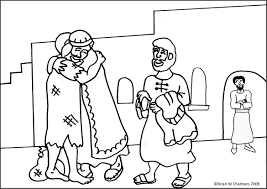
headline 3There is a story popularly called “the prodigal son.”  Luke 15.  There is a son who abused his father in a lot of ways, of which spending his pre-inheritance quickly and badly is one of the least bad.  But there is a marvelous father, who buffers the son’s re-entry into the village and who greets him warmly.  And there is an elder brother who has labored for his father in quiet resentment for years (how prodigal is that?) and who wants nothing to do with his disgraceful brother.  The contrast of the father’s attitude–God’s attitude by analogy, and the brother’s attitude—Israel’s attitude by analogy is the most prominent part of the story.  (I had to do a lot of looking to even FIND a picture that had the elder brother in it.)

What do we gain—what does Mr. Nudge gain—by diverting our attention from the magnanimity of the father and the cold distance of the other son to the partying and profligate younger son, who comes to himself and comes home?  The plausible point of the story is the elder brother; the headline is about the younger brother, by any account the least important character in the story.

There are two kinds of responses to this unhappy state of affairs.  The first is to look at a story’s name—the contribution made by Nudge and his henchpersons—and say, “OK, I see that name but what is it really about.”  That’s a worthy option.

The other is for everyone to do what Nudge has done.  Call these stories by whatever we want to highlight.  So the guy who had a really good harvest and, instead of sharing the bounty with his neighbors, built a whole new barn so he wouldn’t have to share anything at all?  Remember him?  The Story of the Evil Capitalist?  Luke 12. You see where this could go.

I’d rather not let it go there.  Let’s just treat these story names the way we (should) treat headlines in the newspaper.  They are some headline writer’s notion of what will get you to read the article.  They are not reliable guides to what the story is about.

[1] He picked up the nickname because of his enthusiasm for Malcolm Gladwell’s book Nudge, which argues that the force necessary to control a development can be extremely small if it is applied at the right place and especially at the right time.  The thrusters on a spacecraft are a good example of how little it takes if you fire them at the right time and at the right place.
[2] In English, we often say “the hoi polloi,” but hoi is just “the” in Greek, so I left it out.
[3] Nudge is devious but he isn’t very well informed.  On the other hand, I heard a lot of complaints when the King James Version of my early years began to lose out to the Revised Standard Version and every now and then, someone who hadn’t gotten the memo would ask, “But Jesus spoke King James, didn’t he?”
[4] Etymologically, people “conspire” when they are so close that their breaths—spiro—mingle (con-).  Nudge, Drudge, and Fudge are conspiring because the room is so small.


Posted in Biblical Studies, Political Psychology | Tagged , , , , | Leave a comment

Investing in Our Future

According to our long range plan, Bette and I will trundle ourselves off to a really good senior center by the time I am eighty years old. I met Bette when I was 68, so we’ve been talking about it for quite a while and as we have been talking, that remote event has become very nearly imminent. What was philosophical has become strategic and now it is tactical. I love the sequence. It seems to me just the way it ought to be.

Today, I’d like to look at the mechanics of the transition. I have thought through (and written about) the setting one leaves. And speaking of leaves, a leaf on a deciduous tree prepares for falling off its twig by forming an abscission layer. This is two lines of cells, one move prep 1on the leaf side and one on the branch side, that are stuck together with a kind of glue The glue is intended to get less sticky in the fall, so the leaf is less and less likely to stay attached. But—and this is the point—the abscission layer also protects the tree and probably, that is what it is for. When the leaf falls, there is no open wound on the twig. It is sealed and safe.

And what the leaf does by nature’s exquisite preparation, Bette and I hope to do by being thoughtful about it. We are not “falling off,” of course. If another metaphor were required, we could say we were moving to another tree. But in any case, we are leaving this tree and we want to seal off where we have been so our absence doesn’t give any difficulties to the neighborhood projects, groups, and coffee shops we will necessarily be leaving behind.

As I say, “leaving well” is important and I have given some thought to that already. Today’s idea has more to do with managing the transition to a new place. If we were to continue to use the unwieldy metaphor of moving to “another tree,” this essay would be about managing the transition to that other tree.

This is a very practical matter, so I’d like to start back at philosophy again. This is a substantial life change for us and the best way to make that change is to anticipate the new setting and all its attendant opportunities. There is no need to deplore our present setting—which is very nice—but it needs to be less desirable by comparison to our future setting.

A surprising support for this transition comes from one of Jesus’s parables—one of my favorites. You can find it in Luke 16. It is often called “the unjust steward,” but that only shows how wrong headline writers can be. I call it, in line with Jesus’s use of it, “the canny steward.” The man who had been managing his master’s affairs was about to be fired, so he looked at the resources he had access to at the moment and at the needs he was going to have in the future. Then he used the resources he had to support the needs he would have as a former employee. [1]

move prep 2Jesus thought that was smart (not right, but smart), hence my title, “The Canny Steward.” Well, as it happens, I will not be living much longer in the situation where I am now (my house) and I want to emulate the Canny Steward’s behavior in investing resources in the situation where I will be going. I don’t know where that is precisely, but according to the plans Bette and I have made, it will be a certain kind of place and we have been studying “places like that” for years now. What resources can we deploy that will ensure that we will be welcome there?

I have a third transition story to relate, but before we get there, I would like to stop and work with the principles a little. Here’s a story from Walter Mischel’s marvelous book, The Marshmallow Test. [2] This one is about Mischel himself.

So Mischel, having studied the tactics of several generations of preschoolers, did what the best of them did. He made his present practice abstract and his future practice concrete: his present practice unattractive and his future practice attractive.

Here’s the way he puts it.

Cigarettes were my continuous hot temptation, and I had to change them into something that disgusted me in order to cure my addiction. Whenever I felt a craving…I inhaled deeply from a large can filled with old, stale cigarette butts and pipe debris…I supplemented this step by deliberately reactivating that haunting image of the cancer patient [seen in the hospital corridor on his way to radiation treatment] to make the “later” consequences of smoking as hot, salient, and vivid for myself as possible. Perhaps just as important, I made a social contract with my three-year-old thumb-sucking daughter; she agreed to stop sucking her thumb and I vowed to stop sucking my pipe.

The likely consequences of his smoking were clear, but they were distant—much too distant to change his behavior. The visualizations he describes in this section bring that “distant” future close enough to be really distasteful.

That uses the mechanisms I am considering today; it just uses them in reverse. So the Canny Steward brought the unattractive features of his next life close—not strong enough to dig, he says, and too proud to beg—and caused himself to act promptly (and unethically) in his own behalf in order to prevent that kind of life. Bette and I are working at making our Senior Center future “hot, salient, and vivid,” as Mischel says, in order to prepare ourselves for it. We have not yet had to, and with any luck, will never have to, make out present lives in our home “something that disgusts us,” as Mischel did for his tobacco addiction.

On the other hand, the mechanics of the transition are what they are. Fixing on the bad aspects of the present situation and the good aspects of the future one will make you readier to make the transition. Conversely, fixing on the good aspects of the present situation and the bad aspects of the future one will make you more resistant to the transition. It’s just how we work.

move prep 4In fact, I am so confident in the diagnostic clarity of choices like these, that I would be fully confident that I knew what was going on if I saw them in full operation. If I saw a friend who was talking about the transition to a Senior Center doing things that would make it next to impossible, I would judge that, whatever she says, she doesn’t want to move out. If she, for instance: a) began collecting roomfuls of bolts of cloth for sewing projects or b) adding a new wing to the house [4] or c) began to invest in local political causes and groups that she would have to give up if she moved—then I would conclude that she is committed to staying where she is as long as she can. She might just as well dug a moat and installed a gate and a portcullis. Her intention is that clear.

I could run a series of activities that illustrated just the opposite, certainly, but I am counting on the clarity of the NOT MOVING example to make that unnecessary. Besides, I am going to be concluding with what Bette and I are, in fact, doing to prepare for the transition, and that might clarify things.

Here are three. We are looking at the libraries in the two senior centers that made the finals for us, with some knowledge what the libraries are like that only made the semifinals. Those will be important for me because I am offloading books from our house at an impressive rate and I will need a good library. [3] Bette will almost certainly volunteer in the library and if the center has any sense at all, they will put her in charge of it. [5]

Bette and I both like to share meals with friends. It will be important to make sure that there is, in the center we will be going to, a public space conducive to shared meals, and that there is good food, and that there will be opportunity for us to make our own food in our own place and invite friends. Checking out the food facilities will help us picture how we will use them and to look forward to sharing them with friends. Picturing those pleasant events will make it easier for us to look forward to them in vivid and positive ways.

Third, Bette and I both like to be in groups that are talking about things. Bette’s taste in “things to talk about” is a good deal broader than mine, but it is important to both of us. If the group is “about something” and I know something about it, I would like a chance to lead a group like that. So a place with a lot of active groups would be good and a fluid leadership structure would be good. We are looking at both of those things as we explore our options and it looks to us like the chances are really good at either one.

Of course, we will be giving up our present group participations, likely, when we take on the new set. Not our book group, of course: the Bookies will be a part of our lives as long as there are any left.   Reducing our investment in the ones we are going to have to leave and increasing our hot vivid anticipation of the ones we are going to join just seems like common sense. to me.

If anyone were watching our behavior with a view to drawing a conclusion about our “true motivation,” I really believe that he would conclude that we are preparing ourselves to move. If he listened to us talk about it, he would draw the same conclusion.

Or, possibly, if he read this post.

[1] We can pass over, for our purposes, the fact that he did this by royally cheating his master. What he did was wrong and nothing in the story says or implies that it was right. The point of the story, however, is that we, like the steward, will not continue in our present position (living) and that we would do well to use our resources to ensure that we will be well received in our future position (no longer living).
[2] This section, called “An Addicted Smoker’s Self-Generated Cure” appears on pages 136—138.
[3] The Multnomah County Library is also a good library, but I am thinking of something closer.
[4] These would be changes designed for her own use only, not changes to make the house more attractive for sale.
[5] She is an amazing librarian. I suffer guilt feelings every now and then for taking her out of circulation.

Posted in Biblical Studies, Getting Old, Living My Life | Tagged , , , | Leave a comment

“Tangerines” is beautiful

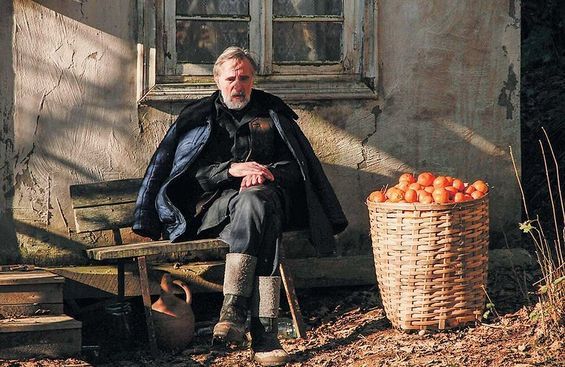
Ida, the Polish movie that won the Oscar for the best foreign film in 2014, is a more complicated movie, certainly. But Tangerines, nominated in the same year, is every bit as powerful.  Just to give you a sense of the part of the world where this takes place, you see Akkhasia at the tip of Georgia, which is sandwiched between Russia and Turkey.

I’d like to start my account at one of the two high points of this marvelous film. I will endtangerines 4 with the second.

Ivo’s house is a quiet place when the Georgians and the Abkhasians or their mercenary soldiers are not killing each other in the road in front of the house. In this scene, Ivo and his Georgian friend are sitting quietly at the table talking. Ivo has just learned that before Nika, the Georgian, enlisted in the army, he had been an actor. Ivo promises that when the fighting is over, he will come to Tblisi and see Nika act. “And,” he says, “Ahmed will come with me.” And he begins, slowly, to clap his hands together. Nika gets it and laughs with delight.

It’s a high point because Ivo and Nika came a very long way to get to that moment. Ivo and his neighbor, Margus, are among the last of the Estonians left in Abkhasia. Georgia is a former Soviet state about the size of South Carolina. Margus, at the right in the picture below, is the one who grows the tangerines.

Almost everyone has gone back to Estonia, but Margus (Elmo Nugannen) go because he is harvestingtangerines 3 tangerines and Ivo (Lembit Ulfsak) can’t go because he is making the crates for Margus’s tangerines. [1] It’s a long way to Estonia, about 1500 miles, but, beginning in the 1850’s Tsar Alexander I began colonizing George with farmers from Estonia. Before the war that came with Abkhasia’s attempt to secede, there were a lot of Estonians in the region. Now there are Ivo and Margus.

And Ivo has house guests. Ahmed, a Chechen mercenary the Russians are paying to fight for Abkhasia, and Nika, a Georgian fighting to prevent that secession. Both men were near death when Ivo and Margus found them on the battlefield but each has recovered somewhat and now each is duty bound to kill the other.

That is how the movie begins. I am hoping that nothing I have said yet, explains why Ahmed and Ivo would come to Tblisi after the war to applaud Nika’s acting.

tangerines 2Ivo locks the two wounded men—one a Muslim and one a Christian, one a mercenary, one a patriot—in separate bedrooms. When they get well enough to pose a threat to each other, Ivo lays down the law. “No one can kill anyone in my house unless I want it to happen.” [1]

That brings about a completely impossible situation except that it makes this story possible. Ahmed, the mercenary Chechen and Nika, the patriotic Georgian, sit at opposite ends of the table drinking tea and eating bread and cheese. They don’t know each other as persons; only as individual members of a class called “enemies.” Each has killed some of the other’s friends, so hostility is natural, but it is also hard to hold on to in the quiet little house with the bread and tea.

The drive toward recognizing the humanity of the other is very strong in that setting and the integrity of the setting is guaranteed by Ivo’s authority as well as by the fact that both men recognize that they owe their lives to his intervention. “Our common status as human beings” seems the only relevant status. Acting on the status of “enemy” is forbidden, so they slide, they “backslide,” as their commanding officers would have put it, into “fraternizing with the enemy.” Except that in Ivo’s house, no one really seems like an enemy.

Only minutes after the high point I described, some soldiers show up. Nika gets the guns from under the bed where Ivo has hidden them and risks his life to save Ahmed from the soldiers. Nika is killed in the exchange of fire, as is Ivo’s neighbor Margus, and if falls to Ahmed and Ivo to bury them.

That brings us to the second high point. They bury Nika in a little plot overlooking the Black Sea, right next to Ivo’s son. Ahmed pushes Ivo about it. Who killed your son? It was, it turns out, Georgians who killed him; the people Ahmed was fighting against. But when Ivo responds, “Does it really matter?” Ahmed understands.

And as they stand there, they produce the second high point of the movie. When Ivo asks, “Would it really matter?” a thought occurs to Ahmed. “If I had died instead of Nika,” he asks, “Would you have buried me here?”

Ivo doesn’t answer immediately. The pause lengthens. “Yes,” he says finally, “but a little further away.” Ahmed smiles in return. It is a beautiful smile. It is a smile that sees the necessity of the answer and that savors the generosity it carries with it—and that finds the mix funny. The smile is the recognition of their comradeship. They are the two men left standing and they have done a good thing.

[1] A. O. Scott, who reviewed Tangerines for the New York Times said he was so impressed by Ulfsak’s performance that he looked up all his other films.  That would have taken a while.  Ulfsak is Estonia’s most famous actor.

[2] Ivo radiates authority. In the first scene, armed men came into his house demanding food. One of them takes the picture of Ivo’s beautiful granddaughter off the shelf and hands it to the other. Ivo intervenes.“Don’t comment. Don’t dare.” To soldiers ransacking his house for food! And they don’t. They put the picture back, take the food and a bottle of vodka, and leave.

Posted in Getting Old, Movies, Politics | Tagged , , , , , | Leave a comment

God’s Holy Library

The Bible is a book made up up books. It is, to say the same thing another way, a compilation. “Bible” points to the unity; compilation to the diversity. I think both notions are valuable and I’d like to think about then a little.

When I was young, the reader of the biblical text for the day would preface the reading by saying, “Listen to the word of God.” I didn’t have any trouble understanding that. The Bible is the word of God. He is going to read from the Bible and wants us to listen. Everything makes sense.

Then they changed it. They began to say, “Listen FOR the word of God.” I was very conservative as a child and that change bothered me. It implied that what you were reading is not really the word of God, but it it “contains,: or might possibly contain, the word of God.  I like the “for the word of God” formulation better now, but then I am no longer either young or conservative.

If the Bible has a unity, and for Christian believers it does, the unity is in the God who reveals Himself by means of all these kinds of books. “So it is,” records the prophet Isaiah, “with the word that goes forth from [God’s] mouth: it will not return to me unfulfilled or before having …achieved what it was sent to do.”[1] I said there was a unity and a diversity. There is the unity. It is God who speaks.

library 2But because the Bible is a book made up of books, it is also a kind of library. [2] That is why I flinch from conservatives who say, “The Bible says…” and then cite something the Bible says, about which the Bible also says something else. The double accounts of creation and the double accounts of David’s kingship and the double accounts of Jesus’s cleansing the temple are all famous, but there are many many more.

Then too, a lot of the Bible is offered in literary forms that are not meant to be taken in any propositional way. Did it really take three days to walk across Nineveh? Wasn’t the teller of that tall tale looking for guffaws when he ended the story with God saying, “So why should I not be concerned for Nineveh, the great city, in which there are more than a hundred and twenty thousand people who cannot tell their right hand from their left, to say nothing of all the animals?”

“…to say nothing of the animals?” Really? The notes that introduce the book of Jonah in my New Jerusalem Bible call it “A light satire, with no pretensions to being historical.” On the other hand, it has a point. And about the point, God may very well say that it [the story of Jonah] will not return without achieving what it was sent to do.

OK. That was the serious part. The Bible, being a library of books, does God’s will in all thelibrary 4 ways it must be done, including telling really great preposterous stories. So I got to thinking about the Bible as a library and then I got to thinking how you would classify various books if you gave them Dewey Decimal numbers. [2] That’s when the fun really started for me.

Here are some I liked especially.

Old Testament: Genesis I put in the 398s. Mythology. Designating something as “mythology” doesn’t mean it isn’t true. It means it isn’t true in the way an empirical study is true. It’s a broad brush account of our origins as a species and of the introduction of evil into a good world. There is a very good parallel in the movie, The Matrix. It shows you what questions need to be answered. When you go back to Genesis, you say, “Hey, that’s pretty good.”

Exodus would be in the 910s,  Travel. Also Isaiah. If there are sub-designations that specify travel in Egypt or travel in Babylonia, I didn’t look hard enough to find them. Egypt and Babylon are the two prominent foreign destinations of the Israelites. For Israel, a “foreign destination” is just “a place to return from.”

Jonah, as Fiction, goes in FIC, as most small libraries designate it.

I would put Leviticus and Numbers in the 340s, in the section for Law.

Song of Solomon would go in a section for Erotica if there were a single section for erotica. Here is the advice of Gwen B on Yahoo eight years ago: “The Sexuality section, usually around 306 and 612 in the Dewey Decimal system.”

Proverbs goes exactly in 398.9. That one is for Proverbs. Also there are lots of self-help designations that would work. I found Dealing with People You Can’t Stand at 302.3, so I might start at that shelf. Better to be poor and walk in integrity
than to be crooked in one’s ways even though rich. (Proverbs 28:6)

Psalms are Poetry, of course, so 809.1 would be a good place.

As a special treat, I will pass along that I found an odd designation at 256. It says “256, not assigned or no longer used.” I can think of a lot of biblical passages that meet those criteria. Different ones for biblical liberals and biblical conservatives, of course.

New Testament: There aren’t as many different kinds of books in the New Testament, but all the same rules apply.

library 1Matthew, Mark, Luke, and John. “The gospels,” as we say. They aren’t biographies. The “life of Jesus” is not taught as if the writer wanted to tell us about what Jesus’s life was like. It’s more like a series of important things to know about Jesus, each of which is given a narrative form. [4] If it had to be located in the Dewey system, I think “Historical Fiction” would be the right place, but if they had a category for fictionalized history, that would be better. Best of all is the film designation “based on actual events.” I like that one because it is true and because it recognizes that the stories have been…oh…enhanced.

The Acts of the Apostles is clearly a story of Organizational Development. Again we find a lot of sources, so I chose Good to Great: Why Some Companies Make the Leap…and Others Don’t. I found that one in 658.

The Pauline letters could all be placed in Pastoral Counseling. There is a Christian Life and Practice designation at 248.4. Maybe there.

A library wouldn’t be better if it contained only books that are important in the same way. A really good library has fiction and non-fiction, prose and poetry, histories and letters, and so on. And each kind needs to be read with an understanding of the kind of literature it is so that we are prepared to receive as much as we can hold of the gift each has to give us. And if each kind were designated separately by a Dewey Decimal number, it might help us remember that.

[1] That’s Isaiah 55 as the New Jerusalem Bible translates it.
[2] Some readers will know that I am married to a librarian. For the record, Bette loaned me a book called Subject Headings in the Library Catalog by Dorothy G. Lewis and one called Cataloging and Classification by Susan E. Snyder, but she isn’t responsible for any of my categorizations.
[3] Melvil Dewey, I learned for the purposes of this post, was a librarian at Amherst College . He worked out the various designations using their collection as his guinea pig(s) in the 1870s.
[4] You could try this yourself if you have the discipline to do it. Pick a trait, e.g., Jesus has the authority to cast out demons, and then find a story that illustrates the general maxim. You can write nearly every event in every gospel that way. The stories Jesus told were probably collected in a different way, but then Jesus used them to illustrate points he wanted to make, so you get the same anchoring device.

Posted in Biblical Studies | Tagged , , , , | 1 Comment

ISIS and the Republican Party: Brothers in Arms

The first scholar of political language I ever ran across was Murray Edelman. From his book, The Symbolic Uses of Politics, I learned that one way to assess the meaning of a political expression is to see how it lines up with who else is using it.

Edelman pointed out, for instance, that in the volatile racial climate of the 1960s and middle east 3 copy1970s, the people pushing hardest for armed confrontation were the cops on the street and the armed and militant black groups. They saw the situation in remarkably similar terms. The Us v. Them language was prominent as was the scorn heaped on people who were trying to make things better. “There’s only one language they understand” was a sentiment as common among the armed and radical left as it was among the armed and reactionary right. The only real difference in this exchange of slogans as who :they” referred to. To the blacks, it certainly meant the cops and sometimes meant “the white power structure.” To the cops, it certainly meant the black militants and sometimes meant the entire black community.

The moderate black leadership and the moderate white leadership were sure there was a “problem” that could be “solved” by “men of good will.” The issues that divided them were really superficial and could be addressed by some new programs, some budgetary tweaking, and persistent efforts to communicate across the racial barrier. “What we have here is a failure to communicate” was a sentiment as likely to be heard on the moderate black side of the conflict as on the moderate white side. [1]

The moderates won. There was not a race war—not, at least, a war of the kind the extremists were calling for. The new programs were tried, the budgets were tweaked and what happened is what we have now. It is not what the moderates promised, but it was not a racial holocaust either.

Ever since then, I have tried to notice, when a political slogan is unfurled, who else is unfurling the same slogan. What I learned from Murray Edelman is that the sides in a conflict may be distinguished by the ends they would like to see achieved or by the tactics they think are appropriate. In a very practical and immediate sense, the people who are calling for the same tactics are “brothers in arms.”

This brings us to ISIS and the Republican party. [1] The Republicans campaign like a home security company. They create bogeywomen [2] to arouse otherwise unconcerned consumers. They define the bad guys in terms of a permanent inner proclivity. They specify the means by which the bad guys should be dealt with. They deprecate all other proposals for dealing with them as well as all other ways of defining them.  We can say that the response of the burglars has the normal range of responses, including seminars on how to disable alarm systems [3] As you see in the somewhat whimsical table below, the moderates are in a very difficult position. “Gee, Officer Krupke, what are we to do?” is the question asked in the three quotes below, including one by the Chair of the Senate Armed Services committee who actually knows “what we are to do.” He want to call the radicals “Islam” to send American troops (back) to fight them.

That table didn’t really do what I wanted.  The red cell on the left and on the right is supposed to read “radical militants;” the blue bars in the center, to read “moderate diplomats” and “moderate Muslims.”

middle east 8

If you can remember seeing West Side Story, you can remember what a hapless figure Officer Krupke was. The really cool guys were the Sharks and the Jets and they saw the situation in exactly the same way. “They” are a threat to “us” and need to be destroyed. That is the Shark/Jet position. It is, with some changes of language due to the international venue, the ISIS/Republican position as well.

ISIS desperately needs a religious war. ISIS recruiters fall asleep at night with visions of religious war dancing in their heads. A global conflict between Christianity and Islam is the “sugarplum” they see dancing. A war to establish a radical Islamic homeland doesn’t do the job. It isn’t urgent enough. Taking oil resources from its Western-supported neighbors doesn’t do the job. Too geopolitical. Getting the U. S. to withdraw military bases from Saudi Arabia, where they sit side by side, with Islamic holy sites doesn’t do the job. Too passive. “Holy War” against the “infidels,” (that’s us) of the “decadent West” (still us), and especially “the Great Satan” (us again) is what will do the job that ISIS has in mind.

What would that do?

It would bring recruits in unprecedented numbers from all over the globe. Nations with no real interest in seeing ISIS prevail against the Kurds or the Turks or the Iraqis or the Syrians would line up to support “a holy war against Christianity.” An Islamic banking system would flourish; arms and materiel would flow to the points of greatest need. The Caliphate would again become a thinkable thought and put fire in the blood of millions of young Muslims.

It’s a long shot, but ISIS is not really without hope because they have the support of theirmiddle east 5 partners, the Republican Party of the United States. “How can you say that?!” you say, having passed by all the paragraphs preceding, which I was counting on to prevent that response, “No one is more anti-ISIS than the Republicans.” That is true. And no one was more anti-cop than the black militants.  That is why I called them “brothers in arms.”

But look at the table. It is the radicals that feed off each other. If ISIS says “This is a war against Christianity” and the United States says, “No it isn’t. This about armed thugs beating up on their neighbors,” everything will be local and contained. If the United States says that the thugs are Islamic and their scriptures support their efforts and what these guys need is to see “a little Christian steel,” then conditions are set for the religious war ISIS needs so badly.

Who in the U. S. will volunteer to partner with ISIS. President Obama could. Since a sizable proportion the conservative electorate still thinks Obama is Muslim, it would be a very satisfying thing—a very un-Muslim thing— for him to do. But he can’t do that; he has a job to do and that would make everything worse. Obama has also been criticized for a “soft” or even a “cowardly” approach to foreign policy. Condemning ISIS in a way that highlighted their religious background would be a very satisfying way to shut up the critics and send his approval rating back north of 50%. But he can’t do that; he has a job to do.

You would think that the Republicans could do that if they really wanted to. They could look at the taunts of ISIS—all put in a religious mode—and refuse to take the bait. That’s not what they have done. They have been bitterly critical of Obama’s refusal to label ISIS as “Islamic militants.” The Republican case is that these guys are Islamic and they are militant, so they are Islamic militants. President Obama’s case is that they are a dozen other things, in addition to those two, and including a religious designation is only helping them achieve their war aims.

Here are a few quotes that I will attribute to right wing Islamophobes, not to the Republican party generally but they will help to identify the ground we are on.

1.  “Christians [should] prepare to wage holy war in an effort to utterly destroy all 1.6 billion of the world’s Muslims because Christians simply have to “face the harsh truth that Islam has no place in civilized society.”

That could not have been phrased better by anyone in ISIS. ISIS is the principal beneficiary. It is fully in accord with their war aims. They didn’t say it, however. This quote comes from Gary Cass, founder of the Christian Anti-defamation Commission.

How about this one?

2. Islamization, she has said, is not something that will happen overnight. “It’s a drip, drip, drip, drip…The mosque-ing of the workplace where you’re imposing prayer times on union contracts, non-Muslim workers have to lengthen their day. … These demands are a way of imposing Islam on a secular society.”

middle east 3More ISIS propaganda, trying to draw the U. S. into defining the conflict as religious, rather than military and political? Nope. This is Pam Geller, founder of the American Freedom Defense Initiative.

“This is a religious war!” is the only hope ISIS has of becoming a self-sustaining movement. “No it isn’t, it’s a regional mugging” is the best hope the U. S. has of isolating ISIS from Islamic nations worldwide. The President knows that. It is likely that the Republicans know it as well.

3.“Look at the world in 2009, and look at the world today. My friends, it is dramatically shifted in favor of the forces of radical Islam, forces of terror, and they are now direct threats to the United States of America.”

Obviously, this is not ISIS. The point of view is strongly opposed to ISIS, but it is strongly in favor of U. S. intervention with ground troops and it labels the bad guys by using religious terminology. They are “radical Islam.” So it still helps ISIS achieve their goal, which is to turn their neighborhood scuffle into an occasion for religious war.

middle east 4This one is by Sen John McCain who, at the time he said this (in an interview on Fox News) was on the verge of becoming the Chair of the Senate Armed Services Committee. He is now the Chair and has a very different view of the matter than the Commander in Chief of the Armed Forces.

Everybody who understands the ISIS challenge knows that their only real hope of success is to call their cause “a religious war” and to taunt the United States into agreeing with them. When we say, as Cass, Geller, and McCain do, above, that they are right; that it IS a religious war, ISIS wins that round and is a step closer to the Caliphate.

[1] Thanks to Cool Hand Luke, that is an expression that has become useful in an amazing variety of circumstances.
[2] Trying really hard to get past gender stereotypes here.
[3] These seminars have been held for many years now in federal and state penitentiaries, where the masters of these crafts can be brought together with novices and a great deal of hard-earned knowledge shared.

Posted in Political Psychology, Politics | Tagged , , , , , | Leave a comment

The Bible in (less than) 300 Words

The bulk of this post is going to be the work of others. My part in it will be limited to telling you who those “others” were and saying why I am so excited about what they did that I wanted to share it here.  Here is the First Presbyterian Church of Portland, Oregon, where we met for so long and learned so much.

disciple 1Two notes here, just as a background. First, the piece I am going to paste into the middle of this document is a narrative of staggering scope. It is an answer to the question, “What is the story the Bible tells?” So it is a document that is historical and doctrinal. It was crafted in the same way the great councils of the church crafted the confessions—think of the council of Nicea in 325 A.D. or the council of Chalcedon in 425 A.D. It was crafted, that is, with part of our attention on what we wanted to say, part of it on being consistent with other parts of the document, yet other parts on meeting the needs of the readers. [1] And finally—the best part for me—on the need to make this a compelling narrative. It is a kind of interest I call “rhetorical,” for what seem to me good reasons, but that cause others to shake their heads sorrowfully.

The second note is that the piece itself is richly theological. If you have theological appetites, you can satisfy them here. This post, however, is not theological; it is, if any one field can be charged with it, more pedagogical.

Here’s the piece. Nine of us, not including me, put this together under a spartan word limit. This is what they did.

The Bible in (less than) 300 Words

In the beginning, God created the heavens,the earth, and mankind. Adam and Eve disobeyed God, resulting in a broken relationship with Him. Not giving up on mankind, God established covenants, including those with Abraham and Moses.

In the Promised Land, God provided for judges and kings, yet over the long stretch of their history the Israelites remained discontented. Unfaithfulness finally led to alliances that resulted in the exile to Babylon, during which the prophet Jeremiah told of God’s passion for reconciliation: a new covenant, through the coming of a Messiah.

An angel announced to the Virgin Mary that she would be with child, the foretold Messiah of David’s lineage.  John, the Baptist, prepared the way for the Messiah and baptized Jesus.  Jesus claimed to be the son of God, preaching God’s love and forgiveness through faith, not laws: fulfilling and supplanting the Mosaic covenant. His teaching, especially his parables, included messages of salvation and love.  He also performed many miracles.

Jesus’ ministry threatened the Pharisees’ status as well as Roman control.  He was crucified.  After his resurrection, Jesus came to his apostles and told them to preach his words to all mankind.  Jesus’ death and resurrection became the source of eternal salvation.

When the disciples were empowered by the Holy Spirit at Pentecost, they began to share with everyone the good news of God’s redemptive work in Jesus. The new church struggled to understand how Jews and gentiles could be united as followers of Jesus. In this united church, God made a way for all people who follow Jesus to be brought back to the relationship God desired. God had been seeking to restore this relationship ever since it was first broken.

If you are not inclined toward theology AND you read all the way down to here, this piece might have struck you as a piece of nonsense. It isn’t, really. It is an adroit summary and an interpretation of a very large story. And it is entirely orthodox, given the leeway of a shading of meaning here and there. And it does manage to tell a story. It has a beginning and a middle and and end. It has a motive and obstacles to its achievement and a successful conclusion.

If you are inclined toward theology, you will notice right away that although the old familiar ground is covered, it is covered in some unusual ways. “Sin,” for instance, is not so much as mentioned. What sin did, however, is the driving theme of the essay from beginning to end. And, to pick another prominent example,specific people are left out almost entirely. In addition to Jesus and Adam and Eve, four people (4!) are named. Abraham, Moses, Mary, and John the Baptist. And yet, in that survey, so very poor on names, they covered the covenantal history of Israel, the Incarnation, the official beginning of Jesus’s ministry, and the crucifixion and resurrection. Amazing!

How did that happen? [2] Let’s begin with just how preposterous it is. Depending a little on how you count them, there are 783,137 words in the Bible. We committed to 300. On the other hand, we had Max Eastman to go on.

A book… should begin by telling in a few sentences the author’s conception of the significant form of that history as a whole, [3]

So began with the idea that no matter how huge the story is, it bare outline of it can be told briefly. Afterwards, additions can be made to restore some of the lost detail, but those additions are made TO the narrative structure, not INSTEAD OF IT. Big difference.

Second, I picked 300 words as the limit because I guessed that would produce enough friction to motivate a meaningful triage, but not enough to blow the whole project sky high. It was a guess, but I’ve done this before (beginning in 1961) so it wasn’t an ignorant guess.

And it worked. In the first rounds, we specified a lot of people and indicated our commitment to a lot of doctrines. But as the space shrank, choices had to be made and at the heart of the choices were these two wonderful questions: a) Is A more important than B and b) Why?

These questions enable discussions about WHY a doctrine is important. What does it do? [4] It is that question that enabled us to deal with “sin” in lines one and two without using the word. We talked about what sin DID, not about what it was. They are both important, but if you are telling a story, the latter is more important than the former and we were telling a story.

Third, and finally, when we got down to the very end, we had to make decisions about “what is True” (notice the capital T) and what the story needs. When you are down to 300 words, what the story needs in order to work gets to be a really compelling matter. Valuable doctrines were left out—doctrines that meet the standard implied by the big T in True—so that the sequence of events could be clear and so that the motive would be seen as adequate to the needs of the story and so that it would end in the way the beginning promised it would end.

All those are concerns that no one—trust me on this—had in mind when we began. In fact I was surprised, myself, at how powerful it got as we threw one doctrine after another, one hero of the faith after another, over the side so we could keep the flow of the narrative intact.

So you might wonder, as Butch Cassidy did, “Who are those guys?” Those “guys” are nine members of a group at First Presbyterian Church in Portland, Oregon. They will have spent, by May 12, thirty-four weeks, working through the Disciple 1 program, offered by Abingdon Press. There is not a trained theologian among them. The amount of biblical literacy varied a great deal among them as did notions of what it means to call a text “sacred.”

They are, in all their wonderful and distinctive complexity, a group of ordinary people. And they did THIS. Wow! Amen.

[1] I did not appreciate this point sufficiently when we began the process of writing this. But there came a time when the members of the class pointed out to me that there was no way to decide finally on one emphasis or another, or on one phrasing or another, until they knew who was going to read it
[2] I am going to give you the short answer. A longer and more adequate answer would have to say that everyone worked really hard at it and some of the hardest work was letting go of treasured doctrines or persons. “You’re not going to tell this story without X are you?” Without “sin,” without David the King, without the ethical teachings of Jesus, without the richness of the Torah? Even the most treasured emphases were laid aside so that the work as a whole could be competed. That’s the longer answer to how it happened.
[3] Eastman had a history of the U. S. in mind, as his example shows (The Enjoyment of Laughter, page xv), but it works on anything you can shape as a narrative
[4]A crucially important question I learned from George Lindbeck of “the Yale School of Theology,” which is not so much an institution as an approach.

Posted in Biblical Studies, Living My Life, Theology | Tagged , , , | 2 Comments