What to Do if the World Burns Up

I didn’t start out to think about the topic of suicide. [1] Actually, I started with the destruction of the entire surface of the earth, courtesy of Neal Stephenson’s recent SevenEves. [2] The death of all the humans on the planet is easily foreseen after the destruction of the moon on page one. Here’s the way Stephenson starts the book: “The moon blew up without warning and for no apparent reason.”  The question for those remaining on Earth is mostly how to die, and, to a limited extent, when.  It is in that context that I have started thinking about it.

Some of the people, as Stephenson tells it, despair at the end of their race [3]. Some, for instance, do “all the things they always wanted to do,:” some legal, some not. And then they commit suicide. Others do what they have always been doing for as long as they can. I think that’s what I would do. If I had a job, I would go to work and do what needed to be done. I like doing what needs to be done. It has been a while since I have done any work anyone wanted to pay me for, so I would follow my present routine, as follows.

I would meet with the Northwest Corner Caucus at Starbucks in Multnomah Village. Then I would go home and write a little more of whatever I was writing. Then a run up in Forest Park or a workout at 24 Hour Fitness downtown. Then a nap. Then something—often another round at Starbucks with a friend on a particular topic. Then checking on what is in the refrigerator for dinner and, if necessary, a trip to the grocery. (I like shopping, but I don’t like planning.) Then dinner and then Bette and I do something or other together and then bed. That’s pretty normal for me.

7 eves fire 1If I knew that the surface of the earth was going to get hotter and hotter until it would no longer support human life, I would keep on doing my routine, or as much of it as was still available, until it got really uncomfortably hot. At that point, Bette and I would consult about how to end ourselves with as much meaning (reflections on lives lived) and as little inconvenience to anyone else as we could manage.

I’ve thought a good deal about suicide, as you would imagine, knowing that I live in Oregon. Our famed Death with Dignity Act provides for a physician’s help for anyone who is near the end of life and (usually) in substantial pain, and who still has the dexterity to convey a pill to his own mouth by his own hand.

As I imagine myself in that situation, I find myself drawing back from it a little. It’s a residual conservatism (I don’t mean that in any pejorative sense) that I might honor at the end or, as I have done with so much of my conservatism, just overrule it. But I don’t think I feel that way about holocaust. The complete consumption of the surface of the earth by fire is “holocaust” in the most literal sense of the term. [5] If it is going to be hot on Monday and blisteringly hot on Tuesday and “hide in the basement” hot on Wednesday and “hurts to breathe air that hot” on Thursday, and “collapse and die from the heat on Friday,” why would I wait until Friday? Is it “suicide” to give up on Thursday? On Wednesday? My guess is that somewhere between Monday and Tuesday, I would want to call it quits. I think I’d want to find a good reason not to.

There is the question of “others,” of course, and Bette is my principal “other,” so we would Ecola fixed updo what we do with most complicated questions. We sit down, pour a couple glasses of wine, and talk it out. I’m just skipping over that part for the purposes of this exercise because I don’t know what I would propose to Bette until I have it clear in my own mind.
In SevenEves, there were “end of the world” parties, as I recall; some quite formal. That sounds pretty good. Would there be a ceremony like a memorial service, except for all of us. Would we celebrate what makes each of us unique and also what joins us all, other than, you know, imminent death?

I think I’d like that. On the principle that one’s death should be in keeping with one’s life, living an everyday sort of life as long as possible and then joining with others to celebrate the end of it sounds just right. I’m imagining something like the party that attends a play that has had a good long run on Broadway. “Wasn’t that just amazing?!,” we would say. “Do you remember the night we were supposed to have a duel with swords and we couldn’t get them apart in time for the scene?  This party is for Young Frankenstein.

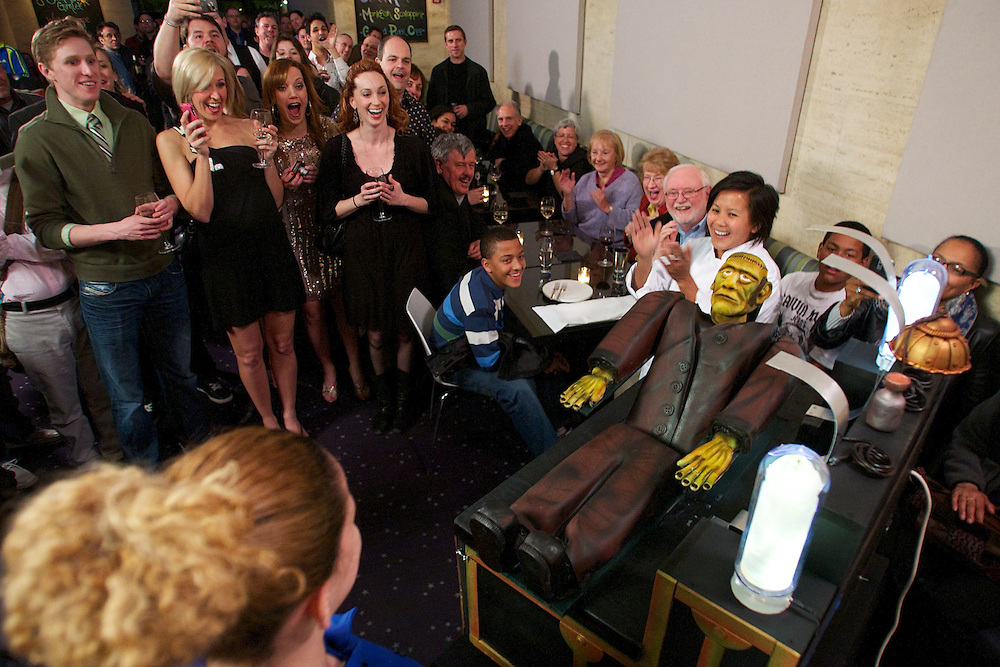
4/21/2010 — BOSTON — The cast of "Young Frankenstein" check out a cake replica of the star monster at a cast party at Teatro restaurant. The cake was designed and made by master chef Jorg Amsler and assistant Jennifer Santos, with engineering provided by Judy Lee and Adam Vollmer.

I’ve lived a religious life, so according to this principle, I ought to die a religious death, but I’m not really sure what that would be like. I have full confidence that if there is a life after this one, that God will manage it and my part in it as He chooses. According to my very forgiving orthodoxy, that makes sense. On the other hand, I am not at all confident that there actually is a life after this one, so I am prepared to lie down, like Abraham, “being old and full of years.”

[1] Please note the careful phrasing. All of my brothers and some of my kids read this and I don’t want to allow the interpretation that I am thinking of –ciding myself. I am not.
[2] The title means what you think it means, which is unusual for Stephenson. There are seven women who regenerate the whole known human population after a cataclysmic event and they are, collectively, what the Eve of the Garden of Eden is to our present human race or what the primate dubbed Eve is to a substantial part of it.
[3] Not what the Apostle Paul imagined for the end of his race and the difference is directly pertinent to what I imagine the theme of this essay is going to be.
[4] About twice as many Oregonians go to the trouble of acquiring the pill than actually use it. People report taking some comfort from the prospect that if the pain gets THAT BAD, there is something they can do. That makes complete sense to me.
[5] Joshua 6:21 says “They devoted the city to the Lord and destroyed with the sword every living thing in it—men and women, young and old, cattle, sheep and donkeys.” The “every living thing” is the holo- of holocaust.

Posted in Books, Living My Life | Tagged , , , | Leave a comment

Believing and Believing IN

I love it when this happens. I have watched Secondhand Lions maybe half a dozen times. Some parts, probably well over a dozen times. And always there is the sense that some part of my mind is receiving some really meaningful signals. It is not, I regret to say, the part of my mind that recognizes and names patterns.

Until last week.

Last week, I said, “Oh. That’s what has been jumping up and down and waving its hand. I see it now.” The element of the movie that caused all that discomfort and this belated recognition is the difference between “believing” and “believing in.”

I’m going to give you the crucial line the way I have heard it all these years. It’s wrong. I finally heard it correctly. Uncle Hub says, as I heard him, “Just because something isn’t true, that’s no reason you can’t believe it.”

garth 5Hub is such an appealing character and the scene is genuinely transformative for Walter, the confused little boy. And those things, among others, made me want to hear Hub differently than the way I was hearing him.

This movie isn’t about religion. It certainly isn’t about Christianity. Hub has a “confession of faith,” of sorts that I have appended and you will see that there is not the slightest whiff of Christian doctrine in it. On the other hand, I am a member of a religious faith that has never made any bones about the historical foundation on which it relies. Christianity is a historical religion in all the important senses. Christians say, “This happened and as a result, I am a different person than I would have been had it not happened.”

So the “true” and the “real” are mixed together as the cement that holds the major boulders of Christian doctrine together. And that’s the reason I was very surprised and also very happy to finally have heard what Hub actually said. What he said was, “Just because something isn’t true, that’s no reason you can’t believe IN it.”

In fact one of the major plot elements in the story is whether “all that Africa crap” really happened or not and that is the story I am telling today. I’ll start with an introduction to the movie. Then I’ll show you the scenes that make up this subplot. Finally, I’ll reflect little on what all that means.

Plot and Characters

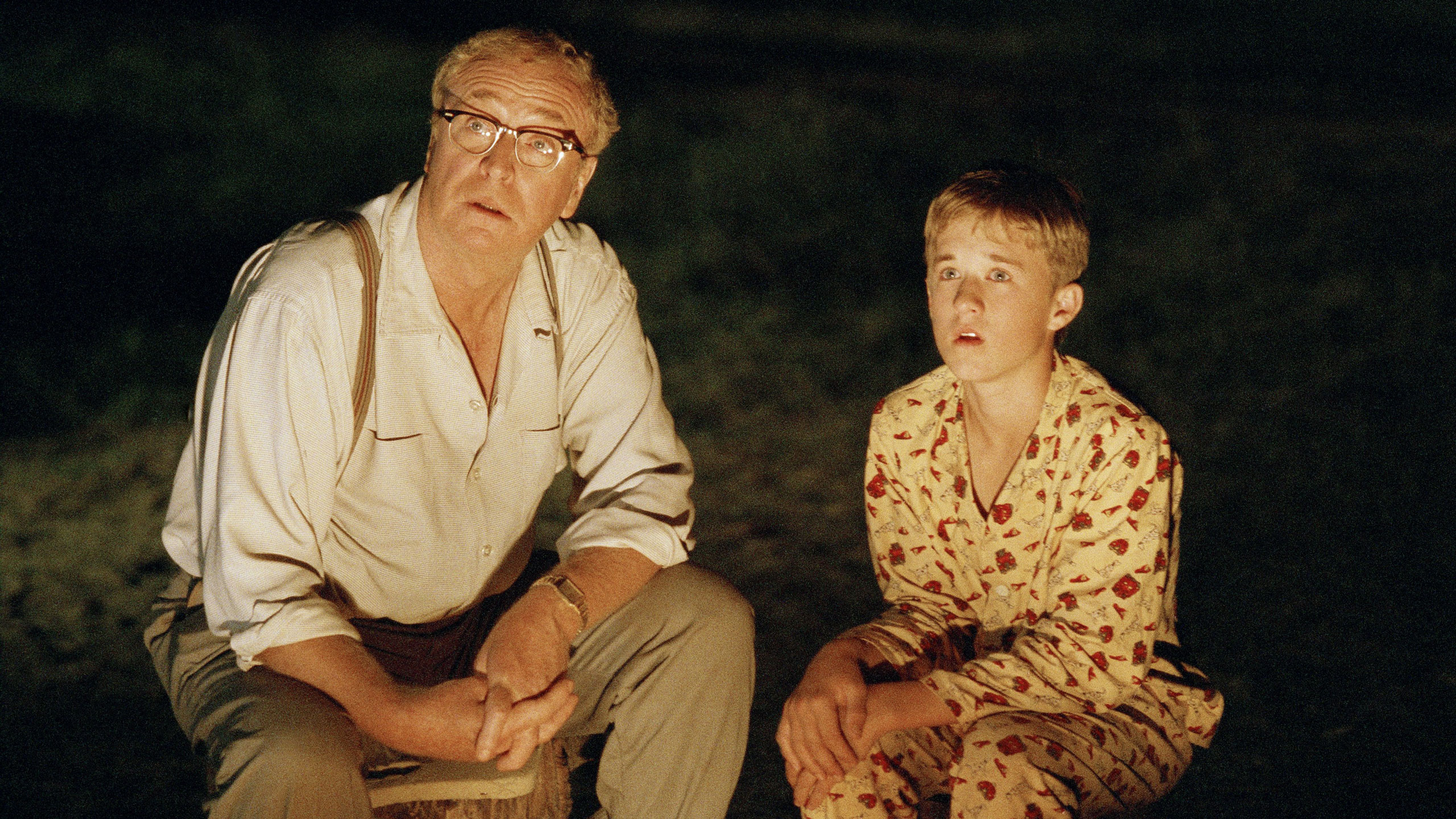
Walter,(Haley Joel Osment) a hapless pre-adolescent is dropped off by his irresponsible mother, Mae,(Krya Sedgwick) to spend the summer with his uncles, Garth (Michael Caine) and Hub (Robert Duval), neither of whom Walter knows. Garth and Hub are old men who live boldly in present day rural Indiana, but the stories they tell about their adventurous pasts are scarcely credible. Hub is the principal hero of the stories; Garth is the principal teller.

Walter is drawn into the world of the stories because they are wonderful stories. First he rejects the whole idea that they happened at all. Then small fragments of the story come to seem plausible. Finally, Walter is living in the stories in the same way that Garth and Hub are.

garth 2Late in the summer, Mae returns with a boyfriend, Stan. Stan is a bully and he is in debt to people who do extreme things to recover their money. Stan tries to get Walter to say where Garth and Hub’s legendary supply of money is. When Walter refuses, Stan punches him and promises a lot more punches if Walter doesn’t give in. That’s the origin of the “friends or enemies” remark.

Scene I

Walter and Uncle Garth are sitting on the porch watching Hub give his “what every boy needs to know about being a man” speech to a bunch of tough guys that Hub has just defeated in combat. Walter asks for more Africa stories.

Uncle Garth:You don’t believe all this Africa stuff.

Walter:It’s a good story.

Scene II

Walter goes to stand with Uncle Hub in the middle of the night, looking over the lake. Garth has said that only Hub will tell Walter whatever happened to the legendary love of Hub’s life, the Princess Jasmine. Walter has come down to the lake to ask him.

Walter:These stories about Africa…about you. They’re true, aren’t they?

Uncle Hub:Doesn’t matter.

Walter:It does too. Around my mom, all I hear is lies. I don’t know what to believe in.

Uncle Hub:If you want to believe in somethin’, then believe in it. Just because something isn’t true, that’s no reason you can’t believe in it.

Sometimes the things that may or may not be true are the things a man needs to believe in the most.

Doesn’t matter if it’s true or not. You see, a man should believe in those things because those are the things worth believing in.

Scene III

Mae and her thug boyfriend have returned, saying that Hub and Garth have all that moneygarth 4 because they stole it from a bank back in the 1930s. Walter replies that they couldn’t have done that because they were in Africa in the 1930s.

Walter:Hub and Garth didn’t rob any banks. They were in Africa.

Mae:Africa! Oh Walter, be serious.

Walter:They were shanghaied to the French Foreign Legion and had adventures for forty years. They couldn’t have robbed any banks.

Stan: Oh come on pal, you don’t believe all that, do you?

Walter:Sure I do.

Mae:You? Mr. Doubting Thomas? Here Stan’s got actual evidence and you believe that Africa crap?

Walter:Yes. Yes I do.

Scene IV

Stan has taken Walter out to the barn, where he believes Garth and Hub’s money has been hidden. He is determined to scare the boy into telling him where it is. He punches Walter in the stomach, knocking the wind out of him. Then he lays out this proposition.

Stan:So what’s it gonna be, pal. Friends? Or enemies?

Walter: Defend yourself.

Movie Note: A full 11 seconds elapses between the question and the answer. During that 11 seconds, Walter’s face turns from passive fear to active joy and we hear, very faintly, the theme music of Garth and Hub’s Africa adventures.

Reflections

The struggle that these passages point to revolves around the nature of the stories. The first question we come across is whether they are historically valid. Walter is a skeptical kid by nature—as Mae’s comment in Scene III shows—and it seems completely beyond belief that the events that make up the stories actually occurred. That way of assessing the Africa stories returns late in the narrative when Walter tries to use the Africa stories as a way of showing that Hub and Garth are not bank robbers. It is the historical accuracy of the stories that Mae has in mind when she uses the word “believe”

But in Uncle Hub’s fullest account of the value of the stories (Scene II), he says “believe in,” rather than “believe.” When Walter says he needs to know about the Africa stories, he says he has lived a life of being lied to and he doesn’t know what to believe—he doesn’t know, he means, “what is verifiably true.” That’s important to Walter because his mother, Mae, lies to him a lot. But Uncle Hub’s response has nothing at all to do with verifiability. “If you want to believe in something,” he says, “then believe in it.” Hub is talking about asserting the supreme value of what makes life good, things like honor, courage, and virtue.

This has always been the tension of Christianity as a historical religion. We maintain that an event actually occurred. We maintain that the event is the basis of our commitment to the values that the event displays. The charm of Secondhand Lions is that Walter moves from asking the “what is true” question to committing himself to the “what is right” question over the course of the film.

So Walter’s response in Scene I indicates only that he finds Uncle Garth’s stories interesting in a time when he has nothing else to do. By Scene II, he wants to know whether Uncle Hub’s adventures actually happened—whether they are historically verifiable in principle.

Uncle Hub’s response sweeps past the question of “believing that an event really occurred” and doesn’t stop until it gets to “values that are worth our commitment.” These things are worth “believing in.” These are things Walter can choose to believe in, regardless of how unreliable his mother is; regardless of how much he has come to clutch empirical certainty as a solution. Certainty is not a solution; commitment to ultimate values is the solution and we are free to commit ourselves to them just be choosing to. In fact, as Stan will find out in Scene IV, no one can stop us.

And Hub snuffs the latent confusion in Walter’s mind by stating clearly that “actual occurrence” is not a condition of such a commitment to values. In fact, Hub lays the contradiction out in three successive statements of relationship

  • Just because something isn’t true, that’s no reason you can’t believe in it;
  • Sometimes the things that may or may not be true are the things a man needs to believe in the most; and
  • Doesn’t matter if it’s true or not. You see, a man should believe in those things because those are the things worth believing in.

So, in order: you can believe in it even if it is not true at the level of historical occurrence. Then, this is particularly true of the most important things. It is the most important things about which we must say that “they may or may not be true.” And finally, it is the values themselves that contain worth. Our obligation to believe in them is only a recognition that they are worth believing in.

This matter of believing and believing in comes to a remarkably clear focus in Scene IV. His mother challenges Walter, “You don’t believe in all that Africa crap, do you?” It is interesting that she uses the “believe in” form, but she means “believe as a matter of historical fact.”

Notice how far Walter has come from his conversation in Scene I with Uncle Garth. Walter asks for more of the Africa story. Uncle Garth says, “You don’t believe all this Africa stuff.” This is the “believe” form; it means, you don’t believe these events actually occurred. It means, oddly, the same thing Mae means by “believe in.” Walter doesn’t answer the question. He asks for the stories on the ground that they are good stories, engaging stories. When Mae challenges him directly—You don’t believe in all this Africa crap…” —he answers directly, “Yes. I do.” And that answer is only moments away from his being punched by Stan and he is, in that way, asked the question much more directly. His answer to Stan, “Defend yourself!” is the same answer he gave his mother. Yes. I do.

This solution—the transition from “good stories” to “Yes, I do believe them” looks so good on the screen that we are tempted, as Christians, to follow that same path. We would say, as Hub did, that values like honor, courage, and virtue or their Christian equivalents, are so True that they are worth believing in whether all that stuff about Jesus of Nazareth happened or not. I think that would be a mistake.

It has never been the position of the church that the values Jesus exemplified are so garth 7
ultimately worthy that they are worth “believing in” whether there ever was a Jesus or not. It has (almost) always been the position of the church that “when the time was right, God sent his Son.” The Son lived out obedience to God and exemplified the values that characterize God’s reign, but he came in history. The church “believes” that he came and we “believe in” the values—God’s values—which he showed and for which he was willing to die.

The values by themselves are “nice.” They are good values. But if they are not God’s values, then we honor them at the cost of honoring God. We value them as if they were of ultimate worth, but it is God who is of ultimate worth and our salvation has come to us by the means God has provided. In Jesus’ appearances after his death, we see the disciples saying with wonder, “So…it was all true.”

Also…in Secondhand Lions, there is what amounts to a post-resurrection scene. The director showed good judgment in removing it from the theater version of the film. It is too long and complicated. Thank God he left it on the DVD. It relies on Josh Lucas—a face we scarcely see in the movie—as the adult Walter to bring off the final confirmatory scene. And it really doesn’t work as narrative.

But it works great as theology. Walter is making a few remarks at Hub and Garth’s funeral when a van of the French Foreign Legion shows up, their horses leaping out of the vans and assuming a formation of respect for one of their own. The old sheik shows up, scars on both cheeks, just as the story has it, and breathing through an oxygen mask. “So…” says one of Walter’s sons, “it’s all true.” And the adult Walter, just a little slower than his son, agrees in wonderment, “It’s all true.”

Uncle Hub’s Confession of Faith

That people are basically good. Honor, courage and virtue? mean everything. That power garth 1and money, money and power, mean nothin’;. That good always triumphs over evil. And I want you to remember this. Love, true love, never dies.


Posted in Movies, Theology, ways of knowing | Tagged , , , | Leave a comment

Did the Media Go Too Far?

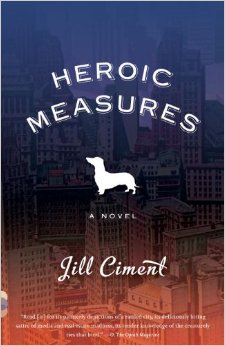
This is mostly a rant about how television “news” operates. If you’ve never watched news programs on television or if you do watch and like what you are seeing, this is probably not the essay you want to read. On the other hand, it is really easy for me to write, because nearly all the writing has been done by Jill Ciment in her novel Heroic Measures, which has recently been made into a movie, Five Flights Up. The role of the media—the way they work a story without actually providing any information about it—is prominent in the book. In the movie, not so much.

pamir 5When I started watching the news on television, I watched “The Huntley-Brinkley Report,” featuring Chet Huntley and David Brinkley. It was fifteen minutes long. NBC announced plan to extend it to thirty minutes and someone asked Brinkley what he thought about that. He didn’t oppose it directly, but he did remark that some days, there are really not thirty minutes of news. Jill Ciment’s story is, in large part, a story of how they have solved Brinkley’s dilemma.

Let’s start with the last of the clips I have taken from the novel and which I have used as the title.

“Stay tuned,” says the newscaster, “next up, the results of tonight’s poll Did the Media Go too Far? and an exclusive interview with Pamir’s girlfriend from rehab, Debbie Twitchell.”

My answer to that question is a resounding Yes! The media did go too far. Further, they went too far down a road where they should never have gone at all if “news” is their business. If generating viewership and thereby advertising dollars is their business, then we’d have to say that they handled it pretty well.

Here is the event that starts the media journey down “the road.”

“The tanker jackknifed; it’s blocking all in-bound lanes,” Ruth continues. “Police don’t know if it was an accident or if the driver swerved on purpose. The mayor is asking everyone to remain calm and to not drive into Manhattan tonight.
Last night’s graphic—the truck’s headlamps as seen by the night-vision robot with Danger in the Tunnel splashed across it—appears on the screen. The morning newscaster, the blond in Washington, D.C., promises that after the station break she’ll be right back with an exclusive interview with the truck driver’s family and friends.

So “Danger” is the first issue. Certainly there is no denying that. It’s a truck full ofpamir 2 flammable liquid. Of course it is dangerous. Now we go to “interviewing the family.”

The truck driver’s uncle and mother have faces like walnuts, shiny tacks for eyes. They’re standing on a snowy sidewalk before a row house in Queens. Behind them, neighbors jockey for a position on the television screen. The mother wears a massive black garment under an overcoat and a headscarf, though Alex and Ruth can’t tell if the scarf is worn for warmth or for religious conviction. It looks like something their grandmothers might have worn. The uncle, a stout man with a black mustache as big as a pocket comb, reads a statement in a stiff guttural accent that goes slack with emotion: “Abdul Pamir is a devout, gentle, and caring son, husband, father, uncle, brother, and nephew. He was born in Uzbekistan, and became a proud American two years ago. We want him to come home safely.”

pamir 3Danger, Will Robinson! The truck driver is a foreigner. He is an Uzbek, which means, among other things, that he was recently part of the USSR. His parents are “foreign-looking.” That’s why the “massive black garment” on the mother and the “black mustache as big as a pocket comb” on the father are included.  A “headscarf for religious reasons” suggests Islam, as does the name Abdul. We have gone well past the flammability of the truck’s cargo now and are approaching the flammability of American xenophobia.

Alex turns on the television: Live Press Conference pulses in the screen’s upper corner. Camera lights, as bright as competing suns, irradiate a makeshift stage in the lobby at city hall. A burly man, captioned FBI Spokesman, the short mayor, and the buzz-cut police chief in full regalia approach a lectern crowned by microphones. The burly spokesman reads a statement: “At eight twenty-two, the aqua-bomb detector finished its sweep of the tank. As of this hour, we believe there is no bomb.” Barrages of questions are hailed at him, but he ignores them. “We’re asking New Yorkers to stay on high alert until the driver’s in custody.” The mayor leans into the microphones. “Keep your eyes and ears open, but go about your lives. Soon as the city engineers give the go-ahead, mine will be the first car through the tunnel. We will not take questions at this time.”

Visually, we have the mayor, a burly man identified as an FBI spokesman and the police chief in full regalia. As to “information,” we learn that they have sent a bomb detector to determine whether there is a bomb attached to this “jack-knifed” semi, whose driver has fled the scene. Everyone is asked to stay on high alert. For what exactly is not specified.

And that was the good part. That was “news.” Now we get “reaction to the news.”

The screen bisects into halves—the basset-eyed newscaster in New York and the blonde in Washington. “What they’re not saying,” the blonde says, “is that Pamir might be wearing the bomb and that’s why they didn’t find one in the truck.”
“You’re right, Kat, the device could be on him and he could be anywhere at this point.”

I think that the “they” in “what they are not saying” is scary, although she might have meant just the FBI, the police, and the mayor. Also, “not saying” is scary. Why are they not saying something that we need to know? The line between “not saying” and “withholding” is a very fine line. And then there is the question of a bomb. Why would he be wearing a bomb? I think it is because his name is Abdul Pamir and his family is from Uzbekistan.

“GOOD MORNING, EVERYBODY,” SAYS THE basset—eyed newscaster. “Before I bringpamir 4 on my first guest, a forensic psychologist and consultant for Homeland Security, to help answer the question—Is Pamir a suicide bomber or not?—lct’s see what the American people think. Here’s how our viewers responded to this morning’s polling question. Seventy-seven percent say yes, Pamir is a suicide bomber, twelve percent say no, and eleven percent isn’t sure. We’ll be right back to see if the experts agree.”

Of course, it doesn’t matter very much what the answer to the question is. It’s the question that matters. It pairs “Pamir” and “suicide bomber.” We might ask why it matters what people think, remembering that all they know is what the media have told them, but, of course, it matters a great deal to the station that people feel they have been asked and also that they keep on watching this particular station to see whether others agree with them. And if it weren’t a fact—a hard clear fact—then why would they have experts there to talk about it? A forensic psychologist? Homeland Security? Please.

The basset-eyed newscaster’s face is as large as the moon. He wears the expression of an oracle about to make a prediction. Across his brow is written Breaking News—Target: New York City.

New York City is now a target. OK.

“The FBI has Pamir cornered nearby in a Bed Bath and Beyond,” Alex tells her. “They have one on the Upper East Side?”
“It’s just around the corner,” the moon-faced guard pipes in.
“Does he have a bomb?” Ruth asks.
“He has hostages,” Alex says.
The garment fades and the basset-eyed newscaster takes over the screen. “Only fifty-two percent of our viewers say they’d come out if their mother called. ‘What do the experts think?”
He’s turns to the double-chinned forensic psychologist from this morning. Six hours under the hot lights and her lipstick looks as if it’s melting. “The suicide bomber believes he’s doing this for his mother,” she says.

pamir 1The cast is still the same. There are telephoto shots from circling helicopters. Pamir has taken hostages in the kitchenware section of Bed, Bath and Beyond. His mother is standing outside, so there is something to see, even if it is the same loop they have been showing for half an hour. The forensic psychologist is still in the studio. The public is still being queried about questions for which they have no knowledge at all.

A bullhorn blasts, but before Ruth can make out what’s being said the words break into echoes against the buildings. Pamir lowers his hands and begins struggling to open his coat, a puffy, hooded gray parka that almost reaches his knees. He tugs at the zipper, but he can’t seem to undo it. The teeth appear to be caught on something. In his panic to get the coat open, he pulls on the zipper as if it is a rip- cord and he is in freefall. Ruth can’t tell if the camera is running in slow motion, or her mind is, but Pamir seems to be fighting with his zipper for an eternity.
Suddenly, white feathers appear to hang in the air all around him. Only when the feathers settle does Ruth realize Pamir’s ripped his parka in two to get it off. He pulls what remains of it over his head. Ruth can see he isn’t strapped with explosives.
The bullhorn barks again, and Pamir tosses his coat into the street. He peels off his sweater, unbuttons his shirt, and throws them on top. Clad only in a T-shirt, he slowly rises to his feet and removes hi sneakers and socks, flings them into the pile, too. “The pants,” the bullhorn barks. He undoes his belt, zipper, and steps out of his pants. Shivering, he kicks them away with his bare foot.
He pulls his T-shirt over his head, and leaves his hands up in the air, but the bullhorn’s not satisfied. It barks and barks until he takes 0ff his underwear and lies down on the ground, spread-eagle. The station discreetly covers his derriere with what looks like a smear of Vaseline.

This is great TV. The “terrorist” is now forced to strip naked and lie on the cold pavement. I can’t think why they would bother with a trial.

“WITNESSES SWEAR THEY SAW A BOMB UNDER Pamir’s coat,” says the evening newscaster, a prematurely white-haired man with a ferret-like face. “Dozens of people described the exact same explosive device down to the number of dynamite sticks and the detonator button’s color. Now the mayor tells us Pamir never had a bomb. Was it a mass hallucination? What did these witnesses really see?” he asks his guest, an intense, thin woman with flyaway hair captioned, “Author of Mass Hysteria.”

One of my favorites. Witnesses agree that they saw something they could not have seen and which the mayor says was never there at all. What shall we do? I know. Let’s bring in a woman who has written about mass hysteria. The “story” has gone away. The experts that can opine about the story have gone away. All that is left, is an expert who can comment on the fantasy the media have devised and explain it as a mass glitch. Still there is no one to talk about market share and the cost of advertising. Dear me. And now we arrive where we began.

“Stay tuned,” says the newscaster, “next up, the results of tonight’s poll Did the Media Go too Far?

You could say that. The only consistent element is the “stay tuned” part. Is there a Video-Industrial Complex. Is it too soon to start worrying about it? Don’t forget to cast your vote and tune in at 11:00 to see how many of your fellow Americans agree with you. We’ll step aside now for some messages.

Posted in Politics, ways of knowing, Words | Tagged , , , , | Leave a comment

Men learn from Hobbes and Women from Rousseau

OK, so it’s never going to replace Mars and Venus. Also, it’s not precisely true. But it is mostly true—more often than not—and it has the same principal virtue that John Gray’s Mars/Venus books have. It teaches that there are two complete orders of reality and that standing in one and judging the other is an exercise in futility.

You need to know that there are two and you need to understand the acts of each in the

Women trying to solve conflict between men

Women trying to solve conflict between men

context of the life-world of each. Gray teaches—over-teaches, really—that men make certain presuppositions about what women are like. They use “what men are like” thinking that they are using “what everyone is like” as the template. Men think, in other words, that they are using a gender neutral standard. When women act differently, the men think they cheated somehow. Then men read the Mars and Venus books and learn several important things.

  • They learn that the women didn’t cheat (or deceive or misrepresent, etc.).
  • They learn that there is a way women act and if you learn to judge them by the standard they use, you can find a way to make it all make sense.
  • They learn that the way they act is, in fact, not the way “persons” act, but the way men act.
  • They learn that acting this way is going to be received in a very predictable and not a very positive way by women.
  • They learn, however, that there is a way of understanding how they see things and that by honoring that way of seeing—not by adopting it yourself, but by knowing it is there— you can work out a very satisfying way of being together.

Brief Digression: When I said that Gray “over-teaches,” I meant that his system works because he lumps all women into the same model and all men into the other model. His approach is not friendly to individual differences. It is also not friendly to men and women who, for whatever reason, have adopted the way of thinking more typical of the other. So I’m not arguing for the validity of Gray’s typing. What I am saying is that he teaches more successfully than anyone I have run across that there are two ways, and identifying the way you yourself do things as “the normal way” is only a self-inflicted wound.

End of Digression (told you it was brief): I want to use the same essential gimmick Gray uses, but I want to use it about something else. I want to talk about interest aggregation.

hobbes 3So the first thing to do is the grossly oversimplify the teachings of Thomas Hobbes
(1588—1679) and Jean-Jacques Rousseau (1712—1788). Rousseau taught (and his followers, the Rousseaueans believe) that there is a general will. If I were writing about societies as a whole, I would probably capitalize, e.g., General Will, but I’m going to be talking about deciding what movie to see, so I don’t think I will capitalize this use. When we express our “interest”—when we “vote,” for instance—what we are doing is expressing our best guess about what the general will is. We are saying, “This is what I think will be best for us.” You can see that Hobbes, at the left, looks bemused.

Hobbes had no idea a any transcendent “general will” at all. On our menu are: a) the war of each against all and b) domination by a large and competent central government (Leviathan). Hobbes (and his followers, the Hobbesians) taught that humans arrange things as best they can. We do know, after all, what we want. We strive to achieve what we want even at the cost of what you want. Most times, it doesn’t work out well and in the long run, it never works out well. Life without Leviathan is “solitary, poor, nasty, brutish, and short.”

Enough political philosophy. A group of men and women are trying to decide what movie to see. The men prefer violent action movies so they vote for violent action movies. The women prefer social comedies, but the women, following Rousseau, don’t vote their preferences. They vote for the kind movie that they believe will be best for the group as a whole. Possibly a historical drama, accurately and colorfully told, of which there are several.

The women propose the historical drama and are very surprised to see that the men allhobbes 4 believe that the group’s welfare will be best served by seeing the violent action movie. Who would have thought it? Why would they believe that such a movie would be best for all? The women, seeing that they must have guessed wrongly about the general will, express their preference for the violent action movie. So it’s unanimous. Or at least it looks unanimous to the guys.  Here is Rousseau, thinking of the General Will or possibly about Happy Hour.

This same decision process operates week after week. Finally one of the women owns up to not really enjoying the violent action movies. The other women chime in; they don’t either. The men are surprised. Really? You keep choosing these movies, and now we learn that you don’t like them. What’s going on?

“Surprised” is the happiest phase of this process for quite a while, so let’s linger. Here’s what the guys know. They are incredibly lucky to be in the company of women who like violent action movies, one after another. Now, after many such movies, they learn that the women actually don’t like that kind of movie although “they said they did.” (We know that is not what they said. We know that they expressed their guess about what would be best for all.) Now the men are wondering, “If you can’t find out what they want by asking them, how can you find out?”

Now let’s go beyond the “surprise” phase. Let’s say that the women blame the men for choosing only the films they like and never choosing the films the women like. The men don’t like to be blamed for something everyone agreed they all should do. The women discover at that point that the men are not “voting” for their sense of the general will, they are only voting their own preferences. Who could be as selfish as that? Really.

The men, it turns out, are selfish. When they say, “Let’s see Mad Max III: The Revenge,” all they mean is, “I want to see Mad Max III.” No other person’s interests are taken into account. The interests of the group as a whole are not taken into account. These men are all I, me, mine.

The women, it turns out, are devious. They say they want to see Mad Max III: Thehobbes 1 Revenge, but they didn’t. The problem of aggregating the interests of the group and making a choice that fits those interests pretty well is a knotty problem. It can be managed—the guys have been managing it this way for years—but it requires a base level of honesty by the participants. What is this thing about I said I wanted this, but all along, I really wanted that. What is all that about?

The men are exasperated. Their lament has been immortalized by Henry Higgins in the line, “Why can’t a woman be more like a man?”

The next time the question of movies comes up, it will be dealt with by some wounded and wary men and women. The men will ask for nominations, knowing that they can’t trust the women to tell the truth. The women will know that when the men nominate a movie, they have only their own interest in mind. They don’t care about the preferences of the women. They don’t care about the long-term viability of the group.

Things get worse and worse. The men are punished for “being honest about their preferences.” The women are castigated for being dishonest in the information collection phase and then vindictive in the assessment phase. The Hobbesians know that the Rousseaueans can’t be trusted. The Rousseauseans know the Hobbesians are heartless bastards.

There is, of course, a solution. The men need to understand that the women are not expressing their preferences, although they seem to be. Just understanding that is a major achievement. Beyond that, they will need either to try to imagine what a “general will” could possibly be or they will need to get the women to express their own “selfish choices” as if that were something to be proud of.

The women need to understand that the men are not refusing to recognize choices otherhobbes 5 than their own. The men believe—where to they get these ideas?—that if everyone expresses a selfish choice, the group will be better able to take all the choices into account and make a good decision. Just understanding that much is a major achievement. Beyond that, the women will have to imagine a way of piling up selfish choices in such a way that the group is benefitted or they will need to get the men to take the welfare of all into account as they make their choices. [1]

This brings us back to the wisdom that John Gray popularized. There really are two distinct ways of addressing the world. Each one makes sense when everyone is using it. But if you know there are two—and there are, in fact, more than two and they aren’t all based on gender—then you can allow for the possibility that arriving at the common good might be harder than you thought.

But if you know this much, you have a chance.

[1] It’s harder than it looks. The men believe that “the general will” cannot be known directly. That’s why you start with honest preferences and bargain your way toward optimal choices. The women believe that it’s a moral matter, a the very foundation. You don’t just say what you want; you take into account the needs and wishes of others before you open your mouth.

Posted in Politics, Sustainability, Words | Tagged , , , , , | Leave a comment

They Could At Least Have Warned Us

I do like democracy. I don’t like how very limited our democracy has become. I would like for us to be better. I’m a fan, a booster; but I think our team has lost a lot over the last few seasons—since, to pick a date, 1948.

The kind of democracy we are now can be represented by diners who get to choose fromearthquake 1 the menu, but have almost no control of what is on the menu or of how any particular menu item will be prepared. That’s really not good enough. We really need for the people running the restaurant to put the right things on the menu. In many cases, “the right things” are the things people want to eat. Sometimes, though, they are the things the people really need to eat.

Here are several views of what I am calling, in this metaphor, “restaurant management.”

Here’s how Edmund Burke and I feel about the restaurant management. Burke said it best:

“Your representative owes you, not his industry only, but his judgment; and he betrays instead of serving you if he sacrifices it to your opinion.”

This expresses my point that sometimes the managers need to exercise their knowledge and their judgment and put “the right things” on the menu.

In the next quote, Herman Göring makes the point that you can get the people to order whatever you want them to order if you know the tricks.

Gilbert: In a democracy, the people have some say in the matter through their elected representatives, and in the United States only Congress can declare wars.

Göring: Oh, that is all well and good, but, voice or no voice, the people can always be brought to the bidding of the leaders. That is easy. All you have to do is tell them they are being attacked and denounce the pacifists for lack of patriotism and exposing the country to danger. It works the same way in any country. [1]

I like to look at this dilemma in the restaurant setting because it is so small in scale and so unthreatening. It’s going to get a good deal more threatening in just a moment, but let me stay at the restaurant for just a bit more. If you were serving your customers french fries and a substantial group of the regulars wanted tater tots, you would just smile and shift over to tater tots. Same thing if they wanted sweet potato fries rather than regular potato fries.

earthquake 2But what would happen if you tripled the price of everything on the menu? That extra money would enable you to add something to the food so that their great grandchildren would be protected from a plague that might or might not strike the area in 2069? I’m going to guess that there would be an uprising and in short order, the cook would be instructed to put the old menu and the old prices back in place. So far, so good.
In 2069, a devastating plague hits the town and the great grandchildren of those early diners drop dead almost immediately. An inquiry is held and the people who were running the restaurant at the time of the aborted attempt to “strengthen the menu” are tried and convicted as mass murderers.

I am, as I said, a fan of democracy. I like to order from the menu as much as the next guy. I am also a fan of far-sighted leadership, when it is necessary.

We can have it either of two ways. We can demand that the state provide for us only the services we want, rather than the ones we need and particularly rather than the ones our great grandchildren will need. On the other side of that coin, we can refuse the judgments of our leaders that some services we need but don’t want or, more likely, don’t want to pay for, should be put in place.

I’m OK with that. We demand control and we accept responsibility.

The other way is for us to take the counsel of our leaders and do the things that have to be done. Then when the distant danger has been prepared for and many lives are saved when it actually occurs, then we praise the leaders for their vision and their willingness to oppose our short term preferences.

I’m OK with that too. We give our consent to the judgment of our leaders about matters we don’t know how to understand or how to appreciate properly. Then we praise them for having done well or condemn them for having done badly.

But today, I’m thinking of a school superintendent on the Oregon coast.
The last person I met with in the Pacific Northwest was Doug Dougherty, the superintendent of schools for Seaside, which lies almost entirely within the tsunami-inundation zone. Of the four schools that Dougherty oversees, with a total student population of sixteen hundred, one is relatively safe. The others sit five to fifteen feet above sea level. When the tsunami comes, they will be as much as forty-five feet below it.

In 2009, Dougherty told me, he found some land for sale outside the inundation zone, and proposed building a new K-12 campus there. Four years later, to foot the hundred-and-twenty-eight-million-dollar bill, the district put up a bond measure. The tax increase for residents amounted to two dollars and sixteen cents per thousand dollars of property value. The measure failed by sixty-two per cent. Dougherty tried seeking help from Oregon’s congressional delegation but came up empty. The state makes money available for seismic upgrades, but buildings within the inundation zone cannot apply. At present, all Dougherty can do is make sure that his students know how to evacuate. [2]

When we have, in the Pacific Northwest, the enormous earthquake and tsunami that areearthquake 4 overdue, we will lose a lot of lives. That’s inevitable. If we prepare for that event, we will lose many fewer lives. Saving all those lives is what we call a “public policy outcome.” It’s an outcome that benefits many of us and that is achieved by the establishment and the funding of a new policy—a policy that, in this case, prepares for an increasingly likely natural disaster.

Here are some quick estimates from the current New Yorker.

In the Pacific Northwest, everything west of Interstate 5 covers some hundred and forty thousand square miles, including Seattle, Tacoma, Portland, Eugene, Salem (the capital city of Oregon), Olympia (the capital of Washington), and some seven million people. When the next full-margin rupture happens, that region will suffer the worst natural disaster in the history of North America.

Just a personal note. Bette and I live about half a mile west of I-5.  Also:

FEMA projects that nearly thirteen thousand people will die in the Cascadia earthquake and tsunami. Another twenty-seven thousand will be injured, and the agency expects that it will need to provide shelter for a million displaced people, and food and water for another two and a half million.

Facing losses of that magnitude, Oregonians are going to be really angry. My interest, as a political psychologist, is what people will do with their anger. Our political leaders are supposed to prepare us for things like this. We know they did not do their job because we were, after all, not prepared. Why should they escape the penalty for their failure? They ran the state during all those years as if preparation were unimportant and now we know that it was crucially important and someone has to get the blame.

accountability road sign illustration design over a white background

accountability road sign illustration design over a white background

It won’t be us, I’m guessing. There was never an election that gave us the chance to choose between “Prepare for the Inevitable” candidates and “What, Me Worry?” candidates. Those are also the high tax and low tax candidates, just so we are keeping the policy proposals lined up with the fiscal implications. Had there been an election like that, we in Oregon would have overwhelmingly chosen the “What, Me Worry” candidates and used in our own private ways the money that would otherwise have been required for public programs. Of course, the parties know that, which is why they never ran for office under those two designations.

We warned them not to offer us that choice and they obeyed and did not offer us that choice. So it couldn’t possibly be our fault. It must be their fault.

[1] Gustave Gilbert, a German-speaking intelligence officer and psychologist. This interview was conducted in Goering’s cell in 1946.

[2] Kathryn Schultz, “The Really Big One”, The New Yorker, July 20, 2015.

Posted in Living My Life, Political Psychology, Politics | Tagged , , , , | Leave a comment

Reading Strategically

I am a strategic reader.  It is the scandal of my book group.  Last month, my grandson, who is headed off to college, drew back from me when I described what I meant by that term and said something on the order of, “Oh…that’s just wrong.”  Sorry if I misquoted you, Karl.

reading 2I began as a strategic reader for the very best of reasons. I didn’t have any choice.  The reading schedule in grad school was brutal during my summer at Miami (Ohio) and I survived it by adopting a very simple plan.  I begin with the question, “How well do I need to read this?”  I defined “well” as “what will I need to know to stay out of trouble?”  Then I would divide the number of pages required by the number of minutes available and get to work.

I use a version of that same process even now.  One of the ways I manage my life these days is to trade book recommendations with friends and then, later on, sit down to talk with them about the book.  The motives are entirely different from grad school, but the process is pretty much the same.  I have a friend who said last week, “Oh…you’ve got to read this.”  When I started the book, I realized very soon that, as much as I valued the friend, I wasn’t going to value the book all that much.

So here’s what I did.  I read the first chapter.  Then I scanned quickly through the rest of the book to get a sense of what it had to offer to a “strategic reader.”  Then I went back and read everything that bore on that particular theme.  It was enjoyable.  It was efficient.  And now I am looking forward to sitting down with my friend and listening to what he liked about it and telling him what I liked.[1]

One of the good things about being in a book group is that you read books you would notreading 1 have chosen yourself.  But sometimes there is very little relationship between what the book wants to do and what you want to do.  (That brings up the author’s intention question, to which we will return.)  I don’t feel I owe the author anything, but I do owe the book group.  All of us read things that matter a lot more to someone else and the only respectable thing to do is to give yourself to that book as a way of honoring the group and all the friendships it holds in place.

I have an example in mind.  We are currently reading Doris Kearns Goodwin’s No Ordinary Time, a study of Franklin and Eleanor Roosevelt in the era of World War II.  I started into the book with high hopes because I like Goodwin and immediately got bogged down.  TMI.  Way too much!  I know she has a researcher—many, probably, but one of them appears on the dust jacket with the author—but there are lots of things about Eleanor’s relationship with her father or Franklin’s with his mother, that I really don’t want to know.  Yet.
On the other hand, I do know a little about World War II, particularly about the diplomatic debates and the military preparations, and it is amazing how satisfying it is to learn a little more about something you already know something about.

So I am not “reading,” No Ordinary Time; I am “reading for.”  I am reading No Ordinary Time for the diplomatic debates and the military preparations.  That interest gives me a focus and I read all that material and some additional material on each side of it.  I learned some interesting things about how Winston Churchill saw the war and how Eleanor Roosevelt saw the war.  When I go back to this book again, probably in a year or so, that relationship will be part of the focus and I will read “some additional material,” perhaps about Franklin’s relationship with the collection of very attentive and competent women with whom he surrounded himself.

readubg 3Assuming I read this book several times over the next ten years, which is more likely than not, I will take as the focus of my reading more and more of what Goodwin has to offer.  I will not go very far from my own interest, but as my interest expands, I don’t have to go very far to be in new territory.  And this “new territory” is the very place I looked at originally and said, “TMI.  Way too much!”

One more example, then I’ll try to give a serious answer to my critics, prominent among whom is my librarian wife, Bette.  I recently read a novel called Bruno, Chief of Police: A Novel of the French Countryside, by Martin Walker.[2]  I read the first part: I got the feel of the town, I met Bruno, I found the event that sets the plot in motion.  Then I read the last part to see how everything turned out.  Then I went back to the place where I had stopped my page by page reading—this is where the murder is reported—and started reading.

I am a Step B reader.  It’s what I like best.  A is the setup; C is the culmination—or, since it’s a French story, the dénouement.  Then comes the B part.  I watch new characters arise, new events slide into the necessary path of the narrative.  I see mHarper Lee Smokesuch more than I would otherwise, since I know where the narrative is going, and I enjoy it much more because I am not reading for C.  I know C.  I am enjoying the whole range of B, every part.  It’s wonderful.

Now about the author’s intention.  This is Harper Lee, by the way, the author of To Kill a Mockingbird and recently, of Go Set a Watchman.  Modern literary theory holds that we can’t really know what it is and furthermore, that there is no reason to prefer the author’s intentions to our own.  But modern literary theory baffles me.  My reasons are much easier to hate.  I like to read books in a way that lowers the cost to me and that raises the enjoyment I receive from reading them.[3]

That seems so sensible to me.  I think I would continue to do it even if it did not scandalize my friends.

[1] And I am not resenting him for dragging me through this long and boring book.
[2] Bette and I are going on a bike and barge tour of France in September and reading murder mysteries is my favorite way of learning about the place we are going.
[3] I read technical scientific articles according to the same principle, but using different markers.  I don’t look for the murder, in other words.  I go to the statistical device I can understand best and to the discussion that I can apply most broadly.  Then I quit.

Posted in Books | Tagged , , , | Leave a comment

No More Buildings Named after YOU

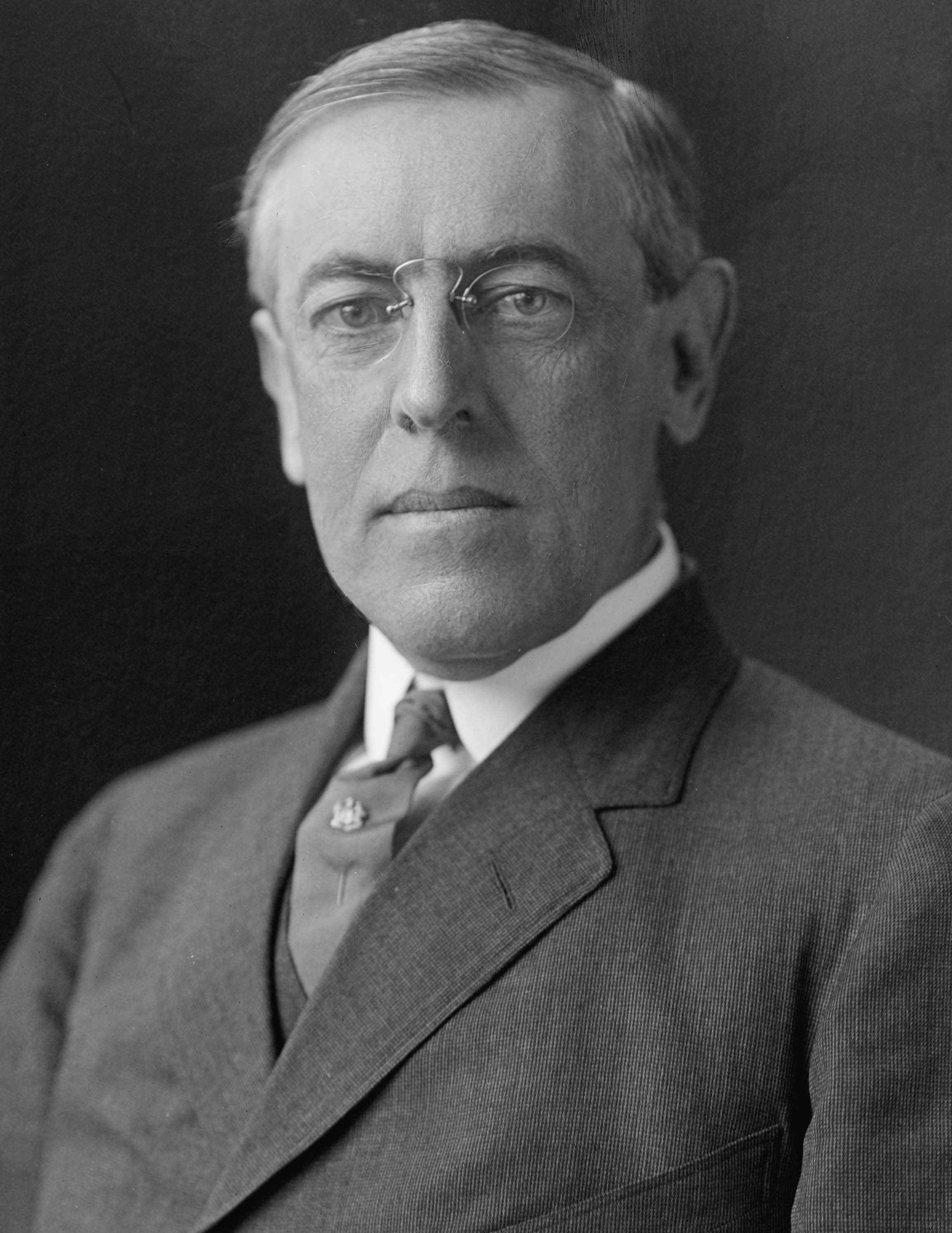
When we moved to Portland, we moved into the Wilson High School attendance area.  As a result, I am the proud father of Wilson alums. Wilson is named for President Woodrow Wilson. [1] It’s a thing in Portland. We also have high schools named for presidents Cleveland, Grant, Jefferson, Lincoln, Madison, and Roosevelt (Theodore).

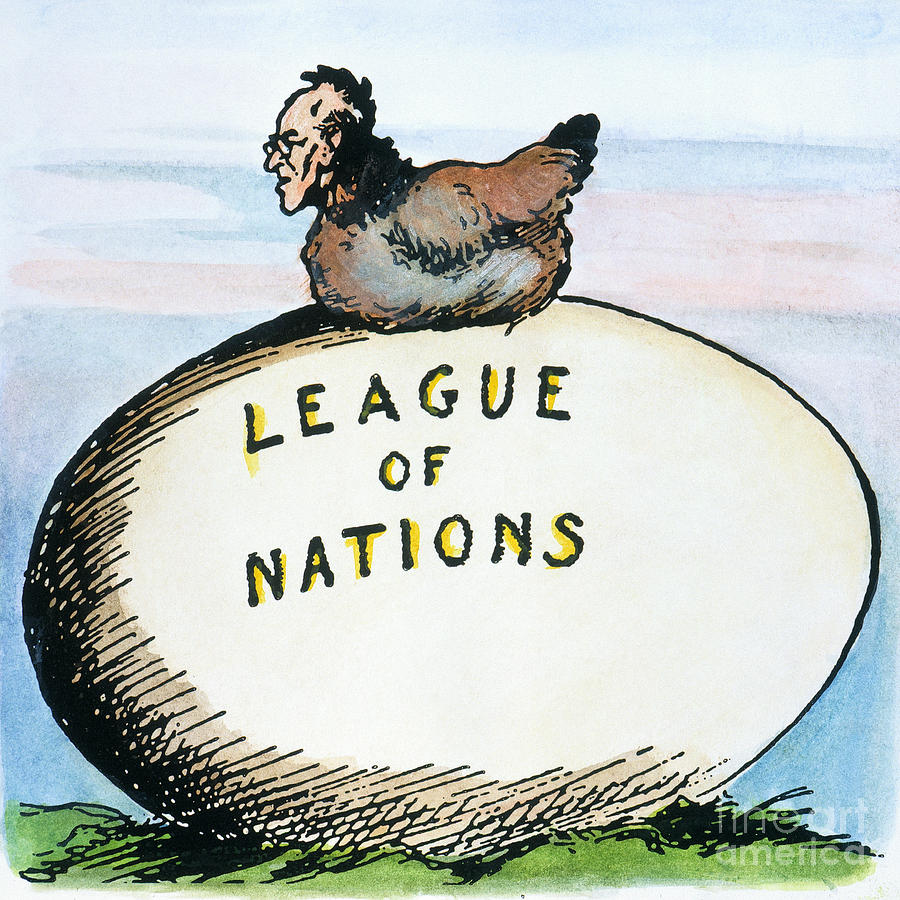
Recently, some people have come to feel that Wilson is not worthy to have a high school wilson 2named after him. It’s a question that is easy to place on the agenda in today’s rather snarky climate of opinion. I began to wonder whether all the students at Wilson are worthy of attending a high school named after the creator of the League of Nations. Establishing “worthy” as the criterion is like increasing the slope on your treadmill.  Everything gets harder and when you forget that you changed it, you wonder why.

I picked up the story when one of Wilson’s teachers, Hyung Nam tweeted, “F*** Wilson and any school he’s named after.” Here’s another of Hyung Nam’s assessments: “We’d have to be ignorant about history to continue to affiliate ourselves with this man,”

It isn’t just Hyung Nam. I have three more for you.  Randy Barnett, a law professor at Georgetown University, says about President Wilson, “Truthfully, he was a bad guy, but that’s not the reason I’m saying this. I’m doing it because he held very, very repugnant views and he acted on them,”

Kendall Berry, a black student at Wilson, says, he thinks the conversation to change the name of the school has already changed the tone in history classes, with students mocking the former president.  You never go wrong mocking former presidents, I guess

And, finally, let’s look at Maddy VanSpeybroeck, a co-founder of Wilson’s Feminist Student Union. “The idea of our schools being named after a person with these ideals just doesn’t sit right with a lot of people,” VanSpeybroeck says, “Especially as feminist ideals and racial ideals are becoming more something our nation is talking about right now.”

wilson 5What exactly is the issue here? Wilson High School was named after a famous American president, a man much revered by many historians because of his domestic record of progressive achievements (all pre-war, of course) and his international record of post-war diplomacy. It sounds like the kind of guy you might want to name a school after.

He doesn’t sound like the kind of guy who would be elected by people with race and gender at the top of their minds and he was not. There were other things at the top of the minds of the electorate in 1912. They were interested in extending the progressive agenda, at which Wilson was remarkably successful in his first term.

We don’t really have a progressive agenda any more, so it is easy to misunderstand. The left-wing politicians of today stretch further than most voters will allow, just to touch the coattails of the practical visionaries of the Progressive Era. It isn’t just that the American political spectrum has shifted to the right, although that is true too, but that private issues have become very important compared to public issues.

When Maddy VanSpeybroeck says “The idea of our schools being named after a person with these ideals just doesn’t sit right with a lot of people,” you have to wonder who she’s been talking to. If I had to guess, I’d guess she has been talking to her friends, for whom “feminist ideals and racial ideals” are the pre-eminent public issues. It is these issues, VanSpreybroeck says, that “our nation is talking about right now.”

I am very much afraid that she is right on that last point. “Our nation” is talking a lot about the public treatment of private matters. What, for instance,  are the implications of a law for my private religious views? Should states where majorities oppose gay marriage be forced to accept gay marriage? Should race be taken into account—or ignored entirely—on questions that involve the awarding of contracts or admission to colleges and universities.

Every one of those issues—important issues, every one of them—has a constituency. The constituency is focused and fervent and funded.  You know what doesn’t have a constituency? Finding a way to repair and maintain our roads and bridges. There are people who think that is an important issue for America, but they they are a pallid bunch compared to the people who are pushing personal purity questions. Or, how about finding wilson 3a way to support consumer spending when more and more jobs are lost to robots and third world workers? That seems pretty important to me, especially because the demands of efficiency push businesses to reduce their labor costs; then to reduce them again. Eventually, someone is going to have to get paid some money because the credit cards are getting stretched. What to do?

Or this one. Locating the U. S. successfully in a world where American interests no longer dominate, but in which we are, nevertheless, the de facto leader. That seems worth a public debate.  Or how about investing in a crash program to reduce energy production through the use of fossil fuels and shifting over to a mix of less polluting forms of energy and grids to distribute that energy to where is is needed.

There is a collection of issues I would call “public issues.” Some of these are being neglected because they have been successfully opposed by the interests who will lose out when those issues are seriously discussed. That’s politics. It happens all the time.  That’s not what I’m worried about today.

But some are being neglected because people are preferring to emphasize “private issues.” When Maddy VanSpeybroeck says that feminist and racial issues are what “our nation is talking about right now,” she is entirely correct. We are talking about collections of private issues, each of which has an intense constituency, rather than about public issues, where a broad coalition of interested parties would have to be developed and sustained over some period of time.

We are sliding very rapidly toward small ball politics. It is a politics where personal grievances, real or imagined, are dominating the agenda. What are the effects of this? I can think of two. First, we are talking about grievances (examples to follow) rather than issues, that is, questions of public policy on which we must make decisions. If you have ever been to a public meeting at which issues were discussed, you know that a small, cheap, tawdry issue that is on the agenda, will be dealt with, while a large, substantive, crucially important issue that is not on the agenda, will not.  Agenda control is absolutely crucial.

A second effect is that people who are good at that kind of politics—I call them grievance mongers [3] to distinguish them from politicians—will flourish at the expense of people who would present our current choices about real issues. Grievance mongers beat politicians in elections. They have success in legislatures and, in some political settings, in executive offices as well.

So this is serious. These issues edge out those. These candidates edge out those. These officeholders edge out those. And all the while, voters are being trained in what “really” constitutes “public debate.” It’s like training children to prefer high salt diets so that food that could, to more discerning palates, taste like itself, will hardly taste at all.

I promised an example. Was Abe Lincoln a racist? We really need to know because the views he held about African-Americans form the basis of our view of President Lincoln. Did he, in his casual remarks to Salmon P. Chase, indicate that he thought that Africans were inferior to whites. Maybe he told racist jokes in the meetings of the Cabinet.

Here are some things to bear in mind. Lincoln moved away from the question of slavery every time he had a chance. He was committed to saving the union and he did. Does anyone really think that Lincoln’s place in history should be determined only on his racial views? Why not only on his Union views? Or better yet, why not both?

Woodrow Wilson was one of the most daring and idealistic diplomats of the 20th Century. Does anyone really think Wilson should be evaluated on the basis of his racial views only? How about on his diplomatic successes only? Or better yet, why not both?

Or, to return to the “small ball” example, should a president be evaluated on his performance in office only? Or on his character only? Or both? Should the people with some of the most demanding jobs ever devised be assessed by modern grievance mongers, using the norms of another time to criticize people whose real choices they can only imagine? It doesn’t seem like a good idea to me.

[1] At the Nassau Club in Princeton, New Jersey, there is a picture of Woodrow Wilson on the wall and a plaque recognizing him as president of the Nassau Club. No other achievements are noted; not his presidency of Princeton University nor his presidency of the United States Just the Nassau Club.  Actually, his first name is Thomas.
[2]The case that the charge of hypocrisy is mostly moral laziness comes in the passage in Neal Stephenson’s The Diamond Age, where the early days of the New Victorians are described. It was way back at the end of the 20th Century. Think back. Moral values had fallen to such a level that no one was willing to take a moral stand. But, as Finkle-McGraw says, “people are naturally censorious,” and some ground for criticism must be found. It was in that way that “hypocrisy” was elevated from “a ubiquitous peccadillo into the monarch of all vices.” And here we are.
[3] The word “monger,” now almost entirely a suffix, has a pejorative feel about it and that is why I am using it. There is no reason why it should. It means “trader.” A fishmonger is someone who sells fish; an ironmonger, iron. My word “grievance monger,” by contrast is a snarly sneery sort of word.

Posted in Economy, Political Psychology, Politics | Tagged , , , , , | Leave a comment

My Inner Wormtongue

Gríma, son of Gálmód was Théoden’s chief staff.

Those of us who are familiar with bureaucratic organizations are likely to read through that line and fill in the missing word, “of” and never notice that it wasn’t there. Others may note that it wasn’t there and complain in passing about the sloppy writing. Here are my two responses: a) please note that the “of” is not there, and b) it isn’t because of the sloppy writing.

I call Wormtongue Théoden’s staff because Théoden leans on him. [1] He leans on himwormtongue 4 because he can no longer stand upright. He can no longer stand upright because Grima Wormtongue has sucked the strength out of him. How did that happen?

I am going to set the stage for this encounter in order to give Wormtongue the role Tolkien has prepared for him. [2] Then I’d like to look at Wormtongue’s disservice to his Lord, Théoden. Finally, I’d like to consider what it would mean to have “an inner Wormtongue,” some part of you that weakens you in the guise of helping you.

Théoden son of Thengal is the Lord of Rohan. He is about to be invaded by the armies of the wizard Saruman. It is a time when Théoden should be mobilizing his people and preparing for war, but he himself has sunk into self-pity and fatalism and those of his war leaders most able to meet the invasion have been killed or arrested. Rohan is ripe for the taking.

Gandalf the White knows all this, but to persuade Théoden of it, he must get past the barriers Grima has thrown up. In the crucial scene, Gandalf confronts Grima, exposes his treachery and renders him mute. Then he begins to bring Théoden to his rightful office. So that’s the scene.

wormtongue 2The second question is this: “How does Wormtongue manage to so enfeeble the once-proud lord of a warrior people?” Here are some of the ways; how many there are depends on how you divide them. The notion underlying this essay is that one’s own “inner Wormtongue” will do in your life (or mine) what Tolkien’s Wormtongue does in Théoden’s life.

Here’s the first. Saruman is preparing to attack Rohan in force. Although Théoden doesn’t know that, Éomer, one of the leaders of his army does know it. Éomer asks permission to go fight Saruman’s orcs. Théoden, on Wormtongue’s advice, says no. Éomer goes anyway. When he returns, Wormtongue throws him in jail.

This is the largest and boldest of Wormtongue’s initiatives. Théoden’s life is in imminent danger and all his responsibilities to his kingdom are being disregarded. There are two modern ideas here. If you were the president of a company that was going rapidly bankrupt and your CFO kept you from finding out, that would be like Wormtongue. Or if you were faced with a hostile takeover and needed urgently to mobilize your company to fight it off, but were kept from knowledge about it, that too would be like Wormtongue.

wormtongue 3The other side of Wormtongue’s treachery is more personal. Let’s say that in order to bring yourself back to full functioning, you needed to engage in physical therapy or regular exercise; or let’s say that most of your strength of character was atrophying because you never went into the world any more to meet its challenges. Let’s say that doing any of the things that would restore you to active functioning were discouraged.

Or, let’s let Wormtongue say it.

I care for you and your as best I may. But do not weary yourself, or tax too heavily your strength.”

And also:

Those who truly love [you] would spare [your] failing years.

Now the argument pivots and turns to uniting them (just Théoden and Wormtongue) against a common enemy—it is a social distraction.

Let others deal with these irksome guests.

The “guests” are not only irksome, but they can be characterized as enemies of the realm.  And then a scheduling distraction.

Your meat is about to be set on the board. Will you not go to it?

Théoden says that there is no time; that the army is about to take the field.

Wormtongue’s reaction constitutes a third distraction.

Are none to be left to defend the Golden Hall of your fathers, and all your treasure? None to guard the Lord of the Mark?

Wormtongue misunderstands, clearly. Théoden has in mind leading his army into battle, as you see in the picture. Wormtongue imagines that the dotard king will remain behind. [3]

Théoden says that no one will be left behind, not even Wormtongue. Wormtongue will ride into battle with Théoden. Wormtongue unleashes his final attack at this point, Théoden’s obligation to him.

“Have pity on one worn out in your service…I at least will stand by you when all others have gone.”

That gives us, in order: a) Do not put a heavy burden upon yourself, b) distract yourself by thinking of the abrasive character of these intruders, c) you really ought to keep to your schedule (it’s mealtime now), ad d) you owe me for my long years of service.

Notice that Wormtongue separates these elements of Théoden’s life, making of each one a claim. About the first, he says that no urgent need demands your attention, that you are only “wearying yourself.” About the second, he says that you need not pursue your own vital interests, because you can shift your focus to the immediate irritations confronting you. About the third, he says that nothing Théoden has to do is as important as keeping to his schedule. (Nothing suggests, by the way that Théoden is hungry. The claim in that it is dinnertime!) About the fourth, he says that Theoden should not act with the kingdom’s best interests in mind because Théoden owes Wormtongue a debt of gratitude that prevents such action.

Théoden reweaves the four threads into a stout rope and, returning the attention to the effect of Wormtongue’s tutelage, loops it adroitly around Wormtongue’s neck.

“[What these intruders are saying] seems to me more wholesome than your whisperings. Your leechcraft ere long would have had me walking on all fours like a beast.”

I will look, Théoden says, at the effects of your tenure in office. It is by those effects that I will judge you. I will not be distracted any longer.

I think Théoden’s response is the right one. Against all the distractions, Théoden asks Wormtongue this: “If I continue to do as you urge, what will become of my kingship and my kingdom?” Or, “If I accept as most important the distractions that you are offering me, one after another, and postpone dealing with the real issue, what will happen?” Or, “If I continue to attend only to the physical cost of an action to me and not to the meaning, the value, of the action, in what sense am I king?”

That’s how the king dealt with his Wormtongue.  I hope I will be able to do as well.
[1] The etymological evidence for this derivation of “staff” is mixed, I’m afraid. The Barnhart Dictionary of Etymology lists this meaning in English from the year 1000. Others identify a staff that officers carried as the source of the image. Having spent quite a few years as staff myself, I can confirm that being a staff person means getting leaned on a lot, so I’m following that line.
[2] The Two Towers. This story begins on page 501 of the Houghton Mifflin paperback I am using.
[3] Dotard is a nasty word. It is build on the intransitive verb “to dote, meaning “
to show a decline of mental faculties, especially associated with old age.” The -ard suffix is a pejorative suffix, as in drunk-ard, slugg-ard, and, very probably, wiz-ard. Or so says M Styborski at humidcity.com: “Think of “wizard” as a sarcastic Middle English way of calling someone a know-it-all.”

Posted in Books, Getting Old, Living My Life | Tagged , , , , | Leave a comment

Win the Day

When Chip Kelly was football coach at the University of Oregon, he was interviewed frequently by sports stations in Portland. He quickly gained a reputation as a terrible “interview,” as the stations put it. They kept asking him question he didn’t want to answer and he kept not answering them.
I wouldn’t say I ever thought Chip was a charming person, but one afternoon, I heard himwin the day 3 talking about “win the day.” I think the interviewer must have been pushing him about overemphasizing a winning record—I don’t remember, really—because Kelly interrupted him with an extended lecture on what “win the day” meant to Oregon.

You win a day’s practice when you keep on hustling when you are tired and learn what you need to learn that day. You win the day when you show up, still sore from that previous game, and begin to address the skills you will need for the next one. You win the day when you come to practice with an open mind, having left behind the stupid plays you made last Saturday and determined to leave the regret behind and address the day freshly.

Every one of those is “winning the day.” I think Chip became my favorite football coach that day. [1] I began that day to think through what “winning the day” would mean for me. Here’s the short form: meet the challenge you are facing right now and call it a win. Here are some everyday examples.

  • You are not facing the challenge of passing the course. You are facing the challenge of giving your whole mind to the time you have set aside for studying. You can win the day today.
  • You are not facing the challenge of reconciling with a former, now alienated, friend. You are facing the challenge of absorbing the insults or the angry passivity and not responding in kind. You can win the day today.
  • You are not facing a meaningless retirement. You are facing the challenge of investing yourself in a person or a project or a book or a movie that engages you and that feeds your soul. You can win the day today.

And here is perhaps the most famous example of all. In the movie, The Lion in Winter, wewin the day 4 see three princes in a cell, waiting for their father, King Henry, to come and kill them.

Prince Richard: (Anthony Hopkins, right) [Henry’s] here. He’ll get no satisfaction out of me. He isn’t going to see me beg.

Prince Geoffrey: (John Castle, center) My, you chivalric fool…as if the way one fell down mattered.

Prince Richard: When the fall is all there is, it matters a great deal. [2]

Richard has “winning the day” in mind. That is why it “matters a great deal,” and he is right.

Let me tell you why I have finally decided to write about this. There are two reasons. I’ll tell you about them and stop.

First, I have a friend who is slowly and quietly losing track of his life. He seems depressed sometimes, but sometimes he seems confused but not depressed. He seems to think he has a problem and he is about to address it decisively, once he gets a few things clear. He wants to know in what city he is living now. He wants to know what kind of place this is—he says, gesturing around at the room.  He says he wants to go home, but can’t remember where that is. He wants to get his wife before he goes, but when he is reminded that his wife died some time ago, he thinks and then begins to nod as if that information is familiar.

How is he going to win the day? The best answers are internal and I will be answering as an observer. [3] On the depressed days, he needs to own up to being depressed. Denying it is attractive, but it will not help him. He needs to be no more depressed than he really is. If doing something that distracts his attention from how depressed he is will help, then choosing to do that distraction is winning the day. When he is confused but not depressed, he needs to gather all the information he needs to make a plan. He has people around who will tell him the truth; people he can trust. Trusting them, in the midst of all the confusion, is the way he can win the day.

If you think of the “day” as his life, nothing looks very promising. He’s going to lose that race as we all do. But each day he is granted is a day he can win if he is willing to focus on that day itself (not on the more general process of which it is a part) and do his best and to take satisfaction in it.

win the dayI admire this man’s struggle. When you walk in off the street and look at the people you see in a retirement center, even a very good retirement center, it is easy to think of them as “losers” living in a place for losers. But since I am going there myself in a year or so, I have begun to wonder whether a lot of those people are busy winning the day, every day.

  • Can you win the day if you are wearing old people’s diapers? Sure.
  • Can you win the day if you have to constantly monitor your mouth for drool. Absolutely.
  • Can you win the day when your confusion makes you want to be cranky with the helpers on the ward? Yes, you can.

These are not questions I feel cavalier about. I’ve been there. In 2006, I had a very confusing bout with depression. I hadn’t ever been depressed before. I’ve had days where I experience what I call “downdrafts,” but this was like nothing I had ever experienced and I didn’t know how long it was going to last. I postponed from week to week the decision of whether to sign up to teach my fall courses at Portland State.  No one knew what it was “about,” if depressions are “about something.” I couldn’t sleep, I couldn’t eat, I couldn’t be fully awake—and worst of all, I couldn’t be interested in anything. What to do?

I went to see a collection of doctors, all of whom agreed that they had no idea what was going on, but they prescribed some anti-depressant medication. But now I am without any coherent narrative of what is going on and how long it will last. The depression is a hole with no dimensions and if there is a contest, it will win and I will lose.

win the day 1But I won a lot of days. Pride is an emotion and I was doing without emotions, being  deep in the hole where I was.  But if I had had emotions available to me, I would have been proud of myself on many of those nights. I looked at what faced me that day and I won the day. I assessed my work favorably. If I had had access to emotions, pride would have been justified. But even without the emotions, my conclusion was that I had done everything I could. [4]

I remember getting out of bed and walking down the hall and around the circle—kitchen, dining room, living room, hallway, back to bed. I did it once and collapsed back into bed, sweating and breathing hard. The next time, I tried to do it twice. Then three times, and back to bed, panting with the effort. Eventually, I was able to walk around the block. I won that day big time.

I exposed myself to things that used to interest me, hoping that the interest would be like a spark that would jump that little gap. It seemed, at the time, as unlikely as being struck by lightening, the legendarily improbable event, but I knew it needed only to be a little spark jumping a little gap and firing the only cylinder that was working at the moment. Every day I gave myself the chance to be interested in something. Most days, that did not happen, but every day I put myself in the place where interest might strike me, I judged that I had won that day.

Winning the day is always about something you can do. You might not be able to make the team, but you can give yourself unreservedly to practicing the skills you would need. Preparing to die properly, in a way you will be proud of, may not sound like a victory, but as Prince Richard says, “when it is all there is, it matters a great deal.” Trying to grasp the fragments of reality as they come whirling by and by holding on the them, to present yourself as the person you once were, is a superb accomplishment. To push against the meaninglessness, the sense that doing one thing is not better or worse than doing another, is the task that engaged Sisyphus. To continue to push is to win the day.

Aragorn had winning in mind as he addressed his troops before the gate of Mordor. He understood that “winning the day” was something they could do, however the battle turned out.  This was before the Eagles came–not another Chip Kelly reference–and before the Ringbearer had fulfilled his quest.  It was when things looked completely hopeless.

“The day may come,” he said, “when the courage of Men fails, when we forsake our friends, and break all bonds of fellowship, but it is not this day.” [5]

[1] One of my favorite fleece vests has only University of Oregon on it. It is black and green, colors the Ducks often use, but it is not the green Oregon uses. It is not “Oregon green.” In fact, it is “Kelly green.” I saw it in the window of the Duck Shop and laughed out loud. I went into the store and bought one and turned around and walked back out. I think they meant it as a pun. I did.
[2] In the movie, The Lion in Winter, the line ends, “…it matters.” But I learned it from President Jed Bartlet on The West Wing and I like those three extra words, “a great deal.”
[3] In the next section, I will be the subject of the report so don’t get critical prematurely.
[4] Bette was a wonderful help to me. We had not been married a year yet, but she knew the man she was married to. She says I am not to say precisely how she helped. I believe she said I would not be winning the day on which I wrote about it.
[5] One of the lines in the movie that is so good, I wish it were in the book.

Posted in Getting Old, Living My Life | Tagged , , , , | Leave a comment

The Equally Unlikely Pilgrimage of Maureen Fry

The first time I read Rachel Joyce’s marvelous The Unlikely Pilgrimage of Harold Fry, I followed Harold’s adventures very carefully. Why is his trip on foot to Berwick-upon-Tweed called “a pilgrimage?” What’s “unlikely” about it. Those seem to me good questions and even in my first reading, I got good answers to them.

A year later, when I nominated the book to my much-loved book group, [1] the pitch I gave was that it was at least two really good stories. Harold is changed into a markedly different person by taking off on this trip. But his wife, Maureen, is also changed into a different person by being left behind. Try as she might, she is unable to hold in her heart the hate that has made their marriage a bitter wasteland for decades. Harold needs to be there, apparently, for Maureen to be able to keep a good grip on that hatred and she feels the disdain leaking out between her fingers as she tries to hold onto it in his absence.

Taking Harold’s story for granted, as I read it for the second time, I find I am more and maureen 2more intrigued by Maureen. In this essay, I’d like to give a brief account of where she is when Harold leaves to mail a letter at the nearest mailbox. [2] And then I’d like to follow her through one stage after another. But let me tell you right now where she winds up. She is sitting with Harold on a park bench in Northumberland,  right on the border of Scotland. She says, “I love you, Harold Fry. That is what you did.” [3]

The story starts in Kingsbridge in Devon where Harold and Maureen live. The mailman has just delivered a letter. Maureen collects it and slides it part way across the table to Harold. That struck me immediately and I didn’t even know these people at the time. She didn’t hand it to him. She didn’t slide it all the way across the table. Why?

Sitting at the table in the next few moments, she asks Harold to pass her the jam. Harold has been profoundly affected by the letter, which says that his old friend, Queenie Hennessy is dying. He picks up a jar and hands it to her.

“That’s the marmalade, Harold. Marmalade is orange. Jam is red. If you look at things before you pick them up, you’ll find it helps”

It’s a nasty, unnecessarily hurtful thing to say. She regrets it several chapters later when she has had a chance to think about it, but Harold is gone by then.[4] I have chosen that remark as one of two markers for how bad the marriage is. Here is the other.

“Harold? Maureen’s voice took him by surprise. He thought she was upstairs, polishing something, or speaking to David.”

maureen 1That’s what Harold thinks. As readers, we know that is exactly what Maureen has been doing. Their son, David, is dead, but Maureen cleans his room every day, waiting for him to come back. She goes into the room and speaks to him. David’s death was the original issue that pushed Harold and Maureen apart and it has gotten worse over the years. Now only the silence and the hostility are left.

Maureen was once a gardener. Then, in all the tragedy surrounding David’s suicide and in all the blame she heaped on Harold, she stopped. Why? Maybe because it was a pleasure, and she could find no place for pleasure in her disaster-stricken life. Maybe because it wasn’t a pleasure any longer. Maybe because Harold enjoyed her gardening so much. [5]

So things are bad. I think you’ll agree that we have established that. It this point that the development I see as a pilgrimage begins and, like many pilgrimages, its beginning is not auspicious.

Maureen didn’t know which was worse, the numbing shock that came with the first knowledge that Harold was walking to Queenie or the galvanizing fury that replaced it.

Harold is “leaving Maureen” and “walking to Queenie.” It feels like a gross infidelity to Maureen. A reader is not likely to say that her fury has no basis at all. On the other hand, a “galvanizing fury” does something to you. It stimulates you or rouses you or stirs you. In short, it “galvanizes” you. [6] None of those responses is compatible with the frozen disdain in which Maureen has held her husband. The fury is the enemy of the disdain; she cannot have them both. Maureen doesn’t know that and, at this stage, neither does the reader.

Here’s a quick glimpse of Maureen “galvanized.”

She fetched out the Hoover, searching out traces of Harold, a hair, a button, and sucking them into the nozzle. She shot his bedside table, his wardrobe, his bed, with disinfectant spray.

And later.

She would decide to strip the beds only to realize there was no point, since there was no one to witness her slamming down the wash basket, or complaining that she could manage perfectly well without help, thank you.

Maureen goes to see a doctor next. She doesn’t really have a plan. She wants to say that Harold is walking because he believes his walking to Queenie can cure her cancer. She is hoping to build that into a case that Harold is suffering from Alzheimer’s disease and needs to be apprehended and brought home. Maureen sees this as a way of “protecting Harold” but we know she isn’t interested in protecting Harold. She is interested in finding a way of protecting her hatred of Harold.

That interview with the doctor didn’t work out very well for Maureen.

In explaining both Harold’s past and his walk, she had been forced to see things for the first time from his point of view. Harold’s project was insane and completely out of character, but it wasn’t Alzheimer’s. There was even a beauty in it, if only because Harold was doing something he believed in for once, and against all the odds.

Harold calls most nights from a pay phone. As a resource for hating Harold, these calls are not as good as his actually being there, but they do reignite her anger. The first call produces this: “Harold, you are sixty-five. You only ever walk to get to the car.”

The second call, this: “I suppose you’ve worked out how much this is all costing.”

The third call ends dramatically. Maureen’s last words are:

“This is your choice, Harold. It’s not mine and it certainly wouldn’t be David’s.” But now Maureen is trapped. Ending on such a blaze of righteousness, she has no alternative but to hang up. She instantly regretted it. She tried to ring him back, only the number wasn’t available. Sometimes she said these things but she didn’t mean them. They had become the fabric of the way she talked.

Maureen 6Maureen relies a great deal on “advice” from David. Author Rachel Joyce, seen here, has made a good choice, I think, to represent this “conversation” as if it were being held between living people.

Some time after dawn, she spoke with David. [7] She confessed the truth about his father walking to a woman from the past, and he listened…So what should I do about Harold, love? What would you do?

He told her exactly what the problem was with his father… He voiced the things she was too afraid to say.

What does that mean? Maureen is not delusional, although she sounds like it in these early passages. Her intimacy with David and her intense loyalty to him are the other side of her distance from and rejection of Harold. Maybe she feels that easing away from David would be disloyal to him. She certainly recognizes that easing away from David moves her in the direction of absolving Harold from [what Maureen maintains is] his complicity in David’s suicide.

You would expect this reliance upon David to change as Maureen moves along on her own pilgrimage and it does. About her phone conversations with Harold, we learn this.

He was so bewildering to her, this man who walked alone and greeted strangers, that in turn she said mildly high-pitched things she regretted about bunions, or the weather. She never said “Harold, I have wronged you.”…She never said, “Is it really too late?” But she thought these things all the time as she listened.

Left alone, she sat in the cold light of the night sky and cried for what felt like hours, as if she and the solitary moon were the only ones who understood. It wasn’t even in her to talk to David.

Her need to use David as a weapon against Harold and her growing admiration for maureen 5Harold’s pilgrimage and her disinclination to seek comfort from “David” all happen at the same time, over the same weeks. Finally, she finds herself pausing in the middle of what was once a routine rehearsal of events with David.

He sends postcards, and occasionally a present. He seems to favor pens. She paused, afraid she had offended David because he wasn’t replying. “I love you,” she said. Her words trickled to nothing and still he did not speak. “I should let you go,” she said at last. [8]

As Maureen’s conversations with Harold change, her feelings about him change and she finds herself acting them out at home, almost against her will.

It was that trip to Slapton Sands [with Rex, the neighbor, to whom she had finally confided the truth about Harold] that had marked her turning point. …Fully dressed, she had toppled onto the bed and closed her eyes. In the middle of the night she had realized where she was with a prickle of panic, followed by relief. It was over. She couldn’t think what exactly it was, other than an unspecific weight of pain. She had pulled back the duvet and curled into Harold’s pillow. It smelled of Pears soap and him. Waking later, she felt the same lightness spreading through her like warm water.

Maureen’s pilgrimage continues and it ends where this essay began. She is sitting with the man who is really, not just legally, her husband when she says. “I love you Harold Fry. That is what you did.” It is tempting to call Maureen’s an “internal pilgrimage” because it contrasts so nicely with Harold’s “external pilgrimage,” but to do that would distort both journeys.

It is the order of changes that distinguishes them. Harold’s changes were all external first. Then they became internal. They became, eventually, who he is. Maureen’s changes were all internal first. Then they became external. They became, eventually, who she is as well as who she and Harold can be.

Of the two, I think I am more moved by Maureen’s courage than Harold’s. Harold had his old reality stripped away from him. Maureen had to let hers go. She saw things she didn’t want to see, as in her account to the doctor of Harold’s Alzheimers, but when she saw them, she refused to deny them. She found a place—it wasn’t Harold, it wasn’t David, it wasn’t Rex—where she could stand and look at who she was and what she had done and she did that.

In a supreme and thoughtful act of love, she refused to come and bring Harold home when, in his despair, he called and asked her to.

Maureen? She was his last chance. “I can’t do it. I was wrong.”

She didn’t hear, or if she heard she wouldn’t allow the gravity of what he was saying. …”Keep walking. It’s only sixteen more miles to Berwick. You can do it, Harold….”

She and Rex had talked it over and over; if he gave up when he was so close to arriving, he would regret it for the rest of his life.”

She turned down the desperate plea of the man she had only recently begun to love again. Being together with Harold again had become almost the most important thing in her life. An earlier Maureen would have jumped at the chance to “rescue him,” but this wise and courageous Maureen refused. She loved him too much for that. She had been on her own road for a long time and that is where she had arrived. I love Maureen.

[1] The Bookies. We embarked on our own pilgrimage in 1983 and have, by this time, developed an intricate process for nominating and choosing books for the next academic year. The relevant part of process for this account is that in August, each person with a nomination makes a little pitch about why it would be a good book for this particular group to read. That is more than saying it is “a good book” or that it is about “an important issue” or that it fills in our reading profile (What, no poetry this year?). The pitch is: this is a book I think we would discuss well; let me tell you why.”
[2] “Postbox.” Sorry. It’s a British story. That means that Harold will spend a lot of time walking on “verges” and being passed by “lorries.”
[3] The word “did” there requires some recognition of what it refers to. Here is the previous statement. “You dear man…You got up and did something…”
[4] When she finally admits to their neighbor, Rex, that Harold has walked away, she has to tell him this: “The Truth is, we don’t talk. Not any more. Not properly. The morning he left, I was nagging him about white bread and the jam, Rex. The jam. It’s no wonder he walked off.”
[5] Even the gardening is restored to her as she begins to open herself to the life she and Harold once had together. “Wearing an old shirt of Harold’s, Maureen planted twenty small shoots and tied them to bamboo stakes without damaging their soft green stems…It was good to feel the soil inside her nails, and to nurture something again.”
[6] I’m just playing. “Stimulate, rouse, and stir” are three of the synonyms my dictionary gives for “galvanize.”
[7] I would have said “spoke to David” because I know that is true. Rachel Joyce is representing Maureen’s sense of what she is doing, which is the right way to write a novel.
[8] Another of the delights of Rachel Joyce’s prose. “I should let you go” is a cliché, even a euphemism for “I want to go now.” But is the most powerful and clear-headed truth about Maureen and David. She should let him go. Yes! That is what she should do.

Posted in Books | Tagged , , , , | Leave a comment