It’s Even Worse Than It Looks

“We know the Republicans are evil! We’ve known it for years.”

That line was not a slip of the tongue, nor was it fortuitously overheard by a passingWorse 1 graduate student. It was a frequently-used assessment by one of the professors in the Department of Political Science at the University of Oregon when I was there in the early 1970s. It was more like a tag line. Anyone could quote it and count on everyone else knowing who had said it. [1]

An assessment very much like it has been published recently by two long time congressional scholars, Thomas Mann and Norman Ornstein. The title of the book is It’s Even Worse Than It Looks and it carries the less catchy subtitle, “How the American Constitutional system collided with the new politics of extremism.” You can’t actually click to look inside unless you go to the Amazon.com website. This essay is not about the book, although I will begin with the authors’ assessment.

Here it is.

“The Republican Party has become an insurgent outlier—ideologically extreme; contemptuous of the inherited social and economic policy regime; scornful of compromise; unpersuaded by conventional understanding of facts, evidence, and science; and dismissive of the legitimacy of its political opposition.”

But wait. Our situation is even worse than that.

“…many in the traditional media…took issue with our criticism of their even-handed treatment of the decidedly uneven behavior of the two major parties.

worse 5Here Mann and Ornstein are claiming that what the media understand as a commitment to professionalism is a major part of the problem. The parties behave “unevenly” and professional journalism would be required to report that unevenness. They would be required to report, borrowing from the language of the condemnation earlier, that the Republican party is extreme and the Democratic party is not. They use the term—in their defense, I will say they use it sparingly—“asymmetric polarization” to describe this reality. The Democratic party, is not extreme, this means, but the Republican party is.”

The media problem Mann and Ornstein point to is that the media don’t regard that as compatible with their professional responsibilities. Our job, the media professionals say, is to report the news “evenly;” sometimes they say “fairly.” That means that they are required to say both parties are, or neither party is, at fault even when they know that one party is at fault and the other is not. It is not (watch carefully here and don’t lose track of which shell the pea is under) “professional” for them to tell what they all know to be true. [2]

I don’t want to lose track of those two aspects of the issue, but neither of them is what I want to think about today. I want to try to imagine a small group of people some of whom are Democrats and some Republicans who could seriously consider the argument this book makes and then come back together the next day as friends.

I’m having trouble imagining it. I’ve had a lot of conversations with friends who used to be Republicans, back when Republicans were a policy-oriented party. They mourn the demise of the old moderate Republican party, with its progressive and conservative wings. They say they would join that party in a minute if it still existed, but add, sadly, that it does not.
Those aren’t the people I’m talking about.

I’ve had a lot of arguments of the “you’re as bad as we are” sort. Saying “Your party is worse 3extremist and irresponsible and mine is not” is like saying your daughter is ugly and mine is not. It gets a very predictable response from the aggrieved parent. As a parent, I am angry that you said that; I deny that it is true; I retaliate as I am able. In my anger, I entirely pass by the question of whether it is true. [3] The easy thing is for me to say something bad about your daughter and it doesn’t much matter what I choose. You hit me (by your attack on my child) so I will hit you (in whatever way I think will hurt the most.

So “Democrats are extreme too!” is the common and easy out. Here’s an example of that tactic as it was expressed in an online response to the book ten months ago.

If you believe there is only extremism on one side, then you have already lost the battle.

But Mann and Ornstein argue that the parties are not symmetrically extreme. One is and one isn’t. I am taking their observations as completely accurate just for the purposes of this essay. I am accepting the Mann/Ornstein thesis so I can ask this question. What will make a conversation possible which includes Republicans who want to continue being Republicans, but who want the current political gridlock stopped and who think that the Republican party is the agent of gridlock?

worse 6I can think of one way. It isn’t much. It requires drawing a line and saying that crossing the line means you are out of bounds. The line gets drawn so that House Speaker John Boehner is inside it and House Majority Leader Eric Cantor and Senate President Mitch McConnell are outside it. Cantor and McConnell are out of bounds. “Out of bounds” means that as a Republican, I withdraw my support from them. Being a Republican means being willing to go as far as Speaker Boehner goes, but not as far as Cantor and McConnell go.

Let me pause here and deal with another objection. The objection is that Cantor and McConnell are just the tip of the iceberg. The metaphor makes the point, of course, so I propose a different metaphor. This is a missile guidance metaphor. Mission Control needs for the thrusters on the left side and the right side of the craft to fire. All the ones on the right side that will fire will be left in place; the ones that won’t will be replaced for the good of the mission. That’ s my metaphor. [4] There’s nothing wrong with having thrusters on the right side. We need thrusters on the right side. But they need to fire when necessary to save the mission.

worse 7The difficulty facing any such resolution of the problem is HUGE! At the bottom, we see conservative candidates who are worried about extremely conservative challengers in the primary elections and not worried about moderate Democrats in the general election. Elections are supposed to keep the candidates moderate, which is “where most of the voters are.” But that is not where the voters are in Republican primaries. Conservative members of Congress can lose the primary election if they can be shown to have colluded with the enemy in Congress. What they call “colluding with the enemy” used to be called “bipartisan cooperation” or “the politics of legislation is the politics of compromise: or “half a loaf is better than none.” Now, in local politics in conservative districts, it’s more like treason.

There are media outlets that reflect and enforce that view. There are extremist millionaires who demand that view as a condition for campaign contributions. There is a substantial part of the Republican membership in Congress, larger in the House than in the Senate, which is hospitable to this “politics of purity.” That includes Mitch McConnell in the Senate and Eric Cantor in the House. By this analysis, it does not include John Boehner, the Speaker.

The national media perpetuate this by their “each party is equally wrong” coverage of outrageous acts against the viability of an American government—any American government. So the “hotheads” in Congress are one part of the problem and the cool and balanced news media are the other part.

Now, I have gotten down to my own project of trying to imagine a conversation including Republican friends that will accept the Mann/Ornstein argument and still keep the conversation going. How will this conversation go? Maybe like this.

I say the Republican Party has to be stopped before it destroys us all.

You say the “game” needs to be kept within bounds, certainly, but we need both parties to make good policy. I agree.

I say that the McConnell—Cantor axis [5] is out of bounds and that if only the Republican party could be mobilized to support Boehner, we would be OK.

You say you thought I didn’t like Boehner.

I say that I don’t like his policy values, but in terms of procedure, he makes a deal and does everything he can to do his part to fulfill it. I like that. I say that the other side, the out of bounds side, the McConnell—Cantor Axis make commitments and then reneged on them. That’s really bad. No one can govern that way.  Furthermore, I say that a Boehner-led Republican party would be open to compromises that would be well within the public’s acceptance and that would solve real problems, such as, for instance, maintaining the country’s credit rating.

You say that you want it to be possible for the two parties to agree at least on avoiding disaster, even if they cannot agree on how to make progress.

You say you would like a program that would systematically repair federal highways and bridges. I say that would cost a lot of money. You say it is clearly money that needs to be spent.

I say the Republican party needs to be much more aggressive in taking on “Tea Party” and “outlier” candidates, so that it can control its own program and its caucus.

You say you want that too because only the Republican program offers any real long term hope for America.

I say that my view is that real hope for American lies in the direction of reducing the inequality of incomes.

You say that is a bunch of socialist nonsense and we part friends, agreeing to meet again next week.

It is discussions like this one that give me hope. It is well short of the political discussions I think we should be having, but it does pave the way for large scale compromises at the federal level—compromises between parties that can deliver their membership when they promise to do so.

If we can do that, I think it will be better than it looks.

[1] To provide a small element of context, the professor who used that line was also the chair of the Lane County Democratic Party. He was known to play both roles in class.
[2] I am highlighting the media issue by framing the issue this way. I am not claiming it is true (although I think it is) because there is something else I want to talk about.
[3] I am not proposing that if it were true, that it should be said out loud or said in asides to others. I am looking only at the unlikelihood of examining the truth of the question when it is put that way.
[4] Someone will point out that politics is run by majority voting, where Mission Control is a rigidly elitist system. True. That’s why the missiles get to where they are going and the policies do not. But elitism isn’t any way to run a country.
[5] Probably meaningful only to old audiences and historians. The bad guys in World War II were referred to by the American media as “The Axis Powers” and the use of “axis” in joining McConnell and Cantor would be the hope that the bad taste that word acquired in World War II would carry over.

Posted in Politics, sociability | Tagged , , , , , , | Leave a comment

A Parent is a Teacher, not a Concierge

I am going to look at that bold title through the lives of Walter Possum and Frances the Badger. Or, rather, through their parents, whom I admire almost more than I can say. These wonderful parents come to us from the mind of Russell Hoban. He published Bedtime for Frances in 1960; Nothing to Do, the only Walter Possum book I know of, in 1964, and A Birthday for Frances in 1968. I became acquainted with these books in the late 1970s. I love these parents because they are warm-hearted and nurturant, for one thing; also they keep a consistent focus on what the child needs to learn and how they might help that happen.matcho

On the other hand, parenting is a little more demanding these days and different norms define what “doing it right” looks like. I have begun to see the term “concierge parent” in use, and the intended analogy with a hotel concierge makes my blood run cold.[1] The concierge’s job is to please the guests; the parents job is to grow human beings. Surely the same set of tricks wouldn’t work for both. They wouldn’t, would they?

I want to explore just how Mother and Father Badger (and Mother and Father Possum) are so successful. The gender stereotypes are not current. It’s kind of a “Leave it to Badger” social setting. The tactics of parenting, especially of the fathers, do not fit the concierge model well at all, but in these stories, everything works. [2]

I’m going to start with a quick description of some events from the three books. I have chosen three of the “where the rubber meets the road” moments. These are the moments at which crucial decisions are made by the parents. Then we’ll back up and try to place these events in a sort of “theory of parenting” model. There might be a drawing of morals after that.

Episode 1: In Nothing to Do, Walter Possum wakes up one Friday morning and discovers that he has nothing to do. He rouses his father, who, unaccountably, is still sleep when it’s almost 6:00 already. Father doesn’t say a word. He goes outside and gets Walter a rake and a basket and tells him to rake leaves.

Then, when Father is leaving for work, Walter approaches him again.

“Raking leaves is not really something to do,” says Walter.

“Well,” says Father, “ I am sorry to hear that, but I have something to do. I have to go to the office, and so I cannot talk about it any more right now.” [3]

The next morning is dedicated to housecleaning, so everyone needs to be somewhere else. [4]

Walter objects. “I have nothing to do and Charlotte [little sister who speaks in bold font only] follows me all the time.”

“I know all about that, says Father, “but you are going to play outside anyhow.” And he went out to the tool shed and hoped for the best.” [5]

The plot goes on from there. It is, in my reading of it, quite sophisticated, but what thefrances 1 stone actually does is not relevant here. and we have two more episodes to consider. This story is based on Father’s gift to Walter of a “something to do” stone. It’s magic. You keep it in your pocket and when you have nothing to do, you rub it and look around and then the stone gives you [!] something to do. [6]

Episode 2: In A Birthday for Frances, [7]we find Frances’s nose seriously out of joint because it is her sister Gloria’s birthday and Frances wants it to be HER birthday. Again. Frances is hiding in the broom closet with her imaginary friend, Alice. What she really wants is for Gloria not to have a birthday celebration at all.

Preparation for the party goes on. That’s the important part to me. We do not break off preparations for negotiations with a disgruntled child.

Mother: Frances, wouldn’t you and Alice like to come out of the broom closet and help us make place cards for the party?

Gloria is drawing rainbows and happy trees on her cards.

Frances is drawing “three-legged cats/and caterpillars with ugly hats.”

Preparation for the party goes on.

Frances is outside sulking and looking through the window at Mother wrapping a present for Gloria.

She says, “I am not going to give Gloria any present.”

“That is all right,” said Mother, and Frances began to cry.

“What is the matter?” said Mother, “Why are you crying?”

“Everybody is giving Gloria a present but me,” said Frances

Frances manages to buy a present for Gloria and then, after a tough struggle, manages to give her the present, rather than eating it herself; then after an even tougher struggle, manages to genuinely wish Gloria a happy birthday.

Frances is on the outs with everyone all the way through the story until the end. Everyone (all the adults) are very solicitous of Frances’s feelings, but the preparations for the party go on all day. The result is that Frances is confronted with an event that is going to happen no matter what. The event is guaranteed by people who are relentlessly nice to her. She is invited at every step to join in.

But…finally, at the very end, there is still a party; still an event for her to join. If they had removed her from the scene, which I would have been tempted to do, that would not have happened. Had the party been postponed until Frances had made her peace with it, that would not have happened.

Episode 3: In Bedtime for Frances, the question is all about facing nighttime fears. Frances does everything she can to get out of bed and do something else.

frances 2She thinks that maybe she can see a tiger in the corner of her room, so she goes to find her parents. The parents determine that the “tiger” did not bite or scratch Frances; they decree that it must be a friendly tiger, and direct Frances back to her room.

Next she sees what might be a giant over by the chair. This gets her to the living room and it gets her a piece of cake, but the advice she gets is to ask the giant what he wants, at which point she determines that it is her bathrobe on the back of the chair.

After that, there is a scary looking crack in the ceiling. This gets her to the bathroom where Father is brushing his teeth and she gets to brush her teeth too. But she is sent back with the suggestion that she enlist help in watching the crack for awhile.  Her Teddy Bear helps.

Then the curtains at her window are moving so she goes in search of adult consolation, but finally, she has reached the end of the road. She wakes her father up to tell him about the wind. Here is what happens.

[It is the wind’s job] to go around and blow all the curtains.

How can the wind have a job? said Frances.

Everybody has a job, said Father. I have to go to my office every morning at nine o’clock. That is my job. You have to go to sleep so you can be wide awake for school tomorrow. That is your job….

If the wind does not blow the curtains, he will be out of a job. If I do not go to the office, I will be out of a job. And if you do not go to sleep now, do you know what will happen to you?

I will be out of a job? said Frances.

No, said Father.

I will get a spanking? said Frances.

Right!, said Father.

Good night! said Frances and she went back to her room.

Reflections

So there are the three episodes. Let me draw together what I think of as the essential elements. Walter Possum has boredom to confront. The job his father gives him isn’t really “something to do,” so the next day, Father gives Walter a “something to do” stone and with the aid of that stone, Walter plays actively and socially all day. “Socially” comes to include his obnoxious sister, Charlotte, for whom Walter invents a “play right here” stick because he has come to understand how a “something to do” stone really works and makes the necessary adaptations.

frances 3Frances comes to grips with a birthday party she does not want, but for which preparations go on all day. She is invited to join at every point and says No at nearly every point, but preparations continue. Eventually, it gets to be Yes or No time for Frances and because her parents have not made themselves the issue, Frances has to decide to do the right thing just because it is the right thing.

Frances comes to grips with her night time fears because she is given a rationale—everybody has a job—and a credible threat which returns her to the real issue. The threat comes from extraordinarily indulgent parents, but eventually Frances is forced to face the fear. The wind is doing his job, she decides, and the moth at the window his job, so she lies down in her bed and does her job.

These are three episodes of parental success. Having been a father and a stepfather and a grandfather, I have to say that my admiration for these parents has no limits. You will notice that there are no “concierge parents” in this hall of heroes. In each case, they herded the child back to what the issue is. In each case, they did not allow escape from what the issue is. In each case, they did not, allow themselves to become the issue.

The “something to do stone” and the repeated invitations to join in the birthday celebrations and the threat of a spanking all do the same thing. They wouldn’t in every family, but they do in these families. They are not “loving too much,” an expression I have written about recently, or too little. It is love that takes the needs of the young person into account and also their need to address the issue that confronts them.

Throwing a fit doesn’t help them. Sulking all day doesn’t help them. Relentless access to the parents is not permitted. It’s you and the issue, kid. I wish you well and I’m on your side. Win or lose, come and tel me about it.

Frances 6

[1] Here are a few phrases Rob Lazabnik’s piece in the Wall Street Journal from July 24, 2015. He says, “You see, these children are members of the Most-Loved Generation: They’ve grown up with their lives stage-managed by us, their college-acceptance-obsessed parents.” and “All those years being your kid’s concierge and coach have created a monster.”  The cartoon comes from that article.
[2] He forgot to end with, “O-k-a-a-a-y?” as is done now, even at the end of commands. I am amazed.
[3] I’m going to include what I think of as the off-Broadway run of the Frances books and introduce Walter Possum and his baby sister, Charlotte. They are from the same world, the same writer so I’m going to just add them in.
[4] Mother is going to do the housecleaning. This is 1964. Who else is going to help with the housecleaning is not a topic for this book.
[5] “He hoped for the best” is striking in this context. I don’t recall any other authorial comment on what an adult thought—as opposed to what an adult did—in the whole Frances/Walter corpus.
[6] Provided that you don’t aren’t too close to the house when you do it (no playing inside) or standing too close to the pocket where Father keeps his money (a costs money thing to do). You have to be at the right place. Then the stone works.
[7] I just now noticed that although this is “a birthday for Frances,” it is not her birthday. It is “a birthday” she needs to come to grips with.

Posted in Books, Living My Life | Tagged , , , , , | Leave a comment

Trump: Not So Much a Candidate as a Tantrum

I have ranted in one setting or another recently about the movie Inside Out, which nearly everyone has found to be delightful and which no one, myself excepted, has found to be dangerously subversive. Today, I would like to make another pitch that the premise of the movie subverts what we care about most in our fragile American democracy and I would like to look at the Donald Trump Phenomenon as the example.

We call our kind of government “representative democracy.” [1] By that, we mean that the people elect people to represent their interests and that these people operate the government with the interests of their constituents in mind. [2] This presupposes both a) that the constituents will know what their interests are and b) that they will choose representatives (now including both the Senate and the President) who will enact public policy with those interests in mind.

We are nowhere near that at the moment and I would like to point to the Pixar film, Inside Out, as an illustration. The movie is about how five emotions collectively construct the life trump 1of a little girl named Riley. These emotions do not have “interests,” of course, because they don’t have intentions. As a result, Riley does not have interests based on intentions. Riley’s behavior represents the dominant emotion at the time.  Here, for instance, is Anger.  A few paragraphs down, I will offer Trump himself.  See if you can see the similarity.

OK, that brings us to tonight’s “debate” among the candidates for the Republican nomination and particularly to Donald Trump. Does the Donald represent Republican voters?

Well…yes and no. He represents the way they feel. He probably will not represent their hopes for public policy. He may not even represent the kind of party they want the Republican party to be. But in Inside Out, how you feel is the only thing that matters and if that holds for Republican voters, I think the best short answer is “Yes. The Donald represents Republicans better than anyone else.”

I got to thinking in this direction based on a piece Jonathan Chait wrote for New York Magazine. Here’s a piece. You can see the whole article here.

The current moment of enthusiasm for Donald Trump is instructive because it pulls the [ideological and emotional] strands apart. Trump’s appeal reflects, in nearly singular form, the nonideological component of Republican rage. He is the candidate of affect.

This is galling, Chait writes, for Republican officeholders who have acquiesced to every demand for “ideological purity” from the Republican base.

Republicans have dutifully complied with every policy demand. They have refused to increase taxes, even at the cost of programs they support, like infrastructure and defense. They quickly withdrew cooperation from all of President Obama’s legislative initiatives, opposed virtually all of his nominees, and joined self-destructive demonstrations of anger they knew would fail.

They have done all this, and now a candidate who has refused to do any of it has surged into the lead. The Republican primary electorate has demanded that candidates be good little boys and they have given their hearts to the baddest little boy around.

And here is Chait’s very best line. See what you think.

His affect supplies his appeal — he is strong, mad, and, above all, unapologetic in a world that demands he apologize. Trump is not the spokesman for an idea at all, but the representation of undifferentiated resentment.

“Undifferentiated resentment” is Howard Beal’s “I’m mad as hell and I’m not going to take

LAS VEGAS, NV - APRIL 28:  Chairman and President of the Trump Organization Donald Trump yells 'you're fired' after speaking to several GOP women's group at the Treasure Island Hotel & Casino April 28, 2011 in Las Vegas, Nevada.  Trump has been testing the waters with stops across the nation in recent weeks and has created media waves by questioning whether President Barack Obama was born in the United States.  (Photo by David Becker/Getty Images)

this any more,” from the movie Network. (You can find it and 99 other beauties on the American Film Institute’s 100 best movie quotes.) This is a newscaster urging people to open their windows and yell his line out into the dark. It’s great catharsis. It’s no way to choose a president.

It’s easy to say bad things about Donald Trump, but if he really represents us, then we are the ones about whom bad things should be said. Trump is betting that that will be enough. The horrible possibility is that he might be right.

[1] Another way to say that is “republican government.”
[2] Not to get picky, but the Framers had overlapping constituencies in mind. The House of Representatives would represent the people, the Senate would represent the states, and the President would represent the judgment of unrepresentative “wise” elites, who would choose him or her by means of an “Electoral College.”

Posted in Politics | Tagged , , , | Leave a comment

Getting Over It

Day 1

My version of the truth is that I came to “causal attribution” as a tool for doctoral study for perfectly good academic reasons. [1] Bette thinks I turned to that kind of research because I was a natural worrier anyway. What I would have liked to say to her in response is that she has not adequately distinguished “rumination from reflective processing,” as in “she is accusing me of the former when actually, I am utilizing the latter.”

I have not said that to her because it is a phrasing I just discovered yesterday. In 2005 [2] rumination 5the journal Psychological Science published an article with a very catchy title. It is, “When Asking ‘Why’ Does Not Hurt” In fact, causal attribution is the study of asking why—usually we ask it of other people, but it is remarkably revealing to ask it of oneself.

The subtitle of this article is “Distinguishing Rumination from Reflective Processing on Negative Emotions.” I am eager to confront Bette with this article. I am pausing only to give myself a chance to read it first, just in case it doesn’t support the conclusions I am already committed to. I am a fan of science, of course, but satisfactory outcomes have their place as well.  This is not a problem Vulcans worry about much.

Day 2

OK. I’ve read it now. There are two distinctions that will make it possible to look at these options the way Walter Mischel and his colleagues look at it.[3] It turns out that I will be able to deal only with the first one today. The second one distinguishes asking “what questions” about a past event from asking “why questions.” Maybe I can get to that soon.

remination 2In the first dichotomy, we need to distinguish “self-immersed” from “self-distanced.” The orientation they call “self-immersed” is part of “the hot system.” It is concrete, it causes a first-person reliving of the event, and it intensified the bad feelings you are having at the time. The other orientation, “self-distanced” is part of “the cool system.” It is abstract, rather than concrete; it supports a “third person” or “bystander” way of remembering of the event; it reduces the bad feelings that come from recalling it.

Since we seem to live in groups, it is always important to look at how my way of doing something looks to you and particularly what vocabulary is available to each of us to describe it. If you reflect on negative experiences in a “self-immersed” first person style, you will be all prepared to misunderstand people who use the other style.

If you use the style of remembering that goes with the hot system, you look at me handling my remembering in the cool system and you say, “That’s not remembering. That’s denying.” You mean, by saying that, that I am avoiding emotional contact with that memory. With the rise to prominence of psychological jargon, you would be able to say just that I am “avoiding.”

rumination 1Or you might say that I am “intellectualizing.” For the direct wrestling with vivid images of the event, you say, I have substituted abstract names that fall into even more abstract categories. I am keeping the event at a distance by dealing with what actually was a very emotional event, as if it were merely a difference of opinion among friends.

As I consider the charges—you call them observations, but they feel like charges to me—I have to admit that you might be right. The real question is whether I am getting the job done or not. I want to deal with those awful past events in a way that reduces or eliminates the physical symptoms I once had when I remembered them and also in a way the reduces or eliminates the mental and emotional stress I once had. If what I am doing actually accomplishes that, then I should reject the charges.

On the other hand, you might be right. What if I am overusing the “cool system,” turning it into a “cold system?” If I am simply distracting myself from remembering those events by some other strategy—drug addiction, alcohol addiction, hypersexuality, workoholism—then the events are still “there” and I still have not learned to live with them. If I am avoiding those memories, I am not processing them and they are still there. If I am “over-intellectualizing” them, then I am not dealing with them and they are still there.

remination 3So when you import the bad words you have available, I need to pay attention to them. You may have come to them by a flawed method. You may have picked up the pejorative words simply because what I am doing is different from what has worked for you and you don’t understand. Regardless of how you came to your judgment, I need to consider it. And the heart of the consideration is this: is what I am doing, working?

Let’s think about “working,” for just a moment. I learned about this from Josh Lyman and Stanley Keyworth. The episode appears early in Season 2: it is called “Noël.” At the end of Season 1 of The West Wing, Josh Lyman, assistant to the Chief of Staff of the President of the United States, is shot. He tries to go back to work when his body has recovered sufficiently, but it turns out that his mind has not recovered sufficiently.

Early in the second season, Stanley Keyworth (Adam Arkin) is called in to help Josh get through those events and this is the distinction he makes. It is the first time I ever heard it.

Keyworth: What we need to be able to get you to do is to remember the shooting without reliving it. And you have been reliving it.

Working a dark and difficult memory successfully brings us out on the “remembering” side; not the “reliving” side. And what I need to do is to listen respectfully to the words you use to characterize my way of working with these memories and match them against the results. If I’m not getting the results, maybe the reason is, just as you said, that I am avoiding the memories or “intellectualizing: them. But if I have been successful in reducing their effect on me, in largely avoiding the tax they levy on my energy and my ability to focus, then I need to say, again respectfully, “I know the cool system I am using looks odd to you, but really I am not avoiding or intellectualizing. I am doing what works best for me.

rumination 7I like it that there are words that point to misuse of the hot or cold system or overuse. They need to be used by people who know what system you are using and what actually works for you. “Works” means that you are actually engaging the emotions, not denying them or hiding from them. And “works” means that you are able to come into contact with the experience that carries these emotions without reactivating their toxic effects.

The authors that this analysis is based on are, for all these reasons, big fans of the cool system. You can read the experiments yourself if you like and see if they are persuasive. For me, what matters most is that a system that is working is respected even by people who have found relief in another system and that we apply pejorative words only to practices that don’t actually work.

[1] I needed a tool by which individuals (especially the students I hoped to work with) could explore their own “life-worlds” by means of a system of notation that could be found in the phenomenological tradition. A study of “causal attribution” using “causal attribution journals” turned out to be just right.
[2] Apparently this particular point has mattered a lot to me lately. I keep referring to John Gray’s Mars and Venus distinctions because he takes the trouble to talk about what men’s processing looks like to women and vice versa. It turns out that each has a supply of good affirming words for their own way of interacting and a supply of bad pejorative words for the other style. I applied that same distinction recently at it bears on aggregating interests and making a group choice. I invented followers of Thomas Hobbes (Hobbesians) and of Jean-Jacques Rousseau (Rousseaueans) and found that each has a supply of good words for their own way of adding up preferences and a supply of bad words for “the other style.” Martin and Doka, in their book on gender and grief (Men Don’t Cry…Women Do) show the same division between those, like me, who grieve in “the instrumental style” and those who grieve in the intuitive style.
[3] Ethan Kross, Ozlem Ayduk, and Walter Mischel, “When Asking ‘Why’ Does Not Hurt: Distinguishing Rumination from Reflective Processing of Negative Emotions. Psychological Science, Vol 16, Num. 9, (2005), pp. 709—715

Posted in Living My Life, Political Psychology, ways of knowing | Tagged , , , , , , , | Leave a comment

Women Who Love Too Much

In 1985, Robin Norwood wrote a book called Women Who Love Too Much. My immediate response was, “Oh dear. She’s redefining what love means.” I haven’t read the book, but I still dislike the title. Is it really possible to “love too much?”

I don’t think so.

To make a judgment like that, it would be very helpful if various actions could be assigned to love and love alone. Not, for instance, to combinations like love and cowardice or love and ignorance. But let’s talk about love as if it were a single unmixed motive.

My notion of love is organized around other dimensions. It doesn’t make any sense to me love too much 1that anyone could “love too much.” You might, of course, do the wrong things. There is nothing about love as a motive that cleans up all the actions it drives. The actions may still be ineffective or even perverse in their effects. The outcome may be disastrous for all parties. That does’t reflect on love as a motive and particularly it does not argue that love might be successfully viewed as an amount, as if there were too little, too much, and just right.

Let’s look at a few settings where this notion might be usefully examined. Ms. Norwood seems to be thinking about—again, I haven’t read the book, I am working off the subtitle of the book, which is: when you keep wishing and hoping he’ll change. The man in the subtitle, a significant other of some sort, is not behaving the way you wish but you stay with him anyway. You say, it seems to me that you are doing that because “you love him too much.” If you loved him only as much as you should—the “amount notion” of love again—you would have dumped him long ago. Apologies to fans of the book if the argument makes is actually more subtle than that.

Love too much 6Let me offer a counter example. The word love doesn’t show up in this text at all but I do think that if there were a subtitle, it could well be: “when you keep wishing and hoping she’ll change.” This is a children’s book, one of my very favorite books of any kind, called A Bargain for Frances. [1] In the first scene, Frances announced to her mother [2] that she is going to play with Thelma. Mother’s response is, “Be careful.”

Frances wonders why she should be careful. Mother ticks off a few instances of Frances’s previous times with Thelma—we get the distinct impression that these are taken from a much larger list.

Remember the last time? said Mother

Which time was that? said Frances

That was the time you played catch with Thelma’s new boomerang, said Mother. Thelma did all the throwing and you came home with lumps on your head.

I remember that time now, said Frances.

And do you remember the other time last winter? said Mother

I remember that time too, said Frances.

That was the first time there was ice on the pond. Thelma wanted to go skating and she told me to try the ice first.

Who came home wet? said Mother, “You or Thelma.”

I came home wet, said Frances.

But even the two instances we see are enough to establish that over and over, Thelma acts as a predator, counting on Frances to be her prey. If Frances wants a friendship relationship with Thelma, she is going to have to offer it from a different place; a different status. Sheep do not make friends with wolves. It doesn’t work that way.

And there is nothing Frances can do to make Thelma want to be a sheep. She could choose love too much 2to put up with Thelma’s abuse—apparently, that is what she has been doing—or she could decide that if she continues to be gentle and tolerant, that Thelma might be shamed into changing her behavior. That’s why I like the wolf and sheep analogy so much. Wolves are not ashamed of killing and eating sheep.

We can imagine Frances’s mother anguishing over the kinds of behavior Frances tolerates from Thelma. Mother might conclude that Frances “loves too much” and that “loving less” is the right thing to do. My argument is that loving smarter is the right thing to do.

Since there is nothing Frances can do to turn Thelma into a sheep, it might be the smart thing for Frances to become a wolf. And that is what she does. In this story, Thelma lies to Frances and cheats her out of her toy tea set. In response, Frances lies to Thelma and gets the tea set back. Thelma understands immediately that a shift in relationship has taken place and that it might not be good for her. “I can see,” says Thelma the wolf, “that I am going to have to be careful when I play with you.” To which Frances the wolf replies, “Do you want to be careful or do you want to be friends?”

As a wolf, Frances now occupies the same status as Thelma. Neither is now predator; neither is now prey. Wolves are a very social species. [3]There is nothing, now, stopping them from being friends.

This achievement of Frances’s love is surprising and encouraging. Nothing about it suggests either that “love considered as an amount” is a useful notion or that “love” requires acquiescing to abuse. I think it stretches the story beyond the author’s notion of it to say that Frances cheats Thelma for the purpose of establishing the basis for friendship. I think Russell Hoban’s notion is that Frances, confronted with Thelma’s new wariness, is moved by an instant generosity to offer Thelma friendship. But as an illustration that the love that works best is the love that is both smart and courageous, the first interpretation actually works better.

Based on the Frances analogy, a useful response to the subtitle of Robin Norwood’s book (when you keep wishing and hoping he’ll change) is that wishing and hoping are not going to get the job done. Deciding what you, yourself, are going to do is the form that love can take that shows the most promise. Just what that is will depend, of course, on the relationship. Hoping he will change, would apply equally to a husband who abuses the children, who spends all his time at work, or who treats his wife as if she were the maid.

love too much 5What would a wife have to do to bring herself to the place where she could offer friendship? Certainly, she will have to be taken seriously. Whatever she has to say can’t be simply waved away at the time or violated without consequence later on. I would want to apply my notion of loving enough to ask, “Do you love him enough to do that?” To say what you want to say will require that your husband be married to an actual person. Loving him enough to establish yourself as a person is a preface to having the kind of marriage in which two persons can thrive and grow.

Applying my notion of “loving enough” to this situation requires that you say what you are willing to do to achieve it. That could be onerous. It could be scary. It absolutely must be generous and non-vindictive. Asking for a new relationship means making it a choice he will want to make. It means that the new actions he might contemplate that will support the relationship should be recognized and rewarded. Actions he might take that fall short of that or that exacerbate the situation need to be either ignored or opposed, depending on what works best for him.

It’s hard to know what to do. And knowing what it will take might establish that it takes too much. But neither of those brings the motive—loving enough to do the right thing—into question and neither of them imagines that “loving more” is going to do the trick.

So let’s have no more of “loving too much.” It’s not a useful notion. Let’s talk instead about doing what a knowledgeable and courageous love might require.

[1] I haven’t written anything about this book since the accession of Pope Francis and the question of who Francis’s friends will be, when the tumultuous politics of his first years in the Vatican are sorted out.
[2] If you don’t know the Frances books, you wouldn’t know that all the characters are badgers. It doesn’t really matter except to the illustrator, Lillian Hoban.

[3]  A good general introduction to the question is Marc Bekoff and Jessica Pierce’s Wild Justice: The Moral Lives of Animals.

Posted in Love and Marriage, Words | Tagged , , , | Leave a comment

Inside Out (and Upside Down)

“It’s a charming movie. It is also distinctly American.”

That’s the assessment of Tanya Luhrmann in the New York Times recently. (See her column here.) I like that way of putting it, because all the things I disliked about the movie, when Bette and I went to see it, were things I took to the theater with me.

I have, for example, a model of “how selves work.” Every model that has any aspirations to adequacy will need to deal with what we intend, what we think, how we feel, and what we do. You can subdivide those further if you like. The principal variations among the models of selfhood are formed by putting one or the other of those elements in first place or by rearranging the means by which they might be related to each other. [1]

For my own system, I put intention first. I am more interested, for instance, in the effects that our intentions have on our thinking than I am in how our thinking affects our intentions. Or, for a jargony summary, conation drives cognition more than cognition drives conation. [2]

Inside Out 3So Bette and I go to a movie—it’s a well done and really cute movie—that eliminates three of our elements. It won’t spoil anything, I am sure, to tell you that the five principal characters are a pre-adolescent girl’s five emotions: fear, anger, disgust, sadness, and joy. Although you would think it sometimes when you are seeing it, the movie is not about Riley, the young girl. It is about those five emotions. The girl herself is just an artifact, a product, of the interactions of those emotions.

If you go to the movie understanding that the movie is about the emotions—the personifications of the emotions—themselves and not about the humans, you will be OK. There is a lot of very acute, research-based understanding of our emotions built into the movie, thanks in part to the professional consultants. [3] You can see their New York Times article here.

So I’m not quibbling about the emotions part. But where is everything else? It would be fair, I suppose, (misleading, but fair) to say that Riley has no emotions. The emotions, rather, have her. Or they ARE her.

Inside Out 2But Riley has no intentions—the part that is most important to me; the part that very largely defines what we think and feel and do. You could almost say she doesn’t “have” those other elements either, although the pictures they show you of Riley’s life do show her acting and thinking. But check the cast of characters: all of the emotions are “voiced,” as we say about animated characters. None of the other elements of selfhood are voiced.

Of course, you say. That’s because it’s a movie about emotions. But that means that it is not a movie about persons and it looks like a movie about persons. Riley and her parents, for instance, have the classic spat at the dinner table that ends with “Go to your room!” What was the father intending, you might ask, by saying such a thing to a daughter overwhelmed with sadness and then, momentarily, with anger. Ask it of another movie. The father doesn’t “intend” in this movie, no does any other person. The emotions do, of course.  Anger was dominating the father’s console at the time.  (Joy is controlling it in the picture of the console above.)

So there’s my own private struggle with the movie. “Charming,” as Luhrmann says, but “distinctly American.” This is the way Americans have come to view the self. According to  Luhrmann, “…there is something deeply cultural about the way this mind is imagined,.” We think of minds this way, and that it has consequences for the way we experience thoughts and feelings. She gives examples from China and from southern India that show other people “imagining their minds” in different ways. But Europeans  also “imagine the mind” in ways that are different from the way Americans do it.  That’s one of the reasons that the Netherlands winds up year after year and one of the happiest nations in the world.

One result, Luhrmann thinks, is that Americans are notably anxious. A 2002 survey by the World Mental Health Survey found that “Americans were the most anxious people in the 14 countries studied, with more clinically significant levels of anxiety than people in Nigeria, Lebanon and Ukraine.” Nigeria? Lebanon? Ukraine? Don’t they read the newspapers? Surely they should be more anxious than we are! But, apparently they are not. At least, they weren’t in 2002. If you think things have gotten better since 2002, you haven’t been reading the same reports I have.

Inside Out 4Luhrmann reports that “Americans are a pretty anxious people. Nearly one in five of us — 18 percent — has an anxiety disorder.We spend over $2 billion a year on anti-anxiety medications.” She thinks it has something to do with how we imagine the mind.

“Our high anxiety,” she concludes, “whatever the challenges we face, is probably one of the consequences” of this way of understanding ourselves.

Speaking only for myself, I want to say that I don’t like those consequences. If thinking of ourselves—how we actually operate as selves—in this “emotions-first” way helps to drive unprecedented numbers of us to antidepressants, then I think we should be looking around for another way to think about how we work.

I have one in mind, of course, but we are w-a-a-a-y too deep in this essay to start on it. I’ll just say this. If you make it a practice to pay attention to what you are trying to do and to pay particular attention (not exclusive attention) to the times you are unable to do it successfully, you will learn a great many useful things about yourself. If you are willing to think about just why, in each of those instances, you were unable to achieve what you were intending, you will learn even more about yourself. It’s amazing. Trust me on that. [4]

.[1] I suspect that what looks to me, at this stage, like a disagreement between Jonathan Haidt (The Righteous Mind) and Walter Mischel (The Marshmallow Test) is a disagreement how the various elements work as a system. So Haidt’s metaphor, the rider and the elephant, and Mischel’s “hot systems and cool systems” might be different ways of saying the same thing. So far, it looks to me like a disagreement.
[2] Conation, the faculty of willing to do something, is either an archaic word or a word that was in a brief eclipse when I was in grad school. That was when I really needed it and it took me a long time to find it. Maybe it will get popular again. It comes into English directly from the Latin conari, “to attempt.”
[3]Dacher Keltner is a professor of psychology at the University of California, Berkeley. Paul Ekman is a professor emeritus of psychology at the University of California, San Francisco.

[4]  I just made a collection of my former students smile.  They spent an entire term on that paragraph and when the recognize it here, they will turn to their current colleagues and say, “You’re not going to believe this.”

Posted in Movies, Political Psychology | Tagged , , , | Leave a comment

What to Do if the World Burns Up

I didn’t start out to think about the topic of suicide. [1] Actually, I started with the destruction of the entire surface of the earth, courtesy of Neal Stephenson’s recent SevenEves. [2] The death of all the humans on the planet is easily foreseen after the destruction of the moon on page one. Here’s the way Stephenson starts the book: “The moon blew up without warning and for no apparent reason.”  The question for those remaining on Earth is mostly how to die, and, to a limited extent, when.  It is in that context that I have started thinking about it.

Some of the people, as Stephenson tells it, despair at the end of their race [3]. Some, for instance, do “all the things they always wanted to do,:” some legal, some not. And then they commit suicide. Others do what they have always been doing for as long as they can. I think that’s what I would do. If I had a job, I would go to work and do what needed to be done. I like doing what needs to be done. It has been a while since I have done any work anyone wanted to pay me for, so I would follow my present routine, as follows.

I would meet with the Northwest Corner Caucus at Starbucks in Multnomah Village. Then I would go home and write a little more of whatever I was writing. Then a run up in Forest Park or a workout at 24 Hour Fitness downtown. Then a nap. Then something—often another round at Starbucks with a friend on a particular topic. Then checking on what is in the refrigerator for dinner and, if necessary, a trip to the grocery. (I like shopping, but I don’t like planning.) Then dinner and then Bette and I do something or other together and then bed. That’s pretty normal for me.

7 eves fire 1If I knew that the surface of the earth was going to get hotter and hotter until it would no longer support human life, I would keep on doing my routine, or as much of it as was still available, until it got really uncomfortably hot. At that point, Bette and I would consult about how to end ourselves with as much meaning (reflections on lives lived) and as little inconvenience to anyone else as we could manage.

I’ve thought a good deal about suicide, as you would imagine, knowing that I live in Oregon. Our famed Death with Dignity Act provides for a physician’s help for anyone who is near the end of life and (usually) in substantial pain, and who still has the dexterity to convey a pill to his own mouth by his own hand.

As I imagine myself in that situation, I find myself drawing back from it a little. It’s a residual conservatism (I don’t mean that in any pejorative sense) that I might honor at the end or, as I have done with so much of my conservatism, just overrule it. But I don’t think I feel that way about holocaust. The complete consumption of the surface of the earth by fire is “holocaust” in the most literal sense of the term. [5] If it is going to be hot on Monday and blisteringly hot on Tuesday and “hide in the basement” hot on Wednesday and “hurts to breathe air that hot” on Thursday, and “collapse and die from the heat on Friday,” why would I wait until Friday? Is it “suicide” to give up on Thursday? On Wednesday? My guess is that somewhere between Monday and Tuesday, I would want to call it quits. I think I’d want to find a good reason not to.

There is the question of “others,” of course, and Bette is my principal “other,” so we would Ecola fixed updo what we do with most complicated questions. We sit down, pour a couple glasses of wine, and talk it out. I’m just skipping over that part for the purposes of this exercise because I don’t know what I would propose to Bette until I have it clear in my own mind.
In SevenEves, there were “end of the world” parties, as I recall; some quite formal. That sounds pretty good. Would there be a ceremony like a memorial service, except for all of us. Would we celebrate what makes each of us unique and also what joins us all, other than, you know, imminent death?

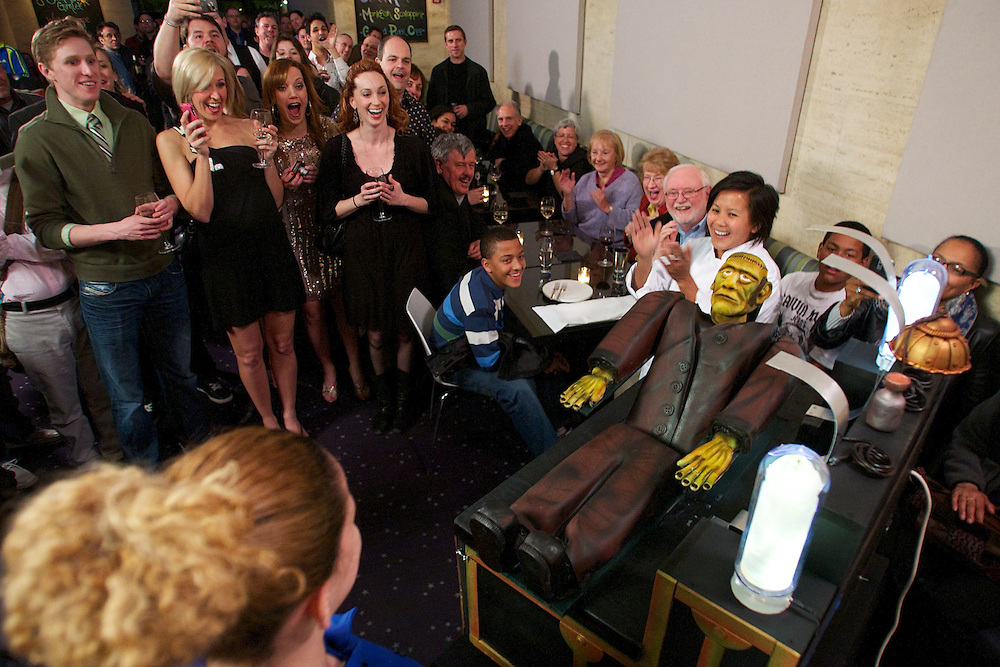
I think I’d like that. On the principle that one’s death should be in keeping with one’s life, living an everyday sort of life as long as possible and then joining with others to celebrate the end of it sounds just right. I’m imagining something like the party that attends a play that has had a good long run on Broadway. “Wasn’t that just amazing?!,” we would say. “Do you remember the night we were supposed to have a duel with swords and we couldn’t get them apart in time for the scene?  This party is for Young Frankenstein.

4/21/2010 — BOSTON — The cast of "Young Frankenstein" check out a cake replica of the star monster at a cast party at Teatro restaurant. The cake was designed and made by master chef Jorg Amsler and assistant Jennifer Santos, with engineering provided by Judy Lee and Adam Vollmer.

I’ve lived a religious life, so according to this principle, I ought to die a religious death, but I’m not really sure what that would be like. I have full confidence that if there is a life after this one, that God will manage it and my part in it as He chooses. According to my very forgiving orthodoxy, that makes sense. On the other hand, I am not at all confident that there actually is a life after this one, so I am prepared to lie down, like Abraham, “being old and full of years.”

[1] Please note the careful phrasing. All of my brothers and some of my kids read this and I don’t want to allow the interpretation that I am thinking of –ciding myself. I am not.
[2] The title means what you think it means, which is unusual for Stephenson. There are seven women who regenerate the whole known human population after a cataclysmic event and they are, collectively, what the Eve of the Garden of Eden is to our present human race or what the primate dubbed Eve is to a substantial part of it.
[3] Not what the Apostle Paul imagined for the end of his race and the difference is directly pertinent to what I imagine the theme of this essay is going to be.
[4] About twice as many Oregonians go to the trouble of acquiring the pill than actually use it. People report taking some comfort from the prospect that if the pain gets THAT BAD, there is something they can do. That makes complete sense to me.
[5] Joshua 6:21 says “They devoted the city to the Lord and destroyed with the sword every living thing in it—men and women, young and old, cattle, sheep and donkeys.” The “every living thing” is the holo- of holocaust.

Posted in Books, Living My Life | Tagged , , , | Leave a comment

Believing and Believing IN

I love it when this happens. I have watched Secondhand Lions maybe half a dozen times. Some parts, probably well over a dozen times. And always there is the sense that some part of my mind is receiving some really meaningful signals. It is not, I regret to say, the part of my mind that recognizes and names patterns.

Until last week.

Last week, I said, “Oh. That’s what has been jumping up and down and waving its hand. I see it now.” The element of the movie that caused all that discomfort and this belated recognition is the difference between “believing” and “believing in.”

I’m going to give you the crucial line the way I have heard it all these years. It’s wrong. I finally heard it correctly. Uncle Hub says, as I heard him, “Just because something isn’t true, that’s no reason you can’t believe it.”

garth 5Hub is such an appealing character and the scene is genuinely transformative for Walter, the confused little boy. And those things, among others, made me want to hear Hub differently than the way I was hearing him.

This movie isn’t about religion. It certainly isn’t about Christianity. Hub has a “confession of faith,” of sorts that I have appended and you will see that there is not the slightest whiff of Christian doctrine in it. On the other hand, I am a member of a religious faith that has never made any bones about the historical foundation on which it relies. Christianity is a historical religion in all the important senses. Christians say, “This happened and as a result, I am a different person than I would have been had it not happened.”

So the “true” and the “real” are mixed together as the cement that holds the major boulders of Christian doctrine together. And that’s the reason I was very surprised and also very happy to finally have heard what Hub actually said. What he said was, “Just because something isn’t true, that’s no reason you can’t believe IN it.”

In fact one of the major plot elements in the story is whether “all that Africa crap” really happened or not and that is the story I am telling today. I’ll start with an introduction to the movie. Then I’ll show you the scenes that make up this subplot. Finally, I’ll reflect little on what all that means.

Plot and Characters

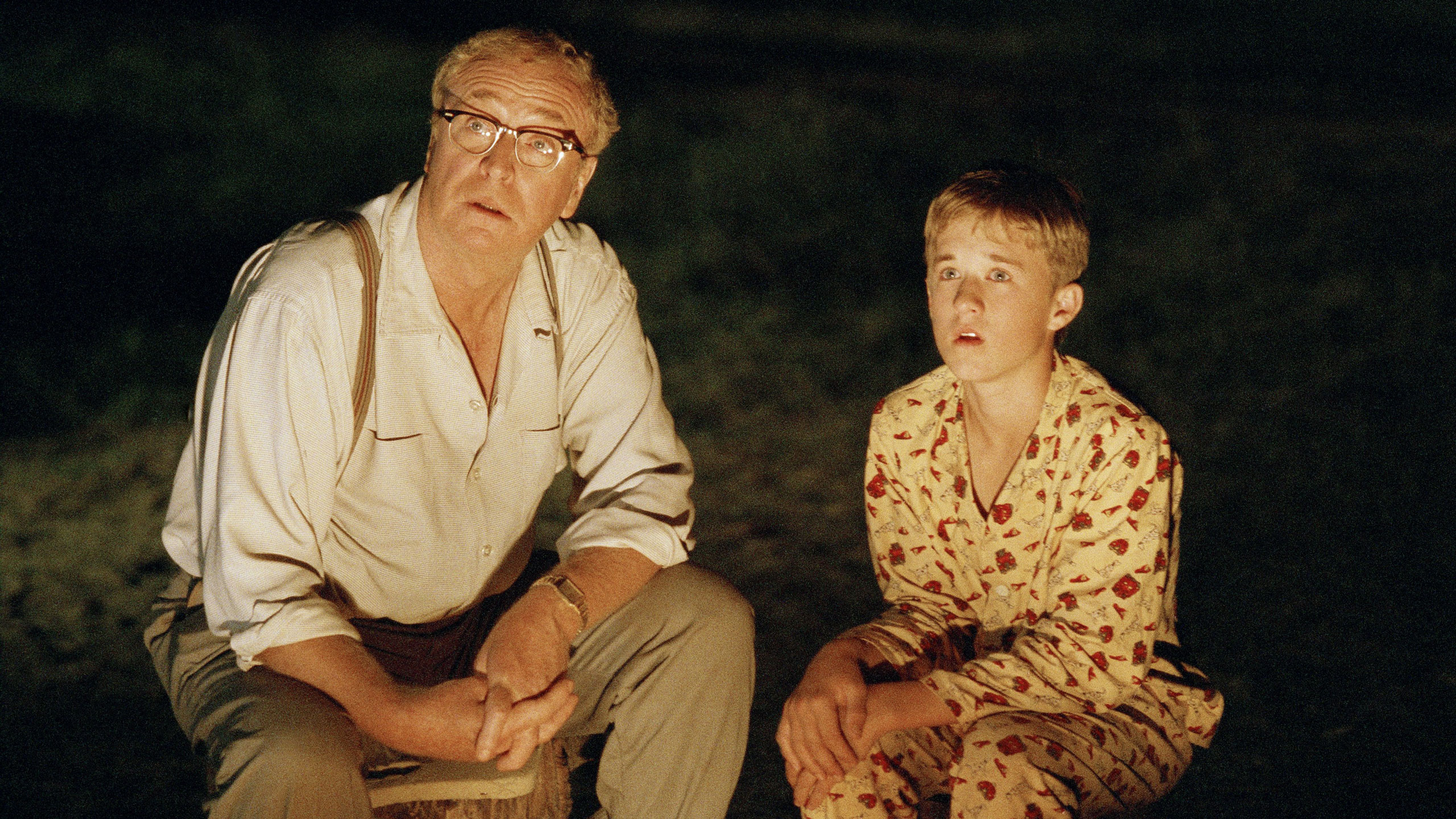
Walter,(Haley Joel Osment) a hapless pre-adolescent is dropped off by his irresponsible mother, Mae,(Krya Sedgwick) to spend the summer with his uncles, Garth (Michael Caine) and Hub (Robert Duval), neither of whom Walter knows. Garth and Hub are old men who live boldly in present day rural Indiana, but the stories they tell about their adventurous pasts are scarcely credible. Hub is the principal hero of the stories; Garth is the principal teller.

Walter is drawn into the world of the stories because they are wonderful stories. First he rejects the whole idea that they happened at all. Then small fragments of the story come to seem plausible. Finally, Walter is living in the stories in the same way that Garth and Hub are.

garth 2Late in the summer, Mae returns with a boyfriend, Stan. Stan is a bully and he is in debt to people who do extreme things to recover their money. Stan tries to get Walter to say where Garth and Hub’s legendary supply of money is. When Walter refuses, Stan punches him and promises a lot more punches if Walter doesn’t give in. That’s the origin of the “friends or enemies” remark.

Scene I

Walter and Uncle Garth are sitting on the porch watching Hub give his “what every boy needs to know about being a man” speech to a bunch of tough guys that Hub has just defeated in combat. Walter asks for more Africa stories.

Uncle Garth:You don’t believe all this Africa stuff.

Walter:It’s a good story.

Scene II

Walter goes to stand with Uncle Hub in the middle of the night, looking over the lake. Garth has said that only Hub will tell Walter whatever happened to the legendary love of Hub’s life, the Princess Jasmine. Walter has come down to the lake to ask him.

Walter:These stories about Africa…about you. They’re true, aren’t they?

Uncle Hub:Doesn’t matter.

Walter:It does too. Around my mom, all I hear is lies. I don’t know what to believe in.

Uncle Hub:If you want to believe in somethin’, then believe in it. Just because something isn’t true, that’s no reason you can’t believe in it.

Sometimes the things that may or may not be true are the things a man needs to believe in the most.

Doesn’t matter if it’s true or not. You see, a man should believe in those things because those are the things worth believing in.

Scene III

Mae and her thug boyfriend have returned, saying that Hub and Garth have all that moneygarth 4 because they stole it from a bank back in the 1930s. Walter replies that they couldn’t have done that because they were in Africa in the 1930s.

Walter:Hub and Garth didn’t rob any banks. They were in Africa.

Mae:Africa! Oh Walter, be serious.

Walter:They were shanghaied to the French Foreign Legion and had adventures for forty years. They couldn’t have robbed any banks.

Stan: Oh come on pal, you don’t believe all that, do you?

Walter:Sure I do.

Mae:You? Mr. Doubting Thomas? Here Stan’s got actual evidence and you believe that Africa crap?

Walter:Yes. Yes I do.

Scene IV

Stan has taken Walter out to the barn, where he believes Garth and Hub’s money has been hidden. He is determined to scare the boy into telling him where it is. He punches Walter in the stomach, knocking the wind out of him. Then he lays out this proposition.

Stan:So what’s it gonna be, pal. Friends? Or enemies?

Walter: Defend yourself.

Movie Note: A full 11 seconds elapses between the question and the answer. During that 11 seconds, Walter’s face turns from passive fear to active joy and we hear, very faintly, the theme music of Garth and Hub’s Africa adventures.

Reflections

The struggle that these passages point to revolves around the nature of the stories. The first question we come across is whether they are historically valid. Walter is a skeptical kid by nature—as Mae’s comment in Scene III shows—and it seems completely beyond belief that the events that make up the stories actually occurred. That way of assessing the Africa stories returns late in the narrative when Walter tries to use the Africa stories as a way of showing that Hub and Garth are not bank robbers. It is the historical accuracy of the stories that Mae has in mind when she uses the word “believe”

But in Uncle Hub’s fullest account of the value of the stories (Scene II), he says “believe in,” rather than “believe.” When Walter says he needs to know about the Africa stories, he says he has lived a life of being lied to and he doesn’t know what to believe—he doesn’t know, he means, “what is verifiably true.” That’s important to Walter because his mother, Mae, lies to him a lot. But Uncle Hub’s response has nothing at all to do with verifiability. “If you want to believe in something,” he says, “then believe in it.” Hub is talking about asserting the supreme value of what makes life good, things like honor, courage, and virtue.

This has always been the tension of Christianity as a historical religion. We maintain that an event actually occurred. We maintain that the event is the basis of our commitment to the values that the event displays. The charm of Secondhand Lions is that Walter moves from asking the “what is true” question to committing himself to the “what is right” question over the course of the film.

So Walter’s response in Scene I indicates only that he finds Uncle Garth’s stories interesting in a time when he has nothing else to do. By Scene II, he wants to know whether Uncle Hub’s adventures actually happened—whether they are historically verifiable in principle.

Uncle Hub’s response sweeps past the question of “believing that an event really occurred” and doesn’t stop until it gets to “values that are worth our commitment.” These things are worth “believing in.” These are things Walter can choose to believe in, regardless of how unreliable his mother is; regardless of how much he has come to clutch empirical certainty as a solution. Certainty is not a solution; commitment to ultimate values is the solution and we are free to commit ourselves to them just be choosing to. In fact, as Stan will find out in Scene IV, no one can stop us.

And Hub snuffs the latent confusion in Walter’s mind by stating clearly that “actual occurrence” is not a condition of such a commitment to values. In fact, Hub lays the contradiction out in three successive statements of relationship

  • Just because something isn’t true, that’s no reason you can’t believe in it;
  • Sometimes the things that may or may not be true are the things a man needs to believe in the most; and
  • Doesn’t matter if it’s true or not. You see, a man should believe in those things because those are the things worth believing in.

So, in order: you can believe in it even if it is not true at the level of historical occurrence. Then, this is particularly true of the most important things. It is the most important things about which we must say that “they may or may not be true.” And finally, it is the values themselves that contain worth. Our obligation to believe in them is only a recognition that they are worth believing in.

This matter of believing and believing in comes to a remarkably clear focus in Scene IV. His mother challenges Walter, “You don’t believe in all that Africa crap, do you?” It is interesting that she uses the “believe in” form, but she means “believe as a matter of historical fact.”

Notice how far Walter has come from his conversation in Scene I with Uncle Garth. Walter asks for more of the Africa story. Uncle Garth says, “You don’t believe all this Africa stuff.” This is the “believe” form; it means, you don’t believe these events actually occurred. It means, oddly, the same thing Mae means by “believe in.” Walter doesn’t answer the question. He asks for the stories on the ground that they are good stories, engaging stories. When Mae challenges him directly—You don’t believe in all this Africa crap…” —he answers directly, “Yes. I do.” And that answer is only moments away from his being punched by Stan and he is, in that way, asked the question much more directly. His answer to Stan, “Defend yourself!” is the same answer he gave his mother. Yes. I do.

This solution—the transition from “good stories” to “Yes, I do believe them” looks so good on the screen that we are tempted, as Christians, to follow that same path. We would say, as Hub did, that values like honor, courage, and virtue or their Christian equivalents, are so True that they are worth believing in whether all that stuff about Jesus of Nazareth happened or not. I think that would be a mistake.

It has never been the position of the church that the values Jesus exemplified are so garth 7
ultimately worthy that they are worth “believing in” whether there ever was a Jesus or not. It has (almost) always been the position of the church that “when the time was right, God sent his Son.” The Son lived out obedience to God and exemplified the values that characterize God’s reign, but he came in history. The church “believes” that he came and we “believe in” the values—God’s values—which he showed and for which he was willing to die.

The values by themselves are “nice.” They are good values. But if they are not God’s values, then we honor them at the cost of honoring God. We value them as if they were of ultimate worth, but it is God who is of ultimate worth and our salvation has come to us by the means God has provided. In Jesus’ appearances after his death, we see the disciples saying with wonder, “So…it was all true.”

Also…in Secondhand Lions, there is what amounts to a post-resurrection scene. The director showed good judgment in removing it from the theater version of the film. It is too long and complicated. Thank God he left it on the DVD. It relies on Josh Lucas—a face we scarcely see in the movie—as the adult Walter to bring off the final confirmatory scene. And it really doesn’t work as narrative.

But it works great as theology. Walter is making a few remarks at Hub and Garth’s funeral when a van of the French Foreign Legion shows up, their horses leaping out of the vans and assuming a formation of respect for one of their own. The old sheik shows up, scars on both cheeks, just as the story has it, and breathing through an oxygen mask. “So…” says one of Walter’s sons, “it’s all true.” And the adult Walter, just a little slower than his son, agrees in wonderment, “It’s all true.”

Uncle Hub’s Confession of Faith

That people are basically good. Honor, courage and virtue? mean everything. That power garth 1and money, money and power, mean nothin’;. That good always triumphs over evil. And I want you to remember this. Love, true love, never dies.

Posted in Movies, Theology, ways of knowing | Tagged , , , | Leave a comment

Did the Media Go Too Far?

This is mostly a rant about how television “news” operates. If you’ve never watched news programs on television or if you do watch and like what you are seeing, this is probably not the essay you want to read. On the other hand, it is really easy for me to write, because nearly all the writing has been done by Jill Ciment in her novel Heroic Measures, which has recently been made into a movie, Five Flights Up. The role of the media—the way they work a story without actually providing any information about it—is prominent in the book. In the movie, not so much.

pamir 5When I started watching the news on television, I watched “The Huntley-Brinkley Report,” featuring Chet Huntley and David Brinkley. It was fifteen minutes long. NBC announced plan to extend it to thirty minutes and someone asked Brinkley what he thought about that. He didn’t oppose it directly, but he did remark that some days, there are really not thirty minutes of news. Jill Ciment’s story is, in large part, a story of how they have solved Brinkley’s dilemma.

Let’s start with the last of the clips I have taken from the novel and which I have used as the title.

“Stay tuned,” says the newscaster, “next up, the results of tonight’s poll Did the Media Go too Far? and an exclusive interview with Pamir’s girlfriend from rehab, Debbie Twitchell.”

My answer to that question is a resounding Yes! The media did go too far. Further, they went too far down a road where they should never have gone at all if “news” is their business. If generating viewership and thereby advertising dollars is their business, then we’d have to say that they handled it pretty well.

Here is the event that starts the media journey down “the road.”

“The tanker jackknifed; it’s blocking all in-bound lanes,” Ruth continues. “Police don’t know if it was an accident or if the driver swerved on purpose. The mayor is asking everyone to remain calm and to not drive into Manhattan tonight.
Last night’s graphic—the truck’s headlamps as seen by the night-vision robot with Danger in the Tunnel splashed across it—appears on the screen. The morning newscaster, the blond in Washington, D.C., promises that after the station break she’ll be right back with an exclusive interview with the truck driver’s family and friends.

So “Danger” is the first issue. Certainly there is no denying that. It’s a truck full ofpamir 2 flammable liquid. Of course it is dangerous. Now we go to “interviewing the family.”

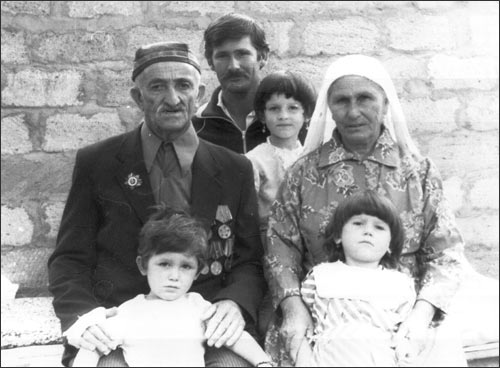
The truck driver’s uncle and mother have faces like walnuts, shiny tacks for eyes. They’re standing on a snowy sidewalk before a row house in Queens. Behind them, neighbors jockey for a position on the television screen. The mother wears a massive black garment under an overcoat and a headscarf, though Alex and Ruth can’t tell if the scarf is worn for warmth or for religious conviction. It looks like something their grandmothers might have worn. The uncle, a stout man with a black mustache as big as a pocket comb, reads a statement in a stiff guttural accent that goes slack with emotion: “Abdul Pamir is a devout, gentle, and caring son, husband, father, uncle, brother, and nephew. He was born in Uzbekistan, and became a proud American two years ago. We want him to come home safely.”

pamir 3Danger, Will Robinson! The truck driver is a foreigner. He is an Uzbek, which means, among other things, that he was recently part of the USSR. His parents are “foreign-looking.” That’s why the “massive black garment” on the mother and the “black mustache as big as a pocket comb” on the father are included.  A “headscarf for religious reasons” suggests Islam, as does the name Abdul. We have gone well past the flammability of the truck’s cargo now and are approaching the flammability of American xenophobia.

Alex turns on the television: Live Press Conference pulses in the screen’s upper corner. Camera lights, as bright as competing suns, irradiate a makeshift stage in the lobby at city hall. A burly man, captioned FBI Spokesman, the short mayor, and the buzz-cut police chief in full regalia approach a lectern crowned by microphones. The burly spokesman reads a statement: “At eight twenty-two, the aqua-bomb detector finished its sweep of the tank. As of this hour, we believe there is no bomb.” Barrages of questions are hailed at him, but he ignores them. “We’re asking New Yorkers to stay on high alert until the driver’s in custody.” The mayor leans into the microphones. “Keep your eyes and ears open, but go about your lives. Soon as the city engineers give the go-ahead, mine will be the first car through the tunnel. We will not take questions at this time.”

Visually, we have the mayor, a burly man identified as an FBI spokesman and the police chief in full regalia. As to “information,” we learn that they have sent a bomb detector to determine whether there is a bomb attached to this “jack-knifed” semi, whose driver has fled the scene. Everyone is asked to stay on high alert. For what exactly is not specified.

And that was the good part. That was “news.” Now we get “reaction to the news.”

The screen bisects into halves—the basset-eyed newscaster in New York and the blonde in Washington. “What they’re not saying,” the blonde says, “is that Pamir might be wearing the bomb and that’s why they didn’t find one in the truck.”
“You’re right, Kat, the device could be on him and he could be anywhere at this point.”

I think that the “they” in “what they are not saying” is scary, although she might have meant just the FBI, the police, and the mayor. Also, “not saying” is scary. Why are they not saying something that we need to know? The line between “not saying” and “withholding” is a very fine line. And then there is the question of a bomb. Why would he be wearing a bomb? I think it is because his name is Abdul Pamir and his family is from Uzbekistan.

“GOOD MORNING, EVERYBODY,” SAYS THE basset—eyed newscaster. “Before I bringpamir 4 on my first guest, a forensic psychologist and consultant for Homeland Security, to help answer the question—Is Pamir a suicide bomber or not?—lct’s see what the American people think. Here’s how our viewers responded to this morning’s polling question. Seventy-seven percent say yes, Pamir is a suicide bomber, twelve percent say no, and eleven percent isn’t sure. We’ll be right back to see if the experts agree.”

Of course, it doesn’t matter very much what the answer to the question is. It’s the question that matters. It pairs “Pamir” and “suicide bomber.” We might ask why it matters what people think, remembering that all they know is what the media have told them, but, of course, it matters a great deal to the station that people feel they have been asked and also that they keep on watching this particular station to see whether others agree with them. And if it weren’t a fact—a hard clear fact—then why would they have experts there to talk about it? A forensic psychologist? Homeland Security? Please.

The basset-eyed newscaster’s face is as large as the moon. He wears the expression of an oracle about to make a prediction. Across his brow is written Breaking News—Target: New York City.

New York City is now a target. OK.

“The FBI has Pamir cornered nearby in a Bed Bath and Beyond,” Alex tells her. “They have one on the Upper East Side?”
“It’s just around the corner,” the moon-faced guard pipes in.
“Does he have a bomb?” Ruth asks.
“He has hostages,” Alex says.
The garment fades and the basset-eyed newscaster takes over the screen. “Only fifty-two percent of our viewers say they’d come out if their mother called. ‘What do the experts think?”
He’s turns to the double-chinned forensic psychologist from this morning. Six hours under the hot lights and her lipstick looks as if it’s melting. “The suicide bomber believes he’s doing this for his mother,” she says.

pamir 1The cast is still the same. There are telephoto shots from circling helicopters. Pamir has taken hostages in the kitchenware section of Bed, Bath and Beyond. His mother is standing outside, so there is something to see, even if it is the same loop they have been showing for half an hour. The forensic psychologist is still in the studio. The public is still being queried about questions for which they have no knowledge at all.

A bullhorn blasts, but before Ruth can make out what’s being said the words break into echoes against the buildings. Pamir lowers his hands and begins struggling to open his coat, a puffy, hooded gray parka that almost reaches his knees. He tugs at the zipper, but he can’t seem to undo it. The teeth appear to be caught on something. In his panic to get the coat open, he pulls on the zipper as if it is a rip- cord and he is in freefall. Ruth can’t tell if the camera is running in slow motion, or her mind is, but Pamir seems to be fighting with his zipper for an eternity.
Suddenly, white feathers appear to hang in the air all around him. Only when the feathers settle does Ruth realize Pamir’s ripped his parka in two to get it off. He pulls what remains of it over his head. Ruth can see he isn’t strapped with explosives.
The bullhorn barks again, and Pamir tosses his coat into the street. He peels off his sweater, unbuttons his shirt, and throws them on top. Clad only in a T-shirt, he slowly rises to his feet and removes hi sneakers and socks, flings them into the pile, too. “The pants,” the bullhorn barks. He undoes his belt, zipper, and steps out of his pants. Shivering, he kicks them away with his bare foot.
He pulls his T-shirt over his head, and leaves his hands up in the air, but the bullhorn’s not satisfied. It barks and barks until he takes 0ff his underwear and lies down on the ground, spread-eagle. The station discreetly covers his derriere with what looks like a smear of Vaseline.

This is great TV. The “terrorist” is now forced to strip naked and lie on the cold pavement. I can’t think why they would bother with a trial.

“WITNESSES SWEAR THEY SAW A BOMB UNDER Pamir’s coat,” says the evening newscaster, a prematurely white-haired man with a ferret-like face. “Dozens of people described the exact same explosive device down to the number of dynamite sticks and the detonator button’s color. Now the mayor tells us Pamir never had a bomb. Was it a mass hallucination? What did these witnesses really see?” he asks his guest, an intense, thin woman with flyaway hair captioned, “Author of Mass Hysteria.”

One of my favorites. Witnesses agree that they saw something they could not have seen and which the mayor says was never there at all. What shall we do? I know. Let’s bring in a woman who has written about mass hysteria. The “story” has gone away. The experts that can opine about the story have gone away. All that is left, is an expert who can comment on the fantasy the media have devised and explain it as a mass glitch. Still there is no one to talk about market share and the cost of advertising. Dear me. And now we arrive where we began.

“Stay tuned,” says the newscaster, “next up, the results of tonight’s poll Did the Media Go too Far?

You could say that. The only consistent element is the “stay tuned” part. Is there a Video-Industrial Complex. Is it too soon to start worrying about it? Don’t forget to cast your vote and tune in at 11:00 to see how many of your fellow Americans agree with you. We’ll step aside now for some messages.

Posted in Politics, ways of knowing, Words | Tagged , , , , | Leave a comment

Men learn from Hobbes and Women from Rousseau

OK, so it’s never going to replace Mars and Venus. Also, it’s not precisely true. But it is mostly true—more often than not—and it has the same principal virtue that John Gray’s Mars/Venus books have. It teaches that there are two complete orders of reality and that standing in one and judging the other is an exercise in futility.

You need to know that there are two and you need to understand the acts of each in the

Women trying to solve conflict between men

Women trying to solve conflict between men

context of the life-world of each. Gray teaches—over-teaches, really—that men make certain presuppositions about what women are like. They use “what men are like” thinking that they are using “what everyone is like” as the template. Men think, in other words, that they are using a gender neutral standard. When women act differently, the men think they cheated somehow. Then men read the Mars and Venus books and learn several important things.

  • They learn that the women didn’t cheat (or deceive or misrepresent, etc.).
  • They learn that there is a way women act and if you learn to judge them by the standard they use, you can find a way to make it all make sense.
  • They learn that the way they act is, in fact, not the way “persons” act, but the way men act.
  • They learn that acting this way is going to be received in a very predictable and not a very positive way by women.
  • They learn, however, that there is a way of understanding how they see things and that by honoring that way of seeing—not by adopting it yourself, but by knowing it is there— you can work out a very satisfying way of being together.

Brief Digression: When I said that Gray “over-teaches,” I meant that his system works because he lumps all women into the same model and all men into the other model. His approach is not friendly to individual differences. It is also not friendly to men and women who, for whatever reason, have adopted the way of thinking more typical of the other. So I’m not arguing for the validity of Gray’s typing. What I am saying is that he teaches more successfully than anyone I have run across that there are two ways, and identifying the way you yourself do things as “the normal way” is only a self-inflicted wound.

End of Digression (told you it was brief): I want to use the same essential gimmick Gray uses, but I want to use it about something else. I want to talk about interest aggregation.

hobbes 3So the first thing to do is the grossly oversimplify the teachings of Thomas Hobbes
(1588—1679) and Jean-Jacques Rousseau (1712—1788). Rousseau taught (and his followers, the Rousseaueans believe) that there is a general will. If I were writing about societies as a whole, I would probably capitalize, e.g., General Will, but I’m going to be talking about deciding what movie to see, so I don’t think I will capitalize this use. When we express our “interest”—when we “vote,” for instance—what we are doing is expressing our best guess about what the general will is. We are saying, “This is what I think will be best for us.” You can see that Hobbes, at the left, looks bemused.

Hobbes had no idea a any transcendent “general will” at all. On our menu are: a) the war of each against all and b) domination by a large and competent central government (Leviathan). Hobbes (and his followers, the Hobbesians) taught that humans arrange things as best they can. We do know, after all, what we want. We strive to achieve what we want even at the cost of what you want. Most times, it doesn’t work out well and in the long run, it never works out well. Life without Leviathan is “solitary, poor, nasty, brutish, and short.”

Enough political philosophy. A group of men and women are trying to decide what movie to see. The men prefer violent action movies so they vote for violent action movies. The women prefer social comedies, but the women, following Rousseau, don’t vote their preferences. They vote for the kind movie that they believe will be best for the group as a whole. Possibly a historical drama, accurately and colorfully told, of which there are several.

The women propose the historical drama and are very surprised to see that the men allhobbes 4 believe that the group’s welfare will be best served by seeing the violent action movie. Who would have thought it? Why would they believe that such a movie would be best for all? The women, seeing that they must have guessed wrongly about the general will, express their preference for the violent action movie. So it’s unanimous. Or at least it looks unanimous to the guys.  Here is Rousseau, thinking of the General Will or possibly about Happy Hour.

This same decision process operates week after week. Finally one of the women owns up to not really enjoying the violent action movies. The other women chime in; they don’t either. The men are surprised. Really? You keep choosing these movies, and now we learn that you don’t like them. What’s going on?

“Surprised” is the happiest phase of this process for quite a while, so let’s linger. Here’s what the guys know. They are incredibly lucky to be in the company of women who like violent action movies, one after another. Now, after many such movies, they learn that the women actually don’t like that kind of movie although “they said they did.” (We know that is not what they said. We know that they expressed their guess about what would be best for all.) Now the men are wondering, “If you can’t find out what they want by asking them, how can you find out?”

Now let’s go beyond the “surprise” phase. Let’s say that the women blame the men for choosing only the films they like and never choosing the films the women like. The men don’t like to be blamed for something everyone agreed they all should do. The women discover at that point that the men are not “voting” for their sense of the general will, they are only voting their own preferences. Who could be as selfish as that? Really.

The men, it turns out, are selfish. When they say, “Let’s see Mad Max III: The Revenge,” all they mean is, “I want to see Mad Max III.” No other person’s interests are taken into account. The interests of the group as a whole are not taken into account. These men are all I, me, mine.

The women, it turns out, are devious. They say they want to see Mad Max III: Thehobbes 1 Revenge, but they didn’t. The problem of aggregating the interests of the group and making a choice that fits those interests pretty well is a knotty problem. It can be managed—the guys have been managing it this way for years—but it requires a base level of honesty by the participants. What is this thing about I said I wanted this, but all along, I really wanted that. What is all that about?

The men are exasperated. Their lament has been immortalized by Henry Higgins in the line, “Why can’t a woman be more like a man?”

The next time the question of movies comes up, it will be dealt with by some wounded and wary men and women. The men will ask for nominations, knowing that they can’t trust the women to tell the truth. The women will know that when the men nominate a movie, they have only their own interest in mind. They don’t care about the preferences of the women. They don’t care about the long-term viability of the group.

Things get worse and worse. The men are punished for “being honest about their preferences.” The women are castigated for being dishonest in the information collection phase and then vindictive in the assessment phase. The Hobbesians know that the Rousseaueans can’t be trusted. The Rousseauseans know the Hobbesians are heartless bastards.

There is, of course, a solution. The men need to understand that the women are not expressing their preferences, although they seem to be. Just understanding that is a major achievement. Beyond that, they will need either to try to imagine what a “general will” could possibly be or they will need to get the women to express their own “selfish choices” as if that were something to be proud of.

The women need to understand that the men are not refusing to recognize choices otherhobbes 5 than their own. The men believe—where to they get these ideas?—that if everyone expresses a selfish choice, the group will be better able to take all the choices into account and make a good decision. Just understanding that much is a major achievement. Beyond that, the women will have to imagine a way of piling up selfish choices in such a way that the group is benefitted or they will need to get the men to take the welfare of all into account as they make their choices. [1]

This brings us back to the wisdom that John Gray popularized. There really are two distinct ways of addressing the world. Each one makes sense when everyone is using it. But if you know there are two—and there are, in fact, more than two and they aren’t all based on gender—then you can allow for the possibility that arriving at the common good might be harder than you thought.

But if you know this much, you have a chance.

[1] It’s harder than it looks. The men believe that “the general will” cannot be known directly. That’s why you start with honest preferences and bargain your way toward optimal choices. The women believe that it’s a moral matter, a the very foundation. You don’t just say what you want; you take into account the needs and wishes of others before you open your mouth.

Posted in Politics, Sustainability, Words | Tagged , , , , , | Leave a comment