Concussion

I have seen the movie Concussion three times now. [1] And I have read the book twice. So I think it would be fair to say that I am a fan. I tend to talk about movies that I liked particularly and part of that conversation, as a rule, is, “What is it about?”

Easy to ask; hard to answer. Ordinarily, I respond by giving a buffet of things different viewers might think it is about. It is aboconcussion 3ut the NFL’s suppression of information about concussions. It is about capitalism and its disregard for the costs incurred by the workers. [2] It is about the aspirations of a young Nigerian doctor to continue to be Nigerian (Igbo, really) while becoming American. It is about the courage of a public servant enduring physical harassment and retaliation by his professional colleagues and vulnerability to punishment by the law—and still continuing to offer his adopted homeland the gift he has to offer.
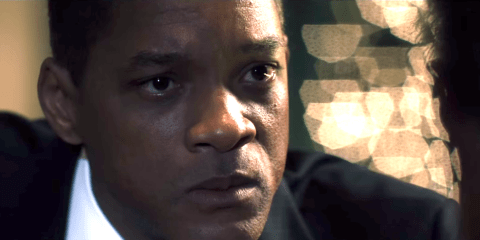
Those are all good answers, but none of them is my answer. I went back to see it again to watch Dr. Bennet Omalu grow. But before I get into that, I have to say that watching Will Smith play Dr. Omalu lets us see the character grow in the way the real Dr. Omalu grew. Will Smith is absolutely wonderful. This is the best work of his career, it seems to me. [3]

Concussion 5Let’s pick up Dr. Omalu at the point where he “meets”—that’s Omalu’s word—Mike Webster. They wheel the body of Hall of Fame Steeler Center Mike Webster into the autopsy room for Omalu to examine. Everyone but Omalu is very conscious of the honor that is being bestowed upon them. Why is Omalu not conscious of it? Well, he has never heard of Mike Webster. Or the NFL Hall of Fame. He doesn’t know what a “center” is. He doesn’t even know what a Steeler is. In Allegheny County, Pennsylvania!

Omalu is thorough. He’s a neurologist and he knows his stuff. But he also believes that “Mike Webster” is still present to him in some way and he wants to learn from Mike, not just from Mike’s body. As part of that thoroughness—paying attention to Webster’s life as well as his death—Omalu discovers the tau tangles in the brain. These are the mind-strangling tangles familiar to anyone who has looked at the brains of old people with Alzheimer’s disease. Webster was 50 years old and had the body of an athlete.

Omalu and some of his colleagues discover Chronic Traumatic Encephalopathy (CTE), the name they give to these Alzheimer-like symptoms which are caused by concussions. Omalu is a doctor and he sees the explanation he has discovered as the kind of thing that will lead to treatment. Mike Webster is not a “center” to Omalu; he is a patient. He knows that future Mike Websters can be forewarned, at least, of the danger. Maybe something can be devised to recognize concussions more quickly and to treat them with more respect; maybe the rules can be changed to lessen the carnage.
concussion 1

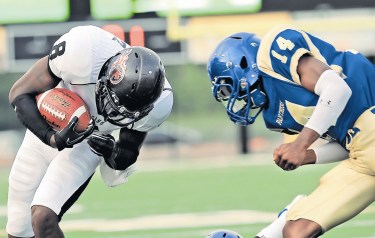
But the NFL doesn’t look at things the way Omalu does. Football is a business and massive financial liabilities are bad for business. No one in the NFL, back in those days, talked about “helmet to helmet contact;” they knew that the violence of the collisions was a major selling point for audiences. Those were the days when the violent hits of a safety on receivers and ball carriers earned him the admiring title, “The Assassin.” And Omalu wouldn’t shut up about CTE, so the NFL declared war on Bennet Omalu. [4] Shortly thereafter, Bennet Omalu declared war on the NFL.

The war goes on. A lot of the middle part of the film is about that war. But none of that part of the plot has anything to do with Omalu’s not knowing what a Steeler is or a center—or, as in the case of Jack “The Assassin” Tatum, a safety. [5] The plot that took me back to see the movie again begins when he meets Mike Webster and culminates in his address to the NFLPA—the players’ association. Omalu stands up in front, behind the podium, addressing the men who give and receive concussions for a living.

He begins by saying:

My wife watches the games. She jumps up and down. Through her eyes, I can see the beauty of the game. The grace. The power.

He caresses those words. He says them slowly and with rich meaning. He has come to see the game the way they see the game. There is an instrumental side to his presentation, of course. He needs to let these players know that he sees the game the way they do; it is the only way he can help them see the game the way he does. But watch Will Smith do it. He makes you feel that he knows what those words mean. They sound like words from the heart.

That is where Dr. Bennet Omalu has gotten to. It is an amazing journey. And because he did get there, he can say the other things he has to say:

Forgive them. Forgive yourselves. Be at peace.

That’s where I want to stop. Anyone who is angry at what the NFL has done and continues to do will not want to stop there. I understand. Anyone who sees this as a movie about the rules of football or about the heartlessness of capitalism or the love of violence men seem to have will not want to stop there. I understand.

The movie I went back to see again ends there. [6]

[1] I count it as seeing it twice when I see it with Bette because she sees so many things I miss and, for the relatively small price of a dinner afterwards, she is willing to tell me what I missed. Nicely.
[2] Dr. Cyril Wecht uses the marvelously apt analogy of getting a race car back on the track. That is the kind of “examination” a concussed player gets, says Wecht. How fast can we, the pit crew, get this player (car) back into the game (onto the track). Exactly.
[3] Not to disparage his role as the anti-technology hardass cop Del Spooner in I, Robot. I liked that one too.
[4] “You’re going to war with a corporation that owns a day of the week,” says Cyril Wecht, trying to give Omalu some idea of what he is taking on, “one the church used to own.” Omalu proceeds anyway. We learn from Omalu’s wife that his surname—the longer version from which Omalu is derived—is Onyemalukwube. It means, “If you know, come forth and speak.”
5] You can see the irony, in this context, of the name “safety” as the name of a position. A safety is supposed to make you “safe” from being scored on by the other team. Tatum’s violence made everyone on the other team less safe and therefore made his team more safe, but only from being scored on. Professional football is notorious for its payback norms, so it is entirely possible that Tatum’s teammates were also less safe because of his play. But his team—the team, not the players—was more safe.
[6] Not quite there. Later, Dr. Omalu is offered a position with the U. S. government—a position described as “the medical examiner of the United States.” In the movie, he is offered this job by a very masculine, very handsome bureaucrat. The bureaucrat begins by saying, “Dr. Omalu. We know what you have done. You are a true American.”
Posted in Movies | Tagged , , , , , | Leave a comment

Auden wrote a mountain

Every year I climb a mountain of a poem, getting, each year, a step or two closer to the top. If it has a top. It is W. H. Auden’s, For the Time Being: A Christmas Oratorio. We read it again last night.

My wife, Marilyn, and I were invited to the home of a friend of a friend one January night auden 3somewhere around 1990. We were going to read a poem by Auden. I thought, but didn’t say aloud, “Who’s Auden?” The evening was glorious. I had never heard such highbrow and lowbrow diction together and they didn’t just coexist; they caroused! We waited for an invitation for the next year, but this wasn’t something, it turned out, that was done every year. That is when we started giving the party ourselves. [1]

Marilyn and I had an Auden reading every year thereafter. We held it as near Epiphany as the availability of weekend evenings allowed. When Marilyn died in the summer of 2003, I determined to do it myself that year (that would be January of 2004). I did it myself the next year as well, January 8, 2005. I found it was a lot of work to do by myself, but I was proud that I could do it. I didn’t know that twenty days later, I would meet Bette and that we would plan the 2006 party together. [2]

We had, last night, as good a reading as any I remember. The room was full of competent readers. They were also engaged in the poem, even those reading it for the first time. It is our practice to pause after each of the first eight sections and share observations about what we have just read. Those times stretched on and no one seemed to mind until the end of the evening, when the host noted that it was well past his bedtime—given that Bette and I still had some cleaning up to do.

I keep reading Auden although mostly, I don’t understand him. It’s a systemic problem and I am sure it will never be solved. I don’t understand Auden because Auden builds on Kierkegaard and I don’t understand Kierkegaard. Nevertheless, I do not experience the evening as a frustration because there are so many other kinds of pleasures, simple pleasures, that Auden offers.

But the one I want to use as my example here is a technique that I call “inversion.” I’m sure it has a proper name, but I don’t know what it is. Auden uses this technique in ways that just make my heart soar. Apparently, I don’t need to understand it to be moved by it. The Virgin Mary, for instance, responds to Gabriel’s announcement by saying:

My flesh in terror and fire
Rejoices that the Word
Who utters the world out of nothing,
As a pledge of His word to love her
Against her will, and to turn
Her desperate longing to love,
Should ask to wear me,
From now to their wedding day,
For an engagement ring.

The inversion I see can be extracted like this: “that the Word, who utters the world out of nothing…should ask to wear me…for an engagement ring.”

auden 2God has pledged, Mary says, to love the world and to turn “her desperate longing [into] love and to join with the world in a covenant so strong and so intimate that it can only be compared to a marriage and, Mary says, God wants to wear me until that day, as a pledge of His intention to achieve [3] that ultimate trust and love. Mary is the symbol of that intention as an engagement ring is the symbol of the groom’s promise to the bride.

I have found that passage hard to live with because I am so drawn to Mary and yet Mary is pointing beyond herself as a ring points beyond itself to an initiative and an acceptance, neither of which is directed at her. In this passage, “the world” is pallid and inaccessible; Mary is gloriously real. Yet focusing on Mary causes the whole narrative to crash. It is the reality of the relationship—God and the world—which is clearly offstage at this point, that is supposed to engage us.

Here is a second example from the last few lines of the poem.

He is the Truth
Seek Him in the Kingdom of Anxiety;
You will come to a great city that has expected your return
for years.

Seek God [He is the truth] in the Kingdom of Anxiety. That is where we live, but we are journeying and on our journey, we will come to a great city. This city as expected our return. What? It has expected our return for many years. What?

Again the inversion. Auden gives us the by now familiar project of seeking God, who is the auden 1Truth. That is, presumably, what “the journey” is about. But that is not what happens. The major actor in this little verse is the city. Possibly “the City.” We used to live there. We left it and it has mourned the loss of us so much that now, seeing us return, having refused to give up the hope that we will return, it celebrates our return as the father celebrated the return of the Prodigal.

As in the case of Mary, we are drawn to the focal figure. We are seeking God, who is the Truth. But all the action is somewhere else; that’s what I am calling an “inversion.” We lived, once, in this city. We loved it and it loved us. We left and it mourned but it never gave up hope. Always, there were watchmen on the walls scanning the horizon hoping for a first view of our return. And now we are back, and the confetti is being prepared and possibly a fatted calf.

The technique amazes me. And I fall for it every year. I love it.

[1] The one thing you know about a party you are giving is that you will be invited to it.
[2] Sometimes, if you hold out long enough, the calvary comes.
[3] Theologically, to “restore.”

Posted in Books, Theology | Tagged , , , | Leave a comment

Does a Marriage Ever “End?”

I have had occasions where I felt I needed to explain what kind of a married man I am/was. Here is the distinction I chose: I am romantic, but I am not sentimental.

When I read Lucy Kalanithi’s account in the New York Times (the hyperlink is given below) of her “continuing marriage” to a man who had just died, it seemed odd to me. Today, I want to push at the boundaries of the experience of bereavement just a little and see if it pushes back.  The picture below illustrates why I want to be careful in what I say.

I have had experiences that bear on this question. In the late 1970’s I watched a marriage departed 1that I described as “going through a rough patch” dissolve right before my eyes.[1] That marriage “ended” in the sense that I now have a certificate of divorce to lay next to the certificate of marriage. Today I am asking in what other senses it “ended.”  Early in the new century, I watched a very good marriage end with the death of my wife. That marriage “ended” in the sense that I now have a certificate of death to lay next to the certificate of marriage. Today, I am asking in what other senses it “ended.”  And I am now married again. [2] Bette and I are both healthy and we are happy together, but I “know things” about the end of this marriage that I would not have known had I not survived its predecessors.

Having had those experiences of “ending,” I would like to reflect on how I now understand them and to place my understanding next to Mrs. Kalanithi’s. If one is to mean that a marriage “never ends” in the sense that the effects of having been married to that particular person never end, then certainly that is true. I will always be affected by having been married to these two remarkable women and the wonders continue to pile up in my current marriage.   But I don’t really think that is a plausible implication of the notion “marriage.” Those marriages, I would say, are over even though their effects linger.

After the memorial service of my second wife, her daughters—women who had been my stepdaughters for nearly a quarter of a century—went through her clothes and jewelry and took, with my blessing,  anything that was meaningful to them and then I took the rest to the Goodwill store. Those clothes meant a lot to me when she was in them. I was as romantic about her as anyone (including her) would want me to be, but the clothes she would never wear again didn’t mean anything at all to me and I was happy to have them out of the house. I was completely romantic about my living wife, but I did not hang onto any sentimentality about her clothes.

Here is a passage from Ms. Kalanithi’s column in the New York Times.

One night recently, alone in bed, I read “A Grief Observed” by C.­S. Lewis, and I came across the observation that “bereavement is not the truncation of married love but one of its regular phases.” He writes that “what we want is to live our marriage well and faithfully through that phase, too.”

departed 4I had read A Grief Observed many times before my wife died. In fact, I had read it many times before my first wife and I divorced. But, of course, I read it with a new focus after I watched my wife die. I learned that I experienced the death of a beloved wife differently than Lewis did. Lewis tends, as I do,  to use the language of his Christian faith to do his thinking.  But I learned that as similar as his faith language is to mine, his experience as a widower was very different from mine. He felt different things and he placed what he felt into his theology in a different way than I did.

So when Lewis writes that bereavement is “not the truncation” of married love, I have no idea what he is talking about. Do I still love my wife, who died nearly thirteen years ago? No. Do I remember her fondly, treasure memories of my life with her, thank God for the privilege of having lived so long with such a remarkable woman? You bet I do.

Here is the next section of Ms. Kalanithi’s column.

Yes, I breathed. Bereavement is more than learning to separate from a spouse. Though I can no longer comfort Paul, the other vows I made on our wedding day — to love Paul, to honor and keep him — stretch well beyond death. The commitment and loyalty, my desire to do right by him, especially as I raise our daughter, will never end. And I am keeping another final promise.

So the vows she made on her wedding day apply equally to the living husband Paul and to her memory of Paul? That’s how I read that. [3] She promised to comfort Paul, to love him, to honor him and to keep him. She says she can no longer comfort Paul, but she holds onto her commitment to love, honor, and keep.

departed 3Those are not words I would use about my wife. I honor her memory and so on, but that’s all I can do. Unless, possibly, Ms. Kalanithi is using those words to mean the same thing she says in the next sentence. What if she means that she will continue to honor her desire to “do right by him?”  I want that too, of course, but what does it mean?

That brings me to the other fragment of Lewis’s statement Ms. Kalanithi quotes: “What we want is to live our marriage well and faithfully through that phase too.” That sounds good to me, but again, the phrasing is crucial. Here is what I think Lewis means: “I want to live our marriage…through the phase of [bereavement] and I know that is what you would want if I were to die before you.”  I like every part of that. If you don’t intend to treasure all of your wife who is left to you after her death, then you aren’t loving the whole woman you are married to during her life. And I would say the same thing taking the wife as the reference point and the husband who has died. I don’t hold very much of the marriage relationship to be symmetrical, but I do hold that.

If Lewis means that there is a “we” who continue to interact so as to accomplish the joint project of the loss of one of us to death, then I have to step off the bus. When she died, I lost my partner. I lost the person who proposed ideas to me and I to her; the person who helped me think through how to proceed on a plan. [4] There is no more “we,” as I understand it.

On the other hand, I do continue to feel bound by commitments I made to my wife before she died. I chose “bound” as a word to represent my continuing commitment to her interests because it is an action I took. I actively foreclosed reneging on those commitments. To me, that is a way of honoring what we had, who we were. [5] It is not a way of honoring “her” today, much less “our marriage” today.

As I look back on my two major losses, I would say that I grieved the loss of my first marriage poorly. I think I did as well as I could at the time, but I was angry and disoriented at the time. I think I grieved the loss of my second marriage well. I loved her well in her health and in her sickness. I mourned her death. I cherish my memories and I am grateful for the time I got to spend with her. But the marriage is gone and I don’t feel sentimental about it.

Because I am not a sentimental person, I was free, when I met Bette, to make a commitment to her. I was free to make the same wedding vows I had made twice before. And, in addition, we made wedding “promises” that captured our own sense of who we were and who we hoped to become. If Bette dies before I do, I will mourn her richly. I will live through the bereavement. I will continue to be grateful for the time I got to spend with her. [6]

So does a marriage ever end? Of course it does. Honoring the memory of commitments made and kept is something to look back on with pride: even a commitment to be “each for the other, a fountain of wonderful and unpredictable gifts, freely and generously given….a matrix of generosity and compassion, of understanding and acceptance.” [7]
[1] I know now that for a married couple headed toward divorce, there is a complex set of views, none compatible with the others, that needs to be taken into account. There is his view and her view, of course. But there is also a rub between the inner feelings and the inner understanding. The inner feeling says things like “I just can’t take this any more,” or “What the hell is going on here?” The inner understanding is society’s understanding, but applied to yourself.  All I am saying in this essay will draw on my memories of my own bewilderment when the feelings and the explanations cannot be brought together.
[2] I am married to Bette. I decided, after I started this essay, to use Bette’s name on the grounds that she is the only wife I have and that she makes up a great deal of my current life, while the memory of earlier marriages makes up a very small part of my current life.
[3] If Ms. Kalanithi believed that Paul was just as much alive as ever, but not in any bodily form, then the case for continuing to honor their “marriage” would mean something different. But then, “widow” would also mean something different. Or it might not mean anything at all.
[4] She told me what kind of memorial service she wanted and I promised her that is exactly the kind that would be held. And that is what happened. But notice the past active indicative form of the verb “wanted” and that I am forced to shift into the passive subjunctive to say that is the kind that “would be held.” That’s the difference. That is bereavement.
[5] It does not imply, of course, that she and I agreed on everything. Sometimes I did things I would not have chosen to do had they not been important to her. I don’t do those things anymore. The commitments I made to her, I still keep The compromises have all come unglued.
[6] On January 6, 2013, I wrote and posted an essay called “Borrowing Bette.” The title was playful because Bette is a librarian, but as I got into the body of the essay, I realized what I was saying; I felt the weight of it for a little bit. Then I read it to her and we laughed and cried together and if she were to die before me—that would not be my first choice—I would be ready to continue to celebrate how wonderful our time together was.
[7] That is the way I phrased my hopes for the marriage in my first letter to Bette. We had known each other a month and I had begun to hope that this could become something wonderful.

Posted in Living My Life, Love and Marriage | Tagged , , , , | Leave a comment

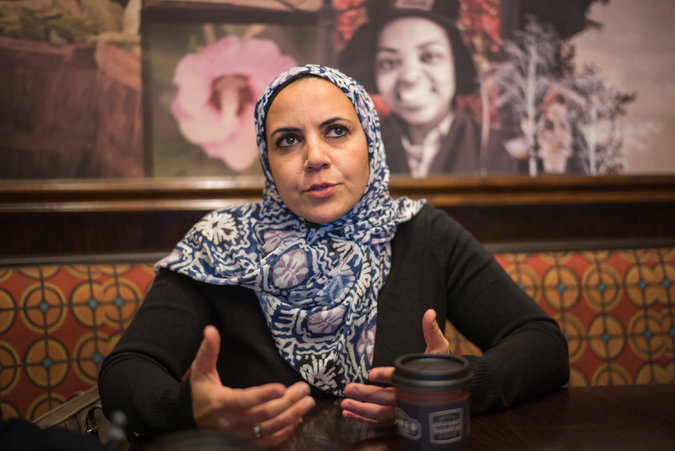
Heba Macksoud v. the Victim-Industrial Complex

I am on the verge of saying that America has a Victim-Industrial Complex. Our society teaches  how to be a victim in the same focused and careful way special teams coaches teach punters how to fall down as if they had been hit by a defensive lineman.

On January 17, 1961, President Eisenhower gave his farewell speech to the nation. The speech is famous, justly famous, I think, for his introduction of the term “military-industrial complex.” I’m going to borrow a line or so from that speech at the end. Since then, there have been as many references to an X-industrial complex as there have been to public scandals called Y-gate. [1] I am introducing “victim-industrial complex” here in an attempt to cash in on the familiarity of the phrase. I have a serious point to make, but I want this early reference to indicate just how irked I am by the whole thing.

grocery 1

Still, for as much time as I spend whining about the attractions of victimhood, it is good for me to stop and recognize someone who, in my judgment is doing it right and Ms. Heba Macksoud came to mind. I found this story in the New York Times—a Lutheran pastor provided the hyperlink in one of his blog posts. The story as writer Samuel G. Freedman tells it has a hero and a few villains. Ms. Macksoud is shopping in a Shop-Rite store, one she knows well, when this happened.

“…a couple of middle-age white men talking. One in particular caught her eye with his beer belly, tattooed forearms and large golden cross. As she neared him, she heard the word “Bible.” When she passed him, he said in a raised voice: “not like the Quran those Muslims read.” He included an obscenity to describe Ms. Macksoud and 1.6 billion coreligionists.

So there’s one of the villains—right out of Central Casting:the Bible Bigot.  BB?  And here is the obvious hero, Assistant Manager Mark Eagan, who took the trouble to find out what the issue was and to make it go away without causing any explosions.

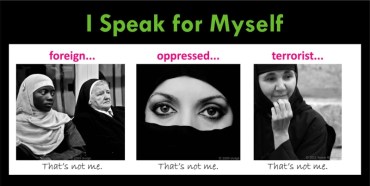
I deplore the Bible Bigot, as I should, and I admire the Assistant Manager as I should. And now that I am done with that, I’d like to spend a little time celebrating Heba Macksoud. Here’s why I think she should be celebrated, particularly by anyone who spends as much time as I do worrying about the Victim-Industrial Complex. Heba Macksoud refused to be a victim.

First, she responded directly to the Bible Bigot—you know, the one with the beer belly, the tattoo, and the golden cross [2]. She said, “You didn’t have to say that.” It cost her a lot to hear what she heard and to regrocery 2spond as she did, but I love what she said. It doesn’t attack the man. It expresses her objection to being spoken of in that way. It categorizes his remark as bad manners (which it was) instead of religious bigotry (which it also was).  It

points out that his bad manners were gratuitous. And then she walked on.

Second, when she recognized what the experience had cost her, she didn’t try to deny it: she went for help. Think, for a moment, how much easier it would have been to leave and go somewhere she could be sure she would feel safe. Then she could write a nasty letter to the store about her awful experience. She could call it a “lynching” [3] and call for a boycott. She could make defamatory anti-Christian noises at her mosque.

grocery 6She didn’t do any of that. She identified the kind of help she needed and went and got it. The help she needed was the help that would enable her to finish her job, which was shopping at her favorite Shop-Rite store. She said, as she recalls it, “I’m not done shopping, but I don’t feel safe here.” She didn’t start with being a woman or a Muslim, surely two of the easier starting places for her.   She started with being a customer. The Shop-Rite store had made an effort to attract Muslim customers and beginning by saying that she was one of those customers, she labelled herself as the kind of person the store was trying to attract. She began by presuming her value to the store. She was someone they would put themselves out for if they really had the health of their business in mind. Note that there is nothing remotely victim-like about that.

And Ms. Macksoud didn’t say that she wasn’t safe, which might or might not be true; she said she didn’t feel safe, which was unquestionably true. She reported the facts and the manager took appropriate action. She didn’t call the cops; she didn’t threaten a suit; she didn’t threaten a boycott. She asked for enough help to finish her job.

The next day, she wrote about it on Facebook. I don’t know what she wrote, but if I base my guess on the way she handled the confrontation in the store, I will guess that she didn’t present herself as a victim. She might very well have presented herself as “one of us”—an actual or an incipient group of men and women with shared interests—who had been ill-used. I hope that is what she did. By making herself an instance of a category, possibly Unfazed Muslim Women or something, she strengthens the category. She makes it clearer for others to see. She reaches out to people who know they would have treated that event differently and who admire how Ms. Macksoud handled it.  That’s going to make more Unfazed Muslim Women and that is bad news for bullies, especially Bible Bigots.

She took several steps toward creating or strengthening a category of people who will be more inclined to sense a threat that they themselves did not experience directly.  That’s a good thing if the threat is real.  Heba Macksoud experienced it. And this category of people  were not forced to react directly to the threat, but Ms. Macksoud was.  In identifying with her, they experienced the threat indirectly and they were given the opportunity to measure themselves against it and to prepare themselves to resist both the aggression and the victimhood.

She’s my hero.

But in celebrating what she did, I run the risk of paying too little attention to the Victim grocery 4Industrial Complex and I would like to do that before I put this essay to bed. By praising what Ms. Macksoud did, I risk implying that it is what other people should do. My view is that other people should do what works for them; this is what worked for Ms. Macksoud. If an man who looked Middle Eastern and who was 6’5” and a very lean 250 lbs had been target by the Bible Bigot, it might well be that the best thing for him to do would be to stroll over there and loom over him a little. Let his presence imply the risk the Bigot is running. And then just walk away. Imagine other people with other resources, each one “doing what works.”  This looks like it worked pretty well.

I would also like to say, however, that “works for me” is going to have to include attacking the Victim-Industrial Complex. I want the result of the encounter to be that fewer people will victimize others; that fewer people toward whom victimization is directed accede to being victims; that “playing the vicim” as a passive form of accusation becomes less and less common as other kinds of resistance are modeled and adopted. In saying that I want Ms. Macksoud to do what works for her, I do not want to neglect my own interest in her doing what works for me as well. I hate the Victim Industry.

“…we must not fail to comprehend its grave implications. Our toil, resources and livelihood are all involved; so is the very structure of our society.”

That was what President Eisenhower said. He said it about the Military-Industrial Complex and I agree with him, but I would like to borrow his words to tar the Victim-Industrial Complex as well. [4]

[1] Education writer Diane Ravitch has referred to an “educational-industrial complex,” for instance and the use of under-inflated footballs by the New England Patriots has been called “Inflate-gate.”
[2] He probably had mustard on his beard too. What a guy!
[3] That worked for Associate Justice Clarence Thomas. That is the way he referred to his confirmation hearing in the U. S. Senate.
[4] Ever heard ads from people who will “solve your IRS issue for you,” implying that the government’s interest in your paying the taxes you owe somehow makes you a victim? Ever heard lawyers advertise their expertise in getting people off on DUII charges as if driving while drunk somehow makes you a victim? Ever heard the plea that your wife, having decided to leave the marriage, is not entitled to the settlement the law says she is entitled to and that having to obey that law makes you a victim of some sort? Those are the people I am talking about.


Posted in Political Psychology, Society | Tagged , , , , | 1 Comment

And don’t forget to wash your hands

According to John’s account, Jesus turned water into wine, really good wine, at a wedding in Cana. I have enjoyed that story for years and now, as an old man, I am beginning to get the beginnings of an idea of what it is about.

I grew up in a culture and in a family where drinking anything alcoholic was frowned Cana 1upon, the example of Jesus to the contrary notwithstanding. That meant that Jesus’s “making” the wine and how much he seems to have made, were sources of mildly rebellious humor. A hundred and fifty gallons of wine?  Really?  That’s a lot of wine for just one wedding.  And then there is the odd interaction between Jesus and his mother. She says, “They have run out of wine. This is a disaster.” He says, “Not really. You want to see a disaster, you see what happens if I launch this ministry before the launch window is fully open.”

As I say, it’s all good fun. But none of that fun leads to the question, “What is this story about?” So the two questions for today are going to be, “Why is the significance of the story not clearer to us?” and “Well…what is it? You think you’ve got some idea of what the significance is, let’s have it.”

You would think that John would be more help than he is. He is the most reflective of the evangelists, but he doesn’t say why he is telling us this story. He does say, “This was the first of Jesus’ signs: it was in Cana in Galilee. He revealed his glory and his disciples believed in him.” [1]

That seems straightforward, but it isn’t, really. You have to know what a “sign” is. John has no interest at all in miracles; signs are important because of what they signify. [2] You also have to know that John has organized this part of Jesus’ ministry around the theme of “replacement.” Those practices of “the Jews,” as John will call them, using a fully alienated way of describing them, are not important to us (believers in Jesus) anymore, but instead, we get this!”

Cana 2As I see it, if Cana is a sign then the sign points to the replacement. [3] Let’s spend a little time with that. According to Brown’s understanding, John has no interest in miracles at all. He doesn’t deny them. He just thinks of them as elementary. It is the semiotic value—the value as a sign—that interests John. So all the attention paid to the “how did he do that?” part of the story is just wasted. This action of Jesus is a sign of something; what does it mean? [5]

If it is a sign of replacement, what is being replaced? This question is the entry to the whole maze to me. My attention has always been drawn to the wine. Wow! Look at that! There’s a lot of wine now and it’s really good wine! But when you get as far as saying that the wine replaced the water, you have to ask why there was so much water there and what it was used for.

All that water was there for washing. The washing was a part of “the tradition of the elders,” according to Mark (see below) and therefore a functioning part of the Mosaic Law.

2  And when they saw that some of his disciples were eating loaves of bread with impure, that is unwashed, hands— for the Pharisees, and all the Jews, unless they first wash their hands with the hand shaped into a fist refuse to eat, since they hold fast to the tradition of the elders; nor, when they come from the marketplace, do they eat unless they immerse; and there are many other customs which they have received to preserve, immersions of cups and of pitchers and of copper utensils and of beds— and the Pharisees and the scribes asked him, “Why don’t your disciples walk according to the tradition of the elders? —but they eat bread with impure hands. [5]

The washing symbolized, as Mark makes plain, the adherence to the Mosaic Law. Jesus makes adherence to that Law impossible for the partygoers. When you look at the wine, you think, “How wonderful! Wine for all!” When you look at the fact that there is now no water at all—no water for the ritual purifications that the Law requires, you say, “Uh oh.” This understanding calls to mind Luke’s use of sēmeion when the old man Simeon says to Mary in Luke 2: “Look, this child is marked for the fall and the rise of many in Israel, to be a [sēmeion] that will be rejected…”

Let me pause for a personal Gee Whiz moment. It never ever occurred to me to wonder Cana 4what the guests would do now that there was no water available. I knew the water was there for use in the rituals of purification. I knew the formerly water, now wine could not be used for that purpose any longer. But my mind still followed the wine and the happy partygoers. Only now—finally—does it occur to me to wonder what they are going to do without water.

You can play it for comedy and I confess that was my first reaction. The partygoers washing their hands in the wine [6] and going to the tables with sticky hands. The hands stick to everything they touch, including each other, and very likely stain whatever they touch as well. You can see the slapstick possibilities. As kids, we did the same thing with the amount. Six stone jars, we mused, with 15—25 gallons per jar, so 90—150 gallons of wine. Whoa! Now that must have been a party to remember! In addition to which, I collected these fantasies from my daughter, Dawne, yesterday. If you washed your hands in the “water,” would they be sticky? Would they leave little purple handprints on the tablecloths? And what it look like if the servants used that “water” to wash the feet of the guests?  How far up would the servants wash? Would those sandals EVER come off again? OK, that was the personal moment and I confess it was fun.

B22-623180 - © - Jean-Marc CharlesSo…what does it mean to say that this event—a sign—was “about” the lack of a continuing need for the water? It means that the Law’s demand for ritual, not for hygienic, purification had been displaced. In its place, a marvelous beverage, fitting the celebration of the coming of the Messiah. Jesus is saying to John’s hearers, “You don’t have to do that anymore.” [7]

Bearing in mind that Jesus’s enemies reviled him as “a winebibber and a glutton” (Luke 7, I am using the King James because I love the phrasing here), it may be that his generosity at this wedding followed him as a story. I picture the story featuring Jesus saying to the guests, “Well, there isn’t any more water, but I have an idea. Let’s all have a drink.”

[1] One of the most charming remarks I have read about how John manages to seem so obvious and so puzzling at the same time was offered by Dr. Merrill C. Tenney: “One of the peculiarities of the Fourth Gospel is the fact that its author chose to hang its key by the back door.”
[2] Ordinary English has let us down yet again, I’m afraid. When we started to use significant as a synonym for important, we lost the obvious question, “Significant. Really? What does it signify?”
[3] This is as good a place as any to indicate my debt to Catholic scholar Raymond E. Brown, this time to his commentary of the Gospel of John. Brown says that this is the first of many “replacements” to follow. Jesus shows up at all the major feasts, for instance, denigrating the central symbolism of the feast and replacing that symbol with himself. The meaning for the followers in the Johannine community was “You don’t have access to these feasts anymore, but if you have Jesus, you haven’t lost a thing.” Replacement.
[4] The Greek word is sēmeion, “sign,” a word from which semiotics, the study of the nature and relationships of signs in language” is derived. John uses sēmeion seventeen times in his gospel.  That’s a lot of times.
[5] The translation is by Joel Markus, in his commentary of the Gospel of Mark, part of the Anchor Yale Bible Commentary series.
[6] John never actually says it “became” wine. He says that the party manager tasted it and said it tasted like wine. That’s what we know and that’s all we know.
[7] To his followers at the party, he is saying “There is no way you could to do it anymore even if you wanted to.”

Posted in Biblical Studies | Tagged , , , , , , | 2 Comments

Wheaton College: Conduct Unbecoming an Evangelical

Wheaton College has recently disciplined a political science professor for saying something that embarrassed them. Since the handiest charge is that she has violated her doctrinal commitments, that is the charge they used, but that is not what she has done.

Here’s what the College says she has done:

“Contrary to some media reports, social media activity and subsequent public perception, Dr. Hawkins’ administrative leave resulted from theological statements that seemed inconsistent with Wheaton College’s doctrinal convictions…”

Now THAT is correct. You just have to read it carefully. This might be the place to identify myself as a Wheaton College alumnus (Class of 1959) [1] and I did learn to read carefully at Wheaton.

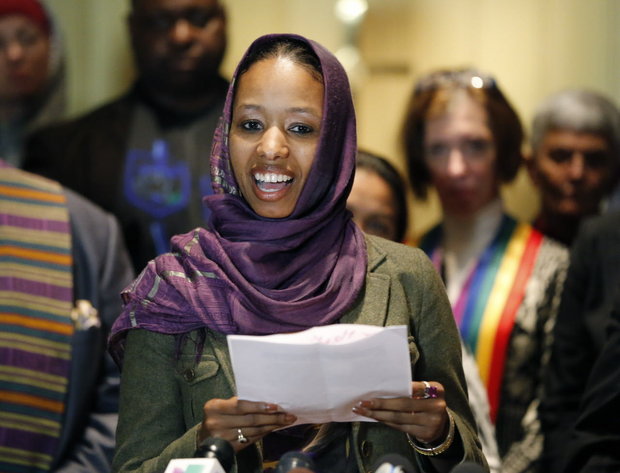
Political science professor Larycia Hawkins said she had planned to wear the hijab until hijab 6Christmas “…in solidarity with my neighbor, who is Muslim. That’s what this is about.” Professor Hawkins also said that she believes that Muslims and Christians worship the same God. That was when the College put her on administrative leave.

I’ve thought a lot about this little spot of friction at Wheaton. I have written three previous versions of this essay, all of which are on their way to electronic oblivion. But finally, I worked out what I wanted to say. Professor Hawkins is guilty of “conduct unbecoming.” [2] Professor Hawkins’ actions and her remarks lack decorum.

Let’s leave that there and start at another place. How about the National Football League? The NFL doesn’t have any doctrinal requirements at all, but they do have a sense that the players ought not to be allowed to embarrass the League. Here’s how they attend to that business.

Discipline may be imposed in any of the following circumstances: Conduct that undermines or puts at risk the integrity and reputation of the NFL, NFL clubs, or NFL players. [3]

hijab 8
This is my proposed solution for Wheaton College. Notice that in the case of the NFL, you don’t have to do anything wrong or say anything wrong. The question is whether what you did or said causes other people to think less of the organization. So let’s ask this: Did anything that Professor Hawkins said or did “undermine…the reputation…of the College?”

Yes. She did. We could ask whether this particular aspect of the College’s reputation needed to be undermined. We might supply a word more favorable to our case; we might ask whether the College really needed to be freed from the burden of some particular aspect of their reputation. We shouldn’t expect the College to look at it that way, of course.

Now if Wheaton had a “conduct unbecoming” policy, like the NFL’s, they could simply say that Professor Hawkins is guilty of “that” and fine her…oh…$50,000 and it would all be over. But Wheaton doesn’t have a policy like that. Wheaton needs to say that Larycia Hawkins is guilty of a doctrinal offense, which at Wheaton, is a contractual violation as well. The College smacked Professor Hawkins with the weapon they had available and they did not have “conduct unbecoming” available. Only heterodoxy. [4]

And it turns out not to be a good weapon. Here is Miroslav Volf, writing in the Washington Post on December 17:

Appealing in part to arguments in my book “Allah: A Christian Response,” Hawkins asserted that Muslims and Christians worship the same God. She did not insist that Christians and Muslims believe the same things about that one God. She did not state that Islam and Christianity are the same religion under a different name, or even that Islam is equally as true as Christianity. She did not deny that God was incarnate in Christ. Neither did she contest that the one God is the Holy Trinity. In fact, by having signed Wheaton’s Statement of Faith, she affirmed her belief in God as the Trinity and Jesus Christ as God and man, fundamental Christian convictions which, among other things, distinguish Christian faith from Islam.

In this paragraph, Volf, Director of the Yale Center for Faith and Culture,  takes the trouble to list a lot of positions that actually would violate Hawkins commitment to uphold Wheaton’s Statement of Faith and to note that Hawkins did not take any of those positions.

hijab 10That brings us to the dilemma Wheaton is facing. Here’s the way I see it. Professor Hawkins has committed an offense related to the image, the “brand” of the college. Serious people who love Wheaton are offended by what she did and said. These serious people have communicated their unhappiness to the President of the College, who has taken a halfway measure of some sort, hoping that will work, at least in the short run. [5] That’s the one horn of the dilemma.

The other horn is that Professor Hawkins is an attractive black women and a professor who has signed the Statement of Faith and has not violated it and is taking a stand that will be approved of by religious organizations from the middle to the left end of the spectrum and by most secular media. She simply can’t be ignored. And given the way she is handling this, I imagine that she will be a very hot commodity, sought after by religious organizations of all sorts.  Notre Dame has recently been providing a happy home for people like her, for instance.

Here’s my favorite resolution of that dilemma. I’m not making any predictions about what will actually happen. All the knowledge I have about this issue I have gained from public media and from my very old memories of having been there in a more conservative time—more conservative for me as well as for the College. But this is what I would like.

President Ryken meets with the Board and with the V. P. for Finance. [6] He apologizes to the Board and to the donors—they will hear about that through the V.P.—for allowing a situation so embarrassing to the College to occur during his presidency. But then he will take a bold step. He will say that the reason Wheaton has a Statement of Faith and the reason the College takes it so seriously is that it is what binds us all together.

“Some of us,” he would say, “are political and cultural moderates and some political and cultural conservatives.” He might even say “liberals and conservatives” just to get a chuckle. We encourage all kinds of diversity because we know it makes the College stronger—all kinds EXCEPT doctrinal diversity. We have made our Statement of Faith the touchstone of our common work together and our common community together. Now is a time for us to reaffirm our unity and—especially in this difficult matter of Professor Hawkins—to affirm our appetite for diversity as well.”

Ladies and gentlemen,” he continues, “there is nothing about our common faith  that hijab 11precludes one of our own from standing up for our neighbors who are being actively persecuted or who are under special scrutiny. Wearing a hijab as a way to dramatize that is…well…a little unusual, but the prophets we revere did unusual things too and did it for the purpose of calling attention to God’s word for their time. What Professor Hawkins did pushes the boundary of our comfort, which is fine, but it does not cross the line of her faith commitment, the same commitment we hold as our common treasure.”

“So I say it is time to ‘man up,’ [7] all of the men and women in this room, and to affirm the unity of our faith and also the flexibility we grant to our faculty in expressing it. If that doesn’t sound good to you, see me afterwards. We are adjourned.”

That’s my fantasy. I’m not a fan of Wheaton’s Statement of Faith, but I still have some affection for the school: it was a very good school for me when I was there. And I still wish her well and I will express that wish with these words from the Alma Mater.

We’ll keep they old traditions, pledge love and honor too,
For Wheaton and her colors The Orange and the Blue

[1] Fifty-nine…”in all things we really shine” in the words of the class song. I am not supposing anyone would doubt my being a part of that class at Wheaton, but if anyone did, my knowing the second line of the class song should put all fears to rest.
[2] We all know uses of becoming that are temporal. It is nearly dawn and the sky is becoming lighter. We have been meeting only in class but now we are becoming friends. This isn’t that. In this use, becoming is just a synonym for “that which is befitting and proper; decorum.” So says the Oxford English Dictionary, giving this as an example: 1598   Shakespeare Love’s Labour’s Lost ii. i. 67   Within the limit of becomming mirth.
3] This is only one of six bulleted items, but it is the one I need for this piece.
[4] Everyone knows orthodoxy. This is what a position is if it is not orthdox.
[5] Not to cast any unnecessary aspersions on President Ryken, but I am currently studying the narrative of Jesus’s trial and sentence and because of that I am reminded that in John’s account, Jesus was publically flogged as Pilate’s way to find a “halfway measure of some sort…that would work in the short run.” He was, in John’s account, trying to find a way to get Jesus off. But, of course, Pilate had Trustees, too, and you need to know what they want.
[6] I am assuming here that the major donors to the College and the members of the Board are angry for the same reasons and that they differ mostly in the tools they have available to express their displeasure. So I won’t speculate about which group might be angry about which part of the charge.
[7] I don’t know the President’s academic background, but if in includes classics, he might slip in a reference to all the “virtue” words in English derive from vir-, the Latin root meaning “man.”

Posted in Advent, Education, Political Psychology, Theology | Tagged , , , , , | Leave a comment

Unitasking. Really.

Studies of efficiency by multitaskers have been nearly unanimous and almost entirely dismal. The more tasks being attempted at once, the lower the efficiency of each task performance. But what if we did it the other way around?

unitask 6Work is organized—predominantly, not entirely—around the idea that productivity is a good thing and, to a lesser extent, that efficiency is good as well. Given that, it is easy to say that whatever impedes those values is a bad thing and, as a rule, we give bad names to bad things. We call the depth of attention of a multitasker, “shallow” and complain that span of attention is choppy. Each episode of attention is “short.” [1]

In a conversation one morning this week—Starbucks, where else?—we were talking about the proportion of people whose ability to attend and to relate to persons who are physically there and to feel empathy for them are all eroding as online time increases. We imagined, in the conversation, that 30% of the workforce [2] was suffering this deficit. Then we speculated about what would happen when that 30% became 80%.

Where to take this Starbucks Caucus-inspired reflection? I’d like to try to look at it in two ways in this essay. The first is the standard succession of cultures based on generations. Every generation deplores the shortcomings of the next generation, etc. The second is a little harder. It asks us to speculate about whether a given cultures really works for its members. What if living life in a certain way is just bad for people? Will they notice the bad effects and go back to what worked?

OK. Let’s see how this goes.

If four out of every five workers has this “condition,” then it is, by definition, “normal” and is therefore not a “condition” as we normally use that word. It is just how people are. How are people? Well, they maintain task focus for…oh…ten minutes at a time. They have many more contacts than people used to have and are, in that sense, more “social.” They can handle somewhere between four and six tasks simultaneously, without any unacceptable loss of efficiency. That’s what people are like in the new normal.

I assure you that a paragraph like that one would not be written by anyone of myunitask 2 generation, and, although I did write it, I found it difficult and I had to go back and scrub out all the “naturally occurring” pejorative words. What a person of my generation would have said would have sounded like a lament. “Kids today!” we would have said. “They don’t have real relationships because they don’t know how. They have markedly reduced levels of empathy. They have virtually no attention span at all. They persist in doing “too many” things at once, thereby depriving themselves of any really clear experience and insuring that their task performance will be poor.”

This is the classic dilemma: we said/they said. The statistically normal traits become the values—the norms—of every generation. We value these things; they value those things. We are statistically normal—we are the norm, in both senses of the word—and they are “deviant,” in the very limited sense that they deviate from the norm. When the generational change occurs, they will be statistically normal and we will be “deviant”—which is not so bad, really, because we will also be old—and they will come up with pejorative names for the traits we valued. For example, I might say that you, the Millennial [3] I am talking to, “can’t keep your attention on the subject at hand.” You might prize your ability to move smoothly and efficiently among the many tasks you are simultaneously tracking.

This is a pretty familiar argument so far. It is exacerbated in our time because the pace of change is so fast and the power of peers is so much stronger than the power of parents. The result is that one generation is more different from the preceding generation than was once the case. But there is another argument embedded in this one and to get at that second argument, we are going to have to take a short hike and start at another conceptual trailhead.

What if it doesn’t work? Then what?

unitask 3What if the society has adopted patterns of behavior that insure that nearly everyone will acquire a disease that, to an outsider, could be easily prevented. [5] Doing things “the way we do them here,” a rough and ready definition of culture, will get you all the deficiencies and all the diseases that those decisions lead to. If beri beri is one of the natural consequences and you are an observant member of the culture, you will get beri beri.

Members of the group who do not have beri beri comprise the datum to be explained. Why don’t they have beri beri? No one asks, in this society, why everyone else does have it. Here, at last, we move away from the conflict of generations, by which Generation A accuses Generation B of failing to meet “the standards,” by which they mean Generation A’s standards. In time, Generation B says the same thing to Generation C, and so on.

If the shallow distracted mode of “attending,” it is almost a courtesy to call it attending at all, is like the beri beri in the example above, then it is the natural result of “how we do things around here.” It is, simply, “culture.”

unitask 4Some of us, I’m guessing it will be mostly older people, are “unculturated.” [6] We tend to severely limit our attention, imagining that paying full attention to the one person you are listening to is somehow a good thing. Naturally, this comes with the loss of the other five things a “normal person” would have been—and really should have been—attending to at the same time. It’s sad, really, but it is how they are.

And we perseverate. Not only do we limit ourselves to one interaction at a time, but we extend this interaction over many minutes. A Millennial might say of his parents, “I have seen them engage in this focused “one to one” thing for as much as an hour, completely oblivious of all the other things that are going on, on Facebook for instance, during that time.”

I’m finished with the snide language now. I allowed myself a few paragraphs of it to try to represent the wonderment, the utter incomprehension, of members of the dominant culture in this future time. These are the people, remember, who, back in our day—back in the time when our cultural assumptions were dominant and the Millennials were deviant—needed help because them had shallow relationships and scattered attention and no inner resources at all. Now I am trying to represent their sense of who we are, under the cultural assumptions that they represent and which are now the dominant assumptions, i.e. the assumptions that undergird “how we do things around here.”

unitask 5The question I was asking—the beri beri question from Putney and Putney—was this: “What will they do when they discover that the new cultural practices don’t work?” Following out the Millennial prescription would, in this view, produce people who are damaged. They have no stable selfhood because they don’t take the time it requires. They have no intimate relationships because they don’t take the time such relationships require. They don’t take the time because more than 27 seconds off-line feels like a month in solitary confinement and whatever you have to do to prevent that dreadful feeling…well, that’s what you ought to do.

What will they do, upon discovering all these serious deficits? They will redefine “personhood” and “relationship” and “alone time” so that these notions fit with the cultural assumptions they have made and which they prefer.  These preferences will become so strong that not following them will look like “deviance” and, of course, they will be deviant by that time. They will be a certain specifiable distance from the new norm.

My guess is that that’s where we are going. The alternative scenario is that people will notice how inadequate the new culture is and there will be a successful backlash against it. Millennials, or, more likely, their children, will reject the norms of their parents and will yearn for an older and a more satisfying time. They will want to talk to people like us who remember things like “conversation,” people who know how to “unitask.”

I say that is possible. I don’t think it is the most likely scenario. The most likely scenario is much darker than that.

[1] Ordinarily, we remember not to say that it is “too short,” because if we said that, we would have to say “too short for what?” and that leads us down a path we are not prepared to travel.
[2] There isn’t a playforce, is there?
[3] “The millennial generation” is used casually as if everyone knew what everyone else meant. Even researchers use a very broad band of birth years to identify this group; birth years from 1980 to 2000. I think it is partly chronological and partly stylistic.
[4] I’m going back to Snell and Gail Putney’s The Adjusted American: Normal Neuroses in the Individual and Society. Many books postulating the notion of a “sick society” were written during this era, but this is one of the easiest to approach.
[5] Notice how important the process is in this word. We would not be called “uncultured,” a state of not being in harmony with the culture. We would be called “unculturated,” meaning that we have not gone through the process of being brought into alignment with the culture. That is what the -ate part of “unculturated” does. It means that we are not hopeless, but we may need…oh…incentives or perhaps just extra time.


Posted in Living My Life, Paying Attention, Society | Tagged , , , , , | Leave a comment

The Matthew Tree

At our house, we are really serious about telling Matthew’s story one year and Luke’s the other year. This year, it is Matthew so we are decorating the tree the way Matthew would have wanted it.

Every now and then, I imagine that I will try to palm off all this playing with the tree as a way to engage my kids in Advent/Christmas, but my kids are all in their 50s. I have some grandchildren in town who are young enough to enjoy this kind of playing around and their parents are amazingly tolerant. But the truth is that I decorate the tree this way because I like it.

Every year something new gets added. This year it is the star. This came to me about a month ago in the middle of what I recall as a sound sleep. I remember liking the idea right away, but very shortly after IMG_0572that I remember thinking that if it doesn’t work, I can say that an angel revealed it to me in a dream. [1]

Everyone knows that the Wise Men—we would call them astrologers today—saw “a star at its rising.” Just by looking
at it, they could tell that it foretold a new king of the Jews. “So,” I said to myself in my sleep-befuddled state, “Just what kind of star would give them that idea?” [2]

Because it is a Matthew year, we celebrate Matthew’s interest in the genealogy of Jesus. Matthew’s genealogy is much better known than the one Luke provides and we celebrate that by featuring the forebears of Jesus on the tree. It took some doing to get four that are exactly alike, but I managed. I have written recently about the amazing women who help to drive Matthew’s genealogy forward. Here, I celebrate all of them at once, including both Jacobs and their sons, both Josephs. It all fits together, as you see. One of the requirements of the tree we choose is that it will have a place for the bears.

As you would imagine, we have different ornaments for the different years—not all the ornaments are different, just enough to establish which year it is. The fact that the Wise Men knew what the star “meant” establishes that they were astrologers, wIMG_0576hich we represent with the signs of the zodiac, four of them in this picture.  The fact that they headed off for Jerusalem, the capital of Judah, establishes that they were political geographers. The fact that they followed the star all the way from Jerusalem to Bethlehem and then didn’t tell Herod what they had found means that they were faithful to their calling.


And, finally, there is the question of where the Wise Men went in Bethlehem. They went to
the house over which the star stopped; the house of Joseph and Mary and their little boy, probably about two years old at the time, Jesus. [3] I mentioned that part of this whole charade was to establish in the minds of the grandchildren (and their parents) that by Matthew’s account, Joseph and Mary lived in Bethlehem. They never got as far north as Nazareth, way up in the Galilee district, until the end of the story Matthew tells.

So for a dwelling, we wanted something that looked as little like a stable as possible. Fisher-Price accommodated us by producing this monstrosity. It has little household “appliances” inside—a computer, a microwave, a toilet, and a phone, all of which make approximations of the appropriate sounds. If you wanted to say that by Matthew’s account, JESUS LIVED IN A HOUSE, you could hardly find anything better adapted to the purpose. [4]

IMG_0580There is a front door that is big enough for the Wise Men, imagining that they parked their camels in the yard. [5] The colors stand out, possibly to make the house easier to find. At a certain point in the process, I back carefully away from exegesis, keeping both hands in plain sight, and let my whimsy take over.

This all works, by the way. The grandchildren know that the story Matthew tells is different from the story Luke tells. Their parents know as well. They know that Grammy and “Dale”—there really isn’t a good title for stepfathers, a plight, but one I share with Joseph—are very picky about how they decorate the tree.[6]

So it’s all good. It gives a theme to each Advent season. I am checking with El Al to see if we can, in two more years, represent the Flight to Egypt is some engaging way.

[1] Among the good reasons not to try this is that it doesn’t fit Matthew’s story. There are lots of dreams in Matthew’s account, but angels don’t give messages to gentiles in dreams. The Wise Men, for instance, were “warned in a dream;” no angel. I am unquestionably a gentile, so I would need to skip any reference to an angel in his year.
[2] The same kind that Balaam saw (Numbers 24:) I imagine. I think Matthew was counting on his story recalling the old familiar story.
[3] That’s the way Herod calculated it, in any case. Presuming that Jesus was born when the star appeared, two years elapsed between the time they first saw the star and the time they conferred with Herod.
[4] The plan, of course, was not to use this monstrosity in the Luke year, when we needed a stable with a feed trough and some animals and some shepherds. The kids really liked the HOUSE, however, so in the Luke year, we brought it back as the INN that unaccountably could not find room for the Holy Family.
[5] This imagines that there were three Wise Men, when in fact no one has any idea how many were in the party. We know that there were three gifts, but that is the only number we have to work with. Since they were academics, it is possible that they had to share the cost of such spendy gifts.
[6] There are lots of non-picky ornaments on the tree as well, including a lot of the most popular secular ones and in Luke’s year Santa’s reindeer need to be kept from fraternizing with the oxen and the asses.

Posted in Advent, Living My Life | Tagged , , , , | Leave a comment

Being “happy”

What do people mean when they say they are happy? Is it a state? A direction? A blissful moment? You are the one who most needs to know.

I finished sending out our Christmas letters before my birthday (today) this year. My practice is to write an email to my friends and family and attach an account of the year with some reference to which Advent season it is this year. [1] Somewhere in the note I give a one-line characterization of the year Bette and I have had. This year, that characterization often included the phrase “healthy and happy.” The reason I put the quotes on “happy” and the reason I am writing this essay are pretty much the same thing.

Every time I wrote it, I experienced a little twinge happy 2because I know a great deal about happiness. I may or may not know that much about being happy myself—that’s really what this essay is about—but I know a lot about “happiness.” I know how it is most often defined by scholars with different research interests. I know that it is thought to be inherited to a considerable degree and otherwise to be achieved. During the last ten or so years that I taught a course in political psychology at Portland State, I used a book by Robert Lane called The Decline in Happiness in Market Democracies. By the time I finished, I had not only read the text of the book many times, but had followed out most of the footnote citations as well. That’s why I know so much about happiness.

Also, I’m a pretty happy guy. To me, saying that doesn’t mean that I’m happy all the time. I categorically reject the notion that happiness is a “state” like, say, marriage, where it would be reasonable to say that either you are or you aren’t. [2]

So, if it isn’t a state, what is a good way to characterize it? I don’t think there is any way to say that “a happy person” doesn’t have moments when he is happy and knows he is happy. You could define it that way without doing a lot of damage: a happy person is a person who has a lot of happy moments. [3]

I would say about myself that I have a lot of happy moments. It is true that I lead a privileged life, but I think my happiness has more to do with being open to appreciation. You can walk out of the house and confront a heartbreakingly blue sky. Or a subtly blue sky. Or a tiny blue patch surrounded by cumulus clouds. You don’t have to be privileged to enjoy that; you just have to be willing.

happy 4I have a lot of happy moments with Bette. I take real pleasure in the jokes that are consummated with a meeting of eyes across the room or the things I count on her to see in a movie that she knows I am going to miss. You can’t manufacture good moments, even in a really good marriage, but you can purposefully arrange situations where good moments just might happen and then you can purposefully celebrate them when they do.

So I like “moments” as a way of looking at “being happy.”

I also like an orientation to happiness as a way of “being happy.” Most of what I mean by the expression “orientation to happiness” is covered by words like resilience or buoyancy [4] but I also want a notion that is broader than that and that has a positive component.

happy 8If that is what you are like—and there are lots of studies of people who have had really awful things happen to them and who, afterward, feel pretty much as satisfied with their lives as they were before—then you feel a lift toward happiness whenever it is not being prevented. There are events that tie a couple of concrete blocks around your ankles and you discover that under the circumstances, you are no longer buoyant. But there are people who are no more buoyant when the concrete blocks are removed than they were before. They are not buoyant. They have learned how to be submerged permanently. Other people start moving toward the surface as soon as the blocks are removed. I am one of those.  Being a Duck (U of O) myself–I am the one at the far left, just swimming out of the picture–I prize buoyancy more than some others.

If there is not something wrong with me I am up around the surface somewhere. And when something was wrong with me and it isn’t there any more—or isn’t wrong any more—I start moving up. It isn’t a decision I make any more than a ship made out of iron and air “decides” to float. And if I am up around the surface, I am inclined to notice the events that make me momentarily happy.

That doesn’t always happen. I had an episode of depression in 2006—still unexplained—where it didn’t happen. For reasons I still don’t understand [5]

happy 7I went into some kind of a sinkhole. I had no energy. I was not interested in anything. I couldn’t sleep at night and couldn’t stay awake in the daytime. It was so unlike the person I had always been, that when I got over it, three or six months down the road (depending on who is counting), I really noticed for the first time “what I am normally like.” Having been so very unlike that while I was depressed turned my normal taken for granted buoyancy into an actual datum. “Oh,” I said, “Look at that! Hm.”

I’ve done three things so far. I have discarded the idea that happiness is meaningfully described as a state, even though I used the word that way in my Christmas letters. I have explored two other kinds of meanings. The first is the “moments of happiness” notion. You are happy, according to this notion, if you have moments of happiness and take the time to notice and appreciate them. The second is the “orientation to happiness” (broader than simply buoyancy) by which standard you move toward happiness whenever there is no reason why you should not. I like both of those.

happy 6There is one further idea I would like to add before the special license I granted to myself for my birthday expires. That is that when I do the work of creating and sustaining the situations in which happiness just might discover me, I am proud of myself. I am more likely to be happy when I approve of what I am doing and how I am living. It isn’t that I feel that I have, in some way, “earned” happiness. It is only that I know I have done the work that has, in the past, established the conditions for my most prized moments of happiness. Doing the work puts me in a mind to receive all the happiness that is available to me on that occasion. [6]

And for me, it’s just a good way to live.

[1] We celebrate Advent using Matthew’s account in odd-numbered years and Luke’s account in even numbered ones.
[2] Or, one I like to use for women, “parity.” Parity is the noun form of an adjective, “parous,” which means “having had children.” Women who have not had children are “nulliparous.”
[3] Unfortunately, that activates the urge to specify just how many happy moments meet the criterion for the state called happiness.
4] That’s really just a choice of metaphors. Do you “bounce back” or do you “float up to the surface?”
[5] My friends will understand how really hard it is for me to have no idea what is going on.
[6] If the adjective “occasional” had not already been kidnapped and made to mean “rare,” I would be able to characterize the happiness I feel on these occasions as “occasional happiness.” I know that doesn’t work any more.

Posted in Living My Life | Tagged , , , , , | 1 Comment

God’s DNA

We’re going to have to talk just a little about the Virgin Mary today. My strategy in entering this field is to begin on the outrageous end of the row and pick my way back to where I parked the car. I thought “God’s DNA” was outrageous enough to do that.

On the other hand, this is a serious-minded essay. I know all the Virgin Mary jokes—have told half of them myself. This essay isn’t about that. It is about changing the metaphor entirely. I will want to work my way around to the proposition that Jesus was not begotten in a reproductive act of any sort, but in a creative act of God.

Where to start? Let’s start with John 3, where the Johannine Jesus, so dramatically different from the Synoptic Jesus, attacks the proposition that “Jewishnss” is a high priority matter. [1]

Virgin 1Jesus’s answer to Nicodemus, so familiar that it is hard to hear at all, goes like this. “In all truth, I tell you, no one can see the kingdom of God without being begotten from above.” [2] So it is the begetting—God’s work—that matters, not the physical birth—the work of humans. That’s all in John 3:3.

Down in John 3:5, Jesus concluded that being “begotten/born” through water and the Spirit is crucially important. Having a Jewish mother, not so much. There is more that really needs to be said about that, but let’s pop back to the Virgin Mary just for a moment. The question we are asking about the Immaculate [3] Conception of Jesus is a Nicodemus-style question, not a Jesus-style question. That alone ought to make us stop and think about what question to ask.

In the Prologue of the Gospel of John, we find that God gave to those who believed in the divine Word—later in the chapter, the divine Word is identified with Jesus— the power to become children of God. These children of God were begotten/born “not from human stock or human desire or human will, but from God himself.” Here is an excerpt: these children of God were not born…from human stock.”

What does that mean?  It does mean something.  It does not deserve to be thrown out or paved over by years of casual attention.  But what does it mean here?

I think it depends radically on the context of the question. In these passages from John, the question is, “Is it enough to have a Jewish mother? Does that establish you as one of God’s people?” To this question, the answer John gives is, “No. That is not enough. No considerations of human parentage will establish that you have been born “from God” (John 1:13)” by water and the spirit” (John 3:5).” So that’s what it means in that context.

What does it mean in the context of the Virgin Birth? There, I think we have to follow an entirely new path.  There, I think “born of the Spirit” requires us to find a way to think of the birth of Jesus in either the conception and birth metaphor or the “new creation” metaphor.

To approach the “new creation” metaphor, I propose that we look at the old creation virgin 2metaphor. [3] Here is Genesis 1: “In the beginning God created heaven and earth “When God began creating heaven and earth, the earth being then a formless void with darkness over the deep and a divine wind sweeping over the waters, God said, “Let there be light.” [4] We see here that the wind (spirit, breath) of God is sweeping over the waters.

The situation here is evil and chaotic. Professor Rendsburg, in making this judgment, points out that every word, with the exception of “wind” is “symbolic of chaos and evil: unformed, void, darkness, deep. God’s role, he says, is “to bring order and goodness into this chaotic and evil world.

We are working with the “creation” metaphor. That was Genesis. Here is Matthew. The angel says to Joseph, who is right on the edge of calling everything off between himself and Mary, “…do not be afraid to take Mary home as your wife because she has conceived what is in her by the Holy Spirit.” Luke says the same thing, although the angel is talking to Mary this time, “The Holy Spirit will come upon you, and the power of the Most High will cover you with its shadow. And so your child will be holy and will be called Son of God.”

According the Raymond E. Brown (The Birth of the Messiah), both Matthew and Luke, by virgin 3referring to “by the Holy Spirit” (Matthew) or “the Holy Spirit will come upon you” (Luke) mean to point the minds of the first hearers back to the first creation. The “creation of Jesus” through the power of the Holy Spirit is analogous to the “creation of the world” through the power of the Holy Spirit. So when I speak of the “creation metaphor,” that’s what I’m talking about.

So these two gospel writers ask us to use a metaphor that is at home with “creation” rather than reproduction. And you will recall that that is what John asked of his hearers as well: “not by the will of the flesh, but by the will of God.” That means that there is nothing more sexual about the creation of Jesus that there was about the creation of the seas and the dry land. And if you want to extend the metaphor off into the area of deep scandal, you would have to ask whether the zebra (or some zebra-like progenitor) also carries God’s DNA.

virgin 5The zebra picture was supposed to be silly; that’s probably why zebra was the animal that came into my mind. If God does not share His DNA with his first creation, then why would we think it appropriate that he shared His DNA with his “second creation?” DNA is not a relevant notion either for the “divine wind sweeping over the waters” or for “the shadow of the power of the Most High.” It’s not a hard question. It’s just a bad question. We should ask DNA questions about situations where DNA is relevant.

But the church was born in contention. Accusations were made; defenses were constructed. “This guy you call the Messiah is actually a bastard from the hills of Nazareth.” [5] And the church says, “He is not a bastard. Joseph and Mary didn’t have sex until after the first child was born.” You see how weak that is as a rebuttal. You have to get some distance away from a situation everyone is going to define as essentially sexual in order to make the distinction I am making today, which is that the gospel accounts emphasize “creation” and not “reproduction.” That distinction is just not going to hold up under controversy.

But, as I said, it seems a lot to ask of people in the middle of a controversy in which sexual charges are being made, to say that such charges are entirely irrelevant. So the church invented a “reproductive process” in which Mary participated but no other human did. Therefore, presumably, Mary’s DNA is a part of Jesus’s genetic makeup. And the other half of Jesus’s DNA is…the Holy Spirit’s? God’s? Joseph’s? Some itinerant Roman soldier’s?

Once you start down the DNA route, which is where the sexual reproduction metaphor takes you, it takes you right to this corner and you have to invent more and more outlandish explanations. It’s a paradox. It’s a mystery. God’s ways are not our ways.

That’s not a good route to take.

I propose, instead, that we go back to the biblical account and say that in the beginning, God’s creative spirit brought good and order out of darkness and chaos and “in the fulness of time” God’s creative spirit came over Mary and produced a son, who was the light of the world. [6] Theologically, we can say that the first act was “creative” and the second “redemptive,” but in the gospels, it is unquestionably a new creation, comparable in scale only to the first creation.

So I conclude that the question of “God’s DNA” is a silly question, as I said at the beginning. But by now, I have said why I think it is silly.

[1] The ironies this argument provides are so thick and overlapping that it is hard to leave them alone. Jesus, the Jew, is arguing with “the Jews” that “being Jewish” is a very low priority matter compared to being “begotten by God.” You are a Jew if you are born of a Jewish mother. You are a part of God’s family if you have been “begotten” by God. So “begotten” is used by one side of the argument and “born” by the other side and in the Greek of John’s time, the word for born and for begotten was the same word. As I say, ironies abound.
[2] There are lots of good reasons for the variability of translations here. I am pushing all the “begetting” (the male part of the process) onto one side and the “bearing” (the female part of the process) onto the other side. So in this passage, Jesus says “begotten from above” and Nicodemus says, “What” Born again? Surely not.”
[3] I want to pause here to acknowledge the work of Gary Rendsburg of Rutgers University. He offers a really good set of lectures, part of the Great Courses series, on “the Book of Genesis.” Lectures 2 and 3 are on the first creation story and the second creation story respectively. It is from his lecture that I learned that “creation ex nihilo” is no part of Genesis 1.
[4] That’s the way Rendsburg translates it. It is given in the New Jerusalem Bible as a “grammatically possible translation” but not the one they chose. I am not competent to choose between them, but Rendsburg’s translation highlights what I want to highlight, so I am going with him this time.  The cartoon I chose to illustrate this moment has, oddly enough, that same translation.
[5] For some years now, I have taken quiet delight in the fact that the English word bastard comes with an etymology that means “born in a barn.” So using this terms fits beautifully with Luke’s account and not at all with Matthew’s.
[6] All the powerful light and darkness poetry of John helps to carry the Genesis account of creation into the New Testament.

Posted in Biblical Studies, Theology | Tagged , , , , , | Leave a comment