A Bad Moment at a Good Party

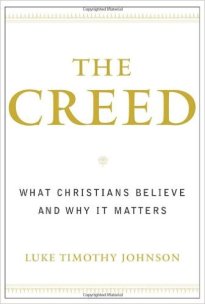
Luke Timothy Johnson has recently written a book about the Apostles Creed.[1] The first job of any writer is to give potential readers a reason to read the book. I think Johnson does a terrific job of that. Here is (most of) the first paragraph of the first chapter. Take a look.

Many Christians know that deadly moment at a party when their friends realize they actually believe something everyone has merrily been belittling. They recall their stammered reassurances, their tortured reinterpretations, their relief when the conversation moves on, their self-contempt…But their embarrassment at being seen as believers reveals them to be Christians whose view of the world has been shaped less by the Christian creed than by its cultured despisers. [2]

creed 3.pngThere are two things worth noting here. The first is the way Johnson sets the hook in the reader. “Did you ever have an experience like this?” he says. Nearly every Christian I know has had experiences like that. If you mix with the general public, it is pretty likely that you are going to be in a conversation where the idiocy, the arrogance, and the utter hypocrisy of religious belief are going to be taken for granted. Your own consequent idiocy, arrogance and hypocrisy are obvious applications of this view. That isn’t fun at all.

The second point is that Johnson has “what the proper response of a Christian should be” in mind. I am not sure he does and I am quite sure that I do not. To me, the question of just what Christian we are talking about is crucially important. The response the Christian makes in the scene Johnson paints is gruesome, I agree. Let’s see if we can get a closer look at what the believers do in this scene. It will help us when we try to imagine what else they might have done.

  • they recall their stammered reassurances
  • they recall their tortured reinterpretations [3]
  • they experience relief when the conversation moves on?
    they experience self-contempt
  • they are embarrassed to have been seen as believers

The first two are normal social frictions with the descriptive language amped up. Reassuring your friends and reinterpreting their meaning are pretty common elements of social interaction. The last two are brutal. “Self-contempt” seems like a lot to feel as a result of a social confusion. “Embarrassed to be seen as believers” is even worse, but if these were really friends, why didn’t they know you were believers.
So…what should the believers have done?

I’m going to try to get around on the other side of this issue so that a) the “belief system” creed 2has nothing to do with religion and b) I am part of the group of friends.

Let’s say that one day I read an article that tells me that a CEO of some local company has a staff astrologer to tell him when to invest. I remark, looking for a laugh, that I want to check with my financial guy to be sure none of my money is invested in that company. One member of the group relies very strongly on astrology—who knew?— and she takes offense. Is that a good thing for her to do? The topic is not astrology. It is the CEO. But it does presuppose that astrology is ridiculous.

Let’s look at a more political one. I say that I have read that some progressive changes are being made in national government and I applaud them. But one of my friends has been reading Marx and Lenin and has just come to the realization that it is liberals (like me) who are postponing the revolution. The “laws of history,” which Marx discovered, still hold, of course, but what Marx called “the immiseration of the proletariat” is being put off and so the revolution which all that misery will fuel is being put off. He objects to my ignorant and casual approval of progressive causes. He is angry and will not be mollified. Again, the topic is not Marxism. It is liberal reforms. But it does presuppose that liberal reforms a.k.a. “bourgeois democracy” are pernicious.

But, just as in Johnson’s scenario, this silent concurrence about assumptions we all share runs afoul of one of the participants. This participant actively objects to that assumption. He would take it out of the silent, “taken for granted” shadows and make it the focus of our discussion. The result of his action is that the discussion that I thought was going to be about sound financial practices is now about the merits of astrological wisdom; the discussion I thought was going to be about progressive reforms is now about Marxist theory.

How do I feel about this guy? I wish he would have let us have our conversation in peace. It’s a very ordinary conversation. We are “merrily belittling” a group or an approach to an issue, but we’re not taking it seriously. We are just exploiting the humor implicit in a view we all take for granted.

Who Am I?

Of course, Luke Timothy Johnson, in his introduction, was not concerned about things like astrology or Marxism. He was concerned about the Christian faith and particularly concerned about the inability of Christians to be “who they are” in a secular setting that presumes religious faith is somehow ridiculous.

But Johnson has a particular notion of “being who you are” in mind. I am who he thinks I am, but I am also some other things he is not considering. This identification of yourself as a Christian apparently requires that you raise the question of your friends assumed world whenever the assumptions contradict or demean or ridicule your own. That sounds touchy to me.

So I answer the question, “Who am I?” in part by noting that I am one of a group of friends. I consent to the topics we discuss and to the presuppositions that make those discussions possible. When I dissent from the topic, I say so. We are friends, not clones. When I dissent from the presuppositions, I might just be quiet and listen. What the hell is going on here? That seems like a reasonable question.

creed 5So the lesson embedded in this setting of the story is: Let it pass and see what happens.

A second response to “who I am” is that I am a friend to each other member of the group. It may well be that “letting it go” is the best thing to do at the time, but it may also be the best thing to follow up with one or more members of the group when time allows.
One member, let’s say, is a person who might have noticed the group’s assumption and been bothered by it. So you sit down with him and say something like, “Did you notice that for a little while, in our discussion last weekend, we seemed to be relying on the notion that astrology [Marxism, capitalism, Christianity] is crazy and so it anyone who relies on it?” If he feels the way you thought he might, you can have a conversation like, “Where did that come from? I was as surprised as you were.” If he doesn’t, the conversation could go another direction and still be useful for you both.

The lesson embedded in this setting (after the discussion) is: Check it out with some friends who were there and see what they thought.

But now, at last, we get to the heart of the “Who am I?” question. I offer three samples below, of which I really like two of them.

Person A: Having proposed the topic, we need to know what you have to bring to the table. If we don’t know that, we don’t know if placing this on the agenda is a good thing for you. If you have something to say, this strategy might be a really good one. Your friends might learn something about you. You might learn something about yourself. If you ever knew anything about Christian apologetics, this would be the time to knock the rust off of what you know and put it into play. And if you are someone who can do that, you probably should. It would be a gift to the group.

A lot of good things are said, in books on “Christian witness,” about the person who can do that. When Johnson raised the question of being “true to who you are,” I think this is the guy he had in mind. And since there seems to be such agreement that this guy is a hero—or, if things turn out badly, a martyr—I’m just going to leave him to his work. He does need to continue to be a friend to the others, but in doing that, he does not need to echo their assumptions.

Person B: But what if you are not a person like that? Disciplined logical arguments are really not your thing. That might mean that moving this topic from the background to the foreground is not a good thing for you to do. Or it might mean that you want to address it not as a topic for discussion, but as an arena where people are invited to share their own feelings and experiences. This person would not say, “Here is how I would defend my Christian beliefs,” but rather:

“Let me tell you about some experiences I have had. According to the assumptions we have been using, these experiences ought to seem ridiculous, but they don’t seem ridiculous to me. Have any of you had experiences, as I have, that seem to point in another direction?”

The lesson embedded in this version of the story, oddly, is exactly like the one in the previous story, but the strengths of the person are different. The person who thinks in terms of doctrines and arguments and logical implications should feel free to propose such a discussion. The person whose strength is in the immediacy of feelings and in the clarity of experiences should feel free to propose a discussion that relies on experiences.

Person C: I think of both of those as authentic and positive contributions to the life of thecreed 1 group. But a person who feels unable to do either of those might still feel that something should be done and that person might think of saying, “Remember when you were talking and laughing about how stupid religious people are? That really hurt my feelings and I wish you would be more careful and not do that any more.”
I really don’t think that is worth doing. It isn’t being a good member of the group at the time of the discussion. If you pursue it with several members of the group afterward, it will look like you are trying to get people to feel bad about something they actually did not feel bad about at the time. That’s not good either. Maybe it would be better to find some more congenial friends?

[1] Johnson’s book is The Creed: What Christians Believe and Why it Matters.

[2] “Cultured despisers” might seem a little heavy handed, but it’s really just clumsy. He is intending to refer to the title of Frederick Schleiermacher’s well-known book, On Religion: Speeches to Its Cultured Despisers. If you are familiar with Schleiermacher and the context in which he wrote, you might smile quietly to yourself when you see Johnson’s use of the term. If you are not, it might well seem like an unnecessarily nasty attack.
[3] “Tortured,” by the way, means only “characterized by twisting” in this usage. You could say that you “torture” ivy into the shape of a wreath.

[4] A dear friend of mine said recently that he knows this kind of conversation very well. To a question like, “You don’t believe THAT surely?” he says, “Yes. I do. Has anyone seen a good movie lately.” I like that. I see the first statement as an act of loyalty to his faith community and the second as an act of generosity toward the friends.

Posted in Communication, sociability, Theology | Tagged , , , | Leave a comment

Do you want a party or a nominee? Choose.

On May 3, the New York Times editorial board published a piece with the title, “It’s Donald Trump’s Party Now.” They were referring to Trump’s convincing and unexpected win in the Indiana primary, so I know what they had in mind. But I think they went too far. What if the Republicans refuse to accept Trump as their candidate? What if Trump refused to accept “Republicanism” as his own platform?

It looks to me as if we are there; or nearly there.

Paul Ryan, who, as everyone knows, is Speaker of the House, is also chairman of the Republican convention. The conventimanning 1on that is going to choose Donald Trump as the nominee of “the Republican party.” Notice the quotation marks. Ryan is the highest ranking Republican. He is behind only Joe Biden as “our next President.” [1] He is as close to Mr. Republican as anyone can be.  He looks pensive, don’t you think?

I put “the Republican party” in quotes because there is a real question at the moment who or what that name refers to. Is it the long history that has led generations of voters to refer to “the Grand Old Party” (that’s what GOP stands for)? Is it the party that writes and adopts the platform on which its candidate will stand? [2] Is it the nominee’s ability to stand with other Republican leaders to protect the party from divisions and to do battle with its opponents?

If you have been reading the papers, you know it is not any of those things.

Standing on the Republican Platform

We can bring the first two questions within shouting distance of each other by imagining that the agenda Paul Ryan has written and failed, so far, to get anyone to accept is the real “Republican Platform.” When Speaker Paul Ryan said recently that he was “not ready to endorse” Trump as the Republican party’s candidate, Trump shot back that he was “not ready to endorse Speaker Ryan’s agenda.”

And I am sure he isn’t. I suspect he is not ready to endorse any agenda. I think just having an agenda would feel constraining to Mr. Trump. Trump sees himself as the leader of a cause. That is not “agenda-friendly.” He sees himself as a savvy negotiator. That is not “agenda-friendly” either. Nothing about Trump, public or private, long ago or recent, suggests that he could stick to an agenda—even an agenda constructed to gain advantages for himself.

manning 3I think of “agenda” and “Trump” in the way I think of the agenda of the Earp brothers at the OK Corral. If there is an agenda there, it is “get them before they have a chance to get you.” Grand Old Party? Really?

As a “negotiator,” Trump is used to cutting the best deal he can for himself at the moment. Apparently he is really good at it. But “cutting a deal” and “having a platform” are different kinds of things and are, in fact, opposing kinds of things. You really can’t “stand on a platform” and “cut a deal” at the same time.

And even worse, Trump would, as the party’s nominee, be charged with negotiating a deal that would be best for the group he is responsible to. The days of “the best deal he can cut for himself” are over if he is the nominee.

And the best deal “at the moment” might not be the best deal on down the road, particularly if you are playing with the faith and credit of the United States. That’s not the kind of thing you could lose in a crap game. You can’t get out of it by filing a Chapter 11 bankruptcy—not for the United States.

So the whole “representing the Republican platform” thing looks moot. If he commits himself to any platform at all, it will be the first time I have ever heard of it. I don’t think he will and I wonder, really, if he could.

Standing with Republican Leaders

But standing “for” the Republican party doesn’t rally have to mean “standing on the platform.” In fact, in these days of candidate-led, rather than party-led, elections, there is often a good deal of variation between “what the party says” and “what the candidate says.” “Standing for” could mean “standing with” the other leaders of the party. Actually, that doesn’t look so good either. Here’s the way Alexander Burns put it in the New York Times for May 6:

Since a landslide victory in Indiana made him the presumptive Republican nominee, Mr. Trump has faced a shunning from party leaders that is unprecedented in modern politics.

I have never seen a collection of Republicans like this before. It includes all the Bushes—both former Presidents and the wannabe. It includes previous standard bearers John McCain and Mitt Romney. It includes columnist George Will, who is never short of a good quote. Should Trump get the nomination, he wrote, conservatives would have to:

“help him lose 50 states – condign punishment for his comprehensive disdain for conservative essentials, including the manners and grace that should lubricate the nation’s civic life.”

Glen Beck (!) a prominent conservative radio commentator is opposed to Trump. And Bill Kristol, editor of the Weekly Standard, as conservative a writer as anyone would want. And Ken Mehlman, former head of the Republican National Committee. The list goes on and on. It includes Republican office holders and staffers from executive and legislative branches.

So it appears that Trump is not only not standing on the platform, he is also not standing with the other prominent members of his party. I think that “Donald Trump” and “Republican Party” are entirely separable entities. I’m pretty sure there is not room in the right lane for both of them.

manning 5[1] And if you can’t imagine what it would be like for a conservative Republican Speaker of the House to move seamlessly into the Oval Office and start “presidenting,” then you owe it to yourself to see John Goodman do it as Glen Alan Walken in Season 4 of The West Wing. I found it disconcerting.

[2] This is a metaphor that has gotten entirely out of hand. In the very old days, you stood up on a tree stump—so people could see you—and delivered your “stump speech.” A little forethought eventually produced a platform that you could stand on if there were not an adequate stump. The platform—the wooden stuff—came to be used to stand for “the platform,” i.e., the proposals the candidate was making, considered collectively. But, of course, we don’t always consider them collectively, so the programmatic platform was imagined to be made up of “planks,” just as the physical platform was. “Senator, we’d like to ask about the foreign policy plank in your platform.” That kind of thing.

Posted in Politics | Tagged , , , , , | 2 Comments

Depth v Breadth, the Crucial Trade-off

I have begun to arouse a little opposition among by beloved Bookies.[1] It’s not the puns this time. They drew the line at three puns per book group meeting and I have stayed well short of the line. Usually.

This is something else. I know for a fact that I am not the only member who enjoys reading books over and over. I am the only one who really defends the practice, however, and I think that’s what gets me in trouble.

Since I began this essay, there has been a discussion of the whole matter at our annual meeting at the Oregon coast, so at the end of my argument, I will tack on a few things I heard from them this year.

The Archaeology Metaphor

deep 3

I have a picture of an archaeological site here. I am going to use it to illustrate what I mean by “depth.” By “breadth,” I will mean many such sites. As you see, this site has a lot of different levels. In this standard picture, each level is older than the one above it. As I read a book, I sift through all the material I am able to reach and when I am finished, level one is gone and all its valuable artifacts bagged and tagged.

When I come back, I do the same thing again, but now it is level two that is open to my inspection, so I see things I was not able to see before. When I am done with that reading, I carefully catalogue and store (“bag and tag” is just crime-scene-speak) the artifacts (evidence) and go away. When I come back, level three is right there waiting for me. I discovered whatever I could about the use of the hearth in the first “reading;” about pottery in the second; and something, at least, about their religious practices in the third.

When I was younger, I used to say about a very rich book that I had read once, “Oh yeah, I read that.” And I had. I had mastered everything I could get to on a first reading and that is all I knew about. I don’t say that about rich books anymore.

The Lathe of Heaven

Perhaps an example would help. One of my favorite books of any kind is Ursula LeGuin’s The Lathe of Heaven. [2] The plot is complicated because George Orr has dreams that change the world. And they change the world retroactively, so that this “new event,” which he just dreamed into existence, seems to everyone else to have happened a long time ago. It took all the effort I could bring to the book to hang onto those realities and to continue to wish George well through them all.

It was at perhaps the fifth reading—the level of the skull in the archaeological site— that I discovered what LeGuin surely intended to be the central axis of the story. Dr. Haber, the therapist, is the bad guy. [3] He believes in changing the world to make it better and once he discovers that George, his patient, can dream new worlds into reality, he uses George relentlessly. George floats in the world in a completely engaged way that looks like pathological passivity to Haber, but is LeGuin’s moral stance in this book. Being “one with the world” is right; “changing the world to make it better” is wrong.

deep 2In this picture, we see the result of Haber’s suggestion that the world not be divided into warring groups by the color of their skin. George dreamed that everyone was gray and when he woke up, they all were—including Dr. Haber.  I’m sure that seemed a good solution to a dreaming mind, however far from Haber’s mind it was.  When George was instructed to bring “peace on earth,” he invented  aliens and had them invade Earth.  Problem solved.

Seeing that duality, that simple moral axis that Haber and Orr represent, took me five readings. People who want to say that it should not have take five readings to get there will get no argument from me. People who want to say that they picked up, in one reading, what it took me five readings to get will find only admiration—maybe just a tincture of jealousy—from me. That person is not facing the same depth v. breadth problem I am facing.

The way the depth v. breadth issue is normally put is “Why would you read the same book over and over when there are so many different (new, other, varied) books to read?” I think it is the form of the question that has caused me the most difficulty over the years. I am committed to a way of grasping the issue that holds depth (many layers down into the site) as one value and breadth, (many such sites) as another. I want a question that puts the value of X up against the value of Y. I would be happy even with a question that went like this: “Surely you don’t think that two layers of depth are worth sacrificing ten additional new sites?!” I might agree that that is a bad tradeoff or I might say that I would gladly trade ten more hearths (yawn!) for just one stone idol (three levels down) or one skull (five levels down).

Objections

So there’s my argument. You really have to account for the benefits of depth when you are deciding how much breadth you are willing to sacrifice to get down that far. And that’s where I would have stopped had the Bookies not had a conversation–I was part of it, of course– that dealt with this same issue. But we did. Here are a few of the objections and one support from an unanticipated source.

Objection 1. You talk about “one level” and one reading as if they were the same thing. Don’t you agree that a really good reader might read…oh…the first five levels in one reading?

Response 1. I do agree. The depth v. breadth trade-off is important as a general issue. It is crucially important that both be valued in principle. But the particularities of the trade-off will differ from one person to another. When I talk about “Level 1,” I am talking only about how far down into the site I can get in one reading. I freely grant that others can get further down in one reading.

Objection 2. You keep using the word “superficial” to refer to the reading of first levels. Isn’t there a negative connotation to the word superficial?

Response 2. Sometimes there is. No one rejects “superficial” as a description of wounds. I do like superficial as the adjective form of the noun surface. The central meaning of the word is exactly what I mean. I think I will be content to allow some people to emphasize the peripheral meanings of the word, which are negative in some settings, if they want to. There is a limit to how much trouble I am willing to get into by doing it, but so far, I think I am still willing.

Objection 3. There are so many really wonderful new books. Are you really willing to pass them up so that you can read the old books at a level you call “deep?”

Response 3. I certainly don’t want to give up on new books. My goal is only to strike a balance for myself. A superficial treatment of these new ones is a positive good all by itself. Even if it isn’t a good book, it can provide a new and interesting look at the world. And if it is a good book, reading it once is a necessary preparation for reading it a second time—you know, down where the pottery can be seen

Support 1: All this talk about novelty and meaning! What about reading an old familiar book the same way we eat comfort food? There are books we re-read just to live in that world again for a little while.

Response 1: Yup. That’s another good reason for reading that kind of book over and over.

[1] I write about the Bookies quite a bit, but when you post a blog, you never know who is going to read it, so let me add a note here. In 1983, my wife, Marilyn, and I and two other couples started a book group. We joined so we could read and discuss books, but over the intervening 35 years, we have become friends, and I have come to call them “the Bookies.” There are 12 of us now; five couples and two singles.
[2] Also two movies by that name. The first a low-budget experiment that I didn’t care for very much, although I did get to hear her narrate it. The second a Hollywood-ish version that departed somewhat from the book, but that added a really engaging visual dimension, and also gave us James Caan as Dr. Haber and Lucas Haas as George.
[3] Haber’s name is built transparently on the Latin verb habere, which means “to have, to hold onto.”

Posted in Books, Movies | Tagged , , , , , | Leave a comment

Political Issues. Both Kinds

It doesn’t actually matter much what the issue is, apparently. It can be put forward this way or that way. We are going to have a Hillary v Donald campaign apparently and I would expect that “the issues,” whatever they turn out to be, are going to be presented in these two ways.

The Bookies were in Newport, Oregon for the last several days. Most years, we spend a few days together at the Sylvia Beach Hotel. [1] During that time, we walk on the beach and through a part of the north end of town.

IMG_0153You don’t have to walk very far to see these two signs. There is going to be a vote, apparently, on whether to “put” (Boo!) or to “restore” (Yea!) fluoride in the water. “Put” emphasizes the novelty. This is new. It could be dangerous. “Restore” emphasizes the familiarity. We used to have this. Remember how nice it was? We could have it again if we wanted.

This is the sign that was most prominently displayed in the neighborhood of the hotel. It says two things. First it identifies the process that is being proposed. “Fluoridation” is the name of the process by which fluoride is added to a public water supply. It does not say anything about possible outcomes which, when you stop and think about it, seems odd.

The second thing it does is to postulate and in-group and an out-group. “Our” is the possessive form of “us” in the objective case and of “we” in the subjective case. We and us and ours all belong together. When they are being emphasized the way they are here, it is reasonable to presume that there is a “their,” which is the possessive form of “them” in the objective case and of “they” in the subjective case. They and them and their all belong together and they all mean “not us.”

It is reasonable to presume, from the sign, that “they”—for the purpose of in-groups and out-groups, it really doesn’t matter just who “they” are—want to put fluoride into the public water supply. “Into our water,” is the way this side would phrase it, I am pretty sure. We don’t know, from this sign, who they are or why they think fluoride should be added or what would happen if it were added. What we know is that “they” are not “us” and that “they” are trying to make a choice that rightfully belongs to “us.”

I hope you will forgive my spending a little time on this. We will be hearing it non-stop at the national level from now until November. Also, please do not imagine that these are subleties. They are clearly there and they clearly work. They are not often remarked on so they may sound unfamiliar, but they are a part of everyday discourse.  They are about as subtle as a punch in the mouth.

Back to work. There really ought to be a sensible reason for dividing “us” from “them.” Here’s an example. “They want to fluoridate our water, while leaving their own water free of fluoride.” There is no reason to think that is the case in Newport, but a situation like that would certainly justify the emphasis on “our choice.”

I imagine that the case in Newport is that some residents want fluoride in the water and some do not. So the water is “our water” and the choice properly belongs to “us,” that is, to “the people who will be voting on the measure and who will be drinking the water.” So “our choice” in this formulation would mean “all of us here in Newport.”  It is inclusive.

That is not what it means on this sign.   Some citizens of Newport are being referred to as “they” because they have different preferences than “us” about the water. It is exclusive.

IMG_0152Here’s the other sign. It just comes from the other side of the conflict, but it might almost have come from another planet. Notice first how the policy process flows. Back in the good old days, we had “healthy water.” [2] Presumably, we made the water “healthful” by adding fluoride to it. And the fluoride produced  healthy water and the healthy water  produced healthy teeth. They don’t say that, but you can see the healthy teeth.

This is an outcome-based argument, where the opponents of Measure 21.164 use a process-based measure. The argument is that we can do something good together and we should. The value of the outcome simply walks past the question of “whose agenda is this” or “who should be making this decision.” We all want healthy teeth and big smiles and so we should all vote Yes on 21.164.

I don’t know anything at all about politics in Newport, but I would guess that this measure is going to lose. Identifying an out-group and opposing them is easily done and it is emotionally powerful. Identifying a policy outcome we all share and trusting that the action we are proposing will achieve that outcome and  benefit us all is done only with difficulty. And the power it has is the power of our common intention—the wish of all of us. That isn’t really very powerful by contrast with an appeal to “us” and to rejecting “them” because they are trying to make a decision that ought to be “ours” to make. That’s where the emotional power is.

You will be hearing more about this from me if, as I confidently expect, it is the dynamic underlying the Hillary v. Donald campaign. Are we having fun yet?

[1] The one thing you need to know about the Sylvia Beach Hotel is that each of its rooms is named after and decorated in the style of an author. They change from time to time, but only slowly. The room where Bette and I stayed is now the J. K. Rowling room, which means that it is the Harry Potter room. The room is filled with “artifacts,” including a painting of Moaning Myrtle on the wall above the toilet. But before that, it was the Edgar Allen Poe room, complete with one wall of bricks and with a pendulum over the bed.
[2] I really don’t like this use of “healthy,” although it is becoming distressingly common. “Healthy water” ought to mean that the water is healthy, which is a good thing. But no one is Newport is arguing that we would be benefitted by having diseased water. They mean “healthful,” i.e., productive of health benefits, water. We want water to be healthful because we want to be healthy.


Posted in Politics | Tagged , , , , , | Leave a comment

Consummating the marriage

Everybody knows what it means to “consummate” a marriage, right? It means to “complete” it; to bring it to its highest state.[1] That’s what the words mean anyway.

That brings us to the question of what a marriage is. Is it, for instance, one thing with common and identifiable characteristics? If marriage has a common character, then the partners would know what choices and commitments to make, what actions were moving their marriage along toward its highest point.

On the other hand, maybe it would be better to say that every marriage is unique, not just in the trivial way in which snowflakes are unique, but in the important way that the standards of consummation will be different for each one. I am inclined to say that this kind of uniqueness is factually true, but unimportant.

consummate 6I like to work in the area between those. I believe that it is reasonable and also useful to say that there are “kinds” or “categories” of marriages and that each kind has the norms of growth and health that are appropriate to it and therefor the kind of consummation that is appropriate to it.

In any case, it is clear that when we move away from consummation as a one-time event we have to begin to consider it as a process. If one “consummates” [2] a marriage by bringing it to its highest point and keeping it there, then we have to leave the yes/no language that would be appropriate to an event and arrive at the need for a language that we can use to describe a level of development over time.

This came to my mind when I was reading a book about something else entirely. It was Leonard Sweet’s The Gospel According to Starbucks. Sweet and I may have somewhat different priorities about the gospel, but we are completely united in our appreciation of Starbucks and he knows a lot more about why Starbucks works than I do. So I was reading along, thinking coffee-ish thoughts, when I hit this sentence on page 52:

“A spirituality that does not bring together body and mind is like an unconsummated marriage. It’s a spirituality that could well be annulled.”

Traditionally, of course, when the bride and the groom have sex after the wedding ceremony, the marriage is “consummated.” But then again, traditionally the main reason to be married was to have children, so it isn’t that the two concepts are unrelated. The sexual union produces the children which brings the marriage to its highest and best state.

We haven’t been traditional in that sense of the word for a long time in the U. S. [3] We have an array of reasons for continuing to marry and it makes sense that if there are so many different reasons, there are likely different pictures of what the highest and best form of the marriage is.

consummate 1Let’s start on the easy end of the scale and work up. Let’s say a young couple discover each other at a party by a beautiful lake and fall instantly in love. This is a really terrific feeling and their idea is that if they get married, they will continue to feel that way about each other. Marriage “locks in” the feelings of infatuation, in other words.

OK, we all know that is not going to happen. There is no hope for the consummation of this marriage in the way we are considering that word in this essay.  But if they are good people and particularly if they get help, they can repent [4] of their folly and adopt a sturdier and more realistic notion of what their marriage could be and what they want it to be. There is no way to tell in advance what the consummation of this renewed marriage is going to look like, but I certainly wish them well and I recommend to them this piece of wisdom (in the section below)  from Ruth Bell Graham.

The two parts of a marriage

I think of relationships as being composed of intimacy and collegiality. I know those are not common terms, but it isn’t common either to divide relationships up the way I do and I need these words. By “intimacy,” I mean to refer to the face to face, “I know who you are” part of the marriage. By “collegiality,” I mean to refer to the side by side, “I am so glad we are working on this together” part of the marriage. Every functioning marriage I ever saw has both of these elements. It’s the balance that is different from one to the other and that really needs to be different.

consummate 4The balance is important because collegiality can decay into routine or even into drudgery. There’s nothing routine about a jolt of intimacy. Intimacy can decay into volatile emotions and loss of trust because when you go that far inside [5], neither of you knows what is there. The steady friendly pace of shared work is a wonderful balance to all that volatility.


 

Two kinds of marriage

Here are two unusual considerations of marriage. We can use them to practice on.
I have nothing bad to say about a marriage where one of the partners is wounded or fragile and who needs to be cared for and protected by a spouse who is much stronger. I am a fan of egalitarian marriage, myself, but that kind of marriage requires people who want it and who are competent to pursue it. How should a marriage be consummated—how, remember, should it be brought to its highest and best form, its “summa?” The stronger partner must bear the weight of the marriage while always remembering that the weaker partner is to be protected, not dominated. The weaker partner must bring harmony or beauty or gentleness to the marriage refusing always to treat weaker as in any way “less valuable.”

consummate 5

I paid a lot of attention to avoiding personal pronouns in that paragraph because there is no reason at all that the weaker partner ought not to be the man in a heterosexual marriage and the stronger partner the woman. If a strong woman and a weak or wounded man marry with the intention of building the best marriage they can make out of the materials that they have, they are not going to get anything but admiration and appreciation from me. And if the man is stronger and the woman weaker, I would feel the same way about it. Or, at least, I would try to. I would take a lot of heat for that from my friends, but I would try to do it anyway.

On the other hand, I have seen marriages that looked like business partnerships to me and that still provided all the values the partners were looking for. Each is independent of the other, sometimes financially independent as well as emotionally independent. Yet something more than convenience seems to keep them together and to enable them to take pleasure in their common work. They don’t seem, at least they don’t seem to me, to be taking pleasure in each other. Maybe the routine and the stability their relationship offers them gives them what they need most.

The consummation of such a marriage would, following the metaphor I am using, bring their cooperation as well as the freedom each enjoys within the relationship to its highest point—to its (con)summation. It is the granting of personal freedom by the partner as well as the celebration of the common work that consummates the marriage and should they fall away, for any reason, from that tenuous balance, they will look back at the time when their relationship was at its best and mourn the loss.

The kind we like best

The marriage I want for myself mixes all those values together in the way Bette and I like them mixed. I proposed a marriage like that when I proposed to Bette and I think she said yes to me partly because that kind of marriage sounded good to her. It was not clear to either of us at the time, just how we would go about defining and achieving that balance. [6]

consummate 3When I think about the consummation of the kind of marriage we have, two things are immediately clear and were clear even from the beginning. The first is that it would take both of us working at it consistently to achieve it. I am thinking, for instance, of the kind of work it takes to make sure that our emotional bank account always has enough funds for us to draw on day by day.  And, should it come to that, for emergencies as well.

The second is that we need to be sure we know what we are trying to do. In the context of this essay, I think I can say that we need to know what consummates our marriage. Not “a marriage” or “someone else’s marriage.” We need to know what consummates our marriage. We’re ten years into this—eleven if you start counting at the first date—and we still have the “doing it on purpose” kind of marriage we set out to have. I feel really good that we are still working (and playing) at trying to keep the kind of relationship we first set out to build.

On the other hand, we aren’t always successful. We achieve that tenuous balance of intimacy and collegiality really well sometimes and not so well at other times. That’s where Mrs. Graham’s maxim about forgiveness comes in. But I think of those ups and downs the same way I think about the ups and downs of temperature in our home. The temperature, as the thermostat measures it, is sometimes too hot and sometimes too cold. When it is too hot, the thermostat turns on the AC; when it is too cold, it turns on the furnace. Think what that means for “consummation.”

I think that if a marriage has a goal, if there is a “kind of marriage” the partners are trying to make and keep, that can serve as a temperature setting. It helps us tell when “the marriage”–the relationship itself– is too hot or too cold even if each of us is comfortable at the moment. We are the ones who need to know that and to bring on the cooler or the warmer air.  There isn’t any machinery for that; that is something we need to do.

But that really is what we are trying to do. It is not, as I have been pointing out in this essay, the only kind of good marriage. But it is the kind of good marriage we like best and keeping it “consummated” is the work and the pleasure of our life together.

[1] The summa in consummate is the same as the summa in summa cum laude. Of course “highest and best” is only good if we are talking about virtues. A “consummate” [it’s an adjective there and pronounces slightly differently] liar is the highest and best kind of liar which is the same as the lowest and worst kind of liar.
[2] Don’t get trapped into imagining that there is any relationship between consummate and consume. Consume is based on the Latin verb emere, “to buy or to take.”
[3] The perspective of former Supreme Court Justice Antonin Scalia aside, that is. Scalia said that he had nine children because God wanted them to have nine children.
[4] The word most often translated “repentance” in the New Testament is the Greek noun metanoia, which means literally “to change your mind.”  The hope here is that these post-romantics could change their mind about what they want and need.
[5] The English intimacy is based on the superlative Latin adjective intimus, “most within.” That is one of the most helpful etymological reminders I ever received. My own view is that in addition to “inside me” and “inside you,” which people generally grant to be mysterious, there is an “inside us,” i.e., “inside the relationship,” which is a different kind of thing entirely and even more mysterious.
[6] Bette is not a defining and deciding kind of person and maybe if I had her instincts for balance and her generosity of spirit, I wouldn’t have to be like that myself. I am, though. I am a defining and deciding kind of person. I could call them discernment and agency if I thought it would help you feel better about it.

Posted in Love and Marriage | Tagged , , , , | Leave a comment

Sustainable Systemic Political Change

For me, the drama is beginning to leak out of the primary balloons. “Informed people” are beginning to speculate about Hillary’s possible running mates. I will want to check back in as the Republican convention decides whether there should be one party there or two. I remember the Dixiecrat secession from the Democratic convention in 1948 so I’ll have some criteria to use in appreciating such an event if it occurs.

So let’s step back just a little and try to think about what the election outcome will mean. Michael Lind’s piece in the New York Times (see previous essay) described Hillary’s center-left inclinations as Bill Clintonism updated for the teens of the new century. I think that’s about right. No Republican candidate I have heard is proposing anything that will result in anything but four years of sumo-style political wrestling. I think those are the practical possibilities.

So let’s look at the impractical possibilities instead. What if we began with an interest in systemic change—a change of the whole system, not just little pieces of it? And what if we considered only changes that could be sustained over many generations. This would not be a spasm of reform; this would be a new way of governing ourselves. I want to pass some ideas along, but I need to start with a story first. You will see why.

Dolbeare and Edelman imagine systemic change [1]

When I began teaching at Westminster College in the fall of 1974, a newly minted Ph. D., I taught an American government course using Ken Dolbeare and Murray Edelman’s new text, American Politics: Policies, Power, and Change, 2nd Edition. There were lots of reasons to like the text, but one that really won me over was Chapter 19, “Political Change.” I had never seen a text that did not imagsustainable 1ine that things would continue pretty much along the lines described in the earlier chapters. This one didn’t do that. That is what makes it so good for 2016.

In Chapter 19 they considered why political systems change and offered several “scenarios.” These were ways of imagining how the system might change beginning from where we all thought we were in the mid-70s. I’m going to tell you about three of them. The first imagines that we just keep doing what we are doing. The second imagines a substantial shift to the right, in the direction of fascism. The third imagines a substantial shift to the left, in the direction of socialism.

In the first scenario, the status quo option:

“basic conditions create no major new dislocations and leave established elites entrenched and with full capacity to orchestrate popular support for their decisions.”

The end state in this scenario is called: Erratic marginal change, culminating in a corporate-dominated system.

In the second scenario, we arrive at: Marginal reactionary change, culminating in fascism. In their account, it doesn’t seem like such a big step:

“…because of the wide spread inability to perceive any alternative to surveillance and repression such policies once undertaken become fixed, and can only intensify. In this manner—by the steady erosion of fixed standards of due process and fair procedures, coupled with rigid insistence on the status quo—a police state evolves. The American version of fascism, well grounded in popular support, is complete.

The “good scenario”

The third scenario, the one we are going to spend our time on, moves us to the left, but this isn’t a Hillary Clinton left. It isn’t a Bernie Sanders left either. There is an election in this scenario and it is a crucially important election, but when you see what events will be needed to prepare for that election, you will see how far we are from achieving it. Dolbeare and Edelman call it: Marginal reformist change culminating in welfare capitalism.

Here’s what that looks like. [2]

There are six major steps. These are all necessary if we are going to generate sustainable systemic political change of any kind I would hope to see. [3] At a certain point, in this scenario, “a tipping point would occur. “

“The most likely would seem to be a sweeping victory for the more progressive political party in an election posing clear-cut alternatives between the new and the old values.”

That crucial event falls between point five and point six in the seris below.

Since Dolbeare and Edelman wrote that in the 70s, we have made a lot of progress toward “an election posing clear-cut alternatives.” Both parties have become the bearers of coherent ideologies and cohesive groups of voters have mobilized to support those ideologies. The likelihood is that “the more progressive political party” will win in the fall, particularly if there are serious splits in the Republican party.

So for all of us lefties, admirers of democratic socialism, this looks like good news. It isn’t. Let’s look now at what happened in America—what, according to this scenario, needs to happen— before the “tipping point” in this scenario.

First, the continuing economic disorganization pushes disenfranchised workers to understand their plight in class terms, not in social group or gender or racial conflicts.

sustainable 2Second, young people with a new vision of the kind of country we could be are the source of new values, values which are both more humanistic (not just anti-corporate) and more egalitarian.

Third, these young people move up into the political mainstream, affecting even the current elite class with these new values.

Fourth, organizations demanding real change would proliferate, driven by the new values and they would vent their impatience with the “same old stuff” by repeated public demonstrations, some even turning violent. The unions would re-awaken and demand greater control over the conditions of work, not just higher wages and benefits.

Fifth, elites, aware of the threat to their control, would try to slow the process down by making marginal concessions. But instead, each concession is seen to grant a new legitimacy to the rationale underlying the demands. This results in increasingly wider agreement within the elites and also among the general public, that this new vision is not only attractive, but truly possible.

[This is when the election happens.]

Sixth, after the election, “major institutional changes” would spread through the Congress and the executive branch of the national government enabling large changes that are both systemic in scope and also sustainable.  So this scenario finally gets to the title I proposed; it is systemic and sustainable.

How close are we?

So let’s look at the current political debates, both articulated and implied. Since we are contemplating a systemic move to the left, let’s focus on what Bernie Sanders and Hillary Clinton are saying. How do their platforms inform the events of this scenario.

sustainability 3Point 1: We have done very well with “continuing economic disorganization.” That’s why there are so many angry voters and why authoritarian candidates are so popular. And despite the rhetorical reliance on “the 1%,” we have not done at all well in seeing our dilemma in class-based terms. Class is important in this scenario because the group, gender, and racial/ethic conflicts can all be manipulated as distractions. Class, by this analysis, can not be a distraction and I can’t think of a substitute.

Points 2 & 3: There are a lot of young people with humanity-affirming and equality-affirming values. As a rule, they lose those when they acquire jobs and mortgages, but maybe it will be different this time. This scenario, “the good scenario,” requires these young people as the value source and before you rush to dismiss them, this is the role played by the communist elites in the Marxist system and if you are considering systemic change, somebody has to play this role. Systemic change is not improv.

Point 4: Organizations demanding “change” have indeed proliferated, but they have been presenting demands that are more easily blunted or diverted. That’s the value of the emphasis on economic class. There are lots of protests on behalf of black people, especially black victims of crime, and protests based on one form or another of gender discrimination, but these don’t add up. You can always play the blacks against the gays against the feminists against the evangelicals. Those disputes divide dissent. When people understand conflict in terms of their social and economic location in society, it unites dissent.

I’m not seeing it. And that means that the violence that attaches itself to some demonstrations is pointless violence. It is violence that expresses the feelings of the victims, but it trivializes the common message rather than amplifying it.

sustainability 4

Point 5. The success of the elites in buying off dissent by strategic concessions has been a wonder to behold. It has not been used by the dissidents as a justification of further demands as the scenario requires. The case for change in exactly the same before the concessions as after. The justification of the demands is the same. But the appetite for the work that these changes require begins to tail off after a few “victories.”

Then there is the “tipping point” election, which is powerfully significant because it has been preceded by the previous five points. There has been a source of the demand for new values and a unification of the economically disenfranchised, and a proliferation of groups demanding change even violently at times, and a refusal to be bought off by partial successes. THEN there is the election. Without points one through five, the election won’t mean much. And that means that point six, the spread throughout government of the demands made in the election, also does not happen.

I really wish Hillary well. I am going to vote for her and contribute to her campaign and propagandize on her behalf with the tools at my disposal. But everything she is doing can be easily assimilated within the political system as it is presently constituted. Everything that is happening now can easily be a part of Erratic marginal change, culminating in a corporate-dominated system.

It is true that electing a nominee like Donald Trump really is a step toward Scenario 2: Marginal reactionary change resulting in fascism. But it is not true, alas, that electing Hillary—or Bernie— is a step toward Scenario 3: Marginal reformist change resulting in welfare capitalism. I wish it were.

[1] One student who heard me lecturing but who didn’t read his book—just guessing—wrote a final exam in which he referred to the author (singular) of our text as Dolberry Nadelman. I am sure Mr. Nadelman would have been proud.
[2] There is a lot wrong with this scenario, of course. It is hugely unlikely, for one thing, and it badly underestimates the resistance to it by both the elites and the conservative electorate. I keep coming back to it because the alternatives are so gruesomely bad and I’m watching Scenarios 1 and 2 on my TV.
[3] Of course, the fascist alternative is systemic as well and sustainable for…oh…a thousand years? Does that sound about right?

Posted in Politics | Tagged , , , , , , | Leave a comment

Party Animals?

Michael Lind is a centrist Democrat. This piece (which was published in the New York Times on April 16) represents what he hopes is happening. On the other hand, he may be right and it doesn’t really matter what he is hoping. He sounds right to me.

Partisan Realignment

Lind surveys two processes in this piece on the way to coming to his conclusion. The first is partisan realignment. He describes that as “the breakup of the mid-20th-century Democrats and Republicans and the reshuffling of voter blocs among the two parties.”

menu 2It is easy to remember the Democratic party as “the party of American liberalism,” and that is true as far as it goes. It is not so easy to remember that “the party of American liberalism” was held in power by the solid South. That Democratic party was the party of “I have a dream,” as Martin Luther King Jr. put it and also of “Segregation now, segregation tomorrow, segregation forever,” as Gov. George Wallace of Alabama put it. Both in 1963, by the way.

You could call that kind of variation hypocrisy. You could call it diversity. You could call it practical politics. Whatever you call it, the civil rights movement put too much strain on it for King’s party and Wallace’s party to continue to be Democrats and the “Solid South,” once solidly Democratic, became solidly Republican.

Policy Realignment

Once the parties were sorted into ideologically coherent groupings, these groupings—Republican and Democratic voters—began demanding ideological consistency from their elected representatives. Or, as Lind puts it, “the adjustment of what each party stands for to its existing voter base.”

Now there’s a good way to look at this and a bad way. The good way is: This is democracy; this is what is supposed to happen. The voters, in their capacity as “the sovereign authority,” express their policy preferences and the candidates who most closely match them are elected and become “the government” and put them into practice. The legislators make the laws [1] and the executive [2] sees to it that those laws are implemented [3].

Two Restaurants

It really doesn’t work that way and it hasn’t ever worked that way. What happens is more like this. A couple walks down a main street, pausing at each restaurant to read the menu in the window. They do not start with “chicken and dumplings made the way mother usedmenu 1 to make them” in mind and search until they find a restaurant that offers that dish. They choose a “kind of restaurant:” vegetarian or Thai or, in Portland, Ethiopian and they go in and sit down and whatever happens is what happens.

So that’s the good way. Over time, the “bad restaurants” go out of business because the customers (voters) don’t choose them. Power to the people! But if you look carefully at what Lind is saying, you see that there are no longer two major restaurants with extensive menus. You don’t go in anymore and choose from the menu. “The kind of food you will get here” is painted all over the front of the building and you get your choice between Honkin’ Huge Burritos with all the hot sauce you can stand and cream of broccoli soup with a nicely seasoned crêpe.

When the customers no longer drive the menu options, the owners are free to do it themselves. And the owners are not relying on revenue from customers to keep the restaurants open anyway, so they can serve whatever they want. There is nowhere you can go to get a hamburger and fries, but then again—if you believe the political ads on TV—you really shouldn’t want a burger–even a tofu burger–and fries. Here’s what you ought to want…and then you get the picture of the restaurant as if it were a stump speech.

That’s where we are. Anyone can tell that just by following the news. What Lind has to say is that this is not an aberration. This is the way it is going to be for the foreseeable future. That’s what he means when he, or whoever wrote his headline for him, says that “TRUMPISM AND CLINTONISM [4] ARE THE FUTURE.

menu 3The voters have organized themselves into two cohesive voting blocks. Now they are requiring that the parties become ideologically cohesive parties. And, partly in response to that, the parties are repelling each other [5] and becoming more and more different. The politicians who succeed within these highly polarized parties are the ones who best represent the polarized electorate. What Lind means by his headline is that Donald Trump and Hillary Clinton best represent their respective parties.  (I especially like this picture because of the alternation of foreground and background.)

Once upon a time, Lind tells us, there were “Rockefeller Republicans.” Those were centrist pro-business Republicans who were in most ways undistinguishable from the Democrats of those days. More cautious about social change, maybe; more inclined to leave the states to their own devices. But not fundamentally different. And not angry. If you ever saw pictures of Nelson Rockefeller running for the Republican nomination and trying to look angry, you know what I mean.

And there were southern conservative Democrats in those days. Some years the split was too big to finesse. In 1948, Strom Thurman and other southern Democrats stormed out of the Democratic convention and formed the Dixiecrat party, hoping to deny incumbent Harry Truman an electoral success. That failed and southern leaders returned to the Democratic party, where they held nearly all the leadership positions in the Congress.

When the two parties contained minority wings, they were compelled to be more menu 4moderate. The Democrats were “in favor of” civil rights in the south, for instance, and they “urged the southern states” to be more fair and moderate. They did not pass binding civil rights legislation and put money into implementing it. Not in those days. It would have…you know…split the party.

So now both the parties are split. The former Dixicrats are now Republicans and the former Rockefeller Republicans are now Democrats. [6] So both parties are “one entreé restaurants” and that’s the way it is going to stay. Here’s what Lind says.

Whatever becomes of his bid for the presidency, Mr. Trump exposed the gap between what orthodox conservative Republicans offer and what today’s dominant Republican voters actually want — middle-class entitlements plus crackdowns on illegal immigrants, Muslims, foreign trade rivals and free-riding allies.

And on the other side, it looks like this.

At the same time, the success of the Democrats in winning the popular vote for the presidency in every election since 1992 except 2004 has convinced most Democratic strategists that they don’t need socially conservative, economically liberal Reagan or Wallace Democrats any more. Many Democrats hope that the long-term growth of the Obama coalition, caused chiefly by the growth of the Latino share of the electorate, will create an all but inevitable Democratic majority in the executive branch and perhaps eventually in the government as a whole. The Clintonian synthesis of pro-business, finance-friendly economics with social and racial liberalism no longer needs to be diluted, as it was in the 1990s, by opportunistic appeals to working-class white voters.

I think Lind is right about where we are going. The restaurant/menu metaphor I use isn’t perfect, but it does point to what I think is the most important truth. Each kind of restaurant is “controlling” the political process by two principal means. First, they are advertising for diners (political propaganda). The candidates are marketed like new model cars. Second, the parties squelch meaningful alternatives. Anyone who proposed a hamburger and fries restaurant to compete with the two major kinds would be asking for a visit from an Inspector from the Department of Health and something—trust me on this—would be found not up to code. [7]

[1] The word means “they who bear the law.” Notice the “carrying” image.
[2] The word means the “following out” of a previous decision. The root word, well hidden in the modern English is sequi, from which we get sequence and sequel. “Following out” would be a great deal easier if the executive and the legislative were not formally co-equal branches, but they are.
[3] Implementation requires a new picture entirely. If you can see plenum = full (as in plenary) in there, then you can appreciate the picture that the “law” at the point that it has been passed, is an intention only and therefore “empty.” It is the job of the executive—and all others bound by the Constitution—to “fill it up” with actual policy. We say “to put meat on the bones” sometimes.  The law is just the bones.
[4] Lind’s distinction looks like this: “Hillary Clintonism, that is, a slightly more progressive version of neoliberalism freed of the strategic concessions to white working-class voters associated with Bill Clintonism.”
[5] There’s a joke there, but I’m not going for it. I have “repel as magnetic polarities repel each other” in mind.
[6] This didn’t all happen at once, of course. Senator Mark Hatfield used to tell me that he and the other eight “moderate” (his term) Republicans in the Senate were ignored by both parties’ leaders. Hatfield said the senators referred to themselves as “the nine lepers.” And Hatfield didn’t leave the Senate until 1997.
[7] If you are the kind of person who likes real life examples better, just check the variety of requirements the 50 states have invented to make third parties who want to play the presidential game hard to start.

Posted in Politics, Uncategorized | Tagged , , , , | Leave a comment

See it for yourself

There is a moment in the new Sally Fields movie, Hello, My Name is Doris, that catches Doris 4everything I want to say about the movie. This picture gives you a feeling for what Doris’s house looks like. The audience sees it. Her brother Todd, who wants to sell the house, sees it. The therapist whom the brother engages to help Doris through the process of de-cluttering, sees it. But Doris doesn’t see it.

Until one moment, very near the end of the story.  It’s a very powerful moment if you are willing to care about Doris, and by this time I did.  This is the moment you want to see.  It’s the best moment in the whole movie.

Of course, you won’t understand the moment unless you see the rest of the movie and seeing the rest of the movie was really hard for me. There is a kind of “comedy” that plays to people who think that watching people humiliate themselves on screen is really funny. I don’t have any criticism of that notion; I just don’t hold it myself. When the characters in the story cringe, I cringe. And there is a lot of cringing to be done in this movie in which nearly 70 year old spinster Doris Miller (Sally Field) has a hopeless and embarrassing infatuation with John Fremont (Max Greenfield), who is 35 years old and handsome.

Doris 1I will need to say just a little about how she goes about pursuing him, but it’s really the house I care about. Doris establishes a Facebook account so that Fremont will “friend her.” Facebook is a whole new thing to Doris. She has no idea how it can be honestly used, let along how it can be dishonestly used, which is what her 13 year old friend Vivian has in mind. Vivian invents a new persona for her and chooses a picture that looks nothing like Doris to dress the page up. It’s a really dumb thing to do and it turns out badly, but—and you hardly notice this on the way by—it is doing something.

Once she has access to Fremont’s Facebook page (because he friended her), she rummages through his profile and learns a lot about him. He is a big fan of a very far out music group, for instance. So Doris goes out and buys some of this music and listens to it and leaves the CD case on her desk at work where Fremont will see it. Doris has never heard music like this and if it weren’t for her hopeless project, she probably wouldn’t like it. But she wants to look like she is accustomed to it, so she practices moving with the music a little. If you look at all this as part of her pursuit of an attractive co-worker half her age, it is all bad, but it you look at it as a lot of doing by a woman who is not used to doing things, it is all good.

Doris 3It turns out the Fremont has a girlfriend, and, as silly as it seems, Doris is shocked by it all. Fremont is two-timing her! He is being unfaithful to a romance he doesn’t even know he is having. So Doris sneaks around the city, following them. When they catch her at it—she really isn’t very good—they invite her to join them and they go to a club where the girlfriend is the singer. This is a place Doris would never have thought of going.

It goes on and on. I really think that in the mind of Director, John Tractenberg, this romantic pursuit is what the movie is about. That’s not what it was about for me. While all this is happening, Doris’s brother Todd (Stephen Root) is trying to get Doris to clean all that crap out of the house and put it up for sale.

Doris fights a losing battle in trying to keep the house just the way it is. She refuses to consider Todd’s proposal. When the Todd and the therapist force their way in, Doris begins to give the reasons why this and then that—one ski, for instance— ought to be kept rather than given away. The reasons are even more embarrassing than the clutter, but you have to remember that “the moment” I referred to has not yet occurred. Doris has not yet seen the clutter with her own eyes. Everyone else sees it, but Doris does not.

The pursuit of Fremont ends badly, of course, as it must. Doris is humiliated. She goes home thoroughly depressed and drinks as much wine as she can hold, collapses on the bed and wakes up with a ferocious hangover. But then it happens. In all the silliness of the office “romance,” Doris has become an active person. She has begun to act in what she thinks of—mistakenly—as her own interest. She has done a lot of new things, like the Facebook account, for example, and the far out music concert. She has done things.

All the goals were wrong, but all the things she did pursuing those goals, made her a person she had never been before. It gave her a stable core of regard for herself, as acting on your own behalf tends to do.

And at that point, she looks around and sees for the first time what everyone else has seen all along. She lives in a nightmare of useless things. These things preserve sentimental associations she has never had herself. They keep, for eventual use, things that will never be used. There is not room in the house for her to be the person she now knows she is capable of being.

We see her see that. And then she throws all the clutter away and begins a new life.

Posted in Movies | Tagged , , , | Leave a comment

Autonomous Christians

Can Christian persons be autonomous? I have three settings where I would like to place that question. In those three settings, the answers are: absolutely not, of course, and “you’re going to have to be more specific.”

Setting 1: Living in the Garden of Eden

According to the Judeo-Christian myth of our origins, humankind came into being in a autonomy 1.jpgspecial relationship with God. There isn’t really any way to say precisely what that relationship was. C. S. Lewis in his Perelandra takes a very creditable shot at imagining what it must have been like. What we need to know is that it was a relationship of intimacy and trust.

Here’s a way of picturing the event that Christian theology calls “The Fall.” God starts up a business of His own. Fabrication, let’s say. And he makes the first man and the first woman junior partners in the business. The sign on the truck says Jehovah and Son and Daughter. [1] Then it is suggested by some nefarious force that it is demeaning to be always an employee and that there is no reason why they can’t just set up on their own: Adam and Eve, Fabrication! So they do that and go into business in competition with their father.

Not to play out this farce unnecessarily, the point is that what was once a relationship so close it couldn’t even be quite familial was wrecked by the demand that the son and daughter made for autonomy. In Christian theology, “autonomy” is just another word for rebellion and since, in this story, we were made for relationship, rebellion leads very naturally to alienation and then to anxiety and then to sin.

So “autonomy” in the essential sense of our relationship with God is just a euphemism for rebellion and that is why my answer to the question in this setting is “Absolutely not.”

Setting 2: Living in Oregon

Or anywhere else, of course, but Portland is the heart of “the none zone.” In Portland, we are “spiritual, but not religious.” So I am considering “society” in the secular sense in which sociologists and political scientists consider it. When we talk about “the sovereignty of the people,” for example, we don’t mean that God is not sovereign. We mean that the king is not sovereign. Autonomy is a perfectly appropriate relationship between neighbors. When my neighbor says he doesn’t like the way I have designed my garden, I say, “So…? Is there any reason your ideas about what my garden should look like should be taken in preference to mine?” The rough equality of personhood makes it possible for us to stand in line and (with small exceptions like a husband who was parking the car joining his wife who was standing in line) we take it for granted that the line goes in order of arrival—and not in order of title or rank.autonomy 2

Autonomy is a wonderful presupposition for a society. It means that if you want me to change my mind, you need to persuade me. It means that no one in a marriage is more important that anyone else. It means that if you are going to violate the expectation that it is my life and so I get to choose what I will do, you will need a really good reason for doing that.

So in the context of everyday life, not just in Oregon, I say the answer to my question is, “Of course.”

Setting 3: Living in Collegiality

People who are “colleagues” are people “chosen to work together.” [2] I am going to have churches in mind here. I didn’t choose churches because they are hotbeds of collegiality, but because they are intermediate between the loyalty and obedience we owe God and the individuality and autonomy we demand in society. [3] Churches are, in this location, “working groups,” and they are, in that way, very much like athletic teams, when the chemistry is good, or small groups of soldiers in battle.

My answer here is “you’ll have to be more specific” because in the intimacy of a well-functioning group, each protects the other. I risk my life to save yours because just yesterday you risked yours to save me. We are bonded into a single unit by the trust and the danger. I am not “obedient” to you as in Setting 1 and I am not separate from you as in Setting 2. I am functioning in such harmony with you—it is the kind of relationship that just might allow us to live until tomorrow—that only colleagueship is close enough.  This picture came from a search for, “He ain’t heavy; he’s my brother.”

autonomy 4Sports teams at their best are like that. If they cover me, they won’t be able to cover you, so you get the ball. It doesn’t mean you’re a better shot; it doesn’t mean you’re more important; it means you are open. The best quarterbacks working with the best receivers, look at the coverage and know how it will seem to the receiver and throw the ball to the place where the receiver will decide to go. That’s not obedience. It’s certainly not autonomy. It’s this third thing. It is a unity of purpose and an abundance of trust and experience: it is a relationship that words like “colleagueship” only hint at.

Now, I’ve never been in a church like that, but if I found one, I would want to go there tomorrow. I wouldn’t actually go, probably, because I have relationships of honor and trust with people at my present church and I wouldn’t want to violate those relationships. But I would want to.

In the schema I have devised here, you can see that the church is intermediate between the individualistic society, where individual autonomy may not be breached, and the relationship of Eden, where trust and intimacy were built into the relationship from the beginning. Structurally speaking, the church could be the place where the autonomy is superseded by the obligations of covenantal love and where the oneness of the community is a way of returning to the relationship of love and trust with God.

In a bad church, you would still have to insist on autonomy. Without collegiality, it’s all predators and prey. [4] And both of those are bad. In a good church, you would think that autonomy would only get in the way.

[1] I did once see a moving truck that said Smith & Son (and Daughter).
[2] The immediate Latin predecessor is collega, “partner in office,” and it is derived from com-, “with” and legare, “to choose.”
[3] I know that there are societies where that is not true: “collectivist societies,” they are called. In the U. S. we presume the values of an “individualist society” or, as critics often put it, a “hyperindividualistic” society.
[4] A very small church joke.

Posted in A life of faith, Living My Life, Society, Theology | Tagged , , , , | Leave a comment

Angry voters are stupid voters

That’s the thesis for today. I have a story to tell you—one of my very few polished performances as a teacher. [1] And there is some throat clearing to be done, 2016 being a presidential year and one of the angriest in my long political memory. And then, if everything works out, a rousing conclusion. We’ll see.

Throat Clearing

I don’t mean by the title to imply that anger is not perfectly appropriate in politics. Of course it is. It is a terrific motivator. Anger can get you up up our of your chair and off to a political meeting when all the rest of you would like to stay home and watch TV. Anger can get you to put your body on the line to protect some valued public right, aware that you are very likely going to get hurt today.

angry 1On the other hand, anger is like the first stage of a space shot. The booster rocket has no idea what the mission is; has no ability to guide the space craft; can not even orient the craft in the proper direction. That is not what it is for and it is no criticism of a booster rocket to say that it is dumb. It is strong; that is its job.

So anger, even in politics, is not a bad thing. On the other hand, anger is undiscriminating. If you have a policy outcome in mind, say reducing the rate of growth of the national debt or ensuring that every citizen is automatically registered to vote, you need to know which parties and which candidates and which policies will help you. Anger won’t do any of that for you so if angry is all you are as a voter, then stupid is all you are as a voter. [2]

Story

Angry voters are looking for appropriate targets for their anger. That’s the good scenario. The guy who hears a political speech that makes him angry and then goes home to kick the dog is not after an “appropriate” target. Anger motivates punishment. I understand that. The question is always who is to be punished and how. From a policy standpoint, kicking the dog fails both of those tests notably.

angry 2I

I was teaching American government at Portland State University during and after the political era of the September 11 attacks. Quite a few of the students in my classes were angry and they favored “angry responses” to this assault on America. When we got to the chapter on foreign policy, these students were looking for policies that would express their anger.

That isn’t what I wanted them to want. I wanted them to survey the policy tools available to us and to choose the ones that would take our country in the direction they thought it should go. I think that is the job of citizenship and to the extent that political science is involved in citizenship training, asking those questions was my job.

I am not above helping students who think that military action is all that works choose what wars to use, when, and against whom. My idea as a teacher is that once you get students on the if/then train, [3] you can get them to pay attention to the outcomes of the policies they have chosen and the methods they have chosen and then they can really learn something. I do the same for students who think that military approaches are usually counterproductive and who prefer diplomatic approaches instead. If you can get them looking at “if I do this, then that will happen,” you have set them up to learn a great deal on their own.

So this particular year, probably 2002, I tried an experiment. I set up a target. Who, exactly, are the bad guys? I chose terrorist recruiters as my bad guys. They prey on young and poor people and get them to sacrifice their lives in order to kill others. They distort the truth; they deceive these impressionable young people about the true meaning of their sacrifice.  They prey on ignorance and poverty and despair.

Then I said that we should come up with a response that “will make their lives a living Hell.” They liked that. It promised a vehicle for their anger. Then I proposed a series of pretty standard liberal interventions around the world.

I proposed a series of agreements with heads of state where terrorist recruiters were known to be active. That one could have come straight out of George Kennan’s theories about “containing” Soviet aggression in the 1950s.

I proposed active anti-poverty measures in areas where there were many poor Muslim young people. If it was the poverty that made the promises of the terrorist recruiters attractive, we could get there first and when the recruiters showed up, the doors would be slammed in their faces. And it would serve them right!

I proposed the direct and indirect support for education for these young people. The more they can learn on their own, the less dependent they will be on what they are told. That included the education of women because recruitment could be shown to be less successful where women were included in the educational system.

I proposed active support for the regional economies where joblessness, not the same as poverty, made young people easy victims of the recruiters. The recruiters would, in effect, have to offer these young people “a better job than the one they had,” which they could not do. The standard counsel of despair and heroism, which comes so easily to the recruiters, would fall on deaf ears.

angry 4Conclusion: If the terrorist recruiters ever found out who hatched this plan, this series of programs that made their lives so awful, they would hate us (“us” would be me and the American government class, I guess) but we are willing to be judged by the punishment we inflicted on them and which they so richly deserved.

They loved it. For each program, I made a plausible argument that it would have a certain effect. Ordinarily, those programs come with liberal rationales, which would cause them to reject those programs. Here, they are seen as fit vehicles for their anger against terrorism—the recruiters, in this case—so they are all good ideas.

Conclusion

OK, that’s the story. That actually happened in several of my classes. I was absolutely dumbfounded. Is it really possible that these students will accept pretty much anything that they see as a way to express their anger? That’s what it looks like to me.

And it is on the basis of experiences like that that I say that voting angry is voting stupid. Anger is a terrific motivator. That’s what it is best at. But when you go to vote, the right questions to ask are consequential questions. What will happen if this person gets to be President? How are the policies that are being proposed being accepted by the crucial audiences? Congress, say? Or our most important allies? Are the policies that best express my anger clearly unconstitutional? Maybe that’s not a good idea.

So my idea is that it is fine for citizens to be as angry as they want to be, but I think we would all be better off if we thought before we voted and the thought I recommend most highly is this: What do I want to see happen to my country?

[1] I don’t like “polished performances” as a rule. It’s not that I can’t manage them; it’s more that the kind of teaching I like best doesn’t have much use for them. I like working with students to define the nature of the problem we have before us and assimilating the experiences that are right there in class within a coherent framework of thought. That’s what I like best.
[2] A lot of people confuse “stupid” with “uninformed.” That’s not what I mean at all. The ability of uninformed voters to vote “correctly,” i.e. for the people they would have voted for had they known a lot more than they do, is really amazing. See Samuel Popkin’s The Reasoning Voter for details.

[3]  If you have a goal, a positive goal, and not just an emotion, then at some point, you will have to say “if we choose this direction, then that will happen.”  When you get on that train, you learn a lot about what your preferences are, about who your allies are, and about how to proceed.

Posted in Education, Politics | Tagged , , , , | 2 Comments