My blog is 6 years old today

Today is May 30, 2016. It is the sixth anniversary of my birth as a blogger. Or six years aftersixty 5 I gave birth to the blog.  It’s a question of perspective, I guess.  And after six years of this, I’d have to say that I am surprised at how much it has changed me. As is often the case, I have three things in mind.

The first is how hard it is to do what set out to do. I had in mind a record of those things that delighted me. I knew when I chose it, of course, that dilettante was mostly a negatively connoted word. Certainly, it does not suggest that the person is actually good at anything. Quite the contrary. A dilettante “dabbles;” he jumps from one idea or project to another without seeing anything through.

I chose it for a different reason. I knew that it was based on the Latin delectare, “to delight in.” And I wanted to write about the things that delighted me. What could go wrong?

Quite a bit, it turns out. To know what is tickling my fancy, I have to be paying attention to my fancy. There is a certain amount of quiet attending involved. And if I am going to hear what is quiet, I am going to have to unhook myself, at least a little, from what is loud and boisterous.

In a loud and contentious political time, people want me to write about politics. I can do that. I have paid attention to politics, in one form or another, for most of my adult life. But if I write about what is going on out there, I run the risk of missing what is going on in here. I miss the early signs of a new idea—a heightened wariness, an unexplained recurrence of a particular image, the filing of one event after another into the same mental file, when that file had scarcely been used before. Those are very quiet things and if I am not quiet, I will miss them.

I chose dilettante as a way to remind myself not to miss those things.

The second thing that surprised me—I see now that it should not have—is that when I pay attention to things because I think I might write about them, I attend to them differently than I would have otherwise. I noticed it because of all my years in the classroom. When I learn something only because it is of interest to me, I learn it one way. When I learn something because I am going to use it for something—I am going to integrate it, for instance, into some larger structure—I learn it differently. It feels different. I have that feeling about the blog and it is a very familiar feeling.

sixty 1In writing a blog, I find that many of the ideas I run across in the course of a day’s conversations are neurologically linked, like a microphone planted somewhere in my mental landscape. They catch and transmit the remarks of passersby; they remind me of stories I haven’t thought of for fifty years; they make connections between phenomena I have never seen as related before. Briefly, it changes how my mind works.

Third, trying to write out ideas as I am thinking them through makes me much more “vulnerable” [1] to the process of writing. Like every other writer I have ever heard of, I have little connections I don’t know anything about. I use a figure of speech and it sends my narrative off in a direction I had not imagined. I use a metaphor that I have always associated with offense to describe a situation I have always associated with defense. It is like coming around a familiar corner and seeing a completely unfamiliar landscape.

I had thought of developing the essay like a ski jump. There are lots of elements to a successful jump and I know they include speed and balance and wind resistance. But sometimes it is more like being the ball in a pinball machine. All you want to do is go safely down the hole, but everything you touch whacks you or bumps you or flips you in an unanticipated direction. And when they are done with you—THEN you get to go down the hole and rest.

So very often, I start off in one direction, looking for the word that will complete the thought, and I choose, instead, one that subverts it. Or, sometimes a word that amplifies it so that it no longer fits in the neighborhood where I was when I started looking. Mostly, I just go with those things. I don’t experience them as “things I am doing.” I experience them as “things that are happening to me” and sometimes I am just charmed by how fresh they are. [2]

sixty 4My first blog was called “Blog 1” and it was 257 words long. Then I sat down and wrote 502 more essays. This one is #503. That works out to somewhere in the mid-70s per year. [3]

In that first essay, I worked out what “log” meant as a nautical device and how the b- of web got assimilated to it to make the word blog. It was heady stuff, for sure. If I had known that six years later, I would think it was a good use of anyone’s time to remember that, I would have been truly amazed.

[1] I am very cautious about using a word like vulnerable. I know that the Latin vulna means “wound,” and know that by using that word, I am setting up a picture of my writing as something that can be “wounded” by new thoughts or images. I don’t want to say that, but I want to almost say that.
[2] By “fresh,” of course, I mean that they seem fresh to me. I will never forget the criticism a teacher wrote on a school essay. I had included a figure of speech I had never heard before and that I really liked. She said it was “trite.” Later, I learned that if I mean “often used to convey that idea, tired from overuse, threadbare,” it was indeed trite. But I had never heard it before, and I was still being charmed by its novelty. Trite! Humph!
[3] Although “year” has been defined in several ways during this time. I counted May—December 2010 as a “year,” because I started in May. Then in 2013, I began a “blogging year,” which begins December 1 and lasts until November 30. So all the yearly collections since 2012 have been named BY (Blogging Year) + the year in which that series ends. So I am working in BY 2016 at the moment.

Posted in Living My Life | Tagged , , , | Leave a comment

Authoritarianism III

I set the table for myself this time. Here is how I ended the previous post—number two in this set of three.

But by far my most vivid contact with these dilemmas has not come as a person, but as a professor. In my teaching years, I looked out over a classroom full of kids who weren’t sure what their own values were. They knew what they felt, but they weren’t sure they should honor those feelings. And they weren’t sure of the effects would be if the policies they liked best were put into effect.

Those are the right concerns to have, I think. At least, they are the ones that have meant the most to me as a teacher. In this third and final essay (Authoritarianism III) I will try to deal with them

The heart of this political dilemma, as it bears on my experience as a professor, at any rate, has to do with two principle values. These values are called a lot of things: I call them authenticity and effectiveness.  They look like this.

A and O Final JPEG

These transactions are really simple in principle. You have certain political preferences that you  may have not yet put into words. We call them “gut feelings” sometimes. And you can see that a particular action would express what you are feeling. You are angry about the immigrants who enter the U. S. illegally and you can see that a wall would keep them from doing that. [1] And the promise that the Mexican government would have to pay for it adds a little something to the proposal. Taco sauce, possibly.

You know what you feel and you can see the actions as a direct consequence—but you also know that you have feelings that you really don’t want to honor. Let’s say that you have these anti-immigrant feelings and you learn that they are properly called “ethnocentrism” and that ethnocentrism is bad. [2] Now the student knows he has a feeling and the “knows” that the feeling is wrong so he absolutely does not want that bad feeling translated into “bad” actions.  Where would he learn that?

I am defining “authentic” very narrowly in this setting. I am going to mean only that the ideas and/or the politically relevant emotions this student has get translated into action. If what he does is the direct product of how he feels and what he thinks, then the action is “authentic.”

bsr005

The  leap from the action taken to the outcome sought is given the name “effective.” The kind of information I am likely to have—the kind referred to in footnote 1—comes in here. “But,” I might say in my professorly role, “That wouldn’t really change anything.” Or I might say, “Yes, it would make that change, but it would cause all these other changes as well and you need to look at ALL the consequences when you are making your choice.”

Mostly by giving the student a chance to think out loud—to voice the ideas and the feelings he has in a relatively safe [3] setting—I help the student clarify his own views and his own feelings. I can help him honor some of the feelings he has and withdraw his support from others. I can help him see that the action he is contemplating—ordinarily it is voting or campaigning for someone—is a very plausible way to express what he is feeling. That is an argument based on reason.

Let’s put a woman student on the hot seat next. She feels the same way her male colleague does and contemplates the same action, but where he is an idealist, she is a pragmatist. He might want to know only whether taking Action A truly expresses “the ideals of the movement,” whatever movement it is. She wants to know whether it will change anything. She wants to know whether her action is going to be “effective.” You notice that I have labeled the bridge between action and outcome “effectiveness.” Will Action A actually produce Outcome A? That’s what she wants to know.

I can help with that. Very seldom did a proposed political action come up in my classes that had not been tried many times before. There is a buffet table full of considerations. Here are some.

  • Yes, it would work, but no one has the authority to do that.
  • Yes, it might work, but it would cause the Senate to be turned over to the control of the other party for the foreseeable future.
  • It might work if adequate funding were available, but all such attempts have been gradually de-funded over the ten years after they were put in place.
  • Yes, it would work. However, these other things would also happen and they would exact a high price.

And of course, there is always:

  • No. That wouldn’t work at all.

I have been talking here about my own work as a professor. I have one more kind of task to describe, but before I do that, let’s look at authoritarianism as it relates to my own teaching. I have said that there are character-based authoritarians and situation-based authoritarians. If I were authoritarian myself and saw my teaching role as being an evangelist for authoritarianism, what I would do is to praise the character traits most commonly held by authoritarians. Four of them are, as you doubtless recall from the last essay: preference for ingroups, ethnocentrism, the priority of social to individual norms and a tendency to rely on agreeable information under threatening conditions.

I would say that all those traits are good and I would give them good names. I would callA and O 6 the ingroup bias, “sticking with your friends.” I would call the ethnocentrism, “American exceptionalism.” I would call the emphasis on social norms “being a team player.” I would call a reliance on friendly sources of information, trusting people “whose hearts are in the right place.” And of course, I would provide pejorative names that they could use to describe the nonauthoritarians. Traitor and coward come readily to mind.

For the situation-based authoritarians, I would argue that authoritarianism isn’t always the right approach. I would talk about my friend the school superintendent, who was not at all authoritarian himself, but who chose authoritarian principles when he needed them. [4] I would ask my students to make the case that this is one of those time. What is it about our time—don’t describe your fears to me—that justifies authoritarianism right now.

And, of course, if I were anti-authoritarian, which is pretty common among political scientists, I could just turn the values around and give good names to the nonauthoritarians and bad names to the authoritarians. But I wouldn’t want to do that. I described that role as “evangelist for (non)authoritarianism.” I don’t want to be that. I want to be someone who knows a lot—that helps with the “effectiveness” transition [5], and someone who can make the world of public discourse hold still long enough for different kinds of students to hear themselves and their fellow students air their “values.” In many cases, this was the first setting in which such statements were “allowed” or in which they were taken seriously.

I did that for many years and I was proud of it. I helped the authoritarians (and nonauthoritarians) learn what their values were and to see what political actions flowed plausibly from those values. I helped them sort through their action choices with an eye toward consistency (for the idealists) or toward effectiveness (for the pragmatists).

Getting the good seats

But there is another kind of question that often gets raised. It is frequent enough and powerful enough that I would like to clear the stage and offer it a solo performance. It is the question of scale. Heatherington and Weiler raised the question of “affirmative action” particularly and pointed out that either action that might be taken could be justified as “fair”—just fair to different settings. That is what I am calling the problem of scale.

Let me illustrate. I would draw on the board—or, in later years, hand out a graphic I had designed—that showed a classroom with only a few chairs (27) for a class that had many more students (81) than the seating would accommodate. The students responded to this situation in two ways. This happened year after year. Some students were interested in the question, “What do I have to do to get one of those desks?” That is the question that meant the most to them and nothing I did succeeded in substitution a policy question for it. Other students said, “Wait a minute. Why are there only 27 desks when there are 81 students registered?” What will we have to do to get enough desks for everybody?”

A and O 5I presented these contradictory responses as a “policy conflict,” but actually only the second response engages policy at all. The students who wanted to get the best of what there was to get did not have a policy orientation in mind at all. They took the system for granted and wanted to know how to work it. “What if we came to class an hour early?” they wondered. “Or maybe if we were among the first 27 students to register for the class. Or maybe we could get the professor to give upperclassmen first shot at those seats and seat underclassmen only if there were still room. Or maybe we could send one of “us” early and have him reserve the 27 seats for the rest of us.”

It is hard to take the dilemma seriously because it appears to be about seats in a classroom. That is its great strength, I think. Those two approaches wouldn’t have to be altered in the slightest if the good to be won were shelter or food or access to medical care. In every case the one approach—the only policy approach—is “How can we provide enough shelter or food or medical care for everyone?”

I did feel a moral obligation as a professor to present the “how can I get mine” approach as deficient and the “how can adequate supplies be found for everyone” as superior. There are people who think that my doing that constitutes imposing my moral stance on students who are there to learn from me, but I don’t think so.

I think I can make a case that a policy approach, an approach that raises the question of what action by the authority (the university in this case) will produce a distribution of goods that is better for everyone is A BETTER QUESTION. [6] I have an obligation as a teacher to prefer better questions to worse ones and to show why they are better and why they should be used.

To recap. For all my students, authoritarian and non-, I have the obligation to help them clarify their values, to learn what the action implications of those values are, and the likely effects of the actions they would choose. It is not my business to say that they should have good character or that they should love their neighbor or that they must mute their fear and their anger and always choose diplomacy over war.

I have never been at all hesitant to talk about my own policy preferences in class when asked. I think it is a good idea, for one thing, but I also cannot think why I should be the only person in the room who is immune from these questions. I start with my own political values—what I think is important and how I feel about those things. I go on to the actions I take that are based on those values. Then I describe the effects I think those policies would have if they were put in place.

I don’t characterize these as “the right answers,” even though I know some students will construe them that way no matter what I say. I don’t defend just why I have the values I have, although I would do so in the office with a student who wanted to know. I defend the authenticity of my choices. They actions I take do truly reflect the values I hold dear. I defend the effectiveness of the actions I advocate. If these policies were put in place, those would be the effects.

In other words, I run the whole system using myself as the guest of honor. I am not above it. It works in my life the same way it works in their lives. If I had a classroom full of ardent authoritarians, that is how I would treat them. And if I had a classrom full of ardent nonauthoritarians—or even ardent anti-authoritarians—that is how I would treat them. And if the values I see implicit in Mr. Trumps pronouncements and the actions he advocates seem to me to lead to disastrous results for us all, I am perfectly free to say that. “Authenticity and Effectiveness;” Authenticity and Effectiveness.

Say it with me.

[1] It wouldn’t, actually, but we are talking here about the translation of feeling to policy preference.
[2] I’m not arguing that any of that is true. I am following carefully along the path the student is trying out because that is the path I am going to be called on to clarify.
[3] I know I cannot protect the student against the eye-rolling and the negative postural feedback of his peers, but I can prevent more overt criticism of the speaker. I cannot and wouldn’t want to, prevent criticism of the ideas we are discussing.
[4] I’m sorry. I have held this off as long as I can. My superintendent friend does not have authoritarian principles, but he does hire authoritarian principals when he needs them.
[5] Being really old and remembering what happened the last four times they tried that also helps. I used to dazzle classes with my memories of playground fights between kids who said they were for Dewey and kids who said they were for Truman. That was 1948. We didn’t know who those people were, but playground fights were always fun.
[6] I admit that a student who calculates his own merit by having more than others will not be pleased by this principle. To that student, I say, “I’ll tell you what. Why don’t you distinguish yourself by the quality of your work? I award A’s to everyone who does A quality work.”

Posted in Education, Politics, Uncategorized | Tagged , , , | Leave a comment

Authoritarianism II

Since this is the second of a proposed three-essay set, I am bound to a certain extent by the promises I made in the first essay. I suggested some divisions in using the word “authoritarian,” so that I could say that Donald Trump may not be “authoritarian” and that only some of his followers are. I promised that I would return to look at those followers and here I am.

I would like to begin, however, with a consideration of the uses of language, especially political language. When a word is used exclusively for its effect in tarring other people, we lose the meaning of the word. That seems like a high price to pay.

No one remembers that “a villain” lives in “a villa” or that “a heathen” lives out in the “heath” and those are not the primary meanings anymore. We have shrunk the perfectly usable expression “invidious discrimination” down to just “discrimination” and made it a word that is always bad. (Oddly, “discriminating” still has some positive uses.) We have taken all the life out of “hero” by insisting that everyone is a hero, each in his or own way, of course. “Language” is now a reason for being wary of a movie. It has an R because of “language.” [1]

When we deny that authoritarian has an actual meaning, we are doing the same to that word and we really need that word.  I mean we need for it to mean something, especially this year. And if it is only a snarl, it does not, really, mean anything.  Trump voters are said, for instance, to be “authoritarian.” In the previous post in this series, I distinguished between “external” or situational or instrumental authoritarians and what I call “real ones.” You can think that some time is just the right time for a strong, strict, even bellicose leader and not “be” authoritarian. It is not who you are; it is what the times require.

But you can also “be” an authoritarian. This use refers to an internal orientation that is characteristic of you. There will be four particular dimensions discussed later. When I call such a person “authoritarian” it is descriptive in the same way that “tall” or “smart” is descriptive. My own test for this is for a group of social psychologists—some are authoritarians themselves, some are non-authoritarians—to sit down and look at the profiles they have collected and sort them exactly the same way. The authoritarian social psychologists will celebrate how many authoritarian subjects there are; the non-authoritarian social psychologists will mourn how many there are, but they will agree entirely on who is who. That’s my test.

a traits 1At this point, I would like to introduce Marc Heatherington and Jonathan Weiler as they are represented in their book Authoritarianism and Polarization in American Politics (2009). I’m going to be relying on their recent work for most of the rest of this essay. They use several tests which look very good to academics. The tests are “valid,” i.e., they test what they are supposed to test and they are “reliable,” i.e. they come up with the same findings when a population is retested. So, in general terms,  these are really good measures.
Here’s how they work. They offer a number of questions, usually yes or no questions, and add up the 0’s and 1’s. [2]. That gives us a profile of complete authoritarians and complete nonauthoritarians. These extreme positions are called “ideal types.” It is taken for granted that most of us are somewhere in the middle but by describing the extremes, we can say “in the middle of what?”

One of the reasons I like Heatheringon and Weiler’s approach is that they are committed to describing, rather than condemning. Let me illustrate:

[There is an] extraordinary difference between authoritarians and nonauthoritarians on the question of whether there is a right way and a wrong way to do things. Again, nonauthoritarians’ resistance to making snap judgments is evident here. One could certainly imagine circumstances in which this attribute could be viewed as admirable and others in which it could be deemed an irresponsible failure to hold individuals accountable when circumstances warrant such accountability.

The authors here describe a trait on which extreme authoritarians differ from extreme nonauthoritarians. In this case it is whether there is “a right way and a wrong way to do things.” If I stand here as a nonauthoritarian, I can wail about the rigidity of the other guys. If I stand as an authoritarian, I can wail about the lack of conviction of the other guys. That’s a lot of wailing and what does it get us?  What Heatherington and Weiler do is to say that there are circumstances in which the one value is best and others in which the other value is best.

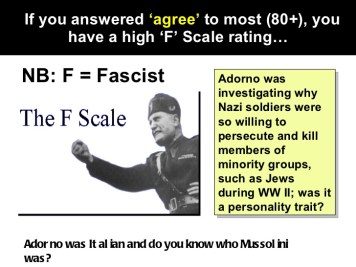
a traits 2That’s what I like. “Authoritarian” is a description; it is not a condemnation. On the other hand, there are times when the policies that authoritarians disproportionately support cost all of us dearly. I can be against those policies without raising—without even considering—the question of just why they chose those policies. And that is what the authoritarianism scholarship, beginning with Theodor Adorno, has mostly done up to now. It is not what Heatherington and Weiler do, which is why I am passing their work along to you.

Do you have any friends who are authoritarians?

Of course you do. I do. And I love some of them dearly. In this section, I would like to follow the authors’ descriptions of four traits on which the authoritarians—those out on one end of the distribution—differ from nonauthoritarians (who are, of course, way out on the other end).

Ingroup v. Outgroup preference

Authoritarians are likely to favor the groups that they are part of or that they affiliate with. Nonauthoritarians are more likely to favor “outgroups,” particularly marginal groups made up of race, poverty, or sexual orientation.

Affirmative Action programs are probably the best example here. These choices are likely to pit authoritarians against nonauthoritarians both on: a) what groups are to be given preference and b) on just what is “fair” in the circumstances. Nonauthoritarians favor the outgroups and define “fair” in historical, not in interpersonal, terms.

2. Accuracy Motivation

Authoritarians and Nonauthoritarians differ scarcely at all on the desire for accurate information—until they feel the presence of a threat.

However, once they [the experimenters] introduced a threat condition, authoritarians subsequently became much less interested than nonauthoritarians in seeking information that was balanced in its approach, and much more interested in pursuing one-sided information that reinforced existing beliefs.

3. Ethnocentrism

I would be really surprised if these findings were different from the ingroup/outgroup findings and I am relieved to see that they are not. I think we call the preference for “people like ourselves” an “ingroup bias” when we are thinking of domestic affairs and “ethnocentrism” when we are thinking of people of other nations and cultures. In any case, nonauthoritarians show significantly less ethnocentrism than authoritarians do.  This puffin sounds pretty familiar to me.

4. Personal Autonomy

Authoritarians tend to feel that autonomy is a good thing provided that it does not a traits 4seriously challenge social norms; nonauthoritarians are more likely to think that it is a good thing even when it does. Nonauthoritarians, to say it another way, are willing to put up with a good deal of disorder to protect the autonomy of persons. They don’t feel the same consideration for the “autonomy” of powerful social systems.
So what does all this mean?

It means that there are circumstances in which doing what the authoritarians want is exactly the right thing to do. In the previous post, I argued that when a school superintendent chooses an authoritarian principal for the high school, that does not mean that he is authoritarian: it means that he know what that school needs at the moment.

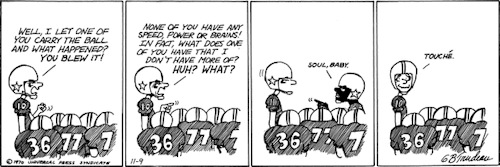
On the other hand, when: a) preference needs to be given to ingroups and where b) one-sided information sources are adequate and when c) groups representing other nationalities or cultures need to be opposed and when d) claims of personal autonomy need to be set aside so that the social norms are honored—in those times, we just cannot have too many authoritarians.  Lining them all up like this makes me think of Gary Trudeau’s old cartoons of B.D. in the huddle–a setting where authoritarianism is crucially necessary–and finding way too little of it.

a traits 4My own personal views really don’t fall at either extreme. Like most people I have some of these traits and some of those. Or I honor these values in one situation and those values in another. In other words, I do not fit the “ideal type” that the tests identify. I fit somewhere further toward the middle of the scale.

But by far my most vivid contact with these dilemmas has not come as a person, but as a professor. In my teaching years, I looked out over a classroom full of kids who weren’t sure what their own values were. They knew what they felt, but they weren’t sure they should honor those feelings. And they weren’t sure of the effects would be if the policies they liked best were put into effect.

Those are the right concerns to have, I think. At least, they are the ones that have meant the most to me as a teacher. In the third and final essay (Authoritarianism III) I will try to deal with them.

[1] And I haven’t even touched words like Nazi, which once meant “a member of the National Socialist Party” and can now mean someone who is, from the standpoint of the accuser, “too strict” about something. Anything. I have head of “grammar Nazis.”
[2] 30 questions in the Right-wing Authoritarianism Scale, 4 in the National Election Study authoritarianism index, 17 in the Social Conformity-Autonomy Scale.

Posted in Politics, Uncategorized | Tagged , , , , | Leave a comment

“It’s in the Book”

Give not that which is holy unto the dogs, neither cast ye your pearls before swine, lest they trample them under their feet, and turn again and rend you. Matthew 7:6, KJV.

IMG_0135 (3).jpgAs you can almost tell, even with the way I cropped the picture, this is a front yard display. It is in my neighborhood in the sense that I drive by it on 35th Avenue every morning on my way to Starbucks. And one morning at Starbucks, my friend Paul McKay said, “Hey, you know that house on 35th that has that pig in the front yard? You know what that is? It’s ‘pearls before swine,’ like in Matthew.”

I hadn’t ever seen that because you don’t see the “pearls” from the road. They are too small.  I took this picture standing in their front yard. From the road, you see only the large white spheres and I just assumed they were mushrooms. This is a truffle hunting pig, I guess. Once Paul said they were pearls, I went there and saw for myself. They are pearls.

Ordinarily, that would be the end of the story. It really should be the end of the story, but as I got to thinking about this very short and ambiguous text, I remembered a record (45 rpm) from my own youth. It is by Johnny Standley and it’s called “It’s in the Book.” [1] Standley plays the part of a southern revival evangelist, with the overdone gestures and the quavery voice. The part I am interested in today—the part, that is, that comes before his leading his imaginary congregation in a hymn called “Grandma’s Lye Soap”—is his exegesis of “Little Bo Peep.” He gives it all:

Little Bo Peep/Has lost her sheep/And doesn’t know where to find them/Leave them alone and they’ll come home/ Wagging their tails behind them.

pearls 1

Then he works each phrase in that tremulous mock-sincere voice. He notes how sad it is that Little Bo Peep has lost her sheep. He is offended that the text says both that she has lost them AND that she does not know where to find them. That seems obvious to Preacher Standley. If she has lost them then obviously, she doesn’t know where to find them. But after all, “It’s in the Book.”

Then he comes to the advice “the Book” offers her. “Leave them alone.” He muses over that a little. If she doesn’t know where to find them, what else could she possibly do than leave them alone?

And finally, he gets to “they’ll come home (“Ah yes,” he assures us, “there’ll be a brighter day tomorrow; they WILL come home.”) wagging their tails behind them. “Behind them,” he repeats with emphasis. “Did we think they’d wag them in front?”

OK, you get the idea. That is the attitude that came back to me when my friend Paul deciphered the front yard display of the “pearls before swine.” When I began thinking about “pearls before swine” with Preacher Johnny Standley whispering in my ear about Little Bo Peep,  I began to think of quibbles that might be made. Five came immediately to mind. [2]

So the question is this: in the prohibition recorded in Matthew 7:6, what exactly is prohibited and does this display violate those prohibitions?

Quibble 1: I learned when I started playing with this that in English, the word swine may be either singular or plural. In English, we can say “that swine” or “those swine.” That’s not true in Greek: tōn choirōn, which is the Greek expression translated “swine,” is plural. Of course, “they” indicates that we are talking about a number of pigs, as in “they will turn again and rend you” and I could have figured it out that way. But I didn’t.

So does this display illustrate a casting of pearls before swine (pl.)? No. Obviously, there is only one pig here.

Quibble 2: What is the rationale given? It is implied that there is something inappropriate about casting something valuable before animals, especially ritually impure animals. But beyond what is implied, only one part of the rationale is certain and that is that it is dangerous. “They might,” Jesus implies, “do you harm.” Now if that is something that herds of pigs do but that individual pigs do not do, then casting pearls before this particular pig might be completely safe and since safety is the only explicit criterion, I would say that this display does not show anything Jesus forbade.

Quibble 3: It says not to cast your own pearls before the swine, but it doesn’t say anything about casting anyone else’s pearls. I can see that there are pearls there in the front yard, but I have no way of knowing whose they are. It is entirely possible that Matthew meant to represent Jesus as saying, “Remember now. Don’t throw your sister’s pearls before swine.” That would be a very prudent piece of advice—almost as prudential as the previous one.

Quibble 4: Does this display show pearls that were cast before “the pigs,” or even this one pig? Certainly not. They may have been cast there. They may have been dropped accidentally. They may have been placed there with great care. There is no way to know that they were “thrown.” Of course, they might have been.

Quibble 5: Does this show pearls that were cast before the swine? Unfortunately, no. It shows that they are now before the swine. It is entirely possible that the pearls were cast behind the swine and that the swine turned around. They do that. I have seen it myself.

And in closing, a final word on silliness. It turns out that Matthew 7:6 has some really interesting meanings—serious meanings—that I was entirely unaware of. You can be as committed to silly as you like, apparently, and it doesn’t keep really interesting ideas at bay.

[1] I remembered (incorrectly) that Andy Griffith had done that recording. I think I was confusing it with his “What it Was Was Football,” which was released about the same time. I remembered correctly that Griffith was known at the time as Deacon Andy Griffith.
[2] I do, from time to time write on scriptural topics in unconventional ways. I remember the time I invented Dewey Decimal classifications for the “books” of the Bible. Today’s musing isn’t one of those. This is just silly.

Posted in Living My Life, Uncategorized | Tagged , , , , | Leave a comment

Authoritarianism I

I really wanted the title “If Authoritarianism is Trump, We Need a New Deal.”  Alas.  It was too long to use.

It is a presidential election year in the United States. A Summer Olympics year everywhere else. This year, more than ever, I hope that the Olympics will be beautiful and that everyone will want to watch because the presidential election in the U. S. is going to be ugly and the fewer people around the world who see it, the better.

Because of Donald Trump’s candidacy—as I write this, he is a candidate for the Republicanauthority 2 nomination—there has been a lot of talk about “authoritarianism.” On behalf of the political scientists of the world, let me invite you to the discussion. We talk about authoritarianism pretty much all the time. It’s just that this year, some of our stuff is landing on editorial pages and is being read by a broader audience.

I like the attention to “our topic,” but frankly, I am not too happy about the way the word authoritarian—that’s spelled with a scarlet A in quite a few papers—is being used. And making good use of it, especially in this election, seems important to me, so I’m going to spend a little time on it. As you see, I am calling this piece Authoritarianism I. I have no idea how far this will go.

I have three questions in mind for today. I will treat all three as serious questions, although you might think that the first two are too easy to be serious about and the third one “merely” definitional.

Question 1: Is Donald Trump authoritarian?
Question 2: Are Trump voters authoritarian?
Question 3: What do you mean, exactly, by “authoritarian?”

You see the problem.

Answer 1: No. That will depend, of course, on our coming to a useful shared notion of what that word means; it will depend also on whether it is the inner, personal, intimate Donald Trump or the outer, public Donald Trump. The outer one is the only one I care about.

authority 1In her book, Eichmann in Jerusalem: A Report on the Banality of Evil [1], Hannah Arendt raises the question of whether Adolf Eichmann was, himself, anti-Semitic. As I read her, the answer is either “No, he was not,” or “He might have been but it didn’t matter to his work.” [2] Arendt came very close to saying that Eichmann really wasn’t bright enough to be a thoroughgoing anti-Semite. She does say, clearly and repeatedly, that Eichmann’s operation of the Nazi death camps would not have been altered by so much as a single Jew if he actually had been an anti-Semite.

Would Donald Trump’s campaign—his posturing, his pronouncements, his race-baiting—be altered by so much as a single epithet by his actually being authoritarian? I don’t think so. That’s why I said No in answer to my question.

If Trump cares about anything at all in an urgent and persistent way, it is his image [3] or as people say these days, his “brand.” That means that we can count on Trump for a certain kind of speech. He doesn’t just want “a wall” between the U. S. and Mexico, for instance, but he wants the Mexicans to pay for it. It’s the language of outrage. It should not be expected to make sense. It is not a policy proposal. It is a scream in the dark. It is emotionally identical to Howard Beal’s famous, “I’m mad as hell and I’m not going to take this any more!”[4]

But if Trump is just “brand tending,” then what will he say when the situation changes? If he were a proponent of authoritarian policies—another possible meaning of the word—he would hang onto those policies no matter what. He doesn’t do that. He shifts the topics and the proposals so that they express the outrage his followers feel. Following Arendt’s line of thought, I would say that Trump is no more an authoritarian than Eichmann was an anti-Semite.

Answer 2: Some are, some aren’t. The question, remember, was: Are Trump voters authoritarian? This is a question we will have to come back to when we have spent more time on actual measures of authoritarianism, but for now, let’s just say that there are “external” or situational Trump voters and “internal” or character-based Trump voters.

My argument at this point is that some people think that this is a crucial time in Americanauthority 3 history in which a bold “take no prisoners” kind of leader is required. Imagine for a moment that you are the superintendent of a school district and that one of your school is a chaotic mess filled with incorrigible students. You may have the most fanciful liberal arts dreams in mind for this school, but first you are going to have to establish law and order. So you choose a law and order principal. He is flamboyant. He drives a fire engine red sports car which has a driver’s side door fitted with a scabbard for his Winchester.  He encourages his teachers to carry guns in class.  The parents who are desperate for order are enthusiastic and reduce his offenses to mere peccadilloes. The others are horrified that some blowhard clown is in charge of their kids’ high school.

In due course, law and order are established and the way is clear for a softer and gentler vision of educational opportunities, at which point you take the next step and choose a mild-mannered liberal arts type as the new principal of the high school. When you chose that first principal, you looked like an educational authoritarian. What is it about you, the horrified parents wanted to know, that makes you value bluster over diplomacy, power over reason, punishment over tolerance. An unhappy childhood perhaps?

What we know about you is that you care deeply about the educational success of your high school and its students. In order to take the next step toward that goal, you needed a tyrant who knew how to play the egotistical maniac. That’s what the sports car and the rifle and the armed teachers are for. But that is not your goal. When you are free to pursue your goal directly, you choose an educational leader for her gentleness and tolerance.

Are you an “authoritarian” superintendent? Of course not. You don’t even like the first principal you chose; it was just what the circumstances demanded. So, the analogy goes, people who support Trump because he is the right man for the job are only “external” or situational or instrumental supporters. They are not really authoritarian, themselves. They are just pooling their votes and their donations with the crazies who are genuinely, internally, psychologically authoritarian.

I see now that I am not going to get to Question 3 today. I thought about going back and changing the “three” to “two,” but I decided to leave it. “Authoritarian 2” will begin with the work of Marc Heatherington and Jonathan Weiler on measuring authoritarianism. When we have got that down, we’re going to go around to the other side—to the voter’s side—and see what their choices are.

In the meantime, take a look at Howard Beal’s rant on the YouTube clip from the movie, Network. It will do you good.

[1] I see that on amazon.com, they are advertising it as The Banality of Evil: Hannah Arendt and the “Final Solution.” The blurb indicates that it is the same book so don’t worry about the change in title.
[2] The movie version of this part of Arendt’s life, called Hannah Arendt, is well worth seeing. In the scene in which she finally defends her views against her critics, she makes the same case I am making here.
[3] The word idolatry was devised to refer to the worship of “an image,” not of “one’s own image.” Still, if you could extend the meaning to Trump’s worship of his own image, I would have no trouble calling him an idolater. NOTE TO THE TRUMP CAMPAIGN: All of  the -olater words are based on the Greek verb latreuo, “to worship.” I didn’t invent it just for you guys.
[4] If you’d like to invest a minute and forty seconds into Beal’s pitch, just google “I’m mad as hell…” and watch it on YouTube. You will be surprised, I think, at how little the language of alienation has changed.

Posted in Political Psychology, Politics, Uncategorized | Tagged , , , , | Leave a comment

A New Home, but still “Home”

I commented earlier on our “going home plan,” i.e., the arrangements we need to have in place before we die. [1] But if I want to think of where Bette and I choose to live as a place we will make into a home [2], then getting there is a sort of “going home plan.”

at home 5Wendy Lustbader has written more sensibly about aging than anyone I have read for a long time and in a recent issue of Generations (2014) she wrote a piece called “It All Depends on What You Mean by Home.” Isn’t it the truth!

Lustbader emphasizes the intuitive character of “the feeling of being at home.” She says:

Exactly what we mean when we say we feel at home turns out to be quite complex, yet the term makes intuitive sense to all of us. The term connotes a state of ease, which we immediately recognize: we know it when we feel it.

And also:

We certainly know it when we lose it.

And also:

Despite the idiosyncratic nature of their responses, three central elements emerged: access to the dignity privacy, and choice inherent in normal life; the capacity to form significant relationships; and the means to contribute to other people’s lives.

Those three quotes and the one I will end with just might interest you in Lustbader’s writings too.

Dignity, Privacy, and Choice

Among the criticisms that emerge from Lustbader’s interviews, some them seem very solid to me; others merely querulous. Here is one of the solid ones. One man said he didn’t like the idea that:

he needed to be “kept busy” through a program of activities. He said it seemed as if he were staying at a perpetual resort, rather than living his true life. “This is too empty for me;’ he continued. “I need to be useful.

The passive form of the verb in “be kept busy” jumped out at me right away. This man would love to keep busy. “Being kept busy” is another kind of thing entirely. Then there is the commitment to “being useful.” If you were designing a retirement center with the most urgent needs of the residents in mind, would you say, “I know what. Let’s attract people who have had long and useful lives and deprive them of that essential usefulness by which they have always marked their interactions.” Probably you would not. On the other hand, “providing experiences” is probably pretty cheap, by comparison with helping residents find community needs to which they can commit themselves.

Here’s one of the ones that seemed to me more querulous than anything else.

“Attending a program is not living” She suggested that participating in a current events program every Wednesday at 3:00 p.m. is not the same as striking up a conversation with a neighbor who shares an avid interest in social and political issues.”

This puts “participating in a program” in opposition to “striking up a conversation with a neighbor.” Ideally, those would be a natural sequence, it seems to me. “So, what did you think of the discussion on refugees? I think if we are going to expect towns to be more accepting of refugees, Congress is going to have to provide them better support.” If that neighbor shares your avid interest, the response ought to be pretty good. Pretty soon, someone says, “Let’s get Ralph and Lauren and go get a cup of coffee and work this out.”

Forming significant relationships

Old age is a wonderful time to have significant relationships. It is not a good time to have to develop them from scratch. [3] At any age, you have to strike some kind of balance between “who I am” and “who I need to be to be accepted.” I’m not complaining; that is what life in an individualistic society is going to be like.

at home 1But among people who have known you for a long time, there is a broader kind of acceptance and it is based on a broader kind of knowledge. People who have known you for a long time know “who you really are,” not just how you seem in the afternoon after your nap. “How he is after his nap” is part of what friends know about you. “He’ll be fine,” they will say, “Just give him a little time.”

Ideally, you move into a retirement center when you still have friends “on the outside.” [4] So the new friends who are just getting to know you are added to the old friends who already do. On the other hand, if moving into a retirement center means leaving behind all the people who know that kind of thing about you, then starting over is going to be tough. We ought to expect to hear complaints like this one.

Newcomers often feel lonely, despite lip service paid to a welcoming atmosphere. Even after several months have passed, they say the ethos of friendliness claimed in the brochures simply does not pan out. “I’m tired of trying to get to know anyone here,” one woman in assisted living said. “It’s like the door is closed on making new friends.”

Here again, there are things that need to be respected and things that can be disregarded. I think we can pass by “the ethos of friendliness claimed in the brochures” as a real disappointment. Has the person who said that never written a brochure? Never known anyone who wrote a brochure? Never had an experience that did not measure up to what the advertising department said about it? Probably not.

200276596-001

Who hasn’t felt like this guy?  I don’t want to feel that way as an old man!

On the other hand, the sense that “the door is closed on making new friends” is a real issue. People who live together set up friendship networks. Those are “closed” in the sense that any stable association of people is closed. These networks can be opened but a) not immediately and b) not unless you bring something to the party. One of the wisest and wittiest remarks I ever read was this:


“They told me to make friends so I wouldn’t be lonely, but it turns out that friends you make so you won’t be lonely aren’t good enough friends to keep you from being lonely.”

Lustbader tells this story about her grandmother.

When she was older than eighty, my own grandmother refused to attend a senior center, saying, “Why would I want to be with a bunch of old people? I’m a live wire, but all they talk about is grandchildren, doctor’s appointments, bowel movements, and medications.” I respectfully challenged her: “Grandma, you are a live wire, but—I hate to say it—someone could mistake you for an old lady. You should go to the senior center, just in case there are some other live wires there disguised as old ladies.” She went, and found four other women with whom she shared laughter and vivaciousness until she died.

I really like that story. I like the distinction the grandmother makes between her sense of herself (live wire) and her sense of the setting she is resisting (conversations dominated by grandchildren, etc.) It is a distinction worth making. “I am X,” the distinction says, “but IT is Y.” But much more than I like that, I like Lustbader’s counter, “Grandma, you are right. You really are X. But there may be some other ladies there who are X’s in disguise. Let’s go find out.”

How can you not like a social worker who can talk like that to her own grandmother?

[1] In Christian theology, “home,” provides only a very dim light apart from questions of relationship. At the risk of dismissing Heaven as our ultimate destination—which I know is very important to some people—I think it makes more sense to think of trust in an ultimate relationship as “home.” I wish Billy Joel were not talking about romantic love between very young people when he wrote, “Home can be the Pennsylvania Turnpike/Indiana’s early morning dew/High up in the hills of California/Home is just another word for you.” A Christian might say, “Home is just another word for being with You.”
[2] Honors to James Whitcomb Riley, “the Hoosier poet,” who correctly said that “it takes a heap of livin’ in a house to make it home.”
[3] I speak as a man who was forced to enter “the dating scene” in my late sixties.
[4] I borrowed that from crime show dialog where the writers think that is the way inmates refer to non-inmates. I liked the irony of the term at this point in the essay.

Posted in Getting Old | Tagged , , , , | Leave a comment

A Bad Moment at a Good Party

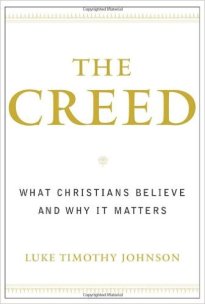
Luke Timothy Johnson has recently written a book about the Apostles Creed.[1] The first job of any writer is to give potential readers a reason to read the book. I think Johnson does a terrific job of that. Here is (most of) the first paragraph of the first chapter. Take a look.

Many Christians know that deadly moment at a party when their friends realize they actually believe something everyone has merrily been belittling. They recall their stammered reassurances, their tortured reinterpretations, their relief when the conversation moves on, their self-contempt…But their embarrassment at being seen as believers reveals them to be Christians whose view of the world has been shaped less by the Christian creed than by its cultured despisers. [2]

creed 3.pngThere are two things worth noting here. The first is the way Johnson sets the hook in the reader. “Did you ever have an experience like this?” he says. Nearly every Christian I know has had experiences like that. If you mix with the general public, it is pretty likely that you are going to be in a conversation where the idiocy, the arrogance, and the utter hypocrisy of religious belief are going to be taken for granted. Your own consequent idiocy, arrogance and hypocrisy are obvious applications of this view. That isn’t fun at all.

The second point is that Johnson has “what the proper response of a Christian should be” in mind. I am not sure he does and I am quite sure that I do not. To me, the question of just what Christian we are talking about is crucially important. The response the Christian makes in the scene Johnson paints is gruesome, I agree. Let’s see if we can get a closer look at what the believers do in this scene. It will help us when we try to imagine what else they might have done.

  • they recall their stammered reassurances
  • they recall their tortured reinterpretations [3]
  • they experience relief when the conversation moves on?
    they experience self-contempt
  • they are embarrassed to have been seen as believers

The first two are normal social frictions with the descriptive language amped up. Reassuring your friends and reinterpreting their meaning are pretty common elements of social interaction. The last two are brutal. “Self-contempt” seems like a lot to feel as a result of a social confusion. “Embarrassed to be seen as believers” is even worse, but if these were really friends, why didn’t they know you were believers.
So…what should the believers have done?

I’m going to try to get around on the other side of this issue so that a) the “belief system” creed 2has nothing to do with religion and b) I am part of the group of friends.

Let’s say that one day I read an article that tells me that a CEO of some local company has a staff astrologer to tell him when to invest. I remark, looking for a laugh, that I want to check with my financial guy to be sure none of my money is invested in that company. One member of the group relies very strongly on astrology—who knew?— and she takes offense. Is that a good thing for her to do? The topic is not astrology. It is the CEO. But it does presuppose that astrology is ridiculous.

Let’s look at a more political one. I say that I have read that some progressive changes are being made in national government and I applaud them. But one of my friends has been reading Marx and Lenin and has just come to the realization that it is liberals (like me) who are postponing the revolution. The “laws of history,” which Marx discovered, still hold, of course, but what Marx called “the immiseration of the proletariat” is being put off and so the revolution which all that misery will fuel is being put off. He objects to my ignorant and casual approval of progressive causes. He is angry and will not be mollified. Again, the topic is not Marxism. It is liberal reforms. But it does presuppose that liberal reforms a.k.a. “bourgeois democracy” are pernicious.

But, just as in Johnson’s scenario, this silent concurrence about assumptions we all share runs afoul of one of the participants. This participant actively objects to that assumption. He would take it out of the silent, “taken for granted” shadows and make it the focus of our discussion. The result of his action is that the discussion that I thought was going to be about sound financial practices is now about the merits of astrological wisdom; the discussion I thought was going to be about progressive reforms is now about Marxist theory.

How do I feel about this guy? I wish he would have let us have our conversation in peace. It’s a very ordinary conversation. We are “merrily belittling” a group or an approach to an issue, but we’re not taking it seriously. We are just exploiting the humor implicit in a view we all take for granted.

Who Am I?

Of course, Luke Timothy Johnson, in his introduction, was not concerned about things like astrology or Marxism. He was concerned about the Christian faith and particularly concerned about the inability of Christians to be “who they are” in a secular setting that presumes religious faith is somehow ridiculous.

But Johnson has a particular notion of “being who you are” in mind. I am who he thinks I am, but I am also some other things he is not considering. This identification of yourself as a Christian apparently requires that you raise the question of your friends assumed world whenever the assumptions contradict or demean or ridicule your own. That sounds touchy to me.

So I answer the question, “Who am I?” in part by noting that I am one of a group of friends. I consent to the topics we discuss and to the presuppositions that make those discussions possible. When I dissent from the topic, I say so. We are friends, not clones. When I dissent from the presuppositions, I might just be quiet and listen. What the hell is going on here? That seems like a reasonable question.

creed 5So the lesson embedded in this setting of the story is: Let it pass and see what happens.
A second response to “who I am” is that I am a friend to each other member of the group. It may well be that “letting it go” is the best thing to do at the time, but it may also be the best thing to follow up with one or more members of the group when time allows.
One member, let’s say, is a person who might have noticed the group’s assumption and been bothered by it. So you sit down with him and say something like, “Did you notice that for a little while, in our discussion last weekend, we seemed to be relying on the notion that astrology [Marxism, capitalism, Christianity] is crazy and so it anyone who relies on it?” If he feels the way you thought he might, you can have a conversation like, “Where did that come from? I was as surprised as you were.” If he doesn’t, the conversation could go another direction and still be useful for you both.

The lesson embedded in this setting (after the discussion) is: Check it out with some friends who were there and see what they thought.

But now, at last, we get to the heart of the “Who am I?” question. I offer three samples below, of which I really like two of them.

Person A: Having proposed the topic, we need to know what you have to bring to the table. If we don’t know that, we don’t know if placing this on the agenda is a good thing for you. If you have something to say, this strategy might be a really good one. Your friends might learn something about you. You might learn something about yourself. If you ever knew anything about Christian apologetics, this would be the time to knock the rust off of what you know and put it into play. And if you are someone who can do that, you probably should. It would be a gift to the group.

A lot of good things are said, in books on “Christian witness,” about the person who can do that. When Johnson raised the question of being “true to who you are,” I think this is the guy he had in mind. And since there seems to be such agreement that this guy is a hero—or, if things turn out badly, a martyr—I’m just going to leave him to his work. He does need to continue to be a friend to the others, but in doing that, he does not need to echo their assumptions.

Person B: But what if you are not a person like that? Disciplined logical arguments are really not your thing. That might mean that moving this topic from the background to the foreground is not a good thing for you to do. Or it might mean that you want to address it not as a topic for discussion, but as an arena where people are invited to share their own feelings and experiences. This person would not say, “Here is how I would defend my Christian beliefs,” but rather:

“Let me tell you about some experiences I have had. According to the assumptions we have been using, these experiences ought to seem ridiculous, but they don’t seem ridiculous to me. Have any of you had experiences, as I have, that seem to point in another direction?”

The lesson embedded in this version of the story, oddly, is exactly like the one in the previous story, but the strengths of the person are different. The person who thinks in terms of doctrines and arguments and logical implications should feel free to propose such a discussion. The person whose strength is in the immediacy of feelings and in the clarity of experiences should feel free to propose a discussion that relies on experiences.

Person C: I think of both of those as authentic and positive contributions to the life of thecreed 1 group. But a person who feels unable to do either of those might still feel that something should be done and that person might think of saying, “Remember when you were talking and laughing about how stupid religious people are? That really hurt my feelings and I wish you would be more careful and not do that any more.”

I really don’t think that is worth doing. It isn’t being a good member of the group at the time of the discussion. If you pursue it with several members of the group afterward, it will look like you are trying to get people to feel bad about something they actually did not feel bad about at the time. That’s not good either. Maybe it would be better to find some more congenial friends?

[1] Johnson’s book is The Creed: What Christians Believe and Why it Matters.

[2] “Cultured despisers” might seem a little heavy handed, but it’s really just clumsy. He is intending to refer to the title of Frederick Schleiermacher’s well-known book, On Religion: Speeches to Its Cultured Despisers. If you are familiar with Schleiermacher and the context in which he wrote, you might smile quietly to yourself when you see Johnson’s use of the term. If you are not, it might well seem like an unnecessarily nasty attack.
[3] “Tortured,” by the way, means only “characterized by twisting” in this usage. You could say that you “torture” ivy into the shape of a wreath.

[4] A dear friend of mine said recently that he knows this kind of conversation very well. To a question like, “You don’t believe THAT surely?” he says, “Yes. I do. Has anyone seen a good movie lately.” I like that. I see the first statement as an act of loyalty to his faith community and the second as an act of generosity toward the friends.

Posted in Communication, sociability, Theology | Tagged , , , | Leave a comment

Do you want a party or a nominee? Choose.

On May 3, the New York Times editorial board published a piece with the title, “It’s Donald Trump’s Party Now.” They were referring to Trump’s convincing and unexpected win in the Indiana primary, so I know what they had in mind. But I think they went too far. What if the Republicans refuse to accept Trump as their candidate? What if Trump refused to accept “Republicanism” as his own platform?

It looks to me as if we are there; or nearly there.

Paul Ryan, who, as everyone knows, is Speaker of the House, is also chairman of the Republican convention. The conventimanning 1on that is going to choose Donald Trump as the nominee of “the Republican party.” Notice the quotation marks. Ryan is the highest ranking Republican. He is behind only Joe Biden as “our next President.” [1] He is as close to Mr. Republican as anyone can be.  He looks pensive, don’t you think?

I put “the Republican party” in quotes because there is a real question at the moment who or what that name refers to. Is it the long history that has led generations of voters to refer to “the Grand Old Party” (that’s what GOP stands for)? Is it the party that writes and adopts the platform on which its candidate will stand? [2] Is it the nominee’s ability to stand with other Republican leaders to protect the party from divisions and to do battle with its opponents?

If you have been reading the papers, you know it is not any of those things.

Standing on the Republican Platform

We can bring the first two questions within shouting distance of each other by imagining that the agenda Paul Ryan has written and failed, so far, to get anyone to accept is the real “Republican Platform.” When Speaker Paul Ryan said recently that he was “not ready to endorse” Trump as the Republican party’s candidate, Trump shot back that he was “not ready to endorse Speaker Ryan’s agenda.”

And I am sure he isn’t. I suspect he is not ready to endorse any agenda. I think just having an agenda would feel constraining to Mr. Trump. Trump sees himself as the leader of a cause. That is not “agenda-friendly.” He sees himself as a savvy negotiator. That is not “agenda-friendly” either. Nothing about Trump, public or private, long ago or recent, suggests that he could stick to an agenda—even an agenda constructed to gain advantages for himself.

manning 3I think of “agenda” and “Trump” in the way I think of the agenda of the Earp brothers at the OK Corral. If there is an agenda there, it is “get them before they have a chance to get you.” Grand Old Party? Really?

As a “negotiator,” Trump is used to cutting the best deal he can for himself at the moment. Apparently he is really good at it. But “cutting a deal” and “having a platform” are different kinds of things and are, in fact, opposing kinds of things. You really can’t “stand on a platform” and “cut a deal” at the same time.

And even worse, Trump would, as the party’s nominee, be charged with negotiating a deal that would be best for the group he is responsible to. The days of “the best deal he can cut for himself” are over if he is the nominee.

And the best deal “at the moment” might not be the best deal on down the road, particularly if you are playing with the faith and credit of the United States. That’s not the kind of thing you could lose in a crap game. You can’t get out of it by filing a Chapter 11 bankruptcy—not for the United States.

So the whole “representing the Republican platform” thing looks moot. If he commits himself to any platform at all, it will be the first time I have ever heard of it. I don’t think he will and I wonder, really, if he could.

Standing with Republican Leaders

But standing “for” the Republican party doesn’t rally have to mean “standing on the platform.” In fact, in these days of candidate-led, rather than party-led, elections, there is often a good deal of variation between “what the party says” and “what the candidate says.” “Standing for” could mean “standing with” the other leaders of the party. Actually, that doesn’t look so good either. Here’s the way Alexander Burns put it in the New York Times for May 6:

Since a landslide victory in Indiana made him the presumptive Republican nominee, Mr. Trump has faced a shunning from party leaders that is unprecedented in modern politics.

I have never seen a collection of Republicans like this before. It includes all the Bushes—both former Presidents and the wannabe. It includes previous standard bearers John McCain and Mitt Romney. It includes columnist George Will, who is never short of a good quote. Should Trump get the nomination, he wrote, conservatives would have to:

“help him lose 50 states – condign punishment for his comprehensive disdain for conservative essentials, including the manners and grace that should lubricate the nation’s civic life.”

Glen Beck (!) a prominent conservative radio commentator is opposed to Trump. And Bill Kristol, editor of the Weekly Standard, as conservative a writer as anyone would want. And Ken Mehlman, former head of the Republican National Committee. The list goes on and on. It includes Republican office holders and staffers from executive and legislative branches.

So it appears that Trump is not only not standing on the platform, he is also not standing with the other prominent members of his party. I think that “Donald Trump” and “Republican Party” are entirely separable entities. I’m pretty sure there is not room in the right lane for both of them.

manning 5[1] And if you can’t imagine what it would be like for a conservative Republican Speaker of the House to move seamlessly into the Oval Office and start “presidenting,” then you owe it to yourself to see John Goodman do it as Glen Alan Walken in Season 4 of The West Wing. I found it disconcerting.

[2] This is a metaphor that has gotten entirely out of hand. In the very old days, you stood up on a tree stump—so people could see you—and delivered your “stump speech.” A little forethought eventually produced a platform that you could stand on if there were not an adequate stump. The platform—the wooden stuff—came to be used to stand for “the platform,” i.e., the proposals the candidate was making, considered collectively. But, of course, we don’t always consider them collectively, so the programmatic platform was imagined to be made up of “planks,” just as the physical platform was. “Senator, we’d like to ask about the foreign policy plank in your platform.” That kind of thing.

Posted in Politics | Tagged , , , , , | 2 Comments

Depth v Breadth, the Crucial Trade-off

I have begun to arouse a little opposition among by beloved Bookies.[1] It’s not the puns this time. They drew the line at three puns per book group meeting and I have stayed well short of the line. Usually.

This is something else. I know for a fact that I am not the only member who enjoys reading books over and over. I am the only one who really defends the practice, however, and I think that’s what gets me in trouble.

Since I began this essay, there has been a discussion of the whole matter at our annual meeting at the Oregon coast, so at the end of my argument, I will tack on a few things I heard from them this year.

The Archaeology Metaphor

deep 3

I have a picture of an archaeological site here. I am going to use it to illustrate what I mean by “depth.” By “breadth,” I will mean many such sites. As you see, this site has a lot of different levels. In this standard picture, each level is older than the one above it. As I read a book, I sift through all the material I am able to reach and when I am finished, level one is gone and all its valuable artifacts bagged and tagged.

When I come back, I do the same thing again, but now it is level two that is open to my inspection, so I see things I was not able to see before. When I am done with that reading, I carefully catalogue and store (“bag and tag” is just crime-scene-speak) the artifacts (evidence) and go away. When I come back, level three is right there waiting for me. I discovered whatever I could about the use of the hearth in the first “reading;” about pottery in the second; and something, at least, about their religious practices in the third.

When I was younger, I used to say about a very rich book that I had read once, “Oh yeah, I read that.” And I had. I had mastered everything I could get to on a first reading and that is all I knew about. I don’t say that about rich books anymore.

The Lathe of Heaven

Perhaps an example would help. One of my favorite books of any kind is Ursula LeGuin’s The Lathe of Heaven. [2] The plot is complicated because George Orr has dreams that change the world. And they change the world retroactively, so that this “new event,” which he just dreamed into existence, seems to everyone else to have happened a long time ago. It took all the effort I could bring to the book to hang onto those realities and to continue to wish George well through them all.

It was at perhaps the fifth reading—the level of the skull in the archaeological site— that I discovered what LeGuin surely intended to be the central axis of the story. Dr. Haber, the therapist, is the bad guy. [3] He believes in changing the world to make it better and once he discovers that George, his patient, can dream new worlds into reality, he uses George relentlessly. George floats in the world in a completely engaged way that looks like pathological passivity to Haber, but is LeGuin’s moral stance in this book. Being “one with the world” is right; “changing the world to make it better” is wrong.

deep 2In this picture, we see the result of Haber’s suggestion that the world not be divided into warring groups by the color of their skin. George dreamed that everyone was gray and when he woke up, they all were—including Dr. Haber.  I’m sure that seemed a good solution to a dreaming mind, however far from Haber’s mind it was.  When George was instructed to bring “peace on earth,” he invented  aliens and had them invade Earth.  Problem solved.

Seeing that duality, that simple moral axis that Haber and Orr represent, took me five readings. People who want to say that it should not have take five readings to get there will get no argument from me. People who want to say that they picked up, in one reading, what it took me five readings to get will find only admiration—maybe just a tincture of jealousy—from me. That person is not facing the same depth v. breadth problem I am facing.

The way the depth v. breadth issue is normally put is “Why would you read the same book over and over when there are so many different (new, other, varied) books to read?” I think it is the form of the question that has caused me the most difficulty over the years. I am committed to a way of grasping the issue that holds depth (many layers down into the site) as one value and breadth, (many such sites) as another. I want a question that puts the value of X up against the value of Y. I would be happy even with a question that went like this: “Surely you don’t think that two layers of depth are worth sacrificing ten additional new sites?!” I might agree that that is a bad tradeoff or I might say that I would gladly trade ten more hearths (yawn!) for just one stone idol (three levels down) or one skull (five levels down).

Objections

So there’s my argument. You really have to account for the benefits of depth when you are deciding how much breadth you are willing to sacrifice to get down that far. And that’s where I would have stopped had the Bookies not had a conversation–I was part of it, of course– that dealt with this same issue. But we did. Here are a few of the objections and one support from an unanticipated source.

Objection 1. You talk about “one level” and one reading as if they were the same thing. Don’t you agree that a really good reader might read…oh…the first five levels in one reading?

Response 1. I do agree. The depth v. breadth trade-off is important as a general issue. It is crucially important that both be valued in principle. But the particularities of the trade-off will differ from one person to another. When I talk about “Level 1,” I am talking only about how far down into the site I can get in one reading. I freely grant that others can get further down in one reading.

Objection 2. You keep using the word “superficial” to refer to the reading of first levels. Isn’t there a negative connotation to the word superficial?

Response 2. Sometimes there is. No one rejects “superficial” as a description of wounds. I do like superficial as the adjective form of the noun surface. The central meaning of the word is exactly what I mean. I think I will be content to allow some people to emphasize the peripheral meanings of the word, which are negative in some settings, if they want to. There is a limit to how much trouble I am willing to get into by doing it, but so far, I think I am still willing.

Objection 3. There are so many really wonderful new books. Are you really willing to pass them up so that you can read the old books at a level you call “deep?”

Response 3. I certainly don’t want to give up on new books. My goal is only to strike a balance for myself. A superficial treatment of these new ones is a positive good all by itself. Even if it isn’t a good book, it can provide a new and interesting look at the world. And if it is a good book, reading it once is a necessary preparation for reading it a second time—you know, down where the pottery can be seen

Support 1: All this talk about novelty and meaning! What about reading an old familiar book the same way we eat comfort food? There are books we re-read just to live in that world again for a little while.

Response 1: Yup. That’s another good reason for reading that kind of book over and over.

[1] I write about the Bookies quite a bit, but when you post a blog, you never know who is going to read it, so let me add a note here. In 1983, my wife, Marilyn, and I and two other couples started a book group. We joined so we could read and discuss books, but over the intervening 35 years, we have become friends, and I have come to call them “the Bookies.” There are 12 of us now; five couples and two singles.
[2] Also two movies by that name. The first a low-budget experiment that I didn’t care for very much, although I did get to hear her narrate it. The second a Hollywood-ish version that departed somewhat from the book, but that added a really engaging visual dimension, and also gave us James Caan as Dr. Haber and Lucas Haas as George.
[3] Haber’s name is built transparently on the Latin verb habere, which means “to have, to hold onto.”

Posted in Books, Movies | Tagged , , , , , | Leave a comment

Political Issues. Both Kinds

It doesn’t actually matter much what the issue is, apparently. It can be put forward this way or that way. We are going to have a Hillary v Donald campaign apparently and I would expect that “the issues,” whatever they turn out to be, are going to be presented in these two ways.

The Bookies were in Newport, Oregon for the last several days. Most years, we spend a few days together at the Sylvia Beach Hotel. [1] During that time, we walk on the beach and through a part of the north end of town.

IMG_0153You don’t have to walk very far to see these two signs. There is going to be a vote, apparently, on whether to “put” (Boo!) or to “restore” (Yea!) fluoride in the water. “Put” emphasizes the novelty. This is new. It could be dangerous. “Restore” emphasizes the familiarity. We used to have this. Remember how nice it was? We could have it again if we wanted.

This is the sign that was most prominently displayed in the neighborhood of the hotel. It says two things. First it identifies the process that is being proposed. “Fluoridation” is the name of the process by which fluoride is added to a public water supply. It does not say anything about possible outcomes which, when you stop and think about it, seems odd.

The second thing it does is to postulate and in-group and an out-group. “Our” is the possessive form of “us” in the objective case and of “we” in the subjective case. We and us and ours all belong together. When they are being emphasized the way they are here, it is reasonable to presume that there is a “their,” which is the possessive form of “them” in the objective case and of “they” in the subjective case. They and them and their all belong together and they all mean “not us.”

It is reasonable to presume, from the sign, that “they”—for the purpose of in-groups and out-groups, it really doesn’t matter just who “they” are—want to put fluoride into the public water supply. “Into our water,” is the way this side would phrase it, I am pretty sure. We don’t know, from this sign, who they are or why they think fluoride should be added or what would happen if it were added. What we know is that “they” are not “us” and that “they” are trying to make a choice that rightfully belongs to “us.”

I hope you will forgive my spending a little time on this. We will be hearing it non-stop at the national level from now until November. Also, please do not imagine that these are subleties. They are clearly there and they clearly work. They are not often remarked on so they may sound unfamiliar, but they are a part of everyday discourse.  They are about as subtle as a punch in the mouth.

Back to work. There really ought to be a sensible reason for dividing “us” from “them.” Here’s an example. “They want to fluoridate our water, while leaving their own water free of fluoride.” There is no reason to think that is the case in Newport, but a situation like that would certainly justify the emphasis on “our choice.”

I imagine that the case in Newport is that some residents want fluoride in the water and some do not. So the water is “our water” and the choice properly belongs to “us,” that is, to “the people who will be voting on the measure and who will be drinking the water.” So “our choice” in this formulation would mean “all of us here in Newport.”  It is inclusive.

That is not what it means on this sign.   Some citizens of Newport are being referred to as “they” because they have different preferences than “us” about the water. It is exclusive.

IMG_0152Here’s the other sign. It just comes from the other side of the conflict, but it might almost have come from another planet. Notice first how the policy process flows. Back in the good old days, we had “healthy water.” [2] Presumably, we made the water “healthful” by adding fluoride to it. And the fluoride produced  healthy water and the healthy water  produced healthy teeth. They don’t say that, but you can see the healthy teeth.

This is an outcome-based argument, where the opponents of Measure 21.164 use a process-based measure. The argument is that we can do something good together and we should. The value of the outcome simply walks past the question of “whose agenda is this” or “who should be making this decision.” We all want healthy teeth and big smiles and so we should all vote Yes on 21.164.

I don’t know anything at all about politics in Newport, but I would guess that this measure is going to lose. Identifying an out-group and opposing them is easily done and it is emotionally powerful. Identifying a policy outcome we all share and trusting that the action we are proposing will achieve that outcome and  benefit us all is done only with difficulty. And the power it has is the power of our common intention—the wish of all of us. That isn’t really very powerful by contrast with an appeal to “us” and to rejecting “them” because they are trying to make a decision that ought to be “ours” to make. That’s where the emotional power is.

You will be hearing more about this from me if, as I confidently expect, it is the dynamic underlying the Hillary v. Donald campaign. Are we having fun yet?

[1] The one thing you need to know about the Sylvia Beach Hotel is that each of its rooms is named after and decorated in the style of an author. They change from time to time, but only slowly. The room where Bette and I stayed is now the J. K. Rowling room, which means that it is the Harry Potter room. The room is filled with “artifacts,” including a painting of Moaning Myrtle on the wall above the toilet. But before that, it was the Edgar Allen Poe room, complete with one wall of bricks and with a pendulum over the bed.
[2] I really don’t like this use of “healthy,” although it is becoming distressingly common. “Healthy water” ought to mean that the water is healthy, which is a good thing. But no one is Newport is arguing that we would be benefitted by having diseased water. They mean “healthful,” i.e., productive of health benefits, water. We want water to be healthful because we want to be healthy.


Posted in Politics | Tagged , , , , , | Leave a comment