
The maxim that it is more blessed to give than to receive is well known and I would apply it without a second thought to director Hannes Holm’s 2015 movie A Man Called Ove. I think the movie fits the maxim and vice versa. On the other hand, I think the maxim doesn’t really capture the two points I would like to explore in this essay and I would like to extend the implications just a bit.
The first point  is that it calls for a comparison of “amounts” or “degrees” of being blessed. It is the word “more” in the maxim that has us comparing one amount of blessedness with another and saying that one amount is larger. That is what “more” means and what it needs to mean. [It says right here than you aren’t allowed to do that.]
But what strikes me in this movie isn’t anything like an amount at all. It is more like a flavor or an overtone or a tint. It is another kind or another source or another delivery system for the “blessedness.” I find that really thought-provoking.
And that leads me to the second point, which has to do with what I called a “delivery system.” But what, really, is the means by which these blessings are conferred? There is no scene where single shaft of light from heaven illuminates the old man’s features. He doesn’t pronounce a blessing on the children and then they pronounce it on him. How does this work exactly?
Ove (Rolf Lassgård) is a grumpy old widower and retiree. [1] His life is stable, but bleak. Then some neighbors move in—people who are very hard to ignore—and Ove is forced to do an amazing variety of things he has not done for a long time. Some, he has probably never done. Let’s look at an example or two.
 The wife, Parveneh, (Bahar Pars) of Ove’s new neighbor is Persian. That’s a short way of saying that she doesn’t know how to be Swedish. It turns out that she has no intention of becoming culturally Swedish, but that’s another story. [2] Parveneh has to make a quick trip to the hospital and leaves Ove in the waiting room with her two children. [This one picture nails the two characters exactly.]
She gives Ove a book that could, in a pinch, be used to entertain the children. The children prevail on him to read to them. They have no idea how far outside Ove’s comfort zone that is. He has never been a father. He doesn’t know all the “reading to the kids” tricks that fathers pick up so quickly. So Ove starts reading to them about a bear. The children don’t like the way he is reading. They think the lines the bear says should sound like a bear.
I don’t think “outside his comfort zone” really captures this request. Ove has very likely never done this or anything like this before. If he ran across a man reading in growly sounds to little children in a public place, I am sure he would have disapproved of it. But he tries. And he does really well. And the kids really like it and, at that moment, they really like him.
How does it work?
So let’s stop, after just this one example, and look at what he gave the children and what the experience of succeeding in pleasing the children with his creative artistry “gave” to him. [3] Ove gave the children a distraction while their mother was busy in the hospital. The children gave Ove the first evidence he had ever had that he might be one of those adults who knows how to please children. The children gave him reason to believe that his growly conversation was delightfully bear-like (ursine, we say in the trade) and he knows he invented those sounds himself.
And, getting away from the “giving” metaphor, we can say directly that Ove is given the opportunity to be a kind of person he never had been before (probably) and that he certainly had not been since his wife’s death. He takes that opportunity and is forced, as a result, to re-evaluate the kind of person he is.
In another scene—another crisis, of course—he is called into the neighbor’s house. The children need to be looked after. He also winds up in the middle of an argument about what to do with a dishwasher that doesn’t work and is therefore, no more than a piece of junk. And Bette remembers (she’s usually right about things like this) that the kitchen where the junky dishwasher sat was full of dirty dishes.
Ove survives bedtime for the children. We don’t see that. Then he fixes the dishwasher. We don’t see that either. And when the parents return, they discover that the counters are all clear because the dirty dishes are either in the dishwasher or because they have been washed and put away in the cupboards.
That’s a very nice favor for Ove to have done and it is a real help to the parents. But a prominent part of the beginning of the story is the parade of neighbors who ask Ove to “look at” (fix) things and he always says No. He says No to the request and also a broader and more hurtful No to the person. Ove is a cranky old man and none of these neighbors means anything to him. But then he is “forced” into the neighbor’s house. There must have been a time for the kids to be in bed. He did that. And he stands in the kitchen looking at a dishwasher he knows he could fix. And he does that. And then he looks (Bette’s version) at the counter full of dirty dishes and then at the empty dishwasher and he shrugs, I suppose, and starts loading the dishes into the dishwasher.
He came to help with the kids because the parents had an urgent need for him. But then what? They didn’t have an urgent need for him to fix the dishwasher. It must have just seemed fitting to Ove. A guy who would come over at night and figure out a way to get the two little girls to bed just must be the kind of guy who would fix a cranky piece of machinery if he could. And the guy who voluntarily fixed the dishwasher is probably the kind of guy who go on and wash the dishes.
I’m making is sound like logic. I know it isn’t logic, but I chose that phrasing deliberately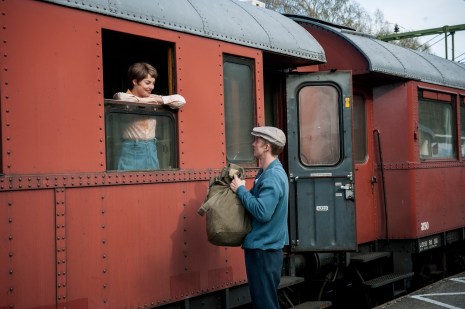 because I think that there is an affinity of some kind between one act of kindness and another. [4] Something like the current of a stream is set up and Ove “drifts downstream” following the implications of the kindnesses he has done, just as he had been following the logic of his refusal to help any of his neighbors. Actually, “who he is to the neighbors” is very much like “who he was to his wife,” who was a marvelous person and the first person ever to really believe in him.
So when we think about “the blessedness of receiving,” I think we need to be alert to currents like these. Ove benefitted much more than anyone else did from his kindnesses to his new neighbors. And it isn’t just that they appreciated his efforts. It is not just that. It is also that Ove was forced to think some very positive things about himself. He was forced to admit that he had done some generous things and possibly even to speculate about whether he was a generous person. Thinking those things was perfectly reasonable, giving the things he had actually done.
That isn’t why he did them. But that is, in fact, how he was blessed.
[1] Ben Whittaker (Robert De Niro) says in the opening lines of The Intern, that Freud thought life was focused on work and love. Well, Ben says, my wife died and I am now retired. What is there to focus on.
[2] In this little town, “doing it the Swedish way” and “doing it the right way” are completely synonymous. Just having someone like Parveneh around makes that clear.
[3] Right away, when you start putting words like “gave” in quotes, you know you are into new territory. The point here is that Ove did this thing and experienced himself in a new way (daring, creative storyteller) and found himself rewarded for it. All those are internal experiences. So “gave to Ove” really doesn’t capture either the source of the reward or the nature of it. “Caused to grow in Ove” would point to the experience better, but we don’t say that.
[4] Or one act of cruelty to another. The tie is so tight that it is a commonplace among sports commentators that a player who makes a superb defensive play at one end of the basketball floor is quite likely to return to the other end and make a superb offensive play. In some odd way, making the basket is “implied” in the prior blocking of the shot. In sports, sometimes, we call it “momentum.”

 As I continued thinking about the sign (I do walk by it every day), I began thinking about the premise. That’s just the way my mind works. Negatively, the premise can be put this way: the milk does not belong to you unless you are a calf. Positively, we could say that the milk is the rightful property of the cow’s progeny, not the cow’s owner.
 Another unfunny way to think about the sign is to think about the alternatives the sign offers. Nothing against coconut milk, of course, or soy milk. It isn’t that I have some fantasy that little coconuts or little soy beans are being deprived of milk that would otherwise have been theirs.
 I don’t think the sign would have gotten under my skin the way it has if I had not enjoyed it so much the first few times I saw it. I saw it as a clever pun (de-calf your coffee) rather than as a moral admonition. And when I saw the sign for what it was, I had the feeling that I had been ambushed—as if someone had whacked me on the knuckles while I was still laughing.
 The answer is Yes. First, he needs to do a little defining of terms. Second, he wants to answer the question positively: Yes, you can have a good life even if you don’t have a good job. I’m right with him so far.
 That’s the feather. That’s how you know you are flying. And I think a “magic feather” is a really good symbol for this effect because this kind of a world is not something that individual workers can do or groups of workers can do. It is not something a candidate supported by the workers can do. It’s “magic” and the symbol of the magic is the feather.
 All we need now is the mouse. But politicians, people who are actually running for office and who tell voters “what they need to hear,” lose . And not only do they lose, but they also take a lot of other candidates down with them, candidates much further down the ballot.
 the bad people over there. Of course, there are other things that are incredibly bad—like when an ICBM lands on you, sent by people following the same script. Still, firing them off is a pretty tidy action.
 The woman who is trying to look “just slutty enough” is an example of the communications paradigm. The women who are dressing modestly so that they will send the message they want to send are, likewise, examples of the communications paradigm. And when Cranley complains: “Too loose. Too tight. Too low. Too high. Who teaches us about these things anymore?,” she is complaining about a lack of the vocabulary that will enable women to say what they mean.
 Emily Badger has
 does sound silly. On the other hand, it is a step forward—a step toward an enduring public conversation—better, that is, than debating whether we have any biases or not. This silly exchange focuses on what the effects of the biases are, which is a conversation worth having, rather than whether there are biases.
 sue it over time.
 Or imagine that the standard of behavior of major league baseball players was very high and those of minor leaguers notably lower. When the minor league player is called up to the majors, he does not want to flaunt his ignorance and naiveté. He wants to behave “the way we do it at this level.” He wants to look like the guys he knows belong in the big leagues.
 the whole “old life” construct. My practice used to be to hit Starbucks twice each morning. I would drive over around 5:30 or 6:00. I’d get coffee for Bette and me and come home to write things like this. Then I would walk over (about a mile) intending to get there about 7:30 for the meeting of “the Northwest Corner Caucus.” [2] And then the other caucus participants and I would do whatever happened that morning.
 I was a senior in high school. She was kind of a “practice girl friend” for me and I was a practice boy friend for her. It was a new and exciting kind of relationship but as the school year was winding down, we both looked at the relationship and realized it wasn’t going anywhere. It was a generous and thoughtful and collegial decision and we were both satisfied with it.
 Now, I do not have any girlfriends west of the river. I brought the only girlfriend I have with me to the east side. But I have a lot of friends over there and being with them has reminded me of my first girlfriend and the fading of a relationship with no future. If it is really true, as I learned in high school, that what we call “the experience of a relationship” is in fact part experience and part expectation, then I should have imagined that when you remove the expectation part, the experience part would start to lose its color and snap. [4]
 distinction from a Portland guide book. It opened with a completely straight-faced joke about a man who came to Portland and got a job and worked hard and saved his money and eventually was able to move to the west side. He married and started a family and then began again to save money so he “could bring his mother across.” First I said, they didn’t really mean that and I read it again. I decided that was exactly what they meant. Then I said, “Ooooh. I want to live in a city that thinks that is as funny as I do.”

 This morning, I had a truly wonderful experience at the Multnomah County Courthouse. I was summoned to be part of the pool of potential jurors and I gave them from 8:00 a.m until 11:30 a.m. so I was available to be chosen. I was not chosen, so I will be back at the courthouse at 8:00 tomorrow morning to give them a second chance.
 But this is different. “Women have a better chance…” and this is a good thing. Really? Let’s see: “Men have less of a chance…” and that is a good thing? Really? The first statement is a commonplace. [1] I have never heard the second said out loud although the meaning is exactly the same. This rooting for the comparative success of women is a new thing, it seems to me. Maybe the sports metaphor comes easily to mind because of the Olympic games, but I hear people rooting for the success of women in the same spirit that they root for the success of American athletes generally.
 Granted. Some will say it is easy to mistake hoping for advances for women for hoping for the disproportionate success of women—and, of course, the failure of men. I know it is an easy mistake to make and I don’t hold bad feelings against Judge Walker for making it. At the same time, the standard itself is sexist and reprehensible and I think it deserves to be vilified. Judge Walker does not, but the position that he, perhaps inadvertently, advanced, does deserve it.
 contains [1] objects or events. When your seventh son brings home a girl he is interested in, you do not say, “Wow! What’s going on?” You say “I think these are getting easier,” which places this event into the category “all such events,” meaning what it was like when the six older brothers brought their girl friends home. I don’t have seven sons, myself, but I can speak for these parents. It is extremely difficult to take this seventh iteration on its own terms! Your mind goes to the category and to this event, the seventh girl friend, as an instance of the category. It isn’t fair to the son or to the girlfriend, but first sons have special difficulties too and I think it all evens out.
 So they did it for a few days and then the man said that times were a little tough economically and although they were doing everything they promised, he would be able to pay them only 75 cents each from now on. It’s still free money. Later, he reduced it further. When he got down to a dime for each kid, there was a rebellion. “What! You expect us to come clear over here to insult you for a measly dime? We’re done with this deal. Goodbye!” The old ugly man waved goodbye as cheerfully as he had done everything else and smiled quietly to himself.
 At the crucial moment in such transitions—I am just about to tell you one of mine—the question, “What is happening here?” or sometimes “Why am I doing this?” gets asked. When it gets a different answer than the one you were expecting, you get the feeling Wiley Coyote gets when he runs off a cliff and doesn’t start falling until he notices that he isn’t standing on anything anymore. Here was my Wiley Coyote moment last week and here’s the way I described it when it happened.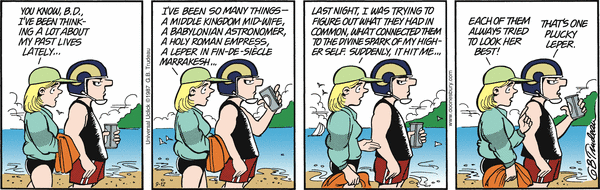
 eally has surprised me. There is no relationship I can see between how constraining a disability is and how the person responds to it. I write on our “front porch,” just outside the door of our apartment. The front edge of this picture is a hallway and I sit at one of the tables. And most of the time I am writing, people are walking by–some with the aid of walkers or canes.
 The Dilettante's Dilemma