
I am going to urge you to take a look at Paul Krugman’s column in today’s New York Times. I don’t like it and I very much hope that you won’t like it either, but let’s start by reading it.
 Here’s the argument. Trump has his heart set on authoritarian control of all the major institutions in the country, not just the political and economic ones. If we just sit back and let him do it, as some self-styled “voices of reason” counsel, we will lose our democratic system and may never get it back. [1]
So here’s Krugman’s counsel. It is the last line in the column and it is a bell-ringer.
When neither the president nor his allies in Congress show any sign of respecting basic American values, an aroused public that’s willing to take names is all we have.
Of course, “ringing the bell” isn’t all Krugman has in mind. He is an economist, after all. He provides specific instances of the kind of opposition he thinks is crucially important. Here are the examples he provides:
- It means patronizing businesses that defend our values and not those willing to go along with undermining them.
- It means letting public figures, however nonpolitical their professions, know that people care about the stands they take, or don’t.
- For example, it is not O.K. for newspapers to publish he-said-she-said pieces that paper over administration lies, let alone beat-sweetening puff pieces about Trump allies. It’s not O.K. for businesses to supply Mr. Trump with photo ops claiming undeserved credit for job creation — or for business leaders to serve on “advisory” panels that are really just another kind of photo op.
- It’s not even O.K. to go golfing with the president, saying that it’s about showing respect for the office, not the man.
The examples make it clear what he would like to see happen. His initial phrasing—“an aroused public that’s willing to take names”—is very spirited; the examples, not so much.
Let’s remember that Krugman’s announced goal is to protect civil society. His proposal is that formerly civil society be relentlessly politicized. It means in point one that we patronize the businesses with the right political values and, I suppose, boycott those with the wrong political values. It means in point two, demanding of all public figures—writers, lecturers, actors, athletes, people who are famous for being famous—that they trade their fame in for public position taking. It means, in point four, that the highest office in the land be treated as a partisan office ONLY, and not also a ceremonial office. [2]
That’s what Krugman says. I have three things to say in response.
First, you don’t protect civil society like that. Krugman defines “civil society” as “institutions outside the government proper.” I agree, but I would define it a little more broadly. I would say that institutions that are principally political or principally economic are both outside “civil society.”
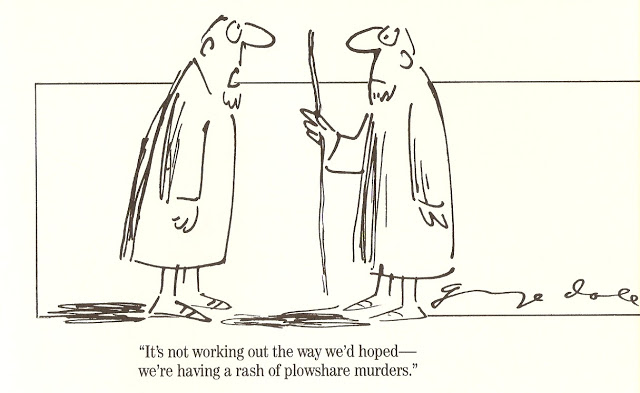
Second, Krugman portrays this an an emergency measure as if when the need for it is over, we will stop doing it. Isaiah 2:4 celebrates the beating of swords into plowshares and the spears into pruning hooks. I am glad that can happen, but the much more common transformation is from plowshares into swords and pruning hooks into spears. Not very many people ever feel it is safe to change them back. It’s like not carrying a gun after a period of carrying it. It’s like turning off your burglar alarm now that it is safe to. These things just don’t happen.
Third, Krugman seems to feel that when we have done the right thing—we have risen up against the impending Trump dictatorship—we will stop and then it will be over. Why would it be over? When we stop, the other side will start. Everything we politicize, they will politicize. And when we are done, they will feel that it is their turn, especially if we are successful at it. What we do as an emergency measure, will become the new norm as they respond in kind.
I have profited greatly from reading a communitarian sociologist named Frank Hearn. In his book, Moral Order and Social Disorder: The American Search for Civil Society, he looks at things in the common three-part way. There is the polity (the political system) and the economy (the economic system) and the society (the social system). As a communitarian, Hearn finds that most problems are best addressed in the social system. He writes soaring and persuasive prose about social institutions and how reliant we are on their proper functioning.
And along with all the beautiful language, he provides a few really ugly words: politicization and commodification. These are processes (the -zation and the -ification tell you that) by which an issue that was at one place is taken up and put somewhere else. Some issues that are properly social have been “politicized;” they have been taken out of the setting where good outcomes might be achieved, and have been put somewhere else. If they have been put into the political system, Hearn says they have been “politicized;” if they have been put into the economic system, he says they have been “commodified.”
Krugman’s proposal is, using Hearn’s language, a massive politicization of civil society. If we do that, we won’t get it back.
[1] Revolutions, just in case your mind was going that way, are very poor ways to establish democratic systems for the same reason that “broil” is not a good setting for croissants.
[2] We have already had parents of soldiers killed in action refuse any recognition of their sacrifice if it is to come from the President, the Commander-in-Chief of all our armed forces.
[3] A perfectly ordinary triad of social institutions reflects this: polity, economy, society.
 reading I have done, memories are not “accessed” in the way a filed document is; it is “recreated” each time. One thing that means is that although pulling a document out of a folder—either the paper kind or the electronic kind—doesn’t alter the document at all, recreating a “document” out of the elements of memory most certainly alters it.
 I describe it as a vision so that I can say what the vision was like. All of this is pure invention (except for the obvious debt it owes to Peter’s vision in Acts 10) but it enables me to say that something happened first and something after that, and so on. I say that I saw a great grey filing cabinet [1] coming down from the sky and a voice speaking to me. It might have begun, “Listen up, dummy.” Or not.
 And so on. 2a might be further divided into 2a-1 and 2a-2 by horizontal lines, but that is seldom needed and never very useful. There are, as you can easily see, four major parts to this “chapter;” the introduction and four substantive sections. The first section has seven subsections. The second section has 12, and so on. A, B, C, D provides the “outline” of the “chapter.” Subsections 1—7 provide the “outline” of Section A.
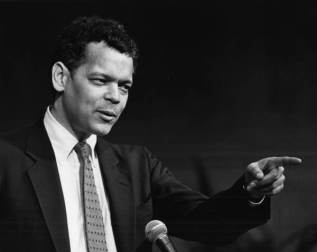 There is a story I attach to Julian Bond’s first experiences in the Georgia State Legislature. The way the story goes, Rep. Bond was the first black State Representative in Georgia and he wondered whether he would continue to be treated as a pariah when his vote made the difference between a bill passing or failing. He was not. When he carried the passage of a bill in his hand, he was treated the way the bearer of any other irreplaceable resource was treated. He was actively courted.
 use it to draw the threads of this argument together. There is an approach to sociology called “symbolic interactionism.” I got deeply into it in grad school and have profited from it ever since. Here is a line I would like to share from the abstract of a paper presented at the American Society of Criminology. It comes from a paper, the short title of which (the part before the colon) is “Labelling the Labelers,” by Jeffrey Ward. The question is, “What happens to the individual after being labeled?” [2]
 the legislators begin by recognizing that he often voted in a particular way, but they did that for two reasons. The first is that it left them free to argue that he and they had the same goal. Those other votes had to do, according to this strategy, with disagreements about means to achieve that goal, which of course “we all share.” The second is that it frees them to grant that those other votes might have been appropriate, but “this situation is different from those.”
 On the other hand, I live with some people and am related to some others, who think that Trump’s approach is the right way to go. Privately, I call those “misguided hopes.” I assume these people can be talked to if someone on the other side is willing to grant them good motives and to work at showing them that the collateral damage of the movement they are supporting will be unacceptably costly to other things they hold dear. I think I owe them the Julian Bond treatment if there is going to be a time on down the road when we can work together. Besides, they are family and friends, not just fellow citizens.
 (Ellen DeGeneris) and trying to persuade her that his feelings for her are intense. “I’m going to show you how much I love you,” he says as he grasps and breaks his little finger. Martha tries to persuade him not to do it and fails and when he does it, she is horrified. But it was all really clear to him and that is the point I want you to remember.
 He says, “I know there is a guy in science class who keeps hitting on you. To show you how much I love you, I am going to kill him so he won’t do that any more.” Her heart races. “Oh,” she says to herself, “He must love me a lot to be willing to do that for me.” The parents, listening through the window are thinking, “Did he just offer to kill someone to demonstrate the intensity of his love for our daughter?” Was he joking? He didn’t sound like he was joking.”
 dependent populations as opposed to the speeches the Trump/Pence campaign made. The Democrats said that coal is dirty, that getting it out of the ground is environmentally hazardous, and that we need to move to sustainable forms of energy. The Republicans said that coal is wonderful and that people who make their living mining coal are wonderful as are the women who wait hopefully for them to return safely from the mine. We will, the Republicans said, find a way to return coal jobs to the prestige they used to have and to honor the brave men who risk their lives to bring that energy to us.”
 department players, and thought the my President had done something wrong and had entertained feelings of disdain, that would be worth doing. Costly, probably, but worthwhile. You can spare some disdain for members of your own team without doing much harm.
 That means that the Democratic opposition is wasting its time playing defense by using policy. Policy isn’t relevant yet. You beat a political machine by bringing publicity to their operations, by prosecuting them to the full extent of the law, by protecting crucial resources who are vulnerable to threats and threatening people who are vulnerable to bribes. We (Democrats) have to work harder and more consistently and with more discipline than they do and since we represent the majority of the voters so far as political outcomes is concerned, we will “win” in this limited way if we do that.
 This is, as I see it, the Democratic problem. Let’s take income as one example. “Income” is two problems. There is how to have enough of it spread broadly enough to sustain a consumer spending economy. There there is the distribution of revenue, which looks at who has a lot and who has only a little.
 This was a whole new thing for me. I was completely smitten and was rooting around for occasions that would allow me to say something that I very much wanted to say. This wasn’t being fastened upon me, as in grade school, or a matter of mutual disinterest, as with my second wife. No, this was me looking for an occasion and seizing on Valentine’s Day as an excuse. That changed my attitude toward it entirely. {The picture is from the right era, at least. In it, we are celebrating Bette’s alma mater, (North Dakota State) which is represented by the same colors as my alma mater (the University of Oregon.)
 “hugs and kisses.” First, it ought to mean “kisses and hugs” because the X is the symbol that is supposed to refer to osculation. Still, we make do with the language as we find it.
 Kobo Abe’s 1964 novel The Woman in the Dunes is the first treatment of this theme I know about. The protagonist , Niki Junpei, is an entomologist who is trapped in a sand pit because the locals won’t let him leave. All day every day he must shovel back the ever-advancing sand dunes. A young woman lives in the cave as well and they both work at this task. Eventually, working at this endless task along with the young woman comes to seem an appropriate way to spend his life.
 begins with the same weather forecast and the same music and the same pointless jokes on the radio—and turning it into a ritual of good deeds. He changes the flat tire on a car, peforms the Heimlich maneuver on a man choking to death in a local restaurant, catches a kid falling out of a tree, rescues a homeless man from starving and freezing to death. And…he honestly courts a woman he loves, knowing that she will continue to reject him and that he will continue to deserve rejection.
 narcissism.” But the case I presented is not like that. This guy—the father, employer, mayor—IS a narcissist. It is what he is like ; he overestimates his abilities and has an excessive need for admiration and affirmation. [3] And that means that he will be a narcissistic father, a narcissistic employer, and a narcissistic mayor. He brings his condition, in other words, to the statuses he occupies and as he plays out the roles those statuses demand, characteristic traits of NPD show up at home and at the workplace and at city hall.
 That brings me to Donald Trump. And for those of you who are wondering why it took me so long, the answer is that I am trying to distinguish between the effects of narcissistic behavior, on the one hand, and the causes or the signs of it on the other
 with narcissism? It seems to me that we can find three there at least.
 I need to find a way to get off this horse before I disappear over the far horizon and I have an idea. There is hardly a more innocuous movie that The Wedding Date, starring Debra Messing and Dermot Mulroney. Messing takes Mulroney to the wedding of her sister, pretending that he is her fiancé when in fact he is a professional escort. Messing is concerned that the proceedings will go well, but they start going badly as soon as she and her “wedding date “ arrive.
 And Stephen Colbert blusters, “If our Founding Fathers wanted us to care about the rest of the world, they wouldn’t have declared their independence from it.” Season 3, Episode 2
 articles called “analysis.” These are “news stories.” In a long life of reading the New York Times, I have never seen anything like it.
 often enough, there is simply no way for the media to deal with them while staying within the boundaries of “professional journalism” as previously defined. I think they have decided that the pallid responses to which they have limited themselves have made them tools of some of the worst elements of American politics and they have decided that if that is what “professional” means, it is time to give it up. (This is Sean Spicer, by the way, President Trump’s Press Secretary. For fans of The West Wing, he is standing where C. J. Craig used to stand.)
 communicate the truth in plain language. “He knows it isn’t true and he keeps on saying it is true. If that isn’t lying, what is?” And these bald confrontational questions wind up in the headlines, not buried in the text. And not countered by someone representing “the other side.
