Remembering Dad at Easter

My father has been dead for more than thirty years, but every Easter, I remember him as vividly as if we talked just last week. I am going to show you two really ordinary pictures today. They are pictures of socks. They aren’t very good socks. The elastic is getting pretty relaxed and there are some little holes up on the ankle. But they were Dad’s socks and I wear them to the Easter services at our church every year.

I want to begin by saying that these socks “represent” something. I put the word in quotes this time because I want to use it literally; the socks “make present again”—they re- + present—a certain part of my relationship with Dad and that I why I wear them at Easter.

Dad had a lot of trouble with the Resurrection. I do too. But he thought it was important so he never quit IMG_0029.jpg wrestling with it. I haven’t either. Dad was in a great deal more contact with “resurrection” than any casually orthodox Christian would have been. I think Dad knew the Resurrection about as well as Jacob knew the angel he wrestled with and for most of the same reasons.

I wear his socks at Easter to honor all that wrestling Dad did and to help me remember to fight the good fight myself. More about “the good fight” in a little while.

I sometimes thought of Dad as a diver who was a long way below the surface and who was brought up to the surface too quickly. He got DCS (decompression sickness), commonly called “bends.” As his son, I never got to the depths he reached and I took a lot longer coming to the surface, so I didn’t have to confront the bends myself. Very much. Here’s how I saw that in Dad.

Dad came to maturity in a very conservative religious culture. You didn’t have to understand what the Resurrection was, but you did have to believe that it was true. That was hard for Dad because that same culture taught him to be very careful about his own integrity; not to say something was true if it was false or that it was unimportant if it was crucial. Some of the religious practices that produced seemed to me more humorous than tragic. In a church service where we were saying “what we believe,” Dad refused to submerge his own beliefs in any kind of “we” at all. He said that if the Apostles Creed began “We believe in God the Father Almighty,” and so on, he would have no trouble with it. “We” do, in fact, believe in God the Father Almighty.

But it doesn’t say that. It says “I believe in God the Father Almighty” and so on. Dad didn’t IMG_0030.jpghave any trouble with that particular clause, but there were clauses that troubled him a good deal and he didn’t say those clauses. The effect was like a radio with a loose connection and some clauses would be easily audible, then some silence, then another audible phrase.

My father was a serious man and he had long ago learned the meaning of the teaching Matthew passes along on “swearing.” Let your yes mean yes and your no mean no” the Matthean Jesus says. “Everything more than that comes from the Evil One.”

As an adult, Dad got a little breathing space from some very modern Christian teachers. Of these, I think Harry Emerson Fosdick was the best known. Fosdick was “a modernist” at a time when “the modernist/fundamentalist controversy” was in full swing. There were a lot of things about Fosdick’s ministry that meant a lot to Dad, but I think it was Fosdick’s panache that really sold him. He said new things and he said them coherently and on occasion wittily. He represents the surface that Dad, following the DCS (bends) metaphor, came up to too quickly.

Here is a story that might illustrate the difference. In the community where Dad grew up, no one would have said “I don’t believe in God” but if anyone had, he or she would have become the focus of a great deal of emotional energy—some of it generous and redemptive, another part of it angry and threatening. But no one would have said what Fosdick said when a young and aggressive parishioner said he didn’t believe in God. “Tell me about this God you don’t believe in,” said Fosdick in the story I heard Dad tell dozens of times. The angry young atheist started down the catalogue of things God has done and things His followers have done that are horrible to contemplate. “Oh…that God,” said Fosdick. “I don’t believe in that God either. Let me tell you about the God I believe in.”

In making Crossroads Brethren in Christ church of Mount Joy, Pennsylvania one pole of Dad’s experience and Harry Emerson Fosdick the other pole, I am not being fair to either, but I am trying to suggest the very great distance Dad had to cover to get from one to the other. And he was forced to do it too quickly. That is how he got the bends.

Somewhere in the transition, Dad acquired the “modernist” belief that theology ought to make sense. In the world where Dad grew up, a world of German pietism, “making sense” was not a high order achievement compared, say, with accepting the mystery of grace on faith. In the world where Dad lived when I knew him, “making sense” was crucially important, but it wasn’t hard to achieve if you began with the right questions. Of course, “beginning with the right questions” isn’t all that hard if the community of Christians you live in takes it for granted that the questions can be reformulated so as to be open to modern rational answers. That didn’t work for Dad. He continued to ask the old kinds of questions and to try to answer them with the new kinds of answers. The effect of that, to finish off the bends metaphor, is that Dad was never quite at home on the surface. He didn’t become “a modernist.” He did reject the belief patterns of his youth. He touched the surface now and then; he aspired to the surface—the place where Fosdick lived—but he couldn’t live there.

And that’s why his voice turned off and on when he “recited” the Apostles Creed and that’s why he continued to struggle with the real event of the crucifixion and resurrection of Jesus of Nazareth. And I do too.

And that is why I wear Dad’s socks to our Easter services every year. But I don’t have the bends, the way Dad did, and I have him to thank for that. For one thing, I was not raised in the depths, as he was. I was raised kind of half way up. Not to do more with this simple metaphor that it will really allow, we “visited” the depths where Dad had lived. And we visited the surface where Fosdick’s successors lived. But we didn’t “live” at either place—at least I didn’t.

I also have Dad to thank for being willing to talk about these things with me. I never heard a story in which some older trusted person was willing to sit and listen to Dad’s doubts and to help him find an authentic way to a mature faith. I can’t think who in his life could have done that. I had Dad.

And in the late 1960’s I came to live at the surface. I never had to traverse the distances Dad did and at the distances I did have to travel, I had him as a guide. Dad was not a guide because he had arrived at the place I wanted to be. He was my guide because he never gave up on the questions that shaped his religious awareness from the time he was small and because he never gave up on trying to make sense out of the answers that were available to him as an adult.

So, from my late 20s onward—the way I have told the story I was 28 at the time and thatmaxresdefault.jpg is probably about right—I tried to understand the essential “truths” of the Christian faith in a way that made sense. I was free, as Dad was not, to mess around with the questions and that is how I was able to come up with “answers” that fit the questions better. Like Captain Kirk, subverting the Kobayashi Maru exercise, I have felt free to reprogram the computer and manage not to die.

But for me, too, there is the matter of the resurrection of Jesus of Nazareth. I don’t understand what it was. I don’t understand it as a template of what is in store for everyone. I don’t reject it because I don’t have an ultimate allegiance to “things I can understand,” but I do continue to wrestle with it, like Dad did, and I honor that struggle in myself as I honored it in him. Which is why I wear his socks to the Easter services and have done so every year since he died. I have worn them 32 times.

Some years before he died, Dad became more and more constrained by Alzheimer’s Disease. My guess is that the loss of cognitive function didn’t affect his life of faith at all. He still trusted Whom he trusted. Alzheimers didn’t do good things to his theology, however. He continued to wrestle with the old questions for awhile, it seemed to me, but without the reservoir of strength he had once had. And then, after a while, it seemed to me that he stopped wrestling, as if he had passed that job on to a successor.

Dad’s last years were spent in an Alzheimer’s unit at a retirement center where he was given very good care. But it was a public place, not a private place, and that is why he needed to have his name taped onto everything he was going to wIMG_0031.jpgear. Of the socks I show you here, one of the tapes is still clear, as Dad had been. And one is blank, the identity has come off, as Dad became. And I think about that when I put on the one sock; then the other.

But I really don’t struggle with the bends, to go back to that metaphor, the way Dad did. I
didn’t dive as deep, the surface therefore wasn’t as far away, and I had someone to talk to. I say the whole Apostles Creed, which Dad would not do, because I know why they put some of those clauses in there—“and under the earth,” for example—and I think there were good reasons for them to do that. I participate in the process because I honor it; I don’t withdraw from the process because I can’t understand the meaning of the words. And I can afford to do that because I don’t have the bends.

Something happened to cause the disciples to change their view of what had happened in the life and death of their friend, Jesus. The various gospel writers give us little scenes that were intended to show why the disciples were persuaded that it was a real event and that Jesus was still, in the present post-Easter time, a real person. The scenes the gospel writers offer us don’t do the job of clarifying for me just what the nature of the post-Resurrection Jesus was. And it may not have answered that question for the disciples either. But without question, they did have the sense that Jesus was “back” and that the whole story of his life and death now meant something they had not understood at the time.

Whatever it was that happened—as illustrated by these scenes from the scriptures—is what I call “the Resurrection.” I believe that “it” happened in the sense that I believe that something which had the recorded effects happened. I don’t say “it” didn’t happen just because I don’t know what to call it.

You would think that would be enough, wouldn’t you? And it is, most of the time. But at Easter, it doesn’t seem to be quite enough and I wrestle again with what else it could mean. And while I wrestle, I honor my father.

I am sure I have walked a mile in his socks by now and I think I understand how he felt. Thanks, Dad.

Posted in A life of faith, Getting Old, Living My Life | Tagged , , , , | Leave a comment

Gifted, the story of “The Continent Uncle”

giften 1Let’s get the invidious comparisons out of the way right here at the beginning. McKenna Grace is much cuter than Matt Damon has ever been. OK, having said that, Good Will Hunting is a much richer movie than Gifted. Both explore the dilemma faced by a brilliant kid who wants to life a normal life. Matt Damon plays a punk from South Boston; McKenna Grace plays Mary, a little girl with no social skills whatsoever (no friends either) being raised by her uncle in Florida.

Thematically, they explore the same ground.

Which brings us to the multiplex. “Multiplex” [1] is the metaphor I have been using lately to convey the idea that when you walk in to see a movie, there is a virtually unlimited number of movies you can see, sitting right there in your chair.

When Bette and I went to see Gifted yesterday, I already knew what “the plot” was.[2] I gifted 6had read the synopsis and seen a preview. But I also knew that sitting there in my chair in the theater, I could see any number of other movies. It occurred to me when we went in that I might be about to see a movie about a “gifted” uncle, who is raising a little mathematically precocious girl in pretty casual circumstances in Florida. I was ready to see that movie and it would have been a really good movie. I might see that movie when I go back to see Gifted again. I could call it The Gifted Uncle.

But the movie I did see is not one I was prepared for at all. I saw The Continent Uncle. Who would have thought it? If you can see the “contain” in continent, you will understand that this particular uncle (Frank Adler, played by Chris Evans) has something he would like to do—a very hurtful thing, it turns out—and all through the movie, he is able to contain himself. And even at the narrative climax, when he does this hurtful thing, it is the least hurtful thing that will redeem the situation, and therefore the most gracious action available to him.  Frank is a really good guy.

Frank Adler has a document in his possession. He is the only one who knows he has it. It will be devastating to his mother (Evelyn Adler, played by Lindsay Duncan) and he has, all along, refused to hurt her in that way. Audiences are not told about this document and we have no idea there is one or what it could mean, but in fact, Frank Adler’s refusal to let out even the tiniest hint of what he has in his possession, is the most powerful theme of the movie, The Continent Uncle. (It is not the major these of the movie, Gifted, or the movie, The Gifted Uncle, which is the one I thought I was going to see.)

It is awkward, I grant you, to say that the most meaningful part of the movie is watching the main character not doing somethinmultiplex 7g. But if the climax of the movie is Frank’s slamming the document down on the desk in front of his unbelieving mother, then his doing nothing about that document all through the movie is enormously meaningful. You just don’t realize it at the time.

Now it may be, I confess, that I am a sucker for this kind of theme. I saw the same thing in The Intern where Ben Whitaker (Robert DeNiro) withholds from us, the audience, and from every character he runs across in the movie, a vital fact about his life. And when you find out what that fact is, what you want to do is to go back through the movie paying particular attention to the times when he could have revealed this fact and did not. We don’t see him strain under the effort of “not saying,” just as we don’t see Frank Adler straining under the effort of “not revealing” the document.

But when you think about it, all those moments of “not doing” become very significant, so far as understanding that plot is concerned, and very powerful emotionally. At least, they did for me.

My way of exploiting the multiplex (see Welcome to the Multiplex, April 6, 2017) is as follows:

  • to get some clarity on the story I saw; then
  • to pick the climax, the defining moment of that narrative; then
  • to reflect on the events necessary to that theme, whether I was aware of them at the time or not; and finally
  • to follow that narrative from the climax to the end.

It was when Frank Adler tossed the document on the desk and we got to see the title that I understood that this movie is not the one I was prepared to see and not the one, either, that the previews had hinted at. From that climax, I worked backward to see what was meaningful in that light of the narrative defined by that climax, and forward to see the conclusion of the story defined by that climax.

gifted 3I have no way of knowing, of course, what movie you will see when you go to see Gifted. You may want to go back and see Good Will Hunting again. I did.  You may attach the principal meaning to the mother and the relationships she has had with her husband, her son (Frank) and her daughter, Mary’s mother. This particular movie is about her relationship with her granddaughter, but Evelyn is a “one interest at at time” sort of person. “Very English,” says her continent son Frank, and there is no reason you can’t just give yourself permission to see the story that stars her and her aspirations, if that is the one you want to see.

Or, if you prefer, you can see the story with the next door neighbor, Roberta Taylor (played by Octavia Spencer). She is a wonderful friend to Frank and a truly exceptional teacher for Mary and she never has, so far as the movie shows us, a single concern for herself. She is entirely invested in the lives of others and that would make a pretty good movie too, if that is the one you would like to see.

Do see Gifted, though. And while you are there, any of those other movies that takes your fancy or that takes over your whole experience.

[1] It just means “many-fold,” (not manifold). It ought properly to be an adjective in most cases.
[2] And virtually none of the plot is going to be revealed in this essay, so you can read it with a clear conscience if you are a “spoiler alert” sort of person. I am not.

Posted in Movies | Tagged , , , , , | Leave a comment

Thinking about Chinese dominance

I grew up at a very favored time in the U. S. We had fought and won a war against “the Axis powers.” We had a nuclear monopoly in the world. We were the last undamaged economy in the world and we rampaged through the world’s other economies, bringing order (based on U. S. interests) and predictability (based on commitments we could enforce) everywhere we went.

It was a very good time. [1]

solar 6It is gone and it is not coming back. Politicians can promise that they will “fight for us,” and as long as we are feeling powerless to control our own economic destiny, that promise will be powerful. They are empty promises. We can no longer control our economic destiny and that is probably a good thing, however uncomfortable it makes us feel.

I want to reflect today on a New York Times article that is, in the narrow sense, “about” China’s domination of the solar panel market. Just a little more broadly, I would say it is really about economic nationalism, a “perversion of the market,” in which the state intervenes to shape the market in support of national goals. And finally, just a little more broadly than that, I would like to look at realistic American goals in a world economy in which China is the dominant power. [2]

Here are some reflections by Keith Bradsher’s Times article.

President Trump, who pressed President Xi Jinping of China on trade and other issues this week when they met at Mar-a-Lago in Palm Beach, Fla., has vowed to end what he calls China’s unfair business practices.

When I referred to politicians “promising to fight for us,” it is actions like this I had in mind, although Hillary’s rhetoric used the same emotional promises. What are we going to do, exactly, about “China’s unfair business practices?” There are no global economic institutions that can constrain China. Arguments made from classic market theories will not cause them to choose a lesser role than their resources could earn them. We are the coach yelling for a charging foul because we have found no way to keep the driver from free access to the basket.

solar 1Consider what China has already done with solar panels. “China is now home,” Bradsher says, “to two thirds of the world’s solar production capacity.” That gets them a place at the table, wouldn’t you think? And, Bradsher continues, “because China also buys half of the world’s new solar panels, it now effectively controls the market.” I would think that would give them most of the other places at the table as well.

What does that mean for us? The Times piece chooses Russell Abney, of Perrysburg, Ohio as the poster boy for these effects. The Chinese government cut its subsidies to domestic buyers of solar panels; the manufactures cut their prices to compensate, and Mr. Abney is out of a job.

… Mr. Abney and about 450 other employees suddenly found themselves out of work. “Within just a few months, it all came crashing down,” Mr. Abney said. “It’s like a death in the family. People feel awkward talking about it.”

In Perrysburg, Mr. Abney lost his job at First Solar, the largest solar-panel manufacturer based in the United States, and looked in vain for a job in the auto industry in the Toledo area. He ended up taking a job three weeks ago at a building materials company in Lancaster, Pa.

That is a huge effect for a small market adjustment in China to have and it wasn’t just in the U. S. There were jobs lost in Germany as well. I think we have lost our sensitivity to this kind of effect because we have been more often the actor than the patient. [3] We are accustomed, in other words, to looking at a specific business decision we made—like China’s decision to cut subsidies to customers—and justifying it by the outcomes for us. We are looking now at that same decision being made by someone else, with unpredictable consequences for us, and no way to square it with our traditional notions of national autonomy.

The case for Chinese capacity in the new global market gets a great deal more extensive and I want to at least bow in that direction, but in dealing just with solar panels, I have laid the foundation for some questions about domestic politics in America.

The nationalists—whether progressive or conservative—are going to make their pitch to solar 2voters on the basis of what we will have to do to “govern ourselves once more” or to “take control of our own destiny” or even “to return America to the leadership we once had.” I haven’t even begun to cover the slogans, and in my list, I restricted myself to only positive images. If you include avoiding negative outcomes—like “Better Red than Dead”—you can make a much bigger list.

The globalists—whether progressive or conservative—are going to say that the world is a certain way and that pretending it is not is only prolonging a fantasy. We can be very successful niche players, these globalists will say, and make a lot of money and continue our tradition as an independent nation.  Or we can waste a lot of money trying to pretend that we dominate the economic and political systems the way we did after World War II—and fail anyway.

solar 3The nationalists will call the globalists, “defeatist.” The globalists will call the nationalists “delusional.” What I want to know is what the voters will call these two “parties.”

In Robert Reich’s excellent book Aftershock, he imagines that Margaret Jones wins the presidency in the 2020 election. [4] Here are a few elements of her platform:

  • increased tariffs on all imports
  • a ban on American companies moving their operations to another country or outsourcing abroad
  • a prohibition on foreign “sovereign wealth funds” investing in the United States.

America will:

  • withdraw from the United Nations, the World Trade Organization, the World Bank, and the International Monetary Fund.
  • end all “involvements” on foreign countries
  • refuse to pay any more interest on our debt to China, essentially defaulting on it, and,
  • stop trading with China unless China freely floats its currency.

Or, as President-elect Jones says as she hits the climax of her acceptance speech, “A nation of good jobs and good wages for anyone willing to work hard! Our nation! America for Americans!” (Thunderous applause).

President-elect Jones’s speech came to mind as I reviewed the coming conflict between the nationalists—like Margaret Jones and Donald Trump—and the globalists, like George H. W. Bush, Bill Clinton, George W. Bush, and Barack Obama. If the average per capita income in the United States continues to decline for middle class families, it is hard to see a globalist getting elected.  In the chart below, look at the trend lines below $50,000,

One more point about China.

But economists and business groups warn that China’s industrial ambitions have entered a new, far-reaching phase. With its deep government pockets, growing technical sophistication and a comprehensive plan to free itself from dependence on foreign companies, China aims to become dominant in industries of the future like renewable energy, big data and self-driving cars.

Solar panels are, in other words, China’s off-Broadway production. They have a model—I called it “economic nationalism” earlier—and the resources to put that model into operation in ways that far outstrip Japan’s efforts in the 1990s. With that much money and that much power and that many customers and that many producers, what global industry could they not dominate if they chose to?

solar 5If this is the wave of the future, economically, how can the American voters prepare to vote their own economic self-interest in national elections? How can they learn to respond to the globalist message when there is no hope in it for them and no way back to American global dominance?

Can these Americans learn to prefer actual prosperity based on being a part of a well-functioning global system, to promises of a return to former glory? We didn’t in 2016. Maybe we will have another chance in 2020.

[1] And I’m not even considering the post-war social conservatism which was very favorable to men. I didn’t know at the time that I was living in a little androcentric bubble; I thought that’s just how things had always been.
[2] In choosing that focus, I am not saying that China now is that dominant power, but China is following the 1990s path used so successfully by Japan, except they are bringing a huge population and huge resource base to the project. If they can continue to buy off their internal dissenters, I don’t see what stands in their way. Certainly, it is not us.
[3[ I know that “patient” looks odd there, but I wanted to imply passivity and also to imply suffering and both of those words derive from a Latin verb meaning “to suffer.” So I am granting myself a little poetic license.
[4] The subtitle of Reich’s book is “The next economy and America’s future.” See page 79 for the platform of the “Independence Party.” Reich’s vision is so compelling that I forgive him for predicting it four years too late. In this fantasy, Jones defeats the Republican candidate, George P. Bush and the Democratic candidate Chelsea Clinton.

Posted in Politics | Tagged , , , , , | Leave a comment

North Carolina. First and Last in Flight

I was an early fan of the saying, “A Mind is a Terrible Thing to Waste.” When I was young, my mother thought that I mostly wasted mine and I wouldn’t want to argue that she was wrong.

On the other hand, there are times when a very broad range of association is a comforting thing to have. Like yesterday, for instance.

A part of what mother called “daydreaming” was my mind’s response to the associationsNC 2 one thing evokes which attached it to another. Of course, associations—plausible but mistaken associations—are the root of a great deal of humor. Advertising for mattresses, for instance, is full of references that could be taken to refer to the mattress or to what one might enjoy doing on the mattress. They count on you to associate the one meaning with the other and nearly everyone does.

That’s what I mean by “association,” but I associate things that aren’t really that close. “I have,” as Tom Lehrer says, “a modest example here.” It has to do with North Carolina. [1]

North Carolinians are called Tar Heels in the same way that Kansans are called Jayhawks. Tar was an early product of the colony of North Carolina and later the state of North Carolina. “Tar Heel” was probably a slur, originally, along the line of “Redneck.” But Tar Heels came to be a treasured term of self-definition when it got associated with the firmness with which North Carolina militia stood their ground.

NC 1I have seen that story set in Revolutionary War times and in Civil War times, but either setting presupposes the line of soldiers with muskets or rifles standing in the way of an attacking army and refusing to retreat. “They stood there,” ran one account I saw, “like they had tar on their heels.” The Tar Heels had the courage to “stand their ground,” a term that makes perfect sense on the battlefield. [2]

North Carolina is also known for the first trials of motor-driven flight by Orville and Wilbur Wright, as pictured above. [3] The first flights took place at Kitty Hawk, North Carolina and when the state legislature put the slogan “First in Flight” on the license plates, it is that event they are commemorating.

But now we come back to the “range of association” problem. I was walking_Image.jpg down the street yesterday when I passed a car with a North Carolina plate. It said, like this one, “First in Flight.” At that point, my mind handed me a meaning of Tar Heel I had never had before. Thank you, mind. It pointed out to me that “Tar Heel” means “Last in Flight.” That’s a very good thing if you are talking about the behavior of soldiers in battle. So I started smiling and have hardly stopped. When I was still chuckling about it this morning, I thought I would share it.

North Carolina: First and Last in Flight.

[1] And this has nothing at all to do with their having defeated my beloved Ducks in the Final Four this year.
[2] And none at all on your front porch.
[3] Again, nothing against North Carolina but Orville and Wilber were from my home town (Dayton, Ohio) and I don’t think I’m ready to give them up.

Posted in Paying Attention, Uncategorized, Words | Tagged , , , | Leave a comment

James the Presbyter at Princeton

I have been paying a good deal of attention to the recent goings-on at Princeton Theological Seminary for one reason or another. The issues themselves are small potatoes, it seems to me; in comparison to the reasons people have given for their responses to those issues. The event itself will come and go; I fear that some of these justifications will remain to trouble us for generations.

What’s going on at Princeton?

Here’s the short version. One of the centers resident at Princeton [1] offered an invitation to a popular conservative pastor to receive an award and give a lecture on a topic completely appropriate to the seminary. The standard procedure is for any constituent part of the Seminary to ask the Seminary to issue an invitation on their behalf. The Seminary is therefore the inviter of record, even the it is not the source of the invitation.

identity theology 1No one questions the speaker’s qualifications to speak on the assigned topic, but he is a member of an organization (the Presbyterian Church of America) which is more conservative than the Presbyterian Church USA, the home denomination of Princeton Seminary and the PCA is a great deal more conservative than the faculty and students at the Seminary itself.

The speaker’s membership in this denomination is being treated as if it were equivalent to membership in the Nazi Party or in the Ku Klux Klan. And treating him in this way is being justified by people from whom I have come to expect better behavior. These are not just people at Princeton. The blogosphere is alive with fingers being pointed and “sadness” being expressed.

James the Presbyter

There is another way to approach this whole matter, needless to say. I’m not done complaining yet about the approaches I have described, but I would like to describe a better way before I finish up with my complaining. You can read about this in Acts 15. James, whom I am calling “the Presbyter,” on no better grounds than that he was a old man, finishes all the deliberations. Here is the passage I have in mind.

Acts 15: 13 When they had finished it was James who spoke. ‘My brothers,’ he said, ‘listen to me. 14 Simeon has described how God first arranged to enlist a people for his name out of the gentiles. 15 This is entirely in harmony with the words of the prophets, since the scriptures say: 16 After that I shall return and rebuild the fallen hut of David; I shall make good the gaps in it and restore it. 17 Then the rest of humanity, and of all the nations once called mine, will look for the Lord, says the Lord who made this 18 known so long ago. * 19 ‘My verdict is, then, that instead of making things more difficult for gentiles who turn to God, 20 we should send them a letter telling them merely to abstain from anything polluted by idols, from illicit marriages, from the meat of strangled animals and from blood.

I want to focus on verse 19. “Instead,” James says, “of making things more difficult for the gentiles [those gentiles who are turning to God], we should…”

The simplicity of this approach is amazing. We have begun to preach the gospel. Welidentity theology 3l beyond our initial expectations, many gentiles have responded positively. We could treat their interest as an occasion for “harassing them” [2]. We could see how sincere they are by putting obstacles in their way. We could cast aspersions on some other aspect of their way of life or their associations. But wait, James says, let’s not do that. They are turning to God. Let’s refuse to throw obstacles in their way.

Identity Politics and Identity Theology

I said that approach was simple. Of course, I didn’t say it was easy. It is not easy, particularly today, because to get to that simple starting place, you have to walk past a lot of other more attractive starting places. Many of these can be grouped together in an approach that Case Thorp, of Orlando, Florida, calls “identity theology.” He means that as an adaptation of the expression “identity politics,” so perhaps we should stop and take a look at that first.

If you think of national politics as the pursuit of the institutions and policies that will best govern the nation, identity politics is the polar opposite. Identity politics does not take “the national interest” as the goal, even for rhetorical purposes; “the goal” is the prominence of my group and its interests. “We,” in identity politics, always means “we Presbyterians” or “we feminists” or “we Evangelicals” or “we, the makers.” [3]

People who point to “identity politics” with alarm say that the pursuit of a separate self-enhancing goal by each group virtually precludes the common pursuit of our common interest. But, in fact, no common victory will achieve the goal of clarifying just who “we” are and how much better “we are” than “them;” a divisive, self-enhancing goal will always better for that.

By referring to “identity theology,” Rev. Thorp means to say that this kind of “it’s all about me” theology has the same effects on the church that “identity politics” has on the political system and in that I am sure he is right.

Christianity and…

identity theology 2The expression “identity theology” is new to me, but it is an idea I have seen in practice for a long time. Sometimes, when I get sloppy, I see it in my own practice so I am not pointing fingers as a mere spectator might. I ran across this idea first in C. S. Lewis’s The Screwtape Letters, the premise of which is that Screwtape, a very senior devil, is giving advice to his pupil, Wormwood, about how to damn human souls. [4] This passage is from Letter 25.

The real trouble about the set your patient is living in is that it is merely Christian. They all have individual interests, of course, but the bond remains mere Christianity. What we want, if men become Christians at all, is to keep them in the state of mind I call ‘Christianity And’. You know—Christianity and the Crisis, Christianity and the New Psychology, Christianity and the New Order, Christianity and Faith Healing, Christianity and Psychical Research, Christianity and Vegetarianism, Christianity and Spelling Reform. If they must be Christians let them at least be Christians with a difference.

In “identity theology,” the difference in “Christians with a difference” has taken over.  That is why people who think of Christianity as an aid to personal piety or to sexual chastity or to richer romances or to liberating the toiling masses, are thinking of their faith as a tool. It is not “our commitment to a common tool” that has ever bound us together or that could ever bind us together.

With that in mind, I want to return to the perspective of the apostle James in Acts 15. James, I now see, is confronted with several varieties [5] of “Christianity and…” James’s ruling is aimed at koinonía—at “common-ness”—so setting the new gentile converts off from any obligation to their Hebrew brothers in Christ is not going to work. It is not “common.”  It is just Christianity and the Gentile Mission. Similarly, James is not going to allow Christianity and the Renewal of Judaism because it puts obstacles into the path of the new gentile brothers in Christ, so it, too, in not “common.”

identity theology 4

I am quite sure, although Luke doesn’t give us this, that James was tarred with “being insensitive to the glorious history of salvation through Torah.” The people doing the tarring were completely committed to what they were already doing and all they wanted was a chance to snipe at the people who had other commitments. I am sure James was tarred with being “oblivious to the rich harvest among the gentiles” by people who didn’t care all that much for the Torah and even less for the Temple.

There are, at Princeton, many issues at play and many factions are playing them. Every one of these—with a single exception—can be characterized, as I see it, as some form of “Christianity and…” [6] It is an elevation of my own private piece of the action to the central place, the place where “our action” and “God’s action.” should be. There is room for a great “commonness” at the center if, and only if, we agree not to harass those who are coming in good faith to participate in the event. This is not a proposal that child sacrifice be reinstituted. This is a question of who should be kept from the discussion on the basis of organizational memberships.

To each of these factions, James’s response is this. “We see what God is doing. He is inviting gentiles to join us. Let us not get caught sabotaging an action God is taking.” And if I could add a small but snarky codicil to James’s letter, this is what it would be. “I see that you are unhappy that my decision is “merely this” or “merely that.” I’ve got an idea. Let’s send them a letter that says that the cautions we want them to observe in honor of their Christian brothers are “merely these” and not any more.

[1] By Princeton I will be referring only to the Seminary, not to the University.
[2] The verb here is parenokleo, which may fairly be rendered “to harass.”
[3] I like that last one particularly because it distinguishes us from “them, the takers.”
[4] This means that one must always read Screwtape “upside down,” in a sense, inverting what is “good” and “bad.” I never had that much trouble with it, but the book appeared in serialized form in newspapers in England in the 1940’s and one man, thinking it was an advice column, wrote in to complain that the advice was so bad that it was virtually diabolical. He used that word: “diabolical.”
[5] Luke’s account actually gives us several varieties. We know there were more.
[6] The exception, lest I forget to be pellucidly clear, is the Seminary’s proposal that we refuse to harass those who are coming as guests and by invitation.

Posted in A life of faith, Biblical Studies, Political Psychology, Politics, Theology | Tagged , , , , | Leave a comment

Welcome to the multiplex

Have I got a deal for you. You buy your ticket to a “theater” showing…oh…half a dozen movies. This ticket will get you into the multiplex theater anytime you want as many times as you want, and when you are there, you can see as many of the movies as you would like.

multiplex 1Some years ago, I read a fascinating review of Chariots of Fire by Ted Mahar, who reviewed movies for The Oregonian at the time. “You’re really going to like this movie,” he said, as I recall it. “You’re going to to talk to your friends and they are going to ask you what the movie was about. And at that moment, you are going to begin to struggle. What was it about, really?  You know you liked it, but what was it about?”

The operating principal of the multiplex I described above is that a movie can be “about” any number of things. It doesn’t have to be about what the director says it is about, although the director’s intentions are always worth knowing.  It doesn’t have to be about what the scriptwriter thought it was about.  You just declare the focus of your concern—you might want to give each of these movies a different name—and construct the events so that they introduce, explore, are constrained by, and draw conclusions about, whatever you said the theme was. [1]

I got to thinking of this recently when I saw The Shirley MacLaine extravaganza, The multiplex 4Last Word. Embedded in the story of Harriet Lawler, a wealthy and talented bully, who lacks only a compassionately written obituary to support her declaration that her life a success, is the inspiring story of Anne Sherman, the girl she picks on to write the obituary.
How to do that?  It’s not that hard.

First, I declare the movie I am interested in to be “that movie about the obituary writer who was about half dead herself.” I watch The Last Word for the purpose of “seeing” this movie—not the other one. For ease of reference, I might think of something to call it. How about Life for the Taking? Does that work?  OK, the movie about the obit writer is now Life for the Taking.

Second, I pick the climax of that story, wherever it occurs and I ask what necessarily preceded it and what does, in fact, follow from it. In the case of my movie, Life for the Taking, the obvious climax is the scene in which Anne Sherman, the obituary writer, hands in her resignation, announcing, “This is not a letter of resignation; this is an obituary.”  How did she get there?  What happens next?

Third, from the pool of available events, I select the events that led Anne to want to do such a thing and to be able to actually accomplish it. This will involve reflecting on her relationship with her father, on getting a really good boyfriend, on her experience of digging through the havoc of Harriet Lawler’s life and in watching Harriet get away with really amazing things.  None of that requires the extensive background they give us to help us watch The Last Word.

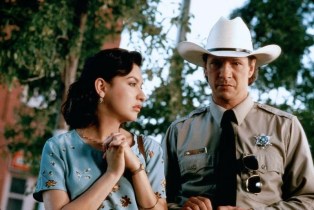
multiplex 3Fourth, I survey the characters who are now “minor characters” in this movie, Life for the Taking. That would include MacLaine, who is the major character in The Last Word. In this new movie, MacLaine is important only as she bears on the odyssey of Anne Sherman.  In what way did each of these characters contribute to the main theme? What depth did they add? What tension? How did each help define this plot?  Here are two of the main characters of one of the movies you can see in Lone Star.
If I go into the multiplex to see movies defined by who is the major character and who the minor characters, I can see—for the same price—as many movies as there are interesting characters. But sometimes, it isn’t the character that catches me.

If I declare a movie to be essentially an allegory, then the work of showing how this part of the movie is intended to point to that part of the story that is not shown. It isn’t character development; it is just point for point illustrations. Or if the director, as in the case of Pleasantville’s Gary Ross, says he intends an allegory, then following it out can be as interesting as if you made the decision yourself.. [2]

One of my favorite all time movies is Lone Star. It isn’t only because there are so many ways to rearrange the plot, but it does, in fact lend itself to that. You can see a very tight Army major drive his career and drive his family because he refuses to reconcile himself with his father who runs the most popular bar for servicemen in town. You can see the border town struggle to stay “American” (Anglo) when 80% of the population is “Mexican”—American citizens who prefer their traditional culture. You can see the sheriff fighting—and eventually winning—to escape the hallowed status of his father, the previous sheriff. You can see, as above, the sheriff and his lady love who do not yet know an awful secret about their relationship.  Buy the ticket and enter the multiplex. See whatever movie you like.

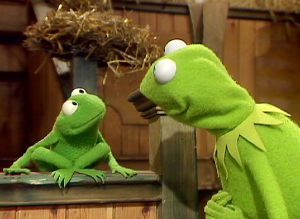
And if you have interests that are…oh…underrepresented in the movies, so much the better. I have an abiding interest in Christian theology, for instance. So I can make a detailed analysis of the kenosis passage in Philippians 2 (“he emptied himself, taking the form of a servant”) out of the Muppets version of The Frog Prince. I’ve already done that. The key line is, “But now I’m Sir Robin the Frog.”  The little frog is Sir Robin; Kermit is the big frog.

The contrast between “the life of this world” and “the life of the ages” which the gospel ofmultiplex 2 John maintains, is beautifully illustrated in The Matrix. When Neo, who is thought to be “the One,” is reunited with his body, which has spent all his previous years immersed in a tub of goo, he wonders, “Why do my eyes hurt?” Morpheus has to tell him, “Because you’ve never used them before.”

Steven Spielberg seems to specialize in these intriguing crossover movies and I’m not the only one to have noticed that. Very likely I am, on the other hand, the only one who regularly uses an account given by an Indian janitor named Gupta in The Terminal, as a superb illustration of what we can and cannot know about the preaching of the early church. Gupta gives the heart of the scene we just have just seen—10 to 15 minutes of carefully drawn action—in 52 words and doesn’t miss a single major theme.

Enough examples. The metaphor I am exploring today is the analytical multiplex. You go to see a movie and have access, within that movie, to all the other movies you can see just by changing foreground and background and redesigning the important lines of cause and effect.

If you are going to try it, try it with The Last Word.  It is so easy to do there.
[1] It works just as well for children’s books, by the way. I have told Russell Hoban’s wonderful Frances the Badger stories at the rate of about half a dozen “themes” per story. Ask me what Best Friends for Frances is about.
[2] Ross says he intends Pleasantville to be the Garden of Eden. Interestingly, there is no God in the Garden of Eden. It seems like an odd omission.

Posted in A life of faith, Living My Life, Movies, Theology | Tagged , , , , | Leave a comment

I saw it with my own eyes

April 4, 2017

I didn’t hit any serious theory about how we see things until I hit grad school. Then we paid a great deal of attention to Gestaltists—illustrations, explanations, and most fun of all, experiments. I liked it all, but at the point where a lot of my peers were saying, “Wow! Imagine that!” I was saying, “Well…sure.” Because I have been a birdwatcher nearly all my life and I know just how wrong you can be.

All of this is about a picture I want to show you. I’m going to tell you what I saw. Then I am going to show you what I saw. By that time, you will not be surprised that they are not at all the same thing. [1]

What I saw

I saw a young woman taking a picture of a young man with her camera as they rode together on a MAX train in Portland. I saw it all in a single glance, so I am going to try to give you an approximation of that experience by reproducing the picture in a very small size and asking you to just glance at it.

IMG_0001 (1).jpgSo think about that a minute while I tell you about birdwatching. Most of the time when you are looking at a bird through binoculars, you have some idea of what it is and a broader notion of what it might be. And rather than just “seeing what is there,” you find that your mind offers you one plausible rendition after another after another. If it ought to have a yellow throat, for instance your eye will choose the yellow of a flower from the background and “place it” onto the throat so that you have a momentary glimpse of the bird with the yellow throat. And you have to be patient and disciplined to see whether the yellow you saw on the throat—you really did see that—actually IS on the throat.

How we see

Gestaltists call it “constructivism,” meaning only that the mind assembles the elements of what you see and presents it to you as a finished product. Or, if you are more experienced, it presents it to you as a hypothesis. Any young parent learns to see the grin on baby’s face and disregard it and then to see the baby’s grimace as a sign that it is experiencing gas pains.  Why no one every thought to call that expression “a grinnace” I cannot really grasp.

The parent constructs the first reality, discards it, and constructs the second reality. When you get good at it, you have hardly any awareness of what you saw at first. That’s why we say “I thought I saw…” which I am calling mere equivocation.

So here’s the same picture at a more useful scale. This is what I saw when I looked back and it is why I decided to take the picture.

What was there

IMG_0001 (1).jpgI’m guessing about the neurological strategies involved here, but I think I saw the woman’s hand being held up at what, you will agree, is an odd angle unless you see that she is holding onto a strap. Which I did not see. I could have, but I didn’t.

Instead–I mean literally “as an alternative”– I saw a camera in her hand. The “camera,” being supplied, I saw at second glance, by the black hat of the man standing on the other side of her. My eye made a hand + camera hypothesis, which pushed aside the hand + strap hypothesis.  “Hand + strap” was there to see, but I didn’t see it.

The camera in hand makes a lot of sense of the attention the man and woman are paying to each other and to the distance between them. So I took the elements of the hand and arm, the “camera,” the social grouping, the distance and I saw her taking his picture. And if you say that I couldn’t have seen that because it wasn’t happening, then I have some really good texts on the neurology of vision you ought to read.

And when you know that there is no necessary relationship between what you see and what is there, you start to wonder how well you would function as a witness when they put you on the stand and put you under oath and demand that you tell them what you saw. They would not be amused, I am sure, if you began by saying that we don’t really “see things” in the way the court imagines we do, but you have no objection to describing the several constructs your mind offered to you—one after the other after the other.

Today, it happens is the birthday of my brother, John, who is far and away the most gifted seer of things it has ever been my pleasure to know. Happy birthday, brother.

[1] We have developed several linguistic bridges in an attempt to mask this chasm. We say, “I thought I saw…” But if one side of the chasm is the elements of vision and the other is the meaning of what we see, there is not bridging of it.

Posted in Living My Life, Uncategorized | Tagged , , , , | 3 Comments

The Last Word

I am married to a librarian and every now and then she dips into whatever bag of tricks librarians have and produces just the right observation. That happened last weekend and I want to tell you about it.

Telling you about it is the doorway to the movie I have been thinking about ever since then. It is called The Last Word [1] and it stars Shirley MacLaine and Amanda Seyfried.

images-1.jpegMacLaine’s character, Harriet Lawler, is a thoroughly unpleasant person. She has no respect at all for personal boundaries and respects no one at all—including her former husband and a woman who could probably be best characterized as her former daughter. She is very bright, very aggressive, and very rich so there isn’t a lot she can’t do just by wanting to.

But, of course, one thing she can’t do by wanting to is to have lived a different life than she has lived. So when it occurs to her that the only way to control what her obituary says is to get it written in time for her to approve it, she sets off to find a compliant writer of obituaries and she finds one in Amanda Seyfried’s character, Anne Sherman. Anne is the perfect foil for Harriet. Harriet is sure of herself, willing to take risks, and has no regard at all for any values other than her own. Anne is unsure of herself, is terrified of making mistakes, and is fits herself whenever possible into the values of others.

When Harriet realizes that she can’t have the kind of obituary she wants without a stupendously successful last chapter to her life, she sets out to accomplish that and takes Anne along to watch how it is done. Part of the re-make of Harriet’s life is to do some good thing for a poor child. She chooses Brenda, a foul-mouthed nine-year black-old girl who takes one look at Harriet and accuses her of being there as a form of “community service.” Why else, thinks the very street smart Brenda, would an old, rich, controlling woman wind up at a center for underprivileged black kids?

Brenda, in her nine-year-old way, is a good bit like Harriet. When we firstimages-3.jpeg
see her, she is in trouble with the local librarian because she has rearranged all the books in the library “in alphabetical order.” Her response to being scolded for having done that is “Letters with decimals are for losers.” [2] She doesn’t understand the notion underlying the Dewey Decimal System, so her rejection of it is naturally broad. Losers?

OK, so then the story happens and Harriet finally dies and at her intricately choreographed memorial service, she leaves Brenda a library full of books which will be organized alphabetically only. And not only that, but she repeats, as part of her last will and testament, which the minister is reading to the assembly, the rationale that Brenda gave to the teacher who was scolding her. “Decimal points with letters and for losers.”

I was horrified. Partly in sympathy with my librarian wife. But she took it better than I did. She said, thoughtfully, “Well, they would all have to be fiction.” Yeah. In this great and overfunded library, no histories, no biographies, not even any political science. And all that because” letters with decimals are for losers.”

For me, that illustrates what is wrong with Harriet Lawler’s makeover. She does something for a little black girl, sure, but she does it is the same way she abused people during her whole life of unremitting aggression.

Exclusive... Amanda Seyfried On The Set Of 'The Last Word'Now I would like to say what is right with Harriet’s approach and to do that, I want to step back a little and talk about the Bible. There are people who think of the Bible as a kind of rule book, every piece of which means whatever the King James Version says it means and every piece of which is applicable to me. There is so much wrong with that approach that it is hard to confine myself to just one criticism. But I will.

Scriptures can be seen as food, which is nourishing, or medicine, which is therapeutic. Everyone can use nourishment, although different readers find different things nourishing. But scripture as therapy depends very much on how sick you are and sick of what. There are a lot of medicines that will make your condition worse.  If Amanda were a Bible reader (no evidence that she is) and happened across Paul’s advice to the Philippians, she would think it is wonderful.  For her, it would only make everything worse because it is a prescription for a disease she does not have.  Paul says, in Philippians 2:2,3

3 Nothing is to be done out of jealousy or vanity; instead, out of humility of mind everyone should give preference to others, 4 everyone pursuing not selfish interests but those of others.

When you see the movie, and I hope you do, you will see that that is not food for Anne and as medicine, it is awful.

Harriet Lawler’s approach to life is medicine, masquerading as food and the awful effect that can have are illustrated clearly in Brenda’s library.

On the other hand, Harriet’s effect on Anne Sherman, the principal beneficiary of Harriet’s work, is magical and beautiful. Anne is sick with the disease for which Harriet’s approach to life is therapeutic. Harriet is the right medicine for the disease Anne has.

images-2.jpegAnne is severely risk averse. She want’s to be a writer, but the very limited range of life experiences she has chosen confine her writing to that of an idealistic little girl. She has chosen a safe little occupation to support her while she “becomes a writer.” She withholds her heart from life-changing romantic involvements for the same reason. She has never gone to Andalusia, here dream vacation, for the same reason.

Later, after Harriet’s life and death have worked their magic, Anne describes her old self as “dead.” And when she hands in her resignation—to general acclaim—she begins it by saying, “This is not a resignation. This is an obituary. The person who worked here is dead and I am leaving her behind as I go.” (Apologies, again, for the inexact quotation. One viewing only, remember.)

So Harriet brought Anne to life. What Harriet proclaimed as TRUTH—analogous to “food,” was really only medicine, but it was exactly the right medicine for Anne, and for her, it was TRUE.

[1] I really like the name. You can say that something is “the last word in convenience,” meaning that it is more convenient that its competitors. You can say “you always want to have the last word,” meaning that you want to be the person who decisively manages the issue. This particular “last word” in an obituary. That is not an expression anyone uses to describe obituaries, but it is obviously appropriate.
[2] That’s the way I remember the line. I have seen the movie only once so far and by this point in the movie, I didn’t even know I was going to like it.

Posted in Biblical Studies, Living My Life, Movies, Uncategorized | Tagged , , , , | 1 Comment

What you said is so misunderstandable

The current political climate is so polarized and so hostile that “misunderstanding” is almost taken for granted. What I say presupposes not the common context of communication, but only my own or those of the group I belong to. Liberals say “A woman’s right to choose” as if there were only one thing a woman could have a choice about. A newcomer to this country upon hearing that phrase for the first time would, in all likelihood, assume that just what it was a woman had the right to choose would finish the sentence. The living room furniture? What movies the couple goes to? What?

This slogan apparently imagines that there is only one body involved and that all choices are equally good so long as the woman herself makes them.  The bookend slogan, just down the page a little, imagines that “choice” is incompatible with “child” as if no one could choose to have a child.

But under current conditions, it is not enough to say something that is misunderstood. Saying something that is misunderstandable is enough; something that could, possibly, plausibly, be misunderstood—that is declared good enough and the antagonist goes right on and “misunderstands” it. Or pretends to.Here’s an example that caught my attention recently. This was is a local neighborhood paper in Portland, in the neighborhood where Bette and I lived before we moved across the river to a different Congressional district.

The guy in the cap, who is badly overdue for a haircut, says that illegal immigrants are criminals. He is right. A less catchy version of his point could be phrased like this. People who have violated the laws governing immigration, and who are therefore here illegally, are criminals. The general case is: people who violate the law are criminals. I don’t have any problem with that at all.My kids used to like it when we read Mrs. Piggle Wiggle stories. I never understood why. The children were always wrong in these stories. One they particularly liked was the “Thought You Saiders Cure,” in which the children keep “creatively mishearing” what is said. [1]


While their father walks them to school, they ask Marilyn Matson’s mother if she’ll be coming to school with them, but Marilyn “fell in her coaster and hurt her head.”

“Now what’s so funny?” Mr. Burbank asked.

Darsie said, “Marilyn’s mother said Marilyn fell in the toaster and is burnt up dead.”

The kids thought that was funny and giggled off and on for several years about it, but that presumes a world of intact families and local events and willfully misbehaving children. It isn’t so funny as the staple of national political warfare. But I do think it is the same technique.

Here’s another one.

The notion that it is offensive to look at a fetus or at a little child and think of that child as a choice his or her parents made might seem puzzling. But the liberal line has stopped at “choice” for so long that conservatives have claimed that the language is misunderstandable. So, in a spirit of correction, they say that the picture shows a child and not a choice. As if anyone were confused.

For myself, not as a policy maker but as someone who really likes words, I find “a child not a choice” and “a woman’s right to choose,” offensive. It isn’t that I don’t know why those formulations are chosen, but it does take a lot of determined “misunderstanding” to get to this place and the costs to the public are high.

I don’t like “America First” as a matter of policy. I think there are lots of things wrong with many of the likely implications. President Trump means it as a cry against multilateralism. He thinks that we can cut a better deal—a deal more favorable to American interests—if we work bilateral deals instead. President Trump has no idea why “America First should be attractive to our major trading partners or the various means they have available to retaliate when trading with the U. S. costs them more than they are willing to pay.

But the context of America First is foreign trade. It can be creatively misunderstood to mean “White Christian America.” It can be taken to mean the President Trump wants to restore racial segregation [2], and to establish one religion over others in direct violation of the First Amendment. It has been taken to mean those things.

But the liberals who do that are declaring the phrase to be misunderstandable. It isn’t that they actually misunderstand it. It is a vulnerable expression and it may be that the Republicans can be damaged by pretending they mean something horrible, not just something that won’t work.

I wind up in a lot of political discussions. I’m not quite sure why. But in many of these discussions, people say that it is crucially important that liberals and conservatives get together to make common cause. In most cases, the “common cause” would be isolating President Trump and the worst of his cabinet, but a lot more people are going to be interested in that when they begin paying the cost of President Trump’s proposals.

Given that, picking fights with conservatives using the Thought You Saiders Syndrome (TYSS?) is not a promising way to begin.

[1] This clip is from rabbitboy.wordpress.com. I couldn’t find the name of the author, but Betty MacDonald wrote the Piggle Wiggle series.
[2] Abraham Lincoln’s solution was to ship as many former slaves as he could back to Africa. The Great Emancipator was a more complex politician that is sometimes remembered.

Posted in Communication, Politics, Words | Tagged , , , , | Leave a comment

Thy rod and thy staff…

…they comfort me.

That’s the way the psalm goes. It is Psalm 23, very likely the most famous psalm in the world. [1] I got to thinking about it the other day and, like so many other things I think about, when I get far enough away from it, I see new things. [2] The powerful truth in this exegetical advice has been captured by Yosemite Sam, as you see.

So today I would like to think through some of the most obvious, and therefore the sheep 4most likely to be overlooked, aspects of Psalm 23. First, it was written by a sheep. We will need an adjective or two here, so let me offer ovine (sheep-like) and pastoral (shepherd-like) as the most useful.
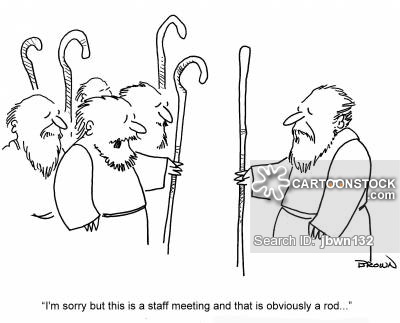
This sheep is a disaster as an author because he has the authorial viewpoint of the shepherd. He speaks, in other words, in his own voice, but he knows things that only the shepherd would know. Or, to use the adjectives I provided above, the voice is ovine, [3] but the words are pastoral. That’s not how they told us to do it in Writing 101.

An Apology

So I would like to explore this discrepancy, but before I do that, I would like to apologize to lovers of Psalm 23 (although I am one) and to explain why the approach I will be taking, helps me. There is a way of understanding this psalm that takes its real world images into account. What, for instance, are rods and staffs used for? And, from the other side of the road, what images are supposed to be called to mind by the use of these words.

There is a danger, when you ask these questions, that you will come to care more about the answers than about the certainty of God’s care that the psalmist wanted to convey. That would be a wrong reading, it seems to me. But where there is danger, there is opportunity as well and the opportunity is learning to take account of the real world and the biblical allusions that his hearers would have understood instantly. With great effort, we can learn to hear these psalms in the way that even the dumbest Israelite would have been able to hear them and then we can appreciate them much more fully.

In short, although I am aware of the danger of substituting the study of the 23rd Psalm for the beauty of it or for the meaning of it, I think it is a danger worth taking. I hope very much that I will not take away form anyone what he or she most liked about the psalm, but this blog is a place where I think out loud and today I want to tell you what happened to me when I started thinking about it.

Ovine Knowledge

I am going to move past the lines “The Lord is my shepherd,” which sets the master metaphor for the psalm, and “he restoreth my soul,” which summarizes the sheeply benefits in a most un-sheeply way. So let’s go to the benefits this sheep celebrates. I have put the King James first and the New Jerusalem Bible in parentheses after it.

He maketh me to lie down in green pastures ( In grassy meadows he lets me lie)
He leadeth me beside the still waters (By tranquil streams he leads me)

These are perfectly ovine preferences. Good grass is better than desiccated scrub and slow moving water is easier to drink from than fast moving and tastes better than stagnant water. Any sheep knows that and any sheep who associates these benefits with the leadership of the shepherd has every reason to be grateful to him.

The Failure of Pastoral Knowledge

We come now to the part where something in my mind said, “Hey. Wait just a minute.”

Thy rod and thy staff, they comfort me. (Your staff and your crook [4] are there to soothe me).

'I'm sorry but this is a staff meeting and that is obviously a rod...'Any shepherd knows what any pastor knows: those under his care are often willful. They want what they want. Very often, they pursue what they want without reference to the dangers to themselves or to the rest of the flock. The shepherd, seeing that, would do what needs to be done. Apart from more spiritual considerations, these sheep are the source of the milk and meat and wool he relies on for his living. So what might he do?
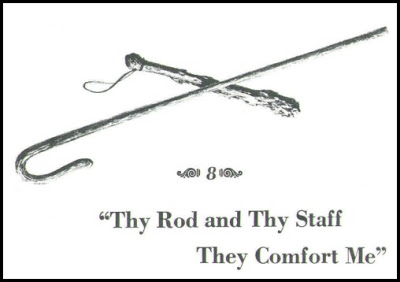
Here I begin to rely on material from an African shepherd, W. Phillip Keller, who wrote a book called A Shepherd Looks at the 23rd Psalm. He knows more about rods and staffs than anyone I have come across and if I am to approach my goal of learning, through careful study, what the stupidest shepherd in Palestine took for granted, I can profit from Keller’s recollections.

We will begin with the staff because that is the picture that came first to my mind. Here is Keller.

The shepherd’s staff is normally a long, slender stick, often with a crook or hook on one end…The staff is also used for guiding sheep. Again and again I have seen a shepherd use his staff to guide his sheep gently into a new path or through some gate or along dangerous, difficult routes. He does not use it actually to beat the beast. Rather, the tip of the long slender stick is laid gently against the animal’s side and the pressure applied guides the sheep in the way the owner wants it to go…Being stubborn creatures sheep often get into the most ridiculous and preposterous dilemmas. I have seen my own sheep, greedy for one more mouthful of green grass, climb down steep cliffs where they slipped and fell into the sea.

Note: I did remove a sentence from that account. See the second ellipsis. It will return to us shortly.

The staff, you will notice is used “to guide the sheep in the way the owner wants it to go.” True as this may be, it is not, let me assure you, the experience of the sheep. Consider this line from that paragraph:

Being stubborn creatures sheep often get into the most ridiculous and preposterous dilemmas. I have seen my own sheep, greedy for one more mouthful of green grass, climb down steep cliffs where they slipped and fell into the sea.

I ask you now to consider the perspective of the sheep. There is a mouthful of green grass to be had and the sheep is greedy. Why not just stretch out a little bit—just a little bit—and get one more mouthful? That is what the sheep wants. The staff is what is preventing me from getting to that luscious bunch of grass. It is an impediment. If I am a sophisticated sheep, I might say it is an unreasonable or an unnecessary or an overly prudent impediment.

I don’t see any comfort there. The operation of the staff to keep the sheep from going sheep 3where its owner wants to prevent it from going—that makes perfect sense. I might go so far as to say that it comforts the shepherd. It does not comfort the sheep.

The rod is a little better, but it is a little like having a father who is capable of dealing out serious physical punishment. You might feel really good about that if you are in danger of getting beat up by others, but you have to know he is capable of that kind of punishment against you. You do know that.

Keller says:

The skilled shepherd uses his rod to drive off predators like coyotes, wolves, cougars or stray dogs. Often it is used to beat the brush discouraging snakes and other creatures from disturbing the flock.

He also says:

And it was, furthermore, the instrument he used to discipline and correct any wayward sheep that insisted on wandering away.

So the comfort you take in the rod, as a sheep, depends on whether you think of its being used on you or on predators. I think that maybe ambivalence is the best I could manage if I were approached by someone with a clipboard and asked, “So…how do you feel about the rod? On a scale of 10.”

That’s how I think I would feel as a sheep. This particular sheep, the one who wrote Psalm 23, is a sheep who thinks like a shepherd. He’s an amazing sheep. I am not at all surprised that goodness and mercy follow him.

[1] I suspect that it is, in part, because it is only 122 words long (in the New Jerusalem Bible), while Psalm 119 is 2448 words long.
[2] I once had a brief enthusiasm for establishing this truth in a website to be called “Find ASIA.” The gimmick is that those four letters are so spread out on the map that you have to get some distance away to see the name of the largest continent in the world
[3] Baaaa.
[4] I’m not going there and I hope you will bypass it as well.

Posted in A life of faith, Biblical Studies, Living My Life | Tagged , , , , | Leave a comment