Halloween

I just don’t get Halloween. Not as a big deal celebration. I get a few things.

I get the language underpinning of it. I know, for instance, that the -een of Halloween is properly “e’en.” In the Scottish version of the word it is a contraction of “even,” still meaning “evening” rather than “eve.”

I get the notion of a liminal time—a time of the year when the borders between the living and the dead are thin and permeable. [2] Such a border means that “they” are closer to us and we are closer to “them.” Whether that is a good thing or a bad thing depends on your views of the relationship between the dead and the living, so it varies quite a bit among cultures and faiths.

If, for instance, “they,” the people on the other side of the border that separates the living and the dead,” are active and inclined to be mischievous, I can see why placating them would be a prudent thing to do and a big part of Halloween is about that.

I get the attachment to the annual cycles of death and rebirth. The autumn is, after all, the time of year when the sun is going away—and who knows whether it will ever come back north—and the plants are all dying.

On the other hand, all these understandings have declined quite a distance from their earlier meanings. Often, when we say things like, “declined from their earlier meanings,” the implication is that we have substituted later meanings. That is not true in this case. In the case of Halloween, the customs have declined from the spooky earlier meanings to no meanings at all. Of course, “no meanings” doesn’t mean “no reason.” The commercialization of Halloween insures that there are lots of reasons to push the celebration of it. I’m thinking of the costumes, the cards, the candy, the paraphernalia. [1] And Bette says that a lot of people have a lot of fun at Halloween, dressing up and going out for candy and so on. I never did, so I really wouldn’t know.

And while I don’t begrudge anyone a bit of special holiday fun—provided I don’t have to do it myself—I belong to a related but different tradition. And for reasons that have nothing at all to do with the secular celebration of the holiday, it is a tradition that has come to mean a lot to me.

In my tradition, the “hallow” of Halloween is a big thing. It means “holy.” Most Americans probably know it as a verb because that is the way Abraham Lincoln used it in the Gettysburg Address: “we cannot hallow this ground.”
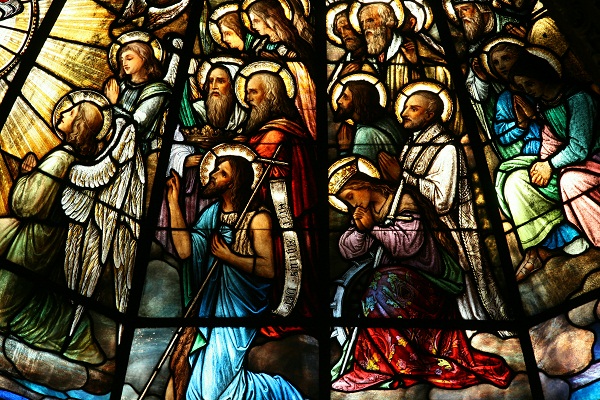
Some Christians celebrate All Saints’ Day. In fact, I celebrate All Saints’ Day, having known and honored quite a few saints in my time. All Saints’ Day is the remnant of a much older and longer celebration called Allhallowtide, which had—as did Christmas, Easter, and Pentecost—a vigil that began the night before. It is that inaugural vigil, “all hallow’s eve,” which placed the word “Halloween” in Western Christianity.

And the limen?

If we are to think that the boundary between the world of the living and the world of the dead is stretched thin at this particular time, I can’t think of a better way to honor that thinness that than to honor those who have left us but whom we still hold in our hearts. The “dying” or “dozing off” of nature in winter suggests it. Pope Gregory III suggested it in the middle of the 8th Century. [2] The practice of many cultures outside the culture of the church, suggest it.

If there is “another side”—something on the other side of the threshold, it matters a great deal how a culture imagines what is there. Is it the spirits of the ancestors, watching kindly over their progeny? Is it the spirits of the ancestors, angry at being dead and waiting only for the thinning of the barrier to come back and wreak havoc? Are there beings that were never human—fairies, ogres, dryads—who have intentions of their own if they can just get back among the living?

There is a lot of such speculation—all of it implicit—in the modern celebration of Halloween. That is, in fact, what the fire theme is for. It accounts for the “lantern” part of the Jack-of-the-Lantern. [4] The fire is supposed to scare the spirits away. On the other hand, it also accounts for the food themes because the food is supposed to appease the spirits, on the off-chance that they are inclined toward malice. And, to add the last little bit of historical setting to it, if you were approached in the “trick or treat” mode by a Druid priest, you might want to think seriously about what a Druid might think a “trick” was.

All Saints’ Day

At my church, the tradition is to hold a reading of the names of the saints who have died since the previous All Saint’s Day. A name is read and a bell is tolled. Then another name; another tone. From the time my wife, Marilyn, was diagnosed with cancer, we expected that we would have only a few All Saints’ Days left to us and we sat in church as the names were read and the bells tolled and held hands and cried. On the All Saints Day after she died, I sat there and listened to her name being called and the bell being tolled and cried by myself.  It was bitter, but the context of meaning made it tolerable.

That year, the “boundary” between my world and whatever is on the other side [5] was thinned almost to transparency. So when I think of Halloween, I think of All Saints Day. And when I think of All Saints’ Day, I think of the day Marilyn’s name was read. And then I think of the day when my name will be read. [6]

So I don’t really object to Halloween. It’s just, as I said at the beginning, that I don’t get it. I do object to conceiving of that time as a time for appeasing malevolent spirits and warding off angry minor deities. I don’t want to be any part of that. [7] All Hallow’s Eve, on the other hand, makes perfect sense to me and offers a great deal of comfort.

[1] How many innocent pumpkins, for instance, have given their lives to become jack-o-lanterns so they can simulate the ignis fatuus, “the foolish fire?”
[2] We don’t use liminal (from the Latin limen) straight up, but it is common in compounds like “subliminal.” A limn is a threshold.
[2] The reference of the author of 2 Timothy may have had something like this in mind (1:16—18) but given the lack of context, it is hard to say for sure.
[3] These people didn’t become saints just by dying. Here’s a good summary of the broader meaning of the terms from http://www.gotquestions.org, a site I like a good deal. “Christians are saints by virtue of their connection with Jesus Christ. Christians are called to be saints, to increasingly allow their daily life to more closely match their position in Christ. This is the biblical description and calling of the saints.”
[4] I almost hate to tell you this, but they didn’t always use pumpkins. Sometimes they used rutabagas and I really like rutabagas.
[5] I don’t mean by that phrasing to say that there is something “on the other side.” I have no idea. But at the beginning, my sense of “no longer here” was so strong that it virtually stipulated some “…and now there.”
[6] I’m not forgetting Bette. I’m just skipping over her because according to our deal, she has to live longer than I will. It just isn’t right to expect a man to marry and lose two such women in just one lifetime.
[7] On the other hand, I fully believe that people can be killed by witchcraft in cultures that believe in witchcraft. People are psychosomatic unities. We don’t come in two packages, one universal and the other local.



Posted in A life of faith, Living My Life, ways of knowing | Tagged , , , , | Leave a comment

Stronger. Also wiser.

In Stronger, Jeff Bauman, played superbly by Jake Gyllenhaal, learns a really hard lesson. It isn’t all that easy to say what it is, but at the very core, it involves being willing to be who people need for you to be.

This is not, in other words, a movie about authenticity. At least, it is not about what we ordinarily call authenticity. [1] Quite the contrary, it is a movie about transcending that core of self and opening yourself as a means by which others’ needs can be met.

Jeff was near the finish line of the Boston Marathon when the bombs went off. His legs stronger 6were so badly damaged that they had to be amputated above the knee. He may very well have died from loss of blood had Carlos not intervened. But he didn’t die and a very frightened city declared him to be a hero—just for not dying.

That put Jeff in a really difficult place. First, he knew he wasn’t a hero. So accepting the status of hero [2] is hard for him. Second, he is a long way from understanding that the city needs him to be a hero—that his hero status is a sacrifice for him and a gift to the city. It takes him a long time to get there. And third, his family and his buddies all try to cash in on Jeff’s status as a hero, which adds an immediately repulsive patina to the whole thing and makes it seem to be one giant con job.  He is repelled by the con job; it takes him longer to see into the core of the matter.

That’s a huge challenge for Jeff and he doesn’t have much to go on in meeting it; he is not much of a person. The whole first part—the pre-marathon part— of the movie is given over to showing us that. Jeff is fiercely tribal and his tribe is not equipped to help him either. In fact, they are the first ones to exploit his new notoriety. [3]

stronger 4The help he gets, he gets from his sometime (but not current) girlfriend, Erin (Tatiana Maslany) who sees what he needs and is unwilling to withhold it from him. She is immediately heroic, as I see it, although that is not the way the movie understands her. And when all the crisis is over and Jeff has had a chance to discover in a whole new way just who he is, he gives himself to Erin.  That is very satisfying. He says something to her in this scene about “leaning on her.”  Yes he does.

The dimensions of Jeff’s difficulty are that a) he is called on to play a part for the benefit of someone else, b) it is a high profile and honorable part, and c) he is trapped by the conventions and expectations of his tribe. Three really big problems and he doesn’t deal with them very well. [4]

It will simplify this transition if we just look at two instances: one is very bad and gives us a sense of just how strained Jeff’s resources are. The other marks the occasion for a substantial step toward health (the Red Sox game) and also an occasion where the work Jeff has already done can be displayed.

The Bruins Game

They want Jeff to come onto the ice wearing a Blackhawk shirt. Erin, also wearing a Bruins shirt, pushes him onto the ice in his wheelchair. Everyone cheers, Jeff’s name is on the readerboard, along with his picture. He is required to wave a flag that reads “Boston Strong” back and forth while everyone cheers.

In the elevator on the way out, he attacks the only person who has dealt with his tragedy in his terms, rather than is her own (the mother) or his own (the father) or their own (his buddies) terms. Erin has put Jeff’s life in the center of her concern and she is the only one who has. That is why she is close to him and available for his anger and rejection.

stronger 8Everything is wrong with the Blackhawks event and it is portrayed so that we see that. Here, for instance, is a picture I didn’t see at the movie and now that I am looking at it, I can hardly believe I missed it.  Look at the cage the shadows of the hockey goal make on his face!  Then Jeff goes through a lot of development. He learns, for instance, that giving Boston the hero they need so badly is a form of self-transcendence.

The Red Sox Game

The setting is not all that different than the Bruins game, but Jeff if different by now. He is not yet ready to go beyond his own limits and offer himself to another person (Carlos is the exception so far), but it is something he can do for his city and the Red Sox are his team—he would really do anything he could for them.

stronger 7So he does. He plays the hero for them. He throws out the first pitch. [5] Carlos pushes his wheelchair out to the mound and that makes sense because Carlos is a hero in the same sense that Jeff is a hero. (As viewers, we understand Erin’s heroism at the Bruins game, but no one in the film understands it that way.) And then he tries to escape from the setting of the game, having done everything he thinks he can do. But here, his heroism catches up with him—not the phony imputed heroism that Boston lavished on him, but the real personal heroism that is based on his courage in responding to his personal disaster. A man named Larry needs to talk with him about the courage he has shown, and Jeff is willing to talk. We are surprised when Jeff asks the man his name; we are dumbfounded when Jeff reaches up and hugs him.

And after Larry, there is another; then another. The scene ends with Jeff still surrounded by people who want something he actually has and is willing to give. I was willing to call Jeff a hero when he understood that the hero business wasn’t really about him—it was a gift he gave to his city. But now Jeff understands that in his determination to work through his disabilities, to have a life again, he has become a hero of another kind entirely. And this heroism, based on his own understanding and his own work and his own pain, is his to give to anyone who needs it.

And he does.

[1] That may be a comment on how inadequate our notion of authenticity is. You could say that by the end of the movie, Jeff authentically embraces his status as a hero—a public property—and uses it to serve the needs of his fellow citizens.
[2] We see the other side of the mirror in the movie Hero, in which Bernie LaPlante (Dustin Hoffman) rescues a woman from a plane only to see John Bubber (Andy Garcia) take the credit for it. Taking credit for being the hero he knows he is not doesn’t bother Bubber at all, but in Stronger, it bothers Jeff a lot.
[3] It’s hard to blame them, under the circumstances. They are no more prepared to deal with Jeff’s situation than Jeff is.
[4] I know I am skipping over the fact that he had his legs blown off and that he suffers, after the blast, from PTSD. Those are large challenges, but they are not the ones that caught my attention this time.
[5] Following Pedro Martinez’s advice, which I am sure we are to take in both the literal and the metaphorical senses of the term: “aim high.”

Posted in Movies | Tagged , , , , , | Leave a comment

Is “the good doctor” candid?

You can ask questions so that they are easy or so that they are hard. This one seems hard to me. [1]

The doctor—the titular doctor in the new ABC series, The Good Doctor—is a very youngdoctor 4 man. Also autistic. Also extremely bright. When you hear him diagnosing a medical condition, you think of Sherlock Holmes.

I have seen one episode so far (twice) and I can tell you with complete confidence that the show is going to be about Dr. Sean Murphy saying inappropriate things and everybody else coping with the destruction he causes. If you picture a tornado (Dr. Murphy) and a horde of relief agencies (the hospital staff) moving in where he has passed, you will have the essential dynamic of the show. [2]

In the first episode, we see Dr. Murphy joining the surgical staff of St. Bonaventure hospital in San Jose. There is a lot of resistance to hiring an autistic surgeon, but Dr. Murphy has a champion, the president of the hospital, Dr. Aaron Glassman. [3] And because Dr. Murphy is always right about the medical things and always wrong about the social things, this is a pot that is just going to keep boiling.

Is Dr. Murphy candid? Here’s an example to work with.

“Why were you rude to me when we first met, then nicer to me the second time we met and now you want to be my friend? Which time was it that you were pretending?”

To begin with, we, as viewers, see all three of the occasions Dr. Murphy is referring to. In the first, he was an odd-talking person who had administered first aid to the patient at the airport. He is urging the medical staff at the hospital to take an action, an echocardiogram (echo), for which no clear diagnostic need exists. And he tries to force his way into the hospital. It is a that point that Dr. Clare Brown (Antonia Thomas) gets firm with him. That is “You were mean to me.”

doctor 5The second occasion was set up when she comes back outside—where Dr. Murphy is still waiting in the rain—to ask him why he kept recommending an echocardiogram. He gives a plausible reason, but while they are talking, the call comes that the echo revealed nothing at all. Dr. Murphy rejects that reading of the echo and when, through Dr. Brown’s auspices, he is shown the screen, he sees something no one else had seen—why the patient is still in danger. That’s the second occasion, and Dr. Murphy characterizes it as “nicer to me.”

The trauma is over; Dr. Murphy has been proven right on all counts. Dr. Brown comes to the cafeteria to congratulate him. That is “Now you want to be my friend.”

So now you know what the circumstances were that Dr. Murphy characterized so badly. The first thing to notice is that he has understood all these events to be personal. They were “about” the relationship of this beautiful woman, Dr. Brown, to him. We know they were not. Dr. Brown was protecting the hospital in the first case, defying her colleagues to consult Dr. Murphy in the second, and generously congratulating him in the third. None of those was personal in the sense Murphy thinks, and it makes me wary of the character of Dr. Murphy that he thinks they were. Then again, he is autistic.

The second thing to note is that Dr. Murphy thinks that some of those actions by Dr. Brown were insincere. When you look at it through the “it’s personal” presuppositions of the autistic doctor, there is one true interpersonal orientation between people. Or between these two people, at least. But the three interactions were different—we are leaving aside the fact that all three situations were different—so Dr. Brown “really meant” what she said in one of those interactions as “was pretending” the others.

Society is not possible under those circumstances.

doctor 2That brings us to the final two questions. The first is, what can Dr. Murphy do to keep from destroying a very good hospital staff? We pretend with each other. We represent ourselves as more interested than we actually are or as less offended than we actually are. We are expected to do that. We are very nearly required to do that, given the penalties that are meted out for failing. [4]

Dr. Murphy simply doesn’t know how to pretend. Some autistic adults learn how to do it after a manner. By some accounts I have read, they don’t learn empathy, but they learn what kind of responses are required from them. These responses are “a performance” of empathy.  To a required expression of sorrow, they learn to return a required expression of thanks. They do not observe, as they might once have, that the person expressing the sorrow is not, in fact, truly sorry but is “only pretending.”

There is reason to think that Dr. Murphy could learn to do that. I’m quite sure he won’t, however, because the show is set on the contrast between his extraordinary medical skills and his abysmal people skills. If he were to get better at his people skills—even in the paint by numbers way I described—the tension of the two threads of the narrative would suffer. Besides, the surrounding cast is responsible to cope with his behavior as it is and it needs to be incumbent upon them to change rather than it being incumbent upon Dr. Murphy to change.

So there are some things a real autistic doctor could do, but I think Dr. Murphy will not be allowed to do those.

The second question is, “What is candor?” If we are going to think about whether the doctor 3doctor is candid, we are going to have to think about what candor is. The Merriam-Webster podcast which featured this word in 2012 gave an illustration like this: “when the job applicant admitted to some indiscretions in his past, the interviewer thanked him for his candor.” Since the root, the Latin adjective candidus, means “white” or “pure,” I think we can see in this interview, the idea that putting your best foot forward is a violation of candor. The “shaping” of your presentation of yourself is a “blot,” let’s say on what would otherwise be a pure unshaped presentation of yourself.

So I think the direct answer is that “the good doctor,” Dr Shaun Murphy is always candid. He cannot choose to be candid because he cannot choose to represent himself in whatever way the situation demands. Nor can he understand—as was illustrated in his conversation with Dr. Brown—that other people routinely “violate” candor for the sake of their colleagues and the welfare of their organizations.

So I think the best short answer is, “Yes. He is candid. But he can’t help it.”

I’m actually OK with Dr. Murphy’s candor. But as I was watching Episode 1, I kept having the feeling that there were people who were celebrating this disability as a goal we should all strive for. “If only,” this line of thinking goes, “we were only candid with each other.” I want to reject that in the strongest terms, even as an ideal.

It may well be that we should approach candor more closely than we sometimes do. I think it is crucially important that we refuse to mislead others unless it is truly necessary. But I really value being brave, as bravery is imagined in the expression “Discretion is the better part of valor.” [5]

I always like valor. Candor, I like sometimes.

[1] When I started running, in the 1960s, it was common to run without socks and that is what I did. I liked the feel of the leather on my foot. Ah, the Nike Cortez. But when I began to use an orthotic, I had to wear a sock on that foot at least, so it wouldn’t blister the sole of my foot.. It was a small town, and people would stop me and ask why I had one sock on and one sock off. I would say that “one sock on” is a matter of simple observation. But the question of how many socks I was not wearing is a deep and vexing philosophical problem. It was a college town so I got away with it for quite a while.
[2] That is not the view of David Shore, who has been called “the creative force behind the show.” Shore says that there is “an honest, unabashed emotionality to this show that is…refreshing.”
[3] Played by Richard Schiff in a style that is nearly identical with his Toby Zeigler of The West Wing. I’ve seen him play other kinds of characters, but I’d have to say he is really really good at this particular one.
[4] Jim Carey approaches this same question in his movie Liar, Liar, in which he falls under a curse of some sort as is doomed to “tell the truth” for 24 hours. To the makers of this film, “telling the truth” means refusing to play the normal parts we play and which make society possible. A woman who has just had sex with Jim Carey’s character asks him, “Wasn’t that just great?!” His response—which is called “honesty” in the movie, is “I’ve had better.” Really? That’s being honest?
[5] Professor Paul Brians on his Washington State University website gives this helpful caution: “In Shakespeare’s Henry IV, Part I when Prince Hal finds the cowardly Falstaff pretending to be dead on the battlefield, the prince assumes he has been killed. After the prince leaves the stage, Falstaff rationalizes “The better part of Valour, is Discretion; in the which better part, I haue saued my life” (spelling and punctuation from the First Folio, Act 5, Scene 3, lines 3085–3086). Falstaff is saying that the best part of courage is caution, which we are to take as a joke. Truly courageous people may be cautious, but caution is not the most important characteristic of courage.”


Posted in Movies, Society, Sustainability, Uncategorized | Tagged , , , , | Leave a comment

Ebb Tide

“I wish it need not have happened in my time,” said Frodo.
“So do I,” said Gandalf, “and so do all who live to see such times. But that is not for them to decide. All we have to decide is what to do with the time that is given us.”

I think that must be one of the most famous exchanges in the English language. The “it” that Frodo wishes had not happened is the discovery of the One Ring, the ring of power, but Gandalf’s rejoinder is much more general. “So do all who live to see such times…” he says. You are a member of a category and the way you are feeling about it is the way all the members of that category feel. But you must find a way to deal with it anyway.

Now…wizards, like Gandalf, live a very long time. Gandalf has seen “such times” overebb 2 and over and he knows what he is talking about. Frodo, like most of the rest of us, is living in the only time he knows. [1] And like the rest of us, Frodo is forced to take the presuppositions of his age for granted.

Peter Stearns, the social historian [2] has a way of approaching matters that is a great deal more like Gandalf’s than like Frodo’s. Stearns will study some small aspect of the whole social whirl and pay attention to how that one small aspect has developed over time. I’m going to reflect on his treatment of the notion of “obedience” today, but I’ll be back from time to time with another notion from his work.

Imagine that you are standing at the shore of the ocean in the middle of the afternoon on a beautiful sunny day and watching the “tide” go “out.” (How odd, you think, to put those words in quotation marks.  I thought so too.) And let’s say you know nothing at all about the influence the moon exerts over the tides on earth. You don’t know that the water goes out for awhile and then comes back in and then goes out. You don’t know the system.

ebb 1What you do know is that the water used to reach much further up the beach and now it is clear down to where you are standing and it is still going down, going “away.” You are horrified, let’s say, because you liked this part of the coast where the ocean “used to come” and you long for “the good old days” when the water—you don’t know to call it a “tide”—used to come all the way up to here.

It seem odd, I suppose, to imagine anyone who doesn’t know about “tides,” but really, who knows about grieving; who knows about “jealousy;” who knows about what a “real man” or a “real woman” ought to be like; who knows whether children should be obedient to their parents? All these are like the tides and we, who take for granted the sentiments of our own time, are like the guy who doesn’t know that “the water going out” is called an ebb tide and that it will all come back.

Let me illustrate by recalling what I can from my recent reading of Stearns’ treatment of obedience. The point of all this is that these ideas about obedience—is it a good thing or a bad thing, does it come at the expense of other important virtues, how is it to be inculcated— are broadly shared by your contemporaries. Whenever you were a child or whenever you were raising children or, more ominously, grandchildren, there was a set of ideas that was considered to be “common sense.”

Stearns says that agricultural families neeebb 3ded to have large families of obedient children.
That’s how the family was made an economically viable unit. So there is an economic infrastructure to the ethical demands of “obey your parents.” Notice how powerful it is when the two are joined. Obeying your parents is the right thing to do and besides that, you will all starve without it. Powerful.

The Industrial Revolution removed the economic infrastructure for many families. For these families, the admonition to obedience was still strong, but now it had to stand alone. After a period when urban and suburban children “helped out at the shop” or even “tended the vegetable garden,” the chores of children shrank to things like keeping their own rooms neat and taking out the garbage and washing the dishes. Household chores, in other words, instead of contributions to the family’s economic viability.

In the latter part of the obedience phase, there grew up an ideal that children should obey gladly. In my own mind, I suspect that there were some good reasons for this new emphasis and some bad reasons. The good reason is that when the cows had to be milked, all that mattered was that the kids got up at the right time and milked them. They could be a snarly about it as them wanted. But for the new work, the “chores,” it actually matters whether the kids “obey” sweetly and kindly or with grousing and foot dragging. The bad reason I am thinking of is that the parents and the people who wrote books about how to be parents sensed that the old “obedience” norm was slipping away and tried to prop it up with a new emotional resonance. “I’m obeying my parents (as I should) and I’m happy about it.”

As urban (and later, suburban) notions of what a good child is like, this happiness in compliance was joined to a happiness in independence. It’s not as hard as you might think. Once you start caring about whether the kids are happy or not—as opposed to just obedient or not—it is easy to join this virtue of any other virtue and “the child who can choose for himself” was the next virtue in line. So now we want children who make good choices and are happy about it. Obedience of the “look both ways before you cross the street” is still appropriate, but that kind of obedience is justified by the immediate context, not by the nature of the parent/child relationship.

ebb 4In the next phase, the helicopter parent phase, parents are responsible for the good choices and the consequent happiness of the children. Let’s just stop and think how far we have come from the farm family where the kids are plowing the back forty and gathering and selling the eggs. Now that the parents are responsible for the choosing that the child does—not, please note, for the choices themselves [3]—a child who is not choosing well or who does not play nicely with others or who can’t make the soccer team or who is not happy, is a problem that the parents need to do something about.

Does that seem weird? Not if everyone you know is doing the same thing. When everyone is doing the same thing, we are back to the guy who doesn’t know what tides are and who therefore mourns the “passing away” of what was once “a mighty ocean.”

Stearns historical approach gives us a chance to look at the matter more broadly. There is a very nice fit in the situation where the farm family has to make a living and so needs a lot of children who will do what they are told. There are good things and bad things about this scheme—as there are about any scheme—but the parts all fit together.

What we need in our time is an economic infrastructure and  an understanding of moral obligations that will do for us what the old agriculture/obedience construct did for them. What should we aspire to for our children? What does it cost them for us to aspire to so much? What does it cost us to aspire to that on their behalf? What do children actually need from their parents [4] as opposed to the things they want or things they think they have a right to?

I think it is an advantage to us all that the problem can be posed generally–that is Stearns’s gift– even granting that any particular family will have to come up with some response to that commonality that works and that is within their means. [5]

So it might be worth considering that the tide is now in, it is high tide, on such questions ebb 5as autonomy for children and choosing as the principal mode of self-expression and the complete responsibility parents have shouldered for the quality and the success of their children. If it is really high tide on all those things, then the demands they make need to be met in some way. Or perhaps they can be modified. Or even rejected.

Whatever is done, it will have to be done again as the tide begins to go back out and new structures will have to be devised. And I would think that even as we must work in the present we are given—just as Frodo must—still we may be able to get some relief from knowing that out children will face different demands and different collections of virtues.

And maybe letting them see us struggling with ours, will help them struggle more successfully with theirs.

[1] Sociologist Peter Berger makes the very good point that “society” is a show that is meant to be seen only once, and when you live a long time and start to see the same things a second or third time, you start to notice things you missed at first.
[2] “my guy,” as I said last month, on gender roles
[3] The law still has the old fashioned view about legal and financial liability.
[4] I will grant you the truth of the observation you are about to make that different children require different things from their parents. That is true. But it is also true that every child needs certain things, common things, although they might need to have them delivered in different ways. The unity and the diversity are both true and both trite.
[5] When my wife and I were raising children, we agreed about most things, but differed on the obedience question. I wanted prompt and effective obedience and I didn’t care all that much what emotional flavor accompanied it. One of my kids could say almost anything by way of complaint while he was doing what he was told to do. My wife felt that the emotional part of the act of obedience was important too. She really wanted happy obedience, although she would settle for silent obedience, if “happy” was too much to ask for at the time. I had no idea when she and I were having these discussions about childrearing, how well we represented the recent emphases of our culture.

Posted in Living My Life, Society | Tagged , , , , | Leave a comment

Jesus and Nicodemus in The Matrix

The question of what kind of life is worth living is addressed in compatible and complementary ways by the Gospel of John and by the Wachowski brothers movie, The Matrix.[1] John’s account of the conversation between Jesus and Nicodemus is powerful, but it is confusing and if you are trying to visualize what they are talking about, you are going to have trouble. The Matrix is a dystopian fantasy, but it tells much the same story John tells and it is remarkably visual.

If they really tell the same story, they belong together. Do they really tell the same story?  I think so. Both ask what “real life” is and if we are going to think about it, we are going to ask what “unreal life” is.

I can think of two ways to approach to notion of “unreal life.” In one, the life you are experiencing isn’t really happening at all although it feels like it is. In the other, the goals toward which a life is oriented are so nearly insignificant that a life in pursuit of them might be said not to be a “real” life at all.

The Matrix

What does the contrast between real and unreal life look like in The Matrix? I’m going to have to count on your familiarity with The Matrix because there is not a good way to summarize it. I do want to point out some of the most important parts.

In The Matrix, we hear about, but do not see, a city of humans located down in the earth where it is warm. [2] It is called Zion. All human beings who are living “the life of the ages” [3]—real life, rather than imaginary life— are in Zion or in one of the ships sent out from Zion. These ships are the only settings in which we see truly self-aware humans in the first movie. It is into one such ship that Neo’s body is taken when it (he) is rescued from his tub of goo.

What about all the other humans? Every other human in the world is locked up in a podmatrix 3 of goo and the sole function of these humans is to provide, through the natural operation of their bodies, the electricity that the Matrix requires to rule them and keep them (us) in their place.  In this picture you can still see the goo on Neo and several of the pods near him, each containing a “human battery.”
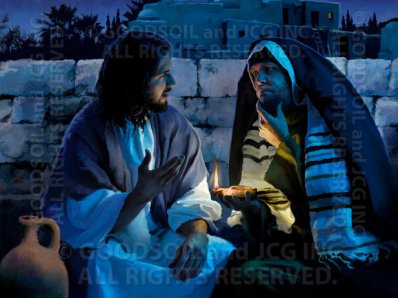
It turns out that it is necessary, in order to keep the human bodies alive, to stimulate the brain with an electronic probe. This probe provides all the neurological input that is needed to simulate a life in society and even the illusion of free moral choice.

Our hero, Neo, is rescued from one of those pods by a crew from Zion and is given access to “the life of the ages”—a life in which things will actually matter. All the other people we see—people who are apparently living lives of consequence (except that there are no consequences)—are people we see as they appear to themselves in the Matrix. They are actually, physically, encased in their own tubs of goo.

Given that a big part of the New Testament is given over to contrasting “real life” and “lingering death,” The Matrix is a good theological movie because it is so graphic. The dialogue between Jesus and Nicodemus is not at all graphic. It is all verbal, and the words are deliberately filled with ambiguity and misunderstanding. [4] If the point being made by John in chapter 3 is the same as the point being made by the Wachowski brothers in The Matrix, it will be a marvelous convenience. John is obscure and difficult; The Matrix is explicit and graphic. My case today is that each is making the same point about life.

Jesus and Nicodemus in John 3

Here I show how the argument is organized in John, with particular attention being paid to some of the deliberately ambiguous words Jesus uses. Here is the passage from the New Jerusalem Bible.

3 Jesus answered: In all truth I tell you, no one can see the kingdom of God without being born from above. 4 Nicodemus said, ‘How can anyone who is already old be born? Is it possible to go back into the womb again and be born?’ 5 Jesus replied: In all truth I tell you, no one can enter the kingdom of God without being born through water and the Spirit; 6 what is born of human nature is human; what is born of the Spirit is spirit. 7 Do not be surprised when I say: You must be born from above.
12 If you do not believe me when I speak to you about earthly things, how will you believe me when I speak to you about heavenly things? 13 No one has gone up to heaven except the one who came down from heaven, the Son of man; 14 as Moses lifted up the snake in the desert, so must the Son of man be lifted up 15 so that everyone who believes may have eternal life in him. 16 For this is how God loved the world: he gave his only Son, so that everyone who believes in him may not perish but may have eternal life.

Jesus talks (verse 3) about being born (genēthē) from above (anōthen). Both of the Greek words I put in parentheses have alternative meanings and Nicodemus takes the wrong one both times. That is the way John has organized this tutorial. Jesus offers the opportunity to misunderstand. Nicodemus makes use of that opportunity. Then Jesus “explains further,” making, in that explanation, the points John thinks are most important.

For instance, the Greek genēthē can mean either “begotten” or “born.” Jesus likely intended “begotten,” since it was more common in his time, as it is in ours, to refer to God’s action as male rather than female and “begetting” is the male contribution as “bearing” is the female contribution. It doesn’t actually matter very much.

On the other hand, it does set us up for his misunderstanding of anōthen, which can mean either “from above,” which is clearly what Jesus intended, or “again,” which is the way Nicodemus construed it.

The third ambiguous expression, one that Nicodemus doesn’t seem to have trouble with, although exegetes do, is zoēn aiōnion. It means “the life of the ages.” It can be construed as a life as long as the age {5] or as long as all the ages. Or it can be construed as a life characteristic of the ages, a life of enduring significance and value.

matrix 5By all three of these expressions, Jesus is talking about the new life in the spirit—the life of the ages—and Nicodemus is talking about the old life, the life of the flesh. So when Nicodemus understands anōthen as “again,” he immediately thinks about being born a second time in the same manner that he was born the first time. So he asks disbelievingly how it is possible for a grown man to enter his mother’s womb so he can be born again. My argument is that in his conversation with Nicodemus, Jesus is better understood as contrasting the insignificant (merely earthly) with the enduringly significant (the heavenly).

Jesus continually stresses the higher life—the life of the ages—and contrasts it with the lower earthly life. He does it in verse 7 where he says “You must be born (begotten) from above.” In verse 12, he chides Nicodemus about not being ready to hear about heavenly things since he is not even ready to hear about earthly things.  Notice the “higher and lower” imagery.  In verse 13, he refers to himself as “the one who came down from Heaven.” In the famous verse 16, he says that the higher life—the zoēn aiōnion—may be granted to anyone who believes in him

Throughout this failed and frustrating conversation, Nicodemus presupposes the quotidian life while Jesus presupposes the significant life. In none of these uses is the extent of “the ages” the point of the argument; rather it is the quality of “the ages” that matters.

This is an easy argument to make, but it is abstract and as pointed as the contrasts might have been for the Johannine community, they seem vague to us. And there, I think, The Matrix can help us.

Jesus and Neo

In The Matrix, the meaningful life is the result of the grasp of reality you have and the choices you make and the actions that flow from those choices. [6] If you are not part of this “higher life,” you are stuck in a tub of goo with a brain probe helping you to imagine that you are living a real life—the life you are not actually living. The contrast on the screen is overwhelmingly clear.

And it is made clearer by the one person who has chosen to live the zoēn aiōnion and matrix 2found it too challenging. Cypher is rescued from the life he imagined he was living and was made part of a real life. The real life was dreary and difficult and he made the choice for which John ridicules Nicodemus. Here we see Cypher in the matrix “experiencing” a juicy steak. At the moment of this picture, his body is back in the hovercraft, but he is making arrangements to be put back into a tub of goo and to have an imaginary life restored—a life of complete insignificance. He says he wants to be somebody famous.

Just how good is this analogy? Well…it’s not perfect. (Perfect is a lot to ask of analogies.) But it is very good in some ways and it is graphically clear, which the account in John is not. First of all, in The Matrix we clearly see “the living and the dead.” The living dodge around in the dark places of the city or hide in the last human city, deep underground. The “dead”–people whose choices matter not at all– are secure in their tubs of goo, imagining that they are actresses or police or notorious hackers, but actually, just producing the electric power that enables their enemies to dominate them. The dead live wonderful lives, but only by the courtesy of the brain probes that allow them such a satisfying hallucination.

matrix 1Second, you can be rescued from such a life. We see Neo choosing it. This is the justly famous “red pill or blue pill” scene where Neo may choose to go back into his life of illusion (blue pill) or he may choose to be rescued (red pill)—literally “lifted up” from the tub of goo—and live a real, though hazardous, life.  Note: to insert the picture here, I have to click on a button that says CHOOSE.  Not a bad name for this picture.

The question I am asking by bringing this difficult passage from the Gospel of John together with an imaginative movie like The Matrix is this: do the “higher” and “lower” lives in the Nicodemus dialogue match up with the “in the matrix” or “free from the matrix” pictures in the movie? I think they do.

Neo is offered the red pill or the blue bill by Morpheus. Nicodemus is offered the red pill—“believe…and enter the life of the ages” or the blue pill by Jesus. Nicodemus chooses the blue pill He is not begotten by the Spirit; he does not enter into the life that believing the claims of the Son of God would have enabled him to enter. He continues living in his tub of goo. [7]

From here on, Neo, having accepted the red pill—which is the only thing he can do as a slave of the matrix—has experiences that Nicodemus cannot have. Neo is redeemed from his tub of goo; his body is restored and his mind aligned to reality; he is trained to do the work that his new colleagues are doing, including rescuing others. But Neo discovers that he is not just one of the colleagues; he is, as Morpheus always believed, “the One.” [8] He is killed by the forces of evil and restored to life, but a life of an entirely different kind. There is a “risen Neo” that is comparable to the risen Christ, but there is nothing in Nicodemus’s life to compare it to.

So far as Nicodemus’s life of “new reality” is concerned, it ended when he took the blue pill rather than the red.

The analogy assessed.

Pretty good. My goal here is to bring John 3 and The Matrix into alignment so that the obscure and hard to visualize meanings in John are given graphic form in The Matrix. If that works for you, you have to see Nicodemus’s puzzlement at Jesus teaching as equivalent to Neo’s continued imprisonment in his tub of goo.

You have to see Nicodemus’s failure to grasp and to choose the message of Jesus as equivalent to his choosing the blue pill; continuing, that is, to live on the meaningless level of mere existence, rather than accepting the life of the ages, which Jesus is offering him.

From there on, Neo has experiences—described above—which Nicodemus does not have and cannot have because all of them require that he take the red pill so that he can be rescued from his slavery and redeemed to be part of a free people.

In closing, I need to say that this is not the view of the contrast between the gospel and the alternatives that is described elsewhere in the New Testament. The Synoptic gospels don’t see things as drastically as this. Quite a number of the New Testament epistles, notably James, but also the Pastoral Epistles, do not see life and death tin these stark images either.

But I think John does see it that way and I find myself wondering if you do.

[1] As a stylistic matter, I use the initial capitals—The and Matrix—to refer to the movie. When the movie is already the context, I use a lower case m-, to refer to the system of control the machines permit.
[2] We do see it in the second two films of the trilogy.
[3] That way of characterizing it comes from John 3. I’ll spend some time with it when we get there.
[4] In fact, considered only from a teaching standpoint, the dialogue between Jesus and Nicodemus is wrong in nearly every way and is an utter failure. As an instance of teaching methodology, it is really awful.
[5] Jesus promises his disciples (Matthew 28:20) that he will be with them “unto the end of the age.” The same word—aiōnion—is used there.
[6] This sentence shows why the style convention I use matters. That sentence with the capitals—The Matrix—is true; without the capitals, it is false. There is no life of significance in the matrix.
[7] I know that is harsh, but I think it is exactly what John means.
[8] Here, as in many places in the movie, the dependence on the language of the Bible is clear. “The One” is a clipped reference to the longer expression “the one who was to redeem Israel.” See Luke 24:21 for an applicable instance.


Posted in Biblical Studies, Movies | Tagged , , , , , | Leave a comment

Albert Peterson’s Dilemma

I want to introduce to you today a fictional businessman, Albert Peterson. [1] Peterson is a good guy in a bad situation. Peterson is the head of Personnel for a U. S. manufacturing firm, engaged in vicious competition with other such firms all over the world. He is a social conservative, which means, in the context of this piece, that he is a supporter of “traditional family values.” He is also a political conservative, which means, in the context of this piece, that he is against “government meddling” and higher taxes.

I invented this Albert Peterson, but there are thousands of these people in the U. S. and additional millions who hold Peterson’s combination of interests and responsibilities and who, therefore, are forced to ignore or to deny a good bit of today’s reality.

family 4My goal for today is to define the difficulty Mr. Peterson is in and to extend my sympathies. If he and I were having a discussion about the U. S. and the future and about what is needed for the long-term health of our homeland, I think I would get angry at him and say things I shouldn’t. But sitting here at my desk on a beautiful fall day, I have nothing for him but sympathy. [2]

Mr. Peterson makes his contribution to his company by keeping labor costs low. There are three ways to do that. You can automate production, export the jobs to Third World countries, where the wages are low, or pay American workers Third World wages. All those work and they are all used. And there is nothing about Peterson’s job that impedes his making to his company the contribution he can make, which, again, is to “reduce labor costs.”

But, of course, by doing the things he is doing, Peterson is doing quite a few other things as well. You can’t do just one thing. That’s not how it works.  The strategies he is pursuing also “have particularly negative impacts on the labor market prospects of men and degrade their marriage-market value.” Specifically [3] the effects include:

“diminishing their relative earnings—particularly at the lower segment of the distribution, reducing their physical availability in trade-impacted labor markets, and increasing their participation in risky and damaging behaviors.”

As you can see in the footnote, this paper was once called “The Labor Market and the Marriage Market.” What Peterson would do, if he could, is to affect the labor market—thereby preserving his company’s profits—without affecting the marriage market. But, apparently it doesn’t work that way, so Peterson is forced to do both or neither.

These events, which the three scholars refer to as “exogenous labor demand shocks,” do, in fact “degrade the marriage market value of these men.” That is, they make them less likely to marry. The “shocks” do not make them less likely to procreate, however, and it was this point that Clare Cain Miller’s article addressed. Marriage is becoming, as she says, “yet another part of American life reserved for those who are most privileged.” [4]

But leaving the class boundaries—her way of talking about privilege—alone, here are some facts she has collected from current research.

Currently, 26 percent of poor adults, 39 percent of working-class adults and 56 percent of middle- and upper-class adults ages 18 to 55 are married,

Just over half of adolescents in poor and working-class homes live with both their biological parents, compared with 77 percent in middle- and upper-class homes,

Thirty-six percent of children born to a working-class mother are born out of wedlock, versus 13 percent of those born to middle- and upper-class mothers.

All these trends are Mr. Peterson’s doing. None of them are things he intended and none are things he applauds. But when “the marriage market value of men” declines—and that is the effect of Peterson’s work—then these social effects follow, their influence on the lower classes being especially powerful.

These effects are not inevitable. People could choose otherwise. People like Peterson—and here I join him—wish that they would choose otherwise. But, in fact, women will continue to hold against men their inability to provide for a family. And why shouldn’t they? And these women and men will continue to make babies anyway, whether they can afford them or not. More single moms, more broken homes, more social stress, more incarceration, more cost.

Mr. Peterson is a social conservative, which means that he believes in the value of 'America's Biggest Export, Our Jobs!!'character. Well…”good character,” really. He believes that people ought to make the right decisions because they are the right decisions. And they do sometimes. But when the economic supports for what used to be “the right decisions” go away, you get a situation where “character” points this way and “economic viability” points that way.

This is a dance with a predictable conclusion. Even the choreography is familiar. It isn’t that there is a contest, something like arm wrestling, between Good Guy Character and Bad Guy Necessity. There are moments when, in the short run, it looks like that. But in the long run, the behaviors that used to be implied by “good character” are redefined and the needs to which “economic necessity” is tied are also redefined. So now the economically required behaviors violate only “what was once considered virtuous by traditionalists.” And there goes the old Good Guy v. Bad Guy contest that sold so many tickets.

“Character” is a tough sell. I saw a cartoon once that shows a man watering the plant to the left of his front porch, but not the plant to the right. His neighbor asks him what he is doing. “I want that plant to grow,” he says, pointing to the one he is not watering. “But,” objects the neighbor, “You are only watering this one.” “I know,” says the man with the watering can, “But I want this one to grow because it wants to grow.”

And that is the character problem. Without quite saying that what we call “good character” at any given time is an artifact of economic relationships, it is a fact that “good character” is forced to swim upstream against the economic current, and it gets tired and stops swimming upstream. The salmon has no choice, at this point, but the society does. It can decide that “these days,” downstream is a much more realistic direction. And that is what we have done.

So Mr. Peterson, the business realist and social conservative, has put himself in a difficult spot. The things he must do [5] to serve his business, cause—in the long run—social consequences he deplores as a social conservative.

But don’t despair. There is hope.There are all kinds of government programs that would help cushion the blow. Clair Cane Miller lists these commonly cited five, but there are many more, including much more basic ones.

Social scientists suggest more routes to good jobs, like through community colleges or apprenticeships. More affordable housing for young people would help, so they don’t move in together simply from economic necessity. Inexpensive and accessible contraception would help, too. Some have suggested expanding the child tax credit, and removing the marriage penalty for benefits like the earned-income tax credit.

But now we must return to Mr. Peterson, the political conservative. As a businessman, hefamily values 5 “degrades the marriage market value of the men.” As a social conservative, he deplores the destruction of intact families and the production of children that no one seems to be able to care for. But now, as a political conservative, he also opposes the government programs which could soften the impact of the economic difficulties and ease some of the social costs of postponed marriages. There really isn’t anywhere else to go.

Mr. Peterson may very well prefer that extended families or charitable organizations work with these broken families. He may very well oppose the substitution of government aid to these families for what should have been, in a better world, private aid. He may very well oppose the higher taxes that will be necessary to give meaningful help to as many men as have seen their jobs exported. But that is really what he is down to and that is why, now that I am writing about him instead of arguing with him in person, I have such sympathy.

There is really nowhere for him to go. He can’t stop replacing high wage workers with low wage workers (or even with much lower wage machines) and if he could, his replacement couldn’t. He can’t change his view about what kinds of families are to be preferred—those values are very deep in the way he sees the world. He can’t even imagine that assistance on the scale that is required will be provided by patchy private initiatives. A thousand points of light would not be nearly enough. And he can’t in good conscience agree that the taxes and the government programs that could cushion the blow and better than doing nothing.

Mr. Peterson is in a very difficult place. He’s not a hypocrite. He’s just stuck.

[1] The name, but not the circumstance, comes from Conrad Birdie’s agent in Bye Bye Birdie. The woman who wants to marry him, if he would only give up show business and become an English teacher, has fantasies of being :Mrs. Phi Beta Kappa Peterson, the English teacher’s wife.”
[2] Literally nothing. I have, for instance, no solutions for him except ignoring and denying reality and he is already doing those.
[3] This article, “When Work Disappears: Manufacturing Decline and the Falling Marriage-Market Value of Men” by David Autor, David Dorn, and Gordon Hanson, was cited in the New York Times article. It was first circulated under a much better title: “Th Labor Market and the Marriage Market.”
[4] I really don’t like the dramatic phrasing. “Reserved?” Really? By whom? “The privileged?” Do you really want to define everyone above the 50th percentile (the definition she uses for comparison) as “privileged?”
[5] This is not a personal choice. This is the mandate of whoever holds Peterson’s job. If he were to decide, perhaps on grounds of social conscience, that he was not willing to take the actions that produced so many bad social consequences, then he would be replaced by someone who wouldn’t mind quite so much.


Posted in Politics, Society, Sustainability | Tagged , , , , | Leave a comment

The Star Spangled Banner as a Commons

ill you all rise, please, and join us in the singing our our national anthem?”

It doesn’t sound all that hard, does it? But, as everyone knows by now, it can be made extremely difficult and we have done that. It seems to me that at the most fundamental level, this is just the tragedy of the commons. [1]

“The commons” as  Garrett Hardin uses it is a common grazing area. All the farmers areteam 5 free to graze their cattle on the common pasture provided they don’t have too many cattle. Only so many and no more. But each farmer has an incentive to add just a few “extra” cattle—how much harm can a few extra cattle possibly do?—to the common area and when too many farmers do that, the commons crashes and there is no food for anyone’s cattle and disaster ensues.

The national anthem is a commons. All public ceremonies in which we participate as Americans—only that one status–are a commons. The inauguration of a new president is such an event. The awarding of medals to the winners of a track and field contest is such an event. The crowning of a new Miss America is such an event—or was once. [2]

About all of these, I would say that everyone who participates in the event, as a contestant or as a spectator, owes a duty to the event. That’s a shorthand way of saying that each one owes to his or her neighbors the courtesy of treating the event as if we all related to it in the same way, not as partisans, who will be guaranteed to feel differently about the outcome.

There is only one way to treat the event as a commons and that is to lay aside, for the moment, the things that divide us and to focus, for the moment, on this one thing that unites us. There are literally thousands of ways to subvert the commonness of the event and every Sunday from now on into the foreseeable future, we will be treated to new ones?

Have you seen the NFL team that stands during the performance of the Star Spangled Banner, linking arms and facing away from the field of play? I haven’t either, but surely it is only a matter of time. Have you seen the team and all the coaches and all the owners standing on the sidelines linking arms and singing the anthem together? Or kneeling together, assuming that someone will be willing to help to owner to his feet afterwards? I haven’t either, but I expect to and if I could see a replay of every NFL opening ceremony next week, I would.

At the Seahawks v. Titans game last week, both teams remained in their locker rooms until after the “unifying ceremony” was over. At the Steelers v. Bears game, one team was on the field and one was not. Here is a survey of what was done at different sites.

A Sunday afternoon football game is a special thing. It is a commons. You can’t just add extra cows to it, confident that no one else will think of it. The real question is not my cows or your cows; it is some extra cows or no extra cows.

Katharine Q Seelye and Bill Pennington   reported in The New York Times that:

At football stadiums across the country, fans seemed united in their irritation that their sacrosanct leisure hours had been hijacked by a raging, uncivil war that in their view should be confined on Sundays to the talk shows — so they could tune it out.

I think the choice of the word “sacrosanct” is absolutely justified here. And the intensity it conveys is justified by the lengths people will go to protect it. [3] These fans want football and nothing else. Well…football and tailgating and nothing else.

The singing of the Star Spangled Banner—which was once something the fans were team 2asked “to join in”—even though the word “free” with that awful tight ee- vowel comes at a high G that hardly anyone can reach. That adds a common ritual to the “sacrosanct leisure hours.” As long as you don’t pay much attention to what it says, you can just wait until the performance is over and the game starts. [4] And as long as it is common, no one objects.

Refusing to treat it as a meaningless ritual—more precisely, a ritual that is powerful because the particulars are not attended to—opens it up to varying interpretations. What does standing quietly in a reverential posture “mean?” It used to mean that you were extending a courtesy to your neighbors and affirming a bond of solidarity with them. But if it now means “Black Lives Really Don’t Matter,” then you would expect some difference of opinion.

To the division between those who want pure leisure—that’s the commons—we add people who want almost pure leisure—broken only by the introduction of the issues that are important to me. Just my cows, that is, not yours. And once there is a divisive issue, your response to it will be divided into affirming it or opposing it. Even doing nothing will be colluding with it.

team 1Now the commons is gone. Players are staying in the locker room until after our “ritual of solidarity is over.” Players are inventing combinations of ways to affirm the unity of the team amidst the different views of the players. Look at this picture of the Detroit Lions. Some are kneeling, some are standing.  All are holding onto each other.  I wish the churches could figure out a way to do that.

President Trump—His Tweetness—has not invented this issue, but he has made it markedly worse and he will certainly lose. Every Sunday, ingenious new ways to give the finger to the President will be invented and displayed on prime time television. Standing, kneeling, squatting, staying in the locker room, joining hands with the other team, wearing blindfolds, holding signs. There is no end to the ways this rebuke can be administered.

And to all the owners and coaches and players who oppose the President’s issue, add all the fans who want no issues at all to distract them from their non-NFL lives. So Trump will lose this one.

But then, how will the commons be restored? Does it ever get restored? Unlike the pasture in Hardin’s parable, the unity of a ritual doesn’t just grow back like the grass does. When you stop overgrazing the grass, it grows back. When you stop chipping away at a common ritual, it just stands there, chipped. Rituals don’t heal.

I think they can be healed. Theoretically. I don’t know how. And since we don’t really know how they can be restored, maybe we shouldn’t damage them so carelessly.

[1] “The Tragedy of the Commons” began to be a much-used metaphor when Garrett Hardin published it in the journal Science in 1968. He says he got it from a pamphlet written by A. F. Lloyd in 1853, so the image has been around for awhile.
[2] It took a little time and thought to give you three grades of illustration: undeniable, plausible, and controversial. I hope you appreciate the care with which this buffet was prepared for you.
[3] In the movie, Concussion, Dr. Cyril Wecht tells Dr. Bennet Omalu, “You’re going to war with a corporation that owns a day of the week; the same day the church used to own.” You want to talk “sacrosanct,” there it is.
[4] I once imagined a protest in which the singer would refuse to sing the words “the land of the free” until the U. S. dropped out of the top ten countries that have the highest proportions of their citizens in jail. He or she would just hum those six words—“o’er the land of the free”—before ending the song.


Posted in Living My Life, Sustainability | Tagged , , , | 4 Comments

I know, but he’s OUR dotard

I didn’t hear President Trump give this speech. I have a lot of trouble seeing him and hearing him. My dentist said just a small amount of nitrous oxide would help solve that problem, but he wasn’t allowed to give me any once I left the office. [1] I was eager to know what he said, however, so as soon as the White House released the transcript, I read it. The man never ceases to amaze me.

I want to begin by saying that Trump’s speech was “bunk.” I mean by that very rich word [2] that it was aimed at a domestic audience, not at the international audience in the U. N. auditorium where he was standing. So the people who were invited to be present for the speech—having never been in “Buncombe”–were in no position to appreciate how good the “bunk” sounded back there.

u n 3If you begin by understanding that President Trump was making a campaign speech aimed at people “back home” it all makes more sense. There is a great deal of anti-U. N. sentiment among Trump supporters. I used to see signs “U.S. out of U. N.” I haven’t seen any of those signs for awhile, but the sentiment lives on. This speech pandered to that sentiment in quite a few ways.

Let’s start with “The socialist dictatorship of [Venezuela’s] Nicolas Maduro has inflicted terrible pain and suffering on the good people of that country.” Why would he say such a thing.  Everyone is against “dictatorship.” Even dictators make sure to call their rule by some other name. But President Trump wants to attach “socialist” to “dictatorship.” “Socialist” is a good word almost everywhere in the world except the United States. It most places, it means caring for all the citizens of your country and sharing the burden of governance and where it is not presupposed, it is sought after. But Trump knows that his base thinks of it as a bad word, roughly akin to ‘communism,” so in constructing his condemnation of Venezuela’s Maduro, he combines them. That makes no sense at all at the U. N., but it makes perfect sense “back in Buncombe.”

Of the specific charges, the easiest to understand is that the U. S. is not getting its money’s worth out of the United Nations.

The United States is one out of 193 countries in the United Nations, and yet we pay 22 percent of the entire budget and more….  The United States bears an unfair cost burden…The American people hope that one day soon the United Nations can be a much more accountable and effective advocate for human dignity and freedom around the world.  In the meantime, we believe that no nation should have to bear a disproportionate share of the burden…”

In the context of the immediate hearers of the speech, none of this makes any sense at all. Does President Trump really think that the costs should be apportioned by dividing the total budget by the number of members? If he doesn’t mean that—and I am sure he doesn’t—then why does he say we are only 1/193 of the membership but pay more than 1/5 of the budget?

It would make much more sense to the immediate audience if he were to compare the percent of each nation’s Gross Domestic Product (GDP) goes to support the U. N., but that way of putting it is going to make no sense at all back in Buncombe. It’s too subtle and it isn’t angry enough.

In addition, I am sure it sounded odd for the leader of a constituent state to get up and say that his nation was better than anyone else. In fact. President Trump said:

The United States of America has been among the greatest forces for good in the history of the world, and the greatest defenders of sovereignty, security, and prosperity for all.

And he said:

 The United States continues to lead the world in humanitarian assistance, including famine prevention and relief in South Sudan, Somalia, and northern Nigeria and Yemen.

And he said:

The United States will forever be a great friend to the world, and especially to its allies.  But we can no longer be taken advantage of, or enter into a one-sided deal where the United States gets nothing in return.

Remarks like these will be considered bizarre by the world leaders who assembled to hear the speech. On the other hand, they are red meat for the core of the Trump constituency and as odd as these statements seem in the setting where they were delivered, they make perfect sense to angry white Trump voters.

The elements of this speech that I have pointed to so far are really no worse than u n 2embarrassing.  They are dumb, but they aren’t really dangerous.  But there is another matter that troubles me and this one I think it is far more dangerous. Trump has in mind changing the understanding of what the U. N. is for.

Why are we all here? Is it really to advance the cause of each of our nations? Really? Is that the behavior we expect from China? From Iran? From North Korea?

Are there really no “world issues” that we can address if we are willing to set aside the national interest for the purpose of working on them? In whose “national interest” is humanitarian aid, for instance?

In the Trumpian vision of the U. N., is there any place for a Security Council, which has the authority to sit down together and act on behalf of common interests—and act in ways that require authority and sustained funding and sometimes even armed force? Does the loose coalition of self-interested nations support such an institution? I don’t think so.

And that the part that I said troubles me. We can get beyond a few self-indulgent speeches aimed at constituents “in Buncombe.” We cannot get beyond a fragmentation of the world’s great powers.

There is another way to look at this, of course. To help me think through this event, I went back and looked at President Obama’s first speech as President to the United Nations. I do not recommend casually that you go back and take a look at that speech. I did and it broke my heart. But I do want to put this short passage into this record; just to help us all remember that it doesn’t have to be the way it was this week. It used to be better and it will be again.

This was President Obama’s vision.

The United Nations was built by men and women like Roosevelt from every corner of the world — from Africa and Asia, from Europe to the Americas. These architects of international cooperation had an idealism that was anything but naïve — it was rooted in the hard-earned lessons of war; rooted in the wisdom that nations could advance their interests by acting together instead of splitting apart.

Now it falls to us — for this institution will be what we make of it. The United Nations does extraordinary good around the world — feeding the hungry, caring for the sick, mending places that have been broken.

The United Nations can either be a place where we bicker about outdated grievances, or forge common ground; a place where we focus on what drives us apart, or what brings us together; a place where we indulge tyranny, or a source of moral authority. In short, the United Nations can be an institution that is disconnected from what matters in the lives of our citizens, or it can be an indispensable factor in advancing the interests of the people we serve.

[1] That’s not precisely true. I do think that the nitrous oxide (“laughing gas”) would have helped because, as the told me at the dentist’s office, nitrous oxide doesn’t make it hurt less, it just makes you care less how much it hurts.
[2] Felix Walker, who served in Congress from1817—1823, is supposed to have given a long speech of which his colleagues disapproved because it took a lot of time and wasn’t about anything. Rep. Walker asked their indulgence. His constituents expected him to make speeches in Congress and this one was for them, back home in Buncombe County, North Carolina. Rep. Walker said he understood that his remarks didn’t make any sense in the context of the Congress, but that he was “speaking to Buncombe.” We derived the English word “bunkum” from that setting; it is familiar to us now as “bunk.”


Posted in Political Psychology, Politics | Tagged , , , , | 1 Comment

Peter Stearns is “my guy” for gender roles

Stearns recently retired as Provost at George Mason University, in Virginia. He is still teaching and still writing. That’s good news for me. In this very partial introduction to Stearns’ thinking, I’d like to tell you why I take it as good news that he is still writing.

Stearns is a “social historian.” Rather than try to say precisely what that means, let me list some of his titles: if you can think of a better name for his specialty, I’d be willing to consider it. Here are my top nine selections from his publications since 2000.

Tolerance in World History (forthcoming)
Sexuality in World History, 2nd ed. (2017)
A History of Shame (2017)
Globalization in World History, 2nd ed. (2016)
The Industrial Turn in World History (2016)
Childhood in World History, 3rd ed. (2016)
Gender in World History, 3rd ed. (2015
Anxious Parents: a 20th Century History (2003)
Fat History (2002)

The only one on this list I have read is Anxious Parents. For me, the most important book Stearns has written is Be a Man!: Males in Modern History, 2nd Ed. That’s the one I am going to introduce to you today. [1]

In the title to this post, I referred to him as “my guy” for gender roles and I’d like toStearns 1 explain what that means before I write anything about his work. When a subject area is both important to me and too confusing for me to sort out, I like to choose “a guy” as my default guru. [2] “Default guru” means that I provisionally accept that person’s perspective as my own and I pay particular attention to writers who diverge a little from that perspective. [3] Sometimes these divergences pile up and I have to look for another guru—if I still feel, by that time, that I need a guru. More often, I keep the guru’s perspective, but modify it to meet my own needs. In that case, I think of myself as a “neo-something.”
I may become a neo-Stearnsian some day but it isn’t going to be today.

Nearly all I know about Stearns comes from his studies of “being male after the industrial revolution.” What Stearns is saying seems right to me—hence the choice of guru—but also, he is the only one I hear saying what he is saying. That makes him, like a rare anything.

In what follows, I am going to choose a few texts from on chapter of the revised edition of his book Be a Man! and comment a little on each of them. I’d like to share my enthusiasm for him. I’d like you to say, “Who IS this guy?” and go look up some of the things he has written.

Passage 1

The basic pattern of modern men’s history is deceptively simple: conditions imposed by the industrialization process undermined key facets of patriarchy, leading to a period of varied compensatory efforts in which establishment of masculinity was a central thread—hence the nineteenth-century preoccupation with male work values and male leisure monopolies. This focus yielded to a period of diverse modifications, which in turn describe major changes in manhood and its standards over the past seventy years.

Comments

This is the first paragraph of Chapter 8. Stearns argues that relations between men and women were clearly defined and stable before the industrial revolution. That doesn’t mean they were good; it means they were clear. The industrial revolution disordered them and what what we today call “modern history” is an attempt to find a balance of gender roles that fit our circumstances as well as the old balance fit theirs.

stearns 2I like that a great deal. If you look at the current fluidity in the performance of gender and the norms by which those performances are judged, it is easy to be overwhelmed by the complexity. If you get a firm notion of how those roles used to be and what happened to them, you can see today’s struggles as an attempt to return to clarity. Starting that far back gives you a perspective on today that you can’t get by starting today.
Passage 2

For men, however, the issue is less one of tolerance than the renewed acceptance of essential tension within the modal personality itself. What men can do for the family is redevelop an appropriate male style, using friendliness but calling on older traditions as well, to provide an approach different from the maternal style: no better, not simply supplementary in the sense of doing a fair share of the woman’s work in the woman’s way, but different, in a manner that will give children a greater range of choice in their own personal styles than the maternal monopoly has normally allowed.

Comments

Stearns had just said that we would be seeing “greater variations around a standard gender personality,” so his point here is that the action is not going to be focused on “tolerance” itself, but on the essential tension within the masculine role. And then he cites some tensions. The first is “using friendliness but calling on older traditions as well, to provide an approach different from the maternal style…”

Stearns has a fairly long treatment of just what the children in the family lose when their father is reduced to trying to get his children to like him. You can go only so far in being “buddies” with your kids and still give them what they need from a father. That is what he is touching on here when he says that friendliness is fine, “but…”[4]

I think the expression “maternal monopoly” is a useful addition to the discussion of how to raise children. It is common to focus on how much more of the work of taking care of the house and the children women do than men. Stearns notes that and agrees with that critique with the expression “fair share” But he also wants to consider whose judgment prevails on how those things are to be done—the house and the kids—and he is the only one I know who cares about that second question.

There is a way men like to do things and it isn’t always the way the women do it. If the men are going to be sharing the work, Stearns says, they ought to be sharing the controls as well. How are the crucial tasks to be defined? How good is “good enough?” Why? The men who are committed to doing “a fair share” of the work are responsible also to do a fair share of the defining of the work and of the evaluation of the work against appropriate norms.

This gives the children, as he says, “a greater range of choice in their own personal styles.” That sounds like a good thing to me.

Passage 3

“Mainstream” definitions raise issues of their own. Some men in the late twentieth century do not like dominant male traits. A problem in gender discussions, from both conservative and radical sides, is a tendency to assume that ultimately rational people should agree on a single set of standards.

Some men find the continuities with earlier traditions of aggressive, competitive behavior, that unquestionably start in boyhood, genuinely repulsive. They believe that men ‘would be better people—and physically and mentally healthier—if they adopted a larger number of female traits.”

Most men, however, if open to formal contemplation of gender issues at all beyond those forced by women’s change, clearly do not want sweeping reconstitutions.

Comments

In his discussions of gender, Stearns carves out for himself a large chuck of the middle of the road. He pushes away views that cluster at the far right edge and also the far left edge. You see that distinction referred to here as “both conservative and radical sides.” He spends quite a bit of time developing what he means by those terms, so I am comfortable in citing for your consideration a passage in which they seem to be casually used. There are, in fact, men who aspire to return to patriarchy because they like the role and have not noticed that it no longer has a place in the modern era. There are men who would like to see the “new manhood” modeled on the traits that are more common to women. There are some feminists—not, Stearns is always careful to say, “feminists as such”—who don’t see the point in men or in masculinity at all. In preserving a place for himself in the middle of the scale, Stearns rejects all those.stearns 3

The second point I would like to make about this passage is captured in the expression, “Most men, however… clearly do not want sweeping reconstitutions.” Let me urge you not to get caught up in this assertion as if it were a too broad generalization about “men, as such.” This book is a research project, not an editorial: Stearns has a lot of information about what men have been saying about gender and the future and he cites it as a scholar would. But further, that’s not really how I am using this statement and I’d like to have you look at it the same way I am looking at it.

Stearns is asking here, whether some new sweeping set of norms can be sold to American men. If you haven’t read a good bit of this literature—and I have—you don’t know how unusual this is. The question of “what men are like” is commonly dealt with as a moral matter. Are they salvageable brutes or unsalvageable? Given all the mess they make, are they worth having around at all? And then there are the child rearing questions. What new norms of masculinity will rescue young male children from the fate of being like their fathers?

The question Stearns is asking here is “Are you going to be able to sell the new norms to men?” That strikes me as a crucially important and very seldom considered question. Stearns answer is “No, you won’t be able to sell it and you shouldn’t try.”

So…Stearns is my “gender roles guy,” and he has been for quite some time. He’s a centrist and I like that. He explicitly rejects the “howling in the forest” school of men’s liberationist thought as well as the “make them as much like women as they will tolerate” school. I like that, too.

He sees positive values within the modal male personality although integrating them in a personally satisfying and social useful form will continue to be a challenge. I like both of those.

He understands today’s gender dilemmas in the long sweep of history. There is an ebb and flow to gendered relations that is obscured by people who live in ebb periods or flow periods and take either of those as “the way it las always been.” Stearns provides historical perspective. And I like that, too.

[1] I spent most of my reading time in the first edition, which was published in 1979. The revised edition (1990) extends the argument somewhat but the basic perspective is still the same.
[2] “My guy” isn’t necessarily a man. Arlie Russel Hochschild is “my guy” for the study of emotions. I like how she studies and who she studies and also how she writes.
[3] My guru for biblical studies is Raymond Brown, for theology and politics, Reinhold Niebuhr, for systematic theology, Gordon Kaufman. I don’t have a guru for fields of study in which I have actually been trained myself, although in each of those fields there are many writers I greatly respect.
[4] Stearns uses “paternal” as the name for the style he thinks must be maintained and “patriarchal” for the role that history is rejecting. It is very much like him to save a man-related word as a goal for which men should still strive. He doesn’t think much of androgyny as a goal.

Posted in Living My Life, Society | Tagged , , , , | Leave a comment

In loco parentis

Who is really well placed to act in loco parentis?

That was a big deal question when I was in college. Mothers and fathers sent their children off to far away institutions, some of them hoping that the college would act for the welfare of their progeny as they would have. That hope is captured by the Latin expression, which means, “in the place of the parent.”  This was not very often the wish of the progeny, as I recall, who were all to happy to be away from home and free to begin crafting a new identity. [1]

Is the sense of the word place that I want to use today. For me, Wheaton, Illinois where I was an undergraduate, was a different place than Englewood, Ohio, where I had lived with my parents. But that’s not really all “place” means. In very status-oriented settings, where there might be servants to take account of, “place”could mean both things at the same time. Here’s an example from Dorthy Sayers’, Busman’s Honeymoon.

“Bunter,” said Lord Peter Wimsey, “You’ve got some beer for Puffett in the kitchen.”

“Yes, my lord”

Mr. Puffitt, reminded that he was, in a manner of speaking, in the wrong place, picked up his curly bowler and said heartily, “That’s very kind of your lordship. Come on, Martha. Get off your bonnet and shawl and we’ll give these lads a ‘and outside.”

And even today, we will hear someone say, “Of course, it’s not my place to…” Most often, that means that some appropriate person—often a parent—should do something that the speaker thinks should be done.  The little tag “Of course…” indicates that the person is putting himself or herself in loco parentis and knows that isn’t quite proper.  It is not his “place.”

Because I’m your mother, that’s why

This familiar appeal to authority can be heard at the very end of many parent/child transactions. [2] This is not new information to the child. The child knew this was true all along and may even have known that this final discussion-ending pronouncement would be used eventually and may even (even) have been counting the steps until it arrived. The child knows this is his mother; he knows the mother is in distress; he is riding and perhaps celebrating, the waves of the events that precede its use.

loco 1And what are those “waves of events.” As specific tools, they vary, of course, from one parent to another, but as kinds of tools, they are pretty common among parents who are trying really hard to be “modern” [3] and “positive.” These tools involve amazing levels of “polite request” and “expressions of appreciation” for the children’s compliance with those requests that sometimes occurs. The tools involve praising a child for doing something he has no sense of doing at all. This has the effect of weaponizing the child, who now knows what behavior he is currently foregoing and therefore what behavior will bring him the attention he craves.  The kid who was perfectly happy looking out the window, learns, for instance, that he has been passing up jumping up and down on his seat.

All this politeness and all this reinforcement of “positive” (really, just “not negative”) behavior are attempts to postpone or to avoid getting to that last stop at which the mother says, “…because I’m your mother.”

A MAX mother

Let me use, as an example, the events that brought this to my mind most recently. I was riding a MAX train—that’s light rail for you non-Portlanders—a few weeks ago. I was trying to keep my bicycle, hanging from a hook behind one of the seats, from swinging out into anyone’s path, so I didn’t see the mother and her three children get on. They established themselves across the aisle from me; there was at least one child in a baby carrier the size of a town car and there were two older children running interference.

I am going to be critical of this mother’s interactions with her children not because they were so egregious, but because they typified a style I have seen in use for some years now and which I particularly dislike. [4]

The first thing that caught my attention was the use of “Please” and “Thank you.” To a loco 2little girl standing on her seat, the mother say “Would you sit down please?” and, when the little girl sat down, “Thank you.” Why is that a good thing to say, I wondered.

And then, to the little boy, who was sitting beside her looking out the window, “You’re doing such a good job of sitting in your seat, Jason. Thank you.”

Why do parent talk like this to their children? If you imagine that they are, basically, a group of peers out on a trip, it would be easy to say that politeness is better than impoliteness, courtesy better than discourtesy. And that’s true, of course, but when you lay out those alternatives, you are buying the premise that these are peers out on a trip. It is under those circumstances that courtesy and discourtesy are the important notions. And in this scenario, no one, please note, is in loco parentis.

And if you are a young mother who is a fan of this style of child-rearing, you will certainly want to object. The most common objection I have heard is that it is better than “the alternatives,” by which the defender normally means abrasive, punishment-oriented parenting. But, of course, that is “the” alternative only if you hold to the “peers out on a trip” model, in which no one is in loco parentis. I don’t like that ugly threatening parenting style either and I don’t want to do anything to justify it.

Whatever parenting style is used, I would like to see it justified by saying that it works. That is a better justification, I think, than that it is polite.  It achieves the desired control of the children’s behavior, it makes available to the children all the kinds of experience that are appropriate in the setting, it protects passersby from the din of unceasing parenting, it leaves the parent in good enough shape to all the other things she needs to do. Those four are the effects I have in mind when I say that a style of parenting “works.” [5]

Does all this “politeness” work? No. I don’t think it does. I think it teaches the children that what the mother tells them to do is, essentially, a request for a favor. This puts the child in a very uncomfortable place. He may grant it, in which case, the mother owes him something. What? He may refuse to grant it, without any notable consequence to himself (until, late in the series, we begin to approach “Because I’m Your Mother!”). The child is being trained to regard what his mother tells him to do as the starting point of a protracted negotiation. Very often, this negotiation is much more entertaining than any other course of action available to the child–much more than sitting quietly and looking out the window, for instance.

I began to think about this some years ago when the suffix “OK?” began to be added to requests and even to orders given to small children. [2] It may have been that the first use of the added tag, “O.K?” was to soften the sound of what otherwise would have been an order to one’s children. That’s what it sounded like to me at the beginning. But as it became a longer and more emotional add-on, it took on the role of seeking permission. “Sally, sit down on your seat, is that OK with you?” [6]

So a child in this scenario, is empowered to place a tax—think of it as a tax on the attention of the mother— on every transaction. The child receives the income generated by the tax; the mother and the siblings pay the tax. The passersby pay the tax as well. It is asking a lot, I think, to require that the child will forego this very attractive situation and most children don’t, particularly when no one is in loco parentis.

What would work better

loco 4What would work a good deal better, I think, is for the parent—we have been considering the mother here, but there is no reason it couldn’t be the father—to take the role of the parent, to be in loco parentis. That means that she has special authority to organize the behavior of the group, to dole out rewards and punishments as needed. She can be as sweet-tempered as the situation allows her to be, subject to getting the work done successfully. And let me remind you that “successfully” has independent metrics for the safety of the children, the health and welfare of the mother, and the safety of non-belligerent parties, such as neighbors and passers-by.

“Because I’m your mother, that’s why” is changed from the fraught and unhappy last stage, to the presuppositions of all the interactions the project requires. “Because I’m your mother” is taken for granted in all considerations bearing on the health, safety, and welfare of the group. It is not an excuse for bad manners. Rather, it provides the extra space in the relationship where politeness can be offered without the danger that it will be taken as appeasement. When the children are, as in the example above, “taxing units,” the costs of all the transactions will be driven up.

A Wise Man Once Said

Finally, I’d like to remember the reflections of one of my favorite pediatricians. He was in practice for a long time and as someone who dealt all day every day with parents and children, he was in a position to reflect on what worked and what didn’t. Over the years, he became wary of prescriptions about child-rearing that were too specific or that promised more than they could deliver.

He said that all the good parenting styles he saw—many, many different styles—had two elements. They had clear standards that the parents and the children understood in the same way and they provided consistent loving support to the children as they negotiated and then internalized the system. Those two things.

Now in fact, this pediatrician is my older brother, Karl. I say that only to give you a chance to disregard my use of his wisdom on the grounds that I am related to him. But Karl shared that insight with me a long time ago and I have used it as the basis of my own thinking about this problem for a long time as well. So my advice to you is, before you disregard it on the basis of our family connection, try it on and see if it works as well for you as it has for me.

[1] Even those of us who knew that loco meant “place,” smiled to ourselves as this distant extension of parenthood was called “loco,” a point we thought was too appropriate to deserve further comment.
[2] I don’t remember using it, myself, although some of my kids read this blog and will correct me if I am wrong, and I don’t remember hearing men resorting to “…because I’m your father” in the same way. Maybe the role discrepancy doesn’t get as wide as it does for mothers.  Or maybe I just haven’t noticed.
[3] I think that mostly means, “not the way my mother was.”
[4] Before you waste the energy pointing out to me that getting a bunch of small children safely from Point A to Point B is hard enough and that she may have had a very tiring day before the episode I saw, let me grant all of that. I don’t mean to be critical of the women I saw on the train. She did call to mind an approach to parenting of which I do want to be critical.
[5] I did my own years as a parent of three small children and I know that you can’t always manage to achieve all these goals. Still, I think it is important to keep them as goals so you will be able to keep track of the tradeoffs you will be forced to make
[6] Originally just OK with a very slight upward inflection to indicate that it was a question, but fairly quickly, a much more elongated O-Kaaaaay? with the drawn out a- and a much greater upward inflection. The short OK might have been a request for confirmation that the direction had been received. The long one sounds like supplication to me.

Posted in Living My Life, sociability, ways of knowing | Tagged , , , , | Leave a comment