
ill you all rise, please, and join us in the singing our our national anthem?”
It doesn’t sound all that hard, does it? But, as everyone knows by now, it can be made extremely difficult and we have done that. It seems to me that at the most fundamental level, this is just the tragedy of the commons. [1]
“The commons” as Garrett Hardin uses it is a common grazing area. All the farmers are free to graze their cattle on the common pasture provided they don’t have too many cattle. Only so many and no more. But each farmer has an incentive to add just a few “extra” cattle—how much harm can a few extra cattle possibly do?—to the common area and when too many farmers do that, the commons crashes and there is no food for anyone’s cattle and disaster ensues.
The national anthem is a commons. All public ceremonies in which we participate as Americans—only that one status–are a commons. The inauguration of a new president is such an event. The awarding of medals to the winners of a track and field contest is such an event. The crowning of a new Miss America is such an event—or was once. [2]
About all of these, I would say that everyone who participates in the event, as a contestant or as a spectator, owes a duty to the event. That’s a shorthand way of saying that each one owes to his or her neighbors the courtesy of treating the event as if we all related to it in the same way, not as partisans, who will be guaranteed to feel differently about the outcome.
There is only one way to treat the event as a commons and that is to lay aside, for the moment, the things that divide us and to focus, for the moment, on this one thing that unites us. There are literally thousands of ways to subvert the commonness of the event and every Sunday from now on into the foreseeable future, we will be treated to new ones?
Have you seen the NFL team that stands during the performance of the Star Spangled Banner, linking arms and facing away from the field of play? I haven’t either, but surely it is only a matter of time. Have you seen the team and all the coaches and all the owners standing on the sidelines linking arms and singing the anthem together? Or kneeling together, assuming that someone will be willing to help to owner to his feet afterwards? I haven’t either, but I expect to and if I could see a replay of every NFL opening ceremony next week, I would.
At the Seahawks v. Titans game last week, both teams remained in their locker rooms until after the “unifying ceremony” was over. At the Steelers v. Bears game, one team was on the field and one was not. Here is a survey of what was done at different sites.
A Sunday afternoon football game is a special thing. It is a commons. You can’t just add extra cows to it, confident that no one else will think of it. The real question is not my cows or your cows; it is some extra cows or no extra cows.
Katharine Q Seelye and Bill Pennington reported in The New York Times that:
At football stadiums across the country, fans seemed united in their irritation that their sacrosanct leisure hours had been hijacked by a raging, uncivil war that in their view should be confined on Sundays to the talk shows — so they could tune it out.
I think the choice of the word “sacrosanct” is absolutely justified here. And the intensity it conveys is justified by the lengths people will go to protect it. [3] These fans want football and nothing else. Well…football and tailgating and nothing else.
The singing of the Star Spangled Banner—which was once something the fans were  asked “to join in”—even though the word “free” with that awful tight ee- vowel comes at a high G that hardly anyone can reach. That adds a common ritual to the “sacrosanct leisure hours.” As long as you don’t pay much attention to what it says, you can just wait until the performance is over and the game starts. [4] And as long as it is common, no one objects.
Refusing to treat it as a meaningless ritual—more precisely, a ritual that is powerful because the particulars are not attended to—opens it up to varying interpretations. What does standing quietly in a reverential posture “mean?” It used to mean that you were extending a courtesy to your neighbors and affirming a bond of solidarity with them. But if it now means “Black Lives Really Don’t Matter,” then you would expect some difference of opinion.
To the division between those who want pure leisure—that’s the commons—we add people who want almost pure leisure—broken only by the introduction of the issues that are important to me. Just my cows, that is, not yours. And once there is a divisive issue, your response to it will be divided into affirming it or opposing it. Even doing nothing will be colluding with it.
 Now the commons is gone. Players are staying in the locker room until after our “ritual of solidarity is over.” Players are inventing combinations of ways to affirm the unity of the team amidst the different views of the players. Look at this picture of the Detroit Lions. Some are kneeling, some are standing. All are holding onto each other. I wish the churches could figure out a way to do that.
President Trump—His Tweetness—has not invented this issue, but he has made it markedly worse and he will certainly lose. Every Sunday, ingenious new ways to give the finger to the President will be invented and displayed on prime time television. Standing, kneeling, squatting, staying in the locker room, joining hands with the other team, wearing blindfolds, holding signs. There is no end to the ways this rebuke can be administered.
And to all the owners and coaches and players who oppose the President’s issue, add all the fans who want no issues at all to distract them from their non-NFL lives. So Trump will lose this one.
But then, how will the commons be restored? Does it ever get restored? Unlike the pasture in Hardin’s parable, the unity of a ritual doesn’t just grow back like the grass does. When you stop overgrazing the grass, it grows back. When you stop chipping away at a common ritual, it just stands there, chipped. Rituals don’t heal.
I think they can be healed. Theoretically. I don’t know how. And since we don’t really know how they can be restored, maybe we shouldn’t damage them so carelessly.
[1] “The Tragedy of the Commons” began to be a much-used metaphor when Garrett Hardin published it in the journal Science in 1968. He says he got it from a pamphlet written by A. F. Lloyd in 1853, so the image has been around for awhile.
[2] It took a little time and thought to give you three grades of illustration: undeniable, plausible, and controversial. I hope you appreciate the care with which this buffet was prepared for you.
[3] In the movie, Concussion, Dr. Cyril Wecht tells Dr. Bennet Omalu, “You’re going to war with a corporation that owns a day of the week; the same day the church used to own.” You want to talk “sacrosanct,” there it is.
[4] I once imagined a protest in which the singer would refuse to sing the words “the land of the free” until the U. S. dropped out of the top ten countries that have the highest proportions of their citizens in jail. He or she would just hum those six words—“o’er the land of the free”—before ending the song.
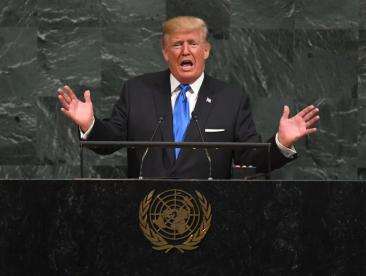 If you begin by understanding that President Trump was making a campaign speech aimed at people “back home” it all makes more sense. There is a great deal of anti-U. N. sentiment among Trump supporters. I used to see signs “U.S. out of U. N.” I haven’t seen any of those signs for awhile, but the sentiment lives on. This speech pandered to that sentiment in quite a few ways.
 embarrassing. They are dumb, but they aren’t really dangerous. But there is another matter that troubles me and this one I think it is far more dangerous. Trump has in mind changing the understanding of what the U. N. is for.
 explain what that means before I write anything about his work. When a subject area is both important to me and too confusing for me to sort out, I like to choose “a guy” as my default guru. [2] “Default guru” means that I provisionally accept that person’s perspective as my own and I pay particular attention to writers who diverge a little from that perspective. [3] Sometimes these divergences pile up and I have to look for another guru—if I still feel, by that time, that I need a guru. More often, I keep the guru’s perspective, but modify it to meet my own needs. In that case, I think of myself as a “neo-something.”
 I like that a great deal. If you look at the current fluidity in the performance of gender and the norms by which those performances are judged, it is easy to be overwhelmed by the complexity. If you get a firm notion of how those roles used to be and what happened to them, you can see today’s struggles as an attempt to return to clarity. Starting that far back gives you a perspective on today that you can’t get by starting today.
 And what are those “waves of events.” As specific tools, they vary, of course, from one parent to another, but as kinds of tools, they are pretty common among parents who are trying really hard to be “modern” [3] and “positive.” These tools involve amazing levels of “polite request” and “expressions of appreciation” for the children’s compliance with those requests that sometimes occurs. The tools involve praising a child for doing something he has no sense of doing at all. This has the effect of weaponizing the child, who now knows what behavior he is currently foregoing and therefore what behavior will bring him the attention he craves. The kid who was perfectly happy looking out the window, learns, for instance, that he has been passing up jumping up and down on his seat.
 little girl standing on her seat, the mother say “Would you sit down please?” and, when the little girl sat down, “Thank you.” Why is that a good thing to say, I wondered.
 What would work a good deal better, I think, is for the parent—we have been considering the mother here, but there is no reason it couldn’t be the father—to take the role of the parent, to be in loco parentis. That means that she has special authority to organize the behavior of the group, to dole out rewards and punishments as needed. She can be as sweet-tempered as the situation allows her to be, subject to getting the work done successfully. And let me remind you that “successfully” has independent metrics for the safety of the children, the health and welfare of the mother, and the safety of non-belligerent parties, such as neighbors and passers-by.
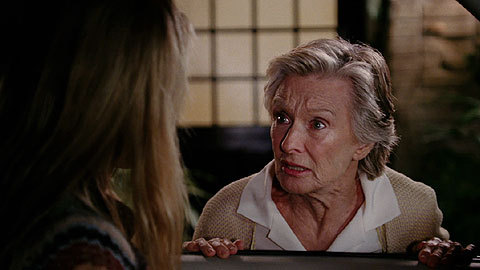 restaurant with one of the most beautiful women in the world and the wife interrupted her affair long enough to notice. She hopes desperately that the husband has had an affair. She thinks that would somehow make it easier for the marriage to survive her affair. Here are the grandmother and the wife in urgent conversation. I’m not even going to bother to identify the parts. It begins when the husband comes home. We, as viewers, have already seen what it cost him to continue to be faithful to his wife.
 And if we did that, the moment would go by when the argument can be put aside just for now and simple humanitarian assistance given—without a ruler across the knuckles for once. And the resentment of elite know-it-alls in exacerbated and Trumpism gets stronger. You can see why Pruitt would like that. You can see why I wouldn’t.
 accumulated—“a lifetime of reasons”—that present events cannot be made the reason for deciding what to do. In that way too, I think Keaton illustrates the resentments of the right wing.
 thing I want to say is that if there are indeed two (or more) and if they operate independently, it is crucially important that we know that. Not knowing it makes us all look foolish.
 similarly formal system. You confess your sins to the priest, [4] he prescribes some act of penance (and possibly of restitution—the movies aren’t as clear about that) and then pronounces, on God’s behalf, that you are forgiven and restored to full fellowship in the church. I hope that account isn’t too far wrong; I am trying only to illustrate a non-state version of the judicial system.
 If there is only one system, then the behaviors of the other person will be evaluated using the norms of that system. This is the step where I lose people, so let’s imagine that a well-known rugby player, Jonah Lomu, for instance, is referred to as the dirtiest basketball player in the league. I know that makes it seem silly, but if you really believe that the only game there is is basketball and if, with that in mind, you watch Lomu doing this, you will be driven to that kind of criticism.
 that it is really hard to do. Picture this. A man finds that his wife has been sleeping around in the neighborhood with his friends. What he wants from her is some sign of remorse and a good faith promise that she won’t do it again. What he gets after each episode is…oh, “enhanced affection” from his wife. Whatever it is that he likes best about the relationship, there if more of it for him for awhile. This is perfectly in keeping with his wife’s understanding that what she did was emotionally hurtful to her husband and now she is making up for it by being emotionally receptive to him. There are no “offenses” here; I was mean so now I am being nice.
 “the reconciliation room.” I liked that It had never occurred to me before that you could name the room after the outcome, rather that after the process.
 nobleman turned shepherd, had seen a lot of bushes on fire, but never one like this. It struck him as odd and he went to see it on the grounds that it was a natural oddity. I was an anomaly. It was The Anomaly.
 But as I said, the name God gave to Moses can be understood as “I will do what I will do” and the doing accomplished things that the name could not. Moses was scarcely willing to believe in the project himself, so God gave him three tricks to do. One has to do with a walking stick that turns into a snake and then back; one with a hand that is terribly diseased and then healthy; and one about water that turns into blood when you pour it out. Moses can, apparently, picture being persuasive in Egypt if he has these tricks in his repertoire. They certainly work for the elders of Israel the same way they worked for Moses. They didn’t believe in the name, but they did believe in the deeds.
 Real issues are at stake. One team is going to win and another will lose. I want to be on the winning team so I subordinate any other interest I might have to the team’s needs. Ordinarily, for instance, I’d rather score than rebound, but winning tonight is going to require more rebounding, so I pass up my shot and get in position for the rebound. This is so clearly what the team needs that I might not even be conscious that I am doing it. But if you see me doing it, you will know how to understand it.
 cost of parking. A resident is recognized and goes on for awhile about how rich our area is in public transit and how, as a result, there is very little need for a resident to have a car at all. That’s the real way to deal with increases in parking fees!. Let’s imagine that this resident is well-known for his pro-mass transit views and nearly always expresses those views in private or small group conversations. It seems odd to us that this familiar pitch would be made again in a public meeting and that the time of the meeting would be taken up by what is, essentially, a public service announcement. But if it is true that this resident would not have allowed himself to make this pitch in a public meeting during “game time,” then his willingness to allow it now is yet another indicator that we have arrived at garbage time.
 Of course, I don’t want to argue that there are, in fact, people who think of the meetings that way. I don’t know whether there are or not. I don’t think I know anyone about whom I would say that—that they attend meetings just waiting for garbage time. On the other hand, this is a way of looking at the meeting that starts at a different place entirely. It understands the meeting as a way for individuals to meet their individual needs in public and that way of understanding the value of the meeting had never occurred to me and likely never would have.
 Sheriff Arpaio was convicted of “flagrant defiance of another judge’s orders in a long-running case over the former Maricopa County sheriff’s targeting of Latinos in Arizona,” according to Joan Biskupic, a CNN court reporter. The court said that Arpaio was violating the constitutional rights of Arizona citizens and he said he didn’t care and wasn’t going to quit. Hence the arrest and conviction.
 Hatfields and the McCoys. [1] On the one side of this divide would be the laws of the land and the men and women charged with seeing to it that it is obeyed. On the other would be the people who are immune from legal prosecution for anything they do on behalf of their tribe. It would mean looking at Eliot Ness and Al Capone as the heads of two tribes fighting for supremacy in Chicago. The fact that one represented the law and the other a criminal organization is not brought to light in this conflict of tribes perspective.
 I know that is where tribalism goes. I don’t know if we are taking large steps in that direction. It looks like it. People who stand up for the integrity of the law will be accused as being members of “the other tribe.” The Tribe of Anti-Trump. That is, after wall, what Capone said to the members of his organization who were not Anti-Ness enough. It is what members of the McCoy Clan said to family members who were not Anti-Hatfield enough. It is what President Nixon meant when he urged the people of his administration to “take one for the team” and go to jail. But he didn’t pardon them.
 can’t believe what he says. He is not credible. That’s the old basic meaning, but it isn’t the meaning that is reflected most in current usage.
 Let’s look at what that boundary condition means because as much fun as it is to have an enormous monster with great pecs and a bad disposition, it is less fun to have a Chief Executive who frequently leaves the common human condition and does “incredible things.”
 President Trump has not had a major legislative victory yet and probably won’t ever have one because his inability to win the early battles causes him to declare war on his teammates. Trump needs to be seen as a winner. That means that high profile programs need to be passed by the Congress. But when the early votes fail, he experiences “signs of stress” and begins to attack his team members. Trump has major conflicts going on now with Paul Ryan, the Speaker of the House and with Mitch McConnell, the majority leader of the Senate.
 The Dilettante's Dilemma