
In May of last year, Carol Marat wrote a piece called “How to Thrive While Living Alone.” Nearly everything in my response to this lovely piece could be construed as criticism of it, so I want to take the time necessary at the beginning to say that I have no criticisms to make of it. At all.
On the other hand, Ms. Marat pushed my thinking in some directions it would not otherwise have gone and I appreciate the help. Two of those directions are these.
- How is “living alone” different from living with a mate? Answer” not as much as you might think.
- And, is there a general model for meeting your own needs—not those of “elderly people living alone” but your needs in particular. Answer: Yes there is. Surprisingly, I have one in mind.
Living “with”
Bette and I had been married for a long time before we began to be married to each  other. We were glad to have found each other and we have enjoyed the marriage fully, but both of us know that marrying each other was not going to be “the answer.” Neither of us, in Shel Silverstein’s well-known parody, was “missing a piece.”
Neither of us, in other words, was going to be “the answer,” the crucial resource to whatever problems each of us had been carrying for years. I think that only very young people imagine that marriage will do that for them. Another way to say that is that each of us is “alone” a good deal of the time and whether we feel lonely or not is really up to each of us. It is, in that respect, just like not having a mate.
That is what brought me to my first reflection about Carol Marat’s piece. If these are the things one ought to do to “thrive while living alone,” how does she imagine “living with a mate?” Let’s deal with the “what to do” part first.
How to live alone and thrive
- The first is to be clear about how you want to live.
- The second is that understanding what your needs are enables you to live authentically.
- The third is that it is crucially important to forgive yourself.
- The fourth is that honoring the special traits that make you who you are in crucially important.
Well…I like the idea of doing all the things she says are important if you are going to live alone. Those four ideas—some of them go too far for my own personal taste—are good guidance.
But when I try to think how she must construct the situation of living with a mate, it all begins to seem odd to me. So, let’s just negate each of those—not implying that this represents Ms. Marat’s views—and see where that takes us.
- The first is that if you live with a mate, it is not necessary to be clear about how you want to live.
I can see why that would be true if you planned to be completely subordinate to your mate. “I don’t need to be clear; she will be clear and I will comply.” Or maybe she imagines the opposite to be the union of the two persons in something like a Vulcan mind meld. [2]
If, on the other hand, you think of yourself as an active presence in the life of your mate,  it is vital that you get some clarity about how you want to live. For one thing, he will want to know that because he will want to take it into account in his own choices. I would think that being clear about how you want to live is fundamental to living in love and harmony with your mate.
- The second is that if you live with a mate, it is not necessary to live authentically, therefore it is not necessary to have the understanding of yourself that would allow it. I think that saying that out loud is close enough to refutation that I can just let it go.
- The third is that is that if you live with a mate it is not necessary to forgive yourself. I guess the idea is that the mate will do the forgiving. If you have ever had the experience of having your mate forgive you for some transgression for which you have been unable to forgive yourself, you know that doesn’t work at all. Forgiving yourself is the foundation of your forgiveness or your mate on anyone else; it is foundation of your accepting and benefiting from forgiveness that is offered to you. [3]
- The fourth is that if you live with a mate, you don’t need to honor the special traits that make you who you are. This is the most difficult one, I think, because it is problematic even in Ms. Marat’s formulation of it. Just to finish off the exercise, I will say that she may be thinking that the mate will understand and honor those traits—I would call them constitutive traits—so that you don’t have to.
First, not all the traits that make up who I am—my constitutive traits—are good. I am defined by my sloth and my greed and my cowardice as much as I am by my energy and my satiety [4]and my courage. So that relates to me as a person. If I go further that think of myself as one member of a partnership, some of my traits that are constitutive also for the partnership. They are important for me and important also for my contribution to the relationship.
Is there another way to approach this question?
Of course. Not that there is anything wrong with this one. It’s just not the one I use. Because I have a notion of what kind of life I am capable of living, I have a notion also of what kind of fuel I will require and how much of it, in order to live that life. I call those “psycho-social resources,” but that’s because I went to grad school late in life (I was in my mid-30s) and mined the literature for the language I needed. You can call it something else if you like.

This turns out to be a very complicated arrangement, so I am going to cut it back to the basics for today. [5] That little formulation requires that I know what I need and that I take responsibility for acquiring it. It would be easy to argue that I could be a better person if everyone were nicer to me, but that way of putting it doesn’t begin where I need to begin, which is: what choices do I have before me? [6]
It also requires that I exercise some discretion about the quality of the resources I am using—“empty calories” is a convenient analogy—and the quantity. I need “enough” of the right kind of resources if I am to be who I want to be and do what I want to do (or am called to do, as in Footnote 5).
 If I know that about my own needs—not what I need to keep trudging on, but what I need to truly thrive—and if I take responsibility for acquiring those, then the distinction between “alone” and “with a partner” simply melts away. “Doing what I need to live the life I am trying to live” is, to say it this way, a more general formulation. It is more fundamental.
It doesn’t point to some different set of requirements of the single and the bound. It points to the common requirements of the two conditions, allowing that precisely how one goes about it will vary as one’s circumstances vary.
That seems like something worth knowing.
[1] I might be missing a few now, but that’s the matter of another post entirely.
[2] Just a note for non-Trekkies. “The Vulcan mind meld or mind probe was a telepathic link between two individuals. It allowed for an intimate exchange of thoughts, thus in essence enabling the participants to become one mind, sharing consciousness in a kind of gestalt.”
[3] If anyone imagines that “forgiveness” is the quick and easy way to restore equilibrium, he is in for a shock. That are many transgressions that require truly understanding what you have done and truly seeking the pardon of those you have harmed and even, in some circumstances, doing what is necessary to heal the harm you have done. All those re compatible with “forgiving yourself” and may sometimes be prerequisite to it.
[4] Just a plea for tolerance from the reader. If English has another word for “enough-ness,” I don’t know what it is. I know “satiety” is unfamiliar, but I’m going with it as the best word I know for that condition.
[5] And these basics will need to skip over the resources I need to live a life of Christian discipleship. That commitment changes both the resource base and the kinds of things for which I will need resources. No chance to deal with either here.
[6] It is also true that “making do with less” is a choice I might make. It isn’t only being responsible to acquire “enough” resources, it is also recognizing that there are not always going to be enough resources and that I need to deal with that situation, too.
 Unfortunately, he was a very popular man and everyone wanted a piece of him, including every president of the U. S. since Truman. Psalm 18 refers to God as our “shield and buckler” and that is a good thing, but President Nixon used Billy Graham as his shield and buckler and that was a bad thing. Billy hoped to be spiritually helpful to the presidents he counseled, and he may have been. He was, without question, politically helpful.
 The matter gets further complicated in The Crown in the next scene where Queen Elizabeth has a private audience with Billy, after the chapel service. She compliments Billy on his clear exposition of the demands of Christian faith.

 we make safely snatch those words out of context and apply them to ourselves, I would say, “Actually, we can’t. They don’t apply directly to us. They apply indirectly to us. They matter enormously, but you have to deal with the thought, not just the words.”
 The same thing happens on the social side. A resident I have gotten to know in my brief time here shows up in the little coffee nook where world problems are hashed out every afternoon [4] and today, he has a cane. Tomorrow—or some tomorrow or other—it is a walker. Then a wheelchair; then a wheelchair with oxygen. Then he doesn’t come all the time; then he doesn’t come at all. These are perfectly ordinary signs that “it” is failing.
 The other side of that dichotomy is harder. The other side is when “you” begin to suffer losses so that you are “no longer yourself.” That’s the way they say it, but, of course, you are “yourself;” you are precisely the self you now are. You are not the self you used to be, of course, which is what everyone who uses that phrase is understood to mean. [5]
 prominent response. When a person has lived a long and successful life, it is perfectly appropriate to celebrate that life as a whole and at the same time to mourn the loss the the person.
 him look bad. I’ve been grateful to him ever since for being willing to do that. His notion of living the Christian life was that around him in the world were people he was called to serve. He didn’t have a narrow or a specifically religious notion of what “service” was. He did have a sense of how those people were to be identified to him, however. He counted on the Holy Spirit to move him toward those particular people he was being called to serve. Not only is that resolutely orthodox; it was not even unusual at Wheaton when I was there.
 Now let’s go back and look at the sequence. “Eliminating drudgery” creates the possibility of leisure, which in turn creates the possibility of self-cultivation in a way that was once possible only for aristocrats. With these new household “conveniences,” everyone can be “like an aristocrat.” [3]
 If it were formulated as a rule, and there is no reason to think anyone would really do that, the rule would be this: if it takes either work or waiting, I will choose something else. Political reform? Takes too long. Providing infrastructure? Way too long. Slowing the rate of climate change? [4] Not every worth thinking about. Easier just to deny the reality of it.
 of St. Bonaventure Hospital in San Jose. Here are Dr. Coyle
 and Dr. Browne. She reproves him as she should and reports him as she should. But Dr. Kalu, her boyfriend, (that’s a gross characterization, but it’s good enough for this small turn of the plot) is angry and physically assaults Dr. Coyle. And then he gets fired for having done that.
 This requires a confrontation between Allegra Aoki (Tamlyn Tomita), who is Chair of the
 St. Bonaventure Foundation—that means she presides over the sources of the money that fund the hospital—and Jessica Preston, (Beau Garrett) who is Vice Chair of Risk Management. You see them here.
 Dr. Andrews, the black Chief of Surgery, (on the right) reproves Dr. Kalu, the dark
 surgical intern, (on the left) for playing the race card inappropriately. Kalu defends himself by arguing that the case he made—white doctors in that situation have been treated differently than he was—is true. Andrews says that isn’t a good enough excuse. “You stepped over a line,” he says. He doesn’t say what “the line” was, but he is about to.
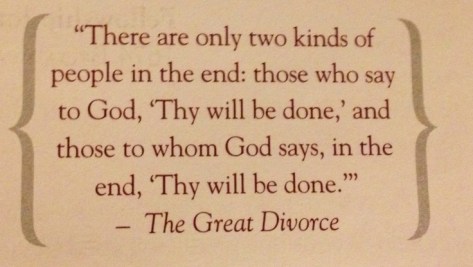
 is like. [1] In The Great Divorce, Lewis gives a very interesting account of the Spirits who are in Heaven and who belong there. In Lewis’s version, the Ghosts come up from Hell as visitors—there is a bus every day for that purpose— and are met at the bus stop by the Spirits who are there to help them.
 It is also true, in this fantasy, that the Ghosts are completely insubstantial. Picture a column of smoke in the shape of a person. The Spirits are substantial—“real” Lewis says—because Heaven is “real” (substantial) and that difference in the two places mimics the spiritual condition of the two kinds of beings.
 physical tasks. The Rights-monger cannot simply wander around Heaven on his insubstantial feet, much less begin a journey to the mountains. He will need quite a bit of help and Len is offering it to him. It means spiritual tasks as well, as in asking for forgiveness for the evils Len had done on earth.

 There are people here, for instance, who manage to stay in touch with their biological family—that ordinarily means siblings and children and grandchildren—and also to build stable friendships with the other residents. I wasn’t all that impressed at the beginning of my time here, but now that I have given it a try, I know how hard it is and I want to learn how they do that. I don’t want to copy them—the differences also need to be taken into account—but I want to learn how they see the field of play and how the decide what to do.
 chipper; the husband was quiet, but he could say things that made sense on their own and that contributed to the conversation. Sometimes. And sometimes not. When “sometimes not” happens, the wife has a decision to make.

 incontestable outline of things. And after that, and without losing any awareness of it, you can attend to a good deal of complexity without losing your sense of the vision as a whole.
 And it isn’t just history. In preparing for a Bible study course that begins in September, I have been studying the Old Testament prophets. And all of a sudden, it occurred to me that there were three major categories of those prophets. Only three. There were the pre-Exilic, whose message was that God is going to punish (“discipline” in some of the prophets) you for your godless ways. And then there were the Exilic prophets, who said to Israel, “Your sentence is almost up. God is going to restore you to your homeland.” And there were the post-Exilic prophets who, with the exception of Jonah, said, “The holiness of the temple and the city and the worship of Yahweh have all been compromised while you were gone. Put things back to the way they should be.” [3] This is someone’s notion of what the prophet Amos looked like. He was one of the pre-Exilic prophets.
 When I hit my first communitarian sociologist, Frank Hearn, I was fascinated by his allocation of all kinds of “social problems” to one of three places. His own preference as a sociologist is that most problems be considered as “social problems,” by which he means problems rightly referred to communities using their own local institutions. But that means that he has to have a nasty name for the practice of referring those social problems to other places, where they really shouldn’t be. [4] Problems that are rightfully social, but that are referred to the polity instead, have been “politicized.” Problems that are rightfully social, but have been referred to the economy instead, have been “commodified.” Three places to put problems: no more. Horizon.
 complexities of today’s policy proposals. DACA or not? Amnesty or not? Enhanced legal immigration or not? But all of these questions take the present political system—the old classic post-medieval Liberal system—for granted. And Deneen says that system is running out of fuel and can’t be saved. I’m sure this picture is an ad for a business of some kind, but note the similarity to Deneen’s communalist picture of liberty.
 movies. [1] The picture I am relying on here is the patient lying on the couch free-associating in the presence of a fully present therapist. The “free” of free associating means, in part, that the little boxes in which we keep the thoughts and feelings that contradict each other are all opened at the same time in free association. And they associate with each other, not in the dark safety of the mind but in the public space between the therapist and the patient. Both hear the patient say things neither has ever heard before. [2]
 year, red states want to do red state things and blue states want to do blue state things. And every year, each color has to put up with federal regulations that requires them to be much more similar than they would really like to be. This tension between the national administration of national systems and the state preferences which express the political culture of their own states, is the heart of the federal bargain.
 know that because they aren’t working. Further, they are not working because they choose not to work and in that choice, they forfeit their claim to society’s help.
 states are finally being allowed to do what they have wanted to do for so long. It is this “permission,” that called to mind the image of Dr. Trump as the therapist and “the red states” as the patient. Dr. Obama kept telling them how they should feel—compassion, for instance, toward those not able to find work—and made them feel ashamed of how they did, in fact, feel. Dr. Trump is allowing those states to say out loud what they have felt for so long and is giving them permission to build systems tying work to medical service.
 has not yet abated. Some of that animosity appears to be no more than personal grudges projected onto public issues. What could have been a perfectly normal division within the Democratic party between the ideological left and the pragmatic center, got blown out of proportion by the personal attachments of the campaign supporters. Hillary’s people need to get over blaming Bernie’s people for “denying her the election.” Bernie’s people need to get over their resentment of Hillary’s persistent tacking to take advantage of the winds of the campaign season
 This argument agrees that the Republicans may be very weak in 2020 as a result of the expected Trump implosion but they make the case that winning seats is more important than the success of the programs so dear to the left wing of the party. And you don’t have to say out loud that you don’t share those goals if you can just make the case that it would be risky to pursue them.
 are not the same kind of thing at all. The dominant voice of the Republican party is now a movement-oriented voice, something like jihad. The Democratic style is collecting groups of voters who are willing to sign on for the campaign, like a state militia. The Democratic party works like the United Nations, not like Al Qaeda. [4]

