
Where I live, people want women to be “strong.” That is the official sentiment, at any rate. That seems to me to be asking for too little. Maybe I can introduce my concern by coming at it from the other side.
For years now, I have misremembered a line from a poem by Charles Kingsley. I am not embarrassed that I misremembered it; I am embarrassed by the fact that I like the wrong version—mine—better than the right version. Here’s the way I have always thought it went: “Only be thou good, sweet maid/and let who can be clever.” [1]
So…what are we talking about here? We are talking about gender norms. What kind of “behavior” [2] should we prize in women? [3] It would be nice, one might think, to say that it depends entirely on the woman. A woman “ought to be” what she wants to be and we should all root for her success.
That never works. I have never heard of a society without gender norms. It makes a contribution to the society, somehow. Usually, what is meant, when someone says that a woman should be free to be whoever she wants to be, is that she should be free to be whatever kind of woman she chooses to be. There is still, in this model, an “OK for women” space and this argument holds that a woman should be able to choose anything she likes from within that space.
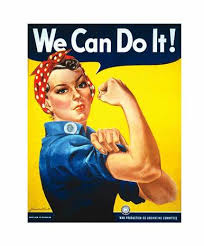 So now that we have corralled the question to a certain extent, we can ask it more meaningfully. What kind of traits—among the traits that are virtues in women [4]—should we emphasize? The current choice, made by the staff of the Senior Center where Bette and I live, is that woman should be strong. The Mother’s Day [5] featured a little card, along with a beautiful flower, that said this: “Here’s to Strong Women. May we know them. May we be them. May we raise them.”
This emphasis, bracing as it is, violates most of the criteria set out above. It presupposes, for one thing, that the women in question want to be strong women. So it is a challenge to the individuality norm. It presupposed that among the various traits women might have, strength is the most important one. [6] It is more important than gentleness, for instance, or good humor, or good manners, or wit, of adept communication.
It will be protested against this indictment, that there is nothing about being “strong” that prevents it from being joined to any number of those other virtues. That is true, in principle, but we are talking here about salience. Some are more important than others. We are not talking here about the best combinations. We are talking about what is to be prized at the expense of what. It’s a salience war.
 Let’s pause for an example. In my political science classes at Portland State, I used to try to teach the importance of salience. We can treat that, for today’s purposes, as “What is the question we are addressing.” I began by noting that in what are now called “the abortion wars,” no one takes a position called Anti-Choice. Similarly, no one chooses Anti-Life. Why? Because you will lose if you do that.
The argument proceeds, instead, as a conflict over which question is salient. Is it “Should the life of the fetus be preserved?” Is it “Should a woman be free to choose what happens to her own body?” You tell me what the question is and I will tell you who is going to win. Why? Because salience is everything.
And that brings us back to strong women. Strong rather than what? If you establish “Should women be strong?” as the question, then I think “rather than weak” is the proper way to complete the question. That makes it a pretty aggressive question: “Do you want women to be strong or weak?” Hint: there is a right answer.
In Julia Ward Howe’s original Mothers’ Day Proclamation, women were thought of as the sources of caresses and affirmation, something nearly any man would desire. Here’s what she said:
Our husbands shall not come to us, reeking with carnage/for caresses and applause.
The point there is that men should not be free to wage war, as they often want to, and then return to their wives for the hero’s welcome. Absolutely not. We mothers will save the caresses and applause for the times when the men do what we want them to do. In this case, that is to forego war and pursue peace.
If you want to say something other than “strong and not weak” or “weak rather than  strong,” you are going to have to change the question that is being asked. Should women be praised for other traits as well? Or is it just being strong? Could we say, for instance: “Here’s to Smart Women. May we know them. May we be them. May we raise them.” As an exercise, I tried googling “nice women” and I got pictures like this.
Or could we say: “Here’s to Nurturing Women. May we know them. May we be them. May we raise them.”
Or could we say: “Here’s to Resilient Women. May we know them. May we be them. May we raise them.”
Or even: “Here’s to Beautiful Women. May we know them. May we be them. May we raise them.”
Some of those traits are currently fashionable for women; others not so much. But the objection would be likely to be one of two kinds. Either it will be that all those are good and one should be simply added to another as “appropriate for women.” Or it will be that each woman should be able to choose for herself what traits to emphasize in her own life.
Those are both good answers, of course, but they do not serve the proponents of the “strong woman” campaign, because they undercut their goals as well as all the others. It’s not a problem with a solution.
There is one thing, however. I am nearly panting with my enthusiasm over the trait that will be chosen for Fathers’s Day. What is the current “virtue” for men? Watch this space.
[1]As I looked it up, I discovered that the actual line is: “Be good, sweet maid and let who will be clever “
[2] Including all traits here, including styles of cognition, intention, and emotion, as well as actual actions.
[3] I think you ought to start getting ready for another post on Father’s day. Gender norming, in the view from the trenches, is not for the faint of heart.
[4]I always savor the pun that is buried there.The word “virtue,”—meaning any virtue at all—derives from the Latin, vir, = man.So, etymologically speaking, every virtue is a “manliness” of some kind. This is most ironically true of the classic virginal maiden who, in preserving her virtue, is preserving her manliness. Etymologically speaking.
[5] The placement of that apostrophe is of climactic importance. The original choice was “Mothers’ Day,” the day of the mothers. It was a call for peace, rather than war; for femininity, rather than masculinity. The current style, “Mother’s Day” is the day dedicated to good ol’ Mom and especially in light of all the ways she helped us along when we were children. You choose your apostrophe placement, you choose your battlefield.
[6] Or, if not the most important one, the one most in need of praise and support.
 The king promises his soldiers, mostly ragtag peasants, that in the future, some wonderful thing will happen to them. There are two elements of this I want to point out. The first is that the reference point is in the future. This is very comforting to soldiers confronting a battle; it imagines that they will have a future. It doesn’t say so. That would be cheap. It just takes it for granted, which is much more powerful.
 have had some interest in it, but more likely, I found it in the places I ordinarily go for reading material and started into it by habit. If I don’t find anything that is of immediate interest, I move on. This is especially true of technical writing. It seems, sometimes, that there is more below the surface of a text than there is right at the surface.
 For a story as fraught as the Genesis account of creation, there are other reasons. All my early exposure to the Genesis accounts—I am trying to remember to use a plural there—was in church. The preacher or teacher had lessons to impart and the lessons were much more important than the text. When you come to consider the text as a matter of interest in itself, you begin to stumble across things; really “obvious” things. And you wonder how you could possibly not have noticed that the first time through. Answer: you were busy with other things. Of the many pictures of Adam and Eve, I chose this one because I thought she was kind of cute and it looks like she is in a sharing mood.
 by citing scripture. So he turns to Genesis and he is undeterred by the 1st story/2nd story differences that have so captivated me. Presumably the two stories he is looking at say the same thing they do now. Chapter one has Adam and Eve created simultaneously by the spoken word of God. Chapter two has Adam created first, then Eve; and Adam was not created by a word of command, but physically, out of dirt. [2]
 the solution to a problem I was already acutely aware of. It was that I wrote essays from time to time and was curious about how this friend or that one might respond. I was reluctant to send these essays to people who might turn out not be interested and who might feel obligated to read them. So Bette said, “Why don’t you just start a blog? That way they can read it if they want and won’t feel obligated.”
 After a few years, I changed my calendar. I invented “the blogging year” for myself. Because I spent some time around the legislature in Oregon, I got accustomed to different calendars for different purposes. So the January to December calendar was just a default setting. I started my blogging calendar (BY 2020 began in December 2019) so that I could more or less start fresh with the church calendar. So every year, I get to “turn the page,” in a sense, and start with Advent. I write a fair amount about Advent, so it was a natural place to start a new “year” of blogging.
 disorientation occurred, [1]
 lar one, I tried to describe how I wanted her to be.
 What might I be told to do?
 Phase III of the spiritual therapy.
 When you come to the question of rationale, the urgency of the question “Why am I doing this?” comes immediately to mind. A famous experiment which I ran across in grad school, had students performing a meaningless task turning pegs on a board. Some are paid a little for doing it; others are not. When they are asked to come back to the lab and do it again, voluntarily this time and without pay, some said yes and some said no.
 When I first thought of this, I got as far as “junk activities” as analogous to “junk food.” But now that I am into it a little, I think it might be worthwhile to pursue further questions. What activities have the effect of providing energy, like proteins do? What activities help us dispose of waste products like fibers do? What activities have the effect of helping us build and maintain tissues? [5]
 wouldn’t think they would work at the same time with the same people, would you? Or that you could cycle back and forth quickly between one kind of appeal and the other?
 could inflict not just on THEM, the people who are denying me and ordering me around, but on THEM, the people who are posting notices that we are all in this together. There just might be something that felt very good about that?
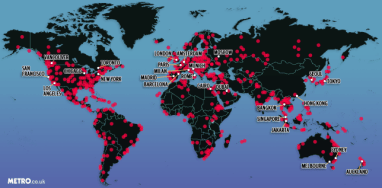 going to spread most rapidly to the places who do not have the resources to defend their populations against it and to the places who do have the resources but are slow in deploying them.
 On the other hand, you still see people out walking, most with face masks on and there in an undeniable camaraderie that reminds me of World War II.
 famous.
 But that is not what I want to do. I want to build a model of human functioning that makes sense to me and that I can use. So I need some premises about human functioning and then I need some observations that test and affirm the premises. [1] I plug the day’s observations, the reading I do, the conversations I have, into the system and up pops new idea—sometimes a really intriguing idea. Take loneliness, for instance.
 receiving what feels like an unedited flow of self-expression from an intimate other and am allowing that same kind of unedited flow to come from myself. There is nothing particularly erotic about this exchange, although there is no reason it could not involve erotic commitment. We hunger, I think, to know who another person really is and at the same time, we know that society simply can’t operate that way. Society—civil association—requires that we play our parts and do our jobs and relate to each other with the psychic surplus. And that is why we hunger to know who another person really is.
 I don’t object to the things that are being proposed, but I also don’t see any connection between those proposals and the kinds of things I think—using the system I have derived for my own use—actually help people. So I see those proposals and I wave them away. Yeah, fine. But when I am pressed to adopt or support them, I am forced to say that I don’t think they will help. And when I am pushed to say why I think that, I trot out my own set of presuppositions and the observations that are consistent with them. That is often not received well.
 Wouldn’t we all.? Why wouldn’t we wish that we were not afflicted at all by COVID-19 and that we could go about our business? There are two elements here. One is context: there is a health crisis for which we are woefully unprepared. We need to get serious about taking the measures necessary to contain it. The other is religious symbolism. “Easter” is a prominent marker in the church year. Having “the churches filled” evokes a long-ago America when most people identified as Christians and where church attendance statistics were eye-poppingly large.
 wants to talk about religion and his hopes for it. We want to talk about illness, disease, and public responsibility. He wants to align himself with the hopes of one of his core constituencies. We want to bring the news of deprivation and disease. And not only do we want to do that, we also want to condemn him for his reference to Easter, as if we didn’t understand that every complaint establishes him more firmly in the pro-religion camp and ourselves in the anti-religion camp.
 Please note that this is not a press conference where there could be follow-up questions. It is not a CDC briefing. It is more like a public appearance byAndrea Ramirez, (seen at the left) the acting executive director of the Center for Faith and Opportunity Initiatives at the U.S. Department of Education. She is a low level (compared to the President) employee and you could require her to say that she, herself, does not hope for the churches to be filled with infectious Christians on Easter. There can be hundreds of such interviews without touching the public appearances of President Trump at all.
