The summary I found for the recent movie, Downhill, starts like this: “Barely escaping an avalanche during a family ski vacation in the Alps, a married couple is thrown into disarray…”
I don’t mean to imply that that is inaccurate, but that is not the movie I saw. I want to tell you about the movie I saw. I am aware that it is probably not the movie that directors Nat Faxon and Jim Rash were trying to make, but it is the movie I went there to see.
Let me illustrate and then we can do a little exploration. Billie (Julia Louis-Dreyfus)and and Pete (Will Farrell) are a barely married couple (they haven’t divorced yet) whose marital poverty is revealed by their responses to the avalanche. They are a couple utterly without resources, without mutual affection, with a goal, without any means of navigating jointly toward that goal. I called attention, in the title I gave this essay, to the fact that it takes energy and resolve to go uphill because that is not the journey gravity has in mind for you. Billie and Pete don’t have energy and resolve—at least not as a couple—so downhill is the only plausible course. You can almost tell that by looking at them in the picture below.
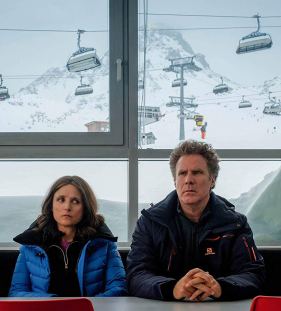 How do we know their marriage is so poor? Because Faxon and Rush go to some lengths to tell us that in many ways. A good example shows Billie and Pete going down to dinner. [1] There is another couple in front of them. The woman has taken the man’s arm and is turned toward him as they walk. Billie and Pete are walking behind them, side by side, with their hands almost, but not quite, touching. When the weight of the example in front of them begins to press down, they hold hands very tentatively. [2] When the other couple turns into a side hallway, they drop their hands immediately and resume the side to side posture.
Neither there nor at any other time in the film do they show any physical affection for each other. That could have been a resource for them, but they don’t have it.
Here’s another example. Pete has planned this “family vacation.” It is a “family” vacation in the sense that they brought their two pre-teen sons along. It is not a family vacation in the sense that Pete has any idea of doing things the boys would enjoy doing. They are all going to go to Austria and do the things Pete thinks the family might like. [3] Pete planned the trip because he desperately wants to be a hero and spending a lot of money in a beautiful setting on activities that his family can get through only by gritting their teeth, is as close to being a hero as he can come.
It wouldn’t have to be that hard. In saying this, I know I am running the risk of saying that it is all Billie’s fault. That is not what I am saying. I am saying that
Billie controls whether Pete feels like a hero or not. Pete wants to be a hero to his wife and has, so far, failed, and in his desperation, he has planned this preposterous ski trip to Austria.
If Billie had planned the trip, it would not have been to this hotel; it would have been to the nearby “kid-friendly” hotel and there would have been lots of things to do that the kids like. Billie is a much more sensible person than Pete; she is more realistic, more organized, more practical. But Pete wouldn’t let Billie plan the trip—none of this is in the movie, I’ m just extrapolating from my sense of the fundamental dilemma of the marriage—because he needs to be a hero. It’s a shame he is so bad at it.
He could, of course, recognize how much better Billie is at planning and settle for being the “big idea guy.” He gets the idea that the family needs a vacation, sells it to Billie, and then supports her in every way as she makes the arrangements. Recognizing Billie’s superior ability doesn’t feel heroic to Pete. Maybe it never did. Maybe it would have, back before his need to be a hero became such an obsession. We don’t know any of that. In any case, it is not what he chooses. This vacation trip is a kind of Hail Mary pass for Pete and like most Hail Mary passes, it is not received successfully.
Pete also does not protect the time he wants to have with Billie. On their first visit to the restaurant, they are invited—insistently invited—to join a hotel employee for dinner. Neither of them wants to go, but eventually, Pete says Yes. It is awful. A work colleague of Pete’s shows up with a free-spirited girlfriend and they take over the next possible “romantic dinner.” Again, Pete could have said No, but Pete does not say No. He does not say No to anyone. He doesn’t understand, apparently, that saying Yes to everyone necessarily implies saying No to the kind of relationship he wants with Billie.
Billie knows that, even if Pete does not. She experiences Pete’s failure to protect the zone of intimacy that would allow them to remember what it was like to be a romantic couple. [4] There is no room in the movie for Billie to tell Pete that—the plot wouldn’t allow it—so I don’t want to say that she should have. I am saying only that she understands what Pete’s affability is costing them and Pete does not.
That’s part one. The skiing trip is a disaster and the reasons I have given are why it is going to fail—avalanche or no avalanche. Part two is about the resources they might have had—they don’t—to navigate the disaster successfully and return home as an intact family.
What would it take? I have made Pete the principal cause of their difficulty so, in a spirit of gender equity, I am going to focus on Billie as the principal cause of their failure to work their way out of the difficulty. In fact, there are so many things wrong, I could stay with either.
Billie’s worst moment—she would agree with this, I’m sure—is the time she and Pete are in a dispute about how he reacted to the avalanche. These were not happenstance avalanches; they are set off by firing cannons placed on the slopes. These are regular and controlled avalanches. Nevertheless, one of them exceeds its mandate a little and breaks over the terrace where Pete and Billie and the kids are eating breakfast. Some people react by running indoors; some by hunkering down at their tables. [5]
The view of the directors is that Pete deserted his family because of his cowardice and that is the view of Billie and the kids as well. Pete holds that accusation off as long as he can and his tendency to deny when he can and obfuscate when denial no longer serves, finally pushes Billie over the edge and she does something that even she knows is wrong. She goes and gets the kids and requires them, in public, to say that their father had deserted them. Pete never recovers from that accusation and, in my estimation, Billie never will either.
She needs to be right. That is her flaw. Ordinarily she holds it at bay, balancing it with other needs she and the family might have, but Pete’s denials are, finally, too much for her and she determines to have her rightness put on display at whatever cost to Pete and the family.
That action that Billie takes, does, however, set up the one potentially redemptive action in the whole movie. They are all taking a last run down the slopes. Pete and the kids have finished but Billie—the best skier in the group—has not made it down. At that point, Pete is reduced to looking anxiously up the hill. [6] Then he goes up looking for her. He finds her sitting on the snow with her skis stuck in the snow vertically. She is done, clearly.
He scoops her up—“rescues her”—and carries her in his arms back down the hill to where the kids are waiting. This is the kind of hero Pete really wants to be, but Billie puts some boundaries on it. “This is for the kids,” she says. “It doesn’t really change anything between us.” Billie is taking an action that will save this family until the boys leave home. It does nothing for the marriage and nothing, also, for the kind of marriage they are teaching their boys to expect for themselves. Pete complains, on the way down the hill that she looks at him as a loser. That is true. There is no compassion at all in her judgment; only embarrassment. She says that if he doesn’t want to be looked at as if her were a loser, he needs to show her something else.
And maybe he does. I wouldn’t bet on it. Pete’s “heroism” is going to require a lot of support from Billie. He really can’t do it on his own. She is going to have to help him decide just what is heroic and to provide the support that allows him to feel heroic when he succeeds. Pete has a lot of strengths as a person—none of which are explored in this film—but acting heroically in the eyes of a wife who sees herself as one of the Olympic judges is not one of those strengths.
So I wouldn’t bet on Pete. That means that I wouldn’t bet on Billie’s willingness to do what she would have to do to turn her doofus husband into the hero he needs to be. You could say that he shouldn’t have that need and that he should give it up. You could say that Billie ought not to have to manage the little dramas which will help Pete feel like a hero. I am sympathetic to both those points.
But neither of those is going to get the job done.
[1] That’s the way I remember it. Bette remembers that they were on their way outside.
[2] Bette remembers that Pete takes Billie’s hand. That’s plausible; Pete cares a lot more about how the family looks to others than Billie does, but I remember it the other way.
[3] These are not, by the way, the things he would have chosen for himself. Faxon and Rush are trying to illustrate Pete’s cluelessness as a father.
[4] One symbol of that failure of Pete’s is that he takes his cell phone with him everywhere he goes and answers it whenever it rings. He does not protect Billie from it which, in my judgment is much worse than failing to “protect her” from the avalanche.
[5] Either response seems reasonable to me, but, in fact, Pete chose to go inside and Billie chose to hunker down with the kids. This difference became the charge that Pete/Daddy had “deserted them.”
[6] Bette remembers that Billie was calling Pete and that he finally heard her. I admit that sounds like Billie, but I didn’t hear her.

 Kristof, with co-author Stuart Thompson and with the help of some statistical model builders, published an interactive graph on the spread of the virus. It shows the effect of different lengths of “intervention.” [1] It is the kind of information we need to decide what “we”—crucial term—should do in the present crisis.
 between X and X+1? Policy cannot be made on any other basis. It treats every member of the population equally; everyone is a check mark. In approaching it this way, we have, according the Moore, “lost our humanity.”
 to try to understand it first.
 certain, that you could call someone else and have a private conversation.
 window and get some coffee; if it is closed, you can still park in the drive through lane.
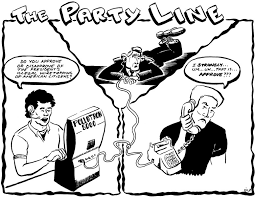
 The often parodied language of the U. S. Senate can be drawn upon here just to illustrate the idea.
 MacWilliams and Nteta argue that there is not really a price to be paid for using such language in campaigning.
 Some people will say that this can be addressed by organizations of likeminded people.
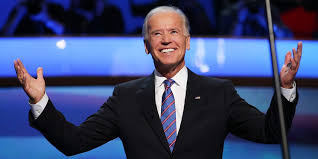 The Democratic party is split again. There was a time when Democrats were notoriously disorganized at the national level. [1] It was this phase that caused Will Rogers to quip, “I am not a member of any organized political party. I am a Democrat.”
 A second consideration is what used to be called “coattails” and is now called “down-ticket effects.” It is the effect the top of the ticket—we are interested now in presidential candidates—will have on candidates for other offices further down the ticket. Some candidates are personally popular, but don’t have a positive effect on candidates for House and Senate from their own party. Some lead a wave of pro-party voting.
 very strong in the very group—white men without college degrees—that has sustained Trump. If he won that group, he would be ripping the heart out of the Trump coalition. It seems plausible to me that he would help out other Democratic candidates, but I’m willing to wait and see what the polls show.
 The contrary idea came to me from W. Timothy Gallwey’s book, Tennis: the Inner Game. Gallwey’s idea is that to play tennis well, you need to expose your body to the game long enough that it can learn the right responses, to give it enough time to learn them, then you need to get out of the way. Give your mind something to do so it doesn’t get in the way of the kind of tennis your body knows how to play.
 really good question.
 Just to set them aside, let’s eliminate some reasons why the meal is so bad that you have to be bribed to finish it. The first is that it isn’t really bad; it’s just that you have not yet developed an appreciation for it and you will if you have continued experiences with it. The second is that it could have been good except that somehow, salt got used where menu called for sugar. The third is that a lot of good ingredients were ruined by ignorant and/or uncaring preparation and the only reason you have to eat it is some odd moral insistence on “finishing things properly.”
 a French expression that means “clearing the table.” The French verb is desservir, literally to “un-serve” the meal. Imagine your death, then, as clearing the table. You had a wonderful meal [5] but you dirtied a lot of dishes and silverware. Not to mention the sauce you dripped on the tablecloth and the faint wine ring at the far edge of your plate. All those are cleared away. That is the fitting end of that experience. But it isn’t the end of the meal. After the table has been restored, they bring the fruit and cheese or the sweets or whatever they bring and the appropriate and desired end of the meal has arrived.
 The second problem for me is that I can’t make any progress in thinking of heaven as a place at all, much less a place we come to deserve because we ate our veggies. For me, the notion that I have come to a good “place” with God, meaning, as in the example above, a good “time of relationship” with God is as far as I am willing to go. It is as far as the leash of my need to understand what I am talking about, will let me go. I am perfectly willing to imagine that in my struggle to know as I have always been known, I have come to a place where my continued physical existence really doesn’t matter all that much. In this picture, I will have lived “the life of the ages” as the Johannine Jesus puts it in John 3 and “the life of the ages” is under God’s care.
