Colleagueship at the The York Times

Probably, the New York Times doesn’t have meetings where the columnists they publish sit down around a table and talk about how things are going at the paper.  Maybe they never did.  But if they used to do that, I’d recommend that the practice be suspended, at least briefly.

Here is a brief excerpt from David Brooks’s column for May 21.

Forty years ago, corporate America was bloated, sluggish and losing ground to competitors in Japan and beyond. But then something astonishing happened. Financiers, private equity firms and bare-knuckled corporate executives initiated a series of reforms and transformations.

The process was brutal and involved streamlining and layoffs. But, at the end of it, American businesses emerged leaner, quicker and more efficient.

Now we are apparently going to have a presidential election about whether this reform movement was a good thing. Last week, the Obama administration unveiled an attack ad against Mitt Romney’s old private equity firm, Bain Capital, portraying it as a vampire that sucks the blood from American companies. Then Vice President Joseph Biden Jr. gave one of those cable-TV-type speeches, lambasting Wall Street and saying we had to be a country that makes things again.

And here is a brief excerpt from Paul Krugman’s column for May 24.

Actually, before I get to that, let me take a moment to debunk a fairy tale that we’ve been hearing a lot from Wall Street and its reliable defenders — a tale in which the incredible damage runaway finance inflicted on the U.S. economy gets flushed down the memory hole, and financiers instead become the heroes who saved America.

Once upon a time, this fairy tale tells us, America was a land of lazy managers and slacker workers. Productivity languished, and American industry was fading away in the face of foreign competition.

Then square-jawed, tough-minded buyout kings like Mitt Romney and the fictional Gordon Gekko came to the rescue, imposing financial and work discipline. Sure, some people didn’t like it, and, sure, they made a lot of money for themselves along the way. But the result was a great economic revival, whose benefits trickled down to everyone.

You can see why Wall Street likes this story. But none of it — except the bit about the Gekkos and the Romneys making lots of money — is true.

Let’s see now.  We know that David Brooks is not “on Wall Street” and Krugman gives us only two categories to choose from.  So I guess Brooks is one of Wall Street’s “reliable defenders.”  And the “fairy tale” Krugman is “debunking” is the previous column of his colleague at the New York Times, David Brooks.

Oh well, maybe they laugh about it over a beer afterwards.


Posted in Politics | Tagged , , , | 2 Comments

Quiet: Some Reflections by an Introvert

This post will eventually be about introversion.  Specifically, it will be about a marvelous book about introversion:  Quiet, by Susan Cain.  It has a subtitle too—The Power of Introverts in a World that Can’t Stop Talking—but the subtitle doesn’t represent the book.  Mostly, the book is about three things that matter to me.  The first is society’s consistent, but largely unconscious  preference for extroverts.  Extroversion is the default value and if you do not or can not act like an extrovert, you have some explaining to do.  The second is about fundamental condition introverts share.  You will be surprised.  The third is what we—we introverts—can do about it.

“We introverts.”  OK, so I’m an introvert.  I’m not shy; I just like social environments with not too much buzz in them.  And when I do things that are best done in an extroverted mode—like lecturing to my university classes or making a social phone call— I need to take some time to get back in touch with myself afterwards.

Let’s look at society’s preference for extroverts.  This is society’s default standard.  It is not preached as a virtue; it is presumed.  When you plan a party with what “people like to do” in mind, you are going to plan a party where extroverts will thrive.  This is exactly the kind of rule it is important to know about, because it’s not hard to make it through a party designed for extroverts.  You find someone else who looks uncomfortable, strike up a conversation, and find a quiet corner of the room.  What’s hard is not knowing what’s the matter with me.  Everybody else looks OK.

I ran into this problem of the “default style” after my wife, Marilyn, died in 2003.  I was grieving.  I felt bad, of course, but I wasn’t confused.  I felt just about the way I thought I should feel under the circumstances.  But it turns out that there is a “right way” to grieve.  It is a style Doka and Martin call the “intuitive” style,  rather than the “instrumental” style.  The instrumental style which is more natural to me.  Their research shows that this style is the gold standard in the field of mental health professionals.  For them, it is the default style of mourning, as extroversion is the default style of social interaction.  It is when you are grieving in the expressive style that the counselors know you are doing it right.  Failing to do it in that style means you are doing it wrong.  And if the expressive style makes things worse, you need to work harder at it.  Hm.

So I get it now: people expect you to be extroverted.  If you don’t know that, you fail a lot and wonder what is wrong with you.  If you do know it, you find a way around it—as in retiring to the quiet corner of a party for a conversation—and everything is fine.

So what is this “fundamental condition” that introverts share?  It is a preference for “low buzz” environments.  Here’s an interesting experiment, which, after I describe it, I am going to use as a metaphor.  Introverts and extroverts were asked to play a challenging word game in which they had to learn, through trial and error, the governing principles of the game.  While playing, they wore headphones that emitted random burst of noise.  They were asked to adjust the volume of their headsets up or down to the level that was “just right.”  On average, the extroverts chose a noise level of 72 decibels, while introverts selected only 55 decibels.  When each group played at the noise level they had chosen—their “sweet spot”—they played equally well.  When each played at the level the other group had chosen, both played worse.

This isn’t just a personal preference either; this is the way the temperamental blueprint is drawn.  Here’s an experiment that catches how fundamental this is.  In 1989, Jerome Kagan gathered five hundred four-month-old infants in his laboratory.  The infants heard tape-recorded voices and balloons popping, saw colorful mobiles dance before their eyes, and inhaled the scent of alcohol on cotton swabs.  About 20% cried lustily and pumped their arms and legs.  Kagan called this group “high-reactive.”  About 40% stayed quiet and placid, moving their arms or legs occasionally, but without the dramatic limb-pumping.

Introverts and extroverts, right?  Yes.  The loud, limb-pumping infants mostly became introverts; the placid, unaffected infants became extroverts.  It isn’t what I expected, but it makes sense.  This one level of stimulation was “just right” for some of the infants and “too much” for others.  The stimulus level was set, to use the word game metaphorically, at 72 decibels and the four-month-old babies who would have been comfortable at 55 decibels, hollered and struggled.  We can only hope that they were not taught, as they grew up, that 72 was the “right level” of stimulation, the level “real people” preferred.  And while we’re hoping, let’s go on and hope that they do not become “low buzz” activists, dedicated to reducing all social environments to 55 decibels.  What they need to know is: a) there is nothing weird about preferring 55 decibels to 72 decibels, b) that in most 72 decibel settings, there are 55 decibel corners and it is OK to search them out, and c) that when they really need to perform in the 72 decibel mode, they will need to find a way to get off by themselves  and recharge afterward.

That last point introduces topic three, which is what to do about it.  Here are some examples.  Extroverts are likely to offer casual information about themselves and think of it as establishing some commonality with the other person.  You have a new dog?  That’s great.  A friend of mine has an amazing tank of saltwater fish!  To that kind of response, I ordinarily look, dumbfounded, at the person and say, “What?”  What the introvert really wants is for me to say that I saw a lot of saltwater fish when I was in the Caribbean last winter and then he can say that he was in Alaska last winter and had a wonderful time climbing a mountain.

That counts as “conversation” for extroverts.  Introverts tend to focus on one or two serious subjects of conversation—often problems or conflicts they are experiencing in school or with kids or with friends.  Even politics.  To my mind—I’m a member of one of these teams, remember, so I’m not being fair—that first tag team “conversation” is a travesty and my partner, the mountain climber whose friend has salt water fish—is a jerk.  To my mind, the pair Cain calls “introverts” are just having a conversation.  Each listens to the other and each responds to what has been said.

What to do?  First, make up your mind that they aren’t doing it wrong.  They are interacting the way 72 decibel people like to interact.  Second, offer your conversation partner a chance to talk about just one thing.  He can choose what the thing is provided we agree to actually talk about it for a while.  Probably that won’t work, but it doesn’t hurt (much) to try.  Third, find someone who likes to have conversations of the sort you like.

Once you know it isn’t you, it isn’t all that hard to fix.


Posted in Books | Tagged , | 2 Comments

The Best Exotic Marigold Hotel

Bette and I saw this movie last night with a friend who had served in the Peace Corps in India.  We enjoyed his comments a good deal, but even without his additional insights into Indian life, it would have been a movie worth seeing.  Judi Dench and Bill Nighy, particularly, are superb.

This short reflection, however, is on a line delivered with considerable intensity by Sonny, the manager of the Best Exotic Marigold Hotel.  He is fending off complaints by several of his elderly British guests that things in their rooms just don’t work.  “We have a saying in India,” he says.  “Everything will be all right in the end… if it’s not all right then it’s not the end.”

That really tickled me.  You’ll notice that there is no referent to “in the end.”  The end of what?  Today?  The monsoon season?  Recorded history?  Some of those meanings are truly relevant to the complaints the guests are making.  Others, not so much.

Also, please note that what sounds first like a promise of help, turns out to be only an indicator of when the end of the episode will occur.  You know the end of the episode is not at hand unless everything is all right, but what you wanted to know when you came down to the desk was when things were going to be all right, and more particularly, what the manager was going to do to make everything all right.

Sonny’s tone is completely assuring.  His placement of his assurance in the wisdom sayings of India is a nice touch.  You almost want to turn away from the desk with a lighter heart.  Perhaps a door is about to be put into the doorway of your room.  Perhaps the telephones will begin to work.  Perhaps even hot water.

But on your way back to your room, you realize that the only thing you were really assured of is that “it is not the end” and you know it is not because “things are not all right.”

It’s beautiful.

Posted in Movies | 2 Comments

Inside Accounts and Outside Accounts

It strikes me now as odd that when I saw the title—Systematic Theology: A Historicist Perspective—on the shelf as I pushed the dust mop by it during my first year of doctoral study, the word that really caught my attention was “a.”  This was in the early 70s, a time when the rule about the sound of h- (as in historicist) rather than the presence of an h- (as in heir) was still often abused and I liked it that this Harvard theologian, whom I had never heard of, took the trouble to get it right.

That was then.  This is now.  Today, the word I want to work on is “historicist.”  Why does Gordon Kaufman, whose magnum opus this is, take all the trouble to be “historicist?”   What kind of a “history” would matter to a theologian?  What kind of outside account would matter so much to a man who makes his living studying an inside account?

Let me take a moment to set up the dilemma; then I’ll give you a little language that I found in Kaufman’s work.  I just finished reading Jonathan Haidt’s The Righteous Mind.  Wonderful book!  As part of his account of how we got the kinds of brains we have and to account for the central role of “team sports” like religion (“team sports” in Haidt’s term) in the way our brains work, Haidt gives a perfectly respectable history of the human race from an evolutionary perspective.  I accept it in every particular.

I have also just finished listening to David Christian’s forty-eight lectures on “big history,” which begins before the Big Bang and continues to the present.  In that process, he too covers what kinds of advantages homo sapiens brought with them—with us—into the new paleolithic world.  It included the kinds of luxuries human societies began to develop when they entered the agriculture era; luxuries like a priestly class that could seek the blessings of the gods on the crops, for instance, and who could live in considerable comfort because of the offerings of the gullible villagers.  I don’t have any trouble with that account either.

I call those accounts “views from the outside.”  Their proponents call them “true” or “evidence-based” or “scholarly.”  For a theologian, however, even one who calls himself a “historicist,” you would imagine it would be pretty much beside the point.  That raises the question, “Is there another way to look at history—a view that a Christian might call a view from “inside” the community of faith?”  Yes.  There is.  That will be what this post is about.

Kaufman tells a parable of a high school boy who wants to be a physician.  He takes the requisite courses and is admitted to med school.  But then he drops out.  Then he returns.  Then he is drafted—this book has a 1968 copyright—and then returns.  And he takes a lot of courses in music while he is in school.  If at the end, he becomes a musician or a long-haul truck driver, we can look at his checkered history and conclude, with no surprise, that he didn’t, after all, show a lot of diligence in med school.  If at the end, he becomes a doctor, we might wonder about the episodes that are harder to understand.  We might ask the boy about the things that confused us and learn that he dropped out to earn money to return; that the draft happens to nearly everyone with medical training; and that the music courses were intended to leaven the kind of life he had seen among physicians, which was all work and had no time for music.  These all make sense.  If we stand back, two things emerge.  The first is that the main character in this story never had the sense that his purpose wavered, but he might grant that some things required explanation.  The second is that everything makes sense, when you take the explanation as the key to the narrative.

That story illustrates Kaufman’s notion of God’s providence.  All these clues, he says: “…remain problematic and dubious unless in one or more of them the purposer himself chose to communicate what he was seeking to do…Such a moment of self-disclosure by the purpose, of course, would never compel credence; we all know well the deceits and conceits with which agents often clothe their activities.  One could choose either to believe or disbelieve that the true character of the history had been disclosed.”

That’s the inside perspective in general.  There is a revelatory tradition.  For many religions (not all) there is a God or gods who could “intend,” so that events that might seem to outsiders to point in all directions, can be seen by insiders all to point in the same direction.  Learning that the kid dropped out of school so he could make enough money to re-enroll, for instance, takes behaviors that seems contradictory from the outside and reconciles them as complementary from the inside.  In fact, you don’t have to be religious to have an explanatory frame of reference.[1]  Haidt says that humans who scavenged for their food had no need for or time for deities.  With agriculture, there was both time—a stable set of religious leaders emerged—and need; the prayers for fertility were crucial to the survival of the village.  I see nothing at all wrong with that as a perspective.

Here’s the best I can do to illustrate the inside/outside problem.  I wrote a short piece about this to my kids ten years ago and the italicized sections are excerpted from that essay.  They are the inside perspective.  They draw on the revelatory tradition in the same way the student’s family and friends draw on his account of his purposes.  The regular font comments following represent the outside perspective which, to my mind, should be embraced without controversy by everyone.

God created beings who would be able to choose a relationship with Him and a setting where they could live. There is, everyone agrees, a habitable earth, and most people (not all) agree that we freely choose the principal commitments of our lives.  It is the agent, not the result, that is the “inside view.”

 They didn’t choose Him, however, and the choice they did make (autonomy) produced disastrous results for both the creatures and the setting. There is no question that “codes” of law and ethics emerged among humans and that they used these codes to define and decide what was “right.”  Kaufman asserts that there must have been a prior time—whenever it was—before these codes emerged.  The Christian tradition identifies it mythically as a time when humans could have lived by obedience, rather than by self-determination.  You should be thinking of “Adam” and “Eve” and “the apple.” Anthropologists have no idea what loyalties there might have been in such a time.  Kaufman doesn’t either, but he links the empirical emergence of self-government with the Christian myth of the Fall.

 So God set about restoring his creatures.  This is Kaufman’s assertion of the purposiveness of the next steps–steps theologians will call, collectively, “redemption.”  Obviously, there is no outside confirmation of this.

To begin this redemption, God made a culture—or waited patiently until a culture appeared (there is no reasonable way to choose between these two mechanisms)—in which social cohesion was very strong and in which the notion of “binding agreements” was honored. No covenants can be made with people who don’t understand just how binding a binding agreement is.  No secular historian is going to want to deny that the people of Israel took the notion of a “binding agreement” as the central commitment to “their deity” or to “the God they imagined had rescued them.”  Those beliefs are facts, at least in principle.  The purposiveness of God in bringing them about is a hypothesis.

 He revealed Himself to these people as a desert despot, like their own leaders: someone with whom personal relationship is everything and binding agreements or “covenants” could be made.  But He was not a desert despot.  He was other.  He was “the one God.”  He was autonomous, holy, loving.  Any historian could follow the development of “religiosity” generally, but tracing the development from small and temperamental local gods to exclusive monotheism is commonplace.  That happened.  The meaning of what happened, or whether there was a meaning at all, is not a question that can be decided from the outside.

He identified Himself to them by bringing them out of slavery and settling them in a land of their own and he made a new covenant with them.  There were several waves of emigrations of Hebrews from Israel.  They may not have been “a people” in Egypt.  Probably a more general ethnic integration occurred between Egypt and Palestine.  Further integration certainly occurred as the tribes conquered Palestine.  Without question, they wound up living in Palestine and having a capitol city in Jerusalem.

This was a new kind of covenant:  “I rescued you from Egypt not because you were worthy, but because I loved you.  You will be my servant people, containing and protecting the light I gave you, so that eventually it can be shared with everyone.” This understanding of what the covenant with God implied was always in tension with other understandings.  There is no question that both understandings were there and that they were in conflict with each other.  Whether either was true is an inside question, not an outside question.

It turned out to be a hard sell.  And centuries of conquest by their more powerful neighbors didn’t solve the problem.  It did, however, produce a myth of a messiah; an anointed one—God’s own choice—who would arise from among them and cast off the hated imperial armies.  There is no question that there were messianic expectations among the Jews after their return from Babylon.  The successful revolts of the Maccabees fed those expectations but, given the geopolitical realities of the time, did not satisfy them.

Then God sent them the messiah the myth foretold, but not the messiah they were expecting.  This messiah was not a military leader; he was a rabbi.  And it turned out that the goal was not restoring this “covenant people” to power, but to open, through them, a whole new category of people who would belong to Him in a new way.  It is not an ethnic group, but a new category–people who will come to the light Jesus held up and will live in that light.  It is people who will ask to be followers, but who will become family. There is no way to verify the messiahship of Jesus, of course, but the description of the “new category” reflects the preaching of the early Christian missionaries and is unquestionably the direction Christianity took as early as the midpoint of the First Century.  “The church” became “a gentile church” very quickly.

In this way of looking at things, “the facts” are not in question.  “The details” of the sacred accounts are not only in question, but are sometimes refutable.  More commonly, they are unknowable.  Did the Israelites take Jericho, for instance?  Yes.  Did Jericho have walls?  No one had found them the last I heard and it wasn’t for any lack of looking.  Did “a handful of trumpet players” (Harold Hill’s phrasing in The Music Man) take down the “famous fabled walls of Jericho?”[2]  Any history shows that the facts essential to the story—the large plot elements—are there.  The history that begins with God’s intentions accepts those facts and weaves them into a fabric of meaning.

It seems to me that a very nice dance could be arranged where the insiders bow to the outsiders on the facts and the outsiders curtsy to the insiders on meaning.  Writing a line like that makes me feel like I’m trying to arrange a nice little dance between the Sharks and the Jets.


[1] Whether you would want to call it “revelatory,” a term Kaufman uses for whatever is taken to be the key to understanding the larger pattern, is another question, of course.  For Kaufman, the empiricism offered by the Enlightenment is “revelatory” if it is taken as the fundamental level of meaning.

[2] I have heard a joke I like about the fall of Jericho.  Joshua arranges his “band of trumpet players” in a formation seven across and marched around the city and had them blow their horns.  Nothing.  Then he organized them in a formation fourteen across and when they blew the trumpets, the walls came a’tumblin’ down.  Moral:  With enough bandwidth, you can do almost anything.

Posted in Biblical Studies, Theology, ways of knowing | Tagged , , , | Leave a comment

Who Will Be Left Behind?

I heard a new word this week: senilicide.  A lot of words that are based on the Latin senex, “old” are familiar to me.  I have taught about this root for many years, pointing out in the process that Senate and senile come from the same root; let them make of it what they will.  So it wasn’t the meaning of the word that caught my ear.

I was listening to a lecture about resources and nomadism.  When you move from place to place, the members of your group who can keep up, do so; the members who cannot, do not.  That could lead, and the lecturer thought it had led, to the practice of killing the weaker of a set of twins.  Less to carry.  Leaving the frail elderly behind would have the same effect, of course.

So for nomads, senilicide and infanticide are just two necessary ways of making sure everyone is “carrying his own weight” so to speak.  It was hardly a decision at all.  When agriculture became the dominant economic mode, those societies could afford to “carry” everyone—both twins, for instance, and the frail elderly.  At that point, they needed to actually decide what to do, a luxury the nomads never had.

These words put me in mind of  some recent American policy debates.  The early end of the right to life scale is dominated by Republicans, who, compared to Democrats, are against contraception education, against contraception services, and against abortion.  Presumably, these policies would produce more young people., more of whom would be fragile at birth.  The Republicans also dominate the late end of the right to life scale.  The section of Obama’s signature accomplishment, the Patient Protection and Affordable Care Act, that would have required Medicare to pay for end of life counseling for anyone who wanted it, was stripped out at the insistence of Republicans.  You might have heard of the “death squads.”  The insistence that we keep alive bodies which are in a persistently vegetative state is on the Republican end, too.

These two positions—both the (anti) infanticide and the (anti) senilicide ends of the spectrum—are Republican territory.  Naturally, since these positions cost a lot more resources—this was the dilemma faced by the nomads—you would expect the Republicans to favor higher taxes in order to guarantee care for these “extra” infants and elders.  Those costs would include extra pre- and post-natal care for the young ones.  It would require a good deal of funding as well as rigorous oversight to be sure that seniors are adequately cared for by people who know how to do it and especially, how to help their families do it.  That would make the Republicans the high tax party in so far as those funds would be necessary to care for the very old and the very young.

But, of course, the Republicans are not the high tax party.

So who’s going to be left behind if it is not the old or the young?  Whose –cide are the Republicans really on?  Poor people, it turns out: the uninsured and the underinsured.  These are people who, given the way our healthcare system distributes preventive care and  therapeutic treatment, are going to have to be “left behind.” 

Everything is clearer when you move from age—the infanticide/senilicide axis—to class.  The wealthy are going to do very well in the private insurance, private treatment environment.  The wealthy will always “carry their own weight” unless you are talking about the current state of the tax system.  For the various middle classes, some will and some won’t.  No one will, I assure you, who develops a condition for which the medicine alone costs $8000 a month.  Among the poor, prevention is nearly absent and insurance is a pipe dream.  These people will absolutely not carry their weight and will, in the nomadic economy the Republicans seem to be proposing, be left behind when they can no longer keep up.

Posted in Political Psychology, Politics | Tagged , , , | 2 Comments

Narrative Seduction

If you think carefully about the experiences you have and how fully you can trust them, this might be a difficult essay for you.  I already know it is going to be difficult for me.

Let’s start with some conventional common ground.  We all know that memories don’t just sit there like buried treasure.  It isn’t just “there” when you come back to get it.  It has changed in the meantime.[1]  We make fun of the way we remember “the old times,” knowing that is not really how they were.  Risks taken have gotten, since the last telling, even riskier; achievements have gotten more and more significant; most of the people we knew “back then” are now largely personalized stereotypes—not so much “persons” as “kinds of persons.”

We now know that happens in real time as well.  Here’s an example that startled me.  Jonathan Haidt is describing a moment of friction with his wife.[2]

  “In passing, she asked me not to leave dirty dishes on the counter where she prepared our baby’s food.  Her request was polite but its tone added a postscript: ‘As I have asked you a hundred times before.’  My mouth started moving before hers had stopped.  Words came out.  Those words linked themselves up to say something about the baby having woken up at the same time that our elderly dog barked to ask for a walk and I’m sorry but I just put my breakfast dishes down wherever I could.  In my family, caring for a hungry baby and an incontinent dog is a surefire excuse, so I was acquitted.”

Then, two pages later:

 “It’s true that I had eaten breakfast, given Max his first bottle, and let Andy out for his first walk, but these events had all happened at separate times.  Only when my wife criticized me did I merge them into a composite image of a harried father with too few hands, and I created this fabrication by the time she had completed her one-sentence criticism …[and] lied so quickly and convincingly and my wife and I both believed me.”

Note that he believed these spontaneous lies he was telling at the time he was telling them.  It was only later that he recalled that it hadn’t really happened that way.  And even then, it might not have happened had he not been a professor of psychology and working on a review article on moral psychology at the time all of this occurred.  So the urge to justify ourselves is, for all practical purposes, instant, comprehensive, and persuasive.

But it isn’t what I want to talk about.

Let’s think about seduction a little bit.  The root verb is the Latin duco, “to lead.”  In our use of the word, it has nearly always to do with sexual misadventures, but there is nothing essentially sexual about the word itself.  We can say “led astray;” representing the “astray” direction by the prefix se-.  Since I began using this word to help me think about these things, I have always been attracted to the presupposition of the word, namely that there is a way you should go.  If there is not a right path, there is not a wrong path.  If there is not somewhere you should go, “astray” has no meaning at all.  And I say this without considering whether the outcome of your having gone astray, of your seduction, was positive, negative, neither, or both.  It isn’t the outcome.  It is, as in Haidt’s fabrication for his wife, that he went “astray.”

Please do not be led astray.  I understand that the urge to justify ourselves is immediate and powerful.   It is also probably more beneficial than harmful, but it is not what I want to talk about today.  There is another kind of seduction.  My sense of it is that it is just as powerful and just as immediate and just as unchosen.  It is our tendency to cause our remembered experiences to conform to the demands of a narrative.

There are, certainly, narratives that seduce us.  That is not today’s topic.  Today, I am thinking about “narrativity.”  Sorry.  I am thinking about the essential character of narrative itself.  Here’s my complement of Jonathan Haidt’s story.  This happened, as I am writing this sentence, about an hour ago.

On Sundays, Bette ordinarily sleeps in so I don’t wake her when I head off to Starbucks.  I do take her Starbucks mug with me.  My New York Times had not yet come when I left, so I spent the time reading Sherry Turkle’s marvelous new Alone Together.  When I was ready to get Bette’s coffee and come home, her blend of coffee (Pike Place) was available but my blend (whatever the bold coffee is at the time) was not.[3]  While I was waiting for my coffee, one of the baristas began dragging out for disposal a substantial quantity of cardboard that Bette needed at home for a landscaping project.  We had, in fact, asked Starbucks to save some cardboard for us and they said they would, but did not.  And here it was.

And had I not waited, I would have missed it.  So why was I waiting?  I was waiting for them to make Bette’s coffee and while I was waiting, this treasure trove of cardboard arrived to complete Bette’s landscaping project.  See how pretty that is?  The loose ends are all tucked in.  The symmetry is complete.  The director of a play would say “it works better,” meaning that the audience would understand the inner connectedness of the two events (my waiting for Bette’s coffee and getting, in addition, Bette’s cardboard) and would celebrate the confluence of the two.  “That was a really good play,” they would say to each other on the way out.  “Did you notice how he was waiting for HER coffee when HER cardboard arrived?”

There is nothing even remotely self-justifying in this story.  If you felt that Haidt’s story made sense because you can see how he would want to justify himself, you will need to find another crib for this one.  Here’s mine.  We learn “narrative.”  We learn what a good narrative is at very deep levels; levels that have nothing to do with manipulating a story for immediate personal gain.  We come to feel that a narrative is an “it,” a separate entity.  We come to feel that it “wants” to be symmetrical, to be purposely and effectively shaped; it wants to “work.”  It seduces us.[4]  It leads us “astray,” remembering that if there is a wrong way (astray), there must be a right way.

And what is that right way.  Is it confessional essays like this one?   Is it remembering what “really happened”[5] for the next 30 minutes so I can tell Bette?  Memory will do what it will do in any case.  And don’t think I have help my chances at “remembering what really happened” by writing this essay.  There is now a narrative about the time I fought so hard at Starbucks to remember and tell the real truth about the coffee and the cardboard.  That narrative wants to be told.  It wants the edges trimmed off and the symmetry found that will make it a narrative that works.  And it will do that.

It can limited, to some extent, the range of changes I will allow.  Let’s say I have a spat with Starbucks and want to shift the scene of this morning’s episode over to another coffee chain or to one of the many local independent coffee shops.[6]  I can insist that the real event happened at a Starbucks no matter how I come to feel about Starbucks.  I can continue to insist that the unplanned benefit was cardboard are refuse to retell the story as if it had been plastic or Styrofoam.  But when I think of what constant elements I can insist on, I realize right away how paltry they are.  They are not even blueprints of the original event.  They are scarcely silhouettes of the original event.  And all the little things that will make the story work will be pushing at me.

If I am going to resist them, I am going to have to have a good reason to do so.  I don’t have that reason at the moment.


[1] And even if, hypothetically speaking, it had not changed, the act of digging it up would change it.

[2]The Righteous Mind: Why Good People Are Divided by Politics and Religion.  This examples is described on pp. 53—54.

[3] I had to fight myself, in writing that sentence so that I would not say that Bette’s coffee was not yet ready.  It’s easier to say and makes no difference at all and even improves, I think, the narrative a little.  And if I were not writing about this topic, I probably would have said that.  And it would have been a lie and I would not have cared.

[4] If you are feeling that you want to dismiss this reflection on grounds of personification alone, I urge you to read Dawkins’ The Selfish Gene or Pollan’s The Botany of Desire.  Then we’ll talk.

[5] Which was fabricated even as a perception, let alone as an experience, let alone as a memory.

[6] Note, by the way, how the second location will eventually play off against “chains of coffee places,” while the first location will compare one chain unfavorably with another.  I will not notice that when I begin doing it, I am quite sure.

Posted in Paying Attention, Political Psychology, ways of knowing | Tagged , , | Leave a comment

The Hunger Games

I finally saw The Hunger Games.  I had to wait until the initial furor passed so Bette and I could get adjacent seats.  I have read all three books of the series—of which I thought the first was by far the best—and was eager to see what they did with the movie.

Here is a truth I am just beginning to accommodate myself to: the movie you see is the movie you are ready to see.  Here are some of the themes I was ready for.  The courage Katniss showed helped her to prevail even in difficult circumstances.  Kindnesses showed (Rue to Katniss and Katniss to Rue, for instance) can make unexpected differences in the outcome.  An evil empire can sustain itself for a long time with the ritual humiliation of the provinces provided there are “Peacekeepers” around for the few times humiliation doesn’t work.[1]  True love will, in the end, conquer all obstacles.  The transition Katniss makes from Diana, the goddess of the hunt, to Aphrodite, the goddess of love, is amazingly effective.

I liked the movie.  I thought it added some very good information to the story the book offered.  The tech specialists in the booth targeting the fireballs and placing the beasts and rejoicing in their artistry—that was a good touch.  Seeing all the engaged participants at the arena is a lot more powerful than reading about them, especially watching them suspend briefly their taste for gore so they could enjoy a really stirring teen romance.

The book is much more subtle about a lot of things.  It is narrated in Katniss’s voice, so it can give us a lot of the anger and the self-doubt and the ambivalence that are hard to portray visually.  Because Katniss sees Peeta[2] more fully in the book, we see Peeta more fully in the book.

The movie I saw was the movie I was prepared to see and I regret to say that it was a movie about U. S. imperialism.  I wasn’t happy about that, but it is what I saw.  The gross discrepancies between life in the provinces and life in the Capitol really rocked me.  In Book 1 and in the movie, only the dissipated and avid, the fans of haut cuisine, haut couture, and violence (and their slaves) live in the Capitol.[3]  These people have no appetites except for vanity and entertainment; their rulers have no appetite except for dominant power.  It is those traits that make necessary the life in District 12 to which we are introduced first.

The gaps between rich and poor in the United States are among the worst in the industrialized world, east or west.  I remember the images of “poverty” that were broadcast and published when JFK “discovered” poverty in West Virginia in 1960.  He was surprised because he had been living in the Capitol.  It has gotten a lot worse since then.  Take a look at Richard Wilkinson’s richard_wilkinson.html .  It is seventeen minutes long, but the first 5:30 will make his point.  If the link doesn’t work for you, go to www.TED.com, type Richard Wilkinson in the search bar and click on the first video on the list that comes up.

Here’s an account of some food differences.  Katniss’s stylist, Cinns, is not presented as a bad guy, but the life he knows is the life where a fabulous lunch appears when you touch a button.  The appearance of this lunch causes Katniss to reflect on it this way.

Cinna invites me to sit on one of the couches’ and takes his place across from me. He presses a button on the side of the table. The top splits and from below rises a second tabletop that holds our lunch. Chicken and chunks of oranges cooked in a creamy sauce laid on a bed of pearly white grain, tiny green peas and onions, rolls shaped like flowers, and for dessert, a pudding the color of honey.

I try to imagine assembling this meal myself back home. Chickens are too expensive, but I could make do with a wild turkey. I’d need to shoot a second turkey to trade for an orange. Goat’s milk would have to substitute for cream. We can grow peas in the garden. I’d have to get wild onions from the woods. I don’t recognize the grain, our own tessera ration cooks down to an unattractive brown mush. Fancy rolls would mean another trade with the baker, perhaps for two or three squirrels. As for the pudding, I can’t even guess what’s in it. Days of hunting and gathering for this one meal and even then it would be a poor substitution for the Capitol version.

What must it be like, I wonder, to live in a world where food appears at the press of a button? How would I spend the hours I now commit to combing the woods for sustenance if it were so easy to come by? What do they do all day, these people in the Capitol, besides decorating their bodies and waiting around for a new shipment of tributes to roll in and die for their entertainment?

The politics of imperial control was familiar to me as a Cold War phenomenon.  I know we still maintain alliances in order to protect what we call our “national interests,” but the process isn’t as clear to me now as it was then.  We rationalized our support for the most brutal dictators because, as the more candid members of the foreign policy elites would say, they were “our dictators.”[4]  But I didn’t hear President Snow say anything, in public or private, that does not echo U. S. foreign policy themes.  It’s what you do and what you say when you have an empire to manage.  It’s not for the squeamish, we are told, but somebody’s got to do it.

The fashions that were prized in the Capitol were much worse in the book than in the movie.  You’d think it would be the other way around, but I think the director looked at the possibility of just filming the outfits described in the book and deciding he just couldn’t sell them visually.  They are made much more outlandish, of course, because we are introduced to the story through the eyes of District 12, the coal mining district.  Still, with unlimited money and no goals other than to outcompete the men and women you know who will show up at the games, these grotesqueries are what will result.  If that doesn’t look at all familiar to you, take some time to look through a really hard-edged fashion magazine.  The best I could do here is the contrast of the “dressed up in her mother’s dress” Katniss and the way over the top Effie Trinkett.  There is a level of U. S. society that really IS the Capitol and the money to do that comes from all the District 12s over which we maintain economic, political, military, and cultural dominance.

Let me conclude by reminding you and I liked the book and liked the movie.  I did not go to see the movie in order to see the pictures I did see or to be reminded of the contemporary realities I was reminded of.  But when I left The Hunger Games, I wasn’t hungry anymore.


[1] The name “Peacekeeper” recalled to my mind the U. S. “Peacekeeper” MX missiles, of course.  If “keeping the peace” is the only goal of policy, intercontinental missiles ought to do it.

[2] Great name for a baker’s son, I thought.

[3]  The ordinary hard-working men and women who will nevertheless be killed when the Capitol is overtaken by the rebels will not show up until Book 3 and my guess is that they will not be seen at all in Movie 3.

[4] The most readable account I know about from this era is John Kenneth Galbraith’s “tract” The Triumph, which was almost certainly intended as a sent up of Dean Rusk, Kennedy’s then Johnson’s Secretary of State.  Rusk himself was a charmer.  I saw him win over an auditorium of hostile young people by saying that he had been raised in a southern town so small that it didn’t even have a village idiot and everybody had to take turns.

Posted in Movies, Paying Attention, Political Psychology, Politics | Tagged , , | 4 Comments

Stand Your Ground

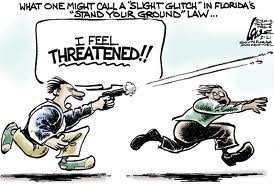
Since George Zimmerman killed Trayvon Martin, a lot of attention has been paid to Florida’s “Stand Your Ground” laws.  People have written about the effect of abundantly available guns on public safety, about the effect of the American Legislative Exchange Council (ALEC) in pushing this law in Florida and several dozen other states, and, of course, the success of the National Rifle association in supporting such laws.  I want to write about what “stand” means.

“Stand” is a good word.  I am sure the person who thought up what to call this law knew that.  Think of “taking a stand.”  (Not “taking the stand;” that’s a different matter entirely).  All the meanings of stand that are paired with “up” are good: stand up for yourself, stand up for America, stand up to bullies.  These are all metaphorical.  Stand up for the national anthem is, again, another thing entirely.

Even “stand your ground” is good when conceived in a moral sense.  Think of Martin Luther’s “Here I stand; I cannot do otherwise.”  Standing your ground often means taking the right stand and refusing to be moved off of it by “the bad guys,” whoever they are.  Standing your ground is absolutely essential in warfare with muskets.  If you don’t stand there in the face of withering musket fire, you’ve already lost the battle.  North Carolina came to be called the Tarheel State because their soldiers stood their ground in battle.  It was, an observer commented, as if they had tar on their heels.

So, apart from the rich history of the phrase, what does “stand your ground” have to do with the killing of Trayvon Martin?  It is time to ask, “‘Stand your ground’ rather than what?”  I think the namers of the law want us to think “rather than retreating like a coward” or rather than “shrinking from the coming conflict.”  In fact, according to an account I heard from Emily Bazelon on the Slate Political Gabfest, the law in Florida before “stand your ground” required that a person retreat from potentially deadly conflict if it were possible.  All courses of action that didn’t lead to conflict and loss of life were to be considered before lethal conflict was legally tolerated.  If you killed someone in such a situation, the question for the court would have been whether you could have done something else under the circumstances.  Now, by contrast, the question is only whether you had reason to feel endangered.  This is an easier case to make, of course, if the person you thought might be a danger to you is already dead.

There are some places where there is no reliable retreat, like your own home for instance.  The presuppositions of the law were all reversed there according to (Emily Bazelon again) “the castle doctrine”—named for the precept that “a man’s home is his castle.”  So the law before “stand your ground” required you to act in a way that would prevent lethal conflict unless you were in our own home. 

The effect of the stand your ground law is that you are always in your own home.  Your “home” is wherever you are: on a crowded main street, in a bar after the home team suffered a humiliating loss, in a part of town controlled by a gang with a very active sense of “our turf.”  Wherever you are in your castle and you are permitted to use lethal force to protect “yourself,” George Zimmerman would say.  But the law means “to protect yourself wherever you are standing.”

Does “standing your ground” require you to allow the other guy to draw first?  Hundreds of westerns to the contrary, no it does not.  To defend the ground you are on, you are allowed to pull your gun and fire if you feel there is an imminent threat.  And more situations are likely to be understood in terms of imminent threat if you have a gun on you. Having the gun steers your perceptions and your immediate rationales in the direction of threat.  Being armed, in other words, makes you more likely to feel threatened and, at best, deterrence, and at worst, killing the other guy first.  So both the way your mind codes the situation and the way having a gun lowers the standard for “threat” moves your hand in the direction of the holster.

Evolution has programmed us instinctually for “fight or flight.”  The Florida state legislature thinks that is one instinct too many.

Posted in Political Psychology, Politics, ways of knowing | Tagged , , , | 4 Comments

Beane Soup 3

I’ve been looking at the movie, Moneyball, as a movie about changing the way you think.  I was first attracted to this notion by looking at the scouts, who were entirely unwilling to change the way they thought about baseball.  Grady, the head scout, concludes his pitch for their approach to drafting and developing new players by saying “…and we’re going to show them how to play Oakland A baseball.”

The conversation really shouldn’t have lasted that long.  Billy Beane, the general manager should have watched the conversation peter out after he asked whether there were any more first basemen like Jason Giambi (No) and whether, if there were, the A’s could afford them (No, again).  There really should have been nothing for the scouts to say after that, but they kept on talking anyway. 

Then I was attracted to the way Peter Brand blinked; he drew back from Billy’s wholehearted embrace of Peter’s theories about baseball.  When Peter describes the misunderstandings that lead general managers to use their personnel badly, he says “Bill James and mathematics cuts through all that.”  That’s Peter’s real position.  The guy who gets on base 20% more than his competition should be playing first base.

But when Peter sees Billy risking his own job to put this theory into practice, he has second thoughts.  If you bet on my theory, says Peter, and “things don’t work out the way we want…”  The way we want?  What happened to “Bill James and mathematics?” He says, hesitantly, that the A’s will win more games with Hatteberg at first base than with Peña there.  Theoretically.  Theoretically?  Theory is all Peter has to go on; theory is why Billy hired him.  Billy puts the question to Peter in the most direct way, “Do you believe in this or not?”  When Peter says he does, Billy puts the rest of the plan into effect.  Peter didn’t change his way of thinking.  He did lapse, momentarily, but Billy brought him back.

So you know who really changed the way he thought about things?  Billy Beane.  It’s the most obvious point in the movie, but I overlooked it for a long time, as we tend to overlook obvious things.  One of the opening scenes shows Billy with team owner, Steve Schott.  Billy is emphasizing how vital “the goal” is and how much he needs more money to achieve it.  With just a little more money, says Billy, “…I will get you that championship team.  This is why I’m here.  This is why you hired me.  And I gotta ask you…what are we doing here, if it’s not to win a championship?”

That’s Billy I.  Here’s Billy II.  He’s talking to Peter just after the A’s broke the American League record for most consecutive games.[1] “This kind of thing (the 20 game win streak), it’s fun for the fans.  It sells tickets and hot dogs.  It doesn’t mean anything.”  Peter interrupts, “Billy, we just won 20 games in a row!”

Billy says, “And what’s the point?  Listen, man, I’ve been in this game a long time.  I’m not in it for a record, I’ll tell you that.  I’m not in it for a ring.”

Hello?  The “ring” is the most demeaning way Billy can think of to refer to what you get when you win the World Series.  This is the “championship team” he referred to when he was talking to the owner.  This is what he meant in talking to manager Art Howe when he said, “If you don’t win the last game of the season, nobody gives a shit.”  This ring symbolizes everything Billy has ever wanted in his years as a general manager.  Until now.

“If we don’t win the last game of the series,” he continues, “they’ll dismiss us.  I know these guys.  I know the way they think and they’ll erase us.  And everything we’ve done here, none of it will matter.  Any other team wins, good for them.  They’re drinking champagne.  They get a ring.  But if we win…with this budget…with this team…we’ll have changed the game.  And that’s what I want.”

The word I have been using in thinking about this movie is the Greek verb metanoein, “to change the way you think.”  I have noted that if metanoia, the fact of having changed, is the goal, the scouts fall short (See Beane Soup 1).  Peter does not fall short, but he does have a moment of failure as a result of his concern for Billy (See Beane Soup 2).  Billy does achieve metanoia—he does fundamentally and permanently changes the way he thinks about baseball and that means he has changed the way he understands what his life is about.

It turns out that Billy is right on both counts.  The scouts do, in fact, try to erase what Billy has done.  We hear them on the radio saying that the failure of the Oakland A’s in the postseason shows that the whole approach was a bad idea. 

But the ultimate confirmation of Billy’s new vision comes when John Henry, the owner of the Boston Red Sox, offers Billy the job of general manager.  Here’s his summary.  After all the on the air yammering by the scouts, the word that jumps out from Henry’s assessment is dinosaur.

“You won the exact same number of games that the Yankees won, but the Yankees spent $1.4 mission per win and you paid $260,000…Anybody who’s not tearing their team down right now and rebuilding it using your model—they’re dinosaurs.  They’ll be sitting on their ass on the sofa in October watching the Boston Red Sox win the World Series.”

How did Billy do that?  It isn’t easy to say, partly because the movie has no interest in the question at all.  The first step is that Steve Schott’s unwillingness to give Billy more money closed off a line of thought that would have allowed Billy to keep on listening to his scouts.  Absent the money, Billy concluded very early that what the scouts were pushing wasn’t going to work.  He didn’t have an alternative, however, until he met Peter Brand in Cleveland and was introduced to Bill James’s mathematical approach to baseball.  Now he has a new approach and his commitment to it is enough for him to tell his scouts, “This is the new approach of the Oakland Athletics.”

But I think Billy really doesn’t commit his career to this new way until he realizes it will require all-out war against the manager and putting his job on the line.  It is at that point that he realizes he is in an all or nothing situation.  “All in, Pete,” he tells Peter Brand, casually, and no one knows just what he means.  It means that he is going to trade every player that Art Howe is playing instead of the players Billy wants him to play.  It means getting up close to the players to explain the new system to them.  According to the movie, getting personally involved with the players is something Billy has never done before.  Billy has put his job on the line, he has made the decisions Peter’s “theory” requires, he has made close personal contact with the players, he has bet everything on the commitment he made when he hired Peter.  He has risked, in the graphic image of the chief scout, finishing his career as a salesman at Dick’s Sporting Goods.

It is what Billy has risked, I think, that brings him to “I’m not in it for a ring” and finally, to “…we’ll have changed the game and that’s what I want.”


[1] The movie shows the streak starting at seven straight.  The streak features fans holding up some really nifty signs.  There’s “Sweet Sixteen” and “Sweeter Seventeen.”  Then, my favorite, “We May Never Lose Again.”

Posted in Movies, ways of knowing | Tagged , , , | 1 Comment

The Good Samaritan

I come from a religious culture in which the value of the questions to be asked is assumed and the Bible is taken to be the source of the answer.  I haven’t lived in that culture for a long time, but, as I discover from time to time, it still lives in me.

I have an example in mind, Jesus’ story about the neighborly foreigner, but I would like to reflect a little, first, on the persistence of my habit of taking my question to the Bible and looking for an answer there.  I really do know better.  To a lot of the questions I have, there is not even a casual sniff of interest in scripture.  The real response of some scriptural texts is, “You really shouldn’t be asking that question.”  I feel a little like a recovering alcoholic.  I do pretty well on my new plan–biblically clean and sober–but then an event happens or I’m hanging out with just those friends who have my old bad habit, and I fall back into it.  Three days later, I wake up with an exegetical hangover that just won’t quit and wonder what happened to me.

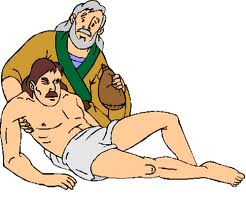
So what about the Good Samaritan?  Everyone who frequents this blog, the ones I know about, is familiar with this story.  If you are not, take a quick look at Luke 10.  A biblical scholar asked Jesus what he should do to inherit eternal life.  He gave a really good answer and Jesus said, “Nice job.  Do that.”  But actually “doing” things at the level of the scholar’s answer is daunting, so the scholar tried to get Jesus to be a little more specific.  This scholar’s habits of mind were, in other words, pretty much like mine except he had Jesus there to consult and I have only the stories.

The question the scholar asked was, “Who is my neighbor?”  Who is the person, in other words, whom I am obligated to love in the same way I love myself?”  Jesus didn’t answer the question at all, possibly because he didn’t like the premise.  In his response, he said, “Let’s don’t talk about neighbors.  Let’s talk about neighborliness.  You know what neighborliness looks like. You chose answer c) from the list I gave you and that was the right answer.  So be neighborly.”

So stop for just a moment and reflect on how hard it is not to formulate in your mind the question, “To whom should I be neighborly?”  How hard is it, in other words, not to persist in asking the question Jesus wouldn’t (won’t) answer?

Actually there is an answer implied in the story.  It just isn’t a very satisfactory answer.  The Samaritan was travelling (v. 33) and he happened upon this victim of roadside violence and he took pity on him.  Right there, face to face with a man who had been brutally treated, he felt compassion and he acted it out.

I really  think that is the answer in the story. Neighbors take pity on the victims they run across and, where it is possible, they act on that feeling.  We don’t know whether the two previous passersby felt pity.  They might have.  If they did, they would have to find some way to quell it or to subordinate it to whatever other duties they were fulfilling.

The clear teaching of this story–not the only teaching–is that acting out the feelings of pity you have is the kind of thing neighbors do and the victim became a “neighbor” when the Samaritan felt the push of compassion.

I feel that way sometimes, too.  I don’t see a lot of physical violence in my life, but I see people who are not accorded the respect they deserve; I see people who are emotionally abused; I see people who are stepped on intellectually by passersby who are quicker afoot and who like to step on people.  I am either going to feel compassion toward these people and act on it or I am going to violate the single clearest feature of the story, which is, “Don’t quell your feelings of compassion.”

I find the implications of that understanding to be daunting, but I do know what they mean.  Now let me ask a few related questions.  Are there certain classes of people who are my “neighbor?”  Are the poor of the third world my neighbors?  Is Mr. Rogers my neighbor?  Are the socially and economically marginal my neighbors?

I don’t have any answers ready to hand.  I listed them only to show how appealing they are and now nicely they flow from the line of thought the scholar wanted to pursue and not at all from the line of thought Jesus substituted for it.  Look at that.  We’re back to the neighbor question again.  We have the question we want to ask and we’re going to keep submitting it until we can find, in this story, an answer.  We are undaunted by Jesus’ refusal to give an answer because we know the question is right and we know it is his job to answer it.

I’ll bet that somewhere in the series of Something Anonymous groups, there are people who could help me.

Posted in Biblical Studies, Theology, ways of knowing | Tagged , | 2 Comments